Finna has been on my radar since it came out back in 2020; it had a funny and clever concept, but it just kept being pushed back on my TBR for whatever reason. I ended up picking it up after hearing praise from one of my creative writing classmates, and although it wasn’t perfect, it delivered on its inventive premise.
Now, tread lightly! This week’s book review contains spoilers for the novella, so if you intend to read Finna, skim at your own risk.
Ava and Jules barely make a living working minimum wage at LitenVarld, a Swedish furniture supply giant. Ever since they broke up, they’ve been trying to avoid each other, and with the labyrinthine structure of the store, it’s easy. But the two are thrown together when an old woman goes missing and the manager tells them that LitenVarld is no ordinary store—it’s prone to opening wormholes that lead to alternate dimensions. Ava and Jules must search across the universes to return the old woman to safety at any cost, but their superiors appear less and less like they have their needs in mind…
TW/CW: blood, violence, grief, mental health themes (anxiety and depression), misgendering
My main concern with Finna was that it would only have the premise to hold it up. It’s a fantastic premise! And although it wasn’t a perfect novella, it went far beyond the expectations for its ideas, delivering an anti-capitalist spin on the monstrous multiverse.
Making Finna a novella was, without a doubt, a wise move. It’s got an inviting premise—a not-IKEA store that’s home to a multitude of portals to strange and hellish dimensions—but it’s one that could have easily been stretched out. It partly works because…well, if you’ve ever been inside IKEA, that’s where your mind naturally goes, but Finna mainly succeeded because Cipri knew the limits of the idea. If it had been a full-length novel, I’m sure it would have been interesting to see the other dimensions hidden within the interdimensional labyrinth of LitenVarld, but the plot couldn’t have sustained itself beyond 100 pages. I’ve seen too many novels where the story has been stretched far too thin, so to have an author know the limits of their story—and have an inventive novella to show for it—was incredibly refreshing.
Finna is the perfect story for right now not just because it has a fun concept, but because it truly nails the kind of corporate neglect that runs rampant in workplaces in this day and age. Even against the threat of a multiverse full of monstrous obstacles (including but not limited to man-eating furniture), Ava and Jules are having to tackle threats leagues beyond their pay grade, and their only compensation is gift cards for a pasta restaurant. Their managers openly tell them that they don’t actually care about the old woman who’s gotten lost in the multiverse—they just want Ava and Jules to find an alternate universe replacement for her so that they can keep up appearances. It’s all so blatantly uncaring and corporate—and it’s all realistic. If some massive chain of stores discovered a wormhole in one of their locations, they would absolutely cover it up until it was no longer possible to do so, especially at the expense of the minimum wage employees. I will say that, although you got hit over the head with this even though the commentary was right there already, Finna’s setup made it perfect for the anticapitalist commentary that Cipri explored—corporations only make it look like they care about you when it looks good for them, and even then, the worker is always dispensable. The execution of this corporate setting was, in the end, what made Finna so successful in that regard—it seems like a real, capitalist response to a fictional problem.
That being said, even though Finna works best as a novella, it did fall victim to some of the pitfalls of novella writing. It’s difficult to develop characters in just over 100 pages, and this worked to the detriment of its protagonists, Ava and Jules. We only knew them from the lens of their situations and their breakup; after finishing the novella, all I knew about Ava was that she a) had a failed relationship with Jules, b) had anxiety and depression, and c) hated her job—nothing much about her personality. This is about as deep as we get with her, and for Jules, we get even less, other than the fact that they’re more reckless and cocky, and for that reason, Ava doesn’t like working with them. The plot was compelling and well-executed enough for me to continue reading the story, but it was so plot and theme-driven that the characters were left in the dust.
Such underdeveloped first drafts of characters meant that the emotional impact of Finna was all but deadened. I got the feeling that I was supposed to feel something when Jules sacrificed themself so that Ava could return to her home dimension, but since I knew so little about them, I never felt much. What Jules needed, perhaps more than a handful of base personality traits, was some kind of motivation; it could also be down to how quickly the second half moves, but their quest through the other dimensions gave us no indication of why they would go from reckless to selfless. It could just be the constraints of the novella format, but I’ve read plenty of novellas longer and shorter than Finna that have been able to establish well-rounded characters with believable motivations, so I’m not sure if there’s much of an excuse for this.
All in all, a novella with a funny, inventive premise and sharp anti-capitalist commentary that was dragged down by its underdeveloped characters. 3.5 stars!
Finna is the first novella in the LitenVerse series, followed by Defekt. Nino Cipri is also the author of the short story collection Homesick: Stories and the forthcoming YA novel Dead Girls Don’t Dream. They have also contributed stories to Nonbinary: Memoirs of Gender and Identity, Transcendent: The Year’s Best Transgender Speculative Fiction, and several other anthologies.
Today’s song:
forgot about this song for ages…
That’s it for this week’s Book Review Tuesday! Have a wonderful rest of your day, and take care of yourselves!
I came into Pompeii with plenty of curiosity, having finally gotten around to listening to Cate Le Bon after hearing her work producing Wilco’s latest album, Cousin, and her vocal feature on St. Vincent’s “All Born Screaming.” Vaguely remembering the buzz and air of weirdness around Pompeii, I decided to listen to it first.
Pompeii and “Dirt on the Bed” have reminded me of why a spectacular album intro can be both a blessing and a curse. If nothing surpasses the first track, then the rest of the album can never recover—or at least reach the heights of the first song. You can enjoy yourself, but never as much as you did after one song. Just one. It’s a horrible dilemma. Pompeii was fantastic from the start, but after the first four songs, nothing’s quite the same—great, but like my experience with R.E.M.’s Green, nothing tops the back-to-back splendor of the first four songs. And that splendor is set in motion by the crawling intro, “Dirt on the Bed.” As the title suggests, it has the dread of something unclean creeping into the house, like a nun on the scent of sin in a shuttered Catholic girl’s school. An off-kilter, stumbling chorus of brass blooms in moldy bursts, an airborne sickness pulsating through each thrum of the bass. Now I know exactly why St. Vincent chose to work with Le Bon—”Dirt on the Bed” is especially evidence of this, but all I could think of during Pompeii is that it felt like St. Vincent had remained lyrically and instrumentally in Actor, but slowly adorned her music with synths. They’re so similar to each other, down to their folkier, precocious indie beginnings that blossomed into full-on devotion to strangeness. This is modern art pop at some of its best, unabashedly weird and precise in every flourish. “Dirt on the Bed” makes even more sense when you see it as a product of a pandemic-produced album; it paces listlessly, putting on a smile as it tries to scrub every trace of illness and dread from a spotless house. Even as calmly as Le Bon sings each lyric, foreboding seeps through every misty horn blast.
That’s how an album intro is done. After several more listens, I’d say that nothing comes quite as close to it, but “Dirt on the Bed,” “Moderation,”“French Boys,” and “Pompeii” is SUCH an undefeated stretch of songs. Pompeii is worth a listen just for that, as is the album’s verySt. Vincent closer, “Wheel.”
…okay, I can’t possibly be normal about this because I cry a little every time I hear it. Either way, there’s an undiluted purity about this song that makes any kind of analysis feel like ten steps in the wrong direction. It’s a paramount example of how easily beauty and simplicity can intertwine, and it cuts more deeply than some songs I know with hundreds of metaphors.
It’s very nearly perfect. Karen O tends to do that.
One of the first times I remember hearing this song was in the car with my dad, as I come across many a good song. Looking back, since I was so young, it must have been a trip back into Sparklehorse’s catalogue shortly after Mark Linkous’ tragic passing. But as we drove home that night, the windows buffeted by snow or sleet, my dad made a wry remark about the lyrics: “he’s not feeling too good, huh?”
With every emotion comes an infinite number of ways to express it, not just confined to song. There’s the kind of songwriting that outright says that you’re sad, while others cloak it in metaphor. Neither is better than the other, but what Mark Linkous did feels like a category all its own, albeit closer to category #2. Many of the lyrics of “It’s A Wonderful Life” (if there was ever a more sarcastic title) are nonsensical, as his lyrics often are (“I wore a rooster’s blood/When it flew like doves”), but nestled between these impenetrable tidbits, the ones that do make sense land like anvils to the gut. I’ve never heard such sadness and shame articulated in the line “I’m the dog that ate your birthday cake.” Dare I say it’s one of my favorite song lyrics ever? It’s up there, just for such an unadorned, bare line to have such an instantly devastating effect; You can picture that dog, not knowing that it’s not supposed to eat human food and not processing that there’s a child sobbing at their ruined birthday, but being able to detect the shame all the same, but never know the reason why. It cowers, but it doesn’t know why it’s feeling this way. Linkous delivers it with all of that shame, clouded in the atmospheric cage of keyboards that prickle with heat lightning.
With that kind of lyricism, it came as a massive shock that this wasn’t one of his classic pieces of melancholy. In fact, Linkous wrote it as a jab at critics who panned an image of overarching depression over his catalogue: “I got fed up with people in America thinking that my music is morose and depressing and all that. That song is like a “fuck you” to journalists, or people who are not smart enough to see what it is.” And…listen, I’m a guilty party. I still think that Sparklehorse is one of the preeminent purveyors of high-quality sad bastard music, and he had enough strife in his life to justify every tear-jerking lyric. Yet this new light makes the lyrics I thought were nonsensical fall into place. Linkous describes the rest of the song as follows: “In the end, it was more about how every day, you should pick up something, no matter how minuscule or microscopic it is, and when you go to bed, you can say I was glad that I was alive to see that. That’s really what it’s about.” Wearing rooster’s blood when it flew like doves becomes a fleeting, once-in-a-lifetime capture of lightning in a bottle, and being the only one who can ride that horse th’yonder suddenly rings out as a humbly sung badge of honor. It was never sarcastic—it’s a wonderful life. I won’t ever be able to hear “I’m the dog that ate your birthday cake” without the sadness it insinuates, so maybe I’m just as much a part of the problem as the journalists he was taking a shot at, but the main takeaway for me is how versatile of a lyricist he is—if you look closely enough, he makes the absurdities of life both tragic and humbly hopeful.
Either way you absorb “It’s A Wonderful Life,” you can’t deny how otherworldly it sounds. Even years after I first heard and subsequently clung to this song, I can only name maybe one other artist who has ever come close to sounding like this—Lisa Germano, who, whether or not the two knew of each other, has a similar modus operandi of making music that sounded like rotting wood and empty doll’s heads. Lyrically and sonically, almost nobody sounds like Sparklehorse, and I suspect it’ll take a miracle for anyone to come close.
It seems I’ve only gotten through one strand in the massive haystack in terms of the INCREDIBLY prolific career of Sparks, which started in 1967 (under several different names) and had its most recent entry last year. Edgar Wright made a documentary about their musical exploits, and the list of artists they’ve influenced seems to span an infinite number of genres, all the way up to Horsegirl in 2023. So, having only heard two of their songs (including this one): hats off to you guys, really! Being that flagrantly weird for almost six decades is nothing short of impressive, and I can’t help but admire their musicianship in that regard.
“Girl from Germany” scratches my eternal itch for early-’70s glam rock, although it’s not all glam—it’s more glam in the sense that Brian Eno was glam at the same time, not quite like Bowie or Bolan were glam. Squeaky-clean, warm guitars as far as the eye can see and a healthy dose of theatricality cloaks this track make for a song that’s deliciously meticulous in every aspect. Russell Mael affects high-pitched vocals that wouldn’t be out of place in The Rocky Horror Picture Show while Ron Mael’s keyboard melodies glitter like light reflected off a glass of wine. And like Brian Eno, they used such a theatrical machine to touch on touchy subjects—in this case, in the climate of the early ’70s, bringing home a German girl to relatives who were mired in the horrors of World War II: “Well, the car I drive is parked outside, it’s German-made/They resent that less than the people who are German-made.” Even if every affectation is theatrical to the core, it’s still a prejudice that resurfaces today—assuming that any given person is an extension of the government and horrors of their homeland, and having to grapple with the cultural fallout of such a simple gesture of love.
Having only heard one song (this one) from Black Foliage: Animation Music, I’ve already logged it into my slipshod mental list of album titles that perfectly describe the music they contain. The Olivia Tremor Control have always been masters of musical density, making soundscapes that unfold like intricate pop-up books, each layer of noise a painted paper cutout in an endless jungle. “Hideaway,” so far, is the pinnacle of that density; with each successive strain of woozy, turn-of-the-century homage to ’60s psychedelia, you’re pulled into a lush forest of plants that unfold just enough to let the tiniest slivers of light through. It’s not just the black foliage that hits the mark so fittingly—the “animation music,” as Will Cullen Hart called it, is “all the stuff floating around…To me, that’s what [animation music] is: sort-of a sound and space, personified—just flying around to greet you in a friendly way.” All at once, the xylophone chimes and trumpet blasts give “Hideaway” the feel of both the colored-pencil animations in Fantastic Planet and the bouncing characters in Schoolhouse Rock!, a papery and breathless expedition into a darkened forest of cartoonish proportions.
It’s been a while since I’ve done any sort of movie or TV review, but this is as good an occasion as any. In 2021, it was announced that Skydance Animation would be adapting Tony DiTerlizzi’s WondLa trilogy; in April, after years of delays, we got our first look. From the get-go, it looked startlingly different from the original novel’s aesthetic language and illustration style. As it turns out, that wasn’t the only change that they made to these books.
After such a disappointing prospect, I vowed to tell myself that WondLa was a piece of media entirely separate from DiTerlizzi’s magical sci-fi world. Now that I’ve watched the show, keeping that mentality was easier than I thought—WondLa barely resembles its source material, but none of the changes made any logical sense. It’s all but left behind what made the original trilogy so memorable, and the result is a Disney mimic with hardly any heart or soul.
Enjoy this TV review!
WONDLA – TV REVIEW
Streaming on: Apple TV+
Release date: June 28, 2024 (all episodes available)
WARNING: This review contains major spoilers for both the TV adaptation and the book series, so tread lightly!
Before I get into my disappointment vomit, I will say that there are a handful of aspects about WondLa that I genuinely enjoyed. The 3D, Disney-style animation isn’t my cup of tea, but it’s objectively goodanimation, and it shows most vibrantly though the backgrounds; although Orbona isn’t as alien as it could have been, the tiny fibers and leaves of each wandering tree and the architectural details of the buildings in Lacus and Solas were rendered beautifully. Joy Ngiaw’s score, although a bit generic in places, had moments of sounding appropriately epic and adventurous—very clearly John Williams-inspired in places. I’ll get to the squishy curse later, but there were a handful of alien species that were translated well from book to screen; Besteel is almost exactly how he looks in the book, and although some of their costumes left…something to be desired, the Arsians (Zin, Loroc, and Darius) were faithfully animated as well. I suppose the latter wasn’t much of a hurdle for Skydance, who seems to favor soft, squishy designs, but given how many other designs they bungled, it’s worth noting. It’s something that clearly took a lot of hard work and dedication to produce, and I’d be at fault if I didn’t acknowledge the labor that went into producing this show. At no point here do I want to disparage the hard work of the animators or the voice cast—this is just the opinion of one person, after all!
Now.
To give you an idea of what my fundamental issue with WondLa is, take a look at this side-by-side comparison of Tony DiTerlizzi’s original artwork with Skydance’s animated adaptation:
I’m still in physical pain when I look at the two next to each other. For the rest of this review, go ahead and call me Kurt Cobain, because hey! Wait! I’ve got a new complaint! Buckle up.
The main issue with Apple TV+’s WondLa is that it fundamentally denies the weirdness of the original books. Not only does everything look smooth, clean, and approachable, it’s Disneyfied in such a way that it loses sight of the core of the story—navigating an alien world, and forming bonds with beings that first frightened you. Even in the supposedly alien Orbona, everything is bright, cheery, and the kind of squishy that’s only useful for marketable plushies; the aliens only look alien insofar as they’re bluish and feathery. Even the Halcyonus couldn’t escape the curse of Disney hyper-masculinity and -femininity, where the women are skinny as rakes and have massive eyes, while the men are built like refrigerators and have tiny eyes. All of the futuristic human elements have lost their retro charm—Sanctuary 573 is now what would happen if you translated white room syndrome into an entire building. (Perfect conditions to raise a child, amirite?) Nowhere does this journey feel strange—you’re just hammered over the head with how Eva is supposed to think that it’s strange, time and time again.
Having The Search for WondLa 3D animated in this style was a fundamental mistake in adapting it. A lot of the more unique elements required a much larger budget to bring to life, and as a result, none of the original designs retain the vibrance that they had in the books. I love that they made Eva Nine mixed-race (WOOOO) and the reasoning behind it is in line with DiTerlizzi’s original vision for the story, but just because she’s a woman of color doesn’t mean that her design has to be sad and boring! Young girls of color deserve role models that haven’t had all of their defining traits stripped away for budget reasons! The budget was why her signature braids were lost, but even then, they could have added the bright colors in her utilitunic. Muthr now looks like a Playmobil figure with exceedingly rudimentary facial expressions (and having her fatal injury be nothing but a massive dent destroyed any of the emotional impact of her death), and Otto…looks nothing like the water bear that he supposedly evolved from. (Why is he furry? Why is his tail so bulbous?? Why is Otto?) Rovender looks…decent, compared to them, but the front-facing predator eyes still ick me out. It’s just not right. My gripes with the Halcyonus have already been stated, the one Mirthian we see looks like a weasel (and not the slightest bit smiley), and Queen Ojo now has gravity-defying lashes, very faint versions of her signature makeup, and a generic, human-looking tiara…for some reason.
Apparently the show experienced budget cuts and changes in leadership during its production, but that’s the only excuse I can think of for how rushed this storyline felt. Even from an objective stance, fitting almost 500 pages’ worth of material into a 7-episode show with less than half an hour’s runtime per episode is just mind-boggling. Predictably, everything gets the juice squeezed out of it as a result, rendering any kind of character development rushed and inorganic. The first episode alone is just an excruciatingly long training montage, complete with the entire theme song for Beeboo and Company—excuse me, Meego and Friends—instead of…y’know, exposition that wasn’t dump-trucked down the viewer’s throat. I can almost give it slack for being a children’s show, but the book never had that problem, despite being for the same target audience. All of the explanations of Eva’s childhood that took up almost an entire episode only took a handful of chapters in The Search for WondLa. The fact that it was geared towards a younger audience makes Eva Nine’s Percy Jackson-style aging up from 12 to 16 even more illogical—if it’s so clearly for children, why make her a teenager?
Which brings me to what I felt was the most offensive aspect of WondLa: the handling of the characters. Such a compressed time frame left zero room for not just character development, but expanding any of the characters beyond a single base trait.
This show turned Eva Nine (Jeanine Mason) into an adorkable Disney princess. Gone is the inquisitive, sensitive 12-year-old she once was, and in her place is the exact same character I’ve seen in at least 10 different Disney movies—clumsy, socially inept (and not even in a way that makes sense for the “raised in a bunker by a robot” plot), and teenage in ways that speak more to stereotypes about teenagers rather than the truths of girlhood that the books touched on. She’s so quirky! Look at her, she can talk to animals, but has no idea how to talk to humans! Teehee! Admittedly, one change that I did genuinely find funny was that one of the first thing she does upon realizing that she can telepathically communicate with animals is get into an animal’s mind to rig this universe’s equivalent of a horse race. That, at least, felt like something the Eva Nine I know would do at age 12.
Rovender Kitt (Gary Anthony Williams), everybody’s favorite blue father figure, got boiled down to a single character trait—and not even one that defines him in the novels. He’s gruff, he’s got a dry sense of humor, and in the beginning, he’s prickly—as you would be, if you were suddenly in charge of a feral twelve-year-old who confidently tells you that she can talk to animals. But WondLa just made him downright mean—again, a consequence of the terrible pacing, but he stays surly and outright hostile to Eva and Muthr for the glut of the series, until we’re lead to believe that absence has made the heart grow fonder, and he automatically does a 180 and becomes a part of their family. Rovender, who becomes a role model to Eva, was all but reduced to someone who would gladly sell her and Muthr off for parts…until he magically isn’t, to advance the plot. Muthr (Teri Hatcher) had a similar treatment; at least the overprotectiveness that they reduced her too wasn’t necessarily a mischaracterization like Rovender, but never once do we see her internal struggles with obeying her programming versus obeying the foreign laws of the natural world—and coming to love them. Another victim of this god-awful pacing…almost all of said scenes where she experiences these changes were cut from the book. However, it is a sweet, full-circle moment that Hatcher gets to voice Muthr here after being the voice of all three audiobooks. She’s got lots of experience with voicing mothers as well, what with being both the real mother and Other Mother in Coraline. (“Don’t you DARE disobey me, Eva Nine!”)
Besteel (Chiké Okonkwo), at least, was faithful in both design and personality; his design looked appropriately menacing, as was his vocal presence. He appropriately felt like a bully, but one with the hunger for power and strength to bring whomever he wanted to their knees. On the other hand, Otto (Brad Garrett)…where do I begin? His design already looks unbelievably cursed (to quote an Instagram commenter, “they done JJ the Jet Plane’d Otto”), but the way they adapted his telepathic communication made me want to throw my laptop across the room. In the novels, Eva Nine only hears his voice in one to two word sentence fragments, like how you’d imagine your pet speaking to you. It’s cute, but never oversaturated with attempts to be cutesy. This version of Otto has been butchered into the corniest, Secret Life of Pets, cutesy mess—he speaks in full sentences now, but they all sound like “sorry, I ate the yummy fish!” or “you better get us out of here before dinner-stick man gets here!” (Also…my guy’s an herbivore, why would he concern himself with yummy fish anyway?)
Such inconsistencies also translated to the side characters as well. Loroc (Navid Negahban) could have been perfect casting—Loroc does eventually look like the alien version of The Devil With the Yellow Eyes from Legion, after all—but the script makes his lines painfully corny and his design equally laughable. Zin (Maz Jobrani) was merged with his sniveling taxidermist, and all of his scientific wisdom and curiosity was flattened into a pushover who just wanted to dissect Eva and be done with it. Queen Ojo (Sarah Hollis) had a character change that was almost understandable; having her bond with Eva and indicate early on the pressure she’s facing as a young royal could have been charming, if not for, again, how corny the script was. Cadmus Pryde (Alan Tudyk) was a notable cameo, but his lines sounded rushed, even when he comes in at the big reveal at the end of the final episode. (Plus…why does he look like the Chris Pine character in Wish?) Again: I’d say none of the voice actors are at fault, but the terrible script most certainly is.
WondLa experienced a multitude of changes to the storyline as well as the designs; sometimes, tweaking the plot or characters in an adaptation can lead to a more meaningful version of the original (see: Fantastic Mr. Fox and How to Train Your Dragon). Tony DiTerlizzi’s apparent willingness for the writers to interpret WondLa as they see fit is almost refreshing—we writers cling tightly to our stories, so I suppose that it’s good for him to be so open-minded about this adaptation, and easier for the show runners to work with. That being said, almost all of the changes I could think of made no sense.
A multitude of characters or topics are renamed (ex. Beeboo and Company to Meego and Friends, Dynastes Corporation to Dynasty Corporation) for reasons that don’t even advance the plot. Darius, who was notably dead in the first book, replaces the role of Arius, only for her to prove a momentary obstacle and not deliver the prophecy to Eva that’s so integral to the plot later on. (I guess that explains the flattening of Zin’s character—if there’s no mark on Eva’s wrist for him to see, then why would he be sympathetic?) Loroc, who does not make an appearance until the second book, has already waltzed into the narrative, albeit in a similar role. And at the end of the show, it’s not Hailey in his battered Bijou who comes to find Eva, but…Cadmus? Why?? But along the way, it seemed like the writers were trying to signal that yes, this is the book you know and love, don’t worry! Here’s a spiderfish! You remember those guys, right? [Points at something that looks like a salamander] What struck me wasn’t necessarily that the plot had changed—that was inevitable—but that none of the changes made any narrative sense—characters and events were just thrown around with no sense of how their roles shape the series. (Also, gotta love the wholly unsubtle shoehorning of references to Skydance’s most recent and very mediocre-looking movie Luck...it felt like a commercial…)
However, I will say, among the many switches and swaps that were made, the role of Caruncle (John Ratzenberger) made sense. His voice (which I recognized without knowing his name…seems like he’s been in every Pixar movie since the dawn of time?) fit with Caruncle’s sleazy character, and although he’s embodying the version of Caruncle that we don’t see until book three, it made sense to have him here to bait Eva. At his core, he’s still slimy, deceptive, and not knowledgeable at all about what he’s selling, so it made sense.
Also, because I couldn’t let this slide: there’s a whole sequence where Eva is being playfully interrogated by two alien children, who ask if she reallyhas ten toes…which results in a sequence where they focus on a teenage girl’s feet for an…uncomfortably long time. Just…why? Was Quentin Tarantino involved in this script? Jesus Christ…
But one change made me realize just how little the writers seemed to understand about the heart of the story, and it sums up how warped of an adaptation WondLa really is. In a climactic moment where Eva finds a replica of her WondLa—a corroded copy of The Wonderful Wizard of Oz—in the ruins of the New York Public Library, she lines it up with an untarnished copy. Here she is, having found her guiding vision of family and wholeness, and this is her response:
“It’s just a book?”
…
Nothing is sacred, is it?
My only comfort comes from my dear friend, who is an avid Percy Jackson fan: someday, a decade or so down the line, maybe we’ll have a more faithful adaptation. One can only hope. You might be asking me, Madeline, why are you so concerned about pacing and writing and all that? It’s a kid’s show! Here’s my answer: just because a piece of media is for a younger audience doesn’t mean that it shouldn’t be high quality and well-written. It can be done, and has been done many times! In book form, that was what The Search for WondLa was! Remember when I mentioned Fantastic Mr. Fox and How to Train Your Dragon! You can drastically change a children’s story and stay true to its message and emotional core! It’s not like these things aren’t possible.
For the fundamental understanding of what made the WondLa trilogy so impactful and unique—and the emotional duress it put me through—1 star.
Today’s song:
That’s it for this TV review! Have a wonderful rest of your day, and take care of yourselves!
The Vela came on my radar again when I dredged my TBR for books to read during this year’s Disability Pride Month. Beyond the disability rep…what could possibly go wrong with Becky Chambers AND Rivers Solomon, right? I’m glad to say I was right—whether it was the work of new-to-me or longtime favorite authors, they all came together in stunning harmony in The Vela, a timely sci-fi epic that’s as observant as it is thrilling.
Asala Sikou can’t afford to care about anybody but herself. Not when her star system is on the verge of collapse, and not when everyone she once knew is long dead. But when she receives a job to track down the Vela, a ship hauling thousands of refugees that mysteriously disappeared, Asala knows that there’s more than meets the eye to the incident. So does Niko, the smart but sheltered child of another planet’s president. The two unlikely companions will have to team up to track down the Vela—and all of its refugees—before they’re embroiled in a galaxy-wide war.
TW/CW: xenophobia, racism, themes of genocide, descriptions of death/corpses
The promise of Becky Chambers and Rivers Solomon in one novel was the main draw of The Vela for me, but by the time I finished the novel, I was fully invested in all four contributors. Their talents came together so seamlessly, making for a novel that wasn’t just coherent, but downright thrilling—The Vela is sure to satisfy whether or not you’re familiar with the authors.
Out of all of the authors who contributed to The Vela, I was the most hesitant about Yoon Ha Lee; the one book I’ve read of his was one that didn’t mesh with my style (but that was also his first attempt at middle grade, so that could have been my issue). I read a sample of Ninefox Gambit ages ago and liked it, but not enough to buy it. Consider me proven wrong about him! As the author who started off the novel, he was the perfect choice. His fast-paced prose made for an opening chapter that integrated the reader swiftly and effortlessly into the world of The Vela. Later on, his battle scenes were some of the highlights of the novel; every chase sequence and dogfight is so meticulous that I questioned whether or not he’d actually been in the thick of an intergalactic war. I’ll be seeking out more of his work after this!
Becky Chambers was, by far, the author I was most excited about seeing in The Vela. I’ve fallen head-over-heels in love with her cozy sci-fi, as many other readers had. What she contributed to The Vela, however, was a sense of complication. Like The Galaxy, and the Ground Within, where she piled a series of unlikely characters together and had them clash in terms of culture, politics, and personality, Chambers excelled at complicating the relationships between each character. Her cozy agenda made me forget how well she writes cold, fascist characters; the way she wrote General Cynwrig sent chills up my spine, conveying the dull distance she has from every other character. Every interaction with her is nothing but war room strategy, and that’s why she and Niko clashed so fundamentally. While toeing over making Cynwrig sympathetic, Chambers gave us a glimpse into her mind without justifying her actions. It’s a difficult dilemma to skirt around, but one that served to develop Niko incredibly; they had a very un-nuanced view of the galaxy, and although their views weren’t changed fundamentally, it allowed them to see different sides without excusing their horrific actions.
Rivers Solomon, the other author I was looking forward to reading in The Vela, gave us the novel’s best glimpse into the mind of the protagonist, Asala. Their prose here, which combines rough-edged anger with exceptional metaphor, fleshed out Asala in ways that the other chapters did not; Solomon had the weight of sculpting all of the events that made Asala as cool and calculated as she was, and by the end, I had a vision of her that was as clear as a map, with every mountain range and river of her life writ out. Her cold disillusionment was palpable, but by the time Asala begins to move more towards purpose and determination, we can see, with incredible clarity, every step that led up to it.
S.L. Huang was the only author featured in The Vela who I was completely unfamiliar with. Now that I’ve finished the novel, I’m keen on checking out her other works, because I can’t think of many other authors who are able to write war so poetically, but never romanticize it at any point. Nothing is ever glorified (as it should be, both in general and considering the themes of The Vela), but there’s something so silk-smooth and beautiful in the way she described battalions of ships on the horizon and the chaos of war as all of the parties scramble for a handhold. For a novel with a prominently anti-war sentiment, Huang’s prose served a valuable purpose—humanizing the consequences of war that many of the characters were unable to grasp, and writing it with such tact and heart that it bordered on poetry.
As a whole…what a timely novel, isn’t it? Surely, we couldn’t learn a thing or two from this world, where star systems and planets are being physically torn apart and destroyed because nobody considered that their enemies are also human…surely that’s not applicable to [checks notes] practically every issue we’re dealing with at the moment, no?
All in all, a seamless and cohesive sci-fi thriller that wonderfully harmonizes the unique talents of the authors that it displays. 4 stars!
The Vela is the first in an anthology series, followed by The Vela: Salvation, which features Nicole Givens Kurtz, Sangu Mandanna, Maura Milan, and Ashley Poston.
Today’s song:
my friend and I were discussing our favorite album intros last night, and they showed me this…they’re right on the money with this one (thanks!!)
That’s it for this week’s Book Review Tuesday! Have a wonderful rest of your day, and take care of yourselves!
I don’t think I’d be alone in saying that we were all feeling apocalyptic in 2020. Fitting that Deerhoof would put out this album in June of that year, a concept album about teenagers making art amidst the collapse of society. Not intentional timing, I’m sure, but maybe too raw all the same. I wonder what it must have been like to listen to Future Teenage Cave Artists during lockdown, but what I can glean is from listening to Horsegirl; on their episode of What’s In My Bag? (worth watching for this and Sparks, The Feelies, and Brian Eno, among others), this was one of the albums that they picked, and drummer Gigi Reece shyly showed off that they’d stitched “Deerhoof” onto the flap of their book bag. So, besides thanking them for their excellent album, Versions of Modern Performance, thank you to Horsegirl for turning me onto this all-consuming song!
The title of Future Teenage Cave Artists reveals exactly what the concept behind the album is: during the collapse of society, cruelty and murder runs amok, but amidst all of this strife, a band of nomadic teenagers hold onto hope and make art. “Future Teenage Cave Artists” is that mission statement made manifest. The whole album was reportedly recorded entirely on laptops and phones (hence the iPhone/tardigrade hybrid on the album cover, drawn by Deerhoof’s vocalist, Satomi Matsuzaki), and I never thought such a simple act could have enhanced the song so much. The shaky, distorted quality of the recording sells the dystopian setting, like we’re not streaming music, but listening to it on some ancient, warped tape recorder leftover from the age of man. It gives it an almost uncanny quality, as though you’re holding onto the last vestiges of this music, and that the battery life on your device is going to run out at any second. It’s so urgent in its hope that I can’t help but play it over and over—amidst this societal collapse, every lyric is a declaration of defiance and purpose: “Gonna paint an animal on a cave wall/Gonna leave it there forever while empires fall.” Concept song or not, I didn’t expect this song to strike such a deeply resonant chord with me; not only does this society feel like it might collapse at any second, but even if it weren’t, we’re surrounded by people who lambast any kind of art as a career—what are you gonna do with that degree? Are youeven going to make any money off of that? And in our capitalist landscape, I do have to get myself some money, but it’s separated the real purpose of art from art, the job—threading a piece of your soul out into the fabric of the world, and making art that reflects your image of the world, making contact with a well deep inside (and outside) of yourself. “Future Teenage Cave Artists” is a defiant ode to the lasting, breathless joy of making art—upfront and urgent, and running on an engine of joy. You can’t get a much better rallying cry than what Matsuzaki fills the jerky outro with: “try my sci-fi!”
Having the pretentious music taste that I do, I remember when Jubilee was everywhere in the summer of 2021. Persimmons, Jeff Tweedy covers, and rave reviews as far as the eye could see. Back then, I had a faint memory of hearing in interview with her on NPR sometime in middle school, but it was ultimately the combination of Jeff Tweedy’s cover of “Kokomo, IN,” my mom’s deep-dive into Michelle Zauner after reading Crying in H-Mart, and a friend’s video of Zauner playing “Paprika” with a massive gong on stage to finally give this storied album a try.
“Paprika” remains my favorite, but “Sit” came out of left field; in all of the shining praises of Jubilee, I never heard anybody talking about it. With its almost shoegazy distortion, humming and throbbing like a swarm of restless cicadas, Zauner’s voice pierces the haze like a lighthouse though the fog. Every lyric is spoken like a final message communicated from an ethereal barrier between dreams, the last words of a stranger your brain fabricated while you were sleeping that will haunt you for weeks afterwards. And like a haunting dream, Zauner sings of the memory of somebody that has clung to her with the strength of burrs, no matter how hard she tries to shake them away: “It’s your name in my mouth I’m repeating/It’s the taste of your tongue I can’t spit out.” They walk through her life with all of the transience of a hologram, a trick of the light that appears in every corner, in unexpected places with unexpected people. And what perfect instrumentals to meld with this; any sense of clarity only comes when Zauner is faced with the reality that she’s “caught up in the idea of you,” but as soon as it dips back into painful reminiscence, she’s consumed by the buzzing distortion, closing her eyes as she’s pulled back into the undertow of memory and fantasy. It’s a track with more weight behind it than most people seem to give it credit for. You can’t lift its impenetrable, stinging fog—the fog is the point.
I’d posit that there’s almost no queer experience that is entirely universal, as the queer community is as multifarious as the identities that it encompasses. But one thing that I think most queer people can relate to is looking back on their life before coming out and thinking how did everybody not know I was gay? How did I not know I was gay? There’s an embarrassing amount for me, including but not limited to lesbian Barbie weddings and a pair of blindingly rainbow running shoes I wore almost daily in 6th grade. But the fact that I had such an extended Erasure phase when I was about 8 or 9…yeah, there’s no heterosexual explanation for that. That CD of Union Street that I briefly kept in my room and played on my Hello Kitty CD player was probably the first to catch on. The gays yearn for the synths.
I have nothing but admiration for Erasure, not just as queer icons, but for being so consistent in their musical exploration. Well…exploration probably isn’t the right word, since they’ve been making variations on the same sound since 1986. But never once has it seemed like they’re doing it out of trying to feel young or reliving fantasies of when they were at the height of their popularity. Andy Bell and Vince Clarke are just artists that were built for the late ’80s—nowhere else could they have flourished so vibrantly. The drama. The synths. The yearning, my god. They’re not just from the ’80s—they are the ’80s. They’ve been acting like it’s the ’80s for every single decade since, never once hopping on trends or changing their sound because they know exactly what they excel at. Listen to any song they’ve put out in the past 10 years, and it’s clear that they’ve still got it. But the cosmic alignment that placed Bell and Clarke in the late ’80s was beyond fate—nowhere else could you have “Sometimes”, with its lovelorn pining…and Andy Bell dancing in the pouring rain with a soaked white t-shirt. Does it get any better than that?
HOT WILCO SUMMER IS HERE!!! Well, it’s been here for about two weeks, but I’m stubbornly committed to these color schemes. But the weather right now is more akin to the Hot Sun, Cool Shroud we’re talking about, so there’s no time like the present. Urgh. I’m not sure much more of this 90 degree heat I can take…
Hot Sun, Cool Shroud – EP proves just how wildly versatile Wilco are. I can’t think of a single band active today that are not only as prolific as they are, but as consistent in quality—and creativity. The prickling apprehension and Nels Cline’s pipe burst of a guitar solo on “Hot Sun” feed straight into “Livid,” a chase sequence-ready metal instrumental that rockets through the air, ricocheting off the walls like a deflating balloon set loose, complete with a barrage of Galaga-like flourishes. “Inside the Bell Bones” has the quiet, uncertain clatter of frigid water dripping from a cave ceiling, and “Ice Cream” and “Say You Love Me” ground the EP to a more emotional conclusion.
But I keep coming back to the chainlink that ties all of these vastly different songs together—”Annihilation.” Next door to “Ice Cream,” it kicks off the second half of Hot Sun, Cool Shroud, returning to a classic kind of Wilco that tugs a particularly tender heartstring. Even if it doesn’t have the sheer gut-punch of “Say You Love Me,” it reminds me of the more grounded moments of The Whole Love. Unlike “Livid”‘s riotous tailspin, this track spirals through the clouds, kept afloat by the wings of love: “A kiss like this/Is endless tonight/This kind of annihilation/Is alright.” Jeff Tweedy’s vocals bring another lyric of his to mind, from 2019’s “Hold Me Anyway”: “light is all I am.” There’s not an oomph behind it, like his voice often has, but this song is so airy and urgent that it can’t be sung any other way. Tweedy described the soundscape of Hot Sun, Cool Shroud as “a summertime-after-dark feeling…All the pieces of summer, including the broody cicadas,” and that makes the lovestruck urgency of “Annihilation” make perfect sense: it’s a secret kiss under the boardwalk as the sun goes down, the lights of the carnival slowly dying as the setting sun sets the sky alight. In that moment, there is nothing but the moment, in all of its humid, breezy warmth.
…AND A BOOK TO GO WITH IT:
The Kindred – Alechia Dow – “We’re boiling angels/Let’s kiss for hours/Equal power/Let’s make it art/This kiss is ours…”
I’d all but forgotten about “Old Lady City” since I first listened to Deadstock:A Shakey Graves Day Anthology, and it seems that…judging from the lack of lyrics anywhere (which on the internet, the manifestation of too many people with too much time on their hands, is a rarity), so did everyone else. Tough crowd. But it’s so unlike any other Shakey Graves that I’ve heard, not even on Movie of the Week. Shakey Graves has never been afraid of being spooky, but this is a kind of off-kilter eery that he didn’t stray towards until now, or however long ago this was originally recorded. Maybe it was too risky to put it on an album for this reason, but this grittier, spookier side is one that I thoroughly enjoy. With vocals by Buffalo Hunt (Alejandro Rose-Garcia’s wife), “Old Lady City” is a scorched, rickety ball of spikes, no edges sanded down. In between twisted strains of nursery rhymes, purposeful breathing, and Buffalo Hunt’s cartoon witch-like cackle, the lo-fi recording makes for a crunching, off-kilter interlude. Rose-Garcia’s vocals are almost nowhere to be seen, but they float in ghostly tendrils in between the splinters, burnt paper, and charcoal of this B-Side.
…AND A BOOK TO GO WITH IT:
The Library at Mount Char – Scott Hawkins – a raw and rickety story that’s more than its appearances let on, just like its protagonist. (Doesn’t hurt that the book cover matches the feel of the song too.)
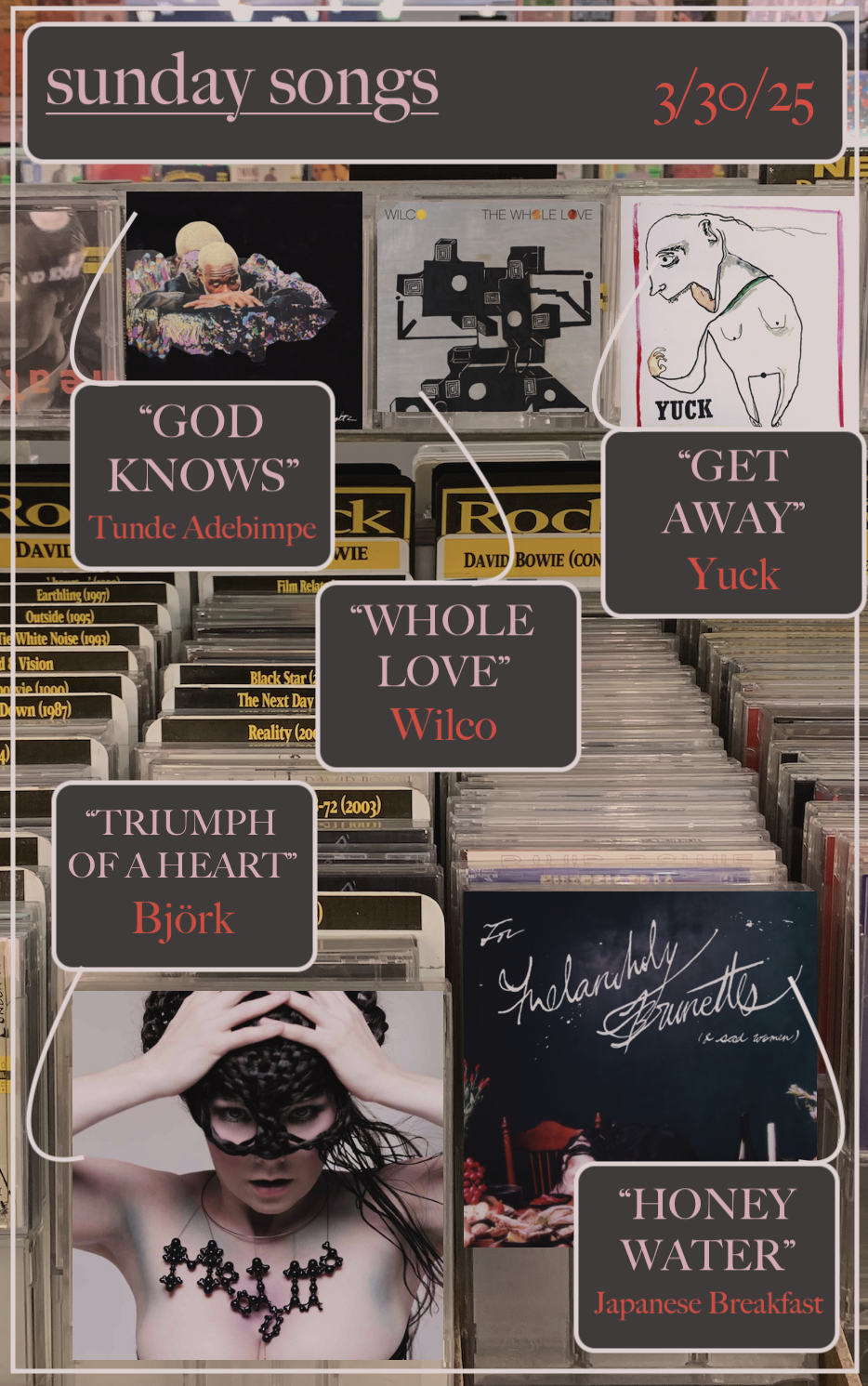
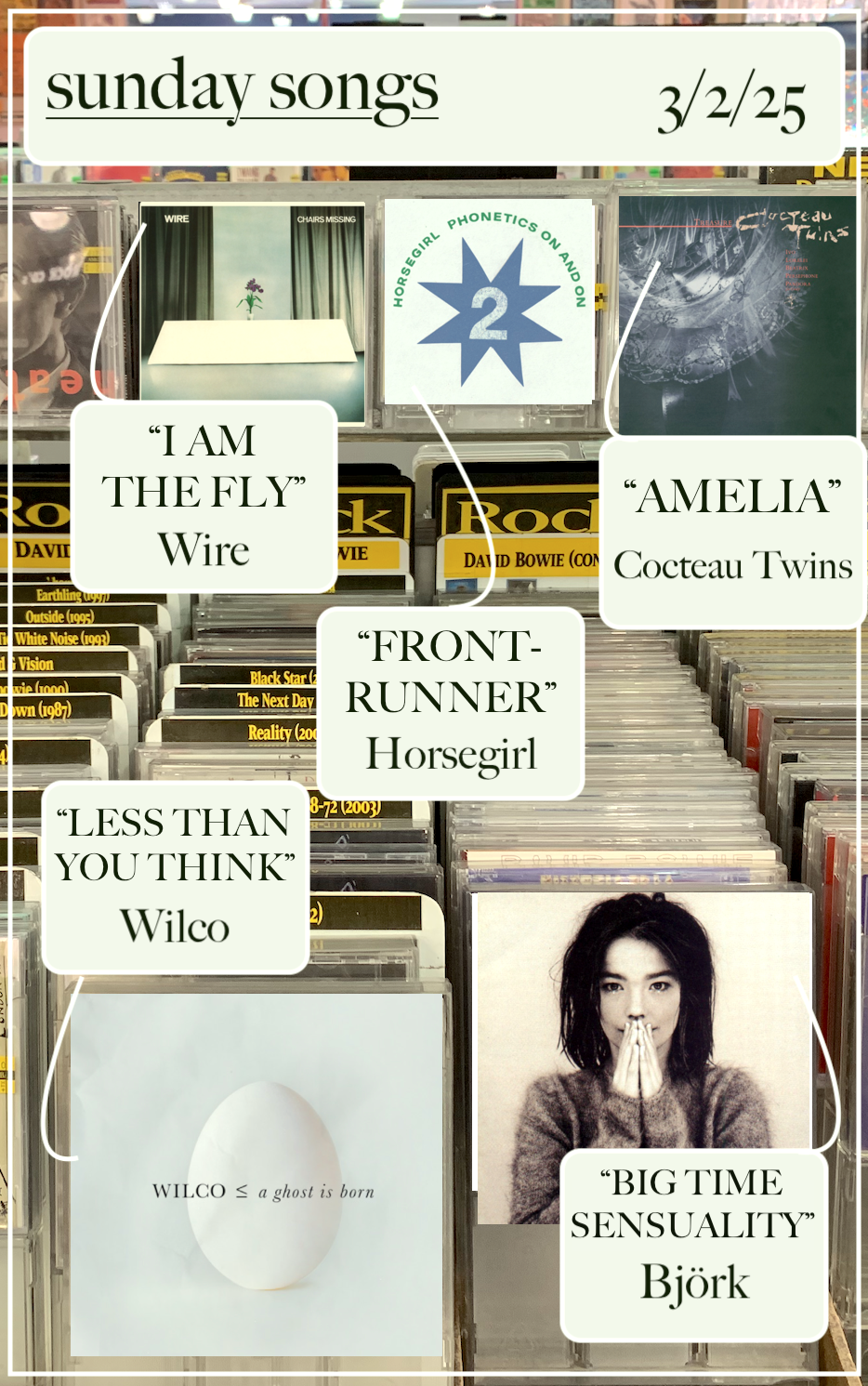
Since this post consists entirely of songs, consider all of them to be today’s song.
That’s it for this week’s Sunday Songs! Have a wonderful rest of your day, and take care of yourselves!
I’m always on the hunt for books with disability and bisexual rep, and I’ll always go for a graphic novel, so Stars in Their Eyes was a natural pick for me! With a charming story and graceful handling of social issues, this graphic novel was an adorable, light read that’s perfect for readers in transition between middle grade and YA.
Maisie has saved up to go to her first FanCon, and now she’s finally on her way! She’s excited to meet her idol Kara Bufano, an action star who’s an amputee just like her. On arrival, FanCon isn’t everything that Maisie thought it would be—it’s loud, confusing, and it’s making her chronic pain act up. But when she meets Ollie, one of the young FanCon volunteers, it’s love at first sight. Maisie feels comfortable talking about her disability and queerness with them, but how will they manage when FanCon is over and they have to go home?
TW/CW: panic attacks, descriptions of cancer (past)
I’m firm in the belief that there should be some kind of smaller, transitory genre between middle grade and YA; the gulf between kid’s books and books meant for teens, especially in terms of maturity, is larger than most realize. But Stars in Their Eyes hits the perfect sweet spot between the two. With younger protagonists but a more nuanced view of social issues—and love at first sight—this graphic novel is a light, comforting read!
Even though I can’t speak to the accuracy of the specific disability rep (Maisie has a lower-leg amputation as a result of childhood cancer), it was so refreshing to see a disabled character written by a disabled author! It’s kind of painful to say that, but…the bar is so low, after so many middle grade and YA books that misrepresent disability. Nevertheless, the discussions surrounding Maisie’s disability were not only important to represent, but well-executed as well! There were plenty of natural segues that were used in Walton’s writing to get into topics such as overexertion and the importance of positive representation (!!!!), and it’s wonderful to see a pointed criticism of the narrative that disabled people exist to inspire non-disabled people. Stars in Their Eyes is bound to be so meaningful to so many young disabled readers, and it warmed my heart.
Stars in Their Eyes is also bound to be crucial for young queer people as well! Maisie is bisexual. and Ollie, the love interest, is nonbinary, but beyond that, there was an emphasis on being young and discovering your identity that I’m so glad is being represented. At 14, Maisie has only come out to a handful of people, and is nervous about being in queer spaces and going to queer events; it’s an issue that I rarely see in queer media, but it’s so important for young queer people know that it’s okay to be nervous about these things! There’s a first time for everything and everyone, and it’s natural to be shy or scared about showcasing your identity or belonging in queer spaces for the first time.
The comic con setting of Stars in Their Eyes was spot-on! I went to comic cons frequently when I was Maisie and Ollie’s age, and it’s a wondrous, nerdy experience—and it’s also an overwhelming one. It’s been several years since I’ve been to one, but I’m glad that this fictional one had a quiet-down room—I hope that soon becomes part of the institution, because what a lot of people don’t talk about with comic cons is that they’re a lot. (Man, I wish my comic con had one of those back in the day…) There’s so much to take in, from all of the booths and celebrities and cosplayers (and all of them crowded in one building), but all of that amounts to a ton of crowds and sensory overload. It’s the first comic con story I’ve seen tackle this aspect, and it’s a refreshing angle to see discussed. I have sensory issues, so that’s mainly why I got overwhelmed so easily at comic con, but it’s great to show younger readers that even though comic con is a wonderful place, it’s natural to be overwhelmed, sensory issues or not.
However, even though pop culture and comic cons were the focus of Stars in Their Eyes, a key part of it was mishandled and hindered some of my enjoyment of this graphic novel. Aside from two fictional TV shows that Maisie and Ollie bond over, almost everything is a fake reference—Barb from Stranger Things is now Bard from Danger Things, Star Wars is now Sci-fi Wars (??) and the Dark Side is the Far Side (????), and any Doctor Who-related media is referred to as “Time Doctors.” I get making faux-pop culture references to dodge copyright or establish a fictional world, but the sheer amount of them and how obviously they were referencing other very popular pieces of media just got so tiring and eye roll-inducing after a while. If it’s that obvious that you’re referencing a piece of media, it defeats the purpose of having a fake piece of media. It got so concentrated that I ended up bumping my rating down from the full 4 stars.
All in all, a lighthearted graphic novel about first love, geekdom, and the being confident in your queer and disabled identities. 3.75 stars, rounded up to 4!
Stars in Their Eyes is a standalone; Jessica Walton is also the author of Introducing Teddy, and has also contributed to the anthologies Growing Up Disabled in Australia, The (Other) F Word: A Celebration of the Fat & Fierce, and Meet Me at the Intersection.
Today’s song:
decided to give cate le bon a try after hearing her work with wilco & st. vincent…pompeii did NOT disappoint!!
That’s it for this week’s Book Review Tuesday! Have a wonderful rest of your day, and take care of yourselves!
Here in the U.S., July is Disability Pride Month! In the three years that I’ve been making these lists, disability is still forgotten even in many intersectional feminist circles, and the importance for uplifting the disabled community has never been more important than know, what with the fallout of the COVID-19 pandemic, where disabled people, especially those who are immunocompromised, were disproportionately affected. Every year, even though I look in as many places as I can, it’s difficult for me to find books with disabled stories at the forefront that don’t center suffering or being “inspiring.” (As of now, I have only ever read one book with my disability, SPD, and heard of only one other. Inspiration for me to write my own stories…) So with these lists, I hope to provide disabled books with a wide range of representation, both in terms of disability and in the intersection of race, gender, and sexuality.
NOTE: my memory (and the internet) is imperfect, so if I’ve misrepresented/mislabeled any of the specific rep in these books, don’t hesitate to let me know!
TELL ME WHAT YOU THINK! Have you read any of these books, and if so, did you enjoy them? What are some of your favorite books with disabled rep? Let me know in the comments!
Today’s song:
this song makes me SO so incredibly happy!! thank you to Horsegirl for recommending it!!
That’s it for this month’s recommendations! Have a wonderful rest of your day, and take care of yourselves!
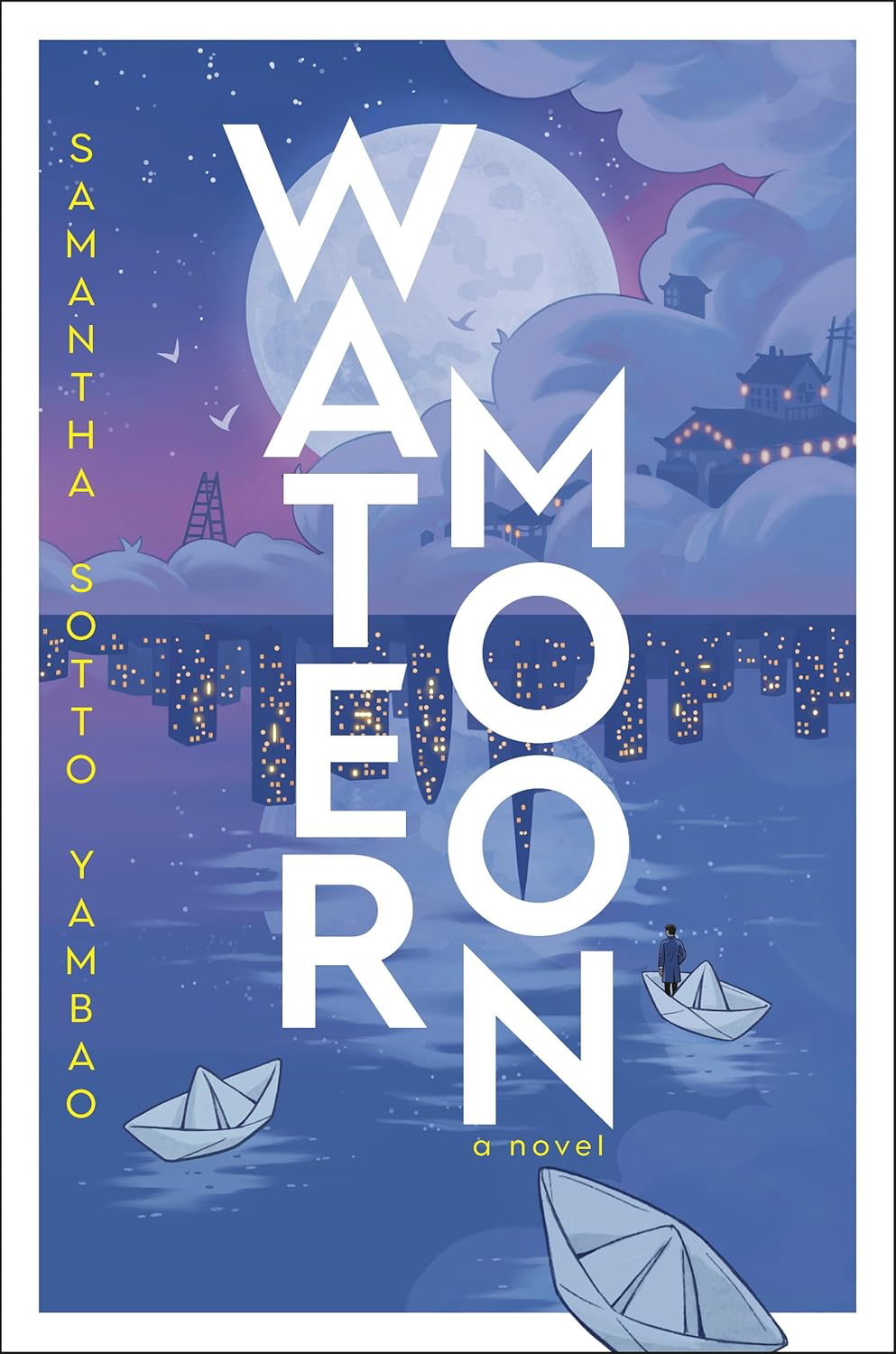
Happy Sunday, bibliophiles! I hope this week has treated you well.
This week: it’ll be two years of making these Sunday Songs graphics in a few days (!!), but I haven’t had many purple color schemes in all that time…enjoy the purple while it lasts. Also, I talk about movies that I haven’t seen and albums that I haven’t quite seen.
Here I am, an absolute poser, posting this without having seen I Saw the TV Glow. I’m a simple woman. I saw Phoebe Bridgers and Jay Som on the soundtrack and immediately downloaded both songs without knowing any of the context apart from Lindsey Jordan being in her first acting role (I’m lovingly suspicious of her acting abilities, but that shot of her with an axe in the trailer is top-tier), and that “Claw Machine” plays in the opening.
The opening? Is Jane Schoenbrun trying to eviscerate us before the movie even begins? For everyone who’s soldiering through the boygenius hiatus: fear not! Phoebe Bridgers, along with Haley Dahl (aka Sloppy Jane, who Bridgers formerly played bass for) have come to emotionally derail your summer. “I think I was born bored/I think I was born blue/I think I was born wanting more/I think I was born already missing you.” Oh! Good to know that I won’t survive 10 minutes of this movie if I eventually watch it! Yippee!
…AND A BOOK TO GO WITH IT:
Freshwater – Akwaeke Emezi – “Your heart is like a claw machine/Its only function is to reach/It can’t hold onto anything…”
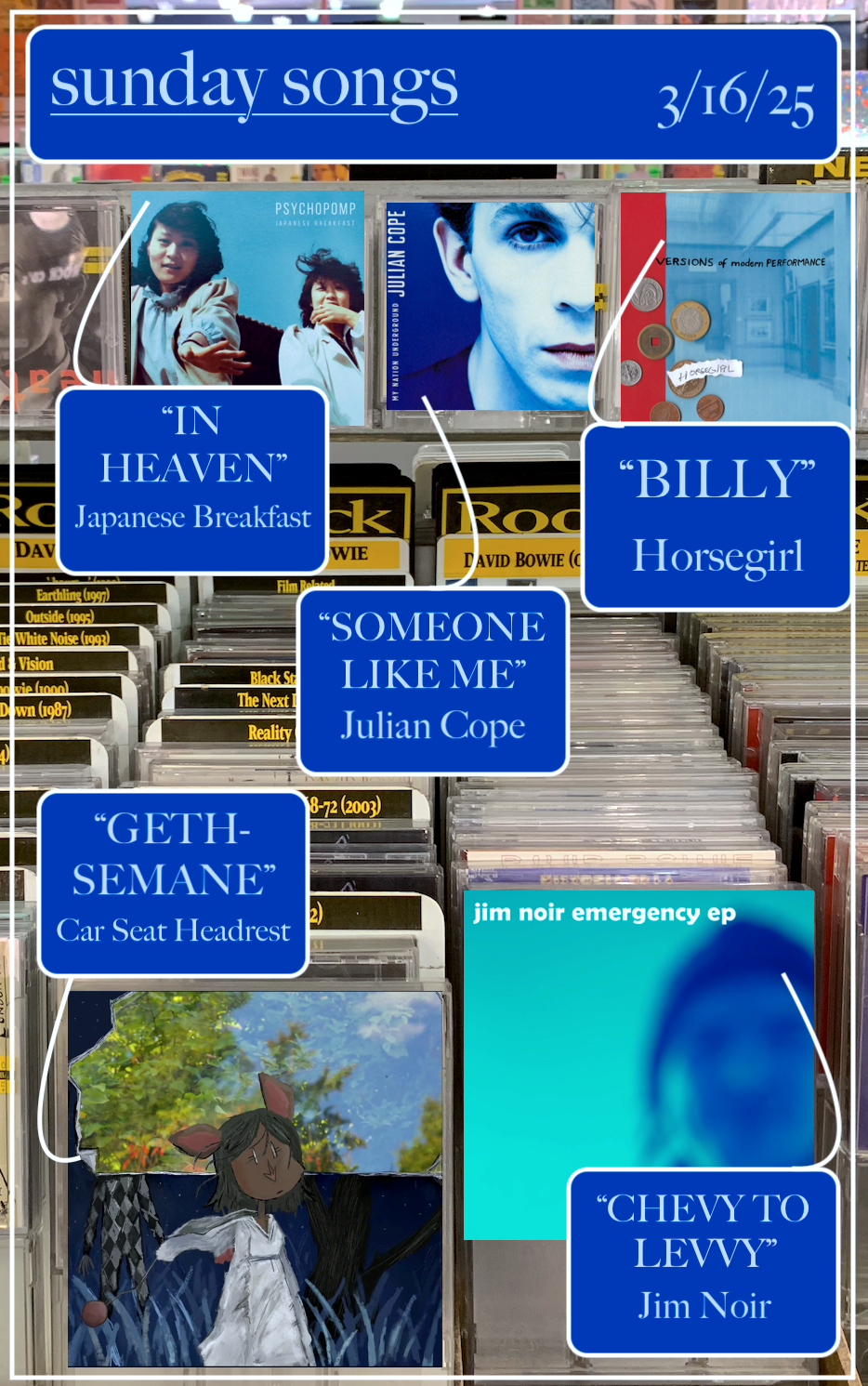
It takes a certain kind of person to have the guts to name their album Saint Julian, but thankfully, it’s not entirely Julian Cope’s fault. Before this album’s release, his record label was intent on Cleaning Up His Act™️ and making him into their idea of a rockstar, thus: the leather, the haircut, and constantly looking like there should be a vine boom whenever the camera lands on his face. It was the ’80s. Comfortingly, the song “Saint Julian” is about his frustrations with god, but to be fair, anybody who can cover Roky Erikson’s “I Have Always Been Here Before” so heartwrenchingly deserves the saint title.
The ’80s never gave Cope the praise he deserved, save for some alternative hits. Crazy, given the fact that after Saint Julian came around, he’d basically become the unacknowledged father of Britpop. Everybody mentions The Kinks (obviously) and The Smiths as some of the progenitors of the genre, but where’s the love for Julian, who basically molded Parklife’s guitar-heavy confidence seven years prior with “Shot Down”? The clean, punchy guitars? The tongue-in-cheek lyricism? Even the look, even if it was more on the part of the record label than Cope himself—there’s no denying Damon Albarn and Jarvis Cocker took plentiful notes, chiseled cheekbones and all. Regardless of whether people will remember that, at least they’ll remember that he could pen a perfect pop song. Oiled and sleek as a new car, it oozes confidence more than Cope’s fabricated persona ever could. He didn’t need to get his hair did to have the gravitas to belt “World, shut your mouth/Shut your mouth/Put your head back in the clouds and shut your mouth,” just like the song’s unnamed protagonist who “[flies] in the face of fashion.” Complete with a mic stand that Cope could climb up and spin around on, it’s the side of the ’80s that I wish lingered—the slickness combined with clever turns of phrase thanks to the likes of Cope. Even if Cope resented the attempts to make him into a pop star (understandably so), there’s no denying that, at the height of his powers, he could write a perfect pop song. Good for him, though. Presently, he’s out living his best life and writing about Stonehenge and rock history. Go off, king.
I suppose all this means is that I selfishly get to gatekeep Julian Cope while cursed with the knowledge that he may get the praise that he deserves. I’ll Cope. I’ll Julian Cope—[gets dragged off stage by a comically large cane]
…AND A BOOK TO GO WITH IT:
Cloud Parliament – Olivia A. Cole – Bold confidence abound—the kind strong enough to avenge the dead and bring entire industries to their knees.
The newest single, however? A joyous summer bop, to say the least! For Waterhouse, this has a slight rock edge, but undeniably remains the indie pop that she’s begun to polish. Strung together with “My Fun,” it’s clear that Memoirs of a Sparklemuffin centers rediscovering joy and healing at the forefront; “Supersad” is an anthem to hauling yourself out of bed, letting go of what you can’t control, and embracing fun in all of its forms: “Could be the worst time I ever had/Lose my mind, always get it back/There’s no point in being supersad.” Stagnation and sadness aren’t just detrimental to your health—at the end of the day, it always feels so boring to me, even if, in the moment, I can’t do anything to do it. And there’s a multitude of things that are way out of your control! No matter how long it takes to get yourself out of the funk, it’s temporary—and there’s no point in being supersad. Life is short.
My mom and I are very similar people in a number of ways, but one of the ways that we hadn’t acknowledged until now is that we’ll see a song with Santigold on it and immediately hit download. It’s Santigold!! Who wouldn’t?
Named “Santidalang” in acknowledgment of the aforementioned legend, this track is a slight reworking of Master Peace (ba-dum tssssss)’s “Shangaladang” from his debut album, How to Make a Master Peace (ba-dum tsssssssssss). For someone who frequently cites LCD Soundsystem as one of his primary influences, what I’ve heard of his music is far from the uptight rhythms that I associate with James Murphy. What he’s taken from him, along with several other indie and dance acts from the 2000’s, is a neat rhythm—it’s a box, when you look at it from afar, but one that’s large enough to allow Master Peace a spacious environment to dance. Even amidst the pressing issues of the lyrics, “Santidalang” never stops being carefree; the opening is delivered with a defiant “ha-ha,” and lines like “The police wanna arrest me and my mates/I’m just wanna get myself some good grades/My mom told that she’s gonna send me away” with the goofy ring of a flexatone in the background and a smile that you can hear through the music. Like Santigold, it’s a grinning middle finger to those who would put him in a box and an assertion of joy in spite of it all. That’s why it’s so perfect that Santigold is featured on this finger after championing a similar mentality of joy and self-love in spite of societal expectations. Santigold bursts into an already vibrant track with her signature confidence, immediately claiming the space as hers. Like Master Peace, her smile and persistence cuts through the track like rays of sunshine: “Try to hold me down/I fight the power with my fist up.”
It’s easy to imagine that both Master Peace and Santigold had an absolute blast recording “Santidalang,” but it seems this picture only confirms it:
Once I hit a valley in my Sisyphean Album Bucket List, I’m due for revisiting Fossora. When it was released almost two years ago, I liked it, but I felt like I didn’t fully get it. Björk is about as out there as out there can get, but even for me, it felt impenetrably so, like she’d ascended to a higher plane of being that us mere mortals couldn’t dream of reaching. Is that still true? It’s Björk, of course it is. But the more I listen, the more the ice melts—it’s not that I never liked Fossora, but for me, its merits become more evident the more time you spend with it. A way-homer, if you will.
I’d forgotten all about “Freefall” in the dust, and in retrospect, the fact that I listened to Fossora while I was figuring out how college works didn’t do wonders for remembering this album—or interpreting it. In Björk’s quest to become the all-knowing fungus queen, she remains as attuned to the surreal thrill of love as she was on Vespertine. Even in the wake of the tumultuous divorce with Matthew Barney (cheating is reprehensible on its own, but IMAGINE CHEATING ON BJÖRK, MY GOD), she has still found time to reminisce about the coalescence that the best relationships produce: “I let myself freefall into your arms/Into the shape of the love we created/Our emotional hammock/Safe inside the fabric of our love-woven membrane.” Of course she refers to it as a membrane, but it’s one of my favorite lyrics; saying that she’s attuned to nature and her body is an understatement—even in such a yearning song, she feels more whole than ever. Love as a fleshy, beating membrane, something to curl up inside like a vital organ (or a cocoon, even), evokes what most songs could not touch with multiple verses. Even if Björk drinking the water of life and willingly being consumed by the fungus has made her music more esoteric than it already was, what strikes me about “Freefall” is that she has such a human understanding of love; not necessarily in the sense of the soul, but in the sense of the sensation of warmth and the bodily joy of watching your heart tie itself to another and merge.
This is going to be different from my normal Book Review Tuesdays, as I’m reviewing an entire trilogy. Normally, that would be a tall order for a single post, but this trilogy is different. It’s a series that I read so often in middle school that even the teachers started to recognize the cover when I brought it in. It’s a series that has woven itself into the fabric of my life, just as Arius’ metaphor of time as a braided rope. It’s a series that inspired me to pursue writing—specifically writing science fiction.
In light of the new (and deeply disappointing) Apple TV+ series, I decided to re-read the series for the first time in six and a half years. Some novels you loved when you were younger don’t age well, but after I devoured all three books in the span of a day each, I can say that Tony DiTerlizzi’s WondLa trilogy has stood the test of time.
When a marauder destroys the underground sanctuary that Eva Nine was raised in by the robot Muthr, the twelve-year-old girl is forced to flee aboveground. Eva Nine is searching for anyone else like her: She knows that other humans exist because of an item she treasures—a scrap of cardboard on which is depicted a young girl, an adult, and a robot, with the strange word, “WondLa.”
☆
There definitely wasn’t an ulterior motive to me re-reading this series…totally not just to replace my reviews on Goodreads from 2016 (“OMG BEST BOOK EVER SQUEEEEEEEEEEEE but BIG FEELS”). Yeah.
The Search for WondLa is the reason why I decided that I wanted to write science fiction. It introduced me to a vast world of sci-fi literature that would become my favorite genre. It showed me a rich world full of bizarre, wonderful creatures and told me that I, too, had the power to foster such weirdness in my heart and bring it into the world. When I say that I don’t know where I would be without the WondLa trilogy, I’m not exaggerating in the slightest. Tony DiTerlizzi truly has, like Arius, given gifts to the world in the form of these novels.
The Search for WondLa coexists as a startlingly original piece of worldbuilding while also paying homage to a number of novels and stories—The Wonderful Wizard of Oz, of course, but also the older sci-fi that has inspired DiTerlizzi throughout his career, from Dune to Star Wars and others. There’s Jim Henson lurking in his fanciful creatures, Hiyao Miyazaki in his alien landscapes, and Ray Bradbury in his matter-of-fact, bombastic dialogue. On the subject of both Miyazaki and dialogue, what always cracks me up about this series (affectionately) is the various names DiTerlizzi gives to his characters and places. When I watched Nausicaä of the Valley of the Wind for the first time, my brother and I agreed that the long chunks of expository dialogue were all part of the hokey charm of the movie—it’s distinctly old sci-fi, and it’s so silly that it becomes charming. The same can be said for DiTerlizzi’s naming process…which is so unsubtle that it’s hilarious. Besteel? Surely he’s not a beast-like, predatory character. A fishing village by a lake? Can’t be anything but Lacus, right? Cæruleans? You’re not gonna believe what color these aliens are…but it’s WondLa’s charm. Intentional or not, these names might be one of the most faithful homages to the sci-fi genre.
Even if The Search for WondLa was the only book in the series, some of the character arcs are so expertly resolved within the span of a single book that it would be a satisfying standalone. Muthr’s may be the most clear-cut, but it’s nonetheless deeply impactful; her journey of battling with her own programming and beliefs and embracing the perilous, unknowable beauty of the natural world forms a key piece of the novel’s emotional anchor. She’s clearly the Tin Man, and although she can never fully adapt, by the end of her story, she has most definitely grown a heart. I think Rovender Kitt is the reason why I love the trope of gruff, older characters who reluctantly end up taking children under their wing on a fantastical journey. His development oscillates between heartbreaking and heartwarming in equal measure; Eva helped him remember to have empathy, and he, in turn, became the father figure that she never had. He never stops being gruff and sarcastic, but he rediscovers his caring core. The last few chapters of the novel are brutal for clear reasons, but Rovender’s breakdown, wracked with grief and survivor’s guilt, guts me every time. It’s a drastic shift from the Rovender we see at the beginning of the novel, but almost 500 pages is enough time for him to become the series’ epicenter of guidance and wisdom.
Part of my motivation to re-read the series was because of the Apple TV+ series (spoiler alert: it’s awful. They turned Eva into an adorkable Disney princess. Skip it.), but watching and reading them closely together made me realize what the show fundamentally gets wrong about the series: it’s weird, and it’s unafraid of being weird. All of the aliens have unique, truly otherworldly designs, with no punches held just because the target audience skews younger. Eva Nine is so far from perfect, even by the standards of young girls: her hair’s a mess, she doesn’t have a clue about surviving in the outside world, and yet confidently asserts that she can talk to animals, something that most would have left behind by the time they turn 12. But it’s all true! She’s unafraid of being weird, but that’s where her loneliness arises: she’s not just looking for humans, she’s looking for someone who understands the circumstances that molded her into the confidently strange person that she is…
Somebody hold me. No wonder I read this book to death when I was 12…
For its undeniable role in shaping the course of my life, 5 stars.
Before the end of The Search for WondLa , Eva Nine had never seen another human, but after a human boy named Hailey rescues her along with her companions, she couldn’t be happier. Eva thinks she has everything she’s ever dreamed of, especially when Hailey brings her and her friends to the colony of New Attica, where humans of all shapes and sizes live in apparent peace and harmony.
But all is not idyllic in New Attica, and Eva Nine soon realizes that something sinister is going on—and if she doesn’t stop it, it could mean the end of everything and everyone on planet Orbona.
☆
A Hero for WondLa is a truly worthy predecessor to book 1 for so many reasons, but what struck me the most upon re-reading it is how painfully accurate—and beautiful—Tony DiTerlizzi’s depiction of weird middle school girlhood is. I had to stop and remember that yes, this is a middle-aged man writing this, and yes, he has a daughter, but she was still a toddler when he wrote this…and yet he nails it. Right down to the smallest details.
A Hero for WondLa follows Eva Nine’s journey after she’s discovered that she’s not the only human. She visits New Attica, the pristine, final stronghold of the human race, where technology rules all. Eva’s first instinct is to fit in; she’s taken under the wing of Gen Pryde and her Mean Girls 2049 posse of identical, plastic friends, who are intent on making her fit in—they giggle at her sanctuary-born eccentricities, and she’s only praised when they mold her to look just like them. Even after that, they’re laughing behind their hands. She flees their false promise of friendship and into the arms of Eva Eight, her long-lost sister who has waited 100 years for her arrival. Eight hates New Attica and all of its lies, and promises Eva that she’s just like her. And yet, despite this insistence, Eva fails to find solace in her, either. It’s only when she becomes one with the Spirit of the Forest that she becomes her truest self—putting that which gives her power front and center. Like The Wizard of Oz, the (emerald) city she has spent her whole journey looking for is nothing but a sham, and in the end, there’s no place like “home”—the person that she is most comfortable being.
Oh, god. I need a minute. Ow. No other book I can think of captures the limbo of being 13 and not knowing who your real friends were lodged so deeply into my heart. Eva, like me, was so desperate for friendship and human connection that both attempts ended in complications, but through it all, everything came back to the found family she has built—the outcasts, the prisoners, the exiled. The ones who had her back. The ones who were just as confused as she was, but joined her journey after realizing the error in their ways.
The aesthetic language of A Hero for WondLa is drastically different than book one, with its pristine, plastic city of humans living in a bubble. Even the clean walls of Sanctuary 573 had a retro feel to them—likely centuries outdated from New Attica’s tech—but all of this is so blindingly new. None of the robots and automatons have the same old-fashioned friendliness as Muthr, trading approachability for sleekness and monstrous amounts of wires and tentacles. But along with it is a sinister aspect that DiTerlizzi doesn’t shy away from; I’d forgotten that, although the discussion is brief, that it’s implies that among all of the mind-control and executions that Cadmus Pryde is carrying out eugenics is casually a part of his long list of crimes against the last of humanity. The WondLa trilogy isn’t one to shy away from darkness (part of why it’s stood the test of time for me), but that aspect stood out, especially since this is science fiction we’re talking about, a genre that has a long history of portraying the eradication of disabilities as a sign of progress. I’d remembered that there are a handful of disabled characters, but having that as a clear signifier of evil in a middle-grade novel is something I can’t praise enough.
The Search for WondLa is a very self-contained story; although book sequels surpass it, in my opinion, the conclusion that it ended on (minus the epilogue) was hopeful and wrapped-up enough that it could have been a reasonable end to Eva Nine and Rovender’s journey. But this novel does such an excellent job of intensifying the stakes in so many ways. As Eva learns of a conflict that could soon entrench the whole planet in war, we get so many of the real time costs. Foreshadowed details, hinted at from the start of the series, metamorphose into sinister threats. Interpersonal relationships become tangled in this vast, interspecies conflict—nobody knows the truth. Side characters (although all but one do end up surviving in the end) often die mere chapters after they’re introduced. It’s a very tense book in and of itself, but as the setup to the massive conflict in the final book, it’s a masterclass in building up both physical and emotional stakes.
And…good god, all of Rovender’s emotional moments always kill me the most. Without going too in-depth, the scene of his complicated reunion with Antiquus destroyed me when I was younger, and it might have destroyed me even more…
It reminds me of another song that similarly destroys me:
“There will come a day/When the Earth will cease to spin/You’ll hold me close and say: ‘my God, where have you been?'” (Shakey Graves, “Chinatown”)
For the deeply emotional journey, then and now, 5 stars.
All hope for a peaceful coexistence between humankind and aliens seems lost in the third installment of the WondLa trilogy. Eva Nine has gone into hiding for fear of luring the wicked Loroc to her companions. However, news of the city Solas being captured by the human leader, Cadmus Pryde, forces Eva into action once again. With help from an unlikely ally, Eva tries to thwart Loroc’s ultimate plan for both mankind and the alien life on Orbona.
☆
The Battle for WondLa was my favorite book of the trilogy when I first read it, and I find myself agreeing with the sentiment almost a decade later. Was this influenced by the fact that, in retrospect, the original book cover almost certainly contributed to my bisexual awakening at age 12? Maaaaaaybe. In all seriousness, it’s such a brutal, beautiful, and downright exhilarating conclusion to a series like no other.
This incarnation of Eva Nine, as matured as we see her in the trilogy, has always been my favorite. After she embraces her powers and connection to the natural world, she’s such a fascinating hero to follow, partly because she never fully gives up her younger traits. In fact, her powers lie in what made her a target in the first novel—her sensitivity and empathy. Now that she can communicate with all of the creatures of Orbona, she uses her sensitivity to find it within herself to accept the machinations of the natural world and show mercy for even the most frightening of beasts. Sensitivity is her superpower, and that is such an important lesson for younger readers—especially young girls. It’s overwhelming to feel everything all of the time, especially when you’re Eva’s age, but having a heroine who wrestles with that and learns to fine tune her all-seeing empathy and use it to her advantage is so, so crucial. I’m likely among a majority when I say that my sensitivity was often treated as a weakness growing up, so having a heroine whose sensitivity saves the world is just about the best role model you could write for a young girl.
As the title suggests, The Battle for WondLa boasts some of the best battle scenes in the whole trilogy. I’m not talking about the massacre of New Attica, although that remains truly brutal, but the ones that display Tony DiTerlizzi’s talent the most is the scenes where Eva uses the sheer might of the forest to win her battles. Now that I’m older, I’ll inevitably associate WondLa with Björk for a number of reasons, but Eva Nine goes from that precocious, earlier “Human Behaviour” Björk straight into “Nattúra” as her development goes on—unflinching femininity channeling the incomprehensible power of nature. Does it get any better than that, folks? Actually, it does—watching Eva Nine take down a squadron of Warbots with the help of a herd of giant water bears. “My herd…help me.” COME ON. Eva getting injured and then being carried back into battle by the mother sand-sniper that she freed from the menagerie? GIVE IT TO ME!! A highlight of the novel, without a doubt.
What stands out to me about Battle is this novel’s willingness to make complicated characters. Whether they’re the culmination of arcs of characters who have been in the series for multiple books or side characters that only show up in the latter half of the novel, there’s something to be said for how unflinchingly complex everyone is, and how that further complicates Eva’s quest to unite humans and aliens on Orbona. Hailey, with whom Eva is still (justifiably) bitter over her treatment in New Attica, sheds his tough, cocky exterior to reveal a loyal, humble friend by the end of the novel. Zin’s scientific distance becomes a detriment to him in the wake of the death of his family—and the threat exerted by his power-hungry brother, making him realize the error in his lack of emotional intelligence. Redimus, who unintentionally caused nearly all the dominoes for the entire series to play out against Eva, is never written as fully black or white; Eva can never fully bring herself to forgive him, but she learns to accept his attempt to, in his own words, “rectify his past actions,” and to accept that everyone is a web of decisions and consequences that never fully align with each other. And that’s what makes her journey feel so much more earned.
At the heart of The Battle for WondLa is connectivity—it’s all very “I/O” to me. Loroc’s ultimate goal is to unite Orbona, but unity in the form of everyone, human and alien, being either enslaved or consumed by him. He tricks his allies with promises of harmony, only for them to realize that harmony ends up being the harmony of being together…inside of his stomach. Eva wins by championing the fact that it’s the uplifting of everyone’s unique strengths that makes a community strong, whether it’s the unity of the aliens or the interconnectedness of all of the plants and animals of Orbona. We are each an integral part of a community, whether it’s a food web or a village, and it is those unlikely connections that make us stronger. As with today, the greatest mistake that any civilization can make is thinking that we are separate from nature. To once again quote Peter Gabriel, “I’m just a part of everything,” and that is where strength—and love—come from.
All in all, an unforgettable finale for a series that changed the trajectory of my life overwhelmingly for the better. 5 stars.
Tony DiTerlizzi is the author of several books for both early readers (Adventure of Meno, Ted, Jimmy Zangwow’s Out-of-This-World Moonpie Adventure, G is for One Gzonk!) and middle grade (Kenny and the Dragon and The Spiderwick Chronicles, co-authored with Holly Black). All seven episodes of WondLa are now streaming on Apple TV+*.
*I could only make it through 5/7 episodes before I had to quit. Only watch it out of morbid curiosity or if you have intentions to read the books and see how you got robbed.
Today’s song:
thank you to my brother for turning me on to this one!!
That’s it for this week’s Book Review Tuesday! Have a wonderful rest of your day, and take care of yourselves!
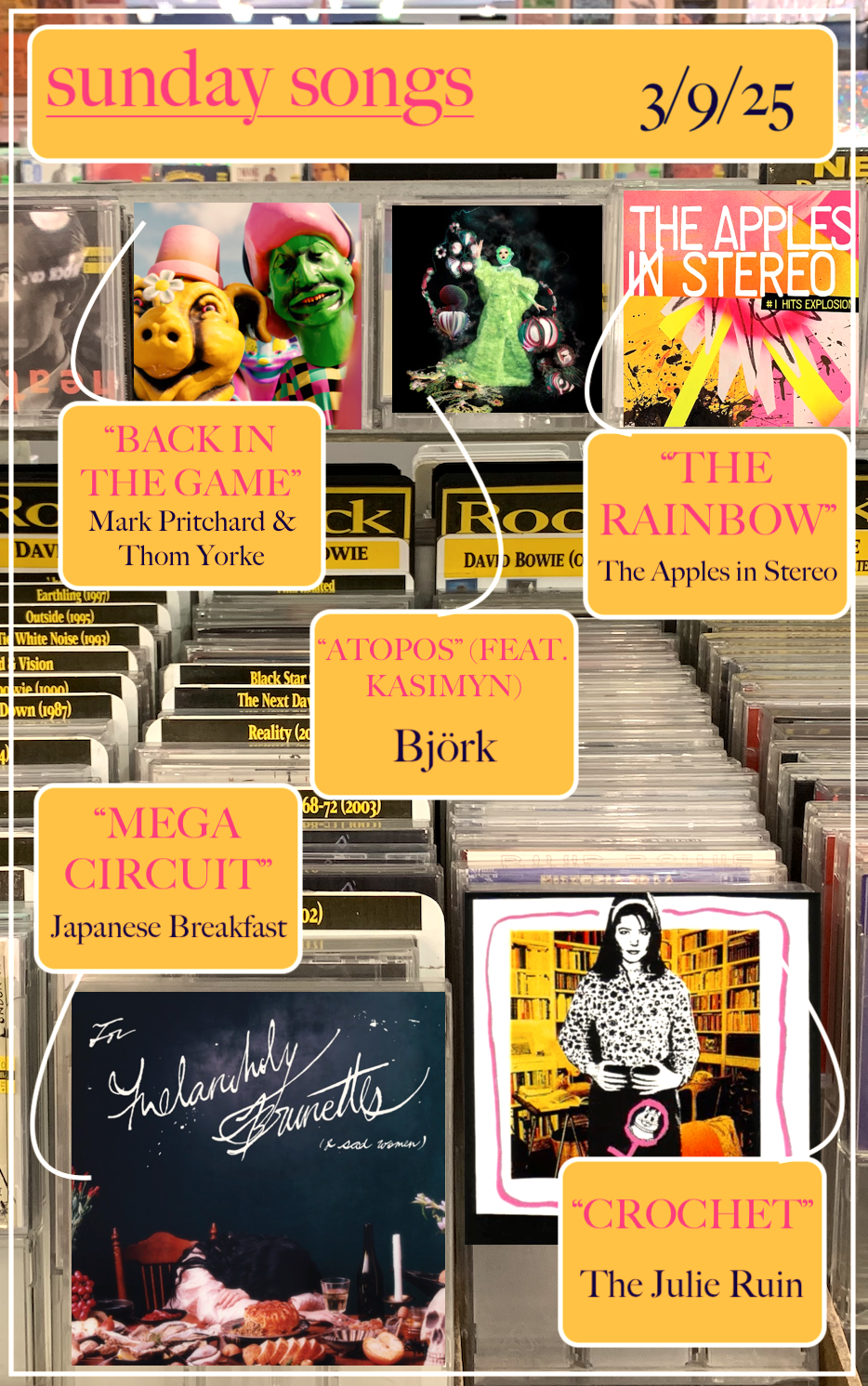
Halfway through 2024…no! No we aren’t 😀😀😀😀😀😀😀😀😀😀😀😀😀😀😀😀
Let’s begin, shall we?
GENERAL THOUGHTS:
After how busy and hectic my sophomore year of college was, June has been a time to recharge in more ways than one. I went on a quiet vacation at the beginning of the month (Ouray and Black Canyon of the Gunnison—the latter is a very underrated national park, I highly recommend it!), and I’ve taken the rest of the month to…well, rest. I’ve tried to be on social media less and focus on art, writing, and generally nourishing my creativity. In preparation for Camp NaNoWriMo (I only ever do the July camp these days because November and April are both abysmally busy times for me now that I’m in college), I’ve decided to round out my sci-fi trilogy and write the first draft of book three; at this point, I’ve beefed up the outline like a grizzly bear before hibernation, so at least I’ll have some sense of direction…wish me luck!
My reading month started out slower, and it’s had some dips, as always, but I ended up reading loads of fantastic queer books for pride month! Predictably, one of my vacation souvenirs wasn’t something related to where we went…no, I bought a copy of The Familiar at a local bookstore (support ’em!) knowing that it would take eons for my hold to arrive at the library. Worth it. I also figured it was as good a time as any to re-read my favorite series from when I was a kid—the WondLa trilogy. My verdict? It healed my soul and reinvigorated my creativity. Some kid’s books don’t age well, but WondLa never gets old.
Other than that, I’ve just been making art, playing guitar, going to pride (so much fun!), watching Hacks, Succession (nearly finished with season 1, and all it’s done is made me fear business majors even more than I already do), and…morbidly, Apple TV+’s new show that they decided to call WondLa. I’m three episodes in, and it’s like watching a train wreck. Expect a retrospective on the WondLa trilogy and possibly a review of…whatever that show is that definitely isn’t WondLa.
On a lighter note, photos from my vacation and pride:
OurayBlack Canyon of the Gunnison50th anniversary of Denver Pride!
(The bear on the title of the post is in honor of a bear we saw crossing the road in Black Canyon. Could also represent bears in general? Happy pride.)
READING AND BLOGGING:
I read 18 books this month! It’s been another relaxed reading month, and although I had a slump towards the end of the month, I read several incredible books for pride month!