Posted in Sunday Songs

Sunday Songs: 12/1/24

Happy Sunday, bibliophiles! I hope this week has treated you well.

This week: apologies for the whiplash lineup, but if your shuffle hasn’t whooped you with Julien Baker and Caroline Polachek back to back, have you even lived?

Enjoy this week’s songs!

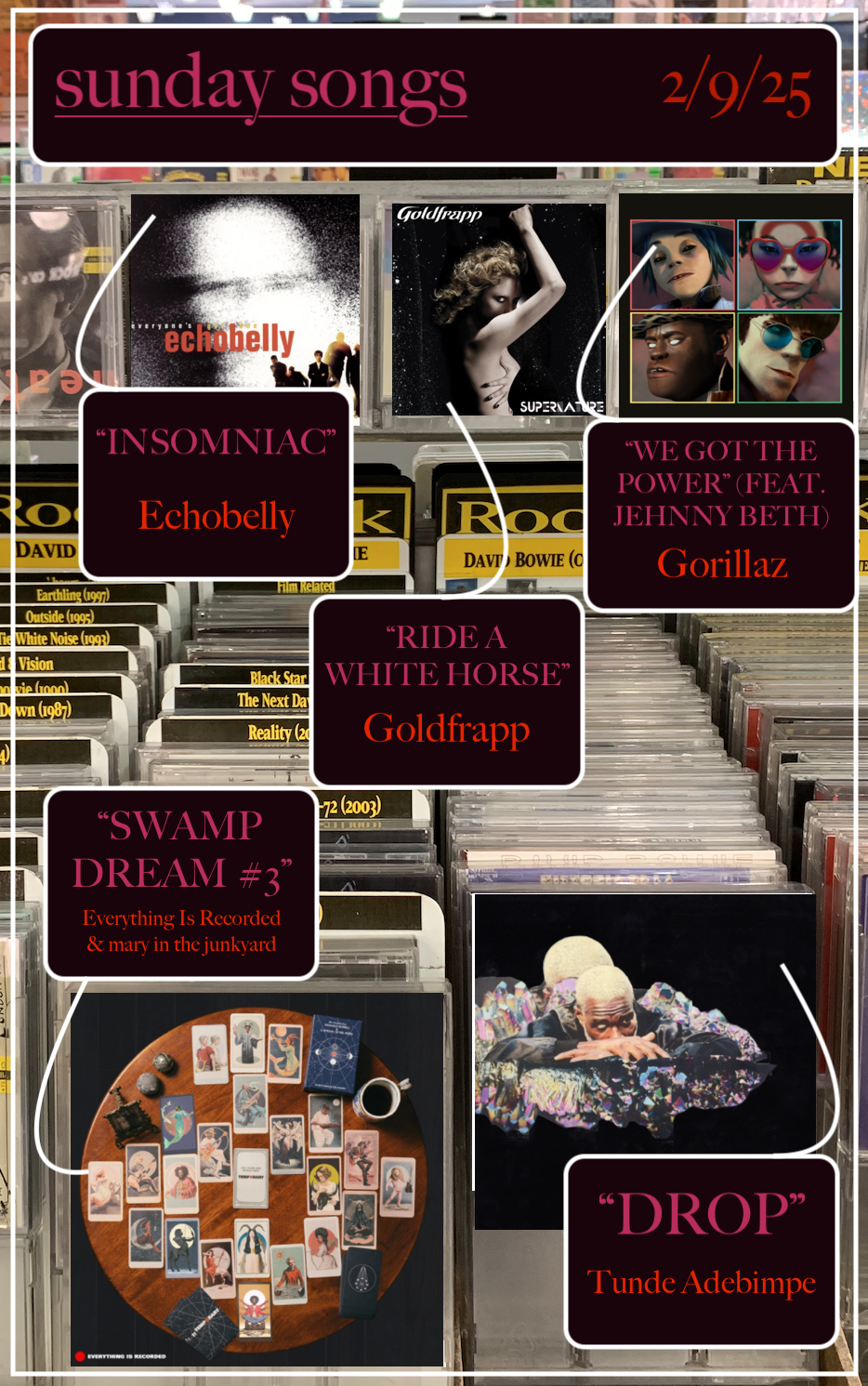
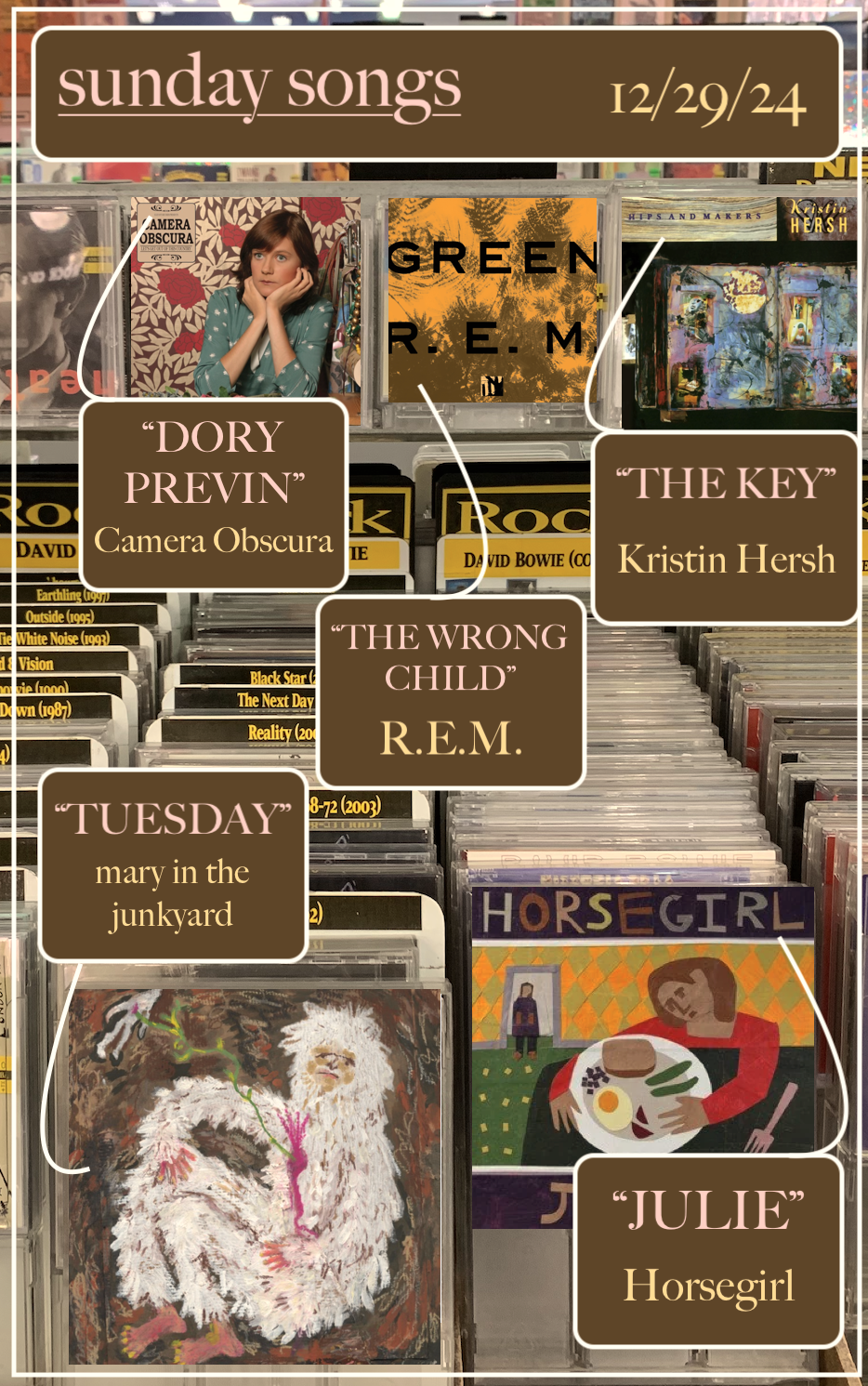
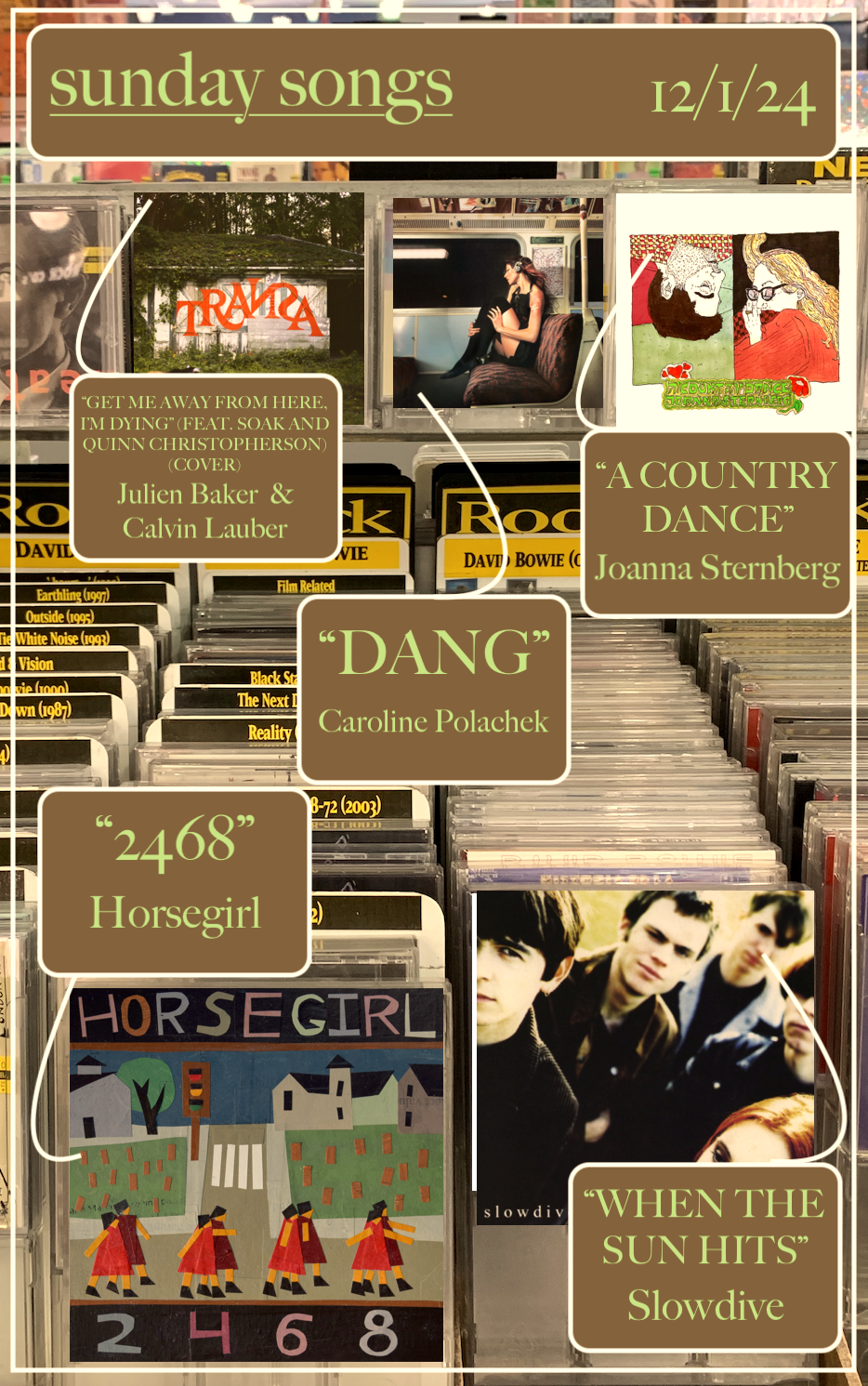
SUNDAY SONGS: 12/1/24

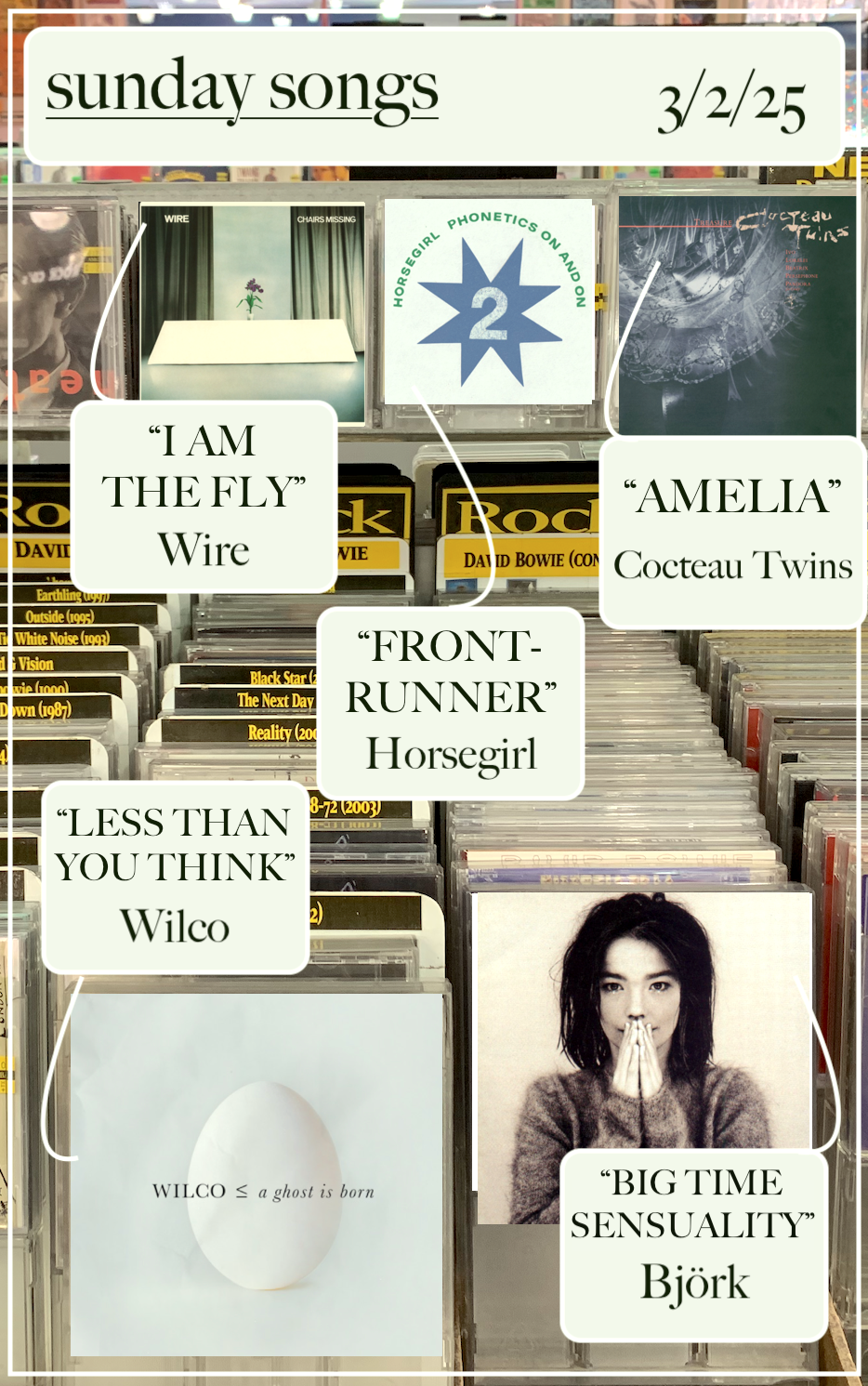
“2468” – Horsegirl

2024 was such a powerhouse year of fantastic albums that I’ve found myself wondering how 2025 could possibly measure up. Of course, the future’s unwritten, to quote Phoebe Bridgers, but if the upcoming solo Tunde Adebimpe album and this are anything to go by, it’s gonna be another fantastic year of music. Or at least a fantastic February, now that we have new Horsegirl on the horizon! Their second album, Phonetics On & On (if there was ever a more Horsegirl album title) comes out on Valentine’s Day next year, so I’m officially spoken for, thank you very much. It’s produced by none other than Cate Le Bon (!!!), and no matter how utterly pretentious I sound for getting excited about Horsegirl being produced by Cate Le Bon, oh my gooooooood (nobody got that), I remain excited after finally listening to some of Le Bon’s weirder solo albums and knowing the magic she worked with Wilco on Cousin back in 2023.

Horsegirl have always been an artsy bunch, taking inspiration from everyone from Brian Eno to Built to Spill, but “2468” reminds me of their picks from their episode of What’s In My Bag?—specifically their last one, The Feelies’ Crazy Rhythms. Penelope Lowenstein described a moment on that episode where she was supposed to be doing homework in Spanish class and was listening to The Feelies instead and felt like “the coolest person in the world.” I’ve always respected The Feelies, but they just make me anxious. Props to them for having their music so sanded down that there’s no wrinkles whatsoever, but it feels like the point after you’ve enjoyed your coffee and the caffeine jitters start to set in, but you have to stay put in your seat. They feel itchy, weirdly. Like something’s trapped in the music and is clawing to get out, but The Feelies just won’t let it. Good for them, man, but the nervous energy transfers very easily. “2468” is proof that Horsegirl’s uptight needle is quivering in the direction of The Feelies, but for all of their toy-solider precision, I don’t think they could ever be that itchily nervous. All of the lyrics are spoken deadpan, in some sort of no-man’s-land between nursery rhymes and marching orders, complete with a little “da-da-da-da-da-da-da-da” in case it gets too strict. With the band decked out in their best Wes Anderson fits, they shuffle and paddy-cake around as their well-oiled machine skips along. They may be taking after their uptight forefathers, but they’ve left themselves plenty of leeway to jump around—and those artsy leaps are what make me the most excited for what the future holds for Horsegirl.

…AND A BOOK TO GO WITH IT:

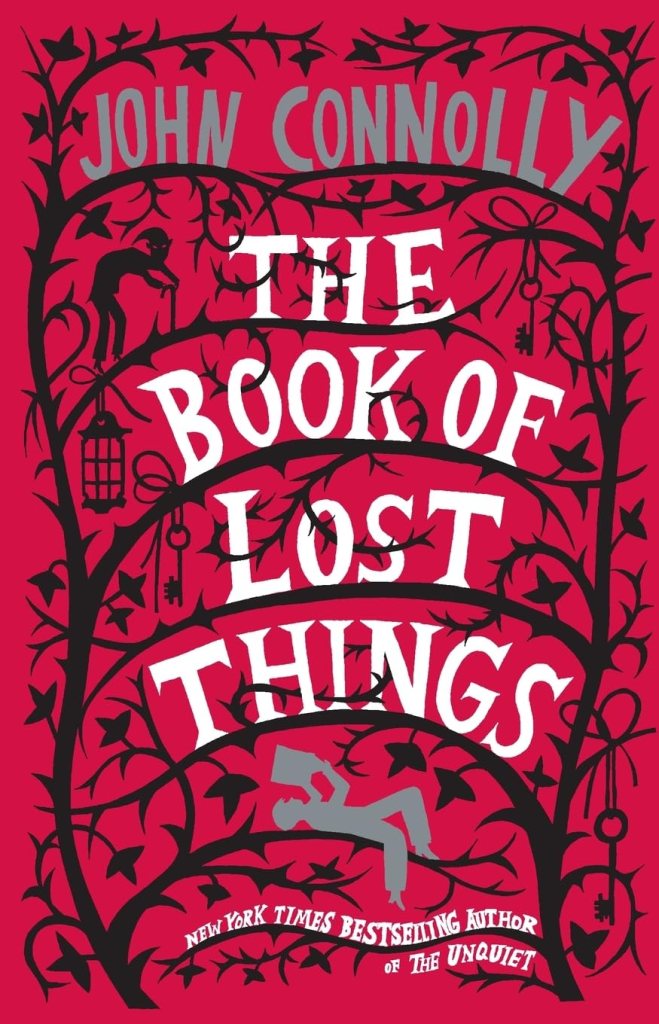
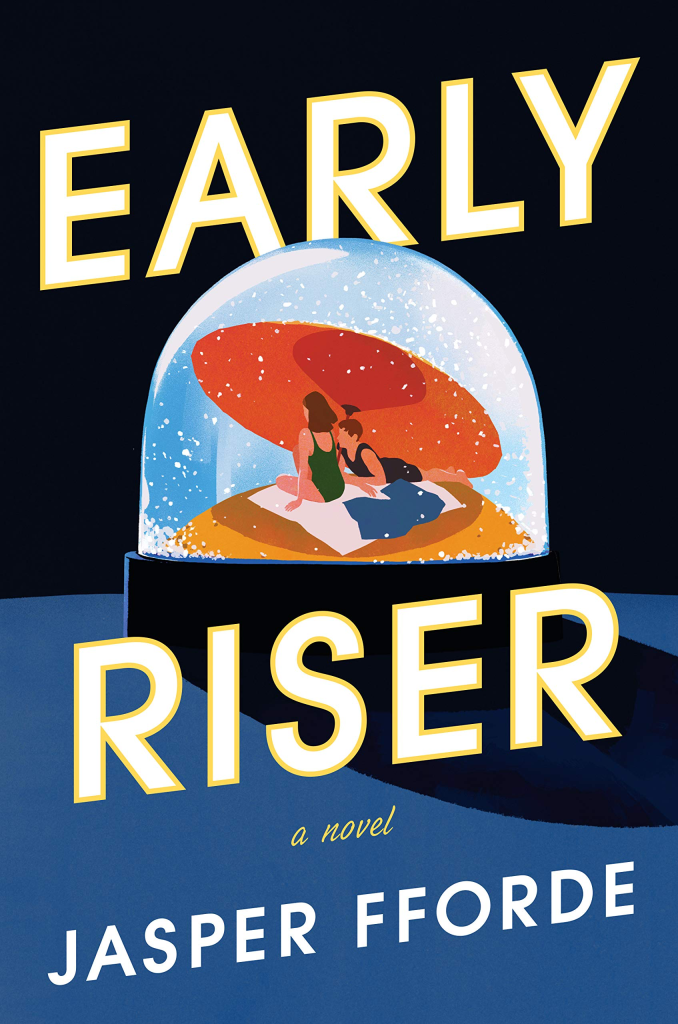
Early Riser – Jasper Ffordedelightfully odd in both concept and writing.

“When the Sun Hits” – Slowdive

Dread it…run from it…shoegaze always arrives on this blog.

I guess I was too mired in Spiritualized (and a sprinkling of Beach House) to get into Slowdive sooner, but it was always at the back of my mind, even when I’d never listened to it yet. I’d seen them floating around in the same musical circles that I listened to, not to mention my awesome honors English teacher from high school wearing a Slowdive shirt out of nowhere for band shirt day during spirit week. (My high school’s English department happened to be very shoegazey. I bumped into that same teacher at a Spiritualized concert in my senior year.) I should’ve hitched a ride on the bandwagon after Soccer Mommy covered “Dagger” last year, but here we are. Look, I know “When The Sun Hits” is their most popular song, and I’m a poser, yada yada yada, but LORD, this is beautiful.

For me, what separates shoegaze is its ability to create an atmosphere. J. Spaceman is the undisputed king (in my mind) in that regard, with his ability to create cosmically lived-in music that sounds all at once intimately personal and wide enough to swallow the world whole. “When The Sun Hits” stirs up that same feeling; the production is nothing short of cavernous, capturing the dappled reflections of water on the walls of a cave and the stringy sunlight shyly peering in. Both the vocals of Neil Halstead and Rachel Goswell take a blinding backseat to the mounting ocean of sound that reduces all else to a wavering echo. Slowdive were one of many alternative bands inspired by David Bowie’s Berlin trilogy, citing Low and Lodger as key influences, but funnily enough, I discovered this song through this inspired mashup of this track and David Bowie’s “Heroes.” I’d be surprised if that missing album didn’t creep in there, given how seamlessly the chorus of “When The Sun Hits” glides into Bowie’s opening chords. Having the first line of the pre-chorus be “It matters where you are” is a choice that defines the song’s experience: when you’re in the midst of experiencing it for the first time, all else seems to fall away. You can’t help but be pulled into the undertow, to be in the present, just to experience this song. That’s shoegaze.

…AND A BOOK TO GO WITH IT:

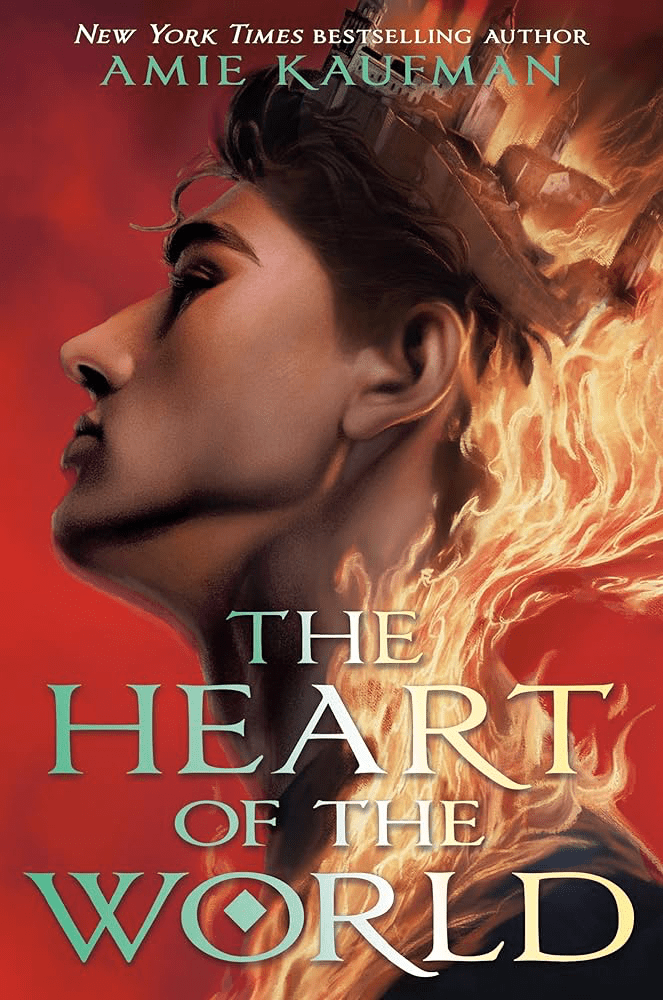
The Heart of the World (The Isles of the Gods, #2) – Amie Kaufman“Sweet thing, I watch you/Burn so fast, it scares me/Mind games, don’t leave me/Come so far, don’t lose me…”

“Get Me Away From Here, I’m Dying” (feat. SOAK and Quinn Christopherson) [Belle and Sebastian cover] – Julien Baker & Calvin Lauber

If you’re able, consider supporting this album, TRANSA, a compilation album featuring over 100 artists organized by the Red Hot Organization to bring awareness to trans rights! The album features Jeff Tweedy, Adrianne Lenker, Bill Callahan, André 3000, Perfume Genius, and so many more amongst its ranks, with both original songs and covers ranging from Kate Bush to SOPHIE.

Predictably, I first heard of TRANSA through Julien Baker, who covered Belle & Sebastian’s “Get Me Away From Here, I’m Dying” with SOAK, Quinn Christopherson, and Calvin Lauber. Lauber, who also produced many of Julien Baker’s newer material as well as boygenius’ “Black Hole,” turns Belle & Sebastian’s melancholy, jangly yearning into an urgent spectacle, a sprint through the woods to a brighter future for all four minutes and 13 seconds. If there’s anything that Baker can always deliver on, it’s urgency—the urgency of trauma, the urgency of love. With the context of both Baker’s queer identity and the album’s overarching theme of the trans experience, “Get Me Away From Here, I’m Dying” takes on a whole new light; “Oh, I’ll settle down with some old story/About a boy who’s just like me/Thought there was love in everything and everyone/You’re so naive” becomes the loss of innocence in the face of homophobia and transphobia and finding solace in fiction, and “Here on my own now after hours/Here on my own now on a bus/Think of it this way/You could either be successful or be us” feels like a vignette of someone on the run after being kicked out of their home. Even the title becomes a rallying cry of wishing to break free of the confines of prejudice that so many queer people know like the back of their hands. SOAK and Quinn Christopherson, both trans artists, trade verses and backing vocals with Baker, creating a harmony of solidarity that gives Belle & Sebastian’s original words an even more emotional meaning.

…AND A BOOK TO GO WITH IT:

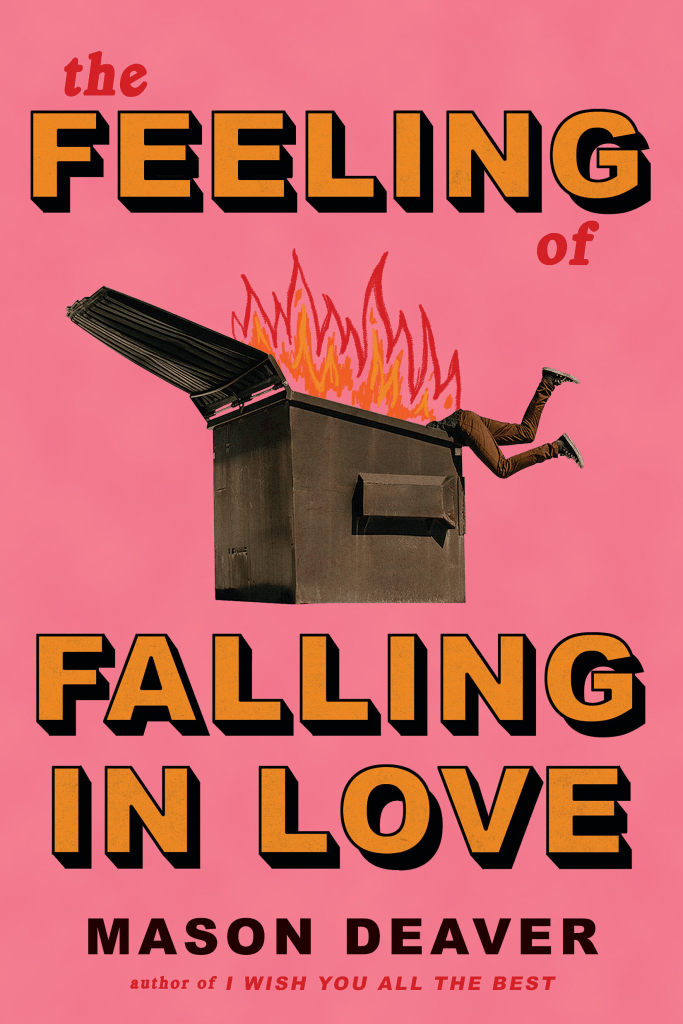
I Wish You All the Best – Mason Deaverheartbreak, new love, and a desire for a new life.

“Dang” – Caroline Polachek

Even with specific music categories being an illusion kept afloat by critics, I feel like what I’ve heard of Caroline Polachek aligns with my hazy definition of indie pop. It’s theoretically everything that should be popular, but like alternative or mainstream rock, it’s the label or the sensibilities that separates it. In the case of Caroline Polachek, she’s definitely too out there for the Top 40, but make no mistake: in the words of XTC, this is pop (yeah yeah, this is pop, yeah yeah, etc). The pop part is what prevents me from entirely getting into her music; as impressive as her vocal range is, it’s often too polished for me, and sometimes the isolated instrumentals feel like they could belong in a commercial. Not always my cup of tea.

But. But. I can’t not admire how weird she gets with it. I’m not seeing any other pop star willingly turn themselves into a chimera in their music videos, after all. And Polachek has more than a few excellent belts and screams in her. (Plus, she has my immediate respect for, after being called “this generation’s Kate Bush,” responding by saying that “SHE [Kate Bush] is this generation’s Kate Bush. Damn right.) “Dang” gets recommended to me in droves around every 6 months, and I can’t not be compelled by it. When I call it corporate, I mean it as a compliment—it feels like a strange distillation of disinterest and sanitized, company-wide messages saying something on the lines of “we’re all a family.” The intro of garbled vocals, followed by Polachek’s bored delivery of “Dang” feels like the pleas of low-level workers drowned out by an uncaring boss waving them off. “Aww, you don’t have enough to provide for your family? Dang. Get that spreadsheet on my desk by noon.” No wonder Polachek, in this live performance on The Late Show, is presenting an unconventional powerpoint, including but not limited to diagrams about “how many wolves are inside you” and a notes-app apology consisting of a paraphrased version of William Carlos Williams’ “This Is Just to Say.” (I’m wondering about the significance of replacing plums with grapes…maybe it’s not that deep?) Her music as a whole remains a bit too pop-polished for me, but I have nothing but respect for her unconventional spin on it—and her vocal range. The shriek beginning at 1:51? Autotune or not, either way, it’s enough to convince me that this is unedited:

good for you, Caroline…put those geese in their place

…AND A BOOK TO GO WITH IT:

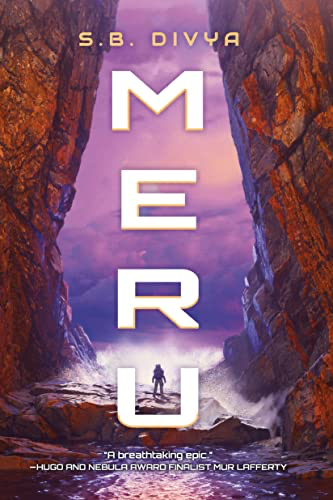
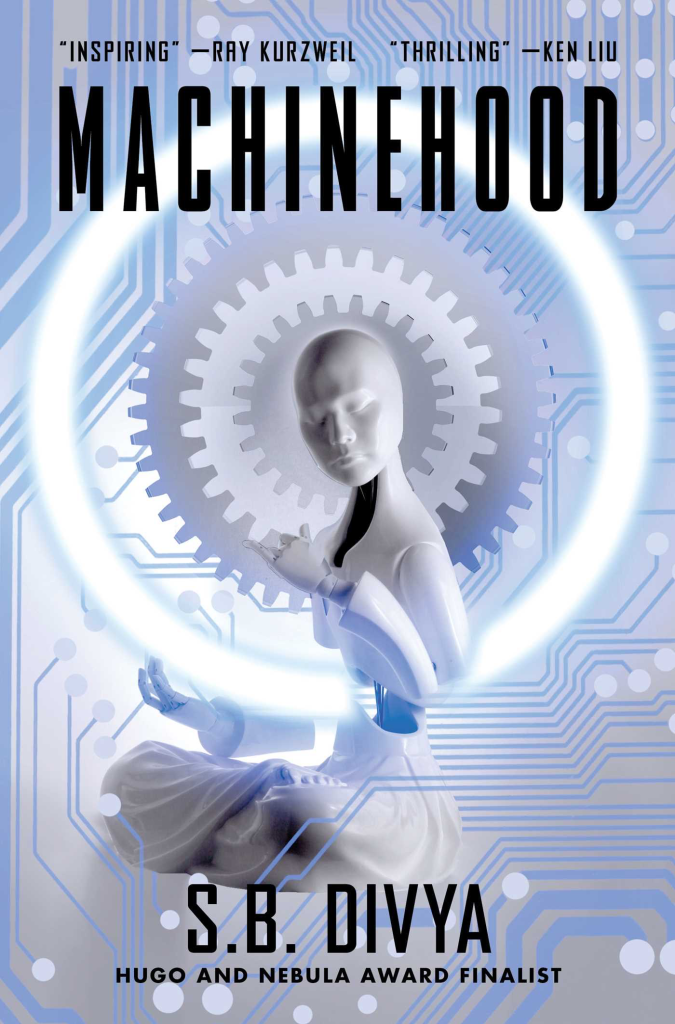
Machinehood – S.B. Divyacorporate disinterest and neglect, with a dose of S.B. Divya’s signature weirdness (and a Christopher Nolan-style thriller).

“A Country Dance” – Joanna Sternberg

I write this as a light snow is falling outside my window, and even though this song was released in August (as was the film it was written for, Between the Temples), it’s so distinctly placed in that period between autumn and winter for me, as far as the sound. “A Country Dance” has a gentle, intimate warmth to it that could only come from the embers of a fireplace in late November or mid-December. It lands on the opposite spectrum of The Shins’ “Black Wave,” which I spoke about around a year ago; seasonally, it’s at the same time, but “Black Wave” feels more like huddling around a fire, exposed to the elements. “A Country Dance” is comfortably cozy, without any notion of the snow biting at your cheeks. For me, good folk music gives you the feeling that you’ve just eaten a stomach-warming, rich holiday dinner—maybe some kind of stew or soup—and that warmth stays in your bones long after you’ve digested it.

I fully thought that “A Country Dance” was a cover—it sounds like it could’ve come out of the ’60s or ’70s, but this is a Sternberg original, and that timelessness is hard to capture—it feels very ’60s and Adrianne Lenker at the same time. (Their music teacher voice certainly contributes to that effect as well.) As the leaves fall off of the trees, this track feels like the perfect antidote to the coming chill—warm, tucked inside of a log cabin, half-asleep and wrapped in woolen blankets. Not every Joanna Sternberg song captures me, but “A Country Dance” honestly makes me feel like the Celestial Seasonings Sleepytime Bear, and that’s not something I’d say about just any song.

…AND A BOOK TO GO WITH IT:

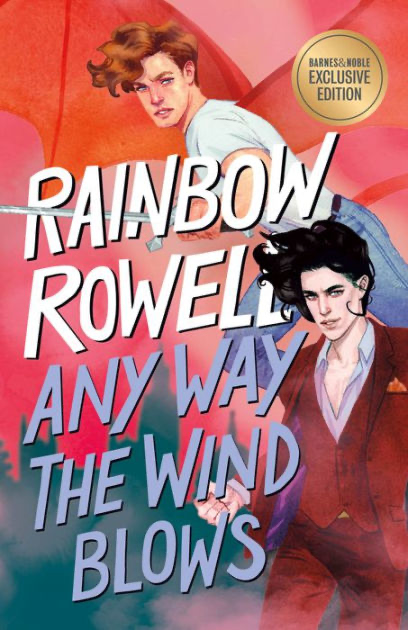
Any Way the Wind Blows (Simon Snow, #3) – Rainbow RowellEven if it is tumultuous in places, the quiet Christmas scenes here invoke this song.

Since this post consists entirely of songs, consider all of them to be today’s song.

That’s it for this week’s Book Review Tuesday! Have a wonderful rest of your day, and take care of yourselves!

Posted in Sunday Songs

Sunday Songs: 11/24/24

Happy Sunday, bibliophiles! I hope this week has been treating you well.

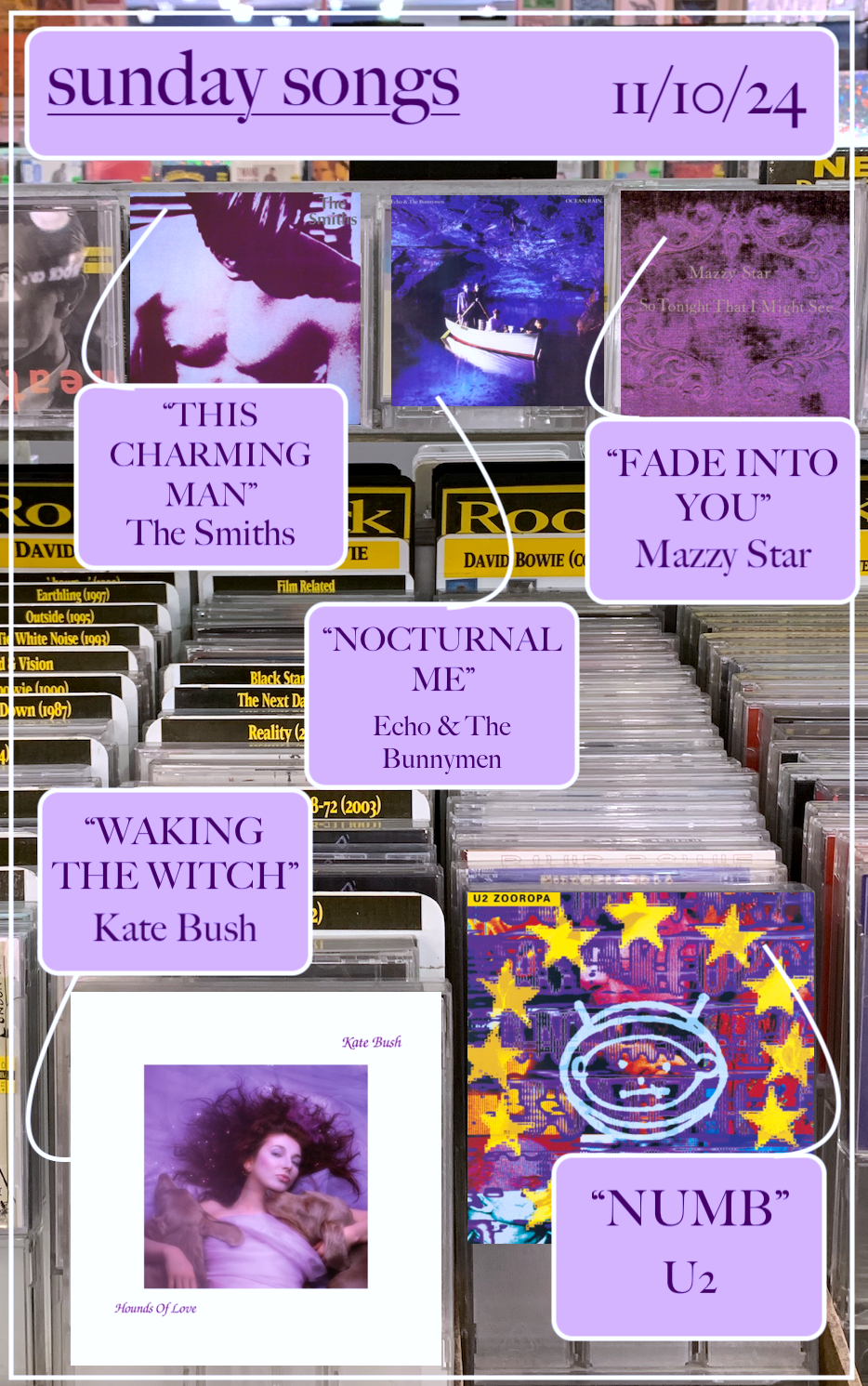
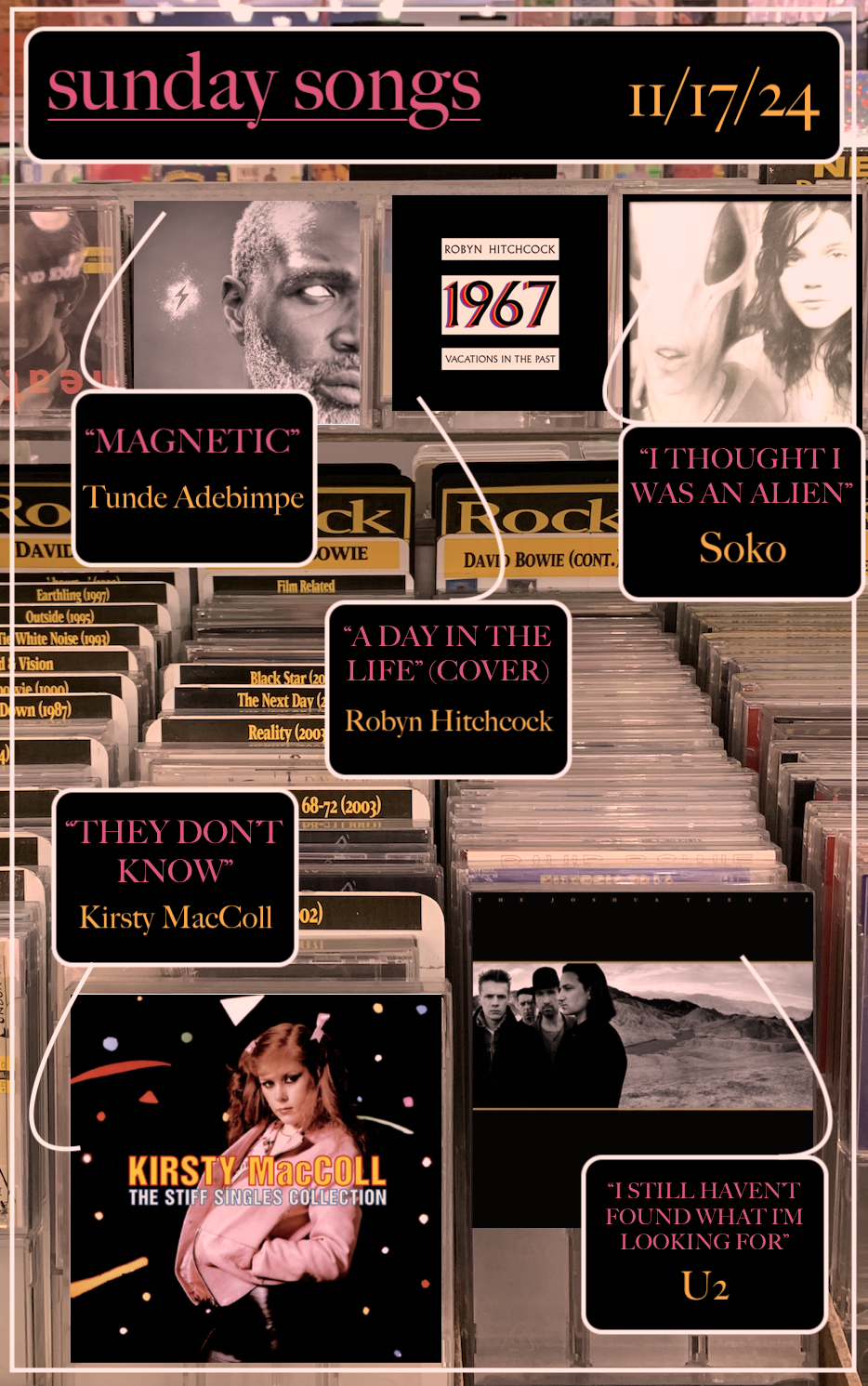
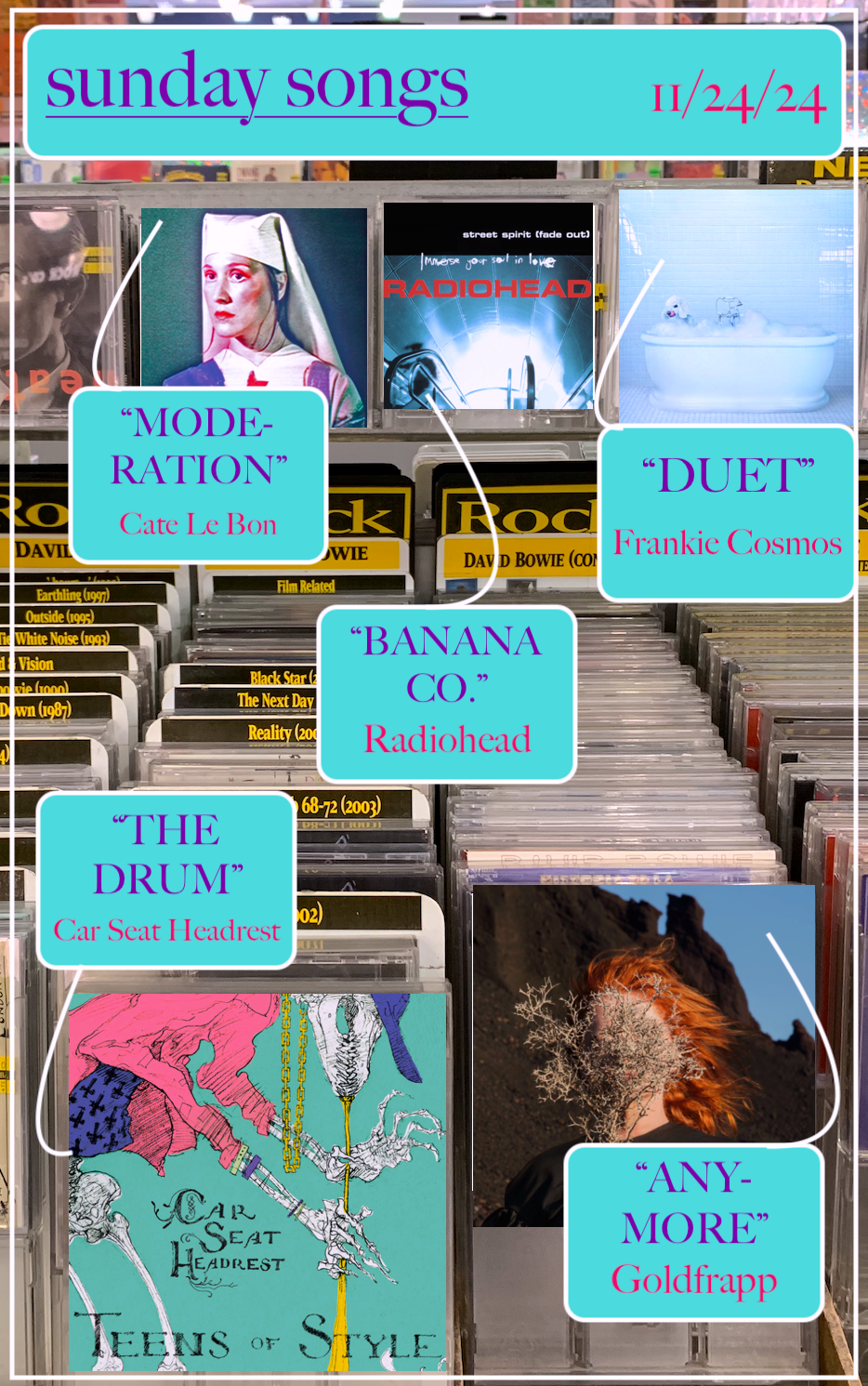
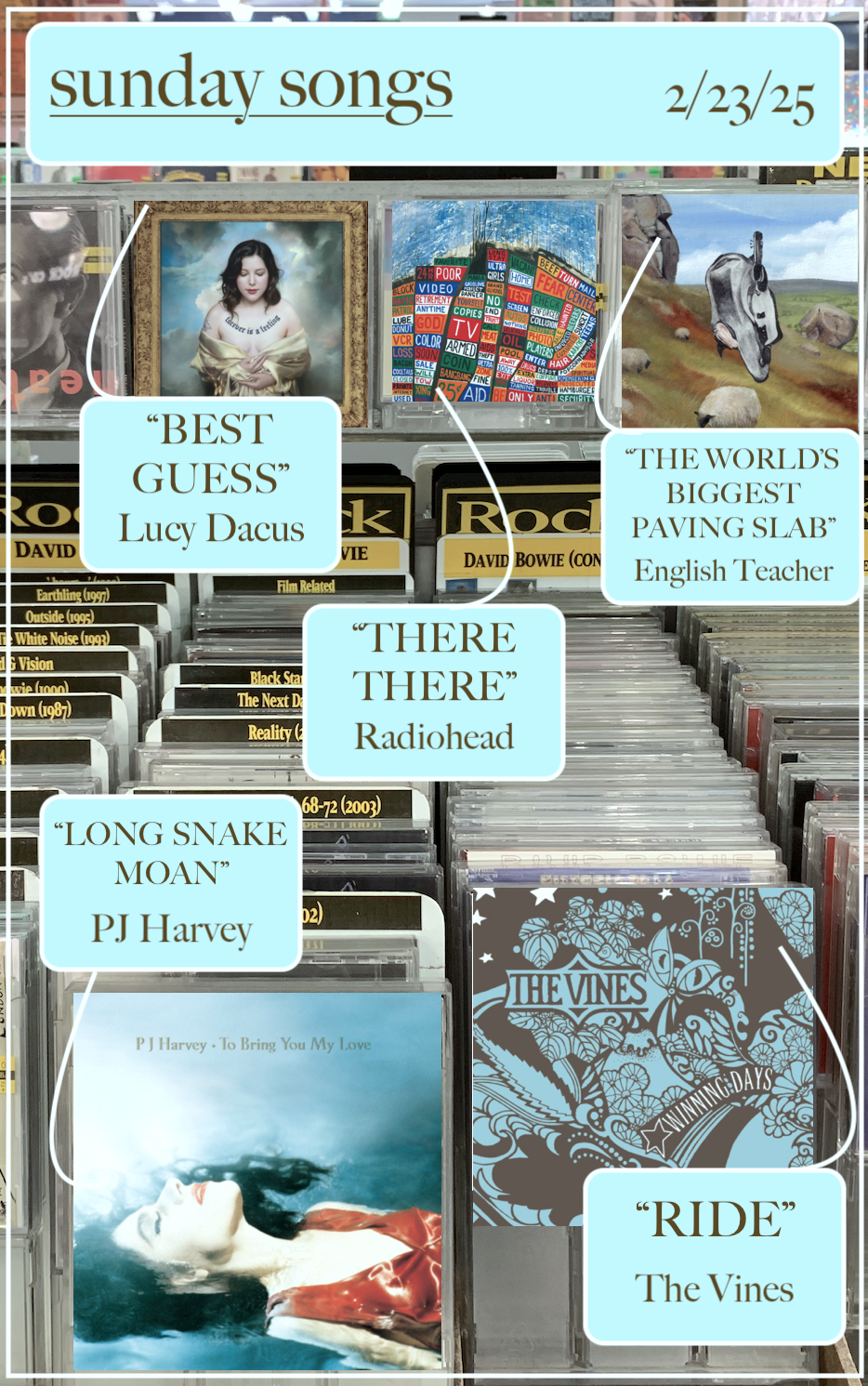
Before I begin, here are the graphics for the past two weeks. I was so excited to write about Hounds of Love, because…well, it’s Hounds of Love, oh my god, self-explanatory, but alas…we all know what happened. Not ideal conditions to write under. Rest assured, it will come back eventually. You can hold me to that. Either way, more music:

11/10/24:

11/17/24:

Now, for this week: ignoring whatever’s going on in that Goldfrapp music video…have fun?

Enjoy this week’s songs!

SUNDAY SONGS: 11/24/24

“The Drum” – Car Seat Headrest

“The Drum” is the first video in this setlist, so there’s no need for a timestamp. Watch at your leisure!

That frame at 1:25 sums up my 8th grade experience more than any words can: Will Toledo with the blurry image of St. Vincent’s self-titled album in the background.

Ah, this one’s a throwback. I remember watching this tiny desk concert in my parents’ bedroom with my mom, who always indulged my adolescent squealing about Will Toledo with the bafflement that “he looks like he’s in high school.” I didn’t fully realize it back then, not even being in high school myself, but…no offense, Will, I love you, but the amount of voice cracks throughout (“he don’t have shIiIiIiiiIIIT”) would make me think that he was 14 or 15 here, and not 23, weirdly. This whole Tiny Desk is a work of art in the art it produces in spite of the awkwardness about. Band? Sorta. Ethan Ives and Andrew Katz are there (it’s so far back that Seth Dalby hasn’t even shown up yet!), but Andrew’s the only one with his instruments beside Toledo. And you’d think the other two guys to the left of Toledo are part of the band, right? They’re just emotional support, which, to be fair, I’d love to have during one of those shows, but it gives the effect of a bunch of guys watching their friend play guitar in senior hall. In an endearing way, honestly. It’ll always be endearing to me. It’s Car Seat Headrest, after all. Nothing but love for our nervous young man.

“The Drum” was one of the earlier tracks that was constantly in my orbit during the peak of my Car Seat Headrest heyday in my early teens. Teens of Style was Car Seat Headrest’s full album as a band (still a three-piece by that point) and the first to be signed to a label, but it retains that lo-fi sound that characterized what gave Car Seat Headrest its name in the first place: being recorded by a deeply self-conscious Toledo in his car. It’s composed mostly of songs recycled and refurbished from his early days self-recording (“The Drum” originally appeared on My Back Is Killing Me Baby), and all of them get a kind of self-deprecating grandeur. Though the lyrics have been whittled away and refined, it’s the same old sad boy underneath, rest assured. “The Drum” doesn’t necessarily fall into that category, but it makes me realize…Will Toledo sure loves writing about drunk people, huh? He’s quite good at it, too, and he’d get even better after this song with “Vincent”: “It must be hard to speak in a foreign language/Intoxicado.” This track feels like the song version of that gag in Snatch where they cut back to clips of Frankie Four Fingers gambling and getting drunk out of his mind to the tune of “Viva Las Vegas.” It’s a hundred tiny vignettes of an off-the-walls character as he stumbles through a nonlinear, drunken reality: he’s reading James Joyce, he’s too high to listen to anyone (and even if he wasn’t, he still wouldn’t be listening), and he owes you $20. He’s a real piece of work, and Toledo is the faithful documentarian struggling to catch up with his antics. And somehow, the bridge gives the sense that said sloshed asshole, swimming in alcohol and ego, has elevated himself to think that he has transcended life itself: “This is our lifetime/And I am its creator/A young man slowly pulled apart/By separate poles of gravity.” This bridge came to Toledo in a dream (with the only difference being that “young man” was originally “snowman”), and it begins to close “The Drum” out as one stumbles through an inebriated dream.

…AND A BOOK TO GO WITH IT:

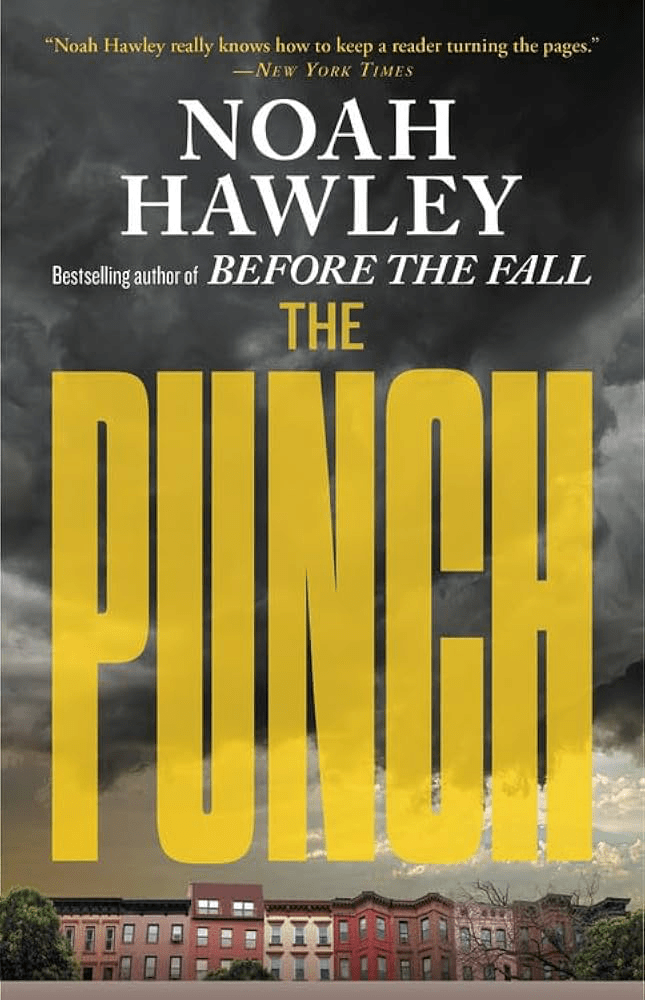
The Punch – Noah Hawleydrunk, dysfunctional people aplenty, all of which need to have their perfect and unparalleled opinions heard. Surely nothing will go wrong…

“Anymore” – Goldfrapp

Another throwback, although this one didn’t factor in changing my 13-year-old brain chemistry nearly as much. That’s not a slight against it—my first memory of Goldfrapp was when I was about 11 or 12, and since then, she’s been a consistent, behind-the-scenes favorite. Between their work with Tricky and Spiritualized, I should’ve been hooked in the first place, but they’re so consistent in her sound, and not in a way that grows tired. Aside from some of the production, “Anymore” could just as easily been from one of their albums from the 2000’s. Their brand of futuristic-sounding synths sounds like something you’d hear from a club in Blade Runner, and not in a way that feels dated. It’s almost like Alison Goldfrapp and Will Gregory are just as precise as the machines that they manipulate to create their music; everything is oiled down until not a single wrinkle remains, and the result feels simultaneously far in the future and timeless…

…if you can ignore the tamer PG (?) version of Feyd Rautha that is the music video. You do you…?

…AND A BOOK TO GO WITH IT:

The Three Stigmata of Palmer Eldritch – Philip K. Dick I feel like this is the kind of music that would play if you took Can-D and going to Philip K. Dick’s version of Barbie Land…

“Moderation” – Cate Le Bon

Several months out from listening to Pompeii for the first time, I find myself returning to it time and time again. I’ll cling to any new weirdness I can find, and Cate Le Bon, at least for this album, delivers. Back in July, I talked about how the first four songs on the album are a cascade of absolute successes; “Moderation” is the second of the four, and although it’s much poppier than the eerie “Dirt on the Bed,” it nonetheless has her oddball twist. The instrumentals, from the so-bright-they-shine guitars to the backing saxophones, are very ’80s, but they’re tweaked enough that they don’t sound like hollow copies; the gated reverb on the drums is gently quieted, while the production, like the music video, feels like everything has been recorded straight from the mouth of a cave.

Something about the lyrics strike me as oddly coy—not in meaning, but more of how they start to reveal themselves as something that makes sense, so vague that they could be applied to anything, and then mischievously peek back behind the curtains and return with something truly bizarre. They’re somewhere in between the matter-of-fact but nonsensical utterances of both Brian Eno and Robyn Hitchcock, and even some of early St. Vincent’s artier ventures. “I get by pushing poets aside/’Cause they can’t beat the mother of pearl.” I love it, and somehow it makes sense, but do I have any clue what that means? Nope. It feels like it’s meant to be poetry more than anything, words strung together for aesthetic effect. The music video gives the distinct feel of a performance piece you’d see projected in a curtained-off corner of an art museum, but the colors of it are the perfect match “Moderation.” Against a backdrop of a brewing storm at sea, Le Bon is cloaked in black, with only her face, arms, or legs visible at any given time. Aside from her “Life On Mars”-blue eyeshadow, the only hints of color she reveals are lacy cuffs on her sleeves or bright colors on her tights. Those pops of color feel like the bursts of oddities throughout “Moderation,” so vibrant that they pop out like cartoon bubblegum.

…AND A BOOK TO GO WITH IT:

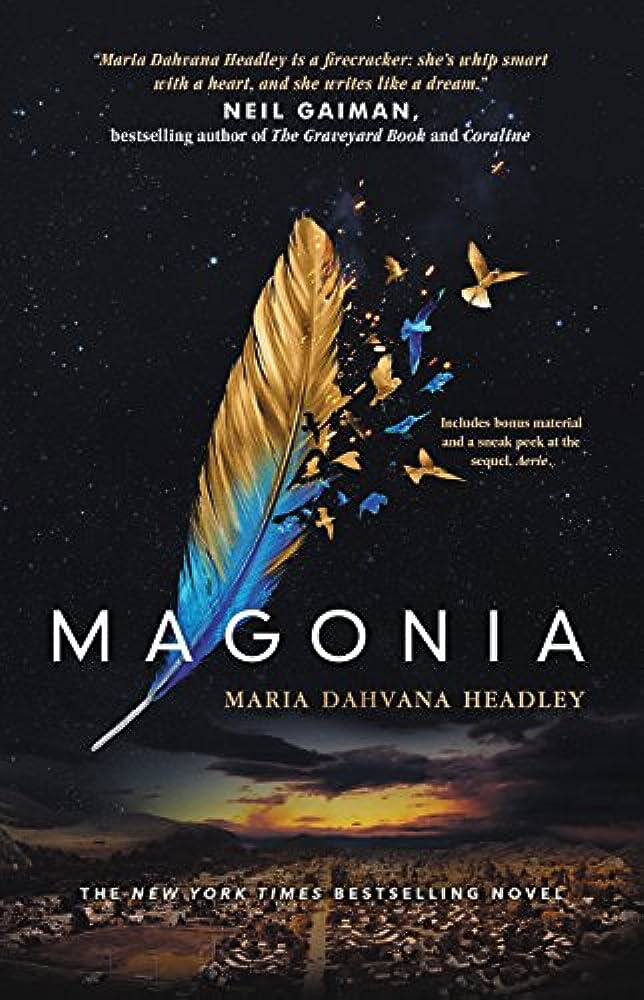
Magonia – Maria Dahvana Headleyyou think you’ve got a typical 2010’s YA fantasy book on your hands, and then it gets bonkers…delightfully so.

“Banana Co” – Radiohead

With every successive Radiohead EP I listen to, I’m baffled at not just the sheer amount of output they had, but how good a solid 90% of it is. The Bends sessions seem like some of the most fruitful of their entire career, what with three EPs and a series of smaller singles released in the periods directly before and after the album’s release. I’ve yet to listen to My Iron Lung – EP or the “Fake Plastic Trees” single, but from what I can tell, they were just constantly cooking. They had to be forcibly removed from the kitchen because the cooking was just TOO GOOD. They just COULD NOT BE STOPPED.

In some ways, “Banana Co” feels like if “Karma Police” was released on The Bends; the term “sardonic wit” is overused these days, but it applies here for sure, as it does to quite a lot of Radiohead. Written about the corporate colonialism of the United Fruit company in various countries in Central and South America, Thom Yorke slathers his honeyed words in sarcasm with the repeated verse: “Oh, Banana Co/We really love you and need you.” Yorke has an almost sleepy register to his words, as though he’s being pulled under by the propaganda himself, before the guitars of Jonny Greenwood and Ed O’Brien coalesce in a controlled blast of everything that makes me miss listening to The Bends. Adding this one to the list of Bends-era songs that make me think “this is a B-SIDE?” (see also: “Maquiladora,” “My Iron Lung”). Luckily—at least for the fans who were alive to see this (cries in Gen Z)—”Banana Co” was a live staple pre-OK Computer, and Yorke has often addressed it towards other colonial problems of the day, including one in 1998 that was addressed to “the people of Indonesia, and the people who have money invested in that country.”

Wow, what a wonderful example of a band committed to calling out imperialism and violence around the world! Surely they would carry these values into this day and age…right? Right?

Uh…

Well. I’ll say that I am quite disappointed after hearing that Thom Yorke confronted a pro-Palestine protestor at one of his solo shows back in October; the protestor demanded that Yorke condemn the ongoing violence in Palestine, and he responded by calling the protestor a coward, then walking offstage. In Yorke’s defense, he has every right to withhold his political views (and also, I don’t think yelling at a celebrity at a concert is necessarily the best way to get people on your side, no matter how good the cause, nor is it going to solve any conflict), but there has to be a much more respectful way of dealing with this kind of thing. Calling this person a coward was not the right move, even if he did want to decline to speak. It’s just so odd and hypocritical to me that he would be a champion for human rights for so long, and then call somebody a coward for protesting the same human rights violations that he once sang about and condemned in the ’90s. Even if he doesn’t publicly condemn the thousands of needless deaths, I just hope that he realizes how hypocritical he sounds. What a shame, really. Again, no way that Thom Yorke’s reading this, but…maybe go listen to your old catalogue over again before you call people protesting the horrors of modern imperialism cowards. Just saying. Free Palestine.

…AND A BOOK TO GO WITH IT:

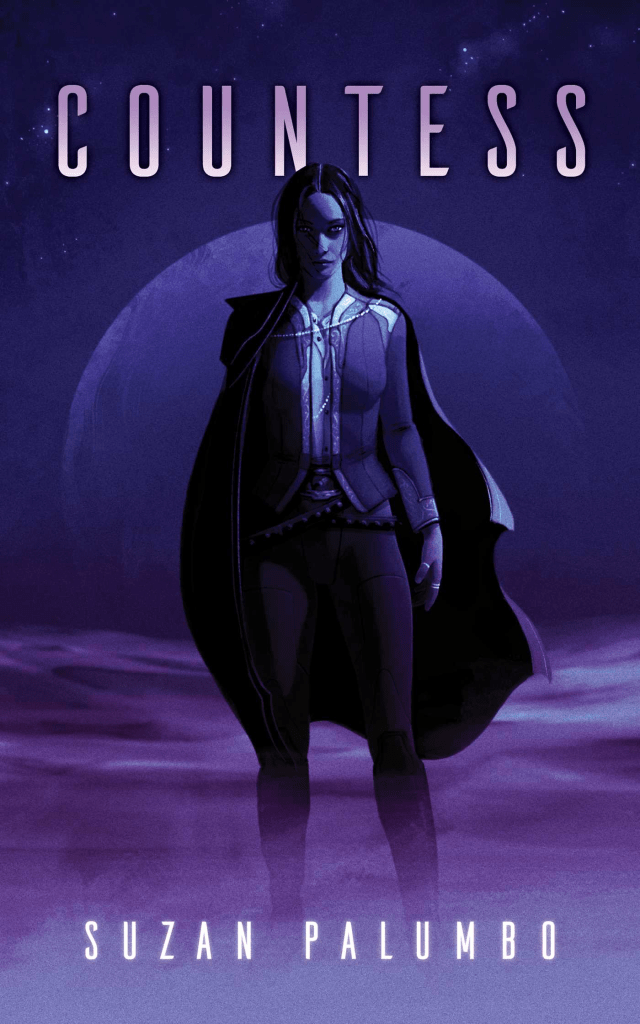
Countess – Suzan Palumbo being under—and breaking the spell—of imperialism and subservience.

“Duet” – Frankie Cosmos

We’re ending on a much lighter note, worry not. Frankie Cosmos is always reliable on that front (whether or not it’s preceded by one of my rants).

I finally caught up with this season of Heartstopper, and I’ve fully moved away from calling it any sort of comfort show, as I feel that would diminish the incredibly important (and tactfully delivered) depictions of eating disorders and mental illness. Nonetheless, it remains a wonderfully queer show, and it’s got plenty of sweet moments, often buttressed by light and bubbly indie pop. I’m only on brand with…a third of the songs that are picked (some of it’s a bit too pop for me), but I can always count on at least a handful of hits popping up—season 3 featured not one but two Arlo Parks songs (“Devotion” and “Pegasus”—Parks is just perfect for the Heartstopper atmosphere), Sufjan Stevens’ “That Was the Worst Christmas Ever!” (it sure was…Charlie cannot catch a break 😭), and, reliably, more Frankie Cosmos. Maybe, just maybe, Alice Oseman might be a fan? We can never really be sure…

Either way, Frankie Cosmos and Heartstopper are matches of media that are made for each other. “Duet” has some of the simplest of lyrics, but they’re delivered with the lovesick joy of doodling hearts in the corner of your notebook as a teenager. Packaged in bite-sized containers (I can’t think of a song of theirs that’s over 4 minutes), they really do feel like bubblegum—sweet, sometimes sickly so, and short-lived, but constructed from simplicity that produces, more often than not, a perfect pop song. Like both the comic’s and the show’s cartoon hearts and leaves that surround the characters, there’s a simple purity to them that’s been distilled to the core.

…AND A BOOK TO GO WITH IT:

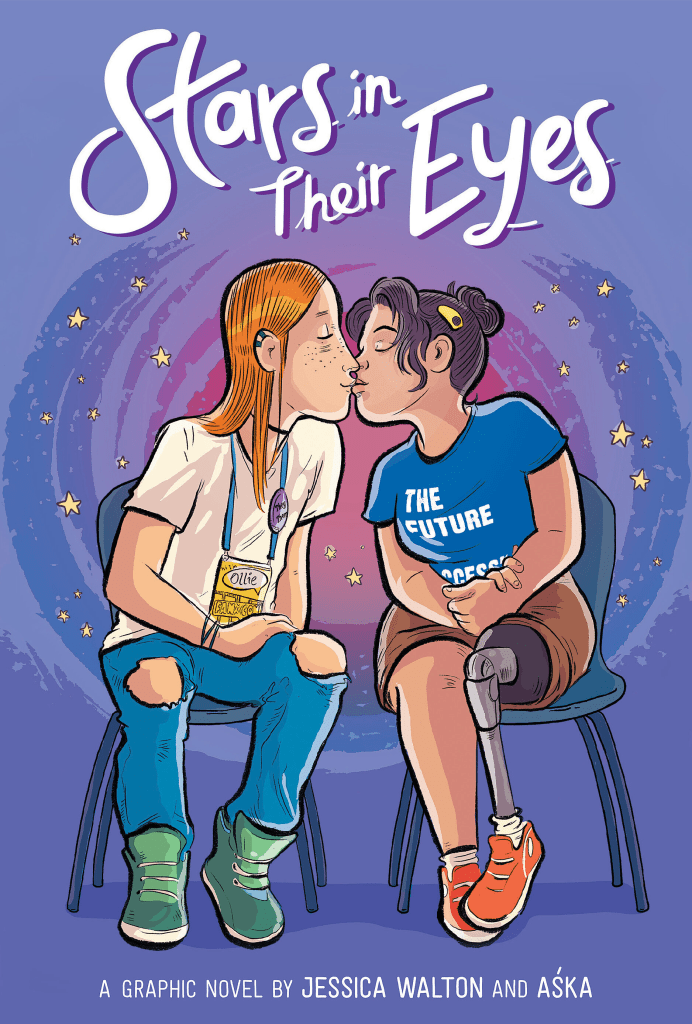
Stars in Their Eyes – Jessica Walton and Aśkasimilarly pure and comforting, and full of color and first love.

Since this post consists entirely of songs, consider all of them to be today’s song.

That’s it for this week’s Sunday Songs! Have a wonderful rest of your day, and take care of yourselves!

Posted in Sunday Songs

Sunday Songs: 11/3/24

Happy Sunday, bibliophiles! I hope this week has treated you well.

This week: next stop, Big Feels™️ central…totally haven’t been anxious for the past week and a half, how’d you guess?

Enjoy this week’s songs!

SUNDAY SONGS: 11/3/24

“Promises of Eternity” – The Magnetic Fields

I had the privilege of seeing The Magnetic Fields a second time last weekend; this year marks the 25th anniversary of an album that (from what I’ve heard) is not so much an album but a great balancing act of music itself: 69 Love Songs, a triple album consisting entirely of songs about love. (Make no mistake, they’re not all romantic. See: “How Fucking Romantic,” “Yeah! Oh, Yeah!” “I Think I Need a New Heart.”) I’ve yet to find the time to set aside a whole three hours and listen to the album in its entirety, but even a glimpse at around half of it over the course of my lifetime leaves me in awe of how Stephin Merritt and company pulled this off. Especially Merritt, as he wrote every single song—his songwriting never falters, but to not sputter out after 69 songs is a feat as awe-inspiring as his vocal range.

Somehow, “Promises of Eternity” slipped by my notice, but it hasn’t let me go since last weekend. Sung by Merritt on the album and by Anthony Kaczynski live, it immediately stuns. In both mediums, the synths just bowl you over—they don’t play as much as grandly announce their presence with the flourish of the same velvet curtain that the song speaks of. That chest-clutching drama defines the rest of the song—all of the lyrics detail the hypothetical collapse of the world if the narrator’s lover did not love them back: “What if no show ever happened again?/No seven, no eight and a half, no nine and no ten?” Most of Merritt’s singing has a sarcastic current to it that almost makes you question if the guy really believes in true love (though “The Book of Love” disproves that hypothesis quickly), but the way that he belts out “What if the clowns couldn’t be clowns?”, of all lines, gives you the feeling that he’s just fallen to his knees and is begging straight to your face. Apparently, the absence of clowns will signal the end? Who’s to say, really? Along with the circus imagery, the organ sound created by the synth makes “Promises of Eternity” feel like an elaborate, gilded carousel of lovesickness, with instrumentals that wouldn’t be out of place at a fairground, but lyrics fit for Romantic (in the Keats way, not the general way) poetry.

…AND A BOOK TO GO WITH IT:

Caraval – Stephanie Garbercircus imagery aplenty, as is the levels of drama being off the charts.

“Surgeon” – St. Vincent

In the age where you can make a synth—and most any instrument, really—make almost any sound you want it to, I shouldn’t be surprised at the staggering achievements that music has made in the simple terms of what noises we can make. What sounds like “the future” feels entirely subjective when we’re talking about anything past the 2010’s—electronic music had exploded, and plus, what sounds futuristic to me might not sound futuristic to you.

My waxing poetic about St. Vincent has mostly been directed to her self-titled 2014 album, which, ostensibly fits that description for me. But with each successive listen to “Surgeon,” I’m blown away at just how much this sounds like the future. This was 2011, and aside from the percussion, most everything on this track sounds utterly alien. Watching the 4AD sessions recording that I linked above was genuinely eye opening—every few minutes, I just found myself going wait, that’s the instrument that’s making that weird noise? The synths are manipulated to the point where they could just as easily be the vocalizations of a children’s choir from another planet. Even the blink-and-you’ll-miss-it trill of a flute turns into a glitch in some kind of code. I can see the threads of Björk—especially Homogenic—throughout, yet it’s so distinctly Annie Clark. By far the most masterful of these manipulations should be obvious: Clark’s guitar solo beginning at 3:36 feels like she’s almost reached the extreme of what the instrument can sound like. It’s hardly even a solo anymore—it doesn’t just sound like a synth, it sounds like some kind of creature whose consciousness has been trapped in a computer and is howling to be freed. If you were to somehow visualize this music, I’d fully believe it if it came out fleshy and trailing with electrodes.

Oh, to spend a day in her mind…

…AND A BOOK TO GO WITH IT:

Freshwater – Akwaeke Emezistagnation, grappling with identities beyond the human, and the desire to free that identity with help of a surgeon.

“Oodles of O’s” – De La Soul

Is it possible for De La Soul to have a bad song? Well…okay, I haven’t gotten into their later catalogue, which seems to have a worse reputation (I don’t know, though, “Snoopies” is pretty fantastic), so that’s up for interpretation. But for me, De La Soul are one of those bands where almost every new song of theirs I find feels like digging up buried treasure. At least in the ’90s, their creativity seemed to come to them as easy it is for the average person to breathe. The lyrics? Deadly serious, but still full of whimsical, silly rhymes—nothing but De La Soul. The best part is that every single line ends in an o sound—quite literally oodles of o’s! The samples? That Tom Waits bassline sample is something to behold. This is my kind of hip-hop. Can’t say if their entire catalogue is perfect, but “Oodles of O’s” is. We need to bring back the word oodles. Carry on the spirit.

At the end of the day, it’s beautiful that this got the video that Dave wanted it to have, now around a year and a half after his passing. Maybe it’s not the grittiness he envisioned, but a donut shop more than makes up for it.

…AND A BOOK TO GO WITH IT:

Geekerella (Once Upon a Con, #1) – Ashley Postonadmittedly, a much fluffier take on fame, but an exploration of how it reduces you nonetheless.

“Anchor” – Soccer Mommy

With the workload I’ve been swimming through this semester, I’m not sure if I’ll get around to reviewing Evergreen, but rest assured—I LOVED it. After a few listens, Sometimes, Forever remains on top, but Evergreen is special. There’s a matured, bedroom-pop-grown-older familiarity to it, but as with every successive album, Sophie Allison always has something new to offer. Her fourth album is a cartography of grief, detailing the tangled web of loss, healing, and pining after your Stardew Valley wife, as it turns out. As with every one of her albums, it’s her introspection that shines—with every kind of grief that she experiences, it feels like a flag planted in the ground, a recognition of every hill and valley of the harrowing trek she’s been on, but recognition that it’s not the end, no matter how much of it is behind her.

In contrast to the largely acoustic (or at least traditionally guitar-driven) landscape of Evergreen, “Anchor” instantly singles itself out as the black sheep of the bunch. Though it covers some of the same ground as the rest of the album, the production doesn’t jump out at you so much as it pounces on you like some creature going after your ankles in the dead of night. I should’ve expected that Allison would retain some of the sound from Sometimes, Forever, but with how the rest of Evergreen sounded, it was a surprise—and a 100% welcome one. With synths and bells that wouldn’t sound out of place in a Chelsea Wolfe track, it has a jaggedness and fear that the rest of the album lacks. In a song about feeling so unmoored in the face of loss, it’s one of the most creative stylistic choices on Evergreen to me. In the same way that a simple object or scent or song can trigger a domino effect of memories that takes days or weeks to recover from, “Anchor” comes out of nowhere with its instrumentation. It has the static and crunch of watching yourself bolting through the woods through the lens of a trail cam, and that’s how grief can make you feel—cornered and in the dark.

…AND A BOOK TO GO WITH IT:

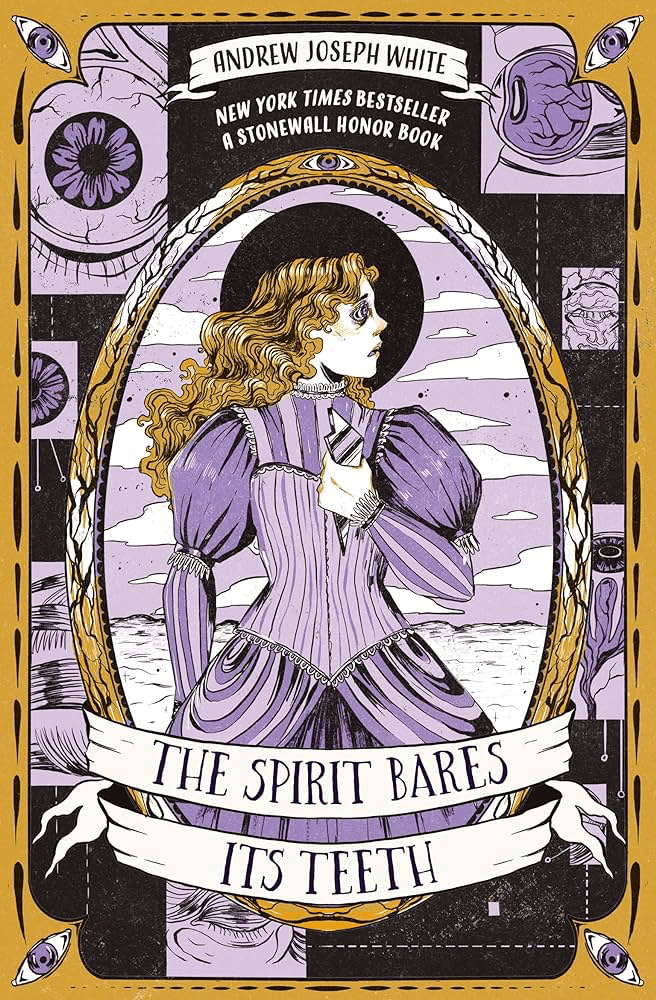
Hell Followed With Us – Andrew Joseph White“When we left the harbor/I was certain of my path/There’s no turning back/Now I long for something that/Could stop me in my tracks/An anchor to cast…”

“Remember My Name” – Mitski

Knowing that “Remember My Name” was released so close to the time that she almost quit music (back in 2019) really puts this song in perspective. Mitski’s still battling being in the spotlight, but this song presents the other side that’s been waging that war; deep down, she harbors a desire to be musically immortal, even at the steep cost: “I gave too much of my heart tonight/Can you come to where I’m staying/And make some extra love?/That I can save ’til tomorrow’s show.” With its crunching guitar riff that’s begging to be sampled and the way that the chorus consumes you in the same way that watching an approaching tornado on the horizon does, there’s so much urgency and volatility packed into just over two minutes. The best of Mitski speaks to that part of me that is so easily overcome by emotion and gives itself over to its throes—sometimes, whatever the situation, you do feel like you need something bigger than the sky. What works so well is that Mitski is dead serious—every song is an explosive, cathartic release. Of course, again, that’s probably what attracts so many parasocial weirdos to her shows, but I at least have the tact to not yell “MOMMY” at her, much less anybody else. That’s exactly the price of the fame she speaks of—she places her heart on a platter, people tear it to shreds, and the process repeats itself every day. I’m just glad that after The Land is Inhospitable and So Are We, she’s repaired that volatile relationship with music, or at least started to. Much as I love a good Mitski explosion, her best music comes when she’s healed, or at least processing it.

…AND A BOOK TO GO WITH IT:

Shadow and Bone – Leigh Bardugo“I need something bigger than the sky/Hold it in my arms and know it’s mine/Just how many stars will I need to hang around me/To finally call it Heaven?”

Since this week’s post consists entirely of songs, consider all of them to be today’s song.

That’s it for this week’s Sunday Songs! Have a wonderful rest of your day, and take care of yourselves!

Posted in Sunday Songs

Sunday Songs: 10/27/24

Happy Sunday, bibliophiles! I hope this week has treated you well.

This week: if I had a nickel for every year that I’ve had a bright green Sunday Songs color scheme right before Halloween, I’d have two nickels, which isn’t a lot, but it’s weird that it happened twice…bon appetit.

Enjoy this week’s songs!

SUNDAY SONGS: 10/27/24

“This Town Ain’t Big Enough for the Both of Us” – Sparks

Because all you musicians totally want my unsolicited advice, I’ll offer it up: this is peak walk-on music. Imagine the band coming onstage the minute the drums kick in after the gunshot sound effect at 0:35. Come on.

In my glacial but nonetheless exploration of Sparks, I realized that I sort of knew this one—it’s one of their most popular and enduring songs, but I knew it from the cover that Siouxsie and the Banshees did, which should tell you all you need to know about how I was raised (read: a hipster). I think my desire for somebody to use this as walk-on music stems from just how punchily theatrical it is. It demands dynamic movement, silk, and finger guns fired into the audience of an opera house. Even though I’d place it well on the outskirts of glam (somewhere near Brian Eno ca. 1974), it walks that line between pure rock and full-face theatre. The Mael Brothers’ brand is significantly tighter than the spandex that their counterparts were (probably) wearing, but the constrained, cagey feel of it adds to the suspense, however thickly they laid it on—it certainly fits with the anecdote about the zoo animals in the first verse. Yet for the slimness of it all, they lean into how over-the-top it is. Case in point: said Wild West gunshot sound effect during the chorus. Brilliant.

Other than Siouxsie, a fair share of artists have covered “This Town Ain’t Big Enough for the Both of Us” over the years. I found out that the most recent happens to be The Last Dinner Party, who…admittedly, other than “Caesar on a TV Screen,” I haven’t exactly liked much, covered it as well, and…eh? The overwhelming vibe I got was that they were trying to go for over-the-top, but, as with…well, everything I’ve heard of theirs, they were trying way too hard. It sounds tight, but there’s hardly any fun in this. And how do you cover Sparks and not make it fun? Siouxsie and the Banshees made it their own—the flow is more dynamic and not as punctuated as the original, but it’s got that theatrical urgency that gives it the oomph that’s necessary to cover the song. The Last Dinner Party restrained themselves so much…and I hate to harsh on them, but they’re missing the whole point! The spirit of “This Town Ain’t Big Enough for the Both of Us” is to go dramatic! Go big or go home! I AIN’T GONNA LEAVE!

…AND A BOOK TO GO WITH IT:

The Good Luck Girls – Charlotte Nicole Davisanother—but very different—twist on Westerns.

“The Big Ship” – Brian Eno

me when I’m in a “making incredibly soothing but also innovative music” and my competition is Brian Eno:

Brian Eno can really do it all. He glammed up the ’70s with Roxy Music, then struck out on his own and glammed some more…and eventually came to be the person responsible for both coining and creating the genre of ambient music. He’s a master of both the lyrical and the instrumental; Another Green World contains both, but is considered by many to be part of his transition to almost exclusively making solo, instrumental ambient music. Even if he did mold the genre, however, I wouldn’t call “The Big Ship” ambient. Compared to something like “1/1,” it has an unmistakable feel of rising action, as in a novel, instead of the former’s soothing plateau. It’s unassuming at first glance, but judging from the outpouring of emotion in the YouTube comments—and its use in deeply emotional scenes from Me and Earl and the Dying Girl and The End of the Tour—”The Big Ship” is anything but. Author David Foster Wallace even said this in his posthumous novel, The Pale King:

“This song is making me feel both warm and safe, as though cocooned like a little boy that’s just been taken out of the bath and wrapped in towels that have been washed so many times they’re incredibly soft, and also at the same time feeling sad; there’s an emptiness at the center of the warmth like the way an empty church or classroom with a lots of windows through which you can only see rain in the street is sad, as though right at the center of this safe, enclosed feeling is the seed of emptiness.”

I don’t think I’ll be able to articulate anything about this song better than Wallace. I don’t think anyone ever could—he really did chip away the truth. You feel all of it. You can touch that drained eggshell’s core of emptiness, but you can see the pinprick of light made by a needle at the top. Whatever you imagine the big ship to be, the gradual rise of the song produces imagery that leads you to believe that this ship could be arriving just as well as it could be leaving. “The Big Ship” is a door ajar, but whether or not you see the light retreating or impending is entirely up to the flip of a coin.

In my mind’s eye, there’s a gargantuan, city-sized ferry, perhaps fueled by a pair of unseen wings on the hull. Like a kind knife through melted butter, it cleaves a path through a roiling sea of fog, curls of mist tracing the polished metal like child’s fingers. It moves slowly, glacially, taking its time to pave a path through the billowing clouds, into whatever lies beyond. I love the title of Another Green World, and even though I haven’t yet listened to all of it, I immediately relate to the concept of the Green World in literature; I was introduced through it by Shakespeare and A Midsummer Night’s Dream, where Athens functions as the world grounded in reality, whereas the realm of fairies, governed by magic, whimsy, and glamour, is the Greener. It is the “false” world, but also the world of innovation and real magic that we strive to create. Like a sprout, it is ripe with possibility, things yet to come to fruition. Perhaps that’s where Eno’s big ship has charted its gentle course.

…AND A BOOK TO GO WITH IT:

The World of Edena – Mœbiussomewhere, across temporal boundaries, I can imagine Eno and Mœbius creating art together—the latter to create the brightly-colored, simple landscape, and the former to soundtrack the gentle humming of its engines.

“Finding Feeling” – Black Belt Eagle Scout

Ten years ago, Katherine Paul self-released their debut EP on Bandcamp as Black Belt Eagle Scout. A decade later, and Paul has brought this artifact of her career to streaming, letting the world see the infancy of this project. Like Eno, it’s a soothing exercise, sculpted from handfuls of reverb and sparing percussion. Now, I can see the remnants of this sound that later permeated into their debut album, Mother of My Children; it flows as easily as water, but in those early days, they were prone to get caught up in the current and let the same phrase repeat itself for quite some time. It’s not that it’s bad by any stretch of the imagination—Paul just hadn’t hit their stride yet, and didn’t know when to whip out the cutting board to make things more succinct. (“Finding Feeling” repeats itself for the first third of the song…which is six and a half minutes long.) The lyrics lack the artistry that Paul would later learn, but time has proven that her voice has always been as crystal-clear and cooling as still water from the mouth of a glacier. “Finding Feeling” almost describes itself as you nearly get lost in the repetition, but the payoff, though long-earned, is the seed of what would become a soaring talent.

…AND A BOOK TO GO WITH IT:

Sea Change – Gina Chung“I go home in the evening/I don’t feel a thing/I don’t know nothing/I go home in the evening/I don’t see a thing/I don’t have anything…”

“I am a Scientist” – Guided by Voices

It’s baffling that this version of “I am a Scientist”—from the 1994 I am a Scientist – EP—never made it onto the album that the original version did (Bee Thousand); the original, as good as it is, screams “demo,” muted in every way. While I’m all for the scrappy, understated recordings (see: everything Car Seat Headrest did until about 2016), the full band backing the EP version makes it into the triumphant march that it was always meant to be. And what a perfect slice of ’90s indie-rock this is—it’s Pavement from an alternate universe, one where they decided to churn out multiple albums a year for the rest of the foreseeable future. I’m no judge of how good said prolific output is, as this is one of two songs I’ve listened to, but if the talent displayed on “I am a Scientist” and the acclaim that their ’90s albums have gotten, I can only assume that said talent hasn’t dried up.

…AND A BOOK TO GO WITH IT:

Flux – Jinwoo Chongan unraveling mystery between men, generations, television, and time travel. (Was it always successful? No, but I enjoyed enough of it. I’ll always applaud the ambition of it.)

“All You Need is Love” – The Beatles

I didn’t conceive of Sunday Songs consciously to put them on Sunday—the alliteration was just there, and it worked. But this week feels fitting that it’s on Sunday, and I’m glad I stuck this song at the end.

Here. Take a moment to breathe. We have miles and miles of anxiety ahead of us and miles and miles of horror behind us. But that is not all there is in the world. You see the spinning earth at the end of this video, animated in silence, and remember that there is love. Even if they were summoned into a studio, you can see all of the people gathered together, covered in flowers, and remember there is love. Millions of miles gives way to the possibility of endless cruelty, but if you look hard enough, you will know that our planet was never molded from just that. Whatever happens, there will always be love, and there will always be someone to embody love. Take a seat. Let the confetti brush your cheeks, let the sound lift you into the air.

All you need is love. I’ll take this into the week, I’ll keep it against my breastbone like a locket until the silver wears into my skin. Will you?

All you need is love.

…AND A BOOK TO GO WITH IT:

Since this post consists entirely of songs, consider all of them to be today’s song.

That’s it for this week’s Sunday Songs! Have a wonderful rest of your day, and take care of yourselves!

Posted in Sunday Songs

Sunday Songs: 10/20/24

Happy Sunday, bibliophiles! I hope this week has treated you well.

This week: we regret to inform you that the All Born Screaming brainrot has persisted for 6 months. It may be terminal. Please stand by.

Enjoy this week’s songs!

SUNDAY SONGS: 10/20/24

“Reckless” – St. Vincent

So. Almost 6 months later, and All Born Screaming remains etched onto the folds of my brain. I already talked about how the climax of this song hit me like a train in my review of the album back in May, but rest assured that time has not dulled its potency. 2024 has been a spectacular year for album intros (see: “IDEA 01,” “Wall of Eyes,” and, I’ll preemptively say it, “Lost”), and All Born Screaming’s “Hell Is Near” rightfully claims its crown in those ranks. But “Reckless” feels like the rightful evolution of it—I’d even to as far to say that it would be stunning as a whole track. Imagine that, combined into about 8:06 of a suspenseful, cinematic build. That’s perhaps the only thing that could make the sonic lightning strike at 2:38 even more explosive. Like a well-shot film, suspense is what drives “Reckless” to its pinnacle of art—every lyric is a footstep down a pitch-black hallway, constantly wary of the faulty wiring in the ceiling that’s ready to burst. Knowing that Clark has opened every setlist for this tour with “Reckless” makes the salt in the wound that SHE DIDN’T COME TO COLORADO ON THIS TOUR even saltier. WHY HAVE YOU FORSAKEN US, ANNIE? YOU WENT TO IDAHO, FOR GOD’S SAKES!

…AND A BOOK TO GO WITH IT:

Death’s Country – R.M. Romero“If your love was an anchor/And I am lost at sea/I hear the riders calling/They’re calling for me…”

“Look What They’ve Done To My Song, Ma” – Melanie

I came here from the wonderful show We Are Lady Parts (highly recommended if you need a laugh and also want to see some Muslim punks being badass and very vulnerable on TV); it’s a fitting soundtrack for the bitter disappointment of the band at the end of the first episode of season 2 as they watch their hit song being covered by newcomers, only for said newcomers to get the bulk of the praise and applause from the crowd.

Given this song’s partial legacy of being butchered for commercial jingles (confirmation that corporate executives never listen to lyrics), there’s something predictably depressing about “Look What They’ve Done To My Song, Ma” becoming exactly what the lyrics talk about. In an slow lament that slants towards an older Broadway standard, Melanie sings of how her music has been dragged through the mud: “Look, look what they’ve done to my song/You know, they tied it up in a plastic bag/And then turned it upside down, oh Mama/Look at what they’ve done to my song.” That kind of Broadway feel is the ideal form for this song—it begs for a spotlight on a sordid character with mascara running down her cheeks as she belts her sorrow into a rapt crowd. The more I think about it, I feel like it’s one of the premier victims of the ’60s-’90s fadeout in music—why, why, why would you start turning the volume down right when she hits the most impassioned belt of the whole song? Melanie specifically wrote it about how her producer (who also happened to be her husband) would often halt her creative process in the studio, diverting her from her vision when he saw what he wanted to be a hit.

“Look What They’ve Done To My Song, Ma” has been covered a slew of times over the years, most notably by greats such as Ray Charles and Nina Simone (!!). Sometimes, with a song that covered, it’s simply a matter of fame, but it taps into what might be one of the most universal fears of anyone in the arts: trying to put yourself out there, but then getting your vision sanitized and reshaped for mass appeal. It’s always at the back of my mind. Being unreceptive towards any criticism is one thing, but I’m always afraid of what I put out there being somehow not right for what publishers want. Whatever finished products I eventually publish will have to be rigorously edited, of course, but it would kill me if there were key parts of my stories I had to dilute just so I could sell more copies. Of course, careers in the arts are often…not the most well paying, to say the least, and I almost fear having to succumb to diluting my vision just because of money more than I fear the dilution itself. Would I be able to live with myself? We’ll cross that bridge when we get to it. No, if. I’ve gotta have a little faith. If this song—released in 1970—was able to break through the constraints of producers and the music industry at large, maybe it isn’t all as bleak. Melanie did get the last laugh, from what I can tell, eventually gaining more creative control and outliving her husband. Sadly, she passed away this January, but her legacy precedes her. I’ve only been familiar with Melanie for a woefully short time, but I hope she’s resting easy.

…AND A BOOK TO GO WITH IT:

Not Here to be Liked – Michelle Quach“Look at what they’ve done to my brain/Well, they picked it like a chicken bone/And I think that I’m half insane, ma…”

“Final Fantasy” – TV on the Radio

Picture this. You open up Instagram. TV on the Radio has posted an ominous picture of their logo on their page. They’ve been on hiatus for almost a decade. When the world needed them most, TV on the Radio returned…

…just to play a few shows in New York, LA, and London.

They’re at least reissuing Desperate Youth, Bloodthirsty Babes for its 20th anniversary and we got “Final Fantasy” out of it. Hopefully the slow creep of the bass and the ominous, razor-sharp lyrics are enough to distract from the fact that we’ve been sidelined…again. I’m just telling myself that they’re cooking up something new, just so I can sleep at night. You can’t just rise from the dead like that only to play…what, nine shows in only 3 locations? Come ON.

…AND A BOOK TO GO WITH IT:

Some Desperate Glory – Emily Tesh “You’ve made a family/Now kill ’em dead/Oh it’s not me Ma/It’s what the TV said…”

“Like Humans Do” – David Byrne

When I heard this in the background of a post on Instagram earlier in the week, I got hooked through the screen—you ever just hear a 10-second snippet of a song and are immediately impelled to download it? It’s so delightfully hooky. No wonder Microsoft chose this song as one of the samples of music for their Windows XP Media Player. It’s now widely accepted as the unofficial “Windows XP Anthem”—the radio edit, that is; Microsoft used the radio edit, which cut out the following line: “I never watch TV except when I’m stoned.” (They replaced the line with “We’re eating off plates and we kiss with our tongues.”) Either way, even though I never got to experience “Like Humans Do” in that context, thank you to whoever decided that David Byrne’s music would be the flagship of Windows XP.

Byrne wrote the song as an imagined perspective of a Martian watching humans interact; the lyrics have a simplistic, domestic calm to them, placidly and warmly recounting the everyday normalities of human life that we take for granted: “For millions of years, in millions of homes/A man loved a woman, a child it was born/It learned how to hurt and it learned how to cry/Like humans do.” With its clanging, light percussion and that classically funky, Talking Heads groove, it’s a jangle that really does embody one of its more delightful lyrics: “Wiggle while you work.” You bet I was IMMEDIATELY wiggling when I first heard this song…and on every subsequent listen. And it feels exactly like the kind of song Byrne would write. It’s in that same vein of Björk’s “Human Behaviour,” but with more of a calm appreciation rather than baffled curiosity on the subject. Relating it back to Byrne’s autism diagnosis later in life doesn’t explain everything, but as with Björk, who said that she “may be semi-autistic” in an interview in 2011, it does make sense for Father Autism himself to take on this kind of subject matter. Of course, you can zoom this lens out to apply this observational mentality to anyone on the fringes of normality, but it does feel like a role I’ve embodied as a neurodivergent person myself. You watch others to learn how to act, and sometimes, you feel like you’re another species collecting enough information to try and blend in. Of course, the freedom comes when you realize that there’s no point in blending in, but for me, at least, there was never a shunning of neurotypical behavior—simply a realization that I would never fully be able to imitate it, and I’d found enough people who understood and words to explain why I am the way I am. “Like Humans Do” feels like the calm epiphany of discovering difference once neurodivergent acceptance becomes reality.

…AND A BOOK TO GO WITH IT:

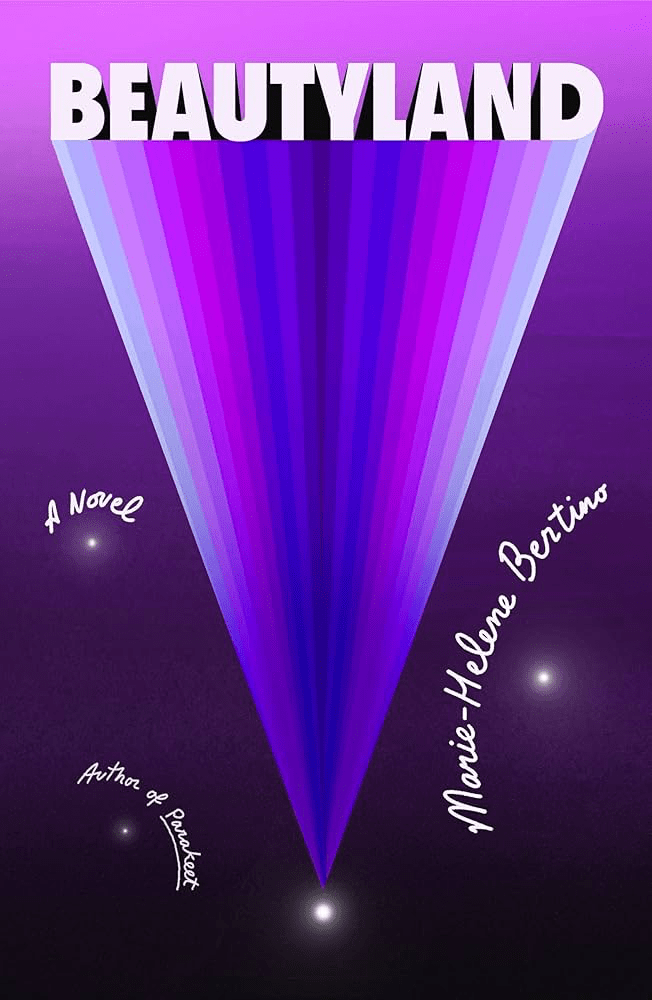
Beautyland – Marie-Helene Bertinolisten, I try not to double-dip on book pairings, especially since I paired this book with “Always Crashing in the Same Car” last week. But…the alien observing humans connection is right there!

“Breaking the Split Screen Barrier” – The Amps

Normally, I take a liking to any given Kim Deal-related song fairly quickly. But “Breaking the Split Screen Barrier” wasn’t so instantaneous for me. The beginning sounds like a series of false starts layered on top of each other. The prolonged space between each chord doesn’t just feel like a ruse: they pile up on top of each other so much that you feel like you’re being served three courses of red herrings. And I hate to say that about The Amps! I don’t think I’m that impatient of a listener, but I’m used to them getting straight to the point (see: “I Am Decided”).

After a few listens, however, you realize how much that slow build pays off. Every instrument has more crunch and crackle than a wadded-up ball of tin foil. In between the gravel and abrasion, Kim Deal murmurs her borderline surreal lyrics into a void curtained by echoing near-abrasion. Maybe I am guilty of being one of those damn gen z-ers with an attention span shorter than that of a minnow, but I think I can be patient—especially when Kim Deal is concerned. It paid off for “Breaking the Split Screen Barrier.”

…AND A BOOK TO GO WITH IT:

The Brightness Between Us (The Darkness Outside Us, #2) – Eliot Schrefer“I know you’re not sane anymore/That doesn’t mean you’re fine…”

BONUS: the great Jim Noir has a new album Jimmy’s Show 2, out on November 5th! He released a music video to accompany the lead single, “Out Of Sight,” this week:

Since this post consists entirely of songs, consider all of them to be today’s song.

That’s it for this week’s Sunday Songs! Have a wonderful rest of your day, and take care of yourselves!
Posted in Sunday Songs

Sunday Songs: 10/13/24

Happy Sunday, bibliophiles! I hope this week has treated you well.

Apologies for the lack of a Sunday Songs last week and a Book Review last week—midterms are one helluva drug. Either way, I have been able to read some fantastic books, so expect a fun review next week. For now, here’s my graphic from last week:

10/6/24:

This week: MOM!!! MOM, MADELINE’S GOING AFTER THIN WHITE DUKE APOLOGISTS AGAIN!

Enjoy this week’s songs!

SUNDAY SONGS: 10/13/24

“Instant Psalm” – The Smile

Unprecedented opinion by me: Cutouts, the second album from The Smile in 2024, was…a slight disappointment. Are all of the songs good? Absolutely—this is The Smile we’re talking about, remember? And yet, even though the talent is all there, well-crafted songs don’t make up for an album lacking in cohesion. If they knowingly named the album Cutouts for this reason, it might make sense, but it really does live up to the name; these are the scraps, but for a band as artfully skilled as The Smile, the scraps will be treasures. Even if Cutouts meanders this way and that without the direction of A Light for Attracting Attention, the moving parts are spectacular.

Take “Instant Psalm.” I love when I just have the gut feeling of knowing that a song will rearrange my molecules after only listening to a 30-second snippet of it. From the minute the strings sunburst into existence, you feel that light blooming in the back of your mind. To say that this song only starts would do it a critical injustice: it awakens in the same way a flower does, the same way a cloud of spores puffs from a stomped mushroom, all of its glistening tendrils erupting in slow motion after the joyous moment of birth. “Instant Psalm” lyrically contains about the same existential dread as any other The Smile track, but I’d place it somewhere near “You Know Me!” in terms of siblings; these glistening tendrils have heralded the manipulation that the former track ushered in, and now, all is left is a kind of mental automation where your mind knows that what it’s doing is wrong, but cannot let go of what’s coiled around it: “yes is not a real yes.” It’s so calm in its submission, and that “Instant Psalm” feels like sparkling dust blown into the eyes, the kind that clogs them up enough that they no longer see reality. If there’s anything highly specific that The Smile has excelled in, it’s making songs about submitting to corrupted, outside forces sound so soothing and sleepy. Again: precisely the point.

…AND A BOOK TO GO WITH IT:

Annihilation (Southern Reach, #1) – Jeff VanderMeer“We can slide through this narrow gap/The narrow gap that you leave us in/And we feel you near/But so close that you disappear…”

“Sick of Goodbyes” – Sparklehorse

Listening to It’s a Wonderful Life prompted me to return to one of my many depressing high school lovers: Good Morning Spider, the album that preceded the former. I thought “Sick of Goodbyes” was okay back then, and given how much I suckled on that album like a baby bottle, “okay” is harsh. Compared to the irresistible draw of the melancholy of “Sunshine” and the adrenaline-blooded screech of “Pig,” this one stuck out like a sore thumb. Why is it so twangy? And my God, is it actually…upbeat?

To be fair, it really does stick out oddly in Sparklehorse’s catalogue, and for how odd Sparklehorse sounds, that really is saying something. It somehow lies at the crossroads of alt-country and punk, where scratchy guitars meet the place where Mark Linkous hefts his Southern twang into the spotlight. It’s got a vigor that few other songs on Good Morning Spider have (save for “Pig”), but the emotion behind it is no less of a punch to the face than the rest. Linkous’ specialty has always been stirring the surreal into his lyrics like a witch tossing strange objects into a cauldron, and “Sick of Goodbyes” has what I think may be one of his best weird one-liners: “no one sees you on a vampire planet.” No beating that, right?

But beating between lyrics like that is one of the sparer sentiments, but there’s no making it flowery: “I’m so sick of goodbyes.” It is sad in the way that a Sparklehorse song typically is, but the fury behind it makes it seem almost intent on healing. It’s a recognition of wanting to free yourself from the wallowing that you’ve been doing, and saving up all of the energy to declare as such. It’s not lost on me that the final belt of the chorus cuts off at “I’m so sick,” but I can’t not see the momentum. There may be no motion yet, but all of that energy has formed legs that are willing to stand, legs that are willing to rise from the muck and power forwards. “I’m so sick of goodbyes” feels like that spark of energy after you’ve gone through the first, ugly period of your grieving and realizing that you’ve spent so much energy on the dead that you have forgotten to go on living.

…AND A BOOK TO GO WITH IT:

The Many Half-Lived Lives of Sam Sylvester Maya MacGregor“If I could just keep my stupid mind together/Then my thoughts would cross the land for you to see/No one sees you on a vampire planet/No one sees you like I do…”

“Not My Body” – Indigo De Souza

“Not My Body,” with De Souza’s intro, starts at 8:02.

While I ping-pong on whether or not I should listen to Any Shape You Take or All Of This Will End in my ongoing Indigo De Souza journey, I watched their Tiny Desk Concert, taken from the period of the latter. When introducing “Not My Body,” she said this about the song: “I think that when I die…what I want is to be composted and to become soil, and for that soil to be used to plant a tree, and I want that tree to be so big and strong. I don’t know what kind of tree yet—still thinking on it—A tree that people can visit and be like, ‘This is Indigo!'” Thus, she joins Peter Gabriel and his oak tree in what I imagine is a growing forest of reincarnation. It’s a soothing thought, to be reborn in the cells of something so sturdy.

Do you ever get those moments where you stop and have this realization that out of the billions of people on this Earth, that you are you, and by some roll of the dice, this is your life, this is your body, and this is who you are? It’s been a recurring thought lately. Those memes about gaining consciousness at age 4 in the middle of a Chuck-E-Cheese honestly hit the nail right on the head. For whatever reason, it’s been a recurring thought as of late. Not ideal for when I’m supposed to be listening to lectures, but it is a humbling reminder. As disembodying as those moments are, they remind me that yes, I do have the reins on this body. De Souza describes “Not My Body” as an ode to nature, and it taps into that feeling of being so conscious of your existence yet, for a moment, a spectator of it: “I’m not my body although you see me/Making moves and walking freely.” Nature, for me, is the missing key in this equation; the redwood tree that De Souza wants to be is the ultimate symbol of groundedness and connectivity—it is rooted in the earth, but its roots connect to all points in the wide world above and below it. There’s a happy medium between awareness and not feeling like you’re adrift in space, and nature has figured it out. And what better way to end such a sentiment than the last third of “Not My Body?” The way De Souza fashions their voice like a theremin, those echoing electronics that almost sound like dolphin calls, the gentle collapse of all the instruments into a single, coalescing being?

…AND A BOOK TO GO WITH IT:

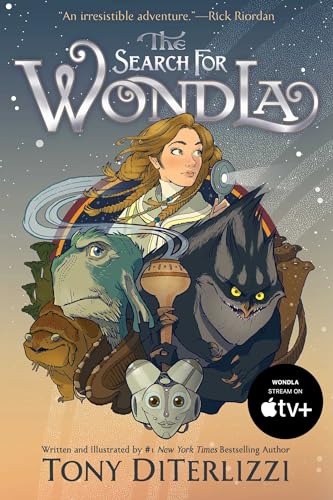
A Hero for WondLa (The Search for WondLa, #2) – Tony DiTerlizziwithout spoiling anything…Eva Eight arc, perhaps?

“Always Crashing in the Same Car” – David Bowie

If you mistook the title of this song for a commonplace idiom, I wouldn’t blame you. Frankly, it should be one. It’s memorable, it’s effective, and it’s a Bowie reference.

Low came at a deeply fraught time in David Bowie’s life. His Berlin trilogy of albums came on the heels of his darkest period, one where he committed actions that he disavowed until his dying day. Hence why I’m always suspicious and disdainful of Bowie fans who think that the Thin White Duke is somehow the “deepest” of his personas. Oh, okay, do you think you’re cool because you like the Bowie who was taking so much cocaine that it addled his brain enough to the point that he had a brush with Nazism? This is the period that Bowie spent the rest of his life thereafter vehemently swearing off (see: “Under the God“), and every clip from that era shows that he was clearly not of sound mind and body. Taking a critical look at the period is one thing, but being so uncritical about a period that Bowie so clearly wanted to forget takes a certain kind of thickheaded edgelord, in my humble opinion. It took him years to return to reality, and the Berlin trilogy chronicles his long and rocky journey towards healing, not to mention getting clean.

The circumstances surrounding “Always Crashing In the Same Car” are a fragment of Bowie’s period of addiction, an instance where, high out of his mind, he rammed his car into the car of his drug dealer. Yet there’s such a calm to this track, both warm and cold. It’s as though Bowie is watching his own life as a spectator, watching the car spiraling out of control from high above the clouds. His voice is placid, restrained, as he resigns himself to the song’s title, doomed to make the same mistakes. Apart from the crooning towards the conclusion, his voice never leaps—what does is the soaring guitar riff that seems to unfold Bowie’s ladder into the sky, from which he can watch his life from a safe distance.

Even if I haven’t gotten to such extreme lows in my life (please hold an intervention if I somehow do, good god), that kind of distance what makes the message of the song land. Breaking out of cycles and unhealthy habits is one of the hardest things a person can do, in my opinion. The effort it takes to change is outweighed by the ease of staying stagnant. You know you’re crashing in the same car, and yet your hands grip the wheel anyway. A few months, I made a commitment at the beginning of the month to stop being consumed by trivial thoughts, and I found myself trapped in an even worse cycle of anxiety just days later. The internal work I did that month was some of the most mentally strenuous that I’ve had in a while—it was far too easy to fall back on ineffective, harmful coping mechanisms than to put in the work to claw myself out of that pit of misery. I’m still working on it. But I’ve put in work. It’s taken a lot of clawing, but I’m growing the armor. Listening back to “Always Crashing in the Same Car” after all that mess gives it a whole new meaning—maybe the triumph I feel from that truly glorious guitar solo is symbolic of how it feels to climb through the sunroof, out of the wreckage, and into the light, knowing that the hard work of breaking these patterns is done.

…AND A BOOK TO GO WITH IT:

Beautyland – Marie-Helene Bertinothe narration of this novel feels the same as Bowie’s singing here: a kind of cool, matter-of-fact distance through which the world is observed, but not without some warmth.

“Sprained Ankle” – Julien Baker

From all accounts, it seems like Julien Baker has something new cooking up post-boygenius, and…hoo, boy. Am I ready? Nope. Nevertheless: I will listen. I will cry. (I already love “Middle Children” and “High in the Basement,” what can I say?) It seems simultaneously like ancient history and the blink of an eye away from when I first discovered Julien Baker, when, halfway through junior year during COVID, I listened to Sprained Ankle while I was a miserable puddle of grief and burnout. Whether or not that’s the only state you can properly listen to Julien Baker without curling up in a ball and crying is debatable, but…the only way out is through. Dramatic expression for weathering an album, I know, but there’s something gratifying in knowing that I’m a happier, stronger, and more healed person than the person I was when Little Oblivions came out in 2021. To my mom: consider this a formal apology for making you sit through almost a-capella Julien Baker depression while driving to school while it was barely even light out.

In the barest sense, Baker was working with what she had. She didn’t have any backup instrumentalists and recorded this in college at age 20, so there wouldn’t be any accompaniment other than what she played herself until Little Oblivions, alternating between guitar and piano. Yet there is no other way that “Sprained Ankle”—or any of the songs on Sprained Ankle—could have been made. It’s a lonely, self-deprecating, and wound-stingingly raw album, and outside of the lyrics, it sounds lonely. Like the bare, unadorned background of the album cover, many of the tracks feel like being in a cramped room with only the sound of your negative thoughts to keep you company. I realize how awful of an endorsement of Baker that is, but in that dreary state of 17, that was just what I needed. (To be fair, it can get to be too much—“Go Home” was exceedingly hard to listen to even back then, which is really saying something.) In the sparse, Baker creates a kind of confessional solace. Confessions are how “Sprained Ankle” starts off, after all: “I wish I could write songs about anything other than death.” There’s a self-awareness to the sadness, but like “Always Crashing In the Same Car,” the engine is running on borrowed fuel, and the marathon runner is sprinting on sprained ankles. Beyond the metaphor, Baker’s voice is meant to be the loudest thing on this record—like the cramped room, it echoes off the walls it’s given, an oral manifestation of the feeling of knowing that all you’ve got is your body. It would take a few years for it to reach the soaring heights of “Claws In Your Back,” but from the start, Baker always knew she had an anchor in her music—the instrument of her wobbling yet lighthouse-beacon piercing voice.

Now that I’ve mentioned “Claws In Your Back,” I can’t not link this dazzling performance from Baker with the National Symphony Orchestra…dare I say I haven’t felt goosebumps quite like this in years?

…AND A BOOK TO GO WITH IT:

The Ghosts We Keep – Mason Deaver“I wish I could write songs about anything other than death…”

Since this post consists entirely of songs, consider all of them to be today’s song.

That’s it for this week’s Sunday Songs! Have a wonderful rest of your day, and take care of yourselves!
Posted in Sunday Songs

Sunday Songs: 9/29/24

Happy Sunday, bibliophiles! I hope this week has treated you well.

This week: high school throwbacks, off-kilter oddities, and a few too many people trying to explore each other’s minds than I’m comfortable with. Cool it, Charles Xavier…

Enjoy this week’s songs!

SUNDAY SONGS: 9/29/24:

“Piano Fire” (feat. P.J. Harvey) – Sparklehorse

It’s a Wonderful Life is one of those albums that took me a bafflingly long time to listen to. I know, I know, I did it to myself, but the fact that I didn’t pick it up when I was 15 and irreparably mired in Good Morning Spider astonishes me. It’s probably owed to the fact that I was also even more irreparably mired in OK Computer, which tends to overshadow things a tad bit. Looking back, maybe it was for the best that I wasn’t on an all-Sparklehorse diet at that age. I already looked pathetic scuffing my snow boots through the hall while blasting “Maria’s Little Elbows” through my earbuds between classes. I was 15, guys. It was 100% that serious, trust me.

What I can say is that I think I would have felt the same way about It’s a Wonderful Life at 15 as I do now—it’s a triumph of an album. Scattering through surreal urgency and subdued melancholy, it has every kind of Sparklehorse you’d like—along with a smattering of collaborators. It’s almost funny how different said collaborators are (take Nina Persson’s delicate backing vocals on “Gold Day” and then Tom Waits growling like a hulking ogre on “Dog Door”), but the power of Sparklehorse has always lain in the disparate elements Mark Linkous cobbles together. Like some kind of American Gepetto, he constructs all of his songs into tiny figures made of warped wood and bird bones, and what totters to life creaks with every step. They’re quaint creatures with acorns for heads and cigarettes and toothpicks for legs, but there’s no other way to love them save for exactly as they are.

Those he chooses to collaborate with feel much the same way. P.J. Harvey, of all people, was a left-field choice when I first heard about her featuring on “Piano Fire.” The only Sparklehorse song I could conceive being able to contain the kind of raw fury she exudes was “Pig,” and that had already come and gone by the time It’s a Wonderful Life came out. “Piano Fire,” however, is one of the most upbeat tracks on the album; you feel a racing urgency to it, immediately sprinting down an overcast beach the minute the first guitar chords kick in. Or maybe it’s the searing heat of airport tarmac that you’re sprinting across the minute you hear the opening line: “I got sunburnt waiting for the jets to land.” Sunburnt describes “Piano Fire” surprisingly well; it has the texture of an old photograph left out in the sun too long, all of the colors now bleached to unnatural, pale shades. Linkous almost takes a backseat on his own song, never raising his voice when he dishes out surreal vignettes of “Fiery pianos wash up on a foggy coast/Squeaky old organs have given up the ghost/Fire them up and kill the piano birds.” But that urgency is why P.J. Harvey is so perfect for this song; once the chorus kicks in, her soaring voice provides the jet fuel for this creaky old jet to careen off the runway and into a sky littered with the strangest birds you’ve ever seen.

…AND A BOOK TO GO WITH IT:

Love in the Time of Global Warming – Francesca Lia BlockBlock’s bizarre, dreamlike prose certainly fits with the surreal imagery that Linkous employs in this song—and the majority of his catalogue.

“Gigantic” – Pixies

In almost two and a half years of making these Sunday Songs graphics…this is the first time I’ve double-dipped. It was bound to happen eventually, not just because my music taste is finite, but because this song has lingered with me from a young age. I faintly remember being around five or six and hearing this song in my dad’s old car, driving in fading light down the road back to my house, and hearing the iconic chorus: “Gigantic, gigantic/Gigantic, a big big love.”

I’ve often talked about how simplicity in lyrics can convey more than the most complex songs in some cases, and if you need further proof, look no further than “Gigantic.” Most of that work is done by the immense, never-fading talent of Kim Deal, who sells every metric ounce of explosive love in this song; with every cry of “A big big love,” you get it—there’s no other words that can adequately describe the kind of secretive, all-consuming romance that swirls through every pluck of the bass. That opening bass riff is the shy, cracking open of a bedroom window when the parents are asleep, an invitation with a blushing, anticipatory smile. What follows never fails to knock me off my feet. I say “knock” and not sweep or lift me off my feet precisely because that’s what it feels like, as though the ground has opened up beneath you, and you’re falling headfirst into the unknown—contained in a kiss that consumes every cell of your body.

…AND A BOOK TO GO WITH IT:

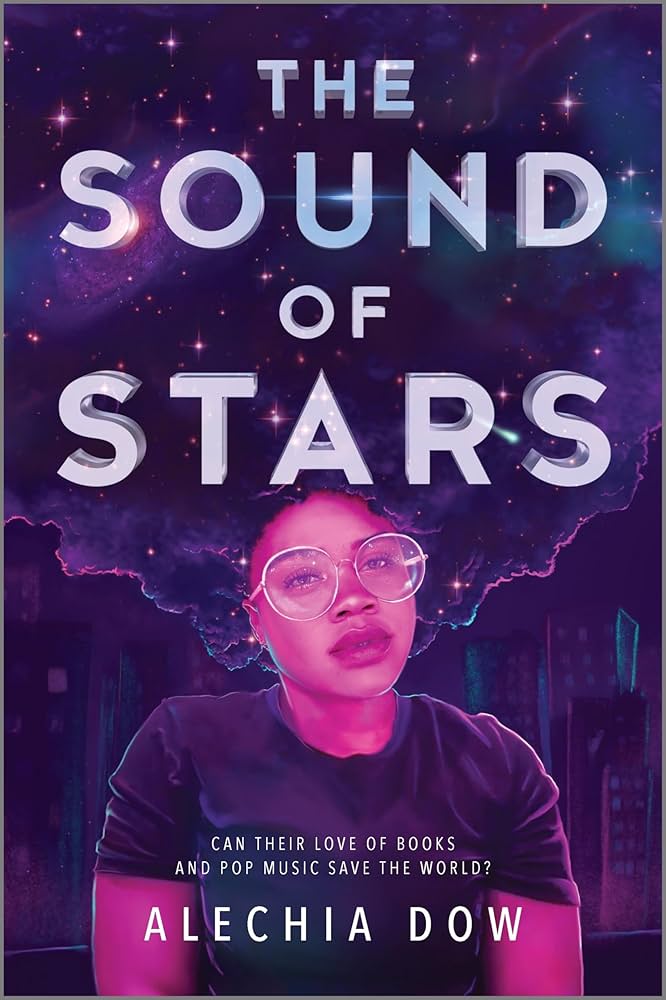
The Kindred – Alechia Dowall-consuming, explosive, and intergalactic love.

“Take Me To The River” – Al Green

I’m sure Al Green is a perfectly nice guy, but…that album cover and title is not it, man…”Al Green Explores Your Mind?” Can he…can he not?

The fact that they were just naming albums anything back in the day aside…how did I not know about this song for so long? I’ve loved the Talking Heads cover for years, but somehow, it never dawned on me to look it up and discover that it was a cover. There’s something to be said for the phenomenon of white artists’ covers of songs by Black artists overshadowing the originals, but this isn’t quite the case—from the looks of it, between the amount of times that this song has been covered (most recently by Lorde for a Talking Heads tribute album, oddly enough) and the royalties from [checks notes] those animatronic wall fish, it’s cemented itself as an enduring classic of soul. I’m sure Al Green isn’t complaining about the latter though, given that he’s gotten the most royalties from the fish cover. Yet no matter the strange journey that “Take Me To The River” has taken, none of it has overshadowed how deliciously groovy it is. It’s endured for five decades in counting precisely because it wastes no time in getting straight into its slinky, infectious funk. Green’s voice flies from slick to howling in seconds and recovers in record time, all in time with the blasts of an impeccable horn section. 50 years, and you can’t not bop your head. I’m still not jazzed about Al Green exploring my mind, but I can’t deny that he worked some undeniable, immortal magic with this one.

…AND A BOOK TO GO WITH IT:

The Final Revival of Opal & Nev – Dawnie Waltonthough the musical genres differ, the atmosphere and climate of the ’70s runs through both.

“Secretarial” – A.C. Newman

I’ve had a turnaround. I’ll be honest—even though I’ve liked several New Pornographers songs since I was young, “Secretarial” has always bugged me for some reason. I never hated it, but it was always one of those songs where, over the years, I developed a reflex of just skipping it whenever it came on shuffle. I didn’t question it for a while. Many years have passed, and for once, I didn’t skip…and here we are.

A.C. Newman—and most of The New Pornographers’ catalogue, by extension—has this songwriting style that’s just so distinctive in a way that I can’t put my finger on. Even if you separated his or Neko Case’s voice from the lyrics, I could hear a line like “So come on, let the sun in/We’ve been gunning for promotion/Postering the slogans on the roadsigns.” and immediately go “yup, A.C. Newman wrote that.” What makes it so distinct has bugged me for years, and to this day, I can’t fully put my finger on it. The closest I can say is that their specific diction has an inherently off-kilter quality to it. Newman is never overly verbose, but the way he arranges words is always slightly askew. His lyrics dwell in the thin limbo between obtuse poetry and sense, situated in a place where you can decently get the metaphor he’s going for, but instinctually, you know that those syllables just don’t go together neatly. “Secretarial,” like another other Newman product, might as well be a puzzle, in that sense, but one that was put together wrong with the pieces that only look like they should fit together, but stick and slide against each other. I’ve never been great with time signatures, but this one is angular enough to match the slanted lyrics. Even if you don’t know the guy, you can’t deny that it takes some serious talent to not just think of but pull off “Lady, it’s secretarial” as a hook.

…AND A BOOK TO GO WITH IT:

Lagoon – Nnedi OkoraforI’ve used this book more than once, but it was right there…

“One day you blew across the water/After racing through the countdown/Spewing ancient wisdom like your friend/The revelation had come and they were looking for me…”

“Henry” – Soccer Mommy

Oh, early Soccer Mommy…oh, “Henry.” This one sure soundtracked many a one-earbud-in free draw in art class my sophomore year. I think it was in the fall that I found this song as well; it carries a distinct smell of wet leaves and wood chips in the pumpkin patch. Cheesy as the title of this album, the self-released For Young Hearts, is, it’s not like it’s a lie. Here’s to many more high schoolers listening to this in art class.

It seems that “Driver” has put a pin in this tradition, but “Henry” is part of a long lineage of Soccer Mommy songs about the seduction of Bad Boys™️ (see also: “Death By Chocolate”). Of course, the natural conclusion was that the ultimate bad boy was to be conquered in “lucy,” that being…the devil himself. (God, I need to stop. I sound like a youth pastor.) But here in 2016, “Henry” chronicled the kind of guy who hung out behind the high school, smoking cigarettes in a leather jacket, and giving you a wicked smile as you passed. Sophie Allison’s younger voice, along with the plucky instrumentation (cannot get enough of that bass), makes you feel like you’re following a mischievous wood sprite through sunlit woods. Light and lovesick, it captures that heady, teenage love drug that makes every step stumble: “‘Cause Henry has a laugh like fire/And it’s spreading through the streets and burning on telephone wires/I don’t know just what it is/But he’s driving all the good girls bad with that evil smile of his.” Soccer Mommy’s had that golden, indie touch all along—”Henry” remains a classic to me.

…AND A BOOK TO GO WITH IT:

Carry On (Simon Snow, #1) – Rainbow Rowell“I don’t know/Just what it is/But he’s driving all the good girls bad with that evil smile of his…”

Since this song consists entirely of songs, consider all of them to be today’s song.

That’s it for this week’s Sunday Songs! Have a wonderful rest of your day, and take care of yourselves!
Posted in Sunday Songs

Sunday Songs: 9/22/24

Happy Sunday, bibliophiles! I hope this week has treated you well.

This week: I apologize in advance for every single driving mention and/or pun that I made in this post. I didn’t even notice it at a certain point…I just couldn’t…stop…

1:58-2:07

Enjoy this week’s songs!

SUNDAY SONGS: 9/22/24

“Bloody Ice Cream” – Bikini Kill

It’s been just under a month since I had the privilege of seeing Bikini Kill live, and even as someone who isn’t a hardcore fan of the band, I had SUCH a wonderful time! That’s owed in no small part to the commanding presence of Kathleen Hanna, not just in the history she carries, but in just how real she was. There she was, a pioneer of feminist punk, just onstage joking about how her bra was too tight and recounting a memory of rich girls pelting her with squirt guns before she walked into a job interview. Never at any moment was there a pretense of acting cool or punk. It was nothing but Kathleen Hanna, in all of her smudged-mascara and sequined glory. Bless Kathleen Hanna, really.

So when she introduced this song, which I was familiar with only in name, by saying that it was dedicated to “all woman writers,” you bet that I stood up and saluted her like it was the national anthem. And even as a fan on the sidelines, I’d accept “Bloody Ice Cream” as a new kind of anthem. It articulates in less than one and a half minutes what so many creators—chiefly women—are told about the profession: “The Sylvia Plath story is told/To girls who write/They want us to think/That to be a girl poet/Means you have to die.” The unspoken doctrine of your craft not being valid unless you sobbed and suffered over it permeates all kinds of media. I’ve been around so many people who think that trauma is the secret to good writing, whether it’s slapping it onto their characters or thinking that their hope in their message is invalid because it doesn’t show the bleakness of the real world. Counterpoint: ever experience happiness? Even once? Was that not in the real world?

The modern world may be far from perfect, but we have an understanding that could nurture and heal the Sylvia Plaths and Virginia Woolfs of tomorrow. And we have the recognition that there is no power greater than joy. In and outside of the writer’s world, we’re taught that to feel downtrodden is to experience the real world, competing each other for how exhausted we are, how much we have on our plates, and how sad and gloomy our projects are. Is this really what creativity is? It’s not like there’s no value in showing the darker aspects of life, but for how much it clogs the literary world, I feel like so many people have forgotten that writing—and imagination—isn’t just a contest for who can work themselves to the bone the most artfully. I write to put out the energy I want to see reflected in the world around me. And that energy is joy. The systems of oppression that surround us want to see people like us being so downtrodden that we have no energy to question them. So write. Write joy. Write what’s in your heart. Scream and dance like Kathleen Hanna. And don’t underestimate the value of kindness. They hate to see you joyous.

…AND A BOOK TO GO WITH IT:

The Crane Husband – Kelly Barnhill“Who was it/That told me/All girls who write/Must suicide?”

“My Impure Hair” – Blonde Redhead

The best shoegaze sounds like you’re slipping in and out of a dream, that limbo best experienced from 1-4 in the morning when you’ve woken up from a dream, your eyes are gummy, and you’re not sure if the hazy shapes forming the walls and bed around you are part of another dream you’ve yet to wake up from. I guess that’s why it’s so easy for people to get high to this kind of music, but like…well, all things, sobriety is better suited to experiencing them. “My Impure Hair” is the closing track on 23 (I’m not even a diehard fan, but I just LOVE that album cover), and even from this tiny taste, it feels like an artfully placed closing track. It has the quality of a lullaby; every element, from the soft instrumentation to Kazu Makino’s vocals, is whispered, as though not to disturb a swaddled baby drifting off in their crib. Once you think you’ve heard a distinct sound, it bleeds into another like spilled watercolors, creating a pale wisp that floats, airless, on the passing wind.

…AND A BOOK TO GO WITH IT:

The First Sister – Linden A. Lewis“But in the end/We defend our decadence/You never wept like that/Whatever lost, I won’t forget about you…”

“Kanga Roo” – Big Star

Nothing baffles me more about “Kanga Roo” than the fact that, although it didn’t officially see the light until 1978, it was recorded sometime in 1974. I suppose there’s some ’60s psychedelic bands that got close to the sound here, but this kind of deterioration feels so modern. It doesn’t sound like 1974! It sounds like a less fuzzy Spacemen 3 or the first take of a Bends-era Radiohead b-side. One of the top comments on the official audio called it “the rough draft for Wilco’s Yankee Hotel Foxtrot, which is the most astute description I’ve ever seen ascribed to it—I don’t know how it never clicked, but suddenly, “Ashes of American Flags” makes eons more sense.

I can only imagine what hearing this in 1978 felt like—probably the musical equivalent of “mom, come pick me up, I’m scared” after expecting something more like “In The Street.” Jesus. That feeling certainly crept into me when I first heard this song, while driving home from a concert late at night, navigating a winding canyon road in near-pitch black. All of the shrill mechanical squeals sound much more menacing when you’re barely awake. “Kanga Roo” sounds like it’s actively pulling itself apart at the seams, a threadbare rag only attached to its halves by a few strands of fraying string. The drums are never on beat or consistent in volume, somebody’s banging on a cowbell for about 15 seconds, and all the electric guitars are doing is getting scratched and squealed into oblivion. It’s a bizarre experience, watching a song crumble like charcoal in a dead firepit the morning after a campfire. Yet there’s an innocence to it; Alex Chilton’s voice is the only clear sound in “Kanga Roo.” You’re hearing the instruments fighting for their lives while Chilton’s plainly singing “You was at a party/Thought you was a queen.” The iconic line that gave the song its name (“oh, I want you/Like a kangaroo”) almost makes no sense, and I’m not sure if Chilton has ever offered up an explanation, but somehow, I see it. I imagine one of those towering, buck kangaroos standing at full height, and feeling the desire to grasp someone in your arms with the strength of such a creature.

I included This Mortal Coil’s cover of “Kangaroo” in one of my past Sunday Songs that I didn’t get around to writing because I was occupied with moving and school; I have too much homework to fully go into who’s coming out victorious if we’re pitting the original against this one, but I’m at least partial to it for how sparse it feels, even with the soaring strings. It’s much more put-together than the original (not to disparage the artful chaos), but there’s something to be said for what it does with the negative space that the Big Star version drowns out. What can I say? They got me. They got me with the big feels.

…AND A BOOK TO GO WITH IT:

The Spirit Bares Its Teeth – Andrew Joseph Whitethe lyrics could match up with any number of books, but it’s the creaking, uneasy atmosphere that puts it squarely in this novel’s company.

“Driver” – Soccer Mommy

I’m so glad that Soccer Mommy has become a prominent enough artist that she has the means to do funny marketing campaigns, because whoever came up with the one for “Driver” had a stroke of genius. By calling a number that Sophie Allison posted, you could get a snippet of the track before it came out, followed by “how’s my driving?”-style call prompt. Maybe we are in an okay timeline.

Without a doubt, Sophie Allison has never been more sure of herself at the wheel. A departure from the expression of beauty in lingering grief that were the two lead singles, “Lost” and “M,” “Driver” presents a more lighthearted detour to the landscape of Evergreen. The backing guitars and effects have gained a grungier, grimier edge, but Allison’s sunshine puts them all in a dusty, golden light. As the guitars and drums thrum like gravel skipping across a dirt road, Allison turns her attention to the present loves of her life. You almost get the feeling that she’s slipping into the self-deprecation of her early career, but there’s nothing but affection for herself, but more in terms of her partner, who puts up with her “losing [her] concentration on every whim.” Allison presents herself as the more emotional, scatterbrained half of the couple, which her partner is playful about, but is also the one to ground her when she gets too far into her head with a reminder of “where are we going now?” She’s never completely blameless, but she’s full of nothing but love for her anchor that keeps her from veering off the path; it’s not like some of her earlier songs, like this would indicate that she’s in danger of slipping away entirely, but it’s an exercise in learning to rein yourself in—and find somebody who isn’t afraid to rest a hand on your shoulders and remind you where your feet are planted.

…AND A BOOK TO GO WITH IT:

Aurora Burning (The Aurora Cycle, #2) – Amie Kaufman and Jay Kristoffnot to get all 2020 Madeline on you all, but…the Kalauri in this song…I’m gonna keel over…

“I’m a five foot four engine waiting to move/I’m a test of his patience with all that I do/‘Cause I’m hot and he stays cool, I don’t know why/But he puts up with my moods/And he makes me smile when he says/’Where are we going now?'”

“Bishop’s Robes” – Radiohead

The connection of inspiration between Radiohead and The Smiths never surprises me, but sometimes, with bands that inspire another, you find a single song that you know is the missing link in the evolutionary tree, the line of ancestry concretely delineating their music as kin. More specifically, it makes sense next to their cover of “The Headmaster Ritual,” though “Bishop’s Robes” takes a much more subdued turn.

Yorke’s raw lyricism thrives in both simplicity and complexity; he can weave any number of stories with denser, more prosey lyrics, but he knows just what kind of simple, unadorned phrases to stab you in the gut with. In this case, it’s the chorus, repeated like a shaky-voiced prayer in a dark corner: “I am not going back.” It becomes more of a reminder than a statement, as though to convince his brain that no, he’s not back in his pre-teen years under the reign of his “bastard Headmaster.” Volumes have been written about the horrors and abuse of the British education system back in the day (see: pretty much anything by Pink Floyd)—and some continuing into now, I would imagine—but what sets “Bishop’s Robes” apart is the mood. It might be more accurate to call it a lack, as the most overwhelming feeling you get from this track is not anger but numbness. There’s a resignation to it, weighing down the music, as though, even in adulthood, the experience has sapped him: Yorke doesn’t have the energy to fling insults along the lines of “spineless swines” or “belligerent ghouls” at his abusive childhood tormentors—all he can do is “bastard.” And it’s that eyebagged, forlorn crawl that sells the lasting effect it had on him. After years of unyielding discipline, I can imagine the fear of not raising your voice—a haunting presence that permeates every note of this track, constantly looking over its shoulder to guard innocent contraband that doesn’t exist.

…AND A BOOK TO GO WITH IT:

Agnes at the End of the World – Kelly McWilliamssecrecy, escape, and the horrors of a perverted version of Christianity in the hands of the wrong man.

Since this post consists entirely of songs, consider all of them to be today’s song.

That’s it for this week’s Sunday Songs! Have a wonderful rest of your day, and take care of yourselves!
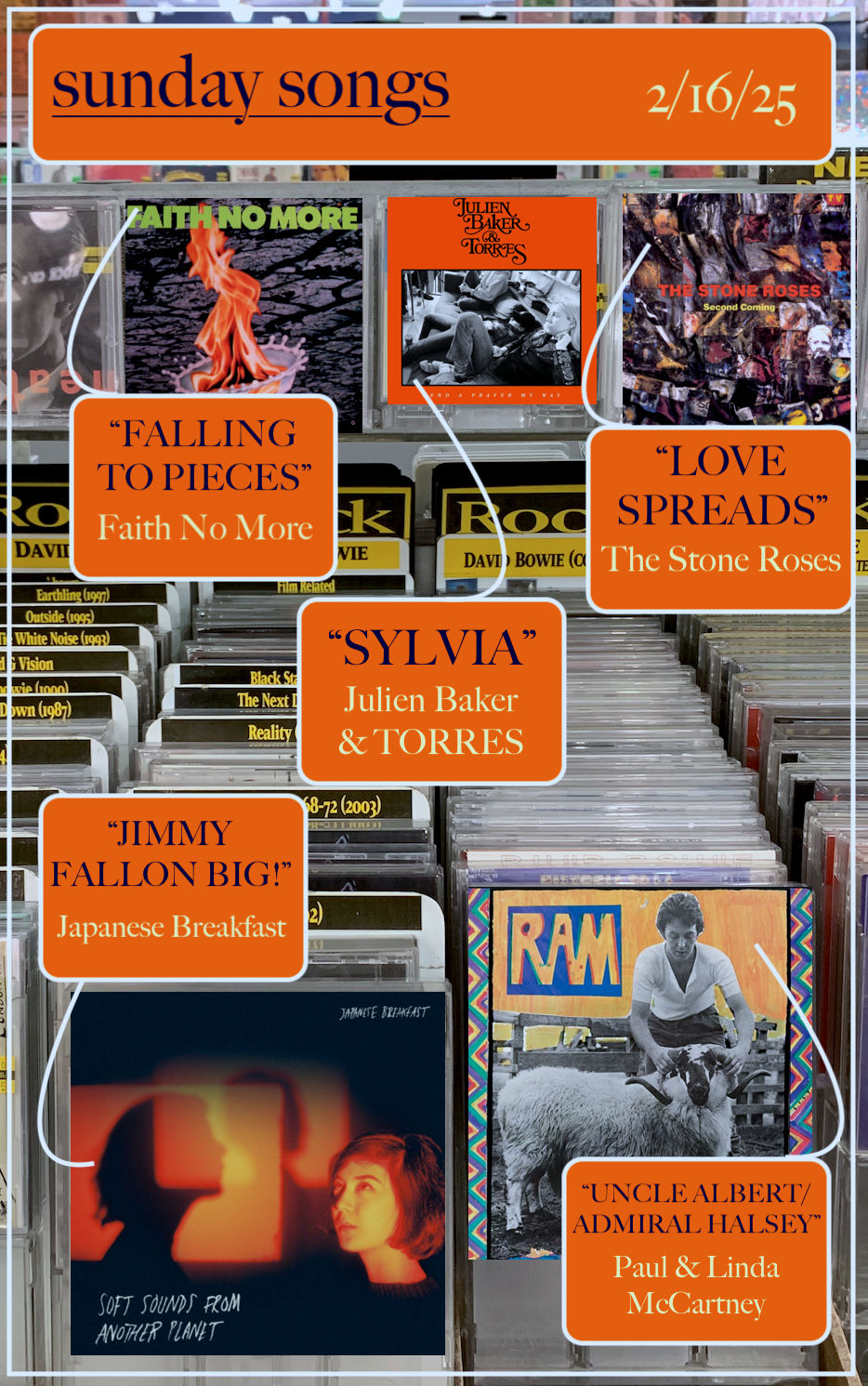
Posted in Sunday Songs

Sunday Songs: 9/15/24

Happy Sunday, bibliophiles! I hope this week has treated you well.

Before I get into today’s songs, I’ve also compiled my graphics for the last few weeks when things got busy. I made them (because I love making silly little graphics and giving them silly little color palettes), so, for your casual perusal, here they are:

8/18/24:

8/25/24:

9/1/24:

9/8/24:

This week: contradictions, distinctive voices, people who deserve to cover The Beatles, and…okay, the jury’s still out on whether or not what seems to be the final boss of hipster white boys can pull off mariachi, but that’s here too, I guess? I don’t know enough about mariachi to judge…

Enjoy this week’s songs!

SUNDAY SONGS: 9/15/24

“Danger” – Panda Bear & Sonic Boom

There’s something to be said for how distinctive Panda Bear (a.k.a. Noah Lennox) sounds—so much so that, having only heard a handful of his songs, when I heard that he had a hand in “Danger,” my immediate reaction was oh, that makes complete sense. What made even more sense was Sonic Boom (a.k.a. Peter Kemper); I had no idea what his deal was until my dad explained that he was one of the original members of Spacemen 3…and all of the puzzle pieces came together in complete harmony.

Someday, in some future age, I’ll bet that some scientists will come up with a way for us to be able to physically touch music. (It physically touches us, in a way, so maybe the inverse isn’t all that far away…who knows.) Whenever they come out with the playlist and the associated objects or capsules of sensation, I dearly hope that “Danger” is among the first, because it’s already a step ahead of the game; it’s so textured and layered that you can almost feel its tendrils brushing against your ear. Technology and creativity have collided to the point where these two have made a song that sounds exactly how it feels to touch one a puffer ball—y’know, the squishy balls you get at Walgreens or something with all the noodles sticking out? All manner of electronic textures were thrown in the stew pot, and the result is so elastic yet so hard-edged, so malleable yet so solid, so transparent yet so dizzyingly dense. Panda Bear’s voice, whether it’s singing or just letting out a spontaneous pigeon’s coo, collapses into neon dust motes with every note.

I’d that imagine that somebody with synesthesia (specifically chromesthesia, the variety where the person links sound to colors, shapes, and movement) would have a field day with the densely-packed prize box of auditory textures in “Danger.” Even with the cries of danger, I feel myself pulled under, drowning in a sea of spores and rubber, with every listen. Maybe that’s the danger—slipping under as your senses surrender to the prickles of this song?

As if making a whole album of, presumably, the same layered insanity (see also: “Edge of the Edge”), Panda Bear and Sonic Boom released an EP with Mariachi 2000 de Cutberto Perez consisting entirely of mariachi renditions of several tracks from Reset, including “Danger”—now reworked as “Peligro.” I’m not sure if I’m fully on board, but…those visuals should’ve been with the original track in the first place! All the colors and morphing shapes…

…AND A BOOK TO GO WITH IT:

The Stardust Grail – Yume Kitasei“All that you do for me/Can’t you see what you do to me?/Gave you a pot for the tea to brew/Give me a spot for the art to grow…”

“Zero Sum” – The Smile

Here I was thinking all of my most anticipated albums of 2024 had come and gone…two Smile albums in one year? WE ARE SO BACK. THOM YORKE HAS BLESSED US!! Between this, the TV on the Radio reunion, new Soccer Mommy in a little over a month, and a Kim Deal solo album on the way…the party’s far from over! Days like the one with the trinity of TV on the Radio, Smile, and Kim Deal news make me remember how silly the people who claim that there’s “no good music anymore” truly are. That’s all on you, chuckleheads. Skill issue. Look harder. (Apply this mentality to all forms of modern media. Add water and stir. You’ll find what you’re looking for.) And sure, all of the bands I mentioned either are or have been a part of mainstays in the alternative scene, but that doesn’t negate the fact that innovative music is still being made, dammit. And if you’re looking for somebody truly new? Boom. Soccer Mommy.

I anticipated that there was going to be at least one more album from The Smile on the horizon, but it really does seem that Yorke, Skinner, and Greenwood just cannot stop their creative flow, and god, I am so grateful for it. Although their first offering, “Don’t Get Me Started,” was…weaker, though not bad by any stretch of the imagination, the official album announcement of Cutouts came with twin singles “Foreign Spies” and “Zero Sum.” The latter was the obvious standout, and not just because it’s the only fast-paced one of the bunch. The Smile and slow-paced songs are by no means a bad combination, but “Zero Sum” is just so supercharged with frenetic energy that it automatically stands out. Chances are, if you happened to inject this song in liquid form into the veins, it would probably have the effect of chugging 5 energy drinks in one sitting. It’s just so spidery, so rapid and skittering that you get eyestrain from trying to track just where the beat goes. I can already see Thom Yorke’s signature jerky, angular dance moves onstage once they slip this into the regular rotation for the tour. (You guys are doing an American tour, right? Right? Right?) Horns triumphantly blare amidst the mile-a-minute guitars and synths (now that’s some “FASTER, JONNY” for you), and Yorke, of course, has a dystopian, buzzword-filled collage of lyrics: “Thinking all the ways/The system will provide/Windows 95, Windows 95.” If there’s anybody who can get me dancing to a repetition of Windows 95, of all things, it’s these guys.

Oh, and…RADIOHEAD HAS BEEN REHEARSING, YOU SAY? I hereby apologize for my inevitable outbursts once a) Cutouts comes out, and b) whatever the hell comes out of this Radiohead Rebirth. WE ARE SO BACK!!!!!!!!!!

…AND A BOOK TO GO WITH IT:

Finna – Nino Cipri“A clipped tongue, acting dumb/Somewhere in the past in a re-run/Thinking all the ways the system will provide…”

“Fortunately Gone” – The Breeders

I don’t typically associate The Breeders with any kind of whimsy. Not like they’re some kind of depression-fest or anything, but they’re not afraid to get on the heavier, crunchier side of things—listen to any track from Last Splash and you’ll know what I mean. So when I paid attention to the lyrics, it was a surprise to see how plainly and delightfully nonsensical they are; “Fortunately Gone” reveals its heart right in the opening verse: “I wait for you in heaven/On this perfect string of love/And drink your soup of magpies/In a pottery bowl.”

The more I think about it, the less surprised I should’ve been by this divergence into tenderly fantastical lyrics. I say that because Kim Deal’s voice feels molded for this purpose. No matter how much distortion you throw at her, there’s a bare-hearted openness to her voice. Her voice is the healing of a scar on your knee, always tender, but never without some semblance of hope, joy, or some manifestation that blood and bruises aren’t all there is to life. Even amidst the grit and ominous air they artfully paste over their cover of The Beatles’ “Happiness is a Warm Gun,” complete with the muted flick of a lighter brought to life, Deal whispers the title refrain with the tone of a child in an empty room watching sunlight peek through the slats of window blinds. That same hope is what buoys this tale, a story of a woman in heaven waiting for her past lover to die so that they may reunite: “Fortunately gone, I wait for you.” Kim Deal was made for the role of this lovelorn, afterlife-confined piner, and nudged into less than two minutes, every tender note lands just as the lyrics tell you so: “Sweetly as it drops upon your head/Just like it did today.”

…AND A BOOK TO GO WITH IT:

The Bad Ones – Melissa Albertreaching through the veil to find out the truth about your best friend’s death—not just in terms of what killed her.

“I Am I Be” – De La Soul

I’m inevitably getting all College™️ with this one, but can you blame me? I spent the other day talking about how this Richard III monologue displays the dissolution of the character’s sense of self. The amount of contradictions it has fits more with the next song I’m discussing (see below), but the clear-cut divisions reminded me of the title here—”I Am I Be.” It functions partly as a vehicle to add in some silly guest features and ad-libs throughout the song, starting with “I am Shortie, I be 4’11′” and devolving into silliness in the background as the song progresses (“I am Patrick, I be the biggest shrimp collector in the world,” and by the end “I am Bob, and I be really tired of doing this, guys”). After their hard left turn into cynicism of De La Soul is Dead, there’s no denying that their propensity for goofiness never faded away, however much they wanted to deny it.

But as a part of the lyrics, “I Am I Be” functions as parts of the self. After three albums, all three members of De La Soul had gotten squeezed like an empty tube of toothpaste to form an image, whether it was the flower power revival of Three Feet High and Rising or the pressure to crank out another classic post-De La Soul is Dead. From the snatches of Buhloone Mindstate that I’ve listened to, it seems like this album was the limbo outside the two—not completely happy-go-lucky again, but always willing to push the boundaries of what hip-hop could be. They were determined to not let the music industry grind them down, despite the bleak first lyrics: “I be the new generation of slaves/Here to make papes to buy a record exec rakes.” This is where, for me, the “I Am/I Be” division comes in. I’m really English majoring it up right now, but hear me out. I am represents the core of the (De La) soul, as dictated by Posdnuos (“I am Posdnuos”), whereas “I Be” is the circumstances where they find themselves (“I be the new generation of slaves…”). Neither negates the other, but together, they form a completed picture of the self. All after the latter lyric concerns Pos’s past, from collaborators abandoning him to his experience being beaten down by the music industry. But never at any point, amidst all this bleakness, does he crumble under the pressure; the end of the first verse is an assertion that no matter what life throws at him, he will pledge to stay true to himself: “If I wasn’t making song/I wouldn’t be a thug selling drugs/But a man with a plan/And if I was a rug cleaner/Betcha Pos’d have the cleanest rugs, I am.” There: bookending the last line, I am, the true self, returns. Dave’s second verse ends in a similar way: “I keep the walking on the right side/But I won’t judge the next who handles walking on the wrong/Cuz that’s how he wants to be/No difference, see I wanna be like the name of this song, I Am.” For a band that have been through the ringer (and largely emerged triumphant, though it took them decades to get there), it’s already a world-weary assertion, but one that never gives up the spirit—to this day, the surviving members of De La Soul continue to spread their artistry and positivity, now even further reaching thanks to their hard-won legal victories surrounding their music being on streaming. Through it all, they’ve stayed true to I Am.

…AND A BOOK TO GO WITH IT:

And Other Mistakes – Erika Turner“Every now and then I step to the now/For now I see back then I might have acted like a fool/Now I won’t apologize for it…”

“Echo” – Kristin Hersh

Crazy how I haven’t managed to talk about Kristin Hersh in one of these posts yet…I’m admitting my bias before I make a statement as sweeping as this, but I truly believe that Kristin Hersh has one of the most unique singing voices I’ve ever heard. It lies at an unusual confluence of the tiniest rasp, an understated Southern drawl, and a nasally tremble that, despite there not being words about it that sound complimentary (sorry, Kristin), is only a banner declaring her voice to be like no other. Separately emphasized, those elements would be off-putting (I only mean the Southern drawl in the way that modern country singers lay it on so artificially thick that it becomes meaningless to the All-American image they’re peddling), but where Hersh lies, they’re the perfect parts.

Whatever Hersh intended Sky Motel to mean (I’m between the sky over a motel or a floating, retro-futuristic motel with a rusty sign advertising vacancies on some kind of hover-buoy near the spaceship parking lot), it’s a fitting feel for “Echo.” Faint cricket songs decorate the intro, and combined with the gray, distorted smokestacks and skylines of the music video, it packages that feeling of staring up at the sky from a hotel parking lot, exhausted and operating on too little sleep. The opening lyrics also conjure the space directly before that—for me, somewhere in the dimly-lit back of a taxi from the airport: “White label on the backseat/glows an artificial green.” Amidst ambling keyboards, Hersh seems to stumble through the streets, torn between extremes; caught between the stability of “an empty lifestyle” and the allure of “the very loudest sound.” Every lyric is a contradiction: “I’m loving everybody/And hating everyone I see.” Hersh straddles the two poles just as the music does—each chorus roars from the bug-flecked quiet of the verses, and drunkenly stumbles back into tranquility just as quickly. Though she never lands on which direction she’s pulled towards, there’s a solemn acceptance that the middle ground is in sight, but just out of reach—”Do you hear the loudest sound/Floating out on the echo?” That violent oscillation of contradiction is what makes “Echo” stick so solidly, both in the inability to land between two extremes and only being able to see the most sparing glow of solace—a space I often find myself as such a sensitive person. It’s easy to get swept up in that turbulence, and easier said than done to reach out to that floating echo.

…AND A BOOK TO GO WITH IT:

I Am the Ghost in Your House – Mar Romasco-Moore “I crave a midnight something/I crave and something hunts me down/I’m scaring everybody/I’m wearing everybody down…”

Since this post consists entirely of songs, consider all of them to be today’s song.

That’s it for this week’s Sunday Songs! Have a wonderful rest of your day, and take care of yourselves!
Posted in Sunday Songs

Sunday Songs: 8/11/24

Happy Sunday, bibliophiles! I hope this week has treated you well.
This week: When I say L, you say OG! L TO THE…?

Enjoy this week’s songs!
SUNDAY SONGS: 8/11/24

“Lazy Eye” – Silversun Pickups

This song returned to me like an old friend not long ago, and with it, some misconceptions that were only picked apart when I saw the music video for the first time. For the longest time, I thought that a woman was singing this song; I saw Nikki Monninger and thought, naturally, she had to be the one singing, right? Wrong—Brian Aubert just has a uniquely high-pitched, more androgynous voice. (To be fair to my past self, Monninger does sing lead on a handful of their newer songs, but she primarily plays bass.)

I specifically remember the only other Silversun Pickups song I know, “Circadian Rhythm (Last Dance)” being on heavy rotation on Sirius XMU back when I was in middle school, but even around 10 years apart from each other, “Lazy Eye” has that same meticulous drive that the best 2000’s indie-rock track had. It’s almost startling to me that this song isn’t the opening track of the album, Carnavas, even having heard nothing else from it—there’s just a feeling of it that’s just so distinctly beginning. The instrumentals build up from steady indie-rock, laden with foreshadowing in the form of Aubert’s driving flourishes of both vocals and guitar. “Lazy Eye” segues into a second act that can bear no description other than explosive, splattering in your face like a can of soda shaken up for too long. But as quickly as everything ricochets in a thousand directions, the floorboards fall out from under it, returning to its mellow origins as the repeated outro of “The room, the sun and sky” fades into the woodwork. Paired with the precipice-staring lyrics of anticipation and coming to grips with reality (“I’ve been waiting for this moment all my life/But it’s not quite right”), make it feel molded for the intro of a coming-of-age movie, coming to grips with the fact that nothing’s as perfect as you can ever dress it in your imagination.

…AND A BOOK TO GO WITH IT:

Where You See Yourself – Claire Forrest“I’ve been waiting/I’ve been waiting for this moment all my life/But it’s not quite right…”

“Juna” – Clairo

I’m far from caught up on any kind of Clairo lore, but apparently “Juna” is the first song that she’s ever made a music video for! There’s something funny, unintentionally or not, about having a song (and a singer) as unassuming as Clairo set against the backdrop of a bunch of screaming, oiled-up wrestlers tossing each other around. Somehow, it works.
Clairo has never fully blown me away, but every once in a while, she’ll break through the mellow and snap into something luscious that has me looping it for days. Maybe I just like Clairo when she leans into the ’70s influences—I always come back to the funky bass that comes through the sadgirl mold in “Amoeba,” but “Juna” fully leans into it. If you took away the synths and left in the layered piano riffs, this track would feel like pure ’70s soul. I’d be fully convinced if there turned out to be some grand conspiracy to make this song just to soundtrack playing pool in a dimly-lit club, flickering lights fading both inside and out as the multicolored balls collide across the velvet. It has all the grace of aging, velvet curtains and the twinkling of new, flirtatious love, the kind that pushes you towards things you wouldn’t have done before: “You make me wanna go dancing/You make me wanna try on feminine/You make me wanna go buy a new dress/You make me wanna slip off a new dress.” Clairo’s voice constantly feels seconds away from dissipating into thin air, but she pulls off the sultry groove that “Juna” presents. And somehow, just like the bizarre juxtaposition of this song’s gentle disposition and said video of greasy wrestlers, something about Clairo’s mouth-trumpet breakdown (new sentences are formed every day) fits right in. I’d prefer…maybe more actual trumpet, but I feel like there’s something perfect about this song not taking itself too seriously. (Not necessarily everybody else in the video hamming up said mouth-trumpet breakdown…yeah)

…AND A BOOK TO GO WITH IT:

The Invisible Life of Addie LaRue – V.E. Schwab“Most of these days/I don’t get too intimate/Why would I let you in?/But I think again…”

“Drain Me!” – Towa Bird

One of my first thoughts while listening to “Drain Me!” was that it sounded like Pixies if they’d gone pop. Seems like an oxymoron, but I swear that there’s something about the guitars near the last third and the chord progression that reeks of “Gigantic.” Conclusion: this is Pixies, if they happened to be a) more pop-inclined, and b) ragingly lesbian.

I’m sure you have to be an unattainable, Taylor Swift level of influential to be able to control when your record comes out, but releasing Towa Bird’s debut, American Hero, this May, right before the rush of summer, was a genius move. Granted, this is the only song of hers I’ve heard, but it is a PERFECT summer song. Charged with reckless kisses and clandestine meetings, it feels like the kind of head-over-heels love that’s made for blasting with the windows down, careening down the highway. Bird’s guitar-driven approach pulls it ever-so-slightly out of the mold of mainstream pop, but there’s no denying that this is a summery pop song for our day and age—you make a song like this, and you’re just asking to have it featured in Heartstopper or something. And how wonderful is it that we have so many out, queer pop songs? Open queerness exists in almost every genre right now, but even if I don’t like a particular artist, it gives me hope to remember that songs about women loving women can draw massive crowds—and even better that this one was written by a woman of color. It’s not like this song is revolutionary, but that doesn’t mean it isn’t worth celebrating—and fully worth dancing around to.

…AND A BOOK TO GO WITH IT:

Road to Ruin – Hana LeeDaredevil sensibilities, magic-powered motorbikes in the post-apocalyptic wasteland…and queer women.

“Lorelei” – Cocteau Twins

Thus (tentatively) concludes my Cocteau Twins summer…for now, at least, until it’s cold and I can allow myself to listen to Victorialand. Cocteau T-winter.

I’ll see myself out…

This is the only track I’ve heard off of their 1984 album Treasure, which critics seem to have attached themselves to like the album’s namesake, but has been described by the band themselves in terms including but not limited to Robin Guthrie calling it “an abortion.” Yeah…again, harsh, but if this is the only track I take from it, how on Earth does “Lorelei” deserve that slander from its own creator? Sure, they hadn’t hit their stride at this point; it sounds more distinctly, in-your-face ’80s with its stuttering drum machine and slipshod production, but it’s all part of the charm, if you ask me. That drum machine is the paperweight keeping the billowing curtain of Elizabeth Fraser’s silk-thin voice tethered to the earthly realm. Even so early on in their career, Fraser had already honed the ethereal breath of her voice, able to make every hum, mumble, and lilt the stuff of magic itself, how I’d imagine the texture of fabric woven from the dewy web of a spider in the early hours of dawn.

…AND A BOOK TO GO WITH IT:

A Magic Steeped in Poison – Judy I. Linthe kind of breathy, enchanting music fit for a magic system based on the properties of tea.

“L to the OG” (from Succession) – Kendall Roy

I’ve finished the first two seasons of Succession, and my main takeaway is this: watching Kendall Roy, a middle-aged billionaire whose vocabulary consists of every corporate buzzword imaginable strung into a sentence, not only try to rap, but say a line like “yo, bitches be catty/but the King Kong daddy/Rock all the haters while we go roll a fatty” gave me more whiplash than the twist ending of the season finale. It’s like watching a train wreck…you just can’t peel your eyes away…

…AND A BOOK TO GO WITH IT:

The Electric Circus – Timothy Lipton“It’s about a young man making his way through the world. It’s set in two different time periods; it kinda switches back and forth…the circus part is a metaphor for the anxiety of modern life.” – Roman Roy, starred review

Since this post consists entirely of songs, consider all of them to be today’s song.

That’s it for this week’s Sunday Songs! Have a wonderful rest of your day, and take care of yourselves!