Posted in Sunday Songs

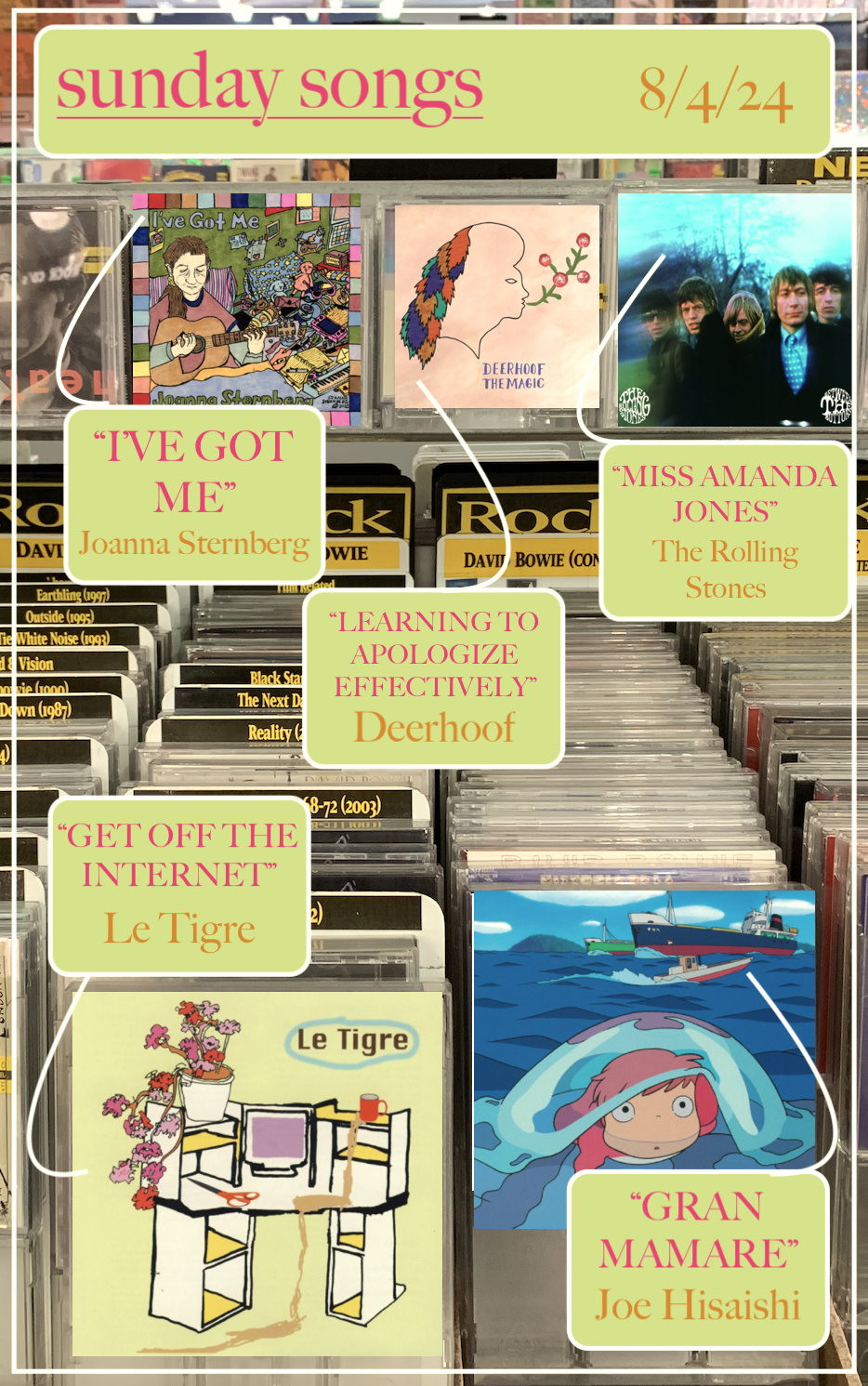
Sunday Songs: 8/4/24

Happy Sunday, bibliophiles!

This week: I fully see the irony of putting a song called “Get Off the Internet” on a blog post……….decidedly on the internet, but you get it, right? Right?

Enjoy this week’s songs!

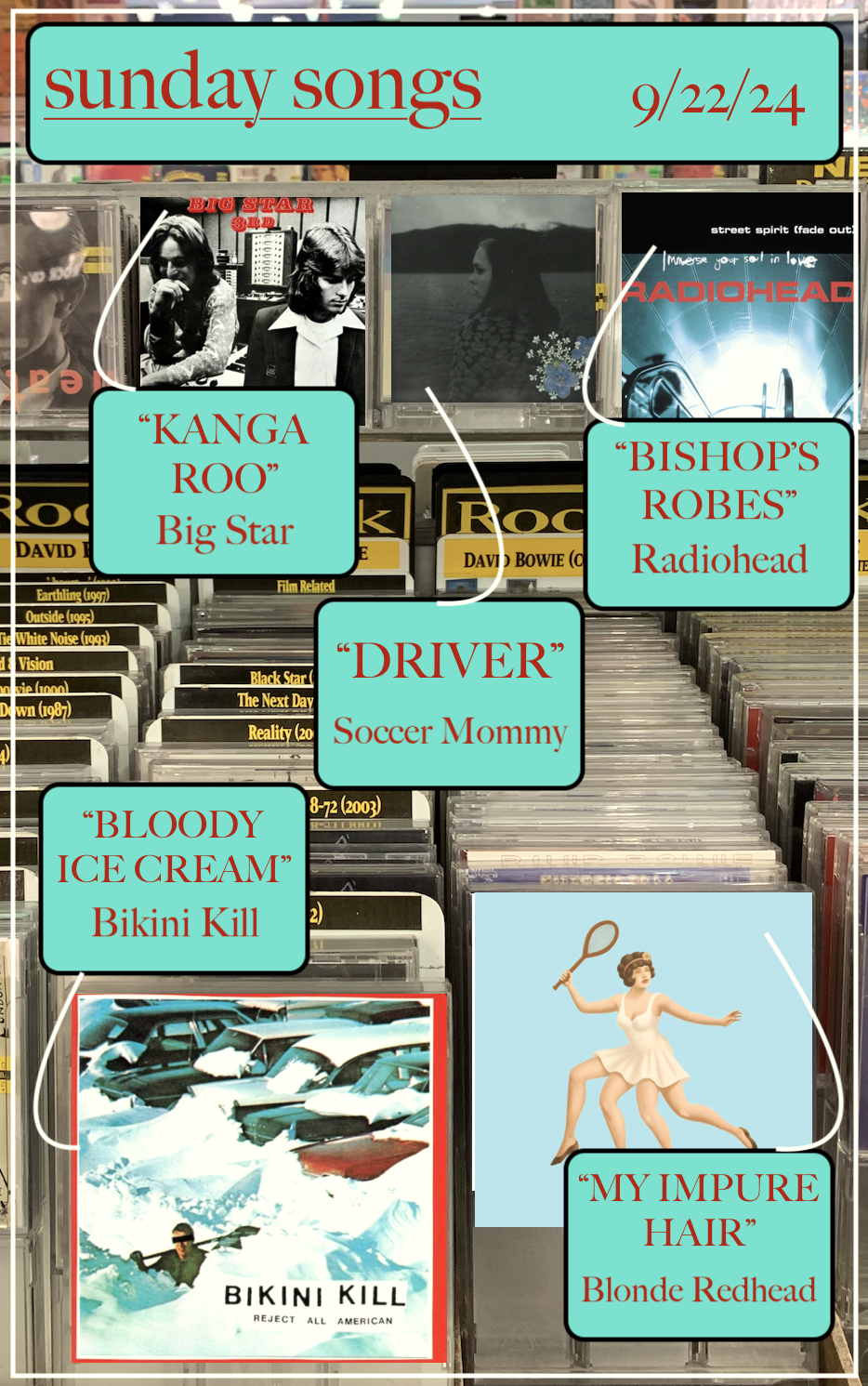
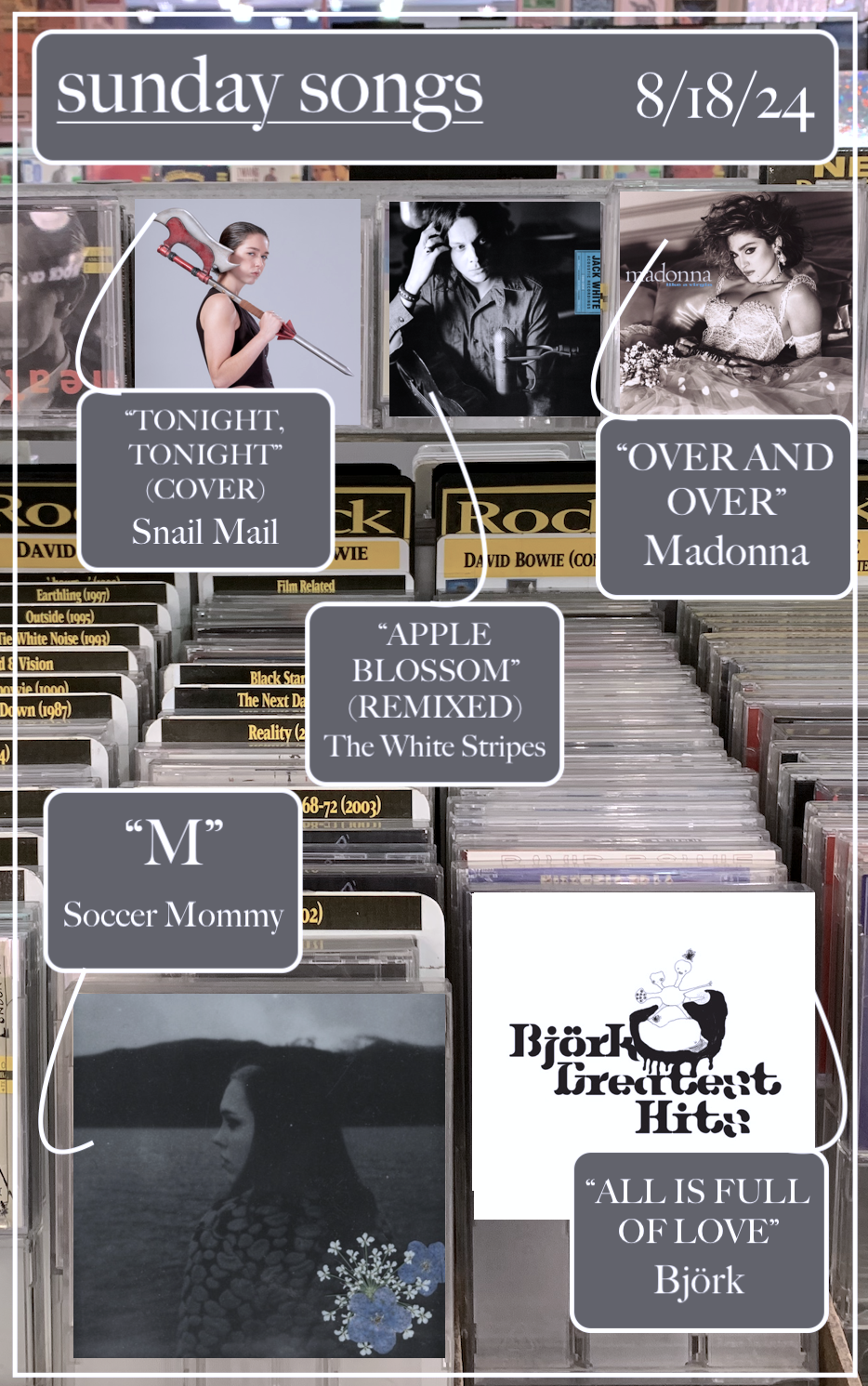
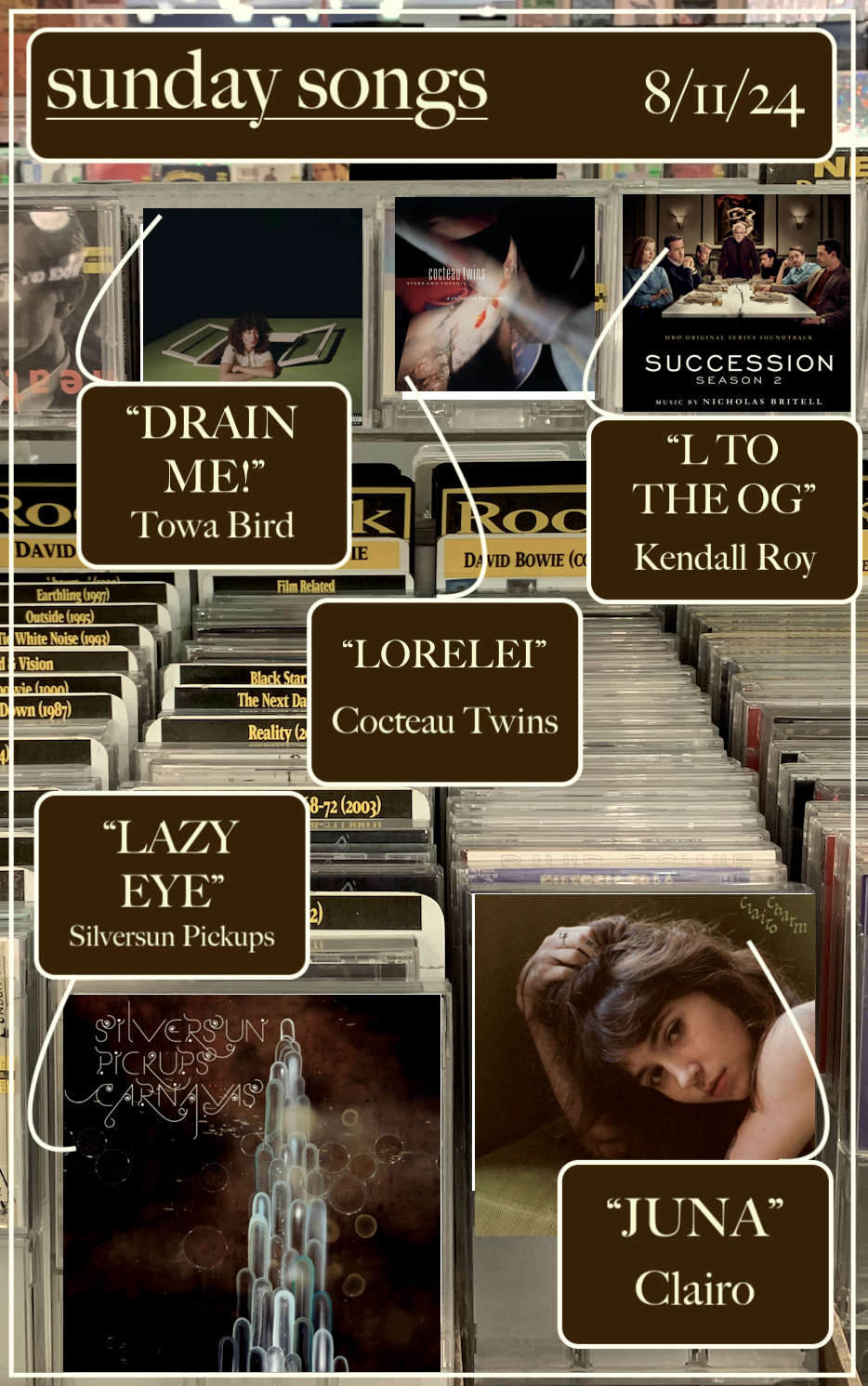
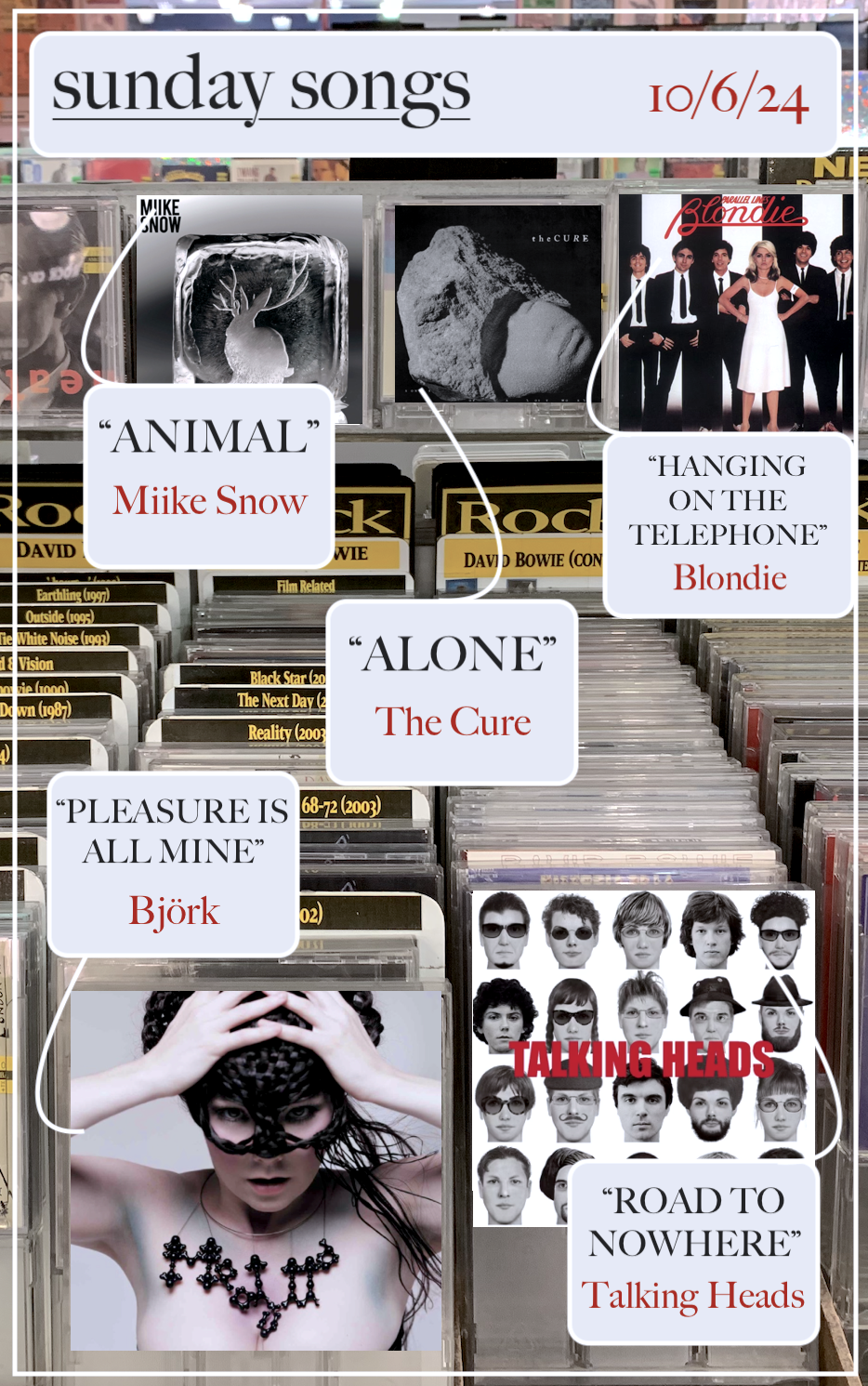
SUNDAY SONGS: 8/4/24

“Get Off the Internet” – Le Tigre

I miss when people could get along despite their politics, but…have you seen Project 2025 lately? Were you not paying attention to Trump’s entire presidency? I wouldn’t be saying this if, y’know, they weren’t trying to take all of our rights away, but…

GET OFF THE INTERNET!! DESTROY THE RIGHT WING!!!!

…AND A BOOK TO GO WITH IT:

Our Stories, Our Voices: 21 YA Authors Get Real About Injustice, Empowerment, and Growing Up Female in America – edited by Amy Reedmodern accounts of femininity and feminism from a collection of incredible authors.

“Gran Mamare” (from Ponyo) – Joe Hisaishi

Watching Ponyo as an adult felt like watching it for the first time. Technically, my recent rewatch was my second time seeing it in over a decade. Every time I’ve thought about it before then, it felt like a fever dream…probably because my first viewing was something along those lines. I was about 5 or 6, and I’m almost positive that I was home sick from school. Either way, I was in my parents’ bed. All I could remember were faint glimpses of Ponyo underwater, the man, the myth, the legend, Fujimoto (close enough, welcome back David Bowie)…and Granmamare.

If there’s any gorgeously-crafted scene (of which there are many) to take away from that movie, it’s any scene with her. No wonder my five-year-old brain retained an image of such beauty, even when it was (probably) sick. Her first appearance isn’t necessarily emotional—all she’s doing is talking to Fujimoto about what to do with Ponyo—but all of the sudden, I found myself overcome with tears. All those years ago, and it took my breath away. (And who better to voice such a goddess of such beauty than Cate Blanchett? It had to be Cate Blanchett.) Maybe I was just in an emotional state, but something in the sheer beauty of that scene stirred up something hidden and beautiful in me. Joe Hisaishi’s sweeping score gives it an appropriately sparkling, John Williams-like grandeur, befitting of a character so powerful that she illuminates the whole ocean with her radiance.

Either way, I’m so glad that I rewatched it. Ponyo want ham.

…AND A BOOK TO GO WITH IT:

Lakelore – Anna-Marie McLemore – mysterious and magical underwater realms, anyone? (Admittedly, Ponyo delivers much more on that aspect, but you can’t beat Miyazaki.)

“I’ve Got Me” – Joanna Sternberg

The name of the video is a bit of a misnomer, in my opinion—yes, technically it is a lyric video, but the lyrics are accompanied by a full-color comic drawn by Sternberg, which makes it feel like a fully-fledged music video. It’s so worth a watch—they have such a charming art style.

When I say this, I say it with all of the affection in my soul, but it’s remarkable that at only 32, Joanna Sternberg sounds just like a kind, elderly music teacher. Again: nothing but affection. Their voice just emanates that comfort that I associate with the kind of person who teaches preschoolers how to use maracas and such. The album art, as well as the associated art only add to the vibe—the scratchy inking and pastel backgrounds only add to the feeling that I would find this CD in said music teacher’s collection. Heck, I can almost imagine having to sing “I’ve Got Me” in a preschool program, if not for lines like “between self-hatred and self-awareness is a very small, thin line.”

Nonetheless, all of this is to say that “I’ve Got Me” has a purity to it. It’s got the sing-songy sway of a children’s song, but in its touching vulnerability, brushes over a sentiment I’ve battled with for much of my life: “why is it so hard to be kind and gentle to myself?” (Boy, do I relate to the panel at 0:46 with a sullen-faced Sternberg wearing thick-framed glasses captioned “me looking through the file cabinet in my brain that stores all of my bad memories”—even better, it’s alphabetized.) Armed with nothing more than their acoustic guitar and a stand-up bass, they produce a solution that gives this even more of a children’s music feel: “Take the box of self-deprecation/Lock it and put it on the shelf/Then wait five days, take that box/And throw it in the fire.” Through said self-deprecation gathering dust and anxiety on the shelf, Sternberg retains an understated but resilient hope—”I’ve Got Me” as a title feels like an assertion that, no matter if you think you’re alone, you are all you’ve got. You have but one body and one mind, in all of its flaws, and you may not be able to control some of the inevitable bouts of self-deprecation, but it’s still you, in the end.

…AND A BOOK TO GO WITH IT:

Someone You Can Build a Nest In – John Wiswellin both a literal and figurative sense, learning self-love after viewing yourself as monstrous.

“Learning to Apologize Effectively” – Deerhoof

Being a newcomer to Deerhoof is a unique experience because I can never seem to find a consensus about what they sound like—or what other people think they sound like, at any rate. One reviewer says this is a return to form, another critic says it’s some kind of new venture, like nothing they’ve ever done before. The only consensus I can seem to draw is that they’re bent on being weird—and I have nothing but admiration for that, especially after seeing the craft to their weirdness. (Learning “Future Teenage Cave Artists” on guitar and having to puzzle through not one but four odd time signatures with my guitar teacher sure was something.)

Either way, I’m almost ashamed to say that the YouTube algorithm spat this one up before me, but I’m not one to complain. I’m done being ashamed with how I found out about songs—so long as I have the song in my hands and I enjoy listening to it, what’s the issue, really? “Learning To Apologize Effectively” is much more rock-oriented (as its album, The Magic, seems to be in its entirety), with crashing. classic rock-recalling guitars. Yet even if their inspirations for this track lie more in mainstream rock, there’s that undeniable weirdness that seems to ooze from their music no matter what. Like with “Future Teenage Cave Artists,” Satomi Matsuzaki’s vocals have an uncanny quality to them, not necessarily in the sound of her voice, but in the ever so off-kilter timing of it—I can’t pin down a time signature, but in her “the song is waiting for another song” intro, each pause makes a deliberate form of obscurity, darting into an unexpected corner when you expect it to go down the well-lit hallway right in front of it. It feels like an imitation of rock from a band used to making the most deliberately strange music for most of their career—an imitation that feels almost authentic.

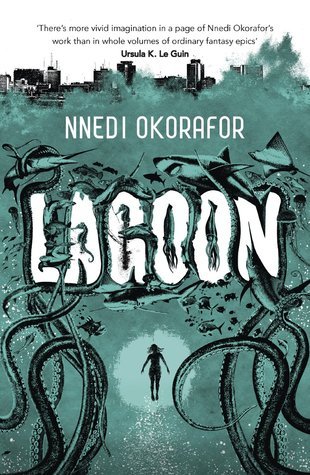
…AND A BOOK TO GO WITH IT:

Lagoon – Nnedi Okorafor“And when we saw what we were doing wrong/We found the cause underwater, long/And then we saw what we were doing wrong…”

“Miss Amanda Jones” – The Rolling Stones

For a fleeting moment, I can pretend that this song exists in a vacuum, and that Mick Jagger hasn’t been acting like it’s 1967 for the past five decades or so. The fact that he (and Keith Richards) have actually survived long enough to act like they’re 20 for so long is almost impressive, but…yikes, dude.

As much as I rag on Jagger and company, I can’t deny that for at least a decade or so, he and the rest of the Stones could concoct some truly legendary songs. Of course they could, they’re the Rolling Stones! Yet somehow, I rarely see this one among the greatest hits—maybe it’s the rose-colored glasses shielding everything once more, but I feel like if it was good enough to name a whole character after it in Some Kind of Wonderful, that has to give it some street cred, right? (So real of them to name a character after a song just so that they could play said song in the movie. I feel like I’m gonna wind up doing that someday.) Aside from being a staple of car rides in my early childhood, it’s just so unbelievably tightly-wound. Not a single cog is winding out of sync, from the twin talents of Brian Jones’ rhythm guitar and Keith Richards’ spiky riffs—in 1966, we already had the precursor to my favorite, early-’70s guitar sound, warm and thick as a fresh pot of soup. It’s a bit too rough around the edges (for the ’60s, anyway) to really be truly jangly, but it’s got the swagger and sway that makes the rock of the ’60s so delightful to listen to.

…AND A BOOK TO GO WITH IT:

Little Thieves – Margaret Owen“Just watch her as she grow/Don’t want to say it very obviously /But she’s losing her nobility, Miss Amanda Jones …”

Since this post consists entirely of songs, consider all of them to be today’s song.

That’s it for this week’s Sunday Songs! Have a wonderful rest of your day, and take care of yourselves!

Posted in Sunday Songs

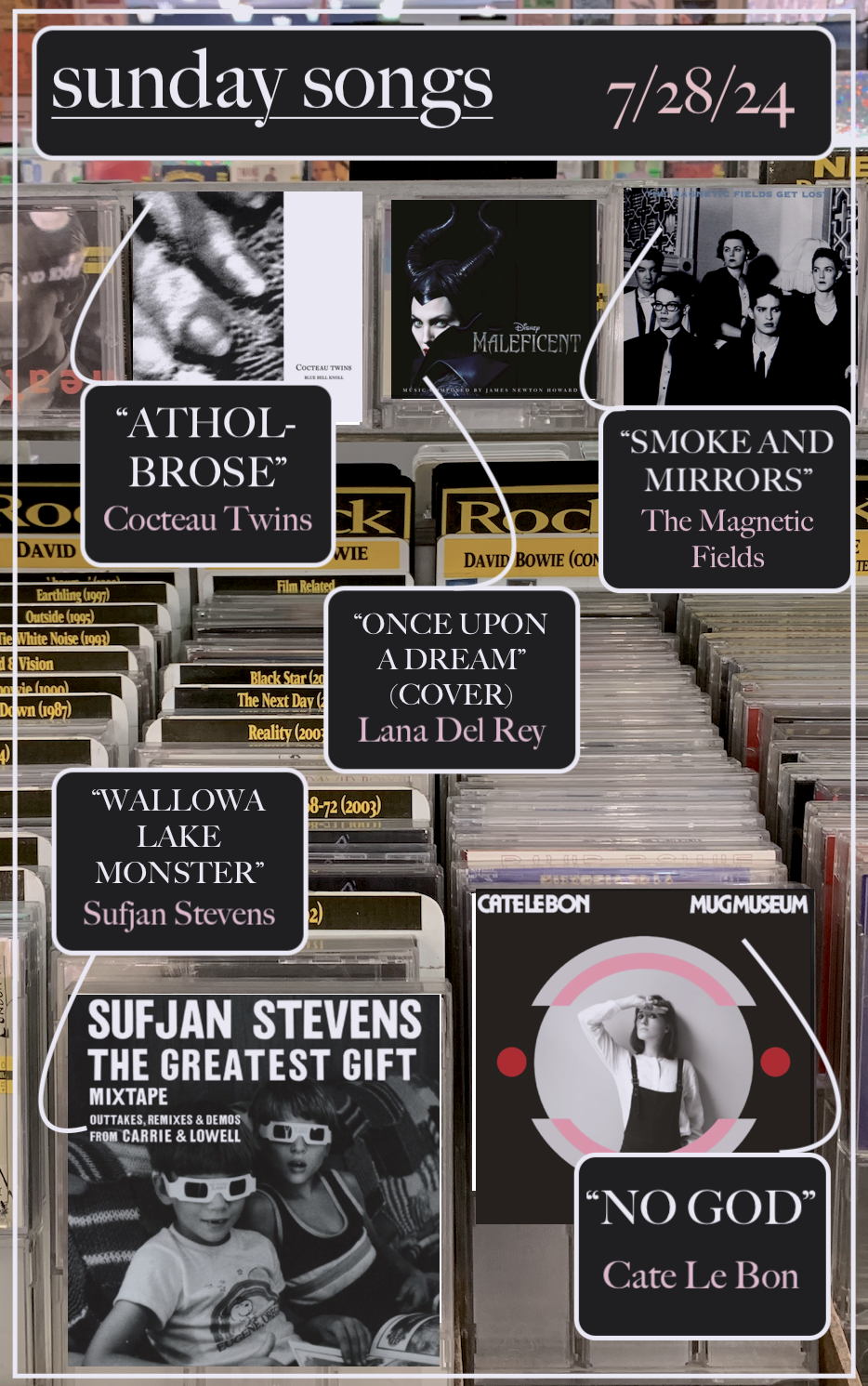
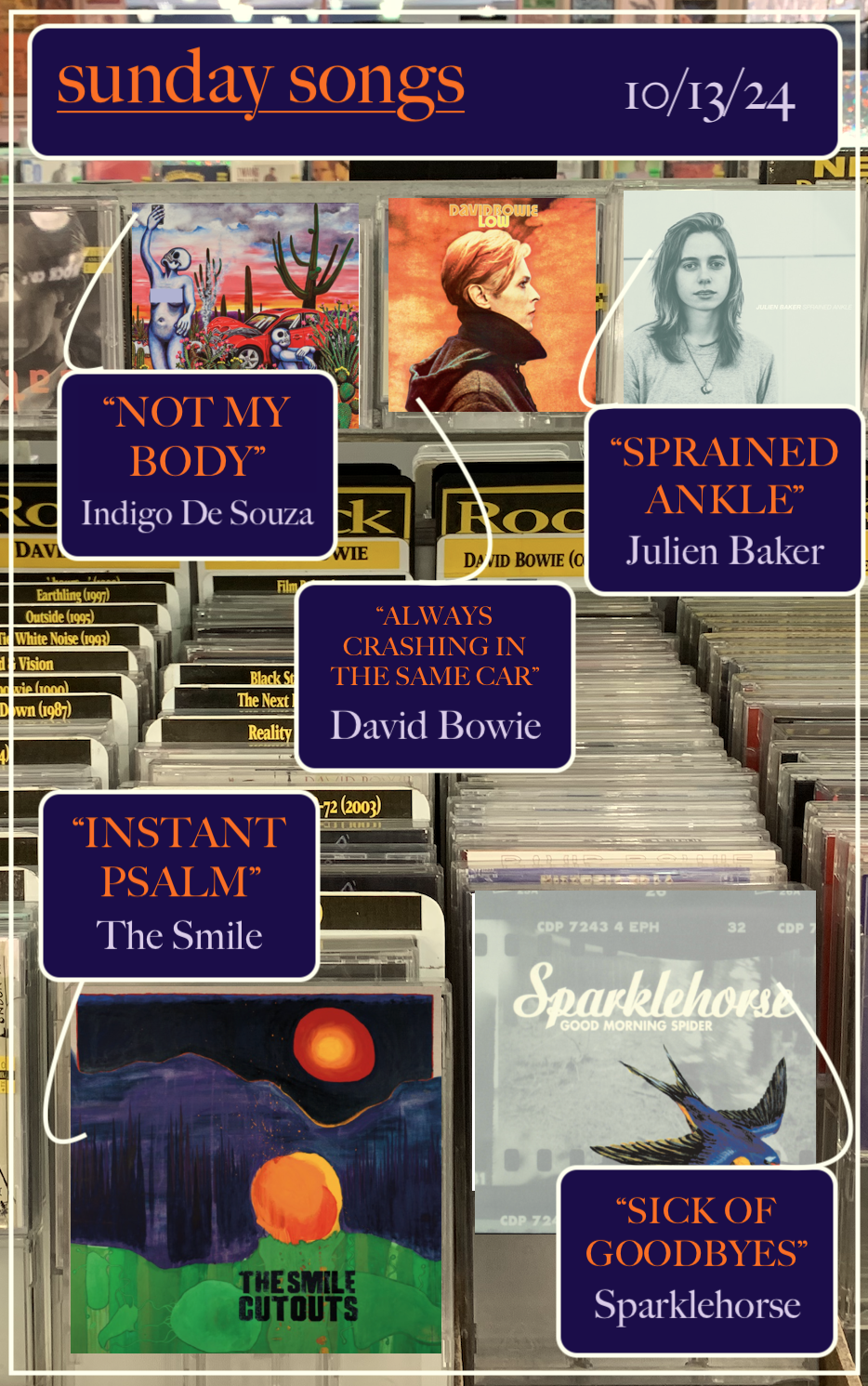
Sunday Songs: 7/28/24

Happy Sunday, bibliophiles! I hope this week has treated you well.

This week: surprise, surprise…I have sympathy for exactly one (1) live-action Disney remake. Soak it up while you can.

Enjoy this week’s songs!

SUNDAY SONGS: 7/28/24

“Wallowa Lake Monster” – Sufjan Stevens

The other night, a friend of mine and I were discussing the merits of album intros—cinematic curtain-openers (David Bowie’s “Future Legend”), gradually creeping easers (IDLES’ “IDEA 01”), and intros so engrossing that the rest of the album almost doesn’t measure up (Cate Le Bon’s “Dirt on the Bed”). I ended up making a Top 5 list that got so overblown that it expanded to top 10, but my friend was remarkably able to whittle it down to 5. “Wallowa Lake Monster” was squarely at the top of their list, and now I understand exactly why.

I’d call “Wallowa Lake Monster” a member of the first category, though in a different sense than “Future Legend.” The album it opens is The Greatest Gift, a mixtape of remixes, demos, and tracks cut from Carrie and Lowell, making “Wallowa Lake Monster” a b-side. I’m now experiencing “Burning Bridge” levels of how the hell was this a b-side, because, in my limited experience of Sufjan Stevens, how does one cut a track this cinematic? Who knows, with what little I know of Carrie and Lowell, save for that it deals with his complicated relationship to his mother. The gliding electronics seem to ripple like lake water itself, as wispy as Stevens’ voice as he opens his tale as one might a storybook: his mother’s twin struggles of alcoholism and schizophrenia become the backdrop for the Wallowa Lake Monster, a creature from Nez Perce legend, as it slowly pulls her under the waves: “And like the cedar wax wing, she was drunk all day/We put her in the sheet, little wreath, candles on the crate/As the monster showed its face.” There’s enough references, from scientific names for flowers to Dungeons & Dragons monsters to the Odyssey, to require three different dictionaries open at once while listening—Stevens has often fallen into the “overly pretentious” side of indie rock in my purview, and although that’s still not without basis, it’s clear that he’s a very literary-minded songwriter. It wasn’t surprising to learn that Stevens originally got his MFA in creative writing! A line as literary as “The undertow refrained with the flame of a feathered snake/Charybdis in its shallow grave” couldn’t have come from anyone but an English major, and that’s pretentious game recognizing game.

Yet in spite of such stunning lyricism, the lyric-less parts are what floored me on the first listen of “Wallowa Lake Monster.” After the flitting, storybook storytelling, clouded in Oregon fog, there was no other way to go but a nearly three-minute, instrumental outro, from synths that cut like searchlights through the dark to a cavernous choir that only rises in its intensity. It grows to such a bellow that you feel its physicality towering over you, much like I would imagine the fraught memory of such a deeply flawed yet deeply important figure in one’s life. It nearly eclipses all else about the song until its final, electronic exhalations.

…AND A BOOK TO GO WITH IT:

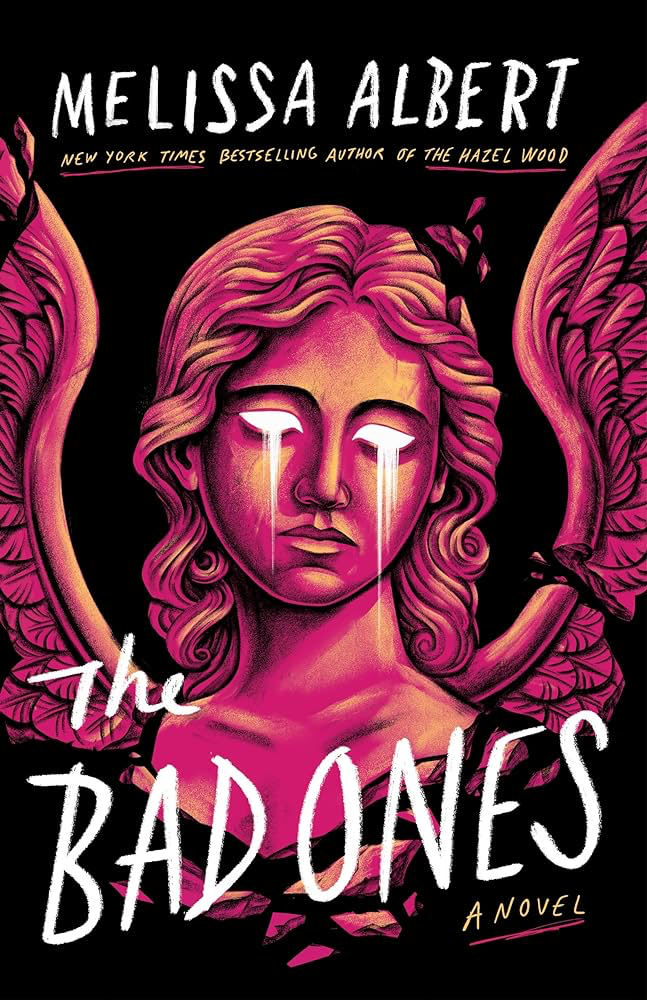
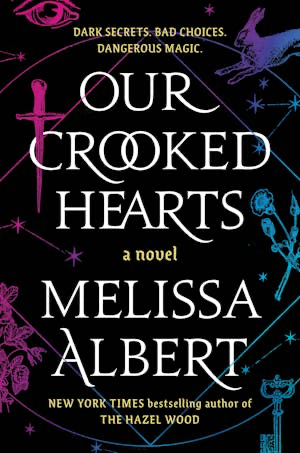
Our Crooked Hearts – Melissa Albert: brimming with magic and secrets, this novel explores a similarly fraught relationship between mother and child.

“No God” – Cate Le Bon

When I talked about “Dirt on the Bed” last week, I talked about how much Cate Le Bon reminded me of St. Vincent, down to their humbler, more arty beginnings. They’re both arty at present, but the art I’m thinking of is more the quaint, fresh-out-of music college sound that St. Vincent had on Marry Me, an era that she recently jokingly referred to as her “asexual Pollyanna” period. Ouch…I can’t say that it doesn’t make sense, because it…does, in a way, but it feels dismissive of all the rampant creativity swirling about in that album.

Cate Le Bon seems to have wallowed in that artsy, borderline twee period for much longer than St. Vincent did; Mug Museum is her third album, and the tracks I’ve heard all ring with that early-2010’s indie, folksy leaning. Le Bon’s Welsh lilt twists ordinary words into melted candy, and much like St. Vincent, her riffs wind around the melody like tiny flower buds bursting from vines crawling up a fading brick wall. Some songs were made for summer strolls, and “No God”‘s bright melodies brim with sunshine and the security of concrete under your feet as you take a morning walk through the city, stopping to sniff a basket of flowers in the window of a storefront. Her vocals get their well-deserved spotlight in the chorus, rich and bubbling with each drawn-out cry of “No Go-o-o-o-o-d,” swirling into the morning dew.

Yet the cheery exterior hides the grief that clouds her 2013 album Mug Museum; much of the album was written after the death of Le Bon’s beloved grandmother, and the title itself explains the memories contained in ordinary objects—an accumulation of mugs, for instance. But the grief of Mug Museum is more of a recognition of lineage; Le Bon said that “The album was inspired by the loss of my maternal grandmother but rather than it being a grief laden album it is more about what someone at the top of the female chain leaves behind.” The lilting repetition of “No God” is suddenly recontextualized as not necessarily spiritual, but the loss of the ground beneath your feet, the rug pulled out from under you now that there’s no maternal anchor. The God here is more a feeling of connection to your feminine ancestors and the security it brings—and the upending of that security once death overcomes the family.

…AND A BOOK TO GO WITH IT:

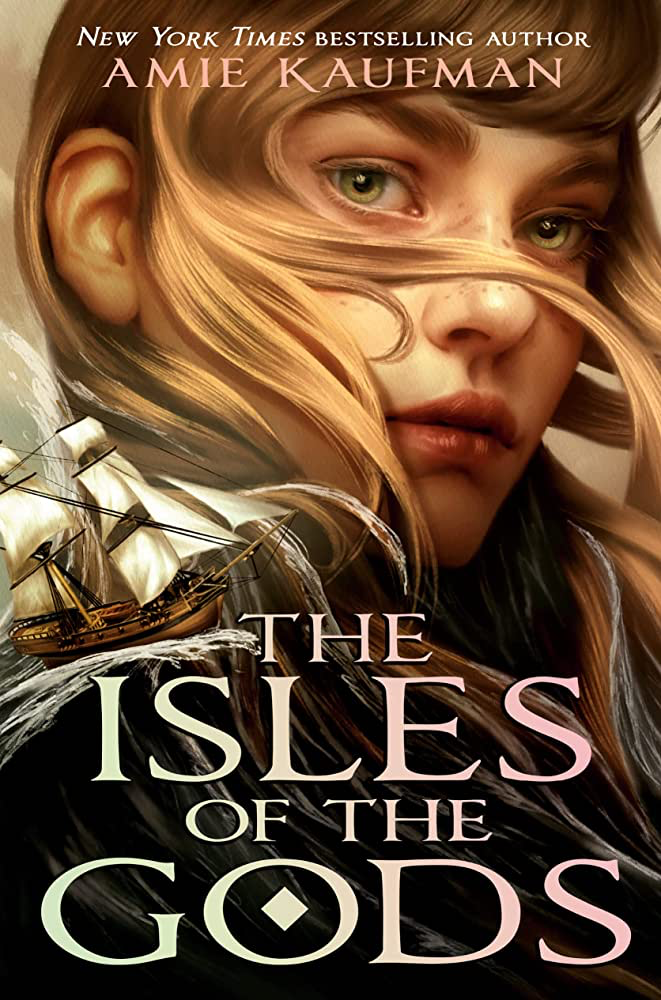
The Isles of the Gods – Amie Kaufman“When leading lambs lose track/Hands hold me back/I saw a face again/I pulled it from my head/No looking, I know it well…”

“Athol-brose” – Cocteau Twins

Another merit I’ve discovered in my apparent Cocteau Twins summer is that they’re perfect for easing overstimulation. In my ongoing journey to better manage my sensory issues, I’ve compiled a playlist full of songs I use to come down from sensory overload, distinct from the playlist where I just pile on all the slow songs. Sensory overload calming demands a more specific kind of slowness, the kind that oozes relaxation and massages every fold of my overstimulated brain.

There you have it. I’ve just described most of the Cocteau Twins’ discography. The combination of their lazy, dreamlike pace and the swirl of graceful gibberish in Elizabeth Fraser’s vocals make them prime sensory calm material. (That instant muscular relaxation I felt when I first heard “Oomingmak” is a sensation I desperately need to bottle the next time I’m overstimulated.) After a recent bout of overstimulation that had me cycling through all of their music that I had on my phone, I decided to bump Blue Bell Knoll up to a higher priority on my Sisyphean Album Bucket List, but also…y’know, Cocteau Twins. I’m waiting until I’m hibernating in December or January for the wintry Victorialand, but Blue Bell Knoll, with its bedsheet white, silken melodies was a welcome embrace after a month of election anxiety (finally quelled for the most part…anyways, HARRIS 2024). I’m glad that I’d only heard “Carolyn’s Fingers” (a song that goes eerily well with “Creep”…somebody needs to make that mashup), because letting Blue Bell Knoll wash over me in nearly-new wholeness was the best way to breathe it in.

“Athol-brose” starts off with a soft-spoken, percussive beat, but quickly swallows you in a murmuring whirlpool, a whispering chorus of voices bobbing and humming in unison like songbirds on the wind. The more distinct, angular synths pave an easy path to Heaven or Las Vegas, their most famous effort, gliding on nebulous wings through a star-flecked field of melody. In Elizabeth Fraser’s mouth, ordinary words are made into alien percussion; the final repetition of “very very silly ball” rolls against her tongue like the rapid flutter of bee’s wings. Like the red floatboat that the album later sings of, “Athol-brose” feels about the closest thing to riding on a motorboat through a sea of stars, then reaching your fingers out to reach for each glowing filament, watching the light trail around your fingertips.

…AND A BOOK TO GO WITH IT:

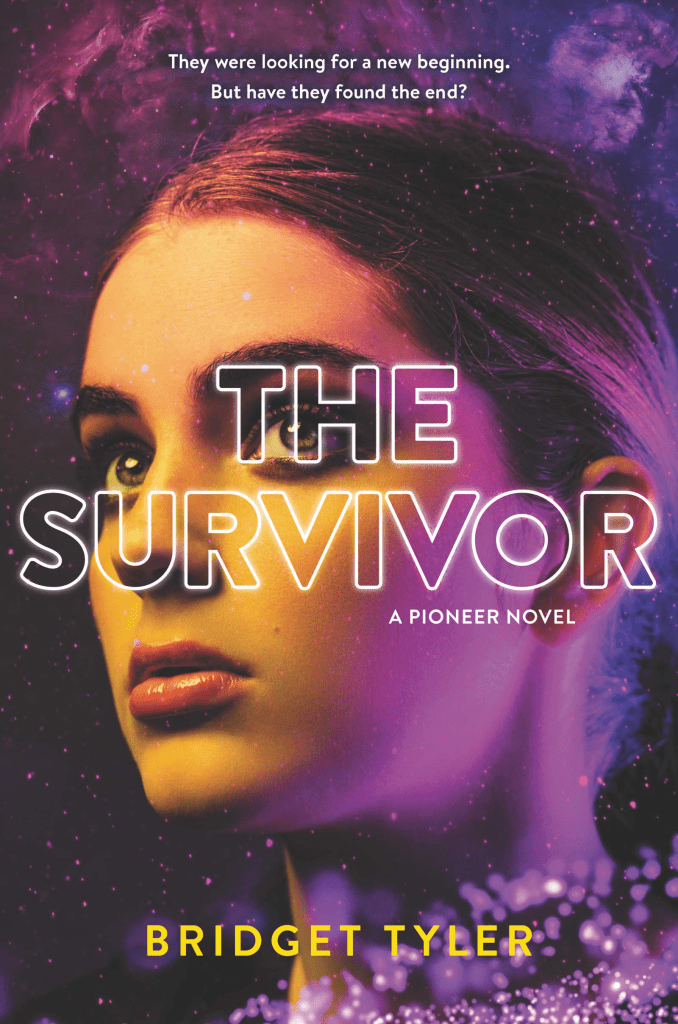
The Survivor (The Pioneer, #2) – Bridget Tylerthere’s a deeply moving scene where an alien character sees his home from space for the first time, and that initial flush of sound fits that explosive wonder.

“Once Upon a Dream” (from Maleficent) – Lana Del Rey

Lana Del Rey and live-action Disney remakes are two things that have never been my cup of tea, although I’ve engaged with some of her music (“Video Games” remains a nostalgic favorite of mine) and some of the movies when I was younger. I write this fully acknowledging that the rose-colored glasses are so far up the bridge of my nose that they’re digging into my skin, but dare I say that this cover—and the film—are exceptions to the mediocrity? Maleficent was one of my favorite movies growing up, and, yeah, it’s Disney, I’m not about to rush to their defense, but I swear it’s the only one of the remakes where they didn’t outright remake it; they flipped it to Maleficent’s perspective and didn’t just rehash the story with CGI…as all the others have done. Who knows. Admittedly, I haven’t exactly been paying close attention to Disney’s army of remakes.

Either way, this is the one instance of trailerized music that clicks into place for me; James Newton Howard’s haunting, sweeping orchestration clearly set the tone for all of the Epic™️ Trailer Music that came after it, but none of his imitators captured that grandeur he establishes. Lana Del Rey’s husky but rich voice hums through a cover that brushes that silky line between darkness and fairytale innocence. I’ll say it again: nostalgia is at the wheel here, but I’d be lying if I said that remembering this cover and listening to it 10 years after Maleficent’s release didn’t give me goosebumps.

…AND A BOOK TO GO WITH IT:

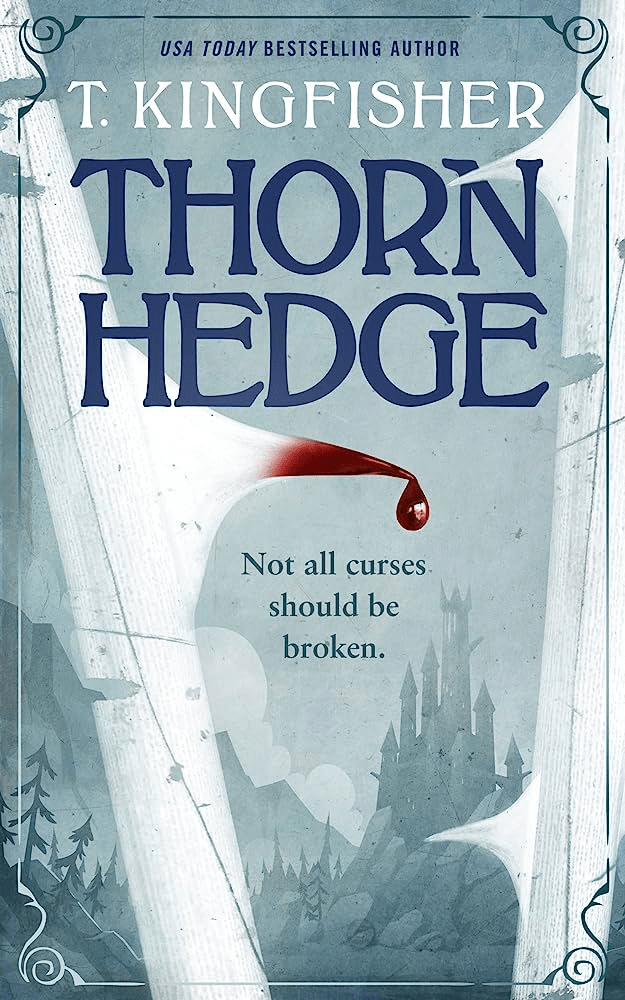
Thornhedge – T. Kingfishera Sleeping Beauty retelling that doesn’t shy away from hidden darkness.

“Smoke and Mirrors” – The Magnetic Fields

At this point, Stephen Merritt has probably had every weird, toxic ex in the book—either that, or he’s happened to have just a handful with all of those horrible qualities rolled into one. Either way, songs like “Smoke and Mirrors” paint him as exhausted by all of them, and understandably so; this track in particular recounts a lover who tried to woo him with sex and affection to distract from the implosion of their relationship (“Smoke and mirrors, special effects/A little fear, a little sex”). He does admit that it was mutual, but keeping up the façade clearly ground him to the bone. Somehow, Merritt makes sounding so exhausted so enchanting and artful. Melding with the appropriately smoky, hazy atmosphere, his voice drifts in and out of focus, just a passing cloud in the thick fog of synths, backing vocals, and bass. Merritt makes such a disaffected mindset into something purple-gray and glittering at the edges, even if all that color and shine is a sham when you fan all the fumes away.

…AND A BOOK TO GO WITH IT:

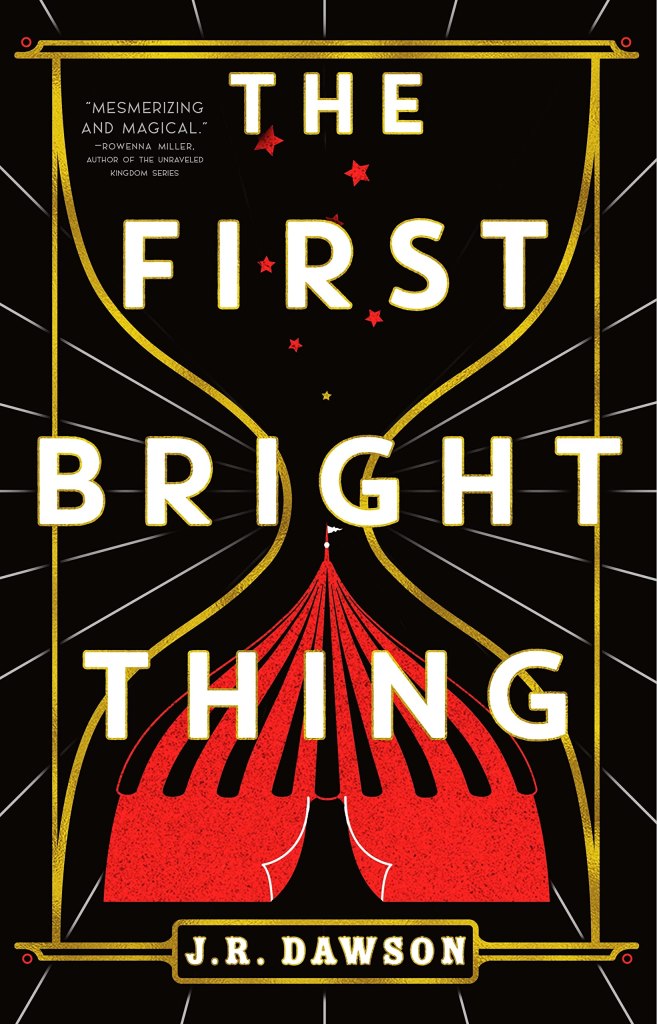
The First Bright Thing – J.R. Dawson“We were foolish, you and I/But there’s no reason to cry/We put on a lovely show, but that’s all/I had to go…”

Since this post consists entirely of songs, consider all of them to be today’s song.

That’s it for this week’s Book Review Tuesday! Have a wonderful rest of your day, and take care of yourselves!

Posted in Sunday Songs

Sunday Songs: 7/21/24

Happy Sunday, bibliophiles! I hope this week has treated you well.

This week: music for pretentious weirdos (me), music for animation, and music that makes me cry on the regular.

Enjoy this week’s songs!

SUNDAY SONGS: 7/21/24

“Dirt on the Bed” – Cate Le Bon

I came into Pompeii with plenty of curiosity, having finally gotten around to listening to Cate Le Bon after hearing her work producing Wilco’s latest album, Cousin, and her vocal feature on St. Vincent’s “All Born Screaming.” Vaguely remembering the buzz and air of weirdness around Pompeii, I decided to listen to it first.

Pompeii and “Dirt on the Bed” have reminded me of why a spectacular album intro can be both a blessing and a curse. If nothing surpasses the first track, then the rest of the album can never recover—or at least reach the heights of the first song. You can enjoy yourself, but never as much as you did after one song. Just one. It’s a horrible dilemma. Pompeii was fantastic from the start, but after the first four songs, nothing’s quite the same—great, but like my experience with R.E.M.’s Green, nothing tops the back-to-back splendor of the first four songs. And that splendor is set in motion by the crawling intro, “Dirt on the Bed.” As the title suggests, it has the dread of something unclean creeping into the house, like a nun on the scent of sin in a shuttered Catholic girl’s school. An off-kilter, stumbling chorus of brass blooms in moldy bursts, an airborne sickness pulsating through each thrum of the bass. Now I know exactly why St. Vincent chose to work with Le Bon—”Dirt on the Bed” is especially evidence of this, but all I could think of during Pompeii is that it felt like St. Vincent had remained lyrically and instrumentally in Actor, but slowly adorned her music with synths. They’re so similar to each other, down to their folkier, precocious indie beginnings that blossomed into full-on devotion to strangeness. This is modern art pop at some of its best, unabashedly weird and precise in every flourish. “Dirt on the Bed” makes even more sense when you see it as a product of a pandemic-produced album; it paces listlessly, putting on a smile as it tries to scrub every trace of illness and dread from a spotless house. Even as calmly as Le Bon sings each lyric, foreboding seeps through every misty horn blast.

That’s how an album intro is done. After several more listens, I’d say that nothing comes quite as close to it, but “Dirt on the Bed,” “Moderation,” “French Boys,” and “Pompeii” is SUCH an undefeated stretch of songs. Pompeii is worth a listen just for that, as is the album’s very St. Vincent closer, “Wheel.”

…AND A BOOK TO GO WITH IT:

Drunk on All Your Strange New Words – Eddie Robson“Sound doesn’t go away/In habitual silence/It reinvents the surface/Of everything you touch…”

“Poor Song” – Yeah Yeah Yeahs

…okay, I can’t possibly be normal about this because I cry a little every time I hear it. Either way, there’s an undiluted purity about this song that makes any kind of analysis feel like ten steps in the wrong direction. It’s a paramount example of how easily beauty and simplicity can intertwine, and it cuts more deeply than some songs I know with hundreds of metaphors.

It’s very nearly perfect. Karen O tends to do that.

…AND A BOOK TO GO WITH IT:

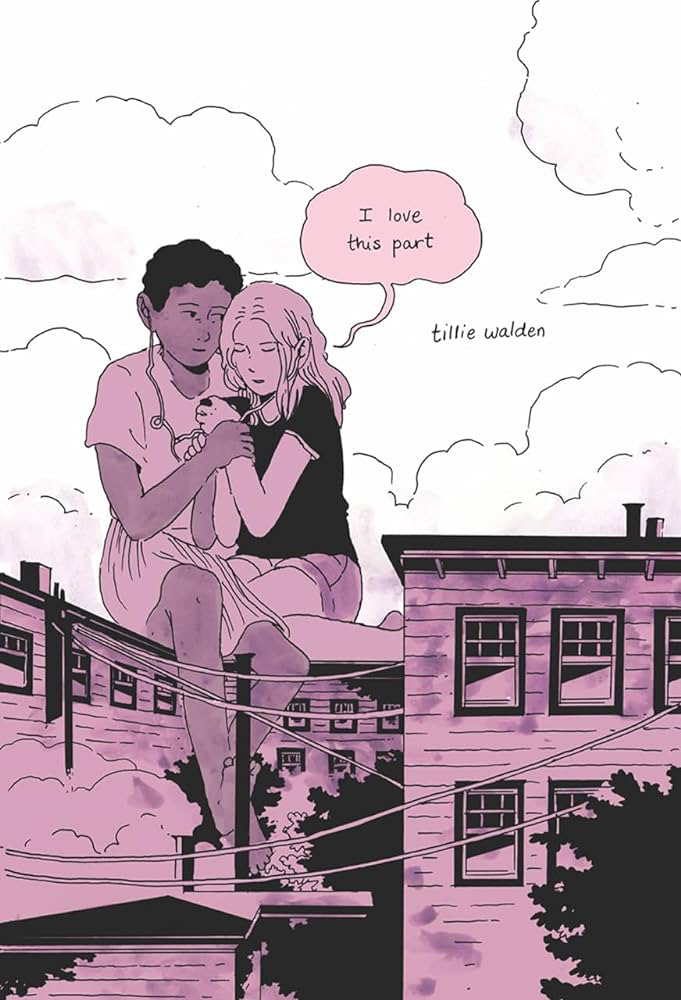
I Love This Part – Tillie Waldenquiet and gentle teenage romance.

“It’s A Wonderful Life” – Sparklehorse

One of the first times I remember hearing this song was in the car with my dad, as I come across many a good song. Looking back, since I was so young, it must have been a trip back into Sparklehorse’s catalogue shortly after Mark Linkous’ tragic passing. But as we drove home that night, the windows buffeted by snow or sleet, my dad made a wry remark about the lyrics: “he’s not feeling too good, huh?”

With every emotion comes an infinite number of ways to express it, not just confined to song. There’s the kind of songwriting that outright says that you’re sad, while others cloak it in metaphor. Neither is better than the other, but what Mark Linkous did feels like a category all its own, albeit closer to category #2. Many of the lyrics of “It’s A Wonderful Life” (if there was ever a more sarcastic title) are nonsensical, as his lyrics often are (“I wore a rooster’s blood/When it flew like doves”), but nestled between these impenetrable tidbits, the ones that do make sense land like anvils to the gut. I’ve never heard such sadness and shame articulated in the line “I’m the dog that ate your birthday cake.” Dare I say it’s one of my favorite song lyrics ever? It’s up there, just for such an unadorned, bare line to have such an instantly devastating effect; You can picture that dog, not knowing that it’s not supposed to eat human food and not processing that there’s a child sobbing at their ruined birthday, but being able to detect the shame all the same, but never know the reason why. It cowers, but it doesn’t know why it’s feeling this way. Linkous delivers it with all of that shame, clouded in the atmospheric cage of keyboards that prickle with heat lightning.

With that kind of lyricism, it came as a massive shock that this wasn’t one of his classic pieces of melancholy. In fact, Linkous wrote it as a jab at critics who panned an image of overarching depression over his catalogue: “I got fed up with people in America thinking that my music is morose and depressing and all that. That song is like a “fuck you” to journalists, or people who are not smart enough to see what it is.” And…listen, I’m a guilty party. I still think that Sparklehorse is one of the preeminent purveyors of high-quality sad bastard music, and he had enough strife in his life to justify every tear-jerking lyric. Yet this new light makes the lyrics I thought were nonsensical fall into place. Linkous describes the rest of the song as follows: “In the end, it was more about how every day, you should pick up something, no matter how minuscule or microscopic it is, and when you go to bed, you can say I was glad that I was alive to see that. That’s really what it’s about.” Wearing rooster’s blood when it flew like doves becomes a fleeting, once-in-a-lifetime capture of lightning in a bottle, and being the only one who can ride that horse th’yonder suddenly rings out as a humbly sung badge of honor. It was never sarcastic—it’s a wonderful life. I won’t ever be able to hear “I’m the dog that ate your birthday cake” without the sadness it insinuates, so maybe I’m just as much a part of the problem as the journalists he was taking a shot at, but the main takeaway for me is how versatile of a lyricist he is—if you look closely enough, he makes the absurdities of life both tragic and humbly hopeful.

Either way you absorb “It’s A Wonderful Life,” you can’t deny how otherworldly it sounds. Even years after I first heard and subsequently clung to this song, I can only name maybe one other artist who has ever come close to sounding like this—Lisa Germano, who, whether or not the two knew of each other, has a similar modus operandi of making music that sounded like rotting wood and empty doll’s heads. Lyrically and sonically, almost nobody sounds like Sparklehorse, and I suspect it’ll take a miracle for anyone to come close.

…AND A BOOK TO GO WITH IT:

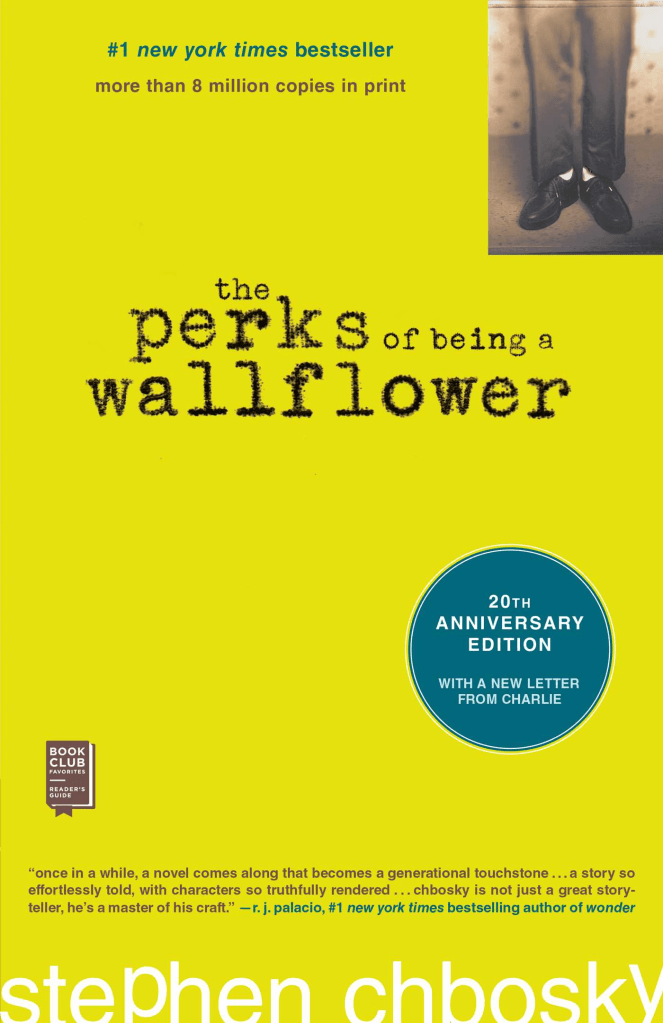
The Perks of Being a Wallflower – Stephen Chbosky Sparklehorse is no “Something,” but the crushing weight of depression and self-loathing comes across similarly.

“Girl from Germany” – Sparks

I’d heard bits and pieces of Sparks before, but like “Future Teenage Cave Artists” last week, I have Horsegirl and their episode of What’s In My Bag? to thank. Love those pretentious (affectionate) weirdos.

It seems I’ve only gotten through one strand in the massive haystack in terms of the INCREDIBLY prolific career of Sparks, which started in 1967 (under several different names) and had its most recent entry last year. Edgar Wright made a documentary about their musical exploits, and the list of artists they’ve influenced seems to span an infinite number of genres, all the way up to Horsegirl in 2023. So, having only heard two of their songs (including this one): hats off to you guys, really! Being that flagrantly weird for almost six decades is nothing short of impressive, and I can’t help but admire their musicianship in that regard.

“Girl from Germany” scratches my eternal itch for early-’70s glam rock, although it’s not all glam—it’s more glam in the sense that Brian Eno was glam at the same time, not quite like Bowie or Bolan were glam. Squeaky-clean, warm guitars as far as the eye can see and a healthy dose of theatricality cloaks this track make for a song that’s deliciously meticulous in every aspect. Russell Mael affects high-pitched vocals that wouldn’t be out of place in The Rocky Horror Picture Show while Ron Mael’s keyboard melodies glitter like light reflected off a glass of wine. And like Brian Eno, they used such a theatrical machine to touch on touchy subjects—in this case, in the climate of the early ’70s, bringing home a German girl to relatives who were mired in the horrors of World War II: “Well, the car I drive is parked outside, it’s German-made/They resent that less than the people who are German-made.” Even if every affectation is theatrical to the core, it’s still a prejudice that resurfaces today—assuming that any given person is an extension of the government and horrors of their homeland, and having to grapple with the cultural fallout of such a simple gesture of love.

…AND A BOOK TO GO WITH IT:

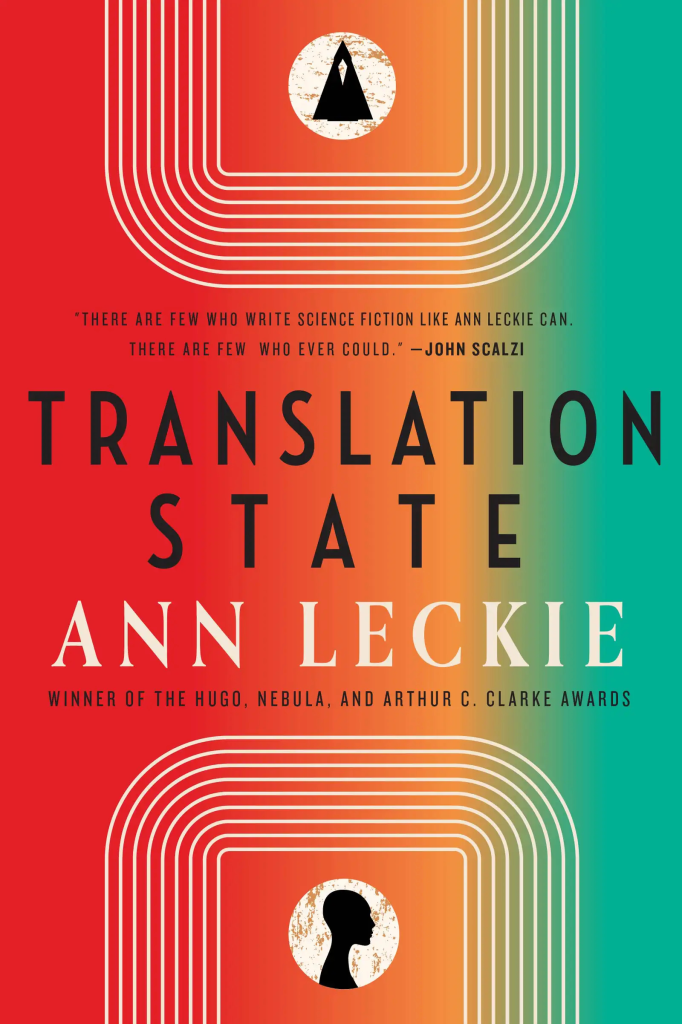
Translation State – Ann Leckie – cross-cultural confusion and characters with heart.

“Hideaway” – The Olivia Tremor Control

Having only heard one song (this one) from Black Foliage: Animation Music, I’ve already logged it into my slipshod mental list of album titles that perfectly describe the music they contain. The Olivia Tremor Control have always been masters of musical density, making soundscapes that unfold like intricate pop-up books, each layer of noise a painted paper cutout in an endless jungle. “Hideaway,” so far, is the pinnacle of that density; with each successive strain of woozy, turn-of-the-century homage to ’60s psychedelia, you’re pulled into a lush forest of plants that unfold just enough to let the tiniest slivers of light through. It’s not just the black foliage that hits the mark so fittingly—the “animation music,” as Will Cullen Hart called it, is “all the stuff floating around…To me, that’s what [animation music] is: sort-of a sound and space, personified—just flying around to greet you in a friendly way.” All at once, the xylophone chimes and trumpet blasts give “Hideaway” the feel of both the colored-pencil animations in Fantastic Planet and the bouncing characters in Schoolhouse Rock!, a papery and breathless expedition into a darkened forest of cartoonish proportions.

…AND A BOOK TO GO WITH IT:

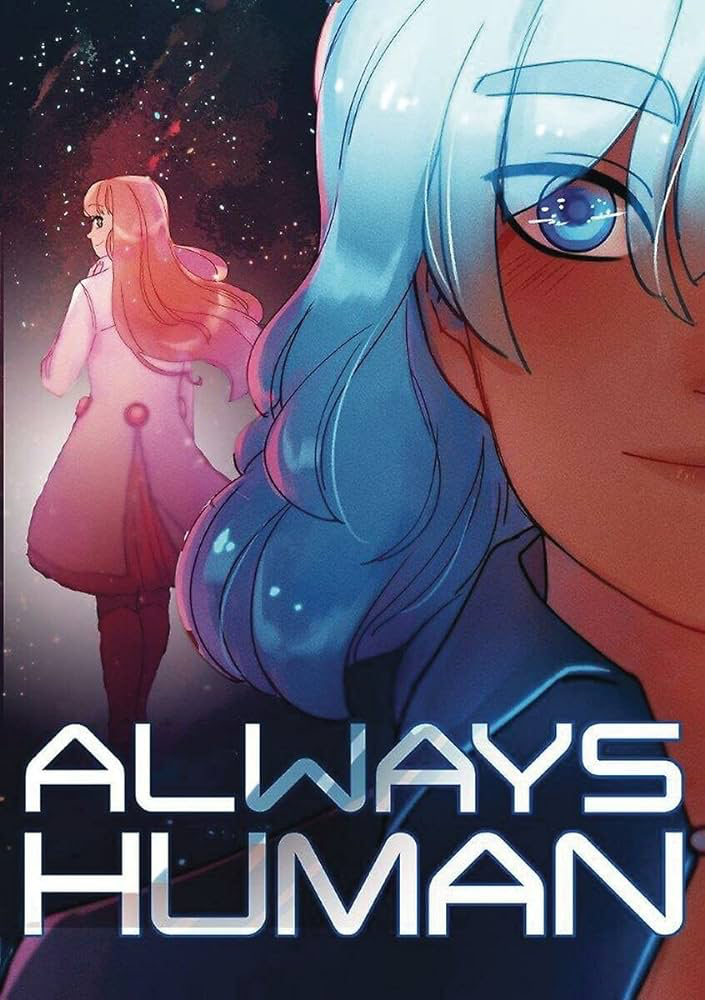
Always Human – Ari North simple, stylized art with vibrant colors—perfect for animation music.

Since this post consists entirely of songs, consider all of them to be today’s song.

That’s it for this week’s Sunday Songs! Have a wonderful rest of your day, and take care of yourselves!
Posted in Sunday Songs

Sunday Songs: 7/14/24

Happy Sunday, bibliophiles! I hope this week has treated you well.

This week: would you like a nice sci-fi in these trying times?

Enjoy this week’s songs!

SUNDAY SONGS: 7/14/24

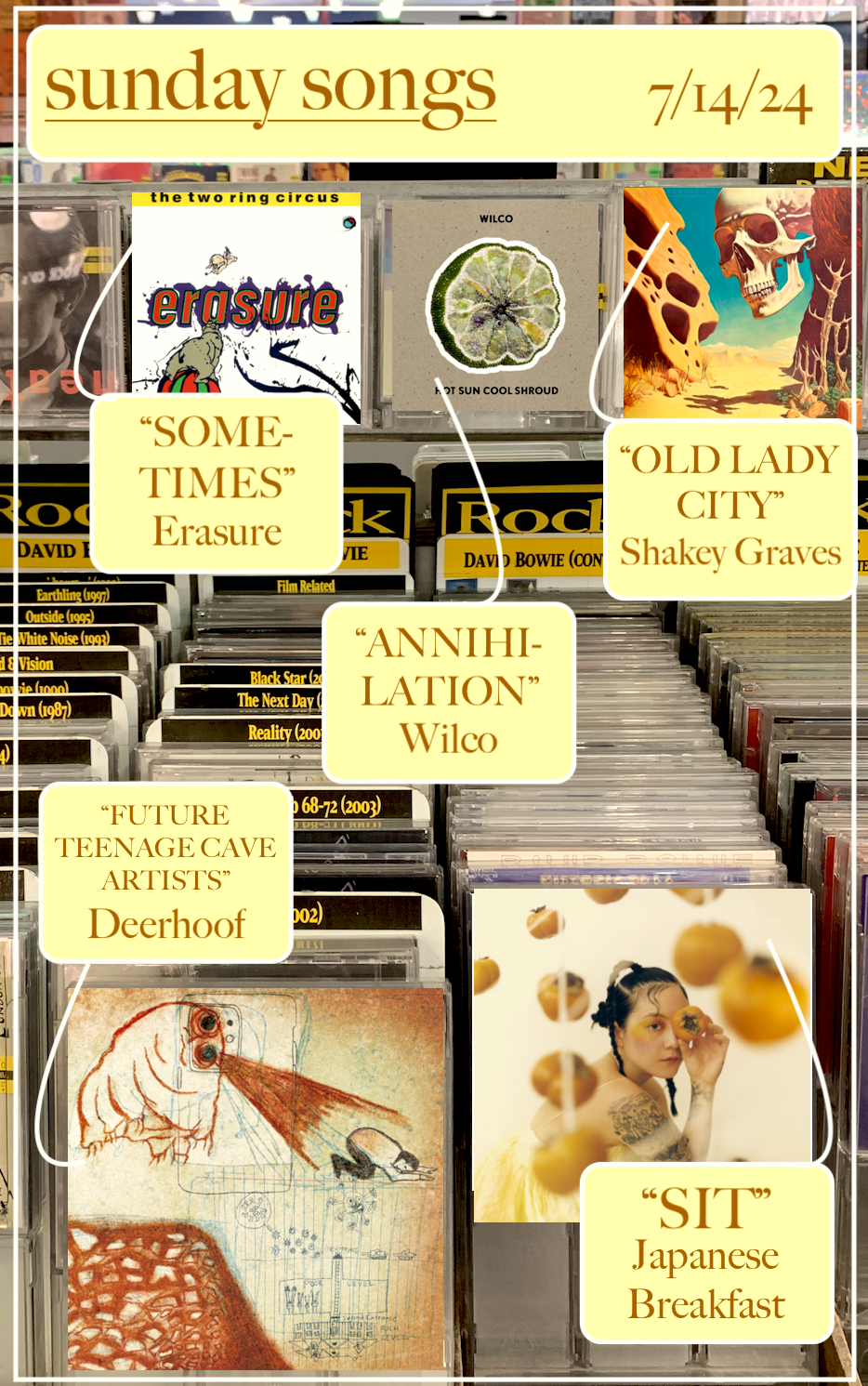
“Future Teenage Cave Artists” – Deerhoof

I don’t think I’d be alone in saying that we were all feeling apocalyptic in 2020. Fitting that Deerhoof would put out this album in June of that year, a concept album about teenagers making art amidst the collapse of society. Not intentional timing, I’m sure, but maybe too raw all the same. I wonder what it must have been like to listen to Future Teenage Cave Artists during lockdown, but what I can glean is from listening to Horsegirl; on their episode of What’s In My Bag? (worth watching for this and Sparks, The Feelies, and Brian Eno, among others), this was one of the albums that they picked, and drummer Gigi Reece shyly showed off that they’d stitched “Deerhoof” onto the flap of their book bag. So, besides thanking them for their excellent album, Versions of Modern Performance, thank you to Horsegirl for turning me onto this all-consuming song!

The title of Future Teenage Cave Artists reveals exactly what the concept behind the album is: during the collapse of society, cruelty and murder runs amok, but amidst all of this strife, a band of nomadic teenagers hold onto hope and make art. “Future Teenage Cave Artists” is that mission statement made manifest. The whole album was reportedly recorded entirely on laptops and phones (hence the iPhone/tardigrade hybrid on the album cover, drawn by Deerhoof’s vocalist, Satomi Matsuzaki), and I never thought such a simple act could have enhanced the song so much. The shaky, distorted quality of the recording sells the dystopian setting, like we’re not streaming music, but listening to it on some ancient, warped tape recorder leftover from the age of man. It gives it an almost uncanny quality, as though you’re holding onto the last vestiges of this music, and that the battery life on your device is going to run out at any second. It’s so urgent in its hope that I can’t help but play it over and over—amidst this societal collapse, every lyric is a declaration of defiance and purpose: “Gonna paint an animal on a cave wall/Gonna leave it there forever while empires fall.” Concept song or not, I didn’t expect this song to strike such a deeply resonant chord with me; not only does this society feel like it might collapse at any second, but even if it weren’t, we’re surrounded by people who lambast any kind of art as a career—what are you gonna do with that degree? Are you even going to make any money off of that? And in our capitalist landscape, I do have to get myself some money, but it’s separated the real purpose of art from art, the job—threading a piece of your soul out into the fabric of the world, and making art that reflects your image of the world, making contact with a well deep inside (and outside) of yourself. “Future Teenage Cave Artists” is a defiant ode to the lasting, breathless joy of making art—upfront and urgent, and running on an engine of joy. You can’t get a much better rallying cry than what Matsuzaki fills the jerky outro with: “try my sci-fi!”

…AND A BOOK TO GO WITH IT:

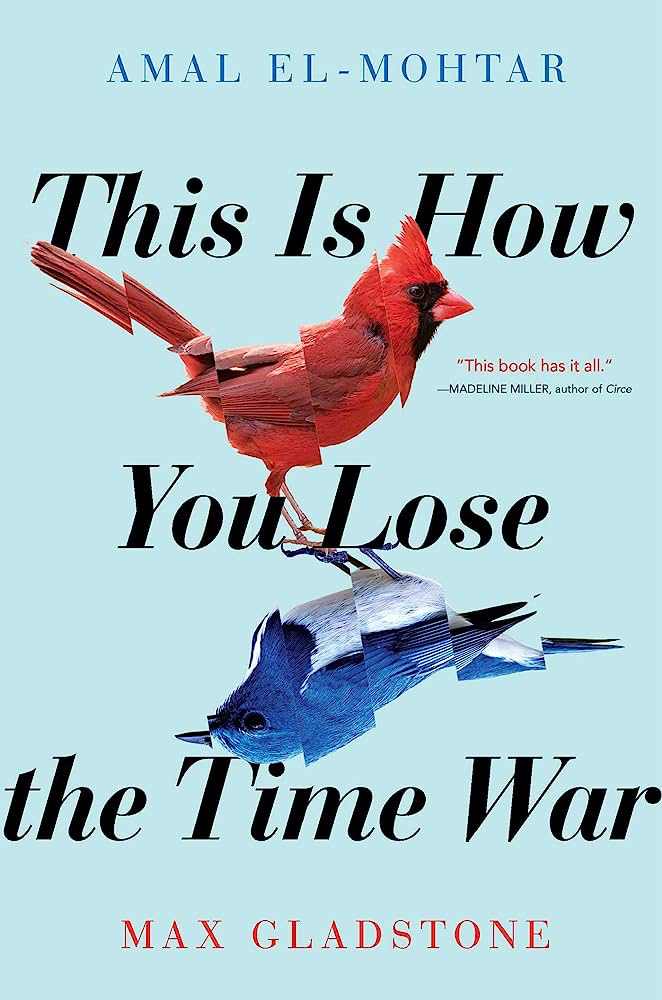
This Is How You Lose the Time War – Amal El-Mohtar and Max Gladstonetwo lovers bent on making a mark in a world where individuality is all but gone.


“Sit” – Japanese Breakfast

Having the pretentious music taste that I do, I remember when Jubilee was everywhere in the summer of 2021. Persimmons, Jeff Tweedy covers, and rave reviews as far as the eye could see. Back then, I had a faint memory of hearing in interview with her on NPR sometime in middle school, but it was ultimately the combination of Jeff Tweedy’s cover of “Kokomo, IN,” my mom’s deep-dive into Michelle Zauner after reading Crying in H-Mart, and a friend’s video of Zauner playing “Paprika” with a massive gong on stage to finally give this storied album a try.

“Paprika” remains my favorite, but “Sit” came out of left field; in all of the shining praises of Jubilee, I never heard anybody talking about it. With its almost shoegazy distortion, humming and throbbing like a swarm of restless cicadas, Zauner’s voice pierces the haze like a lighthouse though the fog. Every lyric is spoken like a final message communicated from an ethereal barrier between dreams, the last words of a stranger your brain fabricated while you were sleeping that will haunt you for weeks afterwards. And like a haunting dream, Zauner sings of the memory of somebody that has clung to her with the strength of burrs, no matter how hard she tries to shake them away: “It’s your name in my mouth I’m repeating/It’s the taste of your tongue I can’t spit out.” They walk through her life with all of the transience of a hologram, a trick of the light that appears in every corner, in unexpected places with unexpected people. And what perfect instrumentals to meld with this; any sense of clarity only comes when Zauner is faced with the reality that she’s “caught up in the idea of you,” but as soon as it dips back into painful reminiscence, she’s consumed by the buzzing distortion, closing her eyes as she’s pulled back into the undertow of memory and fantasy. It’s a track with more weight behind it than most people seem to give it credit for. You can’t lift its impenetrable, stinging fog—the fog is the point.

…AND A BOOK TO GO WITH IT:

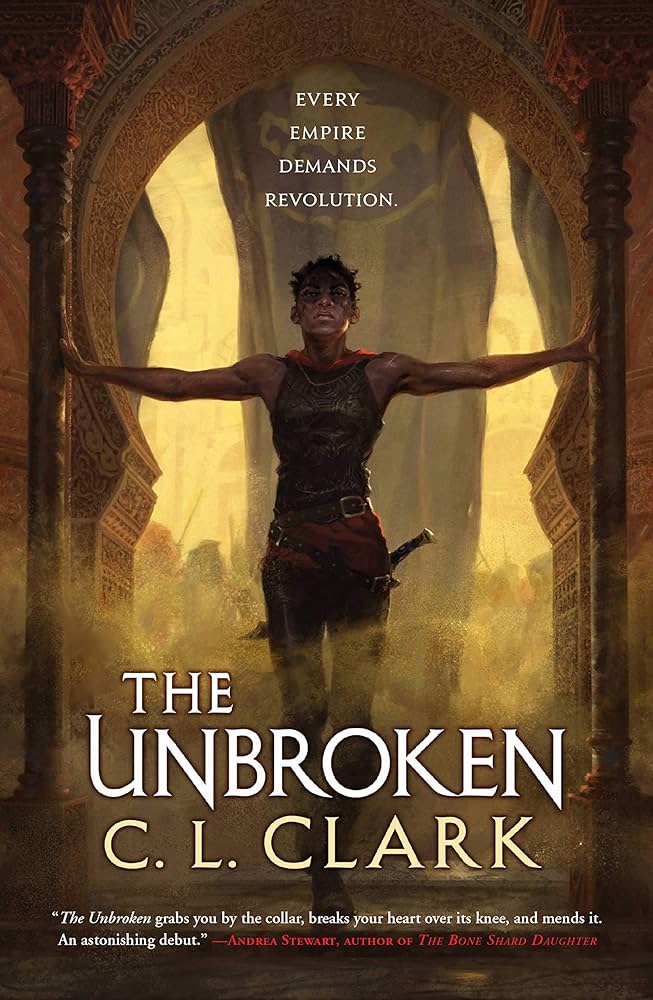
The Unbroken (Magic of the Lost, #1) – C.L. Clark“Caught up in the idea of someone/Caught up in the idea of you/That’s done too soon…”

“Sometimes” – Erasure

I’d posit that there’s almost no queer experience that is entirely universal, as the queer community is as multifarious as the identities that it encompasses. But one thing that I think most queer people can relate to is looking back on their life before coming out and thinking how did everybody not know I was gay? How did I not know I was gay? There’s an embarrassing amount for me, including but not limited to lesbian Barbie weddings and a pair of blindingly rainbow running shoes I wore almost daily in 6th grade. But the fact that I had such an extended Erasure phase when I was about 8 or 9…yeah, there’s no heterosexual explanation for that. That CD of Union Street that I briefly kept in my room and played on my Hello Kitty CD player was probably the first to catch on. The gays yearn for the synths.

I have nothing but admiration for Erasure, not just as queer icons, but for being so consistent in their musical exploration. Well…exploration probably isn’t the right word, since they’ve been making variations on the same sound since 1986. But never once has it seemed like they’re doing it out of trying to feel young or reliving fantasies of when they were at the height of their popularity. Andy Bell and Vince Clarke are just artists that were built for the late ’80s—nowhere else could they have flourished so vibrantly. The drama. The synths. The yearning, my god. They’re not just from the ’80s—they are the ’80s. They’ve been acting like it’s the ’80s for every single decade since, never once hopping on trends or changing their sound because they know exactly what they excel at. Listen to any song they’ve put out in the past 10 years, and it’s clear that they’ve still got it. But the cosmic alignment that placed Bell and Clarke in the late ’80s was beyond fate—nowhere else could you have “Sometimes”, with its lovelorn pining…and Andy Bell dancing in the pouring rain with a soaked white t-shirt. Does it get any better than that?

…AND A BOOK TO GO WITH IT:

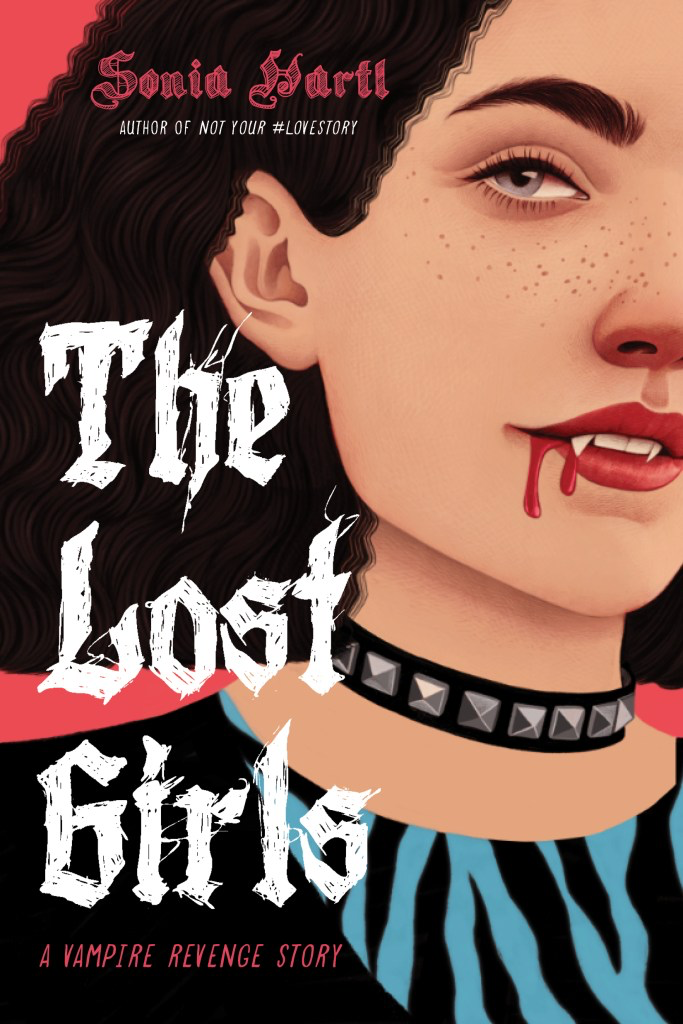
The Lost Girls – Sonia Hartl angst, queerness, romance, and ’80s holdovers. (And vampires.)

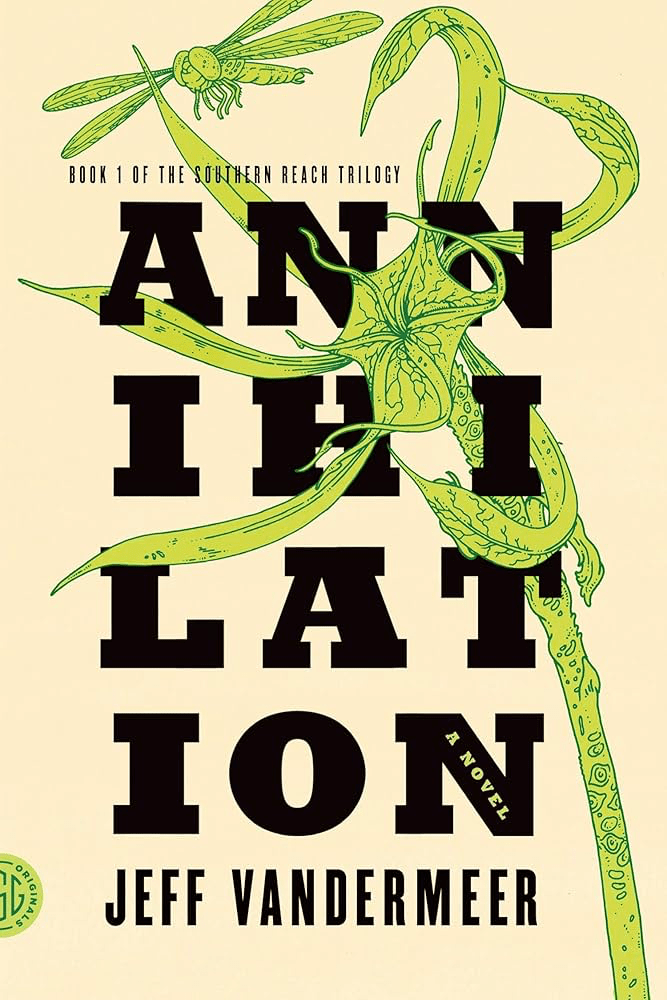
“Annihilation” – Wilco

HOT WILCO SUMMER IS HERE!!! Well, it’s been here for about two weeks, but I’m stubbornly committed to these color schemes. But the weather right now is more akin to the Hot Sun, Cool Shroud we’re talking about, so there’s no time like the present. Urgh. I’m not sure much more of this 90 degree heat I can take…

Hot Sun, Cool Shroud – EP proves just how wildly versatile Wilco are. I can’t think of a single band active today that are not only as prolific as they are, but as consistent in quality—and creativity. The prickling apprehension and Nels Cline’s pipe burst of a guitar solo on “Hot Sun” feed straight into “Livid,” a chase sequence-ready metal instrumental that rockets through the air, ricocheting off the walls like a deflating balloon set loose, complete with a barrage of Galaga-like flourishes. “Inside the Bell Bones” has the quiet, uncertain clatter of frigid water dripping from a cave ceiling, and “Ice Cream” and “Say You Love Me” ground the EP to a more emotional conclusion.

But I keep coming back to the chainlink that ties all of these vastly different songs together—”Annihilation.” Next door to “Ice Cream,” it kicks off the second half of Hot Sun, Cool Shroud, returning to a classic kind of Wilco that tugs a particularly tender heartstring. Even if it doesn’t have the sheer gut-punch of “Say You Love Me,” it reminds me of the more grounded moments of The Whole Love. Unlike “Livid”‘s riotous tailspin, this track spirals through the clouds, kept afloat by the wings of love: “A kiss like this/Is endless tonight/This kind of annihilation/Is alright.” Jeff Tweedy’s vocals bring another lyric of his to mind, from 2019’s “Hold Me Anyway”: “light is all I am.” There’s not an oomph behind it, like his voice often has, but this song is so airy and urgent that it can’t be sung any other way. Tweedy described the soundscape of Hot Sun, Cool Shroud as “a summertime-after-dark feeling…All the pieces of summer, including the broody cicadas,” and that makes the lovestruck urgency of “Annihilation” make perfect sense: it’s a secret kiss under the boardwalk as the sun goes down, the lights of the carnival slowly dying as the setting sun sets the sky alight. In that moment, there is nothing but the moment, in all of its humid, breezy warmth.

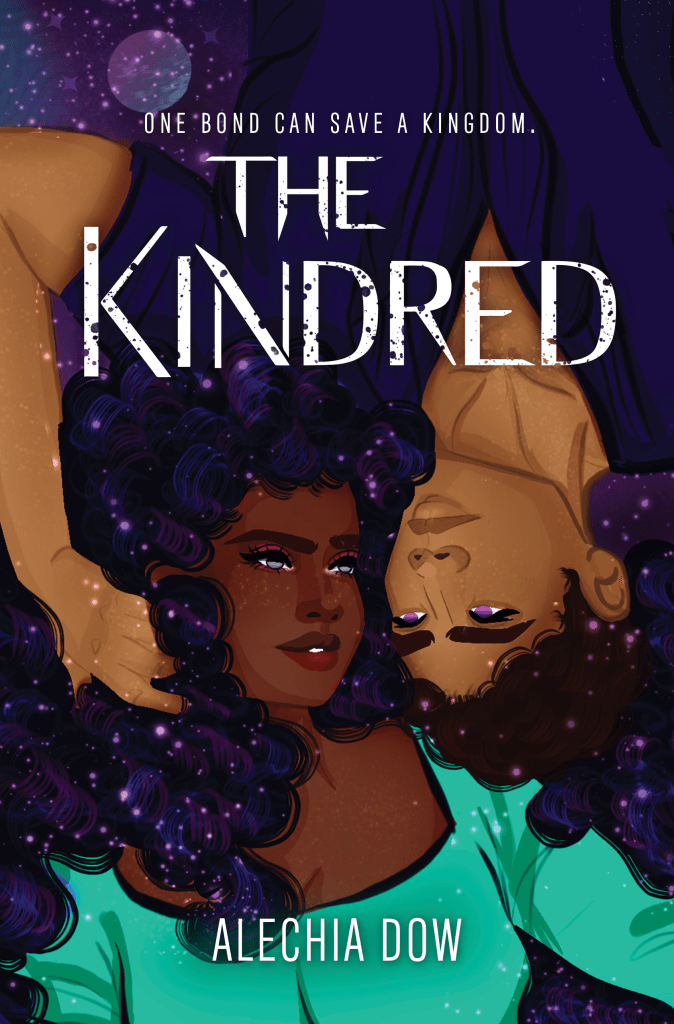
…AND A BOOK TO GO WITH IT:

The Kindred – Alechia Dow“We’re boiling angels/Let’s kiss for hours/Equal power/Let’s make it art/This kiss is ours…”

“Old Lady City” – Shakey Graves

I’d all but forgotten about “Old Lady City” since I first listened to Deadstock: A Shakey Graves Day Anthology, and it seems that…judging from the lack of lyrics anywhere (which on the internet, the manifestation of too many people with too much time on their hands, is a rarity), so did everyone else. Tough crowd. But it’s so unlike any other Shakey Graves that I’ve heard, not even on Movie of the Week. Shakey Graves has never been afraid of being spooky, but this is a kind of off-kilter eery that he didn’t stray towards until now, or however long ago this was originally recorded. Maybe it was too risky to put it on an album for this reason, but this grittier, spookier side is one that I thoroughly enjoy. With vocals by Buffalo Hunt (Alejandro Rose-Garcia’s wife), “Old Lady City” is a scorched, rickety ball of spikes, no edges sanded down. In between twisted strains of nursery rhymes, purposeful breathing, and Buffalo Hunt’s cartoon witch-like cackle, the lo-fi recording makes for a crunching, off-kilter interlude. Rose-Garcia’s vocals are almost nowhere to be seen, but they float in ghostly tendrils in between the splinters, burnt paper, and charcoal of this B-Side.

…AND A BOOK TO GO WITH IT:

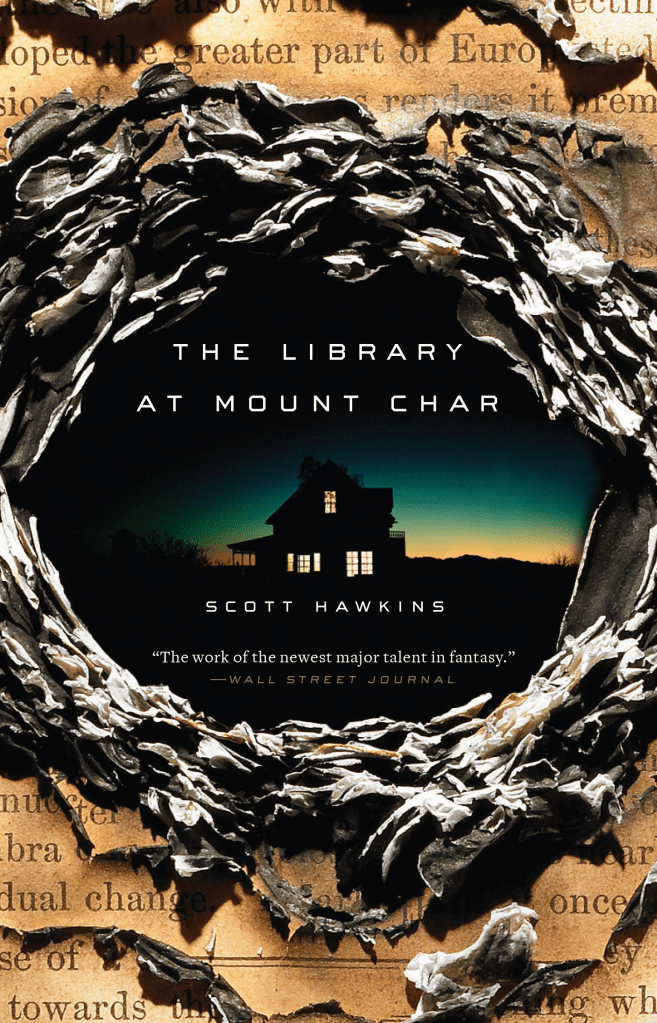
The Library at Mount Char – Scott Hawkinsa raw and rickety story that’s more than its appearances let on, just like its protagonist. (Doesn’t hurt that the book cover matches the feel of the song too.)

Since this post consists entirely of songs, consider all of them to be today’s song.

That’s it for this week’s Sunday Songs! Have a wonderful rest of your day, and take care of yourselves!
Posted in Sunday Songs

Sunday Songs: 7/7/24

Happy Sunday, bibliophiles! I hope this week has treated you well.

This week: it’ll be two years of making these Sunday Songs graphics in a few days (!!), but I haven’t had many purple color schemes in all that time…enjoy the purple while it lasts. Also, I talk about movies that I haven’t seen and albums that I haven’t quite seen.

Enjoy this week’s songs!

SUNDAY SONGS: 7/7/24

“Claw Machine” (feat. Phoebe Bridgers) – Sloppy Jane

Here I am, an absolute poser, posting this without having seen I Saw the TV Glow. I’m a simple woman. I saw Phoebe Bridgers and Jay Som on the soundtrack and immediately downloaded both songs without knowing any of the context apart from Lindsey Jordan being in her first acting role (I’m lovingly suspicious of her acting abilities, but that shot of her with an axe in the trailer is top-tier), and that “Claw Machine” plays in the opening.

The opening? Is Jane Schoenbrun trying to eviscerate us before the movie even begins? For everyone who’s soldiering through the boygenius hiatus: fear not! Phoebe Bridgers, along with Haley Dahl (aka Sloppy Jane, who Bridgers formerly played bass for) have come to emotionally derail your summer. “I think I was born bored/I think I was born blue/I think I was born wanting more/I think I was born already missing you.” Oh! Good to know that I won’t survive 10 minutes of this movie if I eventually watch it! Yippee!

…AND A BOOK TO GO WITH IT:

Freshwater – Akwaeke Emezi“Your heart is like a claw machine/Its only function is to reach/It can’t hold onto anything…”

“World Shut Your Mouth” – Julian Cope

It takes a certain kind of person to have the guts to name their album Saint Julian, but thankfully, it’s not entirely Julian Cope’s fault. Before this album’s release, his record label was intent on Cleaning Up His Act™️ and making him into their idea of a rockstar, thus: the leather, the haircut, and constantly looking like there should be a vine boom whenever the camera lands on his face. It was the ’80s. Comfortingly, the song “Saint Julian” is about his frustrations with god, but to be fair, anybody who can cover Roky Erikson’s “I Have Always Been Here Before” so heartwrenchingly deserves the saint title.

The ’80s never gave Cope the praise he deserved, save for some alternative hits. Crazy, given the fact that after Saint Julian came around, he’d basically become the unacknowledged father of Britpop. Everybody mentions The Kinks (obviously) and The Smiths as some of the progenitors of the genre, but where’s the love for Julian, who basically molded Parklife’s guitar-heavy confidence seven years prior with “Shot Down”? The clean, punchy guitars? The tongue-in-cheek lyricism? Even the look, even if it was more on the part of the record label than Cope himself—there’s no denying Damon Albarn and Jarvis Cocker took plentiful notes, chiseled cheekbones and all. Regardless of whether people will remember that, at least they’ll remember that he could pen a perfect pop song. Oiled and sleek as a new car, it oozes confidence more than Cope’s fabricated persona ever could. He didn’t need to get his hair did to have the gravitas to belt “World, shut your mouth/Shut your mouth/Put your head back in the clouds and shut your mouth,” just like the song’s unnamed protagonist who “[flies] in the face of fashion.” Complete with a mic stand that Cope could climb up and spin around on, it’s the side of the ’80s that I wish lingered—the slickness combined with clever turns of phrase thanks to the likes of Cope. Even if Cope resented the attempts to make him into a pop star (understandably so), there’s no denying that, at the height of his powers, he could write a perfect pop song. Good for him, though. Presently, he’s out living his best life and writing about Stonehenge and rock history. Go off, king.

I suppose all this means is that I selfishly get to gatekeep Julian Cope while cursed with the knowledge that he may get the praise that he deserves. I’ll Cope. I’ll Julian Cope—[gets dragged off stage by a comically large cane]

…AND A BOOK TO GO WITH IT:

Cloud Parliament – Olivia A. ColeBold confidence abound—the kind strong enough to avenge the dead and bring entire industries to their knees.

“Supersad” – Suki Waterhouse

After a string of recent singles, Suki Waterhouse has announced her new album, Memoirs of a Sparklemuffin, out this September. I have to say…oh, god, that’s a painful album title. It sounds like the kind of thing you’d come up with at age 10 when asked for the title of your hypothetical autobiography. It feels like something that would be printed on a Justice shirt with kittens wearing sunglasses and enough glitter to blind a person at short range. Yeesh. But there is a method to the memoir; Waterhouse named the album after a species of Peacock spider from Australia (I wonder if the scientist who nicknamed it “sparklemuffin” regrets it…at least it’s just a nickname): “I came across the Sparklemuffin—which is wildly colored, does this razzle-dazzle dance, and its mate will cannibalize it if she doesn’t approve of the dance. It’s a metaphor for the dance of life we’re all in. The title felt hilarious, ridiculous, and wonderful to me,” she said to Rolling Stone. My verdict? Still a yikes album title, but at least there was thought behind it…?

The newest single, however? A joyous summer bop, to say the least! For Waterhouse, this has a slight rock edge, but undeniably remains the indie pop that she’s begun to polish. Strung together with “My Fun,” it’s clear that Memoirs of a Sparklemuffin centers rediscovering joy and healing at the forefront; “Supersad” is an anthem to hauling yourself out of bed, letting go of what you can’t control, and embracing fun in all of its forms: “Could be the worst time I ever had/Lose my mind, always get it back/There’s no point in being supersad.” Stagnation and sadness aren’t just detrimental to your health—at the end of the day, it always feels so boring to me, even if, in the moment, I can’t do anything to do it. And there’s a multitude of things that are way out of your control! No matter how long it takes to get yourself out of the funk, it’s temporary—and there’s no point in being supersad. Life is short.

…AND A BOOK TO GO WITH IT:

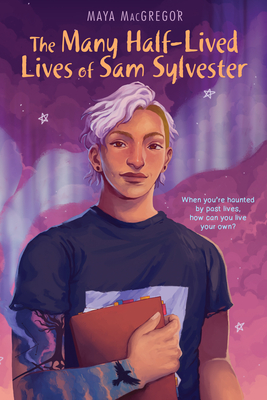
The Many Half-Lived Lives of Sam Sylvester – Maya McGregorLeaving old ghosts behind to turn over a new leaf—and find love.

“Santidalang” – Master Peace & Santigold

My mom and I are very similar people in a number of ways, but one of the ways that we hadn’t acknowledged until now is that we’ll see a song with Santigold on it and immediately hit download. It’s Santigold!! Who wouldn’t?

Named “Santidalang” in acknowledgment of the aforementioned legend, this track is a slight reworking of Master Peace (ba-dum tssssss)’s “Shangaladang” from his debut album, How to Make a Master Peace (ba-dum tsssssssssss). For someone who frequently cites LCD Soundsystem as one of his primary influences, what I’ve heard of his music is far from the uptight rhythms that I associate with James Murphy. What he’s taken from him, along with several other indie and dance acts from the 2000’s, is a neat rhythm—it’s a box, when you look at it from afar, but one that’s large enough to allow Master Peace a spacious environment to dance. Even amidst the pressing issues of the lyrics, “Santidalang” never stops being carefree; the opening is delivered with a defiant “ha-ha,” and lines like “The police wanna arrest me and my mates/I’m just wanna get myself some good grades/My mom told that she’s gonna send me away” with the goofy ring of a flexatone in the background and a smile that you can hear through the music. Like Santigold, it’s a grinning middle finger to those who would put him in a box and an assertion of joy in spite of it all. That’s why it’s so perfect that Santigold is featured on this finger after championing a similar mentality of joy and self-love in spite of societal expectations. Santigold bursts into an already vibrant track with her signature confidence, immediately claiming the space as hers. Like Master Peace, her smile and persistence cuts through the track like rays of sunshine: “Try to hold me down/I fight the power with my fist up.”

It’s easy to imagine that both Master Peace and Santigold had an absolute blast recording “Santidalang,” but it seems this picture only confirms it:

…AND A BOOK TO GO WITH IT:

A Song of Salvation – Alechia Dow – Defiant love and joy in the face of a universe that wants our heroes dead.

“Freefall” – Björk

Once I hit a valley in my Sisyphean Album Bucket List, I’m due for revisiting Fossora. When it was released almost two years ago, I liked it, but I felt like I didn’t fully get it. Björk is about as out there as out there can get, but even for me, it felt impenetrably so, like she’d ascended to a higher plane of being that us mere mortals couldn’t dream of reaching. Is that still true? It’s Björk, of course it is. But the more I listen, the more the ice melts—it’s not that I never liked Fossora, but for me, its merits become more evident the more time you spend with it. A way-homer, if you will.

I’d forgotten all about “Freefall” in the dust, and in retrospect, the fact that I listened to Fossora while I was figuring out how college works didn’t do wonders for remembering this album—or interpreting it. In Björk’s quest to become the all-knowing fungus queen, she remains as attuned to the surreal thrill of love as she was on Vespertine. Even in the wake of the tumultuous divorce with Matthew Barney (cheating is reprehensible on its own, but IMAGINE CHEATING ON BJÖRK, MY GOD), she has still found time to reminisce about the coalescence that the best relationships produce: “I let myself freefall into your arms/Into the shape of the love we created/Our emotional hammock/Safe inside the fabric of our love-woven membrane.” Of course she refers to it as a membrane, but it’s one of my favorite lyrics; saying that she’s attuned to nature and her body is an understatement—even in such a yearning song, she feels more whole than ever. Love as a fleshy, beating membrane, something to curl up inside like a vital organ (or a cocoon, even), evokes what most songs could not touch with multiple verses. Even if Björk drinking the water of life and willingly being consumed by the fungus has made her music more esoteric than it already was, what strikes me about “Freefall” is that she has such a human understanding of love; not necessarily in the sense of the soul, but in the sense of the sensation of warmth and the bodily joy of watching your heart tie itself to another and merge.

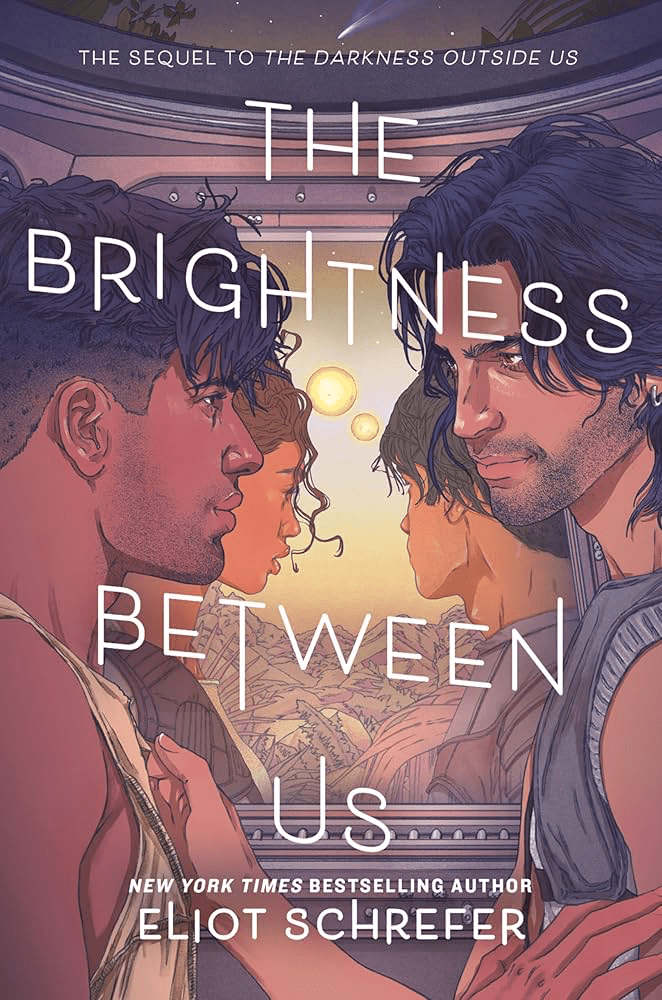
…AND A BOOK TO GO WITH IT:

The Darkness Outside Us – Eliot Schrefer“Our joined presence gains form/Our affections captured in a structure/Visceral sculpting of our love into space…”

Since this post consists entirely of songs, consider all of them to be today’s song.

That’s it for this week’s Sunday Songs! Have a wonderful rest of your day, and take care of yourselves!
Posted in Sunday Songs

Sunday Songs: 6/30/24

Happy Sunday, bibliophiles! I hope this week has treated you well.

This week: this ain’t rock n’ roll…

Enjoy this week’s songs!

SUNDAY SONGS: 6/30/24

“Future Legend/Diamond Dogs” – David Bowie

Another victim of me trying stubbornly to fit this into a color scheme, and also a victim of me trying to align my albums with what I draw on the whiteboard of my dorm. Listen, if the original sleeve was banned in the U.S., that generally means it’s a cool album cover, but probably not a good idea to be displayed for the world and my RA to see. And I was not about to draw David Bowie’s anatomically accurate canine lower half. Nah.

A time-proven rule: nobody does it like Bowie. You can put on all of the theater and spooky voices that you like, but nobody will ever replicate the sheer goosebumps that the intro to this album induces. The same can be said for many songs on this album (see: “Sweet Thing/Candidate/Sweet Thing [reprise]”), but I put “Future Legend” and “Diamond Dogs” together because the most enriching way to experience them is to experience them as a single song, and that single song is one of my favorite album intros of all time. Diamond Dogs is glam rock covered in flies—the lovelorn hope of Ziggy Stardust remains, but stinking of a world left in tatters, a hunk of rotting meat left for the mutant vultures in the searing desert heat. Cobbled from shreds of William S. Burroughs and Bowie’s failed attempt at a musical adaption of 1984, this album is a dystopia full of lust and peril. As a prologue, “Future Legend” is the height of Bowie’s theatricality. On anybody else, a dog’s howl, distorted as though bellowed through a plastic tube would feel like a feeble attempt to set a scene. Bowie, of course, makes it into the most bone-chilling alarm bell signaling the beginning of the end. It’s not the kind of sound any normal dog makes— it immediately triggers a sense of uncanny valley, a hair’s breadth away from being distinctly, evolutionarily wrong. His staticky narration is accompanied by synthy moans and high-pitched, delirious singsong beasts echoing “love me, love me!” as he tells of an alien landscape where all that remains of the 20th century is the excess it produced, the last monoliths that the mutant survivors of some horrific extinction now cling to. Panting dogs and drooling bloodsuckers lick their lips in the distance as Bowie lifts the curtain to declare this an era beyond the collapsed remnants of our sense of time. No month, no four-digit number to designate this hellscape: it is the year of the Diamond Dogs.

And “Diamond Dogs?” Hearing it for the first time while freshly 13 rearranged my molecular structure. In that moment, nobody had ever done anything as cool as that. It’s still true.

Because there will never be another album intro like this:

And in the death, as the last few corpses lay rotting on the slimy thoroughfare,
The shutters lifted in inches in Temperance Building, high on Poacher’s Hill
And red, mutant eyes gaze down on Hunger City.
No more big wheels.

Fleas the size of rats sucked on rats the size of cats,
And ten thousand peoploids split into small tribes,
Coveting the highest of the sterile skyscrapers like packs of dogs assaulting the glass fronts of Love Me Avenue,
Ripping and rewrapping mink and shiny silver fox, now legwarmers.
Family badge of sapphire and cracked emerald.
Any day now…
The Year of the Diamond Dogs!

…AND A BOOK TO GO WITH IT:

1984 – George Orwellneed I really explain this?

“On Repeat” – International Teachers of Pop

In terms of Co-Pilot, I end up focusing. more on Jim Noir, which…well, he has played a very prominent part in my musical life, but Leonore Wheatley’s musical ventures rarely get the praise they deserve. Wheatley’s talents extend to The Soundcarriers (big thank you to my brother for introducing me to them!), Co-Pilot (who released their incredible album Rotate almost a year ago!! Make some noise!!), and International Teachers of Pop, where she provides vocals alongside Katie Mason.

I’ve heard far too many bands who desperately want to market themselves as a second-coming of a certain era of music (We haven’t recovered from what Stranger Things did to shove the ’80s in everybody’s faces…I want out), but only end up sounding like plastic imitations. The key, which this school board of musicians has figured out, is not to set out to imitate. This sounds like a product that emerged from a desire to have fun and make catchy dance-pop and not try and sound like somebody more famous. Fun should be the prime motivation to make music, especially in a side project like this, but the bar’s low in such a hit-churning industry. You can hear Erasure and the Pet Shop Boys in every synthy buzz and flourish, but not because they set out to sound like them—it’s an homage, never an imitation. Mason and Wheatley’s harmonies center this pulsating track, built for booming bass and bouncing feet. (It really was a shame to see how lukewarm the crowd was in the video above—why are they barely dancing??) With lyrics swimming between existential dread and a desire for oblivious joy, “On Repeat” is the product an extensive pop study. Maybe the name is a touch presumptuous, but they’ve got the talent to back up their assertion, tongue-in-cheek or not.

…AND A BOOK TO GO WITH IT:

Machinehood – S.B. Divyaooh! aah! capitalism! woo! woo! yeah! this economy cannot sustain human life! get funky!

“I Won’t Tell” – Conlon & The Crawlers

Listen, I am BEGGING the Hacks fandom to do their stuff, because I can’t keep looping this song over and over on YouTube, and I don’t have a record player and therefore have no reason to snag the copies lingering on eBay…PLEASE. WE NEED TO GET THIS ON STREAMING. WHATEVER IT TAKES. DO YOUR STUFF!!!!!

“I Won’t Tell” was one of two one-off singles (the other being “You’re Comin’ On”) by Conlon & The Crawlers, an offshoot of The Nightcrawlers (top 10 band names that I totally want to steal for reasons that are totally not X-Men-related). From the looks of it, neither song went anywhere, and now the only remnants are floating around on eBay, and, thanks to some digging, a few eagle-eyed people on YouTube. All of this begs the question: how were they able to get this on Hacks? Somebody’s got a great record collection…unfortunately, the scene isn’t on YouTube, but it appears in Season 3, Episode 6, and briefly soundtracks a hilarious slo-mo of Ava and Deborah on a golf course, with Ava confidently strutting beside Deborah with her caddy vest on backwards.

The minute I heard it, I knew I had to hunt it down—it encapsulates a very distinct sound of the late-’60s that I just adore. It’s just deliciously jangly, from the opening riff (a reworked and arguably improved version of the opening to The Nightcrawlers’ “Little Black Egg”) to the almost banjo-like strum that builds the track’s backbone. Chuck Conlon’s butter-and-sugar voice spins the strings of “Little Black Egg” into a precocious, peculiar masterpiece—who would forget a song that opens with “A teaspoon holds more than a fork does/A long snail eats more than a short one?” This vibrant, jangly oddball is practically asking to be used for a tightly-shot Wes Anderson montage. Surely it’s obscure enough for him…

…AND A BOOK TO GO WITH IT:

Floating Hotel – Grace Curtislighthearted, jaunty, and equally matched on the Wes Anderson vibes front.

“A Million Times” – Lisa Germano

I’m not sure which direction I should go for next in terms of Lisa Germano’s discography. She has nine studio albums, two of which I’ve already listened to (Excerpts from a Love Circus and Slide). I know I’ll feel like a kicked puppy lying on a dirt road in the middle of nowhere after I listen to any given album, so chances are, it probably doesn’t matter where I start. Either way, on a whim, I dipped my toes into a handful of songs from her 2009 album Magic Neighbor. Many of the reviews have categorized it as having a childlike innocence juxtaposing the veil of darkness that never lifts from her discography, and there’s tangible strings of it stretched throughout. Even if you’ve dictionary-definition Been Through It like Germano has, I feel like you’d still have to have at least the tiniest mote of innocent glee—or humor—left in your soul to name a song “Kitty Train,” even if it’s a short instrumental break.

“A Million Times” has a childish glint to it, but childish here translates to complacency and toxicity; it feels like the emotional progression of “Small Heads,” musically twelve years down the line, but personally, only a handful. (At least…I hope so. I can only hope that the abusive bastard who inspired her to write any of the songs from Love Circus is just one guy, and that he got his comeuppance.) “Small Heads” acknowledges how unhappy she is in said relationship, but wryly admits that it’s not all the other party’s fault: “How convenient to forget/All the lies that you say/When you’re really really drunk…like me.” It’s a mutual kind of tangling, with both people ouroboros-ing themselves into their own minds so deeply that they’ve ceased to think of each other (“Did I ever think of you?/Did you ever think of me?/Probably not, with our heads in the clouds”), or, as Bowie might put it, “making love to [their] egos.” It’s all just fun and games, right? Whee! “What a lonely life!” she sings to the cheer of the crowd and dainty recorders.

Such fun and games echo through “A Million Times.” Said recorder has made a comeback, and all of the egg shakers and brushes in the background sound like remnants of rusty toys being disassembled. Just as childlike, Germano tosses the relationship across the room like a discarded doll, letting its limbs crumple now that she’s had her fun: “We fell in love and we were caught/Inside this game we call together/And it felt good until we found/We had more fun when we were strangers.” Every motion they go through is described in the same way that Ken tells Barbie “we’re girlfriend boyfriend,” smashing doll heads together to simulate kissing. Such kisses and games are a distraction from the inevitable implosion of their excuse for love—they’re so caught up in performing love that both of them have retreated into their own heads, convincing themselves, over and over, that they’re not sick of playing. It’s self-aware in the way that an arsonist is self-aware: they know that they’ve just burned down a building, but they’ll continue to set as many fires as they like. Germano seems to regress as she drags out her cry of “You can’t leave me/No, not really/We are happy with this misery/So we’ll start it all again/A million times, a million times.” Never before have I heard an accordion that sounds so distinctly ominous—the bellow of it as Germano’s lyrics get progressively poisonous might as well be the siren in a bomb shelter, a low, distant warning of disaster to come. “You can’t leave me” is simultaneously the rug of innocence being pulled out and the dread of pulling apart from someone who you know will collapse without you to parasitically cling to. Platonically, I’ve been the host/discarded toy in such situations, so for my sake and hers, I hope Germano’s since quit playing with her dollies. I’m willing to give her some leeway, since if she’s played up the eerie overtones in this song, she recognizes these patterns for the toxic mess they are.

…AND A BOOK TO GO WITH IT:

The Emperor and the Endless Palace – Justinian Huang“We fell in love and we were caught/Inside this game we call together/And it felt good until we found/We had more fun when we were strangers…”

“Feet-like Fins” – Cocteau Twins

Rounding out the month with yet another Cocteau Twins song…sorry, everybody. Get Victorialand‘ed, I guess. The only thing keeping me from swallowing this album in one gulp like some kind of deep-sea abomination of god is knowing that this is the perfect album for winter, what with the Artic and Antarctic inspiration.

Situated near the end of the album, “Feet-like Fins” is a dewy spiderweb of reverb that glitters in waning sunlight through gray clouds. Crested by soft cymbal crescendos, you can never pick out a note from the track that isn’t vibrating like raindrops on a speaker. Even the bongos that gently steady the melody never truly feel percussive, nothing but droplets sending ripples out into the frigid water. Like “Aikea-Guinea,” “Feet-like Fins” is distinctly watery, but where the former feels like being tossed through the waters of time, this track is a gradual descent into the ocean, watching the last threads of silky light disappear into the shallows as you’re pulled downwards. Judging from the “Frozen World,” Living Planet-inspired patchwork of the album, the feet-like fins likely belonged to the various seals that appear throughout the episode: crab-eater seals, fur seals, and elephant seals; Indeed, the sleek movements of this track mirror their bubble-trailing paths through the water as they hunt for prey.

…AND A BOOK TO GO WITH IT:

Lagoon – Nnedi Okorafora mysterious, alien lifeform stretches its feelers and emerges from the ocean…

Since this post consists entirely of songs, consider all of them to be today’s song.

That’s it for this week’s Sunday Songs! Have a wonderful rest of your day, and take care of yourselves!
Posted in Sunday Songs

Sunday Songs: 6/23/24

Happy Sunday, bibliophiles! I hope this week has treated you well.

This week: I wouldn’t hold out hope for the tape deck…or the Creedence.

Enjoy this week’s songs!

SUNDAY SONGS: 6/23/24

“Soul Love” (Demo) – David Bowie

This week on me being incredibly predictable: needless to say, I’m a wreck again. The demos. The David Bowie demos. They got me…………..

As if I wasn’t already eviscerated by what I’ve heard of Divine Symmetry (see: “Quicksand” [Demo]), we’re already back at it again with Rock n’ Roll Star!, a collection of demos, rarities, and live recordings from The Rise and Fall of Ziggy Stardust and the Spiders from Mars. For me, an album is one of the few things that isn’t ruined by seeing all of the moving cogs inside of its stomach; seeing the nymphs of what would become rock classics makes the process even more admirable—and more human, knowing how many costumes each song had to try on before debuting. A piece of “Moonage Daydream” was once less than two minutes, much less spacey, and called “So Long 60’s”; “Lady Stardust” went through several vocal changes before coming out the other side. Most of these were changes that were necessary for the songs to shine.

And yet, the demo version of “Soul Love” feels like the proper way that the song should have been all along. On Ziggy Stardust, it serves to ground the grandiose, anguished lament of “Five Years,” calming the album in vignettes of grief and young lovers. This demo includes some of Bowie’s notes—you can hear him telling his producers that he envisions the final products with lots of saxophone, which it eventually gained. There was no way that “Soul Love” would have ever made it onto Ziggy Stardust in its sparse, acoustic form; there’s no room for that kind of true quiet on an album that’s not only so lofty in its story, but unabashedly theatrical and glam rock. “Soul Love” was always intimate, but in isolation, with only Bowie and his acoustic guitar, the intimacy feels exactly how it was intended. In such a soft, enclosed space, the secrecy of “A boy and girl are talking/New words/That only they can share” and the silent mourning of “She kneels before the grave/A brave son/Who gave his life to save the slogans.” In the landscape of the Ziggy Stardust narrative, “Soul Love” is the period after the announcement of Earth’s impending doom, where fleeting images of people are shown in private, emotional moments—lovers embracing in the darkness, and a mother grieving her fallen son, but thinking also of the future—was it for the best that he was slain before the calamitous end of the world? That privacy is what makes the acoustic version feel much more fitting to the true intent of the song; the performance itself is as secretive and soft of a moment as the very vignettes that Bowie describes; hunched over his guitar, for the first time, you understand the purpose with which he sings “all I have is my love of love,” solid against his beating heart like loose change in his breast pocket.

…AND A BOOK TO GO WITH IT:

Madman Yearbook ’95 – Mike Allredpure love and David Bowie references abound. Might just be my favorite comic of all time…

“Little Bird” – Lisa Hannigan

The more I listen to “Little Bird,” the more I’m tempted to just copy and paste the lyrics here in lieu of actually writing something, because how else could I do justice to this song? When you’ve got the talent to open a song like this, how do you describe it any better than her?

“Your heart sings like a kettle/And your words, they boil away like steam/And a lie burns long, while the truth bites quick/A heart is built for both, it seems/You are lonely as a church/Despite the queuing out your door/I am empty as a promise, no more.”

One verse. One verse, and I can already feel my chest caving in. Christ. You can dress your story with all the metaphors you like, but Hannigan places them so intentionally that they were never throwaways to make anything more purple or flowery; there’s a quiet tragedy to them, like the squeal of a tea kettle as its contents boil. And it’s not just tying objects like teakettles and churches—thinking to make words disappear in a flush of steam and making the pinnacle of isolation a church is what makes them dig so deeply; it’s Hannigan gives new eyes to these metaphors that turn them into such gut-wrenching poetry. It encapsulates a sensation I often felt as a child, and on occasion now that I’m older: that of being in such a large crowd of people, and everything seeming to collapse into silence and loneliness around you, even though you’re as surrounded and secure as can be. Loneliness, homesickness, lovesickness—the more company it has, the more it aches, I find. Whatever the opposite of claustrophobia is how “Little Bird” is—the feeling of being in an enclosed space, but such a large and unfurnished one that it makes your body instinctively crouch into a small shape. It’s the caldera of loneliness as you grapple with the space one filled by someone, but now occupied by the tug-of-war between whatever made you stay and what made you let them go: “When the time comes/And rights have been read/I think of you often/But for once, I meant what I said.” But the paper-thin, lead-heavy lyrics would not be the same without their messenger—nothing brings it sailing back home like Hannigan’s solemn, wavering warble, each tremble never failing to give me full-body tremors.

In case that wasn’t enough to elicit a good cry, here’s her performance of it on her Tiny Desk Concert (skip to 2:32):

…AND A BOOK TO GO WITH IT:

The Raven and the Reindeer – T. Kingfisher“I was salted by your hunger/Now you’ve gone and lost your appetite/And a little bird is every bit as handy in a fight….”

“We The People…” – A Tribe Called Quest

Of course I came back to this song in an election year. I distinctly remembering “We The People…” coloring the deep-rooted anxiety and turmoil of 2016, what with the hate machine that was Trump’s election campaign and eventual presidency. I really, really want to say that “We The People…” sounds dated, but nothing about it is. First off, A Tribe Called Quest are just that talented, but more importantly…nothing about this song’s politics is dated. Here we are in 2024, and Trump is back, and spewing the exact same rhetoric, now with callbacks to Hitler that aren’t even trying to hide it anymore. In his reelection campaign, the only change to his status are the impeachments (PLURAL, remember) and the 34 felony charges. Predictably, that’s done next to nothing to sway his rabid fanbase. I really wish I could say that this song was a product of its time. Maybe in 20 years, when all of this is behind us, it will be. But no, in eight years, nothing’s really changed. A Tribe Called Quest stripped the desires of Trump and his supporters down to the bone, and eight years later, it makes me ill to think that we’re trapped in this same cycle again.

But you know what else hasn’t changed? Our anger. Back in 2016, we knew the dangers of letting such a raging, narcissistic bigot with no political experience into the White House, and now we’ve survived it, and we’re bent on making sure it won’t happen again. The anger and determination of “We The People…” rings the same, but with more tenacity. It may be disheartening to be stuck in this hell time loop, but at least we have high-quality protest music whose wit (and infectious beat) hasn’t dulled in almost a decade. Thanks, Tribe.

…AND A BOOK TO GO WITH IT:

No Gods, No Monsters – Caldwell Turnbullpolitical unrest and injustice in modern America…now with more monsters.

“Aikea-Guinea” – Cocteau Twins

For the Cocteau Twins, the song’s title is often more important than the lyrics; it’s a placeholder for the abstract feeling that Elizabeth Fraser and company string together, an anchoring point for attempting to describe their lattice-like melodies. In Fraser’s own words, “aikea-guinea” is Scottish slang for “flat shells that have been bleached and smoothed out by the sea and the sand. I’ve just ruined it for you by telling you what it’s all about, haven’t I?”

I really don’t think it has, not at all. In fact, it only sharpens the image that “Aikea-Guinea” conjures as it fizzes like waves dissipating on a rocky shore. By 1985, gated reverb was king (and likely growing overused, at least in mainstream music…and remember, kids, we have “Intruder” to thank for it), but the Cocteau Twins knew just the way to use it to their advantage. By cloaking all of their percussion in it, “Aikea-Guinea” dissolves in your ears like fizzing candy, or more accurately, like crackling sea foam birthed from a freshly-broken wave. Like “Oomingmak,” it’s swathed in mist, but this mist comes from the aftermath of a storm out at sea, the air full of nostril-tingling salt and faint coldness making goosebumps prickle on your bare arms. With each punch of percussion, such seashells that Fraser described tumble through the water, colliding with each other as time and water erode them. Fraser’s voice, which bobs and balloons like frogs after nightfall, is as transient as plankton in the water, spiraling like the trails of bubbles that carry each shell through the currents of time.

…AND A BOOK TO GO WITH IT:

The Light at the Bottom of the World – London Shaha fitting soundtrack to an underwater England of the future.

“Lookin’ Out My Back Door” – Creedence Clearwater Revival

I’m not even that ardent of a Creedence Clearwater Revival fan—my knowledge doesn’t extend much past the hits—but I firmly believe that this is one of those songs, like David Bowie’s “Kooks,” that every kid should have in their life. The only crime about this song is that it wasn’t released in the same key as the music video, which, in my opinion, makes the lighthearted daydream of it feel all the more daydream-like. And speaking of daydreams…usually, I don’t get all up in arms when a given song gets interpreted as being about drugs, but oh my god. Please. “Oh, it’s about tripping, the spoon is an allusion to cocaine, the—” SHUT UP!! SHUT UP!!!!!!!!!!!!!! JOHN FOGERTY WROTE THIS SONG FOR HIS THREE-YEAR-OLD SON, YOU EDGELORDS!!! IT’S NOT AN ACID TRIP, THE LYRICS WERE INSPIRED BY DR. SEUSS!!! For fuck’s sake, man…of all the lyric interpretation cop-outs, this has to be one of the most offensive for me. Just because it was written in 1969 doesn’t mean that it’s about acid…

I guess what tweaks me so much, other than how much of a mainstay of my childhood that “Lookin’ Out My Back Door” was, is that people automatically see silly, nonsensical imagery and automatically attribute it to acid. Do none of you have any imagination? What, did you forget how you got bored in your childhood and started imagining happy creatures dancing on the lawn? Is that how out of touch you are with your inner child?? Okay, I’m getting far too worked up about that, but god. It genuinely gets under my skin that a song of such purity still gets misinterpreted like this. Just goes to show you how we treat childlike wonder and imagination.

Anyway. All that said, no amount of misinterpretation will ever sully this song to me; there’s a joyous warmth to it that really can only be the product of happy creatures dancing on the lawn. I remember imagining them somewhere along the lines of Mercer Mayer’s Little Critter books, and that’s the beauty of it. This song, like Dr. Seuss, was made to be a picture book: the language is simple enough for a child to understand, but there’s so much silliness and vibrance abound that, just like a peeling, well-loved board book, they’ll be asking to hear “doo, doo, doo, lookin’ out my back door” time and time again.

On another note: I’d planned on including “Lookin’ Out My Back Door” this week anyway, but putting it on the heels of rewatching The Big Lebowski recently was only fitting:

…AND A BOOK TO GO WITH IT:

And to Think That I Saw It on Mulberry Street – Dr. Seusssee above—this is the specific Dr. Seuss book that inspired the lyrics.

BONUS: an update to 6/2/24…they finally “Wuthering Heights”-‘d this shit up!!!!!

Since this post consists entirely of songs, consider all of them to be today’s song.

That’s it for this week’s Sunday Songs! Have a wonderful rest of your day, and take care of yourselves!
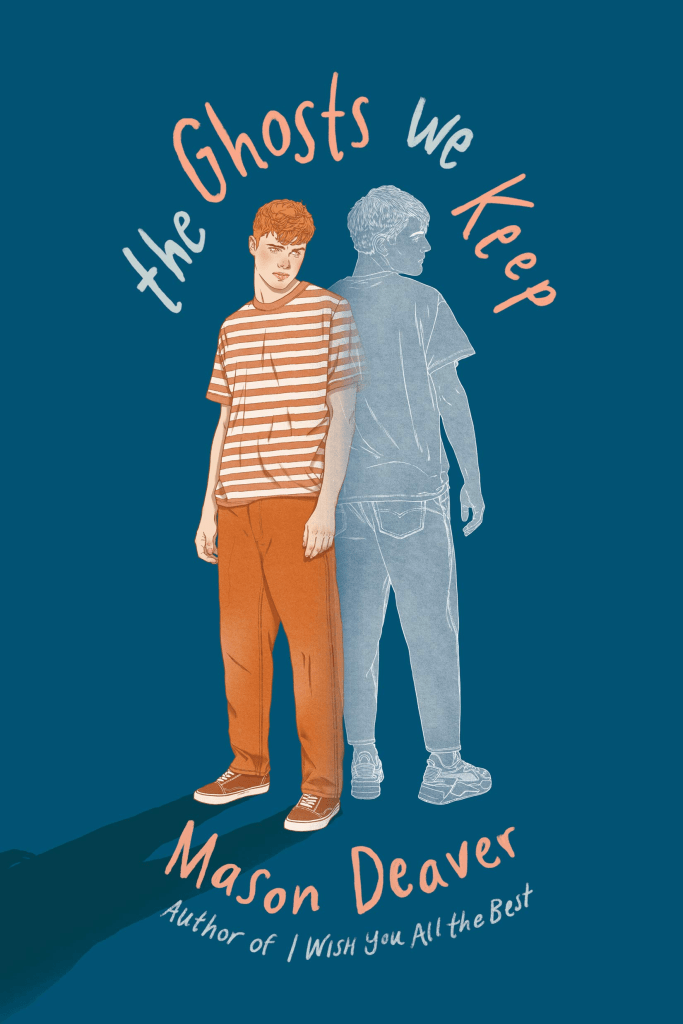
Posted in Sunday Songs

Sunday Songs: 6/16/24

Happy Sunday, bibliophiles!

First off: happy Father’s Day to my incredible dad! Not only are you such a wonderful role model for being a genuinely kind, accepting, and truly empathetic person, you’ve given me the gift of sharing music—what these posts are all about. To be able to share music with you back brings me all the joy in the world. I love you.

This week: 🚨SOCCER MOMMY HAS COME TO SAVE THE SECOND HALF OF 2024, THIS IS NOT A DRILL🚨

Enjoy this week’s songs!

SUNDAY SONGS: 6/16/24

“Lost” – Soccer Mommy

SOCCER MOMMY RETURNS!!! Given the short tour (that’s nowhere near me……..no, I’m totally not mad, no way) that she’s currently embarking on to support some of this new material, there’s a fourth album (sixth, counting the self-released albums) on the horizon, and hopefully on a happier date. Poor thing. I still haven’t gotten over the fact that her last album, Sometimes, Forever, was unintentionally released on the day that Roe v. Wade was overturned. Jesus.

Something that I’ve admired over the years about Soccer Mommy is her willingness to experiment with her production. At their core, her songs have never changed their essence: honest, tender confessions of the trials of heartbreak, grief, and mental health. But the dressing is never the same twice, from color theory’s color-coded tonal shifts and synth-dusted melodies to the darker, more distorted soundscape of Sometimes, Forever. With the latter, Chelsea Wolfe wasn’t somebody that I’d readily compare to Soccer Mommy, but then she comes along with “Unholy Affliction,” and the comparison, at least on that track, is as clear as day. Just when you think she’s playing it safe, she comes out of nowhere with instrumentation that you’d never imagine attributed to her name—and almost every time, it still feels like nothing but Sophie Allison. There’s a boldness to her that’s rare in the genre; there is an expectation of sameness in the kind of indie circles she’s in, an expectation to box yourself into the image that the record label deems as “authentic” in order to stay in their good graces—and the good graces of fans who cling to their raw lyrics. Julien Baker, although her first two albums adhered to that, took a similar leap with Little Oblivions, and that, for me, was her best album to date.

But Soccer Mommy can’t help but be herself. “Lost” strays nearer to some of her sparer, more traditionally indie roots, but with production that feels spun from silk; inside of the glowing cocoon where Allison resides, threads of synth, birdsong, and yearning strings coalesce in what can only be described as the musical form of a grainy polaroid, a sunset tinged with ink, film, and bygone memories. Bygone memories, like much of her other material, is at the core of “Lost,” specifically bygone memories of those bygone. Given the trajectory of “yellow is the color of her eyes,” some have speculated that “Lost” is about her mother’s death, although Allison has chosen to not disclose the subject. whatever the case, I’m glad that Soccer Mommy doesn’t have the kind of rabid Swiftie fanbase that would relentlessly strip away at the press and at Allison herself to get to the bottom of who she’s mourning, because…that’s her own business, dammit. I’m glad us…whatever Soccer Mommy fans are called (does this fanbase have a name?) have the heart to give a human being space to breathe, because, judging from the lyrics (and all of color theory, frankly), Allison needs it. “Lost” distills grief in the truths of the cliche that every movie seems to repeat about grief: “I wish I’d had more time.” Most media leans on that universal kernel to hold the weight of such a complex, unmappable sensation, but Allison scratches at its heart; her grief rests not just in tangible objects, but in the reminders of the time never spent: “I’ve got a way/Of keeping her with me where I go/But how she feels, I’ll never know/It’s lost to me.” The pain of this track is in the insurmountable truth of never being able to fully know a person; of course you can never fully, truly know a person beyond yourself, but grief exacerbates that unsurmountable summit—even if you tell yourself that you could be a cartographer of a brain outside your own, that chance has all but slipped through your fingers. Grief has unrealistic expectations of you; in its throes, it tells you that you could have made up for all of the missed regrets in your lifetime, and that’s half of the knife in your gut. Half of the pain isn’t what didn’t happen, but what can’t happen, even in the alternate reality it presents. When she repeats “If I had another chance/I’d ask her then,” it doesn’t feel like a throwaway from a stale funeral in the MCU—it feels like the testimony of something still putting down the compass and fountain pen, knowing that this expedition was doomed from the start.

So, what, you ask, might us sad girls do while we wait for Soccer Mommy’s fourth LP, which will inevitably destroy us? Watch Allison and fellow storied sad girl Phoebe Bridgers unite to cover Elliott Smith:

…AND A BOOK TO GO WITH IT:

Only This Beautiful Moment – Abdi Nazemianbreaching generational lines to form an understanding of heritage, sexuality, and family.

“Drinking Song” – Haley Heynderickx

Contrary to the song title, Haley Heynderickx is (probably) not responsible for the kind of song that old men will sing in a pub while drunk for generations to come. I mean, that could be a possibility in some alternate universe. I’d like to see that. It’d make for an odd movie scene—nothing about this universe has changed, but instead of old Irish ballads, there’s a pub full of swaying people singing late-2010’s indie rock.

With a title like “Drinking Song,” I fully expected this song to be the prequel to “Oom Sha La La,” a telling of the period where “The milk [was] sour/I’ve barely been to college/And I’ve been doubtful/Of all that I have dreamed of.” Contrary to that, “Drinking Song” is a soft-spoken but resolute declaration of hope, delivered out a summer window while the crickets sing. Any darkness is the shroud of night, and all of the stars seem to bear witness to a constitution of better days to come: “And the edge of the world makes it seem/That everyone gone is still singing the same song/And I can believe in these things/That everyone’s singing along/The good and the bad and the gone.” There’s a kind of childlike optimism to the openness of Heynderickx’s declaration, but one with roots strong enough to hold it; with each repetition of “there’s a light at the end that I know,” that glow, like The Great Gatsby’s green light, pulses with more intensity with each incantation, until it becomes a portal to better times. It’s the opposite of negative overthinking; this song overflows with future vignettes of new cities to explore and new lovers to embrace, all held within the space of the back of your mind. “Drinking Song” is a snow globe containing every good future—all is too small to comprehend in the here and now, but with a little luck, you can hold them in your hands and watch them unfold before you.

…AND A BOOK TO GO WITH IT:

Sea Change – Gina Chungholding onto hope in a time of lovelessness and isolation.

“Bad Form” – Ganser

I like plenty of bands and artists whose catalogue consists of one or two songs tops (see: Wet Leg, Suki Waterhouse, etc.). What distinguishes said bands, for me, is that they’ve made a career out of making those two songs worth your time—they may only be two songs, but they play them well. Sure, “I Just Threw Out the Love of My Dreams” may be one of Weezer’s one, maybe two songs (and even that’s generous), but it’s such a bright and shining piece of machinery that you can’t help but gaze at said one song and know that, yeah, it may be the same song they’ve been peddling since 1994, but it’s one fantastic song.

The more I listen to Ganser, the more I realize that they fall into that camp. I hate to say that every time, but like I said, it’s not always an insult. Although they do have a good amount of deviation here and there, most of Just Look At That Sky, as much as I enjoyed it, is the same three off-kilter, drawled post-punk songs about being numb, exhausted, and angry, or some combination of the three. They’ve got a brand. Ganser, for me, stands out in that their three songs sound different enough from any given song that you can excuse them for relative lack of variety. None of their chords ever align pleasantly—it’s abrasive, grating, and honestly? Fun. As with “People Watching” (which I reviewed at the beginning of the month), Ganser makes the kind of punk that’s aware of how punk it sounds, and they lean into every inch of theatricality with their bleary-eyed drawls and itchy, buzz-saw guitar riffs, fuzzy and stinging like staring straight at the sun—just as like the climax of “Bad Form.” Ganser is a band that’s not afraid to make music that scratches your skin like un-filed, bitten nails, and if that’s their three songs, then three cheers for making three songs that are bold enough to sound unappealing.

…AND A BOOK TO GO WITH IT:

Ten Low (The Facts Sequence, #1) – Stark Holborn“I’m the other man/I’ll take the medicine/The room spins like a feather/Folding over and over…”

“Transatlanticism” – Death Cab for Cutie

I was first introduced to “Transatlanticism” when I was about 12 or 13. A few months after the first listen (and being irreparably entranced), I had an internship at a local flower shop, where the owner had Sirius XMU playing. This song came on at some point, and I’ll never forget the deeply concerned look she gave me when I told her, in the most 13-year-old way possible, how much I “loooooooooooved” this song. She was entirely justified.

Another thing that music criticism does that I’ve never understood: categorizing Death Cab for Cutie as emo. If I suspend my disbelief enough, I can see the basis being in the whine in Ben Gibbard’s voice, especially when he performs live, and the dramatic emotion is there, but…in what world does Death Cab for Cutie belong in the same breath as My Chemical Romance? Really? I could almost see them being the middle ground between emo and indie, with some of the lingering whine and drama, but the key with selling drama is what has always lost me with most emo music: it actually feels authentic. Never once does Gibbard sound like a suburban teenage boy who’s just discovered heartbreak and black eyeliner in one fell swoop. The whine, although it can fit into some of said teenage boy sensibilities (see: “We Looked Like Giants”), just seems more of a product of Gibbard’s natural range than it does a forced vehicle for airbrushed angst.

In theory, “Transatlanticism” fails my test of withstanding a long song; most of the time, in order for a long song to hold enough water past around the six minute mark, there has to be at least some sort of shift, whether that’s tonal, lyrical, or instrumental; it’s why “Cop Shoot Cop” by Spiritualized really feels like it’s over 17 minutes long, with its largely extended sleepwalk of monotony, whereas Nina Simone’s ten minute epic “Sinnerman” has the fervor and gusto, as well as an act structure similar to classical pieces, is a nail-biting journey that never lets go of your shirt collar. (To be fair to J. Spaceman, my guess is that the tedium is the intended effect, seeing as it’s about how his heroin addiction all but made him into a dead man walking. Knowing him, it’s fully intentional.) However, there’s songs like Blur’s “Tender”—nearly eight minutes long and without much change—that have the pure, undiluted heart to keep its sails billowing. You feel everything—it’s an IV drip straight through to the sparest, most instinctual emotions, heart-wrenching in its delicately-crafted simplicity. “Transatlanticism” takes a trick out of that same book; until the last third, all that accompanies Gibbard’s thinning, tender lament is about four piano chords, played over and over with a purposeful negative space between them. Come to think of it, negative space is exactly why “Transatlanticism” works so well. Transatlanticism as a whole is a concept album about long-distance relationships, and even without the lyrics, crushing as they are, you can sense the abyssal gulf cutting down the middle of this song. At the four-minute mark, after Gibbard has finished with the first repetition of “I need you so much closer,” a full minute passes of a single, instrumental strain: those same four chords, a spare guitar lick, and tiny tendrils of synth that faintly moan and rattle like dying machinery, as if trying to conceal their death rattles without bothering anyone. Transatlancism was aided with Brian Eno’s Oblique Strategies cards, and I wouldn’t be surprised if they drew the same cards that produced Bowie’s “Sense of Doubt”—”emphasize difference” and “try to make everything as similar as possible.”

The difference, in this case, is a shift in lyrical style; It’s all but silent compared to the lyrics in the first half, but that silence conveys the feeling of separation, of having a strand of your soul stretched across an ocean and not being able to see who’s on the other shore, just as heartbreakingly as words do. After Gibbard’s lament (“The rhythm of my footsteps crossing flatlands to your door/Have been silenced forevermore/The distance is quite simply much too far for me to row/It seems farther than ever before”), the exhaustion of sorrow leaves you with no strength to do anything but stare into the canyon wrought by distance, too far to even touch fingertips over. Simplicity is what kills me about this song; after that instrumental break, Gibbard repeats the “I need you so much closer” refrain, only to transform it to “I need you so much closer…so come on.” When all of the poetry’s drained, sometimes the most sparing lyricism destroys me. The ocean has spread its impossible distance before you, and all you can do is stare as far as you can, towards the bottom, with only the most baseline instincts of longing to keep you company. It’s such an artful buildup and approach to portraying such deep yearning—you feel that negative space as a tangible barrier. See what I mean about Death Cab for Cutie making their angst authentic? “Transatlanticism” hits me like a goddamn steam train every time without fail. Ow, dude, who kidnapped me and abandoned me in the onion-cutting factory?

…AND A BOOK TO GO WITH IT:

Aurora’s End (The Aurora Cycle, #3) – Amie Kaufman & Jay Kristoffow oof ow ouchie ow ow ow somebody hold me

“Country Sad Ballad Man” – Blur

And now, “Song 3.”

Blur’s self-titled album [slides Anthony Fantano glasses up bridge of nose] is an exercise in becoming the very thing you swore to destroy. After years of being right smack in the middle of the spotlight, participating in a manufactured battle of the bands, and pushing their mutual abuse of multiple substances to the edge, the band collectively decided that a change needed to be made. They packed their bags, temporarily relocated to Iceland, and hammered out a new album. The result was Blur, which had a much dingier, edgier, and altogether harder sound, with a lead single that famously parodied grunge, but then…circled around to being a smash success and an enduring stadium classic. That’s another story. (I’ll give you a hint: wooooooooohoo!) Yet, as much as they poked fun at American grunge, in all of its nihilistic, self-deprecating time in the sun, they slipped straight into the lifestyle, shedding their Britpop gloss for aggressive, alternative guitar, stubble, and, to the detriment of the whole band, excessive abuse of alcohol and heroin (see: “Beetlebum”).

Though the drug use is lamentable (to say the least), as all of the band members now agree, it was their mutual exhaustion and anger at being put through the British media meat grinder that allowed for such a hard—and delicious—left turn. On the verge of snapping, the band decided to put Parklife behind them and get grungy. It was bound to happen eventually, what with Graham Coxon’s adoration for the American alternative scene and the guitar sounds they were producing (should’ve listened to him earlier on that one…). Blur is all but absent of a bad track, crashing with the equivalent of a drum set tossed through a window one minute (“Chinese Bombs”) and slipping into acoustic melancholia in the next (“You’re So Great”). But “Country Sad Ballad Man,” for me, is a highlight I find myself sniffing out every six months or so. With one of the drier and more self-explanatory titles, this track feels like food left to rot out in a heatwave, festering and twangy. Every other lyric finds Damon Albarn stretching his voice into a creaky, scratching highs, as though mocking his own state of lying squarely at rock-bottom: “I haven’t felt my legs/Since the summer/And I don’t call my friends/Forgot their numbers.” The strings on Alex James’ upright bass come loose and unsteady, as though a few more takes of this song would’ve seen them snap off and collapse on the floor. Graham Coxon relishes in the alternative aggression that Britpop never fully allowed for, twisting riffs that seem to languish like drooping eyelids, dripping sweat and numbness. But the real freakout, one that must have been canned and compressed for ages, explodes in a vomit of wobbly distortion and screeching falsetto. It’s a vertigo-inducing outro that caves in like the mold-rotted roof of a wooden house, shattering in a hail of splinters and nails. In all of its spring-plucking chaos, there’s really no other lyric that fits it than Albarn’s self-aggrandizing, high-pitched screech of “I’ve done and fucked it!” yelled straight up from the well of rock bottom.

…AND A BOOK TO GO WITH IT:

So Lucky – Nicola Griffith“Yeah, I found nowhere/It got to know me…”

Since this post consists entirely of songs, consider all of them to be today’s song.

That’s it for this week’s Sunday Songs! Have a wonderful rest of your day, and take care of yourselves!

Posted in Sunday Songs

Sunday Songs: 6/2/24

Happy Sunday, bibliophiles!

Quick announcement before we begin: I’ll be going radio silent as far as posts go for the next week because I’ll be on vacation. See you next week!

This week: diversity win! The person who yelled “I WANNA HAVE YOUR BABIES!” at Joe Talbot during the IDLES show a few weeks back was a man! Happy pride, bibliophiles.

Enjoy this week’s songs!

SUNDAY SONGS: 6/2/24

“Good Luck, Babe!” – Chappell Roan

I think I know what my process is with liking Chappell Roan songs now: inevitably, I hear a snippet on social media and think, “oh, that’s okay,” I hear it a few more times, and then I actually like it. Somehow, I wasn’t wowed by “Red Wine Supernova” until I’d listened to snippets of it three times over the course of several months, and then, boom. It’s my 10th most listened-to song of this year. Oops. “Good Luck, Babe!” hasn’t taken that title, but nonetheless, I’ve found another song to dramatically drape myself out of windows to, and to make matters better, it’s so gay. IT’S SO GAY! CAMPY QUEER POP STARS ARE SO BACK! I’m all for leaving the ’80s (mostly) in the dust, but we need some glittery, romantic ridiculousness to shake things up now and then, right? And if the last chorus of “Red Wine Supernova” wasn’t enough to convince you, then this one will convince you that Roan has, in my limited scope, some of the best pipes in pop music right now. And, whatever, the whole “graphic design is my passion” aesthetic was kind of tired for me even before this lyric video, but for a song as red-gowned and dramatic as “Good Luck, Babe!”…we need more. We need some more visual drama, something like The Kick Inside-era Kate Bush, minus the one-time fedora incident. The chances of Roan or any member of her team actually seeing this post are slim to none, but if they are: somebody needs to “Wuthering Heights” this shit up.

I’m choosing to believe that the combination of the glorious Grammys afterparty pig makeup for the single and the title had to be a reference to Babe, right? Some way or another? Maybe I’m reading too much into it. It’s fine. It’s cool, even…that’ll do, pig.

…AND A BOOK TO GO WITH IT:

The First Bright Thing – J.R. Dawsontalk about stopping the world just to stop the feeling…

“I’m Scum” – IDLES

Something I learned a few Saturdays ago: I may be somewhat punk in spirit, but I am…not built for punk shows. Once IDLES actually came onstage, the music took me out of the grossness of the crowd, but we accidentally wandered too far into the Bro Zone™️, which was anxiety-inducing, to say the least. Love is the fing, but I’m not really feeling the love when I’m pressed up against excessively sweaty and inebriated people on almost all sides and getting conked on the shoulder with unknown objects. Ladies, gentlemen, and others: sensory issues. Also, alcohol.

But if you take anything away from that, it’s that the music took me out of the grossness. IDLES absolutely tore down the house with joyous screamers old and new alike. Even if Joe Talbot summoning the mosh vortex in the middle of the crowd made me want to go in the opposite direction (now I know how anchovies feel inside of those bait balls), he had such a command of the crowd, and not only that, but nothing but positivity to say: chants for Palestine, odes to love and connection between our fellow man, and just calls to get up on our feet and dance. And dance we did. Even just Talbot and Mark Bowen belting “All I Want For Christmas Is You” in mid-May got the crowd (myself included) going crazy. An IDLES show is, without a doubt, an experience of a lifetime. Not all of it was a good experience, per se, but none of the bad had anything to do with how loving and talented the band were all the way through.

That show made me come back to “I’m Scum,” a performance that had me jumping for joy the entire time. I’ve loved it since I discovered their 2019 Tiny Desk Concert, which is a sight to behold: here we are at said Tiny Desk, surrounded by small toys and trinkets and walled in by office decor, and Joe Talbot’s over here turning beet red and drenched with sweat while Mark Bowen, shirtless and wearing American flag leggings, is climbing onto the desk. It’s glorious. Barely contained chaos. “I’m Scum” is taken from Joy as an Act of Resistance., an album title which, before “Grace” and “love is the fing,” was the preeminent positivity slogan to sum up their aggressively kind ethos. As Talbot explained before the band launched into this song, “I’m Scum” was borne of the words of their critics—taking words like “scum” and “loser” and making them into badges of pride. More broadly, said words came from music critics who derided them, as Talbot recounted in Glastonbury in 2019, as “too fat, too old, too stupid, too ugly. Now we’ve been told we’re too good, too nice. Well this is for the critics: eat shit. This song is a celebration of just how ugly, stupid, old and ugly we are.” Never have I sung along to the lyrics “for a long, long while I’ve known I’m/dirty, rotten, filthy scum!” so loudly. Just like any given song of theirs, it’s undeniably joyous, a parade flag-waver as you skip through the streets, save for the fact that you’re yelling “SCUUUUUUUUUUUUUUUM” so loud that your throat goes raw. “This snowflake’s an avalanche” is one of the most hilarious but unifying rallying cries I can think of. The more I reflect on it, the more I can say that this is one of the IDLES songs that I’ve resonated with the most. I’ve grappled with being weird in a broader sense for most of my life, but late high school and college were when I most owned it—I wasn’t concerned with how people thought of me. Now that the former stage is over, I’ve turned that confidence into getting weirder still, especially with my makeup; a friend told me that I wasn’t afraid to camouflage, and there’s nothing that I could say that sums it up better. God, I LOVE being unpalatable. I love being weird. I love being the kind of person that gets stares from the suited-up business majors across the street. I love looking like I don’t belong on this planet. And that’s when I feel most myself, when I outwardly enhance how weird I am and how weird I’ve felt. I’m lefty, I’m soft. And I LOVE being dirty, rotten, filthy SCUM if I do say so myself. Embrace the scum!

…AND A BOOK TO GO WITH IT:

Honor Among Thieves (The Honors, #1) – Rachel Caine and Ann Aguirre“I’m laughing at the tyrants/I’m sleeping under sirens/Whilst wondering where the time went/I’m scum…”

“Oomingmak” – Cocteau Twins

My introduction to the Cocteau Twins came right before I started making these Sunday Songs graphics, so I suppose that’s the only reason that I’ve never covered them here before. In my mind, there’s no band quite like them in the sense that the moods that they glean from me are rare in any other band. When an anonymous person put the iconic “Cherry-Coloured Funk” on the class playlist in art in my senior year of high school, I felt energized in a way that I hadn’t before—energized, but caught in the spacelike fabric of something beyond the world, like wading through cloth and stars. “Energized” isn’t the word I’d use to describe everything else I’ve heard of their catalogue—I’d lean more towards dreamlike and peaceful. The label “dream pop” is more fitting of them than any other band, save for maybe Beach House, who were no doubt influenced a great deal by them; they didn’t just pioneer the sound: they fully embody it. Every song sounds like a dream—Elizabeth Fraser’s method of lilting, nonsensical lyrics contribute to that feeling in no small part. But it’s more the atmosphere of it; somehow, they manage to replicate the feeling of waking up in the early hours of morning after waking from an unusually vivid dream, but not being able to remember it, save for how vivid it felt in the moment.

“Oomingmak” is a mist of peace that falls over your shoulders like a veil—or snow, more fittingly, a shawl woven from the crystalline fragments of snowflakes that melt the moment they make contact with your skin. There’s a simultaneous warmth and coldness to it, a watery swirl that coalesces around a glowing, amorphous radiance; this contact of warmth and chill creates the dewdrop-laden feel of the song. The effects on Robin Guthrie’s delicate lattice of guitar playing are so thin and misty that I thought they were synths—I’ve heard hardly anyone else that can make the guitar quite this delicate. You can play it delicate, sure, but this is the closest I think a guitar has ever gotten to being transparent, shiny as beads and thinner than a strand of hair. Hearing “Oomingmak” for the first time was like having a draught poured over my head, some kind of ambrosia that trickled into my eyes and mouth and induced a trancelike peace, a sense of calm that no other band I know has been able to replicate. Like dewdrops, you feel all of your earthly tethers dissolve.

And it seems the snowy, misty feel was intentional in every sense; much of Victorialand, named after the region in Antarctica, and its imagery owes to the Arctic and Antarctic regions, in no small part thanks to The Living Planet: A Portrait of the Earth, David Attenborough’s companion novel to the ’80s nature documentary of the same name. DAVID ATTENBOROUGH!! MY GUY!! Having watched The Living Planet as a kid, I love seeing that connection—and man, imagine if the ridiculous ’80s soundtrack made its way into Victorialand in any way…again, “Oomingmak” is the only track I’ve heard from this album, but I’m fully preparing myself for some Living Planet flute action. Many of the titles in particular were handpicked from passages of A Portrait of the Earth relating to the Arctic and Antarctic—I assume “Oomingmak” was one of such titles, as it’s the Inuit word for musk ox, literally translated as “the bearded one.”

…AND A BOOK TO GO WITH IT:

Alone Out Here – Riley Redgateslower Cocteau Twins songs feel like the ideal soundtrack for being anxious and wandering aimlessly inside of a spaceship.

“People Watching” – Ganser

Apologies to everybody who I told that this band’s name was Gaster. Who knows how I got that into my head in the space between the IDLES opener being announced and the show itself. I guess I was only one letter off?

Either way, Ganser was a fantastic opener for IDLES—they had just the right amount of energy to pump up the crowd (although I suspect that none of the crowd needed any convincing to get pumped up) and retained the punk attitude that IDLES later blew through the roof. I later ended up searching through their catalogue for the songs in their setlist, and just ended up listening to their 2020 album Just Look At That Sky in its entirety. And I’m a fan! Not my newest obsession, or anything, but I’m so glad that IDLES exposed me to them. Although “People Watching” isn’t off of Just Look At That Sky, to me, it’s the best—or most fun, at least—representation of their sound today. Although both bassist Alicia Gaines and keyboardist Nadia Garofalo trade off on vocal duties (it’s usually a 50-50 split for lead, from what I’ve listened to), both of them have their place in the sun on “People Watching,” and both of them deliver disaffected vocals that conjure the title of their previous album, an exasperated, exhausted glance at the clouds as they inch through the blue. Gaines takes the backseat, save for a chant-like bridge, but Garofalo tends more towards a theatrical, gothic drawl as the chorus drones into a monotone lament: “Oh yeah, the world is big/And you could do better/You shake when you’re nervous/But it doesn’t matter.” It feels like what would happen if Raven from Teen Titans sat down to record a song in her bedroom, vocals and all. And yeah, nihilism is boring and silly, but at least Ganser shake that snowglobe around enough to make it gargle and glitter for three and a half minutes.

…AND A BOOK TO GO WITH IT:

The City in the Middle of the Night – Charlie Jane Anders“Oh yeah, the world is big/And you could do better/You shake when you’re nervous/But it doesn’t matter…”

“Death by Chocolate” – Soccer Mommy

As Sophie Allison has been teasing new music (!!!!!!!!!!!) and doing a select number of intimate U.S. dates to potentially demo some of it (!!!!!!!!!!!! but nowhere near me :/ ), I’ve been looking back at her old catalogue. “Death By Chocolate” appears on Collection, a re-recorded…collection of songs, many of which were originally self-released on Bandcamp; it originally appeared on the EP songs from my bedroom back in 2015. Like with the early Phoebe Bridgers track “Waiting Room” (which I reviewed last June), it’s a portrait of nascent talent, but still not quite out of the teenage woods just yet. Two years after initially recording “Death By Chocolate” at 18, the squirming larva of the original has been reformed into something with wings that can carry it, ready with star-shine guitar work and synths. Allison’s voice, which, at 20 and breaking free of the apparent shyness of recording demos in dorms, still has a few more hurdles to jump—this recording, even post-bedroom, feels like she’s either been mixed into submission or is just vocally holding back. But when her voice does break through, it’s as sweet and trickling as fudgy ice cream, the remnants dribbling down the corner of your lips as you dig through your sundae to find the stem of a maraschino cherry. But man…the lyrics? Thematically, it feels like the first iteration of “lucy,” with its bad boy love interest (that turns from human to, presumably, some manifestation of Lucifer or what he represents), but where “lucy” has more refinement, this has…[checks notes] “I wanna kill myself/I’m gonna go to hell/And he’s the way I’m gonna do it.” Hooooowhee… subtlety has left the building. Slow down, Juliet, just put the knife down…he can’t be all that. Lordy. Even so, it’s so teenage that it can’t not earn its place—all that angst is a part of growing up, and who am I to rag on a queen for letting it out? Gotta get it out of the system.

…AND A BOOK TO GO WITH IT:

Juliet Takes a Breath – Gabby Riveraa new town, and an all-consuming first queer love.

Since this post consists entirely of songs, consider all of them to be today’s song.

That’s it for this week’s Sunday Songs! Have a wonderful rest of your day, and take care of yourselves!
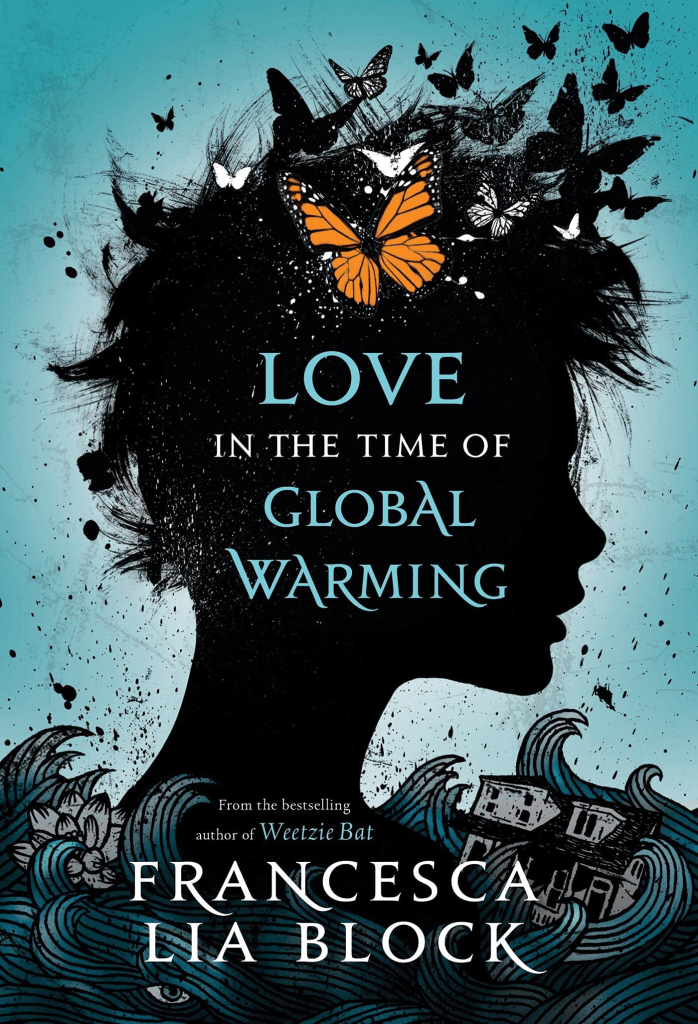
Posted in Sunday Songs

Sunday Songs: 5/26/24

Happy Sunday, bibliophiles! I hope this week has treated you well.

This week: we go back to that house, like we do sometimes.

Enjoy this week’s songs!
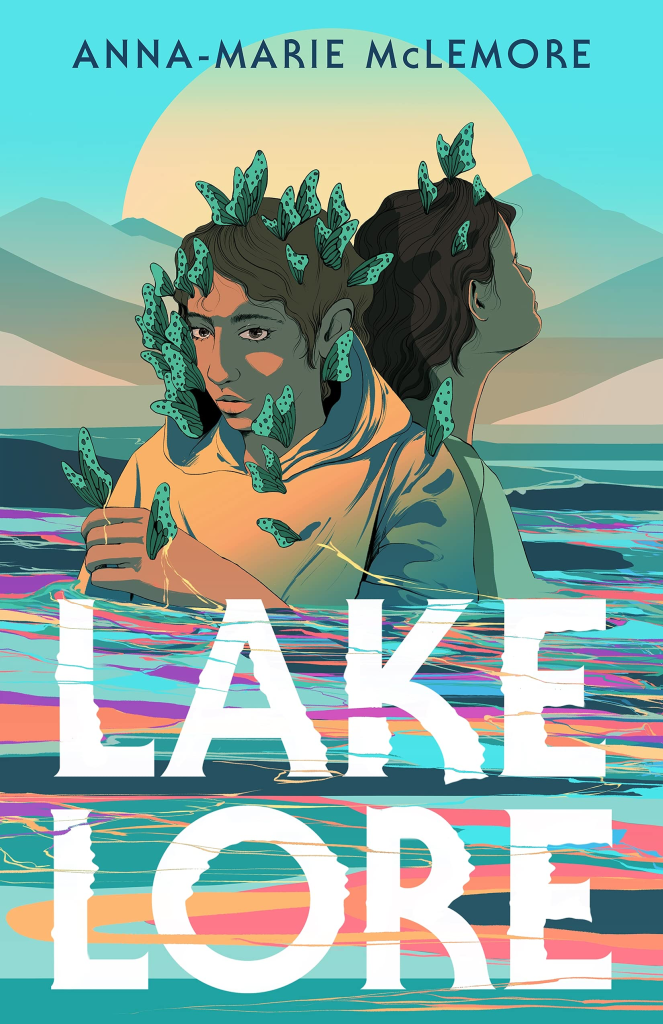
SUNDAY SONGS: 5/26/24

“All I Got” – Santigold

The only good part of 2016 was, without a doubt, the music. Blackstar remains unlistened-to just because I know that listening to it all in one sitting will destroy me (I’m only delaying the inevitable), but nothing will top that, I’m sure. Everything else, though. Teens of Denial? A Moon-Shaped Pool, which I also haven’t listened to all the way because it will similarly put me in the fetal position? Something was in the air, that’s for sure. Chances are that said something was the incomprehensibly crushing weight of grief and existential dread, but my sad bastards make do.

Santigold, thankfully, never got that memo, and saved 2016 early on with 99 Cents, full of gleeful odes to self-love and living to fight another day. It’s hard to think of people that really are cooler than her—if her music wasn’t enough to convince you, then consider her episode of What’s In My Bag, in which she’s wearing a Bauhaus shirt, casually mentions that she’s on a first-name basis with Mos Def, and talks about channeling Kate Bush all in one video. Even without all that, both the music she makes and the energy that she radiates is nothing but positivity, and not the shallow kind that denies some of the darker truths of life, but the positivity cultivated by a truly good and kind spirit that wants nothing but to share some of her goodness with the world. I’ve had bad luck trying to see her live (a 16 and older venue when I was 15, a canceled tour, and bad weather, in order), but part of why I thought last time wouldn’t happen was her posting before the concert that she had a broken leg. Wouldn’t you know it, she was bouncing around onstage with her leg in a cast. That’s just the kind of person she is. She’s a creator that makes odes to the joy of creativity, and her indomitable spirit never seems to let up, even in the face of adversity. And yet, she humanly recognizes the real-time taxes of the music industry—that canceled tour I mentioned was so that she could spend time with her kids. She’s really a rare kind of musician: her authenticity comes not just from her attitude, but her willingness to be true and kind to herself.

Even when she’s being critical, it still sounds as cheerful as ever. “All I Got” is practically covered in multicolored party streamers, the kind of thing you’d hear blasting at a pride parade (anybody wanna start Queers for Santigold with me?). But it’s delightfully petty—I’m almost embarrassed at how many of the lyrics I mixed up before l looked them up, but what I found was even better than what I thought she was singing. “All I Got” is the auditory equivalent of watching somebody dressed in the puffiest, brightest neon clothes and the sparkliest makeup promptly flip you off before gleefully running off into the sunset surrounded by a gaggle of similarly dressed friends. Santigold openly throws darts at the kind of figures that have spread like wildfire in the 1% of society—those who have the most, but barely worked for what they have: “I should ask but don’t want to know/How you get something for nothing at all/Build an empire for yourself/Don’t take this personal: go to hell.” Oh, it’s very personal, I’d argue. Whether that “something” is fame, acclaim, or money, it’s a smiling takedown of people who have never worked a day in their lives and yet earn more than the creative people who get less than the recognition that they deserve—somebody like Santigold, I’d argue, who has the kind of sound that should theoretically have been topping the charts since 2008, but most of her recent acclaim in mainstream culture was born and died with a namedrop from Beyoncé. Maybe modern pop can’t take more than one genuinely kind person with the creativity to match before the industry just implodes. She’s simply too powerful for them. Her talent is best spent on whatever she sees fit, recognition or not. And that’s exactly what “All I Got” declares—she’s blazing a path of her own, straight through the undeserving.

…AND A BOOK TO GO WITH IT:

Your Plantation Prom is Not Okay – Kelly McWilliamsa story of one girl’s relentless determination in the face of small-minded, oblivious tradition.

“Take A Bite” – beabadoobee

beabadoobee recently announced a new album, This Is How Tomorrow Moves, out in mid-August! Is it promising? Yes. How about the album cover? Eh…compared to the cover for the single, it just looks like an outtake? Like they just snapped a picture while she was mid-sentence, put a nice filter on it and just called it a day? Welp…you win some, you lose some.
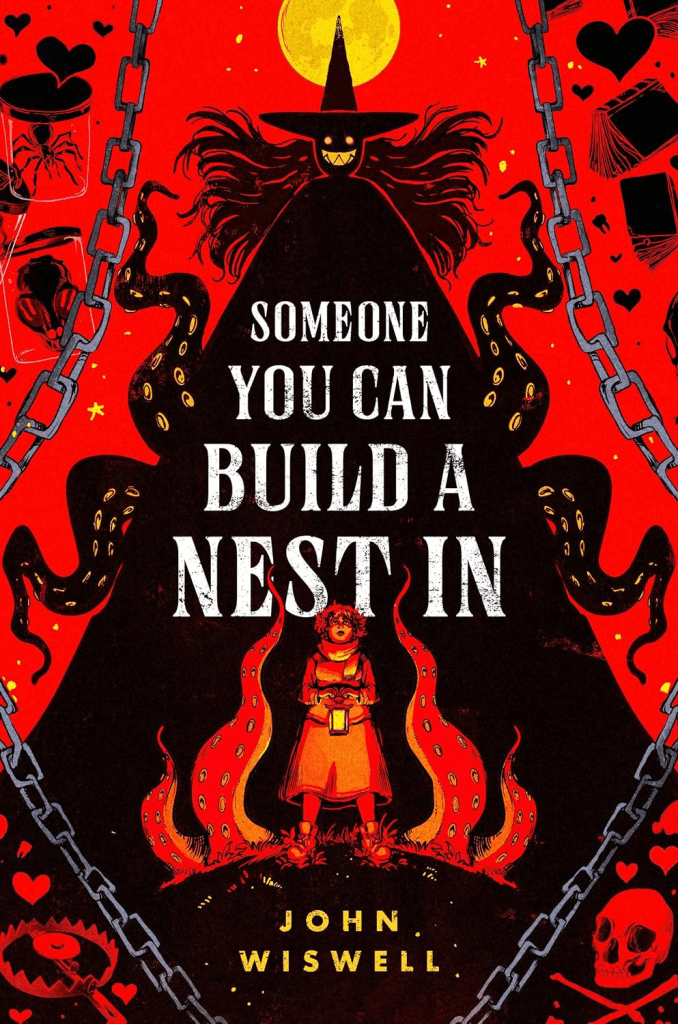
Either way, “Take A Bite” mostly makes up for the lack of a good album cover. It seems like a return to form—at least, of one of the forms she seems to have taken over the years. Thankfully, it’s the form I’ve liked best—the ’90s alternative-informed rock, with a dollop of slick vocals and production made for pop. “Take A Bite” oozes with tired dissatisfaction, with a minor key glossed to a sparkling shine, a coat of wine-red nail polish with a glittering overcoat. Kristi takes boredom and the dregs of an old flame with a sultry, heart-sore twist, drifting through her own imagination to make up for the color drained away by a breakup: “Indulging in situations that are fabricated imaginations/Moments that cease to exist/Only want to fix it with a kiss on the lips/But I think I might take a bite.” I suppose after “the way things go” (which I reviewed back in July), she’s moved from denial, dipped her toes in anger, and barreled straight into bargaining, making deals with her own mind to pull her out of this earthly plane. Her only sustenance is in her own head, and as she twists further inside, the instrumentals appropriately intensify, the background noise bleeding through the sheet of the background of sharp guitars as the unreal seeps into the real—or vice versa? The imagery in the music video isn’t exactly subtle, but either way, I love the shift between the bland, harsh daytime and the softer, sultrier nighttime worlds that Kristi straddles with a simple step through the alleyway. It’s sour and brittle, especially in the last, sore-throated mumbling of “do it all over again,” but like the skin of a cherry, it’s so smooth that you can’t resist at least one bite of the forbidden fruit.

…AND A BOOK TO GO WITH IT:

While You Were Dreaming – Alisha Raiwhen a fabricated image and reputation falls apart, it takes the truest form of yourself to mend the pieces.

“Sugar” – Masters of Reality

Babe, wake up, NEW MASTERS OF REALITY JUST DROPPED?? MASTERS OF REALITY? For the first time since 2009? Wow. That wasn’t on my hypothetical 2024 bingo card.

Either way, they returned from their 15 year extended hiatus with “Sugar” in early May, much to the surprise of…well, everyone. I haven’t followed them closely, but I thought that they’d all but disappeared from the face of the music scene. In the YouTube description, it’s followed up with a promise of a new album (?) but they haven’t revealed much else save for that and some ongoing European tour dates this summer. According to an interview with Louder, Chris Goss said that “Sugar” has been forming since the late ’90s, and it came into being out a desire to “become less esoteric and more directly personal.” Which…okay. Again, I’m not terribly familiar with the band beyond Sunrise on the Sufferbus (now that’s a top 10 album title right there), but “esoteric” is not among the words I’d use to describe the Masters of Reality. Musically? Not necessarily. It’s not the kind of music I’d expect for a pretentious music bro to go “you just don’t get it” to—a lot of standard blues rhythms, and not the kind of odd time signatures or chord combinations that might sound esoteric. And the lyrics? Does a song about a bitey but lovable cat really scream “esoteric?” It’s great! I’d even call it the perfect theme song for my cat. But esoteric it is not. I’m not Chris Goss, but I can’t help but be confused. Either way, I applaud the desire to be more personal for his music—it never hurts to write from the heart. Good on you, man.

Neither complex lyrics nor complex music are things I’d put as hallmarks for the band’s sound, but they do have an uncanny ability to make their music sound so neatly consuming. “100 Years (Of Tears To The Wind)” (another top 10 song title) feels like a wave curling into itself, with instrumentals that don’t just circle, but drown you as they do so—it’s a neat rhythm, but one made to swallow you, not unlike the soundscapes of Spiritualized. When my dad reintroduced us to this song to my brother and I a few years back, we all kept marveling about even though every aspect of this song was so simplistic, it was just so wholly effective in what it does. How does a song with lyrics like “I move, like syrup slow/I move, I didn’t know” feel as powerful as a full orchestra? No matter the personal changes that Goss has vowed to make in his music, I’m glad he stuck that quality; though “Sugar” has a slow, steady build, but by the time the chorus hits you, you’re caught in a swirling riptide of distorted guitars, strings, and chimes, building like a tornado in slow motion around you as your feet remain planted on the ground. The lyrics themselves still feel simple: “Sugar ain’t happy, Sugar ain’t sad/But Sugar got something, and something ain’t bad.” And yet, the shift is easy to see—even if the word choice is more simplistic than not, there’s a clear story, and one that makes a compelling song. Although it’s unclear whether the character of Sugar is drawn from Goss’ personal life or simply fictional, Goss said this about the lyrics: “[It reflects] on intelligent women trying to find their place somewhere in the mess…a real picture of what real people feel. The inner emotional reality of one life and its relevance to many lives.” And that ubiquity is what makes the narrative work: it’s a story that conjures up images of a woman dead-set on paving her own path, however winding it may be. My mind goes to images of a woman alone with her car, filling up the gas tank as the sun sets, her mind wandering about where she’s been as she contemplates where her journey will take her next. That journey will be difficult, but “my Sugar don’t care.” There’s beauty to be found in Goss’ sparse lyricism—it reinforces that your word choice doesn’t have to be eloquent to tell a story worth telling or conjure vivid imagery. All that matters is the heart that you put to page—or song.

…AND A BOOK TO GO WITH IT:

Camp Zero – Michelle Min Sterling“Sugar got born, Sugar got raised/Left her hometown, got lost in a maze/Met lots of men, none of them worked/To just find a place where happiness lurked…”

“Sick in the Head” – Indigo De Souza

So. I Love My Mom. I only put off listening to it because of my tradition of drawing album covers on the whiteboard on my door at school. I know, it’s college, nobody cares, but I would’ve felt weird having skeleton tiddies on display on my door for two weeks, and I doubt it would’ve gone over well with the RA. So there you have it. But now, I am free of such shackles, listening to skeleton tiddy music at my behest.

But lord, what an album. Not only does it feed both my sad bastard and occasionally raw and shouty sensibilities, but Indigo De Souza is seriously a poet. The lyrics on almost every track jumped out at me like cartoon eyes, with that slack-jawed ba-zooooooooing as the reality sets in while I scrubbed my bathroom sink. School really is a better environment for me to process albums, because leaning over to scrub some leftover gunk from the mirror was not the ideal position to let “And there was no one home in that plastic box/In that widow’s womb with the childproof locks” set in. “What Are We Gonna Do Now,” which I reviewed back in March, is still the highlight of I Love My Mom for me, but “Sick in the Head” displays some of De Souza’s most bitingly vibrant poetry. Like…doesn’t “And now that house is gone/There’s a golden lawn/And there’s a silver spoon/Someone’s been choking on” hit you like a sucker punch? But beyond that, I’m so glad that I found this song when I did, because the lyrics resonate at this age. “Sick in the Head” feels to me like a journey through the bramble back to the past, but not necessarily of the painful memories, but the childhood ethos that’s been lost and found again: “Since then our bodies have warped and bent/And now we are gray/I go back to that house sometimes/To say what I need to say.” Whew, preach. It left me wondering how old De Souza was when they wrote this song, and…turns out they were around my age, at least when I Love My Mom came out. Oh. Wow. So I’ve never had an original experience in my life, huh? But I love the imagery of this space being an empty house, and going through some sort of thorny, vine-choked gauntlet to find the part of you that now retreats in a corner, ready to be received when what is right needs to be remembered. And the quest is set off by this essential problem of growing up: “We’re going cause we’re too damn old/And nothing’s making sense anymore.” Sometimes, it’s not the wisdom of age that needs to be consulted to put yourself back on the path: it’s the little kid in you, the one that didn’t yet know that they were being perceived, and just did what they wanted to. And it’s true. My art is truest when I ask myself what my younger self would have wanted to see. It’s so easy to dismiss the stuff that your child self pointed at and said declared cool as childish and the product of an unrefined mind; Sometimes, that might be the case, but too often, we overlook the merit of how much joy that reconnecting with that urge produces. I’m working on being less critical of my writing and art, but I try to think of how little Madeline would’ve thought of how cool current Madeline’s achievements are. There may be nobody home, but there is something beyond a body that lingers in that empty house: the essence of youth and love, that, if nurtured, will guide you to the light.

…AND A BOOK TO GO WITH IT:

The Thirty Names of Night – Zeyn Joukhadar“And now we are gray/I go back to that house sometimes/To say what I need to say…”

“Oswald Opening Theme” (from Oswald) – Evan Lurie

I’m too scared to fully go into any kind of mommy blogging discourse just from the horrific baby names that it’s spawned, but sometimes that’s what Instagram spits out for me…for whatever reason. But in the age of iPad kids and Cocomelon, it’s comforting to see that some of the shows of my childhood are having a resurgence among new parents, particularly because of their low stimulation. In an age where kids are rapidly being fed…well, crap, basically, at incomprehensible speeds, and some parents have moved from using the TV as a babysitter to just getting their children an iPad fresh out of the womb (surely that won’t affect them 10 years down the line), some parents are reverting back to the lower-stimulation shows of yesteryear. Sure, not every single show in my childhood and beyond was angelic and perfect, and not every show now is ultra-high stimulation (I’ve heard Bluey has become gen alpha’s Blue Dog to Guide the Generations, taking the torch from Blue’s Clues), but I’m glad that the low-stimulation comfort that my parents raised me on, as well as some of the shows like Sesame Street that they were raised on, are helping kids this far down the line.

I’ve only seen Oswald come up in very few of these discussions, but I just remembered it the other day, and how quiet it was. It’s just so pure to me. Sure, Blue’s Clues and Zoboomafoo topped it, but there’s something to be said for how gentle and quaint it was. Comforting character design. Evan Lurie’s soft piano theme. Two British eggs who say “yeeees, yeeeeees” like some character that Blur parodied on Parklife. A little dachshund that looks like a hot dog. It’s just so…gentle. Thanks, Dan Yaccarino.

…AND A BOOK TO GO WITH IT:

Good Night, Mr. Night – Dan Yaccarinospeaking of throwbacks…this one was a classic in my household.

Since this post consists entirely of songs, consider all of them to be today’s song.

That’s it for this week’s songs! Have a wonderful rest of your day, and take care of yourselves!