Posted in Book Review Tuesday

Book Review Tuesday (2/25/25) – When No One Is Watching

Happy Tuesday, bibliophiles!

I’ve had my eye on When No One Is Watching for a few years now. I’m not typically a thriller fan, but the concept intrigued me, despite the consistently mediocre to low ratings on Goodreads and The Storygraph. Alyssa Cole is a new-to-me author, and I figured I would give her book a try. However, I’ve come out of it with a mixed bag and uncertainty as to whether I’ll read more of her books in the future. When No One Is Watching had an excellent premise that it only halfway delivered on, but was still entertaining and timely in the end.

Enjoy this week’s review!

When No One Is Watching – Alyssa Cole

Sydney Green has called Brooklyn home for her entire life, yet her childhood is quickly slipping through her fingers. Her neighborhood, which was once home to a diverse group of homeowners, is quickly beginning to be gentrified. Condos are springing up where her neighbors once lived, and her Black and brown neighbors are being driven away one by one. Sydney suspects that something is amiss, and that there may be something more insidious to the gentrification of her neighborhood. With the help of Theo, her well-meaning neighbor, Sydney seeks to uncover the truth of her neighborhood’s fate, but what she finds may be even more sinister than she could have ever imagined.

TW/CW: racism, misogyny, gun violence, murder, loss of loved ones, police brutality, kidnapping

First off, When No One Is Watching is an incredibly timely thriller, and having a thriller surrounding the themes of gentrification is genius. When you strip past the apathy the general American population has of living not just on stolen land, but land that has driven its people of color into the worst possible conditions, it really is a frightening reality to live with. Even if the gentrification of neighborhoods itself isn’t some grand conspiracy, as it partially is in this novel, it’s a no-punches-pulled look at what’s happening to neighborhoods all over the country. Adding in snippets of social media doesn’t always work in books, but weaving in the neighborhood groupchat into When No One Is Watching also served to add a critical piece of the puzzle: that a lot of white people in such situations are so easily willing to dismiss any kind of racism if it doesn’t affect them, even if it’s happening in their own backyard. With an unflinching pen, Cole examines all of the aspects of gentrification, from its history to its current iterations, making for a thriller grounded in a real source of fright.

There are plenty of scary scenes in When No One Is Watching, but the fact that Cole mines the horror out of Syd being in an Uber and her driver driving her away from her destination should tell you something about where this novel lies. That particular scene is at the beginning of the book and isn’t the scariest thing that happens, but man…Cole is excellent at squeezing the horror from very grounded, real events. With the exception of the more sinister twist at the end, this novel creeped me out because almost everything that happened was real—its horror drawn from the realities of racism, misogyny, and gentrification. I can’t speak to this personally, but it felt like the inherent horror of being a marginalized person in the United States, but specifically of being a Black woman, a group that this country has historically done everything in its power to silence and oppress. It really gives weight to the expression “truth is stranger than fiction”—in this case, truth is scarier than fiction. That’s where Cole finds the fear, which made When No One Is Watching so effective in its brand of suspense.

However, a lot of the realism that came through in the suspense aspect of When No One Is Watching was deadened somewhat by the excessive use of modern internet lingo. I don’t mean the AAVE at all—that part was great, and I’m glad to see more of it integrated into literature, because there’s no need to cater to white audiences anymore at this point (and there’s many conversations to be had about how twitter/tiktok/etc. slang has subsumed AAVE so quickly and stripped it of its original meaning). No, I’m talking about the very millennial-sounding, tweet-ready one-liners that many of the characters dole out to make the story “funnier.” (Whew. Lots of hyphens in that sentence, even for me.) If I hadn’t seen the quote “I need you to channel the confidence of a mediocre white man” on at least 10 different t-shirts, stickers, and tweets, it would’ve been funny. About half of the humor in When No One Is Watching lands, but the other half is about the same as this: quips that have been circulated on the internet for at least a decade that could’ve been funny years ago, but have gone so stale that they’ve lost all novelty, originality, and more importantly humor. Again, I liked that When No One Is Watching was able to balance levity with some of the more thriller aspects, but it would’ve tipped the balance even more if more of the humor was original. Even five years after this book’s release, it was so easily dateable. Give it another five, and it’ll be painfully dated.

What hindered When No One Is Watching the most, however, wasn’t that: it was the pacing. It was just odd. When the suspenseful moments came, they were appropriately suspenseful, but there was so much middling around in between these moments for the first 75% of the novel that I started to question whether or not I was reading a thriller. But once the big twist comes in, it’s when I was about 80-85% of the way through the book—and the entirety of the big reveal, the climactic final battle, and the resolution were crammed into only about 15% of the book. It was whiplash-inducing, but not in a way that a thriller should be. Thrillers aren’t my go-to, but for more thriller/horror movies, I like when I have some breathing room between the suspenseful/scary moments (see: Alien, Nosferatu). When No One Is Watching theoretically had that down pat, but where it suffered was that the breathing room was rarely interesting. Other than the fantastic commentary on racism and gentrification, the plot between the suspense was just boring. I didn’t care much for Syd and Theo’s romantic subplot, I didn’t care for them randomly running around and ultimately discovering very little. So much of it could have been condensed in order for the climax to not feel like being chucked out of a bus window and onto the highway—not in a suspense way, but in a wild pacing way. Big reveal, shootout, resolution, and bam, it’s all over…in about 30 pages, tops. As with the humor, there needed to be balance with the plot—more suspense spread out through the novel, and more room to process and mine into the commentary of the climax.

All in all, a thriller with sharp, relevant commentary on racism and gentrification that excelled in its suspense, but was dragged down by uneven pacing and humor that dated itself far too quickly. 3 stars.

When No One Is Watching is a standalone, but Alyssa Cole is also the author of several other novels for adults, including the Reluctant Royals trilogy (A Princess in Theory, A Duke by Default, and A Prince on Paper), the Off the Grid trilogy (Radio Silence, Signal Boost, and Mixed Signals), The Loyal League trilogy (An Extraordinary Union, A Hope Divided, and An Unconventional Freedom), and many other novels.

Today’s song:

That’s it for this week’s Book Review Tuesday! Have a wonderful rest of your day, and take care of yourselves!

Posted in Sunday Songs

Sunday Songs: 2/23/25

Happy Sunday, bibliophiles! I hope this week has treated you well.

This week: British women dominating rock music for decades, American women giving the gays what they want, and Thom Yorke’s seeming inability to make a bad song since 1995.

Enjoy this week’s songs!

SUNDAY SONGS: 2/23/25

“Long Snake Moan” – PJ Harvey

Finally, finally, I’ve listened to a full PJ Harvey album! Took me long enough. Me and my arbitrary rules for listening to albums that I break half the time. Anyway. To Bring You My Love? I know this is the most vague descriptor you could give for an album, but it truly ROCKS. So many of these tracks embody the raw power that rock n’ roll can have. Not just that, but it feels like a love letter to the rich ancestry of the blues in rock n’ roll. Even without as much background knowledge of the blues, you can just feel the grimy, grungy crawling with threads of DNA in the history of blues in every growl that Harvey lets out. The desperation and wayward storytelling of “To Bring You My Love” and “Teclo” could’ve been fragments lost in the American south from decades before Harvey released the album. It feels to me like an example of the enduring power of any kind of music—here we have a white British woman in the mid-’90s taking inspiration from music from the ’20s-’40s made primarily by Black people all the way across the ocean, here in the States. Who would’ve thought.

One caveat with me saying that the album rocks: it’s got a relatively slow tempo, and we don’t get into the real guitars-going-crazy rock for a few songs. “Long Snake Moan” is one such song, and it knows it—Harvey’s sly “mmm-hmm” before the guitars slam into you like the brunt force of an avalanche is more proof of a smirk than a visual could ever be. She knows she’s about to absolutely wallop her listeners. And “Long Snake Moan” is one of the most enduring songs on the album. The title is a nod to Blind Lemon Jefferson’s “Black Snake Moan,” and though the sound differs, the desire of it is what fuels both; Harvey recalls a lust so all-consuming that “You’ll be drowning/Hell’s below, God above/All drunk on my love.” With every impassioned bellow, you can feel the ragged passion sloughing off every note, desperate yet distinctly conscious of its towering presence and power.

…AND A BOOK TO GO WITH IT:

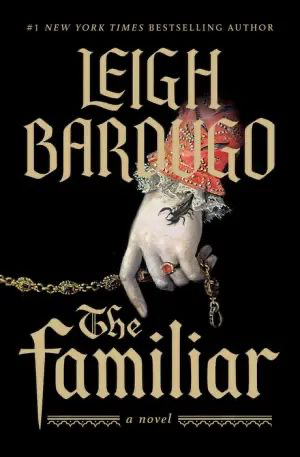
The Familiar – Leigh Bardugo“In my dreaming/You’ll be drowning/Hell’s low, God above/All drunk on my love…”

“Ride” – The Vines

I was this close to calling The Vines Britpop, but as it turns out, they’re technically nothing of the sort. Not because of the sound, which very edges closer to the rockier side of Britpop, but because they’re Australian. I don’t want to risk the wrath of any Australians, so consider myself checked before I’ve gotten hypothetically wrecked. Oops.

Regardless of whether or not they wanted to hop on the bandwagon, “Ride” feels firmly between Blur’s grunge-parody-that-became-kinda-grunge self-titled album and Supergrass. (Craig Nicholls also kinda has that Britpop, bad-boy frontman look on lock. The bangs, the smolder…) And “Ride” is such an adrenaline rush of a rocker. Guitar tone? Heavy and clean in perfect balance. Vocals? Though Nicholls’ voice doesn’t stand out to me, that distorted scream in between the chorus reminds of the best of 2000’s rock. The art of the rock scream is a sacred one—a well-placed scream can make or break a song, and Nicholls’ is simultaneously put in the spotlight and tucked into the crashing rhythms of the chorus, a grungy accent that drives up the fuel-burning energy of the track. It’s got a rasp that’s perfect for just what it is—a headbangable, garage-y rock track begging for a flimsy stereo speaker to be blasted from.

…AND A BOOK TO GO WITH IT:

Victories Greater Than Death (Unstoppable, #1) – Charlie Jane Andersthe adrenaline-rushed, breakneck pace of this novel matches the reckless, rocking urgency of this track.

“Best Guess” – Lucy Dacus

This video is so cute and gay that I can almost ignore how annoying Cara Delevingne is…oh, no, wait, she’s caressing Lucy Dacus and hamming it up for the camera. Of course.

Either way, 2025 is shaping up to be an excellent year for music about tender love between queer women, between Send a Prayer My Way and everything that Lucy Dacus is putting out (aside from “Limerence”…oof). As much as Dacus’ emotional hard-hitters have a soft spot in my heart (was my 18-year-old brain permanently altered by the “Night Shift” belt? Perhaps), she makes tender, gentle love songs look easy. It rings similarly to her pair of Carole King covers (“Home Again” and “It’s Too Late”) from 2022, with the same slow rhythm and inner warmth; even with the fleeting mentions of over-the-moon obsession (“Tracing your tan lines/Making you mind/If this doesn’t work out/I’ll lose my mind”), it’s a very grounded, worldly kind of love song, in typical Dacus fashion. The first verse of the song centers around caressing the more physical aspects of her lover’s body, but it almost immediately professes that “I love your body/I love your mind/They will change/So will I.” So simply stated, but immediately after that, Dacus professes her undying love. That to me, feels like real love—appreciating your partner for everything that they are, impermanent as it may be. It shouldn’t be groundbreaking lyrical ground, and I don’t think it is, but it’s always refreshing when it comes up, with so many love songs focusing on youth and impermanent, surface-level qualities of people. Plus, “Best Guess” is just such a lovely, catchy song. That guitar riff at the end? Absolutely SUCCULENT. Waiter, more Lucy Dacus guitar work, please! Best-of lists are inevitably subjective, but you didn’t get named the 213th best guitarist of all time by Rolling Stone for nothing, queen! Plus, again…it’s gay. More music videos full of queer people AND queer people being happy, please!!

…AND A BOOK TO GO WITH IT:

Navigating With You – Jeremy Whitley and Cassio Ribeirosoft, tender, sapphic love…and bonding over manga.

“There, There” – Radiohead

It always comes back to Radiohead. I don’t talk about music videos as extensively as much as I do the songs themselves, but “There, There” has to be one of my favorite Radiohead music videos of all time. Maybe my favorite? Not sure. Directed by Chris Hopewell, it shows Thom Yorke, his movements edited to give the appearance that he’s a stop-motion puppet, wandering into a Beatrix Potter storybook; after peering into miniature houses hollowed into trees, he finds squirrels smoking pipes, a weasel riding a Penny-farthing, all manner of rodents having a feast, and a cat couple’s wedding ceremony officiated by a crow. Of course, Thom Yorke breaks the first rule of the Brothers Grimm (from which he and Hopewell drew inspiration for the video), that being “don’t steal the shiny clothes off of that ominous-looking tree.” You can imagine how well that goes for him. It goes contrary to the largely technological, dystopian aesthetic that has endured throughout Radiohead’s discography, despite their many changes in sound. Up until The King of Limbs, their music was rarely associated with such naturalistic imagery, but that kind of fairytale darkness, paired with the lyrics, makes for a different kind of eeriness than what they usually brew. It all makes the song’s alternate title, “The Boney King of Nowhere,” all the more fitting.

Now, the lyrics…”We are accidents waiting to happen?” WHEW. I always forget about that one…for a band that seems to churn out unforgettable lyrics at a concerning rate, even this feels like one of the most masterful lines they’ve ever come up with. Like the gleaming coat and boots that Yorke finds in the forest, “There, There” is a song of being tugged in a myriad of directions—likely all the wrong ones. In typical Radiohead fandom fashion, most people seem to be divided about what kind of temptation it’s specifically talking about—general religious, personal relationships, you get the picture. The emphasis on the personal pronouns—”I go walking in your landscape,” “We are accidents waiting to happen”—lead me to believe closer to the latter, though I and We can easily be other concepts. There’s an intoxication to “There, There,” a painfully magnetic urge to enter into something dangerous, something that will by all accounts destroy you, but the irresistible temptation remains: “There’s always a siren/Singing you to shipwreck/Steer away from these rocks/We’d be a walking disaster.” One part of you cries “Heaven sent you to me,” the other cries “We’d be a walking disaster.” The chorus of “Just ’cause you feel it/Doesn’t mean its there” is the perfect embodiment of keeping up the façade of devotion—or any kind of emotion that has such a sway that you’re convinced of its reality, even when it has no roots. The whole band makes this spectacle of temptation feel like a trek deep into the mouth of a cave; Phil Selway leans on the thumping of the tom-toms, creating a truly cavernous shell for the song, while the reverb on Jonny Greenwood’s and Ed O’Brien’s guitars echo as though confined by the same dappled walls.

I get so hyperbolic with Radiohead. God, I know I do. I swear that past a certain point (1995?), a good 75% of their songs are tiny masterclasses in how to be creative—how to craft an atmosphere, how to write a gut-punching lyric, how to make music that sticks.

…AND A BOOK TO GO WITH IT:

Someone You Can Build a Nest In – John Wiswell“Why so green and lonely?/Heaven sent you to me/We are accidents waiting to happen…”

“The World’s Biggest Paving Slab” – English Teacher

So listen. I haven’t seen Frank. The one with Michael Fassbender, right? I’ve been meaning to watch it for years, but I haven’t gotten around to it. Should this music video give me enough of an idea?

My entirely arbitrary album listening system Destiny has not yet decided whether or not English Teacher will end up being a band I actually get into, or if I’ll resign myself to going “oh, this song is GREAT” and put off listening to them for another three to five business years. They’ve only got one album, This Could Be Texas, so I really don’t have an excuse. It’s on the list, though. And that one album won last year’s Mercury Prize, so it has to be worth it—not necessarily by virtue of being award-winning, but beating out Beth Gibbons and Charli XCX isn’t exactly an easy feat, even for an award that seems to cater more to alternative artists. Either way, “The World’s Biggest Paving Slab” is proof that no matter what, some part of me will always be attracted to any kind of alt/indie rock coming out of the UK. Something must be in the water there. Or maybe I inherited the gene from my dad, who spent his high school days listening to Julian Cope. Probably both.

Even just from this glimpse, I can already see how much of an avant-garde sensibility that Lily Fontaine and company have; their chord progressions seem to slant ever so angularly, prickly and particular, until the chorus lets them dissipate like fog. The lyrics are a collage of people and curios from Fontaine’s hometown of Colne; being at university for four years gave her the space to look back on it: “witnessing the social, economic and political issues that exist around there in juxtaposition with the beauty of the landscape and the characters that live within in it.” “The World’s Biggest Paving Slab” evokes everything from banks to remnants of the witch trials and a far-right terrorist—a complex history within what, as far as I can tell, is an unassuming, rural place on the surface. Through Fontaine, Colne itself announces its presence as something to be “Walk[ed] all over,” yet also as something containing multitudes beneath the time-weathered stone, for those who care to notice. Fontaine’s vocals switch from airy in the chorus to spoken-word in the blink of an eye, but both ring equally as cries of complicated pride: “I am the world’s biggest paving slab/And the world’s smallest celebrity.”

…AND A BOOK TO GO WITH IT:

Lagoon – Nnedi Okoraforthe place couldn’t be further away, but it’s a similar concept united around the soul of a place—in this case, Lagos, Nigeria.

Since this post consists entirely of songs, consider all of them to be today’s song.

That’s it for this week’s Sunday Songs! Have a wonderful rest of your day, and take care of yourselves!

Posted in Book Review Tuesday

Book Review Tuesday (2/18/25) – Drown Me with Dreams (Sing Me to Sleep, #2)

Happy Tuesday, bibliophiles!

QUICK ANNOUNCEMENT: because I’m trying to divorce myself from Amazon as much as I can, I’m finally moving over from Goodreads to The Storygraph. From now on, my reviews will be available there @thebookishmutant.

I started the Sing Me to Sleep duology last year, and now that book 2 is out, I figured I would pick it up for Black History Month, but also so I could finally get some resolution! And I sure got a resolution…one that wasn’t as enjoyable as the first book, but nonetheless a twisty, romantic ending to a fantasy duology that balanced fun and social commentary.

Now, tread lightly! This review may contain spoilers for book one, Sing Me to Sleep. For my review of Sing Me to Sleep, click here!

Enjoy this week’s review!

Drown Me with Dreams (Sing Me to Sleep, #2) – Gabi Burton

Saoirse is on the run. Now that her siren identity has been exposed, she must flee to the other side of the wall that divides Keirdre from the rest of the world. Taking sanctuary with the budding Resistance, Saoirse discovers a world full of different species that Keirdre drove out of its kingdom, all waiting for the day that they can take back what is rightfully theirs. But tensions are brewing, and war is imminent. On the other side of the wall, King Hayes, her secret love, awaits, but do his loyalties remain with Saoirse? And will Saoirse be able to fend off the rising tides of war?

TW/CW (from Gabi Burton): murder, graphic violence, discrimination/segregation (fantasy), genocide themes, blood, descriptions of injury, imprisonment

You would think that a book that’s over 400 pages would have plenty of time to work out all of the wrinkles in the plot and the worldbuilding…apparently not. In a perfect world, Drown Me with Dreams would be a great second book in a trilogy, but in this world, it was a duology concluder that tried to do far too much. That doesn’t mean that it was bad by any stretch of the imagination, but it was certainly a step below Sing Me to Sleep.

Oops. I end up stumbling into books with startling relevance to the current climate, and oh my god, am I sick of using that phrase. But. Drown Me with Dreams does an excellent job of expanding on its themes of resistance, racism, and misinformation! Saoirse has now figured out that there’s a wide world beyond the walls of Keirdre that has been obscured by the racist regime in her home kingdom; now that she knows the truth, she’s exposed to a myriad of perspectives and has to do the work herself to deconstruct the lies she’s been fed all of her life. She meets dozens of new mythical species that have been respectively discriminated against by Keirdre, and finds out firsthand how many falsehoods that the ruling powers have upheld for decades. The simultaneous revelations and discomfort of Saoirse discovering the truth is such a wonderful thing for a YA fantasy book like this to explore—in the end, it’s up to us, in our varying experiences in the real world, to discover the truth about how our governments can shape (and mis-shape) the narratives we grow up on. I also love the themes of solidarity present—fantasy or not, I love that the kind of feminism that Drown Me with Dreams champions is the kind that holds celebrating individual experience and solidarity under shared oppressions in equal regard. It’s the kind of unity that I believe will push feminism forward, and it made for a powerful statement in Drown Me with Dreams.

Even though Saoirse and King Hayes were kept apart for the first half of the novel, Drown Me with Dreams had a great resolution to their romance! Was it classic, YA fantasy romance cheese? Yes. Was it good cheese? Absolutely. To paraphrase one of my high school English teachers, there’s a difference between gourmet cheese and “American cheese-food.” I’ve been a YA reader for quite some time now, and there’s a difference between cringeworthy cheese and high-quality cheese. Drown Me with Dreams falls into the latter category, 100%. There’s angsty angry-kissing aplenty, but it’s written believably. If anyone is looking to do slow-burn, enemies-to-lovers romance right, look no further. Saoirse and Hayes weren’t just given enough time to have their romance develop—the stakes of their forbidden love were built up for the whole series, and their chemistry together made for some high quality smoldering. It’s not trying to be enemies-to-lovers in the way that most BookTok fantasy books try and fail to do—Burton’s given us a well-developed romance you can root for, and it made Drown Me with Dreams a standout read in that department.

In my review for Sing Me to Sleep, I mentioned that the book’s main flaw was that it was juggling far too many characters. In that same review, I commended Burton’s ability to craft a rich, layered fantasy world. Both of those aspects collided in Drown Me with Dreams with disappointing results. In Drown Me with Dreams, we finally see the world beyond Keirdre, and it’s full of all of the creatures that Keirdre drove out—dryads, goblins, sprites, you name it. On the surface, I was so excited to see this aspect of the world, but two main issues arose. The first was that we were introduced to a truckload of characters, almost 80% of which had barely anything memorable about them other than the fact that they were from a “new” species. Some of them were slightly consequential, but only just. I had so much trouble keeping track of all of them, which definitely muddied my reading experience. The second problem was that all of this worldbuilding was crammed into a single book—with a kingdom and world this expansive, it needed at least another book to develop fully, which hindered how fleshed out the world ended up being, after all of these promises of it being fascinating and new. (Also, I get the point about racist narratives being made with the goblins, but…what was the reason for making goblins into glorified elves? Why did they need to be conventionally attractive?)

Which brings me to my second major gripe: this series should not have been a duology. Not only are we introduced to a staggering amount of worldbuilding that only amounts to a single book, the same goes for the plot. A full resistance movement, the tensions within said resistance movement, the looming threat of war from multiple sides, and the fallout from said monumental war are crammed into 424 pages…should be enough, right? Most of what I described only happens in the last 2/3rds of the book, and nothing gets nearly the attention it deserves. We get dragged along with a pointless red herring of a love triangle (only for Saoirse to end up with her main romantic interest and for the other guy to just DIE GRUESOMELY? I didn’t really care about the guy, but pour one out for Carrik), and all of the interpersonal conflict rarely lasts, only providing detours on what should’ve been a rich plot on its own. As with the worldbuilding. Drown Me with Dreams should have had at least one more book to expand on everything. It’s a case of Burton biting off far more than she could chew, to unfulfilling results.

All in all, a duology-concluder that didn’t deliver on its epic worldbuilding promises and rushed its climax to a dizzying degree, but delivered on its past themes and promised romance. 3.5 stars!

Drown Me with Dreams is the second and final book in the Sing Me to Sleep duology, which begins with Sing Me to Sleep.

Today’s song:

so uh guess who’s obsessed with the apple tv+ björk concert film

That’s it for this week’s Book Review Tuesday! Have a wonderful rest of your day, and take care of yourselves!

Posted in Sunday Songs

Sunday Songs: 2/16/25

Happy Sunday, bibliophiles! I hope this week has treated you well.

This week: We’ve got Paul McCartney and a song about a dog on the docket, but nowhere is “Martha My Dear” involved. Sorry, gang.

Enjoy this week’s songs!

SUNDAY SONGS: 2/16/25

“Jimmy Fallon Big!” – Japanese Breakfast

Michelle Zauner jokingly referenced this song when posting about her recent appearance on the Tonight Show to promote “Orlando in Love,” the first (excellent) single from her forthcoming album For Melancholy Brunettes (& Sad Women). But before she got Jimmy Fallon Big, someone else tried to—Deven Craige, the bass player for her former band, Little Big League; Zauner wrote the song about how he split the band after his other band was, in his words, about to go “Jimmy Fallon big,” and decided to put his energy into that instead of Little Big League. The move left Zauner crushed: she told NPR in 2017 that “it felt like losing a brother, and there was this shame, feeling like I was never going to get there myself.” There’s truly something more than bittersweet about it—the passion she poured into every bit of the vocals shows a deep devotion to her former bandmate, and yet the resentment sloughs off of the chorus in relenting waves: “Why walk/When you can show up on time?” I mean, they’re on good terms now, but BURN.

I promise this segue will become relevant, but I recently listened to the first episode of Björk’s excellent Sonic Symbolism podcast, where she frequently refers to the history of music as a great tree with thousands of interspersed branches that connect and diverge from one another. Listening to “Jimmy Fallon Big!” is one of those 21st century moments where I can so clearly see the tree rings, the ancestry and lineage where an evolutionary branch broke off. Michelle Zauner has been crafting intricate, emotional dream pop for quite some time now (see: “Sit,” which I talked about back in July), but this track has the Cocteau Twins written all over it. It’s not just the warm, dreamlike drone of the instrumentals, but the way that said instrumentals obscure the meaning of the chorus almost completely. It makes the opening line of “We aren’t bound by law/We aren’t bound by anything at all” make all the more sense artistically. On the first few listens, I almost wondered if it was born from the same songwriting method that Fraser used to craft her nonsense miracles. Where they break off—besides having a clearer anchor tying the music down to earth, is how Zauner grounds the emotion; not many people can get to the level of Fraser, and I don’t think Zauner is one of them, but she’s got the clear talent of crafting the most elaborate musical smoke screen to cloak her misgivings.

…AND A BOOK TO GO WITH IT:

Radio Silence – Alice Osemanpainful secrets, fractured friendships, and a mysterious podcast.

“Uncle Albert/Admiral Halsey” – Paul & Linda McCartney

credit to @DannyVegito on twitter

Memes aside, shoutout to Paul McCartney and his joyous whimsy. I’m fully aware that I use the phrase “joyous whimsy” with the same frequency of congresspeople emailing you saying that you have a MIDNIGHT DONATION DEADLINE and it’s URGENT, and I don’t want to repeat myself, but I think the world needs more of it. And who’s got it? PAUL!

BUTTAH PIE!

BUTTAH PIE?

THE BUTTAH WOULDN’T MELT, SO I PUT IT IN THE PIE, ALRIGHT?

As far as Beatles lore goes, I feel like Ringo gets more of the credit for whimsy, and for good reason—the dude saw the other three tearing at each other’s necks and decided to write a song about an octopus. But as obnoxious as Paul got during a lot of those sessions, over the course of his career, he had a gentleness to his artistic soul too, and it showed in his songwriting.

“Admiral Halsey notified me/He had to have a berth or he couldn’t get to sea/I had another look and I had a cup of tea and butter pie?” C’mon. That sounds like something straight out of some 1940’s British children’s book with yellowing pages and inked illustrations. But uptight is the opposite of how McCartney and McCartney—Linda deserves the brunt of the credit for the sheer jubilation she brings to the “Hands across the water, Heads across the sky” refrain—delivers this song. Plus, the Admiral Halsey in question was loosely based off of an American admiral from World War II, and McCartney painted him as a stiff authoritarian who is “symbolic of authority and therefore not to be taken too seriously,” so it’s making him uptight just so you can stick your tongue in his face. It’s just so infectiously jolly. There’s an orange-hued, sunlit laughter to the whole bit. It’s got the warmth of reuniting with an old friend, or being back in some rose-tinted decade and sweeping your lover off their feet on the dance floor, particularly the “Admiral Halsey” section. It’s hard to think of a song so wonderfully carefree, in every sense of the word. Hands across the water, heads across the sky indeed.

…AND A BOOK TO GO WITH IT:

Tidesong – Wendy Xuhands across the water, as well as a hearty, healthy dose of childlike wonder.

“Falling to Pieces” – Faith No More

Hoooooowhee. Going straight from Paul & Linda McCartney frolicking through a field to Faith No More…I don’t think whiplash even begins to describe that. Well. Welcome to my shuffle.

Faith No More seem to have been on the fringes, even where hard rock is concerned, and it’s easy to see why even the freakier people weren’t as willing to embrace them—Mike Patton’s voice and their mishmash of rock and early hip-hop influences stand out immediately. As does the goofy video. The lyrics and subject matter are standard fare for any kind of alternative music of the time (“Indecision clouds my vision/No one listens/Because I’m somewhere in between/My love and my agony”), but everything else is just off the walls. Directed by Ralph Ziman, the video is the last thing you’d expect to match the song’s aesthetic—neon colors aplenty, Mike Patton in a bowler hat and some kind of clown suit for half the video, and enough fish that I imagine the storyboarding process went something like this. Patton’s distinct vocals rangefrom a nasally standard to a hint of the heights he’d later reach on “Midlife Crisis,” and they stand behind a bassline that holds all of the instrument’s resentment for being in the background for decades. Even in a subgenre that’s already weird, this is real weird, unpredictable, unabashed weirdness. Somebody needs to bring back green-screen goldfish back into hard rock.

…AND A BOOK TO GO WITH IT:

Shadow Speaker – Nnedi Okoraforthe lyrics are broad enough that I couldn’t narrow it down to a specific theme, so I added the mood—and came to this book, a bold, chaotic punch to the face.

“Sylvia” – Julien Baker & TORRES

On April 18th, I’ll have to show where my allegiance lies…Thee Black Boltz and Send A Prayer My Way come out on the same day. Well, okay. I’ve already decided. My allegiance is to Tunde Adebimpe, to the republic! But I’ll stagger my listening. The former has a priority over Julien Baker & TORRES, but I’ll give both a listen.

“Sylvia” is the second single Send A Prayer My Way, and it proves a valuable point: we need more good, wholesome songs about our pets. Why not write love songs for the little creatures that enrich our lives? I mentioned “Martha My Dear” earlier, but we need more songs about our furry (and not furry) friends, if you ask me. (See also: Jim Noir’s “My Little Cat”) TORRES takes the lead on this track, which recounts their experience with a foster dog and how a puppy can touch your heart in the way that only a puppy can: “anyone who has ever had the honor of sharing a home with a beloved pet knows that a pet is family—they’re the best friends you could ever have.”

They recalled an experience of taking Sylvia on the road and feeling as though they were truly meant to be. There’s something special about holding a puppy when you’ve just brought them home, and not just in the warm-and-fuzzy way. There’s an immediacy you feel, the knowledge that you’ve got a little heartbeat next to yours, a furry, helpless body that you’re suddenly in charge of. It really is a new member of the family, and one that you have the responsibility to protect. Puppies are exhausting—the time my boy Ringo slipped out of his collar, ran down the street, and evaded me for a solid five minutes before showing up on my porch with a shit-eating grin comes to mind. But “Sylvia” taps into that feeling of knowing you have more than a companion: “Haunted by all the goodnights that I’ve missed/Every time your cheek goes unkissed/A day for me is a week for you/And my life’s already halfway through/Tomorrow, today’s worries might turn out to be regrets…” It taps in to being conscious of your pet as something you can keep around for amusement, but a deeply ingrained part of your life, while retaining the simultaneous fear and joy of giving them all the love you can in their short lives.

And because we NEED a picture of sweet Sylvia…

BABYYYYYYYYYY

…AND A BOOK TO GO WITH IT:

The Book of Lost Things – John Connolly“Sylvia” had me thinking of fictional dogs—as far as books go, my first thought was of Boswell, David’s loyal dachshund that accompanies him on his adventures.

“Love Spreads” – The Stone Roses

Really and truly Severance-pilled rn…CAN WE TALK ABOUT SEVERANCE? The deepening of existing friendships and yet also the storylines of corporations driving a wedge in their workers to discourage them from solidarity? Unity…unions, perhaps? HELLY WOULDN’T BE CRUEL? SHAMBOLIC RUE? THE WORST MELON PARTY YET? A CHILD? PAPERCLIPS? THE TENDENCY OF CORPORATIONS TO SHOW PROGRESS AS MARGINALIZED PEOPLE SIMPLY SWALLOWED INTO THEIR SYSTEM? GOATS? THE—

Oh, wait, there’s a song here? ALL THE BETTER TO PUT INTO SEVERANCE

…AND A BOOK TO GO WITH IT:

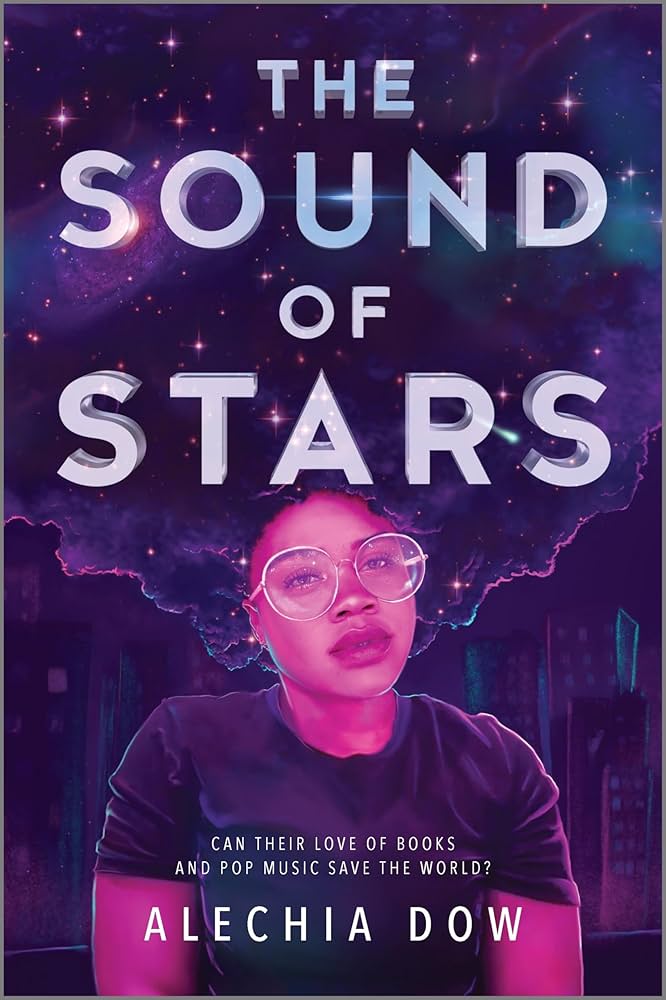
A Song of Salvation – Alechia Dow “Let me put you in the picture/Let me show you what I mean/The messiah is my sister/Ain’t no king, man, she’s my queen…”

Since this posts consists entirely of songs, consider all of them to be today’s song.

That’s it for this week’s Sunday Songs! Have a wonderful rest of your day, and take care of yourselves!
Posted in Book Review Tuesday

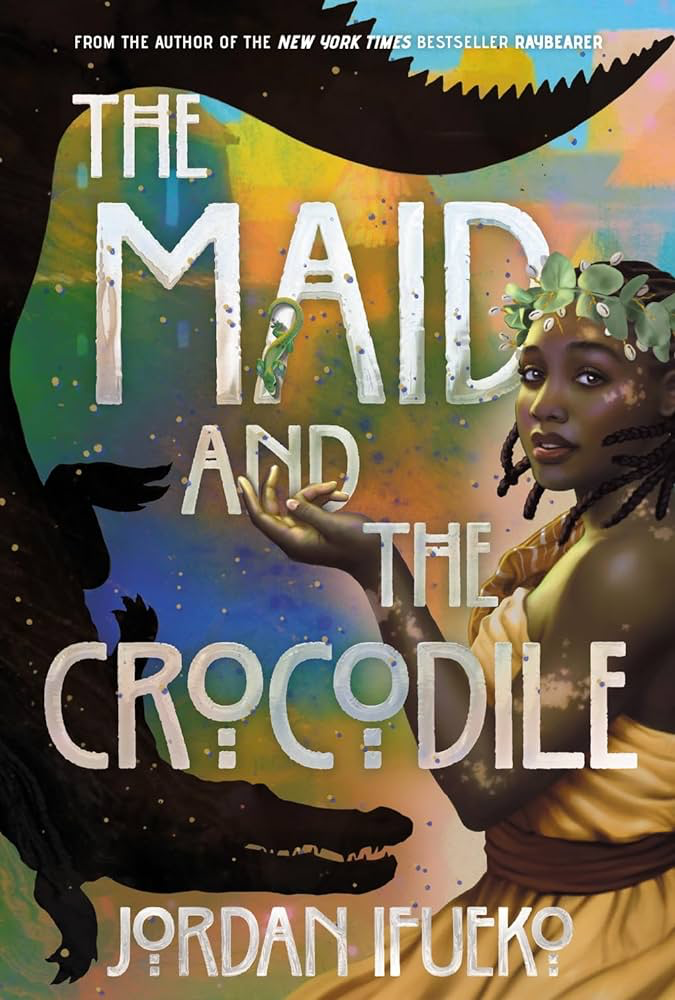
Book Review Tuesday (2/11/25) – The Maid and the Crocodile

Happy Tuesday, bibliophiles!

I had a ton of fun with Jordan Ifueko’s Raybearer duology, but somehow I completely missed that she released a novel last August in the same universe! It was an absolute treat to be back in Ifueko’s world, and The Maid and the Crocodile proved a valuable asset to her fantasy universe.

Enjoy this week’s review!

The Maid and the Crocodile – Jordan Ifueko

Small Sade is desperate for any job that she can find. With her crooked foot and vitiligo, the people of her village think she is cursed and touched by spirits. Eventually, she finds work as a maid, but not before an act of desperation sees her bound to a powerful god, known only as the Crocodile. As she moves up in the ranks, she realizes that she is a Curse Eater—her profession as a maid not only cleans the houses of her clients, but changes their fates. Juggling her newfound ability and a world on the brink of revolution with only the Crocodile as her guide, Small Sade must learn to forge her own path before someone else decides it for her.

TW/CW: ableism, self-harm/mentions of suicide, descriptions of injuries, classism, mentions of sexual assault, abuse, loss of loved ones

I can excuse a handful of pop culture references here and there, but after that god-awful Minecraft trailer, if I hear “the children yearn for the mines” ONE MORE TIME, I’m gonna snap…Jordan Ifueko, this was a great book, but that tested me…especially with the climactic scene that it temporarily undercut.

That aside, it was an absolute treat to return to the world of Raybearer with The Maid and the Crocodile! I didn’t think to re-read the duology before going back into it (I never seem to do that unless it’s with a book I’m really invested in), but I was so easily immersed into the world nonetheless! For both casual and eagle-eyed readers, there are Easter eggs aplenty—several characters from the duology make cameo appearances (SANJEET!!! MY GUY!!!!), and the nuances of the world stay the same, for the most part. It was an easy transition, which isn’t always easy to do. I loved how The Maid and the Crocodile expanded on the world as well! Ifueko really has a strength in writing ordinary characters forced into extraordinary, powerful positions, and Small Sade is no exception. However, she’s much more different than Tarisai, which I appreciated—there’s much more of a sense of her having to work towards the top, and her humored yet determined tenacity was what made her so special of a character. Through her, we see Oluwan City from more ordinary eyes, which makes the themes of the story so much more clearer.

I couldn’t have read The Maid and the Crocodile at a better time, and not just because it was a fun read. Its themes about the nature of change and revolution are critical—IT’S ALL ABOUT LOVE! It’s so refreshing to see a character who wants to help society change for the better not out of revenge or a vague “evil government bad [does not elaborate]” motivation, but out of love. Small Sade’s motives stem from wanting to care for the people she loves and wanting to see that love reciprocated in the world around her. Change rooted from love is a perspective that I rarely see in YA, even though its plots have centered around dismantling governments and revolutionary change for decades. I’m so tired of saying “in times like these,” but I mean it—in times like these, narratives about radical change being rooted in love—for your people, for your country, and for your culture—are critical to understanding what change can truly do.

Whenever you have a disabled character in a non-modern setting, even if it’s fantasy, you always run the risk of amping up the internalized ableism. Small Sade, who is shunned and deemed “spirit-touched” because of her crooked foot (she uses a cane for mobility) and her vitiligo, faces a great deal of ableism. It’s not as though plots about overcoming ableism (NOT the disability, mind you) aren’t worth telling, but in non-modern and fantasy settings, it does get slightly tired to have all disabled characters in these settings go through versions of the same arc. I loved how Ifueko handled Small Sade’s character—she resists ableism, but most importantly, she is a person beyond her experiences of ableism. Her experience of discrimination informs her story, but it is not the entirety of her character. Small Sade is defiant, self-reliant, and deeply caring—she’s so fully-fleshed out, which is a rarity for disabled characters. So hats off to Ifueko for an excellently-written disabled character!

However, though it had its moments, I was never fully invested in the romance between Small Sade and Zuri. I got that they had a connection, but I feel like he showed up too few times for the relationship to really work. Small Sade had eons more character development than he ever had the chance to. I get that a curse slowly turning you into a crocodile tends to do this to a guy, but at times Zuri felt rather codependent—up until the last 50 pages or so, Small Sade felt more like a means to an end for him, and his redemption was too underdeveloped for me to be fully invested in it. I appreciated their mutual resolution, but it was too late for it to feel fully satisfying. Given how strongly written the relationship between Sanjeet and Tarisai was in the Raybearer duology, I really expected Ifueko to deliver more with The Maid and the Crocodile. Small Sade and Zuri had moments, but not enough for me to be invested in them romantically.

All in all, a worthy addition to Jordan Ifueko’s Raybearer universe, full of heart, curses, and hope. 3.75 stars, rounded up to 4!

The Maid and the Crocodile is a standalone, but is set in the world of the Raybearer duology (Raybearer and Redemptor). Jordan Ifueko is also the author of the 2022-2023 run of Marvel’s Moon Girl and Devil Dinosaur, and has also contributed to Jim Henson’s Storyteller: Tricksters.

Today’s song:

That’s it for this week’s Book Review Tuesday! Have a wonderful rest of your day, and take care of yourselves!

Posted in Sunday Songs

Sunday Songs: 2/9/25

Happy Sunday, bibliophiles! I hope this week has treated you well.

This week: there’s never a bad time to listen to Gorillaz, but I certainly could’ve timed when I listened to Humanz better.

Enjoy this week’s songs!

SUNDAY SONGS: 2/9/25

“Swamp Dream #3” – Everything Is Recorded & mary in the junkyard

We now return to some much-needed mary in the junkyard-posting. I suspect it’ll become consistent…at some point. Not to pressure them, but hopefully this year (or the next) holds a full-length album in the future?

In the meantime, we have an excellent collaboration between them and Everything Is Recorded, the stage name of producer Richard Russell (also the founder of XL Records); he’s produced several albums under the name, often amassing a wide variety of musicians and songwriters to bolster them in a Gorillaz-like way, minus the cartoon characters. His forthcoming album, Richard Russell is Temporary, includes the likes of Florence Welch, Kamasi Washington, Noah Cyrus, Roses Gabor (a.k.a. the singing voice of Noodle on “DARE”), Bill Callahan, and mary in the junkyard! Granted, I hadn’t heard of Everything Is Recored until mary in the junkyard announced this single, but if this guy’s the owner of a record label, I could only hope this would introduce this fantastic, burgeoning gem of a band to a wider audience.

If “Swamp Dream #3” becomes the band’s ambassador, I wouldn’t mind either. Even though it’s more electronic than most of their catalogue, it’s got a naturalistic, moss-covered feel to it that you can’t scrape off of their sound no matter how many synths you paste onto it. It has the juddering thrum of rusted machines, all at once simple and a doorway into a hidden world; although I love the music video, “Swamp Dream #3” is begging for some kind of stop-motion treatment. I imagine it as an outside view of a termite’s mound or a rabbit’s warren, with the camera panning over clay worms poking out of the dirt and tiny insects, moles, and other underground rodents traversing the vast network of tunnels. (The real worms and beetles suffice, though.) Clari Freeman-Taylor’s vocals bring a kind of wonder to the song, a curiosity that isn’t quite childlike, but still seeks to shove its hands into the sand and the dirt, searching for hidden pathways and possibilities: “Mystery of my own flesh/I’ll never stop wondering/Never stop/Turning inside out.” Needless to say, the chorus, a repetition of “into the dirt” backed by looped vocals and a stuttering drum machine, could not be a better fit for a song with hands dirtied from looking for earthworms in the ground.

…AND A BOOK TO GO WITH IT:

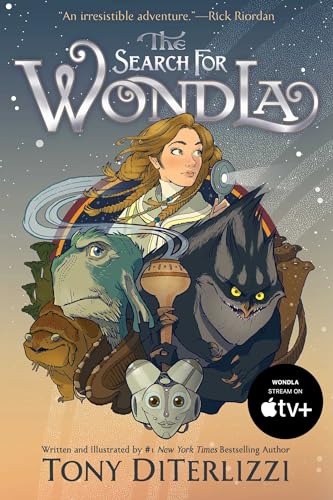
The Search for WondLa – Tony DiTerlizzi“You are from an old land/Crafted out of wet sand/What is it all about?/Staring at your hands…”

“Drop” – Tunde Adebimpe

NEW TUNDE ADEBIMPE JUST DROPPED!! THEE BLACK BOLTZ!! OUT THIS APRIL!! I’m not sure if anything will ever cure the decade-long TV on the Radio drought, but man, a new album from such a fantastic talent sure comes close.

I never got around to writing about “Magnetic,” but it felt so much like TV on the Radio to me—it was distinctly Tunde Adebimpe, but it had that same urgent propulsion that made their indie hits feel ageless. It’s one of those tracks that makes you see how far the footprints of one particular member of a band in their music. TV on the Radio bunched several people together with magic touches into a single band, which is startling, but this touch is unmistakably Adebimpe’s. But “Drop” is where his sound begins to branch out and diverge into something wholly new. It has a flavor that’s simultaneously ’80s and 2010’s indie pop. Once the beatboxing intro fades away, rhythmic as bubbles popping in midair, it becomes a much more relaxed yet introspective dive into Adebimpe’s mind. As the guitars—clean enough to almost sound like synths—radiate into the calm ripple of the track, he grapples with a sensation of awakening; “Drop” couldn’t be a more apt title for a song whose lyrics are steps away from launching off a daunting yet hopeful precipice: “I′m gonna try it for myself/I’m gonna need somebody′s help/Cast an extraordinary spell/And rise into the night.”

Together, “Magnetic” and “Drop” couldn’t make me more excited for the range of Thee Black Boltz. “Magnetic” was a perfect access point for the fans who were wanting something close to TV on the Radio 2: Electric Boogaloo (listen, it’s kind of a self-callout), but “Drop” represents the somewhat uncharted territory that we have yet to see Adebimpe cover fully.

…AND A BOOK TO GO WITH IT:

The Sound of Stars – Alechia Dow“We′re gonna feel it when we drop/Let′s go out where the visions never stop/There is a light/There’s a light just beyond this horizon/See it shine and rise into the night…”

“Insomniac” – Echobelly

Generally, the British were absolutely cooking with grease as far as rock music goes from about 1964 on, but there’s something so fruitful about the ’90s to me. If it’s from the period from 1992-1999 and it’s British, there’s a solid 75% chance that I’ll enjoy it. No, wait. Not exclusively the Brits, just because ’90s rock was so good, guys, but I just love the ’90s. To me, 1994 seems a particularly ripe crop of the vast harvest of the decade, especially the Britpop boom of the first half of the ’90s. Three out of the four of Britpop’s Big Four released albums: Blur with Parklife, Oasis (🤢) with Definitely Maybe, and Pulp with His ‘n’ Hers. But even if you look past the big players, 1994 is full of gems—”Insomniac” being one of them.

I just love Britpop, man. God. I talked a bit about Echobelly last year (with “Bellyache,” from this same album, Everybody’s Got One) with their propensity to take the genre’s penchant for social commentary a step further, as well as their much more diverse lineup compared to many Britpop bands of the time. (Not one but TWO women of color in a Britpop band was pretty much unheard of at the time) “Insomniac” is much more radio-friendly, but it embodies the “pop” of the Britpop, but never in a mindless way—more in the way that their contemporaries could wrap commentary in the most delicious guitar hooks. As Sonya Madan sings of her concerningly high subject (“I think we’ve lost control, dear/Whatever turned you on/You put it up your nose, dear”), the guitars absolutely knock you upside the head. You couldn’t wring the pure Britishness out of it if you tried (particularly the way that Madan sings “I swim in circles/In puddles/In trouble and then I go” like it’s a nursery rhyme…on a song about substance abuse), but you couldn’t wring the pure rock n’ roll out of it, either—this is what a hit should be.

…AND A BOOK TO GO WITH IT:

The Mermaid, the Witch, and the Sea – Maggie Tokuda-Halleven though Alfie gets a more sympathetic redemption arc in the final book, some of his relentless drug abuse certainly rings close to this song.

“Ride A White Horse” – Goldfrapp

“Ride A White Horse” is about as clean of a song you could get. It’s more than polished—it came out of the womb shinier than a disco ball, and its blinding sheen is made for dancing. Alison Goldfrapp has insisted that the title wasn’t a nod to T. Rex (but sort of was a reference to this), but the two songs couldn’t be further from each other—the dance-pop glamour of this song is about as far as Marc Bolan and company frolicking through the woods, but both have entirely distinct energies that differentiate themselves far beyond their respective choice of animals. Even for something made in 2006, Goldfrapp and Gregory’s work still sounds straight out of a club in the Blade Runner universe. Part of this is why I think the choice of making the music video for “Ride A White Horse” the epitome of dirty is kind of genius fit—it’s such a sanitized song, and yet Alison Goldfrapp sings it against superimposed backdrops of rotting food waste with scraps of toilet paper stuck to her heels, not to mention the cameo from what appears to be the proto-Trash Man. Even when there’s flies buzzing off of it, the polish of it never fades.

Also, because this popped up when I looked this up on YouTube, here’s a bit of unexpectedly delightful Goldfrapp content:

…AND A BOOK TO GO WITH IT:

Do Androids Dream of Electric Sheep? – Philip K. Dickas much as I disliked this book, I can’t deny that it fits the atmosphere—more so of the movies, as I said before.

“We Got the Power” (feat. Jehnny Beth) – Gorillaz

In retrospect, it was probably a terrible idea to listen to Humanz for the first time mere days before the inauguration just because of the album’s conception. When telling Pusha T, one of the album’s plentiful collaborators, what the atmosphere of the album was, Damon Albarn described it as “a party for the end of the world if Trump wins.” Not only did he say this well before Trump was elected, but…well, y’know. We all know the mess we’re in. Humanz often gets lambasted by the fandom as their worst album. I wouldn’t say it’s bad, but I think it’s the nexus of modern Gorillaz, which is to say that it’s the point where their albums became increasingly devoted to their collaborators as opposed to the creative force of Albarn and Hewlett. Said collaborators are hit or miss, but most of the songs have a verse by Albarn with the exact same filter over his voice once the collaborators have had their place in the sun. Much as I love my guy Damon, it got slightly tiring after about 10 songs. But if it’s a party for the Trump-era hellscape, Humanz fulfills its purpose with flying colors, balancing social commentary with gloriously catchy pop songs. I feel like the thesis is perfectly encapsulated by Vince Staples’ chorus on “Ascension”: “The sky is falling, baby/Drop that ass before it crash.”

In spite of all that, the album ends on an anthemic note—”We Got The Power.” As simple as the lyrics are, simplicity is what this track needs. In times so overwhelmed with shock, horror, and doom, sometimes a more concise message is the best thing to cut through the noise. “We got the power to be loving each other/No matter what happens.” IT’S TRUE! It’s why “All You Need Is Love” has endured for so long. It’s simple, but it’s the kind of uniting message that we needed. If anyone should know that, with their history of cleverly packaged social commentary, it’s Gorillaz. Albarn is joined by Jehnny Beth (if I had a nickel for every time I’ve heard Jehnny Beth sing a French verse on a British band’s song, I’d have two nickels, etc., etc.) and an uncredited Noel Gallagher. I briefly mentioned it before it, but as much of an Oasis hater as I am, it really is beautiful that they were able to set aside the stupidest possible differences, realize how stupid they were, and join forces on a song about loving each other. You can’t not appreciate it. (To say nothing of Liam…) And as the closing track to an album about a party at the end of democracy, it’s a welcome light at the end of the tunnel, and a true light—it’s not the flashing club lights that shroud the fear of most of the album, but a real lodestar.

…AND A BOOK TO GO WITH IT:

The Stardust Grail – Yume Kitasei“And we dream of home, I dream of life out of here/Their dreams are small/My dreams don’t know fear/I got my heart full of hope/I will change everything/No matter what I’m told…”

Since this post consists entirely of songs, consider all of them to be today’s song.

That’s it for this week’s songs! Have a wonderful rest of your day, and take care of yourselves!

Posted in Books

The Bookish Mutant’s Books for Black History Month (2025 Edition)

Happy Wednesday, bibliophiles!

Here in the U.S., February is Black History Month! I normally begin by talking about how critical it is in these times to uplift marginalized voices (in this case, Black voices) with the attacks on so-called “critical race theory” in elementary schools and the attempts in both the classroom and the government to whitewash our fraught, racist past. However, I find these posts becoming more relevant as the Trump administration strikes down D.E.I. initiatives and has started shutting down “identity months” among many federal agencies. As Trump and his cronies push us into an age (certainly not a golden one) that strips away the celebration and acknowledgment of the wonderful difference that makes up this country, it’s more valuable than ever to celebrate those who have historically been downtrodden. Especially since Trump has purported himself as a friend to Black Americans (then turned around and committed unspeakably racists acts during both terms already), we need to emphasize the truth: Black people are and will always be vital to this country, and their history and contributions are an irreplaceable part of American history. No policy, removal, or dismissal can change that.

As with all of the related lists I make each year, this is not an exhaustive list; I encourage you to always look further and discover books and authors of your own during Black History Month (and during the rest of the year).

For my lists from previous years, click below:

NOTE: while the header image just says YA, I’m including books of various age levels on this list. (I’m just too lazy to make a new header, sorry…)

Let’s begin, shall we?

THE BOOKISH MUTANT’S BOOKS FOR BLACK HISTORY MONTH (2025 EDITION)

FANTASY:

SCI-FI:

REALISTIC/HISTORICAL FICTION:

TELL ME WHAT YOU THINK! Have you read any of the books on this list, and if so, what did you think of them? What are some of your favorite books by Black authors that you’ve read recently? Let me know in the comments!

Today’s song:

That’s it for this year’s Black History Month list! Have a wonderful rest of your day, and take care of yourselves!

Posted in Book Review Tuesday

Book Review Tuesday (2/4/25) – Death of the Author

Happy Tuesday, bibliophiles!

I’ve been a longtime fan of Nnedi Okorafor, albeit on and off—I picked up Akata Witch back when I was in middle school, and then discovered her adult books when I was in high school. Since then, I’ve been a fan of her quirky brand of Africanfuturism. You can imagine my surprise when I found out that Death of the Author was not an addendum to her long sci-fi fantasy canon, but instead literary fiction—albeit, with a dash of sci-fi. Either way, the switch from genre to genre is as smooth as I’d expect from Nnedi Okorafor.

Enjoy this week’s review!

Death of the Author – Nnedi Okorafor

Zelu is on the verge of giving up her dream to be a writer. After a pile of rejected manuscripts and a botched job as a professor, she moves back in with her overbearing, judgmental family as she attempts to get back on her feet. But when a spark suddenly comes to her, she has a bestseller on her hands: Rusted Robots. As she grapples with the price of fame and the mobility—and simultaneous lack thereof—Zelu must come to terms with her own identity as she explores the fabrication of it that the public has created for her.

TW/CW: substance abuse, ableism (external & internalized), loss of a parent, near-death situations, kidnapping

Of all people, I didn’t expect Nnedi Okorafor to take the leap into literary fiction, and after I found out the switch in genre, I didn’t expect to enjoy Death of the Author as much as I did. Thankfully, it’s only really literary in the sense that it’s contemporary, realistic fiction…mostly. The woven tapestry of Zelu’s real life and her creation, Rusted Robots, turned out to be a powerful meditation on the nature of art and identity.

Once again, make no mistake: this is fiction, but it’s not entirely just fiction. The assumption is that it’s a handful of years in the future; Zelu has fairly futuristic, adaptive prosthetics that are still in beta testing, and she tests out an automated cab service that’s been newly introduced to the streets of Chicago. Yet Okorafor takes the same skilled hand that she uses to craft intricate, far-future worlds and translates it into the idiosyncrasies of modern life, from the gauntlet of social media fame (and harassment) to being in the confines of a chaotic, judgmental family. For every character that was introduced, Okorafor matched them with an unforgettable personality, even if they only appeared for a few pages. All of the complex, rapidly fluctuated emotions were depicted with sensitivity, from the highest joys to the deepest pits of anguish and the plentiful uncertainty in between. Even without her talent for worldbuilding, Okorafor is a force to be reckoned with, and Death of the Author is proof.

I was hesitantly optimistic that Okorafor was writing a disabled main character again; Noor was a great novel, but from my memory, there was quite a bit of internalized ableism in the main character that went unaddressed. (However, somehow I didn’t know that Okorafor has experience with disability and was herself temporarily paralyzed, so my bad.) The setting couldn’t be more different for Death of the Author, but Okorafor has certainly stepped up her game as far as writing disabled characters—and part of it is that Zelu is unlikable. More often than not, you can at least sympathize with her, but at times, you can see her for the insufferable, argumentative, reckless stoner that her family sometimes sees her as. Of course, not every disabled character has to be likeable, but her relative un-likeability made some of the novel’s most powerful commentary shine even more. As she grapples with her meteoric rise to literary fame, Zelu’s fans place the burden of her being a “role model” for a number of communities: Black, woman, Nigerian-American, disabled. Being a role model can be powerful, but as soon as people saw Zelu as more of a role model than a person, it disregarded her humanity in an entirely different way. She became an example, not an autonomous being—something that is intimately tied to what many disabled people experience. In that way, Zelu represents a leap in how Okorafor writes her disabled protagonists—not just independent, but human.

I don’t have a ton of experience with meta-fiction—it’s not a matter of me not liking it, I just hardly get around to reading much of it—but Death of the Author pulls it off with ease. If you’re still not convinced that Okorafor’s literary fiction isn’t for you, you’ll at least be tided over by her signature brand of Africanfuturism, complete with the landscape of a futuristic Nigeria, robots, and appearances from Udide. It’s somehow a delightful vision of the future, where types of robots have proliferated across the face of the Earth in the face of the extinction of the human race. It’s threaded into Zelu’s life, yet it’s also a clever distillation of the novel’s themes; Ankara’s struggle with coexisting with Ijele inside of his head, as well as the changing world around him, spoke to the themes of embracing collaboration and the blurry relationship between creator and reader.

Which brings me to the whole “death of the author” part. I’ll admit, the Roland Barthes quote from the (original) “Death of the Author” gave me literary theory flashbacks. But as a grounding concept for the book, I love how Okorafor’s Death of the Author playfully pokes fun at the concept. Here, it’s as though the concept has been subsumed by the publishing industry; instead of taking Zelu’s novel as tied to her heritage and her disabled identity, the world swallows it and regurgitates a whitewashed, Americanized movie adaptation that the public eats up. (“Look what they’ve done to my song, Ma…”) Yet at the same time, Zelu is confronted by readers who insistently pester her, insisting that everything in the novel is fully tied to her identity and selfhood. Death of the Author’s strength is the clarity it finds in the balance. Zelu’s work is intimately tied to her identity, but just as intimately tied to her imagination. Her being marginalized meant that people saw her work as surely being solely about her identity, but that wasn’t the whole story either. (The note in the acknowledgements about Okorafor talking to her daughter about worrying that readers would think that Zelu is her makes the point all the more clear.) In this case, fence-sitting is the most reasonable position I can think of—to consider reader interpretation first and foremost can have fruitful results, but to deny the lived experience veers into foolishness, and vice versa; Okorafor’s embrace of the area in the middle is what made the message so clear. Reading and world-creation is a twin act, created both by ourselves and those who receive our work—it’s not a simple question of one or the other.

All in all, a surprising novel that at first seemed like a left turn, but turned out to be another testament to Nnedi Okorafor’s enduring talent. 4 stars!

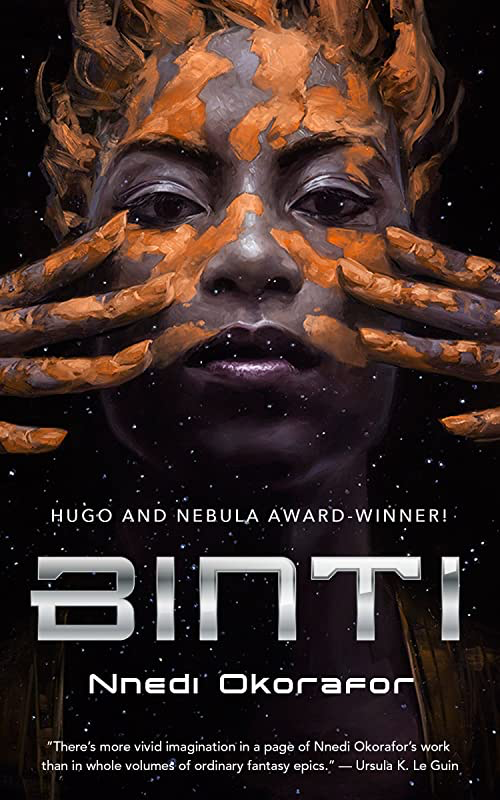
Death of the Author is a standalone, but Nnedi Okorafor is also the author of several books for adults, teens, and children, including the Binti trilogy (Binti, Home, and The Night Masquerade) the Nsibidi Scripts series (Akata Witch, Akata Warrior, and Akata Woman), Lagoon, Noor, the Desert Magician’s Duology (Shadow Speaker and Like Thunder), and many more.

Today’s song:

ADORE this album

That’s it for this week’s Book Review Tuesday! Have a wonderful rest of your day, and take care of yourselves!

Posted in Sunday Songs

Sunday Songs: 2/2/25

Happy Sunday, bibliophiles! Hope you didn’t drive angry today.

Since I’ve been absent for the past two(ish) weeks, here are my graphics and songs from the middle of January:

1/19/25:

1/26/25:

This week: shoutout to Brian Eno songs with vehicles in the names. Plus, Lucy Dacus is thinking about breaking your heart (but when is she not?).

Enjoy this week’s songs!

SUNDAY SONGS: 2/2/25

“Limerence” – Lucy Dacus

January. Love it or hate it, it’s that magical time of year when all of the singles and album announcements for the first half of the year start rolling in. Oh, the sweet sound of new music…especially when it’s from Lucy Dacus! It’s been known that she’s been cooking something up after previewing a handful of new songs post-the record (as is Julien Baker—new album from her and TORRES too!!), but mid-January, she officially announced her new album, Forever Is a Feeling, which will be out this March! Aside from…well, y’know (I know it’s a painting, which makes it more impressive, but what in the PicsArt is that album cover?? That font?? 😭 No hate to Dacus or to Will St. John, but…there could’ve been so many better choices…), I’m so excited for this new record—I’m loving the aesthetic of gilded museums and flowing dresses, as well as the orchestration that Dacus has brought to the record—or at least to “Limerence.”

The other day, I saw some reel or another about how a lot of modern songwriters see writing down explicit, confessional details (or details that sound authentic enough to be confessional) in their songs as an automatic way to get depth, and I halfway agree. I do think that with the steady stream of Phoebe Bridgers wannabes that have been pouring out of some factory in L.A. since 2021 has influenced that, but I don’t think it’s always lazy songwriting. Let’s just say that you can tell when it’s for soul-baring or clout-getting purposes. The key is knowing which details are important: vignettes or extended scenes that elevate the themes or contribute to evoking the intended emotion, something that Bridgers has always excelled at. I hate to say it, but the first lines of “Limerence” nearly feel like the anti-Bridgers method: “Natalie’s explaining limerence/Between taking hits from a blunt, high as a kite/While Roddy’s playing GTA/I swear, why is he so good at this game?/It should be cause for concern.” Against the delicate, piano-dominated orchestration of “Limerence” and the soaring warmth of her voice, such ordinary details feel shoehorned in, without as much connection to the rest of the song. It’s not as though she hasn’t written similarly observational lyrics, but the wording (and maybe the mention of some guy playing GTA with a harp in the background) doesn’t mesh with the rest of the track.

Key word here is nearly. I’ve been a fan of Dacus long enough to trust in the consistency of her songwriting—that bit really is a blip in the vast glory that is her catalogue. The rest of “Limerence” swiftly picks up the slack of those first handful of lyrics. Orchestral Lucy Dacus is, in my opinion, the best Lucy Dacus; guitar carries her humbly captivating gravitas perfectly, yet there’s something about strings, piano, and harp that carry it to new heights (see: “Body to Flame”). With the gentle tempo that recalls the reflection of silk off of marble floors during a ballroom waltz, Dacus drifts into melancholy rumination…as she often does, but it has yet to get old, especially since she’s at least self-aware of the fact (see: “The Shell”). Against the delicate plucking of harps and strings, she sings of drowning herself in distraction just to distance herself from the inevitable collapse of a relationship: “I want what we have/Our beautiful life/But the stillness, the stillness/Might eat me alive.” Carrying the leaden weight of wanting to break free, “Limerence” nervously toes circles around its subject, subtle enough between the folds of a voluminous dress to avoid the truth. The marriage of Dacus’ unbeatable voice and the almost hesitant restraint of the orchestra carve out that feeling of wanting to squirm free, but feeling the weight of severing the other person even more intensely. It’s no wonder that Dacus seemed to have the trouble she did releasing “Limerence” as a single—it was a last-minute call after releasing the much more lighthearted “Ankles” (also excellent), but I can imagine that it has that effect—too personal to keep close but also to release, yet a song that needed to be launched as one launches a satellite out into the vastness of space.

It’s…yeesh, huh? Couldn’t have expected less from Lucy Dacus…anyways, the music video is much more delightful, I promise (and see? 3:19, there’s your album cover):

…AND A BOOK TO GO WITH IT:

Can’t Take That Away – Steven Salvatore“Is there a difference between lying to you/If it feels just as bad as telling thе truth?/I know that there is/And I know what I’ll pick…”

“Here Come the Warm Jets” – Brian Eno

I’m about 6 months too late to make a “brat summer? Nah, Brian Eno summer” joke, but humor me, alright? We cling to what we can in these trying times. Let me have my shitty Brian Eno jokes. Brian Eno winter doesn’t have the same ring to it. (Now, Cocteau Twin-ter—okay, okay, fine, that one’s run its course, I know…)

Somehow, when compiling my list of my favorite album closers of all time, I forgot “Here Come the Warm Jets” entirely. At that point, it had been a solid year since I listened to Here Come the Warm Jets, and it had fallen off my radar. Only when I listened to Before and After Science: Ten Pictures did this track return to me. Obviously, the emotional impact of instrumental tracks can’t be understated, but it seems they’re often overlooked when they’re not film scores. Eno, to me, has a true gift of imbuing such clarity of emotion into his instrumentals (see: “The Big Ship”). Technically, “Here Come the Warm Jets” isn’t technically instrumental, but the vocals don’t come in at 2:33, and they’re so shrouded that they sound like vaguely nonsense chanting. (Eno has said that the lyrics are also meaningless and free-associative, as are many of the lyrics on the album.) Especially as a closing track, “Here Come the Warm Jets” is one of those songs that’s able to breathe life into its title without words. With the dense, buzzing hive of distortion, so thick you could stick your hand in it and feel the wings of millions of insects, it has the fuel and squeal of both tires screeching against the tarmac and the heat and urgency of a plane taking off.

Like “The Big Ship,” you can trace the slow, hopeful ascent of the song, a steady trajectory upwards as the music rises and fades into a cloud-streaked sky. And…okay, well, I know the dirtier interpretations of the whole “Here Come the Warm Jets” phrase, and the playing card on the album cover doesn’t help, but I’m choosing to believe that they’re jet planes, and I can feel the warmth of the rising, fiery hope propelling their engines skyward. Besides, Eno took the title from how he felt the guitar sounded—“like a tuned (warm) jet,” which he added into the track sheet. As with most anything he observes, it’s truly right on the money.

…AND A BOOK TO GO WITH IT:

Activation Degradation – Marina J. LostetterI can imagine the warm atmosphere of this song amongst the machinery of this novel, humming along with all of the engines and parts.

“Brean Down” – Beak>

Man, I admire committing to the bit, but how do you pronounce >>>>? Or >>>, where “Brean Down” is taken from, come to think of it? The only pronunciation I’ve seen is from BBC Radio, which, after some hesitation, called it “four chevrons.” I thought it was some sort of !!! (chk-chk-chk…don’t come for me, that’s all I know about them), but that doesn’t have the pretentious ring I thought it would have. Fascinating…you do you, Beak>. Can’t knock them, especially since one of their (now former, as of last year) members, Geoff Barrow, was from none other than PORTISHEAD back in the day…damn.

When my dad sent “Brean Down” to my brother and I, he described it as “if Radiohead and Shakey Graves had a baby,” and the more I listen to it, I can’t think of a more astute description. There’s a dread-inducing, dead-eyed drone aplenty, but with vocals from someone who’s practically a British Alejandro Rose-Garcia—it’s almost eerie how similar he and Billy Fuller sound. (The Britishness wasn’t even detectable…) Either way, it’s got a kind of creeping, cagey nausea to it that’s perfectly paired with the dusty brick walls and city streets of the music video, all while Fuller sings of alienation and empty absorption: “Tell me what I want and I feel like I do/Stuck in a cage and the people looking at you/Nobody’s perfect and even if you say so/We don’t like the music ’cause it ain’t up on the radio.” There’s your Radiohead for you…but really, Beak> excelled at making the song have the illusion of looseness, with the occasional pulse of the guitar and the drums, but still ultimate feel caged and immobile, as purposefully restrained as the artfully jerky moves of the music video’s danger, Vladislav Platonov. It’s not just the mechanical drone that haunts “Brean Down,” but the sensation as if something is slowly shadowing your figure—conformity, so it seems. Not a whole lot that induces dread as much as that.

…AND A BOOK TO GO WITH IT:

Junker Seven – Olive J. Kelley“Tell me what I want, and I feel like I do/Stuck in a cage and the people looking at you/Nobody’s perfect and even if you say so/We don’t like the music ’cause it ain’t up on the radio…”

“Switch Over” – Horsegirl

Only took me three singles to use the actual Phonetics On & On cover for one of these graphics…I do it for the color scheme. After months, it finally fit. Sorta.

With every single from Phonetics On & On that comes out, I’m continually blown away by just how much Horsegirl have grown and the incredible talent they’ve managed to accrue with experience and maturity. From the beginning, they’ve known how to throw together a tight groove, but “Switch Over” is one of their most striking ones yet. It shines in the way that only freshly polished wood does, creating a catchy, dynamic tapestry with lyrics that, when put together, only consists of about nine words total, repeated over and over. It’s not unusual for Horsegirl, but god, it’s sure been refined from greatness to something fantastic. In limbo between the ’70s (if that wasn’t evident from the Lou Reed poster at the beginning of the video), the ’90s, and something uniquely current. Even with the rhythm kept on such a tight leash, there’s an undeniably current of ease and whimsy running through it—I think it’s the lack of restraint. They’re throwing everything into making something deceptively simple and cooped up, but the passion that they throw into it makes the edges, rigid upon first glance, wiggle with every strike of Gigi Reece’s cymbals. (Also, gotta love how they just disappear into nothingness the minute they hit the cymbals. Peak comedy.) Maybe it’s too early to say so, but Phonetics On & On is shaping up to be one of the best albums of the year—“2468” and “Julie” were hits from the start, but “Switch Over” is proof that we can’t predict the breadth of talent that Cheng, Lowenstein, and Reece (and Le Bon) have up their sleeves.

Man, I’m glad to live in a world with Horsegirl in it. Their only sin so far is refusing to tour near where I live.

…AND A BOOK TO GO WITH IT:

Time and Time Again – Chatham Greenfieldrapid switching and repetition, but this time, it’s repeating the same day over and over (yes, this is basically lesbian Groundhog Day).

“Doo Wop (That Thing)” – Lauryn Hill

Aside from the crushing constraints of the music industry, especially for someone as influential as Lauryn Hill was at her peak…yeah, if I wrote anything as good as this, I’d be perfectly content to get it out there and then disappear from the face of the earth. Well, sure. The tax evasion and the random controversies aren’t exactly ideal. But again—if you release one album and become this influential, I don’t blame her. “Doo Wop (That Thing)” is an extension of that—it’s almost mythic in its construction, written and produced solely by Hill. Sure, I’m late to the party—it took me a minute to warm up to hip-hop as a whole, really—but better late than never.

In fact, I can’t think of a better time to return to this song. If there’s anything that’s essential in these times, it’s “Doo Wop (That Thing).” (The line “Talking out your neck/Saying you’re a Christian” comes to mind for…multiple reasons, related and unrelated to the song’s message.) You need armor against misogyny, materialism, and being seen only for your body and sexuality—it goes both ways, as Hill astutely points out. Patriarchy harms everybody. “Doo Wop (That Thing)” isn’t so much an anthem as it is instructional, and not even instructional in the “and THAT’S why…” way. It’s less of lines on a chalkboard than it is the calloused hand of a mentor, a mother, on your shoulder telling you not just to not make her past mistakes, but to know your damn worth. It’s critical. Men have always thought that they’re immune to the consequences of their actions (and the systems we have in place have reaffirmed that), but I’ve seen Trump’s reelection embolden them even more. Jesus Christ…if I had a son, I’d never kick him out of the house for being queer (a bit redundant, since I’m queer myself, but stay with me), but I WOULD if I found out that he was commenting “your body, my choice” under women’s posts online. CHRIST. Moments like these do seem like nothing has changed since 1998, but maybe that’s why Hill’s rallying cries resonates now more than ever. I want it on banners all across the country, from now until it’s no longer relevant: “Respect is just the minimum.” It’s a call for men to reconsider (and ENTIRELY reconstruct) how they treat women and for those women to realize the potential they have within themselves, restrained by misogynistic structures and societal expectations. The end of the first verse really does send chills down my spine: “Let it sit inside your head like a million women.” Remember those who came before you. You have your power, and their power.

…AND A BOOK TO GO WITH IT:

The Poet X – Elizabeth Acevedoa young girl reckons with being seen only for her body—and learning to use her voice.

Since this post consists entirely of songs, consider all of them to be today’s song.

That’s it for this week’s Sunday Songs! Have a wonderful rest of your day, and take care of yourselves!
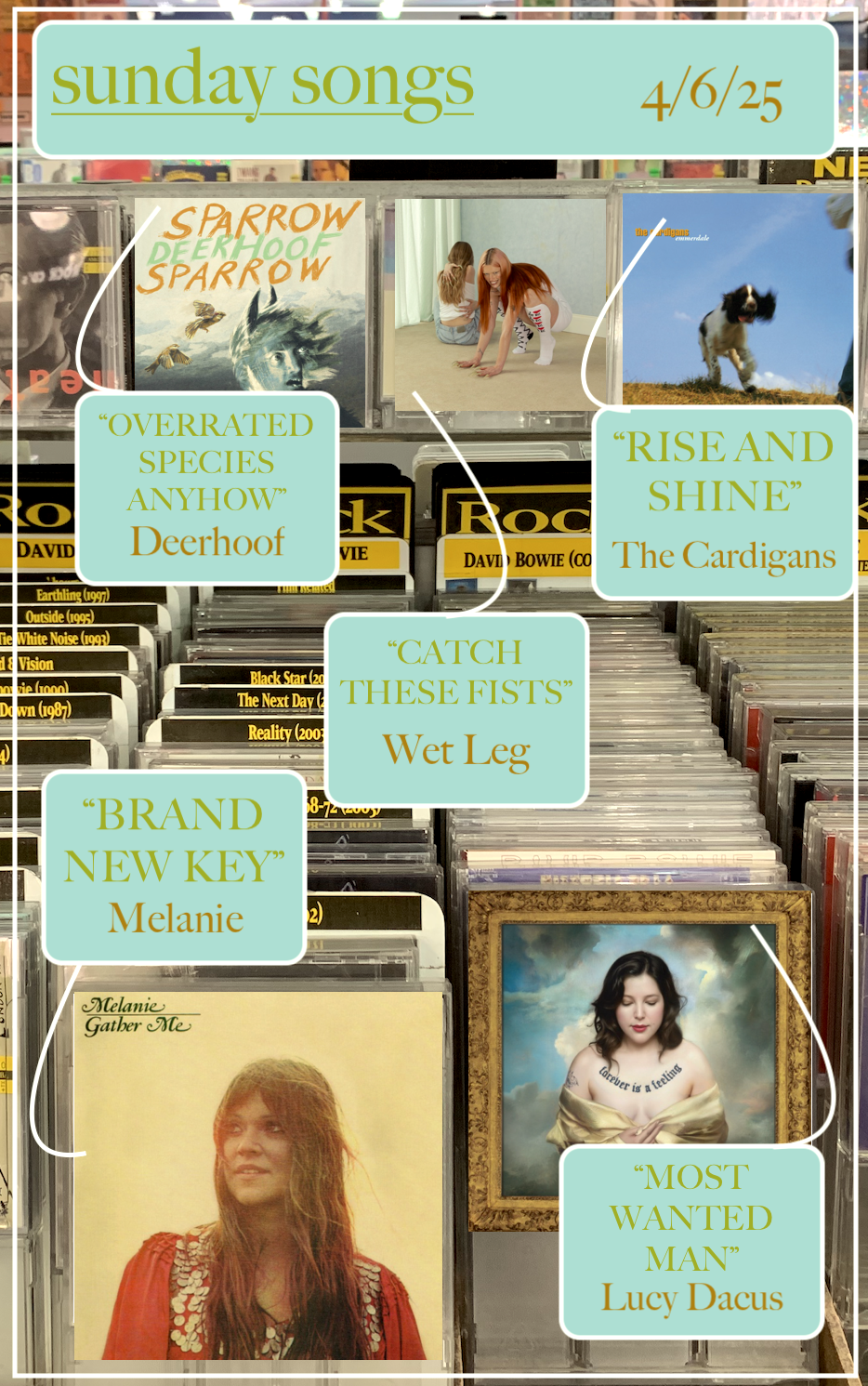
Posted in Book Review Tuesday

Book Review Tuesday (1/28/25) – The Marble Queen

Happy Tuesday, bibliophiles!

Graphic novels haven’t been all I’ve been reading this month, but I’ve certainly been on a kick of reviewing them. Unfortunately, this one wasn’t nearly as good as The Infinity Particle, but it’s apples and oranges to compare them. I really need to stop putting everything with “sapphic” and “fantasy” in the description on my TBR, because while I love those two things together, they aren’t automatically the recipe for a good book. Sadly, The Marble Queen is proof of that.

Enjoy this week’s review!

The Marble Queen – Anna Kopp and Gabrielle Kari

Princess Amelia lives in a kingdom in turmoil. Accosted on all sides by pirates and on the brink of war between its neighboring nations, Marion is on the verge of collapse. Only a miracle can save it—and that miracle may be to marry Amelia off to the prince of the neighboring kingdom of Iliad. But soon, she finds out that there was a mistake—it was not the prince she is being married off to, but the new queen, the stunning Salira. Stuck in a foreign kingdom with no control over her destiny, Amelia searches for answers. But with political forces from all sides conspiring against them, she must ally with Salira in order to save both of their kingdoms from ruin.

art by Gabrielle Kari

TW/CW: blood, violence, loss of loved ones, anxiety, poisoning (attempted)

I went into this graphic novel thinking I’d get a sapphic fantasy. The sapphics? They’re here. The fantasy? Not so much. The writing and artwork? The latter picked up some of the slack left by the rushed writing, but not enough. Given more page time and refinement, The Marble Queen could have been something promising, but it was clearly a case of too many plot ideas in a shell that could not hold all of them.

If you’re looking for fantasy, The Marble Queen will likely disappoint. If you’re looking for something more along the lines of a regency romance with political intrigue thrown in, you might be more satisfied. The Marble Queen has plenty of ballroom dancing, flowy dresses, court intrigue, and pirates, but nothing that would necessarily separate it from something in our history. There was a vague, throwaway sequence about some crystals beneath Iliad that supposedly had magical powers, but it ended up having zero consequence to the plot—it felt like Kopp threw it in just so that she could say “See? See? This is fantasy, we promise!” Also, so many of the place names felt so randomly plucked and too close to real world things—kingdoms called Marion (not necessarily a common name, but similar enough to Marianne/Maryanne that it loses the fantastical feel) and Iliad (I don’t think I have to explain that one) made the worldbuilding feel even lazier. The Marble Queen’s artwork also had a lack of immersion—other than the glimpses we got of the palace and the outside world, many of the characters were shown on flat, monochrome backgrounds, making it difficult to get a full picture of the world. Had this been historical fiction with a loose basis in some of our cultures, it might have been more effective.

Additionally, The Marble Queen was all over the place in terms of plot. I got the impression that Kopp and Kari had a plethora of ideas for what to do with the story, but not nearly enough time to execute them. As a result, every subplot felt smushed together like sardines in a tin can—so many of them were there, and yet almost none of them had room for proper mobility. I was particularly intrigued by Amelia’s anxiety and her feelings of isolation in Iliad. Her fear and alienation, although given a fair amount of space in the first half of the novel, had the potential to be poignant, but since it was shoved in unceremoniously against at least six other subplots, it had to room to grow into a compelling, sensitive story. The same went for the political intrigue—I liked it in concept, but the plot with Stefan had so little room to develop that by the time the reveal came, I’d guessed it about 30 pages earlier. In between all this, we get rapid-fire scenes of training montages, poisoning attempts, emotional backstory with not nearly enough grace given to the grief they should have held, said random bit about magical crystals that doesn’t end up being relevant at all, and a pirate that was clearly supposed to be a “fan favorite” character, but only got about 5 pages of character interactions tops. Given more polishing, The Marble Queen could have been a successful story, but it had no sense of direction, which made me struggle to keep my interest in the characters.

Said plot, more overstuffed than a Thanksgiving turkey, is why I think the romance didn’t work for me either. I did get that the arrangement was meant to be rushed, but when so many extraneous plot events were happening around Amelia and Salira, I never bought the chemistry that Kopp so badly wanted to convince the reader that existed between them. We’re supposed to believe that Amelia and Salira are slowly falling in love, but there’s hardly any indication in the dialogue that a connection is being made, save for a heavy dose of panels of Amelia with sparkly eyes and anime blushing. We’re supposed to sympathize with Salira because of the untimely death of her first girlfriend, but we hardly get an indication that she’s uncomfortable during the wedding, and after the explanation to Amelia, she comforts her, and then they make out in front of a painting of her ex-girlfriend and move on. Again, this was a victim of The Marble Queen‘s full-to-bursting plot—a romance that could have been compelling was ruined by a plot that moved too fast and contained too much of the wrong things.

The art was…alright, I suppose. That gorgeous cover set my expectations too high. I could get on board with the almost-Manga art style, and I did enjoy some of the expressions that the characters made. Although the color palette was warm and pleasant, it was largely flat—there was a significant lack of shading and depth, which can sometimes work, but in a story and world this fantastical, some of it was necessary. Additionally, Kari had a tendency to overexplain some of the gestures of the characters. Instead of having some creative (and sometimes silly) depictions of sound effects, there were direct writings of, say, “rise,” “kneel,” or “stab” when characters stood up, knelt or got stabbed, or repetitions of “beautiful” when Amelia first sees Salira. In moderation, some of this could have worked, but in such large amounts (and in places where these things could have easily been inferred by…well, just looking at the artwork), they grated on me.

That being said, I loved Gabrielle Kari’s character designs! She did an excellent job of making the characters expressive and distinctive in their respective looks. Anime blushing aside (I could let it slide after a while), all of the characters had wonderful stylistic quirks and tells, making them fun to follow around their kingdom, even when the writing itself slacked off. The design language wasn’t just clear, but enjoyable to see between the kingdoms; I loved the contrast of Amelia’s flowing, flouncy dresses in contrast to the tighter, more soldierly attire of the royals of Iliad. It added what some of the writing failed to add with the themes of her alienation and isolation—she was clearly an outsider, in both her foreign mannerisms and personality and the way she stuck out in the crowd.
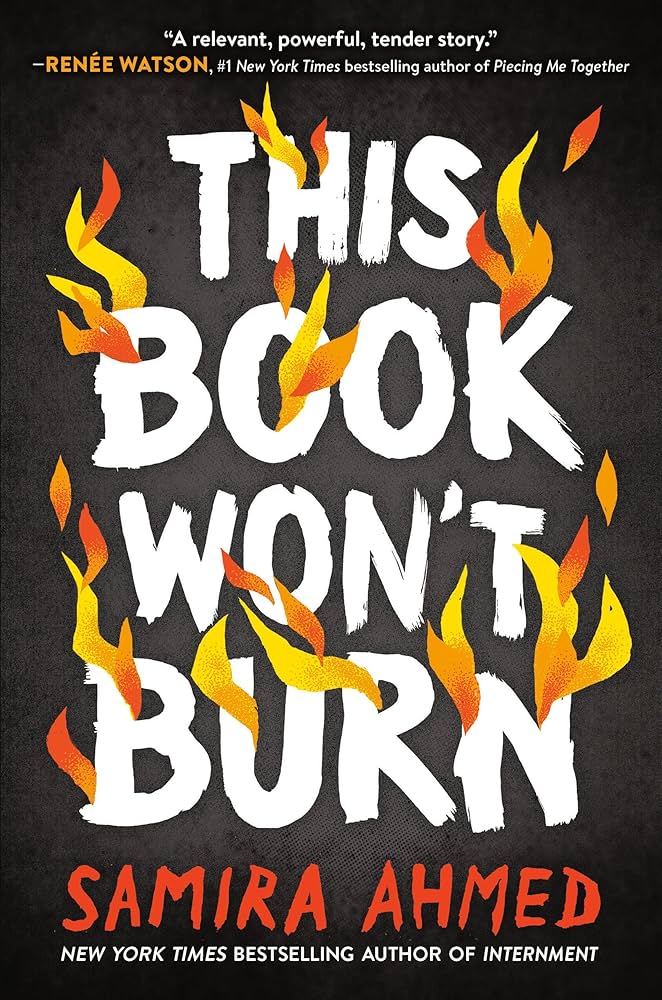
All in all, a fantasy (?) graphic novel with the potential for epic drama, but got dragged down by an overstuffed plot that squeezed the life out of the characters. 2 stars.

The Marble Queen is a standalone, but Anna Kopp is also the author of Lifeblood, as well as many Minecraft novels for younger readers. Gabrielle Kari is also the illustrator of No Holds Bard, written by Eric Gladstone.

Today’s song:

NEW TUNDE ADEBIMPE IN APRIL, LET’S GOOOOOOOOOO

That’s it for this week’s Book Review Tuesday! Have a wonderful rest of your day, and take care of yourselves!