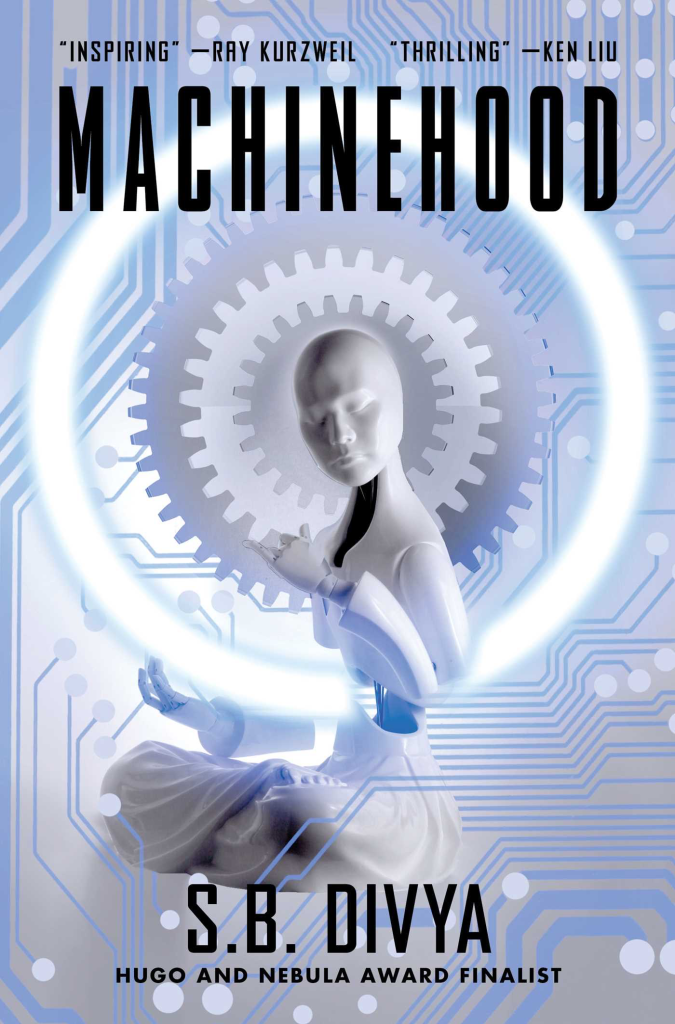
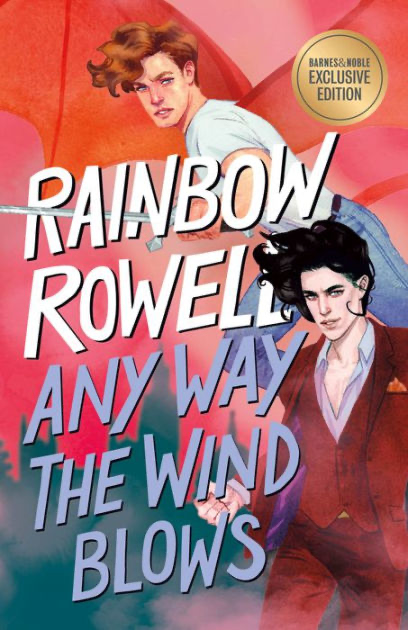
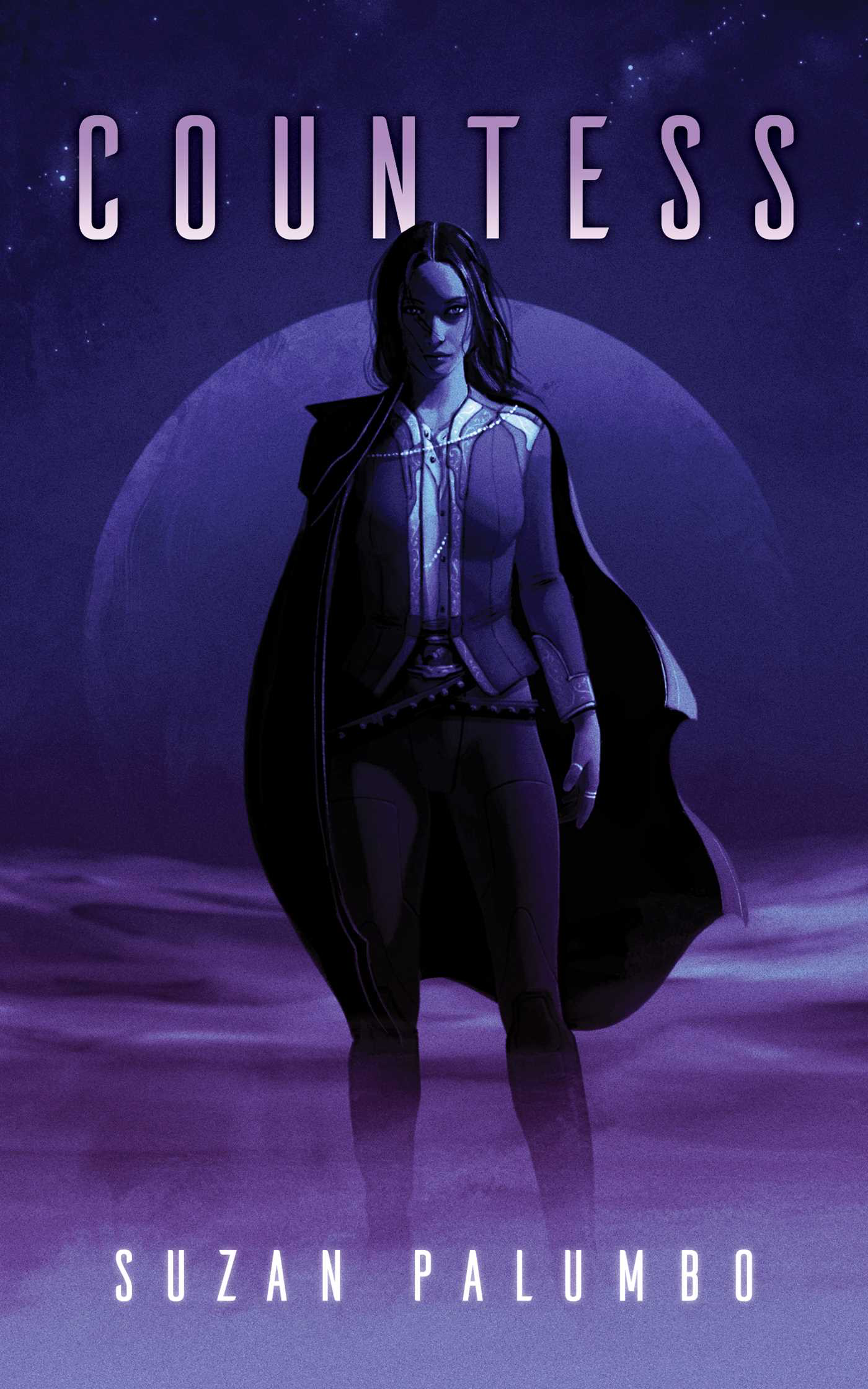
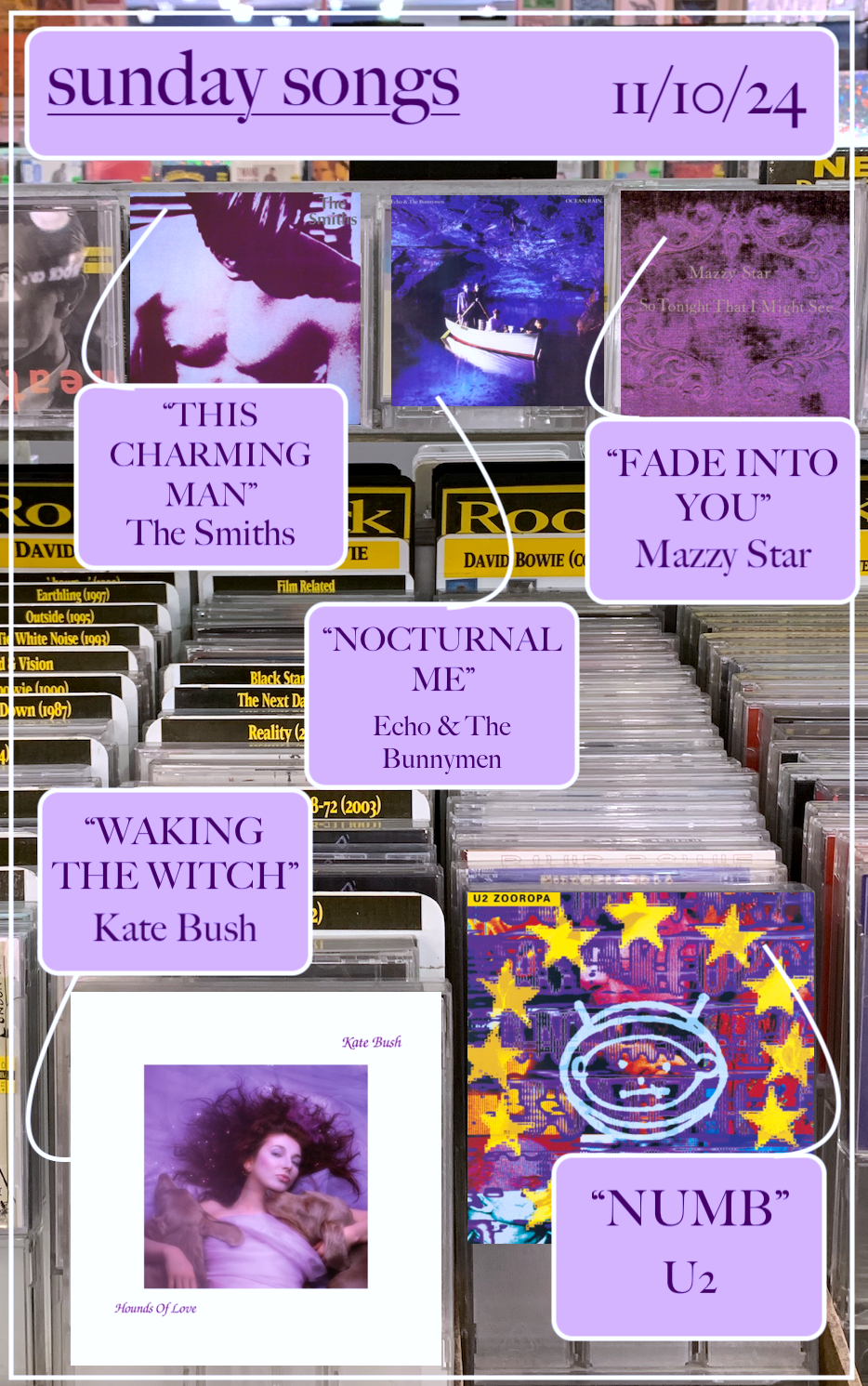
Posted in Sunday Songs

Sunday Songs: 10/13/24

Happy Sunday, bibliophiles! I hope this week has treated you well.

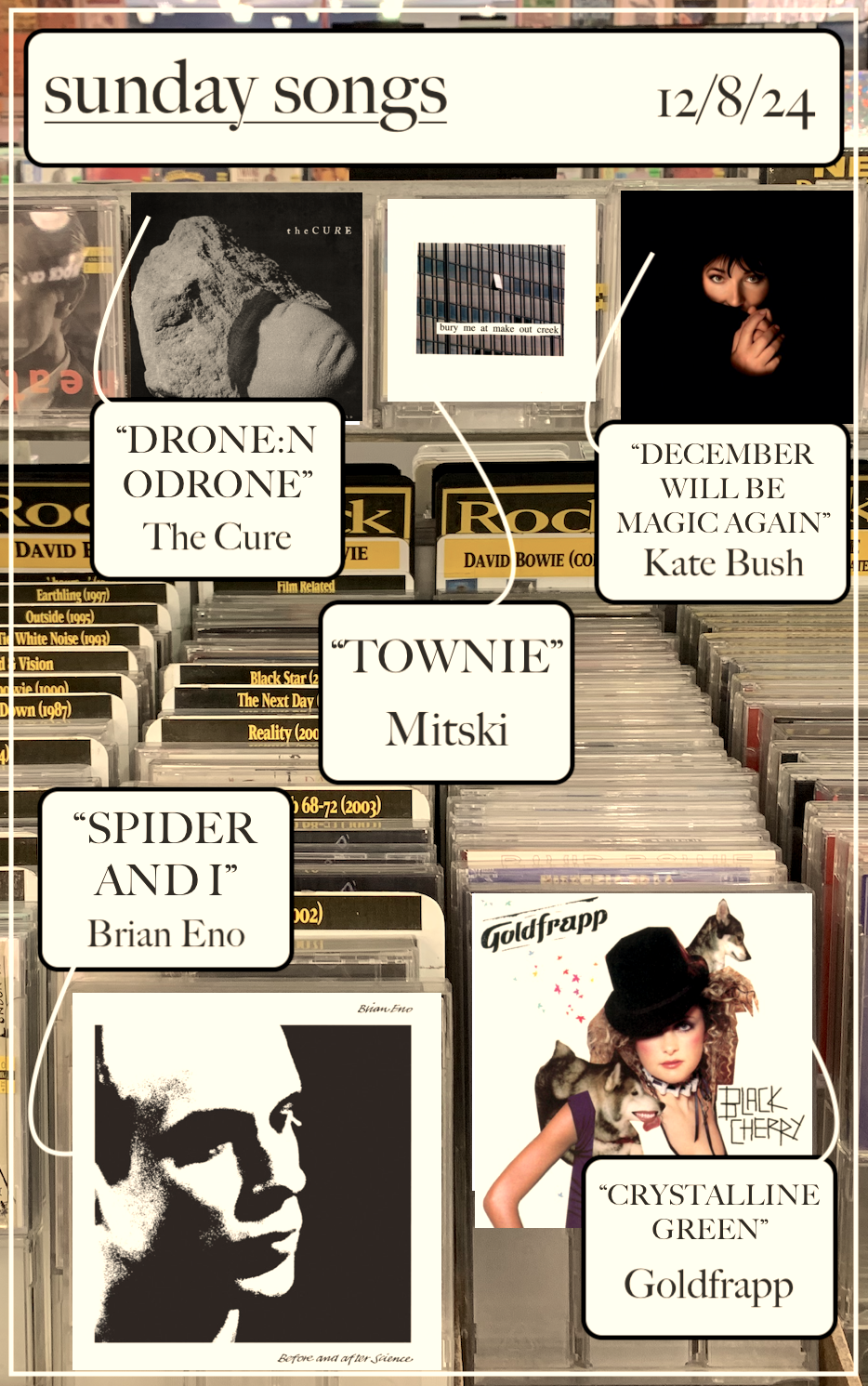
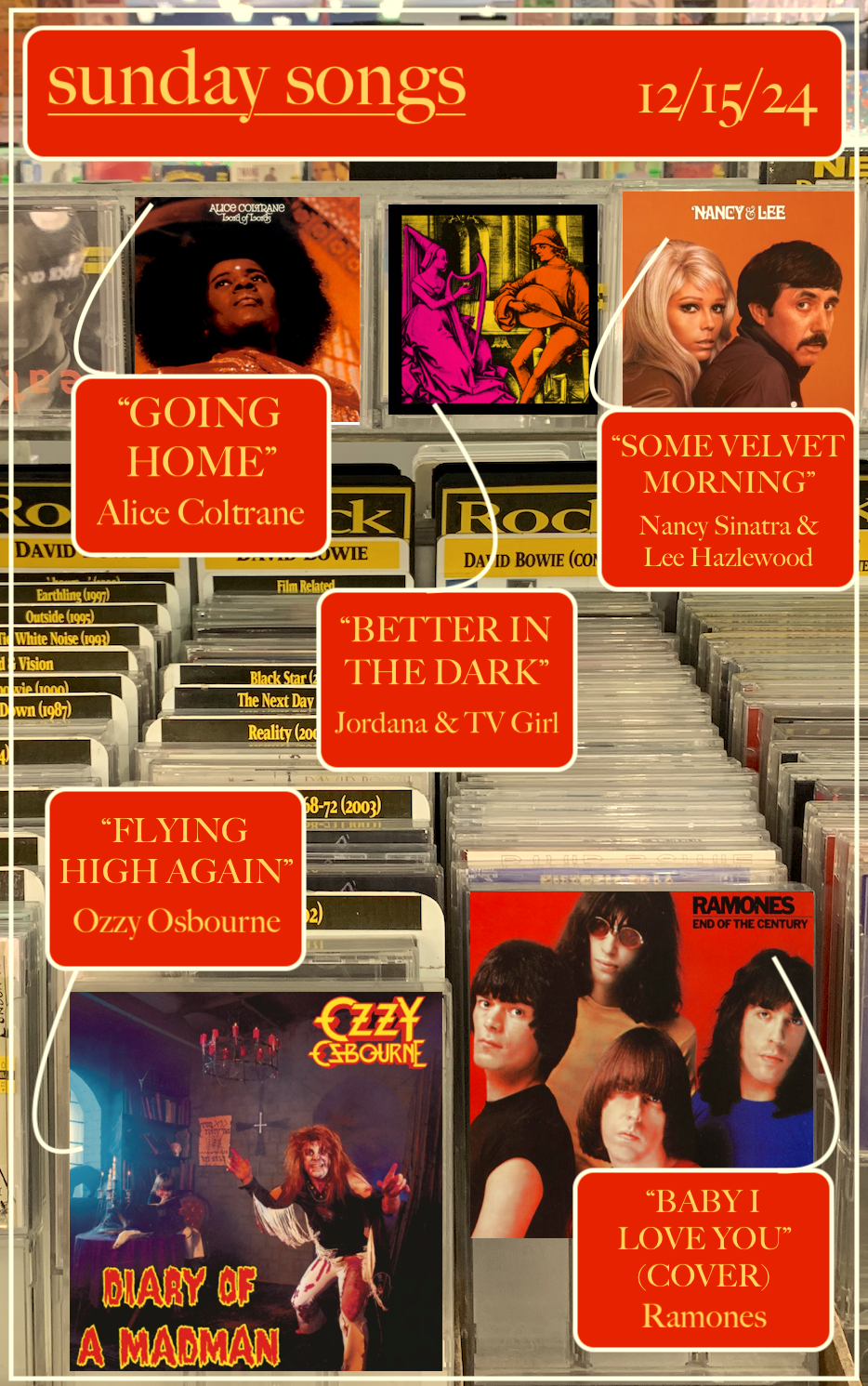
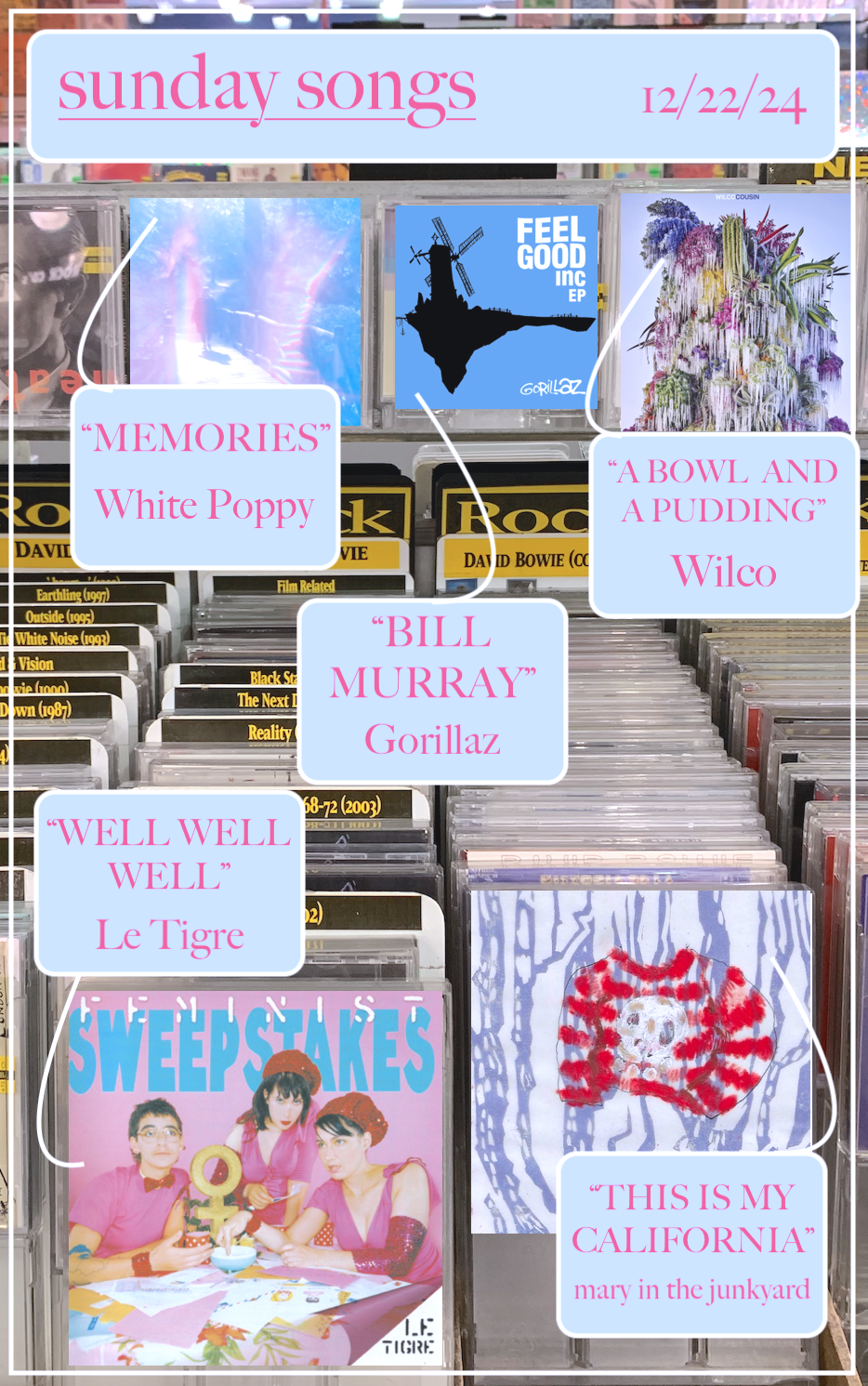
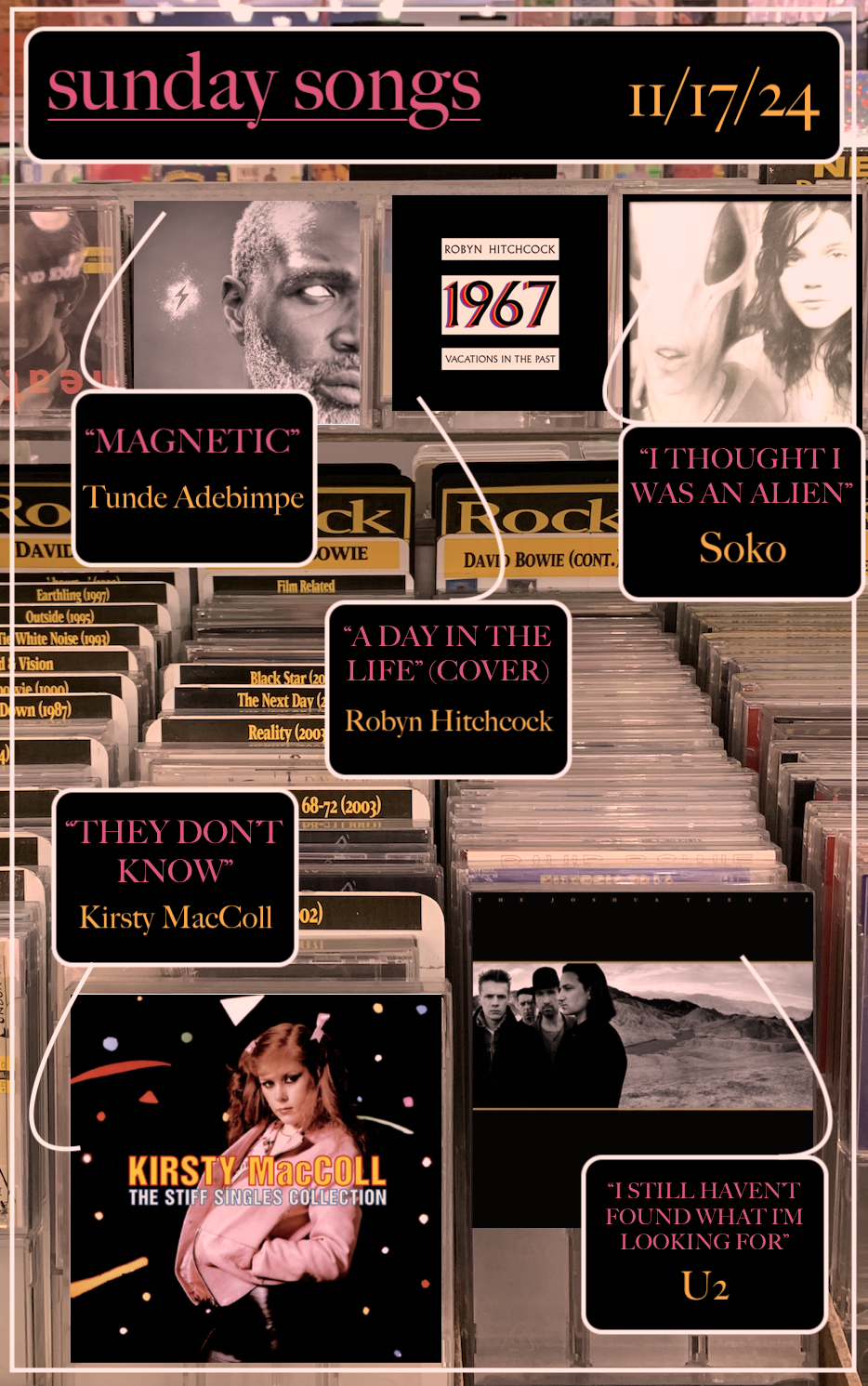
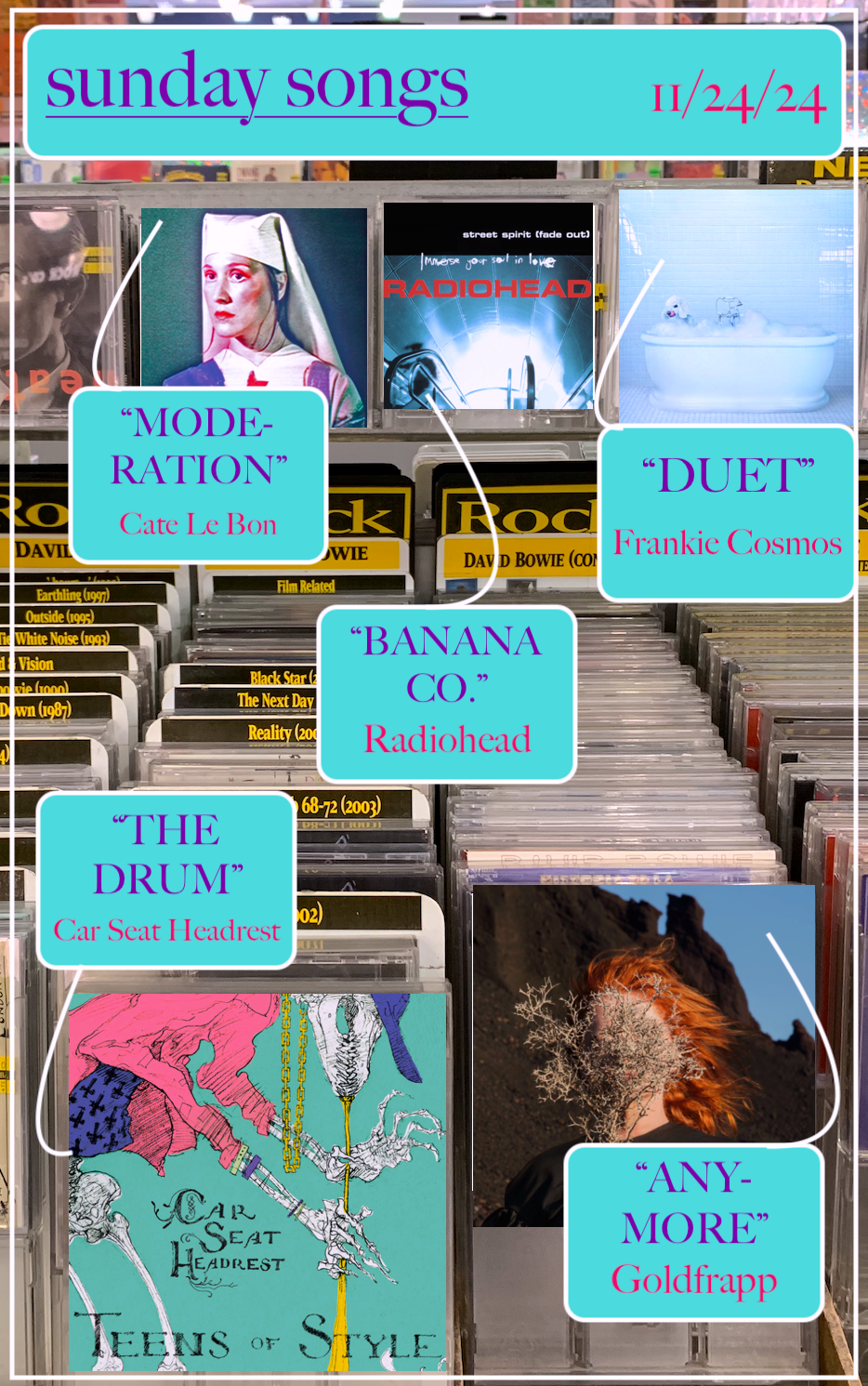
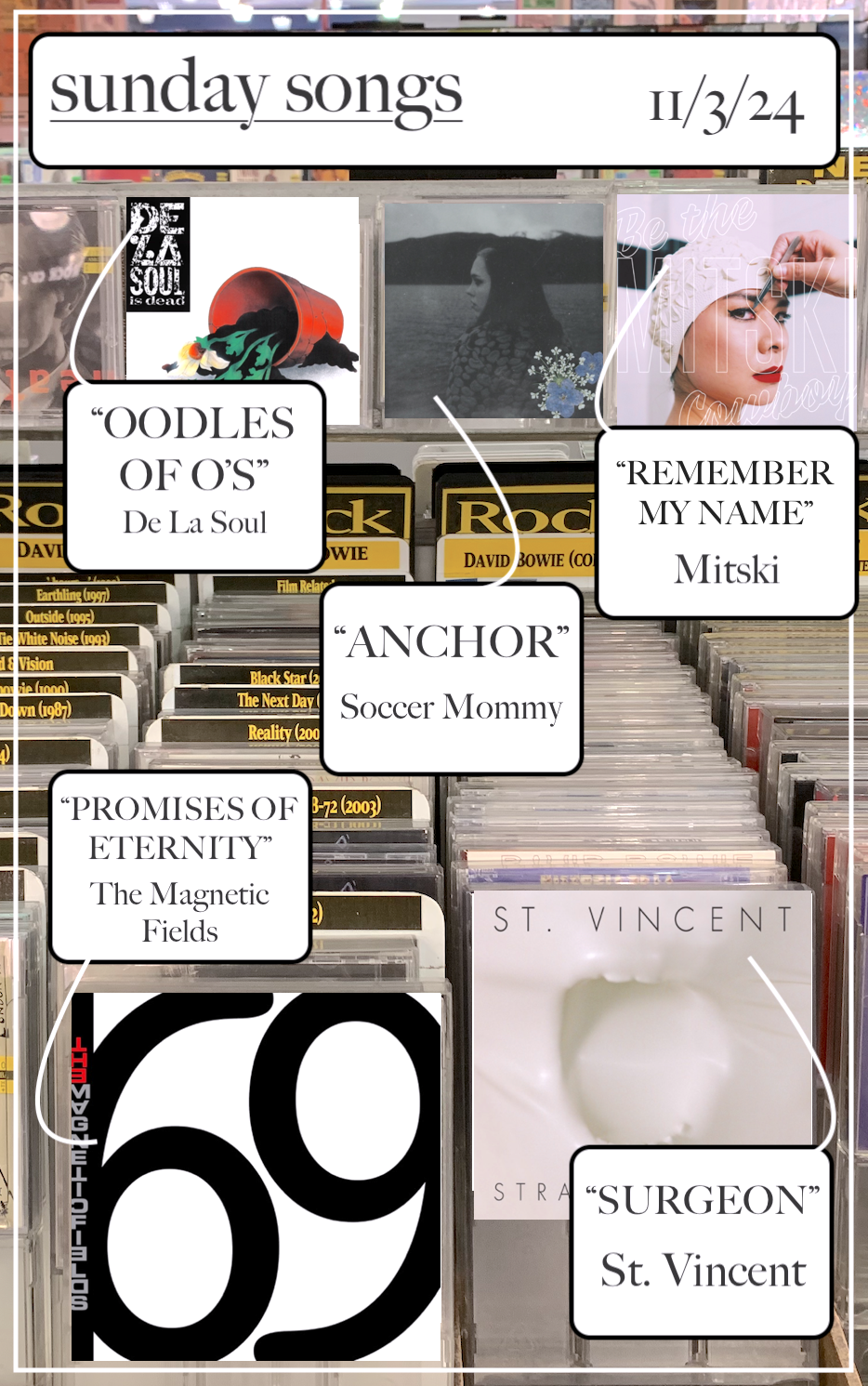
Apologies for the lack of a Sunday Songs last week and a Book Review last week—midterms are one helluva drug. Either way, I have been able to read some fantastic books, so expect a fun review next week. For now, here’s my graphic from last week:

10/6/24:

This week: MOM!!! MOM, MADELINE’S GOING AFTER THIN WHITE DUKE APOLOGISTS AGAIN!

Enjoy this week’s songs!

SUNDAY SONGS: 10/13/24

“Instant Psalm” – The Smile

Unprecedented opinion by me: Cutouts, the second album from The Smile in 2024, was…a slight disappointment. Are all of the songs good? Absolutely—this is The Smile we’re talking about, remember? And yet, even though the talent is all there, well-crafted songs don’t make up for an album lacking in cohesion. If they knowingly named the album Cutouts for this reason, it might make sense, but it really does live up to the name; these are the scraps, but for a band as artfully skilled as The Smile, the scraps will be treasures. Even if Cutouts meanders this way and that without the direction of A Light for Attracting Attention, the moving parts are spectacular.

Take “Instant Psalm.” I love when I just have the gut feeling of knowing that a song will rearrange my molecules after only listening to a 30-second snippet of it. From the minute the strings sunburst into existence, you feel that light blooming in the back of your mind. To say that this song only starts would do it a critical injustice: it awakens in the same way a flower does, the same way a cloud of spores puffs from a stomped mushroom, all of its glistening tendrils erupting in slow motion after the joyous moment of birth. “Instant Psalm” lyrically contains about the same existential dread as any other The Smile track, but I’d place it somewhere near “You Know Me!” in terms of siblings; these glistening tendrils have heralded the manipulation that the former track ushered in, and now, all is left is a kind of mental automation where your mind knows that what it’s doing is wrong, but cannot let go of what’s coiled around it: “yes is not a real yes.” It’s so calm in its submission, and that “Instant Psalm” feels like sparkling dust blown into the eyes, the kind that clogs them up enough that they no longer see reality. If there’s anything highly specific that The Smile has excelled in, it’s making songs about submitting to corrupted, outside forces sound so soothing and sleepy. Again: precisely the point.

…AND A BOOK TO GO WITH IT:

Annihilation (Southern Reach, #1) – Jeff VanderMeer“We can slide through this narrow gap/The narrow gap that you leave us in/And we feel you near/But so close that you disappear…”

“Sick of Goodbyes” – Sparklehorse

Listening to It’s a Wonderful Life prompted me to return to one of my many depressing high school lovers: Good Morning Spider, the album that preceded the former. I thought “Sick of Goodbyes” was okay back then, and given how much I suckled on that album like a baby bottle, “okay” is harsh. Compared to the irresistible draw of the melancholy of “Sunshine” and the adrenaline-blooded screech of “Pig,” this one stuck out like a sore thumb. Why is it so twangy? And my God, is it actually…upbeat?

To be fair, it really does stick out oddly in Sparklehorse’s catalogue, and for how odd Sparklehorse sounds, that really is saying something. It somehow lies at the crossroads of alt-country and punk, where scratchy guitars meet the place where Mark Linkous hefts his Southern twang into the spotlight. It’s got a vigor that few other songs on Good Morning Spider have (save for “Pig”), but the emotion behind it is no less of a punch to the face than the rest. Linkous’ specialty has always been stirring the surreal into his lyrics like a witch tossing strange objects into a cauldron, and “Sick of Goodbyes” has what I think may be one of his best weird one-liners: “no one sees you on a vampire planet.” No beating that, right?

But beating between lyrics like that is one of the sparer sentiments, but there’s no making it flowery: “I’m so sick of goodbyes.” It is sad in the way that a Sparklehorse song typically is, but the fury behind it makes it seem almost intent on healing. It’s a recognition of wanting to free yourself from the wallowing that you’ve been doing, and saving up all of the energy to declare as such. It’s not lost on me that the final belt of the chorus cuts off at “I’m so sick,” but I can’t not see the momentum. There may be no motion yet, but all of that energy has formed legs that are willing to stand, legs that are willing to rise from the muck and power forwards. “I’m so sick of goodbyes” feels like that spark of energy after you’ve gone through the first, ugly period of your grieving and realizing that you’ve spent so much energy on the dead that you have forgotten to go on living.

…AND A BOOK TO GO WITH IT:

The Many Half-Lived Lives of Sam Sylvester Maya MacGregor“If I could just keep my stupid mind together/Then my thoughts would cross the land for you to see/No one sees you on a vampire planet/No one sees you like I do…”

“Not My Body” – Indigo De Souza

“Not My Body,” with De Souza’s intro, starts at 8:02.

While I ping-pong on whether or not I should listen to Any Shape You Take or All Of This Will End in my ongoing Indigo De Souza journey, I watched their Tiny Desk Concert, taken from the period of the latter. When introducing “Not My Body,” she said this about the song: “I think that when I die…what I want is to be composted and to become soil, and for that soil to be used to plant a tree, and I want that tree to be so big and strong. I don’t know what kind of tree yet—still thinking on it—A tree that people can visit and be like, ‘This is Indigo!'” Thus, she joins Peter Gabriel and his oak tree in what I imagine is a growing forest of reincarnation. It’s a soothing thought, to be reborn in the cells of something so sturdy.

Do you ever get those moments where you stop and have this realization that out of the billions of people on this Earth, that you are you, and by some roll of the dice, this is your life, this is your body, and this is who you are? It’s been a recurring thought lately. Those memes about gaining consciousness at age 4 in the middle of a Chuck-E-Cheese honestly hit the nail right on the head. For whatever reason, it’s been a recurring thought as of late. Not ideal for when I’m supposed to be listening to lectures, but it is a humbling reminder. As disembodying as those moments are, they remind me that yes, I do have the reins on this body. De Souza describes “Not My Body” as an ode to nature, and it taps into that feeling of being so conscious of your existence yet, for a moment, a spectator of it: “I’m not my body although you see me/Making moves and walking freely.” Nature, for me, is the missing key in this equation; the redwood tree that De Souza wants to be is the ultimate symbol of groundedness and connectivity—it is rooted in the earth, but its roots connect to all points in the wide world above and below it. There’s a happy medium between awareness and not feeling like you’re adrift in space, and nature has figured it out. And what better way to end such a sentiment than the last third of “Not My Body?” The way De Souza fashions their voice like a theremin, those echoing electronics that almost sound like dolphin calls, the gentle collapse of all the instruments into a single, coalescing being?

…AND A BOOK TO GO WITH IT:

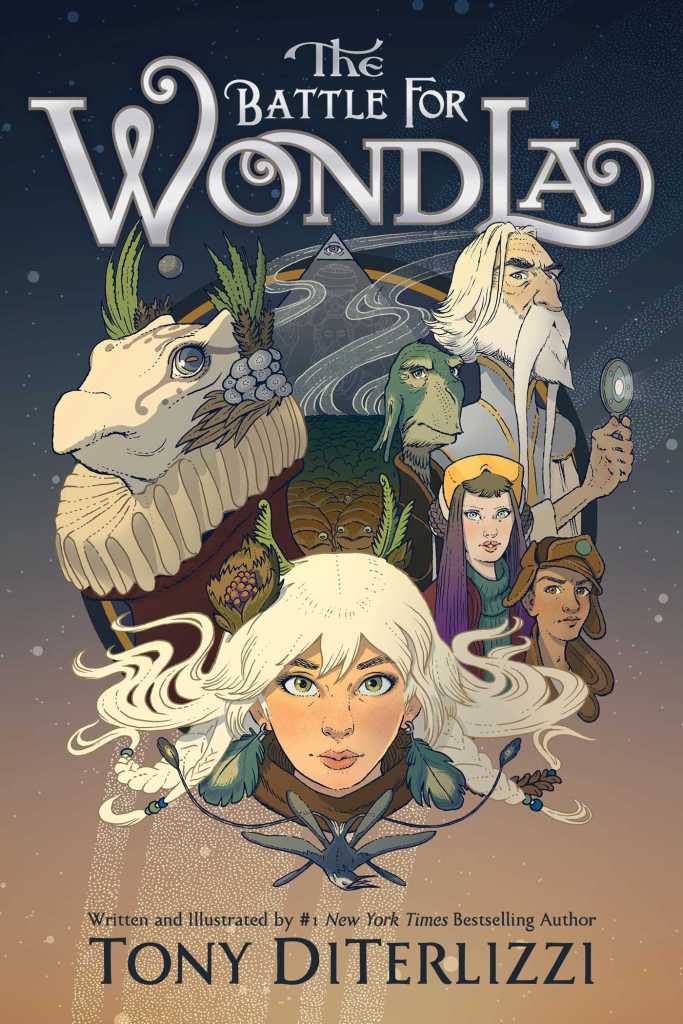
A Hero for WondLa (The Search for WondLa, #2) – Tony DiTerlizziwithout spoiling anything…Eva Eight arc, perhaps?

“Always Crashing in the Same Car” – David Bowie

If you mistook the title of this song for a commonplace idiom, I wouldn’t blame you. Frankly, it should be one. It’s memorable, it’s effective, and it’s a Bowie reference.

Low came at a deeply fraught time in David Bowie’s life. His Berlin trilogy of albums came on the heels of his darkest period, one where he committed actions that he disavowed until his dying day. Hence why I’m always suspicious and disdainful of Bowie fans who think that the Thin White Duke is somehow the “deepest” of his personas. Oh, okay, do you think you’re cool because you like the Bowie who was taking so much cocaine that it addled his brain enough to the point that he had a brush with Nazism? This is the period that Bowie spent the rest of his life thereafter vehemently swearing off (see: “Under the God“), and every clip from that era shows that he was clearly not of sound mind and body. Taking a critical look at the period is one thing, but being so uncritical about a period that Bowie so clearly wanted to forget takes a certain kind of thickheaded edgelord, in my humble opinion. It took him years to return to reality, and the Berlin trilogy chronicles his long and rocky journey towards healing, not to mention getting clean.

The circumstances surrounding “Always Crashing In the Same Car” are a fragment of Bowie’s period of addiction, an instance where, high out of his mind, he rammed his car into the car of his drug dealer. Yet there’s such a calm to this track, both warm and cold. It’s as though Bowie is watching his own life as a spectator, watching the car spiraling out of control from high above the clouds. His voice is placid, restrained, as he resigns himself to the song’s title, doomed to make the same mistakes. Apart from the crooning towards the conclusion, his voice never leaps—what does is the soaring guitar riff that seems to unfold Bowie’s ladder into the sky, from which he can watch his life from a safe distance.

Even if I haven’t gotten to such extreme lows in my life (please hold an intervention if I somehow do, good god), that kind of distance what makes the message of the song land. Breaking out of cycles and unhealthy habits is one of the hardest things a person can do, in my opinion. The effort it takes to change is outweighed by the ease of staying stagnant. You know you’re crashing in the same car, and yet your hands grip the wheel anyway. A few months, I made a commitment at the beginning of the month to stop being consumed by trivial thoughts, and I found myself trapped in an even worse cycle of anxiety just days later. The internal work I did that month was some of the most mentally strenuous that I’ve had in a while—it was far too easy to fall back on ineffective, harmful coping mechanisms than to put in the work to claw myself out of that pit of misery. I’m still working on it. But I’ve put in work. It’s taken a lot of clawing, but I’m growing the armor. Listening back to “Always Crashing in the Same Car” after all that mess gives it a whole new meaning—maybe the triumph I feel from that truly glorious guitar solo is symbolic of how it feels to climb through the sunroof, out of the wreckage, and into the light, knowing that the hard work of breaking these patterns is done.

…AND A BOOK TO GO WITH IT:

Beautyland – Marie-Helene Bertinothe narration of this novel feels the same as Bowie’s singing here: a kind of cool, matter-of-fact distance through which the world is observed, but not without some warmth.

“Sprained Ankle” – Julien Baker

From all accounts, it seems like Julien Baker has something new cooking up post-boygenius, and…hoo, boy. Am I ready? Nope. Nevertheless: I will listen. I will cry. (I already love “Middle Children” and “High in the Basement,” what can I say?) It seems simultaneously like ancient history and the blink of an eye away from when I first discovered Julien Baker, when, halfway through junior year during COVID, I listened to Sprained Ankle while I was a miserable puddle of grief and burnout. Whether or not that’s the only state you can properly listen to Julien Baker without curling up in a ball and crying is debatable, but…the only way out is through. Dramatic expression for weathering an album, I know, but there’s something gratifying in knowing that I’m a happier, stronger, and more healed person than the person I was when Little Oblivions came out in 2021. To my mom: consider this a formal apology for making you sit through almost a-capella Julien Baker depression while driving to school while it was barely even light out.

In the barest sense, Baker was working with what she had. She didn’t have any backup instrumentalists and recorded this in college at age 20, so there wouldn’t be any accompaniment other than what she played herself until Little Oblivions, alternating between guitar and piano. Yet there is no other way that “Sprained Ankle”—or any of the songs on Sprained Ankle—could have been made. It’s a lonely, self-deprecating, and wound-stingingly raw album, and outside of the lyrics, it sounds lonely. Like the bare, unadorned background of the album cover, many of the tracks feel like being in a cramped room with only the sound of your negative thoughts to keep you company. I realize how awful of an endorsement of Baker that is, but in that dreary state of 17, that was just what I needed. (To be fair, it can get to be too much—“Go Home” was exceedingly hard to listen to even back then, which is really saying something.) In the sparse, Baker creates a kind of confessional solace. Confessions are how “Sprained Ankle” starts off, after all: “I wish I could write songs about anything other than death.” There’s a self-awareness to the sadness, but like “Always Crashing In the Same Car,” the engine is running on borrowed fuel, and the marathon runner is sprinting on sprained ankles. Beyond the metaphor, Baker’s voice is meant to be the loudest thing on this record—like the cramped room, it echoes off the walls it’s given, an oral manifestation of the feeling of knowing that all you’ve got is your body. It would take a few years for it to reach the soaring heights of “Claws In Your Back,” but from the start, Baker always knew she had an anchor in her music—the instrument of her wobbling yet lighthouse-beacon piercing voice.

Now that I’ve mentioned “Claws In Your Back,” I can’t not link this dazzling performance from Baker with the National Symphony Orchestra…dare I say I haven’t felt goosebumps quite like this in years?

…AND A BOOK TO GO WITH IT:

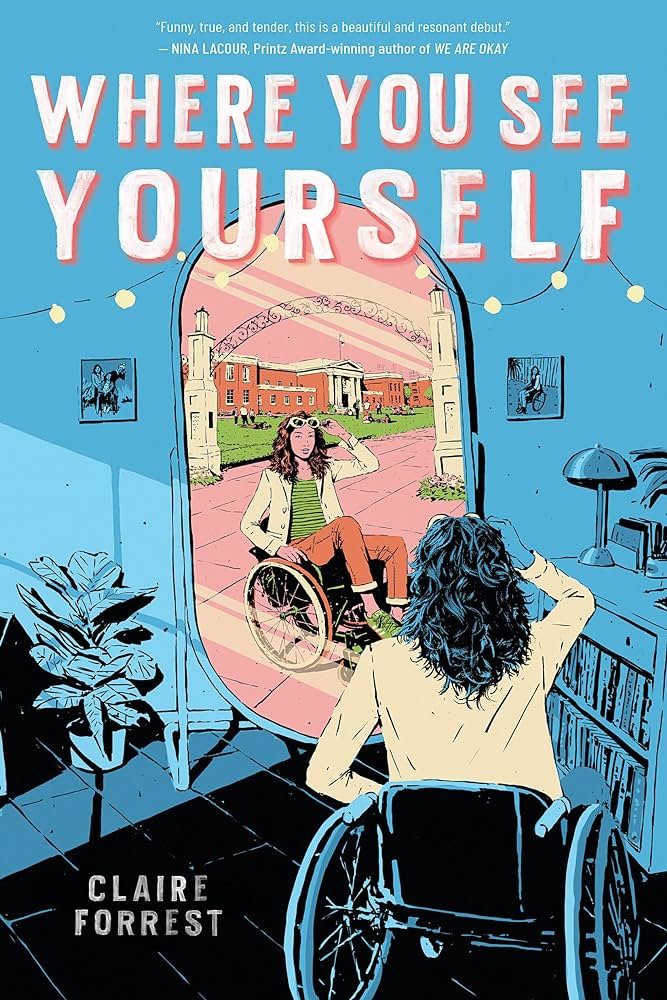
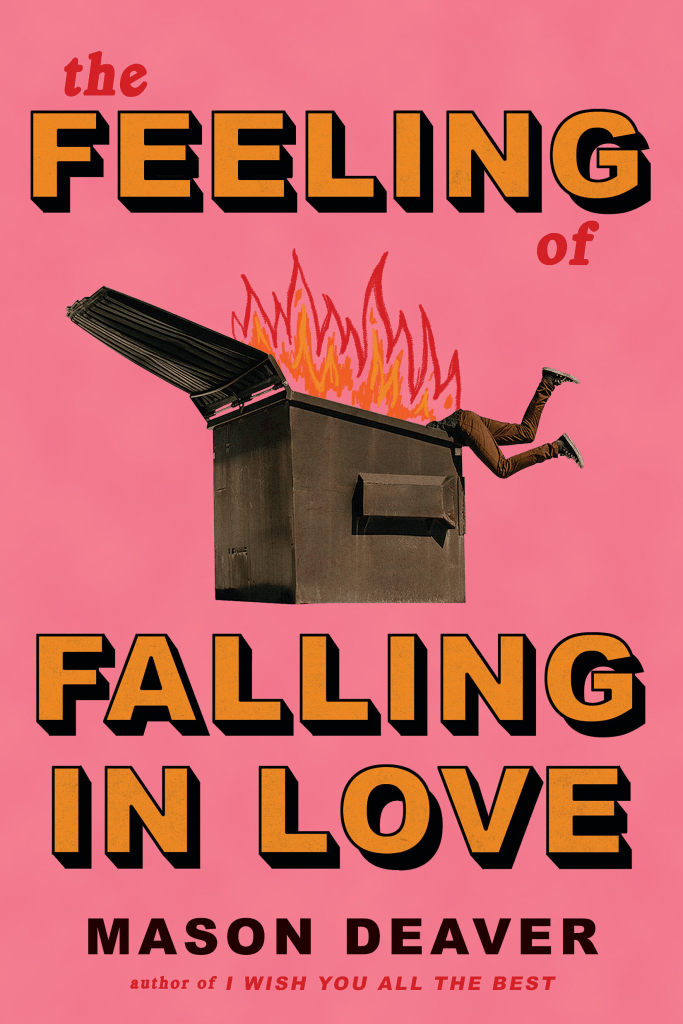
The Ghosts We Keep – Mason Deaver“I wish I could write songs about anything other than death…”

Since this post consists entirely of songs, consider all of them to be today’s song.

That’s it for this week’s Sunday Songs! Have a wonderful rest of your day, and take care of yourselves!

Posted in Book Review Tuesday

Book Review Tuesday (10/1/24) – Death’s Country

Happy Tuesday, bibliophiles, and happy October!

Since today is both in the middle of Latinx Heritage Month and the start of spooky season proper, I figured I would deliver on both fronts. I’d heard a lot of buzz about this one, especially the fact that it had polyamorous representation—something I rarely see in literature, much less in YA. Genre fiction written in verse is also uncommon, so I had to pick up this book since it combined both of them. The result was something that was inventive at every turn.

Enjoy this week’s review!

Death’s Country – R.M. Romero

Andres Santos is ready for a new start. After moving to Miami from São Paulo, he’s keen on leaving his past behind—especially his brush with mortality after nearly drowning and seeing the face of Death itself. He barely escaped by making a deal with Death for a second chance at life. Now, he’s a part of a happy, poly triad, deeply in love with spunky photographer Renee and joyous dancer Liora. But when a car crash puts Liora in a coma, Andres and Renee know that the only option is to confront Andres’ past—by returning to the Underworld where he once bargained for his very life.

TW/CW: car crash/coma, emotional abuse, suicide, self harm, eating disorders, fantasy violence

The minute that David Bowie was mentioned, I tried so hard not to go headfirst into liking this novel. My expectations were average, and I wanted to be surprised. And then “Space Oddity” became a recurring motif. You know me, I ate that up.

For the most part, I’ve rarely seen genre fiction and novels in verse mix. The latter is usually reserved for telling realistic fiction stories and occasional historical fiction, though I’ve only seen one or two examples of the latter. But using this method outside of fiction is something that, now that I’ve read Death’s Country, I feel should be utilized more often. Poetic language lends itself to describe the dark, fantastical setting of this novel and fantastical settings in general, and Romero’s is no exception; even if it doesn’t fill up the entire page, the flowing language renders the setting in luscious detail. Given that romance is also at the beating heart of this novel, Romero’s decision of putting it in verse made the romance feel all the more like the center of the narrative. Once more, her language didn’t just put the spotlight on it—the sparsity of the amount of words on the page truly made it feel like the center of the universe.

Even with the leaps and bounds that literature, mainly YA, has made in terms of queer representation, I’ve seen hardly any with polyamorous representation. (The only other one that I can remember is Iron Widow, which I also recommend!) What I liked about how Death’s Country handled it was that it was a polyamorous story, but that it wasn’t necessarily about polyamory; those stories have a place, but sometimes, the most powerful representation comes from seeing yourself in fantastical stories usually reserved for white, cishet, etc. protagonists. There are great discussions about the stigmas surrounding polyamory (cheating, slut-shaming, etc.), but they were only a part of the story, not the whole. The more that I think about it, a poly triad makes this story work in a way that it might not have with a couple; having two people, not just one, braving the Underworld for their girlfriend in a coma, presented a unique twist on a story that’s been retold countless times, and presented an opportunity to explore multiple perspectives of love under duress.

I went into Death’s Country expecting a meditation on death (obviously), but what I didn’t expect was such an insightful metaphor about how we idealize those we love in death. The Underworld in Death’s Country is almost a vehicle for reproducing what people deem most memorable about them: not just how they die, but how they were seen in death. Liora, who was adored unconditionally by both Andres and Renee, has been molded into a romanticized version of herself that, upon closer inspection, barely resembles the real Liora. Most of that is thanks to the manipulation of The Prince, but we later find out that even he is a reflection of the dark side of Andres’ love—that kind of unquestioning idealization that strips a real person into a glowing facsimile of who they once were. This provided an insight into these kinds of retellings (Death’s Country is a loose retelling of the myth of Orpheus and Eurydice) that they don’t normally touch on; death changes the people you love physically, but also mentally—in the perceptions of others that come to define them once their physical body is gone.

However, I feel like Death’s Country could have used a dual POV to execute the emotion to its absolute fullest. The only perspective we get is Andres, while we never get into the headspace of Renee, who is journeying with him through the underworld alongside him for the entire book. I wasn’t as big of a fan of Andres as a protagonist (I found him to be on the abrasive side at worst), but Romero’s writing of him was never sloppy or badly-executed in a technical sense. I just had the strongest sense that Renee had just as much of a story to tell as him! I get that Andres was specifically the one who made a deal with Death for another shot at life, but Liora isn’t just his girlfriend—she’s Renee’s girlfriend too. She needed more backstory, but I have a strong feeling that Death’s Country would have been enhanced if she’d also had more of a voice.

All in all, an inventive, fantastical novel-in-verse with plenty of fresh twists on otherwise well-trodden literary ground. 4 stars!

Death’s Country is a standalone, but R.M. Romero is also the author of The Dollmaker of Krakow, The Ghosts of Rose Hill, A Warning About Swans, and the forthcoming novel Tale of the Flying Forest.

Today’s song:

A NEW CURE ALBUM?? what a time to be alive

That’s it for this week’s Book Review Tuesday! Have a wonderful rest of your day, and take care of yourselves!

Posted in Sunday Songs

Sunday Songs: 9/29/24

Happy Sunday, bibliophiles! I hope this week has treated you well.

This week: high school throwbacks, off-kilter oddities, and a few too many people trying to explore each other’s minds than I’m comfortable with. Cool it, Charles Xavier…

Enjoy this week’s songs!

SUNDAY SONGS: 9/29/24:

“Piano Fire” (feat. P.J. Harvey) – Sparklehorse

It’s a Wonderful Life is one of those albums that took me a bafflingly long time to listen to. I know, I know, I did it to myself, but the fact that I didn’t pick it up when I was 15 and irreparably mired in Good Morning Spider astonishes me. It’s probably owed to the fact that I was also even more irreparably mired in OK Computer, which tends to overshadow things a tad bit. Looking back, maybe it was for the best that I wasn’t on an all-Sparklehorse diet at that age. I already looked pathetic scuffing my snow boots through the hall while blasting “Maria’s Little Elbows” through my earbuds between classes. I was 15, guys. It was 100% that serious, trust me.

What I can say is that I think I would have felt the same way about It’s a Wonderful Life at 15 as I do now—it’s a triumph of an album. Scattering through surreal urgency and subdued melancholy, it has every kind of Sparklehorse you’d like—along with a smattering of collaborators. It’s almost funny how different said collaborators are (take Nina Persson’s delicate backing vocals on “Gold Day” and then Tom Waits growling like a hulking ogre on “Dog Door”), but the power of Sparklehorse has always lain in the disparate elements Mark Linkous cobbles together. Like some kind of American Gepetto, he constructs all of his songs into tiny figures made of warped wood and bird bones, and what totters to life creaks with every step. They’re quaint creatures with acorns for heads and cigarettes and toothpicks for legs, but there’s no other way to love them save for exactly as they are.

Those he chooses to collaborate with feel much the same way. P.J. Harvey, of all people, was a left-field choice when I first heard about her featuring on “Piano Fire.” The only Sparklehorse song I could conceive being able to contain the kind of raw fury she exudes was “Pig,” and that had already come and gone by the time It’s a Wonderful Life came out. “Piano Fire,” however, is one of the most upbeat tracks on the album; you feel a racing urgency to it, immediately sprinting down an overcast beach the minute the first guitar chords kick in. Or maybe it’s the searing heat of airport tarmac that you’re sprinting across the minute you hear the opening line: “I got sunburnt waiting for the jets to land.” Sunburnt describes “Piano Fire” surprisingly well; it has the texture of an old photograph left out in the sun too long, all of the colors now bleached to unnatural, pale shades. Linkous almost takes a backseat on his own song, never raising his voice when he dishes out surreal vignettes of “Fiery pianos wash up on a foggy coast/Squeaky old organs have given up the ghost/Fire them up and kill the piano birds.” But that urgency is why P.J. Harvey is so perfect for this song; once the chorus kicks in, her soaring voice provides the jet fuel for this creaky old jet to careen off the runway and into a sky littered with the strangest birds you’ve ever seen.

…AND A BOOK TO GO WITH IT:

Love in the Time of Global Warming – Francesca Lia BlockBlock’s bizarre, dreamlike prose certainly fits with the surreal imagery that Linkous employs in this song—and the majority of his catalogue.

“Gigantic” – Pixies

In almost two and a half years of making these Sunday Songs graphics…this is the first time I’ve double-dipped. It was bound to happen eventually, not just because my music taste is finite, but because this song has lingered with me from a young age. I faintly remember being around five or six and hearing this song in my dad’s old car, driving in fading light down the road back to my house, and hearing the iconic chorus: “Gigantic, gigantic/Gigantic, a big big love.”

I’ve often talked about how simplicity in lyrics can convey more than the most complex songs in some cases, and if you need further proof, look no further than “Gigantic.” Most of that work is done by the immense, never-fading talent of Kim Deal, who sells every metric ounce of explosive love in this song; with every cry of “A big big love,” you get it—there’s no other words that can adequately describe the kind of secretive, all-consuming romance that swirls through every pluck of the bass. That opening bass riff is the shy, cracking open of a bedroom window when the parents are asleep, an invitation with a blushing, anticipatory smile. What follows never fails to knock me off my feet. I say “knock” and not sweep or lift me off my feet precisely because that’s what it feels like, as though the ground has opened up beneath you, and you’re falling headfirst into the unknown—contained in a kiss that consumes every cell of your body.

…AND A BOOK TO GO WITH IT:

The Kindred – Alechia Dowall-consuming, explosive, and intergalactic love.

“Take Me To The River” – Al Green

I’m sure Al Green is a perfectly nice guy, but…that album cover and title is not it, man…”Al Green Explores Your Mind?” Can he…can he not?

The fact that they were just naming albums anything back in the day aside…how did I not know about this song for so long? I’ve loved the Talking Heads cover for years, but somehow, it never dawned on me to look it up and discover that it was a cover. There’s something to be said for the phenomenon of white artists’ covers of songs by Black artists overshadowing the originals, but this isn’t quite the case—from the looks of it, between the amount of times that this song has been covered (most recently by Lorde for a Talking Heads tribute album, oddly enough) and the royalties from [checks notes] those animatronic wall fish, it’s cemented itself as an enduring classic of soul. I’m sure Al Green isn’t complaining about the latter though, given that he’s gotten the most royalties from the fish cover. Yet no matter the strange journey that “Take Me To The River” has taken, none of it has overshadowed how deliciously groovy it is. It’s endured for five decades in counting precisely because it wastes no time in getting straight into its slinky, infectious funk. Green’s voice flies from slick to howling in seconds and recovers in record time, all in time with the blasts of an impeccable horn section. 50 years, and you can’t not bop your head. I’m still not jazzed about Al Green exploring my mind, but I can’t deny that he worked some undeniable, immortal magic with this one.

…AND A BOOK TO GO WITH IT:

The Final Revival of Opal & Nev – Dawnie Waltonthough the musical genres differ, the atmosphere and climate of the ’70s runs through both.

“Secretarial” – A.C. Newman

I’ve had a turnaround. I’ll be honest—even though I’ve liked several New Pornographers songs since I was young, “Secretarial” has always bugged me for some reason. I never hated it, but it was always one of those songs where, over the years, I developed a reflex of just skipping it whenever it came on shuffle. I didn’t question it for a while. Many years have passed, and for once, I didn’t skip…and here we are.

A.C. Newman—and most of The New Pornographers’ catalogue, by extension—has this songwriting style that’s just so distinctive in a way that I can’t put my finger on. Even if you separated his or Neko Case’s voice from the lyrics, I could hear a line like “So come on, let the sun in/We’ve been gunning for promotion/Postering the slogans on the roadsigns.” and immediately go “yup, A.C. Newman wrote that.” What makes it so distinct has bugged me for years, and to this day, I can’t fully put my finger on it. The closest I can say is that their specific diction has an inherently off-kilter quality to it. Newman is never overly verbose, but the way he arranges words is always slightly askew. His lyrics dwell in the thin limbo between obtuse poetry and sense, situated in a place where you can decently get the metaphor he’s going for, but instinctually, you know that those syllables just don’t go together neatly. “Secretarial,” like another other Newman product, might as well be a puzzle, in that sense, but one that was put together wrong with the pieces that only look like they should fit together, but stick and slide against each other. I’ve never been great with time signatures, but this one is angular enough to match the slanted lyrics. Even if you don’t know the guy, you can’t deny that it takes some serious talent to not just think of but pull off “Lady, it’s secretarial” as a hook.

…AND A BOOK TO GO WITH IT:

Lagoon – Nnedi OkoraforI’ve used this book more than once, but it was right there…

“One day you blew across the water/After racing through the countdown/Spewing ancient wisdom like your friend/The revelation had come and they were looking for me…”

“Henry” – Soccer Mommy

Oh, early Soccer Mommy…oh, “Henry.” This one sure soundtracked many a one-earbud-in free draw in art class my sophomore year. I think it was in the fall that I found this song as well; it carries a distinct smell of wet leaves and wood chips in the pumpkin patch. Cheesy as the title of this album, the self-released For Young Hearts, is, it’s not like it’s a lie. Here’s to many more high schoolers listening to this in art class.

It seems that “Driver” has put a pin in this tradition, but “Henry” is part of a long lineage of Soccer Mommy songs about the seduction of Bad Boys™️ (see also: “Death By Chocolate”). Of course, the natural conclusion was that the ultimate bad boy was to be conquered in “lucy,” that being…the devil himself. (God, I need to stop. I sound like a youth pastor.) But here in 2016, “Henry” chronicled the kind of guy who hung out behind the high school, smoking cigarettes in a leather jacket, and giving you a wicked smile as you passed. Sophie Allison’s younger voice, along with the plucky instrumentation (cannot get enough of that bass), makes you feel like you’re following a mischievous wood sprite through sunlit woods. Light and lovesick, it captures that heady, teenage love drug that makes every step stumble: “‘Cause Henry has a laugh like fire/And it’s spreading through the streets and burning on telephone wires/I don’t know just what it is/But he’s driving all the good girls bad with that evil smile of his.” Soccer Mommy’s had that golden, indie touch all along—”Henry” remains a classic to me.

…AND A BOOK TO GO WITH IT:

Carry On (Simon Snow, #1) – Rainbow Rowell“I don’t know/Just what it is/But he’s driving all the good girls bad with that evil smile of his…”

Since this song consists entirely of songs, consider all of them to be today’s song.

That’s it for this week’s Sunday Songs! Have a wonderful rest of your day, and take care of yourselves!
Posted in Book Review Tuesday

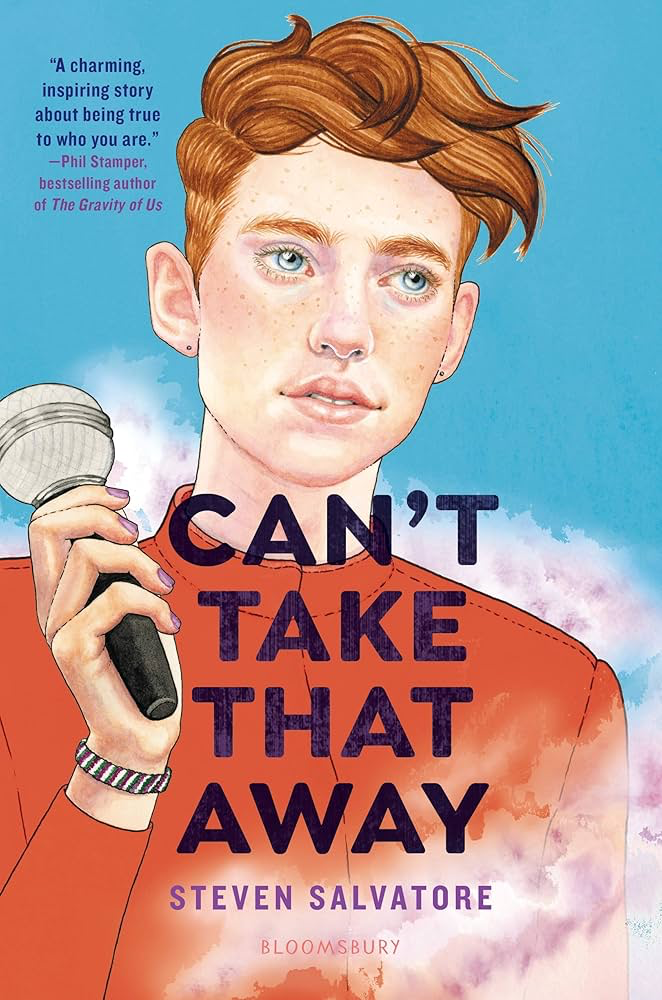
Book Review Tuesday (9/24/24) – Some Girls Do

Happy Tuesday, bibliophiles!

More importantly, Happy Bisexual Visibility Day…one day late! 🩷💜💙 I figured I would center a bisexual story for this week, and between my readings for school, I’ve been trying to squeeze in some books for this occasion and for Latinx Heritage Month as well. I’ve read a handful of Jennifer Dugan’s other novels, and I can always count on her for a solid queer YA romance. Some Girls Do wasn’t her best work, but when it hit the right notes, it was appropriately sweet.

Enjoy this week’s review!

Some Girls Do – Jennifer Dugan

Ruby Torino is intent on keeping her head down until she graduates high school. Even though she’s sick of competing in beauty pageants to appease her mother, she knows that it’s the only way out—the next one’s prize is a scholarship to a community college. There, she can be openly bisexual and not have to please her parents. But when Morgan Matthews, an out-and-proud athlete who was kicked out of her Catholic school after they found out she was a lesbian, transfers to Ruby’s school, her world is turned upside down. Against all odds, the girls end up falling for each other. But Ruby can’t risk coming out—and Morgan can’t seem to let it go.

TW/CW: homophobia, biphobia, verbal and emotional abuse, pressure to come out

Some Girls Do wasn’t a perfect romance, but it was about imperfect people, and for half of the main cast, it worked out. It didn’t blow me away, but it was a solid read for Bisexual Visibility Week!

I wasn’t a fan of both members of the couple (more on that later), but Ruby was such an excellently complicated protagonist! All of her life, she’s been in a volatile position, what with her mother, who had her when she was a teenager, pressuring her into competing in beauty pageants to fulfill the dream she never got to live out herself. Between that and her abusive, homophobic father, she’s learned to guard herself, making her outward personality prickly and unapproachable, even as she blends in with the popular crowd. She’s far from a perfect person, and yet I found myself rooting for her in a way that I couldn’t bring myself to root for Morgan; Ruby’s struggles were tangible and her victories hard-won, and the biggest aspect that kept me reading Some Girls Do was the desire to see her dreams fulfilled.

I find that there’s a limbo that a good amount of queer media doesn’t talk about in terms of environments that people can grow up in. The hometown of Ruby and Morgan is in an in-between place: on paper, it’s mildly liberal and accepting, but there’s still a stigma around queer people. The high school has a pride club, but its members fear holding hands in the hallways. Some of Morgan’s friends act supportive, yet turn up their noses at the idea of the pride club. It’s a dynamic that I haven’t seen explored in queer media often, and Dugan did such a wonderful job in both portraying it and shedding a light on it. Like Ruby and Morgan’s relationship, it’s uncertain what the next day will bring, but there are pockets of unconditional shelter and safety if you look hard enough.

With that out of the way…Morgan. I was not a fan of her. To Dugan’s credit, it’s shown pretty clearly where she’s coming from; by being out, she’s had to risk everything, and is adamant that those who wronged her are proven wrong. But in being so out and proud, she comes off as callous and selfish in all of the wrong ways. When she and Ruby are trying to make it work, she continually pressures Ruby to come out, seemingly oblivious to the very real consequences that could befall her if her parents found out that she was bisexual. Even in her staunch “warrior defending the LGBTQ+ community” stance, she somehow completely forgot that not everyone has the privilege to be openly queer. There was some reconciliation of her attitude and said privilege towards the last part of the book, but in the end, it felt like too little too late.

In concept, Ruby and Morgan’s relationship was cute; once they got into a good rhythm, they had moments of quiet, tender bonding and sweet banter in equal measure. Yet despite Dugan’s efforts to make it work, the way that Morgan was written made it so that it never fully landed. It felt as though no matter how hard they fell for each other, Morgan would never accept that Ruby wasn’t comfortable with public being her girlfriend; even though there were moments at the Pride Club meant for Morgan to learn the error of her ways, she continued to pressure Ruby to do things that weren’t just uncomfortable but unsafe for her. If you took all of that out of the equation, they had some solid chemistry. But Morgan’s unwillingness to accept that Ruby had to stay closeted for her safety made the foundations of what could have been a good romance fold. Encouraging your partner to put her safety in jeopardy is decidedly not romantic.

All in all, a sapphic romance starring some girls that were thoughtfully written and easy to root for, but some girls that were too selfish to even try to like. 3.5 stars!

Some Girls Do is a standalone, but Jennifer Dugan is also the author of several other novels for YA and Adult audiences, including Hot Dog Girl, Melt With You, Verona Comics, The Last Girls Standing, Love at First Set, and many more.

Today’s song:

I’m SO glad my shuffle brought this one out of the depths, I forgot how much I loved it :.)

That’s it for this week’s Book Review Tuesday! Have a wonderful rest of your day, and take care of yourselves!

Posted in Sunday Songs

Sunday Songs: 9/22/24

Happy Sunday, bibliophiles! I hope this week has treated you well.

This week: I apologize in advance for every single driving mention and/or pun that I made in this post. I didn’t even notice it at a certain point…I just couldn’t…stop…

1:58-2:07

Enjoy this week’s songs!

SUNDAY SONGS: 9/22/24

“Bloody Ice Cream” – Bikini Kill

It’s been just under a month since I had the privilege of seeing Bikini Kill live, and even as someone who isn’t a hardcore fan of the band, I had SUCH a wonderful time! That’s owed in no small part to the commanding presence of Kathleen Hanna, not just in the history she carries, but in just how real she was. There she was, a pioneer of feminist punk, just onstage joking about how her bra was too tight and recounting a memory of rich girls pelting her with squirt guns before she walked into a job interview. Never at any moment was there a pretense of acting cool or punk. It was nothing but Kathleen Hanna, in all of her smudged-mascara and sequined glory. Bless Kathleen Hanna, really.

So when she introduced this song, which I was familiar with only in name, by saying that it was dedicated to “all woman writers,” you bet that I stood up and saluted her like it was the national anthem. And even as a fan on the sidelines, I’d accept “Bloody Ice Cream” as a new kind of anthem. It articulates in less than one and a half minutes what so many creators—chiefly women—are told about the profession: “The Sylvia Plath story is told/To girls who write/They want us to think/That to be a girl poet/Means you have to die.” The unspoken doctrine of your craft not being valid unless you sobbed and suffered over it permeates all kinds of media. I’ve been around so many people who think that trauma is the secret to good writing, whether it’s slapping it onto their characters or thinking that their hope in their message is invalid because it doesn’t show the bleakness of the real world. Counterpoint: ever experience happiness? Even once? Was that not in the real world?

The modern world may be far from perfect, but we have an understanding that could nurture and heal the Sylvia Plaths and Virginia Woolfs of tomorrow. And we have the recognition that there is no power greater than joy. In and outside of the writer’s world, we’re taught that to feel downtrodden is to experience the real world, competing each other for how exhausted we are, how much we have on our plates, and how sad and gloomy our projects are. Is this really what creativity is? It’s not like there’s no value in showing the darker aspects of life, but for how much it clogs the literary world, I feel like so many people have forgotten that writing—and imagination—isn’t just a contest for who can work themselves to the bone the most artfully. I write to put out the energy I want to see reflected in the world around me. And that energy is joy. The systems of oppression that surround us want to see people like us being so downtrodden that we have no energy to question them. So write. Write joy. Write what’s in your heart. Scream and dance like Kathleen Hanna. And don’t underestimate the value of kindness. They hate to see you joyous.

…AND A BOOK TO GO WITH IT:

The Crane Husband – Kelly Barnhill“Who was it/That told me/All girls who write/Must suicide?”

“My Impure Hair” – Blonde Redhead

The best shoegaze sounds like you’re slipping in and out of a dream, that limbo best experienced from 1-4 in the morning when you’ve woken up from a dream, your eyes are gummy, and you’re not sure if the hazy shapes forming the walls and bed around you are part of another dream you’ve yet to wake up from. I guess that’s why it’s so easy for people to get high to this kind of music, but like…well, all things, sobriety is better suited to experiencing them. “My Impure Hair” is the closing track on 23 (I’m not even a diehard fan, but I just LOVE that album cover), and even from this tiny taste, it feels like an artfully placed closing track. It has the quality of a lullaby; every element, from the soft instrumentation to Kazu Makino’s vocals, is whispered, as though not to disturb a swaddled baby drifting off in their crib. Once you think you’ve heard a distinct sound, it bleeds into another like spilled watercolors, creating a pale wisp that floats, airless, on the passing wind.

…AND A BOOK TO GO WITH IT:

The First Sister – Linden A. Lewis“But in the end/We defend our decadence/You never wept like that/Whatever lost, I won’t forget about you…”

“Kanga Roo” – Big Star

Nothing baffles me more about “Kanga Roo” than the fact that, although it didn’t officially see the light until 1978, it was recorded sometime in 1974. I suppose there’s some ’60s psychedelic bands that got close to the sound here, but this kind of deterioration feels so modern. It doesn’t sound like 1974! It sounds like a less fuzzy Spacemen 3 or the first take of a Bends-era Radiohead b-side. One of the top comments on the official audio called it “the rough draft for Wilco’s Yankee Hotel Foxtrot, which is the most astute description I’ve ever seen ascribed to it—I don’t know how it never clicked, but suddenly, “Ashes of American Flags” makes eons more sense.

I can only imagine what hearing this in 1978 felt like—probably the musical equivalent of “mom, come pick me up, I’m scared” after expecting something more like “In The Street.” Jesus. That feeling certainly crept into me when I first heard this song, while driving home from a concert late at night, navigating a winding canyon road in near-pitch black. All of the shrill mechanical squeals sound much more menacing when you’re barely awake. “Kanga Roo” sounds like it’s actively pulling itself apart at the seams, a threadbare rag only attached to its halves by a few strands of fraying string. The drums are never on beat or consistent in volume, somebody’s banging on a cowbell for about 15 seconds, and all the electric guitars are doing is getting scratched and squealed into oblivion. It’s a bizarre experience, watching a song crumble like charcoal in a dead firepit the morning after a campfire. Yet there’s an innocence to it; Alex Chilton’s voice is the only clear sound in “Kanga Roo.” You’re hearing the instruments fighting for their lives while Chilton’s plainly singing “You was at a party/Thought you was a queen.” The iconic line that gave the song its name (“oh, I want you/Like a kangaroo”) almost makes no sense, and I’m not sure if Chilton has ever offered up an explanation, but somehow, I see it. I imagine one of those towering, buck kangaroos standing at full height, and feeling the desire to grasp someone in your arms with the strength of such a creature.

I included This Mortal Coil’s cover of “Kangaroo” in one of my past Sunday Songs that I didn’t get around to writing because I was occupied with moving and school; I have too much homework to fully go into who’s coming out victorious if we’re pitting the original against this one, but I’m at least partial to it for how sparse it feels, even with the soaring strings. It’s much more put-together than the original (not to disparage the artful chaos), but there’s something to be said for what it does with the negative space that the Big Star version drowns out. What can I say? They got me. They got me with the big feels.

…AND A BOOK TO GO WITH IT:

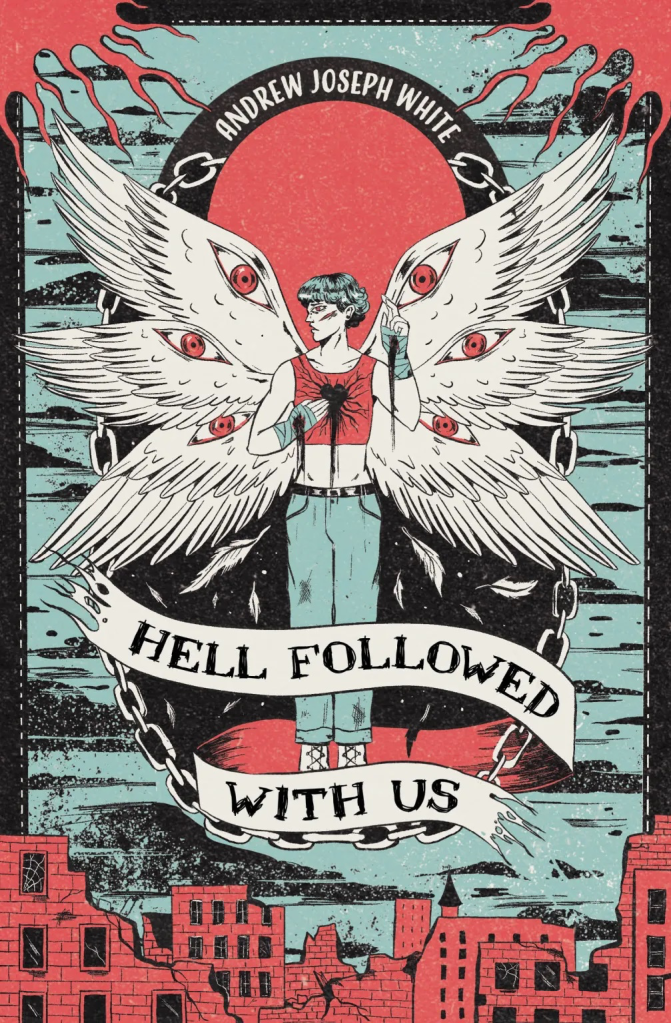
The Spirit Bares Its Teeth – Andrew Joseph Whitethe lyrics could match up with any number of books, but it’s the creaking, uneasy atmosphere that puts it squarely in this novel’s company.

“Driver” – Soccer Mommy

I’m so glad that Soccer Mommy has become a prominent enough artist that she has the means to do funny marketing campaigns, because whoever came up with the one for “Driver” had a stroke of genius. By calling a number that Sophie Allison posted, you could get a snippet of the track before it came out, followed by “how’s my driving?”-style call prompt. Maybe we are in an okay timeline.

Without a doubt, Sophie Allison has never been more sure of herself at the wheel. A departure from the expression of beauty in lingering grief that were the two lead singles, “Lost” and “M,” “Driver” presents a more lighthearted detour to the landscape of Evergreen. The backing guitars and effects have gained a grungier, grimier edge, but Allison’s sunshine puts them all in a dusty, golden light. As the guitars and drums thrum like gravel skipping across a dirt road, Allison turns her attention to the present loves of her life. You almost get the feeling that she’s slipping into the self-deprecation of her early career, but there’s nothing but affection for herself, but more in terms of her partner, who puts up with her “losing [her] concentration on every whim.” Allison presents herself as the more emotional, scatterbrained half of the couple, which her partner is playful about, but is also the one to ground her when she gets too far into her head with a reminder of “where are we going now?” She’s never completely blameless, but she’s full of nothing but love for her anchor that keeps her from veering off the path; it’s not like some of her earlier songs, like this would indicate that she’s in danger of slipping away entirely, but it’s an exercise in learning to rein yourself in—and find somebody who isn’t afraid to rest a hand on your shoulders and remind you where your feet are planted.

…AND A BOOK TO GO WITH IT:

Aurora Burning (The Aurora Cycle, #2) – Amie Kaufman and Jay Kristoffnot to get all 2020 Madeline on you all, but…the Kalauri in this song…I’m gonna keel over…

“I’m a five foot four engine waiting to move/I’m a test of his patience with all that I do/‘Cause I’m hot and he stays cool, I don’t know why/But he puts up with my moods/And he makes me smile when he says/’Where are we going now?'”

“Bishop’s Robes” – Radiohead

The connection of inspiration between Radiohead and The Smiths never surprises me, but sometimes, with bands that inspire another, you find a single song that you know is the missing link in the evolutionary tree, the line of ancestry concretely delineating their music as kin. More specifically, it makes sense next to their cover of “The Headmaster Ritual,” though “Bishop’s Robes” takes a much more subdued turn.

Yorke’s raw lyricism thrives in both simplicity and complexity; he can weave any number of stories with denser, more prosey lyrics, but he knows just what kind of simple, unadorned phrases to stab you in the gut with. In this case, it’s the chorus, repeated like a shaky-voiced prayer in a dark corner: “I am not going back.” It becomes more of a reminder than a statement, as though to convince his brain that no, he’s not back in his pre-teen years under the reign of his “bastard Headmaster.” Volumes have been written about the horrors and abuse of the British education system back in the day (see: pretty much anything by Pink Floyd)—and some continuing into now, I would imagine—but what sets “Bishop’s Robes” apart is the mood. It might be more accurate to call it a lack, as the most overwhelming feeling you get from this track is not anger but numbness. There’s a resignation to it, weighing down the music, as though, even in adulthood, the experience has sapped him: Yorke doesn’t have the energy to fling insults along the lines of “spineless swines” or “belligerent ghouls” at his abusive childhood tormentors—all he can do is “bastard.” And it’s that eyebagged, forlorn crawl that sells the lasting effect it had on him. After years of unyielding discipline, I can imagine the fear of not raising your voice—a haunting presence that permeates every note of this track, constantly looking over its shoulder to guard innocent contraband that doesn’t exist.

…AND A BOOK TO GO WITH IT:

Agnes at the End of the World – Kelly McWilliamssecrecy, escape, and the horrors of a perverted version of Christianity in the hands of the wrong man.

Since this post consists entirely of songs, consider all of them to be today’s song.

That’s it for this week’s Sunday Songs! Have a wonderful rest of your day, and take care of yourselves!
Posted in Book Review Tuesday

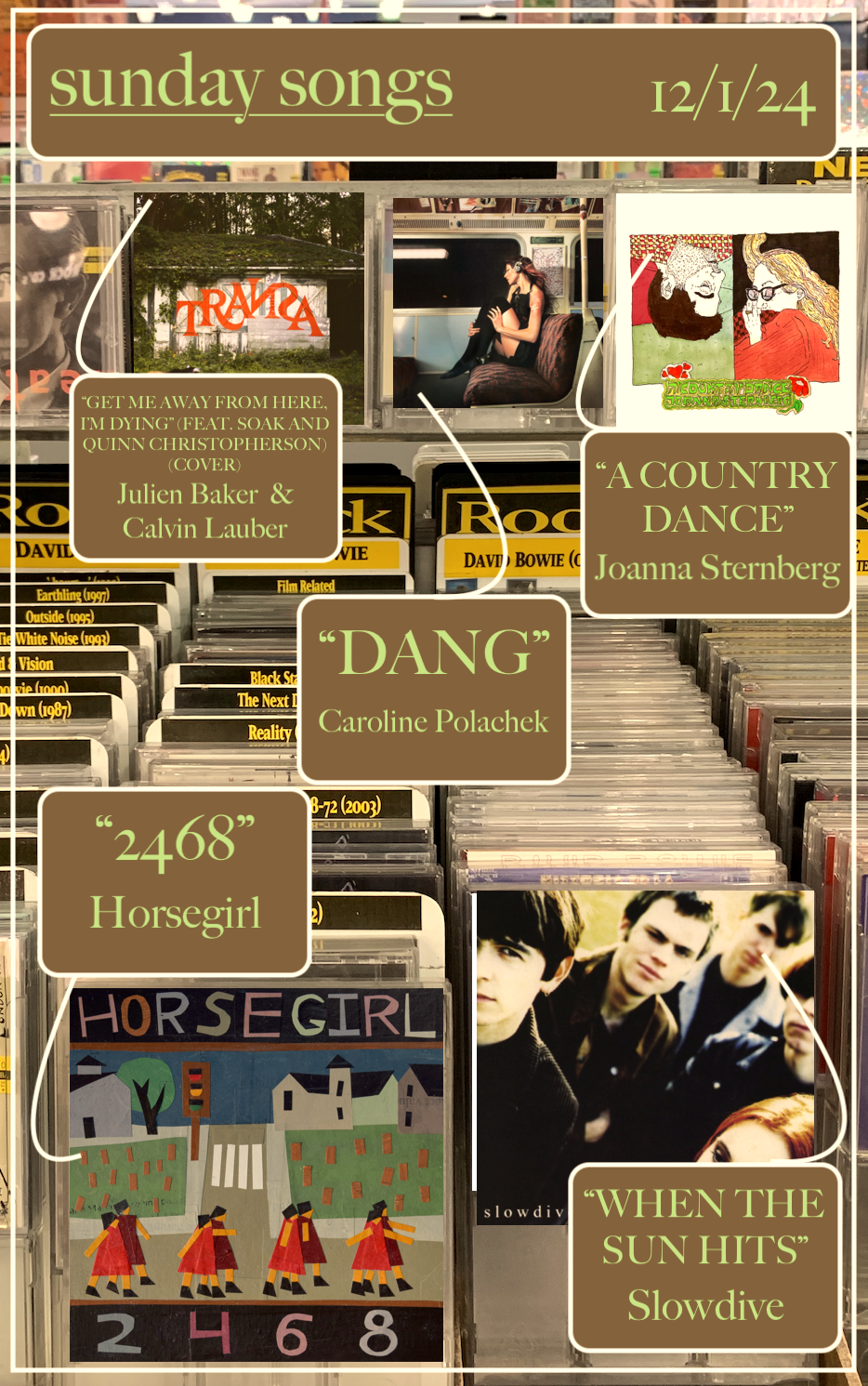
Book Review Tuesday (9/17/24) – The Crumrin Chronicles, vol. 1: The Charmed and the Cursed

Happy Tuesday, bibliophiles!

2024 really is the year of healing my inner middle schooler…I can feel the Courtney Crumrin obsession jolting back into my body…

I’ve been a fan of Courtney Crumrin from a young age—maybe a little too young, considering how quickly the subject matter gets dark, for better or worse. You know what? Definitely better. It was one of my favorite comics growing up, and Naifeh’s talent in both the writing and illustrating department has had a permanent impression on me, and spurred on my love of paranormal comics even before my Hellboy obsession was kicked into high gear. This continuation of Courtney’s story was one that I’d nearly forgotten about, but delighted in as a longtime fan—a worthy continuation of the story of the most dangerous witch in Hillsborough.

Enjoy this week’s review!

The Crumrin Chronicles, vol. 1 – The Charmed & The Cursed

Wilberforce Crumrin was trapped in the faerie realm for a century, while his older brother Aloysius got to live out a full life in the mortal world. Now rescued from his curse of never aging, Will finds himself under the wing of his adoptive older sister, a feared witch by the name of Courtney Crumrin. To help her little brother adjust to the mortal world, Courtney gifts Will with a charmed locket that will make everybody who encounters him go to great lengths to be his friend. But the love he receives from his classmates is hollow, and soon, Will must learn to discern who his real friends are.

TW/CW: fantasy violence, bullying, anaphylactic shock, loss of loved ones

When I say “I support women’s rights and women’s wrongs,” I mean Courtney Crumrin. Let a middle school girl with an ungodly amount of magical powers rain righteous fury down on a bunch of corrupt older men if she wants to.

I’m so glad that my mom reminded me that The Crumrin Chronicles existed, because it was high time that my middle school Courtney Crumrin obsession got reanimated. These new installments of the story prove that Ted Naifeh’s still got it, whether you’re talking about the stellar, eerie writing or his distinctively angular art style. In every way, it’s a treat for any longtime Courtney Crumrin fan!

Several years after the events of The Final Spell, Will has been rescued from the faerie realm, and now has to acclimate to the mortal world—which has progressed over a century from when he last saw it. The shift in the series’ name reflects the shift in the protagonist—it will always be about Courtney, but it’s clear that this is Will’s story through and through. I’m loving the ways that Naifeh has begun to develop Will’s character; apart from his delightfully old-fashioned mannerisms (ex. calling everybody “chaps,” constant exclamations of “jolly good” and whatnot), you truly get the sense that he’s a fish out of water in every way—he knows nothing about this new world that he’s in, and on top of that, he constantly has to pretend that he’s in the loop with everyone else.

In the shift from Courtney to Will as the protagonist, Courtney has also filled the role of Uncle Aloysius in the original series. What with their parents remaining as bafflingly clueless as they always were, Courtney is the only person Will can turn to for advice and comfort—she’s the only person in his life who knows the truth about his origins. Courtney, now with several years of maturity (and honing her powers) behind her, has grown more reclusive, but no less of a formidable force, both for fury and for love. Her being in a more secondary role doesn’t dull the truly awesome impact of the magic-wielding moments she gets; age has only focused and sharpened the reach of her wrath, and she uses it to its full extent when it comes to protecting the ones she loves—especially her little brother.

Protecting said little brother is what drives the central conflict of The Charmed & The Cursed; the inciting incident is brought on by a charm that Courtney places on Will that will make all of his classmates love him, thereby making his transition to modern school easier…in theory. Even if it does go awry, it teaches Will a valuable lesson about true friendship—and gives him a few real friends along the way. But the gesture alone felt so true to Courtney; she knew firsthand what it was like to be the new kid and not have anybody to show her the ropes, both socially and magically. What she and Will both learn by the end is that, in terms of the horrors of middle school, nobody can protect you from that. It’s a fact of life that puberty and making friends are rough, but sometimes, it’s up to you to decide who your real friends are.

Side characters usually aren’t a strength of Courtney Crumrin—by nature, Courtney really doesn’t have friends, save for her crotchety, geriatric warlock uncle, some talking cats, and a handful of fantastical creatures who come and go (and often either turn on her or die horribly. Fun times. Guess who hasn’t gotten over Skarrow…), but the ones that Naifeh introduces in The Charmed & The Cursed have a lot of promise! I immediately saw a bit of my younger self in Tucker, and as a kind of foil to Will, she works wonderfully; in contrast to Will, who wants to understand the real world he’s now trapped in, all she wants to do is escape it. Both of them show each other a version of reality—Tucker shows Will how his “friends” really see him, while Will shows Tucker that maybe the real world does have something in it for her. Putting a goth girl in this universe was an obvious choice, but I love Cinnamon too—and her burgeoning romantic relationship with Tucker!

The magical conflict (a CEO who happens to be a vampire, and this time, not in the metaphorical sense) was very much just a setup to stoke the flames for the rest of the series, but that doesn’t mean it wasn’t a fantastic ride. Between the callbacks to Courtney Crumrin’s Monstrous Holiday to Courtney getting to unleash the full extent of her magic, I was grinning to ear the entire time! The callbacks didn’t feel shoehorned into the narrative either—the element that does return does so for a logical reason, and there are enough new solutions to the vampire problem at hand that it doesn’t feel like a straight-up rehash. It’s loads of fun—and it provided a fascinating setup for what seems to be the main conflict of The Crumrin Chronicles.

All in all, a return to a comic I remember fondly that was clearly created with nothing but love. 5 stars!

The Crumrin Chronicles: The Charmed & The Cursed is the first volume in the Crumrin Chronicles series, followed by The Crumrin Chronicles: The Lost & The Lonely, and The Crumrin Chronicles: The Wild & The Innocent, which will be released on October 1, 2024. This series is a sequel to the Courtney Crumrin series, which consists of The Night Things, The Coven of Mystics, The Twilight Kingdom, Courtney Crumrin’s Monstrous Holiday, The Witch Next Door, The Final Spell, and the prequel Tales of a Warlock, which tells the story of Uncle Aloysius. Ted Naifeh is also the author and illustrator of several other comic books, including The Good Neighbors (written by Holly Black), Polly and the Pirates, Princess Ugg, and many more.

Today’s song:

FINALLY listened to all of It’s a Wonderful Life yesterday!! Sparklehorse and P.J. Harvey was a combination I never knew I needed so badly…

That’s it for this week’s Book Review Tuesday! Have a wonderful rest of your day, and take care of yourselves!

Posted in Sunday Songs

Sunday Songs: 9/15/24

Happy Sunday, bibliophiles! I hope this week has treated you well.

Before I get into today’s songs, I’ve also compiled my graphics for the last few weeks when things got busy. I made them (because I love making silly little graphics and giving them silly little color palettes), so, for your casual perusal, here they are:

8/18/24:

8/25/24:

9/1/24:

9/8/24:

This week: contradictions, distinctive voices, people who deserve to cover The Beatles, and…okay, the jury’s still out on whether or not what seems to be the final boss of hipster white boys can pull off mariachi, but that’s here too, I guess? I don’t know enough about mariachi to judge…

Enjoy this week’s songs!

SUNDAY SONGS: 9/15/24

“Danger” – Panda Bear & Sonic Boom

There’s something to be said for how distinctive Panda Bear (a.k.a. Noah Lennox) sounds—so much so that, having only heard a handful of his songs, when I heard that he had a hand in “Danger,” my immediate reaction was oh, that makes complete sense. What made even more sense was Sonic Boom (a.k.a. Peter Kemper); I had no idea what his deal was until my dad explained that he was one of the original members of Spacemen 3…and all of the puzzle pieces came together in complete harmony.

Someday, in some future age, I’ll bet that some scientists will come up with a way for us to be able to physically touch music. (It physically touches us, in a way, so maybe the inverse isn’t all that far away…who knows.) Whenever they come out with the playlist and the associated objects or capsules of sensation, I dearly hope that “Danger” is among the first, because it’s already a step ahead of the game; it’s so textured and layered that you can almost feel its tendrils brushing against your ear. Technology and creativity have collided to the point where these two have made a song that sounds exactly how it feels to touch one a puffer ball—y’know, the squishy balls you get at Walgreens or something with all the noodles sticking out? All manner of electronic textures were thrown in the stew pot, and the result is so elastic yet so hard-edged, so malleable yet so solid, so transparent yet so dizzyingly dense. Panda Bear’s voice, whether it’s singing or just letting out a spontaneous pigeon’s coo, collapses into neon dust motes with every note.

I’d that imagine that somebody with synesthesia (specifically chromesthesia, the variety where the person links sound to colors, shapes, and movement) would have a field day with the densely-packed prize box of auditory textures in “Danger.” Even with the cries of danger, I feel myself pulled under, drowning in a sea of spores and rubber, with every listen. Maybe that’s the danger—slipping under as your senses surrender to the prickles of this song?

As if making a whole album of, presumably, the same layered insanity (see also: “Edge of the Edge”), Panda Bear and Sonic Boom released an EP with Mariachi 2000 de Cutberto Perez consisting entirely of mariachi renditions of several tracks from Reset, including “Danger”—now reworked as “Peligro.” I’m not sure if I’m fully on board, but…those visuals should’ve been with the original track in the first place! All the colors and morphing shapes…

…AND A BOOK TO GO WITH IT:

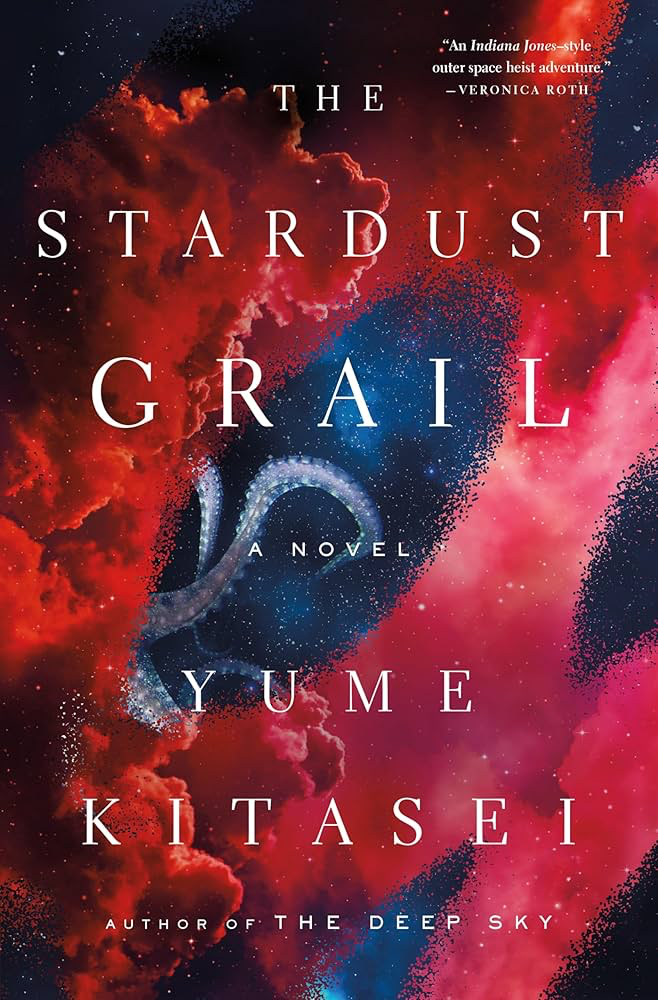
The Stardust Grail – Yume Kitasei“All that you do for me/Can’t you see what you do to me?/Gave you a pot for the tea to brew/Give me a spot for the art to grow…”

“Zero Sum” – The Smile

Here I was thinking all of my most anticipated albums of 2024 had come and gone…two Smile albums in one year? WE ARE SO BACK. THOM YORKE HAS BLESSED US!! Between this, the TV on the Radio reunion, new Soccer Mommy in a little over a month, and a Kim Deal solo album on the way…the party’s far from over! Days like the one with the trinity of TV on the Radio, Smile, and Kim Deal news make me remember how silly the people who claim that there’s “no good music anymore” truly are. That’s all on you, chuckleheads. Skill issue. Look harder. (Apply this mentality to all forms of modern media. Add water and stir. You’ll find what you’re looking for.) And sure, all of the bands I mentioned either are or have been a part of mainstays in the alternative scene, but that doesn’t negate the fact that innovative music is still being made, dammit. And if you’re looking for somebody truly new? Boom. Soccer Mommy.

I anticipated that there was going to be at least one more album from The Smile on the horizon, but it really does seem that Yorke, Skinner, and Greenwood just cannot stop their creative flow, and god, I am so grateful for it. Although their first offering, “Don’t Get Me Started,” was…weaker, though not bad by any stretch of the imagination, the official album announcement of Cutouts came with twin singles “Foreign Spies” and “Zero Sum.” The latter was the obvious standout, and not just because it’s the only fast-paced one of the bunch. The Smile and slow-paced songs are by no means a bad combination, but “Zero Sum” is just so supercharged with frenetic energy that it automatically stands out. Chances are, if you happened to inject this song in liquid form into the veins, it would probably have the effect of chugging 5 energy drinks in one sitting. It’s just so spidery, so rapid and skittering that you get eyestrain from trying to track just where the beat goes. I can already see Thom Yorke’s signature jerky, angular dance moves onstage once they slip this into the regular rotation for the tour. (You guys are doing an American tour, right? Right? Right?) Horns triumphantly blare amidst the mile-a-minute guitars and synths (now that’s some “FASTER, JONNY” for you), and Yorke, of course, has a dystopian, buzzword-filled collage of lyrics: “Thinking all the ways/The system will provide/Windows 95, Windows 95.” If there’s anybody who can get me dancing to a repetition of Windows 95, of all things, it’s these guys.

Oh, and…RADIOHEAD HAS BEEN REHEARSING, YOU SAY? I hereby apologize for my inevitable outbursts once a) Cutouts comes out, and b) whatever the hell comes out of this Radiohead Rebirth. WE ARE SO BACK!!!!!!!!!!

…AND A BOOK TO GO WITH IT:

Finna – Nino Cipri“A clipped tongue, acting dumb/Somewhere in the past in a re-run/Thinking all the ways the system will provide…”

“Fortunately Gone” – The Breeders

I don’t typically associate The Breeders with any kind of whimsy. Not like they’re some kind of depression-fest or anything, but they’re not afraid to get on the heavier, crunchier side of things—listen to any track from Last Splash and you’ll know what I mean. So when I paid attention to the lyrics, it was a surprise to see how plainly and delightfully nonsensical they are; “Fortunately Gone” reveals its heart right in the opening verse: “I wait for you in heaven/On this perfect string of love/And drink your soup of magpies/In a pottery bowl.”

The more I think about it, the less surprised I should’ve been by this divergence into tenderly fantastical lyrics. I say that because Kim Deal’s voice feels molded for this purpose. No matter how much distortion you throw at her, there’s a bare-hearted openness to her voice. Her voice is the healing of a scar on your knee, always tender, but never without some semblance of hope, joy, or some manifestation that blood and bruises aren’t all there is to life. Even amidst the grit and ominous air they artfully paste over their cover of The Beatles’ “Happiness is a Warm Gun,” complete with the muted flick of a lighter brought to life, Deal whispers the title refrain with the tone of a child in an empty room watching sunlight peek through the slats of window blinds. That same hope is what buoys this tale, a story of a woman in heaven waiting for her past lover to die so that they may reunite: “Fortunately gone, I wait for you.” Kim Deal was made for the role of this lovelorn, afterlife-confined piner, and nudged into less than two minutes, every tender note lands just as the lyrics tell you so: “Sweetly as it drops upon your head/Just like it did today.”

…AND A BOOK TO GO WITH IT:

The Bad Ones – Melissa Albertreaching through the veil to find out the truth about your best friend’s death—not just in terms of what killed her.

“I Am I Be” – De La Soul

I’m inevitably getting all College™️ with this one, but can you blame me? I spent the other day talking about how this Richard III monologue displays the dissolution of the character’s sense of self. The amount of contradictions it has fits more with the next song I’m discussing (see below), but the clear-cut divisions reminded me of the title here—”I Am I Be.” It functions partly as a vehicle to add in some silly guest features and ad-libs throughout the song, starting with “I am Shortie, I be 4’11′” and devolving into silliness in the background as the song progresses (“I am Patrick, I be the biggest shrimp collector in the world,” and by the end “I am Bob, and I be really tired of doing this, guys”). After their hard left turn into cynicism of De La Soul is Dead, there’s no denying that their propensity for goofiness never faded away, however much they wanted to deny it.

But as a part of the lyrics, “I Am I Be” functions as parts of the self. After three albums, all three members of De La Soul had gotten squeezed like an empty tube of toothpaste to form an image, whether it was the flower power revival of Three Feet High and Rising or the pressure to crank out another classic post-De La Soul is Dead. From the snatches of Buhloone Mindstate that I’ve listened to, it seems like this album was the limbo outside the two—not completely happy-go-lucky again, but always willing to push the boundaries of what hip-hop could be. They were determined to not let the music industry grind them down, despite the bleak first lyrics: “I be the new generation of slaves/Here to make papes to buy a record exec rakes.” This is where, for me, the “I Am/I Be” division comes in. I’m really English majoring it up right now, but hear me out. I am represents the core of the (De La) soul, as dictated by Posdnuos (“I am Posdnuos”), whereas “I Be” is the circumstances where they find themselves (“I be the new generation of slaves…”). Neither negates the other, but together, they form a completed picture of the self. All after the latter lyric concerns Pos’s past, from collaborators abandoning him to his experience being beaten down by the music industry. But never at any point, amidst all this bleakness, does he crumble under the pressure; the end of the first verse is an assertion that no matter what life throws at him, he will pledge to stay true to himself: “If I wasn’t making song/I wouldn’t be a thug selling drugs/But a man with a plan/And if I was a rug cleaner/Betcha Pos’d have the cleanest rugs, I am.” There: bookending the last line, I am, the true self, returns. Dave’s second verse ends in a similar way: “I keep the walking on the right side/But I won’t judge the next who handles walking on the wrong/Cuz that’s how he wants to be/No difference, see I wanna be like the name of this song, I Am.” For a band that have been through the ringer (and largely emerged triumphant, though it took them decades to get there), it’s already a world-weary assertion, but one that never gives up the spirit—to this day, the surviving members of De La Soul continue to spread their artistry and positivity, now even further reaching thanks to their hard-won legal victories surrounding their music being on streaming. Through it all, they’ve stayed true to I Am.

…AND A BOOK TO GO WITH IT:

And Other Mistakes – Erika Turner“Every now and then I step to the now/For now I see back then I might have acted like a fool/Now I won’t apologize for it…”

“Echo” – Kristin Hersh

Crazy how I haven’t managed to talk about Kristin Hersh in one of these posts yet…I’m admitting my bias before I make a statement as sweeping as this, but I truly believe that Kristin Hersh has one of the most unique singing voices I’ve ever heard. It lies at an unusual confluence of the tiniest rasp, an understated Southern drawl, and a nasally tremble that, despite there not being words about it that sound complimentary (sorry, Kristin), is only a banner declaring her voice to be like no other. Separately emphasized, those elements would be off-putting (I only mean the Southern drawl in the way that modern country singers lay it on so artificially thick that it becomes meaningless to the All-American image they’re peddling), but where Hersh lies, they’re the perfect parts.

Whatever Hersh intended Sky Motel to mean (I’m between the sky over a motel or a floating, retro-futuristic motel with a rusty sign advertising vacancies on some kind of hover-buoy near the spaceship parking lot), it’s a fitting feel for “Echo.” Faint cricket songs decorate the intro, and combined with the gray, distorted smokestacks and skylines of the music video, it packages that feeling of staring up at the sky from a hotel parking lot, exhausted and operating on too little sleep. The opening lyrics also conjure the space directly before that—for me, somewhere in the dimly-lit back of a taxi from the airport: “White label on the backseat/glows an artificial green.” Amidst ambling keyboards, Hersh seems to stumble through the streets, torn between extremes; caught between the stability of “an empty lifestyle” and the allure of “the very loudest sound.” Every lyric is a contradiction: “I’m loving everybody/And hating everyone I see.” Hersh straddles the two poles just as the music does—each chorus roars from the bug-flecked quiet of the verses, and drunkenly stumbles back into tranquility just as quickly. Though she never lands on which direction she’s pulled towards, there’s a solemn acceptance that the middle ground is in sight, but just out of reach—”Do you hear the loudest sound/Floating out on the echo?” That violent oscillation of contradiction is what makes “Echo” stick so solidly, both in the inability to land between two extremes and only being able to see the most sparing glow of solace—a space I often find myself as such a sensitive person. It’s easy to get swept up in that turbulence, and easier said than done to reach out to that floating echo.

…AND A BOOK TO GO WITH IT:

I Am the Ghost in Your House – Mar Romasco-Moore “I crave a midnight something/I crave and something hunts me down/I’m scaring everybody/I’m wearing everybody down…”

Since this post consists entirely of songs, consider all of them to be today’s song.

That’s it for this week’s Sunday Songs! Have a wonderful rest of your day, and take care of yourselves!
Posted in Book Review Tuesday

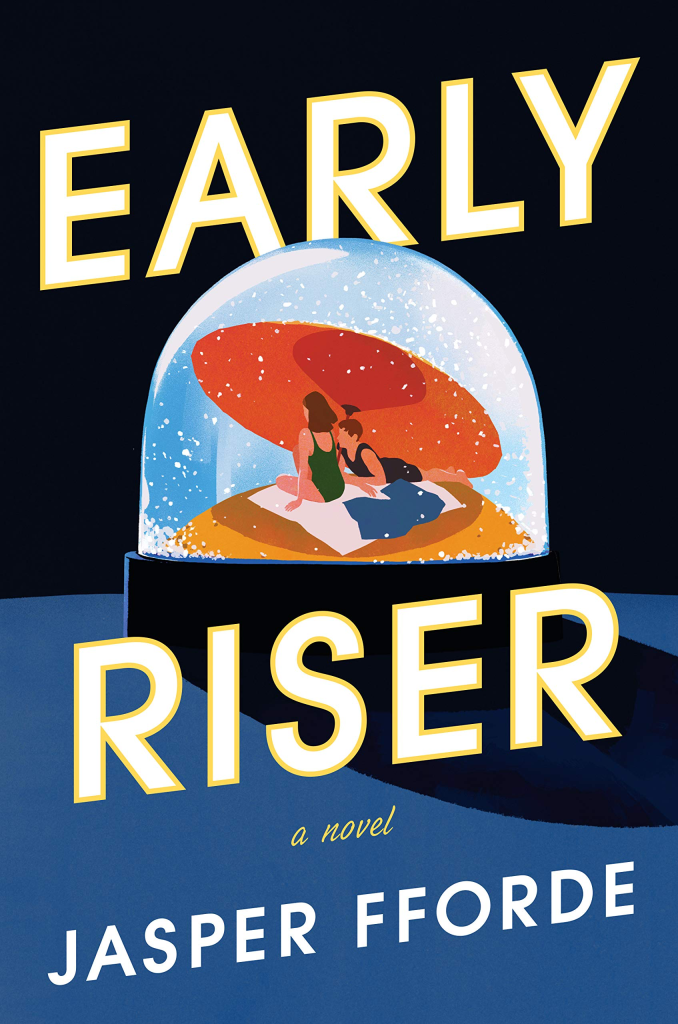
Book Review Tuesday (9/10/24) – The Sun and the Void

Happy Tuesday, bibliophiles!

Looks like I’m back! I’ve returned to college, and, as it always does, it has taken me some time to settle in. My ducks aren’t fully in a row, but they’re straightened enough that I’ve figured out when and where I’ll have times to squeeze in some writing. Key word is some: chances are I’ll stick to the two posts a week for a while now that I’ve got lots of schoolwork on my hands.

For this week’s Book Review Tuesday, I have a book that it’s almost miraculous that I liked as much as I did; at their worst, overly long epic fantasy novels are the bane of my existence. The Sun and the Void clocks in at nearly 600 pages, and I expected at least some of it to be a slog. Lo and behold, this novel held so much more in store—vibrant characters, Venezuelan-inspired mythology, and a daring quest across an inhospitable land.

Enjoy this week’s review!

The Sun and the Void (The Warring Gods, #1) – Gabriela Romero Lacruz

Reina has lived her life on the outskirts of society. Though her kind, the nozariels, have won their freedom, her tail and features mark her as an outcast. Reina returns to her estranged grandmother in dire need of healing—and answers. Now kept alive by means of dark, unpredictable magic, she is now the owner of a terrible secret: her grandmother is in league with a demon-god hungry for sacrifices, and one such sacrifice may be someone that she holds dear.

On the other side of the kingdom, Eva struggles to hide her true self. Her mixed heritage—part human, part valco—makes her a target. Soon after she is set to be married off to a man she barely knows, she falls in with a revolutionary. But this charming, volatile man has a darker side, a hunger for power that will not spare her if she stands in the way.

The paths of these women intersect as the clock ticks, and the fate of both of their worlds may hang in the balance…

TW/CW (from the author): alcohol, assault, blood, child death, childbirth, death, demons, emotional abuse, gore, infertility, kidnapping, pregnancy, racism, religion, sexually explicit scenes, mentions of slavery, violence

Ever since my tastes started drifting more into adult novels, I’ve had a history of getting a hundreds or so pages into an epic fantasy novel, losing my way, and coming out with only the vaguest sense of plot and one character. There’s some of it that’s on me, but it’s often a case of rambling; I’ve found many such novels to be more wordy than necessary and convoluted in their delivery of the worldbuilding. I lowered my expectations for The Sun and the Void for this very reason, though I clung onto it because of the promise of the Venezuelan and Colombian-inspired setting and anticolonial storyline (!!!!!!!!!!!!). Beyond being sick of generic, catch-all European settings in fantasy, my half-Colombian Spidey sense was tingling…and for good reason! The Sun and the Void is an overlooked gem of epic fantasy, with magic and action abound.

The vibrant setting that Romero Lacruz crafts was the clear star of The Sun and the Void. Her South American-inspired landscape was a breath of fresh air in a sea of vaguely European epic fantasies, breathing some much-needed life and diversity into the genre. Logistically, this region of South America—Venezuela and Colombia—also provides a variety of biomes to play with: we get flashes of deserts, forests, and glittering, tropical beaches, all with a fantastical dash of demons and monsters. That alone would have already put it a step above your average epic fantasy, but it was this series’ unique fantasy races that truly shone! As metaphors for oppression and who the dominant power in society deems “acceptable,” the nozariels and valcos were effective on that front. Their designs, however, were what made them so fun, making for memorable characters in looks and culture as well as personality.

In my experience, there are certain brands of epic fantasy that are allergic to accessible writing. When I say accessible, I don’t mean simple; accessible doesn’t mean the absence of artful prose or clever metaphor. For me, accessible prose is inventive, but not so caught up in making itself sound clever that it becomes a chore to read. Romero Lacruz’s writing is a fantastic case study in how to hit the balance between artful and digestible. Every action scene, political machination, and argument is rendered in ways that do feel like how people talk, and yet she never forgets to season her prose with unique metaphors and descriptors of the characters and their surroundings that keep you hooked—or, in my case, vigorously highlighting on my Kindle. At no point did the writing feel pompous or overly convinced of its own talent—it’s writing for writing’s taste, which is what writing should be.

Power dynamics were at the forefront of The Sun and the Void, and the explorations of them were some of the most impactful parts of the novel. Through the side characters, Romero Lacruz portrays the different way that power manifests itself in people; no matter how “noble” their causes, characters like Doña Ursulina and Javier became so obsessed with achieving their goals that it subtly began to eclipse all else. What was unique about The Sun and the Void, however, was how it was framed: through the eyes of vulnerable, sensitive women that get pulled under their spells. Such abusive dynamics meant that Reina and Eva were respectively drawn into the web of these other characters. At no point were they helpless—they were victim to people that promised them healing or freedom, and became so entangled in the schemes of others that they had to fight tooth and claw to find their way back to the light.

That being said, the weakest links in The Sun and the Void lay in the worldbuilding. Even though this novel is one of the few lengthy epic fantasies that I’ve read that miraculously doesn’t get overly convoluted, the price it paid was that some of the worldbuilding was left messy and sloppy once I took a closer look. The glossary was helpful, but it took quite a while to get used to some of the intricacies of the magic system. Terms are thrown around in a very slipshod way, and instead of the dreaded page-long block of worldbuilding exposition, we get…a few sentences, at most, before said facet of the magic system is barely mentioned for the rest of the novel. It’s an issue with followthrough—once something was mentioned, it often took 300 pages for it to make a brief appearance, only to poof back into the unexplained ether. It’s clear that there was a lot of thought behind the worldbuilding, but the issue was more of following the time-honored rule of Chekhov’s gun—Chekhov’s magic system, in this case. The gun did go off in the end, but it took so long to get to that moment that I completely forgot the significance of it being there in the first place.

All in all, an epic fantasy that defied the conventions of the genre—setting, writing style, and more—in all of the best ways. 4 stars!

The Sun and the Void is the first novel in the Warring Gods series, followed by The River and the Star, which is slated for release in 2025. The Sun and the Void is Romero Lacruz’s debut novel.

Today’s song:

BLESSED WITH ANOTHER NEW SOCCER MOMMY TRACK AND A NORTH AMERICAN TOUR NEXT YEAR!!!!!

That’s it for this week’s Book Review Tuesday! Have a wonderful rest of your day, and take care of yourselves!
Posted in Book Review Tuesday

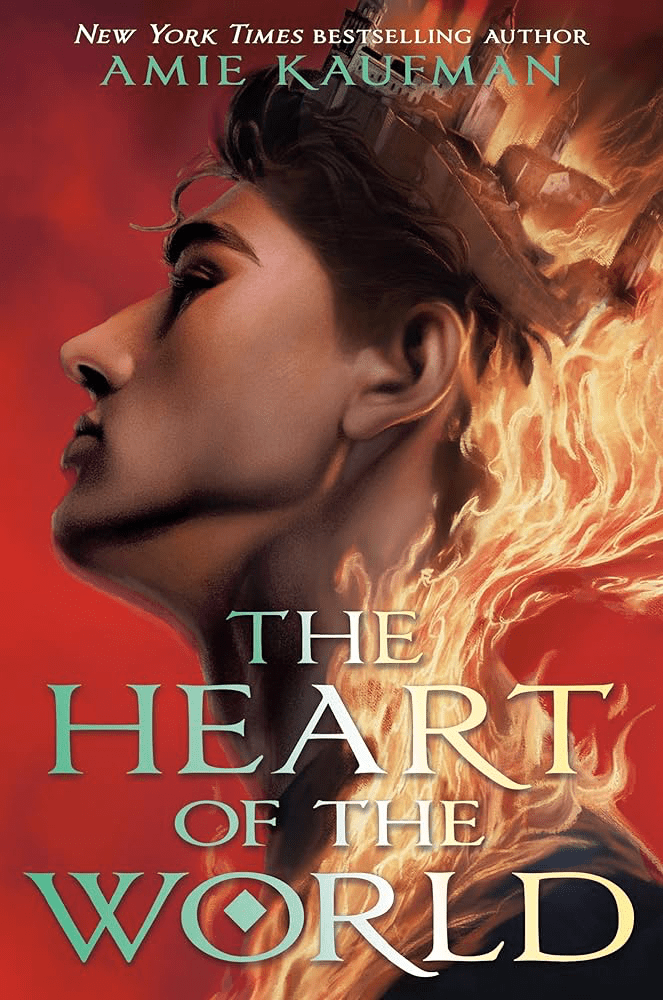
Book Review Tuesday (8/13/24) – Beautyland

Happy Tuesday, bibliophiles!

As far as science fiction goes, I’m not usually for the literary side of it—that goes for most literary novels of any genre, to be honest. I’ve often found that the sci-fi part is dulled in favor of mass appeal. But the premise of Beautyland fascinated me, not just as a science fiction reader, but as someone who’s grown up feeling like an alien. Surprise, surprise—I cried.

Enjoy this week’s review!

Beautyland – Marie-Helene Bertino

Philadelphia, 1977. Humanity has given the gift of Voyager 1, along with its landmark Golden Record, to space. Unbeknownst to us, a power hidden deep in the cosmos has given humanity a gift in exchange. At the same time as the launch of Voyager 1, a baby is born to an unknowing mother, not human but alien. Her mother names her Adina, and as Adina grows older, she learns how to communicate with her kinfolk in space, reporting the oddities of human life and culture through an old fax machine. As Adina pretends to be human, she experiences the joy and terror of human existence, but longs for closure—will she ever be able to return to her homeworld?

TW/CW: cancer, sexual harassment, loss of loved ones, pet death, bullying, grief, 9/11 themes (brief)

One of the best feelings is when you pick up a book that you’re interested in, but not expecting anything marvelous from, and then getting absolutely pied in the face out of nowhere with the feeling that this book gets me. Setting aside my reservations for literary sci-fi, Beautyland digs into the heart of my experience growing up—of feeling alien, but of cataloguing all of the nonsensical facets of American culture and the feeling of not belonging. I cried. I laughed. I had an echoing pang in my chest for a while. Like life, all of it was worth reading and living.

Observations about the human condition formed the heart of Beautyland. Through Adina’s messages on a fax machine, she reports to her alien superiors on everything from the oddities of American culture (“When it was time to decide the official food of movie-watching, human beings did not go for Fig Newtons or caramel, foods that are silent, but popcorn, the loudest sound on earth”) to the painful and uneasy truths of human existence (“The ego of the human male is by far the most dangerous aspect of human society”). Bertino’s writing shone the most when chronicling Adina’s observations. She adopted a blunt, matter-of-fact tone of a distanced journalist, someone watching our species from the sidelines, yet always managed to wring the emotion from it, be it humor or sorrow. The wonder of Adina when she visited her superiors at night, in a vast room inside of her mind, was just as palpable, capturing her childlike curiosity. You felt every joy of Adina reporting back on the eccentricities of humanity, and every sorrow once Adina matures and realizes the dark side of our nature. The eventual abandonment of her superiors as she grew older drove the point home even more—at a certain point, nobody can answer these questions for you, and you realize that you don’t have the answers, and neither does anyone else. All that’s left to do is live your life, and observe.

Though it wasn’t outright said or diagnosed, the neurodivergent themes of Beautyland were what stuck with me the most. (I have sensory processing disorder, and, among other things, I felt Adina’s growing discomfort with sensations as simple as hearing people breathe and chew.) Whether or not you believe that Adina is actually an alien, the experience of being on the fringes and unable to understand not just other people but their actions deeply resonated with me. As Adina moves through middle and high school and is ostracized by her more popular peers and tries to scientifically observe them, she’s confronted with a frequent feeling of questioning why it has to be this way: why are these girls looking at me like I’m gum on the bottom of their shoes? Why is not wanting sex such an affront to men? Why don’t they like me? That feeling of knowing something’s missing, but being unable to find it, put into words a feeling I struggled with through my adolescence, a sense that everybody else knew something I didn’t, and that was what made me so strange to them.

I read Beautyland as both science fiction and historical fiction; some people have put it up in the air as to whether or not Adina actually is an alien, but I think the answer is…yes. Both can be true. I’ve grown up in a similar way to Adina, feeling so on the outside of everything that I’ve attached myself to science fiction and alienness in general. Like Adina, it’s informed by some neurodivergence and general outsiderness, but there’s something to be said for all of the questions presented being true. Yes, she may be an alien sent from an advanced race beyond the solar system, and yes, she has some neurodivergent tendencies as well. The two can coexist. And Beautyland’s embrace of how these qualities can intersect was what made it so impactful; this experience fundamentally makes us human, even if it makes us feel alien. I often see criticism of alien or robot characters who are characterized as “inhuman,” but what makes them inhuman boils down to them just having the traits of neurodivergent people (“lack” of emotion, misunderstanding of how humans work) and those on the asexual/aromantic spectrum (no desire for romance or sex, that which “makes us human”), and I think it’s a valid criticism to apply to characters who are written thoughtlessly. But who’s to say that an alien character like this can’t also be neurodivergent and asexual? Again: the two can coexist. Bertino wrote Adina as a character with a deep understanding of human culture, and that, to me, does not skew the reading of her as asexual and neurodivergent.

Somehow, one of the most emotional parts of Beautyland for me was how Bertino wrote about Carl Sagan. As I mentioned before, the novel is written in fragments, not always linearly, but taking frequent detours outside of Adina’s immediate life and into moments of relevant pop culture at the time—the popularity of Carl Sagan being one of them. With her connection to the Golden Record and the absence of her own father, Adina looks up to Sagan as a surrogate father, someone who can teach her more about the cosmos from which she was born from. Even having never met him in person, the way that Adina processed Sagan’s death was where I lost it; this is one of her first experiences of loss, and it’s the loss of someone who has unknowingly guided her through her alien life, teaching her about the universe, and by proxy, given her a roadmap of the human condition. Fleeting as it was, Bertino wrote this instance—and the connection to Sagan in general—with the kind of love of someone you feel like you’ve known all your life, but have never even met.

All in all, a deeply human exploration of what it means to be alien. 5 stars!

Beautyland is a standalone, but Marie-Helene Bertino is also the author of Parakeet, 2 A.M. at The Cat’s Pajamas, and the short story collection Safe as Houses.

Today’s song:

new Smile!! not my favorite, and I can see why they left it off the album, but a solid track nonetheless.

That’s it for this week’s Book Review Tuesday! Have a wonderful rest of your day, and take care of yourselves!

Posted in Sunday Songs

Sunday Songs: 8/11/24

Happy Sunday, bibliophiles! I hope this week has treated you well.

This week: When I say L, you say OG! L TO THE…?

Enjoy this week’s songs!

SUNDAY SONGS: 8/11/24

“Lazy Eye” – Silversun Pickups

This song returned to me like an old friend not long ago, and with it, some misconceptions that were only picked apart when I saw the music video for the first time. For the longest time, I thought that a woman was singing this song; I saw Nikki Monninger and thought, naturally, she had to be the one singing, right? Wrong—Brian Aubert just has a uniquely high-pitched, more androgynous voice. (To be fair to my past self, Monninger does sing lead on a handful of their newer songs, but she primarily plays bass.)

I specifically remember the only other Silversun Pickups song I know, “Circadian Rhythm (Last Dance)” being on heavy rotation on Sirius XMU back when I was in middle school, but even around 10 years apart from each other, “Lazy Eye” has that same meticulous drive that the best 2000’s indie-rock track had. It’s almost startling to me that this song isn’t the opening track of the album, Carnavas, even having heard nothing else from it—there’s just a feeling of it that’s just so distinctly beginning. The instrumentals build up from steady indie-rock, laden with foreshadowing in the form of Aubert’s driving flourishes of both vocals and guitar. “Lazy Eye” segues into a second act that can bear no description other than explosive, splattering in your face like a can of soda shaken up for too long. But as quickly as everything ricochets in a thousand directions, the floorboards fall out from under it, returning to its mellow origins as the repeated outro of “The room, the sun and sky” fades into the woodwork. Paired with the precipice-staring lyrics of anticipation and coming to grips with reality (“I’ve been waiting for this moment all my life/But it’s not quite right”), make it feel molded for the intro of a coming-of-age movie, coming to grips with the fact that nothing’s as perfect as you can ever dress it in your imagination.

…AND A BOOK TO GO WITH IT:

Where You See Yourself – Claire Forrest“I’ve been waiting/I’ve been waiting for this moment all my life/But it’s not quite right…”

“Juna” – Clairo

I’m far from caught up on any kind of Clairo lore, but apparently “Juna” is the first song that she’s ever made a music video for! There’s something funny, unintentionally or not, about having a song (and a singer) as unassuming as Clairo set against the backdrop of a bunch of screaming, oiled-up wrestlers tossing each other around. Somehow, it works.

Clairo has never fully blown me away, but every once in a while, she’ll break through the mellow and snap into something luscious that has me looping it for days. Maybe I just like Clairo when she leans into the ’70s influences—I always come back to the funky bass that comes through the sadgirl mold in “Amoeba,” but “Juna” fully leans into it. If you took away the synths and left in the layered piano riffs, this track would feel like pure ’70s soul. I’d be fully convinced if there turned out to be some grand conspiracy to make this song just to soundtrack playing pool in a dimly-lit club, flickering lights fading both inside and out as the multicolored balls collide across the velvet. It has all the grace of aging, velvet curtains and the twinkling of new, flirtatious love, the kind that pushes you towards things you wouldn’t have done before: “You make me wanna go dancing/You make me wanna try on feminine/You make me wanna go buy a new dress/You make me wanna slip off a new dress.” Clairo’s voice constantly feels seconds away from dissipating into thin air, but she pulls off the sultry groove that “Juna” presents. And somehow, just like the bizarre juxtaposition of this song’s gentle disposition and said video of greasy wrestlers, something about Clairo’s mouth-trumpet breakdown (new sentences are formed every day) fits right in. I’d prefer…maybe more actual trumpet, but I feel like there’s something perfect about this song not taking itself too seriously. (Not necessarily everybody else in the video hamming up said mouth-trumpet breakdown…yeah)

…AND A BOOK TO GO WITH IT:

The Invisible Life of Addie LaRue – V.E. Schwab“Most of these days/I don’t get too intimate/Why would I let you in?/But I think again…”

“Drain Me!” – Towa Bird

One of my first thoughts while listening to “Drain Me!” was that it sounded like Pixies if they’d gone pop. Seems like an oxymoron, but I swear that there’s something about the guitars near the last third and the chord progression that reeks of “Gigantic.” Conclusion: this is Pixies, if they happened to be a) more pop-inclined, and b) ragingly lesbian.

I’m sure you have to be an unattainable, Taylor Swift level of influential to be able to control when your record comes out, but releasing Towa Bird’s debut, American Hero, this May, right before the rush of summer, was a genius move. Granted, this is the only song of hers I’ve heard, but it is a PERFECT summer song. Charged with reckless kisses and clandestine meetings, it feels like the kind of head-over-heels love that’s made for blasting with the windows down, careening down the highway. Bird’s guitar-driven approach pulls it ever-so-slightly out of the mold of mainstream pop, but there’s no denying that this is a summery pop song for our day and age—you make a song like this, and you’re just asking to have it featured in Heartstopper or something. And how wonderful is it that we have so many out, queer pop songs? Open queerness exists in almost every genre right now, but even if I don’t like a particular artist, it gives me hope to remember that songs about women loving women can draw massive crowds—and even better that this one was written by a woman of color. It’s not like this song is revolutionary, but that doesn’t mean it isn’t worth celebrating—and fully worth dancing around to.

…AND A BOOK TO GO WITH IT:

Road to Ruin – Hana LeeDaredevil sensibilities, magic-powered motorbikes in the post-apocalyptic wasteland…and queer women.

“Lorelei” – Cocteau Twins

Thus (tentatively) concludes my Cocteau Twins summer…for now, at least, until it’s cold and I can allow myself to listen to Victorialand. Cocteau T-winter.

I’ll see myself out…

This is the only track I’ve heard off of their 1984 album Treasure, which critics seem to have attached themselves to like the album’s namesake, but has been described by the band themselves in terms including but not limited to Robin Guthrie calling it “an abortion.” Yeah…again, harsh, but if this is the only track I take from it, how on Earth does “Lorelei” deserve that slander from its own creator? Sure, they hadn’t hit their stride at this point; it sounds more distinctly, in-your-face ’80s with its stuttering drum machine and slipshod production, but it’s all part of the charm, if you ask me. That drum machine is the paperweight keeping the billowing curtain of Elizabeth Fraser’s silk-thin voice tethered to the earthly realm. Even so early on in their career, Fraser had already honed the ethereal breath of her voice, able to make every hum, mumble, and lilt the stuff of magic itself, how I’d imagine the texture of fabric woven from the dewy web of a spider in the early hours of dawn.

…AND A BOOK TO GO WITH IT:

A Magic Steeped in Poison – Judy I. Linthe kind of breathy, enchanting music fit for a magic system based on the properties of tea.

“L to the OG” (from Succession) – Kendall Roy

I’ve finished the first two seasons of Succession, and my main takeaway is this: watching Kendall Roy, a middle-aged billionaire whose vocabulary consists of every corporate buzzword imaginable strung into a sentence, not only try to rap, but say a line like “yo, bitches be catty/but the King Kong daddy/Rock all the haters while we go roll a fatty” gave me more whiplash than the twist ending of the season finale. It’s like watching a train wreck…you just can’t peel your eyes away…

…AND A BOOK TO GO WITH IT:

The Electric Circus – Timothy Lipton“It’s about a young man making his way through the world. It’s set in two different time periods; it kinda switches back and forth…the circus part is a metaphor for the anxiety of modern life.” – Roman Roy, starred review

Since this post consists entirely of songs, consider all of them to be today’s song.

That’s it for this week’s Sunday Songs! Have a wonderful rest of your day, and take care of yourselves!