Posted in Sunday Songs

Sunday Songs: 4/14/24

Happy Sunday, bibliophiles!

This week: only one question remains…can you dig it?

Enjoy this week’s songs!

SUNDAY SONGS: 4/14/24

“What’ll I Do” – Lisa Hannigan

A small but vibrant joy of life: songs coming back to you when you least expect them to. Not long ago, I just had a fleeting memory of the chorus, and so I went back through Passenger to try and find the exact song (because I was not about to google “Lisa Hannigan song that goes oh oh oh oh eh eh ah ah ah eh eh”). Luckily, it didn’t take much digging, and now I have this parcel of dancing happiness.

One of the top YouTube comments on the music video for “What’ll I Do” calls this song “the happiest sad song ever,” and there’s really no other way to describe it. Lisa Hannigan does have a penchant for belting out her melancholy, but this one somehow feels happy, even though it’s about a breakup; the lyrics are like watching an slapstick comedy where miserable event after comically miserable event starts crashing down on the protagonist (“What’ll I do now that you’re gone?/My boat won’t row, my bus doesn’t come/And I have the fingers, you’ve got the thumb”), but somehow, they’re smiling through the pain, and clicking their heels for the heck of it. “What’ll I Do” sits squarely at the point where so many bad things have happened to you that you just have to laugh—there’s no use in being miserable anymore, so why not just have a laugh at yourself and do a silly little dance? And Hannigan has juiced that emotion out in barrels, making this circus of bad luck into a full-on show, a folksy singalong that’s begging for a line of cheerful dancers. I wouldn’t complain about that for the music video, but the one that we do have is hilariously fitting as well—seemingly filmed from a phone, the whole video is Hannigan singing the song while on a rollercoaster; the camera shakes incessantly, and she has to break the lip sync at least twice just so she can grab her hat before it flies away. (I get it. We’ve all been there. Currently thinking about this Hello Kitty baseball cap that fell off while I went to Legoland that one time. I never forgot about you…) Like the lyrics, it’s a rollercoaster that’s already dragged you around and thrown you up in the air, making you want to puke, but there’s nothing left to do but have a laugh until the ordeal is over.

…AND A BOOK TO GO WITH IT:

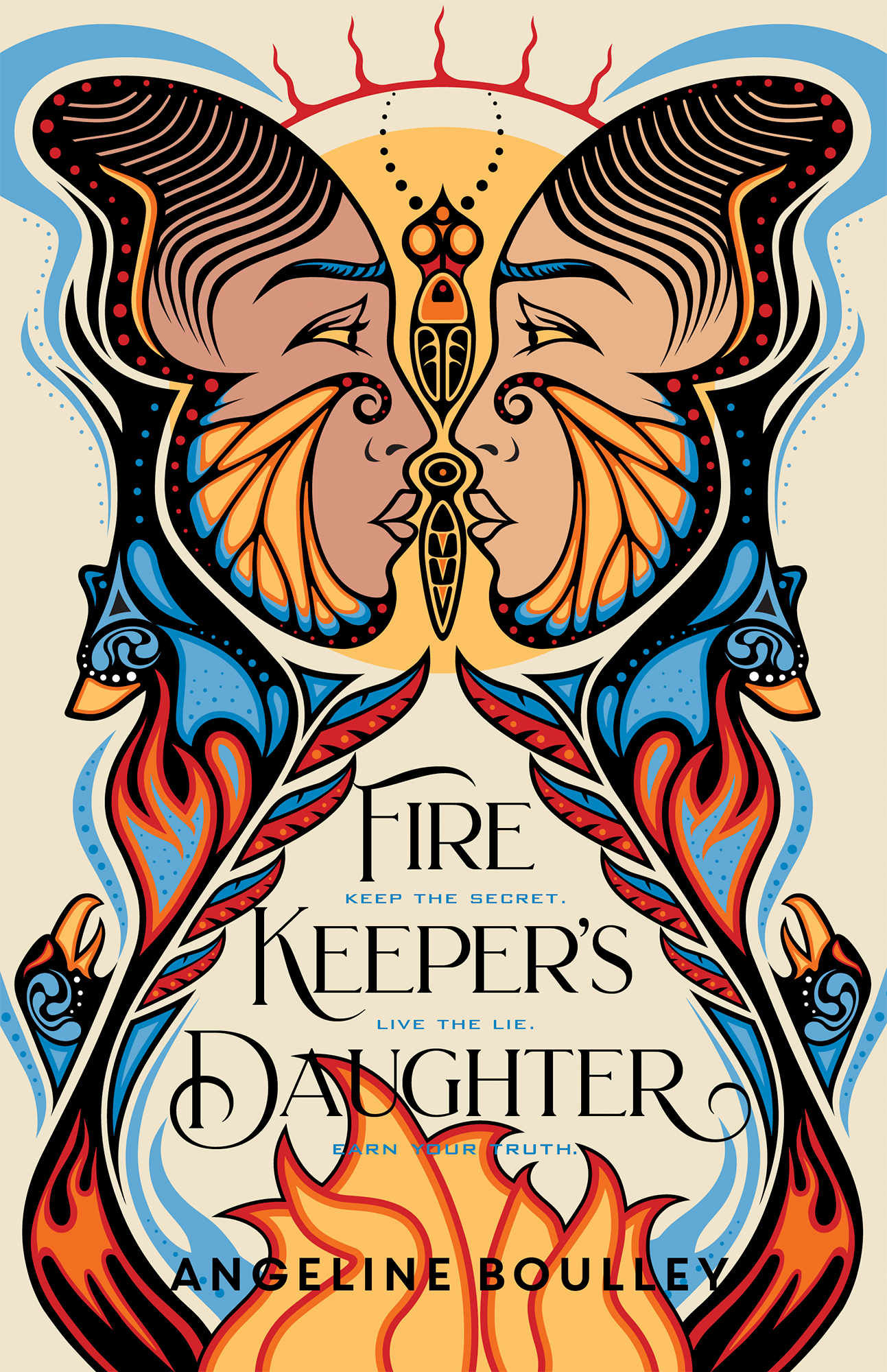
Reggie and Delilah’s Year of Falling – Elise Bryantthe story of a distant crush told through holidays, all while reconciling with current relationships gone stale and grappling with changing feelings.

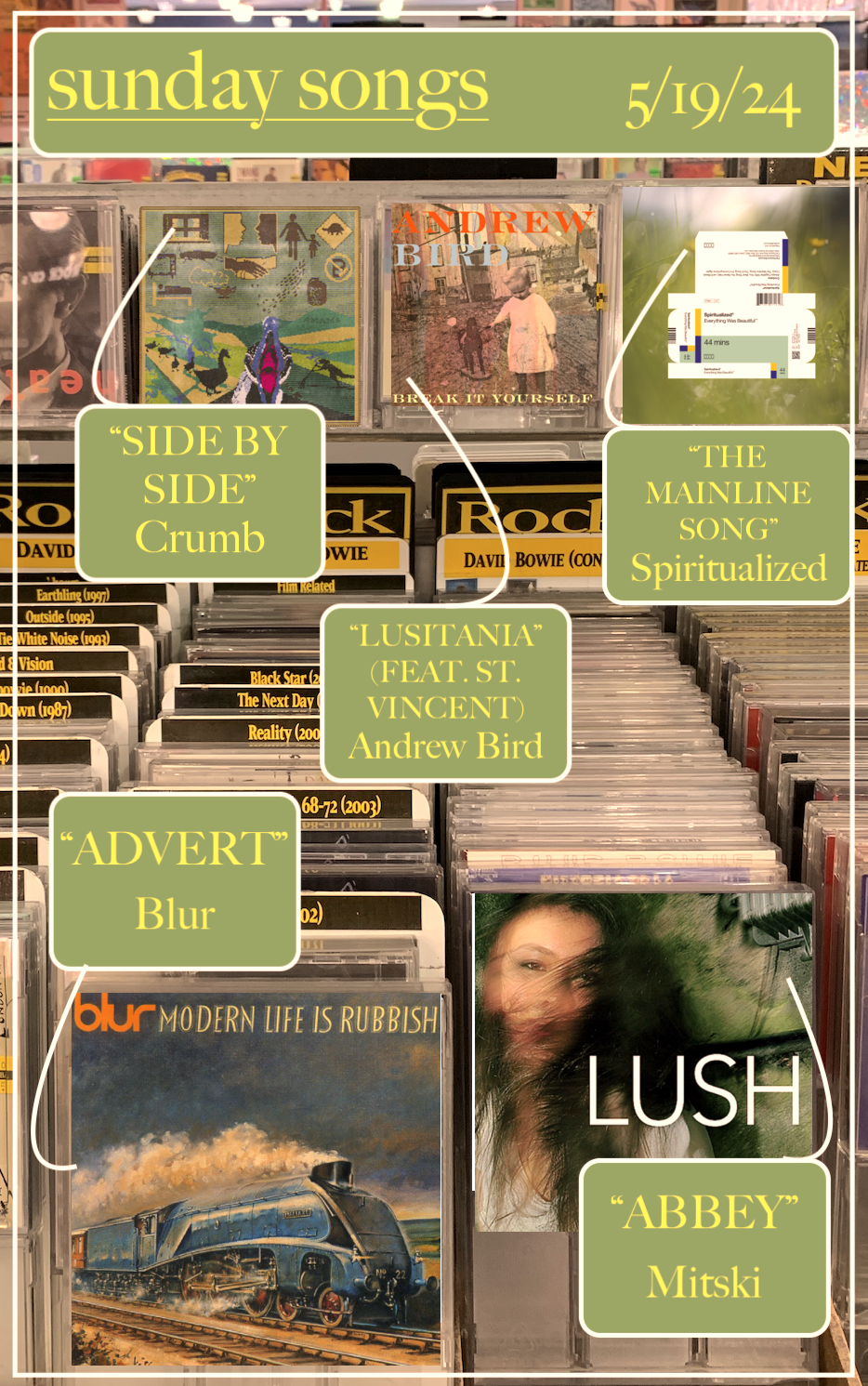
“Dust Bunny” – Crumb

Crumb? Making somewhat uptempo music? It’s more likely than you think.

…I actually mean that seriously, for once. Other than a handful of songs off of their last album, Ice Melt, Crumb has been known for their calm—gentle, electronic dream-pop melodies that drifted along like the bubbles in a can of soda, and tasted of that same sweetness. At least, that’s how I think of their music—in the past few years, they’ve been the band that my mom puts on when she needs to focus on her (incredible!) art, or just do some cleaning—any task that necessitates some calming of the brain. Crumb have recently announced the release of their third album, AMAMA, which is set to release just over a month from now (!!)—May 17. I initially missed “Dust Bunny” when it was released as a single last year, but now that I’ve listened to it alongside “AMAMA” and “Crushxd,” it seems like some sort of shift is on the way for the band…even if it is just the tempo. “Dust Bunny” has picked up the pace, letting the drums take the wheel as the frantic energy blossoms from the (always plentiful) synths. As evidenced by the underwater-sounding effects on both the instrumentation and Lila Ramani’s voice, they’ve never lost that wooziness that coated their earlier songs like syrup (see “Locket”), but the molasses has melted enough to allow for their constant wiggling to speed up. The lyrics, too, feel like a far cry from “I don’t have class/Got a lot of time on my hands/To sit, wait around…”; just as with the music, Ramani recalls a vignette of panic and guilt: “You’re seeing a ghost/Can’t undo what’s been done/Forever no more/Stacks of clothing fill your room, you/Can’t find one thing to return.” Despite the spaciness of the synths, there’s no doubt that it’s morphed from danceable upbeat to the kind of upbeat that’s only so because it soundtracks the search for your sprinting around the house to try and find your keys 5 minutes after you were supposed to leave for work; or, if we’re sticking to the metaphor, trying to get that one dust bunny out of your dorm before your RA comes to do a room inspection so that they don’t think you’ve been living in a pigsty this whole time. But that panic never overwhelms the music—being so cloaked in color-changing mist and melting shapes as it is, it’s still the same ol’ Crumb deep down.

…AND A BOOK TO GO WITH IT:

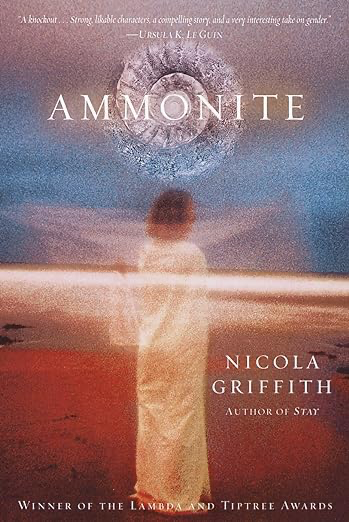
And Other Mistakes – Erika Turnerreconciling with the weight of your past actions and other people’s perceptions takes center stage in this novel.

“Can U Dig It?” – Pop Will Eat Itself

Yet another infectious earworm that I have my dad to thank for, and also, I can definitively say that I’ve found it: my favorite band name. I mean, come on. Pop Will Eat Itself? How true is that? And doesn’t it just sound so cool as a name?

If you’re expecting their songs to be a meditation on the nature of pop, as their band name is, I’m not entirely sure if you’d be satisfied. Granted, I’ve only heard two of their songs (including this one—check out “X, Y, & Zee” for more), and neither of them concern their lyrics with such things. What they’ve got is something far superior: four and a half minutes of listing off comics, movies, TV shows, and bands that they like—sorry, dig. And it’s a blast. Aside from the fact that I never anticipated Alan Moore ever being directly referenced in a song, it’s just a catchy, synthy, fandom-fest—I’m surprised that this hasn’t been accepted as some kind of comic con anthem. Plus, there’s the enhancement of the music video, in all of its terrible ’80s CGI glory—lots of old TV sets floating around in the ether and the band members superimposed over panels from Watchmen and The Killing Joke. It’s the nerdiest club banger I’ve ever heard. What else is there to say? It slaps. Glad we can formally acknowledge that Alan Moore knows the score.

…AND A BOOK TO GO WITH IT:

…well, pretty much anything that they mention in this song: The song is basically a reading list in and of itself, so…

“Poo Pants” – Cyriak

It’s a metaphor for capitalism.

…AND A BOOK TO GO WITH IT:

The YouTube description: Marx who?

“Somebody Up There Likes Me” – David Bowie

And that’s another Bowie album for the books! As…incapacitated as he was during that period, Young Americans feels like the first album of proof of how easily it came to Bowie to slither in and out of genres as easily as most people stroll through an open door. It oozes with slickness—somewhere in my mental periphery, this album exists solely in a smoky nightclub as midnight ticks by, clammy with warmth and blasting with saxophones. Personally, sometimes the sax went on a little too long for my liking (see “Win”), but for the most part, Bowie knew exactly how much to smear about—and make it sound deliciously raw and sultry.

But sultry isn’t all that the album boasts—Bowie always has something clever and meditative up his sleeve. Fresh off of Diamond Dogs, which was full of the proposed contents for a musical version of George Orwell’s 1984 which he never got to make, Bowie had Big Brother on the brain; the kind of theatricality that what I’ve listened to of Diamond Dogs suits a musical well, but as he turned his genre gaze to soul, it almost feels like he had that sultry quality in mind and turned it into deliberate deception. The subject of “Somebody Up There Likes Me” is the sleaziest of the sleazy—a politician who seems to float amongst his subjects without any fear of retribution: “He’s everybody’s token, on everybody’s wall/Blessing all the papers, thanking one and all/Hugging all the babies, kissing all the ladies/Knowing all that you think about from writing on the wall.” As the saxophone howls, Bowie’s fictional figure struts through the street, stopping once in a while to sweep a woman up into his arms and plant a kiss on her cheek. But every act of generosity is an empty one—this is someone grooming the public along with his own image, putting on a show of authenticity just to get them to cough up the spare change from their pockets. Bowie sums it up in the bridge: “Was a way when we were young, that/Any man was judged by what he’d done, but/Now you’ve pick them on the screen (What they look like).” Fresh off the heels of Nixon, I’m sure this was already closer to the political climate than most people wanted to admit, but I can’t help but think of how this has only been exacerbated—and not just in the 21st century. We got Reagan only a handful of years after Young Americans was released (there’s a “savage son of the TV tube” for you), and the cycle has only repeated itself in the years since. But for me, the genius in this song isn’t necessarily about the message, timely as it continues to be; this song could have been put in any of his albums, but having it on Young Americans makes the sleaze glow like neon. Setting this politician against the backdrop of a distinctly American sound, something that comes off so howling and genuine, encapsulates that political climate disturbingly well—a façade of a clean-cut, American man of the people with charm and sex appeal, but with all manner of evils stowed just out of reach of the cameras. The soundscape of Young Americans begs for some kind of old Hollywood love story, and Bowie knew it—and he took that atmosphere to its most perverse extreme just to make it ring true.

…AND A BOOK TO GO WITH IT:

Some Desperate Glory – Emily Teshskeevy politicians persist into the future…

Since this post consists entirely of songs, consider all of them to be today’s song.

That’s it for this week’s songs! Have a wonderful rest of your day, and take care of yourselves!

Posted in Book Review Tuesday

Book Review Tuesday (4/9/24) – A Tempest of Tea

Happy Tuesday, bibliophiles!

I enjoyed Hafsah Faizal’s Sands of Arawiya duology when it came out, but when I heard that she was doing a fantasy heist novel with vampires and tea involved…yep. I’m in. No questions asked. And like her previous books, A Tempest of Tea was full of heart, humor, and more than a little blood.

Enjoy this week’s review!

A Tempest of Tea (Blood and Tea, #1) – Hafsah Faizal

Arthie Casimir runs a tight ship. By day, she runs a tearoom, but as soon as night falls, it’s a hub for vampires. It’s her only livelihood, and the one thing keeping her off the streets. But her secret is slowly spilling out—and the only way to keep it under wraps—and running in the first place—is to make a deal with some of the most dangerous vampires in the city. And infiltrating their inner circles isn’t a job for just one person. With a ragtag crew at her back, Arthie finally has an in—but will they be able to get out in one piece?

TW/CW: loss of loved ones (past), blood, gore, violence, themes of colonialism, racism, human trafficking/kidnapping (past), fire

Everybody, say it with me: every YA fantasy novel with an ensemble cast and a heist plot isn’t ripping off Six of Crows! Every YA fantasy novel with an ensemble cast and a heist plot isn’t ripping off Six of Crows!

Sure, the inspiration is there (it’s hard not to be inspired by Leigh Bardugo, after all), but like The Gilded Wolves or Into the Crooked Place, the similarities end with a fantasy heist plot with multiple POVs. (The same cannot be said for Among Thieves. BOOOOOO.) I already had high hopes that Hafsah Faizal had the skill to pull off a fantasy heist of her own, and she more than delivered—A Tempest of Tea was nothing short of a delight from start to finish.

Hafsah Faizal has a knack for creating lovable characters, the kind that easily bounce off one another and produce no shortage of genuinely clever banter. I’m glad to say that this quality carried over tenfold into A Tempest of Tea! Arthie was such a compelling protagonist to follow; her wit and determination made her the perfect mastermind for the Athereum heist, and her charm made every line of dialogue a treat. Her relationship with the equally charming Jin made for a pair with instant chemistry—they were similar enough that they meshed with each other excellently, but different enough to make them unique assets to the team that they were building. Flick, though the least developed of the three, was just as compelling—I find myself wanting so much more of her backstory! I imagine we’ll get more of that in book 2, but having that part of her somewhat hidden gave her so much more appeal, especially given that she was instrumental to the heist.

The setting was equally lovable in all of its lush descriptions! Already, it’s just pure fun to begin with—a historical, London-like setting with vampires embedded in the culture—what’s not to like? There’s really not a whole lot of magic, but just by introducing vampires and having them affect Arthie’s world in the ways that they did made A Tempest of Tea so much fun to pick apart. A lot of those shifts were evident in the changes Arthie made to her teahouse (and bloodhouse) when night fell—subtle hints like those made the world feel so much more real—and under a very palpable strain. The vampires themselves weren’t the most original take on vampires I’ve ever seen (not really much to distinguish them from any other vampire), but Faizal’s way of writing them is what made them stand out—they were often alluring, but in a way where the predatory side of them was transparent, but their influence of the characters was as well.

Part of why I was so excited for Faizal to do a heist novel was that her style seems like it was made for that all along. She has such a cinematic, action-packed writing style that made the Sands of Arawiya books such an adventure. It seems like more years of writing experience under her belt have benefitted her greatly—all that time honing her writing made A Tempest of Tea a finely crafted heist novel! All of the beats were there, and though they were familiar, Faizal’s writing practically jumps off the page, making the atmosphere seep through the ink and drag you right along with Arthie and her band of outcasts and criminals. There’s tons of well-choreographed action, but just the right amount that it didn’t overwhelm the narrative. Up until the ending (more on that later), the pacing was similarly excellent—the balance of character development/backstory, worldbuilding, and delicately constructing the plot made for a book that I had to force myself to not read in one sitting.

However, my only major issue—and the only thing keeping me from giving it the full four stars—is how the culmination of the heist was executed. We got all of the tension of sneaking into the Athereum and some of the confrontation, but the execution of it felt incredibly rushed. I could almost stretch my suspense of disbelief enough to side with Faizal and say that it was supposed to feel like a blur, but that’s reaching, even for me. There were far too many twists and turns crammed into a single scene, and for all of the somewhat quiet scenes that went on earlier in the novel, I could have used some more page space to spread all of these events out. It was discombobulating, but not in a way that felt stylistic or intentional in any way. It also dampened the emotional impact of the ending—we’d been going so fast that I barely registered that the book had actually ended when it did.

All in all, an action-packed heist fantasy that faltered in some execution at the end, but flourished in its cinematic writing and characters. 3.75 stars, rounded up to 4!

A Tempest of Tea is the first book in the Blood and Tea duology, with an untitled sequel tentatively slated for release in 2025. Hafsah Faizal is also the author of the Sands of Arawiya duology (We Hunt the Flame and We Free the Stars), and has contributed short stories to the anthologies Eternally Yours and The Grimoire of Grave Fates.

Today’s song:

That’s it for this week’s Book Review Tuesday! Have a wonderful rest of your day, and take care of yourselves!

Posted in Sunday Songs

Sunday Songs: 4/7/24

Happy Sunday, bibliophiles! I hope this week has treated you well.

This week:

Choose the best answer: You can blow with:

a) This

b) That

c) Us

d) All of the above

Enjoy this week’s songs!

SUNDAY SONGS: 4/7/24

“Flea” – St. Vincent

Affirmation of the week: I have listened to this song a healthy amount of times. At least I didn’t pull the “listen but nothing but this song for almost four hours straight” stunt that I did with “Broken Man.” See? I’m better now. I’m savoring this one, and by “savoring,” I mean “listening to it slightly less, but still putting it on repeat for at least half an hour when it comes on shuffle.” What new St. Vincent does to an mf.

“Broken Man” is shining proof that All Born Screaming has a good chance of being my album of the year, but somehow, Annie Clark outdid herself even more with this latest single. I’m glad that “Broken Man” and “Flea” are tracks three and four on the album, respectively; even past the fact that they fit so slickly together, I like the idea that the title and closing tracks are a secret—she’s got something insane up her sleeve. I can just tell. After “Broken Man”‘s torrent of fury, vengeance, and Dave Grohl’s drumming, “Flea” makes the transition into the outright bloody—not bloody in the sense of the trail of destruction that “Broken Man” left, but in the sense of parasitism. Clark described the upcoming All Born Screaming as being bred in “That kind of isolation [that] breeds paranoia and loneliness…loneliness can breed violence.” Now I can see exactly where the whole “post-plague pop” label she stuck on it comes from. “Flea” slinks along on tiny, pointed legs, thrumming with a racing heartbeat and an insatiable thirst for blood; the repetition of “Once I’m in, you can’t get rid of me” is sung lower and raspier, a threat paired with a predatory lick of the lips. The kind of loneliness and violence Clark described seems to be exactly where this kind of sinister lust comes from—being isolated for so long could easily make love turn to lust, and lust consequently to hunger, so drained of human touch that what was once affection has become leeching for nutrients at the other person’s expense. And everything about “Flea” sounds frighteningly hungry, down to the parched-throat rasp with which Clark delivers the verses. When she ends verse two with a dried-out confession of “I look at you, and all I see is meat,” followed by a faint belch in the background, I suddenly got the feeling that I was being watched by something waiting to tear me limb from limb and suck me dry. It’s intense, but it’s the kind of intoxicating thrill ride that I’ve taken with Clark for nearly ten years. And the chorus finds the narrator covered in someone else’s blood, begging for just one more bite; the desperation sloughs off like a second skin, every blood-soaked belt starved and howling. It’s a kind of visceral musicianship that I haven’t seen from St. Vincent in years; although Daddy’s Home was certainly raw, it was the kind of raw you get from getting someone enough wine to spill about their childhood trauma and laugh it off. All Born Screaming is about as raw as flesh itself—it’s all the clearer that Clark has no intention of pulling punches, and that’s exactly what makes a St. Vincent song so iconic. “Rattlesnake” and “Severed Crossed Fingers” don’t illicit waves of emotion in me for nothing—they’re hearts laid bare in the street. In other words: Clark is at her best when she’s herself. Should be a given, but it’s more evident in some albums than others.

God, April 26th can’t come any sooner…

…AND A BOOK TO GO WITH IT:

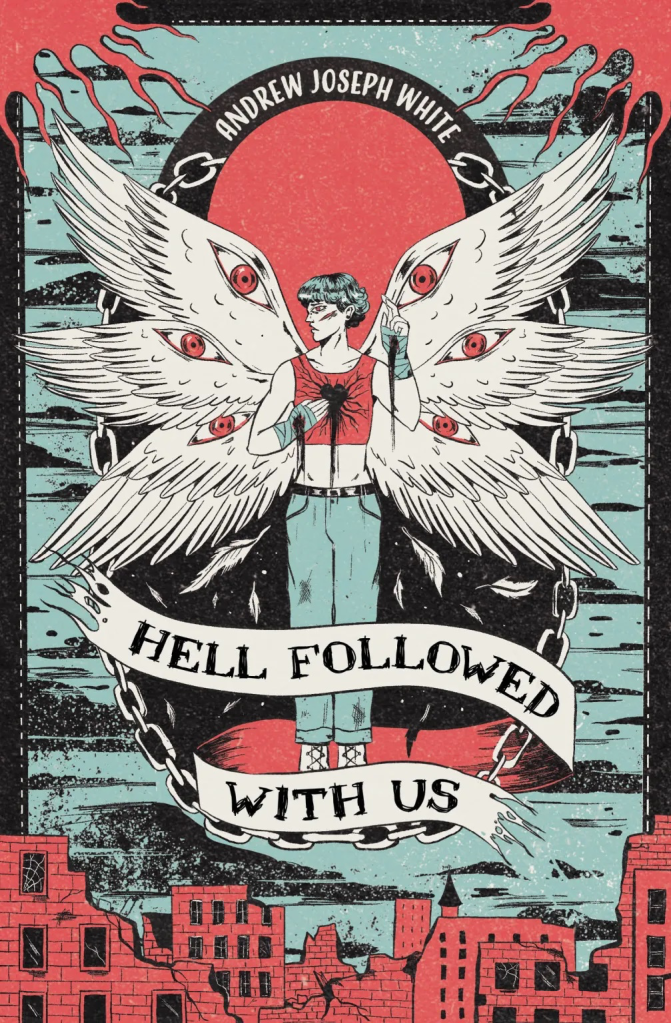
Hell Followed With Us – Andrew Joseph Whitedepending on how All Born Screaming goes, I might preemptively merge this with “Hell Is Here”…

“Tonight” – TV on the Radio

Aaaaaaaaaand, that’s one more album on the Sisyphean Album Bucket List. Between the “Wolf Like Me” (the best song there is about werewolves after this), the deeply moving “Province” with its David Bowie feature (YOU HEARD ME!!), and this, I now know that Return to Cookie Mountain has to make its way into the rotation. I have Chelsea Wolfe to thank for this one; at her fantastic show at the Gothic Theater in March, she played this before the show—I wouldn’t be surprised if she was a fan before, but I suspect that it’s a kind of thank you to the fantastic Dave Sitek, who produced her truly fantastic new album, She Reaches Out To She Reaches Out To She. Also, with a title like Return to Cookie Mountain, I feel like I just have to listen.

What “Tonight” made me realize about TV on the Radio is how effectively—and quickly—they can craft an atmosphere. Some of the most layered ones I can think of are from their early career, namely the first version of “Staring at the Sun” that appeared on their debut EP, Young Liars. Instead of the shorter version that made the cut for Desperate Youth, Bloodthirsty Babes, this one has a thirty second intro (that feels longer, honestly) that consists of just the a cappella vocals of the band, interspersed with an excerpt from a Spanish-speaking radio station. Even though the chatter on the radio station seems cheerful and singsong, the drawn-out gives it a prolonged air of foreboding and sorrow to come, like the next thing we hear will be the somber announcement of someone’s death. Thankfully, that doesn’t happen, but the first lyrics we hear on the heels of that are “Cross the street from your storefront cemetery,” which, bam. That’s how you start a song. When it comes to both of those aspects, “Tonight” operates in a similar way, creating an atmosphere that’s haunting before the instruments even kick in. With the whine of a distant siren and the ever-so-slightly distorted collision of wind chimes, “Tonight” instantly transports you to a place of brown grass and barren vastness, pockmarked by dead trees strung with glass bottles and the faint sounds of the road in the distance. The music seems to lumber with every step, a beleaguered creature that lurches with every step, as if its limbs are tied down with the wind chimes you hear tinkling throughout the song. Hollow whistles harmonize with a moaning clarinet and Tunde Adebimpe’s clarion call of a voice, all at once ragged and brimming with vitality. A fair amount of the buzz surrounding TV on the Radio when they got their start were vocals comparisons of his to Peter Gabriel, and it’s an apt one—they have a similar quality of being roughly visceral, but booming with emotion. Dave Sitek is also credited with “magic” on this song, which I cannot find a musical definition for the life of me, but if there’s anything that you would credit the man for, it’s that. He has the touch.

I often get so caught up in the atmosphere that I only mine the lyrics later, but the lyrics in “Tonight” pop out so prominently on the first listen; as the wind chimes huddle for warmth, Tunde Adebimpe’s voice cuts through them like a steak knife through fabric—”My mind is like an orchard/Clustered in frozen portraits.” How does this man do it? Every single line in this song is a literary gem in and of itself, and it’s not just because of the repeated references to Edgar Allan Poe’s “The Telltale Heart”—like heartbeats rumbling through flimsy floorboards, the lyrics never fail to send chills up my spine: “Her rusty heart starts to whine/In its tell tale time.” My rusty heart sure does whine whenever those lyrics wash over me. And like the sparse nature of the atmosphere, the lyrics tell of a spare mental space, one so full of sorrow and unpleasant memories that, like the telltale heart, cannot be pushed from the mind. The song still haunts me in a largely melancholy way, but it has an uplifting sentiment at its heart. I can’t help but think of Soundgarden’s “The Day I Tried to Live” and its similar atmosphere of doom, but its lyrical heart being the fact that despite all of the horrible things crashing down around you, there will always be something left to live for, so all you can do is push through. Adebimpe’s sentiment feels like wading through a slurry of unpleasantness that never seems to end (“Blossoms that bloom so fine, just to drop from the vine/I’ve seen them all tonight), but he makes the light at the end of the tunnel shine as bright as it can: “The time that you’ve been afforded/May go unsolved, unrewarded/Some nameless you cannot know, may be coming to show you/Unbridled love and light.” No matter how much you have to push down and wade through, never doubt that good things are coming. It’s something I struggle to hold to heart, but I’ve added this song as an unexpected guiding light. I can never know the future. It scares me. But there is certainty in the love lingering beyond my current time. There is always love.

…AND A BOOK TO GO WITH IT:

The Bad Ones – Melissa Alberta similarly haunting atmosphere woven from swirling memories.

“the rot” – Dean Blunt

Contrary to my graphic, this is not, in fact, that well-intentioned but ultimately regrettable black square everybody posted back in 2020. My text box accidentally cut out the 2 on Black Metal 2, the only thing distinguishing it from the cover of Black Metal, which is…also just a black square. Gotta admire Dean Blunt for committing to the bit.

I stumbled across this song thanks to Arlo Parks, who chose Black Metal 2 as one of her picks on her episode of Amoeba Records’ series What’s In My Bag?, where she also talks about my bloody valentine and happens to be wearing one of the coolest Radiohead shirts I’ve ever seen. The songs she discusses there—“VIGIL” and “the rot”—serve as bookends, the opener and closer of Black Metal 2, respectively. Both of them have the atmosphere of a massive curtain thrown over your eyes—you’re immediately thrown somewhere else in a space that Blunt has created; no time is wasted in transporting you into his world. While “VIGIL” has the tidal-wave mounting tension of strings to prop it up, “the rot” is the last, gentle minutes of a plane ride home. It’s a distinctly sunset song: you’re slumped back in your seat, golden light is spilling through the window, and you have the sense, more than ever, that a chapter is closing, but not necessarily in a negative way. You can tell that there’s a myriad of different instruments, but all of them are toned down to a faint crawl, strings gently winding, acoustic guitars drifting away like insects in the early evening. “the rot” in particular has such a gorgeous vocal contrast between Blunt and guest artist Joanne Robertson; like Phoebe Bridgers and Jeroen Vrijhoef on “Garden Song,” what grounds the song is the stark difference, although that of Blunt and Robertson feels much more natural and less jarring than the latter. Where Blunt has the warmth and thickness of the ocean lapping over a volcanic shore, Robertson’s words float like the breeze stirring the water. Both of them drift like motes of dust into the air, closing out Black Metal 2. Without even having listened to the whole album, I can tell how successful “the rot” is as a gentle closer.

…AND A BOOK TO GO WITH IT:

Echo North – Joanna Ruth Meyer – the frost, like the rot, lures you into the woods and makes you chase after old dreams.

“Weapon of Choice” – Fatboy Slim

Me when I walk without rhythm (I didn’t attract the worm):

…AND A BOOK TO GO WITH IT:

Dune – Frank Herbertas is written.

“Satellite of Love” – Lou Reed

Ugh, I’m so glad this song came back intro my regular rotation recently. The outro did wonders for amping me up for my astronomy midterm.

It’s been about four years since I’ve consciously started listening to this song, but I’m sure my dad played it in the car long before that. But I’ll always love this era of Lou Reed, and you know who I’ll also always love? David Bowie. And Bowie, along with Mick Ronson (Bowie’s guitarist in the Spiders from Mars) co-produced Transformer, which has spent a woefully long time on my album bucket list. It’s smack dab in that early-’70s sound that I just live for, and I’ve already heard a handful of the classics from the album already—“Walk On the Wild Side” and “Perfect Day,” to name a few. But “Satellite of Love” remains my favorite thus far, and it’s not just because I collect space-related songs like a bower bird collects shiny rocks and trinkets. As with…well, almost every Lou Reed song, “Satellite of Love” is tinged with melancholy; it tells of love watched from a distance, the aftermath of a breakup watched from below like a stargazer looking at a meteor shower. The offbeat admission of “I love to watch things on TV” feels like an admission of what Reed thought that the relationship had turned into—just something to pass the time and make the eyes go limp. I can’t help but think of Lisa Hannigan—I can’t be sure if this was her exact inspiration, but I wouldn’t be surprised if the chorus of “Passenger” came from a similar metaphor of distant love adrift in the sky—”Oh, my satellite/Oh, my passenger.” For once, Lou Reed is the one that doesn’t sound abjectly in mourning—wistful, sure, but there’s still some light shining in the corner of his eyes, even if it’s just the reflection of a star. For me, the outro is what pumps just the barest pulse of hope into “Satellite of Love”—the piano begins to gallop, clapping and snapping dominates the percussion, and Reed begins a harmony with a wailing, angel-voiced Bowie. Reed remains anchored to the ground, but Bowie, naturally, ascends skyward with every note. There’s something about it that feels like he’s extending a hand from somewhere in the night sky, inviting us to join in the chorus.

…AND A BOOK TO GO WITH IT:

All Systems Red (The Murderbot Diaries, #1) – Martha Wellsthe detached observation of love (and humanity in general) is much more humorous than wistful in nature here, but we can’t deny that Murderbot likes to watch things on TV.

Since this post consists entirely of songs, consider all of them to be today’s song.

That’s it for this week’s Sunday Songs! Have a wonderful rest of your day, and take care of yourselves!

Posted in Book Review Tuesday

Book Review Tuesday (4/2/24) – Drunk on All Your Strange New Words

Happy Tuesday, bibliophiles!

Ever since it came out, Drunk on All Your Strange New Words has been on my radar; beforehand, I hadn’t even heard of Eddie Robson, but the premise was so fascinating that I just had to get my hands on it. After several trips to several bookstores with no luck in finding it, my hold finally came on Kindle—and it was a delight to read!

Enjoy this week’s review!

Drunk on All Your Strange New Words – Eddie Robson

For Lydia, First Contact started in the mind. The aliens we greeted were called the Logi, and they communicated entirely telepathically. Lydia works as a translator for a Logi cultural attaché named Fitz. It’s a pleasant job—Fitz is good-natured, and together, they pick apart plays and literature to determine if they are suited for intergalactic sales to the Logi. The unfortunate side effect is that translating the Logi’s telepathic language into English makes her feel drunk, earning her a less-than-stellar reputation on the job. But when Fitz is murdered and all eyes land on her as the suspect, Lydia must keep the police and Logi ambassadors off of her tail—and get to the bottom of Fitz’s murder.

TW/CW: xenophobia (fictional), murder/assassination, mild violence, death threats

I am on my hands and knees trying to find sci-fi with aliens that really feel alien. The quest is ongoing. But if you’re on that same quest with me (let us join hands, sisters in disappointed with humanoid aliens), Drunk on All Your Strange New Worlds is the cure for all that ails—all that and a dose of some good ol’ British humor.

I get to go off about aliens!! I GET TO GO OFF ABOUT ALIENS!! ALIENS WOOOOOOOOOOO THIS IS WHAT I’VE BEEN WAITING FOR

First off: the Logi! Drunk on All Your Strange New Words boasts some incredible alien design and culture, and I had so much fun exploring it throughout the novel. The whole concept of telepathic aliens whose speech makes the act of translation make humans feel drunk was already fascinating to me; it was so out of left field, and a concept I’d never really considered before; the only other instance I’ve seen of alien speech having unintended physical effects on the human body or brain was in A Desolation Called Peace (though that was arguably more drastic), but it still felt truly weird, which a lot of sci-fi doesn’t touch on, strangely. I loved getting such a complex, multilayered picture of the Logi beyond that, from the head coverings they wear to protect from Earth’s atmosphere to their unexpected strength; some of the elements of them almost veered into the supernatural (technically not much of a spoiler since it happens early on, but the reveal was so cool to me that I’ll keep my mouth shut for your enjoyment), but even that felt like a marker of an alien well done—so outlandish that the only explanation that humans can come up with is paranormal.

Creating all of that excellent background for the Logi is one thing, but it wasn’t all left as a lofty concept to puff up the worldbuilding—it had real, tangible effects on the characters and the plot, which I was so grateful for. Robson executed the real-time effects of humans interacting with a lot of these alien behaviors exceedingly well! It isn’t just that Lydia feels like she’s had a few too many after a long translation job—the feeling of drunkenness extends to drunken behaviors, the consequences of which had unfortunate implications for keeping said job. Having that was also a great device to start putting Lydia under suspicion for the other characters—there were enough instances of perceived instability or unprofessional attitudes that the authorities had all the more evidence to implicate her in Fitz’s murder. This is all to say that Robson really left no stone unturned when it came to the worldbuilding, and my enjoyment skyrocketed because of that!

The cultural environment around First Contact and the integration of the Logi into human culture also felt a little too real, in the best and worst way possible. At this point, the world has advanced into an undefined point in the future, and enough time has passed between now and First Contact that there aren’t just bigots and zealots with xenophobic intention, but organizations targeting aliens and professors giving whole lectures on what they perceive as a Logi encroachment into human culture, literature, and media. Paired with the faulty software that scores the truthfulness of the news that Lydia consumes (that aspect felt very “three days from now”), it felt like a more realistic depiction of alien contact and communication than we usually get; at heart, we still fear what we don’t understand, but it’s neither all-out annihilation of the aliens nor a global, complete hippie kumbaya event of unity. It’s demonstrative of human nature in the face of what we don’t understand: the bad and the very ugly, but enough good to keep us afloat and on good terms with the visitors from another world.

For most of the novel, I was really into the mystery surrounding Fitz’s murder. (I knew it was gonna happen from the start, since, y’know, in the blurb, but I didn’t want for him to die. I just wanna see the little alien guys!! Let them vibe!!) The slow burn of it kept me turning page after page, and for most of the novel, felt appropriately paced. It didn’t feel like we were jumping from place to place for no reason—every outing had a motive and revelation that added to the mystery in a way that made sense. However, though I enjoyed much of it, I feel like it got a little too slow-burn. The subtlety was good for most of the novel, but it got to a point where I was 90% of the way through the book and we still had no idea who the killer was and who the prime suspect was, now that most of the others had been eliminated by that point. Said killer was also introduced very late into the novel and quite sparingly, which made the reveal feel unearned—if we’ve spent all this time poring through suspects and barely touched on the actual killer, then what was the point? For such a clever novel, that felt like such an amateurish move—the only reason that we didn’t suspect them was because we had no idea who they even were for almost the entire novel.

All in all, a delightful combination of sci-fi and murder mystery that boasted some of my favorite aliens that I’ve read in a while. 4 stars!

Drunk on All Your Strange New Words is a standalone, but Eddie Robson is also the author of Hearts of Oak.

Today’s song:

That’s it for this week’s Book Review Tuesday! Have a wonderful rest of your day, and take care of yourselves!

Posted in Monthly Wrap-Ups

March 2024 Wrap-Up 🌾

Happy Sunday, bibliophiles, Happy Trans Day of Visibility, and Happy Easter for those celebrating!

Mentally, I’m still at the beginning of the semester, but somehow midterms are over and I’ve just gotten back from break…ignoring that…

Let’s begin, shall we?

GENERAL THOUGHTS:

I’ve continued to be busy in most of my academic aspects of life, but I’ve managed to stay on top of it—midterms season wasn’t as bad as I thought it was going to be, and it certainly helped that we got an accidental four-day weekend thanks to a snowstorm so drastic that my college called two snow days in a row. I’ve lived in Colorado my whole life, and I’ve never experienced a double snow day…good times, gotta say. I didn’t leave my dorm for all of that Thursday and spent my time playing Minecraft and drinking hot chocolate. A win is a win. But now, the weather’s warming up, and I’m looking forward to soaking it all in.

I honestly thought that this month was going to be my worst reading month, but I read a lot more than I expected; spring break definitely gave me a boost, and March has ended up being my best reading month of 2024 so far! Rating-wise, it’s a different story (certainly more stinkers in this batch), but there were plenty of excellent reads before and after my brief reading slump. Blogging has been about the same—again, school has made it so that I’m mostly sticking to my usual book reviews and Sunday Songs, but I’ve had fun writing them all the same.

Other than that, I’ve just been drawing, playing Minecraft (WE’RE FINALLY GETTING THE DOG UPDATE), studying, watching The Bear, The Completely Made-Up Adventures of Dick Turpin (STAND AND DELIVAH), Abbott Elementary, and Constellation (I haven’t been this stressed out and baffled by a show since Dark, and that’s really saying something), series 17 of Taskmaster, Dune: Part 2 (may thy knife chip and shatter), seeing Chelsea Wolfe live (!!!!! THE QUEEN), and reverting from human to hibernating grizzly bear the minute snow started falling.

READING AND BLOGGING:

I read 19 books this month! I thought it would end up being a lot less than that, but spring break gave me much more time to read. As far as ratings, this has probably been my worst reading month (first DNF and 1-star rating of the year…), but that doesn’t mean that I didn’t read a ton of fantastic books!

1 – 1.75 stars:

The Sevenfold Hunters

2 – 2.75 stars:

Pangu’s Shadow

3 – 3.75 stars:

Womb City

4 – 4.75 stars:

Wuthering Heights

FAVORITE BOOK OF THE MONTH: The Bad Ones4.25 stars

POSTS I’M PROUD OF:

POSTS FROM OTHER WONDERFUL PEOPLE THAT I ENJOYED:

SONGS/ALBUMS THAT I’VE BEEN ENJOYING:

APRIL 26TH CANNOT COME SOON ENOUGH
returning to my sad bastard roots
shoutout to this absolute weirdo and his lyrics
alright I FINALLY listened to this album, great stuff
and the best song title goes to…
such a delightfully summery album
already loved TVOTR, but chelsea Wolfe turned me on to this one. haunting…

Today’s song:

listen this is a banger but don’t think I wouldn’t deck Morrissey in the face without hesitation

That’s it for this month in blogging! Have a wonderful rest of your day, and take care of yourselves!

Posted in Sunday Songs

Sunday Songs: 3/31/24

Happy Sunday, bibliophiles, Happy Trans Day of Visibility, and Happy Easter, for those celebrating! I hope this week has treated you well. 🐰🏳️‍⚧️

For once, I’ve got a color scheme that lines up with the festive colors. Enjoy it while it lasts….either way, this week: songs about love, songs that feel like being in a swimming pool, and songs about jelly.

Enjoy this week’s songs!

SUNDAY SONGS: 3/31/24

“Freedom of Speak (We Got Three Minutes)” – De La Soul

It’s been about a year since De La Soul’s music triumphantly returned to streaming after decades of legal battles, and about a year since my De La Soul awakening. Three Feet High and Rising is now permanently etched into my map of my freshman year of college; I spent a good two weeks with that delightfully creative and unabashedly silly album as my soundtrack, and it put a spring in my step even when the weather remained cold enough for those nasty piles of sludge and dirt leftover from at least three separate snowstorms to stay on the sidewalk. I listened to it in spring, but it’s undeniably a summer album, all bright colors and jumping joy.

Three Feet celebrated its 35-year anniversary earlier this month (3/3), and with it came a handful of demos that got left off of the extensive; it feels like a Kate Bush or self-titled St. Vincent situation (and no, I will not stop shoehorning the latter album into every conversation, this is just how it is talking to me) where they were just cooking so much and without any dilution of talent, so they just had to leave a few tracks on the back burner so as not to a) overstuff the album and b) blow our minds more than they already had. I haven’t had the chance to dig through the other demos and scrapped songs that they released, but it’s clear from “Freedom of Speak (We Got Three Minutes)” that it was a tough decision to leave them off Three Feet High and Rising. Never once was their joyous spirit dimmed, and this track is proof. After a conversation with my family, I concluded that part of what endeared me to De La Soul (and a lot of other hip-hop artists at the time) is that they lacked the machismo that defined the genre in the decades to come; not to get all “mOdERn mUSiC sUCks” with it, but I do find myself missing the early days when people like them or A Tribe Called Quest just released their collage hip-hop with subject matters that, most often, just ended up as anecdotes about their days and the snacks that they liked—or, in De La Soul’s case, a PSA about wearing deodorant that clocks in at less than a minute long. (“THAT’S RIGHT! YOU SMELL 🫵”) Who knows why that mentality got left in the dust; I bet it hasn’t gone away entirely, but I’m not well versed in hip-hop enough to know where it ended up. “Freedom of Speak” has a similarly stream-of-consciousness premise, with a good chunk of it being Posdnuos and Trugoy (rest easy) talking about their routines—taking a shower, cooking breakfast, shopping with girlfriends. But even with such a mundane subject matter, they managed to inject it with the same infectious joy that made the whole of Three Feet High and Risin so memorable—ordinary things feel like the smoothest, most cheerful events to grace the earth, and all of it is wrapped around a fake construct: being forced to cram all of their musings into three minutes. They got cut off at 2:51, unfortunately. Oops.

…AND A BOOK TO GO WITH IT:

The World of Edena – Jean Giraud Mœbiusokay, fine. You got me. I’m double-dipping again. But there’s something similar about the ways that Mœbius and De La Soul are creative—and delightfully technicolor.

“When” – Deau Eyes

Lucy Dacus brought me here; while I was doing some digging on “My Mother & I” a few weeks ago, I found a thread talking about the performance with her mom on backing vocals, and a user mentioned seeing her with Deau Eyes as the opener on at least one of her tours. They both hail from Virginia and seem to be on good terms with each other, and any friend of Lucy Dacus (minus T*ylor Sw*ft) is a friend of mine, so I figured I would give her a listen. And…I can’t get fully on board with most of her style— it ranges from somewhat experimental indie to pure twang, but most of it comes off quite forced. And the fact that a lot of the marketing around her weirdly centers around her being a gemini, of all things (?), is certainly odd, but…if that’s her worst sin, then I can let it pass. That one’s probably more on her marketing team than on her.

“When,” against some of the other Deau Eyes songs I listened to, sounds more like 2020’s Sleater-Kinney, which is a win I’ll certainly take. Even if my enjoyment of Deau Eyes extends mostly to this song, it’s a smoothly urgent indie shuffle, rattling along with Ali Thibodeau’s (ohhhhhhh, so that’s where the name came from) vocals, which hold the melody steadier than an anchor holds down a time-battered ship in the stormy sea. Delayed guitar riffs travel in neat circles around the centerpiece of Thibodeau’s voice, playing tricks on my ears as I try to pinpoint exactly where they’re coming from—a single center or hovering all around? It’s almost dizzying on headphones, but Thibodeau keeps it reserved enough to not overwhelm the song. In this case, it’s the lyrics that are the spotlight; in a world where we are told that we are naught but products to be sold, when our bodily wellness is the cost for being able to navigate through the world with any kind of arbitrary success, Thibodeau has a bridge that couldn’t be any more relevant: “Hey, I see you/You matter more than you think you do/Each and every move, it matters too/So set the mood.” Just like how Thibodeau’s vocals anchor the music, she anchors the space around her, encouraging us to follow suit; the lyrics are simple, but undeniably true. Maybe I’m not sold on every part of Deau Eyes’ catalogue, but good on her for spreading the good word of letting yourself take up space in a world that wants to make us small. It’s what you deserve.

…AND A BOOK TO GO WITH IT:

VenCo – Cherie Dimalinethe time has come to reclaim your space, and by “reclaim your space” I mean “exact feminist witchcraft justice upon the skeevy, corrupt white men who wanted to take that away.”

“Jelly Filled Coffin” – Hether

Sometimes, you have a long and sentimental reason for finding and subsequently liking a song. Sometimes Apple Music digs it up, slaps it on the abject depression “Chill” playlist, and you listen to it just because of the name. It’s like “Crocodile Tears and the Velvet Cosh”—if there is ever another song called “Jelly Filled Coffin,” they’ll be copying this guy.

I first talked about Hether (a.k.a. Paul Castelluzzo) a little over a year ago, and I didn’t expect to be talking about him again—”Shy” was sweetly catchy, but I didn’t find myself wanting to uncover more of his music. I guess I’m a lazy, no-good, Gen Z slave to That Damn Phone then, since Apple Music did the discovering for me, but…for once, the algorithm did something good, unlike the time that of Montreal’s nearly 10-minute-long suicidal ideation “No Conclusion” landed on, of all places, the “Get Up!” playlist. I can’t make this shit up. At least we can take comfort in the fact that no human mind could fuck a playlist up that badly. You have to take the wins when they aren’t blatantly the product of automation. Even though Play it Pretty was released only three years after Hether Who? – EP, there seems to have been a shift towards the meandering for Hether; “Jelly Filled Coffin” has the glassy eyes of the peak of summer, humid and delirious from staring too long in the sun. The first comparison that came to mind was a less psychedelic Ty Segall—they have a similar delivery, drifting like a lazy river in the public pool, but just as brightly chlorine-colored. Every line feels like it’s being dictated from somewhere in the depths of the same pool, rippling and unnaturally blue (or is that the jelly? Depends on the jelly we’re talking about). The concept of a jelly-filled coffin was such an oddball pairing that I almost didn’t think of how oddly tragic it could potentially be—presumably being lowered six feet under, but trapped in a substance slippery enough to give you the illusion of movement. That would explain the resignation with which most of the lyrics are delivered: “Rip it out from my chest/Keep the love and leave the rest/Tether me to a post/A parasite chose you, the host.” And yet, even with the exhaustion creeping through the ripples of distortion, it never feels truly sad—it’s more delirium than outright depression, sleepwalking on the borders between sadness and just being tired. My dad made the comparison of his lyrics to Robyn Hitchcock, and many of his songs have a similar quality; on anybody else, it might sound tragic, but here, it could just be as deep as words strung together that sounded unique.

…AND A BOOK TO GO WITH IT:

In the Watchful City – S. Qiouyi Lua meandering body-hop between the stories of strangers inhabiting a strange world.

“Nostalgia” – Alice Phoebe Lou

Like Hether, I never expected to be wandering back around to Alice Phoebe Lou. I think it was around two years ago that I found her through “Witches,” which came from an old high school friend after I posted one of those “send me a song that reminds me of you” question boxes on my Instagram story. I was glad to have a new song to spin around in my head, and I was gladder still that something as gently bubbly as “Witches” reminded them of me. It sneaks back into my shuffle every now and then, and I never complain when it does.

“Witches” and “Nostalgia” are only about a year apart in terms of release date, but both of them are broadly categorized under blues; the former doesn’t feel like blues at all—more sparkly indie pop than anything, but I have no purview to talk about how blues has evolved as a genre over the decades—but the latter certainly does. Fitting that this song is called “Nostalgia” in the first place, since all of it evokes a time capsule made of sea glass, harkening back to the slow, swaying melodies of the ’40s and ’50s, but with a distinctly modern touch. If there was one lyric that would properly encapsulate this song, it would be this: “It feels like swimming/Swimming with my eyes closed.” Indeed, the soft organs and Lou’s voice feel like they’re being projected from inside of an underwater cave, a rich gray until the light from a crack in the ceiling makes the water dance on the ripples in the rock. With every lyric, you travel further in the water in slow motion, the foam from your impact fanning out around you, bubbles swirling upwards as you close your eyes, letting the waves kiss your skin. And yet, it feels just as vividly like a ballroom slow dance, engulfed in golden light as the sunset fades into night and drinks clink all around you. Whichever effect Lou was going for—or neither of those at all—is suited to her voice; her voice dips from a quiet, bluesy coo to a musical exhale that echoes through the caverns with ethereal gentleness.

…AND A BOOK TO GO WITH IT:

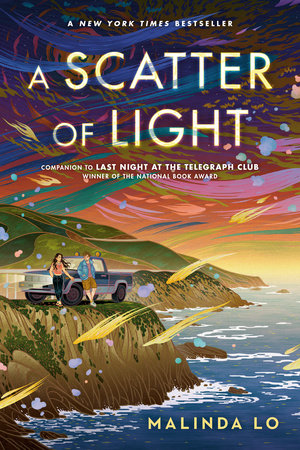
Last Night at the Telegraph Club – Malinda Lolesbian love in the 1950’s, with a dash of butterflies and moonlight kisses.

“Charm You” – Samia

This is one of maybe…three or four Samia songs that I’ve listened to so far, and I wish I liked them all as much as I liked this one. Then again, there’s only a certain type of as-of-yet undiscovered musician that can cover The Magnetic Fields’ masterpiece “Born on a Train” (which I reviewed about a year ago!), and…I hate to say it, but Samia is not that kind of musician. But I’ll let it slide—Arcade Fire covered the same song ages ago, and they didn’t quite pull it off either; they have the extensive instrumentation to theoretically pull it off, but the only recordings I could find were ones where the sound quality isn’t great and Win Butler was singing like he had the world’s most painful case of strep throat, so…not exactly their proudest moment either. It’s hard to cover near-perfection. I feel like Peter Gabriel has been one of the only people I can think of to cover The Magnetic Fields well and not make it sound either more melodramatic than it ever needed to be or just plain bland (seems there’s no in-between), but also, that’s Peter Gabriel. I should also mention The Shins and their excellent cover of “Strange Powers”—that, at least, was perfectly suited to James Mercer’s penchant for bare emotion, and even though The Magnetic Fields have such a dense orchestration to a lot of their songs, making this one acoustic wasn’t as risky of a move as it seems—Mercer makes it work beautifully. (Childhood staple, too.) We aren’t worthy of The Magnetic Fields, and we are similarly not worthy of Peter Gabriel or The Shins. It’s a hard act to follow. So props to her for trying, at least. Chances are I’m just too attached to “Born on a Train,” but I feel like to cover it, you’ve got to back up all that emotion with the toy-train-on-plastic-tracks instrumentals and faded grandeur peeking out from behind the curtain.

That aside, Samia captured something truly rare in “Charm You”—there’s something about it that sets it apart from all the other songs of hers I’ve listened to. Some of her other songs feel like she’s stretching her voice too thin, but the warm wails of this track perfectly suit the mood she’s meticulously crafted—a love song, but not one of wanting to chase a lover down or get them to like her. I’ve unintentionally bunched together too many songs that inherently feel like swimming, but this song in particular is a dive into a hot tub, a slow, boiling love that seeks to bare its soft parts: all of the pretense of a crush is gone, and all that’s left is to fall in deep: “What if we could shut up for an hour or two/Quiet, memorizing what the people do/Wouldn’t have to try and find myself in you.” The style of songwriting that Samia has taken is an approach I’ve seen a lot of indie pop artists take—collaging a hodgepodge of vignettes together to form a cohesive story—often a love story. It’s a move right out of the Phoebe Bridgers/Arlo Parks/Lucy Dacus/[fill in the blank with your sadgirl of choice] playbook, but what makes them stand out from the others is the emotion that strings them together—it’s not random moments just to flash your songwriting chops. That’s a trap I’ve seen a lot of songwriters fall into, but for once, Samia seems to have the writing flair to pull it off; every lyric on “Charm You” sounds like a red-cheeked confession with a bashful smile, giggling at some charmingly awkward memory: “Baby, let me show you the synthetic pond/Couldn’t we believe it was the hand of God/Making water boogie to a Ke$ha song?” Maybe it’s the way that the word “boogie” feels so out of place that it fits in perfectly or the image that it creates (I can see the warm, blue-lit water rippling from here, wherever there even is), but Samia’s vignettes are ones that stick, and not ones that just toss in a fruit metaphor and talk about smoking on the porch, or something. Like the album cover of Honey, there’s a blue warmth about “Charm You” that instantly charms the heart.

…AND A BOOK TO GO WITH IT:

Margo Zimmerman Gets the Girl – Brianna R. Shrum and Sara Waxelbaumtrying to be someone you’re not—even if it’s the prevailing queer stereotype—isn’t the surefire way of making someone like you, but maybe tutoring and mutual pining will…

Since this post consists entirely of songs, consider all of them to be today’s song.

That’s it for this week’s Sunday Songs! Have a wonderful rest of your day, and take care of yourselves!

Posted in Book Review Tuesday

Book Review Tuesday (3/26/24) – The Cybernetic Tea Shop

Happy Tuesday, bibliophiles!

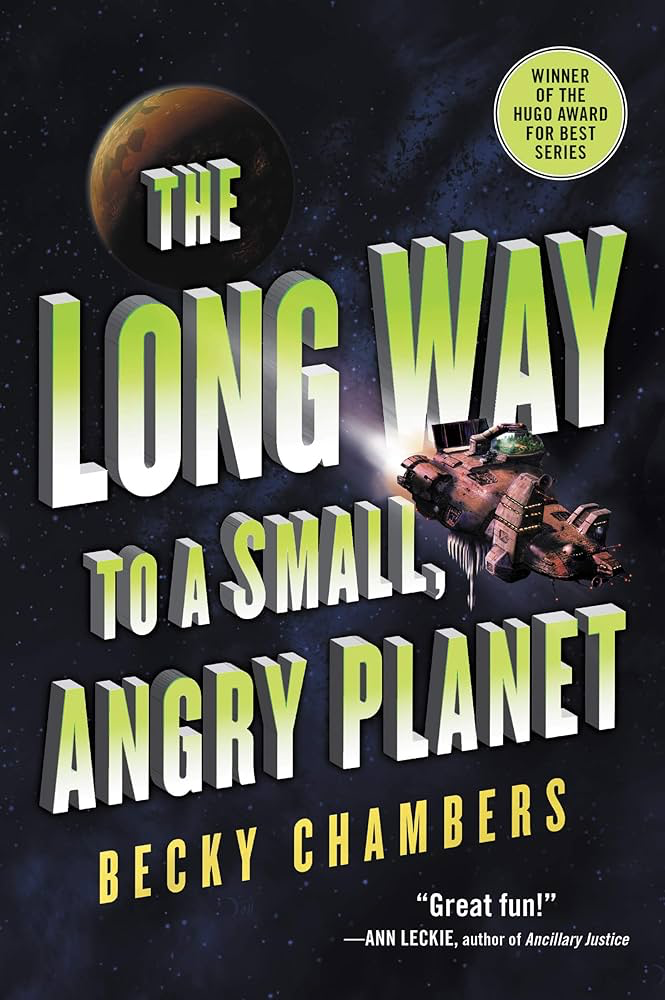
There’s a special place in my heart dedicated to cozy sci-fi, but the sad thing about it is that hardly anybody does it well save for Becky Chambers. I guess it’s hard to reach the bar when it’s been set astronomically high (no pun intended), but I will still read any cozy sci-fi that comes my way, despite the amount of times that the blurb “for fans of Becky Chambers!” has severely led me astray. However, in the midst of my reading slump, The Cybernetic Tea Shop was the perfect novella to tide me over and lift my spirits.

Enjoy this week’s review!

The Cybernetic Tea Shop – Meredith Katz

After the death of her master, Sal, an autonomous robot operating outside of the laws of a futuristic America, runs the tea shop that her master founded. For hundreds of years, she has run it like a well-oiled machine, but something in her program seeks something more. When Clara, an AI technician struggling to make ends meet, walks into Sal’s tea shop by chance, they have an instant spark of friendship—and perhaps even something more. Is Clara what Sal needed all along, and is Sal the key to the similarly vacant space in Clara’s heart?

TW/CW: loss of loved ones (past)/discussions of grief, hate crimes/discrimination (sci-fi)

Since about 2021, I’ve lost count of the amount of times that the tagline “for fans of Becky Chambers!” has let me down. Nobody does cozy sci-fi like her; all of the times I’ve read books with that promise, you get some semblance of found family (which comes off rather forced, in the worst instances), but it often lacks the quiet, tender moments that put the cozy prefix in. However, in that respect, I’m glad to say that The Cybernetic Tea Shop wasn’t a letdown—not without its flaws, for sure, but more than enough to scratch my never-ending cozy sci-fi itch.

I’ve been in a very novella-centered headspace for months, given that I’m trying to write one for class and I’ve been studying how they work for said class as well. One of the foremost concerns we’ve been talking about is how much worldbuilding you can fit into such a small space—often 100 pages or less. The key, I’ve learned, is, after giving your reader the necessary context to make the world feel real, is to only expand on the parts that are essential to understanding the circumstances of your characters. Katz did an excellent job of establishing this kind of worldbuilding, and it speaks to what a novella can achieve in such a small page count! Inevitably, I found myself wanting more of the futuristic American setting that Katz built, but the context we get is only what we need to understand Sal: the creation of intelligent robots, the outlawing of said robots because of ethical complications with intelligence, and the discrimination and illegality of robots in the centuries since. It’s the perfect foundation to set up not just the world, but the conflicts that these characters encounter.

Cozy sci-fi, by nature, often keeps things small; a handful of characters, a singular setting, and all else happening in the background. Novellas, also by nature, typically scale it down as well. The Cybernetic Tea Shop only centers around two characters, but that’s all it really needs; this novella is small in every aspect, and that’s why it largely succeeded. By narrowing down two characters (and their budding romance) and a single, unique setting, Katz confined her world to reasonable limits to explore in a novella; nothing ever felt too convoluted or too large to fit into just over 100 pages, but it didn’t feel too sparse, either. Similarly, aside from the character-driven focus (also the backbone of cozy sci-fi), there’s hardly any plot points, and that was actually a strength of The Cybernetic Tea Shop—in terms of structure, it was practically a Goldilocks of novellas.

However, although the general craft of the novella was commendable, the writing left a lot to be desired. For such a fascinating world and two characters moving through it in a unique way, I wanted so much more from the writing. The prose was rather bare-bones, doing the bare minimum to describe a setting or situation. I wanted so many more descriptions—and genuinely interesting descriptions— of Sal’s tea shop; you can do so many fun things with a tea shop, but I hardly got a sense for what it looked like, what it smelled like, or any other kind of sensory details. Similarly, the dialogue, although it had moments of being sweet, was often bland and stiff, and felt transactional in terms of the prose—just a way to get from point A to point B. Given that the romance between Clara and Sal was what eventually drove the novella, transactional dialogue is the exact opposite of what The Cybernetic Tea Shop needed; the kind of romance that Katz was shooting for wanted to be anything but transactional, but ended up falling flat.

In addition, I found myself wanting more from the characters. Again: cozy sci-fi is a heavily character-driven subgenre, and the evolving relationships between the characters are what make the plot go forward, and not necessarily outside conflict. I did like that Katz only zoomed in on Clara and Sal, but I almost wish that the novella had been all from Sal’s perspective. We get a very detailed and nuanced vision of Sal’s character, from her grieving her long-dead master to her insecurities and fears about being in hiding as an autonomous robot. Clara, on the other hand, was given very little of the same treatment; I would have liked to have seen her have some kind of romantic hurdle to overcome—commitment issues, hesitance, or something along those lines—that would make her something more than just a tool to instigate romance. We did get some of her background, but it didn’t add to much about her in terms of personality—the only part of her character that paired her with Sal was that she’s an AI technician, and therefore in a place to help Sal. With the focus on two characters, it would do Katz a favor to give both of them the fleshing-out that they deserve.

That being said, although Clara’s characterization left a lot to be desired, I did like the more romantic aspect of the plot towards the end of the novella. Even beyond the super sweet asexual/wlw representation (both Sal and Clara are asexual and sapphic!), there was a lot about the romance that worked; the setup of Clara fixing Sal’s programming evolving into cuddling was such an adorable and genius setup, and the resolution that came from it was similarly heartwarming. It did feel slightly rushed, but aside from that, Katz left it in a place where I didn’t quite want more, but was satisfied in knowing that their relationship was bound to blossom. I wanted something cute, and I got something cute, so Katz 100% succeeded on that front!

All in all, a tender, cozy novella with sweet romance and tight structure, but bland prose and half-baked characterizations. 3.5 stars!

The Cybernetic Tea Shop is a standalone, but Meredith Katz is the author of several other novels for adults, including the Pandemonium series (The Cobbler’s Soleless Son, Behind Bars, Heir to the Throne, and Barred Souls), the Sixth Sense Investigations series (Empty Vessels and If Wishes Were Fishes), and many more.

Today’s song:

shoutout to chelsea wolfe for playing this before her show. hauntingly beautiful.

That’s it for this week’s Book Review Tuesday! Have a wonderful rest of your day, and take care of yourselves!

Posted in Sunday Songs

Sunday Songs: 3/24/24

Happy Sunday, bibliophiles! I hope this week has treated you well.

This week: sit down, kiddo. Soon you’ll be a mature adult, so your father and I have decided that you’re ready to learn about the (acid, lady) birds and the bee(tle)s.

…why are you leaving?

Enjoy this week’s songs!

SUNDAY SONGS: 3/24/24

“Dissolved Girl” – Massive Attack

Like Odelay, I’ve very much screwed myself over when it comes to this album; as my brother was showing this song to me in the car (thank you, by the way), I talked to him about the album, and after we talked about all of the songs I’ve heard off of Mezzanine, we concluded that I’ve…basically listened to the whole thing, save for some of the apparently duller songs and some instrumental breaks. Oops. My brother’s advice was to go through the album in its entirety anyway, so I’ll still take that advice. Eventually. The Sisyphean album bucket list persists.

I have a special soft spot for songs that sound like their album art. Most of the tracks on Mezzanine have a similarly creeping feel, but “Dissolved Girl,” to me, feels the most like Nick Knight’s photograph of a shiny, almost glistening stag beetle; the initial photo was taken by Knight at London’s Natural History Museum. Minus the pincers, it almost looks like the exoskeleton of a xenomorph—also a fitting image for the creeping feel of some of Mezzanine’s tracks. Much of the album retains that prickly feel of looking at the fine hairs adorning the beetle’s legs, but this song, especially the intro, captures it best. I can almost imagine that same beetle in captivity, scuttling around across a blank canvas in erratic patterns, like a shot from an old nature documentary. Its antennae twitch, it pauses in thought, then scuttles off into a corner again, only to emerge a few seconds later. Looking back, I’m ashamed that I completely missed that fact that this track was also featured in The Matrix. Granted, I was also so caught up in the glorious cheese of that movie that there wasn’t much else to focus on except for a) that one absolute monster of an H.R. Giger fever dream scene, and b) the fact that Keanu Reeves can barely act (sorry, dude, I’m sure you’re a nice guy). But like the stag beetle’s shell, that sleekness blends in with the landscape that the Wachowski Sisters crafted all those years before. I’ve tricked myself into thinking that there were raindrops or dewdrops on said beetle’s shell, but no—it was a trick of the light, and a trick of the music. “Dissolved Girl” runs over your skin like frigid water and catches all the colors of light like an oil spill, darkly alluring in the dapples patterned across it. Sarah Jay Hawley’s voice isn’t just sultry—it’s a puff of rasping steam from a rusty teakettle, blossoming into strange clouds as it’s swallowed by synths and guitars that were made for dramatic entrances and nothing more. It really is dissolving, but it seems to reform itself every passing second, an ouroboros of electronic deja vu.

…AND A BOOK TO GO WITH IT:

The Fifth Season – N.K. Jemisinthe lyrics don’t reflect the connection so much as the feeling of it does—uncertainty, circularity, and deja-vu abound.

“Acid Bird” – Robyn Hitchcock

Note to any aspiring songwriters who may come across this post: I accidentally typed “acid birthday” into YouTube while looking this song up, so there’s a good song title right there. It already sounds ten times ickier in subject matter already, but…it sure is a song title.

Robyn Hitchcock seems to have been planted in the rich, fertile soil of ’60s musical inspiration from the start. Listen to any of his songs from his solo works or from one of his many groups over the years, and that bright, whimsical jangle always pops out of the woodwork. But before I saw him back in January, I found out that he’d played several short shows where he only played sets of Syd Barrett covers, and the comparison clicked instantly. Personally, I’m glad that Hitchcock took the good parts from Barrett’s legacy and never went off the deep end, but if there was ever a perfect fit, the two’s musical and lyrical styles were practically made for each other. There’s no doubt that plenty of artists have found drugs to be an outlet for imagination, but it’s always temporary; I never mean to make light of addiction and the very real consequences it can have on a person and their loved ones, but every time I hear about any of these instances, it’s a short-lived outlet. We know where it tragically led Barrett (rest easy) and many other artists of his time, but often, these things have been discovered have always been dormant—maybe it was the drugs that exposed them, but that kind of creativity lingers in all of us. We all have different ways of finding it, and all we can do is learn to live with it carefully—the very things that we perceive as opening it can destroy it just as quickly. At least we can look to Hitchcock as an example—it seemed he knew early on that his wild creativity was at the wheel, and he’s managed to preserve it for decades.

That kind of easygoing, ’60s feel is etched all throughout his decades-long, insanely prolific career, but some of the earliest notes of it, to me, can be found in his first solo album, Black Snake Diamond Role, and in particular, “Acid Bird.” Aside from the unmistakably sixties jangle of it all, from the lazily swaying chords to the way that the guitar is almost made to sound like the limbo between a guitar and a sitar. And like the entirety of Hitchcock’s career, this song is full of oddball wordplay, entirely nonsensical, but somehow sensible, in the sense that, having seen him live, he had every intention of putting these words together in this exact order. It’s unmistakably late ’60s psychedelia—I can hear the lyricism of Pink Floyd’s “See Emily Play” and the instrumentation of…well, probably any late ’60s Beatles song you can think of, and yet, it couldn’t be anybody else but Robyn Hitchcock. Going even later, I’ve always thought of his wordplay as so much like Marc Bolan, like he has access to some bizarre fantasy world that can only be described to us mortals in words that don’t fully make sense when strung together in the order that they are. I’m just glad that Hitchcock has dedicated his career to mapping it in all of its hills, valleys, and acid birds.

…AND A BOOK TO GO WITH IT:

The Crane Husband – Kelly Barnhilla hazy, eery crawl between genres, steeped in slipshod tapestries and sinister birds.

“Barley” – Water From Your Eyes

If you laid out all of the elements of “Barley” bare, it would fit a pretty common definition for really pretentious music. You’ve got your discordant synths, you’ve got your avant-garde, nonsensical lyrics, you’ve got some off-kilter guitar riffs for good taste, and you’ve got disaffected vocals courtesy of Rachel Brown, who sounds for all the world like they did not want to be there. But this song feels more in the vein of play than construction—the minimalism and freeform feel of it all feel like just that: freeform. It feels like this song was conceived in 5 minutes tops, and I’ve grown to enjoy that quality about it. I keep bringing up Beck in this post for reasons unknown to me, but the technique of Water From Your Eyes (or, alternatively, what sigma male gymbros call tears) seems to be similar: stick a bunch of parts together with a bit of synths and Elmer’s glue, then create the most earwormy eyesore you’ve ever heard. I say “eyesore” only because it’s the best word that comes to mind—it doesn’t sound pleasant, and yet, it sounds good. Between Brown’s vocals, the hectic instrumentations, and the urgency of it all, “Barley” feels like the squirming child of Guerilla Toss and Wilco’s “Spiders (Kidsmoke)“—drolly sung, but full of lyrics that could be prophetic, and as jagged and crawling as all get-out. I’d never thought I’d compare those two, but that’s the beauty of this song—it’s a strange, stiff chimera of a song, and I love it and all of its jerky, weak-kneed beauty.

…AND A BOOK TO GO WITH IT:

Aug 9 – Fog – Kathryn Scanlana similar connection of loose bits and bobs, this time in the form of poetry made from what remained of a stranger’s diary that Scanlan found at an estate sale.

“Ladybird” – Jim Noir

HE’S BACK! Well, he never really left, and was doing some incredibly impressive things while he was “gone,” but he’s back to serving up EPs via Patreon (as always, support a fantastic independent artist if you’re financially able! It’s worth your while!).

Before the switch from monthly EPs to releasing the excellent record Rotate as half of Co-Pilot, a lot of the EPs he was putting out were starting to feel thinned out; even at the beginning of the project, many of the tracks were throwaways that he later polished up, but as time went on, some of the whimsical, lighthearted creativity that he’s known for seemed to have bled out somewhere down the line. The last few EPs felt a little hollow—the last thing I’d expect of Jim Noir, the same mind that could make a song about putting off going to the store to get tea (if there was ever a more British concern) into a sunny, ’60s-flavored synthfest. I wouldn’t be surprised if he was saving his musical time and energy for Co-Pilot during the weaker run of EPs (justifiably so, I mean, God, what a record), but I did miss the more creative tidbits. It seems that some time away has given him time to shake things up, and now we have Ladybird – EP, which I can happily say is a delight! I found myself particularly drawn to the title track; there’s still a hesitant restraint about it, but it has every hallmark of a catchy Jim Noir tune—cymbal heavy drumming, humming vocals, and of course, bleep-bloop aplenty. Gotta have that good bleep-bloop. The background is decorated with sounds that almost ring like a submarine’s radar, and the rest of it hums with buzzy energy, nervously scuttling about like the insect it’s named for. It’s hesitantly bouncy, with eyes that seem to dart about every few minutes before ducking behind the nearest door. I wouldn’t call it his masterpiece, but it gives me hope that this could be the start of the album that he’s been teasing for…almost two and a half years now, I think? If Rotate is all we get, then I’d certainly be happy, but I find myself wanting another win for Jim Noir. It’s what he deserves.

…AND A BOOK TO GO WITH IT:

Binti – Nnedi Okorafor“I’m surrounded by things I’ve never needed so much/I’d rather give it away instead of finding it’s not enough…” right there, huh?

“Spun” – Chelsea Wolfe

As I’m writing this, it’s been about a day since I saw Chelsea Wolfe a second time for the She Reaches Out To She Reaches Out To She tour. Insufferable crowd and headache-inducing opening band notwithstanding (2/3 times that I’ve seen shows at this venue, the crowd has been gross and disrespectful, so…hopefully not a curse), she and her band put on an incredible show; obviously, nothing’s going to compare to my first experience seeing her at the Stanley Hotel, which is about as goth as one can get even if Wolfe isn’t present, but what this show had going was the fact that one of her songs was performed whilst some kind of trick of the light made her look like she’s standing astride some kind of fiery, inter-dimensional portal. What I’m trying to say is that she absolutely brought down the house. As usual.

Somehow, I thought that “Spun” would be on the setlist, and I listened to it a handful of times before the show, but…I guess I remembered wrong? It wasn’t one of the songs I was sorely looking forward to seeing, but I do feel a little silly now that the song I’ve picked for this week is the one she didn’t play. Well, any excuse to talk about Chelsea Wolfe is a good excuse, so here we are. Seems I need to add Spun to the album bucket list, since almost everything off of it has been nothing short of arresting. “16 Psyche” was the first song from Spun I heard, back when my tender, 14-year-old brain was as impressionable and soaked up melodramatic lyrics like a sponge (listen, there’s nobody else who can deliver “my heart is a tomb/my heart is an empty room” but her); now that I’ve seen it live, it’s one of her most captivating tracks. But “Spun” is captivating in an entirely different way; where “16 Psyche” takes a nosedive into cloak-billowing wails and drama almost immediately, “Spun” has the pace and feel of mold crawling up the walls. Staunchly on the more metal side of Wolfe’s brand of goth-metal (I promise I’m not stringing buzzwords together, that’s just her brand), the industrial drums and guitars march like a legion of robots summoned from hell, armor cracked as they trudge through the flames. Fleeting moments of said drums speeding up provide a cliff for the instruments to dive off, then leap straight down into the lake of fire, a tenuous equilibrium shattered when you least expect it. “Spun” prowls with its hackles raised, poised to bolt from a history best left in the flames: “I lift my eyes, I slow my gait/And I never wanna see you again.” But the final breaths of “Spun” are exhales released from a clenched chest, fittingly whispered by Wolfe as though she’s speaking in tongues: “And all and everything or nothing.”

…AND A BOOK TO GO WITH IT:

The Genesis of Misery – Neon Yangthe title already sounds like something that Chelsea Wolfe would name an album, but even if that weren’t true, this novel is chock-full of fiery forges, prophetic madness, and the voices of angels (or are they?)

Since this post consists entirely of songs, consider all of them to be today’s song.

That’s it for this week’s Sunday Songs! Have a wonderful rest of your day, and take care of yourselves!
Posted in Book Review Tuesday

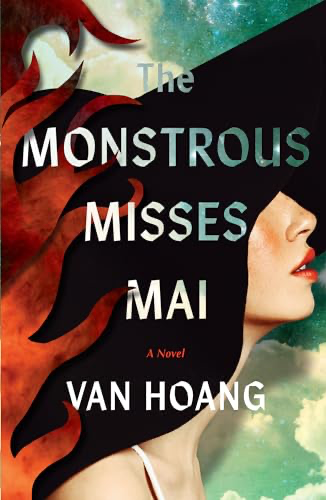
Book Review Tuesday (3/19/24) – The Monstrous Misses Mai

Happy Tuesday, bibliophiles!

Technically, this review is an early review, but I didn’t get it as an ARC—I got it through the Amazon First Readers program. Usually, the books they offer aren’t my cup of tea, but The Monstrous Misses Mai seemed intriguing, and I never say no to free Kindle books. I love a good story about witches, and though it was predictable at times, The Monstrous Misses Mai was an entertaining addition to the wide subgenre!

Enjoy this week’s review!

The Monstrous Misses Mai – Van Hoang

Los Angeles, the early ’50s. Cordelia Mai Yin is down on her luck. Disowned by her parents and out of work, she’s been finding it difficult to find a place to stay. The apartment she eventually finds is cramped and occupied with three other roommates, but they have more in common than just their middle names. They all have unfulfilled dreams—and they all need a way to pay the rent. Callum, a mysterious friend of their landlord, knows it too. He offers them the deal of a lifetime, in exchange for a small sacrifice. Now, Cordi has a stable income and the job of her dreams, but the spells binding her reality are quickly beginning to fade, and the girls are running out of sacrifices to appease them…

TW/CW: body horror (mild), murder, loss of loved ones, manipulation

WARNING: this review contains some spoilers!

I received a free copy of this book as part of the Amazon First Reads program!

In the grand scheme of things, I don’t blame these characters—mostly Cordi—for turning to witchcraft to find a way to pay the rent. You gotta do what you gotta do in this economy. And in the economy of L.A. in the ’50s too, I guess.

The Monstrous Misses Mai was such an entertaining novel! I love a good book about witches, but I would say that it’s slightly different than your typical witch novel in that none of the main characters know what they’re doing with their magic. They’re all but sucked into a magical pyramid scheme that requires greater and greater sacrifices as it drains them little by little. Magic always comes at a cost: we all know that from the get-go, and this novel is no exception. But not knowing what exactly would happen to the women of the Mai residence was what kept the tension up for this novel for me. Although I wanted more out of the eventual climax (more on that later), it was a great narrative tactic to keep the reader guessing—not necessarily about where the plot would go, but about how things would go wrong for the characters.

Van Hoang has excellent prose, and it especially served this novel when it came to describing both L.A. in the ’50s. Her descriptions are so vivid and colorful—there wasn’t a single image in this novel that I couldn’t visualize in almost cinematic detail. The way that Hoang described both the cramped loft that the Mai women share and the glitz and glamor of the fashion world that Cordi finds herself entangled in made the world feel so much more tangible, and the divide between the double lives that the characters lived felt so much more fleshed out and tense as a result. Having such a stark contrast made the creeping feeling of dread for the characters even more palpable—with the magic that they were dabbling, the glamorous lives that they were leading would no doubt catch up to them.

The Monstrous Misses Mai focuses on four women (Cordi, Tessa, Silly, and Audrey), but we’re reading entirely from Cordi’s perspective. Cordi was a compelling enough character, and her struggles—both financial and magical—fueled the plot and pacing in a steady way. However, I wish I could say the same for the other characters. Tessa was next in terms of the most fleshed-out character, but for most of the novel, she only felt like Cordi’s confidante, and not the magical accomplice that she was supposed to be. Silly and Audrey were barely characterized at all—Silly was only seen in sparing glimpses, and what we got of Audrey was entirely one-dimensional; Audrey was the token no-nonsense, “guys, maybe it’s a bad idea to be messing around with forbidden magic” character, and all the resolution gave her was an “I told you so” [strikes pose with hand on hip] moment and no development whatsoever. I feel like this novel could have worked better as a multi-POV novel; if we got into the heads of all four of the Mai women, we could have gotten individual ideas for their specific stakes, risks, and transformations.

Remember what I said about not knowing about the magic? It worked for most of the novel, but when it came to the ending, I found myself wanting more. The resolution felt so predictable—they’re finally too many spells deep to reverse their magic, leaving them in a worse situation than they were before. For a little while, I almost thought it was going to resolve in some kind of tired “oh, women and their vanity hahaha, you know how chicks are” ending, but luckily, it’s 2024, so not to worry about that; I do appreciate that the blame was placed squarely on Callum for being the one who instigated a magical pyramid scheme and nearly stole their souls. However, I feel like there wasn’t a whole lot that was original about Hoang’s take on this kind of story. I expected there to be something strange about what the magic cost them or how their transformations occurred, but all we get is their (very mild) bodily deterioration and some lost fingernails/hair loss. Which, yeah, the fingernails were pretty gross, but I found myself wanting a kind of unique magical toll that it took—something otherworldly that would ultimately expose them. It wasn’t bad, per se, but it wasn’t the most memorable take on this kind of story.

All in all, a story of witchcraft and deception with memorable prose but not-so memorable twists. 3.5 stars!

The Monstrous Misses Mai is a standalone, and Van Hoang’s adult debut. Hang is also the author of the Girl Giant and the Monkey King series (Girl Giant and the Monkey King and Girl Giant and the Jade War) and the forthcoming middle grade novel Hidden Tails.

Today’s song:

That’s it for this week’s Book Review Tuesday! Have a wonderful rest of your day, and take care of yourselves!

Posted in Book Review Tuesday

Sunday Songs: 3/17/24

Happy Sunday, bibliophiles! I hope this week has treated you well.

Happy St. Patrick’s Day! Despite appearances, you theoretically would not actually be able to pinch this week’s graphic for not wearing green, despite wearing mostly brown. Please give it up for Lucy Dacus and her green top.

Also, most of the songs this week are either bittersweet or just………flat-out sad, so…apologies in advance.

Enjoy this week’s songs!
SUNDAY SONGS: 3/17/24

“Sarah” – Alex G

I knew it. I knew I’d fall into the Alex G trap eventually. My Car Seat Headrest-poisoned brain finally succumbed to another sad white guy with voice cracks and bedroom recording equipment. It was only a matter of time.

I genuinely can’t decide if “Sarah” is fully tragic, or if there’s some sweetness in there. The atmosphere that Alex G creates certainly leans toward the former; listening to this song is a blur from a car window, sticky with the humidity of the South as you drive past flat, dismal lawns and white-painted houses that have stood there so long that the paint has peeled and molded to brown in the corners. It dwells in a kind of dream-space where the narrator is hesitant to leave, knowing that the consequences will crash down upon them the minute they step foot into the less-green grass on the other side of the fence. Again, my mind has permanently been altered by listening to too many of the earlier, lo-fi Car Seat Headrest songs when I was at the tender, impressionable age of 14, but there’s an enchanting melancholy of the cheap distortion on the guitar and the synths that drift like ribbons underwater, each note trailing off like a thought unsaid. In a way, “Sarah” is a kind of love song, but with a love that’s overshadowed by the damning realization that you’re not the right person for the one you love. And yet, the narrator cannot extricate themselves from Sarah, wanting to cling to her desperately, but knowing that the more they stay, the more they’ll destroy her. It doesn’t feel like a self-hating, depreciating kind of awareness—it’s a crushing realization that the narrator really is, in some way, in a place where they’ll only drag the people they love down with them, against all of their wishes. That’s what makes it tragic to me; Alex G sings half of the song in a higher pitch that drives his voice to shattering cracks, and you can hear his voice break as he sings the line “she loves me like a dog.” The distorted howl of “did I make a mistake?” feels like it drifts up into a smoky, firework-scented sky as it dissipates into digital nothingness, an anguished thought birthed in the depths of introspection.

…AND A BOOK TO GO WITH IT:

Man o’ War – Cory McCarthya painful and poignant journey of learning to love yourself and other people.

“Houdini” – Kate Bush

Two years ago, I doubt I would have listened to The Dreaming in full. I warmed up to Kate Bush’s earlier stuff more easily, but with the onset of the most recent season of Stranger Things, I was just kind of Kate Bush’d out, which, for a woman of her insane talent, it kind of embarrassing to say. I just couldn’t turn a corner without hearing “Running Up That Hill”—as objectively good a song as it is, the omnipresence of it turned me off. But two years, a listen to The Kick Inside, and more than a good word from my brother (the world has never seen a more fervent Kate Bush superfan), and I finally found myself here. I’m glad I listened to it now—even though my love for “Suspended in Gaffa” (still my favorite track) persisted through the summer of 2022, there was so much weirdness and artistry to the album that it was almost overwhelming—more than once it felt like that in a “mom, come pick me up, I’m scared” way (see: “Get Out of My House”), but overall, that was all apart of the package deal. Admittedly, I can’t fully get on board with all of it; as much as I love the lyrics to “Sat in Your Lap,” that song has irrationally annoyed me since I was a kid, and that quality hasn’t exactly faded—I wish it had, but it’s in the minority of songs that I actively skip on this album. After three albums, this almost feels like Bush’s Hunky Dory: the moment where she had honed her skills and image and officially started going absolutely bonkers.

One such aspect that Bush had nailed by the time that The Dreaming came around was channeling raw, untapped emotion; you can almost feel the bewildered, shaking tears slipping from her eyes as she is faced with something divine in “Suspended in Gaffa” and the feral release in the form of braying like a mule at the end of “Get Out of My House.” It’s overwhelming because it’s exactly what you’re supposed to feel—both of these songs are about separately intense and overpowering emotions, and I believe there’s very few musicians out there who can make that tidal wave translate from the music to the body. That’s already a feat, but given that she was 24 when she released this album…okay, I need to stop googling “how old was Kate Bush when she released [insert album],” because I inevitably get existential. Either way, it’s talent—and “Houdini,” the album’s grief-drenched penultimate track, is testament to that. Recounting the story of Houdini’s wife, Bess, who tried to contact him through seances with a code that the two had devised to ensure that it was him (“Rosabel, believe”); contact was allegedly made in 1929, but she lated believed the code to be the result of trickery from beyond the grave. It’s a deeply tragic story, and Kate Bush pulled no punches in drowning “Houdini” in sorrow. Soft piano dominates the piece, but when it isn’t demure and solemn, Bush lets out a mourner’s wail so convincing that I’d easily believe that she’s channeling Bess Houdini’s bereaved spirit as she bellows out “With your life/The only thing in my mind/We pull you from the water!” That image, of Houdini passing the key to his chains to Bess through a kiss, was what made it on the cover art—I thought it was a wedding ring for the longest time, but to be fair, only the round part is visible on her tongue, and the rest is concealed behind her lips.

…AND A BOOK TO GO WITH IT:

The Monsters We Defy – Leslye Peneloperomance, daring, and communicating with spirits beyond the veil.

“Objects” – Big Thief

Alright. That’s enough of the abject depression for now. Here. Sit down on the bench beside me. Here’s $20, go see a Big Thief.

I’d like to think that I’ve found out about all of these separate Big Thief songs independently, but in reality, all of the songs I end up listening to are the ones brought up by my fantastic brother’s equally fantastic girlfriend, so once again: thank you. If there was ever a song to describe this time of year—nearly spring, almost warm, and the grass is still brown but peppered with sprouts pushing through—it would be “Objects.” Each pluck on the guitar feels like worms and beetles gently crawling through crumbly earth, the shifting of tiny pebbles and dead leaf fragments as they bore tunnels through the ground. This was only recorded about eight years ago, but there’s already a stark difference in Adrianne Lenker’s voice; when I think of this song and earlier songs (see also: “Velvet Ring”), her voice sounds papery, thinner than thumbnails and soft enough to fold into simple origami. It’s gotten simultaneously more feathery, more feral, and richer with the years, but what I’ve heard of these first two Big Thief albums feel like time capsules in her vocal evolution. And like the springtime that “Objects” evokes, the lyrics are all about the spillover of love as it begins to blossom; like the same sprouts that push their way to the sunlight, the object of affection inspires the narrator to “[Leave] the familiar/Air is getting chillier/Stepping outside your skin.” It’s not just Lenker’s voice that feels understated—all of the instruments feel restrained and green, but it conveys that fizzy, bashful feeling of the beginnings of love.

…AND A BOOK TO GO WITH IT:

A Million Quiet Revolutions – Robin Gowqueering the Revolutionary War, and the blossoming of young love.

“Your Young Voice” – King Creosote & Jon Hopkins

I generally have Joe Talbot of IDLES to thank for a lot of things, namely the musical positivity he’s brought into my life, but I also have him to thank for finding this song. Recently, Talbot was featured on BBC’s CBeebies bedtime story segment, where, after reading the picture book Under the Love Umbrella, he listed off some songs to soothe children. This was one of them, and the minute I heard it, I understood completely.

This song is a very sparing one. In a sense, “Your Young Voice” is barely a song at all. It’s only two lines that repeat for almost three and a half minutes: “And it’s your young voice that’s keeping me holding on/To my dull life, to my dull life.” And yet, it tugs at the heartstrings more than some songs with a full verse-chorus structure of the same length. The lyrics are so simple, and yet, their repetition weaves together what a mountain of unnecessary stanzas do in any other piece; their repetition feels like a promise, a mantra—you get the sense that whoever’s young voice is keeping the narrator anchored, the only thing keeping them clinging to the end of their fraying rope. Repeated over these three and a half minutes, it feels like a prayer to remember why they’re enduring this life in the first place. King Creosote (a.k.a. Kenny Anderson…King Creosote is a fantastic stage name, if I’ve ever seen one) has a voice with a constant, shuddering waver that whispers over your ears like cold wind over the plains, and that waver is what cements that image of frailty and unconditional love for me. “Your Young Voice” is also simple in its composition—mostly acoustic guitar, with some piano that fades into the ending as Anderson’s voice dissipates into the fog, but this song is all about dredging the well of deep emotions from a place of emotions stripped bare: there’s no need for embellishment or flair. No matter if your interpretation of the young voice is a parent to a child or teenagers falling in deep (not the interpretation that would’ve come to mind first, but that’s how Sex Education took it, although they used a cover…not nearly as good as the original, in my opinion), this song is love, boiled down to its tearful essence.

…AND A BOOK TO GO WITH IT:

Under the Earth, Over the Sky – Emily McCoshnot to double-dip on the pairings (it’s been three months, it’s fine), but this one is an even better fit, in my opinion—the bare tenderness of the father-son relationship at the heart of this novel was made to be listened to with this song.

“My Mother & I” – Lucy Dacus

When I was thinking about organizing this graphic, I was just loosely going off of looks, not necessarily what order the songs are in. That’s generally how the process goes. However, there are times where I end up shooting myself in the foot and then turning around and shooting the feet of everybody else who might happen upon this post. I mean…I guess “Houdini” or “Sarah” would been kind of an awful way to end this batch, but it looks like we’re bringing down the house with…Lucy Dacus ruminating on the complicated relationship between her and her mother. Real light stuff to go with your Sunday morning cup of coffee, huh? My bad, guys.

2019, the album where “My Mother & I” appears, is part cover album, part original material, each song released to coincide with a holiday—“La Vie en Rose” for Valentine’s Day, “Dancing in the Dark” for the shared birthday of her father and Bruce Springsteen, and “In The Air Tonight” for Halloween (Lucy, it’s a good cover, but…that’s the song you cover for Halloween? Out of all the objectively spookier songs that exist?), etc. “My Mother & I,” as you probably gathered, was released on Mother’s Day, and also to coincide with Taurus season—both Dacus and her mother are Tauruses, part of what the song anchors itself around (“The stars have a lot to say/About women born in the month of May”). It’s a beautiful song, but I find myself glad that I haven’t been able to connect to it fully; the relationship that Dacus describes with her mother, the distance and later connection emphasized by the fact that Dacus was adopted, is one that seems to be full of fractures, but scored by the love that ultimately tethers them. I’m so close to my own mother that it makes me thankful that, even if I had the aspiration to write music, the only feeling that would come up is gratitude because I have the honor of being her daughter. There’s a restrained kind of sorrow that hints at places where Dacus seems to have needed the guidance of her mother (“They called me an old soul/When I was too young to know/The difference between a soul and a ghost/I feared what was inside/Trapped in my body, kept from the other side/A spirit searching for a second life”). “My Mother & I” comes from a place of wistful rumination, but ultimately reaches for a sense of forgiveness and commonality—Dacus branches beyond the Taurus connection to a wholly human one—”We want love, warm and forever/We want to die in the presence of our loved ones/My mother and I.” It’s…ow. Yeah. I don’t know why I went into a Lucy Dacus song that I hadn’t heard and not thought “hmm, surely it won’t be emotionally crushing!” But in this case, the emotional core comes from a kind of forgiveness that has taken years to spread its roots, but has only grown stronger in the dirt with age. And it seems that the forgiveness is mutual, since she’s since performed this song with her mother on backing vocals:

…AND A BOOK TO GO WITH IT:

Our Crooked Hearts – Melissa Albertforbidden magic with lineage through a flawed mother and a daughter left to pick up the pieces.

Since this week’s post consists entirely of songs, consider all of them to be today’s song.

That’s it for this week’s Sunday Songs! Have a wonderful rest of your day, and take care of yourselves!