
Posted in Book Review Tuesday

Book Review Tuesday (9/16/25) – Mistress of Bones

Happy Tuesday, bibliophiles!

Guess who’s back/back again…with a negative review. Oopsies.

Yeah, sorry. I feel like this always happens, and I hate that it’s happening a) right when I come back to blogging in earnest and b) at the start of Latine Heritage Month. I swear this has happened so many times. (Don’t worry! I made a whole post about so many more books by Latine authors that are actually worth a read!) But a gal’s gotta review some bad books sometimes, and remember, kids: a book’s diversity doesn’t immediately mean that there aren’t any issues with the writing.

I’ve been hearing about Mistress of Bones around the blogosphere, and the premise seemed like some classic, YA fantasy fun. I regret to inform you that I’ve once again been duped into reading a very lackluster and generic fantasy book. There’s some slack I’m willing to give this novel because it’s Maria Z. Medina’s debut, but god, I haven’t read such a hot mess in quite some time.

Enjoy this week’s review!
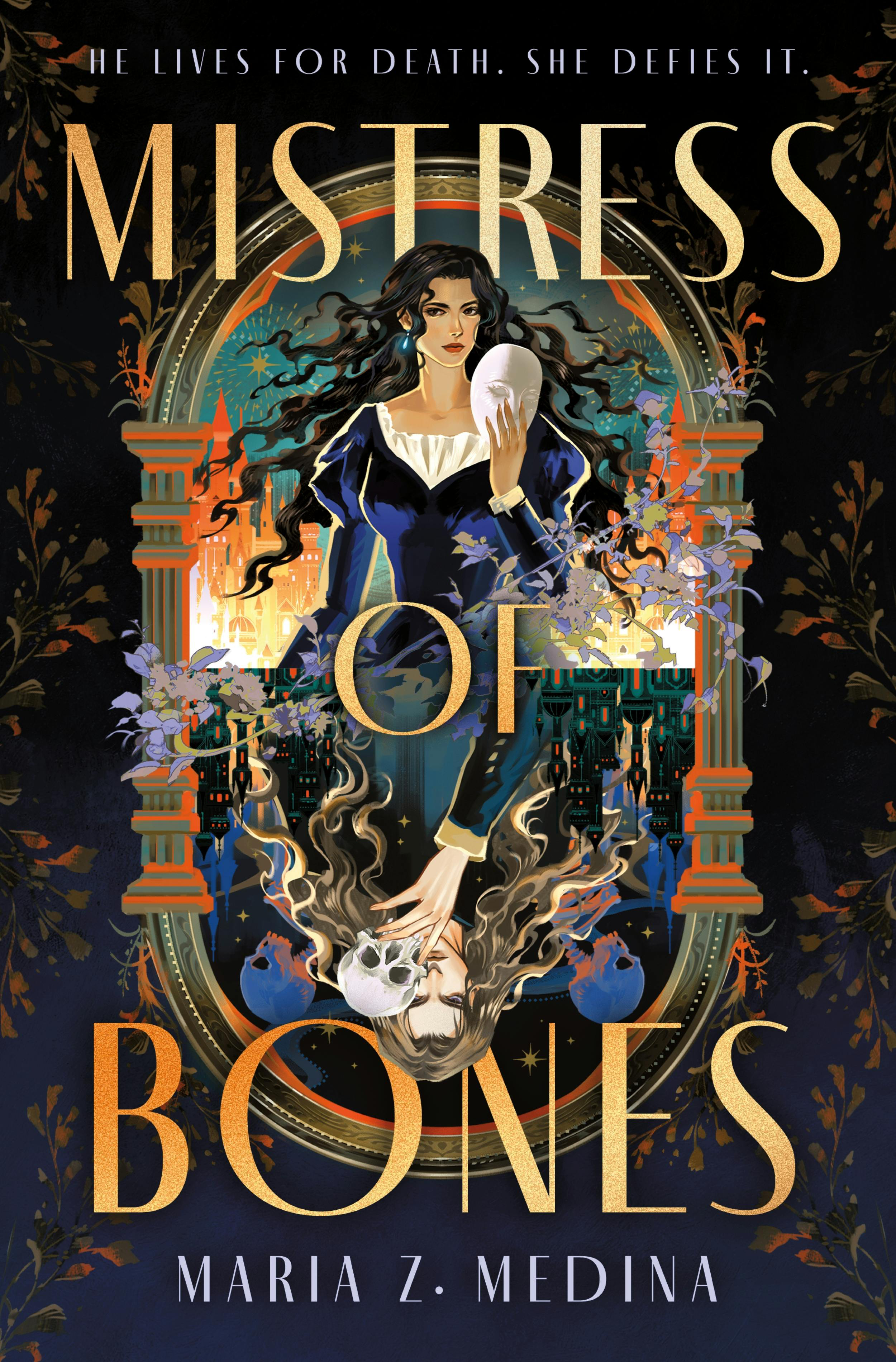
Mistress of Bones – Maria Z. Medina

Azul de Arroyo cares for little more in life than her beloved older sister, who had an early death at fourteen. But by channeling the bone magic of her people, she was able to resurrect her at a young age. But when her sister is killed again, she has no choice to journey to the capital city in order to steal back her sister’s bones and return her to life. Soon, Azul has run afoul of the Emissary of Lord Death; her escapades have not gone unnoticed, and he’s got his eye on her. The rules of Death cannot be reversed so easily, and he’ll do anything to stop her—however pulled he is to her. Dragged into a tangled web of dark magic and court intrigue, Azul must do everything in her power to bring her sister back—even at the cost of the world.

TW/CW: animal death, loss of loved ones, violence, gore, murder

DNF at about 60%. I just couldn’t take it. I really tried to make it through this one, but at a certain point, I realized just how fleeting life is, and wanted to spend that life with something other than this novel.

Listen. There’s a certain amount of slack I’m willing to give a novel like this based on a) the fact that it’s a debut novel, and b) how hard it is to get published as a marginalized author. Every novel is, to some extent, a labor of love, and I’m sure this was the truth for Mistress of Bones. I don’t mean to discount the work of Medina and anybody else involved. But god, this was a MESS. Labor of love as writing always is, this needed at least two more rounds of editing. At LEAST.

The problem with the setup of Mistress of Bones wasn’t that it had a nonlinear timeline. I don’t even know if I would call it nonlinear, but there aren’t adequate words to describe…quite what the situation with this novel is. It’s less nonlinear and more just thousands of flashbacks in a trenchcoat posing as a novel. I didn’t mind them in the prologue, and in fact, I did actually enjoy the way the prologue set up the narrative and the tone of the story. It was appropriately spooky and it set up Azul’s character nicely—it got the job done. However, this novel ended up being 50% flashbacks. Mind you, they weren’t just to the same period as the prologue, but jumping to entirely random years in the past. None of it made any logical sense, and not even in a convoluted way—it wasn’t complex, the plot points were just scattered every which way. At that point, if that much of your plot is propped up by taking random detours into the past, there’s something desperately wrong with the plot. Take the flashbacks away, and the plot was just the writing equivalent of a pile of crumpled-up tissues on the ground.

I’m usually one for bombastic dialogue; in fact, I’d like to think that I have a good tolerance, given the steady diet of classic sci-fi novels and ’80s X-Men comics I consumed when I was in high school. If done right, campy dialogue can enhance the atmosphere and the writing style in many ways. But Mistress of Bones missed the mark by miles. The key to its downfall was how self-serious it all was. Once again: I still read a good amount of YA, and there’s a certain amount of drama that you’ve got to accept from the get-go. But Medina constantly had teenagers exclaiming “Bah!” like Romantic English poets and then spouting off the corniest lines of dialogue known to man without an inch of self-awareness. (Thomas Thorne-core, and I don’t mean that in a good way. iykyk.) It was just so self-serious that it defeated the purpose of amping up the drama. What’s more is that all of the characters had the exact same voice. I expected it to be just reserved for the spooky edgelord male YA love interest, but no…they were ALL involved in this. If you’re aiming for drama, you at least have to do it right.

Speaking of the characters…they were also woefully mishandled. I’m wise enough in my older years (read: my early twenties) to know that hardly any YA fantasy book marketed with a Six of Crows comparison delivers. But this was a special kind of mismarketing. First off, only Azul, the Emissary, and Nereida really got any page time. There were a handful of other purportedly important characters skittering about somewhere, but they got so little page time that I lost interest in them and their minimal sway over the plot. Not only that, but even between the main characters, they all had virtually the same voice. They all had that pompous, overly self-serious tone that I spoke about earlier, but there was almost zero variation between any of them. You mean to say that a witch, the emissary of death himself, and a seventeen year old girl would have the exact same speaking voice? It’s almost like they were indistinguishable from each other on purpose—I can’t think of any other explanation for the breadth of how far this hot mess spreads.

Beneath it all, I can’t really say that there was much about Mistress of Bones that grabbed my attention. There were a few quirks in the worldbuilding that kept me reading for a good length, but they were barely sustained. I’m always excited to see Latine-inspired worlds and cultures in genre fiction, but it barely extended past the Spanish-inspired names. I was intrigued by the whole concept of the floating continents and the gods that mandated this seismic shift, but it barely seemed to have any bearing on the plot or the characters. The Emissary of Death should’ve had significant sway over the plot and over Azul’s actions, but the title only served to give him more edgelord love interest points. Looking back, I think this issue boils down most of my problems with Mistress of Bones as a whole: it was all setup with no payoff. We were promised a multilayered, multi-POV fantasy with romance and intrigue, and we only got the bones of those things (no pun intended). It was all skeleton, with no skin or muscle tissue to make the novel into something that could function on its own.

All in all, a novel full of messy, undelivered promises masquerading as a plot. 1.5 stars.

Mistress of Bones is Maria Z. Medina’s debut novel and the first novel in the Mistress of Bones duology; no information is currently available about the sequel.

Today’s song:

GORILLAZ AND SPARKS, THIS IS NOT A DRILL

That’s it for this week’s Book Review Tuesday! Have a wonderful rest of your day, and take care of yourselves!

Posted in Book Review Tuesday

Book Review Tuesday (10/29/24) – The Book That Wouldn’t Burn

Happy Tuesday, bibliophiles!

The ranting hour is upon us…yet I didn’t hate the book I’m reviewing today. It’s not abject hatred, more just frustration. Maybe I am a good-for-nothing Gen Z-er with no attention span, but I feel like if you don’t get into much concrete worldbuilding until the halfway point of a nearly 600-page book, that’s a real crime in your writing. Unfortunately, The Book That Wouldn’t Burn is guilty.

Enjoy this week’s review!

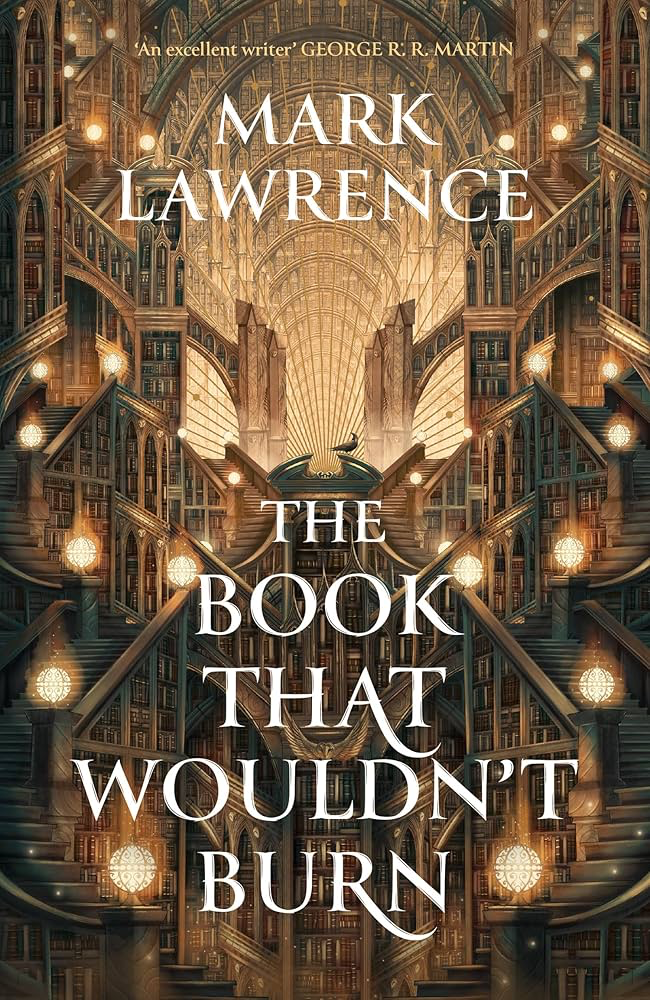
The Book That Wouldn’t Burn – Mark Lawrence

At a young age, Livira was kidnapped, then rescued and delivered to a sprawling city. Within that city was The Library, a building with layers upon layers inside, containing an archive that spans thousands of years. Now focusing on the education she never had, Livira will discover secrets that will change her world forever.

Evar has lived his entire life trapped inside of the bowels of The Library. Hunted by monsters, he was orphaned at a young age, and his siblings have slowly been picked off as well. With no escape in sight, he spends his days desperately looking for a way out—and he cannot see one until he finds a lost girl named Livira.

TW/CW: kidnapping, loss of loved ones, blood, violence

DNF at 44%.

I know I often gripe about long fantasy novels taking eons to get to the point, but this pushed it to the extreme. All of the rave reviews kept swearing that there was some massive payoff to the excruciating trek that was this book, but the intangible promise of something wasn’t enough to keep me going. The Book That Wouldn’t Burn felt stuffed to the brim with plot lines of no substance or development, and it’s not like the book was too short to be cut down. 571 pages. There were absolutely some chapters that had no business being there.

Suspense and worldbuilding are story elements that normally aren’t confused, but it seems that Lawrence got them mixed up in the construction of The Book That Wouldn’t Burn. It’s one thing to have a crucial element of your world be a secret—that was what the novel hinges on, and from the looks of it, understandably so. This technique is mainly for elements that will change the way the reader and the characters perceive the world. Lawrence’s problem was that he applied that to almost all of the worldbuilding. We get a brief glimpse of the outside world, but not much is known save for the divisions between humans and sabbers (a hostile, dog-like species), and that there’s a Vaguely Medieval Epic Fantasy Town™️ outside of The Library. I get that the focus is on The Library, so what’s the point of establishing any of it if it’s not going to be of any consequence later on in the book? Granted, I didn’t finish it, but the way it was written was so hasty. I did get some semblance of how The Library works, but it was too little too late. If you dangle some reveal over the reader’s head the entire time, you should at least have some information about the world to scaffold why you should care. To some extent, I can see that since all of this was foreign to Livira, but that’s not an excuse to barely describe anything!

I wanted to like Evar, but in the end, his situation was more compelling than who he was as a person. That’s because he’s a walking case study in why tragic backstories don’t automatically make a character fleshed-out. We know all about how he’s been trying to claw his way out of the catacombs of The Library and has been hunted by monsters who have killed his parents and many of his siblings…but we know nothing else other than that. Aside from an implied resilience on the virtue of him being able to survive being trapped in a monster-filled maze beneath a library, I know nothing about this kid. We are given exactly zero hints about his personality. I felt pity for him because of his circumstances, but I put down this book knowing nothing about what makes him tick, other than a vague semblance of revenge. I don’t know why he speaks the way he does, I don’t know his habits, I don’t know how he interacts with the world. I wanted to know him! His relationships were solely defined by their proximity to other people (many of whom were dead). By the time he finally met Livira, I couldn’t care less about how they would interact—mostly because Livira got sucked into some Library portal right before anything of significance could happen. 250 pages, about a third of which were devoted to Evar, and I just could not care less.

Now, for why I picked up The Book That Wouldn’t Burn in the first place…The Library. Again, this could be a consequence of me not reading enough of the book, but I think there’s merit in saying that there’s not nearly enough focus on what’s actually interesting about it for the first half of the novel. After the initial revelations that a) Livira now has access to a library the size of a city with archives spanning thousands of years and b) that there are people trapped in a monster-filled maze beneath it, we get…nothing else. There’s much more focus on Livira’s education in The Library, mainly because when she comes there, she does not know how to read or write. That wouldn’t be a bad thing if it weren’t for the fact that these scenes are repetitive to a fault. Remember what I said about this book potentially benefitting from some hedge trimming? This is precisely where I would slim down the page count. I don’t ascribe to the belief that every little thing has to advance the plot, but you’ve got to have something to keep the reader’s interest—it felt like the same cycle of Livira reading, writing, and getting teased by the apprentices. Rinse and repeat for approximately 100 pages. Now do you see why I quit?

The lesson of The Book That Wouldn’t Burn is that you can’t hold a book afloat on a concept alone. I wanted to like the premise so much—what’s not to like about a massive, age-old library that’s larger than a city and holds unknowable horrors beneath it? But the scaffolding necessary to keep me interested was flimsy at best. Lawrence’s writing had moments of being clever, but that, along with the shaky bits of information about the library, were not enough to hold my interest. 1.5 stars, because it wasn’t all bad, but I was so painfully bored by a book with a fascinating premise, which is truly a crime.

The Book That Wouldn’t Burn is the first novel in The Library trilogy, followed by The Book That Broke the World and The Book That Held Her Heart. Mark Lawrence is also the author of several fantasy series, including The Broken Empire trilogy (Prince of Thorns, King of Thorns, and Emperor of Thorns), The Red Queen’s War trilogy (Prince of Fools, The Liar’s Key, and The Wheel of Osheim), and many more.

Today’s song:

saw the magnetic fields for the 69 Love Songs anniversary tour over the weekend—what an incredible show!!

That’s it for this week’s Book Review Tuesday! Have a wonderful rest of your day, and take care of yourselves!
Posted in Book Review Tuesday

Book Review Tuesday (5/14/24) – Dear Wendy

Happy Tuesday, bibliophiles!

Hooooooooooooo-whee…rant incoming…they’re good for the soul. Sometimes. I hate to do this so soon after I posted this year’s AAPI Heritage Month recommendations, but I just had to get this review off my chest. I highly recommend all of those books over this one.

God. I really wanted to like this one. Older YA where the characters are in college are few and far-between, and what’s even fewer and further-between is aromantic/asexual representation, much less POC aro-ace representation. I almost DNF’d this one, but I really wanted to stick it out and see if it turned out any better…and tragically, it didn’t. I hate to say it, but Dear Wendy was one of the most stiffly-written books I’ve read in quite a while.

Enjoy this week’s review!

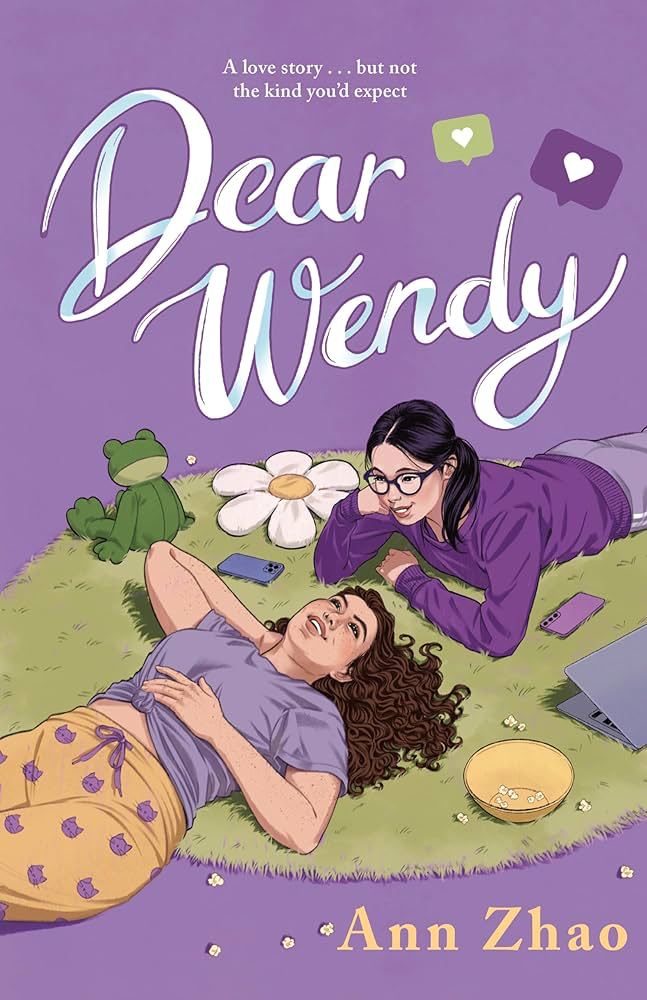
Dear Wendy – Ann Zhao

Sophie Chi and Jo Ephron are both second-semester freshmen at Wellesley College, and they don’t know that they know each other. Sophie runs Dear Wendy, an Instagram account that gives love advice to Wellesley’s student body, and Jo runs Dear Wanda, a much more unhinged parody of the former with joke advice to contrast Wendy’s more serious online persona. The two meet in real life and immediately hit it off—they’re both aroace, and have never met many people, even in the queer community, who have experienced the same things as them. But as their online feud as Wendy and Wanda gets heated, Sophie and Jo must decide if they want to divulge their mutual secret—and risk their real friendship.

TW/CW: aphobia, anxiety, bullying, discussions of coming out/non-accepting parents (brief)

Ooof. Even from an outside perspective (as a non-ace person, but still queer), there’s a noticeable dearth of asexual-/aromantic- spectrum stories, even in YA, which is usually several steps ahead of the game as far as being progressive. So in concept, I’m glad that Dear Wendy exists, and I’m sure it will help a ton of a-spec people find their voices and feel seen. But good lord, this was easily one of the most poorly-written novels I’ve read all year. I’m genuinely baffled that I read the same book as all of the other people who left such glowing reviews. Baffled. Again, speaking from an outside perspective, but I think the a-spec community deserves better than this…

I usually preface my negative reviews with this, but I’ll say it again, because it always applies: I’m willing to give a certain amount of slack to Ann Zhao since Dear Wendy is her debut novel. It’s so hard to put pen to paper, and harder still to get it published, and that in and of itself is an intense labor of love. And I’m so glad that this book exists for some people for its discussions of AAPI, aroace, and gender non-conforming identity. I’m sure it’ll be a book that will mean a great deal to a great deal of people.

But. But.

All that doesn’t fully excuse how painfully stiff Zhao’s writing was. Dear Wendy would have been a DNF for me had I not stubbornly tried to stick it out, just because I was convinced that the rest of the book wouldn’t be a disappointment. I wanted to give it a chance, with the combination of the premise and the fact that it’s Zhao’s debut. I had faith that it would get better, but it never did. For a novel that purported itself to be charming and emotional, the writing felt more like a textbook or a brochure than fiction—never once did any of the characters feel like real people talking. The novel was full of writing choices that just felt downright odd; at some point, we hear one of the main characters eavesdropping on two other characters (about the Social Media Drama™️), and after each of these side characters speak, we get their first and last names—and then never hear from them again. Characters list out song titles like they’re being read aloud by Siri, and all of the attempts at humor are just the characters doing word-for-word reenactments of jokes from Tumblr and TikTok without any attempts to hide the evidence. And for two characters that are supposed to have opposing personalities, their voices blended together in an indistinguishable, bland mess—the only way we can “tell” is through the differences in their fabricated social media personalities. If I wanted to be hit over the head with something that unsubtly, I would’ve stood under the ice dispenser in the dining hall. But through it all, I was just struck by how none of the people acted like people—they acted like social media fabrications of queer people, and the world was similarly dictated through an artificial lens.

Dear Wendy is full of a myriad of relevant topics: aroace identity and acceptance, the suffocation of allosexual culture and the unrelenting pressure to find “the one,” and immigrant parents who don’t fully accept your queerness, to name a few. I’ll say again how glad I am that these subjects are being discussed in literature, because it’s true—we do need to talk about these things! But their delivery, more than not, zigzagged around one of the most time-worn rules of writing: show, don’t tell. Although this is realistic fiction, I feel like it falls into the same kind of mistakes that some sci-fi or fantasy novels make when they deliver information that is new to the reader: they deliver it in unpalatable blocks, making time all but stop in the narrative just so the author can explain The Important Thing™️. This was how most of the discussions felt in Dear Wendy; instead of a new worldbuilding point, it was just the character’s inner monologue, uninterrupted, for at least two pages at the longest. I get that it’s crucial to weave in these points, but there’s a way to do it without harming the flow of the story—once or twice is fine, when there’s a reason for the character to be so deep inside their head, but given that this story was supposed to center around Sophie and Jo’s relationship, there could have been so many more bonding scenes where they talked about this organically! That’s not to say that those scenes weren’t there, but since we were already stuck in inner monologue limbo 50 pages ago, none of the information was new, and therefore, none of the bonding felt like new ground.

In the author’s note, Ann Zhao calls this a love letter to Wellesley College, and that although her experience there wasn’t all good, she wanted to highlight the good in Dear Wendy. Remember what I said about the stiff writing? It applied to the surroundings, too. If her writing style contained…any sort of soul, then that mission statement would have come across. Instead, I felt like I was reading a college website for some parts of the novel. I got so far in to Zhao’s descriptions of the campus and the features of the dining hall that I had to blink and question whether or not she’d been paid to write all this by the college. Look—I’m sure Wellesley is a great place (historically women’s colleges are fantastic!) and I don’t want to negate the love that Zhao had for her time there, but there were so many places where the descriptions didn’t feel, again, like people experiencing their environment—it was just being dictated through a lens so devoid of personality that I felt like I was on a college tour, forced to hear a long-winded monologue about a bunch of landmarks that I’d never see again.

Usually, I’m in favor of a little pop culture referencing once in a while. I’ve never understood the argument that pop culture references in YA fiction take them out of the story. What, is fiction supposed to exist in some kind of culture-less vacuum? God forbid your characters engage with the same media as you do…god forbid you pay homage to the creators that inspired you to put pen to paper, apparently? If there’s anything that actually takes me out of the story, it’s the fake celebrities/artists/social media apps. (I get that a lot of that is dodging copyright, but the point still stands.) The argument has never made sense to me. Sure, dumping them all in a barrage is obviously a no-no, but there’s an art to a well-placed reference, and it’s an art that I appreciate. I have a completely arbitrary Goodreads shelf for books with good music references. (This one almost went on it just for an off-hand mention of Mitski.) But reading Dear Wendy made me understand where the anti-pop culture reference people are coming from. The whole book felt like a front to shove in as many references as humanly possible. Dear Wendy is over 360 pages—it wouldn’t have killed Zhao to cut out the chapter entirely consisting of Jo and Sophie talking about Harry Styles. The only places where the music references in particular felt relevant where when Jo was DJ-ing at the college station, and even then, when she was talking to Sophie about her upcoming song choices, it felt like they were being queued up and read aloud by Siri. Mind you, this wasn’t when Jo was actually DJ-ing—this was when she was talking to her friend. It only would have been worse if she’d said “Remastered version” in verbal parentheses.

And…god. If another book tries to smother me with this many Taylor Swift references, I’m going to chew my kindle in half. It’s already bad enough that even the dining hall TV was showing me news clips about whatever mediocre thing she’s doing…please, I thought literature was supposed to be an escape…

All in all, a platonic love story with all the ingredients for something meaningful and sweet that substituted personality and charm for stiffness and irrelevant references. 1.5 stars.

Dear Wendy is a standalone and Ann Zhao’s debut.

Today’s song:

That’s it for this week’s Book Review Tuesday! Have a wonderful rest of your day, and take care of yourselves!

Posted in Book Review Tuesday

Book Review Tuesday (7/5/22) – Among Thieves

Happy Tuesday, bibliophiles!

I forget when or how I came upon this book, but looking back, I sadly wish that I’d passed it by; I put it on hold at the library to have another queer fantasy book to read, but I ended up finishing it in about an hour feeling sorely disappointed. The reviews promised Six of Crows but gayer (of course you have my attention), but what I read ended up being a shameless Six of Crows ripoff.

Enjoy this week’s review!

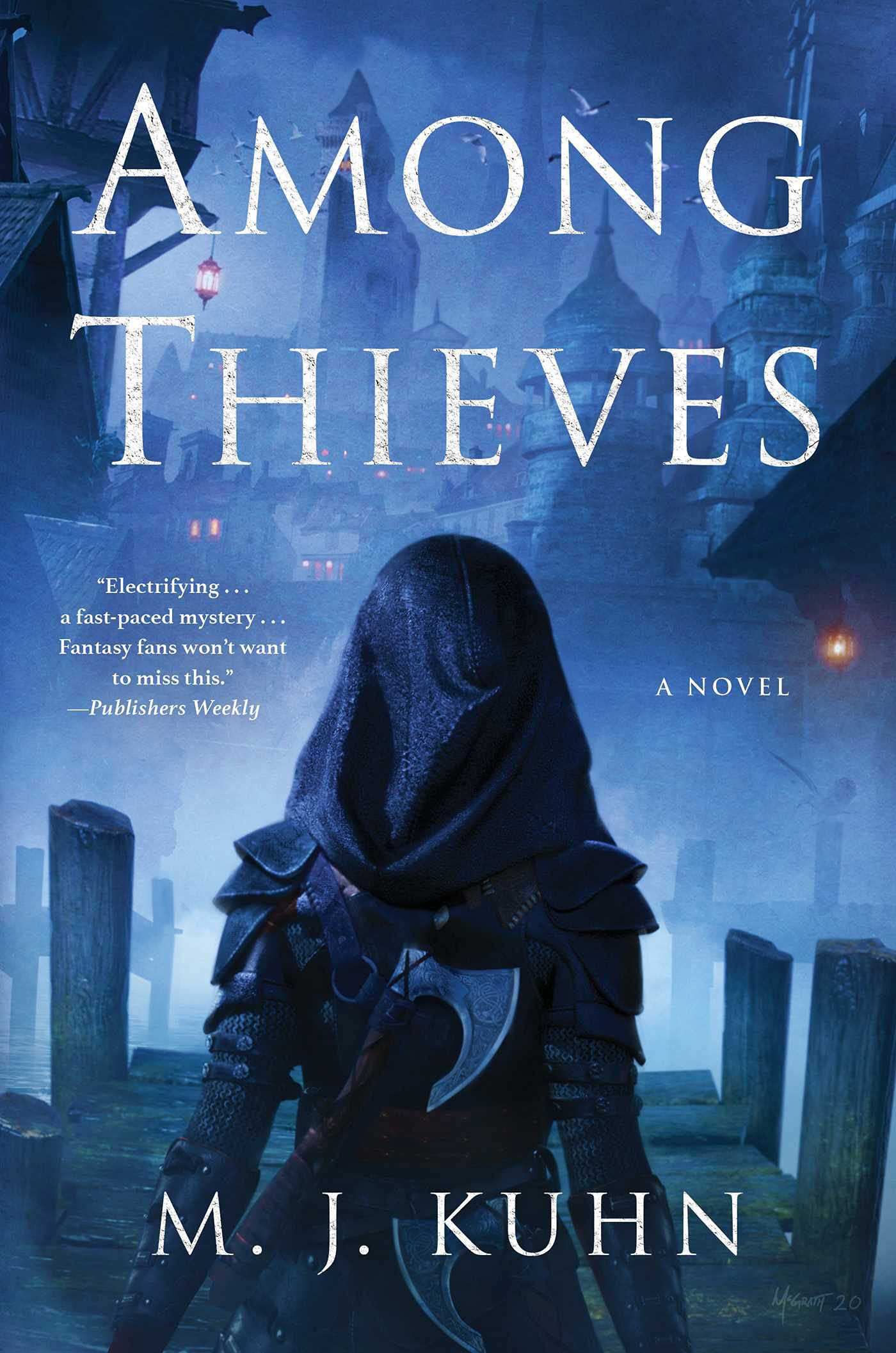
Among Thieves (Thieves, #1) – M.J. Kuhn

Ryia Cautella is an infamous assassin, earning the name of The Butcher with her axe-wielding tactics. What she hides, however, is her past; after narrowly escaping the Guildmaster, the tyrant ruler of her kingdom, he and his lackeys have been searching all over the city of Callowwick for her. The only way out is to find her way into the Guildmaster’s highly fortified stronghold, and it’s a job she can’t do alone. With the help of Cal Clem, the head of a failing crime syndicate, and a band of criminals and misfits, Ryia may finally have a chance at freedom. But will her search for freedom cost Ryia her life?

TW/CW: slavery, violence, dismemberment, mentions of branding

I’ve noticed a trend over the past few years with YA; after the dystopian craze (mostly) blew over, fantasy heist books in the vein of Six of Crows started becoming far more popular. Unlike a lot of the dystopian books that came after books like The Hunger Games, however, the fantasy heist trend actually produced plenty of really fun, memorable books with a lot of originality. However, with every book trend, there come books that are obvious, blatant ripoffs of their inspiration. I hate to say it, but Among Thieves is one of them.

Now, I try to preface my negative reviews with this: I 100% understand how hard it is to put yourself out there into the book world. And there’s some slack I’m willing to give Among Thieves since it appears to be M.J. Kuhn’s debut novel.

That being said…all I can really say about Among Thieves is that it’s basically a Walmart version of Six of Crows.

Soon after the book started, I noticed all the pieces falling into place for a vague Six of Crows ripoff; apart from a little gender-swapping, most of the characters were nearly carbon copies of the iconic characters from Six of Crows; the only major difference I found was that there was a sapphic romance (sort of?) between Ryia (Inej, basically) and a gender-swapped version of Wylan (Evelyn), and that Cal (Kaz) just stood there on the sidelines. Otherwise, it was almost offensive how much these characters were almost carbon-copies of SoC characters—most notably Ivan, who was so, so similar to Matthias that it nearly gave me a headache. Same appearance, same vaguely-Northern/Western-European fantasy background, same personality…the only difference was that he was a forger. That was it. It’s always great if you take inspiration from certain books when you create your book—in fact, it’s impossible not to take some inspiration from something—but if it becomes as blatant as a ripoff as this, it’s just a steaming, unoriginal pile of garbage.

Nothing made much sense after Cal and Ryia assembled their crew. Granted, as soon as I saw how ripped-off the characters were, I started to lose faith in everything else. That being said, most of the heist made little to no sense, and the progression just felt like being tossed around to random places with seemingly no sense or purpose. They’re trying to break into this stronghold, and…now they’re in a prizefighting ring? Now they’re at sea again? It just felt like “now we’re in an airplane!” kind of nonsensical plot progression without any rhyme or reason.

As for what the reviews described as “Six of Crows but gayer,” I felt…more than a little let down. There was sapphic representation (sort of a will-they-won’t-they romance between Evelyn and Ryia), but they seemed to be the only queer characters. I would’ve liked it more if I was more invested in the characters, but it was…just alright. Nothing groundbreaking, and it wasn’t exactly “gayer” than SoC, since it had the exact same amount of queer rep that SoC did. I love sapphic fantasy any day, but it left me wanting a lot more. Most of the book did, really.

All in all, a half-baked ripoff of Six of Crows that seemed far too obvious for its own good. I slapped on a half star to my rating since Kuhn’s writing style had moments of being good, but that’s about all of the positives I can think of for this book. 1.5 stars.

Among Thieves is M.J. Kuhn’s debut novel, and the first novel in the Thieves series, followed by the forthcoming Thick as Thieves, slated to be published in 2023.

Today’s song:

That’s it for this week’s Book Review Tuesday! Have a wonderful rest of your day, and take care of yourselves!
Posted in Book Review Tuesday

Book Review Tuesday (6/21/22) – A Lesson in Vengeance

Happy Tuesday, bibliophiles!

I really didn’t have much attachment to this book; I think I just put it on my TBR because I’d like Victoria Lee’s previous book, The Fever King, a decent amount, and I’d heard there was queer rep in it. I ended up fishing it out of my TBR to find specifically queer books for pride month, and it was available at my local library, so why not? To my dismay, A Lesson in Vengeance was one of the most frustrating books I’d read in a long time—it’s been a while since I’ve been this angry at a book.

Enjoy this week’s review!

A Lesson in Vengeance – Victoria Lee

Felicity Morrow carries a great burden: she may have been responsible for the untimely death of her girlfriend, Alex. After that fateful day, she took a semester off from the Dalloway School, a legendary—and perhaps haunted—boarding school deep in the mountains. But when she returns, a fascinating girl named Ellis has arrived, a teen author prodigy who came to the school to research for her next novel. Felicity and Ellis become entrenched in the history of occult and witchcraft tied to the Dalloway School, but the path they go down is one that could lead to death—or worse.

TW/CW: murder, gore, animal death, loss of loved ones, mental health issues (depression), grief, toxic relationships, descriptions of murder (hanging, burying alive, etc.)

I don’t think a book has made me this angry in ages. I should’ve DNF’d it, but I almost just finished it out of spite. I recognize that there’s so much work that goes into writing a book and putting it out into the world, so take this review as you will, but god. I have an absolute laundry list of gripes with this book, I’m sad to say.

A Lesson in Vengeance pretty clearly took inspiration from The Secret History, a book that I didn’t expect to enjoy as much as I did. But there’s a key aspect of The Secret History that A Lesson in Vengeance astronomically missed the mark on that could’ve made or broke it: it’s established early on that it’s a cautionary tale, and that these characters are either already horribly toxic people or that the book is their corruption arc. A Lesson in Vengeance misses that by miles, and these deeply flawed characters are romanticized. I’m not saying that I need “UNRELIABLE TOXIC NARRATOR” in skywriting, but the way that Lee romanticized Felicity deliberately going off her meds and dismissing her well-meaning therapists disgusted me. I’m all for “messy” queer characters, but this goes FAR beyond just “messy”—these are just straight-up horrible people, and it seemed like Lee didn’t recognize this or handle it properly.

Let’s talk more about the characters. Lee’s writing style is what earned the half-star from me, but their prose had a fatal flaw when it came to the characters; most of them are meant to be dangerous and alluring, but what was written as “mysterious writer girl with unorthodox methods” was more than anything just another toxic rich person added to the mix. All of the characters were clearly backstabbing, flawed people who solved their problems with drugs and alcohol, but again—it was all romanticized as part of the “dark academia aesthetic.” I’M SORRY, WHAT? How is rich people smoking indoors an “aesthetic?” More importantly, how is DELIBERATELY GOING OFF YOUR MEDS AN “AESTHETIC?” I’ve never been the biggest fan of dark academia, but I can’t deny that when it’s done well, it’s chilling; this, however, was just a mess of a book built off of an aesthetic that failed to realize its fatal shortcomings. I’m sorry, I don’t want to read about rich people smoking indoors for 370-odd pages.

Additionally, there wasn’t much keeping the plot together. I went in thinking that there would be a murder mystery hidden somewhere, along with witches, the occult, and a budding sapphic relationship. However, the book ended up being 60% rich people smoking and drinking themselves silly (uninteresting from the start) with a weak witchcraft sideplot that was sidelined for most of the book and was never really resolved. All of the diversity that this book promised, though well-intentioned, felt more like a checklist: Black character? Check. South-Asian character? Check. And the sapphic relationship that I was hinging on just ended up being a toxic mess of manipulation without any self-awareness of its nature: again, it was framed as an “alluring, mysterious” kind of thing, when in reality, it was just…borderline abusive and devoid of any emotional intelligence whatsoever.

All in all, a premise that had the potential to be mildly interesting, but did nothing more than romanticize its toxic characters and lend itself to a story centered more around a flimsy aesthetic than a plot. 1.5 angry little stars.

A Lesson in Vengeance is a standalone, but Victoria Lee is also the author of the Feverwake series (The Fever King and The Electric Heir, as well as the novellas The Traitor’s Crown and The Stars and Everything in Between) and the forthcoming The Girl That Time Forgot.

Today’s song:

That’s it for this week’s book review Tuesday! Have a wonderful rest of your day, and take care of yourselves!