

Happy Sunday, bibliophiles! I hope this week has treated you well.
This week: some of my favorite women in music getting unabashedly weird with it, the pioneering bisexuals of Britpop, and…crabs.
Enjoy this week’s songs!
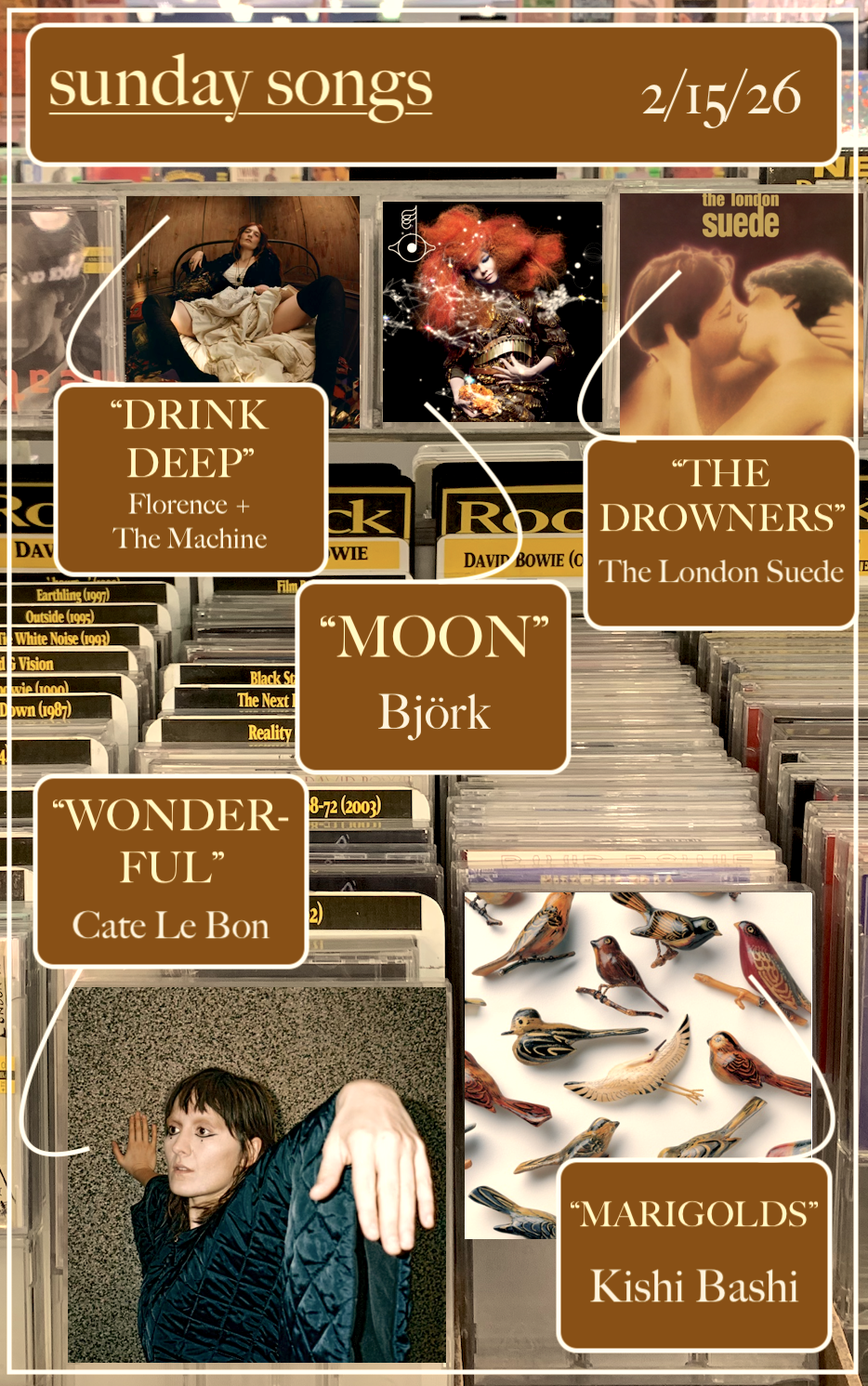
SUNDAY SONGS: 2/15/26
In her review of Crab Day for Pitchfork, Laura Snapes said this about the album’s inspiration (Cate Le Bon’s young niece replacing the mean-spirited pranks of April Fool’s Day for Crab Day, where you celebrate by drawing crabs): “nonsense is often the best response to nonsense, that the constructs we use to prop up our lives are often totally arbitrary.” Le Bon has had a deep sense of absurdity, but Crab Day as an album is built all about taking ordinary things in our life to task, but also about being faced with the fact that half of the things in our lives are arbitrary, flimsy constructs. Some of it’s done gleefully, as in the creation of Crab Day, but for others, it’s more emotional—“I Was Born on the Wrong Day” came out of Le Bon’s mother digging up her birth certificate and admitting that they’d had her birthday wrong for decades. Crab Day, both lyrically and musically, explores the pain that comes from realizing that our world is built on the flimsiest stilts imaginable, but also the glee that comes with spitting in the face of them and embracing life’s absurdity.
There’s always been quirkiness surrounding Le Bon’s music, but Crab Day feels like the moment that the eggshell split open and she fully embraced offbeat, unconstrained creativity. That’s not to say that any of her earlier work isn’t creative—quite the opposite, having just listened to Mug Museum—but this album is where her current sound began to coalesce in earnest. It’s much more guitar-oriented than her more recent works, but it’s got all of the hallmarks of what’s become her signature style: artful blares of saxophone, offbeat lyrics, and slanted melodies and rhythms that read like the audio version of a picture frame hanging at a crooked angle. “Wonderful” exemplifies that crookedness, easily the most unfettered moment of weirdness on the album. The guitars scream Lodger-era David Bowie, and the lyrics of mid-’70s Brian Eno. But the fact that seemingly every commenter in the YouTube comments section has an entirely different band comparison as to what it sounds like proves how original Le Bon’s unique arrangement of elements is. With everything from the xylophones to Le Bon’s vocals at a breakneck pace, it’s an ode to being constantly in motion: “I wanna be your motion-picture film, oh yeah/I wanna be your ten-pin ball, ball, ball.” In the context of the album’s crusade to expose life’s absurdity, it feels like a concentration of her spirit throughout this album, but also her career at large: to be adventurous in all sorts of ways, and to be constantly be searching for a new way of setting creativity and weirdness in motion.
…AND A BOOK TO GO WITH IT:

Floating Hotel – Grace Curtis – it’s difficult to match a song as singular as this to a book, since it’s so distinct; but if anything, this would match the bustle of a Wes Anderson-esque hotel in space.
Realizing that Kishi Bashi had written a song named after my favorite flower was already an exciting revelation, but finding out how engrossing of a song it is made that discovery all the better. Tinged with both joy and melancholy, “Marigolds” surrounds cross-generational experiences, and bridging the gap of realizing that everybody around you has a complex inner life, separated by time, but united in the here and now: “It’s the realization that another person’s perception of the world is just as real to them as yours is to you, and that this humility is the first step in living in harmony on a planet that is ultimately made up of 8 billion parallel universes.” With that emotional core to the track, the field of marigolds couldn’t be a more perfect metaphor—each bloom appearing similar on the outside, but each one having a unique, complex makeup that can’t be seen from the outside. His usual lush string arrangements are layered in a glimmering swarm evoking the delicateness of flower petals and the ephemeral wingbeats of songbirds. Paired with a gorgeously animated music video by Geoff Hopkinson, featuring marigolds that turn into fantastical, jellyfish-like beings, “Marigolds” is an utterly transportive track, scented with pollen and wistful longing.
…AND A BOOK TO GO WITH IT:
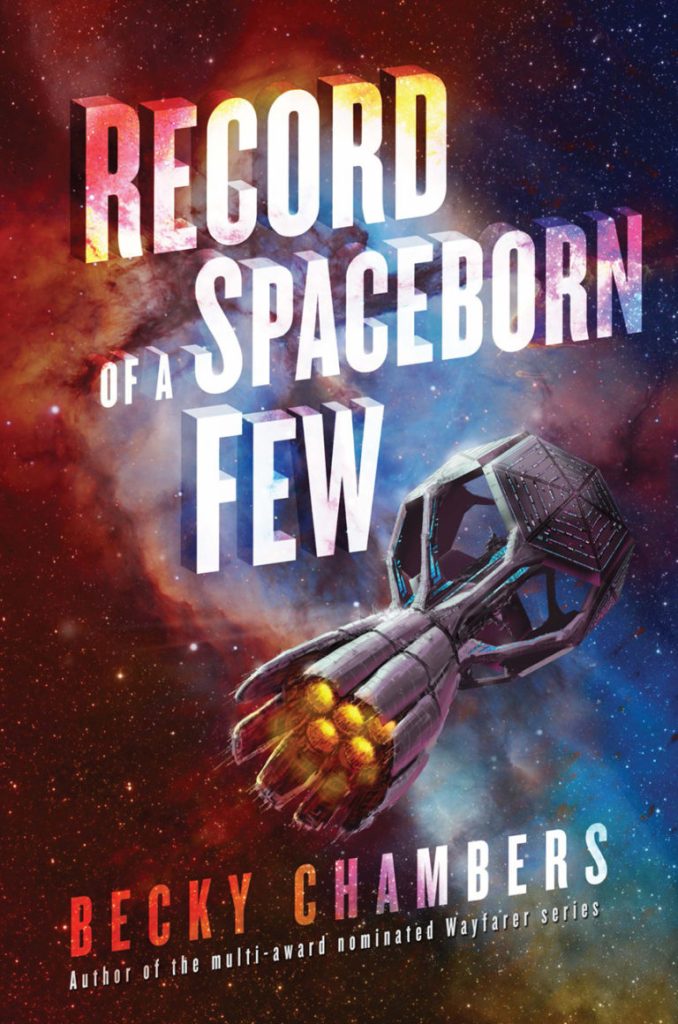
Record of a Spaceborn Few – Becky Chambers – “I wish that I could grow up with you/I wanna see the world the way you do/I want to fall off the edge with you/I want to have fun with you…”
“Drink Deep” – Florence + The Machine
You guys, I’m sorry. Every time I hear a Florence + The Machine song, it’s described as some masterpiece that leaves permanent claw marks on your heart, and then I listen and I come back feeling…perfectly alright? I’m sure there’s something I’m missing, but some things just aren’t everybody’s cup of tea all the way. Objectively, Florence Welch has great vocal range, and I’ve never hated any song of hers, but I’ve also never thought to myself, “I need to listen to more Florence + The Machine.” Maybe part of it’s just that she’s been unfairly associated with the TikTokification of female rage (or, “female rage is when a woman sings loud and man is bad”) and “divine feminine” becoming a buzzword, but that’s not her fault at all. However, as I follow a lot of music publications online, I saw that Mark Bowen of IDLES was one of the producers on her latest album, Everybody Scream, so I was at least intrigued.
One of my dearest friends has been trying to convert me for quite some time (once again, SORRY), but I heard a snippet of this one, and I was hooked out of nowhere. It sounds almost nothing like any of her other songs I’ve heard. Again, Welch has a great voice, but I feel like a lot of her songs seem to rely on the strength of her voice in order to amp up the emotion, and the rest of the music doesn’t always follow. “Drink Deep” is more contemplative, but also, a lot eerier than I gave her credit for. Here, Welch translates her experience with her life passing her by as she’s touring (while everybody else moves about normally in their lives) as akin to being prisoner to the fae, trapped and ageless in their realm for hundreds of years while everyone else ages naturally: “What I thought was a night was a thousand years/What I thought was a sip was a thousand tears/But still, they said/Drink deep.” It devolves into a kind of Celtic-inspired folk horror where what Welch ends up essentially cannibalizing herself at the will of the fae—an apt metaphor for what the music industry puts its performers (especially women) through. The atmosphere of “Drink Deep,” with an ominous, thundering drumbeat, chimes, and a warbling choir reminiscent of Kate Bush’s “Rocket’s Tail,” evokes the passage into another, darker realm, a descent into an unbreakable deal made in blood.
…AND A BOOK TO GO WITH IT:
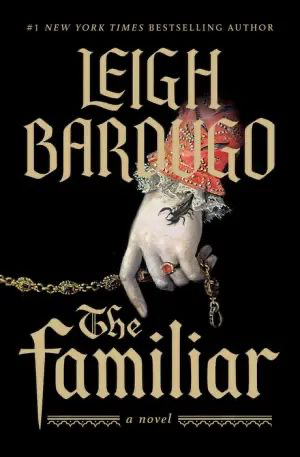
The Familiar – Leigh Bardugo – “They gave me gowns and riches/Cut gold thread with their teeth/Every night I went to see them/No, I did not sleep/And every cup they brought to me/Oh, you know I did/Drink deep…”
Every time I mention Biophilia, it’s inevitable that I go on and on about the app—which is appropriate, since it is the backbone of the album. But I feel like you’re missing an entire chunk of the album if you don’t talk about the delicately constructed visual language of it—for me, you’re missing half the story if you don’t see the elaborate costumes and the artistry of the visuals. All of the music videos for Biophilia are showstopping, and the music video for “Moon” feels like the best introduction to the album’s aesthetic. Literally, it’s a moving version of the album cover, but the superposition of the moon phases over Björk’s body visually convey the lyrics and the concepts behind them. I love the jagged, glowing constellation-shapes surrounding her, both a map of the app and of a galaxy itself; and I cannot get enough of Björk’s costumes for this album cycle. That combination of her rusty, Mars-orange wig and the metallic shades all throughout her bronzy dress and the playable harp corset, against the stark black of the backdrop, are just such a memorable, cosmic color combination to me. The blue ringing her face and eyes brings out the contrast spectacularly. This is the epitome of a wholly realized creative vision brought to life. Granted, this is much later in her career, but it gives me some hope that maybe, in some ideal timeline, some of the projects that I’m envisioning can someday can get as much of my creative freedom inside of them as possible.
The best way that I can describe “Moon” is that I feel as though I’m listening to a perfect circle. Set in 17/8 sign to mimic the phases of the moon, the chorus of harps seem to circle each other, an elaborate, delicate Ouroboros that encircles itself forevermore. It takes a. rare genius to make a song sound like a shape, but that’s exactly the kind of musician that Björk is. Her mind!! Her MIND!! Having a lighter, more celestial tone for a song about the moon, a subject that often invokes more ominous, sweeping majesty or loneliness (see: Radiohead’s “Sail to the Moon,” Bachelor’s “Moon”) makes it stand out from its many, many peers; the instrumentation is so pearly and dewy, and her line about “adrenaline pearls” makes me think of “Cocoon” in the sweetest way. And more poignant still is how she relates these lunar phases to the phases we cycle through in life—”Best way to start anew/Is to fail miserably/Fail at loving/And fail at giving/Fail at creating a flow/Then realign the whole.”
…AND A BOOK TO GO WITH IT:

Activation Degradation – Marina J. Lostetter – “As the lukewarm/Hands of the gods/Came down and gently/Picked my adrenalin pearls/They placed them in their mouths/And rinsed all the fear out…”
“The Drowners” – The London Suede
I think I just like 90% of Britpop. The only band in the genre that I’ve never liked is Oasis, and I’ve heard some argue that they’re not stylistically Britpop, but were just lumped into the genre because they blew up at the same time as bands like Blur and Pulp. I’m not sure if I can agree in good conscience just because I despise Oasis, but given what I’ve heard of them…it makes sense. Other than them, I’ve loved everything I’ve heard from the rest of the Big Four—and “The Drowners” is really convincing me that I need to listen to more of The London Suede.
At the forefront of every other explosive new subgenre, you will find a bisexual. The London Suede were one of the first bands to be called Britpop in earnest, and contributed a significant amount to its sound, although they were focused less on British social commentary and more on a dramatic, glam rock resurgence that recalled David Bowie’s storytelling and subversive sexuality and Morrissey’s literary-minded lyrics (and half-unbuttoned shirts). In their earlier days, they very much banked on the profitability and controversy of the queer imagery and lyrics in their band, as Bowie did back in the ’70s, from the lesbian couple on their self-titled album cover to Anderson’s obliquely queer lyrics and androgynous presentation. If he wasn’t bisexual, I’d honestly feel like it bordered on queerbaiting, relying on the shock value of subversive sexuality to make more money. But it’s not his fault, necessarily—God knows there’s legions of glam rock/metal artists from the ’70s and ’80s who glommed onto the queer aesthetics for the money it made them, and later disavowed queerness entirely. (Lookin’ at you, Alice Cooper.) Ultimately, The London Suede feel more like they’re indebted to English literary tradition to me—often queer, often subversive, and dramatically indulging in themes of class division and excess. That’s what Anderson and co. feels like to me, and “The Drowners,” with its cult of ambiguous sexuality, glamor, and wealth, feels like a worthy tribute.
…AND A BOOK TO GO WITH IT:
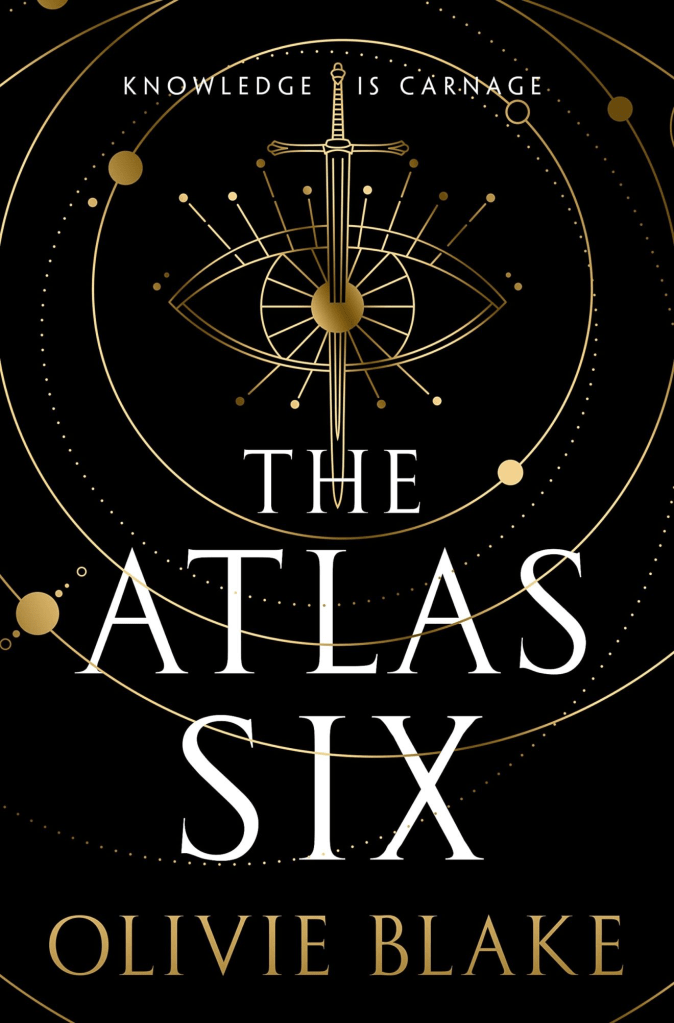
The Atlas Six – Olivie Blake – this brand of Britpop being big and dark academia being a major literary trend missing each other temporally is either a major blessing or a curse—they fit a little too well with each other.
Since this post consists entirely of songs, consider all of them to be today’s song.
That’s it for this week’s Sunday Songs! Have a wonderful rest of your day, and take care of yourselves!










 The Bookish Mutant