Posted in Book Review Tuesday

Book Review Tuesday (12/16/25) – Katabasis

Happy Tuesday, bibliophiles!

I’ve been a fan of R.F. Kuang’s work for years (though I’ve steered away from the Poppy War trilogy, given how many people I know have been emotionally eviscerated in its wake). As bored as I am with dark academia, if there’s anybody I trust with the genre, it’s Kuang—and for the most part, her latest venture into the bowels of academia (and Hell itself) was an adventurous success!

Enjoy this week’s review!

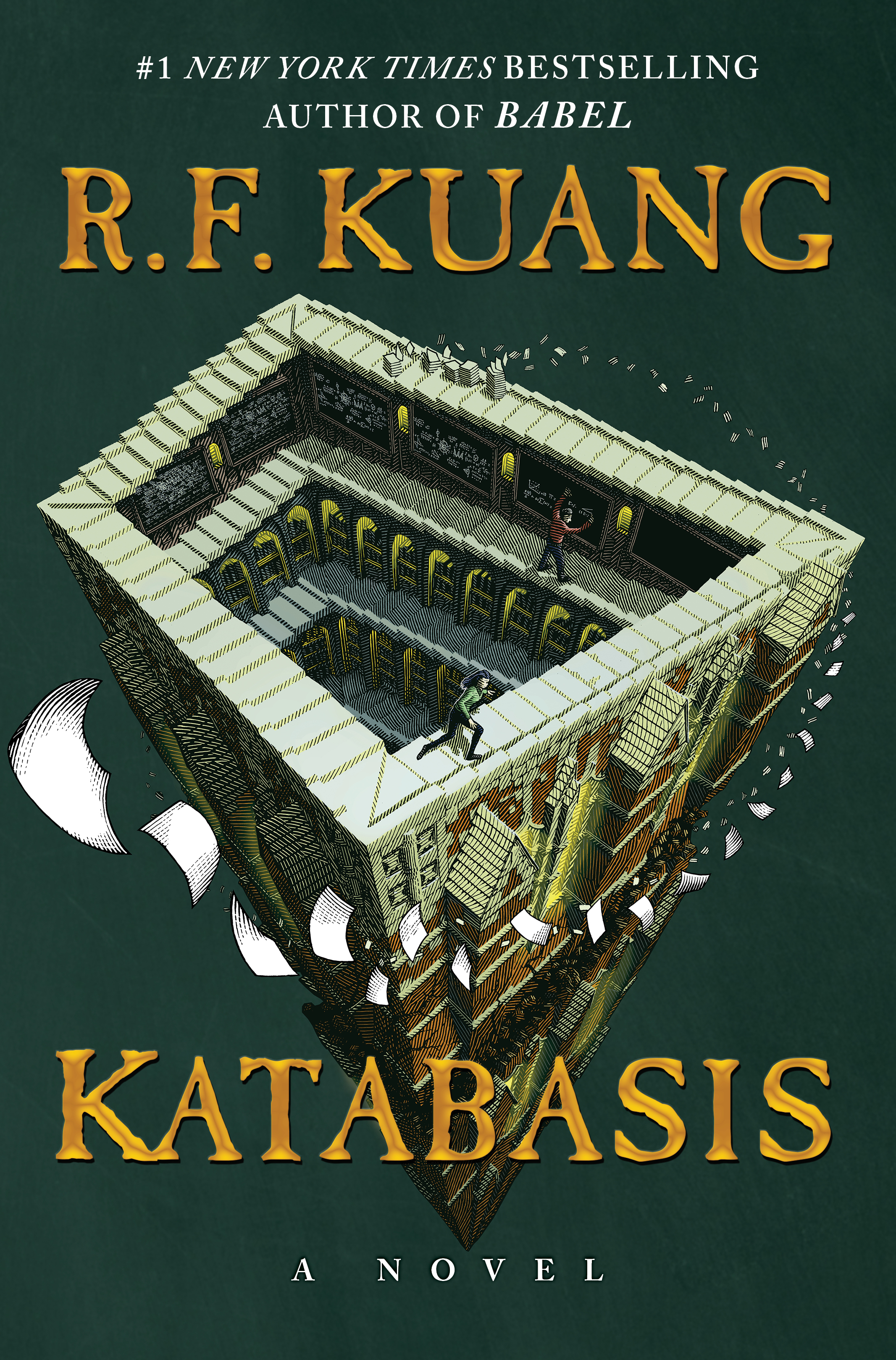
Katabasis – R.F. Kuang

Professor Grimes is going to Hell, and it’s all Alice Law’s fault.

After a backfired spell sends their advisor to an early grave, two rival Cambridge grad students find a way to enter Hell to bring back Professor Grimes. Braving all manner of demonic horrors beyond their wildest nightmares, Alice Law and Peter Murdoch have agreed to risk it all for their beloved professor. Yet the further they travel through Hell, they must come to grips with the man Professor Grimes was—and if the man they idolized was really worth going to Hell for.

TW/CW: violence, gore, loss of loved ones, sexual assault/harassment, suicidal ideation/suicide, ableism

There’s really nobody doing it like R.F. Kuang. She isn’t my favorite author of all time, but nonetheless, I don’t think I’ll ever find another fantasy book that has both spooky scary skeletons sending shivers up my spine AND a well-placed dig at Jacques Derrida. That’s how it’s done.

Right after it was released, Katabasis seems to have made a major splash in the book community (namely BookTok)—partly because Kuang’s next novel was bound to be highly anticipated, but partly because it sparked some debate about anti-intellectualism. But compared to something like Babel, which is practically footnotes upon footnotes, I feel like this…isn’t that bad? Sure, it’s very esoteric, but most everything is so easily searchable online? Or in the library? Granted, I understood a fair amount of this solely because I took a literary theory course for my English degree, but even then…just google what you don’t know! And maybe you’ll learn something fun! I don’t know how one would go into an R.F. Kuang book and not expect something academically-minded, but maybe this is just the people who were only used to the strictly realistic fiction of Yellowface? Who knows.

Either way, the academic aspect of Katabasis was such a fun element for me. Whether or not that’s because I’m so hopelessly English-majoring it out here, but I loved all of the subtle nods to world mythologies and literature. (The bit about postmodern and poststructuralist magic cracked me UP. Poststructuralism slander healed my soul. Thanks, literary theory.) But ultimately, I loved what Kuang said about academia; there’s the satirical part that it can be Hell, but also that it demands an inhumanity of you that is systemically supported and produces such spectacular burnout. Being the genius that people like Grimes wanted required students like Alice and Peter to relinquish their humanity in pursuit of knowledge and prestige, and that’s something that you shouldn’t have to sacrifice to get what you want. Given Kuang’s accolades and track record, I’m sure she’s experienced this firsthand, but it was a potent statement on the pressure that’s put on students, especially in the Ivy Leagues and other prestigious institutions, magical or not.

Katabasis had a wild version of Hell, and so much of the fun of the book was exploring it. Granted, it is rather all over the place, but I feel like it emphasizes Kuang’s initial rule of Hell: there are no rules in Hell. There’s the parts that are just Cambridge but in Hell, carnivorous hordes of Tim Burton-esque skeletons, deities from all kinds of mythologies, and one very lucky cat. (Shoutout to Archimedes, I’m glad he survived!) Entire sections of Hell are made out of M.C. Escher’s structures, there’s impossible shapes everywhere, and all of it serves to make Alice and Peter get as close to snapping as possible—exactly what you’d expect from Hell. Tonally, it was also kind of all over the place; some of it was genuinely horrific, while other parts bordered on Beetlejuice-esque camp. But all of these disparate elements made sense as a sort of archive of all possible Hells; it’s a very academic Hell, but beyond that, it seems like an exercise in writing that Kuang had tons of fun writing. That passion poured off every page!

Alice and Peter’s relationship formed the core of the novel, and I loved following them as characters. They made such an odd couple of rivals to friends to…something more, I’d imagine, and their personalities bounced so well off of each other. The perspectives that both of them brought to Kuang’s satire of academia—Alice’s struggles as a woman of color and Peter’s as a chronically ill person—really hammered the commentary home. My main criticism of Katabasis has to do with the 75% mark (more on that later), but I feel like part of why it felt so off-balance for me was that Peter wasn’t there. Alice was a compelling character on her own, but Katabasis leaned so much on their shared dynamic, the scholarly banter they bounced off of each other and the warring struggles that eventually coalesced as they realized their dual mistake in idolizing Grimes. They had such effortless chemistry both as rivals and friends, making them easy to root for.

Of course, when you’ve created a Hell this dizzyingly intricate and complex, you’re bound to get lost. Alice and Peter did, and so did Kuang herself. There’s a point at the 75% mark where the plot, along with the characters, gets hopelessly lost. By this point, we’ve moved on past “we’re here to get Grimes,” but it seems like none of the detours served the novel in any way. The real kicker is that this part of Hell isn’t even that new or interesting—it’s even more academic commentary, which, while I liked it at first, was just repetitive and regurgitated the same satire about academia that Kuang had already talked about in the first third of the book. I’m all for taking detours to explore an unknown realm, but this one didn’t even feel new at all. My edition of Katabasis is around 540 pages, mind you, so it’s not like cutting too much of this would’ve made it too short. I feel like not every little thing about a novel directly needs to serve the plot, but I feel like it should at least develop the characters or show us something new, and this part of Katabasis did none of those things. Thank goodness we were whisked out of Hell soon after that.

All in all, an inventive and satirical journey into the depths of Hell—which, as it turns out, looks an awful lot like Cambridge. 4 stars!

Katabasis is a standalone, but R.F. Kuang is the author of several other fantasy and fiction novels, including Yellowface, Babel, and the Poppy War trilogy (The Poppy War, The Dragon Republic, and The Burning God).

Today’s song:

I just need everybody to know that this cover exists. That’s it.

That’s it for this week’s Book Review Tuesday! Have a wonderful rest of your day, and take care of yourselves!

Posted in Book Review Tuesday

Book Review Tuesday (11/25/25) – Mad Sisters of Esi

Happy Tuesday, bibliophiles!

Guess who’s back…for only a week, probably. We’ll see. My college is on this maddening schedule that only gives us one (1) week after Thanksgiving Break and then it’s straight into finals, so I’ve been grinding for most of November. But now I’m on break, thank goodness!

I found out about Mad Sisters of Esi while doing a research paper on the history of science fiction in India. It sounded intriguing—who doesn’t love an incomprehensibly large cosmic whale, after all? I’m not usually one for fantasy (citation needed) novels that are this dense and self-referential, but there was so much passion poured into every word that I couldn’t help but be dragged along for the bizarre ride.

Enjoy this week’s review!

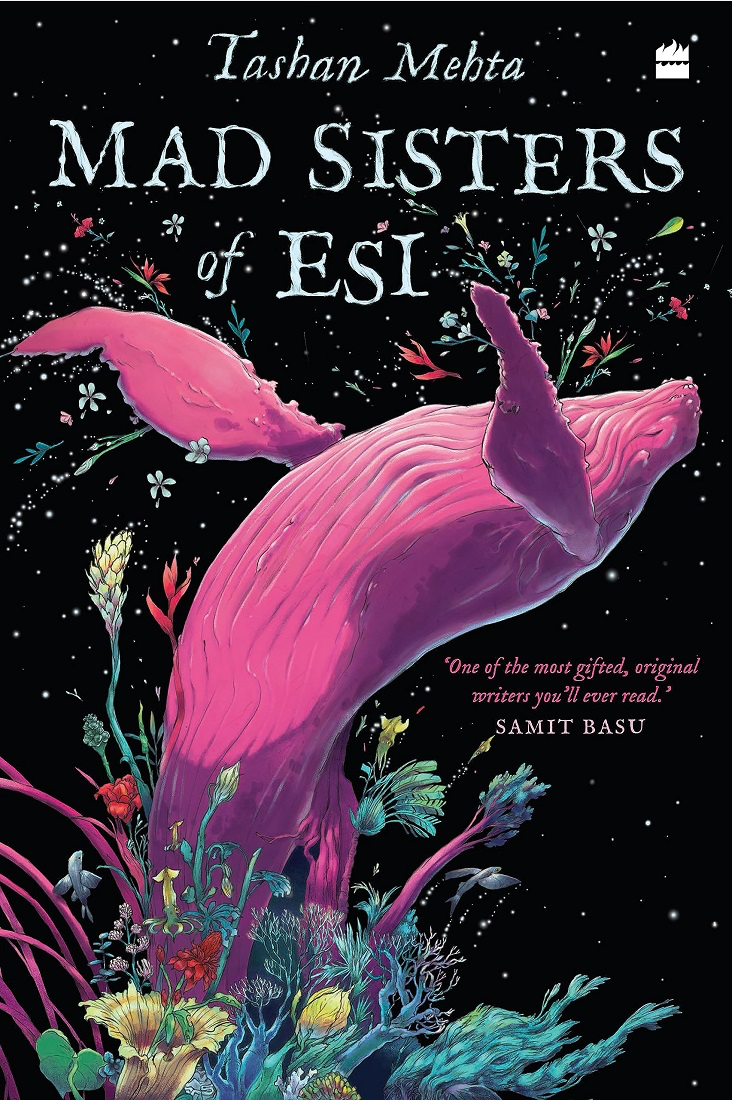
Mad Sisters of Esi – Tashan Mehta

Myung and Laleh are inseparable sisters living inside the Whale of Babel, a whale the size of a galaxy, large enough to contain planets in the folds of its body. They have never known life outside of the Whale, save for the Great Wisa, their distant, unknown creator. Laleh is content to explore the endless lands inside the Whale’s body, but Myung yearns for something more. Her journey takes her to the far edges of the universe, but so far that she cannot find her way back to her only home. As Myung and Laleh attempt to find their way back to each other, they ponder the stories that got them to where they were, and if stories themselves can bring them back together.

TW/CW: loss of loved ones, grief, abandonment

If you’re wondering how I’ve been lately, I’m apparently saturating myself with “[]ad Sisters” media. Mad Sisters of Esi? Bad Sisters? What am I doing here? What’s going on with all these sisters?

I’m glad that this trend doesn’t have a name, but I love the trend of recent genre fiction coming to conclusion that “maybe [x] was the friends we made along the way” can actually be a very powerful message. Maybe storytelling was the friends we made along the way. God. What a book.

I was captivated by the premise of Mad Sisters of Esi, but I could have easily not been. It falls into those fantasy books that verge more on the literary side that are very self-serious about been multilayered, dense, and Deep with a capital D. Not that there’s anything wrong with it, but toeing the line between a story that’s actually meaningful and a book that’s 500+ pages of needlessly convoluted, pretentious nonsense that only serves as a monument for how supposedly complex of a plot the author could dish up. The latter are often all style and no substance, but the real frustrating part is that they’re so convinced of their substance that it deadens any meaning that it could’ve had. (See my review of The Spear Cuts Through Water. At least Simon Jimenez has other good books. Go read The Vanished Birds instead of that one.) It’s just a literary version of “look, Ma, no hands!” that rarely results in anything really substantive.

My main criticism of Mad Sisters of Esi is that it does stray into that territory sometimes. It never fully went over the edge for me, but there were moments were it got too convoluted for both my taste and the service of the narrative. Most of it was complex, but not needlessly so, but at a certain point, parts of it got dizzying. I definitely didn’t get everything about this book, and I feel like it’s almost the point. For me, what separates the two kinds of fantasy novel that I just described is…well, love. I could tell right away that Mehta didn’t write Mad Sisters of Esi to show off how complicated of a narrative that she could write—there’s a story, a tangible message, and a thrum of passion that spills through in every page. With every fictional academic article and magical town, I knew that Mehta’s world was born of love. Which, given the nature of this book’s themes, is exactly what it should have been. It’s a novel that’s all about love, storytelling, and the act of creation, and Mehta’s writing felt more than faithful to that premise.

Mad Sisters of Esi is full of meta commentary on the nature of storytelling. I’ll get more into that aspect later, but part of what sold those thematic elements was Mehta’s prose itself. Mehta is clearly someone who has studied her fair share of fairytales. Mad Sisters of Esi doesn’t just feel like a fairy tale in terms of the plot—Mehta’s prose has the same enchanting quality of a timeless fairy tale. The narrator bobs in and out, always with a cryptic lesson. The lush world is rendered in the most magical, wondrous detail. All of the descriptions surrounding Myung and Laleh make them sound like classic protagonists in an ancient tale. It was all very self-aware, but in a way that made the story feel fuller—and drew me in page by page. With Mehta’s strong hand, every location that Myung visited was bursting with bizarre, fantastical life—I was hooked on nearly every aspect.

If this novel has made me realize anything, it’s that we don’t have nearly enough cosmic whales in literature. We need more of them, frankly. Or maybe not—I’m torn on whether or not we should gatekeep them so they don’t get tired. I doubt they would, though. Either way, you can’t just promise a galaxy-sized whale full of planets and two sisters that live inside it and not deliver on that premise. Thankfully, Mehta did in spades. The world of Mad Sisters of Esi was a sight to behold. Every minute detail was somehow nonsensical and yet made perfect sense. It all felt very trippy and whimsical, and above all, so vibrant. I loved every quirk in every location that Myung visited in the vast universe; I’ve seen reviews compare it to The Phantom Tollbooth, and honestly, I have to agree—it has that same absurd, dreamlike quality more often than not. Beyond that, I love the integration of the academic articles and research papers about all of the bizarre events and people within this novel—it added such a fun layer of worldbuilding that made it all feel more grounded and real—as much as it could be, with all of the out-of-this-world (no pun intended) stuff that was going on.

With all of the emphasis on madness, I was really hoping there wasn’t going to be yet another story about art being all about suffering. From how incredible the first few chapters were, I was hopeful. But with everything about madness, madness, madness…doubt crept into my mind, for sure. I’m not confident that I fully got what Mehta intended, but I feel like this is what I took away from it. There is a little madness in every creation, even if you’re not actively suffering—how do you create a massive cosmic whale and not go a little crazy? Yet she emphasizes that even if you pour your all into your creation, that you run the risk of losing yourself, and that’s when your creation goes wrong. Mehta’s madness isn’t the suffering kind of madness—it’s about the passion. It’s about throwing all of your love into the act of creating, just so that the world is a little brighter and less boring than it was before, and to give your love a physical form. The reason that Myung is so lost out in the universe is that she strays from something that was created with nothing but love. That’s my two cents (is that expression even relevant anymore now that we don’t have pennies?), especially given how the novel concluded. That’s why the passion I felt from every page felt authentic—the passion is what it’s about, to love what you create and not destroy yourself in the process, because you too are made of love.

All in all, a dazzling and surreal space fantasy full of love, sisterhood, and whales. 4.5 stars!

Mad Sisters of Esi is a standalone, but Tashan Mehta is also the author of the novella The Liar’s Weave, and has contributed to several anthologies, including Magical Women, Solarpunk Creatures, and The Gollancz Book of South Asian Science Fiction, Vol. 2.

Today’s song:

That’s it for this week’s Book Review Tuesday! Have a wonderful rest of your day, and take care of yourselves!

Posted in Book Review Tuesday

Book Review Tuesday (10/28/25) – Red City

Happy Tuesday, bibliophiles!

It’s safe to say that I’ve grown up with Marie Lu in my formative years. Sure, her quality has wavered on occasion, but she’s been such a consistently talented writer and a consistent presence in my life since I was about 13 or 14. When I heard she was writing her first adult book, I was over the moon—and I’m glad to say that I devoured Red City just like I devoured her other books as a pre-teen.

Enjoy this week’s review!

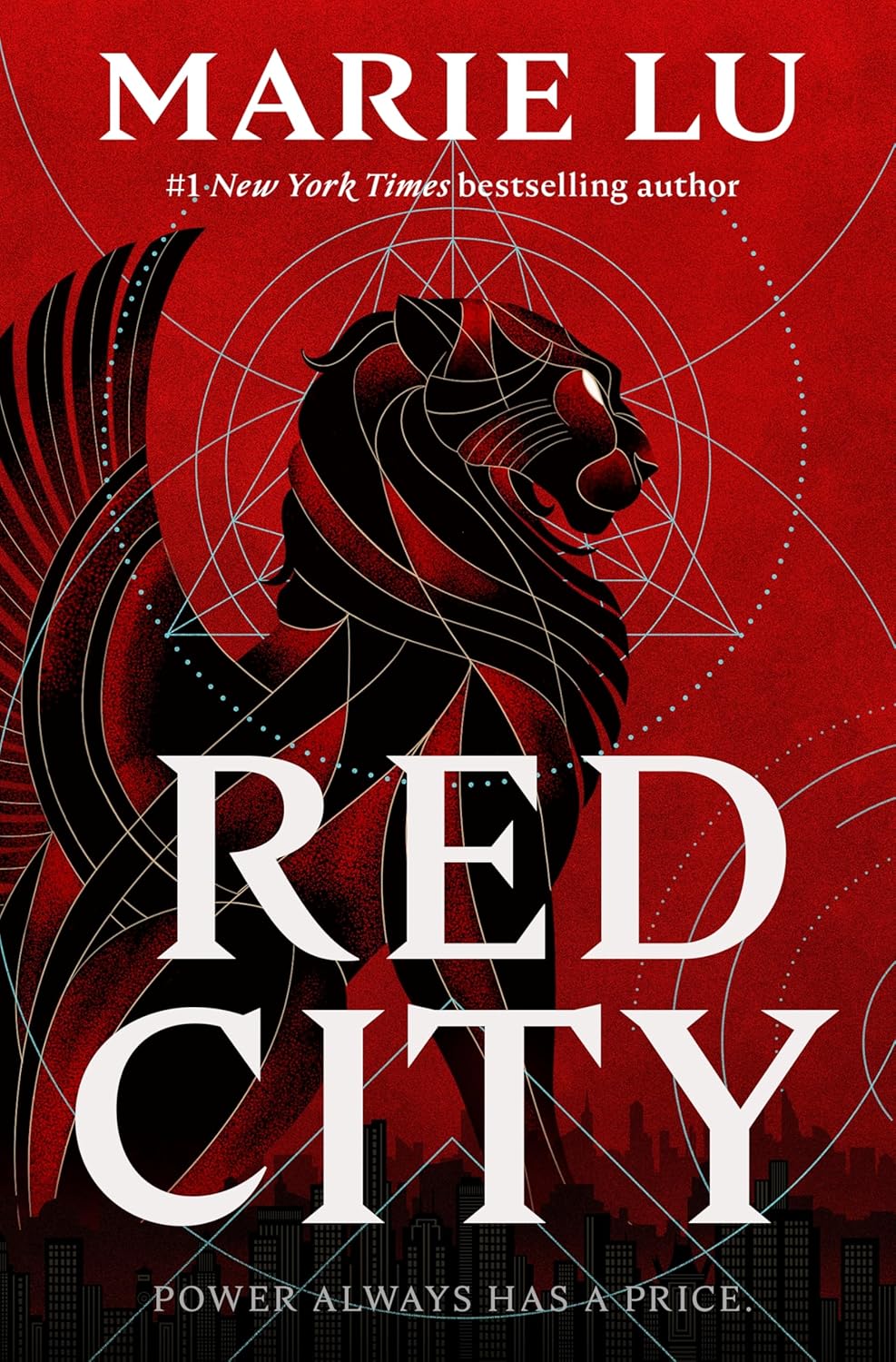
Red City (The New Alchemists, #1) – Marie Lu

In Angel City, Alchemy is the backbone of the wealthy. Those who are knowledgeable in the art of alchemical transformation can perform acts once thought impossible, both through the study of magic and the consumption of sand, a drug that makes the user more perfect—at a deadly price. For Sam and Ari, childhood friends caught on the opposite sides of the criminal syndicates of Angel City, this price is one that will bring them everything that they ever wished for. But will the rift deepening between them ever be breached—and what is the price of the enmity they’ve sown between each other in their quests for power?

TW/CW: substance abuse (fantasy), torture, violence, sexual content, loss of loved ones, child abuse

Marie Lu slipping in a reference to Nannerl Mozart whenever it’s humanly possible:

I’ve been on the Marie Lu train beginning with Warcross all the way back when I was 13 or 14, and I’ve been hooked ever since. Has she had her lower points? Sure, but it’s overshadowed by her consistency overall. Even her weaker books have still been loads of fun. It feels like a wonderful, full circle moment to be reading her adult debut now, here in my twenties and nearly finished with college. Thankfully, it did not disappoint.

First off, I think Lu’s really onto something with this alchemy-based magic system…I’m fully invested in this world! A lot of what I know about alchemy (chiefly from my amazing dad, who’s taught whole classes about this—shoutout to him!) is all about transformation—not just with the kind of alchemy that was done in ancient times with physical objects and elements, but of self-transformation, whether to reach a lofty goal of immortality or of general spiritual betterment or being closer to the divine. In Red City, the premise hinges around this quality of alchemy being perverted; you can physically perform transformation-based magic of several types, but the alchemical transformation is aided by a drug called sand. Of course, in the hands of criminal syndicates around the world, it becomes a tool to become more “perfect.” Leave it to the mafia to ruin alchemy. (New elevator pitch for Red City just dropped?)

On that subject, I really like that use of alchemy as a way to critique our societal concept of perfection. Self-transformation can be an incredibly powerful thing, when you’re putting in the work to become a better, kinder, smarter, etc. person. But when the urge to become perfect consumes you to the point of becoming a shell of your former self, it eats you up from the inside. Sam and Ari both fall prey to this, and it destroys them both. Lu always has a knack for using her fantasy and sci-fi worlds to critique parts of society, whether it was the examination of otherness and marginalization in The Young Elites or the sidelining of women’s stories in The Kingdom of Back. Using the negative potentials of transformational, alchemy-based magic to critique our society’s tendency to glamorize a destructive kind of false perfection.

So of course, by virtue of this story being about wealthy people doing horrible things to stay perfect and powerful, of course it’s set in Los Angeles. (Cue “Los Ageless” by St. Vincent. There ya go, past Madeline.) Well, not really Los Angeles. This is an alternate world that Red City is set in, and the scene is set in Angel City. But Lu took such great pains to make the worldbuilding as airtight as possible, which I thoroughly enjoyed! I expected nothing less from her, honestly, given her track record. Peppered with everything from fictional textbooks to congressional testimonies to FDA announcements, Lu left no stone unturned when it came to finding out how alchemy magic would affect the world. Even with the real-world basis to go off of, it seemed effortless for her to integrate alchemy and have the world still feel so real. I was immersed from page one, and there wasn’t a hole to be found throughout.

Making the jump from YA to Adult is harder than a lot of authors make it seem, but Marie Lu did it with ease with Red City! I feel like a lot of authors make the switch not considering how different the characters’ voices and choices will be, even with an age difference of only 5-10 years from the teenagers were once writing. I’ve read quite a few adult books from normally YA authors where the protagonists still read like teenagers. Lu made it look easy. It’s much more mature for sure, but never strays into edgelord torturefest territory either just to seem more “adult”; the violence, complexity, and sexual content are dialed up, but in a way that felt realistic for the characters, their circumstances, and the stakes. (And for the record, the way she wrote sex scenes was effortless and never got cringy, thank goodness! If I remember correctly, The Midnight Star got pretty steamy in some places, so I’m not surprised, but it’s worth commending.)

As always, Marie Lu’s characters are the star of the show in Red City. Man, she can craft such compelling characters! She just keeps winning!! Sam and Ari were both unlikable in some capacity, but they felt like tragic heroes to me. They were both doomed from the start (and I’m assuming they’ll get even more doomed as the series goes on…yippee!), but Lu wove them both like tapestries, and their stories hooked me from the start. My only nitpick is that Sam seemed to get disproportionately more development than Ari, but I’m assuming that’s what the mysterious book 2 is setting up. What we have now is excellent—Sam and Ari were both such compelling, tragic protagonists, and the way that their quests for power, recognition, and perfection tore them apart was nothing short of breathtaking. MARIE LU HAS DONE IT AGAIN!

All in all, a dark and dazzling addition to Marie Lu’s expansive fantasy canon that you won’t want to miss. 4.25 stars!

Red City is the first novel in the New Alchemists series, though no information has been released about its sequels or how long the series will be. Lu is also the author of many series for young adults, including the Legend series (Legend, Prodigy, Champion, and Rebel), the Warcross duology (Warcross and Wildcard), the Young Elites trilogy (The Young Elites, The Rose Society, and The Midnight Star), the Skyhunter duology (Skyhunter and Steelstriker), the Stars & Smoke duology (Stars & Smoke and Icon & Inferno), the standalone novel The Kingdom of Back, and the DC Comics tie-in Batman: Nightwalker.

Today’s song:

That’s it for this week’s Book Review Tuesday! Have a wonderful rest of your day, and take care of yourselves!
Posted in Book Review Tuesday

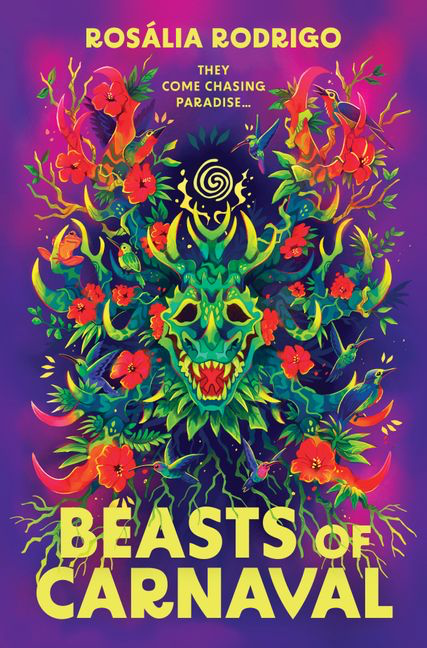
Book Review Tuesday (9/30/25) – Beasts of Carnaval

Happy Tuesday, bibliophiles!

Continuing with Latine Heritage Month, here’s a new release that caught my eye! The cover and premise seemed stunning, and I was intrigued by the inclusion of Taíno mythology. On almost all of those fronts, Beasts of Carnaval delivered instantly—I was hooked from page one!

Enjoy this week’s review!

Beasts of Carnaval – Rosália Rodrigo

Sofía has heard legends of Isla Bestia since she was a child. They say that enchanting performances and mysterious people populate the mysterious island, and those who come there are too entranced to ever return to the real world. Sofía is sensible enough to not believe the rumors. But when her twin brother goes missing, her trail leads to Isla Bestia. There, she’s drawn into a bizarre, luscious world of magic and shifting alliances. Caught up in a tangled web of intrigue, Sofía must keep her wits about her if she wants to find out which of her new allies are men—and which of them are monsters.

TW/CW: colonialism/imperialism themes, loss of loved ones (past), panic attacks, religious bigotry, blood, murder, racism/slavery themes, misogyny

Before I get into gushing about everything I adored about Beasts of Carnaval, I’ll get my one major pet peeve out of the way: fantasy worlds that are named so closely to reality that they basically are reality. Rodrigo’s world is essentially the Caribbean, except that the countries are named slightly differently—their colonizers are Hisperian, for instance. Real-word terms such as mestiza are used, so at that point…I dunno, it’s so close to historical reality, so why not just set it in the Caribbean of the past and just establish that there’s magic and some minor changes? Alternate history, anyone? I guess there’s a ton of fantasy novels that do that for European countries, but honestly, I’ve never liked it no matter the country that inspired the setting.

I dunno, the commentary would come across no matter the setting. Beasts of Carnaval isn’t the first book to have this, but for me, even though it peeved me, it didn’t take away from how lush the worldbuilding was; beyond the real-world hierarchies that were present, I loved the magic in this world, and it was integrated into the real world almost effortlessly. It’s a very fleshed out world rooted in historical themes and cultures, enlivened by vibrant and vivid magic inspired by Indigenous Taíno mythologies.

After reading Beasts of Carnaval, I’m absolutely going to be looking out for anything else that Rosália Rodrigo writes, because the prose of this novel was truly captivating! A Carnaval-inspired setting is bound to have some fun imagery, but Rodrigo wrung every ounce of magic out of it. With her prose, Isla Bestia wasn’t just abstractly a place that nobody wants to leave—she really makes you feel the seductive enchantment of the entire island! From the first description of the hummingbird dancer at the beginning, I was nothing short of captivated—I was hooked from start to finish, and I loved every minute of exploring the world that Rodrigo had crafted!

Compelling prose needs a compelling protagonist, and Sofía was just that! I adored her character, and she just seemed to leap off the page for me. From the start, I loved the many facets of her personality; she was strong-willed, determined, sensible, and sometimes practical to a fault, but I loved watching her adventures. Especially in contrast to the other characters around her, she was so focused on her mission of finding her missing brother that I got sucked in immediately. Hidden beneath her practical exterior, her deep caring for Sol made me root for her instantly, and I loved the way she fought back against the micro (and very much macro)aggressions that she experienced in daily life for being mixed-race. It’s rare that I love a character from the get-go, but Sofía captured my heart immediately!

A part of Sofía’s character that I also appreciated was the discussion of her mixed-race/mestiza identity! As a mixed-race person myself (though I’m very white-passing), I loved the nuanced discussions surrounding her conflicting feelings about her identity and how it positioned her in the highly stratified world around her. Rodrigo also had some excellent discussions about passing privilege and the treatment that Sofía got as this universe’s version of an Afro-Latina woman, especially with her being a former slave; Rodrigo did an excellent job of balancing her pride with the hurt she carries from enduring decades of racism from her peers and having to justify being a part of either of the communities she’s descended from. It was also especially poignant to have her arc revolving around discovering the magic of her Indigenous ancestors, inspired by Taíno mythology! It’s always so fulfilling to connect with one’s culture (speaking from experience), and to have that be physically manifested as healing magic was nothing short of emotional. I couldn’t get enough of it!

Overall, an enchanting and emotional novel that hooked me instantly. 4 stars!

Beasts of Carnaval is Rosália Rodrigo’s debut novel.

Today’s song:

MICHELANGELO DYING MY BELOVED

That’s it for this week’s Book Review Tuesday! Have a wonderful rest of your day, and take care of yourselves!
Posted in Uncategorized

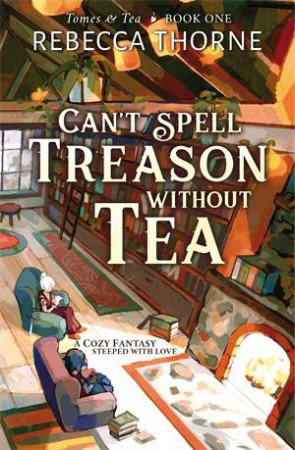
Book Review Tuesday (7/12/25) – Can’t Spell Treason Without Tea

Happy Tuesday, bibliophiles!

Continuing with my reviews for Disability Pride Month, here’s a sweet cozy fantasy with queer, disabled leads! Of course, those three factors are what drew me in, and I was in the mood for something more low-stakes. Though it wasn’t the best cozy fantasy out there, Can’t Spell Treason Without Tea was a sweet diversion.

Enjoy this week’s review!

Can’t Spell Treason Without Tea (Tomes & Tea, #1) – Rebecca Thorne

All Reyna and Kianthe want to do is escape. Kianthe is tethered to her job as the most powerful mage in the Queendom, and Reyna works as one of the Queen’s most esteemed bodyguards. But against all odds, they run away together to live out their shared dream: opening a bookshop that serves tea. As their dream falls into place, they discover that it’s not as easy as they thought to abandon their lives and run away, from the guards searching for Reyna and the complications of Kianthe’s magic. But they’re determined to make their dreams come true, and they’ll stop at nothing to have a moment of peace.

TW/CW: fire, injury, loss of loved ones, murder, violence, panic attacks

If you can get past the initially corny title, there’s some comfort to be had here, just like a good cup of relaxing tea. Am I committed to sticking around for the even punnier titles in the rest of the series? Not really, if I’m being honest. That said, if you’re looking for something fluffy, romantic, and sweet, Can’t Spell Treason Without Tea is the perfect diversion for you.

As far as coziness goes, Can’t Spell Treason Without Tea was a solid entry into the genre! Although it’s more action-oriented than a typical cozy fantasy novel, the pacing works in such a way that it takes a backseat to the more quiet, gentle parts of the novel. Thorne’s way of describing the mountainous landscape and the interior of the bookshop was relaxing and cozy; if it hadn’t been July when I read this, it would’ve been the perfect book to read while swaddled in blankets during the winter. It’s hard to get a reader invested in a relationship that’s already been going strong for at least a few years, but those quiet moments were perfect to get acquainted with Reyna and Kianthe. There’s plentiful soft, tender moments between the couple, both when they’re enjoying spending time together and when they’re trying to work out issues—often related to hurdles with getting the bookshop to work, but usually with something more interpersonal at its heart. If you can already get past the corny title, chances are, you’ll get past some of the more corny book and tea-related puns—for the most part, it’s a very silly, fluffy book, and it 100% fulfills its purpose as such. And damn, I needed a fluffy book.

Though this isn’t the best cozy genre fiction I’ve ever read, I think Thorne’s writing style lends itself perfectly to the subgenre. She had a very soothing way of describing the world and the characters—every description felt very bucolic and gentle, making even the world seem comforting alongside the storyline. With this style, she was able to render the quiet, tender moments of relationship development between Reyna and Kianthe beautifully, whether it was working out disagreements in their visions of the bookshop or helping the other work through panic attacks. Her writing just has a calming quality that not many writers do—an essential tool when you’re writing cozy fiction. Thorne’s passion for her characters and world truly shone through in every word, and it was clear that they took great care in making their writing as true to the intended mood as possible.

A rotating cast of characters is going to be a staple if your novel centers around a bookshop that serves tea, but that isn’t even where this novel’s character problem arises: it’s how they’re introduced. The issue with having Can’t Spell Treason Without Tea being placed smack dab in the middle of an established relationship is that many of the other characters are established as being involved with them, but you’re barely offered an explanation as to why. It seems like there’s quite a lot of short stories and one-shots and whatnot surrounding the novel, but without that context, it was rather disorienting juggling all of the characters when the protagonists had established relationships with them and their roles were hardly ever fully explained. Combine that with the fact that there were so many of these characters, and you’ve got a bit of a mess as far as getting the reader to care about anyone besides the protagonists.

Now, about the worldbuilding…or, “go, girl, give us nothing!” The worldbuilding wasn’t the main draw for me when I picked up Can’t Spell Treason Without Tea, but even then, it was rather underwhelming. Generically European and vaguely medieval high fantasy setting strikes again…free me from this prison!! I get that the romance and the characterization was the more central aspect to the book, but I still think that Thorne could’ve done much more with her worldbuilding. Try as I might, there wasn’t anything new offered about the setting. Though the descriptions of said setting were soothingly written, I struggled to find anything that stood out about the world—not even the magic system or the creatures. The monarchy and mythical creatures (griffins, dragons, etc.) were standard fare, but even those didn’t have any small quirks that would distinguish them from any other fantasy novel. If I think of what drew me in to this book, my mind goes to it being cozy and having queer/disabled leads; though I loved these aspects and think they were done wonderfully, they don’t strike me as necessarily unique—I’ve read other books with these exact qualities that had original worldbuilding to back them up. I’m not saying that this book had to have some insanely convoluted worldbuilding or anything, but at least give us something!

All in all, a cozy fantasy that was sweet enough to tide me over, but could’ve done with something more to distinguish it from all the rest. 3.5 stars!

Can’t Spell Treason Without Tea is the first novel in the Tomes & Tea series, which continues with A Pirate’s Life for Tea, Tea You at the Altar, and the final book, Alchemy and a Cup of Tea, which is slated for release in August of 2025. Rebecca Thorne is also the author of This Gilded Abyss and The Day Death Stopped.

Today’s song:

saw car seat headrest on saturday night…you will most DEFINITELY be hearing about that soon!!

That’s it for this week’s Book Review Tuesday! Have a wonderful rest of your day, and take care of yourselves!
Posted in Book Review Tuesday

Book Review Tuesday (6/10/25) – When the Tides Held the Moon

Happy Tuesday, bibliophiles!

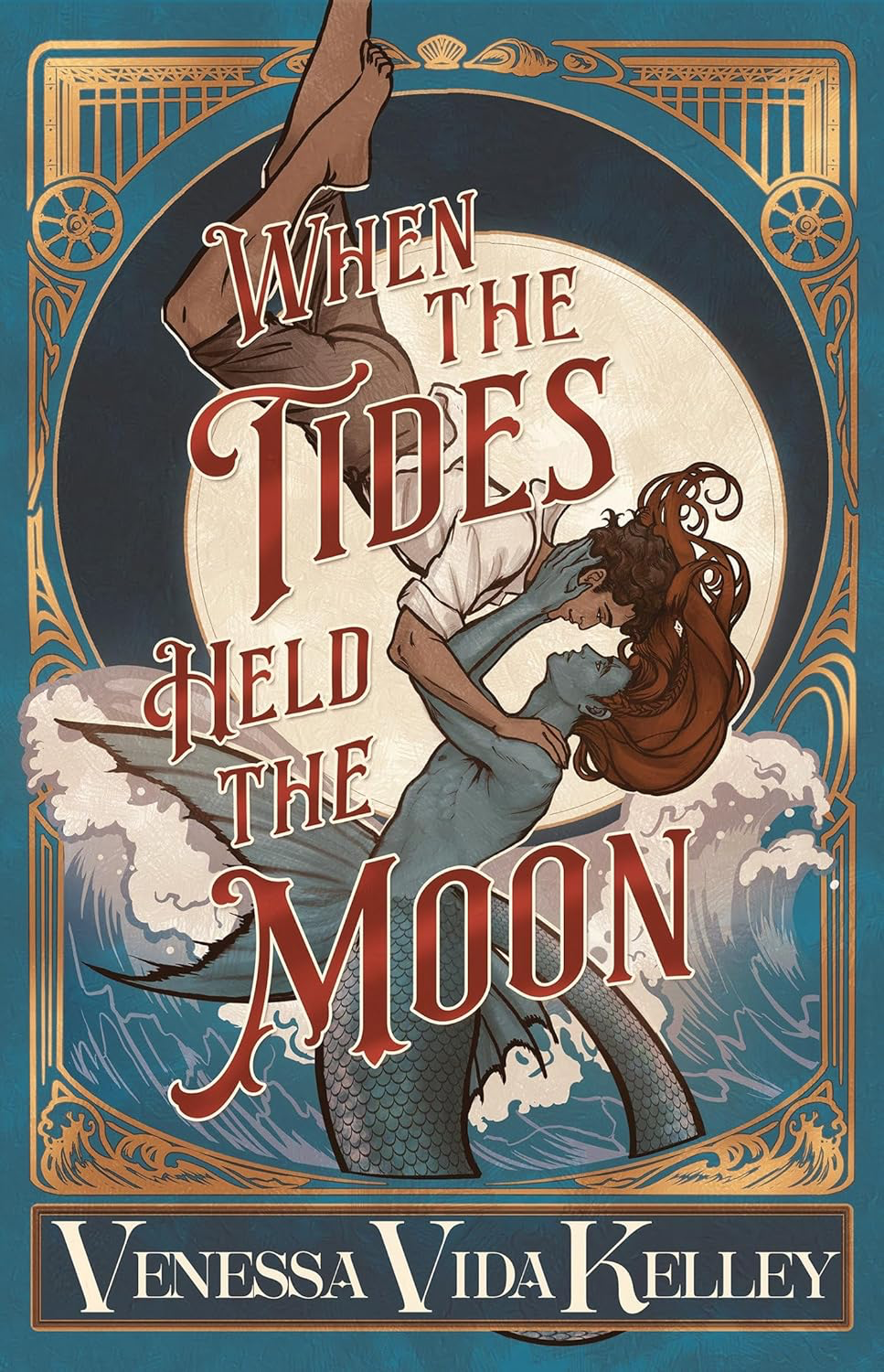
I found this novel in an Instagram post about upcoming queer releases in 2025, and this one immediately caught my eye. You put a comparison to The Shape of Water in the tagline, and you bet I’m in. (If anything, it’s right between The Shape of Water and Nightmare Alley, given the setting.) Venessa Vida Kelley has delivered a vibrant and sensitive story of queer love and solidarity amongst weirdos.

Enjoy this week’s review!

When the Tides Held the Moon – Venessa Vida Kelley

Orphaned and far from his homeland of Puerto Rico, Benny Caldera makes a living as an ironworker in 1910’s New York City, barely scraping together enough to stay afloat and out of reach of the taunts of his white coworkers. But when Sam Morgan, the owner of a sideshow, notices his handiwork, he commissions a strange project for him: a tank whose contents are unknown to him. Benny takes the opportunity for a new job, and finds an unexpected family in the sideshow’s performers. He soon finds out that the tank holds an impossible marvel: a captured merman. As Benny gains the merman’s trust, he finds himself drawn to him—and the merman to him. But when Morgan’s abuse to the merman turns deadly and the sideshow begins to crumble, it’s up to Benny to hatch a plan to save them all.

TW/CW: racism, homophobia, abuse (emotional and physical), violence, blood, ableism, xenophobia, mentions of sexual assault (off-page)

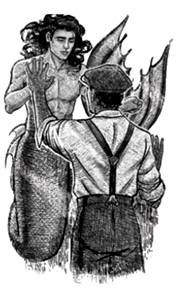
art by Venessa Vida Kelley

I may be a somewhat critical consumer, but listen…you dangle a comparison to The Shape of Water in front of me like a carrot, and goddamnit, I’m eating it right up. God forbid that a weird girlie such as myself consume even more media about found family, fish people, and the nature of marginalization!! That being said, nothing comes close to The Shape of Water, but that’s not the book’s fault. When the Tides Held the Moon is a beautiful novel in all of its parts.

When the Tides Held the Moon boasts a vibrant cast of characters, and it really felt like a feat for Kelley to balance all of them and still give them unique and complementary personalities. Besides Benny and Río, the cast is mostly rounded out by the fellow performers in the sideshow, of which there are many. Yet out of the nine (I think?) primary side characters, none of them ever felt like an afterthought. Each of them were not only rounded out, but had such thoughtfully planned interactions with all of the other characters—sometimes clashing, and sometimes meshing perfectly. There were individual romances and special friendships between the nine of them, but they were a shining example of found family done well. Despite their individual differences, their solidarity and kinship shone through on the page, making for a narrative that had no shortage of tenderness and heart.

The romance between Benny and Río shone in When the Tides Held the Moon. There was such a tenderness to both of them that gave the novel so much of its heart. I’m always a sucker for narratives about two outsiders falling in love, but I love the ways that their separate senses of outsiderness intertwined; they shared music, stories, and tales of their respective homelands. The slow burn romance was paced well, and never felt rushed. I do feel like the ending was a tad bit too close to The Shape of Water, without spoiling anything, but I think their individual way of solidifying their romantic relationship at the end of the novel separated itself enough in the end, making for a resonant, vibrant end to the novel and to their respective arcs. It was all just so wonderfully sweet, but never in a way that felt insincere or cloying—I just loved them!

When the Tides Held the Moon is an incredibly diverse novel, which was exactly how it should’ve been; even without nearly as much knowledge as Kelley has (this was a very well-researched novel and it shows), it would’ve been a disservice to show either New York City or the culture of sideshows as places that don’t have a history of diversity. Immigrants from many different countries (Puerto Rico, Ireland, India, and Russia to name a few) are at the forefront, as well as lots of queer people, disabled people, people of color, and people who overlap within these intersections. However, some novels have a tendency to have a very 21st century view of all of these things. When the Tides Held the Moon felt very historically sensitive in terms of the language it used around these characters, but not in a way that was sanitized. In fact, it didn’t hold back from depicting the kinds of horrific oppression that these characters faced. Yet it wasn’t straight-up trauma porn either—it was honest about the struggles marginalized people faced during this time period, but never in a way that felt like their trauma was being exploited for emotion. That emotion shone through naturally in the interactions that the characters had and the solidarity they fostered in the face of mutual oppression.

That being said, the major thing keeping When the Tides Held the Moon was some of the writing, particularly the dialogue writing. Even from someone with a fairly high tolerance for bombastic, dramatic dialogue (I love Ray Bradbury and the Claremont run of X-Men for similar reasons, if that gives you a good idea of where I’m at), Kelley’s dialogue often bordered on too much. As sensitive and nuanced as everything else about this novel was, the dialogue trended towards excessively cheesy and overdramatic more often than not. Though I adored Río as a character, his voice very much fell into that overly verbose, “wise”-sounding dialogue that you could slap on any fantasy character. Benny in particular had some of that pathetic “aw, gee, mister, gimme a break, why don’tcha” kind of overwritten voice that was in-character at best but almost grating at worst. The side characters had varying degrees of this affliction, but none of them necessarily jump out at me save for the very stereotypically New York mobsters (“he’ll be sleepin’ with the fishes,” etc…wait, there was SUCH a missed opportunity them to say that). The only exception I can think of was Matthias since it was established that it was his genuine personality and not a consequence of the writing. If this were any other novel, I would’ve tolerated this much less, but Kelley’s story had so much heart that I could partially let it slide…but not all the way.

All in all, a beautiful, sensitive novel about love and marginalization with a big heart. 4 stars!

When the Tides Held the Moon is a standalone and Kelley’s debut novel. She is also the author of the forthcoming graphic novel Manu Faces the Music, which is set to be released in 2026.

Today’s song:

That’s it for this week’s Book Review Tuesday! Have a wonderful rest of your day, and take care of yourselves!
Posted in Book Review Tuesday

Book Review Tuesday (3/25/25) – Water Moon

Happy Tuesday, bibliophiles!

Even with me being slightly less online than I’ve been in the past few years, I’ve seen a lot of buzz about Water Moon. Enough that it warranted a hardcover copy that was a whole $31 at Barnes & Noble…not even a special edition or anything, just a regular copy. Nevertheless, I wanted to give it a less expensive try, so I got it on hold at the library. Though it didn’t live up to both the $31 or the Studio Ghibli comparisons it warranted, Water Moon was a heartfelt, if a little confused, about the connectivity of people and the choices that lead us to the places we end up.

Enjoy this week’s review!

Water Moon – Samantha Sotto Yambao

Hana Ishikawa is set to receive a very unique inheritance. Her father has given her control over his old shop in Tokyo; tourists and passersby will see a ramen restaurant, but once you look inside, you find that its wares are something completely different: a pawnshop where you can exchange your life’s regrets and unpleasant choices. But on her first day on the job, Hana finds the shop destroyed. Looking for answers, she instead finds Keishin, an American tourist searching for answers of his own. Their search leads them into a strange realm of magic and wonder that may hold the keys to the problems they’re facing…and more.

TW/CW: loss of loved ones, grief, abandonment, mentions of abortion/pregnancy issues (brief), blood/violence, descriptions of injury

Water Moon was a good stab at magical realism; it had some beautiful elements that had me enraptured, but not for long enough. Its fundamental issue is that it wanted to do too much but didn’t have the space to do it. What we have here, messy as it was, at least read well and presented some moments of lovely, whimsical magical realism.

While this novel had some issues throughout with thematic cohesiveness, I do think that the central one (or the one that felt like it was supposed to be central, at least), was a beautiful one—connectivity through the choices we make. Hana’s life is dictated by regret, but she learns, through jumping through fantastical worlds, that it’s the unexpected things in life that bring us together that make life worth living. I especially loved the connection to the Super-Kamiokande Neutrino Detector, something that Keishin has returned to Japan to study—capturing the secrets of this elusive, subatomic particle that can only be observed (if you’re lucky) in an observatory filled with distilled water underground. I’m a sucker for when writers are able to articulate that emotion with science, especially with something as misunderstood as physics; Water Moon did a lovely job of using that as part of the larger metaphor about how lucky we are to experience the unexpected, and how that can bring us together. I just wished Yambao had done more with it, but what we had, I loved.

I also loved the worldbuilding in Water Moon! I don’t think the childlike wonder that Yambao was going for was properly executed all the way, but I love the inherent whimsy that’s integral to holding the worldbuilding together. You travel to these parallel, unseeable worlds found in puddles on the ground, and in those worlds, you find everything from villages dedicated to hanging the stars at night and origami and paper planes with a life of their own. Even with the rather sinister undercurrent that runs through it, the glimpses of the fantasy worlds were almost dreamlike. They had a distinct quality of feeling like the kinds of fantasies you imagined when you were a kid (especially the puddle travel), which enhanced the feel of the world overall.

However, that whimsy only came off in varying degrees. That was due to the writing, which often came off rather rote. Yambao presented the reader with a myriad of fantastical, objectively wondrous elements in this parallel world that Hana and Keishin venture into, only to describe it in the flattest terms. For a magical realism novel, the writing felt almost utilitarian, designed to describe a setting or a phenomenon with the absolute minimum amount of description for the reader to get an idea of what it looked like. Sure, Water Moon didn’t need to be excessively flowery or purple in its prose, but when you have a setting as whimsical and magical as this, more description is necessary.

The same applies to the feelings of the characters—they hardly seemed to react to their settings, only serving to be chess pieces that were dragged around at will when the plot called for it. Keishin at least had something of a personality, but other than him, most of the characters, including Hana, were defined only by what had happened to them. They were defined only by their backstories, and that dictated everything that they did throughout the story—not their motivations or their personalities. All of this, combined with Yambao’s relatively flat writing, made their romance lackluster. Not only did it feel like the classic “oh, our main characters are a boy and a girl, therefore they have to fall in love,” it was just so rushed and un-earned—we didn’t get nearly enough development (or page time) from either of them to merit a full-blown romance. Even though they’d jumped through magical puddles together and visited whimsical worlds, I found myself barely caring for either of them, or their romance.

Back to the subject of themes…I wholly believe that a book shouldn’t be constrained by talking only about one theme. In fact, most every book does that anyway—having a book centered around a single theme without even a handful of sub-themes or topics is practically impossible. Like I (and Yambao) said, everything is connected. Water Moon, however, had a problem with articulating it. Beyond the bit about choices and connectivity, Water Moon wanted to say so much about so many things—motherhood, grief, regret, parent-child relationships—and yet it didn’t know what to say about any of them. A theme was introduced with the same emotional weight as the central theme, it got 50 pages of page time, and then it barely resolved itself. Water Moon had almost no sense of direction, leaving me with a book that didn’t resolve itself in a satisfying or logical way. Ultimately, this felt like a case of too many cooks in the kitchen—it was an ambitious attempt to tackle every theme and give it the same weight, but it ended up in a plot (and characters) that ran around confused for almost all 374 pages and underbaked statements on what it wanted to say.

Overall, an ambitious and dreamlike novel with a world that was a treat to explore, but offered up flat characters and had no sense of what it wanted to do with itself. 3.5 stars!

Water Moon is a standalone, but Samantha Sotto Yambao is also the author of Before Ever After, Love and Gravity, A Dream of Trees, and The Beginning of Always (under the name Samantha Sotto).

Today’s song:

so hauntingly beautiful :,)

That’s it for this week’s Book Review Tuesday! Have a wonderful rest of your day, and take care of yourselves!

Posted in Book Review Tuesday

Book Review Tuesday (3/18/25) – The Teller of Small Fortunes

Happy Tuesday, bibliophiles!

You know it. You know I’m all for cozy literature. I wasn’t particularly in a moment where I needed cozy fantasy, but these days, I love to space them into my regular reading rotation to keep things lighter, if need be. I’m usually more for sci-fi than fantasy, but I love a good fantasy every once in a while. The Teller of Small Fortunes wasn’t the best cozy fantasy I’ve read, but like a mug of tea, it was great for a momentary hug of warmth and love.

Enjoy this week’s review!

The Teller of Small Fortunes – Julie Leong

Tao is an immigrant from Shinara, making a living far to the west in Eshtera. She makes a living off of fortune-telling, but hers are not like the grand tales that people expect from those with Shinn heritage. But Tao’s fortunes have a catch: they are small fortunes, minor events that seemingly have no consequence, but will add up towards a life of crucial choices. She cannot stay for long in one place, lest these fortunes pile up and her customers start to expect more complex predictions. But when she crosses paths with an ex-mercenary and a thief-turned-poet on the road, Tao has to keep a promise to the fortune she gave them: they’re looking for a missing girl, and Tao knows that she’ll be reunited with them. What’s unknown, however, is how it’ll happen…

TW/CW (from Julie Leong): political conflict, death of a parent, parental neglect, racism, grief, alcohol

While The Teller of Small Fortunes wasn’t the best cozy fantasy I’ve ever read, if you’re looking for something sweet to tide you over, look no further! In the mood for found family, cats, spells, and wonky pastries? I’ve got just the book for you.

Given the crowds that I hang around with, it might surprise you that I’ve never actually played DnD. I’ve always been adjacent to people who are into it and frequently play it, but I’ve never played myself. By osmosis, I know enough about it to discern that anyone who loves DnD will absolutely eat up The Teller of Small Fortunes! Somebody with more DnD knowledge could probably sort each character into a class, but I’m illiterate in that department; yet even still, I can tell that it came about in the way that many DnD campaigns seem to: out of love and out of friendship. Leong’s cozy fantasy has the perfect balance of wholesomeness, levity, and more serious themes, and overall, it’s an ode to the friends we find in unexpected places. The contrasting personalities of Tao, Mash, Silt, and Kina made for a delightful found family with goals that often got in the way of each other, but twisted to form a journey across a fantastical land that taught them lessons about identity, friendship, and individuality. It’s just so sweet. Admittedly, it did border on a bit cloying at times (even for me, both with my cozy fiction proclivities and my merciless sweet tooth), but overall, cozy fantasy fans will be more than satisfied. Plus, there’s a cat. Automatic win in my book.

Tao’s character arc and the themes around it were the heart of The Teller of Small Fortunes. This novel focuses heavily on her immigrant identity, but it explored something that I haven’t often seen with these narratives. In order to make a living outside of her home country, Tao has to perform a stereotype—in her case, being a seer. She relies on this preconceived notion of her people all being able to see the future, and knows that she’ll be able to make money off of it, yet she tries so hard to make it define her. On the other side of the coin, there’s the Guild of Mages, who physically want to use her as a pawn, fitting her into their similarly superficial stereotype of what a magic-user should be. Yes, The Teller of Small Fortunes is very much a “be yourself” narrative (I will always hate Disney for making people trivialize this kind of message), but it’s one that’s complicated by the nuance of the aspects of Tao’s identity. For her, being herself is a lifelong fight, held up by several systemic forces of oppression. Her journey is a mental one just as much as it is physical, and it required the same labor, with a satisfying conclusion: the conscious effort by her to not let other people box her in.

However, the writing sometimes got on my nerves. For me, cozy fantasy can sometimes fall into the trap of being almost condescending in its writing style; it veers to strongly into the “and what did we learn today, kids?” kind of storytelling, even if it’s often aimed at adults. There is a marked difference between having a low-stakes plot and dumbing down the language for your audience. The Teller of Small Fortunes didn’t completely fall into making the language overly digestible, but every plot point and side quest (of which there are many) tended to have a very clear, obviously stated lesson that accompanied the ending. Even if said plot points were well-executed—which they often were, especially the scene with the phoenix egg—their impact was often lessened by the regurgitating of what the scene was meant to mean for the characters and the message, as if we couldn’t figure it out. I honestly didn’t mind that these plot points, especially the ending, were wrapped up in notably kind, easier ways—that’s almost a staple of cozy fiction, at this point—but we didn’t have to get their message shoved in our faces on a neon sign. Additionally, as a character, Kina also erred on this side of saccharine—she was sweet in the way that some cozy fiction characters are, but like the pastries she made, it got a little too sweet in a grating way.

I also found the worldbuilding to be quite generic. The Teller of Small Fortunes was one of those fantasy novels that took existing countries, copied and pasted them into the narrative, and added magic and mythical creatures; Shinara was clearly an analogue for China, which, while it was great for the themes of anti-immigrant sentiment and xenophobia, didn’t make for worldbuilding that was interesting or novel in any way. The same can be said for most of the other places that Tao and the gang pass through—most of them fell under the “vaguely European, I will not elaborate” curse that plagues high fantasy, and the only things that distinguished them, if any, were some of the exports/trades that they had. I will say that I loved the system of the Guild of Mages, and they served as great commentary for tokenization and a distant but tangible source of corruption in the world, but they didn’t have enough of a presence for them to have an effect on the world for me. It all felt very lackluster to me in contrast to the care that was put into the characters. I also would’ve liked more clarification on the regional magic. It’s implied through some of Tao’s background that magic is often associated with/endemic to particular regions (hence the stereotypes of Shinn people being seers/fortune tellers and whatnot), but we don’t get a clarification of whether or not the rule also applies to the surrounding regions.

Overall, a cozy fantasy that had lovely, poignant characters and themes, but was less fortunate in the worldbuilding department. 3.5 stars!

The Teller of Small Fortunes is a standalone and Julie Leong’s debut. Her next novel, The Keeper of Magical Things, is a companion novel set in the same universe as The Teller of Small Fortunes, and is slated for release in October 2025.

Today’s song:

That’s it for this week’s Book Review Tuesday! Have a wonderful rest of your day, and take care of yourselves!
Posted in Book Review Tuesday

Book Review Tuesday (12/24/24) – The Lost Story

Happy Tuesday, bibliophiles, and a merry Christmas Eve (and Christmas, in advance) to those who celebrate! No matter your beliefs, I hope you’re staying warm and spending time with your loved ones this week. Happy holidays! ❄️⛄️🎄🍪

I discovered Meg Shaffer’s debut novel, The Wishing Game, about a month back and loved it. (Bottom line: if you’re an adult who wished they could’ve gotten Willy Wonka’s golden ticket as a kid, READ IT.) Naturally, I moved onto The Lost Story the minute it became available at the library. Although it wasn’t as strong as Shaffer’s debut, The Lost Story is a testament to the healing power of fantasy.

Enjoy this week’s review!

The Lost Story – Meg Shaffer

When they were 15, Rafe Howell and Jeremy Cox went missing in the West Virginia woods. Six months after their disappearance, they came back, seemingly unscathed. What the rest of the world doesn’t know is that they escaped to a fantasy world hidden deep in the Red Crow State Forest. But only Jeremy remembers their odyssey. Now, distanced for 15 years, Rafe remembers nothing about what happened that day, and Jeremy has a magical knack for discovering missing persons.

Emilie Wendell has gotten wind of Jeremy’s talent for locating the missing, and enlists his help to find her older sister, who vanished in the same stretch of woods where he and Rafe went missing all those years ago. With Rafe and Jeremy in tow, Emilie discovers a magical world that could have only sprung from the mind of a child, only visible to those who look hard enough. But confronting this world and its secrets may lead to the very reason that Jeremy and Rafe never spoke of their time together—and the reason why Emilie’s sister never returned.

TW/CW: near death situations, discussions of child endangerment/kidnapping (past), abuse (physical and emotional), homophobia, loss of loved ones (past), fantasy violence, mentions of suicide (past)

I never got around to reviewing The Wishing Game (which I liked better than The Lost Story) here, but it’s safe to say that Meg Shaffer is out here doing the good work, and by the good work I mean writing books about reclaiming childhood innocence and joy via the stories we loved as children. Having read both books, Shaffer really gets the power of stories—and the power of rediscovering them in adulthood. The balance between childlike wonder and whimsy and the harrowing realities that come with adulthood are a difficult balance to strike, but The Lost Story lives in the reality between them and never denies either aspect. Rafe and Jeremy’s journey of healing, rescuing people who may not need to be rescued, and realizing their love for each other was a rickety, emotional ride, but one that, once the plot got going, paid off in spades. Plus, I love that Shaffer made this story a distinctly queer one—I always love queer books, but the fantasy escapism plot with their queer identities made so much sense when you consider how fiction can be a sanctuary for queer people.

Part of what made that aspect of The Lost Story land so well was that Shanandoah truly felt like a child’s wonderland. There was a charm to the misplaced names (the Valkyries being only what a young girl would think of the real Valkyries of Norse myth, for instance) and the over-the-top magical ones, and each fantasy element had the nonsensical aspect of a child’s mind. This world is full of magical horses, impossibly sweet fruit, vengeful spirits, and everything a child could possibly populate a fantasy world with—and all of it is delightful. The Narnia influence was clear (it’s wonderful! Imagine C.S. Lewis without the proselytizing), but there was a whimsy to it that Shaffer excelled in—even if it was separate from the real world, she fully succeeding in making a world feel like it was ripped from the pages of a 13-year-old girl’s notebook.

However, I really didn’t see the point of Emilie being a part of the story. In contrast to Jeremy and Rafe’s complicated relationship, the only thread connecting her to the narrative was the fact that it was her sister who happened to have gone missing. Her personality bordered on grating—there wasn’t much to her other than a determination to find her sister and having her “teehee! so quirky”-isms when the plot called for it. (But did it really call for it?) My main issue with her is that she didn’t have the development that the other characters did. She witnesses the wonders and horrors of Shanandoah and comes out of it having barely changed, save for the fact that she’s reunited with Shannon. In contrast with Rafe and Jeremy, it just seemed increasingly obvious that she didn’t have as much business being there, even though she was purportedly the main character. The Lost Story might have been stronger if she had been nixed entirely—she was placed as the protagonist, but at its heart, it was the story of Rafe, Jeremy, and Shannon, not her.

Additionally, The Lost Story had some issues with its pacing. It took nearly halfway through the book for the characters to reach Shanandoah, the whole premise of the book. The first third or so, although Shaffer’s establishment of the exposition was spread out evenly, tended to drag. Instead of more development that could have lead more to the (excellent) arcs of the characters later on, we get drawn-out scenes of banter between the main characters once they reunite, as well as some tired training montages that could have been flattened out into a much shorter scene. As a result, the first half of the events in Shanandoah were rushed together—our heroes reach this famed fantasy land, and almost immediately, they’re separated and thrown on wildly different adventures that only converge in the last quarter or so. For such a grounded story, there needed to be more even allocation of events that truly mattered, which is why I couldn’t give it the full 4 stars.

That being said, I loved how the duality of the themes were tied together in the end. For all of the characters, the land of Shanandoah was escapism, but they had different ways of handling reality while in it. For Rafe and Jeremy, they couldn’t stay because there were real monsters they had to confront; Shanandoah worked both as a place for them to rekindle their relationship, but also to confront the very real demons back in the real West Virginia. For them, they had to return to the real world to heal. But for Shannon, Shanandoah was the realest part of her life. She had gotten into a situation that no child should ever be placed in, and for that, her childhood wish for another world came true, and it became her sanctuary. If The Lost Story had gone with either interpretation, I would’ve been happy, but I loved Shaffer’s approach in depicting both sides of fantasy and escapism. Fantasy can be a place to ignore all of your troubles, but also a place you return to when you need healing. Even if it’s fictional, it can be the truest, realest part of you. Both can be true.

All in all, a heartfelt and heartstring-tugging fantasy for all of the kids who wanted to return to Narnia. 3.75 stars, rounded up to 4!

The Lost Story is a standalone, but Meg Shaffer is also the author of The Wishing Game.

Today’s song:

That’s it for this week’s Book Review Tuesday! Have a wonderful rest of your day, and take care of yourselves!
Posted in Book Review Tuesday

Book Review Tuesday (10/29/24) – The Book That Wouldn’t Burn

Happy Tuesday, bibliophiles!

The ranting hour is upon us…yet I didn’t hate the book I’m reviewing today. It’s not abject hatred, more just frustration. Maybe I am a good-for-nothing Gen Z-er with no attention span, but I feel like if you don’t get into much concrete worldbuilding until the halfway point of a nearly 600-page book, that’s a real crime in your writing. Unfortunately, The Book That Wouldn’t Burn is guilty.

Enjoy this week’s review!

The Book That Wouldn’t Burn – Mark Lawrence

At a young age, Livira was kidnapped, then rescued and delivered to a sprawling city. Within that city was The Library, a building with layers upon layers inside, containing an archive that spans thousands of years. Now focusing on the education she never had, Livira will discover secrets that will change her world forever.

Evar has lived his entire life trapped inside of the bowels of The Library. Hunted by monsters, he was orphaned at a young age, and his siblings have slowly been picked off as well. With no escape in sight, he spends his days desperately looking for a way out—and he cannot see one until he finds a lost girl named Livira.

TW/CW: kidnapping, loss of loved ones, blood, violence

DNF at 44%.

I know I often gripe about long fantasy novels taking eons to get to the point, but this pushed it to the extreme. All of the rave reviews kept swearing that there was some massive payoff to the excruciating trek that was this book, but the intangible promise of something wasn’t enough to keep me going. The Book That Wouldn’t Burn felt stuffed to the brim with plot lines of no substance or development, and it’s not like the book was too short to be cut down. 571 pages. There were absolutely some chapters that had no business being there.

Suspense and worldbuilding are story elements that normally aren’t confused, but it seems that Lawrence got them mixed up in the construction of The Book That Wouldn’t Burn. It’s one thing to have a crucial element of your world be a secret—that was what the novel hinges on, and from the looks of it, understandably so. This technique is mainly for elements that will change the way the reader and the characters perceive the world. Lawrence’s problem was that he applied that to almost all of the worldbuilding. We get a brief glimpse of the outside world, but not much is known save for the divisions between humans and sabbers (a hostile, dog-like species), and that there’s a Vaguely Medieval Epic Fantasy Town™️ outside of The Library. I get that the focus is on The Library, so what’s the point of establishing any of it if it’s not going to be of any consequence later on in the book? Granted, I didn’t finish it, but the way it was written was so hasty. I did get some semblance of how The Library works, but it was too little too late. If you dangle some reveal over the reader’s head the entire time, you should at least have some information about the world to scaffold why you should care. To some extent, I can see that since all of this was foreign to Livira, but that’s not an excuse to barely describe anything!

I wanted to like Evar, but in the end, his situation was more compelling than who he was as a person. That’s because he’s a walking case study in why tragic backstories don’t automatically make a character fleshed-out. We know all about how he’s been trying to claw his way out of the catacombs of The Library and has been hunted by monsters who have killed his parents and many of his siblings…but we know nothing else other than that. Aside from an implied resilience on the virtue of him being able to survive being trapped in a monster-filled maze beneath a library, I know nothing about this kid. We are given exactly zero hints about his personality. I felt pity for him because of his circumstances, but I put down this book knowing nothing about what makes him tick, other than a vague semblance of revenge. I don’t know why he speaks the way he does, I don’t know his habits, I don’t know how he interacts with the world. I wanted to know him! His relationships were solely defined by their proximity to other people (many of whom were dead). By the time he finally met Livira, I couldn’t care less about how they would interact—mostly because Livira got sucked into some Library portal right before anything of significance could happen. 250 pages, about a third of which were devoted to Evar, and I just could not care less.

Now, for why I picked up The Book That Wouldn’t Burn in the first place…The Library. Again, this could be a consequence of me not reading enough of the book, but I think there’s merit in saying that there’s not nearly enough focus on what’s actually interesting about it for the first half of the novel. After the initial revelations that a) Livira now has access to a library the size of a city with archives spanning thousands of years and b) that there are people trapped in a monster-filled maze beneath it, we get…nothing else. There’s much more focus on Livira’s education in The Library, mainly because when she comes there, she does not know how to read or write. That wouldn’t be a bad thing if it weren’t for the fact that these scenes are repetitive to a fault. Remember what I said about this book potentially benefitting from some hedge trimming? This is precisely where I would slim down the page count. I don’t ascribe to the belief that every little thing has to advance the plot, but you’ve got to have something to keep the reader’s interest—it felt like the same cycle of Livira reading, writing, and getting teased by the apprentices. Rinse and repeat for approximately 100 pages. Now do you see why I quit?

The lesson of The Book That Wouldn’t Burn is that you can’t hold a book afloat on a concept alone. I wanted to like the premise so much—what’s not to like about a massive, age-old library that’s larger than a city and holds unknowable horrors beneath it? But the scaffolding necessary to keep me interested was flimsy at best. Lawrence’s writing had moments of being clever, but that, along with the shaky bits of information about the library, were not enough to hold my interest. 1.5 stars, because it wasn’t all bad, but I was so painfully bored by a book with a fascinating premise, which is truly a crime.

The Book That Wouldn’t Burn is the first novel in The Library trilogy, followed by The Book That Broke the World and The Book That Held Her Heart. Mark Lawrence is also the author of several fantasy series, including The Broken Empire trilogy (Prince of Thorns, King of Thorns, and Emperor of Thorns), The Red Queen’s War trilogy (Prince of Fools, The Liar’s Key, and The Wheel of Osheim), and many more.

Today’s song:

saw the magnetic fields for the 69 Love Songs anniversary tour over the weekend—what an incredible show!!

That’s it for this week’s Book Review Tuesday! Have a wonderful rest of your day, and take care of yourselves!