
Posted in Book Review Tuesday

Book Review Tuesday (2/25/25) – When No One Is Watching

Happy Tuesday, bibliophiles!

I’ve had my eye on When No One Is Watching for a few years now. I’m not typically a thriller fan, but the concept intrigued me, despite the consistently mediocre to low ratings on Goodreads and The Storygraph. Alyssa Cole is a new-to-me author, and I figured I would give her book a try. However, I’ve come out of it with a mixed bag and uncertainty as to whether I’ll read more of her books in the future. When No One Is Watching had an excellent premise that it only halfway delivered on, but was still entertaining and timely in the end.

Enjoy this week’s review!
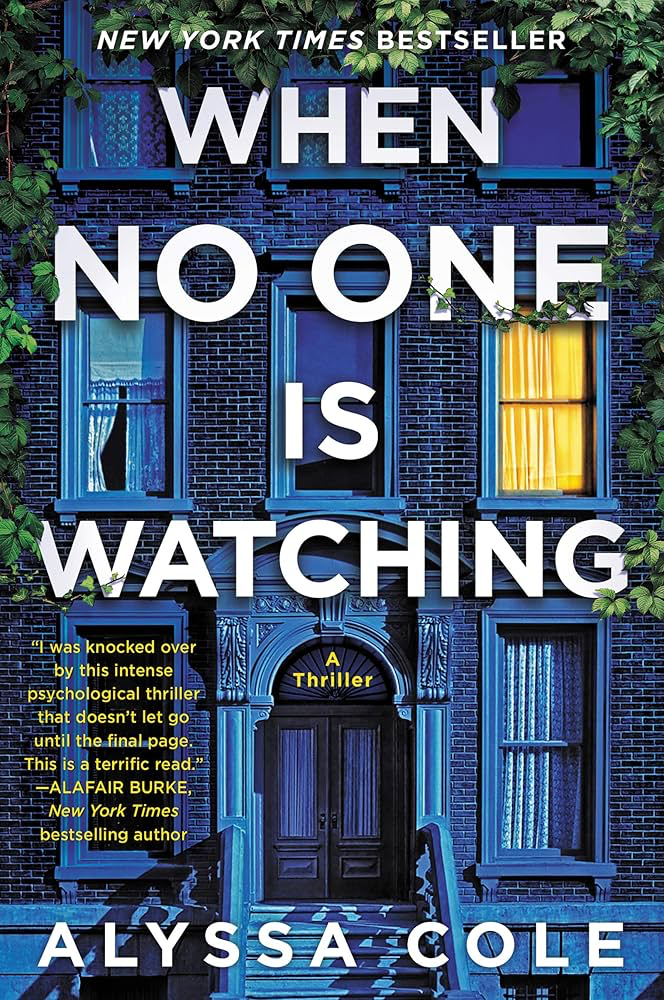
When No One Is Watching – Alyssa Cole

Sydney Green has called Brooklyn home for her entire life, yet her childhood is quickly slipping through her fingers. Her neighborhood, which was once home to a diverse group of homeowners, is quickly beginning to be gentrified. Condos are springing up where her neighbors once lived, and her Black and brown neighbors are being driven away one by one. Sydney suspects that something is amiss, and that there may be something more insidious to the gentrification of her neighborhood. With the help of Theo, her well-meaning neighbor, Sydney seeks to uncover the truth of her neighborhood’s fate, but what she finds may be even more sinister than she could have ever imagined.

TW/CW: racism, misogyny, gun violence, murder, loss of loved ones, police brutality, kidnapping

First off, When No One Is Watching is an incredibly timely thriller, and having a thriller surrounding the themes of gentrification is genius. When you strip past the apathy the general American population has of living not just on stolen land, but land that has driven its people of color into the worst possible conditions, it really is a frightening reality to live with. Even if the gentrification of neighborhoods itself isn’t some grand conspiracy, as it partially is in this novel, it’s a no-punches-pulled look at what’s happening to neighborhoods all over the country. Adding in snippets of social media doesn’t always work in books, but weaving in the neighborhood groupchat into When No One Is Watching also served to add a critical piece of the puzzle: that a lot of white people in such situations are so easily willing to dismiss any kind of racism if it doesn’t affect them, even if it’s happening in their own backyard. With an unflinching pen, Cole examines all of the aspects of gentrification, from its history to its current iterations, making for a thriller grounded in a real source of fright.

There are plenty of scary scenes in When No One Is Watching, but the fact that Cole mines the horror out of Syd being in an Uber and her driver driving her away from her destination should tell you something about where this novel lies. That particular scene is at the beginning of the book and isn’t the scariest thing that happens, but man…Cole is excellent at squeezing the horror from very grounded, real events. With the exception of the more sinister twist at the end, this novel creeped me out because almost everything that happened was real—its horror drawn from the realities of racism, misogyny, and gentrification. I can’t speak to this personally, but it felt like the inherent horror of being a marginalized person in the United States, but specifically of being a Black woman, a group that this country has historically done everything in its power to silence and oppress. It really gives weight to the expression “truth is stranger than fiction”—in this case, truth is scarier than fiction. That’s where Cole finds the fear, which made When No One Is Watching so effective in its brand of suspense.

However, a lot of the realism that came through in the suspense aspect of When No One Is Watching was deadened somewhat by the excessive use of modern internet lingo. I don’t mean the AAVE at all—that part was great, and I’m glad to see more of it integrated into literature, because there’s no need to cater to white audiences anymore at this point (and there’s many conversations to be had about how twitter/tiktok/etc. slang has subsumed AAVE so quickly and stripped it of its original meaning). No, I’m talking about the very millennial-sounding, tweet-ready one-liners that many of the characters dole out to make the story “funnier.” (Whew. Lots of hyphens in that sentence, even for me.) If I hadn’t seen the quote “I need you to channel the confidence of a mediocre white man” on at least 10 different t-shirts, stickers, and tweets, it would’ve been funny. About half of the humor in When No One Is Watching lands, but the other half is about the same as this: quips that have been circulated on the internet for at least a decade that could’ve been funny years ago, but have gone so stale that they’ve lost all novelty, originality, and more importantly humor. Again, I liked that When No One Is Watching was able to balance levity with some of the more thriller aspects, but it would’ve tipped the balance even more if more of the humor was original. Even five years after this book’s release, it was so easily dateable. Give it another five, and it’ll be painfully dated.

What hindered When No One Is Watching the most, however, wasn’t that: it was the pacing. It was just odd. When the suspenseful moments came, they were appropriately suspenseful, but there was so much middling around in between these moments for the first 75% of the novel that I started to question whether or not I was reading a thriller. But once the big twist comes in, it’s when I was about 80-85% of the way through the book—and the entirety of the big reveal, the climactic final battle, and the resolution were crammed into only about 15% of the book. It was whiplash-inducing, but not in a way that a thriller should be. Thrillers aren’t my go-to, but for more thriller/horror movies, I like when I have some breathing room between the suspenseful/scary moments (see: Alien, Nosferatu). When No One Is Watching theoretically had that down pat, but where it suffered was that the breathing room was rarely interesting. Other than the fantastic commentary on racism and gentrification, the plot between the suspense was just boring. I didn’t care much for Syd and Theo’s romantic subplot, I didn’t care for them randomly running around and ultimately discovering very little. So much of it could have been condensed in order for the climax to not feel like being chucked out of a bus window and onto the highway—not in a suspense way, but in a wild pacing way. Big reveal, shootout, resolution, and bam, it’s all over…in about 30 pages, tops. As with the humor, there needed to be balance with the plot—more suspense spread out through the novel, and more room to process and mine into the commentary of the climax.

All in all, a thriller with sharp, relevant commentary on racism and gentrification that excelled in its suspense, but was dragged down by uneven pacing and humor that dated itself far too quickly. 3 stars.

When No One Is Watching is a standalone, but Alyssa Cole is also the author of several other novels for adults, including the Reluctant Royals trilogy (A Princess in Theory, A Duke by Default, and A Prince on Paper), the Off the Grid trilogy (Radio Silence, Signal Boost, and Mixed Signals), The Loyal League trilogy (An Extraordinary Union, A Hope Divided, and An Unconventional Freedom), and many other novels.

Today’s song:

That’s it for this week’s Book Review Tuesday! Have a wonderful rest of your day, and take care of yourselves!

Posted in Book Review Tuesday

Book Review Tuesday (4/16/24) – Happy and You Know It

Happy Tuesday, bibliophiles!

Happy & You Know It was a book that’s outside of my usual reading comfort zone—I’m not usually a realistic fiction person, and it seemed literary, though it didn’t end up being very much so. Either way, the premise was enough to grab me out of my sci-fi/fantasy stint, and though it wasn’t executed the way I wanted it to be, Happy & You Know It was still a biting and entertaining piece of satire.

Enjoy this week’s review!

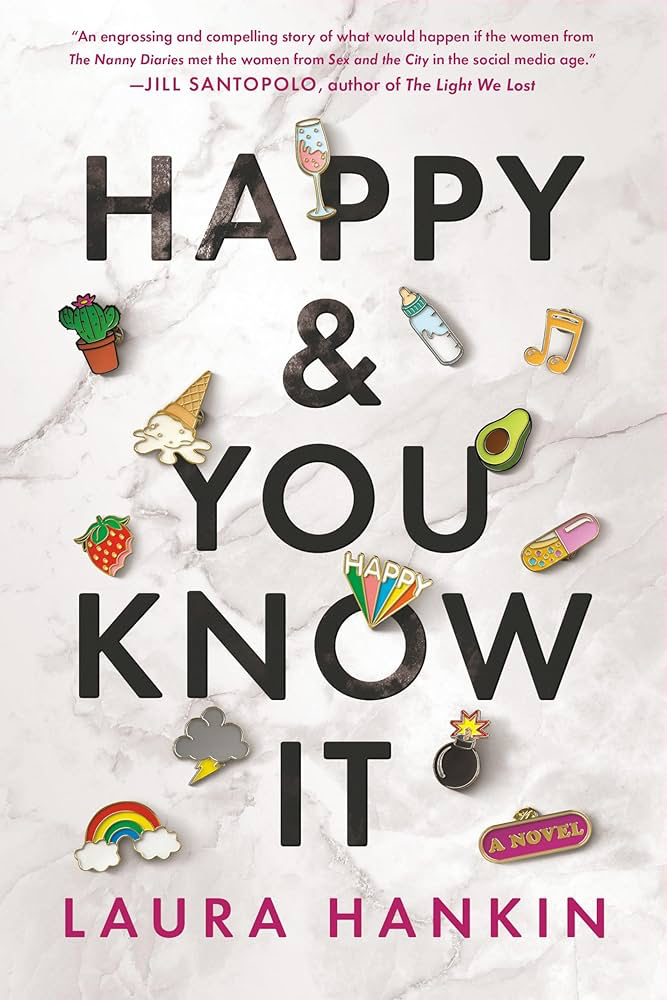
Happy and You Know It – Laura Hankin

Claire Martin has been unceremoniously thrown into the lowest point in her life. After her band, Vagabond, replaces her and rockets to stardom not long after, she’s left with fewer and fewer options to keep a job—and pay the rent in New York City. But when the opportunity presents itself to become a playgroup musician for a cohort of rich, Manhattan moms, Claire jumps at the chance—she’ll be paid for music again, even if it’s just singing nursery rhymes, and they’ll surely pay her exorbitantly. Claire is thrust into a world of mommy influencers, babies that are too well-dressed for their own good, and a multitude of secrets. This playgroup isn’t what it seems—and Claire may have been sucked into their whirlwind of lies too late…

TW/CW: substance abuse, cheating/affairs

Given the first page, I was expecting for Happy & You Know It to be a wilder ride than it actually was, but that’s not to say that it was a bad novel. Though I feel like the plot didn’t reach its full potential, it was still a fantastic piece of satire—biting, timely, and hilarious at all the right times.

The gauntlet you always have to run when writing satire—or any genre, honestly—that’s somehow involved with social media is making it sound realistic. Too often, authors heavily force a hand of making sure the characters use all of the right slang and terminology, and end up falling headfirst into what looks like a boomer’s distorted vision of the internet and how it operates. I was bracing myself for Happy & You Know It to have some of those trappings, but thankfully, none of that was to be found! Hankin’s depiction of this inner circle of rich, Manhattan mommy influencers felt scarily true to how such figures act, from the curation of every little aspect of their lives down to the tone-deaf, over-the-top names for their babies. It was ridiculous, but that was precisely the point—those kinds of influencers who treat their growing babies like playthings for them to dress up so they can get more likes is ridiculous, and Hankin clearly understood how twisted it gets when these behaviors are pushed to the extreme.

Claire was a perfect protagonist for Happy & You Know It: an outsider who is morbidly enchanted by this world of kale smoothies and sponsorships, but is so desperate that she falls in too deep just when she realizes how right her instincts were about the morbid part. Hankin did a fantastic job of detailing all of her motivations—given the care that was put into crafting her extensive backstory with her former band and the constant, emotional reminders she gets from their stardom, almost all of what she did made sense. She’s just the kind of person who thinks that she’s smart enough to run from a dangerous situation, but cornered enough to convince herself that she can make it out unscathed. I almost with that this novel was entirely from her perspective, and we didn’t get the POV shifts from most of the playgroup mom—I guess we wouldn’t have explicitly seen the details about Whitney and Christopher’s affair, but I’m sure there’s a way that it could have been revealed. The less we knew about the moms, I think, the better.

Perhaps that was part of what made the initial reveal about the true nature of the TrueMommy supplements (no spoilers) fall slightly flat—part of it may have been that it was a bit predictable, but part of it was that we knew too much about the rest of the moms. By the time that this reveal kicks in past the halfway point, my Spider-sense was already tingling—too much for how far into the novel it was. This amount of time should’ve been enough to ramp up the suspense, but I feel like I saw too much into their heads, and therefore, had a good guess of what the first twist was going to be. Especially since we only got some of the moms’ perspectives (Whitney, Gwen, and Amara), I feel like the balance was off. With Claire as an “outsider looking in” protagonist, it would have worked so much better if that secrecy was also confined to her POV—and nailed in that feel of the novel.

On that subject, given how gloriously over-the-top the introduction was, I expected the culmination of said twist to be a lot more dramatic than it was. It looked so messy from the start, and yet the ending felt wrapped up far too neatly—just a moment of confrontation, and then a time skip where everyone is (mostly) living happily ever after in wake of this supposedly drastic revelation. The one red herring we sort of got felt too obvious, and so it was easy to point to the real perpetrator, which dampened the effect. The setup didn’t match the end result—I guess I did want more of a disastrous downfall for almost all parties involved (can you tell I like Fargo?), but if you specifically have an introduction to hint at some spectacle of corruption and ruin, it needs to deliver—and unfortunately, Happy & You Know It missed the mark on that front.

All in all, a slightly disappointing mystery, but a deeply fulfilling and sharp satire. 3.5 stars!

Happy & You Know It is a standalone, but Laura Hankin is also the author of The Daydreams, A Special Place for Women, and the forthcoming One-Star Romance.

Today’s song:

aaaaaaaaaaand that’s another album added straight to my bucket list

That’s it for this week’s Book Review Tuesday! Have a wonderful rest of your day, and take care of yourselves!
Posted in Book Review Tuesday

Book Review Tuesday (4/2/24) – Drunk on All Your Strange New Words

Happy Tuesday, bibliophiles!

Ever since it came out, Drunk on All Your Strange New Words has been on my radar; beforehand, I hadn’t even heard of Eddie Robson, but the premise was so fascinating that I just had to get my hands on it. After several trips to several bookstores with no luck in finding it, my hold finally came on Kindle—and it was a delight to read!

Enjoy this week’s review!

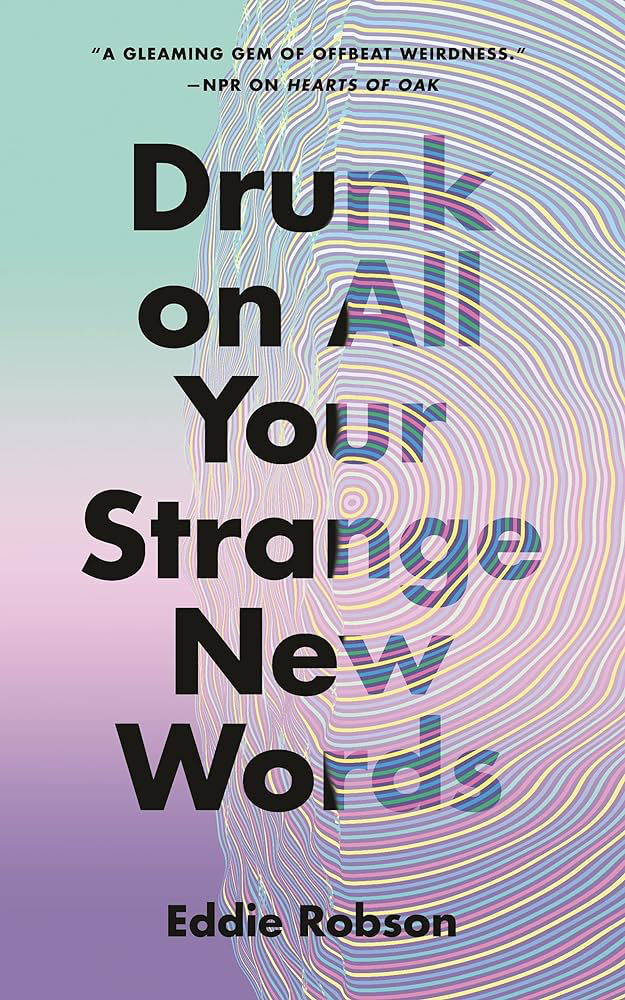
Drunk on All Your Strange New Words – Eddie Robson

For Lydia, First Contact started in the mind. The aliens we greeted were called the Logi, and they communicated entirely telepathically. Lydia works as a translator for a Logi cultural attaché named Fitz. It’s a pleasant job—Fitz is good-natured, and together, they pick apart plays and literature to determine if they are suited for intergalactic sales to the Logi. The unfortunate side effect is that translating the Logi’s telepathic language into English makes her feel drunk, earning her a less-than-stellar reputation on the job. But when Fitz is murdered and all eyes land on her as the suspect, Lydia must keep the police and Logi ambassadors off of her tail—and get to the bottom of Fitz’s murder.

TW/CW: xenophobia (fictional), murder/assassination, mild violence, death threats

I am on my hands and knees trying to find sci-fi with aliens that really feel alien. The quest is ongoing. But if you’re on that same quest with me (let us join hands, sisters in disappointed with humanoid aliens), Drunk on All Your Strange New Worlds is the cure for all that ails—all that and a dose of some good ol’ British humor.

I get to go off about aliens!! I GET TO GO OFF ABOUT ALIENS!! ALIENS WOOOOOOOOOOO THIS IS WHAT I’VE BEEN WAITING FOR

First off: the Logi! Drunk on All Your Strange New Words boasts some incredible alien design and culture, and I had so much fun exploring it throughout the novel. The whole concept of telepathic aliens whose speech makes the act of translation make humans feel drunk was already fascinating to me; it was so out of left field, and a concept I’d never really considered before; the only other instance I’ve seen of alien speech having unintended physical effects on the human body or brain was in A Desolation Called Peace (though that was arguably more drastic), but it still felt truly weird, which a lot of sci-fi doesn’t touch on, strangely. I loved getting such a complex, multilayered picture of the Logi beyond that, from the head coverings they wear to protect from Earth’s atmosphere to their unexpected strength; some of the elements of them almost veered into the supernatural (technically not much of a spoiler since it happens early on, but the reveal was so cool to me that I’ll keep my mouth shut for your enjoyment), but even that felt like a marker of an alien well done—so outlandish that the only explanation that humans can come up with is paranormal.

Creating all of that excellent background for the Logi is one thing, but it wasn’t all left as a lofty concept to puff up the worldbuilding—it had real, tangible effects on the characters and the plot, which I was so grateful for. Robson executed the real-time effects of humans interacting with a lot of these alien behaviors exceedingly well! It isn’t just that Lydia feels like she’s had a few too many after a long translation job—the feeling of drunkenness extends to drunken behaviors, the consequences of which had unfortunate implications for keeping said job. Having that was also a great device to start putting Lydia under suspicion for the other characters—there were enough instances of perceived instability or unprofessional attitudes that the authorities had all the more evidence to implicate her in Fitz’s murder. This is all to say that Robson really left no stone unturned when it came to the worldbuilding, and my enjoyment skyrocketed because of that!

The cultural environment around First Contact and the integration of the Logi into human culture also felt a little too real, in the best and worst way possible. At this point, the world has advanced into an undefined point in the future, and enough time has passed between now and First Contact that there aren’t just bigots and zealots with xenophobic intention, but organizations targeting aliens and professors giving whole lectures on what they perceive as a Logi encroachment into human culture, literature, and media. Paired with the faulty software that scores the truthfulness of the news that Lydia consumes (that aspect felt very “three days from now”), it felt like a more realistic depiction of alien contact and communication than we usually get; at heart, we still fear what we don’t understand, but it’s neither all-out annihilation of the aliens nor a global, complete hippie kumbaya event of unity. It’s demonstrative of human nature in the face of what we don’t understand: the bad and the very ugly, but enough good to keep us afloat and on good terms with the visitors from another world.

For most of the novel, I was really into the mystery surrounding Fitz’s murder. (I knew it was gonna happen from the start, since, y’know, in the blurb, but I didn’t want for him to die. I just wanna see the little alien guys!! Let them vibe!!) The slow burn of it kept me turning page after page, and for most of the novel, felt appropriately paced. It didn’t feel like we were jumping from place to place for no reason—every outing had a motive and revelation that added to the mystery in a way that made sense. However, though I enjoyed much of it, I feel like it got a little too slow-burn. The subtlety was good for most of the novel, but it got to a point where I was 90% of the way through the book and we still had no idea who the killer was and who the prime suspect was, now that most of the others had been eliminated by that point. Said killer was also introduced very late into the novel and quite sparingly, which made the reveal feel unearned—if we’ve spent all this time poring through suspects and barely touched on the actual killer, then what was the point? For such a clever novel, that felt like such an amateurish move—the only reason that we didn’t suspect them was because we had no idea who they even were for almost the entire novel.

All in all, a delightful combination of sci-fi and murder mystery that boasted some of my favorite aliens that I’ve read in a while. 4 stars!

Drunk on All Your Strange New Words is a standalone, but Eddie Robson is also the author of Hearts of Oak.

Today’s song:

That’s it for this week’s Book Review Tuesday! Have a wonderful rest of your day, and take care of yourselves!