
Happy Tuesday, bibliophiles!
I’ve had this book on my radar for a few years, as well as The Lesson; I almost read it earlier last week, but then I discovered that I could only read it on my phone, for some reason (nope). Coincidentally, I found it at Barnes & Noble later that week (on a very necessary detour I made with a friend), so I finally decided to pick up a copy for myself. Now, I’m so glad that I have a hard copy—No Gods, No Monsters is one of the most unique fantasy novels I’ve read in a while!
Enjoy this week’s review!
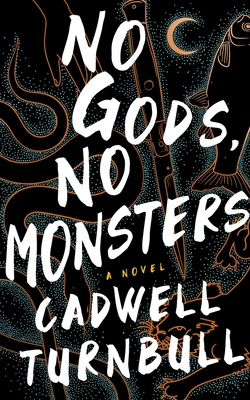
No Gods, No Monsters (Convergence Saga, #1) – Caldwell Turnbull
Around the world, strange creatures have come out of hiding from the shadows. Creatures of myth and legend, those thought to be confined to the imagination. In the wake of this unexplained event, known globally as The Fracture, the stories of people across America collide. A woman reckon’s with her murdered brother, unjustly killed by Boston cops, but learns that her brother’s life was more fantastical than she could have ever imagined. A professor goes in search of a friend presumed dead, but finds a schism between two cults in its place. A young girl must warm up to the presence of her adopted sister, who she grows to love despite her bloodlust. All of these events converge as the world of monsters is revealed, but can mankind reckon with their presence—and their demand to be seen?
TW/CW: police brutality, gun violence, gore, substance abuse/past mentions of an overdose, sexual abuse, domestic abuse
If I’m being honest, it’s a real shame that No Gods, No Monsters has an average rating of 3.45 on Goodreads. To be fair, it’s probably one of those “you love it or you hate it” books, but I absolutely loved it. Sometimes you love the book with an average rating over 4.00 and tens of thousands of reviews, but sometimes it’s those lower-rated and lower-reviewed novels that hit the spot. (see also: Spare and Found Parts – Sarah Maria Griffin)
No Gods, No Monsters truly felt dreamlike, and that’s what made this novel stand out to me. It’s not concerned with being overly coherent, and it drifts about in bits and pieces. I guess that’s the aspect that put a lot of people off, but it’s the kind of writing and storytelling that suits the story that Turnbull is trying to tell. It fits with the whole theme of “monsters have come out of hiding and we can’t do anything about it” theme—there’s global panic, sure, but first there’s the denial that anything is happening at all, and then the reality hits you, and you still try to deny it. This whole novel felt like navigating the haze of denial while the monsters creep out of the shadows: you know exactly what’s going on, but as long as you can help it, I’m not here, this isn’t happening.
I feel like No Gods, No Monsters could have just as easily worked as a short story collection. Each section, switching POVs from dozens of characters who are slowly woven together, works on its own, situated within worlds that are’ separate until the threads begin to tie themselves into an interlocking web of magic towards the end. They all felt like short stories, but I don’t think anything was taken away from them not being short stories—No Gods, No Monsters is a very non-traditional novel in several ways, and I liked that it toed the line between novel and anthology in order to flesh out the themes of community and the things that bound all of the characters together in the chaos.
My favorite section had to be that of Sondra and Sonya—their story was all at once chilling and tender, heartwarming, heartbreaking, and horrifying. Off of the top of my head, this instance in the novel is one of the few depictions I can think of where talking about complicated love in a fantasy/sci-fi setting really does feel complicated; the complication is very literal in the sense of depicting the drain (no pun intended—no spoilers, though) on Sondra, but her horror of both reckoning with the actions of Sonya in the present and how much they bonded in the past felt nuanced in a way that truly made me feel for Sondra. In general, this part of the novel is representative of what I loved about the novel as a whole: although there were some physical consequences to the monsters coming out of hiding, I loved that Turnbull chose to focus more on the emotional and interpersonal connections that happened in the aftermath.
Going off of that point, I loved how No Gods, No Monsters handled its expansive worldbuilding! The event that incites everything that happens in the novel is implied to be the start of a global upheaval, but Turnbull handles the complexities of it with aplomb. It doesn’t feel like every single action movie where we go instantly into mass panic and riots in the streets (although that is stated to have happened in the background), but instead gives us information in breadcrumbs through how it affects the many and varied characters of the novel. I did find myself wanting more of how the monster emergence is affecting the world, but a) I figured that the uncertainty is a consequence of the characters themselves not fully knowing what’s going on, and b) the fact that this is a series, so we’re bound to learn more in the books to come. I have We Are the Crisis downloaded, so I’m excited to find out more!
All in all, a truly memorable and inventive fantasy that explored the not-often-discussed areas of trauma and denial in the face of global upheaval. 4 stars!
No Gods, No Monsters is the first installment in the Convergence Saga, followed by We Are the Crisis. Caldwell Turnbull is also the author of The Lesson.
Today’s song:
That’s it for this week’s Book Review Tuesday! Have a wonderful rest of your day, and take care of yourselves!

 The Bookish Mutant