

Happy Tuesday, bibliophiles! I’m back from my road trip with a fantastic book for you.
I try to stick to mostly queer books for June, but I read extra queerly all year…think of this as pregaming for Disability Pride Month. (Both apply to me, I get a pass, right? Hell, it’s my blog and I’ll do what I like.) Nevertheless, I bought Life Hacks for a Little Alien while on vacation (shoutout to Townie Books in Crested Butte). I’d heard great reviews of it, particularly that it encapsulated neurodivergent childhood beautifully, so of course I had to read it. What I found was a heartstring-pulling and tender depiction of neurodivergent childhood.
Enjoy this week’s review!
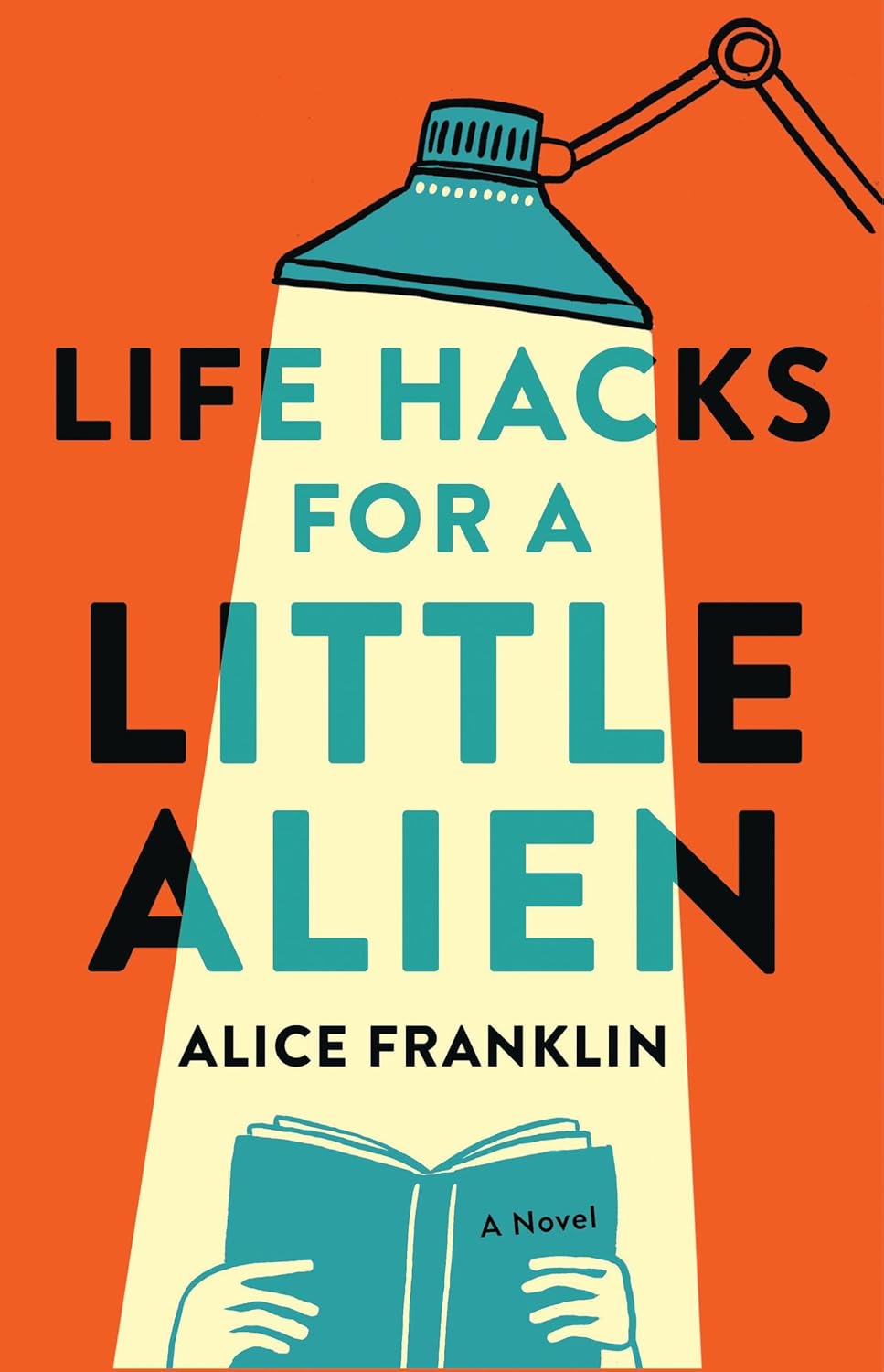
Life Hacks for a Little Alien – Alice Franklin
In England, a young girl grows up not knowing that she’s neurodivergent, but certain that she’s different from the other children. She doesn’t talk or think the way they do, and her parents are having trouble keeping up with her. She never shows any interest in much anything, but when insomnia prompts her to watch TV at night, she discovers a documentary on the Voynich Manuscript. Soon, the mysterious manuscript heightens her curiosity and invigorates her life. The only thing that would make it better is to find the Manuscript itself—and she’s determined to get it in her hands and decipher its impossible code.
TW/CW: ableism, vomit, bullying, institutionalization/mental illness themes
I have once again been ensnared by a book with metaphors about aliens relating to neurodivergent. It will happen again.
I’ll absolutely be reading more by Alice Franklin after this, because her writing style captivated me from the start! The first comparison that sprang to mind, strangely, was of Wes Anderson. It feels odd to jump from literature to film, but stay with me. The narrator’s voice is very matter-of-fact and particular, which are qualities than can be ascribed to both very self-assured children and comically self-assured Wes Anderson characters. The linguistic footnotes and reading lists at the end of each chapter were also reminiscent of the wry judgements of Anderson’s omniscient narrators. All of this is to say that Life Hacks for a Little Alien boasted such a charming voice. Second person POV is a notoriously difficult POV to write from; Franklin chose it for the book because she found it personally easier to write and thought that it would help the reader have empathy for the protagonist. I think it would’ve been easy to have empathy for the narrator no matter what, but the use of the second person gave Life Hacks for a Little Alien such a unique flavor. As the narrator tried to pick apart the structures of how a young English girl is supposed to act, she was methodical, but in a way that was always witty, snarky, or charming. Yet that voice, when faced with the harsher realities of neurodivergent life, never faltered in its emotional connection. I was invested in the narrator’s story from the start, and from then on, Franklin kept me hooked!
Although I’m not autistic, I am neurodivergent (I have sensory processing disorder, which has some similarities to autism), and there are so many aspects of Life Hacks for a Little Alien that resonated with me. Even if I weren’t so interested in sci-fi, the latent, never-ending feeling that you’re from another planet never fades, and the latent alienation that exists in everyday life was depicted with such authenticity and heart. Beyond that, what was depicted most accurately to me was the lingering sense of “I’m doing what the other kids are doing, so why am I wrong/why are they laughing at me/what about what I did makes it wrong?” Neurotypical society is so full of idiosyncrasies, and being neurodivergent makes you realize that from an uncomfortably young age. The narrator’s struggles with picking it apart were delivered with such sensitivity and accuracy, and I loved that her special interest in linguistics and the Voynich Manuscript was not just something that made her fall in love with learning again, but also became a survival mechanism for her to navigate a complicated world.
Beyond that, the use of the Voynich Manuscript and linguistics as a metaphor for the narrator’s experience was easily the most poignant part of a very poignant novel. Many neurodivergent people of various diagnoses often express the feeling that they were never given the same “script” as neurotypical people, a feeling I’ve often shared; if anything, we were basically given a kind of indecipherable Voynich Manuscript that the author understands perfectly, but nobody else does. The narrator’s theory by the end of the novel is that it functions as a way to help aliens navigate Earth, but what is unspoken is that she sees it as such too—she feels like the alien that has been given an indecipherable code with strange pictures in order to understand a completely foreign world. You can see how that hit me in the gut instantly…and it goes even further. English linguistics are full of similar idiosyncrasies as the neurotypical world, and you’re expected to go along with them all the same, even though they frequent contradict all manner of rules. The narrator’s interest in linguistics becomes her way of understanding—or failing to understand—the world. It’s such a beautiful, multilayered metaphor, and it struck such a resonant chord within me.
I have almost no criticisms of Life Hacks for a Little Alien, and I might’ve given it 4.75 or 5 stars if not for this one aspect. My only real problem with Life Hacks for a Little Alien is that it just…ended. Although the epilogue wrapped things up in a more satisfactory and clean manner, the real ending just…ended. For such a meticulous book, it was jarring to end in such an abrupt place. Even though we got some sort of resolution, Life Hacks for a Little Alien seemed to just plunk itself down and end unceremoniously. I’m fine with some books having neatly wrapped-up endings, but this novel seemed to need some semblance of one. I fully expected another chapter afterwards. However, I can sort of see how it might function—this isn’t necessarily the end of the narrator’s story, and her life was far from over by this point. Yet it felt like the end of this arc and the beginning of a new chapter in her life, which seems to necessitate some more closure.
All in all, a deeply poignant and beautiful meditation on neurodivergent girlhood and navigating alien worlds. 4.5 stars!
Life Hacks for a Little Alien is a standalone and Alice Franklin’s debut novel.
Today’s song:
That’s it for this week’s Book Review Tuesday! Have a wonderful rest of your day, and take care of yourselves!

 The Bookish Mutant