
Happy Tuesday, bibliophiles!
I’ve had my eye on Unconquerable Sun for several years; it’s appeared on several lists of queer sci-fi books that have caught my attention, and a loose retelling of the story of Alexander the Great seemed interesting enough. Unfortunately, Unconquerable Sun was overblown, overwritten, and kind of a waste of 500+ pages.
Enjoy this week’s review!
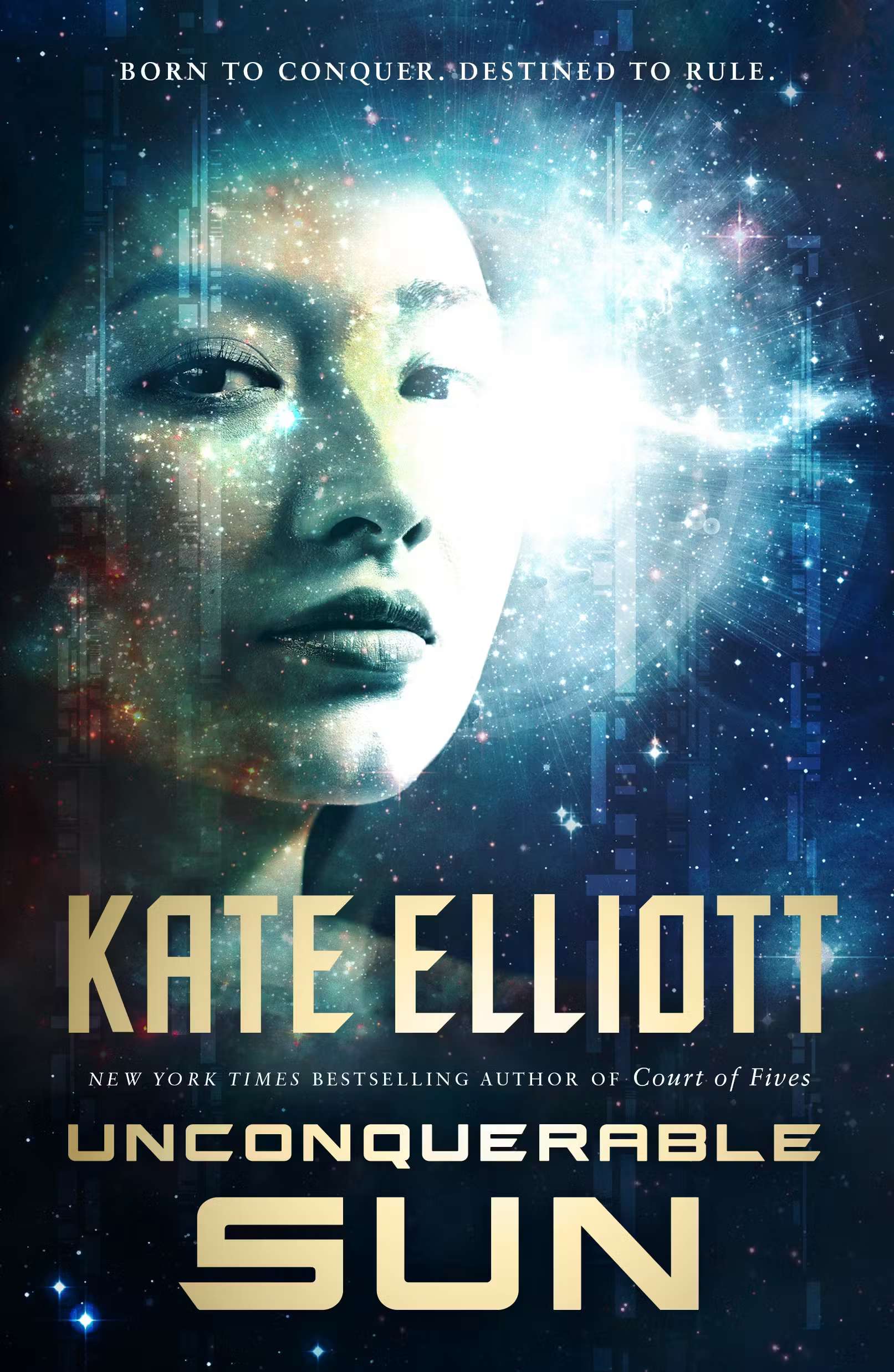
Unconquerable Sun (The Sun Chronicles, #1) – Kate Elliott
The Republic of Chaonia is in chaos. Princess Sun has come of age, and the throne that she’s inheriting is one of immense responsibility. Her mother, the Queen-Marshal Eirene, commanded armies and seemed to pull off miracles in order to keep their empire afloat. With a ruthless court and bloodthirsty enemies on all sides, Princess Sun must fight to earn her name—and keep her planet alive.
TW/CW: war themes, human experimentation, xenophobia (fictional), violence, murder
Unconquerable Sun wasn’t bad enough for a full-on DNF. I didn’t hate it, but I certainly didn’t enjoy reading it. Ultimately, the reason I slogged through it was because it felt like the book equivalent of the sunk-cost fallacy: I’d already gotten halfway through and I was at least vaguely curious as to what would happen, so I saw it through to the end. Sadly, things really didn’t pick up from there—this novel is 528 pages of mediocre worldbuilding and even worse characters.
Unconquerable Sun pairs two writing issues that are a fatal combination. The way that Elliott wrote the dialogue was downright obnoxious. It had that pompousness of somebody trying too hard to make the royalty come across appropriately Royal, which circled back around to just being corny. Suffering through that was already a lot, but then comes the second issue: with one notable exception, almost all of the characters had this exact same voice. Most of their voices were indistinguishable from the other, and to make matters worse, they all had the most annoyingly overwritten dialogue possible. Even the non-royal characters had voices like this, when they reasonably shouldn’t be talking like elitist politicians—it was annoying to read, but more often than not, it didn’t even make sense. It reminded me of Maria Z. Medina’s Mistress of Bones, which, to this novel’s credit, was way worse, but it had a similar issue: it made no sense for most every character to sound the same. It was a headache-inducing combination, one that doomed me to lose interest in this novel early on.
Those issues with the dialogue translated to the characters as well. Most of the characters weren’t terribly distinguishable from one another, and there were countless side characters who didn’t have any business having such a large role in the story. Elliott attempted to do some in-depth development of Princess Sun, but I feel like a lot of the discussions of her living in her mother’s shadow were heavy on the telling and lacking on the showing, making her a somewhat hollow protagonist. (That being said, I liked how Elliott wrote about her being mixed-race, and the depictions of the discrimination she faces and her inner conflict was at least decently done.) Now, remember how I said that all of the characters were/sounded the same, save for one? That’s where we get to the issue with Persephone, who was utterly obnoxious in a secret third way. Elliott was so clearly trying to make her the witty, rebellious one, from the eye roll-inducing chapter names (Rick Riordan and his consequences) to her quippy, Joss Whedon dialogue. Similarly, her seeming issues with family were so glossed over just so she could be the quirky, messy foil to the more stuck-up Princess Sun, a dynamic that couldn’t have been more overdone. It’s a real feat for me to hate most of the cast of a single novel, but somehow, Unconquerable Sun pulled it off.
Unconquerable Sun was a mixed bag in terms of the plotting and pacing. Even though I wasn’t the biggest fan of this novel, I will say that the scenes were nicely plotted and placed. The disastrous royal wedding scene was compelling, and many of the similar scenes were action-packed and kept me hooked enough to see this novel through to the end. I’m not too keen on military sci-fi as a subgenre, but the fight scenes were well-paced and the action solidly written. Other than that, I really don’t think Unconquerable Sun needed to be this long; there was a significant lull in the middle that mostly consisted of the main cast running in circles that definitely needed to be trimmed down by at least 50 pages minimum. (I peeked at the sequel, Furious Heaven, and that one is over 700 pages…UH OH.) This novel was just too overwritten for its own good—it mostly affected the characters, but the plot wasn’t spared either.
To Elliott’s credit, the worldbuilding was solid. The bones of Unconquerable Sun’s world were well-thought out, and she did a good job of building up the history of all of the factions and all of their issues. The court intrigue was decently written, and it was the only place where the insufferably highfalutin dialogue worked. That was one of the only aspects of the novel that I wanted more of, but it was often left in the dust in favor of pew pew pew military sci-fi time. I’d mostly seen Unconquerable Sun advertised for said court intrigue, but it’s solidly military sci-fi (the Guardian review quite literally called it a “shoot ’em up,” so that’s on me for not seeing that. My fault, not the book’s fault). I wish this had been developed more, but it did a good job of humanizing the people caught in the crossfire of war, from the Phene victims of experimentation and the soldiers who had been drafted against their will; of course, I’m that one friend who’s too woke, but I feel like that could’ve been increased more, and there was some good potential for some commentary on the imperialism rife in this novel. Of course, this is military sci-fi, so this might be an ordering a milkshake from Home Depot situation, but I think my point still stands; military sci-fi, at its best, can be an excellent way to dissect of the horrors of war, imperialism, and unfair exploitation of all kinds.
All in all, a space opera that had too much and too many of everything: overwritten dialogue, forgettable characters, and, overall, just pages. 2 stars.
Unconquerable Sun is the first book in the Sun Chronicles, followed by Furious Heaven and Lady Chaos. Kate Elliott is also the author of several other books for teens and adults, including the Black Wolves series (Black Wolves and Dead Empire), the Jaran series (Jaran, An Earthly Crown, His Conquering Sword, and The Law of Becoming), the Court of Fives trilogy (Court of Fives, Poisoned Blade, and Buried Heart), and many more.
Today’s song:
That’s it for this week’s Book Review Tuesday! Have a wonderful rest of your day, and take care of yourselves!


