Posted in Book Review Tuesday

Book Review Tuesday (8/18/26) – The Republic of Memory

Happy Tuesday, bibliophiles!

It’s always the best feeling when you find an extra cool-looking book at a bookstore that you’ve never even heard of before. (It’s a rare feeling for me, since I spend too much time reading and engaging with content about reading. Oops. I need to get out more.) That’s what happened with The Republic of Memory, and I recently bought myself a copy (shoutout to the Boulder Bookstore!).The Republic of Memory boasted so many inventive concepts, and it was such an original novel!

Enjoy this week’s book review!

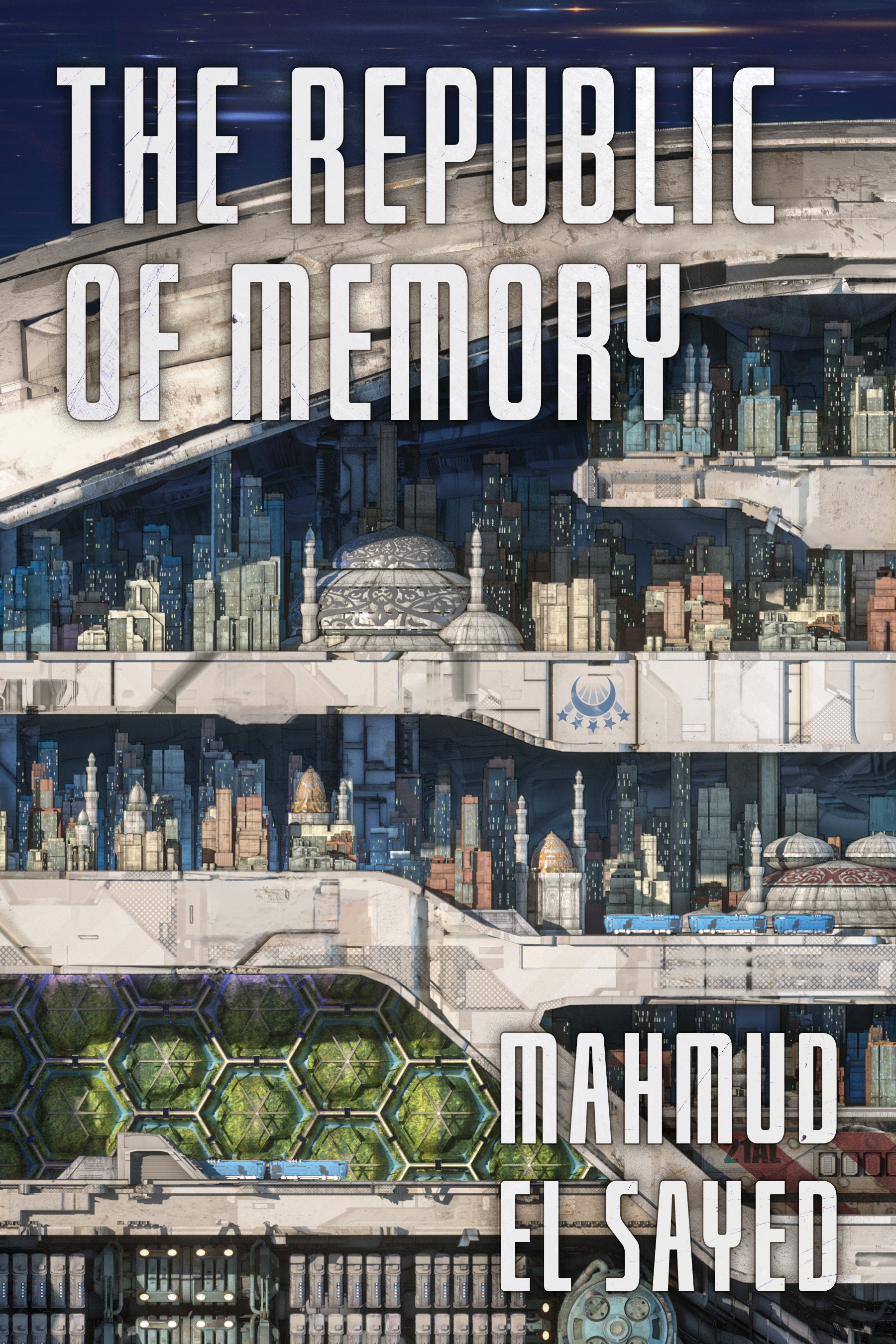
The Republic of Memory (Song of Safina, #1) – Mahmud El Sayed

Onboard the Safina, a generation ship on a 400 year journey, revolution is brewing. Factioning based on one’s language and the tyrannical rule of the Captain have begun to chafe on the thousands of crew members. But when the Safina is plagued by a series of targeted blackouts, many of the disparate crew must come to terms with the fact that the foundations of their ship—and their journey—are about to change forever.

TW/CW: violence, police brutality, xenophobia, murder, homophobia, infertility, sexual content, suicide

Without a doubt, The Republic of Memory is one of the more original sci-fi novels that I’ve read recently. It’s in a subcategory that Mahmud El Sayed calls Arabfuturism, and though I’ve read speculative fiction by Arab authors, it was so fascinating to see all of the cultural aspects integrated into this classic sci-fi setting. The worldbuilding is top-notch, and El Sayed did an amazing job of making the vast, interconnected world of the Safina into such a lived-in place brimming with history. I loved how El Sayed explores the idea of linguistics and language; the Safina is stratified based on language, and he gets into every possible outcome of separating people and groups based on language. Not only that, he gets into so much detail on how this has affected the culture aboard the Safina in the past few centuries, from how translators have become bureaucratic annoyances to a con-lang that mixes at least six different languages becomes a form of resistance. To say that El Sayed put so much thought into The Republic of Memory is a major understatement—this is a massive worldbuilding undertaking that was nothing short of phenomenal.

This novel dissects the beginnings of revolutions like very few others I’ve read have done. Until the end, it’s not terribly action-packed, but I loved that about it; it’s very much in the vein of a political thriller, and you get to see the revolution boiling over and eventually erupting through a kind of slow-burn, tense series of incidents all across this centuries-old generation ship. Along with El Sayed’s expert worldbuilding, there was such an incredible attention to detail paid to every aspect of what could trigger a revolution. We get a complicated, messy history of the Safina and all of the circumstances leading up to it, and The Republic of Memory is, in a way, a trail of hundreds of separate dominoes leading to the climax. It felt like a very honest depiction of how a revolution begins: not in a single, concentrated burst of activity, but a slow implosion over the course of years—in this case, centuries.

The Republic of Memory juggles dozens of POV characters. It’s a hard task, but I think it partially worked. It reminded me of Grace Curtis’s Floating Hotel, which is admittedly a very different book, but it has the same structure of including lots of POV characters in service of telling the story of the vast setting. For El Sayed, it wasn’t the setting that was told through the characters, but the story of a revolution from dozens of different perspectives. Although I wish some of the characters had been developed more, I loved how El Sayed examined the rumblings of a budding revolution through characters of all walks of life. Not all of the characters were likable or necessarily compelling, but I liked how they contributed to different views of how the revolution aboard the Safina was brewing. The execution wasn’t perfect, but I liked the approach that El Sayed took with the characters.

Unfortunately, the big ideas that made The Republic Memory so compelling also became its downfall. El Sayed has so much to say about the nature of language, resistance, and ideologies; for the most part, he’s successful in getting his ideas across. But there was a point when those ideas got so tangled up in the already complex plot that they made said plot even more convoluted than it already was. There were moments where El Sayed was so clearly so deep in his head that he thought it would be perfectly fine to frequently have nigh-incomprehensible chapters in the main con-lang of this novel, which were dizzying, to say the least. (To be fair, said con-lang incorporates elements from at least six different languages, so there’s bits and pieces that you eventually understand, but boy, it takes a long way to get there. And I’m not sure if it was worth it.) In addition, I’m not sure there was enough payoff for all of the established ideas; granted, The Republic of Memory is the first in a duology, but I think El Sayed ran into the classic issue of wanting to have lots of Big Statements on said Big Themes, but there wasn’t nearly enough time to get into everything that he established at the beginning of the novel. It’s a very ambitious novel, but not everything in it was executed neatly enough. I have faith in book two though.

All in all, a densely-packed sci-fi novel with lofty ideas to spare, which was both its strength and its weakness. 3.75 stars!

The Republic of Memory is Mahmud El Sayed’s debut novel, and the first book in the Song of Safina duology; the release date of the sequel has not yet been announced.

Today’s song:

phoebe bridgers + cameron winter doing a duet is seriously a match made in heaven!!

That’s it for this week’s Book Review Tuesday! Have a wonderful rest of your day, and take care of yourselves!

Posted in Book Review Tuesday

Book Review Tuesday (7/28/26) – The Language of Liars

Happy Tuesday, bibliophiles!

I discovered S.L. Huang through The Vela and The Water Outlaws, and I was intrigued enough by their writing to put The Language of Liars on my TBR. It was the most compelling premise I’d seen in any of their novels—and it quickly proved to be their best.

Enjoy this week’s review!

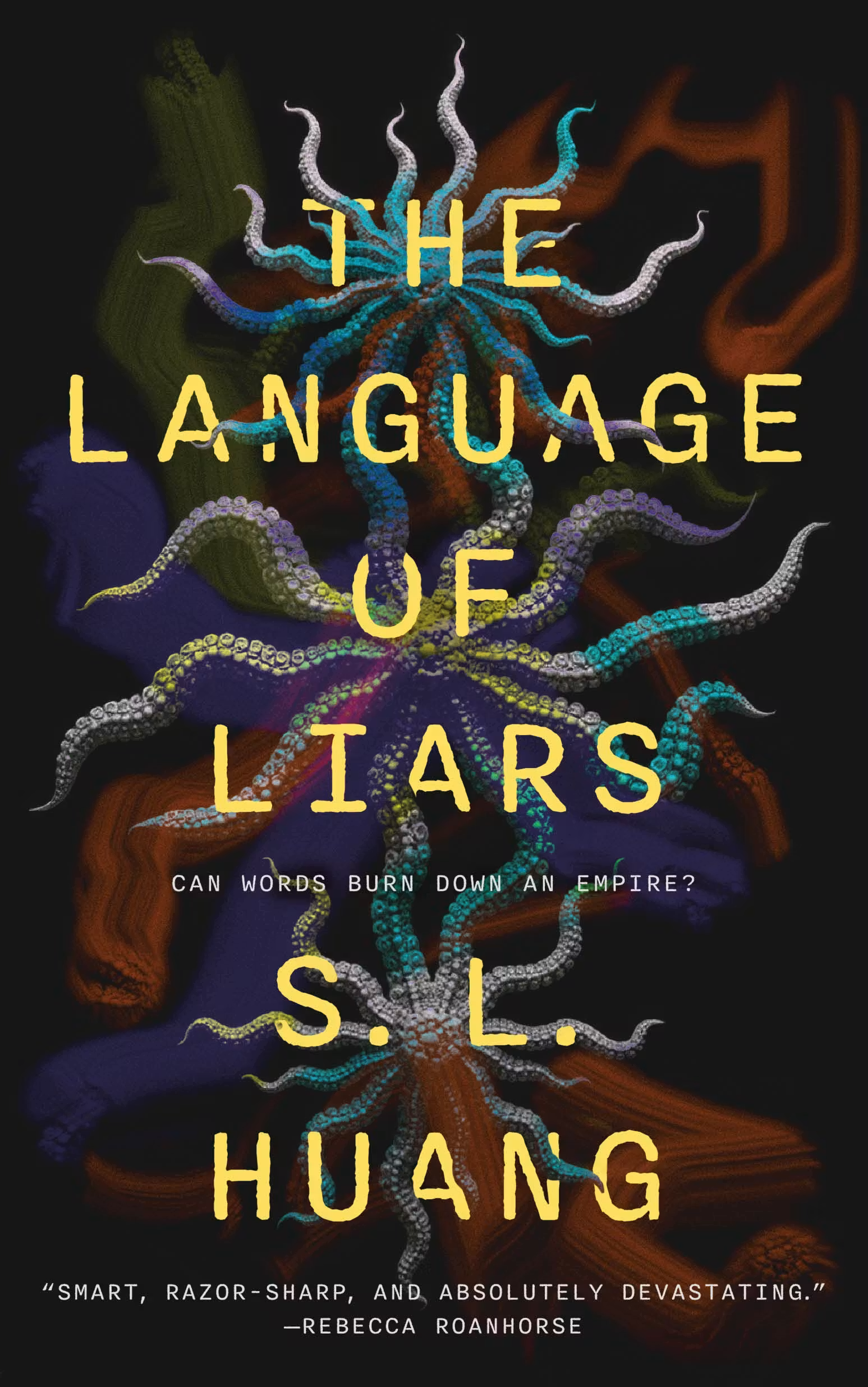
The Language of Liars – S.L. Huang

The Star Eaters are the key to making sure that galactic civilization runs—they are the only species who can mine the element required for space travel. But so little is known about them—scientists haven’t been able to figure them out and linguists have not been able to decipher their language. The only way—or so Ro has been told—is to jump into their minds, inhabiting their bodies in order to pick apart their enigmatic existence. Ro has been assigned to jump into the mind of a Star Eater, and he carries a monumental amount of responsibility on his shoulders. But the more Ro figures out about the Star Eaters, the more he realizes that this mission was never about understanding, and that the sinister ulterior motives may spell a horrible fate for him and his team.

TW/CW: genocide, torture, imperialism/colonialism, slavery, police brutality, violence

TREAD LIGHTLY! This review contains spoilers, so if you haven’t read this novella and plan to, read at your own risk.

I’ve only read one full novel by S.L. Huang, but after reading The Language of Liars, I’m convinced that this is their best work yet. Few other novellas are able to pack so much top-notch worldbuilding, twists, and emotions into so few pages, but this one did. I’ve been thinking about it for days.

I enjoyed The Water Outlaws, but I wasn’t quite as invested in the story as I was with The Language of Liars. What carried over from that novel was Huang’s distinct writing style. They excel in extruding the raw emotion from the most minute, overlooked moments. Every little thing is important to Huang, and that made The Language of Liars into a truly unique novella. The care they put into each metaphor carried over to the care they put into each minor character. The inhospitable, alien world and all of its contradictory rules were written tensely—and intensely. I find myself thinking of Octavia Butler’s famous note to herself, where she vows to “make people FEEL, FEEL, FEEL!”; Huang certainly carries on Butler’s legacy in that regard—as well as their commitment to making anti-colonial sci-fi that truly makes you think.

The world of The Language of Liars is a truly intricate one, but Huang pulled off the exceedingly tricky feat of establishing it a) in less than 200 pages, and b) doing it without unwieldy chunks of exposition. Part of why I think Huang was so successful was because of the tidbits at the beginning of each chapter: passages from books, news segments, and quotes from fictional politicians all buttressed this world, making it feel real in the spaces between the narrative. Beyond that, Huang did an excellent job of not only pulling off this marvel of worldbuilding, but making it compelling. There’s a whole host of fascinating species, all with their own cultures and wars that the narrative is able to dip its toes into without derailing the plot. I especially loved all of the cultural quirks of Ro’s species, and the creature design in me loved how Huang went beyond “these aliens look like rabbits” to integrating rabbit-like behaviors into their language and culture.

I debated whether or not to reveal the big twist of The Language of Liars in this review because it knocked me off my feet and I don’t want to ruin that for other people. And yet, it’s so hard to discuss this novella without talking about it, and I desperately want to talk about it. As it turns out, this cutthroat social system of the Star Eaters is entirely a fabrication, and the reason that the Star Eaters’s culture is so enigmatic and unknowable is that it cannot be known—all of the remaining Star Eaters’s consciousnesses have been hijacked by other alien spies like Ro. It gutted me. The other civilizations were so desperate to “understand” (read: figure out so they could adequately exploit) the Star Eaters that they committed a mental genocide on the entire species, and everything about their culture that could’ve been discovered has been lost forever. It’s a seismic blast of a twist. And it makes such a potent point about the nature of imperialism and the history of anthropology and linguistics—sometimes, something as innocuous as attempting to understand another culture or language can quickly be turned into tools of exploitation and slavery. Though there was the faintest (faintest) glimmer of hope at the end, that haunting conclusion has stayed with me for weeks. Not only did I not see it coming, but the way that Huang executed it made everything fall into place horribly—it takes a hard left turn into psychological horror, in my opinion, but it’s the horror of imperialism.

The Language of Liars isn’t necessarily about disability, but Ro is hinted to be neurodivergent. I hesitate to put an exact name to it, as he’s an alien with entirely different physiology and brain chemistry. (That being said, some of the traits that Huang names are similar to autism, namely a difficulty grasping social cues and aversions to certain food textures.) However, I think a part of the twist that stood out to me is that the entire premise felt innately neurodivergent. Here you have Ro, who goes undercover into the mind of an alien creature to get to the bottom of their language and culture, and is shoved headfirst into a world of intricate, often contradictory social cues. Say the wrong thing, and you’ll be punished, and yet everybody else is unwilling to share what it is that makes words or phrases “wrong.” And as the twist tells us, this intricate, contradictory system of words is a house of cards that’s easily toppled: nobody knows what to do or what to say in the end, only that one wrong word could mean death. Everybody’s just performing normalcy, but it all falls apart at the drop of a hat. The Language of Liars felt so neurodivergent to me, and Ro’s journey of struggling to figure out this thankless construction of language hit home for me in more ways than one.

All in all, an inventive and haunting novella that packs a startling amount of power into less than 200 pages. 4.25 stars!

The Language of Liars is a standalone, but S.L. Huang is also the author of The Water Outlaws, the Cas Russell series (Zero Sum Game, Null Set, and Critical Point), and several other novels for adults.

Today’s song:

such a classic album—this is my favorite track, without a doubt

That’s it for this week’s Book Review Tuesday! Have a wonderful rest of your day, and take care of yourselves!
Posted in Book Review Tuesday

Book Review Tuesday (7/14/26) – Machine (White Space, #2)

Happy Tuesday, bibliophiles!

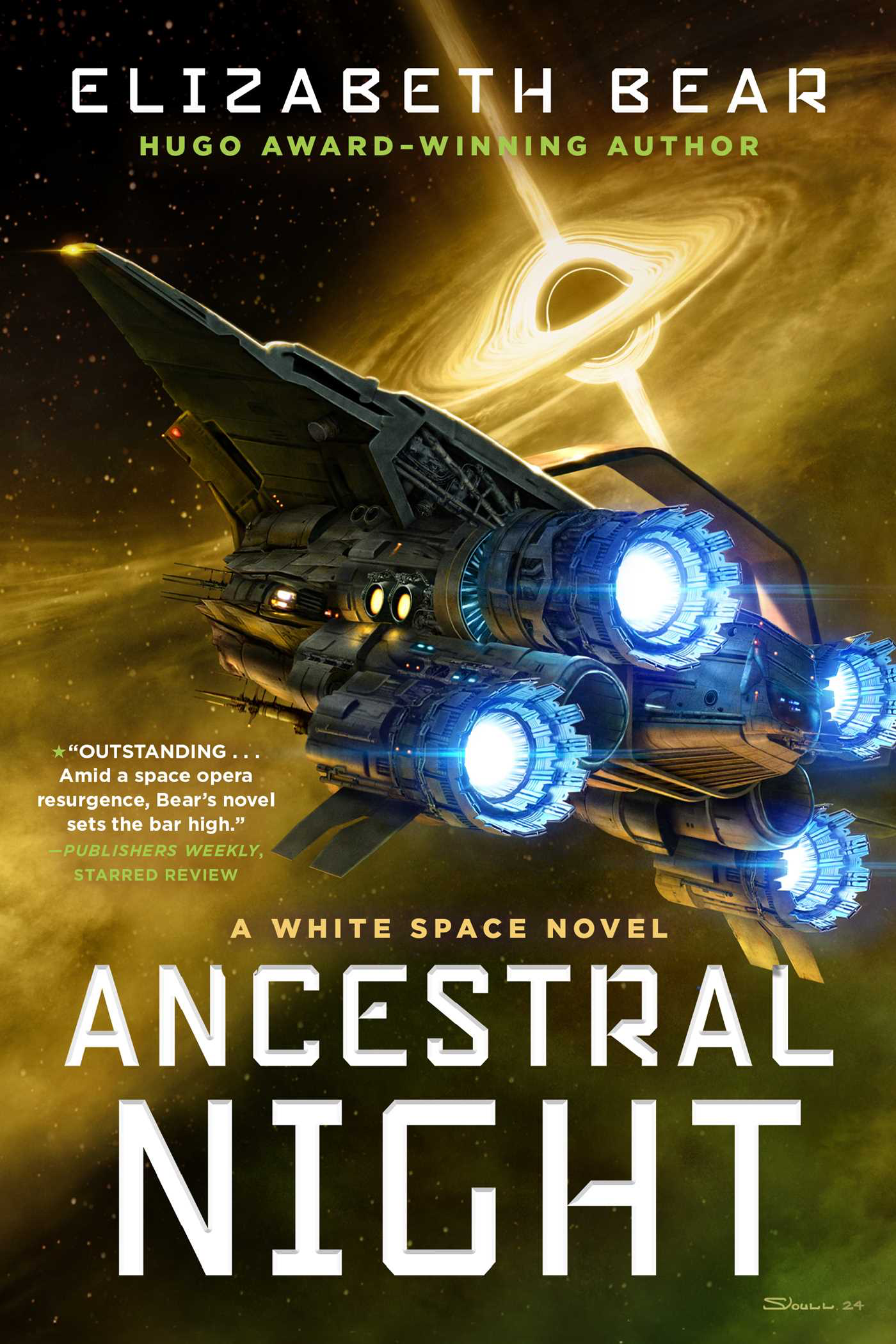
Thankfully, after last week’s disappointment, we’ve got something to save the track record for Disability Pride Month. I started Elizabeth Bear’s White Space trilogy earlier this year, and I knew I wanted a physical copy of book 2. It’s one of the great joys in life when a sequel is better than the first book—and Ancestral Night was already a 4.5-star read for me, so this was huge! Machine was a fantastic step up for a series that’s already a cut above the rest.

Enjoy this week’s review!

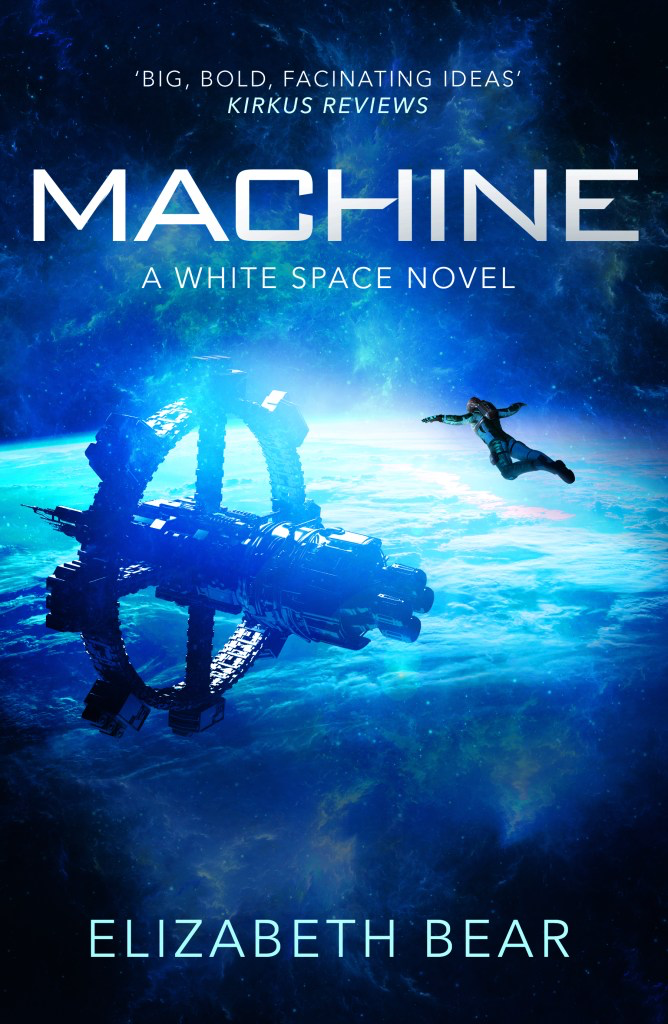
Machine (White Space, #2) – Elizabeth Bear

Dr. Brookllyn Jens is a special kind of doctor. Her patients are usually aliens, and her status as an emergency specialist means that her job description tends to involve having to jump out of spaceships. It’s already a job that keeps her on the edge. But when Dr. Jens and her crew discover two ships that have been abandoned for thousands of years, they uncover a mystery with layers upon layers of disastrous implications. With a strange, antiquated AI, an entire human crew in cryosleep, and a potential conspiracy on their hands, Dr. Jens and her crew must race against the clock to make sure that everybody makes it out alive.

TW/CW: ableism, misogyny, medical content, xenophobia, violence, murder

Genuinely, my sole problem with this novel is the title. Elizabeth Bear thought out this intricate and complex space opera world full of thousands of aliens and unique space travel, and couldn’t think of a more memorable title than Machine? I mean, yeah. There sure are Machines. Lots of ’em. But come on, really.

As much as I enjoyed Haimey’s story in Ancestral Night, I really think that making the White Space series several collected companion novels was the right move. It expands the intricate world that Elizabeth Bear has crafted in so many exciting ways that were only possible through the eyes of a different cast of characters. I loved the ways that the Synarche and all of the different species within it were fleshed out. Bear’s writing is as sharp as ever—her voice is so witty and hilarious, but she also knows just how to stick the landing when it comes to the more climactic or serious moments. The pacing was top-notch, especially considering that Machine is nearly 500 pages long—I blew through hundreds of pages at a time, and Bear never lost me.

I absolutely adored Dr. Jens as a protagonist, and Bear’s willingness to let her protagonists be messy yet lovable people made her shine. Dr. Jens has such a dry sense of humor, and her wry observations about the world around her made Machine such an entertaining read. But beyond that, I loved her continuous self-reflection—about the ideas she’s constructed about herself, but also about her work and the world around her. The supporting cast was so vibrant and lovable—it was a treat to see Cheerilaq again, first off, but all of the characters were so delightful and added a real human (and syster) authenticity to Core General’s staff. Sometimes your coworker gets on your nerves for no discernible reason, and they’re also a massive cetacean-like being getting wheeled around in a massive tank. On that subject, I loved all of the new Systers that Bear introduces. My creature design brain predictably became that meme of the dog with the propeller beanie and the giant lollipop seeing all of the truly alien aliens that populated the Synarche. But Bear went beyond good creature design and into crafting memorable, multilayered characters, which is what makes her space opera stand out in the end.

In particular, the expansion of the AI and robots in the Synarche was one of the most intriguing aspects of the world that Bear discusses in Machine. The whole plotline with Helen Alloy was one of the most well-executed. I love how Bear interrogates the objectification of women and how sci-fi has historically translated this into female-presenting robots. The visceral discomfort that Dr. Jens has that Helen was specifically created to have a hypersexualized, feminine form felt was like seeing the sun peer through the clouds after decades of weird men writing all kinds of messed-up sex-bots. It’s treated with the appropriate level of disgust—both on Helen and Dr. Jens’s part. Helen’s manipulation also ends up being vital to the later twist, and her entire arc of deconstructing the lies that she was programmed with was handled with such tenderness. Beyond the robots, I think that thread of treating people who have been brought up with hateful ideologies and not immediately dismissing those with different opinions was one of the best aspects of Machine; Bear’s insistence that people—human, alien, or AI—are not inherently bad, only victims of harmful ideas, was so necessary.

Bear’s take on disability in a sci-fi context was also such a respectful and well-researched one! She listed off several sensitivity readers in the acknowledgements, and their work paid off—for someone who seems to be non-disabled, by all accounts, this might be one of the most caring representations of a disabled person and their struggles in sci-fi I’ve seen by a non-disabled author. Dr. Jens has a chronic pain disorder, and she has a special exo-suit that manages some of her pain, but not all of it—sci-fi tech still has limitations in the far, far future. She still aches and gets physically taxed from her daring missions. Granted, I’m not chronically ill, but it felt like Bear paid so much attention to how Dr. Jens’s symptoms would present and how her high-stakes profession would affect it. Additionally, there’s a lot of talk about how disability is handled in the future; there was lots of discussion of “rightminding,” a process that, among other things, mitigates the effects of some mental illnesses. It would’ve been so easy to just slap it on as a cure-all technology, but Bear’s approach was one that I rarely see in sci-fi. It’s not necessarily “disability isn’t cured,” but it’s handled on a case-by-case basis, there’s an understanding that different kinds of disabled people have different needs and opinions about how they want to live with their disabilities with the technology available. This rejection of the one-size-fits-all approach to disability was a breath of fresh air, and wasn’t afraid to get into the nuance of how disabled people live their lives.

Disability wasn’t the only issue that gets dealt with in a refreshing amount of nuance. Bear was not afraid to get into the weeds with this novel, and it made my reading experience so much better. Machine, more so than its predecessor, gets into how a utopia and utopian ideas can be twisted into something sinister. It all feels very Ursula K. LeGuin—the Synarche is without a doubt an ambiguous utopia like The Dispossessed. (First off, I liked that Bear interrogates the ethics of “rightminding” targeting potentially “dangerous ideologies,” and how that ends up being decidedly non-utopian.) I appreciated that Bear discusses how well-intentioned utopias can be co-opted into vehicles for hatred, but also how that revelation wracks the people who genuinely believed in this utopia—people like Dr. Jens. Her arc in having faith in her hospital and the Synarche was so human—her entire reality and faith in the organization she devoted her life to is messily upended. But the realization that she comes to—that you can take the good work you wanted to do and the faith in your fellow people outside of corrupt organizations and do your own work—was one that feels so vital. I also loved the thematic potential of the infectious meme—not unlike the spread of a hateful ideology—that is treated as an infection that has to be weaned out with attention and care. Bear’s depictions of that crushing realization and how Dr. Jens and her coworkers pick up the pieces was so heartfelt, and a very potent message in this day and age.

All in all, a spectacular companion to Ancestral Night that expanded Elizabeth Bear’s masterfully crafted space opera universe with pulse-pounding action and heart. 5 stars!

Machine is the second book in the White Space trilogy, a series of companion novels set in the same universe; it is also includes Ancestral Night (book 1) and Folded Sky (book 3). Elizabeth Bear is also the author of several other series, including the New Amsterdam series (New Amsterdam, Seven for a Secret, The White City, Ad Eternum, and Garrett Investigates), the Jacob’s Ladder trilogy (Dust, Sanction, and Grail) and many others

Today’s song:

still going through my mom’s records from the ’80s. this remains peak.

That’s it for this week’s Book Review Tuesday! Have a wonderful rest of your day, and take care of yourselves!
Posted in Book Review Tuesday

Book Review Tuesday (2/17/26) – The King Must Die

Happy Tuesday, bibliophiles!

Confession time: I was not a fan of Kemi Ashing-Giwa’s debut, The Splinter in the Sky. I didn’t think I would read any of her other books. But my hunger for sci-fi knows no bounds, and when I saw this, I was intrigued enough by the premise to give her writing a second shot. Thankfully, the gamble paid off—The King Must Die was an unexpected delight, full of rebellion, blood, and the friendships that somehow spring up from those other two things.

Enjoy this week’s review!

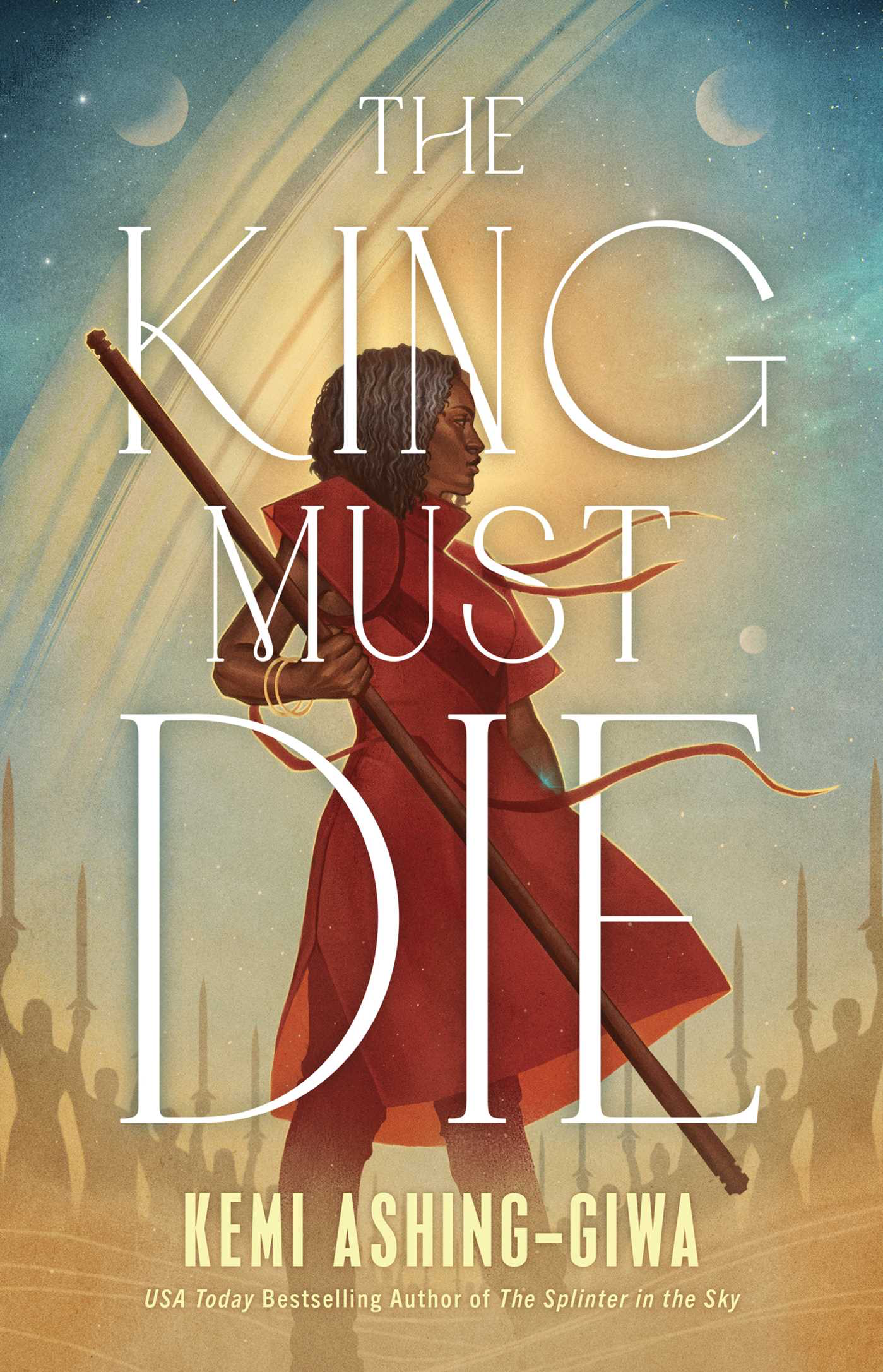
The King Must Die – Kemi Ashing-Giwa

Newearth was once humanity’s last hope, a planet terraformed by incomprehensible, alien overlords. Now, it’s on the verge of destruction, with dwindling resources divided unfairly amongst the struggling poor and the Sovereign that rules over them. What’s more, the Sovereign has the power of the omnipotent, alien Executors on their side, willing to do their divine bidding at a moment’s notice, leaving a path of destruction in their wake. Fen, the daughter of anti-imperialist rebels, is on the run after the assassination of her fathers. With a target on her back, she flees for a neighboring rebel faction. But when Alekhai, the ruthless heir to the Sovereign, stumbles directly into the plans of the rebellion, Fen is faced with a brutal choice: join forces with him, or let the rebellion fall prey to the Sovereign.

TW/CW: murder, loss of loved ones, gore, blood, violence, descriptions of injuries, torture

I almost passed on this novel when I saw that it was by the same author as The Splinter in the Sky. But sometimes, every once in a while, it’s worth it to give an author another chance; if not for second chances, I wouldn’t have loved Grace Curtis’s Floating Hotel, for instance! I’m glad I took the chance with Kemi Ashing-Giwa, because The King Must Die was an action-packed, adrenaline-filled story of rebellion and intrigue.

My issue with The Splinter in the Sky was that the story did not feel original. A recurring thought I had while reading it was that it had poorly copied A Memory Called Empire‘s homework—there wasn’t enough about the story that was original. I can excuse some of it, since this was her debut novel, but debut novels can have a story that doesn’t border on being a rip-off. That being said, I do remember liking some of Ashing-Giwa’s prose. Thankfully, she’s worked on both of those fronts, creating an original story to go with said prose, and the prose itself has been leveled up significantly! Ashing-Giwa had such a vibrant way of describing the imagined world of Newearth and the many people within it, so much so that I could easily see myself walking through its war-torn jungles. Her dialogue is snappy without being corny, and her metaphors added a poetic flair to an often bloody and dreary landscape. The King Must Die is a marked improvement from Ashing-Giwa’s debut, fleshing out what I felt lacked in her writing on the first time around.

Whenever I say that an adult novel is a good transitory novel between YA and Adult age groups, it always seems backhanded. I guess that’s because literary circles still turn their noses up at YA for the most part. Listen—even though I’ve aged out of the target audience, I read a fair amount of YA (although adult novels have eclipsed them), I write YA, and I have a deep respect for it as an age group (it’s not a genre!). There’s a difference between YA (novels that genuinely portray the complex emotions of teenagers and their circumstances) and YA (tropey slop banking on the latest fanfiction/TV trends). And I think there’s something about The King Must Die that felt like it could be an excellent book to introduce older teens to more adult genre fiction. Sure, the kill count and amount of blood in general is very much adult, but Ashing-Giwa hits that balance between the political intrigue that’s more present in Adult novels with the character drama that I associate more with YA. It has the fast pace that I associate with some of my favorite YA sci-fi romps that I ate up in high school, but with a level of maturity that would have been lost on me at that time. It’s difficult to balance this kind of complicated worldbuilding and politics while also having this character drama, but The King Must Die had both in spades.

The main part that felt YA (affectionate) to me was the character dynamics. The dynamic between Fen and Alekhai is a classic YA setup; she’s a runaway rebel, and he’s the heir to the empire she wants to destroy. Will sparks fly? …no, evidently, but they did make for some seriously compelling character dynamics. I appreciated that, although there were multiple opportunities for Fen to be paired off with any number of characters, all of them were platonic, and they still gave me that juicy, delectable drama that’s usually only reserved for romances. Fen had such excellent chemistry with Mettan, Sinjara, and the other rebels, but what stood out the most was her relationship with Alekhai. I love a good redemption story for a villain, but it’s even more impressive given how much that Ashing-Giwa establishes about him that honestly…shouldn’t be that redeemable. But his development over the course of the story culminated in something so emotional, and the slow cracking of his shell from a ruthless, indestructible royal to someone who only wanted love in return was incredibly poignant.

The King Must Die is still sci-fi for sure, but I’d place it somewhere in the nebulous category of space fantasy. There are some elements that solidly ground it in science fiction: the alien Makers and their terraformed planet, for one, but also some of the technology. However, much of the action that we see on the ground was very fantasy, what with battles waged with intricate swords and quarterstaffs. I loved the strange, often horrifying beasts that we encounter throughout, though I would’ve liked explanations about how they fit into the ecosystems; we get a lot of tidbits of creatures that supposedly went extinct centuries ago, but are showing up for…reasons, and are never brought up again. As a whole, there were a handful of holes in the parts of the worldbuilding that didn’t relate to a) the politics or b) the terraformed Newearth, but for the most part, the world of The King Must Die was a compelling one without a doubt.

In general, I liked the ending and the epilogue; on a more technical level, Ashing-Giwa is excellent at writing battle scenes that really pump up your adrenaline. Some of the imagery, as well as Askrynath’s dialogue, reminded me of the final battle in the throne room in Hellboy II: The Golden Army, which, if you know me well, is a compliment of the highest order. Conceptually, I like how the ending and epilogue resolved—through selflessness and collective community work, the empire was dismantled and a more fair system was set up on Newearth. However, it felt wrapped up far too neatly. An empire that size—especially one with the backing of incomprehensibly all-powerful aliens—doesn’t crumble in a day. I wanted to see more of the messiness of rebuilding a new world in the ashes of the old one—the transition just felt too clean to be realistic. To be fair, The King Must Die is already pushing 500 pages, so I get it if that didn’t make the final cut. Nonetheless, it was a satisfying ending—just too satisfying for my liking, and for the tone of the story itself.

All in all, a sci-fi adventure that balanced genuine political critique with fast-paced action and dramatic, snappy dialogue—it’s rare to find a book that succeeds with both. 4 stars!

The King Must Die is a standalone, but Kemi Ashing-Giwa is also the author of The Splinter in the Sky and the novella This World Is Not Yours.

Today’s song:

That’s it for this week’s Book Review Tuesday! Have a wonderful rest of your day, and take care of yourselves!
Posted in Book Review Tuesday

Book Review Tuesday (1/20/26) – Ancestral Night

Happy Tuesday, bibliophiles!

I’d like to think that I’m a competent, capable adult, but a few months back, I picked up book three of this series without realizing that it was book three. Oops. All the same, I was motivated to read it, so I ended up getting a copy with some gift card money for Bookshop.org. Long haul as it was, I’m so glad I took the leap—Ancestral Night knocked me off my feet from the first few pages, and that momentum almost never stopped.

Enjoy this week’s review!

Ancestral Night (White Space, #1) – Elizabeth Bear

Haimey Dz and her small crew fly under the radar, making a living salvaging spaceships at the edge of the galaxy. But after a run-in with a gang of pirates and the discovery of a galaxy-changing revelation hidden inside a derelict spaceship, Haimey knows that she can’t let just anyone get ahold of this secret. Inside of the spaceship is illegal, ancient technology that could turn the tides for the worse if in the wrong hands—and judging from the spaceship, it was already in the wrong hands. Infected with a strange, ancient parasite and with pirates and the government hot on her heels, Haimey and her crew must get to the bottom of this mystery before this tech falls into the wrong hands.

TW/CW: descriptions of injury, violence, blood, emotional abuse, grief, suicide, mental health themes

I really need to put together some kind of list of sci-fi with cats on spaceships. There’s enough out there that it’s a Thing, and though it’s not enough to be a full-on trope, it never fails to make me smile, both as a sci-fi fan and a cat lover. Jonesy from Alien set the precedent, but I think it’s just that through line of historically having cats on boats for good luck that makes it so wonderful. Bushyasta and Mephistopheles deserve a spot in the sci-fi cats pantheon.

The world of Ancestral Night is truly something to behold. From the get-go, I got lost in it so easily—Bear’s prose kept me hooked for all 500+ pages. Part of that was just how intriguing the world was. Everything you could want in a space opera is here—mysterious, derelict spaceships with dark secrets, all manner of very alien aliens, two naughty cats on a spaceship, and perhaps best of all, eldritch, centuries-old seahorse creatures that live in the vacuum of space. Who could ask for more, really? There’s a dormant part of my high school brain that was obsessed with Aurora Rising that got beyond amped about salvaging spaceships, so that was an automatic win. I loved the Atavikha an unreasonable amount, as well as the aliens, but that’s not news at all. But I love the care that Bear took to make this world feel familiar in the right places, but appropriately alien where it was necessary. It’s a world where you can read George Eliot in your free time, but also come face to face with a creature so alien you barely have any appropriate human analogues for it. Balance is key, and Bear balanced it well.

With sci-fi like this, there’s a tendency to forget that no matter how much time you spend on worldbuilding, your universe still may feel like it isn’t lived in; everything’s too sterile and sleek, and you never get the sense that these strange planets and moons and whatnot are places where people spend their lives. Bear circumvented that issue from the get-go—everything about Ancestral Night felt lived-in, from the humble spaceships to the crowded space stations that Haimey and her friends navigated. Her spaceship wasn’t just a way to get around: it was a place where Haimey lounged around and read old books and petted her cats. Every corner that the crew explored was full of not just lore, but memories—everything in Ancestral Night had a story, and that did almost as much work as the worldbuilding in making sure that Bear’s world felt real.

Another aspect that made Ancestral Night feel real was Haimey herself. I’m all for representing marginalized people beyond stereotypes, but there’s something to be said for queer characters who are unapologetically messy and make decidedly terrible decisions—and Haimey makes terrible decisions aplenty. (I finished Pluribus not long ago, and I thought the same about Carol. I guess they’re both lesbians who fall for highly questionable pirate ladies, in the end.) If Ancestral Night was a TV show, I fully would’ve thrown something at the TV when she kissed Zanya. HAVE YOU LEARNED NOTHING? That being said, she felt so staggeringly real in the amalgamation of all her hopes and flaws. Even in this far-flung sci-fi world, this woman who reads ancient classics onboard her spaceship and dotes after her cats and falls for the messiest, scariest pirate women was so refreshingly real, and in spite of those flaws, ultimately lovable.

Ancestral Night is a space opera without question, but the worldbuilding will certainly appeal to the more hard science fiction-leaning readers for sure. Care for the worldbuilding obviously isn’t exclusive to hard sci-fi, especially as a cozy sci-fi/space opera/soft sci-fi defender and enjoyer, but not every space opera you come across goes into this much detail about accretion disks. Bear doesn’t shy away from getting esoteric with the worldbuilding, whether it’s in terms of astrophysics or politics. The politics form the core of the novel for me. My one major problem with the novel was that it had a tendency to go into Haimey’s philosophical musings about the nature of governments and freedom to a point where it was difficult to suspend my disbelief that nothing bad had happened to her while this was all going on, given everything else that happens throughout. (How did she not get conked on the head by pirates mid-digression during half of those scenes?) However, the nature of these digressions fed into the thematic elements of Ancestral Night really well, and I loved how they formed the backbone of Haimey’s character.

Even though not all of the philosophical musing landed, the setup of it, as well as the worldbuilding of Ancestral Night, set such a wonderful stage for Haimey’s character development. She’s caught between two very opposite poles: the Clade where she grew up, where her existence was placid but assimilated, and the pirates, whose messy anarchy is hyperindividualistic to a fault. Set against the backdrop of a flawed yet somewhat well-intentioned government, Haimey’s realization that her true self comes not from sacrificing her individuality or her obligation to do good for others in her community was so poignant. All her life, the notion of who she really is has been forced upon her from both sides, and yet what’s in her heart is where the two ideologies meet: retaining her uniqueness, but not kicking everybody else aside in the process. Haimey’s true spirit comes from how she decides her life should be, but also from the positive relationships around her. It was such a heartfelt message, and Haimey’s arc gave Ancestral Night a powerful emotional core.

All in all, a captivating space opera with real, lovable protagonists, a lived-in universe, and mystery that had me on the edge of my seat. 4.5 stars!

Ancestral Night is the first novel in the White Space series, followed by Machine and The Folded Sky. Bear is also the author of several other award-winning novels, including the New Amsterdam series (New Amsterdam, Seven for a Secret, The White City, Ad Eternum, and Garrett Investigates), the Jacob’s Ladder trilogy (Dust, Sanction, and Grail) and many others.

Today’s song:

That’s it for this week’s Book Review Tuesday! Have a wonderful rest of your day, and take care of yourselves!
Posted in Book Review Tuesday

Book Review Tuesday (1/13/26) – We Will Rise Again: Speculative Stories and Essays on Protest, Resistance, and Hope

Happy Tuesday, bibliophiles, and from the bottom of my heart, fuck ICE. Rest in power, Renee Nicole Good. My heart goes out to everybody in Minneapolis right now. ❤️‍🩹

Whoo, look at me! Actually reviewing a book not long after it came out!!

I found out about We Will Rise Again soon after it came out, and it immediately caught my eye—in fact, it seemed almost specifically engineered for me. I mean, speculative fiction based on social justice? Come on. And while the stories and essays within it varied in quality, this anthology was a worthy endeavor and a much-needed collaboration.

Enjoy this week’s review!

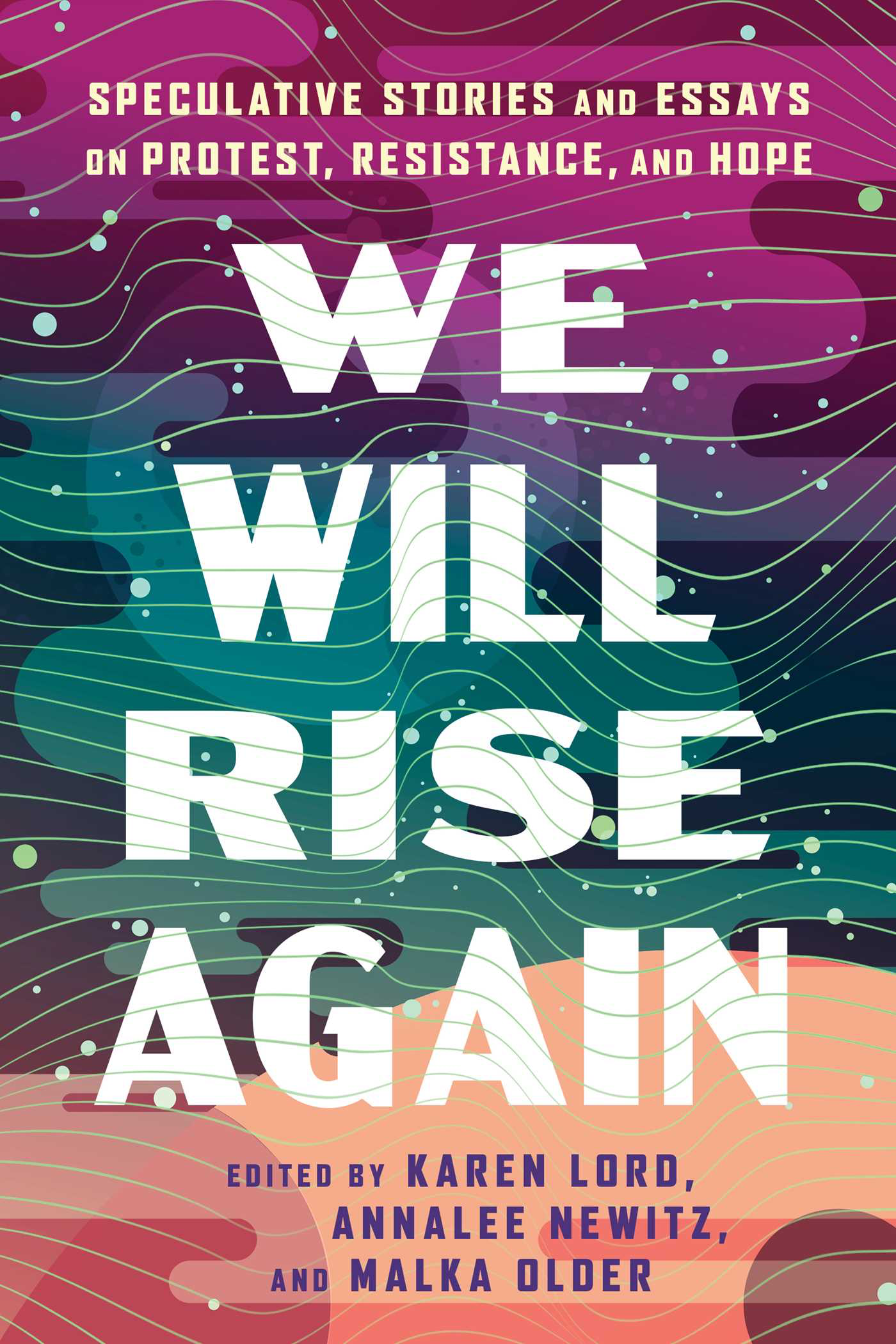
We Will Rise Again: Speculative Stories and Essays on Protest, Resistance, and Hope – edited by Karen Lord, Annalee Newitz, and Malka Older

(description from The Storygraph:)

From genre luminaries, esteemed organizers, and exciting new voices in fiction, an anthology of stories, essays, and interviews that offer transformative visions of the future, fantastical alternate worlds, and inspiration for the social justice movements of tomorrow.

In this collection, editors Karen Lord, Annalee Newitz, and Malka Older champion realistic, progressive social change using the speculative stories of writers across the world. Exploring topics ranging from disability justice and environmental activism to community care and collective worldbuilding, these imaginative pieces from writers such as NK Jemisin, Charlie Jane Anders, Alejandro Heredia, Sam J. Miller, Nisi Shawl, and Sabrina Vourvoulias center solidarity, empathy, hope, joy, and creativity.

Each story is grounded within a broader sociopolitical framework using essays and interviews from movement leaders, including adrienne maree brown and Walidah Imarisha, charting the future history of protest, revolutions, and resistance with the same zeal for accuracy that speculative writers normally bring to science and technology. Using the vehicle of ambitious storytelling, We Will Rise Again offers effective tools for organizing, an unflinching interrogation of the status quo, and a blueprint for prefiguring a different world.

TW/CW: violence, transphobia, themes of oppression/marginalization, ableism, murder

Somehow, it’s so on brand that Ursula Vernon would be that hardcore about gardening. I always vaguely got that vibe from her work, but her essay was not a surprise in the slightest.

There were all kinds of speculative fiction authors featured in We Will Rise Again: familiar authors I’ve liked, familiar authors I haven’t been a fan of, and unfamiliar authors entirely; in fact, all three of the authors who edited the anthology (Karen Lord, Annalee Newitz, and Malka Older) are all hit-or-miss authors for me, but I stuck to this anthology because the concept was so compelling to me. Sure enough, not only were their stories fascinating, so were everyone else’s. Some of my favorites were Charlie Jane Anders’s “Realer Than Real,” a meditation on being transgender in the U.S. and poking fun at gender roles, Abdulla Moaswes’s “Kifaah and the Gospel,” a potent commentary about Palestinian resistance and the inherent absurdity of colonialism, and Malka Older’s “Aversion,” an excellent commentary about how to get people to pay attention and care about issues without having to expose them to a barrage of triggering, disturbing imagery. (The latter isn’t deeply relevant at all, no way! No way…) Whether in sci-fi, fantasy, or loosely speculative formats, all of them came together in a vibrant quilt of different perspectives and ideas.

The nonfiction in We Will Rise Again was, for the most part, equally potent. I was so excited to see Nicola Griffith featured in here, and her essay “Rewriting the Old Disability Script” was as timely as ever; even though disability representation in media at large, not to mention literature, has gradually gotten better, this was a potent reminder of the staggering lack of representation of disability of any kind in mainstream media. I’d already read N.K. Jemisin’s “How Long ‘Til Black Future Month? The Toxins of Speculative Fiction, and the Antidote That Is Janelle Monae,” but it fit perfectly in this anthology and was well worth a re-read. The very core of We Will Rise Again was that the fiction stories had tangible input from activists with real-world experience; without this, I still would’ve liked these stories, but with this added layer, they strangely gave me more hope. The faith of real-world activists embedded in fiction emphasizes what this anthology was really about, for me: educated, grounded hope for a better future.

However, with an anthology that cast such a wide net idea-wise, there’s bound to be some misses. I think the biggest issue with We Will Rise Again was that it verged on being too broad. Naturally, when you’re talking about social justice, there are so many things that you can talk about, and this anthology discusses the whole gamut of them in both fiction and nonfiction, from community care to transphobia to disability rights. For the most part, I could see the common thread through all of them easily. Some of them, however, bordered on being very loosely strung together; for instance, although I loved Vernon’s essay “The Quiet Heroics of Gardening,” the connection between it and the other stories was very, very loose. I think the issue was that not all of the fiction stories had nonfiction paired with them—the format they had with most of these stories could’ve cohesively been applied to all of them and given the anthology a better, more reasonable structure.

Overall, there weren’t any stories that I didn’t like, which is a rare thing in any given collaborate short story anthology. However, I did have a structural issue with some of them. Speculative fiction is a notoriously broad term, and I think some of the stories in this collection took that a little too seriously. While some of them were clearly sci-fi, fantasy, or at least had some speculation and change to the world, some of them barely felt speculative. For instance, if you took away the fleeting fantastical element of Vida James’s “Chupacabras,” I would’ve thought that it was only set a few years after the present—there wasn’t a ton that was new about it, and said fantastical element felt like an afterthought. (I had a similar issue with Sabrina Vourvoulias’s “Persefoni in the City.”) Even with some of the “this is only meant to be a few years from now” stories, I got that what was speculative was the politics (ex. with Izzy Wasserstein’s “The Rise and Fall of Storm Bluff, Kansas”), but with the ones I mentioned, hardly anything had changed. While I get that the focus wasn’t necessarily on the worldbuilding, with the anthology’s whole point being on genre/speculative fiction as a way of collective imagination and imagining better worlds, stories like those felt at odds with the intended message. “Speculative” was a bit generous of a term for some of those stories.

All in all, a diverse and hopeful anthology, both in terms of its contributors and its subject matter, all coming together to make powerful statements about how to survive in this landscape and dream of something better. 3.75 stars!

We Will Rise Again is a standalone anthology; Karen Lord is also the author of the Cygnus Beta series (The Best of All Possible Worlds, The Galaxy Game, and The Blue and Beautiful World). Annalee Newitz is also the author of The Terraformers, Autonomous, Automatic Noodle, and The Future of Another Timeline. Malka Older is also the author of The Investigations of Mossa and Pleiti series (The Mimicking of Known Successes, The Imposition of Unnecessary Obstacles, and The Potency of Ungovernable Impulses) and the Centenal Cycle (Infomocracy, Null States, and State Tectonics).

Today’s song:

LODGER 🙌

That’s it for this week’s Book Review Tuesday! Have a wonderful rest of your day, and take care of yourselves!
Posted in Book Review Tuesday

Book Review Tuesday (12/23/25) – Embassytown

Happy Tuesday, bibliophiles! Merry Christmas Eve (Eve)—in advance, I hope you all have a lovely, safe, and restful remainder of the year.

This book was recommended to me around two years ago by a good friend of mine, and I’ve been trying to find it ever since. Last Wednesday, we had a power outage (it lasted four days 😵‍💫) because of some scarily high winds. Without anything to read on my Kindle, which was rapidly losing battery, my mom and I decided to make a Barnes & Noble run on day 2, where I finally happened on a copy. Lo and behold, Embassytown blew me away with its experiments in language, alienness, and communication—thanks, said friend!

Enjoy this week’s review!

Embassytown – China Miéville

Avice Benner Cho is many things: an interplanetary traveler, a politician, a former resident of a colony filled with all manner of alien species. But the most important of these distinctions is that she is a living simile in the language of the Ariekei, an alien race with a language that is impossible for humans to speak. The only way of communicating with them is through genetically modified ambassadors. Having left the alien-populated Embassytown as a child, Avice has returned just as tensions between the humans and Ariekei. Developments in language and communication have made leaps and bounds, but their consequences could spell war between the two species.

TW/CW: substance abuse, violence, gore, blood, war themes, suicide, infidelity, sexual content

One of my first thoughts after finishing Embassytown was “man, no wonder Ursula K. Le Guin blurbed this.” Even having only read a handful of her books, I could see how faithfully this follows in Le Guin’s footsteps. Embassytown is an experiment in language, but more than that, it’s a meditation on individuality and autonomy that blew me away with its creativity.

While I was helping teach another science fiction course in the fall, my students inadvertently got into a discussion about the hypothetical consequences of a society that couldn’t lie. I couldn’t help but think about it when I reflected on Embassytown. Of course, the reverse happens here: an alien species who evolutionary cannot lie suddenly breaks down the constructs of their language, and once they are able to lie, all hell breaks loose. (I’m not exaggerating. It’s very grim. The hopeful ending was an exceptional relief.) Some novels just have the inherent feel that they came from a series of thought experiments (say, what if you made first contact with an alien species that you can’t speak the language of without changing yourself, and they also can’t lie?), and Embassytown is one of them. But Miéville used this opportunity to really break down the effects of language and turned it into a meditation on religious fanaticism, autonomy, but most of all, communication. More often than not, this novel’s a dense mouthful, and I still don’t think I’ve processed and/or comprehended 100% of it, but what I have been able to chew on was breathtaking.

Since this is The Bookish Mutant…it’s once again the Creature Design Hour! And my god, this is some top-tier creature design here! The Ariekei were such a well-thought-out species, and the amount of detail that went into everything from their language to their culture knocked me off my feet. My mental image of them was plain fun, first off: I’m a huge fan of these spider-horse-coral-beetle creatures. Now that’s what I call a critter. One of my minor pet peeves about the novel was that most of the other aliens (or “exots,” as they’re called), are only scarcely described, but I think that’s a consequence of everything being an afterthought in the face of how detailed the Ariekei culture was. (Please, China, give me all the creatures!!) Case in point: they have several stages to their lifespan, and one of them, evolutionarily, was that when they grow old, their bodies break down in such a way that’s meant to feed their young, like many insects and arachnids do in real life; nowadays the Ariekei consider it barbaric, but their society adapts to accommodate their aging population instead of eating them. Even with the amount of real-world, familiar descriptors that were used to describe them, I think Miéville was so successful at creating them because they felt alien.

What also blew me away was how thoroughly Miéville examined how First Contact affects humanity—and not just that, it fundamentally changes it. Humans physically can’t speak the language of the Ariekei because the Ariekei have two mouths, and beyond that, a language constructed entirely differently than ours, completely absent of metaphor and the ability to lie. Our solution is to create genetically modified Ambassadors, doppelgängers raised in labs just so that they can speak the language—even their names are just halved versions of normal names (EzRa, CalVin, MagDa, etc.). The ripple effects that creates, from the Ambassadors’ fractured sense of identity to their interactions with unmodified humans, was so thoroughly examined that I could imagine the Charlie Kelly-esque, intricate corkboard filled to the brim with every possible ramification for first contact. (On reflection, I feel like Eddie Robson’s Drunk on All Your Strange New Words feels like a toned-down version of some of the stuff in this novel.) One of the reasons that kept me from rating Embassytown the full 4.75-5 stars was that I didn’t particularly care for Avice, or any of the other characters (even though Scile was an insufferable—and later downright horrible—mansplainer, the weird cheating love triangle with CalVin icked me out); yet in this case, their individual reactions to interacting with aliens made it worthwhile, especially when it came to picking apart their personalities.

That alienness that I mentioned earlier accentuated what, for me, was the primary experiment of the novel. For me, Embassytown was all about the consequences of losing oneself—autonomy, individuality, the like, but also what it takes to empathize with somebody wildly different than yourself. Both the humans and the Ariekei fundamentally have to change themselves in order to communicate with the other species, be it through genetic modification or the dissolution of the structure of their language. Taken too far, and war breaks out, nearly decimating both species. But what saves them from the brink is maintaining individuality while still being peacefully working around those cultural hiccups in order to unify and solve problems. Neither of them lose their cultural identity, but they find ways around them that benefit both parties. That’s how true cooperation comes about: communication that serves both sides, but also does not deny the individuality and humanity of the other.

I never thought I’d get emotional at a sentence like “I don’t want to be a simile anymore…I want to be a metaphor,” but man, here we are. I am nothing if not an overly sensitive English major. The leap from being like something to being is a leap into autonomy and self-determination, which, after all the bloodshed and bigotry at the climax of Embassytown, is what saves the day. When both species are left to pick up the pieces, they do so through mutual recognition of autonomy without tearing themselves in two just to please the other party. Nothing short of beautiful.

All in all, a multilayered and multifaceted exploration of the rocky road of communication—unexpectedly emotional and utterly alien. 4.5 stars!

Embassytown is a standalone, but China Miéville is the author of several other novels, including the New Crobuzon trilogy (Perdido Street Station, The Scar, and Iron Council), The City & The City, Railsea, King Rat, Kraken, and many others.

Today’s song:

That’s it for this week’s Book Review Tuesday! Have a wonderful rest of your day, and take care of yourselves!
Posted in Book Review Tuesday

Book Review Tuesday (12/9/25) – Planetfall

Happy Tuesday, bibliophiles! My finals are pretty much over, so it looks like I’ll be coming back.

Yeah, I thought I’d broken my “comes back from break, immediately writes a negative review” streak too. As always, I maintain that a balance is necessary.

For the most part, my quest to find more diverse sci-fi has been successful and has led me to find so many remarkable new books and authors. However, there are always some misses along the way, because as always, diversity isn’t a guarantee that a book will have a sound plot and characters. I’d seen Planetfall come up on several lists of science fiction with solid queer and disabled rep, so of course I snapped up a copy at the library when I had the chance. Unfortunately, Planetfall was lukewarm at best, and a jumble of unfulfilled promises at worst.

Enjoy this week’s review!

Planetfall (Planetfall, #1) – Emma Newman

22 years ago, escaping the brink of certain extinction, the last remains of humanity formed a colony deep in the cosmos, on a mysterious planet home to a strange alien structure. Leading them was Lee Suh-Mi, a godlike figure who has retreated in recent years to live inside of the alien structure. Renata “Ren” Ghali, an engineer, has spent her life toiling away to make this new haven habitable for humanity. But when a stranger arrives on their doorstep bearing an uncanny resemblance to Suh-Mi, Ren must question everything she knows about her new planet—and her supervisors.

TW/CW: panic attacks/mental illness (PTSD, anxiety) themes, ableism, grief, death, murder, descriptions of injury, death of a child, substance abuse (alcohol)

Once I got past the halfway mark of Planetfall, my recurring thought was “This is just Prometheus if it sucked.” Prometheus is already a divisive film (I’ll always have a soft spot for it, I don’t care), but this novel feels like what would happen if you separated Prometheus from the Alien franchise…and then surgically extracted everything that was interesting about it.

I will say, even though my overall experience with Planetfall wasn’t the best, there were some significant positives. Newman’s prose had moments of being very clever and poetic, though they were few and far between. I liked the inclusion of Renata’s mental illness, and the pushback of the narrative of disability/mental illness needing a cure, especially in sci-fi settings. The casual inclusion of lots of characters who were queer and/or people of color was also a plus.

Yet once you get beyond that, there isn’t much to like about Planetfall. One of the worst things to fall short on in genre fiction in general is the sense of place. If you’re in the real world, you can let go of descriptions on the basis that your reader exists in this world and knows how it functions; when you’re creating something entirely new—say, an alien planet—grounding the reader in the setting is almost always an absolute necessity. I was so excited to explore the alien colony that Newman set up, but hardly any of it was expounded upon. Other than a few throwaway descriptions of Ren hearing alien creatures’ mating calls (how do you not follow up on that?? Tell me about the creatures!) while trying to fall asleep at night, I have almost no clue about how this planet looks. I think there’s…some caves? Maybe? All I can say with certainty is that there’s an ominous alien structure. That’s about all I can tell you. That also extends to the interior of the colonists’ base—I’m lost as to even what that looks like, even though that’s where we spend most of the novel.

This novel’s biggest pitfall is that it sets up far too many things—both in terms of plot and theme—and there’s practically no payoff for any of it. Newman clearly wanted to say something about religious fanaticism, but her analysis didn’t get further than “religious fanaticism is bad,” which, while that’s obviously true, really merits going deeper than that. The plotline about Ren’s guilt and mental illness was the closest Planetfall had to having something tangible to say, but even that got lost amidst the tangled mess of half-baked threads. Given the prominence of guilt and religion in this novel, there could’ve been something compelling for Newman to explore, but those dots were barely connected, if at all. The same is true of the plot. The entire foundation of the colony is upended? Nah, we’re dealing with that later, I guess. There’s a whole thread where they find evidence of an alien language, and…nothing happens. I kid you not. They just drop that thread and leave it there. If you go into Planetfall thinking that any of the plot threads will be resolved, prepare yourself for disappointment. Reading this novel made me feel like Darla from Finding Nemo shaking Nemo in a plastic bag, desperately trying to get him to “wake up!” Spoiler alert: it never did.

Part of what accentuated that feeling of narrative unresolution was the fact that the characters weren’t developed nearly enough for me to even care what happened to them. Ren came the closest, but I suspect it was more because she was actively being horribly mistreated by some of the other characters. I’m not sure if I know a lot about her other than what happens to her, even though Planetfall happens entirely from her point of view. To Newman’s credit, her guilt was written quite evocatively, and that was where I felt the glut of my sympathy for her. She was less of a character and more of a chess piece for things to unceremoniously happen to. Had she been characterized beyond her crushing guilt, I might have been much more interested in the story—guilt is an emotion, not a character trait.

The same can be said for all of the other characters. All Mack really did was act badly enough for Newman to have an excuse to slide him in as the antagonist in the eleventh hour. Sung-Soo didn’t have any discernible traits other than the fact that he upends what the colonists had believed for decades. Speaking of other colonists…other than maybe four other named characters, where were they? With the lack of description, I fully would’ve believed you if you told me that there were only seven people tops on this planet. Planetfall was just so painfully bare-bones in most regards. All of the promises of a good story are here, from the themes to the plot, but it’s all promises and no deliverance. It’s the literary manifestation of doing the least to get your readers to believe that there’s a story going on.

All in all, a sci-fi novel that promised intrigue, mystery, and devastating secrets, and delivered on…none of those things. 2 stars.

Planetfall is the first book in the Planetfall series, followed by After Atlas, Before Mars, and Atlas Alone. Emma Newman is also the author of several other series, including The Split Worlds (Between Two Thorns, Any Other Name, All is Fair, A Little Knowledge, and All Good Things), the Industrial Magic duology (Brother’s Ruin and Weaver’s Lament), The Vengeance, and many others.

Today’s song:

That’s it for this week’s Book Review Tuesday! Have a wonderful rest of your day, and take care of yourselves!
Posted in Book Review Tuesday

Book Review Tuesday (10/21/25) – Failure to Communicate

Happy Tuesday, bibliophiles!

I found out about this book earlier this year while looking for more sci-fi with queer and/or disabled rep (as I always am). This book seemed to have nearly the perfect premise—I just can’t get over how genius it is to have an autistic protagonist who’s had to study human behavior her whole life study alien behavior as well in order to initiate First Contact. I ended up buying it for Bookshop.org’s recent Anti-Prime Sale, and I ate it up in a handful of days. Though not without its flaws, Failure to Communicate delivers almost completely on its remarkable premise, full of political intrigue, aliens, and heart.

Enjoy this week’s review!

Failure to Communicate (Xandri Corelel, #1) – Kaia Sønderby

Xandri Corelel has spent her life studying everyone around her, be they people or aliens. She’s been forced to, after centuries of eugenics has made her one of the few autistic humans left in the universe. She uses these skills as a Xeno-Liaison, negotiating with all sorts of aliens on behalf of the Starsystems Alliance. But when presented with a potentially hostile species possessing one of the most powerful weapons in the universe, Xandri faces the most difficult negotiation of her career—one that may chance the face of interspecies relations forever.

TW/CW: ableism, xenophobia (fictional), violence, blood, genocide themes, slavery, animal death

“Autistic person spends entire life trying to understand human behavior, doesn’t fully understand it, then spends her entire career understanding alien behavior instead” has to win the gold medal for the best sci-fi premise I’ve heard in years. (Also, felt.) And though not all of it delivered on said premise, Failure to Communicate is a hidden gem for sure.

Now, I’m reviewing a space opera book which features a whole host of alien species, which means it’s time for my obligatory creature design rant. The aliens in Failure to Communicate are…a complicated case, for sure. The majority of them are basically larger, intelligent versions of real-world animals (with some brief exceptions), but Sønderby is self-aware of the fact; for instance, the Psittacans (a name that Xandri gave the species and didn’t develop on its own, thankfully) basically look like giant parrots, but Xandri explains that in-universe, all of their parrot-like features aren’t anything like what we would call, say, feathers, but evolved in such a way that they looked exactly like Earth parrots independently of Earth. This same explanation is given to pretty much all of the other species in the book, which is a bit too convenient to apply to 90% of the aliens in the novel. As for the Anmerilli, though I’m not disparaging the cover artist in any way, I feel like the cover didn’t do justice to their more alien features—and man, was I relieved that these aliens weren’t just humans with extra steps. Well…if you boiled it down, they kind of were, but there were enough traits that they at least got to the level of a decently compelling Star Wars humanoid. (Also, Sønderby’s descriptions of the Zechak also made me picture them as genocidal Piglins, which was…uh, interesting, for sure.)

But what almost made up with that for me was the in-depth explanations of their respective cultures. In the end, Failure to Communicate wasn’t necessarily a book about biology—it was a book about politics, anthropology, culture, and communication. That, at least, was incredibly fleshed out and much more thoroughly thought-out—as it should’ve been. Dissecting some of the alien cultures was one of the best parts of the novel. These cultures and the conflicts between them formed the backbone of the novel. Though until the end, Failure to Communicate is somewhat light on action, Xandri’s experiences with navigating the intricacies of dozens of alien cultures was nothing short of compelling—Sønderby has the mind of an anthropologist, and there was truly no stone left unturned. I loved that she didn’t shy away from depicting the discomfort that comes with interacting with other cultures for the first time and having one’s own values brush up against theirs—it’s bound to happen with First Contact, and it’s bound to happen in a lot of novel, multicultural interactions. There were some places where I felt there needed to be more nuance (ex. the whole situation with the Zechak; yes, they’re genocidal, but it verged too close to “this entire species consists of genocidal, cold-blooded killers,” which Xandri tries to self-correct, but isn’t emphasized enough. I’d find that hard to believe), but overall, I loved Sønderby’s cultural explorations.

Sønderby’s commitment to not shying away from discomfort was one of the best parts of the novel, and that was made manifest in her main character, Xandri. There was a ton about her that I loved—her keen eye for cultural quirks, her inner monologues about the idiosyncrasies of the neurodivergent world, and her unflappable sense of justice. However, she was far from a perfect character—even being in a world populated with aliens, she harbored her own unconscious biases and prejudices, which she frequently had to come to terms with throughout her mission. She lashed out, she made rash decisions—she was imperfect. And though she was easy to root for, she had plenty of flaws, a balance that is difficult for any author to strike.

Failure to Communicate isn’t an action-heavy book, which I’m all for—waiter! More cozy sci-fi, please! However, I hesitate to call this novel “cozy,” especially considering the moment when shit hits the fan during the last third of it. Everything that happens then swiftly merits the “cozy” title being unceremoniously ripped off. Nonetheless, Sønderby takes some cues from cozy sci-fi’s best; I loved how she let the plot meander in the more interpersonal conflicts as opposed to the big and showy ones, and let the often messy character dynamics take the lead. The ending was also messy and bittersweet, but not in a way that lacks resolution—it is a resolution, just a very complicated one with quite a lot of uncomfortable implications for Xandri. Another example of Sønderby not shying away from making things complex. I do like that it ended on a very hopeful note, as much of a wreck as some things ended up being.

Being neurodivergent, the subject of disability was part of what drew me into Failure to Communicate. I’ve mentioned on here that I have SPD, which shares some similarities with autism, and I related to Xandri’s lifelong mission to study and understand the neurotypical people around her in order to try and piece together how their world worked. She deals with a hefty dose of ableism (both from well-intentioned and malicious people) throughout the book, which was quite rough, but I loved that she never compromised her pride in being autistic. Sønderby takes the trope of futuristic societies erasing disability as a sign of progress to task, which amplifies Xandri’s struggles as an autistic woman into the struggles of possibly being the only autistic person in the entire galaxy. Which…yeah. The ableism is inevitable at that point. The only disability aspect that I’m not so sure about was having the twist that Marco was also disabled (specifically, he has bipolar disorder); I do appreciate that Sønderby uses it as an opportunity to show that almost identical conditions can produce a hero as well as a villain and that the pressures of ableism drove him to betray the team, but I really don’t think the latter had enough nuance to it. Not that disabled characters can’t be evil, obviously, but it felt too much like making a mentally ill character automatically a villain simply because they’re mentally ill. I’m willing to give Sønderby the benefit of the doubt because she handled all of the other disability-related topics so wonderfully, but it still didn’t sit completely right with me.

Also, I just have to mention that this book is so, so queer. BLESS. First off, I loved that Xandri was bisexual, but I appreciated that she was polyamorous too—there’s hardly any depictions of polyamory out there that don’t make their characters the butt of a joke or a fetish, so this was a breath of fresh air, for sure.

All in all, a wholly unique space opera about communication, culture, and collision. 4 stars!

Failure to Communicate is the first novel in the Xandri Corelel series, followed by Tone of Voice and preceded by Testing Pandora, a prequel novella. Kaia Sønderby is also the author of the YA fantasy novel Damsel to the Rescue.

Today’s song:

That’s it for this week’s Book Review Tuesday! Have a wonderful rest of your day, and take care of yourselves!
Posted in Book Review Tuesday

Book Review Tuesday (8/5/25) – On Earth As It Is on Television

Happy Tuesday, bibliophiles!

On Earth As It Is on Television has been on my TBR for at least a few years, and I’ve nearly bought it at least twice at my local Barnes & Noble before settling on it last week. It seemed quirky and interesting, but this novel ended up blowing me away with how inventive, heartfelt, and downright funny it was. The best 5-star reads come out of nowhere, and On Earth As It Is on Television is one of them.

Enjoy this week’s review!

On Earth As It Is on Television – Emily Jane

Aliens have finally come to Earth. Without warning, dozens of spaceships appear over Earth, causing a worldwide panic. Days later, they leave without a word. As the world falls into chaos, the lives of three people intersect as the world struggles to reckon with this occurrence. Blaine struggles to wrangle his TV-addicted children, now convinced that they need to skin people to find the aliens within, and go along with the mercurial plans of his wife, Anne. Catatonic for 30 years, Oliver suddenly regains consciousness, only to be whisked away on a strange journey by a stray cat. Heather, always the outsider among her stepfamily, ponders if the aliens could finally mark the start in the next chapter of her mundane life. All of their journeys converge as the world reckons with their place in the universe—and what could be next for the human race.

TW/CW: car accident, death, imprisonment, suicidal ideation, substance abuse

I did not expect a book with such a massive volume of millennial cat meme-isms to nearly make me cry multiple times. One minute they’re going on about Mr. Meow-Mitts and “himb peets” or something, and 20 pages later I’m a puddle on the floor. What a book.

There’s not a ton I can compare to in terms of On Earth As It Is on Television, but if anything, it’s quite like No One Is Talking About This, a book that also deals with the chaos of 21st century life; there’s a lot of meme-speak, there’s a lot of mindless media consumption, and there’s a whole lot of absurdity. A lot of the humor takes cues from the oversaturation of memes in the 2010’s (cats, bacon, etc.), but it’s a lot funnier than that entails—it’s more about the ridiculousness of that microcosm than it is about the actual humor; for me, it fed into the whole side of the story that was about the ridiculousness of modern life, as we are oversaturated with…well, everything. Plastic, fatty foods, cat memes. (If you have minimal tolerance for phrases like “heckin chonker” and “floofy boi,” this might not be the book for you. It’s a lot, but stay with it, trust me.) Surprisingly, this ends up being very poignant by the end of the novel, but it was both an astute observation on our 21st century state of being in a perpetual deluge of mindless information and content. Jane cranks the absurdity up to its absolute maximum without it feeling overwhelming—it’s totally goofy at times, but it’s great satire as well.

Both of the sci-fi books that I’ve rated in the 4.75-5 star range this year have involved cats in some way. Coincidence? I think not. (Shoutout to The Last Gifts of the Universe and Pumpkin the cat.) The way that On Earth As It Is on Television uses cats was one of the funnier parts of the novel, setting aside the pervasion of cat meme-speak. As well as causing worldwide panic, the alien ships have an unexplained effect on the world’s cat population—they all come back telepathic, and the results are hilarious. It’s clear that Jane is a cat lover, and it came through in every page. It added another wonderful layer of silliness to an already absurd novel, and I thoroughly enjoyed it. And honestly, it seemed completely plausible for cats to be the ones to pick up on alien frequencies, out of all the creatures on Earth.

Usually for a 5-star novel, I get super attached to at least a few characters. On Earth As It Is on Television might honestly be an exception, but that’s not a slight against it in the least. I didn’t like all of the characters—in fact, I doubt it was the point for them to be likable—but they all felt real. Blaine didn’t have a distinct personality for the beginnings of the novel, but you come to realize that he’s been so swallowed up by trying to juggle everyone else that it’s become his personality. Avril and Jas are the most insufferable children you could ever dream up, but they feel like the terrible kids you’re stuck sitting next to at the DMV or on the plane. Heather came off dramatic and whiny more often than not, but I could easily see how much her life felt out of her control. All of this is to say that though they were not all likable in the traditional sense, they felt real, and that was what felt refreshing. For a novel that tracked the trajectories of ordinary people, they felt especially authentic. It’s a mass reckoning with the absurdity of life, and Jane makes every detour worth it.

If anything, it was the characters’ journeys that were the most compelling part of the novel. All of the interconnected characters throughout On Earth As It Is on Television were thrown into circumstances outside of their control, both physical and mental, and nowhere that any of them went ended up being predictable. The concrete trajectories ranged from the ordinary (Heather feeling forgotten amongst her stepfamily) to the outright bizarre (a catatonic man regaining consciousness after 20 years and going on the world’s weirdest road trip with a telepathic cat), but all of them presented such rich character development. They crisscrossed all over the country, at times laugh-out-loud funny and other times more grounded and solemn. Wacky as it was, Jane used them all to wring out so much emotional development from a worldwide crisis that affects everyone differently; grappling with the fallout of feeling important in the universe, but then being forgotten just as quickly.

I’m a sucker for fun alien designs, and I didn’t expect On Earth As It Is on Television to deliver as much as it did. The Malorts aren’t peak creature design, but with their three-handed meerkat-like appearances and affinities for plastic crap, they hammered home the themes of the novel excellently. I wasn’t looking for any kind of realism in this novel, which is why I’m so glad that Jane went so bonkers with the design and culture of the Malorts, from their dietary preferences to their fascination with cats. They were a perfect vehicle for the absurdity that this novel emphasizes, and they provided as many laughs as the humans. There was a moment where there was so much plastic involved in the novel that I thought that the wry commentary on consumerism was going to fall flat, but the Malorts ended up turning it into a solution for climate change in-universe: why not give the Great Pacific Garbage Patch to a bunch of aliens who really like plastic for some reason? It was totally wonderful and goofy, but it segued nicely into the novel’s themes of finding joy in unlikely and mundane places and things.

More on that…any book that makes observations of shiny, plastic souvenirs and children repeating meme-isms into something genuinely poignant and moving deserves some kind of praise. But by the end, I loved what it had to say about the nature of life, however absurd it may be: everything is messy and out of your control, but that’s okay. Life is worth living for all of the strange detours and tiny miracles that you can find in every day life—cats, children singing, good food, silly television, and unexpected forks in the road. No matter our place in the universe or what the government does, we can always look to the ordinary to find solace. And beyond that, we can look to each other—our family, our friends, and strangers—to anchor us in the face of upheaval. On Earth As It Is on Television is a novel about many things (cats, TV, road trips, aliens), but above all, it’s about the small miracles that make life worth living—and what better way to end such a strange, beautiful novel? When we are inundated with mindless consumption, what better resistance is there than to notice life’s small, organic miracles? Finding and reading this novel felt exactly how it was intended to be read—on a whim, and being unexpectedly moved by it in so many places.

All in all, a clever, quirky, and unexpectedly moving novel about the biggest and smallest things in our human—and alien—experiences. 4.75 stars, rounded up to 5!

On Earth As It Is on Television is a standalone, but Emily Jane is also the author of Here Beside the Rising Tide and the forthcoming American Werewolves.

Today’s song:

BIOPHILIA ‼️

That’s it for this week’s Book Review Tuesday! Have a wonderful rest of your day, and take care of yourselves!