Posted in Book Review Tuesday

Book Review Tuesday (4/2/24) – Drunk on All Your Strange New Words

Happy Tuesday, bibliophiles!

Ever since it came out, Drunk on All Your Strange New Words has been on my radar; beforehand, I hadn’t even heard of Eddie Robson, but the premise was so fascinating that I just had to get my hands on it. After several trips to several bookstores with no luck in finding it, my hold finally came on Kindle—and it was a delight to read!

Enjoy this week’s review!

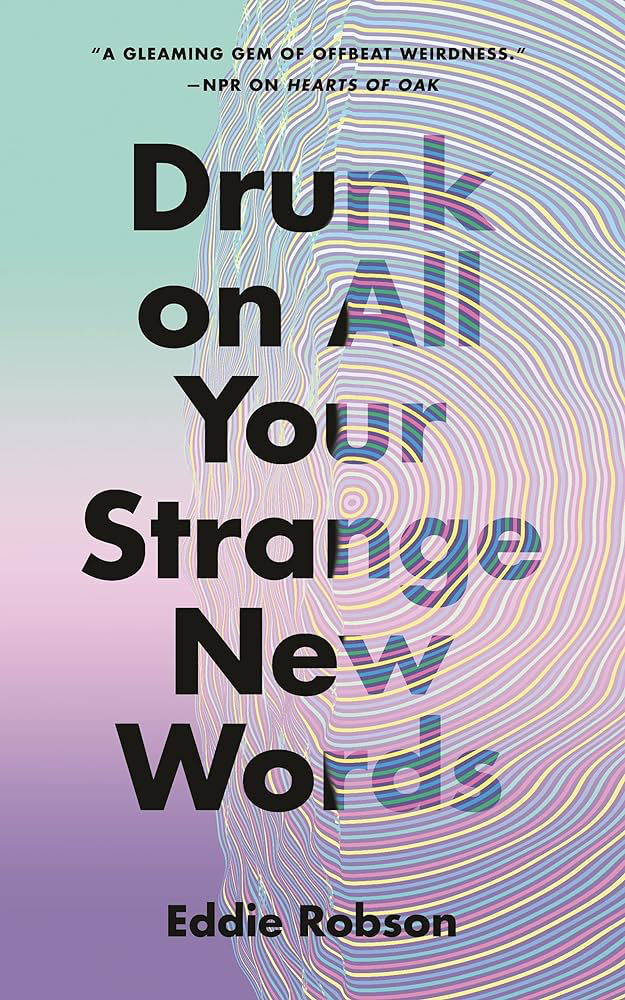
Drunk on All Your Strange New Words – Eddie Robson

For Lydia, First Contact started in the mind. The aliens we greeted were called the Logi, and they communicated entirely telepathically. Lydia works as a translator for a Logi cultural attaché named Fitz. It’s a pleasant job—Fitz is good-natured, and together, they pick apart plays and literature to determine if they are suited for intergalactic sales to the Logi. The unfortunate side effect is that translating the Logi’s telepathic language into English makes her feel drunk, earning her a less-than-stellar reputation on the job. But when Fitz is murdered and all eyes land on her as the suspect, Lydia must keep the police and Logi ambassadors off of her tail—and get to the bottom of Fitz’s murder.

TW/CW: xenophobia (fictional), murder/assassination, mild violence, death threats

I am on my hands and knees trying to find sci-fi with aliens that really feel alien. The quest is ongoing. But if you’re on that same quest with me (let us join hands, sisters in disappointed with humanoid aliens), Drunk on All Your Strange New Worlds is the cure for all that ails—all that and a dose of some good ol’ British humor.

I get to go off about aliens!! I GET TO GO OFF ABOUT ALIENS!! ALIENS WOOOOOOOOOOO THIS IS WHAT I’VE BEEN WAITING FOR

First off: the Logi! Drunk on All Your Strange New Words boasts some incredible alien design and culture, and I had so much fun exploring it throughout the novel. The whole concept of telepathic aliens whose speech makes the act of translation make humans feel drunk was already fascinating to me; it was so out of left field, and a concept I’d never really considered before; the only other instance I’ve seen of alien speech having unintended physical effects on the human body or brain was in A Desolation Called Peace (though that was arguably more drastic), but it still felt truly weird, which a lot of sci-fi doesn’t touch on, strangely. I loved getting such a complex, multilayered picture of the Logi beyond that, from the head coverings they wear to protect from Earth’s atmosphere to their unexpected strength; some of the elements of them almost veered into the supernatural (technically not much of a spoiler since it happens early on, but the reveal was so cool to me that I’ll keep my mouth shut for your enjoyment), but even that felt like a marker of an alien well done—so outlandish that the only explanation that humans can come up with is paranormal.

Creating all of that excellent background for the Logi is one thing, but it wasn’t all left as a lofty concept to puff up the worldbuilding—it had real, tangible effects on the characters and the plot, which I was so grateful for. Robson executed the real-time effects of humans interacting with a lot of these alien behaviors exceedingly well! It isn’t just that Lydia feels like she’s had a few too many after a long translation job—the feeling of drunkenness extends to drunken behaviors, the consequences of which had unfortunate implications for keeping said job. Having that was also a great device to start putting Lydia under suspicion for the other characters—there were enough instances of perceived instability or unprofessional attitudes that the authorities had all the more evidence to implicate her in Fitz’s murder. This is all to say that Robson really left no stone unturned when it came to the worldbuilding, and my enjoyment skyrocketed because of that!

The cultural environment around First Contact and the integration of the Logi into human culture also felt a little too real, in the best and worst way possible. At this point, the world has advanced into an undefined point in the future, and enough time has passed between now and First Contact that there aren’t just bigots and zealots with xenophobic intention, but organizations targeting aliens and professors giving whole lectures on what they perceive as a Logi encroachment into human culture, literature, and media. Paired with the faulty software that scores the truthfulness of the news that Lydia consumes (that aspect felt very “three days from now”), it felt like a more realistic depiction of alien contact and communication than we usually get; at heart, we still fear what we don’t understand, but it’s neither all-out annihilation of the aliens nor a global, complete hippie kumbaya event of unity. It’s demonstrative of human nature in the face of what we don’t understand: the bad and the very ugly, but enough good to keep us afloat and on good terms with the visitors from another world.

For most of the novel, I was really into the mystery surrounding Fitz’s murder. (I knew it was gonna happen from the start, since, y’know, in the blurb, but I didn’t want for him to die. I just wanna see the little alien guys!! Let them vibe!!) The slow burn of it kept me turning page after page, and for most of the novel, felt appropriately paced. It didn’t feel like we were jumping from place to place for no reason—every outing had a motive and revelation that added to the mystery in a way that made sense. However, though I enjoyed much of it, I feel like it got a little too slow-burn. The subtlety was good for most of the novel, but it got to a point where I was 90% of the way through the book and we still had no idea who the killer was and who the prime suspect was, now that most of the others had been eliminated by that point. Said killer was also introduced very late into the novel and quite sparingly, which made the reveal feel unearned—if we’ve spent all this time poring through suspects and barely touched on the actual killer, then what was the point? For such a clever novel, that felt like such an amateurish move—the only reason that we didn’t suspect them was because we had no idea who they even were for almost the entire novel.

All in all, a delightful combination of sci-fi and murder mystery that boasted some of my favorite aliens that I’ve read in a while. 4 stars!

Drunk on All Your Strange New Words is a standalone, but Eddie Robson is also the author of Hearts of Oak.

Today’s song:

That’s it for this week’s Book Review Tuesday! Have a wonderful rest of your day, and take care of yourselves!

Posted in Book Review Tuesday

Book Review Tuesday (3/26/24) – The Cybernetic Tea Shop

Happy Tuesday, bibliophiles!

There’s a special place in my heart dedicated to cozy sci-fi, but the sad thing about it is that hardly anybody does it well save for Becky Chambers. I guess it’s hard to reach the bar when it’s been set astronomically high (no pun intended), but I will still read any cozy sci-fi that comes my way, despite the amount of times that the blurb “for fans of Becky Chambers!” has severely led me astray. However, in the midst of my reading slump, The Cybernetic Tea Shop was the perfect novella to tide me over and lift my spirits.

Enjoy this week’s review!

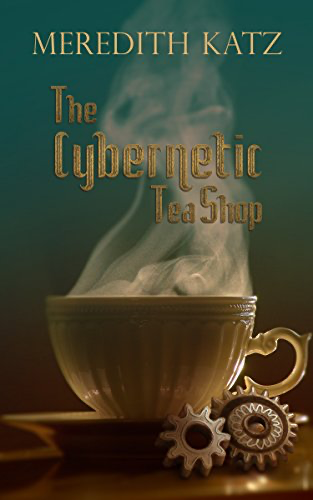
The Cybernetic Tea Shop – Meredith Katz

After the death of her master, Sal, an autonomous robot operating outside of the laws of a futuristic America, runs the tea shop that her master founded. For hundreds of years, she has run it like a well-oiled machine, but something in her program seeks something more. When Clara, an AI technician struggling to make ends meet, walks into Sal’s tea shop by chance, they have an instant spark of friendship—and perhaps even something more. Is Clara what Sal needed all along, and is Sal the key to the similarly vacant space in Clara’s heart?

TW/CW: loss of loved ones (past)/discussions of grief, hate crimes/discrimination (sci-fi)

Since about 2021, I’ve lost count of the amount of times that the tagline “for fans of Becky Chambers!” has let me down. Nobody does cozy sci-fi like her; all of the times I’ve read books with that promise, you get some semblance of found family (which comes off rather forced, in the worst instances), but it often lacks the quiet, tender moments that put the cozy prefix in. However, in that respect, I’m glad to say that The Cybernetic Tea Shop wasn’t a letdown—not without its flaws, for sure, but more than enough to scratch my never-ending cozy sci-fi itch.

I’ve been in a very novella-centered headspace for months, given that I’m trying to write one for class and I’ve been studying how they work for said class as well. One of the foremost concerns we’ve been talking about is how much worldbuilding you can fit into such a small space—often 100 pages or less. The key, I’ve learned, is, after giving your reader the necessary context to make the world feel real, is to only expand on the parts that are essential to understanding the circumstances of your characters. Katz did an excellent job of establishing this kind of worldbuilding, and it speaks to what a novella can achieve in such a small page count! Inevitably, I found myself wanting more of the futuristic American setting that Katz built, but the context we get is only what we need to understand Sal: the creation of intelligent robots, the outlawing of said robots because of ethical complications with intelligence, and the discrimination and illegality of robots in the centuries since. It’s the perfect foundation to set up not just the world, but the conflicts that these characters encounter.

Cozy sci-fi, by nature, often keeps things small; a handful of characters, a singular setting, and all else happening in the background. Novellas, also by nature, typically scale it down as well. The Cybernetic Tea Shop only centers around two characters, but that’s all it really needs; this novella is small in every aspect, and that’s why it largely succeeded. By narrowing down two characters (and their budding romance) and a single, unique setting, Katz confined her world to reasonable limits to explore in a novella; nothing ever felt too convoluted or too large to fit into just over 100 pages, but it didn’t feel too sparse, either. Similarly, aside from the character-driven focus (also the backbone of cozy sci-fi), there’s hardly any plot points, and that was actually a strength of The Cybernetic Tea Shop—in terms of structure, it was practically a Goldilocks of novellas.

However, although the general craft of the novella was commendable, the writing left a lot to be desired. For such a fascinating world and two characters moving through it in a unique way, I wanted so much more from the writing. The prose was rather bare-bones, doing the bare minimum to describe a setting or situation. I wanted so many more descriptions—and genuinely interesting descriptions— of Sal’s tea shop; you can do so many fun things with a tea shop, but I hardly got a sense for what it looked like, what it smelled like, or any other kind of sensory details. Similarly, the dialogue, although it had moments of being sweet, was often bland and stiff, and felt transactional in terms of the prose—just a way to get from point A to point B. Given that the romance between Clara and Sal was what eventually drove the novella, transactional dialogue is the exact opposite of what The Cybernetic Tea Shop needed; the kind of romance that Katz was shooting for wanted to be anything but transactional, but ended up falling flat.

In addition, I found myself wanting more from the characters. Again: cozy sci-fi is a heavily character-driven subgenre, and the evolving relationships between the characters are what make the plot go forward, and not necessarily outside conflict. I did like that Katz only zoomed in on Clara and Sal, but I almost wish that the novella had been all from Sal’s perspective. We get a very detailed and nuanced vision of Sal’s character, from her grieving her long-dead master to her insecurities and fears about being in hiding as an autonomous robot. Clara, on the other hand, was given very little of the same treatment; I would have liked to have seen her have some kind of romantic hurdle to overcome—commitment issues, hesitance, or something along those lines—that would make her something more than just a tool to instigate romance. We did get some of her background, but it didn’t add to much about her in terms of personality—the only part of her character that paired her with Sal was that she’s an AI technician, and therefore in a place to help Sal. With the focus on two characters, it would do Katz a favor to give both of them the fleshing-out that they deserve.

That being said, although Clara’s characterization left a lot to be desired, I did like the more romantic aspect of the plot towards the end of the novella. Even beyond the super sweet asexual/wlw representation (both Sal and Clara are asexual and sapphic!), there was a lot about the romance that worked; the setup of Clara fixing Sal’s programming evolving into cuddling was such an adorable and genius setup, and the resolution that came from it was similarly heartwarming. It did feel slightly rushed, but aside from that, Katz left it in a place where I didn’t quite want more, but was satisfied in knowing that their relationship was bound to blossom. I wanted something cute, and I got something cute, so Katz 100% succeeded on that front!

All in all, a tender, cozy novella with sweet romance and tight structure, but bland prose and half-baked characterizations. 3.5 stars!

The Cybernetic Tea Shop is a standalone, but Meredith Katz is the author of several other novels for adults, including the Pandemonium series (The Cobbler’s Soleless Son, Behind Bars, Heir to the Throne, and Barred Souls), the Sixth Sense Investigations series (Empty Vessels and If Wishes Were Fishes), and many more.

Today’s song:

shoutout to chelsea wolfe for playing this before her show. hauntingly beautiful.

That’s it for this week’s Book Review Tuesday! Have a wonderful rest of your day, and take care of yourselves!
Posted in Book Review Tuesday

Book Review Tuesday (11/28/23) – Hunger Makes the Wolf

Happy Tuesday, bibliophiles!

Hunger Makes the Wolf came on my radar when I was looking for more books with disability rep (as always), but I ended up buying it on my Kindle after my dad notified me that I had some unused Kindle points (thank you for reminding me!)—it was free with the points added on, so how could I resist? And while Hunger Makes the Wolf wasn’t perfect, it’s a ton of gunslinging, space-fantasy fun.

Enjoy this week’s review!

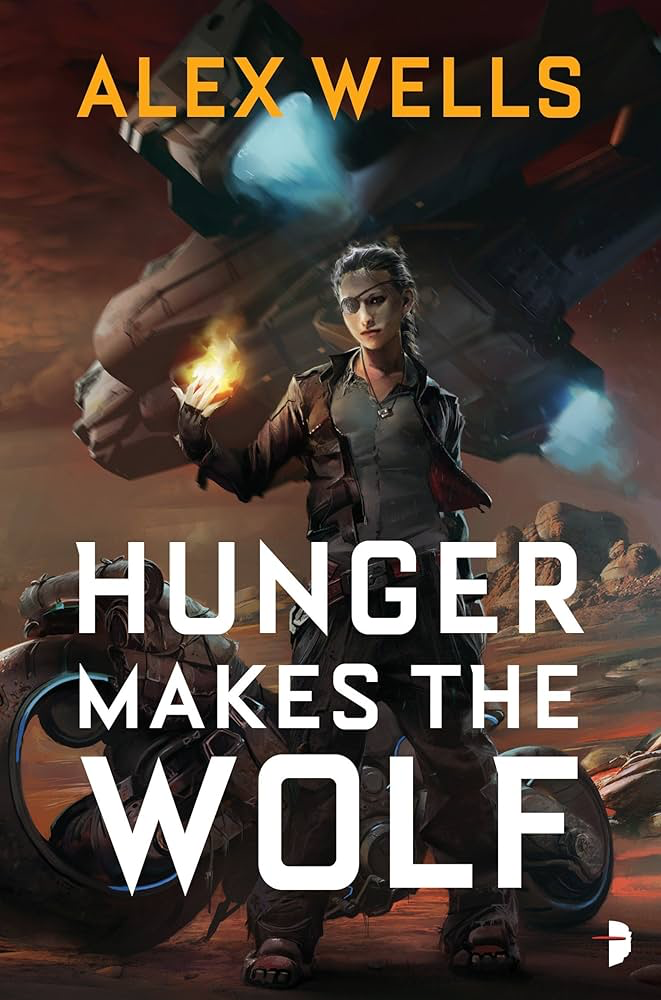
Hunger Makes the Wolf (The Ghost Wolves, #1) – Alex Wells

Hob Ravani ekes out a living in the deserts of Tanegawa’s World, a planet owned by TransRifts—the corporation who controls the market on interstellar travel in the whole galaxy. For 10 years, Hob has gotten by with the help of the Ghost Wolves, a group of bandits roaming the desert and finding money where they can. But when Hob discovers the body of Nick, the man who recruited her to join the Wolves, abandoned in the desert, she knows that she has to act before TransRifts discovers their operation—and discovers the powers that she’s kept hidden from sight.

TW/CW: murder, descriptions of injuries, descriptions of corpses, violence, loss of loved ones, human experimentation

Writing accents phonetically is a slippery slope that I’m not going to get fully into in this review. In this case, though, Alex Wells had decent success with making everyone who was meant to sound like they had a Southern accent actually sound like they had a Southern accent, which worked—this novel was a space Western, after all. That being said, the unintended consequence was that Wells’ spelling of Hob’s accent was that I imagined her voice more like Holly Hunter in Raising Arizona than the badass, hardened gunslinger that she was made out to be. It sort of worked, though.

As far as sci-fi subgenres go, I’m not usually huge on space Westerns; I’ve rarely seen them done exceedingly well (even The Mandalorian got more than a little repetitive eventually), but the best are at least fun. And that was what Hunger Makes the Wolf was—incredibly fun. It had all of the trappings of a debut novel, but what Wells did get right on the first time was that pacing. Although the action sequences were what made Hunger such a blast to read in the best parts, Wells also knew how to balance them out with quiet, more emotional moments, and also moments to slip in worldbuilding without absolutely walloping you with it. Wells’ action was really the star of the show here; their fight scenes had just the right amount of tension, levity, and butt-kicking to make for more than one delightful scene.

Recently, I’ve read several sci-fi books that were marketed as “space fantasy,” and none of them have really fit the bill. And yet, Hunger Makes the Wolf wasn’t necessarily marketed as such, but it does what the other novels lacked. Even amidst the classic sci-fi backdrop of corporate greed, massive spaceships, and gruesome human experimentation, there’s the element of the characters’ strange hidden powers. Naming said powers “witchiness” was already a win in my book, the charm of it really fits the Western atmosphere that Wells was going for—it hits that sweet spot of not sounding overly jargon-y or formal, but not too hokey, either. Every time one of the characters mentioned it, I couldn’t help but smile—especially in Hob’s aforementioned Holly Hunter voice.

Hunger Makes the Wolf is an incredibly ambitious novel, and the ambition is accentuated when you remember that this is Alex Wells’ debut. In some ways, it worked; Wells managed to juggle a safe amount of the worldbuilding without leaving the reader without context, but also without dumping it excessively. However, what Wells did not juggle as well was the sheer amount of characters that we jump between. Hunger was clearly meant to have a found family theme to it, which I’m normally a sucker for, but Wells just had so many extraneous characters on their hands that none of the character relationships felt fleshed out. If we had gotten more scenes with Hob and the rest of the Wolves, for instance, I would have believed that they really were as thick as thieves. Adding onto this, the perspective switches may not have been necessary; Mags, although she plays a prominent role, doesn’t have a perspective or voice that added anything substantial to the narrative. It’s a classic debut author case: Alex Wells had some spot-on ideas, but they bit off far more than they could chew.

All in all, a rollicking space fantasy with action aplenty, but with characters that left me wanting more. 3.5 stars!

Hunger Makes the Wolf is the first book in the Ghost Wolves duology, followed by Blood Binds the Pack. Hunger was Alex Wells’ debut novel; they are also the author of the short story Angel of the Blockade.

Today’s song:

FARGO IS BACK I AM FOAMING AT THE MOUTH OH MY GOOOOOOOD

That’s it for this week’s Book Review Tuesday! Have a wonderful rest of your day, and take care of yourselves!

Posted in Book Review Tuesday

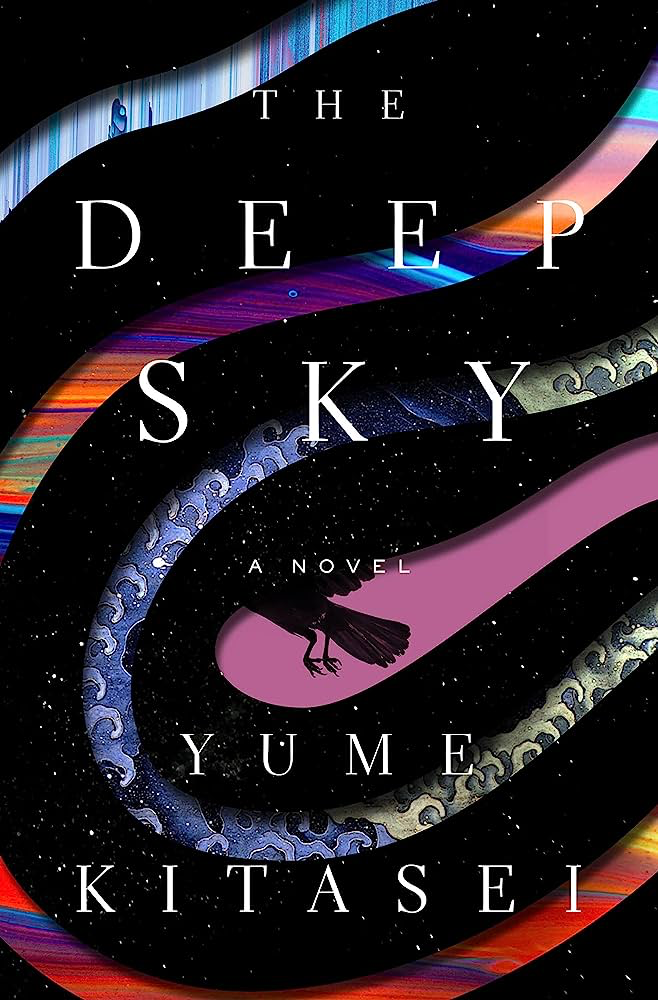
Book Review Tuesday (11/7/23) – The Deep Sky

Happy Tuesday, bibliophiles!

The Deepy Sky came out this July, and I’ve been seeing a ton of buzz about it around the blogosphere since. I’m always in for a sci-fi thriller, and this one delivered in that aspect, as well as the wonderful mixed-race rep!

Enjoy this week’s review!

The Deep Sky – Yume Kitasei

Asuka has been chosen as a representative on a mission to deep space, where she will help give birth the next generation of Earth’s children. But she has been chosen to represent Japan—a country she barely knows, as a half-Japanese, half-Latina girl raised in the United States. Feeling like an imposter to an unfamiliar country, she accepts her duty and joins the crew of the Phoenix. But a deadly explosion onboard the ship leaves her the only surviving witness. With all eyes on her once more, Asuka must get to the bottom of the explosion before the perpetrator strikes again.

TW/CW: racism, terrorism, miscarriage/fertility themes, death of a child

“Literary” sci-fi rarely does it for me; most of what I’ve read barely scrapes past the 3.5 star rating for me, at best. Often, what happens is that the sci-fi element gets significantly watered down for the sake of marketability, drama, and a place in a celebrity’s book club (see: Sea of Tranquility, In the Quick). But The Deep Sky had the chops to make itself unique—and incredibly poignant.

The sci-fi plot of The Deep Sky is pretty standard as far as story elements go, but Kitasei’s approach to it made it feel fresh. It’s the setup for a myriad of sci-fi thrillers: you’ve got a large crew voyaging through the depths of space, only for a tragic accident to leave everyone onboard in suspicion, with no way to get back to Earth. It’s not necessarily a new approach plot-wise that keeps it going—it’s the emotional core that Kitasei brings to it. You’re really able to see deeply into Asuka’s head, deeper than a lot of authors dare to go with these kinds of stories; it’s a great way to increase the stakes without having to complicate the mystery of the story.

Also, LET’S HEAR IT FOR MIXED-RACE REPRESENTATION!! I’ve been on a roll with books with amazing mixed-race characters and stories lately (see also: Leslie Marmon Silko’s Ceremony—a very different book, but no less poignant), and as a mixed-race person, I’m so glad that narratives like these exist. Kitasei’s depiction of the imposter syndrome that Asuka faces about her identity is twofold—not only is there the level of it that comes with her being of Japanese and Mexican descent in the U.S., but also in the fact that she has to represent Japan—a country that she’s barely been to—in this mission. It really did make me feel so, so seen. Kitasei’s portrayal of having these intersecting identities and them coming at odds with how others want to box you in was deeply moving and authentic, and I cannot thank her enough for that.

Back to the subject of literary sci-fi. A lot of these types of novels that I’ve read deal with intersecting, nonlinear timelines, which may or may not have to do with actual time travel (case dependent). For the most part, it worked incredibly in Kitasei’s favor—even outside what we can consider the “main” plot, the pieces that we get of Asuka’s life before the deep space mission were almost more intriguing than the actual murder mystery in space. Kitasei’s character work is incredibly detailed and nuanced, and having most of this novel be driven by character and family was a choice that made me enjoy it that much more. These types of sci-fi thrillers normally lend themselves to very distant characters, and minimal character work by proxy (outside of “trust no one”), so this was a breath of fresh air in that sense.

That being said, the nonlinear timeline was also what brought part of the novel down for me. There’s much more emphasis placed on the time before the mission than the actual mission, making the murder mystery plot feel like an afterthought. The way that these timelines were spaced out meant that we went long stretches without checking in on what’s supposed to be the novel’s inciting incident, which made the stakes feel much lower than they were meant to be. The tension got appropriately amped towards the end, but other than that, there really wasn’t as much thriller as I was expecting going in. Maybe this is just a matter of how The Deep Sky was marketed, but I did wish we got a little more of the “main” plot.

All in all, a rare gem of a literary sci-fi novel where every page brimmed with emotion and suspicion. 4 stars!

The Deep Sky is a standalone; it is also Yume Kitasei’s debut novel.

Today’s song:

listened to my first Arlo Parks album, and I’m a fan!! this was my favorite, for sure

That’s it for this week’s Book Review Tuesday! Have a wonderful rest of your day, and take care of yourselves!

Posted in Book Review Tuesday

Book Review Tuesday (5/30/23) – The Memory Police

Happy Tuesday, bibliophiles!

I forget how exactly I came across this novel, but it was one of the first books that I put on my Libby wish list way back in March 2020, when I lived off of Kindle books. At the time it was always on hold for weeks when I tried to check it out, and so gradually, it faded to the bottom of the list. But after years of forgetting about it, I rediscovered this novel—and it was finally available! Usually, literary science fiction doesn’t always do it for me, but The Memory Police was a strangely quiet dystopia with a powerful undercurrent.

Enjoy this week’s review!

The Memory Police – Yōko Ogawa (translated by Stephen Snyder)

A young writer leads a quiet life on a distant, unnamed island, grieving a multitude of losses. Her parents passed away many years ago, but it isn’t just people that are disappearing—it’s objects, animals, and ideas as well: hats, birds, ribbons, and all manner of things. Once they disappear, nobody on the island has any recollection of their existence—they simply fade from public memory. And to enforce this, the island is under the iron fist of the Memory Police, who are there to make sure that these forgotten things stay that way. But she seems to be one of the only people who still clings to the memory of what’s been lost.

When the writer’s editor falls under suspicion from the Memory Police, she hatches a plan to hide him under her floorboards, silently completing her novel as they evade capture. And as more and more objects begin to fade into obscurity, her writing may be the only thing left to cling to.

TW/CW: loss of loved ones (past), kidnapping, police brutality

The Memory Police has been compared time and time again to 1984, and the comparison is clear, but it seemed to take a more literary approach. And while the “literary” part initially made me suspicious, this was one of the most creative and wholly human dystopian novels that I’ve read in a long time!

What sets The Memory Police apart from most other dystopias that you can think of is its perspective. We aren’t given an extensive history as to how the unnamed island came to be under such totalitarian rule, and how everything began disappearing and why. Nor do any of the characters—save for the main character’s editor, referred to only as ‘R’ in this translation—have names, save for their roles or jobs (the protagonist’s parents) or their physical appearance (the old man). All this book seeks to do is give you an ordinary person’s view into something haunting—the protagonist is just as confused as you are, and she is moving through this world in the only way that she can. Naturally, I was curious about the main plot points (how and why everything was disappearing, and how the Memory Police came to be), but I got that the point wasn’t to explain such things, but to see it happening firsthand through somebody else’s eyes, when they may know about as much as we do. I assumed the Memory Police were in control of what disappeared and they had some degree of immunity, which I was curious about, but the decision to omit these details at least made sense as a stylistic choice.

Make no mistake—The Memory Police is certainly haunting, but there’s a quietness to it that makes it stand out from the rest. In this state-surveilled, isolated island environment, this novel is the closest thing that you can get to a slice-of-life story. Other than some chilling instances involving break-ins by the Memory Police, it’s the story of one woman flying under the radar and trying to write her novel as the world is crumbling around her. There’s a constant fear surrounding everything, but in between, she finds time to craft a novel, share secret memories about her parents’ world and what they loved, and hold parties from an elderly man who helps keep her editor hidden. Sometimes, frightening change doesn’t come in the form of something obvious—it’s often slow and goes unnoticed, and it is the small things that keep us going through it.

Literary science fiction like this often comes off like it’s trying to be better than “regular” science fiction, like it boasts some lofty message that your common novel can’t possible get across. I’m glad to say that The Memory Police does none of that—some of the writing does fit that style, but nothing about it comes across as belittling or haughty. In fact, it has an incredibly powerful message. With all of the plot centering around the loss of memory and holding on to the last remnants of a past world, the ending made an incredibly powerful statement: as long as there is somebody around to keep a memory of something alive, memories never really die—they always stay with us. It’s a beautiful message on loss, and about resistance in general—maybe the most powerful thing we can do in the face of tyranny is to know that there is a way to change things, and hold memories of what our forebears did in the face of similar situations. This book is proof that dystopias don’t have to be flashy and overtly gritty to get their themes across—quietness can be just as powerful.

All in all, a nontraditional dystopia that made an incredible impact from reveling in its quiet moments. 4 stars!

The Memory Police is a standalone, but Yōko Ogawa is the author of many other novels that have been translated into several different languages, including Revenge, The Housekeeper and the Professor, Hotel Iris, and more.

Today’s song:

Peter Gabriel Summer 2 is upon us

That’s it for this week’s Book Review Tuesday! Have a wonderful rest of your day, and take care of yourselves!