
Happy Sunday, bibliophiles, and Happy New Year! I hope this week has treated you well.
This week: double-dipping on St. Vincent to start 2026 off right. Plus: songs you can effectively wallow in during cold weather, or if that’s not your speed, songs to keep you warm.
Enjoy this week’s songs!
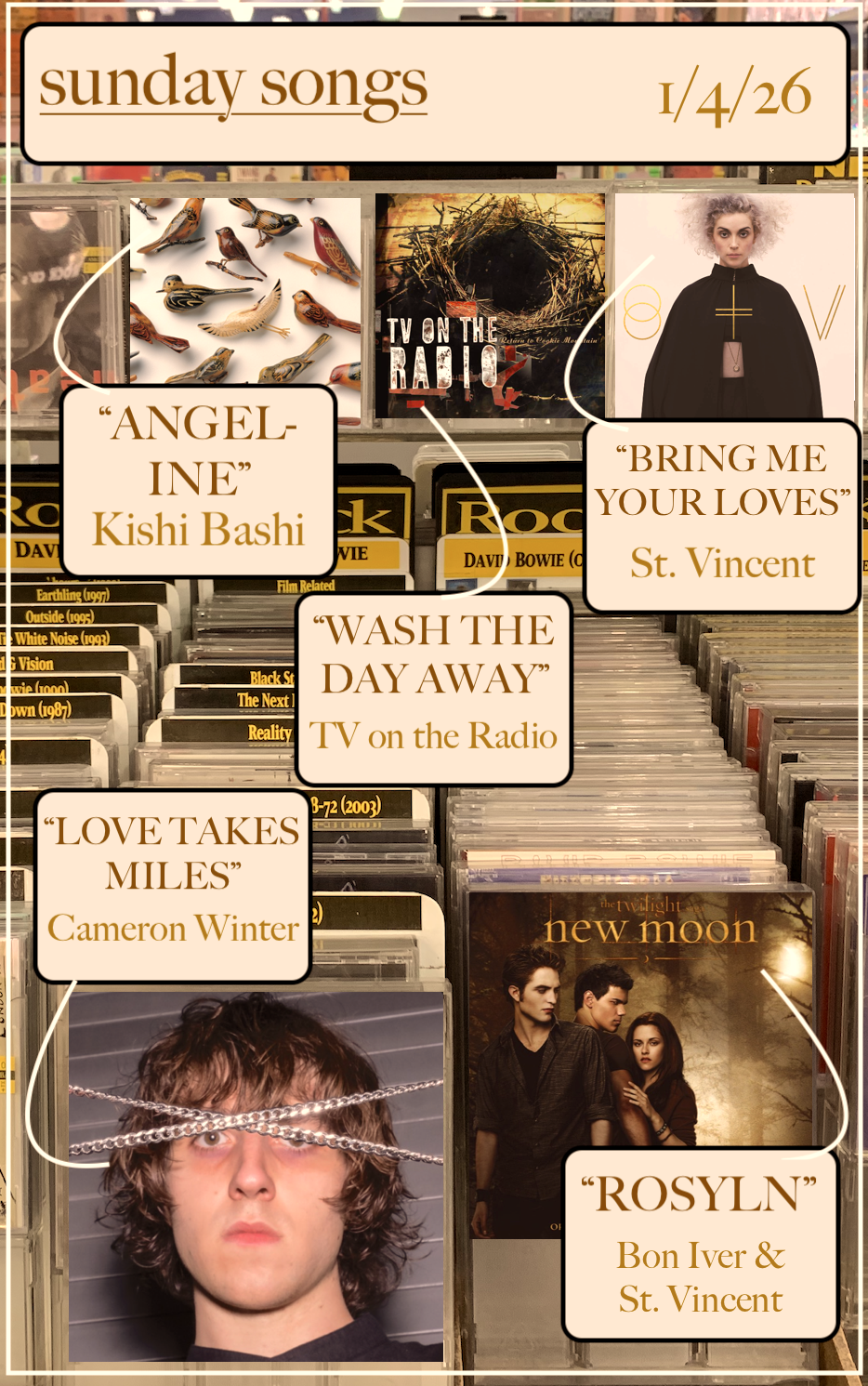
SUNDAY SONGS: 1/6/25
“Love Takes Miles” – Cameron Winter
As much as I’ve changed over the past decade, some things stay the same. When some pasty, mumbly white guy goes into alternative rock, I’M SEATED.
Other than a handful of songs, the Cameron Winter/Geese-mania seems to have passed me in fleeting glimpses. There’s nothing quite as wild as seeing some random band you saw open for Spoon in 2022 blow up all of the sudden. And good for them!! I’ve only heard “100 Horses” from the former, but it’s a solid art-rock song. No pun intended, but it’s honestly miles away from this song, but something about it snagged me immediately. Winter’s said white boy mumbling took a few minutes for me to a) get used to and b) decipher in the first place, but once it did, it put me in an undeniable chokehold.
The beautiful thing to me about “Love Takes Miles” is that it simultaneously sounds wise beyond its years, in the way that random encounters with old folks do, but so distinctly saturated with young love. I love a good yearner song, and this is prime yearning territory—even the strings sound like they’re also wistfully staring at the moon. “Love Takes Miles” is a breathless, lovestruck sprint, but one that’s ready to steady its pace into a marathon—after all, “Love takes miles/love takes years.” Young love as it is, Winter fully embraces the commitment that comes along with love, and wholeheartedly throws himself into it. It’s an ode to being so in love that you know what it is to get really, really into the weeds with someone, knowing that there will be all manner of forks in the road. As far as I can see, Winter’s at the wheel, and he’s ecstatic about every bump on the merit that he’s spending it with the people he loves most. AMEN! YOU BETTER START A-WALKIN’, BABE!!
Do I agree with the endless YouTube comments comparing Winter to [checks notes] Brian Wilson and Beethoven? Jesus Christ, no, I’ve only heard…what, three songs? Beethoven? Goddamn. And yet, what a tender pearl of a song. I’ve played it countless times now, and every time, it gives me the urge to have an impromptu kitchen dance party. Heck, it makes me misty if it catches me in the right mood. That string section, man. And that’s talent I can’t deny.
…AND A BOOK TO GO WITH IT:
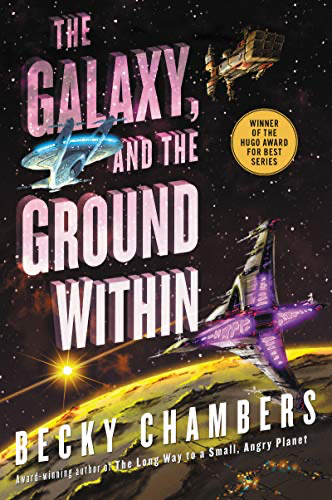
The Galaxy, and the Ground Within (Wayfarers, #4) – Becky Chambers – “Love will call/When you’ve got enough under your arms/Oh oh, mama/Love will call/Love will make you fit it all in the car…”
“Rosyln” – Bon Iver & St. Vincent
My brother was brave enough to endure all four movies of the Twilight Saga for the bit, and I can’t say that I’m that brave. For both the books and the movies, Twilight is something I’ve absorbed bits and pieces of through meme osmosis. But if there’s one thing that I’ll give these movies, it’s that they have some bangers on the soundtrack (see: “Supermassive Black Hole”). It made me so mad as an 11-year-old to see that this was always the most popular of St. Vincent’s songs on iTunes, but that was probably because I was conditioned to be a Twilight hater. But I’m enough of a St. Vincent fan to realize how excellent of a song this is. Even though I’m writing this in January, “Rosyln” is such a distinct, perfectly autumn sound: it’s like the fog and chill were baked into the mix itself. Bon Iver and St. Vincent are an eery match in this duet, both of their voices cloaked in enough reverb to make them sound like they’re singing in tandem from the bottom of a well. “Rosyln” had been incubating long before Twilight: New Moon came out (the lyrics have nothing to do with the story), but it’s no wonder that they picked it for the soundtrack—it’s so Pacific Northwest that you can feel the cold, damp earth beneath your boots and the dewy mist on your face.
…AND A BOOK TO GO WITH IT:
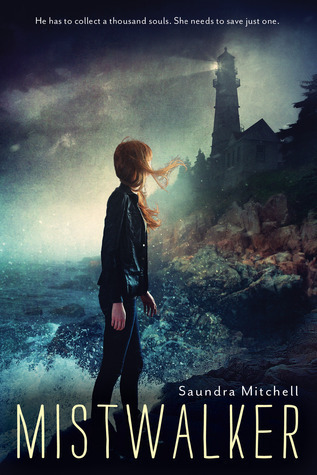
Mistwalker – Saundra Mitchell – “Up with your turret/Aren’t we just terrified?/Shale, screen your worry/From what you won’t ever find…”
Intertwined with frequent listens to “Love Takes Miles” in the last hours of 2025 was Kishi Bashi. A ton of Kishi Bashi. You’ll be hearing more about him a lot more in the coming weeks (this is a threat). This song spurred it on, and it made me remember just how inventive he is—there’s just such an intricacy to his compositions. Going through any given Kishi Bashi song feels like being in the middle of a woodcut illustration, ducking my way through all manner of delicately carved plants and watching wooden birds nestle in the branches.
Compared to most of the work of his that I know, “Angeline” is more restrained, and for good reason—Omoiyari, the album where it comes from, deals primarily with the climate of the United States in the 1940’s, particularly the Japanese Internment Camps (see: “F Delano”); It’s a somber album, collecting vignettes of the decade that lean into both the sorrow and conflict, but also the flickers of hope. The album’s inspiration mainly stemmed from the internment camps, but the more that Kishi Bashi researched about America’s fraught history with mass incarceration of minorities, the album grew beyond the experiences of Japanese-Americans and into people of color as a whole (with sobering parallels to Trump’s first administration…and today. God.) “Angeline” collects both the former and the latter like fireflies in a jar. Amid gentle acoustic strums, he weaves a tale of a Black man who falls victim to the Jim Crow-era practice of convict leasing, arrested for a petty misdemeanor and sent to work in the mines, all the while pining for the titular Angeline. For me, it’s songs like these that can be the most impactful; even if “Angeline” is fictional, by putting the human souls into historical events that the education system treats as vestiges of the distant past make them all the more realer, even if the characters are rooted in fiction. Education, for me, fails when it fails to recognize that within every historical event or system, large or small, there were innumerable lives and souls within it, not simply statistics or numbers.
…AND A BOOK TO GO WITH IT:
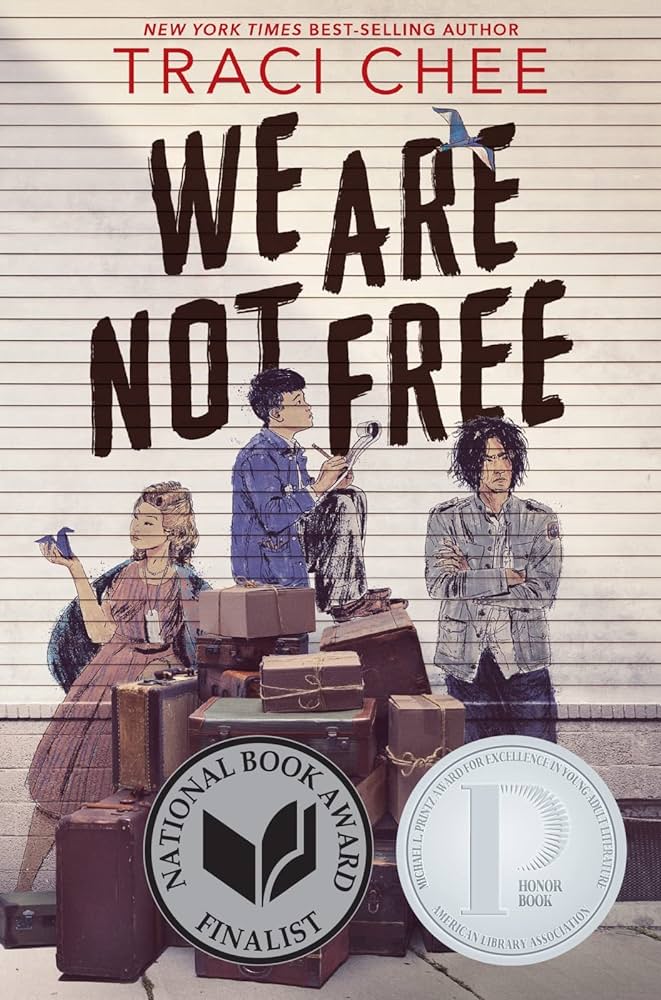
We Are Not Free – Traci Chee – though “Angeline” isn’t specifically about the Japanese Internment Camps, this novel deals with the same subject matter, also concerned with its parallels in the present day.
“Wash the Day Away” – TV on the Radio
There are closing tracks, and then there are Closing Tracks. Plenty of closing tracks can be appreciated on their own, but sometimes, a great closing track works as its primary function and nothing but. If this were anywhere else on Return to Cookie Mountain, it would be a foolish placement. “Wash the Day Away,” with its “Intruder”-esque drum intro and its grinding swirl of rusty sound, feels like a dilapidated airplane gently being guided onto solid ground. Although I still haven’t listened to Return to Cookie Mountain in its entirety, “Wash the Day Away” makes me want to listen to it more, just to get the full effect of this track; but back to back with the moving “Tonight,” it creates a crashing, sparking end to the album that collapses in a flurry of embers and scrap metal. Paired with “Tonight”‘s lyrics, it’s a bittersweet sendoff, pairing destruction and loss of innocence with accidental beauty: “We did believe in magic, we did believe/We let our souls act as canaries/Our hearts gilded cages be/Watched a million dimming lanterns float out to sea/Lay your malady at the mouth of the death machine.” (And oh my god, another lyrical win for Tunde Adebimpe! Man, he can really conjure an image.) It’s an explosion in slow motion, but Adebimpe and co. let you languish in the aftermath—the last three minutes of this track’s 8-minute runtime are a slow fadeout from the barely-controlled cacophony, letting every bit of machinery run its course, guiding you gently out of the experience. Like I said: Closing Tracks.
…AND A BOOK TO GO WITH IT:
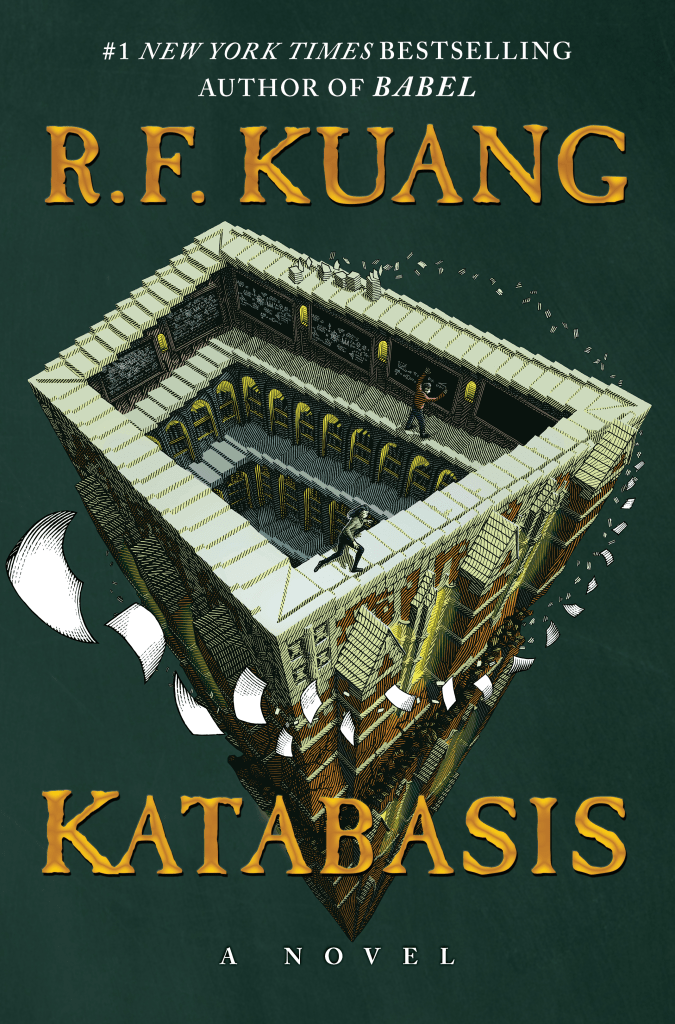
Katabasis – R.F. Kuang – “We did believe in magic, we did believe/We let our souls act as canaries/Our hearts gilded cages be/Watched a million dimming lanterns float out to sea/Lay your malady at the mouth of the death machine…”
“Bring Me Your Loves” – St. Vincent
From 2015-2016, my laptop had three uses: schoolwork, Minecraft, and playing St. Vincent’s self-titled album and almost nothing else. I’ve talked extensively about how this album has permanently etched itself onto my consciousness, and 10 years after its release (as well as the release of the deluxe edition), it still holds up to me as such an out-of-the-box album, Annie Clark’s peak of creativity and jagged melodies. But back when I was in middle school, “Bring Me Your Loves” was my least favorite track on the album. On an album full to bursting with hit after hit, I still think that it’s the album’s weakest link. In contrast to the methodical process behind most of the album, it seems like all Clark herself has said about it was that it was “bananas. It’s just totally bananas.”
The more I listen to “Bring Me Your Loves,” the more it feels like foreshadowing for what was to come. It has a much more traditionally pop structure, and it’s less lyrically adept than the rest of the album, with a kind of baseline metaphor about feral and rabid love, leashes and dogs—it feels like an early incarnation of the kinkier stylings of MASSEDUCTION, all leathery and sweaty and breathless. But it hasn’t reached that point yet, and strangely, it feels like the most suited to the vague concept surrounding St. Vincent’s persona at the time as a “near-future cult leader.” It’s very seductive, dealing in patterns of pushing and pulling, domination and resistance. Clark’s vocals on the chorus soar, twisting and turning from master to servant with every vowel. As is the norm with this album, “Bring Me Your Loves” pushes Clark’s guitar to places that you would never expect a guitar to go, turning it from an instrument into a futuristic siren song that ensnares you with its angular, jagged spell. It’s proof that even the weakest points on this album are better than your average song.
…AND A BOOK TO GO WITH IT:
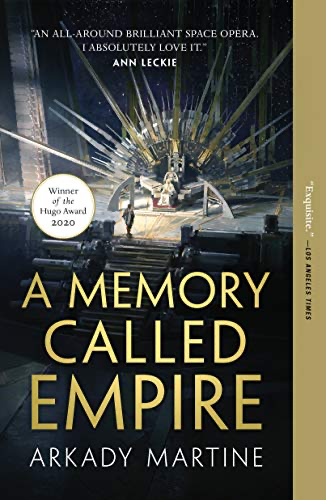
A Memory Called Empire – Arkady Martine – “I, I took you off your leash/But I can’t, no, I can’t make you heel/Bring me your loves/Bring me your loves/We both have our rabid hearts/Feral from the very start start…”
BONUS: I couldn’t slip this in anywhere else, but speaking of St. Vincent and Twilight, here’s another song she contributed to the soundtrack of Twilight: Breaking Dawn, Part 2. Man, I wish it was a) on streaming, or b) available to buy without buying the whole album!! It’s another gem of that perfect, 2012-2015 era of St. Vincent trapped in amber. So, so delicious.
Since this post consists entirely of songs, consider all of them to be today’s song.
That’s it for this week’s Sunday Songs! Have a wonderful rest of your day, and take care of yourselves!


 The Bookish Mutant