Posted in Sunday Songs

Sunday Songs: 4/7/24

Happy Sunday, bibliophiles! I hope this week has treated you well.

This week:

Choose the best answer: You can blow with:

a) This

b) That

c) Us

d) All of the above

Enjoy this week’s songs!

SUNDAY SONGS: 4/7/24

“Flea” – St. Vincent

Affirmation of the week: I have listened to this song a healthy amount of times. At least I didn’t pull the “listen but nothing but this song for almost four hours straight” stunt that I did with “Broken Man.” See? I’m better now. I’m savoring this one, and by “savoring,” I mean “listening to it slightly less, but still putting it on repeat for at least half an hour when it comes on shuffle.” What new St. Vincent does to an mf.

“Broken Man” is shining proof that All Born Screaming has a good chance of being my album of the year, but somehow, Annie Clark outdid herself even more with this latest single. I’m glad that “Broken Man” and “Flea” are tracks three and four on the album, respectively; even past the fact that they fit so slickly together, I like the idea that the title and closing tracks are a secret—she’s got something insane up her sleeve. I can just tell. After “Broken Man”‘s torrent of fury, vengeance, and Dave Grohl’s drumming, “Flea” makes the transition into the outright bloody—not bloody in the sense of the trail of destruction that “Broken Man” left, but in the sense of parasitism. Clark described the upcoming All Born Screaming as being bred in “That kind of isolation [that] breeds paranoia and loneliness…loneliness can breed violence.” Now I can see exactly where the whole “post-plague pop” label she stuck on it comes from. “Flea” slinks along on tiny, pointed legs, thrumming with a racing heartbeat and an insatiable thirst for blood; the repetition of “Once I’m in, you can’t get rid of me” is sung lower and raspier, a threat paired with a predatory lick of the lips. The kind of loneliness and violence Clark described seems to be exactly where this kind of sinister lust comes from—being isolated for so long could easily make love turn to lust, and lust consequently to hunger, so drained of human touch that what was once affection has become leeching for nutrients at the other person’s expense. And everything about “Flea” sounds frighteningly hungry, down to the parched-throat rasp with which Clark delivers the verses. When she ends verse two with a dried-out confession of “I look at you, and all I see is meat,” followed by a faint belch in the background, I suddenly got the feeling that I was being watched by something waiting to tear me limb from limb and suck me dry. It’s intense, but it’s the kind of intoxicating thrill ride that I’ve taken with Clark for nearly ten years. And the chorus finds the narrator covered in someone else’s blood, begging for just one more bite; the desperation sloughs off like a second skin, every blood-soaked belt starved and howling. It’s a kind of visceral musicianship that I haven’t seen from St. Vincent in years; although Daddy’s Home was certainly raw, it was the kind of raw you get from getting someone enough wine to spill about their childhood trauma and laugh it off. All Born Screaming is about as raw as flesh itself—it’s all the clearer that Clark has no intention of pulling punches, and that’s exactly what makes a St. Vincent song so iconic. “Rattlesnake” and “Severed Crossed Fingers” don’t illicit waves of emotion in me for nothing—they’re hearts laid bare in the street. In other words: Clark is at her best when she’s herself. Should be a given, but it’s more evident in some albums than others.

God, April 26th can’t come any sooner…

…AND A BOOK TO GO WITH IT:
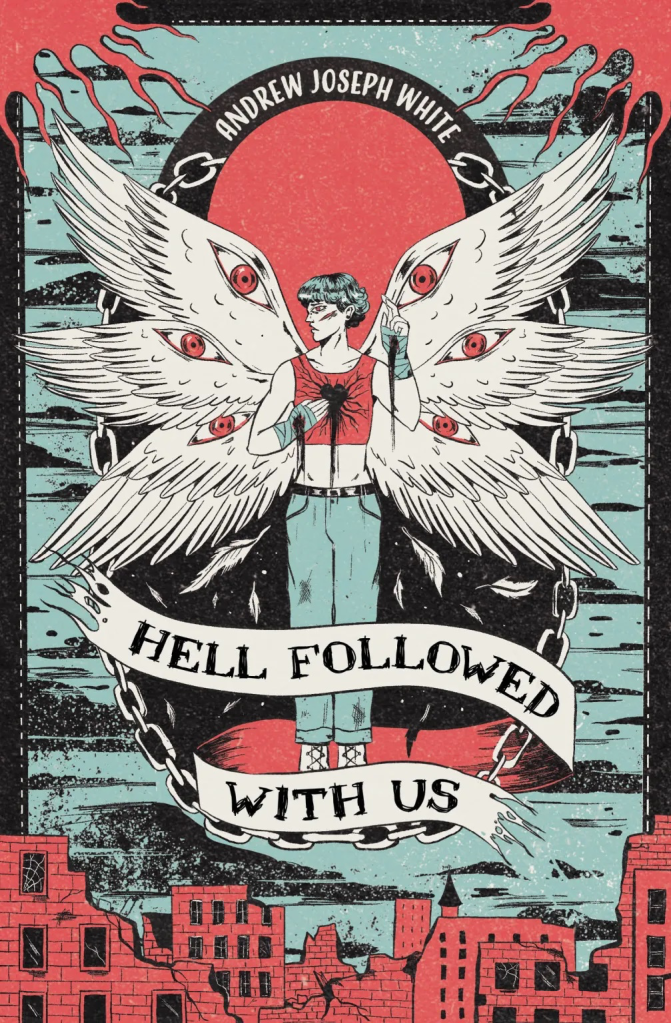
Hell Followed With Us – Andrew Joseph Whitedepending on how All Born Screaming goes, I might preemptively merge this with “Hell Is Here”…

“Tonight” – TV on the Radio

Aaaaaaaaaand, that’s one more album on the Sisyphean Album Bucket List. Between the “Wolf Like Me” (the best song there is about werewolves after this), the deeply moving “Province” with its David Bowie feature (YOU HEARD ME!!), and this, I now know that Return to Cookie Mountain has to make its way into the rotation. I have Chelsea Wolfe to thank for this one; at her fantastic show at the Gothic Theater in March, she played this before the show—I wouldn’t be surprised if she was a fan before, but I suspect that it’s a kind of thank you to the fantastic Dave Sitek, who produced her truly fantastic new album, She Reaches Out To She Reaches Out To She. Also, with a title like Return to Cookie Mountain, I feel like I just have to listen.

What “Tonight” made me realize about TV on the Radio is how effectively—and quickly—they can craft an atmosphere. Some of the most layered ones I can think of are from their early career, namely the first version of “Staring at the Sun” that appeared on their debut EP, Young Liars. Instead of the shorter version that made the cut for Desperate Youth, Bloodthirsty Babes, this one has a thirty second intro (that feels longer, honestly) that consists of just the a cappella vocals of the band, interspersed with an excerpt from a Spanish-speaking radio station. Even though the chatter on the radio station seems cheerful and singsong, the drawn-out gives it a prolonged air of foreboding and sorrow to come, like the next thing we hear will be the somber announcement of someone’s death. Thankfully, that doesn’t happen, but the first lyrics we hear on the heels of that are “Cross the street from your storefront cemetery,” which, bam. That’s how you start a song. When it comes to both of those aspects, “Tonight” operates in a similar way, creating an atmosphere that’s haunting before the instruments even kick in. With the whine of a distant siren and the ever-so-slightly distorted collision of wind chimes, “Tonight” instantly transports you to a place of brown grass and barren vastness, pockmarked by dead trees strung with glass bottles and the faint sounds of the road in the distance. The music seems to lumber with every step, a beleaguered creature that lurches with every step, as if its limbs are tied down with the wind chimes you hear tinkling throughout the song. Hollow whistles harmonize with a moaning clarinet and Tunde Adebimpe’s clarion call of a voice, all at once ragged and brimming with vitality. A fair amount of the buzz surrounding TV on the Radio when they got their start were vocals comparisons of his to Peter Gabriel, and it’s an apt one—they have a similar quality of being roughly visceral, but booming with emotion. Dave Sitek is also credited with “magic” on this song, which I cannot find a musical definition for the life of me, but if there’s anything that you would credit the man for, it’s that. He has the touch.

I often get so caught up in the atmosphere that I only mine the lyrics later, but the lyrics in “Tonight” pop out so prominently on the first listen; as the wind chimes huddle for warmth, Tunde Adebimpe’s voice cuts through them like a steak knife through fabric—”My mind is like an orchard/Clustered in frozen portraits.” How does this man do it? Every single line in this song is a literary gem in and of itself, and it’s not just because of the repeated references to Edgar Allan Poe’s “The Telltale Heart”—like heartbeats rumbling through flimsy floorboards, the lyrics never fail to send chills up my spine: “Her rusty heart starts to whine/In its tell tale time.” My rusty heart sure does whine whenever those lyrics wash over me. And like the sparse nature of the atmosphere, the lyrics tell of a spare mental space, one so full of sorrow and unpleasant memories that, like the telltale heart, cannot be pushed from the mind. The song still haunts me in a largely melancholy way, but it has an uplifting sentiment at its heart. I can’t help but think of Soundgarden’s “The Day I Tried to Live” and its similar atmosphere of doom, but its lyrical heart being the fact that despite all of the horrible things crashing down around you, there will always be something left to live for, so all you can do is push through. Adebimpe’s sentiment feels like wading through a slurry of unpleasantness that never seems to end (“Blossoms that bloom so fine, just to drop from the vine/I’ve seen them all tonight), but he makes the light at the end of the tunnel shine as bright as it can: “The time that you’ve been afforded/May go unsolved, unrewarded/Some nameless you cannot know, may be coming to show you/Unbridled love and light.” No matter how much you have to push down and wade through, never doubt that good things are coming. It’s something I struggle to hold to heart, but I’ve added this song as an unexpected guiding light. I can never know the future. It scares me. But there is certainty in the love lingering beyond my current time. There is always love.

…AND A BOOK TO GO WITH IT:
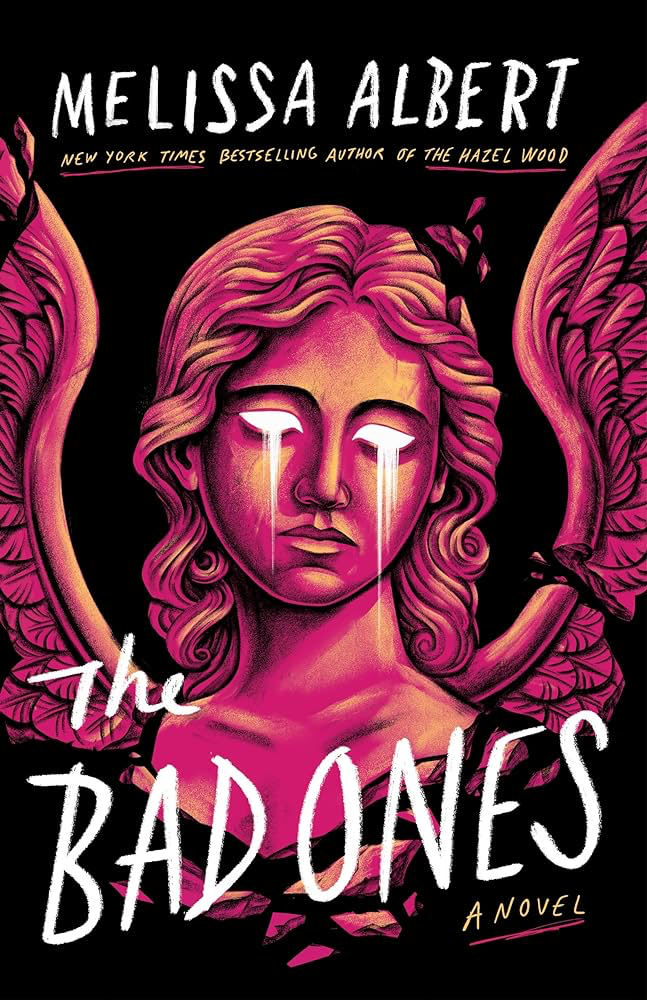
The Bad Ones – Melissa Alberta similarly haunting atmosphere woven from swirling memories.

“the rot” – Dean Blunt

Contrary to my graphic, this is not, in fact, that well-intentioned but ultimately regrettable black square everybody posted back in 2020. My text box accidentally cut out the 2 on Black Metal 2, the only thing distinguishing it from the cover of Black Metal, which is…also just a black square. Gotta admire Dean Blunt for committing to the bit.

I stumbled across this song thanks to Arlo Parks, who chose Black Metal 2 as one of her picks on her episode of Amoeba Records’ series What’s In My Bag?, where she also talks about my bloody valentine and happens to be wearing one of the coolest Radiohead shirts I’ve ever seen. The songs she discusses there—“VIGIL” and “the rot”—serve as bookends, the opener and closer of Black Metal 2, respectively. Both of them have the atmosphere of a massive curtain thrown over your eyes—you’re immediately thrown somewhere else in a space that Blunt has created; no time is wasted in transporting you into his world. While “VIGIL” has the tidal-wave mounting tension of strings to prop it up, “the rot” is the last, gentle minutes of a plane ride home. It’s a distinctly sunset song: you’re slumped back in your seat, golden light is spilling through the window, and you have the sense, more than ever, that a chapter is closing, but not necessarily in a negative way. You can tell that there’s a myriad of different instruments, but all of them are toned down to a faint crawl, strings gently winding, acoustic guitars drifting away like insects in the early evening. “the rot” in particular has such a gorgeous vocal contrast between Blunt and guest artist Joanne Robertson; like Phoebe Bridgers and Jeroen Vrijhoef on “Garden Song,” what grounds the song is the stark difference, although that of Blunt and Robertson feels much more natural and less jarring than the latter. Where Blunt has the warmth and thickness of the ocean lapping over a volcanic shore, Robertson’s words float like the breeze stirring the water. Both of them drift like motes of dust into the air, closing out Black Metal 2. Without even having listened to the whole album, I can tell how successful “the rot” is as a gentle closer.

…AND A BOOK TO GO WITH IT:
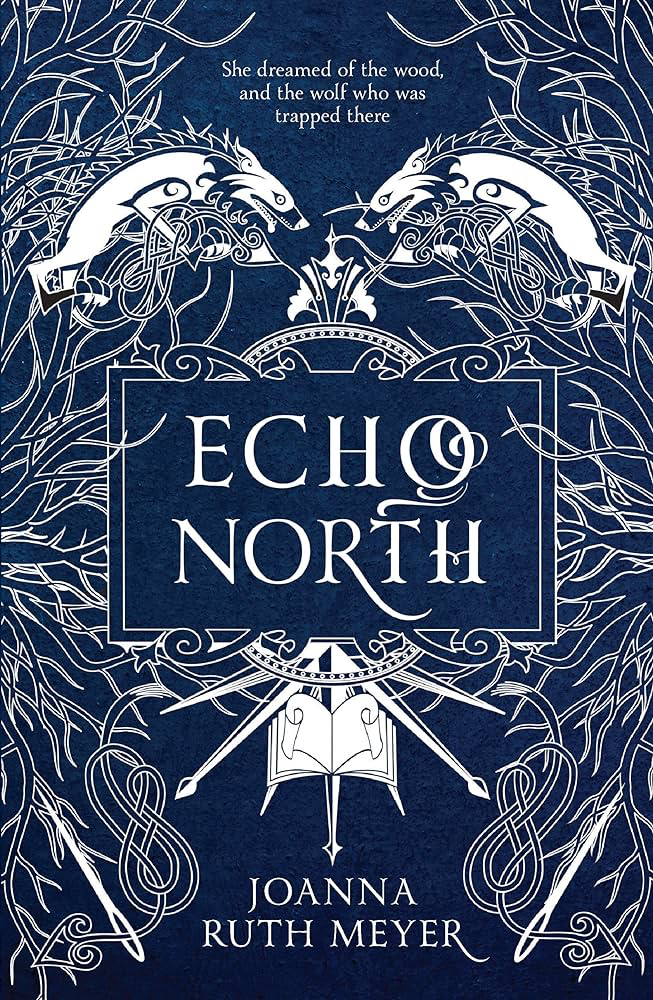
Echo North – Joanna Ruth Meyer – the frost, like the rot, lures you into the woods and makes you chase after old dreams.

“Weapon of Choice” – Fatboy Slim

Me when I walk without rhythm (I didn’t attract the worm):

…AND A BOOK TO GO WITH IT:

Dune – Frank Herbertas is written.

“Satellite of Love” – Lou Reed

Ugh, I’m so glad this song came back intro my regular rotation recently. The outro did wonders for amping me up for my astronomy midterm.

It’s been about four years since I’ve consciously started listening to this song, but I’m sure my dad played it in the car long before that. But I’ll always love this era of Lou Reed, and you know who I’ll also always love? David Bowie. And Bowie, along with Mick Ronson (Bowie’s guitarist in the Spiders from Mars) co-produced Transformer, which has spent a woefully long time on my album bucket list. It’s smack dab in that early-’70s sound that I just live for, and I’ve already heard a handful of the classics from the album already—“Walk On the Wild Side” and “Perfect Day,” to name a few. But “Satellite of Love” remains my favorite thus far, and it’s not just because I collect space-related songs like a bower bird collects shiny rocks and trinkets. As with…well, almost every Lou Reed song, “Satellite of Love” is tinged with melancholy; it tells of love watched from a distance, the aftermath of a breakup watched from below like a stargazer looking at a meteor shower. The offbeat admission of “I love to watch things on TV” feels like an admission of what Reed thought that the relationship had turned into—just something to pass the time and make the eyes go limp. I can’t help but think of Lisa Hannigan—I can’t be sure if this was her exact inspiration, but I wouldn’t be surprised if the chorus of “Passenger” came from a similar metaphor of distant love adrift in the sky—”Oh, my satellite/Oh, my passenger.” For once, Lou Reed is the one that doesn’t sound abjectly in mourning—wistful, sure, but there’s still some light shining in the corner of his eyes, even if it’s just the reflection of a star. For me, the outro is what pumps just the barest pulse of hope into “Satellite of Love”—the piano begins to gallop, clapping and snapping dominates the percussion, and Reed begins a harmony with a wailing, angel-voiced Bowie. Reed remains anchored to the ground, but Bowie, naturally, ascends skyward with every note. There’s something about it that feels like he’s extending a hand from somewhere in the night sky, inviting us to join in the chorus.

…AND A BOOK TO GO WITH IT:

All Systems Red (The Murderbot Diaries, #1) – Martha Wellsthe detached observation of love (and humanity in general) is much more humorous than wistful in nature here, but we can’t deny that Murderbot likes to watch things on TV.

Since this post consists entirely of songs, consider all of them to be today’s song.

That’s it for this week’s Sunday Songs! Have a wonderful rest of your day, and take care of yourselves!

Posted in Book Review Tuesday

Book Review Tuesday (4/2/24) – Drunk on All Your Strange New Words

Happy Tuesday, bibliophiles!

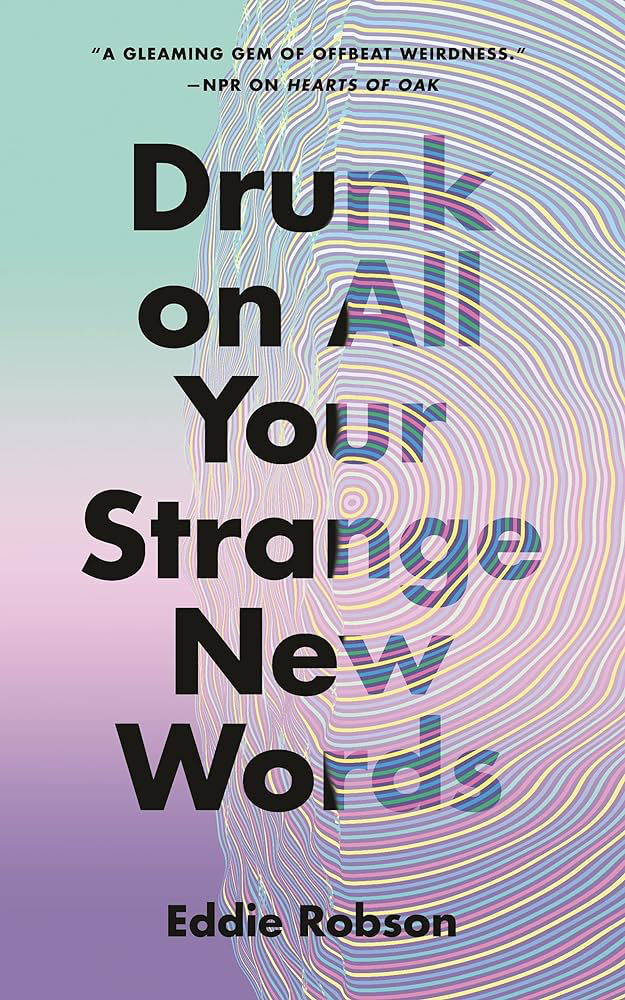
Ever since it came out, Drunk on All Your Strange New Words has been on my radar; beforehand, I hadn’t even heard of Eddie Robson, but the premise was so fascinating that I just had to get my hands on it. After several trips to several bookstores with no luck in finding it, my hold finally came on Kindle—and it was a delight to read!

Enjoy this week’s review!

Drunk on All Your Strange New Words – Eddie Robson

For Lydia, First Contact started in the mind. The aliens we greeted were called the Logi, and they communicated entirely telepathically. Lydia works as a translator for a Logi cultural attachĂŠ named Fitz. It’s a pleasant job—Fitz is good-natured, and together, they pick apart plays and literature to determine if they are suited for intergalactic sales to the Logi. The unfortunate side effect is that translating the Logi’s telepathic language into English makes her feel drunk, earning her a less-than-stellar reputation on the job. But when Fitz is murdered and all eyes land on her as the suspect, Lydia must keep the police and Logi ambassadors off of her tail—and get to the bottom of Fitz’s murder.

TW/CW: xenophobia (fictional), murder/assassination, mild violence, death threats

I am on my hands and knees trying to find sci-fi with aliens that really feel alien. The quest is ongoing. But if you’re on that same quest with me (let us join hands, sisters in disappointed with humanoid aliens), Drunk on All Your Strange New Worlds is the cure for all that ails—all that and a dose of some good ol’ British humor.

I get to go off about aliens!! I GET TO GO OFF ABOUT ALIENS!! ALIENS WOOOOOOOOOOO THIS IS WHAT I’VE BEEN WAITING FOR

First off: the Logi! Drunk on All Your Strange New Words boasts some incredible alien design and culture, and I had so much fun exploring it throughout the novel. The whole concept of telepathic aliens whose speech makes the act of translation make humans feel drunk was already fascinating to me; it was so out of left field, and a concept I’d never really considered before; the only other instance I’ve seen of alien speech having unintended physical effects on the human body or brain was in A Desolation Called Peace (though that was arguably more drastic), but it still felt truly weird, which a lot of sci-fi doesn’t touch on, strangely. I loved getting such a complex, multilayered picture of the Logi beyond that, from the head coverings they wear to protect from Earth’s atmosphere to their unexpected strength; some of the elements of them almost veered into the supernatural (technically not much of a spoiler since it happens early on, but the reveal was so cool to me that I’ll keep my mouth shut for your enjoyment), but even that felt like a marker of an alien well done—so outlandish that the only explanation that humans can come up with is paranormal.

Creating all of that excellent background for the Logi is one thing, but it wasn’t all left as a lofty concept to puff up the worldbuilding—it had real, tangible effects on the characters and the plot, which I was so grateful for. Robson executed the real-time effects of humans interacting with a lot of these alien behaviors exceedingly well! It isn’t just that Lydia feels like she’s had a few too many after a long translation job—the feeling of drunkenness extends to drunken behaviors, the consequences of which had unfortunate implications for keeping said job. Having that was also a great device to start putting Lydia under suspicion for the other characters—there were enough instances of perceived instability or unprofessional attitudes that the authorities had all the more evidence to implicate her in Fitz’s murder. This is all to say that Robson really left no stone unturned when it came to the worldbuilding, and my enjoyment skyrocketed because of that!

The cultural environment around First Contact and the integration of the Logi into human culture also felt a little too real, in the best and worst way possible. At this point, the world has advanced into an undefined point in the future, and enough time has passed between now and First Contact that there aren’t just bigots and zealots with xenophobic intention, but organizations targeting aliens and professors giving whole lectures on what they perceive as a Logi encroachment into human culture, literature, and media. Paired with the faulty software that scores the truthfulness of the news that Lydia consumes (that aspect felt very “three days from now”), it felt like a more realistic depiction of alien contact and communication than we usually get; at heart, we still fear what we don’t understand, but it’s neither all-out annihilation of the aliens nor a global, complete hippie kumbaya event of unity. It’s demonstrative of human nature in the face of what we don’t understand: the bad and the very ugly, but enough good to keep us afloat and on good terms with the visitors from another world.

For most of the novel, I was really into the mystery surrounding Fitz’s murder. (I knew it was gonna happen from the start, since, y’know, in the blurb, but I didn’t want for him to die. I just wanna see the little alien guys!! Let them vibe!!) The slow burn of it kept me turning page after page, and for most of the novel, felt appropriately paced. It didn’t feel like we were jumping from place to place for no reason—every outing had a motive and revelation that added to the mystery in a way that made sense. However, though I enjoyed much of it, I feel like it got a little too slow-burn. The subtlety was good for most of the novel, but it got to a point where I was 90% of the way through the book and we still had no idea who the killer was and who the prime suspect was, now that most of the others had been eliminated by that point. Said killer was also introduced very late into the novel and quite sparingly, which made the reveal feel unearned—if we’ve spent all this time poring through suspects and barely touched on the actual killer, then what was the point? For such a clever novel, that felt like such an amateurish move—the only reason that we didn’t suspect them was because we had no idea who they even were for almost the entire novel.

All in all, a delightful combination of sci-fi and murder mystery that boasted some of my favorite aliens that I’ve read in a while. 4 stars!

Drunk on All Your Strange New Words is a standalone, but Eddie Robson is also the author of Hearts of Oak.

Today’s song:

That’s it for this week’s Book Review Tuesday! Have a wonderful rest of your day, and take care of yourselves!

Posted in Monthly Wrap-Ups

April Wrap-Up 💻

Happy Sunday, bibliophiles! I hope this week has treated you well.

This monthly wrap-up was brought to you by the letter ‘S.’

Let’s begin, shall we?

GENERAL THOUGHTS:

Well, here we are. It’s nice and warm outside, I’m only about a week and a half away from finishing my first year of college, and “Cool About It” is my most-listened-to song of the year so far, according to Apple Music. Yeah, I’m fine.

Somehow, I’m finally at the stage in the school year where everything is starting to wind down. My really stressful finals finals moment ended up happening…a good two weeks before I really should’ve been doing all that, but there’s something to be said for starting projects early and finishing them before everything is supposed to get stressful. (My secret? Overthinking and overestimating how close due dates are. Works like a charm.) Now that finals are right around the corner, I really don’t have a whole lot to do, blissfully. All is quiet. No stats tests to bomb at 7 am in a building I’ve never even set foot in before. I have achieved inner peace (becoming a humanities major).

That being said, working on all of these projects did eat up a good amount of time that I’d normally be reading, or blogging, and all of my other silly little activities, so my reading did take a relative hit. But that doesn’t mean that I didn’t find some great books—I got to some anticipated releases, and I have another 5-star read to tick off the list! There were several non-review/Sunday Songs posts that I was eager to get to (see below), and I managed to get them all written, so I’m glad about that. Also, finally finished the Broken Earth trilogy…[incoherent, muffled screams intensify]

Other than that, I finished Dark (CORRECTION: IT FINISHED ME. GO WATCH DARK), watched Beau Is Afraid (forget Beau, dude, I’m afraid…also very overwhelmed…), had some fun on Easter, got a nasty cough (just now getting over it 😭), and started packing up my dorm. Time…time is a thing, huh?

READING AND BLOGGING:

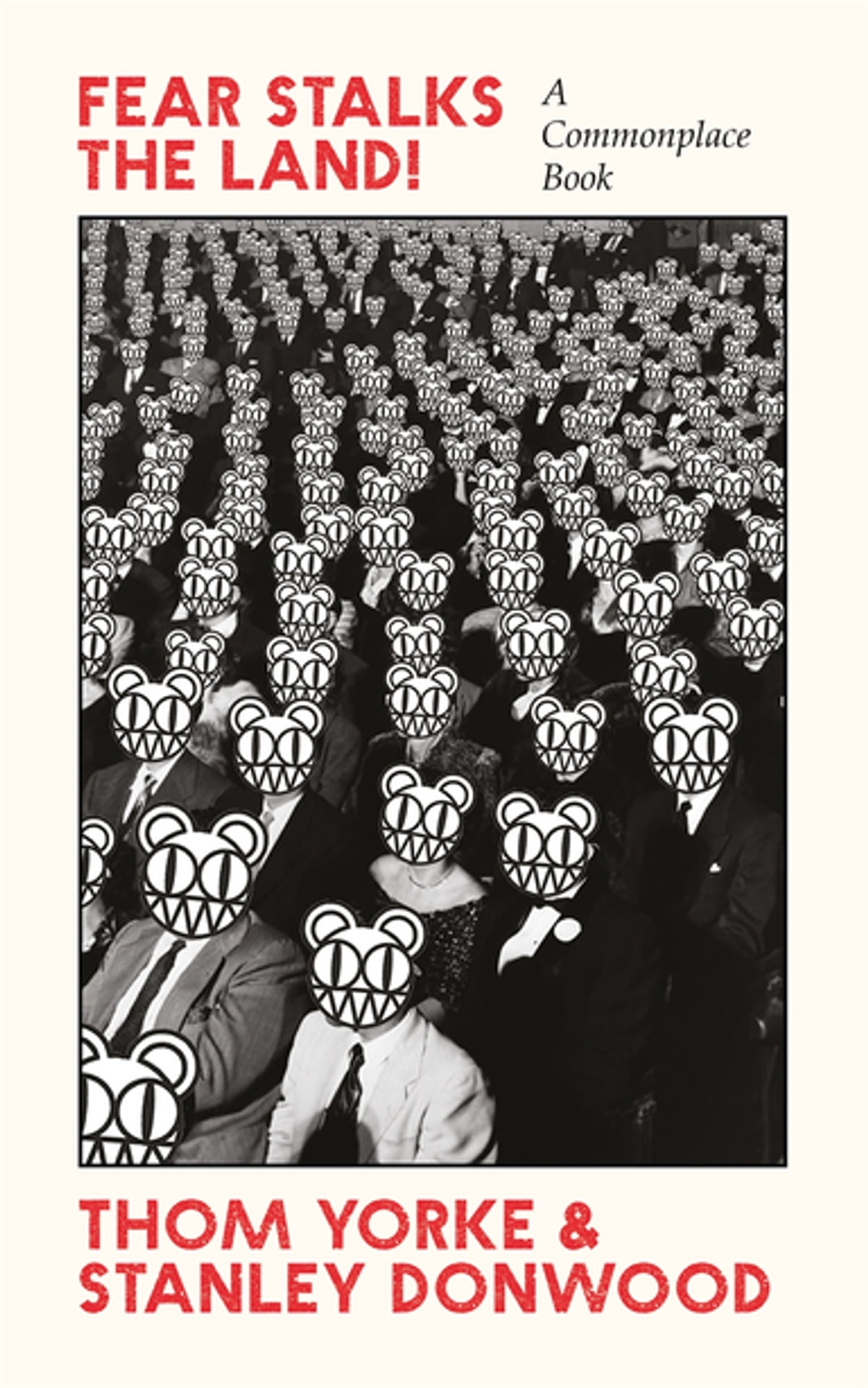
I read 16 books this month! I wasn’t able to read as much because of finals season, but it’s been a decent, if slightly more on the “miss” side of hit or miss, bunch. I did get a 5-star read, but said book was Thom Yorke’s lyrics and poetry combined with Stanley Donwood’s older Radiohead art, so that was bound to happen.

Also, I unintentionally read an abnormal amount of books that start with the letter ‘S’…do with that what you will.

2 – 2.75 stars:

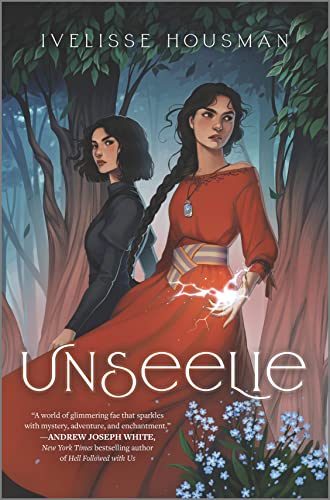
Unseelie

3 – 3.75 stars:

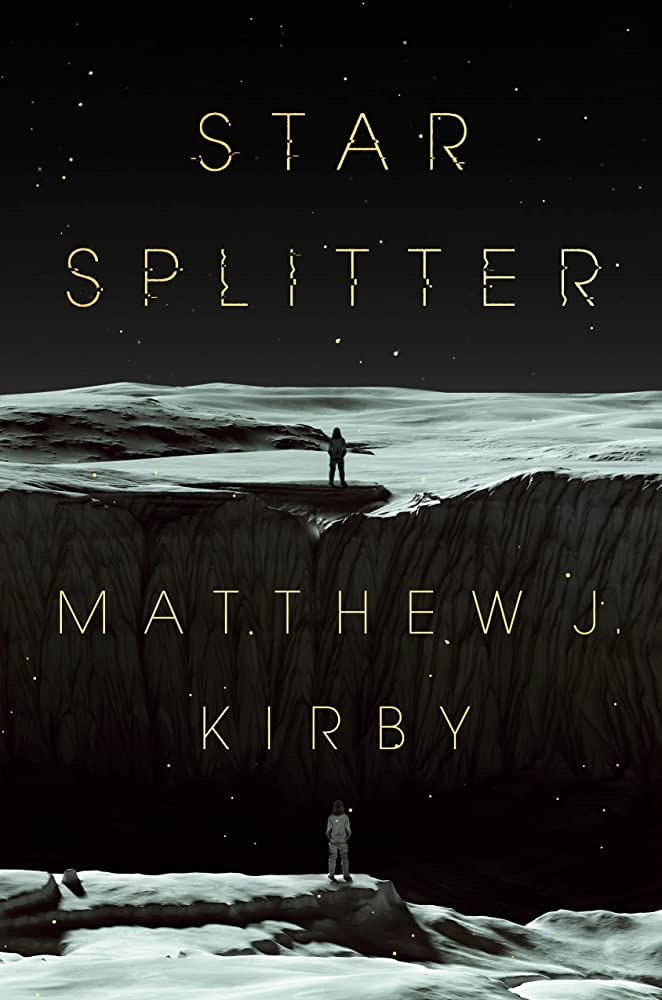
Star Splitter

4 – 4.75 stars:

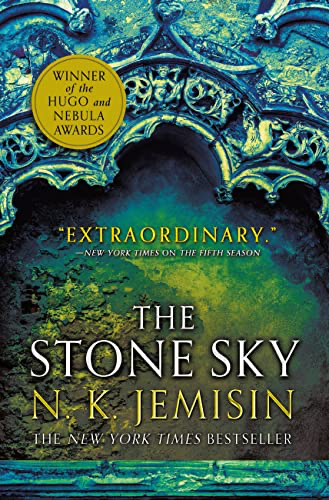
The Stone Sky

5 stars:

Fear Stalks the Land!

FAVORITE BOOK OF THE MONTH: Fear Stalks the Land!5 stars

POSTS I’M PROUD OF:

POSTS FROM OTHER WONDERFUL PEOPLE THAT I ENJOYED:

SONGS/ALBUMS THAT I’VE BEEN ENJOYING:

this song has taken up far too much space in my brain but I’m not complaining at all
this song sounds so sparkly I love it
we love First Band on the Moon in this house
another favorite of mine from this album
I wish you could still make custom ringtones out of songs bc this would absolutely be my pick
what is April if not Dark and boygenius taking up all my brain space
no thoughts only the one happy Radiohead song in existence

Today’s song:

in which Peter Gabriel gets into those Danny Elfman shenanigans

That’s it for this month in blogging! Have a wonderful rest of your day, and take care of yourselves!

Posted in Sunday Songs

Sunday Songs: 4/30/23

Happy Sunday, bibliophiles! I hope this week has treated you well.

Here we are at the end of April, and my cough finally seems to be letting up. The weather’s consistently warm again, the trees are starting to bloom, and I’m doing my best to ignore the fact that the latter will definitely trigger some allergies in a few weeks, because hey, the trees are starting to look beautiful. All is green and new!

Enjoy this week’s songs!

SUNDAY SONGS: 4/30/23

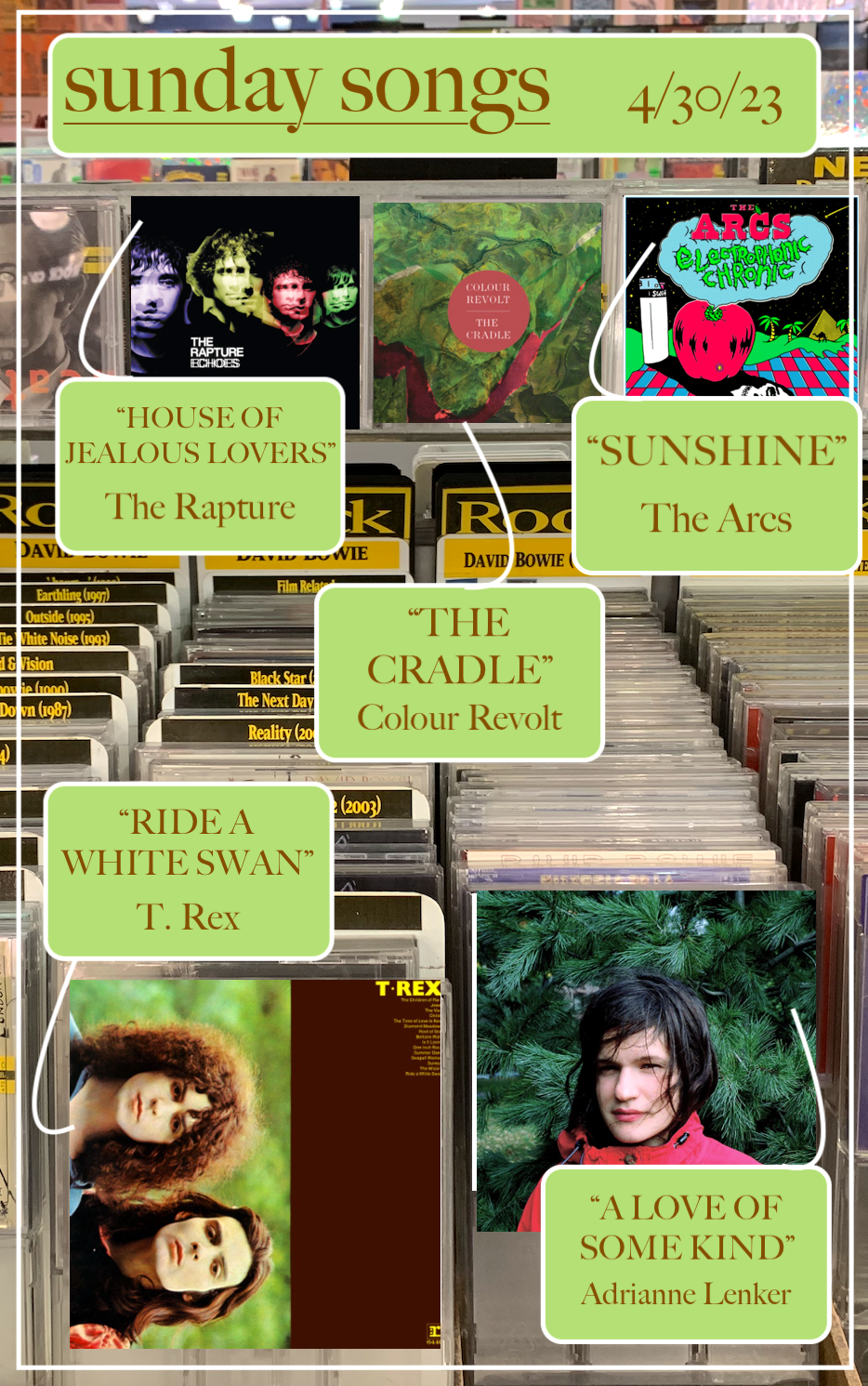
“Ride a White Swan” – T. Rex

there has never been a better visual descriptor for how this song makes me feel

PACK YOUR BAGS, FELLAS, WE’RE GONNA GO WEAR EXCESSIVELY LONG DRESSES AND DANCE IN THE WOODS

T. Rex, Marc Bolan’s self-titled debut, was the last hurrah of his hippie roots (you really can’t go back from album titles like My People were Fair and Had Sky in Their Hair…But Now They’re Content to Wear Stars on Their Brows, huh) before going full-on glam rock, as well as the first album under his newly shortened name (no longer the full Tyrannosaurus Rex). But even as he’d gotten a crisper, cleaner name to call himself, he hadn’t fully abandoned the original, psychedelic fantasy that was Tyrannosaurus Rex, and this song—and, judging from most of the song titles on the rest of the album, everything else—is proof. It’s got everything—druids, spell casting, black cats, tall hats. What else does one really need in life? It’s whimsical. It’s lovely. It’s light. It’s a classic. Revel in the joyous whimsy!

And it seems like it was the perfect storm—for a short time, anyway. Arriving in 1970, right at the end of the sixties when the world was still clinging to the flower-child mentality, this was the perfect piece of escapist hippie music. It was Bolan’s first hit as T. Rex, and it was what launched him into stardom in the early seventies. From what I can tell, most of his career after his (excellent) third album, The Slider, was an attempt to rekindle some sort of hit, both in the U.K. and in the U.S., and despite his efforts and his complicated relationship with fame, never ended up being fruitful. Especially knowing that he died so prematurely and that most of his efforts were in vain, it always makes me sad to think about that stage of his life. Bolan was obviously such a creative soul at heart, a skilled frontman and a master of oddball wordplay, and thinking about he wasted so much of that talent by trying to please other audiences really seems to me like one of the great tragedies of rock music history. It doesn’t feel right to reduce Marc Bolan to a lesson to all of us creatives intending to make a living, but I think his story speaks more to the music (and any creative) industry as a whole; he’d gotten a taste of fame, and this fame pressured him to try and crank out hit after hit. It’s not so much an issue of Bolan as a person, as flawed as some of his fame-induced decisions were, but the way that the music industry has shaped people to behave in that way. Art should be art for art’s sake, not a pursuit of money or stardom. The music industry did Marc Bolan an unforgivable disservice, and I’ll die on that hill.

Anyways, listen to The Slider. God-tier album.

“A Love of Some Kind” – Adrianne Lenker

Alright, I’ll step off my Marc Bolan soapbox for a moment. Let’s cool down a little.

This lovely spring weather has made me feel the same way that this song does. Even if the album cover for Hours Were the Birds wasn’t set against a backdrop of dewy pine branches, I have no doubt that it would still sound the same. Adrianne Lenker seems to have captured the art of making an unrelated smell like petrichor and gently rock about like a wooden boat on a lake. There’s a slight melancholy to it (nothing quite compared to “Disappear,” another track I love from this album—I need to listen to the whole thing), but it’s undeniably hopeful; it’s a plea for reciprocation and love after a rocky period, a star-staring hope and yearning: “I know we’re strangers, so it’s okay/ You don’t have to say it/Strange is better anyway/And I think that we can make it.” There’s a certain talent that the best singer-songwriter artists, in my experience, have: the ability to hinge an entire song with a single instrument and their voice. Most of the time, it’s an acoustic guitar, and Lenker hits the nail right on the head. With just her gentle, misty voice, and the strums of her guitar, she evokes all of those sensations I mentioned earlier with such relatively little material. Even her birdlike whistles bring to mind the feeling of plants stretching their feelers after the snow melts away. I really need to listen to more Adrianne Lenker.

“House of Jealous Lovers” – The Rapture

The beginning of “House of Jealous Lovers” functions to me like the sound engineering of the screams in Jordan Peele’s Nope: are they screams of ecstasy? Are they screams of fear? Who knows. They’re all shrouded in a deliberately-placed layer of fuzz that makes it impossible to tell. And by the time you’ve started to contemplate if it’s one or the other, it’s too late: it’s Uptight White Boy Music Time.

And even without knowing much about said Uptight White Boys, it’s clear how “House of Jealous Lovers” took its place in the early 2000’s post-punk-revival movement in New York City, sliding right next to the likes of The Strokes, The Yeah Yeah Yeahs, and others. There’s not much going on lyrically, but there’s a frantic urgency to the hoarse scream that Luke Jenner (no relation to…any other infamous Jenners, luckily) delivers every line in that makes every word feel like a command. Cloaked in endlessly delayed guitars, it feels like it’s hiding something the whole time, even if part of the bridge just consists of the band counting to eight in unpredictable, wavering tones. Throw in some cowbell (as one does), and you’ve got such a strangely suspended moment in time: shaky and uptight, but somehow still self-assured in a way that makes this song hold up after almost 20 years. It feels like the world’s most neurotic club jam. I love it.

“The Cradle” – Colour Revolt

I stole this one from the great Julien Baker, who named it on boygenius’ episode of Pitchfork’s Pass the Aux series, as her hype music when she was a senior in high school, right next to…Drake? I can’t forgive the Drake, but…we all did questionable things in high school, I guess.

Drake aside, I’m so glad that Julien Baker introduced me to this song. Just like that, I’ve got another album on the Sisyphean list of albums on my notes app. Just like “House of Jealous Lovers,” we’ve got another hoarse white guy (I’ve got cough drops for everybody, take your pick) who somehow makes it work. Wonderfully. There’s so much that “The Cradle” does in such a short amount of time. It seems to invert the formula of musical buildup. Apart from the first few guitar chords, the first seconds of the song explode into delightfully crunchy guitars, letting the music take center stage, making the quiet, abrasive vocals linger in the background like a sinister afterthought. There’s something sinister about this song that I can’t quite pin down—maybe it’s that inversion, the way that the song explodes in the beginning, and only goes quiet and plodding during the last 30 seconds, as if you’re in a horror movie, waiting for something to drop from the rafters. There’s something compellingly intricate about this song, even more impressive that The Cradle was an album made in the aftermath of Colour Revolt getting dropped by their former label and three of their five original band members jumping ship. Even if this is my only exposure to Colour Revolt right now, I can still say how impressive of a feat that is.

“Sunshine” – The Arcs

Inside of you there are two wolves. One of them wants to listen to “Sunshine” by The Arcs. The other wants to listen to “Sunshine” by Sparklehorse. You are incredibly pretentious, and you also probably need a nap.

When I first heard this song, I seriously thought that the light, tinny piano intro was going to be the start of a sample. To any artists reading this (I doubt there are, but still): THIS HERE. SAMPLE THIS. WHAT ARE YOU DOING.

I’m not up to date on any of my Arcs lore, but the jump from the songs that I heard on heavy rotation on Alt Nation back when I was in middle school to this is nothing short of gutsy. But somehow, it makes complete sense. Just like the animations in the music video, it’s vibrant and polished to a shine, bursting with neon color. From the backing vocals to the smooth piano intro, it’s clearly a song that’s been in the studio for extensive amounts of time, a piece of art being chiseled out of stone. And what came out when the dust settled was an irresistibly pop-sounding indie tune of a perfect length. Every move feels exceedingly deliberate, from when the backing vocals kick in with the “sha-la-la-la-la-la”s in the last third to the quiet explosion of different instruments in the background. The only other song I can think of called “Sunshine” is an exceedingly melancholy one (as with pretty much any Sparklehorse song…sorry, Mark), but if anything, this is a song that more than lives up to its title.

Since this post consists entirely of songs, consider all of them to be today’s song.

That’s it for this week’s Sunday Songs! Have a wonderful rest of your day, and take care of yourselves!
Posted in Uncategorized

Sunday Songs: 4/23/23

Happy Sunday, bibliophiles! I hope this week has treated you well.

I may be slightly sick, but I did not lose my lack of coherence, so today, I give you a very famous banana, Wall-E, and the only band that can make a Black Sabbath song sound dainty. Have fun trying to bring it all together. I certainly did.

Enjoy this week’s songs!

SUNDAY SONGS: 4/23/23

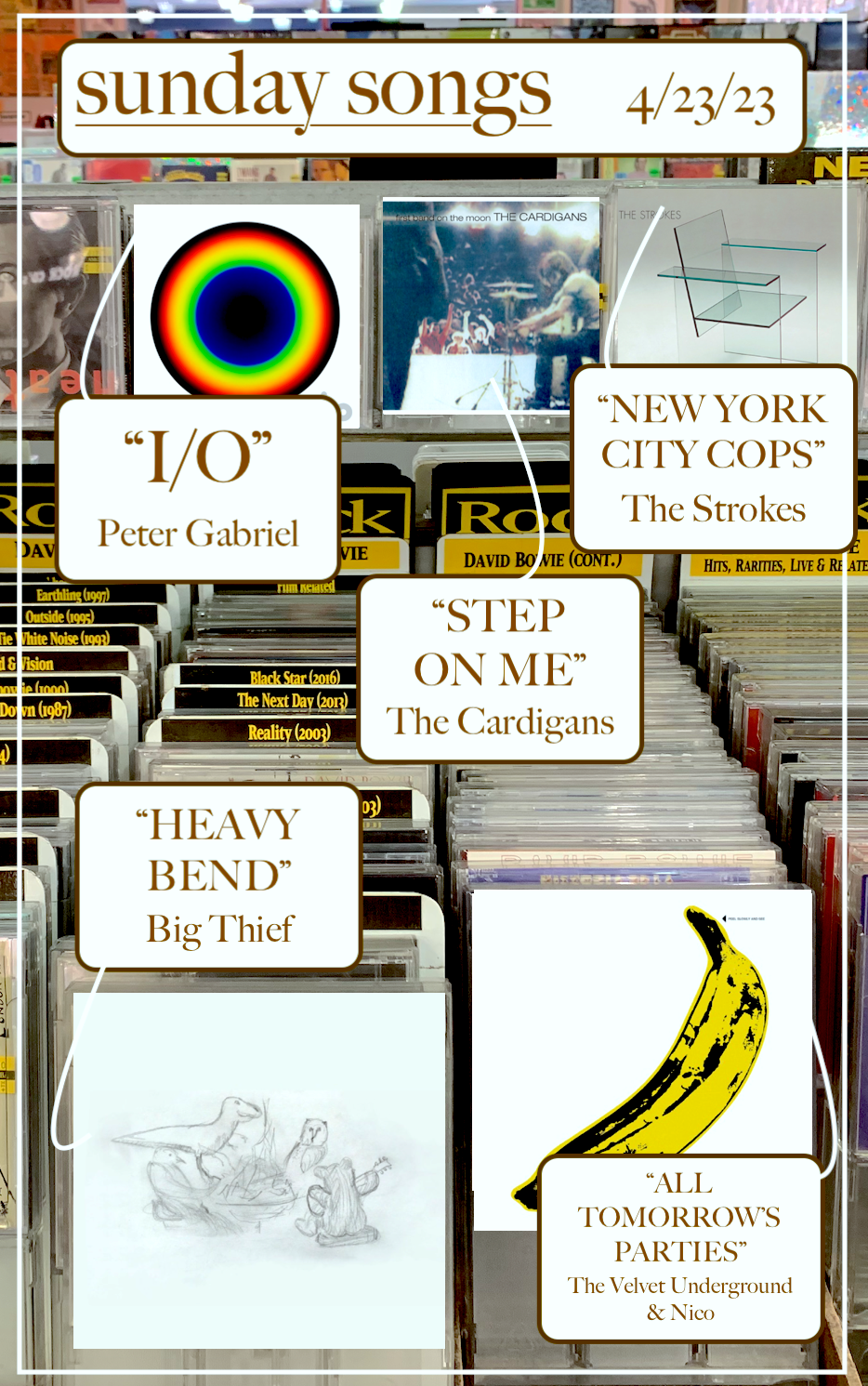
“Heavy Bend” – Big Thief

With full sincerity, I mean this in the absolute nicest way possible: the beginning of this song sounds like an Apple ringtone. An Apple ringtone, but the kind that has no business being as much of a banger as it is. Like the Piano one. Did any of that make any sense? I need a Taskmaster-style choreography to this one now. Would this give Noel Fielding shrew vibes?

My Big Thief/Adrianne Lenker conversion has begun, thanks to my brother and his girlfriend, and every day I’m inching closer to listening to Dragon New Warm Mountain I Believe In You. But this song is unique—everything, from the echo of Adrianne Lenker’s sighing into the microphone to the hypnotic, harp-like strums that feel like the auditory answer to dew-covered spiderwebs in the early morning. That hypnotic quality reminds me a lot of “Bicycle,” another song that I raved about a few months ago, that shares the quality of feeling enchantingly impressionistic, like a painting imbued with motion. And as much of a cliche as this is, “Heavy Bend”‘s biggest crime is being too short. Some songs work as short and snappy (see “We’ve Got a File on You,” “Pam Berry,” “A Little Bit of Soap,” etc.), but this song feels like it’s begging for a key change, a bridge, just something to propel it beyond a minute and 36 seconds. On the other hand, that makes it tantalizingly easy to play on repeat. If you play it enough times on loop, you can just pretend that it’s longer. Denial is the first stage of grief.

“All Tomorrow’s Parties” – The Velvet Underground & Nico

nothing like cackling at niche jokes alone in your dorm, amirite?

I’ve finally got around to listening to another classic album—one that I’d heard about half of beforehand anyway, but still enjoyed, for all of its legend, discomfort, and strange beauty. A classic story of a disaster and a sales flop becoming a tried-and-true classic, every song feels like its own world—a very seedy, eerie, and hazy world, but a world all the same. I doubt anybody will ever describe Nico’s voice better than the journalist Richard Goldstein, who described it as “something like a cello getting up in the morning.” I wouldn’t automatically put it on my top 10, but it’s clear that its lasting legacy isn’t without reason.

“All Tomorrow’s Parties” is one of the songs that was relatively new to me, and it quickly became my favorite of the album. There are so many layers to it, more than the peelable, bruised, Andy Warhol banana on the album cover. It chugs along like a great machine, elephantine in its size, slow in its looming progress. Nico’s distinct voice, thick, resonant and cavernous, plows it along, drawing a long shadow over the music. Each piano chord seems to plod along, even with how rapid each chord is. It almost feels like a dirge in the way it seems to crawl, certainly for the fate of said “poor girl” that the song describes. Unlike “Heavy Bend,” this song is the perfect length—the typical 3 minutes doesn’t give it enough time to loom over the listener, but just over six minutes gives it all the time in the world.

“I/0” – Peter Gabriel

“gay rights” – Peter Gabriel 2023

Oof, another beautiful one…I’m just glad this one is easier to swallow than “Playing for Time,” but it’s just as powerful.

Peter Gabriel’s had his fair share of movie involvement, from writing various film soundtracks to providing the tearjerking end-credits song “Down to Earth” for Pixar’s Wall-E. So it’s not surprising how easily he can slip into that cinematic smoothness with such ease. Certainly helps that the Soweto Gospel Choir, the same choir that performed with him on “Down to Earth,” provided backing vocals for “I/O” as well. Even though every song from the forthcoming i/o (stop trying to capitalize the i STOP TRYING TO CAPITALIZE THE i) has been paired with a visual so far, this one is practically begging for its own Pixar movie, or even just some animated music video. You can feel every bit of nature creeping through this song, from every creature mentioned in the lyrics to running water and green hills.

was this another gateway to sci-fi for baby Madeline? probably.

If we’re keeping with the Pixar theme, that would be two Pixar movies that he would hypothetically contribute to with a deeply environmentalist message. I’ve never been a die-hard Disney or Pixar fan, but Wall-E is special to me in so many ways—it was one of the first movies that I ever saw in theaters as a kid, and 15 years later (Jesus, I feel old), it reflects on humanity’s disconnect from nature, and the dangers of thinking that we’re the masters of everything that we can grab at. The scene where Wall-E reaches up to touch the stars still fills me with incredible awe. But, as with everything, we didn’t listen, and now we’re in the landscape where a handful of corporations are responsible for polluting a large part of our planet. And that is why we’ve become disconnected: as soon as we forget that we’re as much a part of the Earth as every other plant, animal, and other entity, we think that we can get away with all of this. And that’s what Wall-E tried to tell us in 2008, and it’s what “I/O” is telling us now: “So we think we live apart/because we’ve got two legs, a brain and a heart/we all belong to everything/to the octopus suckers and the buzzard’s wing.” Here and now, I’m glad that at least one other old white guy besides David Attenborough recognizes this. Happy belated Earth Day.

“Step On Me” – The Cardigans

I can’t pull the “I LiKEd tHiS sOnG bEFoRe IT wAS a tIKtOk sONG” card because I technically didn’t know this song in particular, but with David Bowie as my witness, I can swear that I did grow up listening to The Cardigans in the car quite a bit. I’ve had the luck of having very few songs I know become “tiktok songs,” but I’ve found that it’s no use griping over it and insisting that “[you] liked it before it was cool.” People are just going to assume that you got a song from some popular place, and that is the case sometimes, as much of a pretentious hipster I am. I vehemently despise tiktok’s obsession with speeding up every song that gets popular (WHY), but either way, it led me back to The Cardigans and to First Band on the Moon, and I’m happy with that—and happy that everybody else seems to be enjoying it.

(Does anybody know if this song was attached to a certain trend? I know that it’s vaguely trending, but I’m not sure how or why—I’ve just seen it with a few unrelated art videos…)

“Step On Me” is one of many lovely bites of pop on First Band on the Moon, and one of the best—certainly my favorite track on the album. Nina Persson casually just created the national anthem for people-pleasers with this one—a song about dodging your own needs, letting people walk (sorry, step) all over you: “go on and step on me,” even as the object of the song stands on her left foot and breaks it. With a crunching, muted intro that continues to punctuate the end of every chorus, everything about this song is proof that The Cardigans. got the recipe for a good pop song down to a science back in the 90’s—Nina Persson’s deceptively delicate, ringing voice, no shortage of hooks and catchy lyrics, and radio friendliness without over-simplicity. Every time the scratchy, muted intro comes on shuffle, I can’t help but drop everything and turn up the volume. Like I said—The Cardigans had pop music down to a science. No wonder they’re trending again. If you can make a Black Sabbath cover sound dainty (MULTIPLE TIMES), you can pretty much do anything.

“New York City Cops” – The Strokes

Like Jack White, Julian Casablancas is just one of those musicians who I really want to hate, but then I hear songs like this that are just so undeniably catchy that I just can’t hate him all the way. That being said, the thought of him still makes me want to roll my eyes all the way back in my head, mainly because of flashbacks of him taking over Sirius XMU and saying something along the lines of “now, this next song is from a 60’s punk band from Peru…oh, you don’t know them?” I really wish I was kidding.

Even though the beginning feels a little manufactured to me (the staged-feeling quality of Casablancas screaming, then going back on it: “ahahaha………didn’t mean that at all 🫦”…oh, please), the rest of the song is a masterfully tight piece of post-punk (oh, post-punk revival…okay, fine). It’s delightfully uptight—it all feels boxed in a cramped room, but it takes the confines of that room runs with it, never once loses momentum after the first drumbeat. The rough edges of Casablancas’ voice contrast perfectly with each scratchy guitar chord, a constant buffet of sound that never loses its sandpapery texture. I mean that as a compliment—it’s not a grating sandpaper, but more of the hard-edge, punk sandpaper that makes The Strokes sound the way they do. And although this song was subject to some abysmally bad timing in the U.S. (the song was initially removed from the U.S. release because the album was released so close to 9/11—the chorus of “New York City cops/but they ain’t too smart” was, understandably, a massive no-no so close to such a tragedy, even if it was completely unintentional), I’m glad “New York City Cops” ended up seeing the light of day a significant amount of time after the fact.

Since this post consists entirely of songs, consider all of them to be today’s song.

That’s it for this week’s Sunday Songs! Have a wonderful rest of your day, and take care of yourselves!
Posted in Books

The Bookish Mutant’s Books for Autism Acceptance Month âˆž

Happy Thursday, bibliophiles!

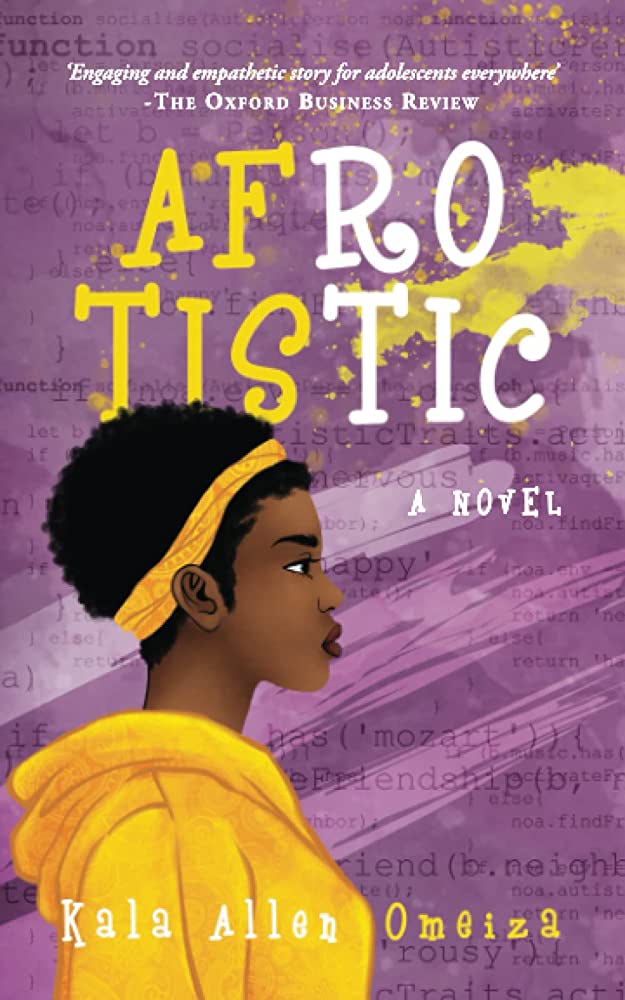
As some of you may know, April is Autism Acceptance Month here in the U.S.! I don’t think I’ve highlighted a book list for the occasion, but in my ongoing quest for disability rep in general, I’ve come across many great books with Autistic protagonists and stories. If you’re looking to diversify your reading, it’s always important to uplift every kind of marginalized voice, and disability rep in general often gets left in the dust. So I’ve compiled a list of books by Autistic (with one exception—the author is still neurodivergent, just not Autistic) for this month.

NOTE: some of the older books on this list may still use the term Asperger’s, but in recent years, the term has since been renamed to Autism Spectrum Disorder (ASD) in the DSM-5, in part because of its association with Hans Asperger, who was involved with Nazism. Some people still use the term, but it is still important to acknowledge the history behind the term.

Enjoy these book recs!

THE BOOKISH MUTANT’S BOOKS FOR AUTISM ACCEPTANCE MONTH

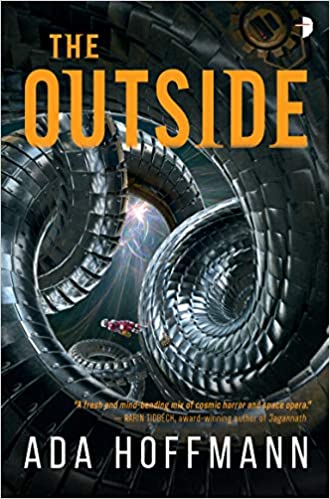
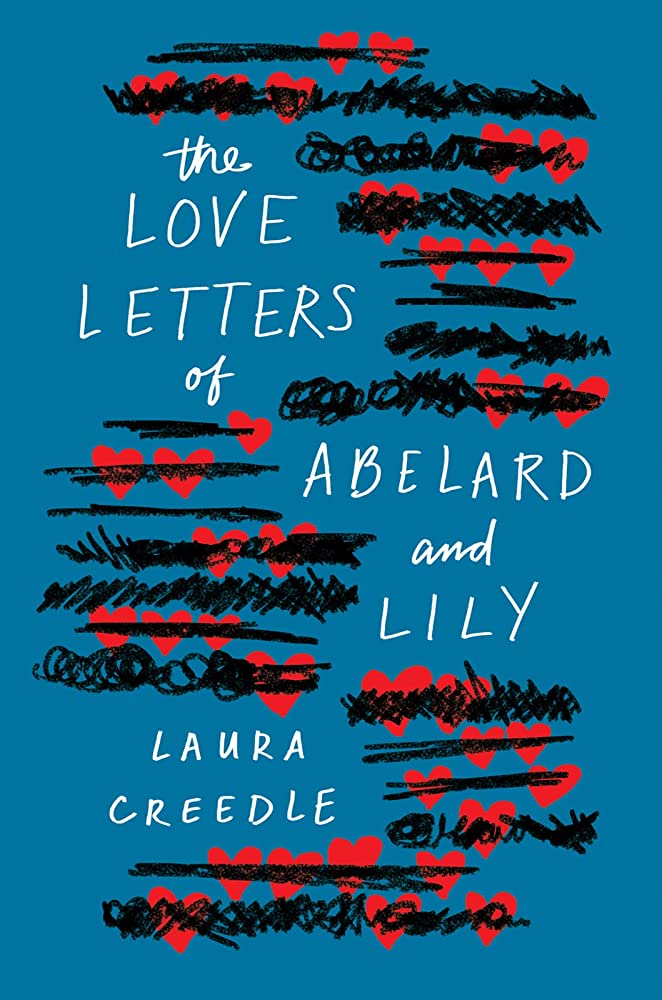
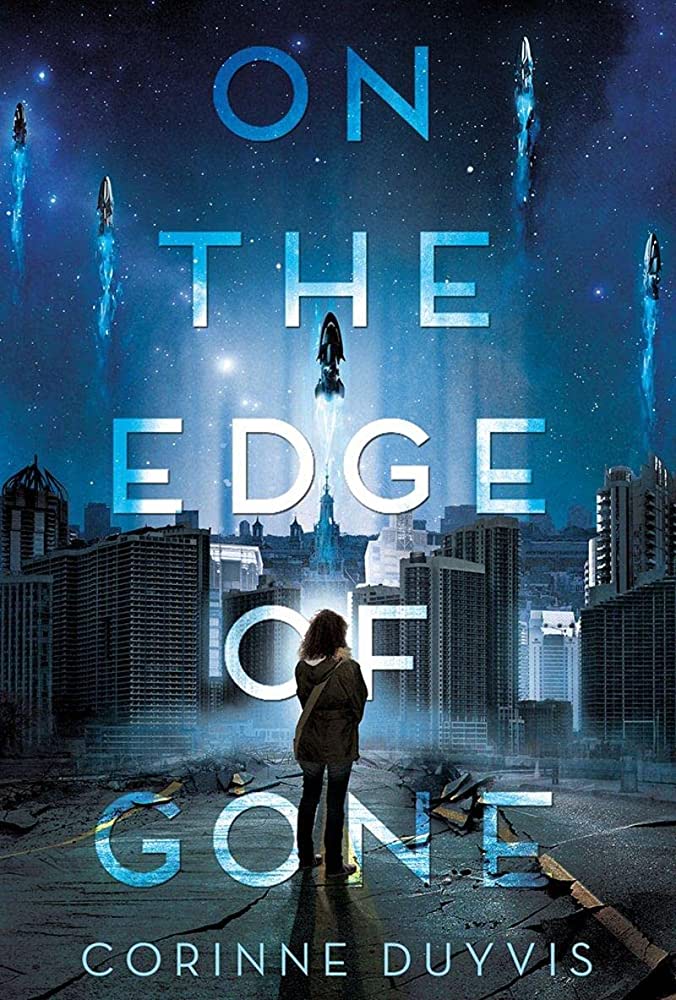
READ:

ON MY TBR:

TELL ME WHAT YOU THINK! Have you read any of these books, and if so, did you like them? What are your favorite books with Autistic rep? Let me know in the comments!

Today’s song:

That’s it for this list of recommendations! Have a wonderful rest of your day, and take care of yourselves!

Posted in Book Review Tuesday

Book Review Tuesday (4/18/23) – The Spear Cuts Through Water

Happy Tuesday, bibliophiles!

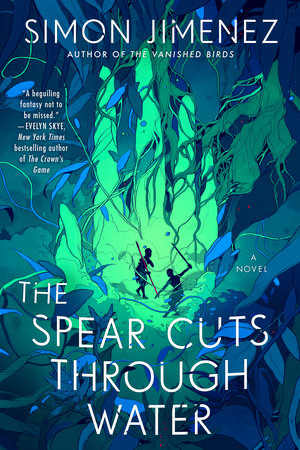
I was in a fantasy mood recently, so I decided to pick up The Spear Cuts Through Water after hearing some rave reviews from other bloggers. The gorgeous cover only added to the sell. But in the end, this novel ended up being a major disappointment—a murky, 500+ page slog that was only enjoyable for fleeting moments. I really need to stop setting myself up for disappointment with all these overly long high fantasy books…

Enjoy this week’s review!

The Spear Cuts Through Water – Simon Jimenez

The Emperor of the Moon Throne has terrorized the land of the Strangled Throat for centuries, aided by his three reckless sons, aptly dubbed The Terrors. But like everything else that he has seized, the Emperor’s power comes from an age-old moon god who has been locked under the palace against her will. But a god is not meant to be kept in captivity.

So she escapes. Aided by Jun, a disgraced palace guard, and Keema, a warrior from a distant, mysterious land, she sets off on a journey to find her freedom. But the Moon Throne will not let go of her so easily…

TW/CW: ableism, cannibalism, child abuse, murder, body horror, substance abuse, mentions of sexual assault (off-page), torture, loss of loved ones

This is one of those instances where I feel like I’ve read a completely different book than all of the 5-star reviewers. I really wanted to like it—and there were a few things that I did like—but ultimately, it felt like a 20-minute prog-rock song in book form: well-written, but so unneccesarily convoluted and full of itself that it became insufferable.

Before I go on my tirade, I will acknowledge that there were some wonderful, very bold and skilled parts of this novel. Jimenez’s writing had moments of being both beautiful and insightful—there were a few anchors to pull me through the slog, and his prose had moments of being incredible. 2nd person is always a bold choice, but unlike other aspects of this novel, it was executed very well, succeeding at being both immersive and fresh without feeling like it was bold just for the sake of being so.

“Bold” is generally I word that I could ascribe to most of this book. A lot of it was written in a fresh, nontraditional way, and I appreciated its execution in some sections. But a lot of it just felt like showing off—having unconventional chapter breaks and an infuriating structure just for Jimenez to show that he was capable of doing so. Most of these ended up being to the novel’s detriment. The random “chapter” breaks (there really weren’t any chapters in this book?), which mostly just ended up being sized-up font that was, essentially, what should have just the first sentence of the paragraph. And since they were all just first sentences of the paragraph, there were 2-3 of these breaks per page. POVs got switched without warning and without explanation, making the reading experience overcomplicated where it could’ve been an easy fix. It just felt like it was biting itself in the foot in the name of art—it could have been a beautiful story, if it wasn’t so intent on showing off how “different” it was.

As a result, so much of this novel got lost. Even though I was fairly lost trying to discern whose POV is it this time, I did notice one thing while reading The Spear Cuts Through Water—where’d the worldbuilding go? Other than the vague notion of a fantasy world (gods and goddesses, some talking animals/spirits, etc.), I had no idea of the layout of the world, the regions of the world, any kind of cultural cues or conventions, any kind of magic system…it just wasn’t there. At all. The same goes for the characters—they were all but cardboard, moved around like pawns for seemingly no reason. (I get that they were under oath by the Moon God, but the point still stands. They didn’t need to be that stiff.) Other than the reveal about Keema, nothing compelled me about either of them, or any of the other passing side characters. This novel was just so intent on chasing itself in circles that it forgot the essential elements that a novel needs.

All in all, a fantasy with great potential, but that ended up losing itself under layers of attempts to be daring and new. 2 stars.

The Spear Cuts Through Water is a standalone, but Simon Jimenez is also the author of The Vanished Birds.

Today’s song:

LOVE this album, this feels like a perfect match for “There’s No Other Way”

That’s it for this week’s Book Review Tuesday! Have a wonderful rest of your day, and take care of yourselves!

Posted in Sunday Songs

Sunday Songs: 4/16/23

Happy Sunday, bibliophiles!

Casually just started coughing up a lung for a week, but at least the sun’s out for the first time in about 3 months, so a win is a win in my book. It would be nice to be able to sleep without waking myself up from said coughing, but maybe if I just listen to the record another time through…hmm…

Enjoy this week’s songs!

SUNDAY SONGS: 4/16/23

“Hammer Horror” – Kate Bush

Oh, the beauty of unflattering YouTube thumbnails.

I always feel guilty for not liking Kate Bush as much. She’s clearly been such a groundbreaking artistic genius for most (if not all) of her career, and she’s an undeniably incredible storyteller as well. But music taste is music taste, and everybody’s got a different one.

I used to think that Kate Bush was generally just hit or miss for me, but as I’ve started to listen to more of her work, I think the root of it is that I’m just more into earlier Kate Bush. I haven’t pinned down a rhyme or reason, really—I haven’t listened to The Kick Inside or Lionheart yet—but they’re really just so fun. There’s an infectious, early-70’s-inspired undercurrent that runs through all of them, combined with high drama that only a 19-year-old Kate Bush could produce. Take “Hammer Horror,” which combines an operatic, orchestral element in the first 30 or so seconds, but slips into a Hunky Dory-like groove, punctuated by lightning strikes of bright guitar—man, I miss how guitars sounded in the 70’s. It’s pure theatre—and even though I’ve never claimed to be a theatre kid, there’s something about the way that she leans fully into all of the clawing-at-the-camera drama that makes it all the more fun to listen to…if you just forget the music videos of that whole period. (*coughcough “Them Heavy People” coughcoughcough*)

*cough*

can somebody pass the Dayquil? seems I’ve got some—*C O U G H*

“Satanist” – boygenius

Worry not: the Boygenius Breakdown is far from over. I’ll spare you from the rest of it after this week for the sake of adhering to my self-imposed color schemes, but behind the facade, I’m still curled up in the fetal position listening to “We’re In Love.”

Penned by Julien Baker and sectioned off for each of the powerhouse members of boygenius to shine, “Satanist” was an instant hit for me from the record after the singles had been released. Backed by steady guitars, this song stands as a fun, cheeky dare about pushing the limits friendship—”will you be a Satanist with me?/Mortgage off your soul to buy your dream/Vacation home in Florida.” It all feels like a bit of tongue-in-cheek fun, but with boygenius’ strong connection and shared friendship, there’s an intangible, genuine feel to it, as if the song could’ve stemmed from a genuine question. (Again: “Were In Love” feels like its lyrical twin, in that sense. Lots of callbacks and intertwining on this album.) But at its culmination, when Phoebe Bridgers’ sharp-edged scream fades into a hazy, sunset background, the music suddenly sinks underwater, all three of their voices seeming to fade under the waves in a haunting, enchanting conclusion. I can almost imagine that, with the image of the record, that the end of this song is their hands reaching up from the ocean—”you hang on/until it drags you under.”

“Amoeba” – Clairo

“[Clairo’s] a lebsian” was an easy sell from my brother’s girlfriend for this song before I could actually hear it playing, but it was a worthwhile sell beyond that. Most of what I know of Clairo comes from snippets of some of her viral songs and Lindsey Jordan (a.k.a. Snail Mail) making the crowd sing “happy birthday” to her over FaceTime during one of her shows, but I’m glad that I’ve been exposed to this song. It flows effortlessly, easily: never does it feel the need to elevate itself or explode entirely, and its gentle existence is what continues to endear me. The vocals scream 2010’s, but some of the instrumentals feel like they traveled in a time capsule from the 70’s—quiet as they are, the funky keyboard licks and bassline make me sway in my seat every time. Everything in this song is understated, but that’s its hidden power—if everything is quiet, no part can overpower another, making for a seemingly perfect melding of each element. I don’t know how much of that is Claire Cottrill and how much is Jack Antonoff (who my feeling are still divided on—he produced the betrayal that was MASSEDUCTION and then the masterpiece that was Daddy’s Home right after…?), but whatever the case, it’s a lovely, gentle pop song.

“Worrywort” – Radiohead

This song might as well be an endangered species. A hopeful Radiohead song? I almost don’t believe it…

I still have plenty of Radiohead’s discography left to trudge through, even after 4 years of them being second only to David Bowie for me, but the joy of that is that, for now, there’s always something new to discover. I’m just hoping that it’ll stay that way for longer—every cell in me is hoping that A Moon-Shaped Pool was their last project, but…hurgh, that’s a story for another day. Thom Yorke and Stanley Donwood’s Fear Stalks the Land!: A Commonplace Book, a collection of lyrics, poetry, and art from the Kid A/Amnesiac era turned me onto this one, snugly tucked away on Knives Out – EP. Amidst…well, everything else that came from that period—a mass airing-out of early 2000’s paranoia and fear—”Worrywort” feels like the only light of hope that was produced at that time in Yorke’s life. Aside from how much I love the spelling of “Worrywort,” like it’s some sort of medicinal plant, there are so many delicate parts to this song, much like the tiny fibers inside of a leaf. All of the synths layered on top of each other feel like a visual representation of if you hooked up guitar pedals to plants and heard what tiny, thin sounds they made while photosynthesizing or spreading their roots. With that making up all of the instrumentations, Thom Yorke’s plaintive murmur stays shadowy, only resorting to his signature keening in tiny parts of the background. And as I said before, it’s one of the only Radiohead songs that I can think of that seems, at least on the surface, to feel lyrically optimistic (no pun intended); “There’s no use dwelling on/What might have been/Just think of all the fun/You could be having.” What? Who are you, and what have you done with Thom Yorke? Not that I’m complaining. Glad he was at least fleetingly cheery for a brief moment sometime in 2001.

Against the backdrop of…well, everything else that Radiohead has put out there, lyrics like these almost feel like a ruse, like there’s some sly, cynical commentary hidden in there. But there really doesn’t seem to be—if anything, it feels like Yorke confronting his own demons, a battle between the voice of depression and the reassurance that he’s trying to bring to the surface. But either way, it’s strangely comforting—there’s something of a beautiful mantra in the song’s outro: a repetition of “it’s such a beautiful day.” Sure is.

“Bath County” – Wednesday

Nothing heals the soul quite like an excess of crunchy guitars.

Getting through my album list is proving to be a Herculean (but still enriching) task, so who knows if or when I’ll end up listening to Wednesday’s new album, Rat Saw God, but I’ve heard it’s been getting good reviews? Pitchfork, like Rotten Tomatoes, is always something I take with a grain of salt (JUSTICE FOR DADDY’S HOME), but an 8.8 from them is still pretty impressive. Laced with urban legends, Southern heat, and abandoned houses, the atmosphere of “Bath County” shines through, pioneered by Karly Hartzman’s mercurial voice—capable of being all at once smooth and soothing, but cracking and abrasive at other times. The guitars are an extension, screaming when the time is right (and even when it isn’t), making the whole song feel like watching a bonfire tower into the sky. I’ve seen Wednesday be compared to everything from grunge (makes sense) to shoegaze (…nah, I don’t see it), but either way, from my limited experience with the band, they’re very 90’s—but still very them.

Since this post consists entirely of songs, consider all of them to be today’s songs.

That’s it for this week’s Sunday Songs! Have a wonderful rest of your day, and take care of yourselves!
Posted in Uncategorized

Sunday Songs: 4/9/23

Happy Sunday, bibliophiles, and happy Easter for those celebrating! 🐣

I’m still riding the boygenius high, and I will most certainly be riding it for much longer (that is a threat), but I promise I’m listening to a few more songs…maybe…

Enjoy this week’s songs!

SUNDAY SONGS: 4/9/23

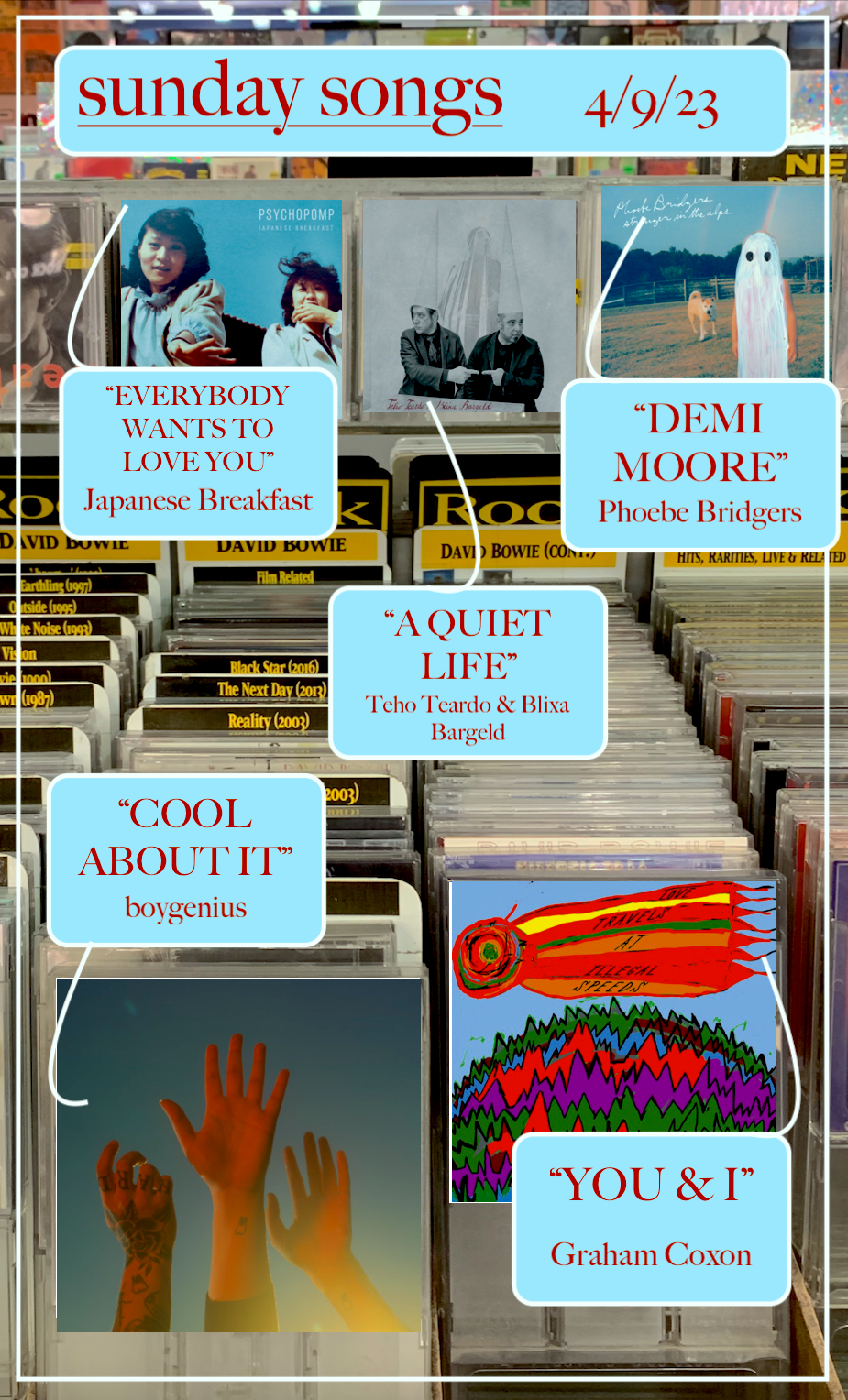
“Cool About It” – boygenius

Never in a million years would I have predicted having a song with banjo in it constantly on repeat, but life is full of surprises. All the better if said songs are delivered by the likes of boygenius.

I’ll surely be raving about boygenius’ recently released full-length debut the record for the next month, but this song, after their first four singles, is taking center stage in my head constantly. With a melody inspired by Simon & Garfunkel’s “The Boxer” and sparse, gentle instrumentation that lets each member of the supergroup bathe in the spotlight, it’s a quiet, introspective highlight. Julien Baker, Lucy Dacus, and Phoebe Bridgers take turns reflecting on the mixed emotions of painful, strained reunions with exes and old friends, hidden lyrics shine through in not-so-hidden lyricism—”I can walk you home and practice method acting/I’ll pretend that being with you doesn’t feel like drowning,” in Bridger’s final words. boygenius have let their joint talents meld together in a handful of different structures, but somehow, this neat, boxed-in sections where one singer takes the lead per verse make for a song that truly feels like all of them. And as gently as bubbling water in a creek, their harmonies rise as one for each chorus—my heart can’t help but leap a little when each of them harmonize to the final line of each verse: “even though we know it isn’t true…”

[fanning face] The power they have, I swear…

“You & I” – Graham Coxon

I’ve been meaning to get more into Graham Coxon’s solo work ever since my 2021 Blur frenzy, and through the nuggets of song titles that I seem to remember completely at random, I’m getting more and more excited about it. The only song of his that I know that isn’t a cover or from the soundtrack of The End of the F***ing World (which I still need to watch…), it’s an unadulterated dose of tight, anxious Britpop straight to the veins; even without Blur and all of the detriments that came with its fame, it’s clear that this is the kind of music that Coxon was meant to play. And he plays it well. Each punchy chord feels laid out on a precise grid, and from what I can gather about him, it seems like something he would do. “You & I” is a distinctly polished song—not in the way that an over-produced, Top 40 hit is, but polished in the way that every edge has been meticulously sanded down to perfection, not a note out of line. These nervous, uptight white guys know their stuff sometimes…

“Everybody Wants To Love You” – Japanese Breakfast

I’ve gotten bits and pieces of Japanese Breakfast over the years—I remember being in the car all the way back in middle school and hearing a piece of NPR about her debut album, Psychopomp, and being interested, but I don’t think I ever got around to listening to it then. With all the buzz around Jubilee and her acclaimed novel Crying in H-Mart, I figured I might get around to giving Michelle Zauner and company a listen. Like “You & I,” I remembered the title of this song at random, and I’m so glad I did!

“Everybody Wants To Love You” feels like the 2010’s, indie rock answer to a poppy love song of the 50’s or the 60’s. Everything about it feels cheery—the bright, practically glittering guitar tones, the sharp pep of Zauner’s voice, and the starry synths that seem to leave sparkling trails over every second of the song. Add a wonderfully catchy guitar riff and package it into the pop-standard 2 and a half minutes, and you’ve got something that feels like it could come out of any era. Well…maybe not any era—some of those lyrics definitely would not have flown in the mainstream before the 60’s, but that’s not the point. It’s just 2 and a half minutes of joy, purely and simply.

“A Quiet Life” – Teho Teardo & Blixa Bargeld

Over break, I went through the first season of Netflix’s Dark with my family, and ever since, I’ve ripped a solid half of the songs from that show and slapped them haphazardly into my music taste. Seems like that’s largely the case for a lot of the commenters on this video too (all of the Dark references have passed the vibe check with absolutely flying colors), and, among other things, Dark reminds me how good it feels to be so invested in every part of a show—not just the story itself, but every little detail that goes into it. Like the music.

I won’t go into how perfectly this song melds with the overall themes and the last episode of season 1 of Dark for fear of spoiling something so wonderfully intricate, but it’s chilling on its own as well. Blixa Bargeld boasts such a rich voice—it reminds me a lot of Jarvis Cocker, with that same rasp at the edges of the resonance you can feel in your chest. Just like Dark’s absolutely disturbing score, Bargeld’s vocals seem to buzz in moments, turning from something human into the hum of putting your ear next to a beehive. There’s a deeply poetic feel to everything in this song’s atmosphere, with the orchestral composition forming in the background and the gloom that seems to settle over every note like fog. It creeps along like frost, painted in the same grays as the album cover. What I’m trying to say here is this: whoever was in charge of the music direction for Dark—I SALUTE YOU. BLESS YOU.

“Demi Moore” – Phoebe Bridgers

Phoebe Bridgers is a distinctly 2020 artist in my musical canon. I first listened to Stranger in the Alps in the early months, before everything went…y’know, and Punisher came out that summer. But unlike Punisher, an album that’s a no-skip for me to this day, some of the songs on Stranger in the Alps didn’t do it for me on the first few listens. It’s understandable—Stranger was her debut, and with Punisher, she had more time to hone her craft and sound. But I’ve recently come back to some of those songs that I didn’t warm up to the first time; some of them still don’t impress me, but “Demi Moore,” along with the harrowing “Killer,” took a while to grow on me.

With a title borne from a misheard lyric (“I don’t wanna be stoned anymore” became “stone Demi Moore,” this song, like many of her others, lingers in the hazy, middle-of-the night lairs of vulnerability. Especially on Stranger, the instrumentals often take a backseat to Bridgers’ singing, letting the emotional side speak for itself amidst quiet synths that flicker like satellites in the night sky. Phoebe Bridgers’ voice floats along like misty fog over a creek, all at once thin and full of emotion.

And again—normally I can’t stand banjos, but these somehow work because of how…quiet they are? Sorry for the banjo slander here, but…I can’t help it, I’m sorry. I was forced to learn in 7th grade for school, but I didn’t enjoy much of it, save for trying to pluck out a rendition of “It’s A Wonderful Life” from memory. I’ll begrudgingly admit that it did help me get a bit of head start on playing guitar, but I still have a vendetta with the instrument. I digress.

Since this post consists entirely of songs, consider all of them to be today’s song.

That’s it for this week’s Sunday Songs! Have a wonderful rest of your day, and take care of yourselves!
Posted in Music, Sunday Songs

Sunday Songs: 4/2/23

Happy Sunday, bibliophiles! I hope this week has treated you well. 💗

Not to worry, folks: the inevitable Boygenius Breakdown™️ is scheduled for next week to allow for some time for everything to sink in. As per the never-stated-but-generally-just-implied agreement, however, this week’s Sunday Songs meets the required Queer Quotient™️ that every Bookish Mutant post is required to pass before entering the blogosphere. I’m running a tight, gay ship over here, and I’ll see to it that it stays that way.

Enjoy this week’s songs!

SUNDAY SONGS: 4/2/23

“Born on a Train” – The Magnetic Fields

In the span of about a week, “Born on a Train” sprung from just being downloaded to my third most listened-to song of this year, according to Apple Music. Maybe that says more about my penchant for wearing songs into the ground than it does about the song itself, but I swear there’s an infinite magic woven into every note of it. Snugly fit in The Charm of the Highway Strip, a loose concept album about traveling and roads, this third track gently chugs along like the train the chorus speaks of. (And another example of the band’s generally wry humor—I haven’t listen to Charm in full yet, but the fact that “Fear of Trains” is only four tracks away from this song always cracks me up. Duality of man.) The drums and muted, acoustic guitar strums throughout recall the machinery of a train, in contrast to the ringing chimes as Stephin Merritt finishes out each chorus. And as with most Magnetic Fields songs, it’s laced with bittersweetness to the core; there’s a sense of the narrator grappling with their own nature, knowing that they’re bound to leave everyone that they love, that same lonely, fleeting, twilight feel as the “ghost roads” that Merritt describes in the first verse. Merritt’s voice has the same resonance that you feel inside a cave, reverberating through your bones—it was easy to feel, hearing this song live at a smaller venue, which I still count myself incredibly lucky to have experienced.

On that habit of riding songs into the sunset, I think I get sick of only about half of them—”Born on a Train” feels like one of the ones that’ll stick.

“Drooler” – Palehound

At this point, all that’s keeping me from listening to more Palehound right now is the fact that A Place I’ll Always Go is too complicated of an album cover to draw on the door whiteboard on my dorm (wait, I forgot about posting those…maybe once school’s out? Don’t hold me to it), and for some reason, even though I can listen to any other artist’s discography out of order, I’ve stubbornly decided to do so with them. (With the albums, at least—I didn’t know this EP existed until recently…oops…) But…Dry Food was just so good. I couldn’t get enough of the whole album. Something about El Kempner’s talent for letting every instrument go loose and reining them back in just as quickly keeps me listening over and over again.

So I ended up finding and promptly listening to her very first musical outing as Palehound, 2013’s Bent Nail – EP. The decision to make “Drooler” the first track was a clearly calculated one—it lulls you in with Kempner’s brightly-toned guitar notes that seem to gently roll like a loose wagon wheel, but drops off just as quickly, breaking into a bluesy, catchy groove, strangely accented at times with the sounds of pots and pans clanging against each other. All the while, Kempner’s voice does similar gymnastics, slipping into lower tones and spiking airily high in the space of seconds. It’s hard to keep that balance—something that she frequently tests on songs like “Pet Carrot” (which works on the EP, and bafflingly maintains on her performance of it on her Tiny Desk Concert), but “Drooler” toes the line with ease. And just like that, everything that Kempner builds devolves into riotous fuzz at the end, a skidding, spark-flying crash to a perfect piece of guitar-driven indie-rock.

“Eye Patch” – De La Soul

So I’ve got another De La Soul album to add to my never ending album list, huh? I’m not complaining. Anything for another experience of wonderful, creative music, that Pos, Dove, and Mase seem to exude from their very pores, or something…

Two albums after their breakout Three Feet High and Rising, De La Soul had made a point to shed the sunshine-colored, mislabeled hippie image that had followed them everywhere, but even though that image was a major point of resentment for Plugs 1, 2, and 3 after the album’s release, listening to songs like “Eye Patch” leads me to believe that, at least musically, that spirit never quite left. Backed by the endlessly catchy samples of Jimmy Reed, the Outlaw Blues Band, and the same French language learning program that they sampled for Three Feet High and Rising, it’s another earwormy patchwork that, even from my limited experience with the band, feels like their trademark. It’s smooth, rolling like waves over your skin, the perfect walking soundtrack for a movie, or just walking to class and feeling the sun on your skin. And despite the more serious undercurrent that emerged in everything post-De La Soul is Dead, there’s still samples of sheep and children laughing—there’s no denying of the original, three fresh-out-of-high school friends making music in the basement ethos that have made De La Soul so lasting.

“Crocodile Tears and the Velvet Cosh” – David J.

Part of what I love about this song is that there will never be another song called “Crocodile Tears and the Velvet Cosh.” If there is, I can guarantee that it’ll be ripping this title off.

I can never claim to be fully goth (even though I can and will go overboard with the black eyeliner, without hesitation) partly because both Bauhaus and Love & Rockets (a.k.a Bauhaus – Peter Murphy) have historically been hit or miss for me. I’ve still found some of the latter that are already classics for me (“Holy Fool,” “Bad for You,”…why do I keep putting off listening to Lift?); the solo careers have been similarly hit or miss, though I’ve been hoarding a small handful of songs from Murphy, Ash, and David J., respectively as of late. Strangely, even though I’ve only heard two songs of his (the other being “I’ll Be Your Chauffeur”) David J. has been the one that I’ve liked the most consistently. As much as I love and respect the eclectic spirt of Love & Rockets (okay, scratch that: I can’t forgive them for “The Purest Blue,” there’s NO excuse for that nightmare fuel), sometimes you have to sit back and linger on the gentle side of things. That’s exactly what “Crocodile Tears and the Velvet Cosh” feels like for me: it slings a reassuring arm over your shoulder, and lets you relax while the breeze tugs at your hair. Filled with tiny packets of clever wordplay (“I read you like a book/Seeing through/without ever losing my place”), it’s an unassuming, acoustic piece with hidden bits that glisten in the dark.

“VBS” – Lucy Dacus

I finally got around to listening to Home Video last week, and although I wasn’t as wowed as I was with her sophomore album, Historian, it still exists as an insect trapped in amber. The album chronicles Dacus’ childhood and adolescence in Virginia, grappling with her latent queerness in contrast to her Christian upbringing, as evidenced in “VBS,” a slice-of-life recounting of church camp. Musically, Home Video wasn’t as expansive and vast as its predecessor, but Dacus’ lyricism throughout the entire album is as strong as ever—I can’t stop thinking about the lines “Sedentary secrets like peach pits in your gut/locked away like jam jars in the cellar of your heart.” For such an unassuming-sounding song (in the beginning), there are so many tiny layers to peel back, from the underlying seeds of questioning everything she’s known to the explosive burst of guitars as Dacus describes, “There’s nothing you can do, but the only thing you’ve found/playing Slayer at full volume helps to drown it out.” The latter makes me wish for more of the guitar work that Dacus displayed on songs like “Timefighter,” but that moment as a self-contained piece, like the glass butterfly boxes that form each song, makes the storytelling even clearer and cleverer than ever.

Since this post consists entirely of songs, consider all of them to be today’s song.

That’s it for this week’s Sunday Songs! Have a wonderful rest of your day, and take care of yourselves!