Posted in Monthly Wrap-Ups

The Great Big Wrap-Up of Everything | August-December 2024

Happy Tuesday, bibliophiles, and happy New Year’s Eve! 2024 was…well. It sure was a year, wasn’t it? Things happened! Too many things. Man.

I’ll keep it short, because I’ve said something along the lines of the same thing for several months now. I like doing these wrap-ups, but they’re certainly time-intensive, so I doubt I’ll be able to keep up with the monthly schedule going into 2025. However, my brain does like sorting things into silly little lists with bullet points and whatnot, so I thought I would throw this together for the end of the year. Even though I was working so much, I did get to a lot of fun reads, and I didn’t want to leave them out! As I said in my 5-star Reads post, it’s been a rocky and anxious year, but that doesn’t mean it wasn’t populated with good reads—and moments in general—throughout. So, for the last time in 2024, here’s a wrap-up of everything from August to December.

Enjoy this massive wrap-up!

WRAP-UP: EVERYTHING I’VE READ SINCE AUGUST

AUGUST

I read 17 books in August! I don’t think anything for the rest of the year will measure up to having two 5-star reads back to back, but either way, this ended up being a lovely month for reading. Also, before everybody comes after me for DNFing Remarkably Bright Creatures…you can’t blame me after this line was said by a supposedly 30-year-old character: “bicep day was lit at the gym today.” How do you do, fellow kids?

Book Reviews:

1 – 1.75 stars:
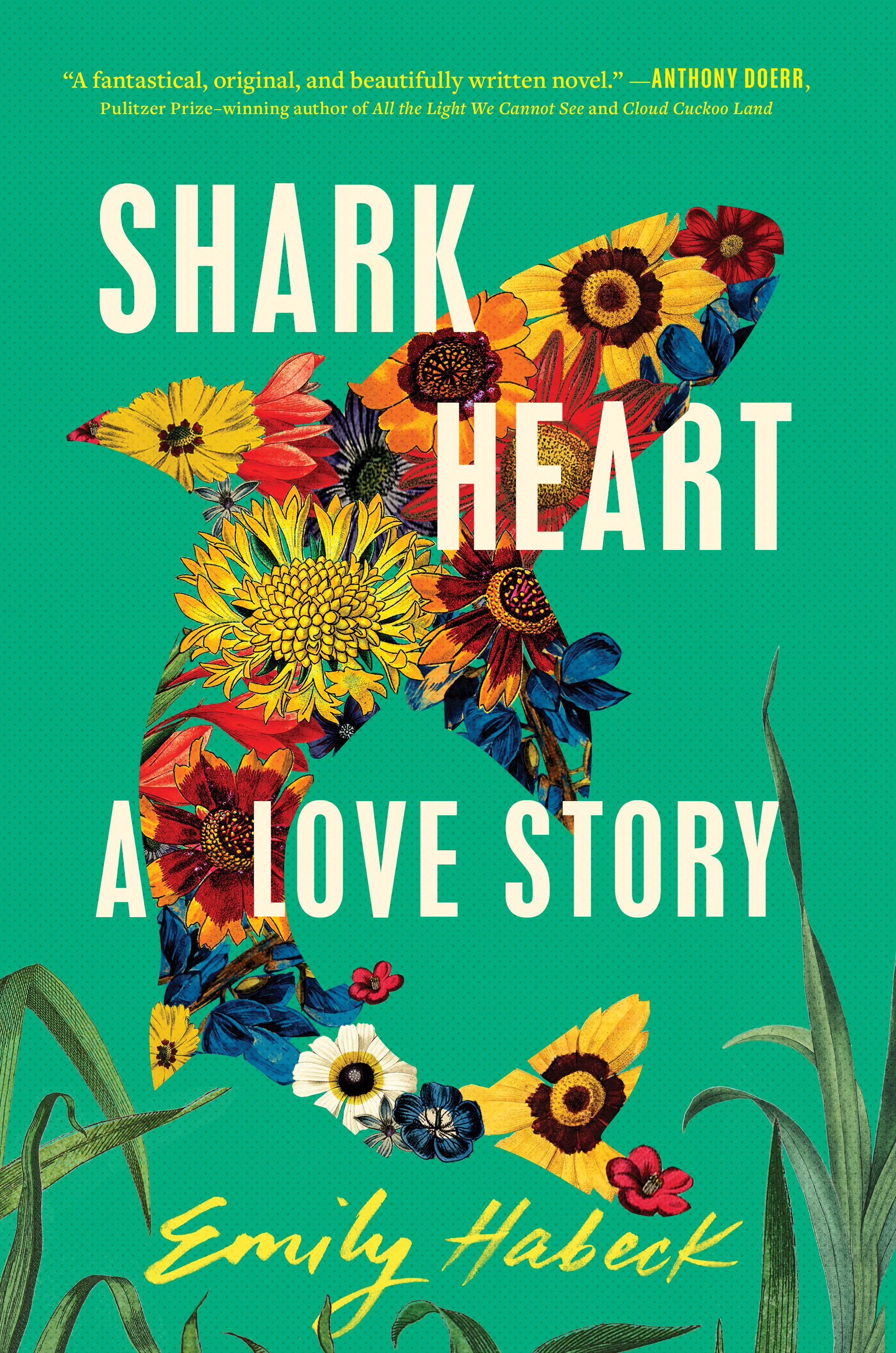
Shark Heart

2 – 2.75 stars:

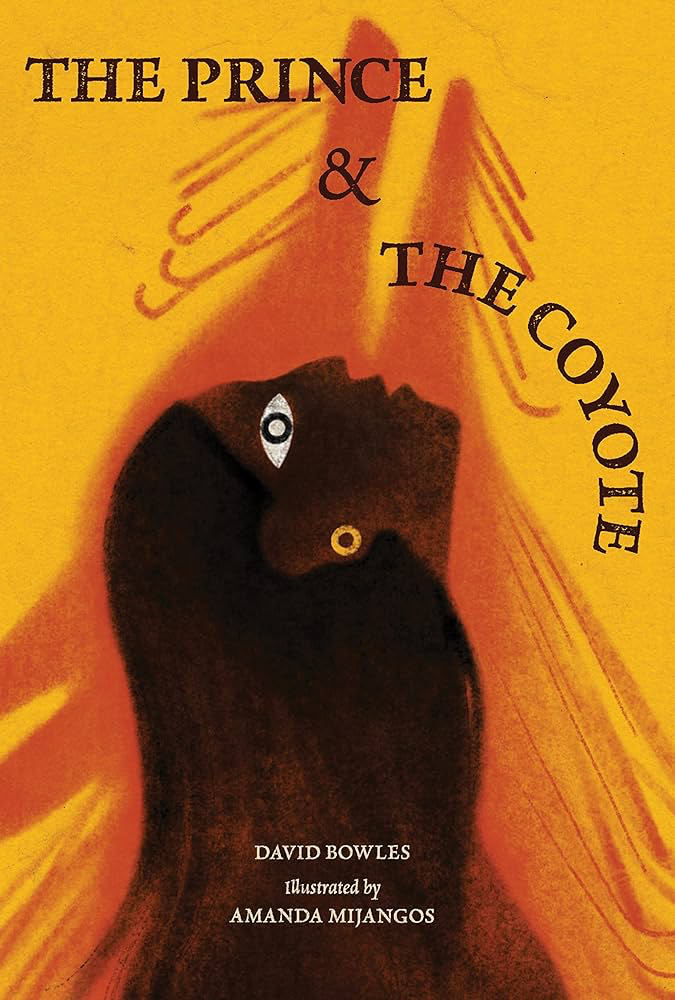
The Prince and the Coyote

3 – 3.75 stars:

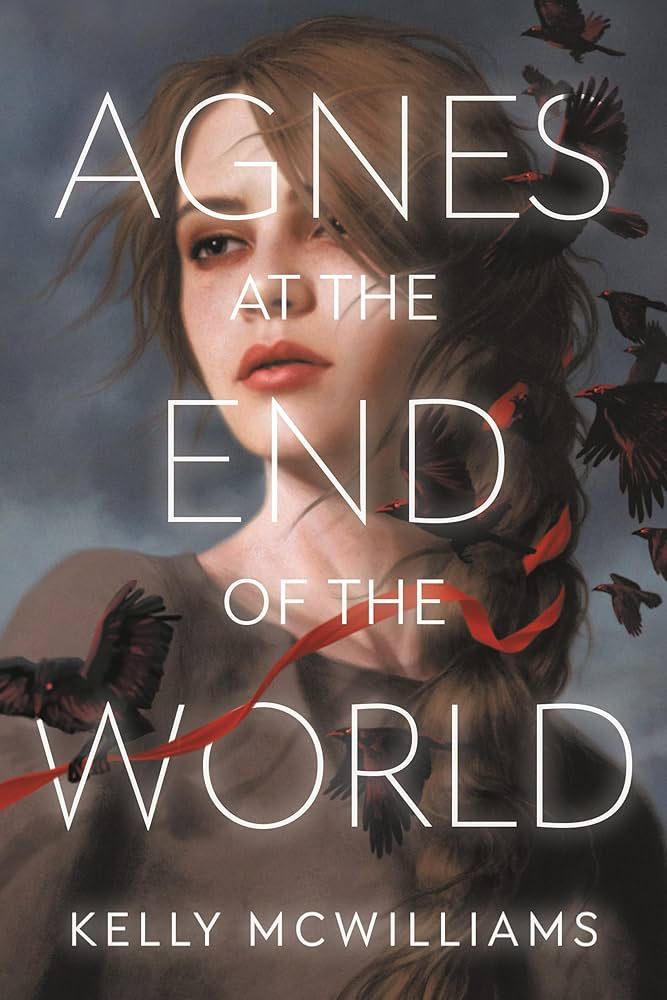
Agnes at the End of the World

4 – 4.75 stars:

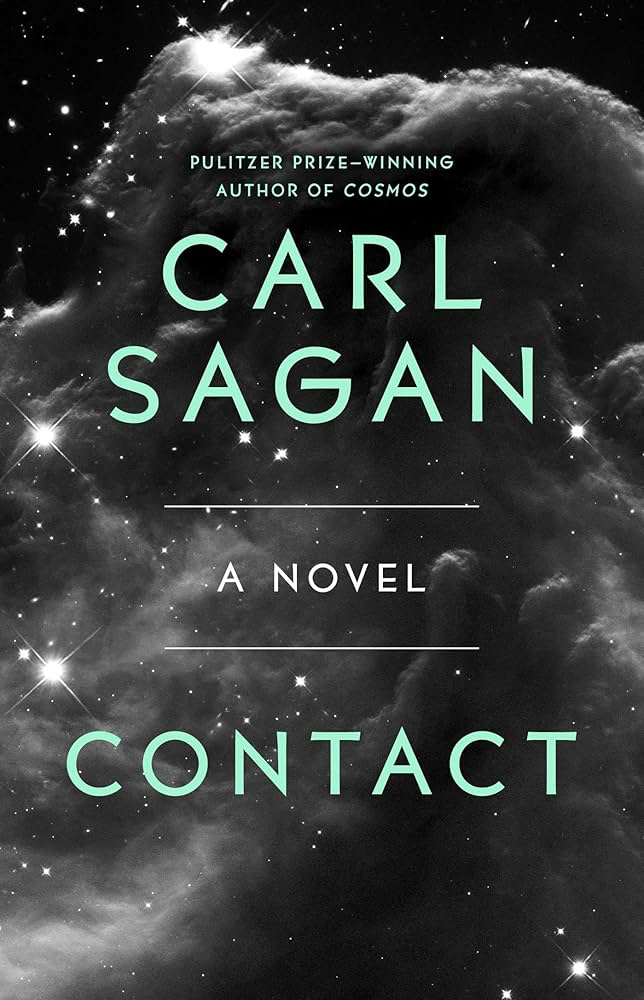
Contact

5 stars:

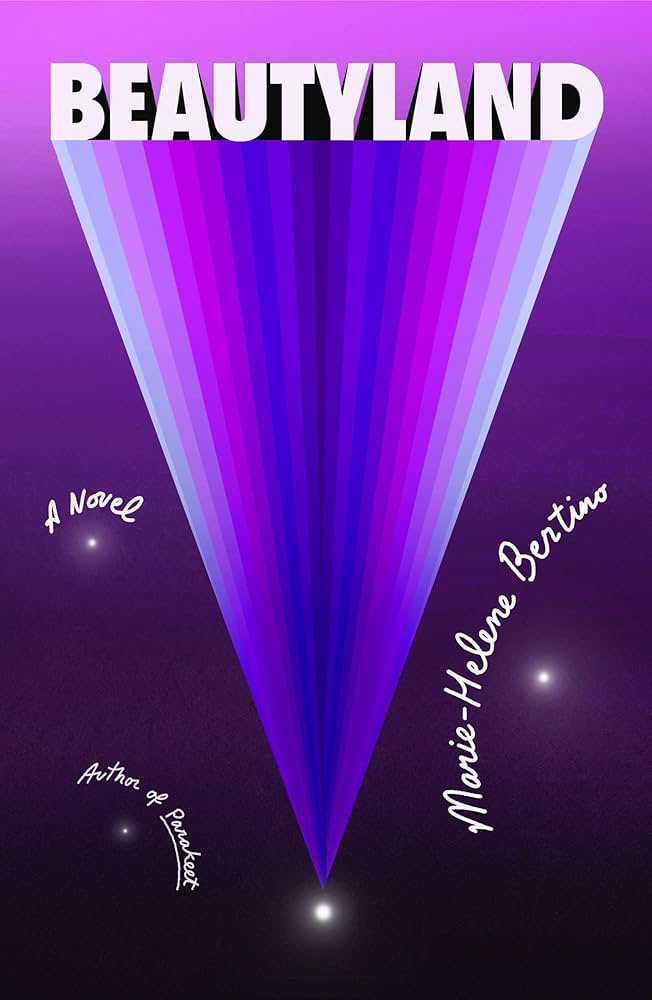
Beautyland

SEPTEMBER

I read 15 books in September! I was so caught up in my reading schedule being disturbed (somewhat) by school starting that I didn’t even realize that I didn’t have any 1 or 2-star reads! Miraculous. Either way, between my work, I was able to squeeze in some great reads for both Bisexual Visibility Week and Latinx Heritage Month.

Book Reviews:

3 – 3.75 stars:

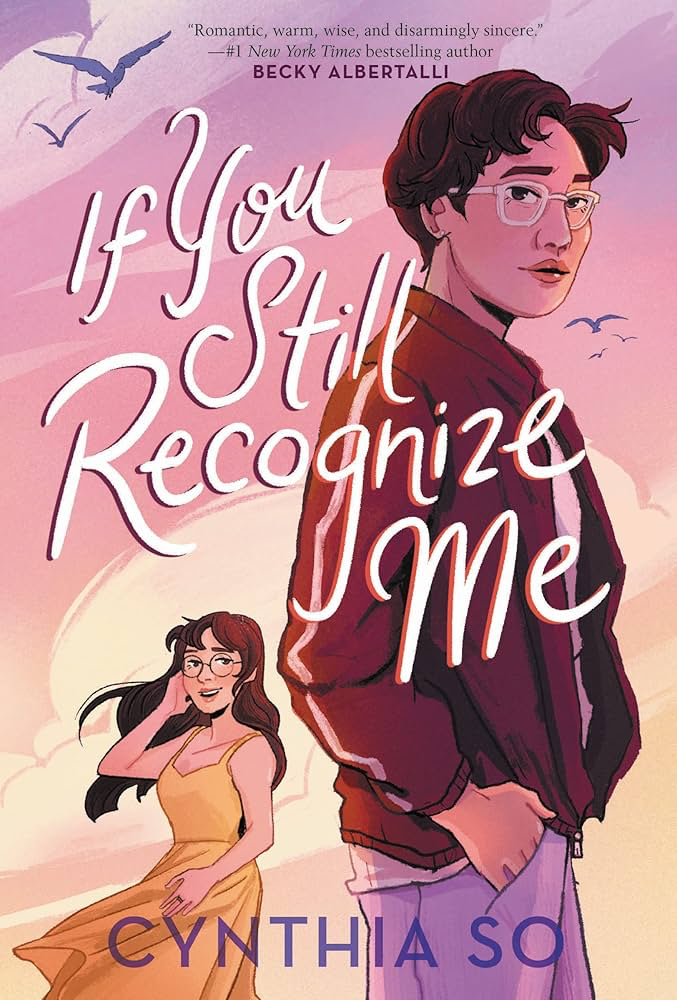
If You Still Recognize Me

4 – 4.75 stars:

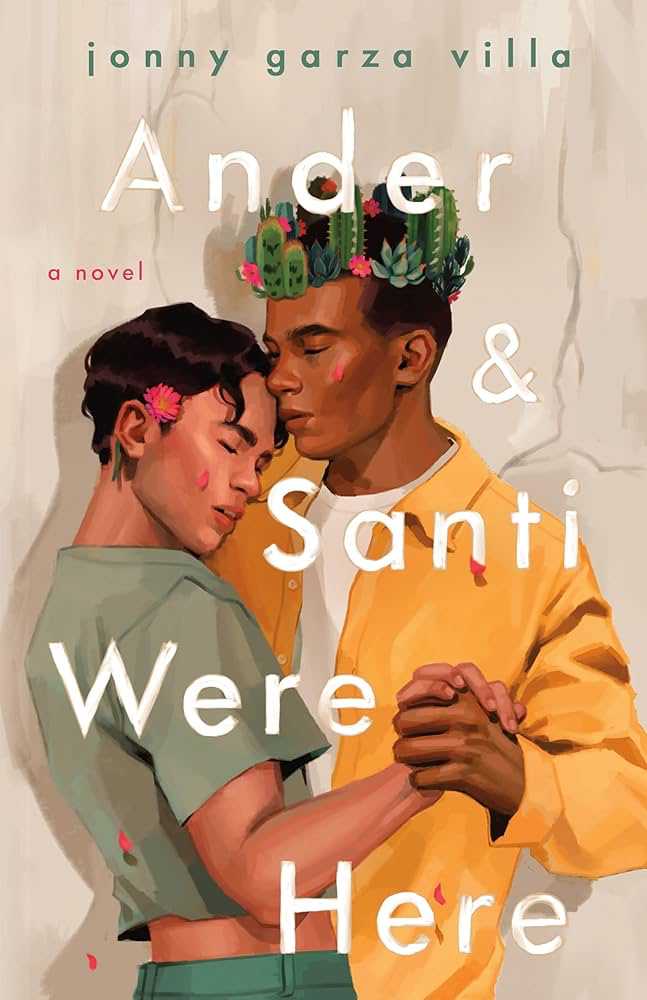
Ander and Santi Were Here

5 stars:

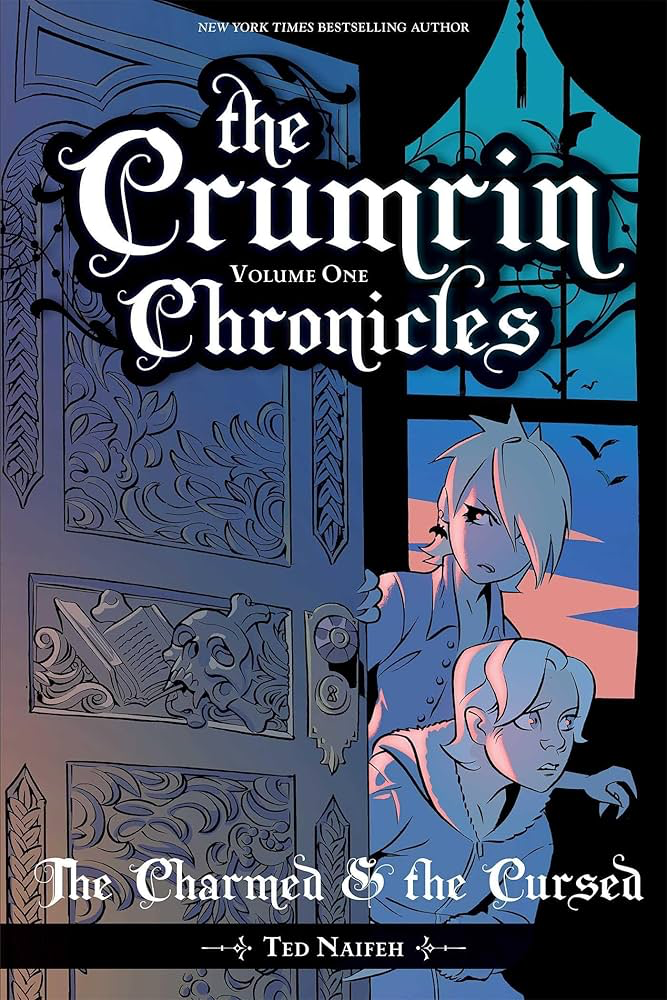
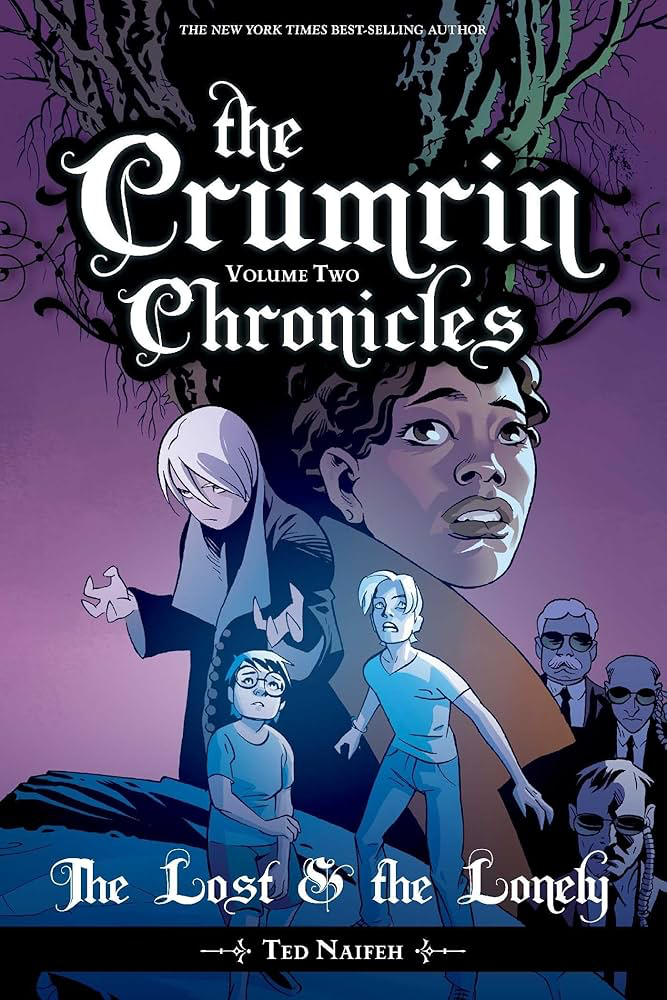
The Crumrin Chronicles, Vol. 1 – The Charmed and the Cursed

OCTOBER

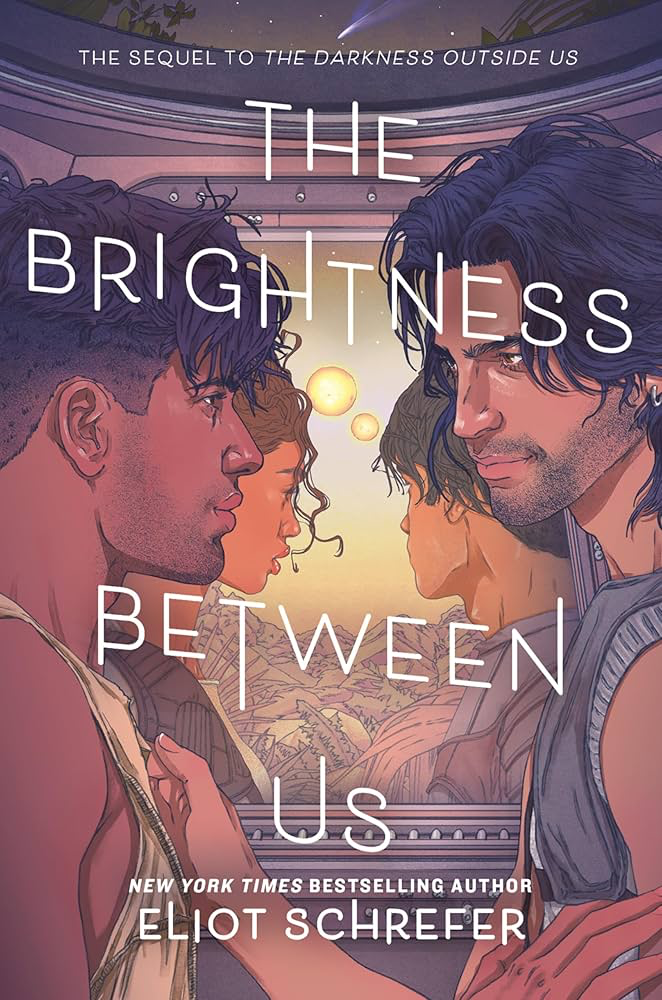
I read 15 books in October! Spooky season, busy as it was, another great month for books—new Crumrin Chronicles, new books from Amie Kaufman and Eliot Schrefer…oh, and I finally read Hamlet after all these years. I’ve seen so many adaptations that I just found myself going “HE DID IT!!! HE SAID THE LINE!!! HE SAID THE LINE!!” whenever I saw a passage I recognized.

Book Reviews:

1 – 1.75 stars:

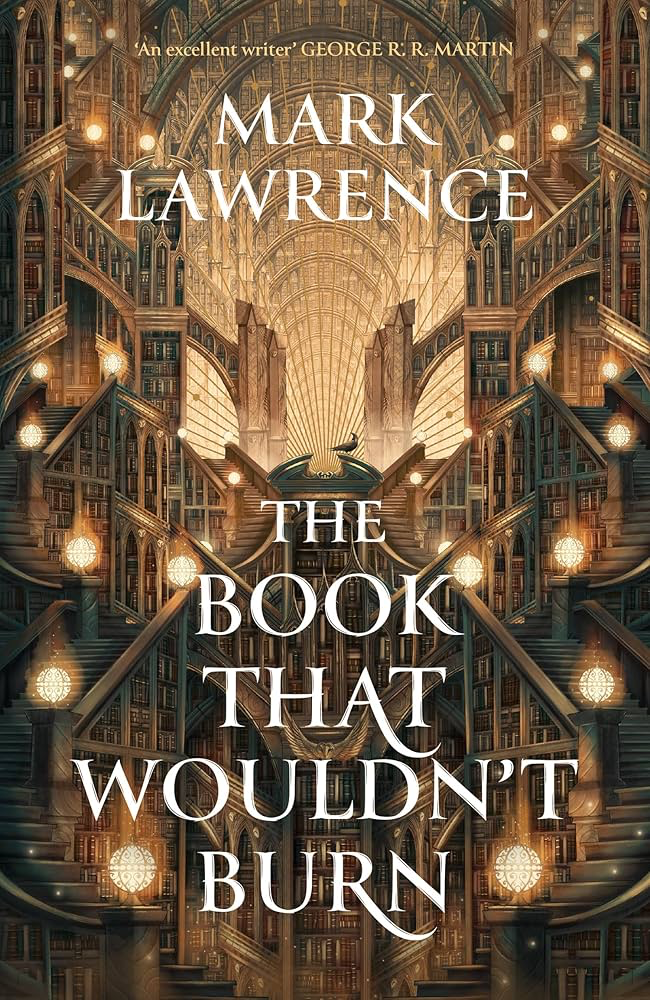
The Book That Wouldn’t Burn

2 – 2.75 stars:

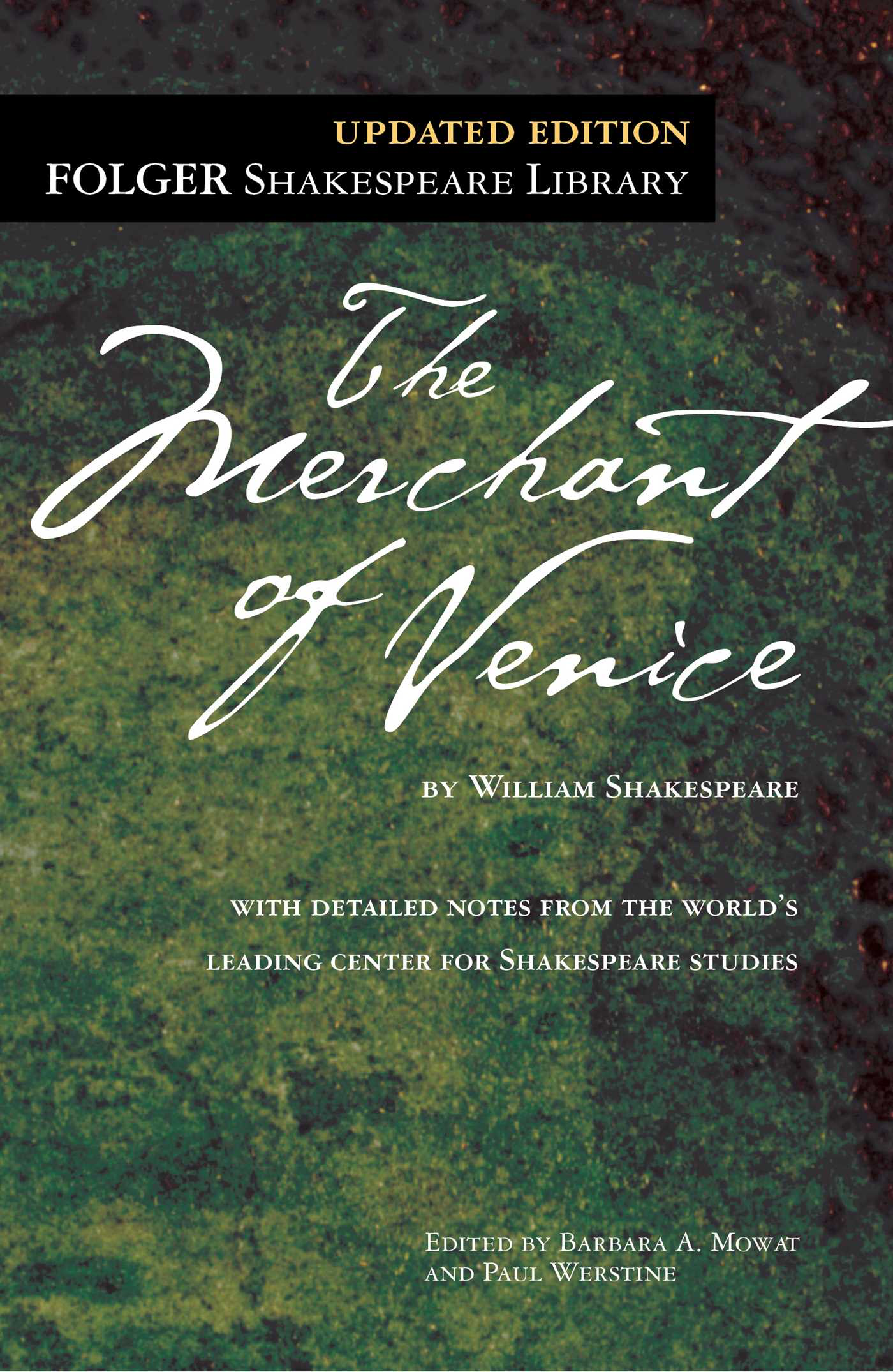
The Merchant of Venice

3 – 3.75 stars:

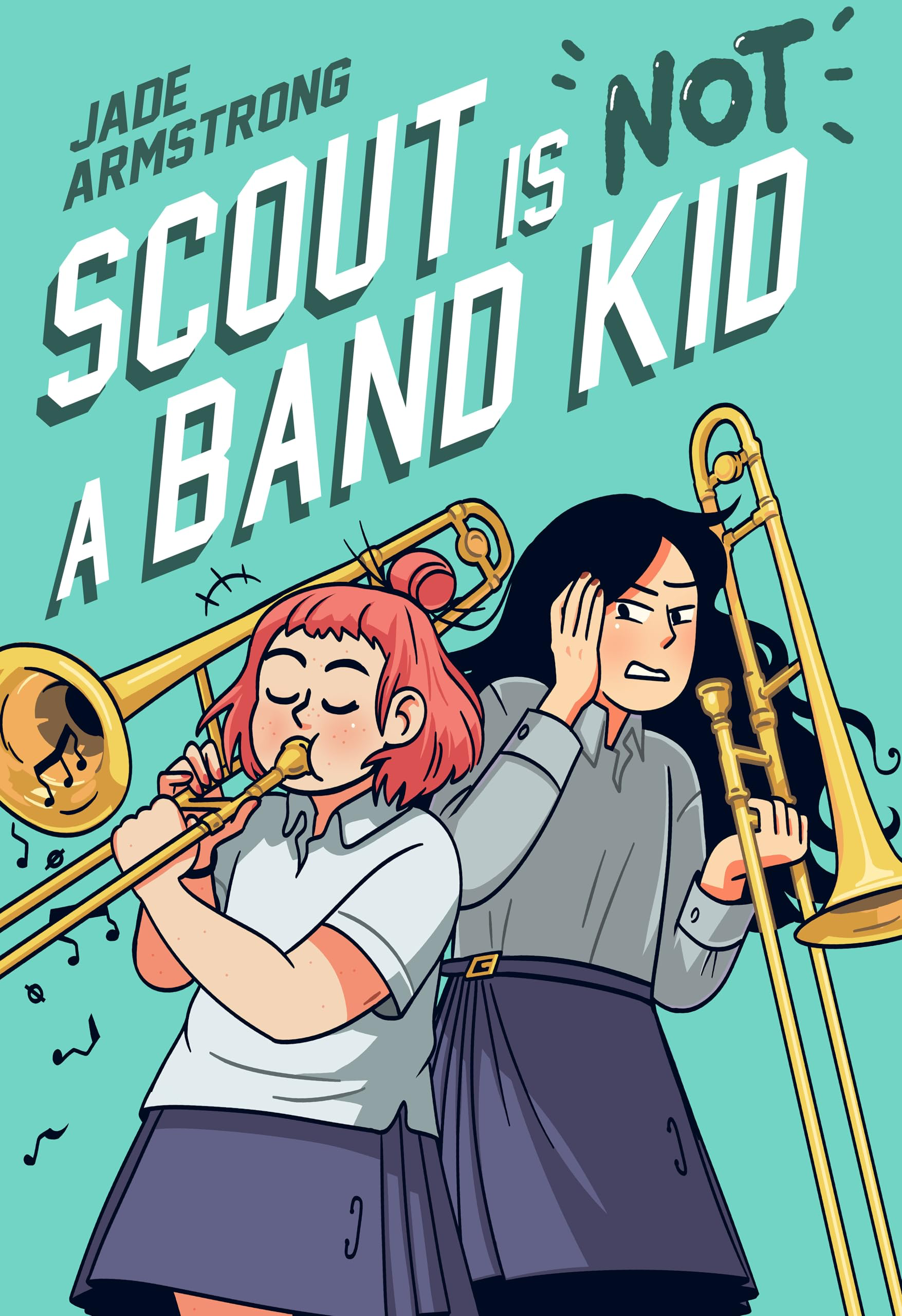
Scout is Not a Band Kid

4 – 4.75 stars:

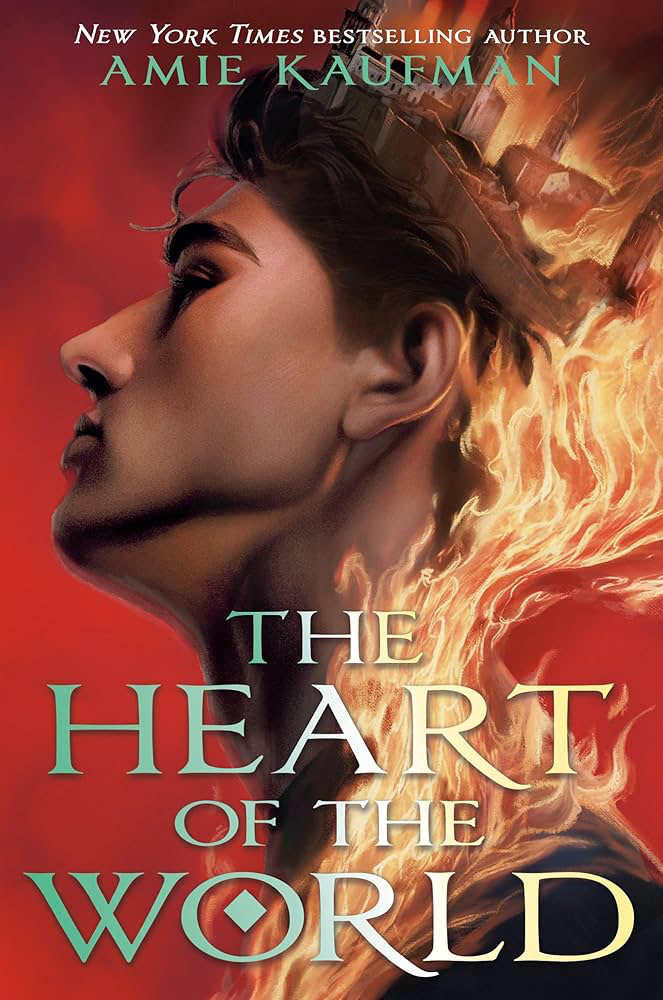
The Heart of the World

5 stars:

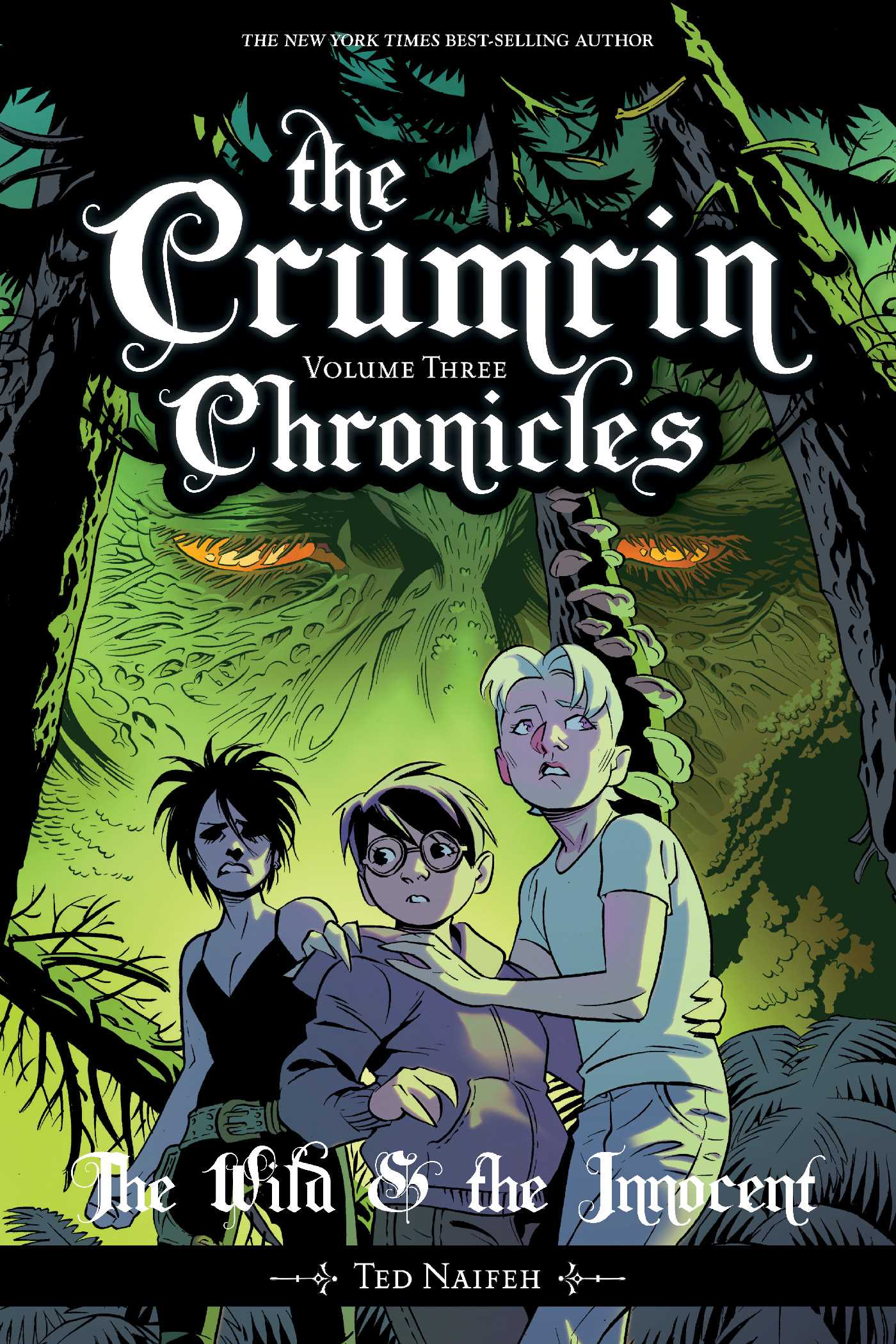
The Crumrin Chronicles, vol. 3: The Wild & the Innocent

NOVEMBER

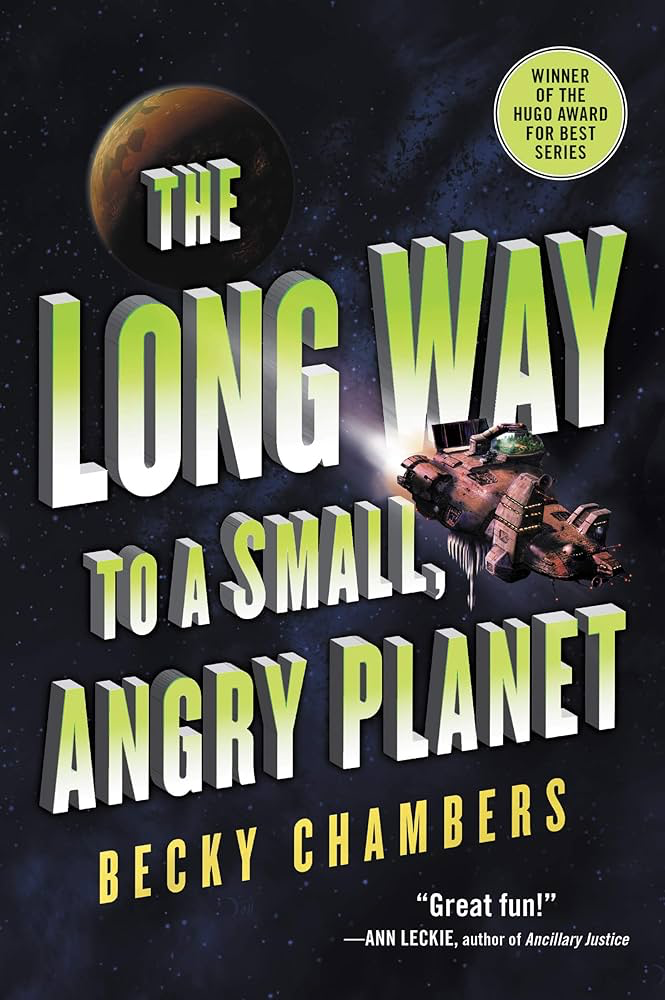
I read 14 books in November! I shouldn’t have to explain why I decided to read The Long Way to a Small, Angry Planet on Election Day. Jesus fucking christ. Also, I hate to speak ill of the dead, but either I’ve grown out of Rachel Caine, or I just read her better books in high school…maybe I should’ve read Ink and Bone when my taste was less discerning.

Book Reviews:

1 – 1.75 stars:
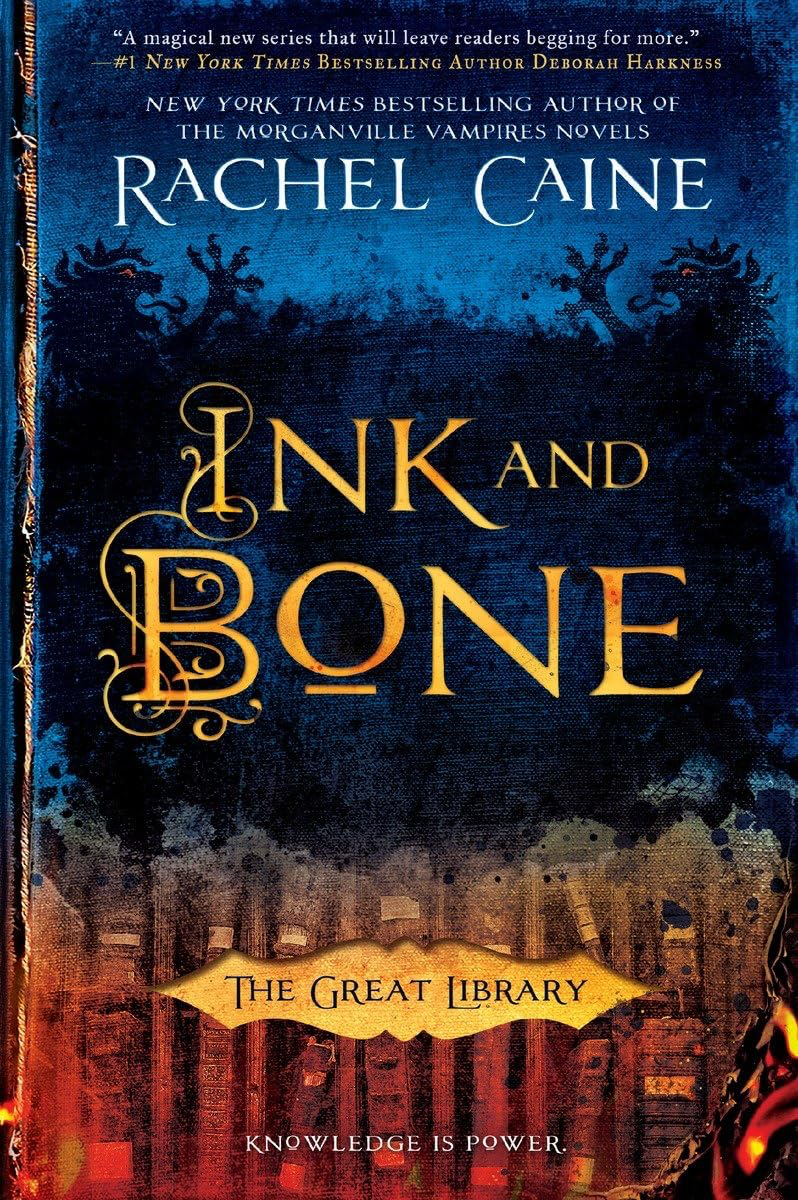
Ink and Bone

2 – 2.75 stars:

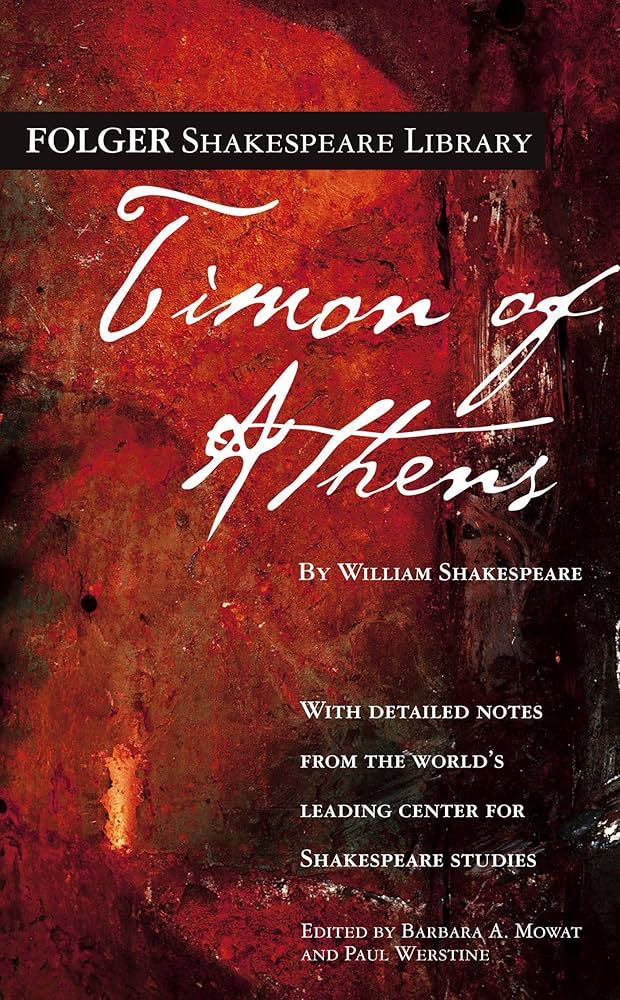
Timon of Athens

3 – 3.75 stars:

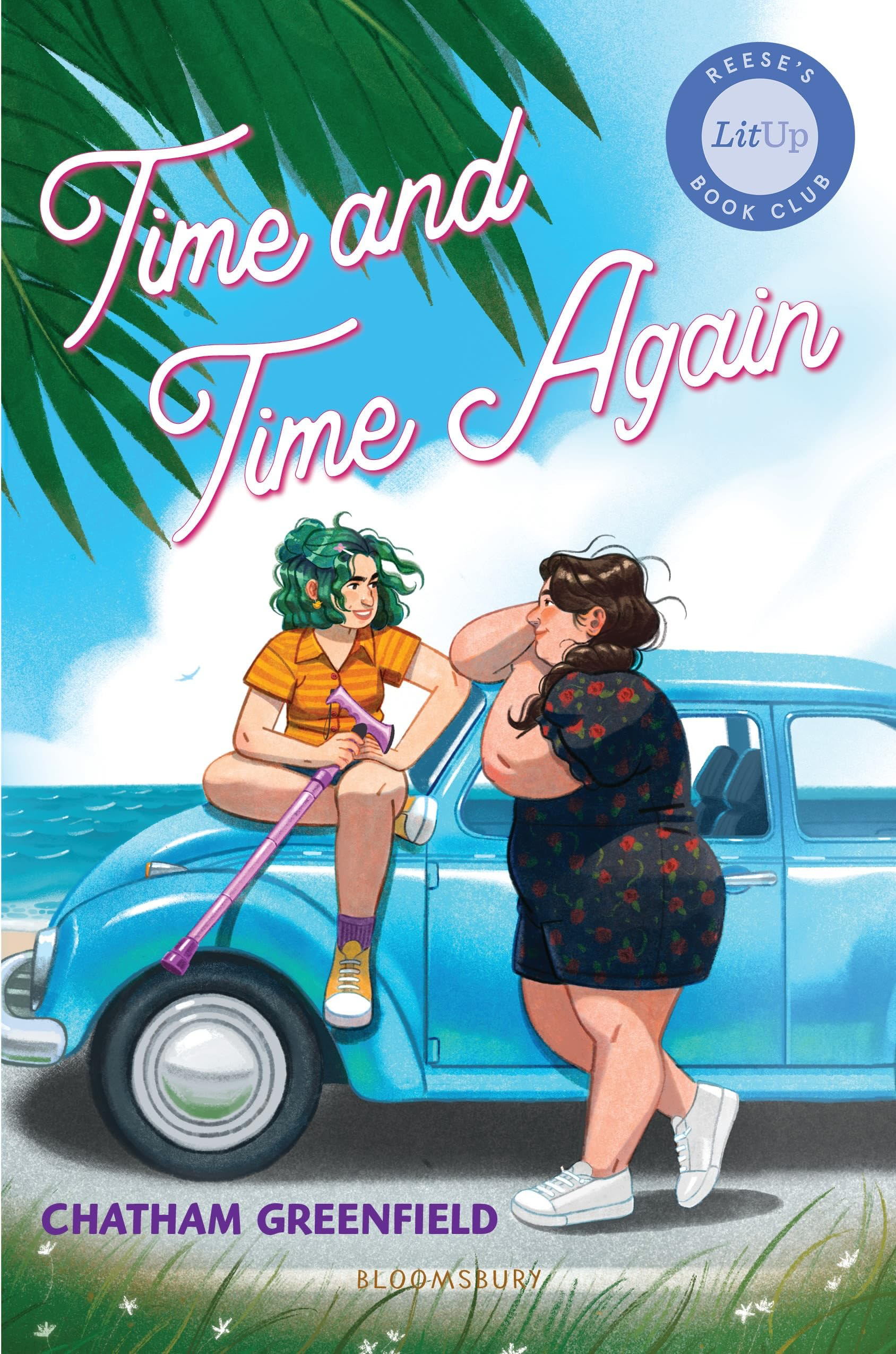
Time and Time Again

4 – 4.75 stars:

The Long Way to a Small, Angry Planet

DECEMBER

I read 13 books in December, and rounded out my Goodreads challenge with 199 books read this year! I’d say that’s pretty impressive. December proved to have a solid bunch this month (to say nothing of the pretentious, 212 pages of nothing that was Orbital).

Book Reviews:

2 – 2.75 stars:
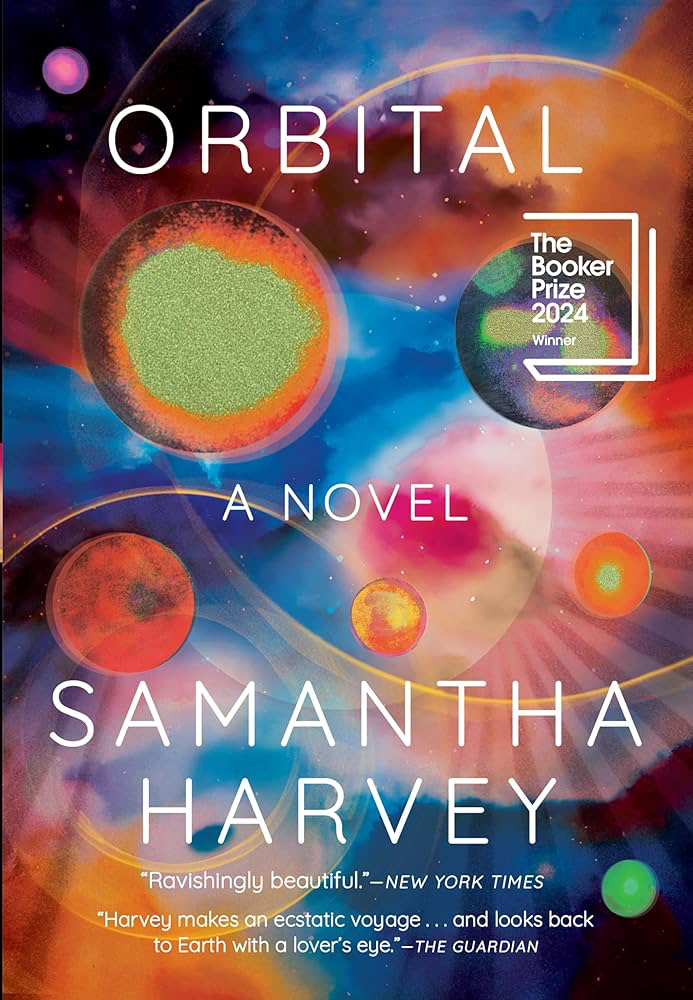
Orbital

3 – 3.75 stars:

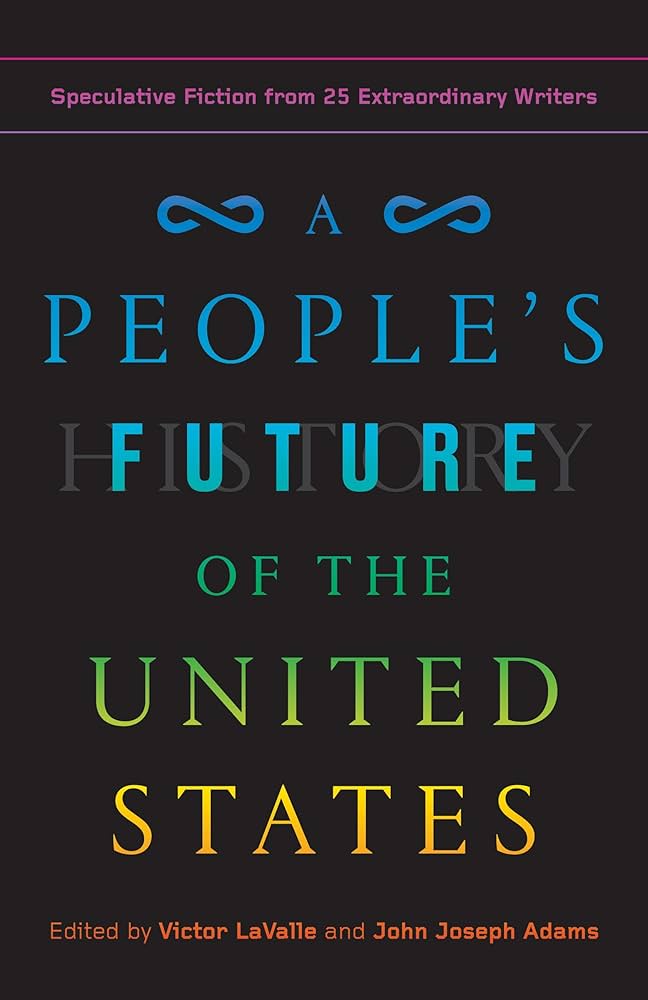
A People’s Future of the United States

4 – 4.75 stars:

The Tempest

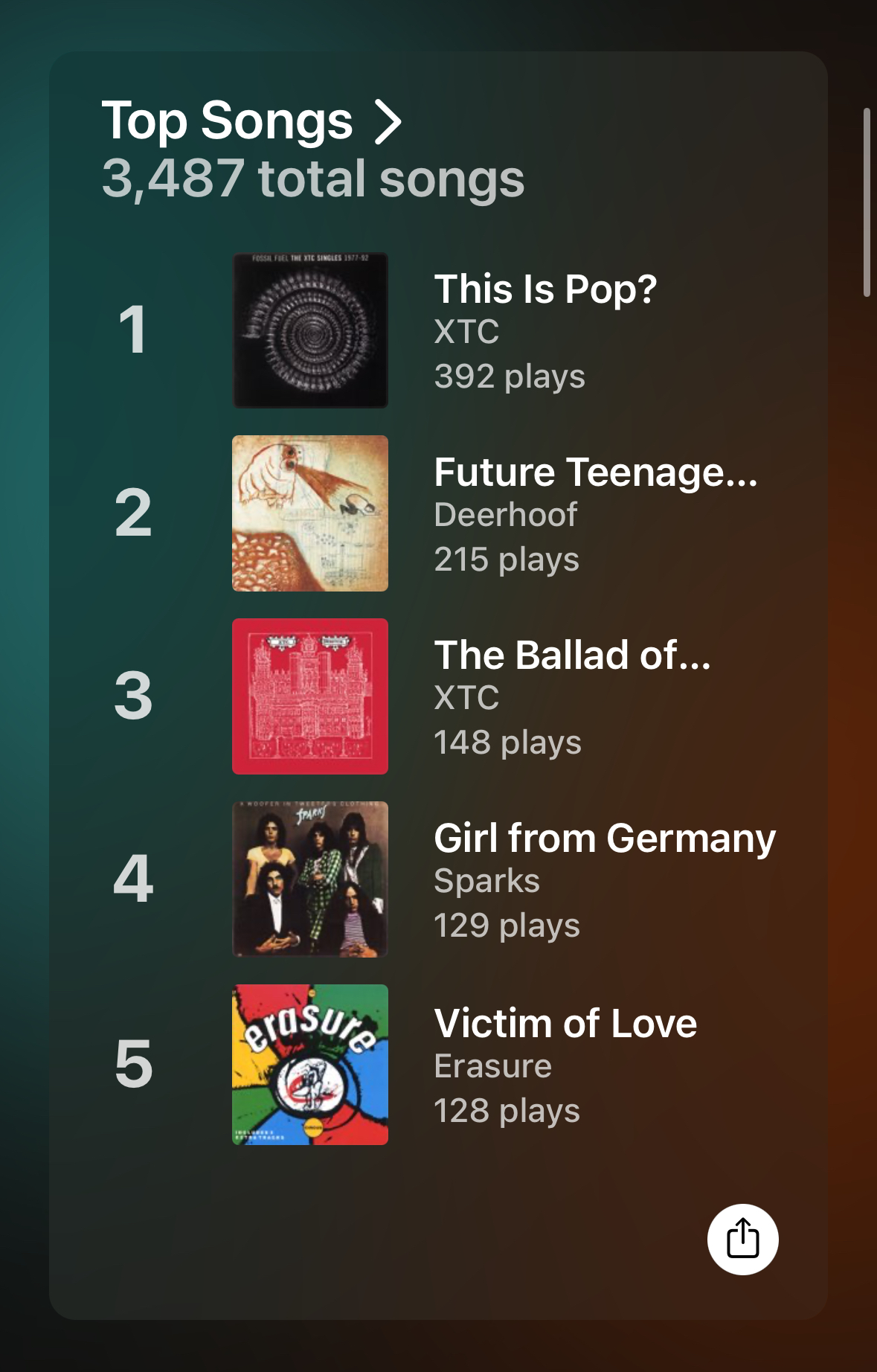
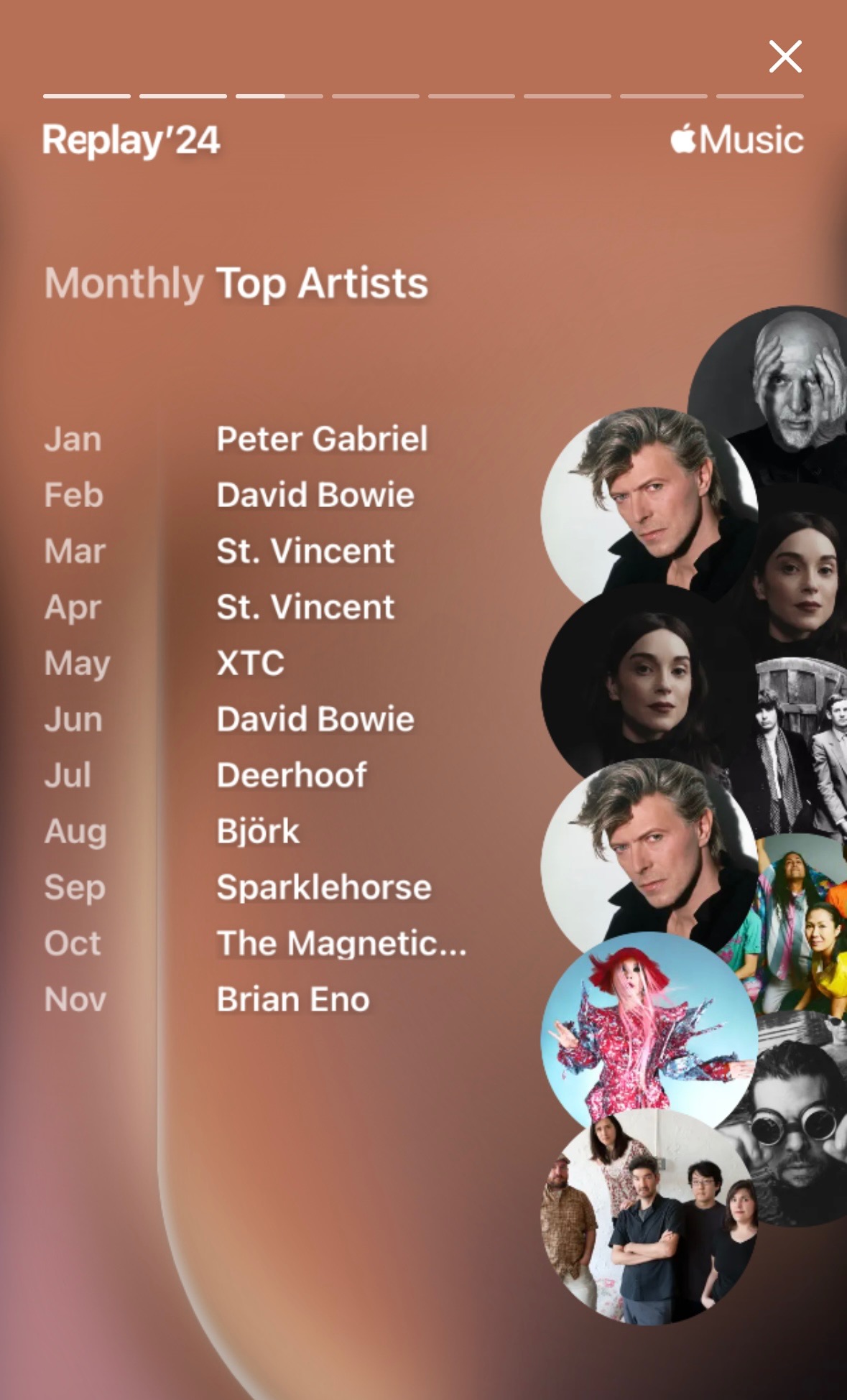
In lieu of my usual songs/albums that I’ve been listening to lately, enjoy some selections from my Apple Music Replay. It appears I’ve lost my hypothetical Welsh street cred (no longer in the top 100 listeners for Super Furry Animals…it’s been an honor), but it’s been replaced by being in the top 500 for XTC? I did listen to “This is Pop?” and “The Ballad of Peter Pumpkinhead” an unhealthy amount…
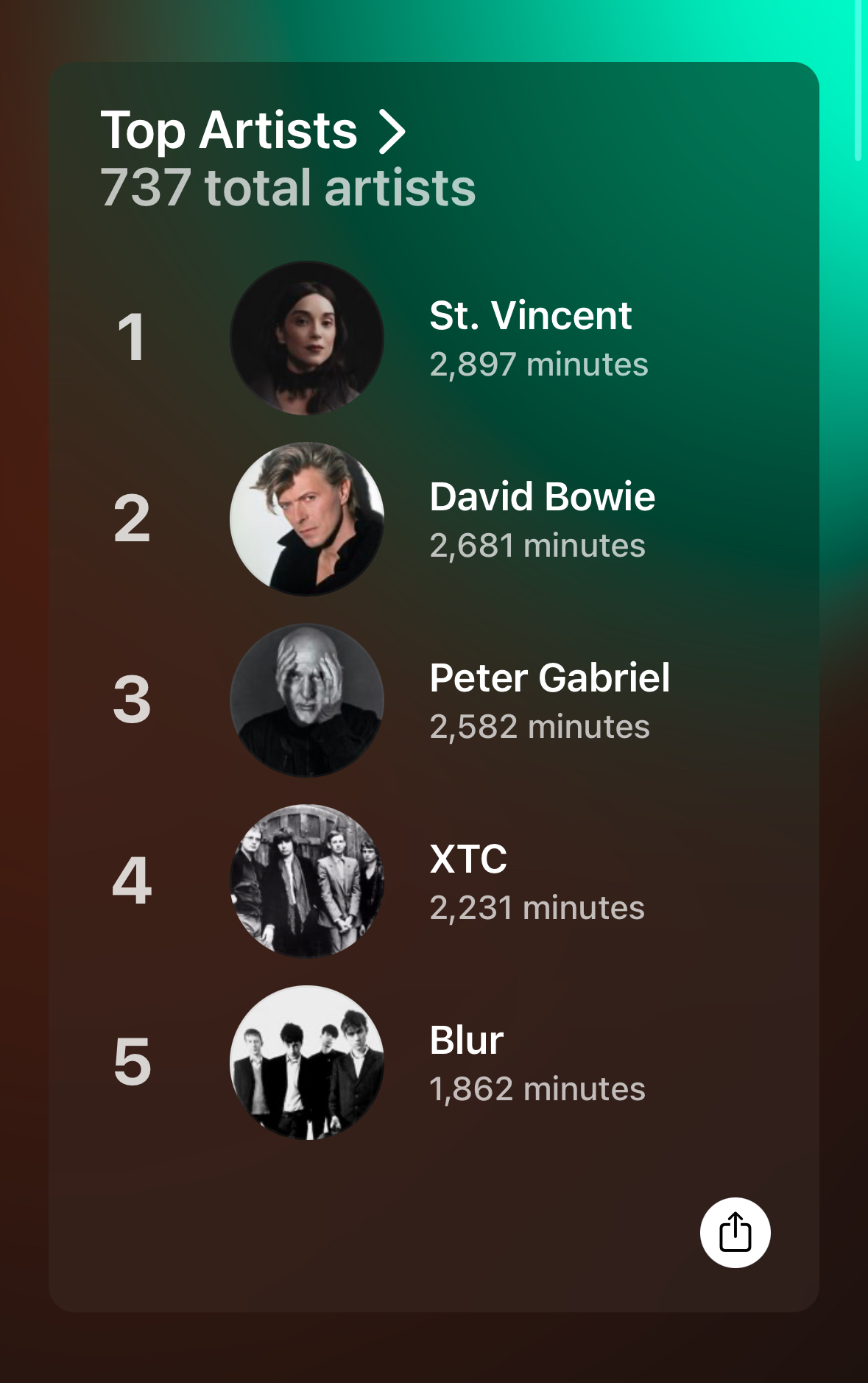
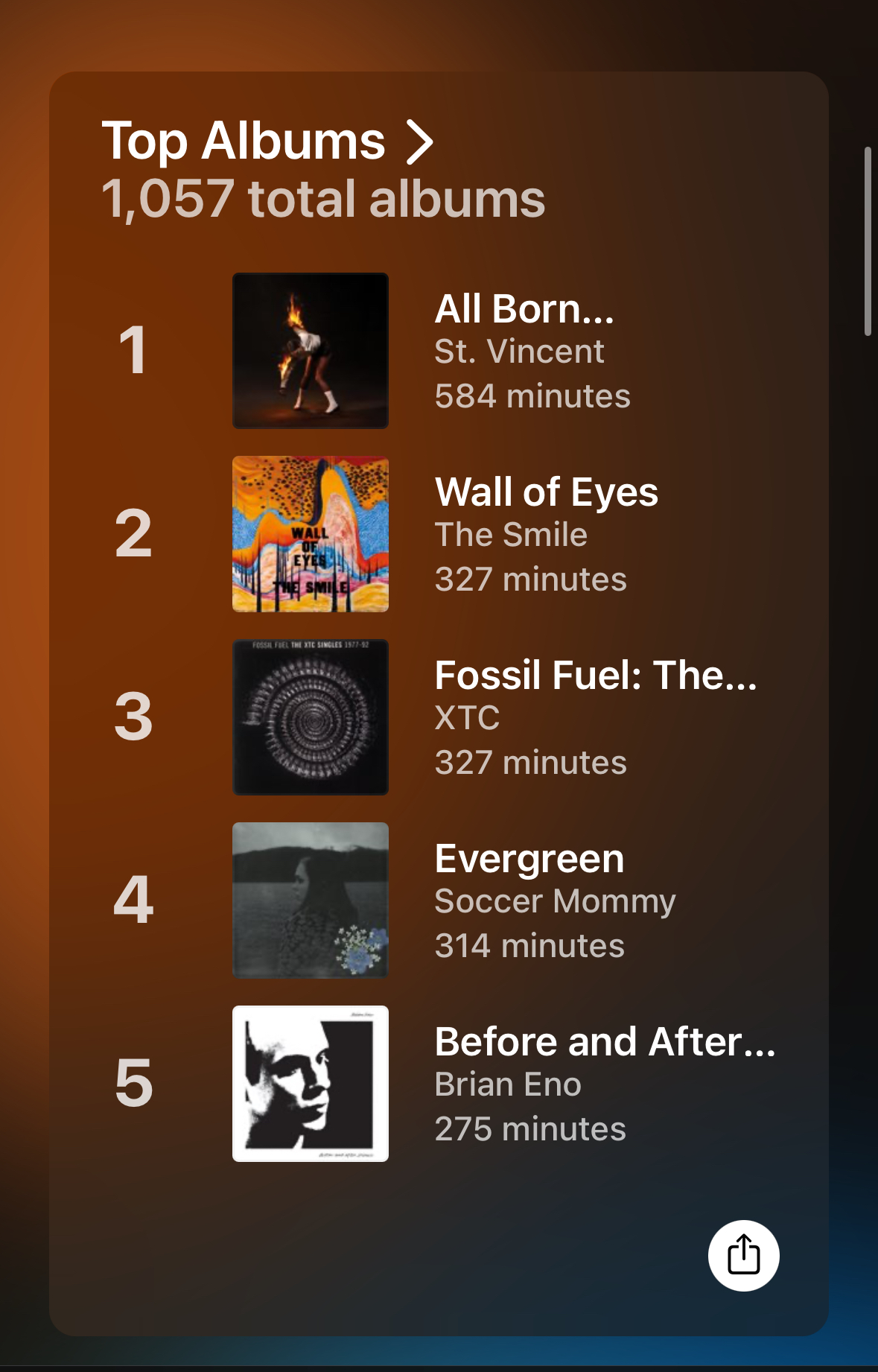
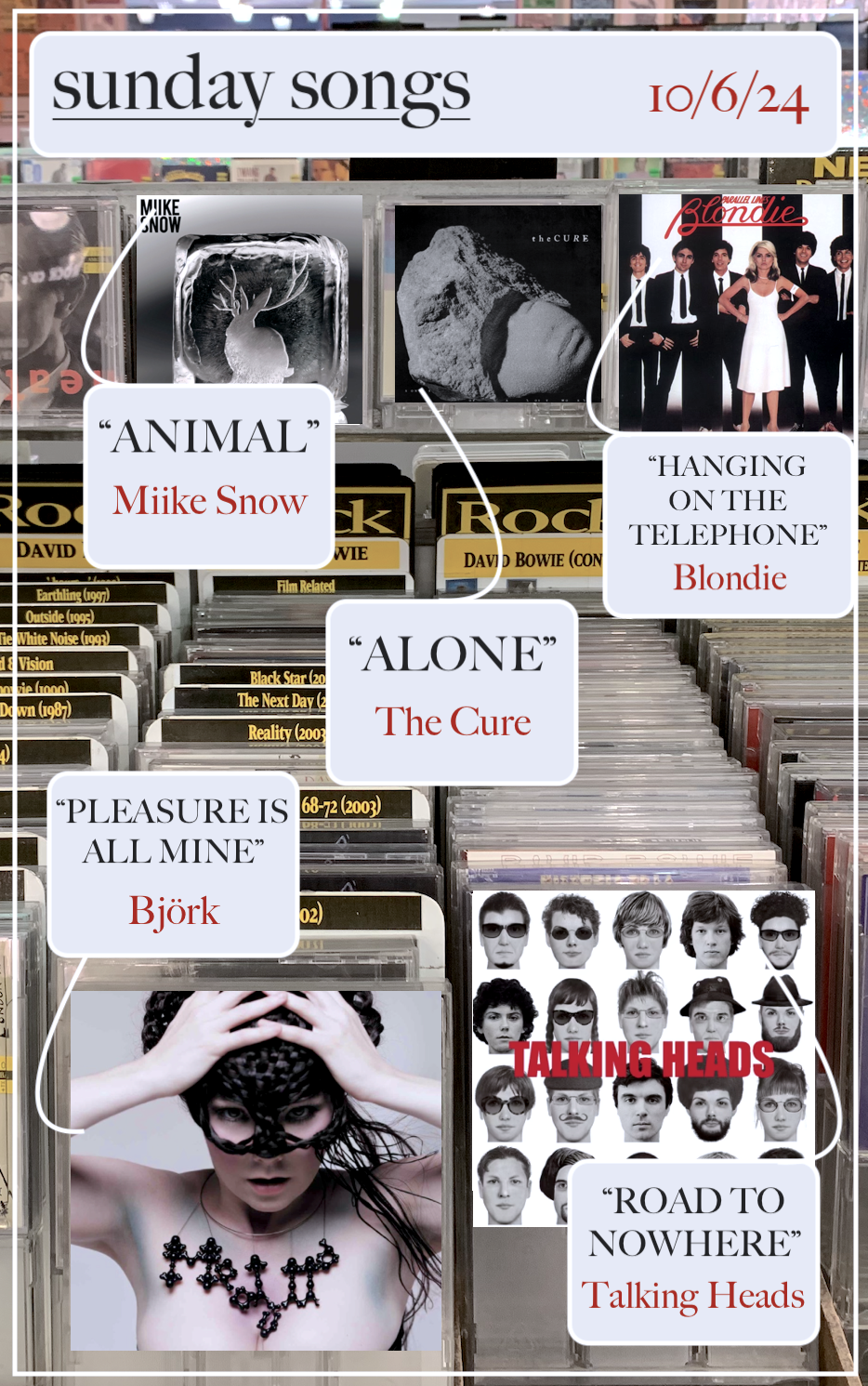
In addition, here are my Sunday Songs for each month:

AUGUST:

SEPTEMBER:

OCTOBER:

NOVEMBER:

DECEMBER:

Today’s song:

it’s finally cold enough to allow myself to listen to Victorialand! Great album to close out 2024 with.

Now, how to wrap up a wrap-up…all I can say is that I love you. My blog may not have the numbers of views and likes that it used to (even though the follower count has gone up…620 of y’all, oh my god, thank you!), but I treasure the small community that I’ve got here. I write these things mostly to write out into the world what I want to see and ramble about the things I love, but I’m grateful that, through it all, you’ve all stayed to stick it out and listen. I’ve always done it for myself and not in the service of getting more likes or views, so I’m glad that someone’s listening anyway.

I hope you all find love, solace, hope, or whatever it is you need in this coming year. In the grand scheme of things, I’m frightened (and hoping that my Canadian cousins have a room to spare up north, hahahahaha [SCREAMING]), but on the smaller scale, with the things I can control, I’m glad to be turning over a new leaf. It’ll be difficult, but I’ve built up the tools to go forward in a healthier, compassionate, and more loving way. Whoever you are, I hope 2025 brings what you need, big or small. As always: spread love, not fear or hate. Look at the stars. Keep on reading, watching, listening, and engaging with what you love. And most importantly, be kind—to others, and to yourself.

Lots of love,

Madeline

Posted in Uncategorized

The Bookish Mutant’s 5-Star Reads of 2024

Happy Monday, bibliophiles!

Some years make it difficult to focus on the good things. It would be easy for me to look back at this year and see that it’s been ruled by anxiety, because…well, a good portion of it was. I was incredibly anxious about a number of things this year, I’m on the precipice of some big transitions in my life, and we’re entering a dark time in our country’s history. It can be so all-consuming that I forgot that it did not, in fact, consume all. I do have some pretty proud achievements to count towards myself this year, but most of all, I got through it. Whatever gripped me, whether or not I should have been worrying about it, I got through it. And I’m here. And I’ll be here through 2025.

The amount of books I’ve read gets smaller every year, but it’s allowed me to be more selective. Sure, my 5-star reads shrink every year, but it’s proportional to how much I actually read. I’m more selective now that I have less time to read—that doesn’t mean that bad books slip through, but I feel like the amount of stinkers I’ve read has decreased, and I’ve expanded my DNF criteria to just mean books that aren’t egregiously bad, but that I don’t want to continue with simply because life is short. My 5-star reads this year consisted of the return of old favorites, anticipated sequels, and new-to-me books that blew me out of the water—a diverse patchwork of a rocky but ultimately fruitful year—and they were a part of what made this year good.

NOTE: I will not be including re-reads on this post; I re-read The Galaxy, and the Ground Within as well as the entire WondLa trilogy this year—obvious 5-star reads.

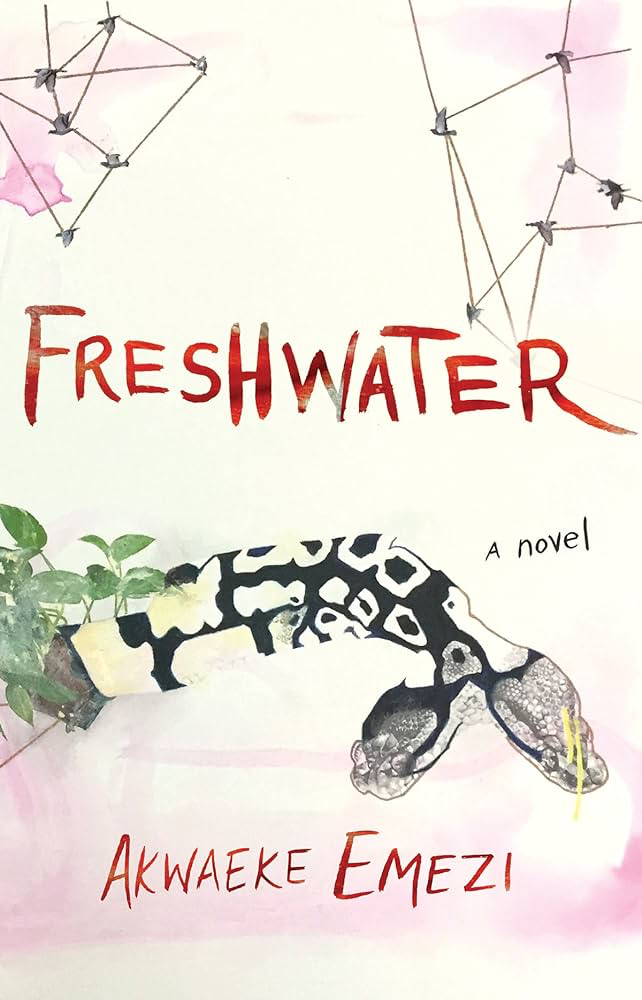
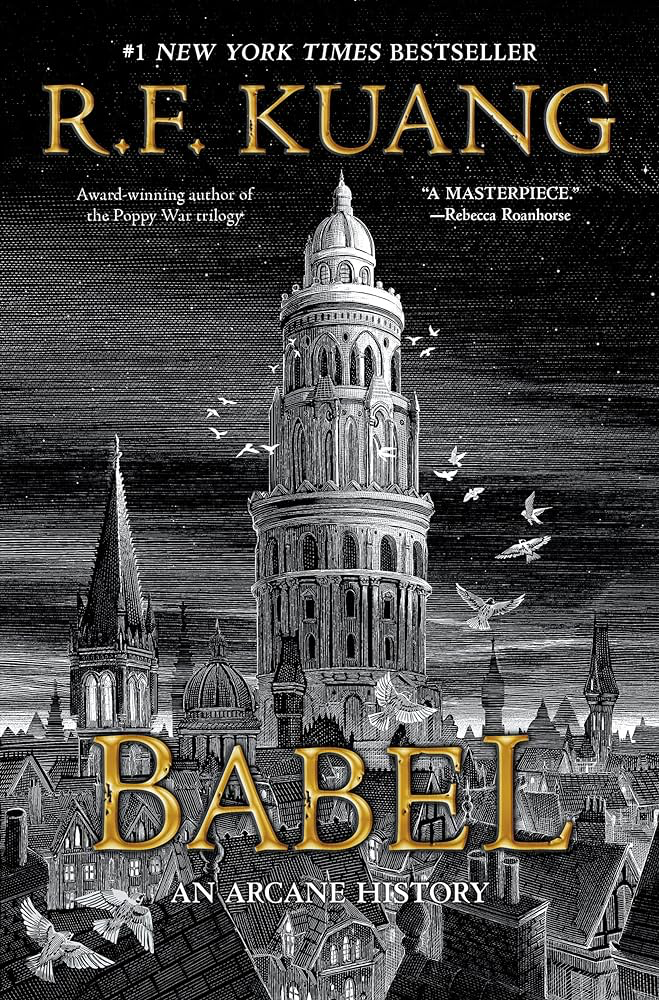
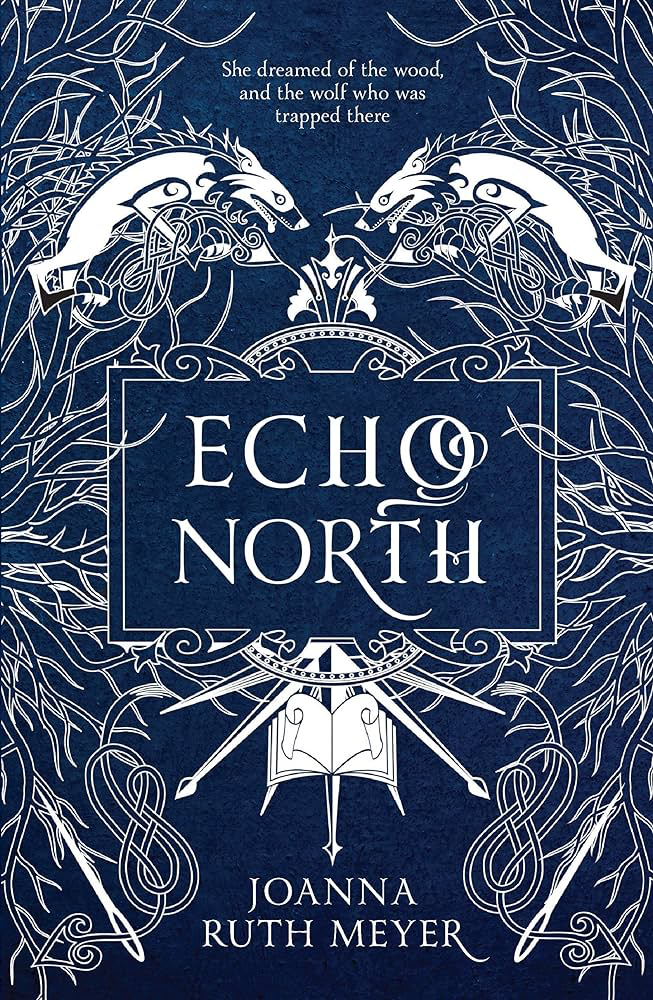
⭐️⭐️⭐️⭐️⭐️THE BOOKISH MUTANT’S 5-STAR READS OF 2024⭐️⭐️⭐️⭐️⭐️

HONORABLE MENTIONS (4.5 stars)

TELL ME WHAT YOU THINK! Have you read any of these books, and if so, did you enjoy them as much as I did? What were your favorite reads of the year? Let me know in the comments!

Today’s song:

That’s it for my favorite books of 2024! Have a wonderful rest of your day, and take care of yourselves!

Posted in Sunday Songs

Sunday Songs: 12/29/24

Happy Sunday, bibliophiles! I hope this week has treated you well.

This week: Patchwork songs, and a few too many lyrics that hit me like a train. It’s the final Sunday Songs of the year…I might as well ramble.

Enjoy the final Sunday Songs of 2024!

SUNDAY SONGS: 12/29/24

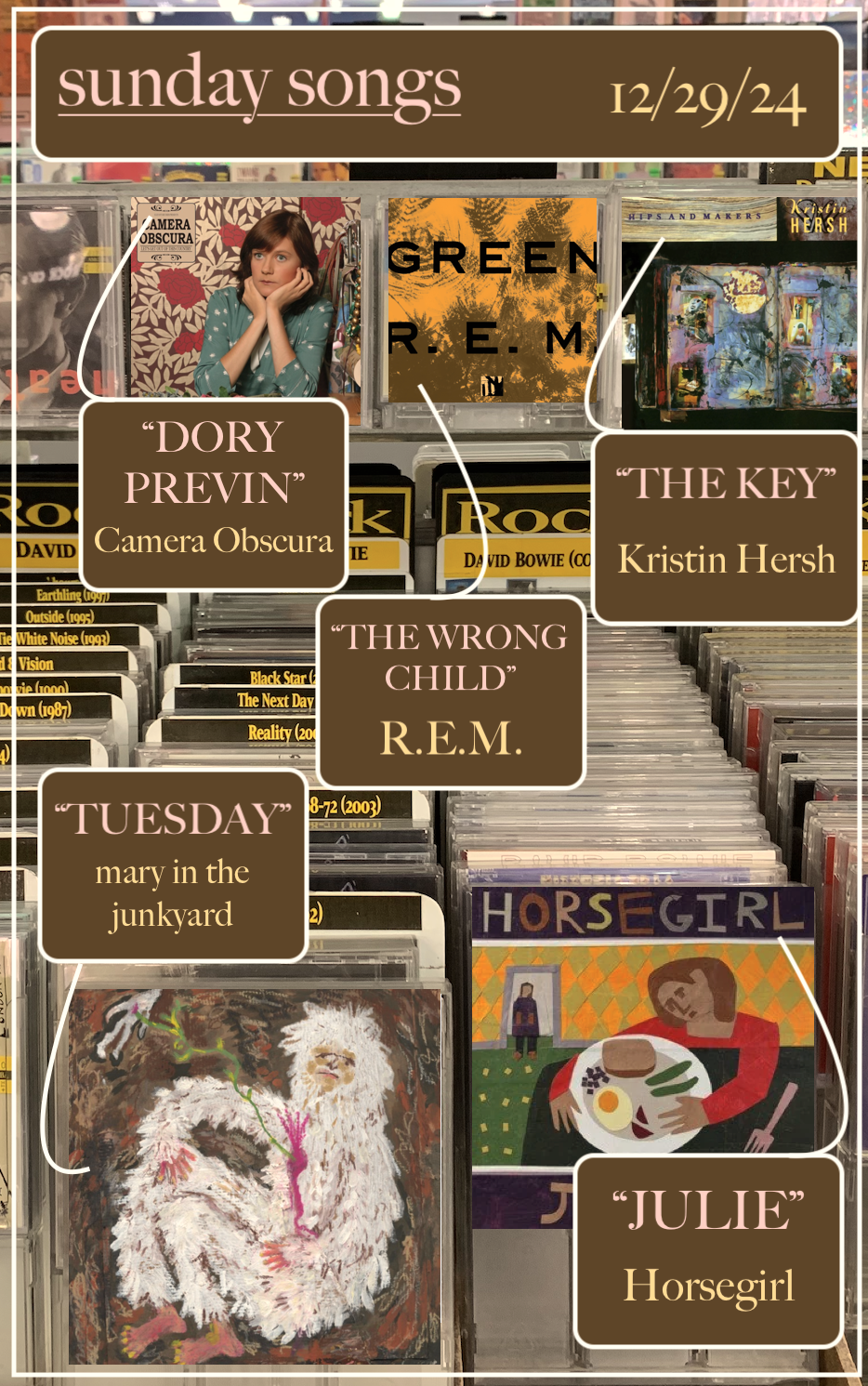
“Tuesday” – mary in the junkyard

“this is my california” was my introduction to mary in the junkyard, but “Tuesday” was what convinced me to like them. [slides glasses up bridge of nose] Having listened to their entire discography now (read: a four-song EP and three singles), I gather that, whenever it comes time for them to release an album, I’ll be happy with the product, but I really, really hope that “Tuesday” is more the direction that they go in.

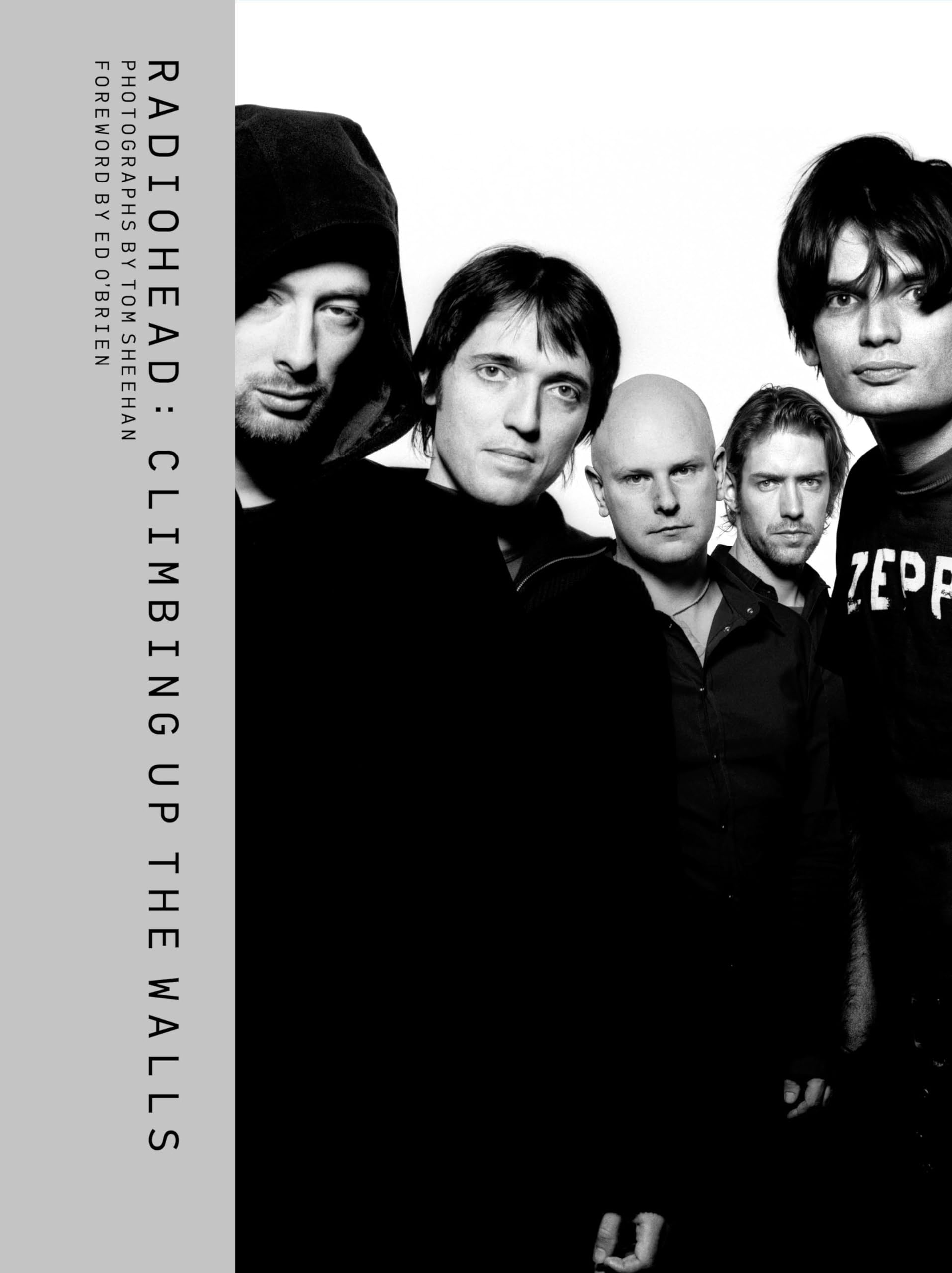
“Tuesday” might as well be three songs Frankensteined together into a neat five minutes, but in its shambling, stitched-up form, it packs an unexpected punch. Imagine: three figures hunched over a cauldron. One adds something adjacent to your typical sadgirl indie, one adds the juiciest bass-line you’ve ever heard, and another adds a skittering tribute to Radiohead’s “2+2=5.” Pieces of the patchwork monster reveal themselves in the light in the form of Clari Freeman-Taylor’s lyrics—a favorite of mine is “I feel like an alien here/Breathing from a separate hole.” As…gross an image that potentially conjures (no, not that hole, GET YOUR MIND OUT OF THE GUTTER), it’s apt for the jerkily combined spare and found parts of this song. It’s an urgent sprint through a foreign landscape, furtive as it darts into alleys and backroads as it tries to find its way around. The disheveled yeti in the music video seems more whimsical than the lyrics imply, but it’s nonetheless a story of a creature out of its element.

Freeman-Taylor, when interviewed for The Line of Best Fit, explained that “Tuesday” was written about living in the city for the first time: “[I] was feeling very small…I wanted to write about my yearning for chaos and realness—we all have wildness within us that we might be suppressing and we shouldn’t feel like aliens because of it.” Wildness and chaos are what stands out to me—”Tuesday” scampers with the speed of a frantic prey animal, cornered as it finds a new burrow to dart into. Cities and nature have a very different kind of chaos to them—a city’s chaos feels bred by the bustle of machinery and productivity, and it becomes so compressed and rushed that order births chaos; nature’s chaos comes only from the cycle of itself. That clash of opposite breeds of chaos is where “Tuesday” finds its not-so-happy, alien(ated) medium, the space between the shards of flint where the embers crack away.

…AND A BOOK TO GO WITH IT:

Beautyland – Marie-Helene Bertino – isolation, alienation, and surviving both from suburbs to big cities.

“Julie” – Horsegirl

First off: in concert with an excellent song, I have to praise this incredible music video by Daphna Awadish Golan! Her style melds so well with the collaged aesthetic of Horsegirl’s album covers and sound; the music video consists entirely of black and white footage of cities, animals, and people colored in with pastels that jump away from the grainy shades of gray.

As for “Julie” itself, the song makes me even more excited for Phonetics On & On just because I entirely can’t pinpoint the direction that Horsegirl are going in—and that excites me so much. Sure, albums have their more energetic points and their slower points, but this track is only one song away from “2468” and lands just past the halfway mark of the album. Their first album, Versions of Modern Performance, was fairly cohesive in its tempo and the invitations of different sounds and lyrical styles; aside from the instrumental interludes, there were never any slowdowns unless it was to watch a song crumble (“The Fall of Horsegirl”), but even that was crunched out and artsied-up to the extreme.

That’s not to say that “Julie” isn’t artsy, but it touches a more introspective side that the band have rarely reached thus far. The skeleton, aside from the slower tempo, is as Horsegirl as ever: guitar slides that dart around like frightened koi in a pond, buzzing synths, and a healthy dose of “da-da-da-da”s integrated throughout. (Is it really Horsegirl if there’s no da-da-da-da?) Yet the lyrics deviate from their usual style of sticking nonsense phrases together. Whether or not there’s a real Julie behind it, they extend reflection and comfort towards a figure: “Well, there’s something on your plate/You wish it was morе than you could take/We have so many mistakеs to make/What do you want from them?” It feels like an encouragement to break from monotony and form; the colored-over footage of subways in the music video emphasize that impression, but the mistakes to make feels to me like an encouragement to be human, to break free of a routine or lifestyle that isn’t necessarily crushing, but nonetheless doesn’t serve you either. With the way that the Horsegirl gang has with weird words, it doesn’t surprise me that they have something more emotional in them, but either way, it’s a promising glimpse of Phonetics On & On.

…AND A BOOK TO GO WITH IT:

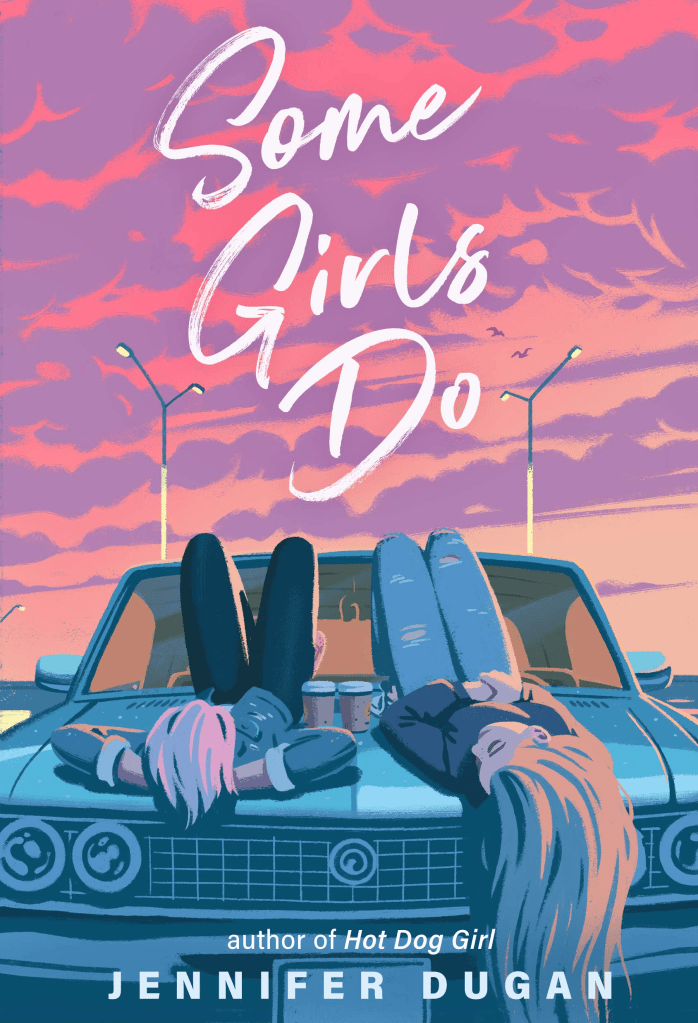
Some Girls Do – Jennifer Dugan“To have the same dream three times a week/Favors too big for you to keep/I have so many mistakes to make/Mistakes to make with you/You know I want them too…”

“Dory Previn” – Camera Obscura

The two-week gap between it doesn’t do it justice, but I’m reaping the benefits from Suki Waterhouse’s episode of “What’s In My Bag?” She’s got taste.

What is it with Scotland and cranking out soft-sounding indie pop bands in the late 90’s and early 2000’s? Does the weather necessitate that kind of tempo? No complaints of course, knowing that they produced this and Belle and Sebastian, who Camera Obscura were heavily influenced by. Even from all the way across the pond, “Dory Previn” has a nearly country twang, but it’s distinctly indie-pop, with its ever-stargazing, wistful delivery of Tracyanne Campbell’s lyrics or the muted instrumentals. The album title, Let’s Get Out of This Country, suggest more urgency, but “Dory Previn” implies that the sentiment is more out of quiet resignation; it’s a song at the crossroads, not ready to give up a lover, but at the same time “Sick of the sight of my old lover/Went under sheets and covers to get away from him.” Simultaneously wrapped up in the waning colors of the sunset and right smack in the emotional middle of 2 a.m., it feels like the exhausted yet determined position right after you’ve cried your eyes out; you’re embarrassed it took this long to decide, but you’re making a change—for Campbell, it’s the mantra-like repetition of “I think it’s time/I put him out of my mind.”

…AND A BOOK TO GO WITH IT:

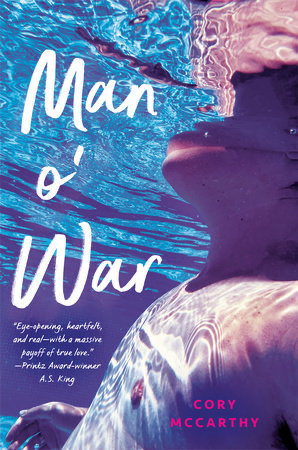
Man o’ War – Cory McCarthy“So I took a glimpse of Montana/Now nothing else matters/I’ll heal eventually…”

“The Wrong Child” – R.E.M.

Can we talk about Green? Genuinely, I think the only thing wrong with the album is that the album cover isn’t green. Probably a joke between the band members and the album artist, but the burnt shade of yellow on the cover does somehow fit how the album feels—sunny, but in a humid, Southern way. Sometimes it’s the eager yellow of energy and intent (“Get Up,” “Stand”), and other times it’s the fading yellow of a sunset over memories curling up and going sepia (“I Remember California”).

I’ve loved this album since late high school, but “The Wrong Child” was one that I was so used to skipping when it came on shuffle that it became lost. To be fair, the beginning is one of the less listener-friendly ones of the album, immediately opening with the out-of-sync clash of the mandolins and the key that Michael Stipe is singing in. (Can we talk about those mandolins? If anything else, Green will make you appreciate what a mandolin can do.) Once you stay with it—and I’m so glad I did on that fateful night in early December—it contains some of Stipe’s most evocative poetry on the whole album. The first verse should be in masterclasses about the ability of music to set a scene:

I’ve watched the children come and go/A late long march into spring/I sit and watch those children/Jump in the tall grass/Leap the sprinkler/Walk in the ground/Bicycle clothespin spokes/The sound the smell of swingset hands…”

The smell of swingset hands! It’s so specific, but I can smell exactly what Stipe is describing, the medley of the sweaty scent of skin with the tang of metal smeared all over it. There’s some gravel mixed in if I dig deep enough. I can feel the tickle of every blade of grass, each ray of sunlight. But more than that, I can feel the deep-seated aching of this song. Over the years, there have been a variety of interpretations of the song, everything from a burn victim reintegrating into society to a young gay boy’s experience of homophobia. In 2008, Stipe admitted that he’s “fine with any and all interpretations that aren’t manifested in real life as harmful, hateful or violent,” but that it was loosely centered around “a kid who is physically handicapped, and left it purposely undefined.” It is distinctly othered song. I can’t relate to the severity of what the subject experiences, but even some of it rings true for me; I did feel isolated from my peers for quite some time, in part due to my SPD, among the varied things that made me different. There was never that outright bullying, but I could see it all in the periphery, the kids that laughed behind their hands whenever I had what they saw as an overreaction to an unexpected sound—some of that “Hey those kids are looking at me/I told my friend myself/Those kids are looking at me” certainly put a bit of a knife in my gut. But this subject has become so removed from society for whatever reason that they yearn for the outside world, even if its occupants do nothing but torment them. They attempt to self-soothe, but in the end, they try to mold themself to the outside world instead of the other way around, repeating the chorus like a mantra: “I’m not supposed to be like this/But it’s okay.” And god, Stipe’s delivery of “it’s okay,” the bleeding rawness of it…oh, god. Yeah. It gets me every time. It delivers that sense that the subject is trying so hard to justify their existence and their right to play with the other kids that they’ve convinced themself that they are inherently wrong. They try and try, but never reach the happiness the other kids have, and the only way they know to try to reach it is to convince themself that they’re the problem, not the prejudice and taunting of the others. That is what any kind of prejudice does to you: it convinces you that, even if you were born in the same way as humans have been reproducing for millions of years, that you’re wrong, and not the fabricated idea of rightness taught from a young age. In the end, I’m glad that Stipe kept the subject undefined, because it does provide a kind of sanctuary, a reassurance that none of us are alone in this experience, whichever lyric rings true.

…AND A BOOK TO GO WITH IT:

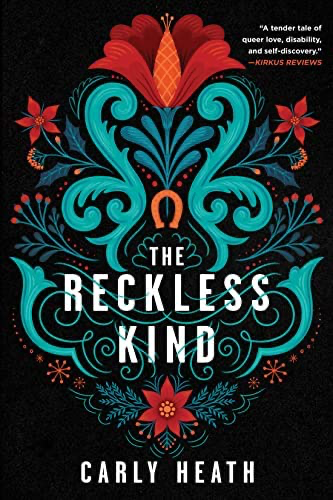
The Reckless Kind – Carly Heath“Hey those kids are looking at me/I told my friend myself/Those kids are looking at me/They’re laughing and they’re running over here/They’re laughing and they’re running over here/What do I do?”

“The Key” – Kristin Hersh

“You don’t inspire a metric ton of trust/’Cause I’m on fire, and so is all my stuff.”

There. I could just leave it at that, and it would explain the whimsical cleverness of this song, kind of like “Little Bird,” which I talked about back in July. Once again, that wouldn’t work, simply because there are just too many good lyrics here. Leave some for the rest of us, Kristin! God. So selfish. Can’t we get some of whatever creativity inspired “If I lived in a pumpkin shell/I’d have the key/And if I had a daughter/She’d look a lot like me?”

I may use the word “whimsy” quite liberally, but there’s a kind of ethereal whimsy to “The Key” that I can only describe in images. This song was a frequent visitor in my dad’s car when I was young; I associate it the most with nights spent on the car ride back from dinner or road trips. As the sky darkened, so did the images in my mind—not in emotion, just in the amount of light that was let in. Kristin Hersh felt candlelit, the kind of music meant to soundtrack a child’s nursery in the early hours of night. The lyrics nearly call to mind Lewis Carroll—save for the absence of made-up words, I wouldn’t bat an eye if you attributed “Copper and snow/Make a dusky blue boy” to one of his poems, if he’d condensed them more. Less British, of course. (Maybe that’s for the best.) We’re not getting too “Walrus and the Carpenter” with it, but we sure are close. “The Key” is inherently soft; in that children’s bedroom, dated maybe 100 years ago, with flowery, peeling wallpaper and lacy curtains, I can see a pink, plush blanket over a bed tucked in the corner, yellowed by a lantern on the dresser. Hersh’s fingerpicking has a comforting repetition to it, chords blending into each other as gently as freshly-washed hair splays out across a pillow. In between all of these images, there’s a ballerina in a music box that squeaks as it spins in a circle. Sometimes it’s the one I had as a kid, sometimes there are subtle tweaks—longer hair, different painted eyes. Like that music box, the repetition is soothing in a way that few songs are—the song’s outro of “and we’d dance all night” is a promise, and one filled with golden-lit joy to come. As Hersh’s guitar fades out, I see that mother and daughter, dancing in circles. I didn’t quite get it when I was younger, but that repetition, that security, swaddled me up like a blanket.

…AND A BOOK TO GO WITH IT:

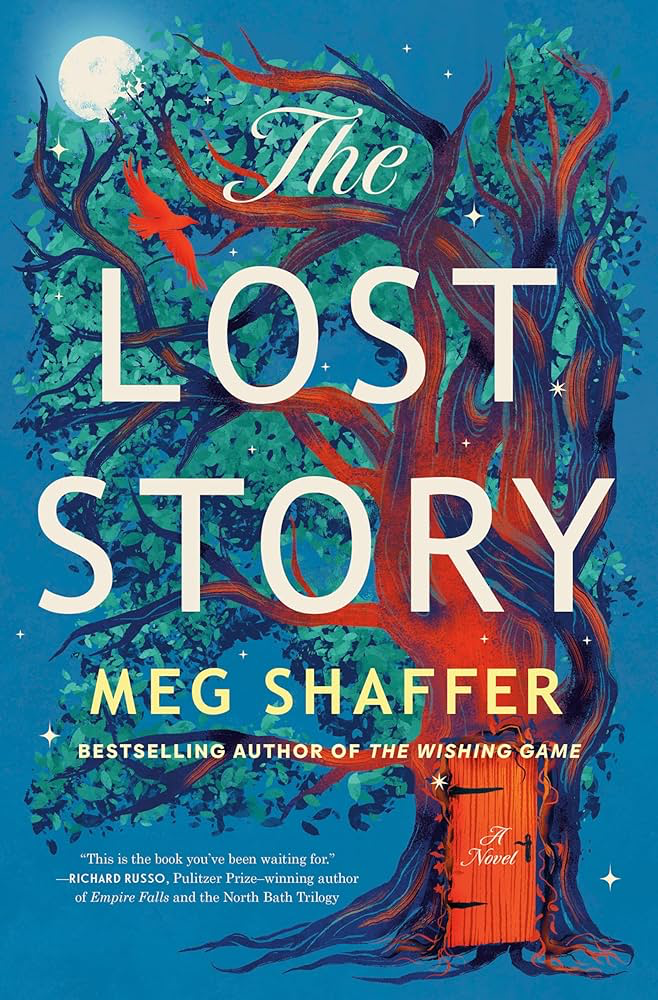
The Lost Story – Meg Shaffer“If I lived in a pumpkin shell/I’d have the key/And if I had a daughter/She’d look a lot like me…”

Since this post consists entirely of songs, consider all of them to be today’s song.

That’s it for the last Sunday Songs of 2024! Have a wonderful rest of your day, and take care of yourselves!

Posted in Sunday Songs

Sunday Songs: 10/13/24

Happy Sunday, bibliophiles! I hope this week has treated you well.

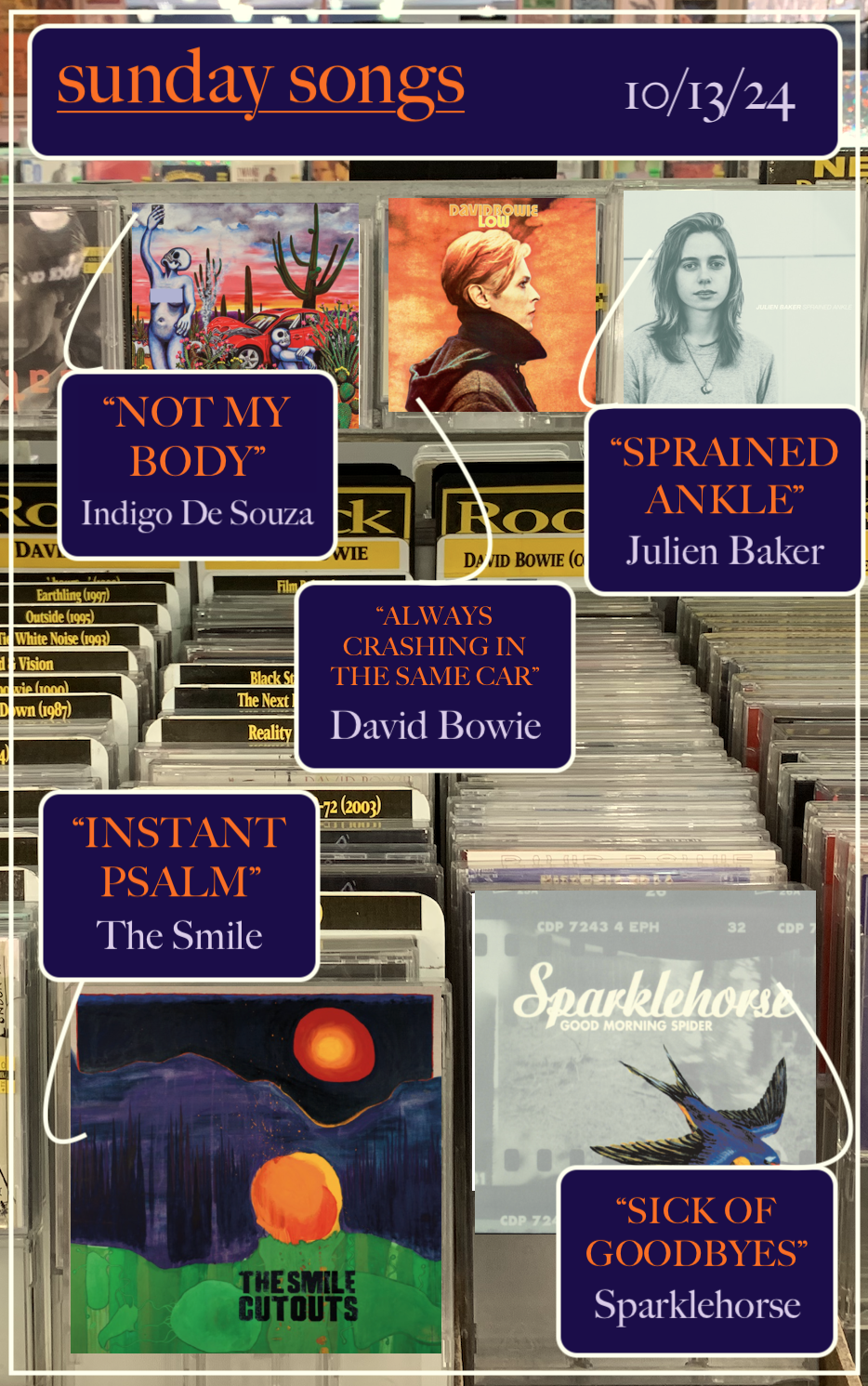
Apologies for the lack of a Sunday Songs last week and a Book Review last week—midterms are one helluva drug. Either way, I have been able to read some fantastic books, so expect a fun review next week. For now, here’s my graphic from last week:

10/6/24:

This week: MOM!!! MOM, MADELINE’S GOING AFTER THIN WHITE DUKE APOLOGISTS AGAIN!

Enjoy this week’s songs!

SUNDAY SONGS: 10/13/24

“Instant Psalm” – The Smile

Unprecedented opinion by me: Cutouts, the second album from The Smile in 2024, was…a slight disappointment. Are all of the songs good? Absolutely—this is The Smile we’re talking about, remember? And yet, even though the talent is all there, well-crafted songs don’t make up for an album lacking in cohesion. If they knowingly named the album Cutouts for this reason, it might make sense, but it really does live up to the name; these are the scraps, but for a band as artfully skilled as The Smile, the scraps will be treasures. Even if Cutouts meanders this way and that without the direction of A Light for Attracting Attention, the moving parts are spectacular.

Take “Instant Psalm.” I love when I just have the gut feeling of knowing that a song will rearrange my molecules after only listening to a 30-second snippet of it. From the minute the strings sunburst into existence, you feel that light blooming in the back of your mind. To say that this song only starts would do it a critical injustice: it awakens in the same way a flower does, the same way a cloud of spores puffs from a stomped mushroom, all of its glistening tendrils erupting in slow motion after the joyous moment of birth. “Instant Psalm” lyrically contains about the same existential dread as any other The Smile track, but I’d place it somewhere near “You Know Me!” in terms of siblings; these glistening tendrils have heralded the manipulation that the former track ushered in, and now, all is left is a kind of mental automation where your mind knows that what it’s doing is wrong, but cannot let go of what’s coiled around it: “yes is not a real yes.” It’s so calm in its submission, and that “Instant Psalm” feels like sparkling dust blown into the eyes, the kind that clogs them up enough that they no longer see reality. If there’s anything highly specific that The Smile has excelled in, it’s making songs about submitting to corrupted, outside forces sound so soothing and sleepy. Again: precisely the point.

…AND A BOOK TO GO WITH IT:

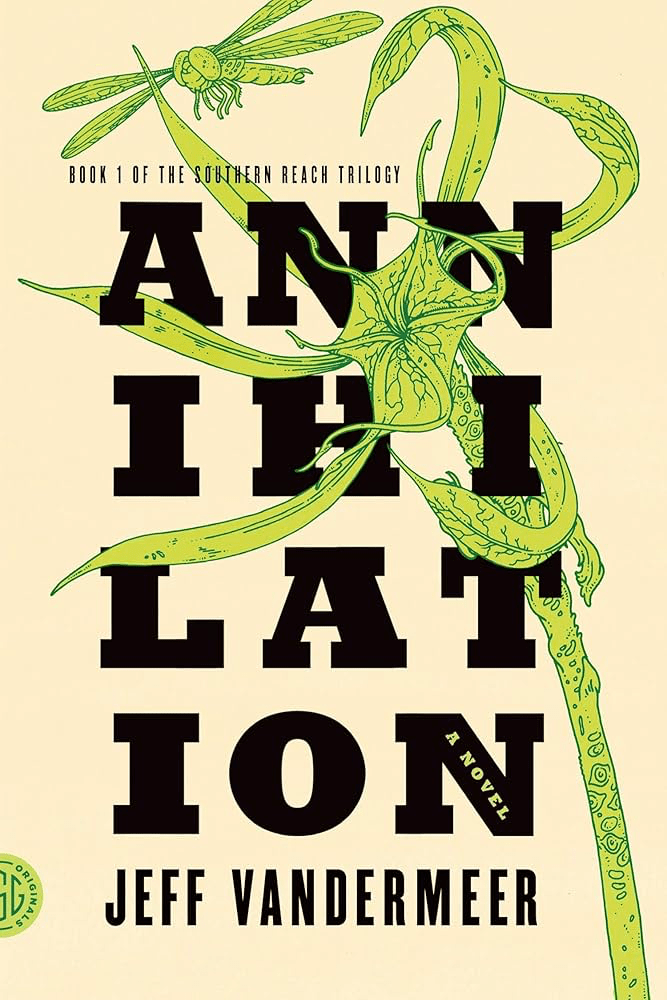
Annihilation (Southern Reach, #1) – Jeff VanderMeer“We can slide through this narrow gap/The narrow gap that you leave us in/And we feel you near/But so close that you disappear…”

“Sick of Goodbyes” – Sparklehorse

Listening to It’s a Wonderful Life prompted me to return to one of my many depressing high school lovers: Good Morning Spider, the album that preceded the former. I thought “Sick of Goodbyes” was okay back then, and given how much I suckled on that album like a baby bottle, “okay” is harsh. Compared to the irresistible draw of the melancholy of “Sunshine” and the adrenaline-blooded screech of “Pig,” this one stuck out like a sore thumb. Why is it so twangy? And my God, is it actually…upbeat?

To be fair, it really does stick out oddly in Sparklehorse’s catalogue, and for how odd Sparklehorse sounds, that really is saying something. It somehow lies at the crossroads of alt-country and punk, where scratchy guitars meet the place where Mark Linkous hefts his Southern twang into the spotlight. It’s got a vigor that few other songs on Good Morning Spider have (save for “Pig”), but the emotion behind it is no less of a punch to the face than the rest. Linkous’ specialty has always been stirring the surreal into his lyrics like a witch tossing strange objects into a cauldron, and “Sick of Goodbyes” has what I think may be one of his best weird one-liners: “no one sees you on a vampire planet.” No beating that, right?

But beating between lyrics like that is one of the sparer sentiments, but there’s no making it flowery: “I’m so sick of goodbyes.” It is sad in the way that a Sparklehorse song typically is, but the fury behind it makes it seem almost intent on healing. It’s a recognition of wanting to free yourself from the wallowing that you’ve been doing, and saving up all of the energy to declare as such. It’s not lost on me that the final belt of the chorus cuts off at “I’m so sick,” but I can’t not see the momentum. There may be no motion yet, but all of that energy has formed legs that are willing to stand, legs that are willing to rise from the muck and power forwards. “I’m so sick of goodbyes” feels like that spark of energy after you’ve gone through the first, ugly period of your grieving and realizing that you’ve spent so much energy on the dead that you have forgotten to go on living.

…AND A BOOK TO GO WITH IT:

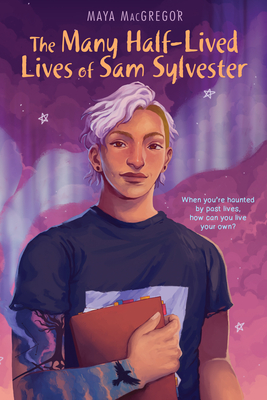
The Many Half-Lived Lives of Sam Sylvester Maya MacGregor“If I could just keep my stupid mind together/Then my thoughts would cross the land for you to see/No one sees you on a vampire planet/No one sees you like I do…”

“Not My Body” – Indigo De Souza

“Not My Body,” with De Souza’s intro, starts at 8:02.

While I ping-pong on whether or not I should listen to Any Shape You Take or All Of This Will End in my ongoing Indigo De Souza journey, I watched their Tiny Desk Concert, taken from the period of the latter. When introducing “Not My Body,” she said this about the song: “I think that when I die…what I want is to be composted and to become soil, and for that soil to be used to plant a tree, and I want that tree to be so big and strong. I don’t know what kind of tree yet—still thinking on it—A tree that people can visit and be like, ‘This is Indigo!'” Thus, she joins Peter Gabriel and his oak tree in what I imagine is a growing forest of reincarnation. It’s a soothing thought, to be reborn in the cells of something so sturdy.

Do you ever get those moments where you stop and have this realization that out of the billions of people on this Earth, that you are you, and by some roll of the dice, this is your life, this is your body, and this is who you are? It’s been a recurring thought lately. Those memes about gaining consciousness at age 4 in the middle of a Chuck-E-Cheese honestly hit the nail right on the head. For whatever reason, it’s been a recurring thought as of late. Not ideal for when I’m supposed to be listening to lectures, but it is a humbling reminder. As disembodying as those moments are, they remind me that yes, I do have the reins on this body. De Souza describes “Not My Body” as an ode to nature, and it taps into that feeling of being so conscious of your existence yet, for a moment, a spectator of it: “I’m not my body although you see me/Making moves and walking freely.” Nature, for me, is the missing key in this equation; the redwood tree that De Souza wants to be is the ultimate symbol of groundedness and connectivity—it is rooted in the earth, but its roots connect to all points in the wide world above and below it. There’s a happy medium between awareness and not feeling like you’re adrift in space, and nature has figured it out. And what better way to end such a sentiment than the last third of “Not My Body?” The way De Souza fashions their voice like a theremin, those echoing electronics that almost sound like dolphin calls, the gentle collapse of all the instruments into a single, coalescing being?

…AND A BOOK TO GO WITH IT:

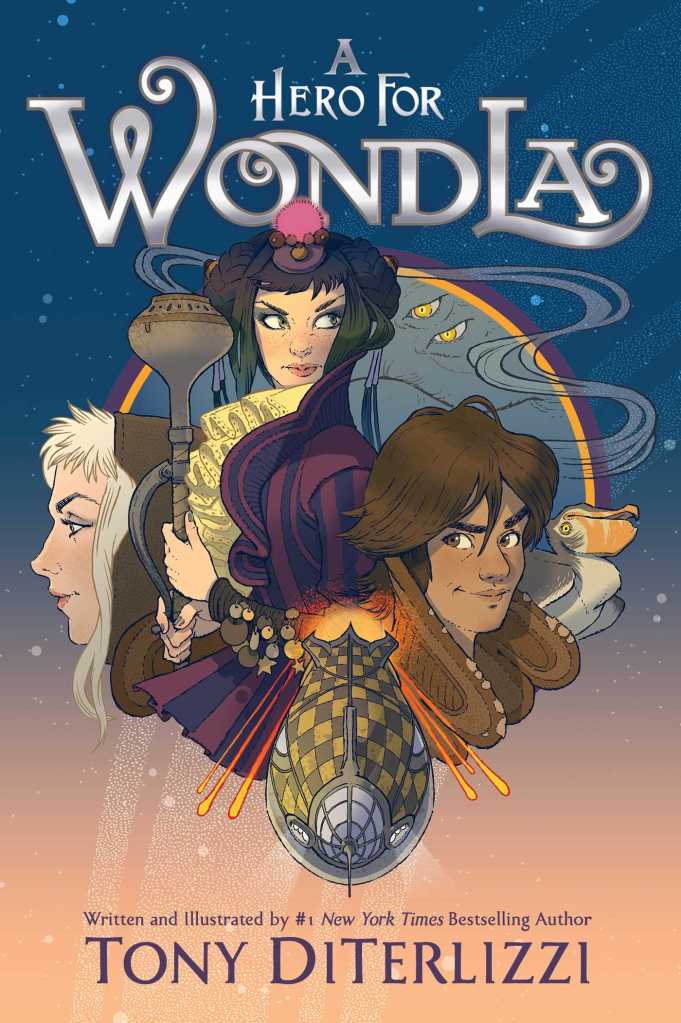
A Hero for WondLa (The Search for WondLa, #2) – Tony DiTerlizziwithout spoiling anything…Eva Eight arc, perhaps?

“Always Crashing in the Same Car” – David Bowie

If you mistook the title of this song for a commonplace idiom, I wouldn’t blame you. Frankly, it should be one. It’s memorable, it’s effective, and it’s a Bowie reference.

Low came at a deeply fraught time in David Bowie’s life. His Berlin trilogy of albums came on the heels of his darkest period, one where he committed actions that he disavowed until his dying day. Hence why I’m always suspicious and disdainful of Bowie fans who think that the Thin White Duke is somehow the “deepest” of his personas. Oh, okay, do you think you’re cool because you like the Bowie who was taking so much cocaine that it addled his brain enough to the point that he had a brush with Nazism? This is the period that Bowie spent the rest of his life thereafter vehemently swearing off (see: “Under the God“), and every clip from that era shows that he was clearly not of sound mind and body. Taking a critical look at the period is one thing, but being so uncritical about a period that Bowie so clearly wanted to forget takes a certain kind of thickheaded edgelord, in my humble opinion. It took him years to return to reality, and the Berlin trilogy chronicles his long and rocky journey towards healing, not to mention getting clean.

The circumstances surrounding “Always Crashing In the Same Car” are a fragment of Bowie’s period of addiction, an instance where, high out of his mind, he rammed his car into the car of his drug dealer. Yet there’s such a calm to this track, both warm and cold. It’s as though Bowie is watching his own life as a spectator, watching the car spiraling out of control from high above the clouds. His voice is placid, restrained, as he resigns himself to the song’s title, doomed to make the same mistakes. Apart from the crooning towards the conclusion, his voice never leaps—what does is the soaring guitar riff that seems to unfold Bowie’s ladder into the sky, from which he can watch his life from a safe distance.

Even if I haven’t gotten to such extreme lows in my life (please hold an intervention if I somehow do, good god), that kind of distance what makes the message of the song land. Breaking out of cycles and unhealthy habits is one of the hardest things a person can do, in my opinion. The effort it takes to change is outweighed by the ease of staying stagnant. You know you’re crashing in the same car, and yet your hands grip the wheel anyway. A few months, I made a commitment at the beginning of the month to stop being consumed by trivial thoughts, and I found myself trapped in an even worse cycle of anxiety just days later. The internal work I did that month was some of the most mentally strenuous that I’ve had in a while—it was far too easy to fall back on ineffective, harmful coping mechanisms than to put in the work to claw myself out of that pit of misery. I’m still working on it. But I’ve put in work. It’s taken a lot of clawing, but I’m growing the armor. Listening back to “Always Crashing in the Same Car” after all that mess gives it a whole new meaning—maybe the triumph I feel from that truly glorious guitar solo is symbolic of how it feels to climb through the sunroof, out of the wreckage, and into the light, knowing that the hard work of breaking these patterns is done.

…AND A BOOK TO GO WITH IT:

Beautyland – Marie-Helene Bertinothe narration of this novel feels the same as Bowie’s singing here: a kind of cool, matter-of-fact distance through which the world is observed, but not without some warmth.

“Sprained Ankle” – Julien Baker

From all accounts, it seems like Julien Baker has something new cooking up post-boygenius, and…hoo, boy. Am I ready? Nope. Nevertheless: I will listen. I will cry. (I already love “Middle Children” and “High in the Basement,” what can I say?) It seems simultaneously like ancient history and the blink of an eye away from when I first discovered Julien Baker, when, halfway through junior year during COVID, I listened to Sprained Ankle while I was a miserable puddle of grief and burnout. Whether or not that’s the only state you can properly listen to Julien Baker without curling up in a ball and crying is debatable, but…the only way out is through. Dramatic expression for weathering an album, I know, but there’s something gratifying in knowing that I’m a happier, stronger, and more healed person than the person I was when Little Oblivions came out in 2021. To my mom: consider this a formal apology for making you sit through almost a-capella Julien Baker depression while driving to school while it was barely even light out.

In the barest sense, Baker was working with what she had. She didn’t have any backup instrumentalists and recorded this in college at age 20, so there wouldn’t be any accompaniment other than what she played herself until Little Oblivions, alternating between guitar and piano. Yet there is no other way that “Sprained Ankle”—or any of the songs on Sprained Ankle—could have been made. It’s a lonely, self-deprecating, and wound-stingingly raw album, and outside of the lyrics, it sounds lonely. Like the bare, unadorned background of the album cover, many of the tracks feel like being in a cramped room with only the sound of your negative thoughts to keep you company. I realize how awful of an endorsement of Baker that is, but in that dreary state of 17, that was just what I needed. (To be fair, it can get to be too much—“Go Home” was exceedingly hard to listen to even back then, which is really saying something.) In the sparse, Baker creates a kind of confessional solace. Confessions are how “Sprained Ankle” starts off, after all: “I wish I could write songs about anything other than death.” There’s a self-awareness to the sadness, but like “Always Crashing In the Same Car,” the engine is running on borrowed fuel, and the marathon runner is sprinting on sprained ankles. Beyond the metaphor, Baker’s voice is meant to be the loudest thing on this record—like the cramped room, it echoes off the walls it’s given, an oral manifestation of the feeling of knowing that all you’ve got is your body. It would take a few years for it to reach the soaring heights of “Claws In Your Back,” but from the start, Baker always knew she had an anchor in her music—the instrument of her wobbling yet lighthouse-beacon piercing voice.

Now that I’ve mentioned “Claws In Your Back,” I can’t not link this dazzling performance from Baker with the National Symphony Orchestra…dare I say I haven’t felt goosebumps quite like this in years?

…AND A BOOK TO GO WITH IT:

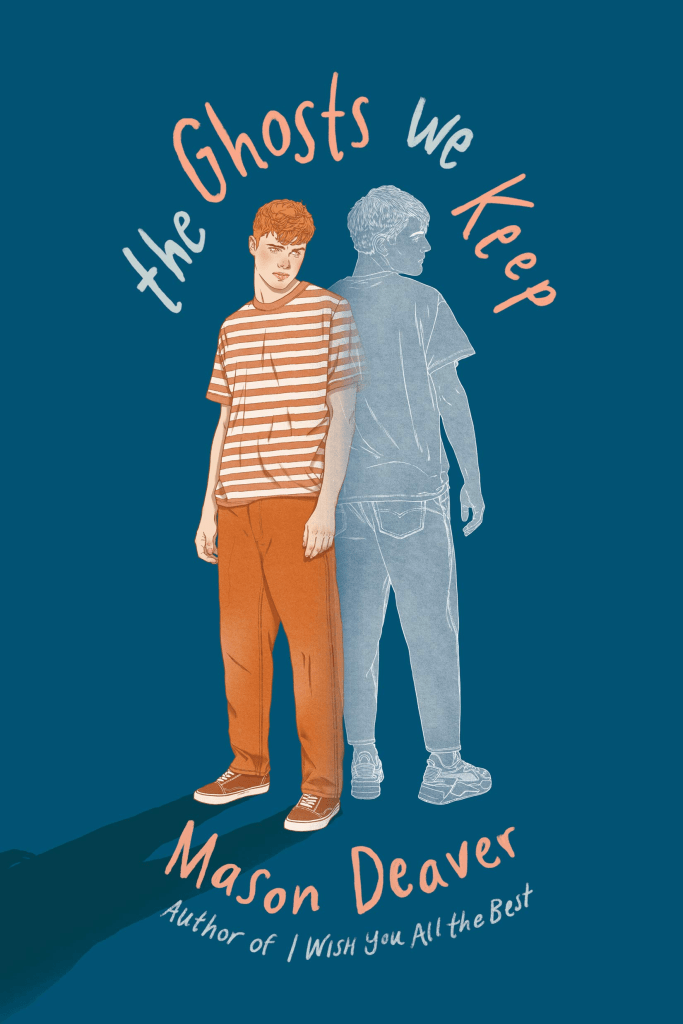
The Ghosts We Keep – Mason Deaver“I wish I could write songs about anything other than death…”

Since this post consists entirely of songs, consider all of them to be today’s song.

That’s it for this week’s Sunday Songs! Have a wonderful rest of your day, and take care of yourselves!

Posted in Book Review Tuesday

Book Review Tuesday (8/13/24) – Beautyland

Happy Tuesday, bibliophiles!

As far as science fiction goes, I’m not usually for the literary side of it—that goes for most literary novels of any genre, to be honest. I’ve often found that the sci-fi part is dulled in favor of mass appeal. But the premise of Beautyland fascinated me, not just as a science fiction reader, but as someone who’s grown up feeling like an alien. Surprise, surprise—I cried.

Enjoy this week’s review!

Beautyland – Marie-Helene Bertino

Philadelphia, 1977. Humanity has given the gift of Voyager 1, along with its landmark Golden Record, to space. Unbeknownst to us, a power hidden deep in the cosmos has given humanity a gift in exchange. At the same time as the launch of Voyager 1, a baby is born to an unknowing mother, not human but alien. Her mother names her Adina, and as Adina grows older, she learns how to communicate with her kinfolk in space, reporting the oddities of human life and culture through an old fax machine. As Adina pretends to be human, she experiences the joy and terror of human existence, but longs for closure—will she ever be able to return to her homeworld?

TW/CW: cancer, sexual harassment, loss of loved ones, pet death, bullying, grief, 9/11 themes (brief)

One of the best feelings is when you pick up a book that you’re interested in, but not expecting anything marvelous from, and then getting absolutely pied in the face out of nowhere with the feeling that this book gets me. Setting aside my reservations for literary sci-fi, Beautyland digs into the heart of my experience growing up—of feeling alien, but of cataloguing all of the nonsensical facets of American culture and the feeling of not belonging. I cried. I laughed. I had an echoing pang in my chest for a while. Like life, all of it was worth reading and living.

Observations about the human condition formed the heart of Beautyland. Through Adina’s messages on a fax machine, she reports to her alien superiors on everything from the oddities of American culture (“When it was time to decide the official food of movie-watching, human beings did not go for Fig Newtons or caramel, foods that are silent, but popcorn, the loudest sound on earth”) to the painful and uneasy truths of human existence (“The ego of the human male is by far the most dangerous aspect of human society”). Bertino’s writing shone the most when chronicling Adina’s observations. She adopted a blunt, matter-of-fact tone of a distanced journalist, someone watching our species from the sidelines, yet always managed to wring the emotion from it, be it humor or sorrow. The wonder of Adina when she visited her superiors at night, in a vast room inside of her mind, was just as palpable, capturing her childlike curiosity. You felt every joy of Adina reporting back on the eccentricities of humanity, and every sorrow once Adina matures and realizes the dark side of our nature. The eventual abandonment of her superiors as she grew older drove the point home even more—at a certain point, nobody can answer these questions for you, and you realize that you don’t have the answers, and neither does anyone else. All that’s left to do is live your life, and observe.

Though it wasn’t outright said or diagnosed, the neurodivergent themes of Beautyland were what stuck with me the most. (I have sensory processing disorder, and, among other things, I felt Adina’s growing discomfort with sensations as simple as hearing people breathe and chew.) Whether or not you believe that Adina is actually an alien, the experience of being on the fringes and unable to understand not just other people but their actions deeply resonated with me. As Adina moves through middle and high school and is ostracized by her more popular peers and tries to scientifically observe them, she’s confronted with a frequent feeling of questioning why it has to be this way: why are these girls looking at me like I’m gum on the bottom of their shoes? Why is not wanting sex such an affront to men? Why don’t they like me? That feeling of knowing something’s missing, but being unable to find it, put into words a feeling I struggled with through my adolescence, a sense that everybody else knew something I didn’t, and that was what made me so strange to them.

I read Beautyland as both science fiction and historical fiction; some people have put it up in the air as to whether or not Adina actually is an alien, but I think the answer is…yes. Both can be true. I’ve grown up in a similar way to Adina, feeling so on the outside of everything that I’ve attached myself to science fiction and alienness in general. Like Adina, it’s informed by some neurodivergence and general outsiderness, but there’s something to be said for all of the questions presented being true. Yes, she may be an alien sent from an advanced race beyond the solar system, and yes, she has some neurodivergent tendencies as well. The two can coexist. And Beautyland’s embrace of how these qualities can intersect was what made it so impactful; this experience fundamentally makes us human, even if it makes us feel alien. I often see criticism of alien or robot characters who are characterized as “inhuman,” but what makes them inhuman boils down to them just having the traits of neurodivergent people (“lack” of emotion, misunderstanding of how humans work) and those on the asexual/aromantic spectrum (no desire for romance or sex, that which “makes us human”), and I think it’s a valid criticism to apply to characters who are written thoughtlessly. But who’s to say that an alien character like this can’t also be neurodivergent and asexual? Again: the two can coexist. Bertino wrote Adina as a character with a deep understanding of human culture, and that, to me, does not skew the reading of her as asexual and neurodivergent.

Somehow, one of the most emotional parts of Beautyland for me was how Bertino wrote about Carl Sagan. As I mentioned before, the novel is written in fragments, not always linearly, but taking frequent detours outside of Adina’s immediate life and into moments of relevant pop culture at the time—the popularity of Carl Sagan being one of them. With her connection to the Golden Record and the absence of her own father, Adina looks up to Sagan as a surrogate father, someone who can teach her more about the cosmos from which she was born from. Even having never met him in person, the way that Adina processed Sagan’s death was where I lost it; this is one of her first experiences of loss, and it’s the loss of someone who has unknowingly guided her through her alien life, teaching her about the universe, and by proxy, given her a roadmap of the human condition. Fleeting as it was, Bertino wrote this instance—and the connection to Sagan in general—with the kind of love of someone you feel like you’ve known all your life, but have never even met.

All in all, a deeply human exploration of what it means to be alien. 5 stars!

Beautyland is a standalone, but Marie-Helene Bertino is also the author of Parakeet, 2 A.M. at The Cat’s Pajamas, and the short story collection Safe as Houses.

Today’s song:

new Smile!! not my favorite, and I can see why they left it off the album, but a solid track nonetheless.

That’s it for this week’s Book Review Tuesday! Have a wonderful rest of your day, and take care of yourselves!