Posted in Book Review Tuesday

Book Review Tuesday (7/29/25) – Redsight

Happy Tuesday, bibliophiles!

As Disability Pride Month comes to a close, here’s one last book to finish off the month. This one has been on my TBR for at least a year, and it’s evaded me in the library thus far—thankfully, Barnes & Noble finally brought my chase to an end. Even though I’m growing a little weary of every new sci-fi that hinges on the promise of “incomprehensible space religion, woooooo,” Redsight provided a fascinating twist in the subgenre.

Enjoy this week’s review!
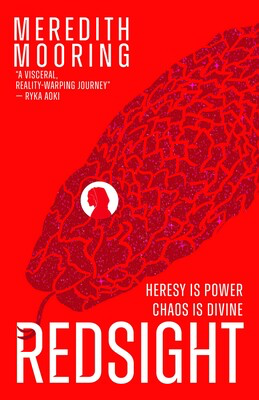
Redsight – Meredith Mooring

Korinna knows that she is doomed to a life of obscurity. Even though her being a Redseer gives her the power to manipulate space-time itself, she is the weakest of her order, and little mercy is shown to the weak. Resigning herself to a position navigating a warship for the treacherous Imperium, Korinna is at war with herself. But when the warship is boarded by strange pirates, Korinna learns that she has power beyond comprehension—all deliberately hidden. With her newfound abilities and a desire to uncover the secrets of the Goddesses that once ruled the galaxy, Korinna searches for answers, but what she finds may be more dangerous than she could have ever bargained for.

TW/CW: violence, gore, blood, death of children (off-page)

In the last six or seven years, I’ve seen a major trend in science fiction where the plot centers around an ancient, ominous Space Religion™️ (see: Gideon the Ninth, The First Sister, The Genesis of Misery). It’s a Thing. The usual suspects include an AI/vague cosmic entity deity, some form of cult, vague to overt references to Catholicism, and repression. I’m honestly fine with all of these things—in fact, having a cultish religion on an intergalactic scale is often a fascinating way to set up a story, and can be used to many ends, whether it’s deepening worldbuilding or critiquing organized religion in the real world, as it often does. My problem was that it’s everywhere. I feel like every other space opera I find is some kind of retelling of Joan of Arc or “what if God was real and it was a robot and the robot wanted to kill you?” Again, interesting once or twice, but after a point, they all start to blend together. On a personal level, I guess it’s partly because I don’t often connect as deeply to stories about religion/religious trauma, but I swear every other adult sci-fi book out there is like this.

Redsight is one of those books. However, it had enough different aspects that it was separated from the rest for me. It honestly veers into space fantasy at times, toeing the line between that and space opera expertly. Even though the redseers and all of the other witches in the universe had a slightly similar structure to some other books I’d read (spooky magic, incomprehensible goddesses trapped in tombs for thousands of years, etc.), it was Mooring’s exploration of how this insular cult of witches affected the outside world that stood out to me. The space-time manipulation is awesome, first off, but there’s also a host of space pirates, sprawling libraries, and transformative magic that goes…wrong. Snakes are involved. Also, Korinna and the others don’t exist in a vacuum—they’re a small part of a massive galaxy and are entangled in all manner of messy, manipulative politics throughout the universe. (There’s a strong Bene Gesserit vibe going on…I guess Dune might be to blame for the big spooky space religion trend?) They are outwardly very strange to others, and they don’t feel self-contained, as some other similar books are—they felt like a small part of a much more expansive world, which is what set it apart. Plus, I loved how it served as a critique of both that can come from organized religion AND the corruption that spreads into imperial politics—it’s all a great examination of systemic corruption, which I enjoyed thoroughly.

One of the more unique aspects of Redsight was how disability was handled. Up until we leave the Navitas, where all of the redseers are trained, pretty much all of the characters you meet are blind. All of the priests and priestesses of Vermicula are blind, and the way that Mooring shows us how it’s accommodated in the universe is fascinating. Through the power of redsight, they can sense most everything they need to sense through…well, manipulating the fabric of time and space, which is pretty badass in and of itself. But beyond that, I love how many intricacies to Korinna’s life are detailed. We see how she senses space around her with her blindness, how the Order of Vermicula produces special tactile books so that everyone can read the holy texts, and how she navigates the universe without being accommodated like she was within the Order. Knowing that Mooring herself is blind, I’m sure that she thought of everything when it came to how Korinna would navigate the universe, accommodations or not, and it showed through in her writing.

If you’re looking for a twisty book, then Redsight is the book for you! Even though I feel like I’m iffy when it comes to predicting twists, the ones in this novel had me constantly guessing. Mooring nails a critical combination of a very slow-burn first third of the novel, gradually building tension, while also throwing out a red herring where you think you know what the big mid-book reveal is, but…oh boy, I did not. (Red herrings, Redsight, red witches…lots of red in this book! Say, what’s that pooling on the floor?) In all seriousness, Mooring did an excellent job of creating tension and putting up all manner of red flags and misleading clues, and they came up organically: they were both the result of Korinna not knowing any better and the propaganda and narrative control that both the Order of Vermicula and the Imperium had over the knowledge that was passed onto her. It deepened the worldbuilding and the pacing of Redsight…for the most part.

All that being said, the ending was quite rushed. With as much buildup as this novel had, it was kind of bound to happen. All things considered, Redsight is Mooring’s debut novel, so I can let some of it go, because I enjoyed the majority of it. But there was just far too much crammed into the last 100 or so pages of the novel. Even with the theme of undoing systemic corruption, the speed at which it happened was truly just bonkers. For the truly mind-boggling, cosmic scale that everything in Redsight happened in, it seemed illogical that everything that happened in the novel would’ve been able to happen so quickly. After all of that, it was wrapped up strangely tightly—the loose ends were tied up basically because…the Goddesses can just do whatever, and it’s fine. I guess if you’re dealing with universe-creating Goddesses, by that logic, they can also clean up messy endings? It felt cheap. For the amount of time spent just on the buildup in the first third of the novel, everything was resolved far too quickly than seemed plausible, even with my suspension of disbelief.

All in all, a gripping and captivating—if a little messy—story of corruption and history, all set within the bounds of a boundless, magic-filled universe. 4 stars!

Redsight is a standalone, and Meredith Mooring’s debut novel.

Today’s song:

That’s it for this week’s Book Review Tuesday! Have a wonderful rest of your day, and take care of yourselves!


Posted in Books

♿️ The Bookish Mutant’s Books for Disability Pride Month – 2024 Edition ♿️

Happy Monday, bibliophiles!

Here in the U.S., July is Disability Pride Month! In the three years that I’ve been making these lists, disability is still forgotten even in many intersectional feminist circles, and the importance for uplifting the disabled community has never been more important than know, what with the fallout of the COVID-19 pandemic, where disabled people, especially those who are immunocompromised, were disproportionately affected. Every year, even though I look in as many places as I can, it’s difficult for me to find books with disabled stories at the forefront that don’t center suffering or being “inspiring.” (As of now, I have only ever read one book with my disability, SPD, and heard of only one other. Inspiration for me to write my own stories…) So with these lists, I hope to provide disabled books with a wide range of representation, both in terms of disability and in the intersection of race, gender, and sexuality.

NOTE: my memory (and the internet) is imperfect, so if I’ve misrepresented/mislabeled any of the specific rep in these books, don’t hesitate to let me know!

KEY FOR TERMS IN THIS POST:

  • MC: Main character
  • LI: Love interest
  • SC: Side character

For my previous lists, click below:

Let’s begin, shall we?

♿️THE BOOKISH MUTANT’S BOOKS FOR DISABILITY PRIDE MONTH (2024 EDITION)♿️

FANTASY:

SCIENCE FICTION:

REALISTIC FICTION:

TELL ME WHAT YOU THINK! Have you read any of these books, and if so, did you enjoy them? What are some of your favorite books with disabled rep? Let me know in the comments!

Today’s song:

this song makes me SO so incredibly happy!! thank you to Horsegirl for recommending it!!

That’s it for this month’s recommendations! Have a wonderful rest of your day, and take care of yourselves!

Posted in Book Review Tuesday

Book Review Tuesday (6/17/24) – Floating Hotel

Happy Tuesday, bibliophiles!

Old news: I’m desperate for good cozy sci-fi, and most of that desperation comes from the fact that nobody does it like Becky Chambers, but publishers will slap “perfect for Becky Chambers fans!” on literally any sci-fi book with a hint of several people crammed on a ship. It has to stop. Floating Hotel looked like it might actually live up to those expectations, but I was hesitant because I didn’t enjoy Grace Curtis’ debut, Frontier. But I’m glad I gave Floating Hotel a chance, because it was just what I needed!

Enjoy this week’s review!

Floating Hotel – Grace Curtis

The Grand Abeona Hotel knows no borders, no political affiliations, and no galaxy or planet to call home. But for many, the Grand Abeona is their home away from home—a safe haven where nobody cares who you are and why you’re here. Run by Carl, the aging manager who first came to the hotel as a stowaway, the Grand Abeona is home to a vibrant cast of characters, all of whom will have paths that will unexpectedly intersect. And as small mysteries begin piling up in the far corners of the Grand Abeona, Carl and the hotel’s misfit staff must pull the pieces together before the hotel itself is put in harm’s way.

TW/CW: death, torture (both offscreen), verbal abuse

In retrospect, there’s really no better book that I could have read on my Kindle, which has the Grand Budapest Hotel on the case. Some things were just meant to be.

I doubt anyone will ever top Becky Chambers in terms of cozy sci-fi, but Grace Curtis comes close—and that’s exactly why I’m so glad that I gave her another chance. Though it’s not without its mystery and relatively high-stakes subplots, Floating Hotel is a cup of tea for the soul: quiet, observant, and downright warm and charming.

My main issue with Frontier was that it promised action, but delivered next to nothing; it’s not that I don’t like books without action, but when your book’s tagline is “love, loss, and laser guns,” you kind of…have to deliver there, no? After reading Floating Hotel, it’s clear that quieter, cozy sci-fi is what Curtis was meant to write; aside from the rebellion subplot, which was relatively under-the-radar and wasn’t a major issue until the last 20% of the novel, this novel had comfortably low stakes. Although there was a fair amount of turmoil in the empire established in the world of Floating Hotel, you really do feel like the Grand Abeona is a safe haven from all of the ills of the galaxy. There, nobody cares who you are, so long as you have a story to tell.

Another issue with Frontier was that, with all of the characters and subplots it juggled, a lot of the plot points blended together, giving the reader little time to connect with anybody. If my leap from Frontier’s 2-star rating to my 4-star rating of Floating Hotel wasn’t indication enough, Curtis has significantly improved on that aspect of her writing in the space between the two novels! This novel similarly juggles a multitude of characters—many of whom only get one chapter in the vast sea of POVs—but all of them have a unique place in the story. None of the backstories or motivations felt forced, and all of them connected back to how the Grand Abeona has healed them as people; through all of their eyes, whether it’s a waitress, a piano player, or a professor visiting for a conference, you can see just how important of the Grand Abeona is as a safe haven. Floating Hotel is one of the few books with more than 10 (I think?) POVs that has truly worked for me, and it’s a combination of really being able to connect each one to the hotel and its story, and it incorporates other characters organically before we even get their POVs—the interconnectedness was so smooth that I didn’t mind the massive amount of voices displayed.

Curtis clearly understands the cozy part of cozy sci-fi that so many people who market books as “cozy” never seem to get—the near absence of stakes. For the majority of the novel, it’s a very down-to-earth, slice-of-life kind of plot where all of the mysteries are more humorous than troubling; I mean, one of the main subplots of the first half of the novel is trying to find the culprit of an anonymous admirer leaving love letters in the lobby index. And I ate it up. It’s just so gentle!! Is the fate of the galaxy at stake? Absolutely not! The hotel staff is just getting together once a week to watch terrible movies for nostalgia’s sake!! Peak cozy sci-fi right here, folks!! There are queer and disabled characters abound (WOOHOO!!), but neither homophobia nor ableism are plot points at all! They’re just going about their lives!! This is the stuff!!

What both Curtis and Becky Chambers get right about cozy sci-fi as well is that cozy doesn’t necessarily equal apolitical. In the background, there’s plenty of discussions of imperialism with the tyrannical empire crawling with shady cloning and nepotism (take a guess at how those two things tie together…). Curtis isn’t afraid to take stabs at capitalism, environmental destruction, xenophobia (I love the subplot about the empire banning media about aliens because it would compromise the perceived superiority of the human race), and so much more over the course of the novel, and it elevates it exponentially. It emphasizes another truth (for me, at least) about cozy sci-fi, and being a gentle person in general—cozy or quiet does not equal docile or unwilling to speak out about injustice. To quote IDLES, another bastion of kindness: “Ain’t no doormats here/It doesn’t mean you have to bow, or say “Your Highness”/Just kill ’em with kindness.”

All in all, a gentle and masterful piece of cozy sci-fi, and a marked improvement from Grace Curtis’ debut. Consider my faith in her writing restored! 4 stars!

Floating Hotel is a standalone, but Grace Curtis is also the author of Frontier.

Today’s song:

am I ashamed of listening to this on repeat while writing the third book in my sci-fi trilogy? absolutely not.

That’s it for this week’s Book Review Tuesday! Have a wonderful rest of your day, and take care of yourselves!