Posted in Book Review Tuesday

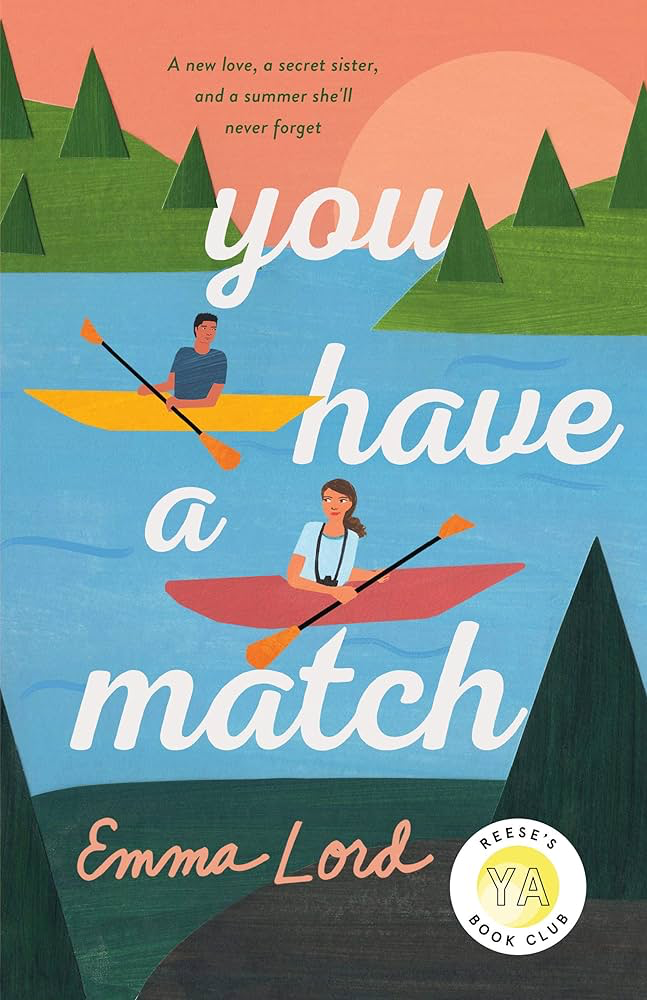
Book Review Tuesday (12/18/23) – You Have a Match

Happy Tuesday, bibliophiles!

Ever since I read Tweet Cute and loved it about three years back, I’ve been meaning to read Emma Lord’s follow-up, You Have a Match, for ages. I’m not sure if I can just chalk it up to “I shouldn’t read anything that’s languished on my TBR for more than 3 years” because it seems like most of the Goodreads reviewers I’m seeing found it just as disappointing, but either way, this one was a miss for me.

Enjoy this week’s review!

You Have a Match – Emma Lord

Abby mainly decided to give a DNA service a go as a joke. But the results tell her that she has a secret sister—Savannah Tully. And Savannah isn’t just an ordinary sister—she also happens to be an influencer with a seemingly perfect life. Desperate to find out about the sister her parents hid from her, she hatches a plan to meet up with her at summer camp. But distractions from Leo, her best friend (or something more?) and co-chef at the camp, and drama between her and Savannah threaten to throw a wrench in her plan to find out why her parents separated her sister.

TW/CW: grief/loss, mentions of substance abuse, anxiety, mentions of abandonment, brief descriptions of injury and illness (broken bones, pneumonia)

I was banking on You Have a Match being at least decent just because of the memory of how good Tweet Cute was, but I really should’ve run for the hills the minute I saw the Reese’s YA Book Club sticker on it. But whether or not I’m looking at Tweet Cute through rose-colored glasses or if Emma Lord just took a dip in quality, You Have a Match was not nearly as sweet—or even enjoyable—as its predecessor.

The main issue with You Have a Match was that it didn’t seem to know what it wanted to be. The premise (and partially the title, although it definitely applies to both) was advertised mostly as a kind of coming-of-age story of sisterhood, but the book itself also wanted to shove a fully-developed romance plot in between it all. The thing is, both of these stories could have been great as separate books—one about finding your lost sister, one about falling in love at summer camp. And I really believe that Lord could’ve succeeded with both of those stories. But even though it could have been possible to merge the two, You Have a Match felt like it didn’t know where to put the emphasis. As a result, the story felt like it needlessly jumped all over the place, making both of the plots cease to be cohesive. It really feels like a case of Lord biting off far more than she could chew.

As a result, the romance that was supposed to happen between Abby and Leo definitely suffered. So much attention was brought to the plot with Savannah and her friends that there was no room for their chemistry to develop, and by the end of the novel, none of the romance felt fleshed out in any way. All of it hinged on the reader believing the information that was very much told (certainly not shown…) that they’d had a beautiful friendship for years, and even that wasn’t enough to save the absolutely lukewarm romantic aspects of this book.

The pacing of You Have a Match didn’t help either of these issues—in fact, it was probably the reason that they were exacerbated. Once the characters got to camp, none of the timing made any sense. It felt like we were just being bounced along like a pinball from subplot A to subplot B without any room to breathe or make sense of what was happening. Everything felt transient and borderline pointless; 309 pages (for the Kindle edition) isn’t that short of a page count, but some points really did feel like filler. This is probably what could have solved the “this book doesn’t know what it wants to be” issue—cut all the filler and focus on developing the relationships between the characters, and chances are, I would’ve enjoyed it so much more.

Part of what endeared me to Tweet Cute was that the social media parts rarely came across as a Gen X author trying too hard to sound “hip.” As much as it can be, it felt real enough that the humor and romance could come through via that aspect. However, whatever internet savviness that Lord had was lost somewhere in the dust between Tweet Cute and You Have a Match. Maybe it was the shift in focus from Twitter to the whole mess that is the concept of Influencers, but it felt incredibly shallow in comparison. Despite her (eventual) redeeming qualities, Savvy came across as the most unoriginal, cardboard-cutout idea of an influencer (fit, makes green smoothies, immaculate hygiene, does yoga, etc.), but Lord could have easily subverted that idea with something that set her apart. All of the nuance came down to “influencers are people too, my life isn’t always perfect :(” and never went any further. Especially with the fact that Abby and Savvy were sisters all along, I feel like this could’ve gone so much deeper—or, at least, in a more interesting direction.

All in all, a coming-of-age, summer camp rom-com that wasted almost all of the potential that it had. 2 stars.

You Have a Match is a standalone, but Emma Lord is the author of several other novels, including Tweet Cute, Begin Again, When You Get the Chance, and the forthcoming novels The Break-Up Pact and The Getaway List.

Today’s song:

if I listen to this enough time, will I just forget that winter exists?

That’s it for this week’s Book Review Tuesday! Have a wonderful rest of your day, and take care of yourselves!

Posted in Book Review Tuesday

Book Review Tuesday (12/12/23) – Shadow Speaker

Happy Tuesday, bibliophiles!

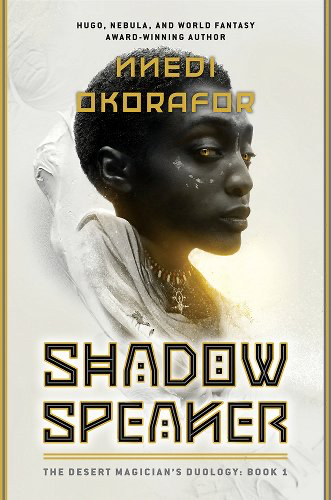
I’ve been a fan of Nnedi Okorafor for several years now, but it wasn’t until about a month ago that I found out that one of her first novels, which originally went out of print, was being reissued with new content and a new cover! (Gorgeous cover, by the way.) I ended up buying it, and though it wasn’t her best (what else would you expect from one of her very first books), but it’s not just a fun ride—it’s a glimpse into an incredibly talented author coming into her own.

Enjoy this week’s review!

Shadow Speaker (The Desert Magician’s Duology, #1) – Nnedi Okorafor

Niger, 2074. In the wake of a nuclear disaster, both humanity and the natural world have developed powers far beyond their imaginations. These Shadow Speakers have been given strange abilities by the aftershocks of nuclear war. Born into this world is 15-year-old Ejii, gifted the abilities of advanced sight and hearing the thoughts of animals. When she was young, her father, a corrupt politician, was assassinated. All these years later, Ejii decides that, regardless of the horrific legacy her father left behind, she must journey out into the Sahara Desert to search for his killer.

TW/CW: murder, beheading, fatphobia

Being a (somewhat) longtime fan of an author and reading their debut or earlier works further down the line is always an eye-opening experience. I was expecting something along those lines when I bought Shadow Speaker the other day, but…man, I really had no idea what I was in for. Shadow Speaker was honestly kind of bonkers, but in the best possible way. Quite plainly, it’s one of the boldest debut novels that I can think of.

Shadow Speaker was Nnedi Okorafor’s first novel (published all the way back in 2008), and it really does feel like a debut. I said eye-opening before because you can see the through lines where Okorafor hadn’t yet hit her stride in terms of writing; in contrast to the tight organization of most of her other novels, we still get chunks of worldbuilding delivered paragraph by paragraph. Her prose has the same bold brightness and whimsical spirit that really stands out as her signature, but it hasn’t been refined as much. And with the re-release this November, despite apparent rounds of editing, there’s still a few things that haven’t aged well from 15 years ago (ex. the villain’s evilness explicitly being tied to him being fat…mmmm, yikes…). All debuts are bound to have flaws, but the latter ones could have probably been edited out. But unlike that, I feel like it’s worth keeping some of the writing as it is—reading this novel was a time capsule into the mind of a younger writer.

And yet, Shadow Speaker is still one of the boldest books I’ve read in a long time, debut or not. Everything about is really and truly nuts, and that was the best part about reading it. Once you get the exposition of Ejii’s post-apocalyptic, magical world out of the way, at no point did I know where this novel was going, and at a certain point, I ceased to even care. There’s the spread of X-Men-like powers caused by a nuclear disaster, a talking camel (also because of the nuclear disaster, how did you guess?), gods and goddesses roaming across the land…you get the idea. Actually, no. You don’t get the idea. And that’s the point of this book, from what I can tell—Ejii and her ragtag band of nuclear magicians don’t know where they’re going either, and that’s where the fun of Shadow Speaker lies.

Over the years, Nnedi Okorafor has proven herself to be an absolute master of Afrofuturism (more specifically Africanfuturism and Africanjujuism, in her words), and the latter (a term that she coined to describe a subgenre of fantasy that is specifically Afrocentric and is inspired by the mythologies of Africa) really describes this novel to a T; although the inciting incident and the introduction of powers has a distinctly sci-fi feel, Shadow Speaker is so clearly fantasy. It’s hard to do that kind of genre-bending so effortlessly in a debut, but already, Okorafor make it look easy. Every element, whatever genres you want to ascribe them to, is blended seamlessly into the world of the Desert Magician Duology as smoothly as stirring together the ingredients of a cake. It’s an impressively distinct world, and despite its flaws, I’m glad this book was brought back into print.

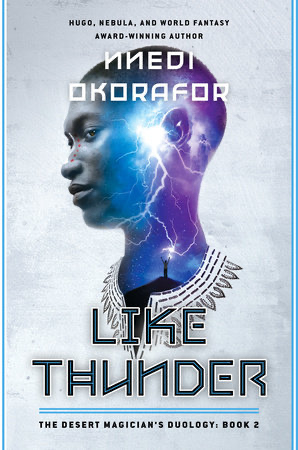
Part of the reason for re-releasing Shadow Speaker is that Nnedi Okorafor just published its intended sequel, Like Thunder, this November. Hopefully I can get my hands on it soon, but it’ll certainly be interesting to see the leap in writing style between the two, given how much time has passed…

All in all, a bold and wild debut from one of science fiction’s most original writers active today. 3.5 stars!

Shadow Speaker is the first book in the Desert Magician’s Duology, followed by the new sequel, Like Thunder, which came out this November. Nnedi Okorafor is also the author of many books for adults, teens, and children, including Lagoon, the Binti series (Binti, Home, and The Night Masquerade), Noor, Remote Control, and many others.

Today’s song:

this song makes me ridiculously happy

That’s it for this Book Review Tuesday! Have a wonderful rest of your day, and take care of yourselves!

Posted in Book Review Tuesday

Book Review Tuesday (12/5/23) – The Witch King

Happy Tuesday, bibliophiles!

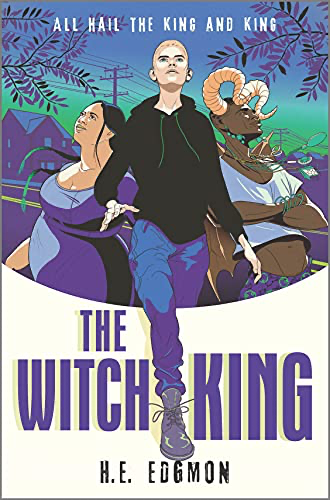
Far be it from me to start the month off with a negative review, but that’s just how my December started off. Eh. Should be a lesson to me for trying to read something that’s been on my TBR for 3+ years—my tastes generally don’t change dramatically in that amount of time, but my standards for writing and plot certainly did. That’s all to say that The Witch King was a promising, inclusive fantasy that quickly proved itself to be not worth my time.

Enjoy this week’s review!

The Witch King (Witch King, #1) – H.E. Edgmon

Wyatt Croft is a witch, and in the North American realm of the fae, witches are the enemy. Years ago, Wyatt’s magic got out of control, forcing him to flee back to the human world and go into exile. But his betrothal to Emyr, the prince of the fae, has not dissolved, and Emyr is back on the hunt for him. Forced back into the world of the fae, Wyatt must come to terms with his engagement—one that may hold the lives of all of North America’s witches in the balance. And his feelings for Emyr may be coming back, as much as he wants to hide them…

TW/CW: transphobia, deadnaming/misgendering, blood, gore, abuse (physical and verbal), panic attacks, substance abuse, PTSD themes

DNF at 36%.

The Witch King has made me realize that I need to expand my criteria for DNFing books; most of my DNFs are 1-star books—the ones that are just so bad that I can’t finish them. In comparison to a lot of the other books on my DNF shelf, The Witch King wasn’t comparably as bad. But the difference is that at a certain point, it was just so clear to me that this book was not worth my time. I really wanted to like it, but once I got past the first third, there wasn’t any point in me finishing this book. A DNF is not always a 1-star read, but a 1-star read is not always a DNF. It’s like geometry but easier to explain.

I wanted to emphasize that I really wanted to like The Witch King. But in the 3+ years that this book has languished on my TBR, it’s clear that my standards have changed. The foreword by Edgmon was incredibly touching, and it’s so clear that this was the book of their soul—there’s no denying the love that went into this book. And it’s so, so important to support trans authors like him, but it’s just as important to remember that even when you read diversely, a book’s diversity doesn’t automatically fix every plot hole and writing issue. There’s some slack I’m willing to give Edgmon because this was his debut, but The Witch King really left a ton to be desired.

It’s clear that Edgmon put a lot of thought into constructing Wyatt’s character, but in his quest to make him as relatable as possible, Wyatt turned from simply “relatable” to an incompetent mess. Even as a queer person, there’s only so many “I am a gay little worm who makes terrible life decisions” (actual quote from the book) jokes I can take. Jesus Christ. The word “cringe” is outright abused these days, but I feel like this is a valid quality to ascribe to the writing of The Witch King, since most of the humor feels so overdone and unfunny. If your type of humor consists of Tumblr jokes from 2017, then boy, do I have the book for you. All of the attempts to make Wyatt seem more human and fallible made him just feel like a pathetic mess incapable of seeing past his personal faults and (many) mistakes. It absolutely grated on me after a certain point. The rest of the writing wasn’t all bad, but good god, Wyatt’s characterization made me want to jump ship almost immediately.

Since I abandoned ship after the first third, there’s probably some context that I inevitably missed, but the worldbuilding of the North American fae really left a ton to be desired. Apart from the rivalry between witches and fae, there really wasn’t much of an explanation as to how the fae worked in tandem with the human world: where do the borders between human and fae begin and end? How do the two interact? And more importantly, what are the different interactions between the different species of fae? There were a bunch of different creatures that were just thrown at you in the background with zero explanation, never to be seen again. There’s a difference between convoluted worldbuilding and worldbuilding that just isn’t properly thought-out, and this fell firmly into the latter camp. It was all just a hot mess. I’ve read several reviews saying similar things about the worldbuilding, so…I guess it never did get better beyond what I read? Oof.

That being said, I really appreciate the diversity that Edgmon wrote into The Witch King. Having a trans main character is so important, and as much as Wyatt got on my nerves, characters like him need to be in the spotlight. Edgmon presented a lot of character that were very diverse in terms of race, gender, and sexuality, and while it seems like the representation wasn’t all accurate and some of Edgmon’s depiction of social issues wasn’t handled as well as it could’ve been (glad I didn’t get to that part, I guess…), it’s always good to have a range of characters like that. It’s about all I have to say about The Witch King that’s positive, but it’s worth being highlighted.

All in all, a diverse fantasy debut that sadly crashed and burned in its characterization and lazy worldbuilding. 2 stars.

The Witch King is the first book in the Witch King duology, followed by The Fae Keeper. Edgmon is also the author of the Ouroboros series, which consists of Godly Heathens and Merciless Saviors.

Today’s song:

That’s it for this week’s Book Review Tuesday! Have a wonderful rest of your day, and take care of yourselves!
Posted in Book Review Tuesday

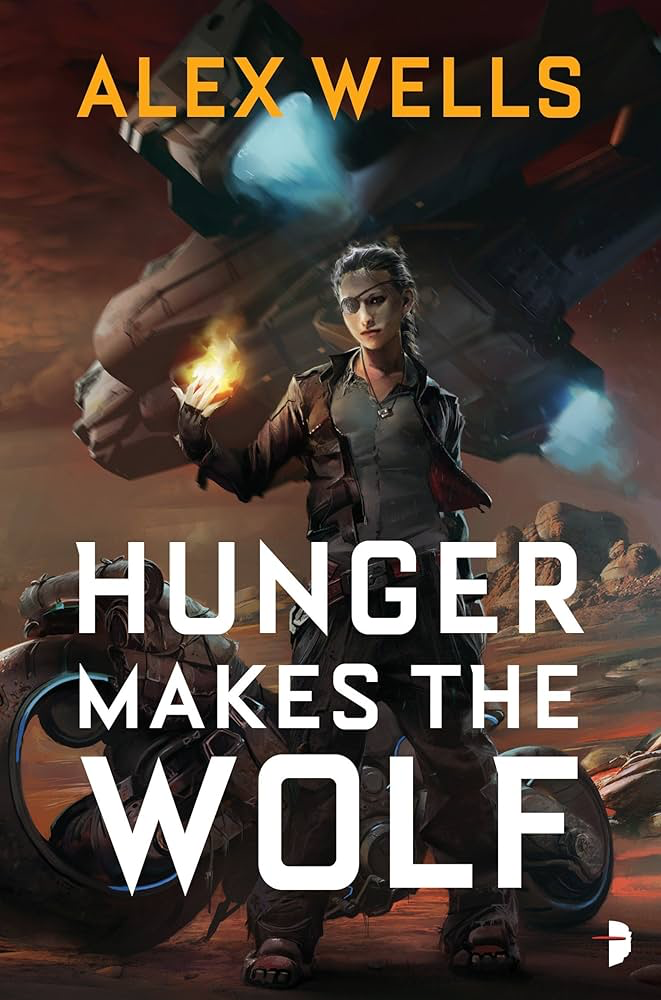
Book Review Tuesday (11/28/23) – Hunger Makes the Wolf

Happy Tuesday, bibliophiles!

Hunger Makes the Wolf came on my radar when I was looking for more books with disability rep (as always), but I ended up buying it on my Kindle after my dad notified me that I had some unused Kindle points (thank you for reminding me!)—it was free with the points added on, so how could I resist? And while Hunger Makes the Wolf wasn’t perfect, it’s a ton of gunslinging, space-fantasy fun.

Enjoy this week’s review!

Hunger Makes the Wolf (The Ghost Wolves, #1) – Alex Wells

Hob Ravani ekes out a living in the deserts of Tanegawa’s World, a planet owned by TransRifts—the corporation who controls the market on interstellar travel in the whole galaxy. For 10 years, Hob has gotten by with the help of the Ghost Wolves, a group of bandits roaming the desert and finding money where they can. But when Hob discovers the body of Nick, the man who recruited her to join the Wolves, abandoned in the desert, she knows that she has to act before TransRifts discovers their operation—and discovers the powers that she’s kept hidden from sight.

TW/CW: murder, descriptions of injuries, descriptions of corpses, violence, loss of loved ones, human experimentation

Writing accents phonetically is a slippery slope that I’m not going to get fully into in this review. In this case, though, Alex Wells had decent success with making everyone who was meant to sound like they had a Southern accent actually sound like they had a Southern accent, which worked—this novel was a space Western, after all. That being said, the unintended consequence was that Wells’ spelling of Hob’s accent was that I imagined her voice more like Holly Hunter in Raising Arizona than the badass, hardened gunslinger that she was made out to be. It sort of worked, though.

As far as sci-fi subgenres go, I’m not usually huge on space Westerns; I’ve rarely seen them done exceedingly well (even The Mandalorian got more than a little repetitive eventually), but the best are at least fun. And that was what Hunger Makes the Wolf was—incredibly fun. It had all of the trappings of a debut novel, but what Wells did get right on the first time was that pacing. Although the action sequences were what made Hunger such a blast to read in the best parts, Wells also knew how to balance them out with quiet, more emotional moments, and also moments to slip in worldbuilding without absolutely walloping you with it. Wells’ action was really the star of the show here; their fight scenes had just the right amount of tension, levity, and butt-kicking to make for more than one delightful scene.

Recently, I’ve read several sci-fi books that were marketed as “space fantasy,” and none of them have really fit the bill. And yet, Hunger Makes the Wolf wasn’t necessarily marketed as such, but it does what the other novels lacked. Even amidst the classic sci-fi backdrop of corporate greed, massive spaceships, and gruesome human experimentation, there’s the element of the characters’ strange hidden powers. Naming said powers “witchiness” was already a win in my book, the charm of it really fits the Western atmosphere that Wells was going for—it hits that sweet spot of not sounding overly jargon-y or formal, but not too hokey, either. Every time one of the characters mentioned it, I couldn’t help but smile—especially in Hob’s aforementioned Holly Hunter voice.

Hunger Makes the Wolf is an incredibly ambitious novel, and the ambition is accentuated when you remember that this is Alex Wells’ debut. In some ways, it worked; Wells managed to juggle a safe amount of the worldbuilding without leaving the reader without context, but also without dumping it excessively. However, what Wells did not juggle as well was the sheer amount of characters that we jump between. Hunger was clearly meant to have a found family theme to it, which I’m normally a sucker for, but Wells just had so many extraneous characters on their hands that none of the character relationships felt fleshed out. If we had gotten more scenes with Hob and the rest of the Wolves, for instance, I would have believed that they really were as thick as thieves. Adding onto this, the perspective switches may not have been necessary; Mags, although she plays a prominent role, doesn’t have a perspective or voice that added anything substantial to the narrative. It’s a classic debut author case: Alex Wells had some spot-on ideas, but they bit off far more than they could chew.

All in all, a rollicking space fantasy with action aplenty, but with characters that left me wanting more. 3.5 stars!

Hunger Makes the Wolf is the first book in the Ghost Wolves duology, followed by Blood Binds the Pack. Hunger was Alex Wells’ debut novel; they are also the author of the short story Angel of the Blockade.

Today’s song:

FARGO IS BACK I AM FOAMING AT THE MOUTH OH MY GOOOOOOOD

That’s it for this week’s Book Review Tuesday! Have a wonderful rest of your day, and take care of yourselves!

Posted in Book Review Tuesday

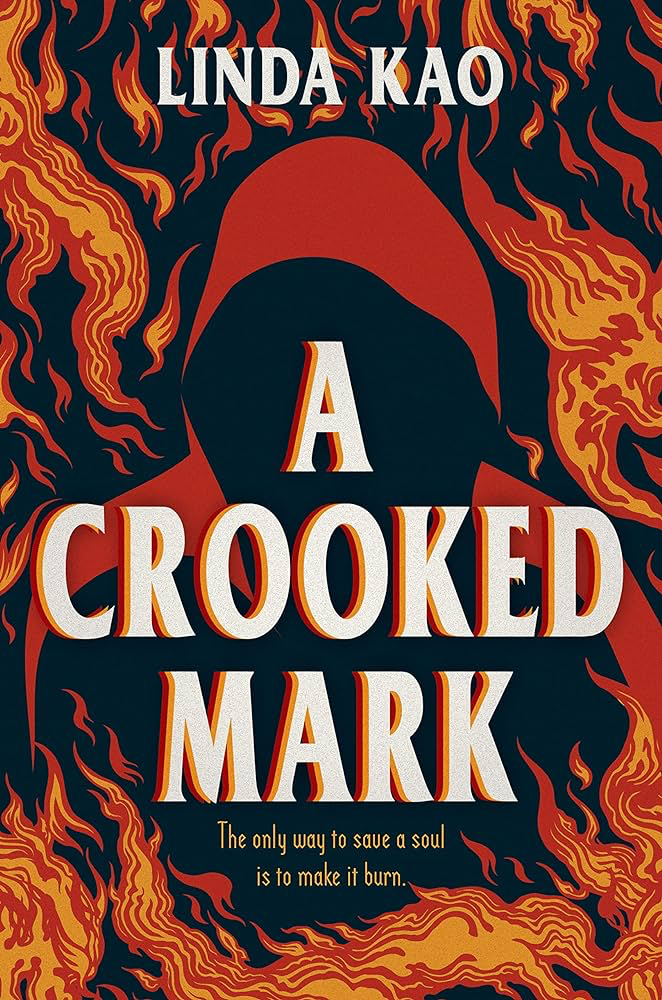
Book Review Tuesday (11/21/23) – A Crooked Mark

Happy Tuesday, bibliophiles, and more importantly, MERRY FARGO DAY!! SEASON FIVE IS FINALLY HERE!! REJOICE!! I’ve been waiting three years for this…I can’t WAIT to watch it tonight!

I’ve noticed that I’ve read a lot of adult books this month (much of which have been more literary fiction) and not a lot of YA; although it’s been a much better reading month than October, I wanted some YA to mix it up. A Crooked Mark was the perfect book to scratch that itch—campy and silly in the best possible way.

Enjoy this week’s review!

A Crooked Mark – Linda Kao

Matthew Watts knows that evil works in mysterious ways. That’s why his father has raised him to know the signs of those marked by Lucifer himself. Ever since he was young, they’ve been going from town to town, making sure the Marked are killed before their evil is unleashed on the innocent. But Matt’s father has a new mission for him—his first ever solo mission, following a girl named Rae Winters. As Matt tries to blend in at the local high school, he befriends Rae—and begins to fall in love with her. And as his mission steers in the wrong direction, he begins to question if all that he’s working for is a lie…

TW/CW: murder, descriptions of burning alive, car crash, grief, loss of loved ones (on and off page), descriptions of injury

A Crooked Mark caught my eye over the summer because of its premise—not necessarily that it was particularly unique, but because it sounded so similar to Frailty—a movie about a father and his sons killing those that God has told him are demons. As far as I can tell, there’s no real correlation between the two (though I’d be shocked if this wasn’t at least a partial inspiration for the book), but, again, caught my eye—of all the movies to inspire a younger-leaning YA novel, Frailty would not be my first choice. That being said, A Crooked Mark, though not without its flaws, scratched the itch I needed—corny, supernatural fun.

From here on out, if I say “corny” in this review, I mean in the most affectionate way possible. I was on a streak of reading a lot of adult fiction/more literary-leaning fiction, and while I enjoyed all that, A Crooked Mark was just the kind of unserious book I needed to shake things up. It feels like it could’ve been the kind of campy, supernatural drama that I would’ve watched in middle school, down to the fact that there’s actually a character named Moose. It’s great. I’ve seen a lot of reviews comparing it to Supernatural, which I haven’t seen, but even from the vibes I get from the show, the comparison hits the nail right on the head. The writing, while it wasn’t the best, really nailed that feel, even if it wasn’t what Kao was going for. I can probably enjoy it more because there isn’t cheesier acting attached to the already cheesy writing, but either way, A Crooked Mark was made for corny enjoyment.

Going off of that, A Crooked Mark really nailed the beats of that kind of campy, paranormal story. Matt was the perfect protagonist for this story—not overly brooding, but still self-serious (in a very un-serious way) enough that he was fun to follow around. His friend group didn’t necessarily contribute a whole lot to the narrative, but they served the purpose of putting a shield around Rae—and later being sources of conflict once everything went south. Rae was on the too-perfect side, but again: this is the campiest book I’ve read all month. I’m not expecting monumentally good character development. I did also love that Matt was mixed-race—as a mixed-race person, I wouldn’t say it’s groundbreaking rep, or that the book explores his mixed-race identity poignantly (it really doesn’t), but it’s more important in that everybody deserves to be the hero of a cheesy, paranormal teen drama. It’s what we deserve.

That being said, for a book where Matt was up against the clock trying to discover if Rae really was marked by Lucifer himself and put an end to said evil, A Crooked Mark meandered quite a lot. It was more than a sagging middle—more of a sagging 60-75% of the whole book. There was a whole lot of uneventful high school bonding, a lot of Rae’s tutoring sessions that went nowhere, and a lot of hemming and hawing in general. It would have been easy to add bits of drama here and there to amp up the stakes, and Kao partially did this, but not enough to sustain the story. Especially since a lot of the “twists” ended up being dead ends, (save for the Big Twist™️), there really should’ve been more suspense—or at least more drama—before the main twist right before the climax. I was in it for the cheese in the first 30% or so, and it only managed to pick up in the last 20% of the book—not enough to hold my attention.

All in all, A Crooked Mark isn’t anything revolutionary or exceptionally well-written, but if you’re in the mood for something spooky and campy, this is the perfect book for you. 3.5 stars!

A Crooked Mark is a standalone and Linda Kao’s debut novel.

Today’s song:

I love listening to music like this while I’m just calmly doing chores…I’ll just be cleaning the sink and Joe Talbot’s aggressively screaming about kindness and consent in my ears bahahaha I love IDLES

That’s it for this week’s Book Review Tuesday! Have a wonderful rest of your day, and take care of yourselves!
Posted in Book Review Tuesday

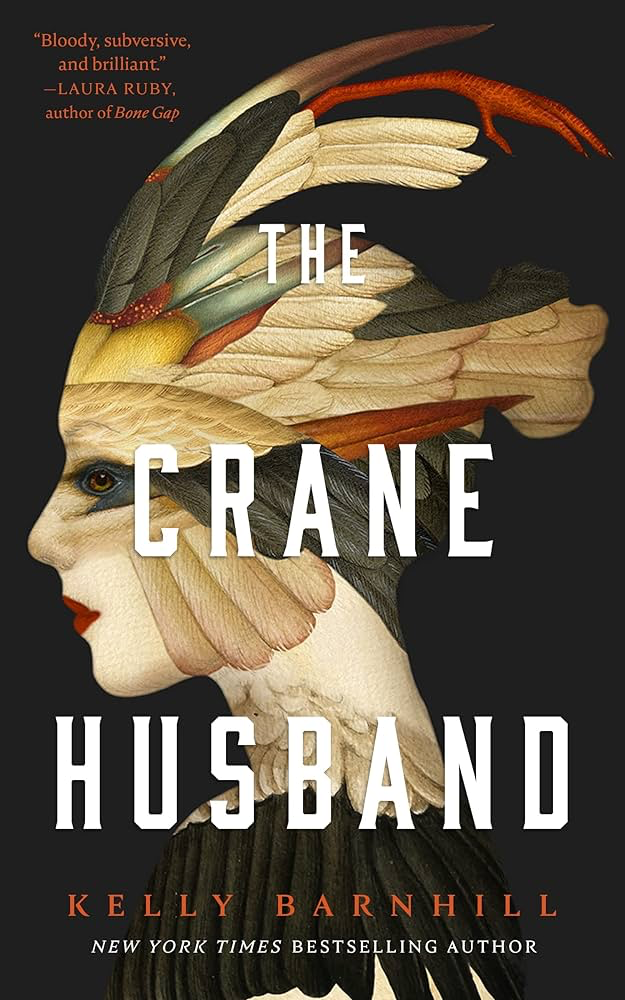
Book Review Tuesday (11/14/23) – The Crane Husband

Happy Tuesday, bibliophiles!

Brief rant: don’t you love it when Goodreads posts the nominees for the “YA Fantasy & Science Fiction” category and…there’s no science fiction books on the list? Not a single one? Thank you Goodreads 🥰

It’s been years since I’ve read anything by Kelly Barnhill; I read a fair amount of her middle-grade novels when I was younger, and there were hits (The Girl Who Drank the Moon) and misses (Iron-Hearted Violet). But either way, the road has taken me back to her adult novella, a chilling retelling of “The Crane Wife” that I thoroughly enjoyed.

Enjoy this week’s book review!

The Crane Husband – Kelly Barnhill

In a distant future, a fifteen-year-old girl lives on one of the few remaining farms in the United States, growing cloned crops in order to make a living. Her father passed away when she was young, and now she manages the farm with her mother and takes care of her six-year-old brother, Michael. But when her mother brings home a new suitor, the girl is appalled to find that the suitor happens to be a giant crane—a crane intent on working her mother to the bone in order to produce tapestries to sell. As her mother succumbs to the wills of the crane and her family grows poorer, the girl knows that the only way out is to rid the house of the crane—and she’ll do anything to make sure the bird is out of the farm.

TW/CW: death of a parent, blood, abuse, animal death, child endangerment

It’s been at least seven or eight years since I’ve read anything by Kelly Barnhill, and I was pleasantly surprised to find that when faced with the (quite large) jump from stylistic choices between age groups, she does so with eery grace! The Crane Husband was a disturbing treat, quick but chilling.

I only had a vague notion of the original Japanese folktale of the Crane Wife that this book subverts, but even without that background, Barnhill weaves a haunting, dystopian fairytale like no other. It’s that lovely kind of book that falls into science fiction, but has just enough trappings of other genres to pass as something else. The magical realism element is heavier than the rest, and it rules the book—rightfully so, given the subject matter. But like a good fairytale, Barnhill’s ability to suspend disbelief made The Crane Husband all the scarier—scenes that would have otherwise seemed charmingly quirky or absurd were downright horrifying under her lens.

Barnhill’s writing was what sold how horrific the events of The Crane Husband truly were. The way she captured the voice of the unnamed, fifteen-year-old protagonist as she had to take her livelihood into her own hands in the face of the invading crane husband had such a tangible desperation, making the conflict feel real as all get out. Tension crept out from every word, and I found myself keeping my Kindle in a vice grip as I read. And that tension never wanes—in only 118 pages, Barnhill built up monumental tension that books three times the length have failed to uphold. The Crane Husband really was nail-bitingly eerie, and it was worth it all the way.

The way that Barnhill used this tangibly uncomfortable atmosphere to drive the point of this folktale’s subversion home was also masterful. The main twist in this iteration is, hence the title, that the protagonist’s mother brings home a giant crane who she takes as her husband. And instead of the crane wife wasting away to produce beautiful tapestries, it’s the human mother being forced by the crane husband to churn out tapestries like a machine. Abusive relationships were the main theme of the novella, and Barnhill’s depiction of abuse through this lens felt as authentic as it could be, from the strained, forced silence of the women of the family and the lack of support that the protagonist finds when she tries to seek help. Beyond that, The Crane Husband’s message about suffering for art was equally powerful and important; the emphasis on how the protagonist’s mother works to the point of near-death in order to create something that people will think of as “transformative” was commentary that I wasn’t expecting from the novel, but enjoyed wholeheartedly. Needs to be said.

That being said, my only major problem with this novella was that it directly referenced the original folktale that it’s retelling. Though it was in a flashback scene, it felt tacky and unnecessarily meta to hand it to you right there—and not only that, but basically delivering the twist right at your doorstep. I will admit that I loved the line about cranes making other creatures do the work for them, but at that point, it isn’t even foreshadowing anymore—it’s just whacking you over the head with the twist that it’s supposed to be hiding from you. It made me more than a little mad, but the rest of the novella was so good that I could almost let it slide. Almost.

All in all, a timely and truly disturbing retelling that packed a stinging punch with an impressively short page count. 4 stars!

The Crane Husband is a standalone; Kelly Barnhill is also the author of many books for children, including The Witch’s Boy, The Girl Who Drank the Moon, and Iron-Hearted Violet. She is also the author of When Women Were Dragons, her first full-length novel for adults.

Today’s song:

NEW SMILE ALBUM IN JANUARY EVERYBODY STAY CALM

That’s it for this week’s Book Review Tuesday! Have a wonderful rest of your day, and take care of yourselves!
Posted in Book Review Tuesday

Book Review Tuesday (11/7/23) – The Deep Sky

Happy Tuesday, bibliophiles!

The Deepy Sky came out this July, and I’ve been seeing a ton of buzz about it around the blogosphere since. I’m always in for a sci-fi thriller, and this one delivered in that aspect, as well as the wonderful mixed-race rep!

Enjoy this week’s review!

The Deep Sky – Yume Kitasei

Asuka has been chosen as a representative on a mission to deep space, where she will help give birth the next generation of Earth’s children. But she has been chosen to represent Japan—a country she barely knows, as a half-Japanese, half-Latina girl raised in the United States. Feeling like an imposter to an unfamiliar country, she accepts her duty and joins the crew of the Phoenix. But a deadly explosion onboard the ship leaves her the only surviving witness. With all eyes on her once more, Asuka must get to the bottom of the explosion before the perpetrator strikes again.

TW/CW: racism, terrorism, miscarriage/fertility themes, death of a child

“Literary” sci-fi rarely does it for me; most of what I’ve read barely scrapes past the 3.5 star rating for me, at best. Often, what happens is that the sci-fi element gets significantly watered down for the sake of marketability, drama, and a place in a celebrity’s book club (see: Sea of Tranquility, In the Quick). But The Deep Sky had the chops to make itself unique—and incredibly poignant.

The sci-fi plot of The Deep Sky is pretty standard as far as story elements go, but Kitasei’s approach to it made it feel fresh. It’s the setup for a myriad of sci-fi thrillers: you’ve got a large crew voyaging through the depths of space, only for a tragic accident to leave everyone onboard in suspicion, with no way to get back to Earth. It’s not necessarily a new approach plot-wise that keeps it going—it’s the emotional core that Kitasei brings to it. You’re really able to see deeply into Asuka’s head, deeper than a lot of authors dare to go with these kinds of stories; it’s a great way to increase the stakes without having to complicate the mystery of the story.

Also, LET’S HEAR IT FOR MIXED-RACE REPRESENTATION!! I’ve been on a roll with books with amazing mixed-race characters and stories lately (see also: Leslie Marmon Silko’s Ceremony—a very different book, but no less poignant), and as a mixed-race person, I’m so glad that narratives like these exist. Kitasei’s depiction of the imposter syndrome that Asuka faces about her identity is twofold—not only is there the level of it that comes with her being of Japanese and Mexican descent in the U.S., but also in the fact that she has to represent Japan—a country that she’s barely been to—in this mission. It really did make me feel so, so seen. Kitasei’s portrayal of having these intersecting identities and them coming at odds with how others want to box you in was deeply moving and authentic, and I cannot thank her enough for that.

Back to the subject of literary sci-fi. A lot of these types of novels that I’ve read deal with intersecting, nonlinear timelines, which may or may not have to do with actual time travel (case dependent). For the most part, it worked incredibly in Kitasei’s favor—even outside what we can consider the “main” plot, the pieces that we get of Asuka’s life before the deep space mission were almost more intriguing than the actual murder mystery in space. Kitasei’s character work is incredibly detailed and nuanced, and having most of this novel be driven by character and family was a choice that made me enjoy it that much more. These types of sci-fi thrillers normally lend themselves to very distant characters, and minimal character work by proxy (outside of “trust no one”), so this was a breath of fresh air in that sense.

That being said, the nonlinear timeline was also what brought part of the novel down for me. There’s much more emphasis placed on the time before the mission than the actual mission, making the murder mystery plot feel like an afterthought. The way that these timelines were spaced out meant that we went long stretches without checking in on what’s supposed to be the novel’s inciting incident, which made the stakes feel much lower than they were meant to be. The tension got appropriately amped towards the end, but other than that, there really wasn’t as much thriller as I was expecting going in. Maybe this is just a matter of how The Deep Sky was marketed, but I did wish we got a little more of the “main” plot.

All in all, a rare gem of a literary sci-fi novel where every page brimmed with emotion and suspicion. 4 stars!

The Deep Sky is a standalone; it is also Yume Kitasei’s debut novel.

Today’s song:

listened to my first Arlo Parks album, and I’m a fan!! this was my favorite, for sure

That’s it for this week’s Book Review Tuesday! Have a wonderful rest of your day, and take care of yourselves!
Posted in Book Review Tuesday

Book Review Tuesday (10/24/23) – Stars, Hide Your Fires

Happy Tuesday, bibliophiles!

Here I am with a proper book review this week! I’m not exhausted now! However, I’ve still been in something of a reading slump for a fair portion of the month. Behold the consequences.

Knives Out in space? Yep. I am not immune to propaganda. I fell for that one. The gorgeous cover helped. Duped by a pretty cover again. I’m always on the hunt for YA sci-fi that really delivers, but even though Stars, Hide Your Fires was an entertaining read, it largely fell into the “ballrooms in space” trap that so much of the subgenre suffers from.

Enjoy this week’s review!

Stars, Hide Your Fires – Jessica Mary Best

Cass knows her place. As a thief scraping out a living on a backwater moon, she knows that there’s no escape that the life that the Emperor and his family have made for people like her. But when she sees the chance to hitch a ride to the Palace Station, she knows she’s hit it big. Steal enough jewelry, and she’ll be able to escape the planet forever. But when the Emperor is mysteriously murdered and suspicion lands on her, Cass must find a way to escape the space station—and clear her name.

TW/CW: murder, blood, sci-fi violence

I really need to stop going after YA sci-fi books where most of the plot takes place in some kind of ballroom or palace. After a certain point, it just gets so bogged down in the flowy dresses, jewelry, and court intrigue modeled after…I don’t know, Ancient Rome, probably, that it barely feels like sci-fi anymore. It’s really a travesty. But even though Stars, Hide Your Fires was far from perfect, it didn’t fall into every single one of the pitfalls I just described. It at least had a few elements that almost set it apart. Almost.

I’ll give Best this—for the first quarter of the book or so, Stars, Hide Your Fires did actually feel like science fiction. Although we didn’t get into the full extent of the worldbuilding, I did like the setup of the class difference just from showing the differences between two planets. You really did get a sense for Cass’ situation, and the setting of the dead, backwater moon really emphasized not only that, but the stakes that Cass later had to follow up on. Best’s writing sold the dusty, gloomy setting that dominates the first quarter of the book, and in comparison to all of the glittery ballroom business that comes later, it was a well-written contrast.

I’d also have to hand it to Best for keeping Stars, Hide Your Fires so tightly paced! Even though I lacked much connection to the plot, I’d be remiss if I didn’t acknowledge how neat it was—that part really felt sanded to a polish. All of the beats lined up straight into place, and with the exception of some dawdling in the middle, it at least held my attention for most of the novel. If anything, Stars, Hide Your Fires had some solid timing—Jessica Mary Best clearly had her line of dominoes ready to fall from the start, and the suspense was palpable.

That being said, other than the first and last quarters, I barely got the sense that this was science fiction. It’s one of those books where it could have just as easily been a historical drama or even fantasy if you took away the space setting. Sci-fi is my go-to, and usually, I’d like for a novel to present at least something partially new, whether it be a subversion of a typical setting, a unique kind of technology, or even some aliens to populate the universe. (ALIENS! ALIENS! ALIENS!) But other than being set in space, Stars had nothing to its name in that department. You could have just as easily made the palace a grounded palace on Earth, and hardly anything about the plot would have changed. Cass’ home moon could have been a different country, the spaceships could have been trains, the escape routes that she took could have been back alleys or indoor ventilation ducts. Even though it’s billed as sci-fi, Stars, Hide Your Fires doesn’t have anything to show for it other than being in space.

Additionally, I felt hardly any connection to the plot or characters. That was in no small part thanks to how unoriginal much of it was. You’ve got a generic setup of a tyrannical empire, but you don’t get much of a sense of what exactly is tyrannical about what they’re doing, other than being generally evil and a bit of monkey business with clones. To oppose them is an equally generic rebellion, and other than them being billed as heroic, you don’t really have much motivation to root for them since their goal is defeating said empire and not much else. Cass doesn’t have any ties to either, but other than her poorer background, there’s not much to her, either. My, a loner, rebellious pickpocket? Where have I seen that before? That’s the sad thing about this novel—if we’d had some original elements to any of the plot points, it could have been really fun. I’m all for a heist in space, but you’ve got to have the sci-fi chops to pull it off. And there’s some slack I’m willing to give Best since this is her debut novel, but it was still disappointing on that front.

All in all, an entertaining YA novel that could have elevated itself above simply “entertaining” if it had boasted any kind of original elements. 3 stars.

Stars, Hide Your Fires is a standalone; it is also Jessica Mary Best’s debut novel.

Today’s song:

thank you to whoever was in charge of the Wilco pre-show playlist on Sunday night for this

That’s it for this week’s Book REview Tuesday! Have a wonderful rest of your day, and take care of yourselves!

Posted in Book Review Tuesday

Book Review Tuesday (10/10/23) – Always Human

Happy Tuesday, bibliophiles!

Always Human came onto my radar around three years ago—probably from my fellow bloggers—but I’d forgotten about it until I came across it at my college’s library. I’m always a sucker for cozy sci-fi, and I never say no to a graphic novel, so of course I picked this book up. But while it was sweet and had some great commentary on disability, it didn’t quite scratch my sci-fi itch in all the right ways.

Enjoy this week’s review!

Always Human – Ari North

Sunati lives in a world of body modification. With simple, easy-to-use technology, she can change any part of her appearance that she wishes—even enhancing her memory so that she won’t have to study for tests. But not everybody has it as easy as Sunati. Austen has Egan’s syndrome, which means that her immune system rejects any kind of body modification. When the two meet by chance, it’s love at first sight. And although they are different in all kinds of ways, it won’t take long before they realize that they were made for each other.

Art by Ari North

TW/CW: nothing that I can find—Always Human is very gentle, and I’d be hard-pressed to find anything triggering about it. Enjoy!

Always Human is sweet. It was a soft, tender palate-cleanser, but I didn’t find myself getting very attached to any of it. It’s cute, and I’d say it’s worth a read, but it lacked the emotional weight to fully immerse myself in the characters or the world.

Let’s start out with the positives. It’s rare that fictional, sci-fi disabilities actually mirror the experience of disabled people, but Always Human did an excellent job of portraying Austen’s disability. Austen has Egan’s syndrome, a fictional autoimmune disorder where her body rejects any kind of body modification, which is central in the futuristic world where Always Human is set. Throughout Sunati and Austen’s developing romance, this novel makes the very important case that disabled people do not exist to inspire you, and that going through life as a disabled person isn’t some grand feat. It’s something that Sunati has to contend with when talking about Austen, and watching her learn made at least some of the romance work.

Additionally, I loved how vibrant the art style was! I’m not usually one for the quasi-manga style that North draws in, but every panel really did pop. The vibrant pinks and blues truly shone, which simultaneously sold the joyous glow of young love and the bright, technology-centric world that Sunati and Austen inhabit. Just like the story itself, there are no hard edges: everything is soft and cloudy, calling sunsets, cotton candy, and hope to mind. It suited the story exceptionally well—Ari North absolutely looked like she knew what she was doing.

However, there was one part of the art that didn’t sit as pleasantly with me. Although the colors consistently popped, the character movements…did not. Their poses looked so consistently stiff. And listen. I’m an artist. I get it. Drawing dynamic poses is so hard. Game recognizes game. But the characters’ movements looked so wooden, no matter what pose they were drawn in. These static poses failed to immerse me fully in the story—if they don’t look like they’re really moving, how can I believe that anything else is? I’m saying this to myself as well as Ari North: maybe a few more of those nice references on Pinterest would have livened up the art.

Always Human made the jump from WebToon to print after seemingly wild success on the former, but I’m not sure if the plot format survived the leap. The broken-up chapters would theoretically work if I were getting them, say, once a week, but all together, they didn’t feel quite as coherent. I’m all for cozy sci-fi and slice-of-life stories, but what makes the ones I like work is that there’s still some kind of end goal, however low-stakes it may be, that the characters are heading towards. Always Human felt rather meandering in that sense. It really felt like the plot was being made up as North went along, and the result was quite lukewarm. Even the romance, which the plot clearly hinged on, was set up and happened so quickly that the rest of the story didn’t hold much water. If the romance had been slowly developed over the course of the graphic novel, I would have felt much more engaged. Thus, I never really felt the emotion that North was trying so hard to get across—it all felt rushed and half-baked. Insta-love is never the answer, kids.

All in all, a light and fluffy sci-fi comic that boasted vibrant color and cogent points about disability, but felt rather stiff in both the art and the plot. 3 stars.

Always Human is the first volume in the Always Human series; the series concludes with Love and Gravity.

Today’s song:

adore this album, but also, I can’t listen to it too many times in a row, y’know?

That’s it for this week’s Book Review Tuesday! Have a wonderful rest of your day, and take care of yourselves!
Posted in Book Review Tuesday

Book Review Tuesday (10/3/23) – Under the Earth, Over the Sky

Happy Tuesday, bibliophiles!

I swear it’s entirely a coincidence that I’m reviewing two books that have titles separated by commas with the word “sky” somewhere in them (The other would be Deep as the Sky, Red as the Sea). They’re entirely different books, but I’m glad to say that they’re equally excellent. Under the Earth, Over the Sky gives fantasy a tenderness that it’s desperately needed for years, and I am all the better for reading it.

Enjoy this week’s review!

Under the Earth, Over the Sky – Emily McCosh

Iohmar does not meddle in the affairs of the human world. He is above such things, being an ancient fae king older than human civilization itself. But when he finds an abandoned, dying baby in the borderlands between the human world and his kingdom, he takes it upon himself to raise him as his own. He names his human son Lorcan, and he takes him back to live in the fae kingdom. But Iohmar’s ancient magic has begun to wane, and with threats encroaching into his kingdom, he must do whatever it takes to protect baby Lor and the rest of his subjects.

TW/CW: past mentions of abuse/loss of a loved one, abandonment of a child, nightmares, child endangerment

I’m so sick and tired of grimdark, man. I’ll save my rant about it for another day, but I just feel like it’s a blight on fantasy, and on any genre where it’s applicable. (Life is full of joy and beauty! They can never take your joyous whimsy!) That’s why this book feels so necessary. Under the Earth, Over the Sky really did heal my soul. It may not be without its flaws, but it’s such a deeply moving and poignant tale of love beyond boundaries and parenthood.

For the past few years, I’ve found myself drifting away from most kinds of high and epic fantasy; at their very worst, they’ve just felt like the same plots coughed up over and over, but with far heftier of a page count than is necessary. But Under the Earth, Over the Sky feels like the best kind of subversion of all of the self-serious, high-and-mighty tropes that have turned me off from a fair portion of the genre. How do you make your haughty, ancient king of the fae with the wisdom of a thousand moons a genuinely compelling character? Simple: make him raise a baby. The synopsis already made this book sound endearing, but I couldn’t have predicted how much of a warm bath to the soul that this book would really be.

Of course, the dynamic between Iohmar and his adopted son was where Under the Earth, Over the Sky shone the brightest. Watching Iohmar’s cold heart slowly melt as he began to care for Lor was truly a joy, and Emily McCosh portrayed all of the ups and downs of their father-son relationship so poignantly. He was such a compelling character beyond his dynamic with Lor as well; McCosh also did an excellent job of making his life and relationships genuinely complicated, making him feel truly fleshed-out and making some of the stakes seem more real. Every part of his raising Lor tugged at my heartstrings, from the moment he realizes that he has to care for this baby, to grappling with the fact that his appearance frightens his own son. Not to praise the plague that is the Disney live-action remakes, this novel reminded me of the only good one—the dynamic between Angelina Jolie’s Maleficent and baby Aurora was similarly sweet. The fact that it’s a father-son relationship also feels so important—having a male character showing such vulnerability and care is something that we need more of, certainly.

Most of the other character interactions were similarly comforting and cozy. I especially loved the dynamic between Iohmar and his wife Rúnda; they were so quietly devoted to each other, and their gentle love fueled the already heartwarming feel of this novel. The interactions between Iohmar and the humans he encounters along the way were similarly poignant. Not only did they serve to drive home the rift between Lor’s human and adopted fae identities, Iohmar’s subtle changes in how he dealt with humans was so tender and indicative of his shifting character. Strangely, even though there weren’t as many characters, subtle interactions like these were what made the world feel lived-in—it didn’t take a lot for this world to feel populated, which helped immensely with my feeling of immersion.

However, as well fleshed-out as many aspects of Under the Earth, Over the Sky were, the subplots surrounding the main plot felt rather rushed. Although the stakes of Iohmar’s magic rotting were clear and tangible, the aspect of the rippling felt like it barely held any weight. They weren’t as well established at the start of the novel, and that lack of immersion felt like none of it was really serious—it really did feel like an afterthought. That part was resolved in a similarly messy way, but at least it got somewhat neatly swept under the rug. It was an interesting enough concept, but a lack of context and fleshing-out made it feel almost meaningless.

All in all, a refreshingly cozy and tender story of parental love and changes of heart. 4 stars!

Under the Earth, Over the Sky is a standalone, but Emily McCosh is also the author of All the Woods She Watches Over, an anthology of short stories and poetry, and the ongoing In Dying Starlight series.

Today’s song:

live laugh Lisa Germano

That’s it for this week’s Book Review Tuesday! Have a wonderful rest of your day, and take care of yourselves!