Posted in Book Review Tuesday

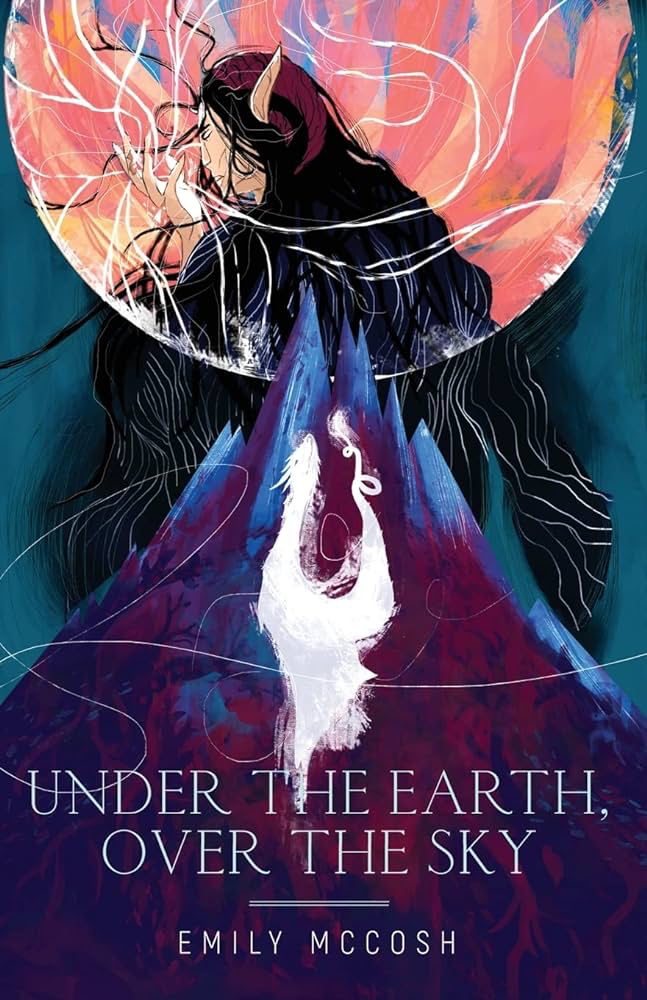
Book Review Tuesday (9/26/23) – Deep as the Sky, Red as the Sea

Happy Tuesday, bibliophiles!

Fingers crossed, I should be able to keep up with at least these reviews and my Sunday Songs now. Plus, I’ve read some good books lately, and I’m itching to write a full-length review! Especially about this one. I’ve seen it here and there on the blogosphere, and it’s getting average reviews on Goodreads as of now; I don’t usually gravitate towards historical fiction, but Deep as the Sky, Red as the Sea was such an engrossing read!

Enjoy this week’s review!

Deep as the Sky, Red as the Sea – Rita Chang-Eppig

The pirate Shek-Yeung has a reputation that precedes her. After her husband is murdered by a Portuguese sailor, she takes it upon herself to do everything in her power to take his fleet for her own, starting with marrying her husband’s second in command and having his son. With the ship under her iron rule, she becomes just as feared as her husband once was. But as the Emperor of China begins a crackdown on piracy and her crew begins to turn against her, Shek-Yeung must grapple with the power that is slipping through her fingers—and taking care of her new son.

TW/CW: blood, gore, near-death situations, descriptions of illness, loss of loved ones, misogyny

I love a good swashbuckling pirate book, so I never considered that a more grounded pirate story could possibly exist. And it does—its name is Deep as the Sky, Red as the Sea, and it has just as much of a punch and importance, even if it lacks the conventional adventuring that typically comes along with pirate stories.

I’m not usually much for historical fiction; it’s not a genre that I typically gravitate towards, but if I pick it up, it’s usually because it’s intertwined with another genre (fantasy, etc.). Literary historical fiction, even less so—that usually brings to mind the thousands of WWII novels with the exact same font that I always have to reshelve at the library. But Deep as the Sky, Red as the Sea occupies a very unique niche. It has all of the diligent research and worldbuilding of any good historical fiction, with a fair dose of drama and an emotional core that sets it apart from the often distant literary fiction novels that I can think of. Even though I know next to nothing about the time period in which its set (listen, I took AP World History online, you can understand my situation), Chang-Eppig clearly put so much time into fleshing out Shek-Yeung’s world—and all of it paid off.

On that note, I’ve seen a lot of complaints about this book having dry writing. At times, the worldbuilding and negotiations did trail in the slightest, but to me, this novel was just the right amount of captivating. Even with all of said drama and heavy plot points, the writing felt cinematic—I don’t mean that in the way of a blockbuster, but of that special kind of Oscar-winner that you actually watched and enjoyed. It knew when to hold its breath and let the silence fill the page, and it knew when to make your emotions swell. I wouldn’t call it perfect, but it’s impressive enough that I’m wowed by the fact that this is Chang-Eppig’s debut novel. I’d gladly watch a movie adaptation of this book.

The characterization in Deep as the Sky, Red as the Sea was just as stellar as the other aspects! Shek-Yeung was such an expertly written protagonist in almost every way that I can think of. Chang-Eppig captured every aspect of her personality effortlessly; she lives at that intersection of aging and legacy where she isn’t as physically strong as she was in her youth, but she’s just as fearsome and skilled as she was back then. She’s been beaten down by the trials of womanhood and the shadows of her past trailing her, but is slowly learning to love again. Every part of her was nothing short of captivating, and she was the perfect emotional core for the story, even if she was reluctant to show her own. The side characters were just as wonderful as well, and the perfect foils to Shek-Yeung. Yan-Yan was my absolute favorite. She was just the sweetest…my girl needs a hug

That being said, I feel like more could have been done with Shek-Yeung’s character development at the end of the novel—and the ending of the novel in general. Throughout the novel, Shek-Yeung basically had that mentality of “we’re all just meat sacks on a floating rock and we’re all just animals that don’t care about each other” (it’d be insufferable on any other character, but…she’s a middle-aged pirate in the Qing Dynasty who’s just witnessed the brutal murder of her husband, I can at least kind of see it in her case). But most of the smaller arcs with her seemed to be leading up to her learning how to heal and love again, what with her son and with the rest of her crew (esp. the more optimistic Yan-Yan). But even after the climactic events of the last part of the novel, she hardly seemed to change. It just didn’t make sense for her, who’d been so well-written up until this point, to suddenly go static. Most of the ending felt rushed in general—it felt ambiguously but not necessarily in a literary way, but more in an “I don’t know how to end this book, so I’m going to write a few more sentences and call it a day” kind of way. It just felt like such a disservice to what was an otherwise stellar novel.

All in all, a beautiful historical drama with some of the most well-written characters I’ve read in a while. 4 stars!

Deep as the Sky, Red as the Sea is a standalone; it is also Rita Chang-Eppig’s debut novel.

Today’s song:

favorite song from this album!!

That’s it for this week’s Book Review Tuesday! Have a wonderful rest of your day, and take care of yourselves!

Posted in Book Review Tuesday

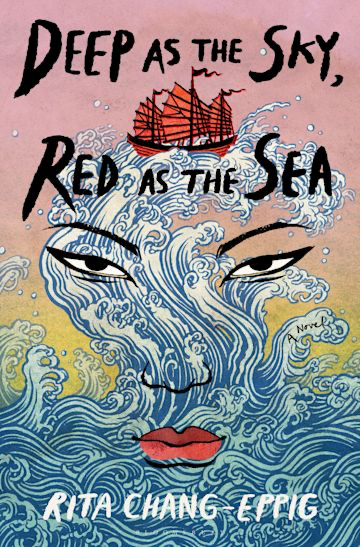
Book Review Tuesday (8/22/23) – Imogen, Obviously

Happy Tuesday, bibliophiles!

I’ve been reading Becky Albertalli’s YA books since middle school, and they’ve always had a special place in my heart. Although some of them have been hit-or-miss, I was looking forward to reading this one—it seemed so deeply personal to her, and I was so excited for the bisexual rep! And although it wasn’t perfect, it was such a deeply authentic depiction of the bisexual experience.

Enjoy this week’s review!

Imogen, Obviously – Becky Albertalli

Imogen Scott knows her place—the token ally amongst her very queer friend group. She knows the nuances of queer culture and discourse in and out, but she’s confident in her heterosexuality. But all of that changes when she stays with her best friend Lili at her new dorm in college. Lili, who happened to tell everybody that Imogen was her ex in an ill-thought-out lie. Imogen is happy to keep up the ruse, but when she meets Tessa, one of Lili’s new (and very cute) friends, she begins to question whether or not it’s the role of “ally” that’s the lie after all.

TW/CW: biphobia/homophobia (external & internalized), forced outing, underage drinking

From the start, I knew that Imogen, Obviously was going to be a deeply personal book for Becky Albertalli. That’s exactly what it was, and that’s exactly what it should have been. Even though it wasn’t without its flaws, Imogen, Obviously is an incredibly important book in that it shows us a narrative of bisexuality that isn’t portrayed as much, and that there is no one true narrative of how bisexuality is in the first place.

As a bisexual reader, Imogen’s story resonated so much with me, even if our coming-out journeys were different. And the fact that Imogen has a coming-out journey that deviates from a lot of the bisexual representation in media in general is a breath of fresh air; along her path of self-discovery, there’s some fantastic discussions about how we internalize stereotypes, the pressure to be “queer enough,” internalize biphobia and feeling like you don’t belong in queer spaces, and so much more. (And I’m glad that somebody’s talking about how random bisexual “traits” that float around social media…I once saw one that said “you may be bisexual if winter is your favorite season”…huh? What does that have to do with anything?) It’s a love letter to those who who feel like exceptions from the norm in a place that’s already populated by outsiders.

Adding onto that, what makes Imogen, Obviously such an important book to me is that it has such an important message about bisexuality, and about queerness in general: there is no one way to be bi, and that the entire queer experience doesn’t have to be entangled with suffering. We watch Imogen struggle with feelings of imposter syndrome in the queer community and repeatedly being put down by a “friend” who feels like she has the ultimate queer authority because she’s experienced quite a lot of homophobia, and it serves as an important reminder: we can’t exclude queer people from their own community just because they “aren’t queer enough” by some arbitrary measure. Again, it speaks to the personal element of this book, what with Albertalli’s own recent forced outing, but it’s a message that needs to be loud and clear.

Apart from the many wonderful messages that this book spreads, I loved watching the relationship between Imogen and Tessa develop! It really felt accurate to having your first queer crush in real time, with all of the stomach butterflies and shy conversations. They were a lovely match for each other, and although I was cheering for Imogen for every page, the two of them made my little bi heart so happy. Their romance really was a resonant and joyful one, something that Albertalli has nearly mastered writing.

All that being said, I had some issues with the writing that prevented me from giving Imogen, Obviously the full four-star treatment. I don’t remember enough about her other books to say how they were written (it’s been a while), but the way that she wrote these high school and college characters just felt so…off. She just peppered in all of the gen z slang into her dialogue whenever possible, and none of it felt natural or genuine. It felt like somebody observing gen z and/or TikTok from a distance, then trying to employ said slang from memory. It all felt so clunky, and at times, as much as I hate to say it, painful. I’m pretty sure that nobody says “discoursing” as a verb for discussing discourse. As fantastic as the rest of the book was, the cringy nature of the writing put me off from fully enjoying it.

All in all, a beautiful and necessary depiction of bisexuality that was hindered by its attempt to capture gen z speak, but excelled in every other department. 3.75 stars, rounded up to 4!

Imogen, Obviously is a standalone, but Becky Albertalli is also the author of the Simonverse (Simon vs. the Homo Sapiens Agenda, Leah on the Offbeat, and Love, Creekwood) and Kate in Waiting. she is also the co-author of What If It’s Us and Here’s to Us (with Adam Silvera) and Yes, No, Maybe So (with Aisha Saeed).

Today’s song:

That’s it for this week’s Book Review Tuesday! Have a wonderful rest of your day, and take care of yourselves!
Posted in Book Review Tuesday

Book Review Tuesday (8/15/23) – Nightbirds

Happy Tuesday, bibliophiles!

I’ve seen this novel around a fair bit ever since it came out, both in the blogosphere and from our queen Amie Kaufman, who co-hosted the podcast Pub Dates with Kate J. Armstrong. It seemed like a more unique YA fantasy concept, and the 20’s-inspired setting intrigued me, and…okay, who wasn’t looking at that gorgeous cover? Now that I’ve read it, I can say that I enjoyed it, but I came away with mixed feelings—Nightbirds was a well-crafted fantasy in terms of worldbuilding, but its characters and general fence-sitting about what it wanted to say slightly put me off.

Enjoy this week’s review!

Nightbirds (Nightbirds, #1) – Kate J. Armstrong

In Simta, no one is more sought after than the Nightbirds. Long ago, these girls from the Great Houses were bestowed with the magic of witches, and with a kiss, they can grant that power to anyone who wishes to wield it. Matilde, Sayer, and Æsa are this season’s Nightbirds, but they have already learned that they will only ever be seen and treated as disposable. Yearning for something more to life, they stumble upon an underground networks of witches—witches whose powers come fro outside of the Great Houses, and are hidden from sight from the government. With the knowledge that their power will not be suppressed, the three Nightbirds set out to make things right.

TW/CW: misogyny, fantasy violence, murder, death, past mentions of torture, near-death situations

I came to this book mainly from the word of Amie Kaufman, who also happened to release a 1920’s-inspired YA fantasy this year. And while I did enjoy Nightbirds as a whole, the more I thought about it, the more drawbacks I found. If you’re torn between the two, stick with The Isles of the Gods.

Let’s start with the best part of the novel, though: the worldbuilding at the atmosphere! The Jazz Age inspiration was heavy, but it was executed incredibly; the worldbuilding, from the hidden magic to the forces trying to suppress it, was impeccably-crafted, with not a single stone unturned in terms of the intricacies of Simta and Armstrong’s world as a whole. It was a world that felt genuinely fun to be in—there was so much to explore along with the three main characters, and I enjoyed every minute of it.

All that wouldn’t have been possible with Armstrong’s atmospheric writing. There were other markers about Nightbirds that signaled it as a debut novel (more on that later), but for a first novel, the writing in this novel was fantastic! It’s the kind of writing that doesn’t just immerse you in the world, but dunks you headfirst into it with its vivid, vibrant imagery. Armstrong’s writing was so clear that I could visualize the world of Nightbirds almost cinematically, every scene played out like it already had a screen adaptation. The steady pacing added to that effect as well—it had a great balance of political intrigue, action, and down time to keep me intrigued for most of the novel.

However, the multiple POVs were an issue for me for most of the novel. The worst crimes that a multi-POV book can commit is not marking which POV the chapter is from, and switching POVs without warning in the middle of a chapter. Nightbirds was guilty of both. With these kinds of books, it’s often a struggle to pick out one character’s voice from another, but the third-person POV remedied that slightly. Even so, it was maddening trying to feel my way through the chapter and remember whose POV was being focused on. And speaking of the characters, they were in some serious need of being fleshed-out. Other than Matilde, whose personality was being entitled and stubborn, I could barely get a read on both Sayer and Æsa beyond what the synopsis said about them. Aside from Matilde, they had hardly any distinctive features, personalities, or traits, which made the whole multiple-POV mess all the more maddening. All of it could have been prevented with some chapter headers and giving the characters more life—it really wouldn’t have been all that hard of a fix.

And for a book that was advertised as being a feminist fantasy, Nightbirds really didn’t seem to know what it wanted to say. For a plot centered around an archaic system built on exploiting teenage girls, you would think that there would at least be some commentary on it. All we really got was a hollow, vague sense of taking back power, but there was no real call to action to do just that; aside from the revelation of the underground network of witches whose magic hasn’t been suppressed by the fantasy patriarchy, there’s hardly any real questioning of the system or realizing that there is a way to reform it and break away from it entirely. It’s like the book equivalent of thinking that you’re a feminist just because you post some instagram infographics on your story every once in a while and do nothing else. It’s saying “smash the patriarchy!” and then sitting comfortably and doing nothing. That’s basically what Matilde’s “character arc” ended up being, honestly. I know there’s probably better words to describe it, but the one that comes to mind is just…white woman-y. I guess I missed the queer rep (WHERE??? I saw no indication of any queerness 😭), but except for that and the conveniently described token side character of color, there was no hint of intersectionality. And no, I’m not saying that every book has to have an impeccably diverse cast, but for a book that billed itself as feminist and supposedly centered around tearing down oppressive systems, I feel like intersectionality should be taken far more into consideration. Nightbirds just came off as more white feminism than actual feminism.

All in all, a fantasy debut with stunning worldbuilding, but that was dragged down by its lack of fleshed-out characters and hardly any hint of the feminist messaging that it advertised. 3.5 stars.

Nightbirds is the first in the Nightbirds duology, which continues with the forthcoming sequel Fyrebirds. Nightbirds is Kate J. Armstrong’s debut novel.

Today’s song:

this is just such a GROOVE

That’s it for this week’s Book Review Tuesday! Have a wonderful rest of your day, and take care of yourselves!
Posted in Book Review Tuesday

Book Review Tuesday (8/8/23) – Machinehood

Happy Tuesday, bibliophiles!

After I read Meru back in June, I immediately went through the rest of S.B. Divya’s full-length books and put them on my TBR. Even though sci-fi is my favorite genre, I don’t readily jump for sci-fi thrillers quite as often, but after loving Meru, I was willing to give this one a chance. And while it wasn’t without its flaws, Machinehood was an incredibly detailed and twisty novel!

Enjoy this week’s review!

Machinehood – S.B. Divya

2095. In Welga Ramirez’s world, humans and machines work in an uneasy symbiosis. Artificial intelligence has become so advanced that humans must take all manner of pills, not only for them to keep from getting sick, but to be strong enough to compete with the machine labor force. Welga has intentions to retire from being a bodyguard. But after a client is killed in front of her and a hybrid human-machine terrorist group called the Machinehood is to blame, she must track down her killer—and the members of the Machinehood that have threatened to attack every major pill funder until production comes to a standstill.

TW/CW: violence, murder, racism, substance abuse, abortion/forced pregnancy, miscarriage

You ever finish a book that’s so detailed in its worldbuilding that not only can you imagine all of the described conventions and their ramifications, but the massive google doc that was probably behind it all? That’s how Machinehood felt to me—aside from the one other S.B. Divya book that I’ve read so far, Machinehood was one of the most thoughtfully-crafted books I’ve read in a long time.

At its best moments, Machinehood felt like a good Christopher Nolan movie. There was no shortage of suspense, and while it was difficult to keep up with at times, it was always an enjoyable read. I don’t gravitate towards sci-fi thrillers as much, even though sci-fi is my favorite genre, but this novel reminded me of what the really well-written ones are capable of doing; the suspense kept me guessing, the tension hardly ever let up, and there were twists aplenty to satisfy any sci-fi reader’s appetite. And of course, nothing makes a thriller like a main character about to retire, and then has to do that One Last Mission™️. When it’s not a part of a huge franchise, it works for me.

Machinehood is S.B. Divya’s first novel, and even then, it’s easy to see the threads from where they eventually branched off to Meru. The most prominent of those was, by a long shot, the worldbuilding. Like Meru, the dystopian, AI-dominated world of Machinehood is painstakingly detailed, down to the most minute consequence of any given sociopolitical ramification. I wouldn’t be surprised if Divya had some kind of Pepe Silvia-style conspiracy cork board to keep track of all the possibilities of this world that they created. There truly was no stone left unturned, and for the most part, it was a positive experience—between the moments of suspense, it was fascinating to see these possibilities unfold. From the myriad of pills that keep humans competing with the AI labor force to the ways that genetic and physical modification advanced, there was nothing that Divya didn’t think of, and that created one of the most fleshed-out sci-fi worlds that I’ve read recently.

Unfortunately, the downside of all of that excellent worldbuilding was its delivery. Having read Meru first, it’s easy to see how Divya improved on this delivery from Machinehood to there. Meru deftly toed the line between explaining its complex worldbuilding and dumping it all in one sitting. Machinehood, on the other hand, could have used some work in that department. As much as I enjoyed how richly layered the worldbuilding was, Divya had a frequent tendency to ramble on about said worldbuilding; even with all of the suspenseful plot points falling into place, this novel took frequent breaks to explain why [x] was a result of [y] and [z], which took away from the tension built up during the parts where the actual plot occurred. It’s a pitfall that I can almost excuse, given that a) Divya’s worldbuilding is obviously top-tier, and b) this was their debut novel, but it definitely took away from some of my enjoyment of the book as a whole. This novel probably would’ve gotten the full 4 stars from me if not for all of this.

All in all, a twisty and suspenseful debut with extensive worldbuilding that sometimes suffered from just as extensive rambling. 3.75 stars, rounded up to 4!

Machinehood is a standalone, and S.B. Divya’s first novel. Divya is also the author of the Alloy Era series (Meru, Loka, and an untitled third book) and Runtime, and has contributed to many short story collections.

Today’s song:

been listening to this song a bunch again, we’re levitating over here

That’s it for this week’s Book Review Tuesday! Have a wonderful rest of your day, and take care of yourselves!
Posted in Book Review Tuesday

Book Review Tuesday (8/1/23) – Magonia

Happy Tuesday, bibliophiles, and happy August! I always look forward to my birthday month, but…I could do without everybody posting that one Taylor Swift song (sorry swifties my neighbors blasted it over and over when I was in school and I can’t take it any longer 😭)

This book has been on and off my TBR over the years; I feel like I put it on my list when I first got Goodreads, lost interest in it a few years later, then got it recommended to me by a friend who saw it on another list. The reviews don’t lie: Magonia really was a strange book, but despite some of its flaws, its strangeness was 100% its strength.

Enjoy this week’s review!

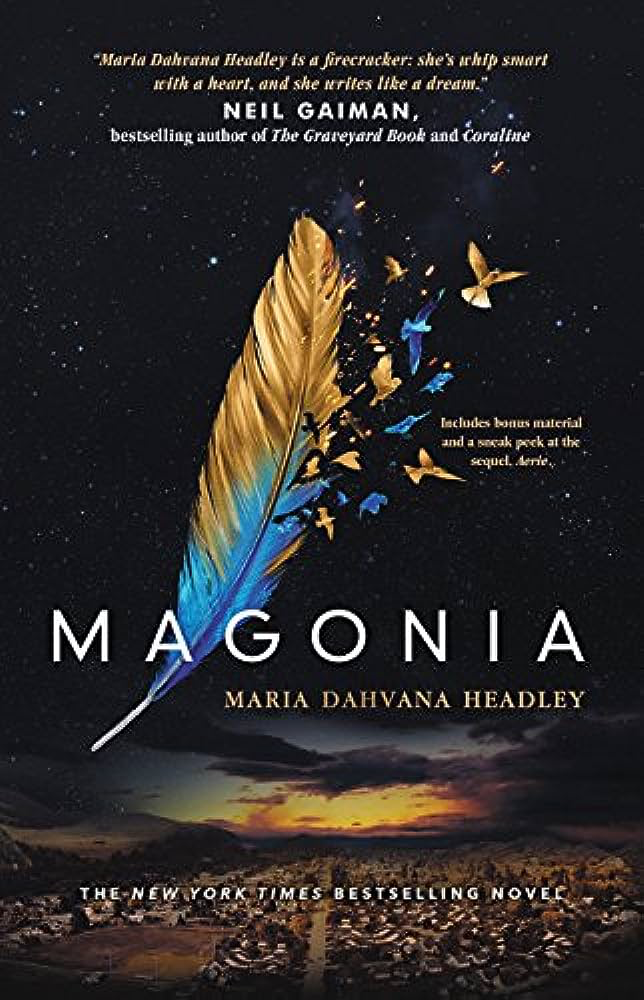
Magonia (Magonia, #1) – Maria Dahvana Headley

All of her life, Aza Ray Boyle has had a mysterious lung disease, incapable of being diagnosed by all kinds of doctors. She can barely breathe or speak without assistance, even with the copious medications prescribed to her. But recently, Aza has begun to see giant ships in the sky. Her parents chalk these visions up to her medication, but Aza knows that something in the sky is waiting for her—and it is. But after a freak accident leads her family to believe that she is dead, Aza is swept up into the world of Magonia, a world of skyfaring ships where she can finally breathe. But as she discovers her hidden Magonian heritage, she discovers that this idyllic world in the clouds is not as peaceful as she once thought—and that the world below may be in danger…

TW/CW: fantasy violence, death/funeral, themes of grief

To put it plainly, Magonia was a weird book. For a YA book that was published in 2015, it feels a lot more daringly weird than most YA books got back then and still do today. Magonia was Maria Dahvana Headley’s first YA novel, and it shows, but not necessarily in a bad way; despite its flaws, it was a refreshingly quirky addition to the pantheon of early to mid-2010’s YA.

I’ve seen this book shelved as having disability rep, and that’s part of why I decided to pick it up again. Aza has a lung disease, but it’s fictional; all of her life, doctors cannot seem to diagnose her, until it is discovered that the disease happens to be a whole bird growing in her chest that factors into the book about a third of the way through. And…I’m torn on whether or not to call it disability rep. On the one hand, the descriptions of Aza’s life before the bird revelation match a lot of other stories I’ve read about people and fictional characters with breathing-related illnesses and disabilities, what with being constantly in and out of hospitals and struggling to fit in with one’s peers. And on the other hand…it feels a little strange, as a disabled reader, to categorize having a fictional ailment of bird growing out of your chest as a disability, especially since the problem resolves itself almost immediately once Aza arrives in Magonia. My issue isn’t that this plotline exists—it’s the category of others labeling this as disability rep that feels questionable to me.

That aside, Magonia was a refreshing novel to read! Especially for a YA book published in 2015, when the industry was so mired in self-serious Hunger Games rip-offs, the unapologetic weirdness of this novel felt like a breath of fresh air, even almost a decade later. We need more whimsy like this in YA—it shouldn’t just be reserved for middle grade. The whimsy doesn’t just die when you hit the age of 13! (Or, at least, it shouldn’t.) I loved the world that Headley created, full of winged people, whales that swim through the sky and giant bats (CREATURES YEAAAAAAAH) and massive frigates that patrol the skies. Headley put so much love into this part of the worldbuilding, and it shone through in every page. It did not hold back in its magical fun, and I am so much better for it.

I’ve seen a lot of reviews saying that they didn’t like how Aza’s voice was written, and to a point, I can understand it. From the looks of it, most of Headley’s body of work is aimed at adults, so it makes sense that she felt as though she had to tone it down and write Aza in a certain, “teenagery” way. But for the most part, I feel like it worked—Aza really did read like she was really 15 going on 16: despite her circumstances, she was still an angsty teenager, but that wasn’t her whole personality. She reacted to her situation as a real teenager would, had her priorities set where a teenager would have them. Aza really was a teenager, and teenagers tend to over-exaggerate things sometimes. It wasn’t all over-exaggeration, though—it was just the right amount of drama and realistically being frightened by everything going on around her, because who wouldn’t be?

However, as engrossed I was with the whimsical fantasy worldbuilding, I found the ending to be quite messy. I get that it’s the first book in the series, but Magonia could have been wrapped up in a much neater and more cohesive way. Details that were only given in the last 50 pages suddenly had utmost importance to the plot, all of the loose ends got even looser, and everything felt generally rushed. Looking back on how much I enjoyed the worldbuilding, it feels like a case of paying too much attention to that and not enough to how the plot would actually play out. Everything felt crammed together and sped through in such an unceremonious way. It’s why I felt like I couldn’t quite give this novel a full 4 stars; the ending made the rest of the intricacies earlier into a rushed mess.

All in all, a refreshingly weird YA fantasy that excelled in its whimsical worldbuilding, but failed in the messy pacing of the ending. 3.75 stars, rounded up to 4!

Magonia is the first in the Magonia series, followed by Aerie. Maria Dahvana Headley is also the author of The Mere Wife, Queen of Kings, Some Gods of El Paso, and many other novels and short stories. Headley also translated a modern version of Beowulf in 2020.

Today’s song:

NEW WILCO JUST DROPPED?????

That’s it for this week’s Book Review Tuesday! Have a wonderful rest of your day, and take care of yourselves!
Posted in Uncategorized

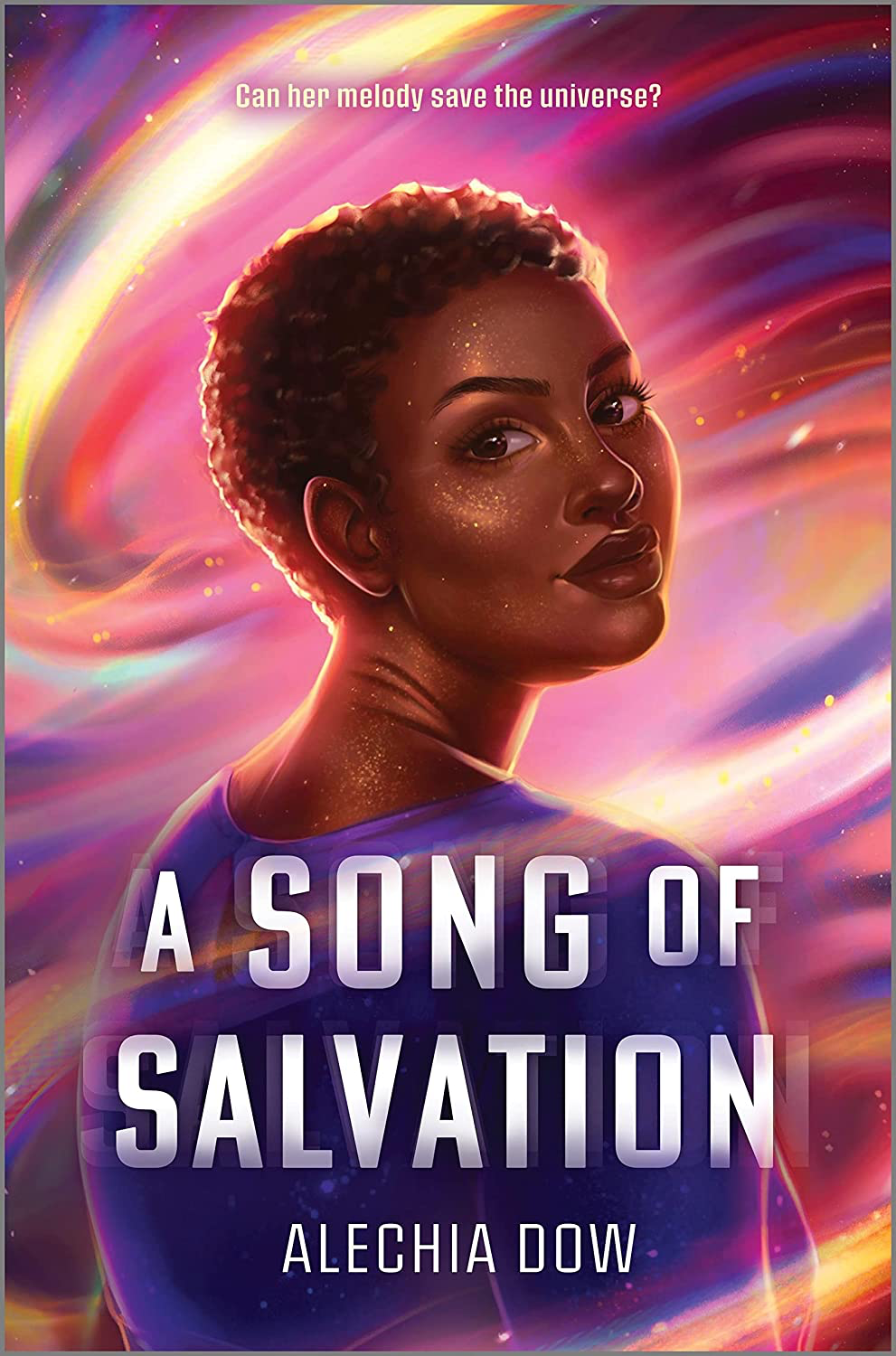
Book Review Tuesday (7/25/23) – A Song of Salvation

Happy Tuesday, bibliophiles! Everybody say happy birthday to Hobbes, who turns 7 today:

I’ve been following Alechia Dow ever since The Sound of Stars was a 5-star read for me way back in 2020; I’ve loved reading her brand of hopeful, queer YA sci-fi with Black characters at the forefront, and so I was so excited to hear that A Song of Salvation was set in the same universe as her first two books! Unfortunately, I found it to be more lackluster than her first two books, but that doesn’t mean that I still enjoyed it.

Enjoy this week’s review!

A Song of Salvation – Alechia Dow

Zaira Citlali knows her purpose. As the reincarnation of the goddess Indigo, she has been granted with their powers—but cannot seem to harness them. What’s worse, her mortal enemy, the destruction god Ozvios, remains at large, and as he creates war all across the galaxy, he’s eyeing Zaira as a prime sacrifice. But Zaira won’t go down without a fight, even if it means rushing to control her powers. With the help of Wesley, a disgruntled smuggler who just wants to get the job done, and Rubin, a celebrity podcaster that Wesley definitely doesn’t find ridiculously attractive, she must find her way to Terra, the center of intergalactic conflict, to ensure that the song of the universe remains intact.

TW/CW: themes of war, genocide, colonialism/imperialism, murder

I liked this book. But I wanted to like it so much more. Ever since The Sound of Stars, I’ve been trying to get my hands on every Alechia Dow that comes out—normally, I love her special brand of sweet, vibrant sci-fi with Black, queer characters at the forefront. But putting this book next to The Kindred has made me realize that I’m liking her books less and less with each one that comes out. And that makes me really sad. It almost makes me scared to re-read The Sound of Stars, which was a 5-star read for me, just out of fear that it won’t be as impactful for me now as it was back in 2020. All that is to say that A Song of Salvation was still a solid read, but a visible downgrade from both The Sound of Stars and The Kindred. It doesn’t feel like her best work at all.

I’ll start with the positives: if anything, A Song of Salvation was still fun and well-crafted. Dow’s space opera universe where queer characters of color are in charge of their own destinies and get to star in their own star-crossed romances is always a treat to step inside of. The new context and worldbuilding that Song adds to this already vibrant world made it even more fleshed out and real, and Dow was adept at handling all of the intergalactic politics as war descended upon the universe. It’s all richly layered and detailed, with no stone left unturned in terms of the eccentricities of everything going on. And of course, sci-fi with high(ish) stakes but with ultimately hopeful and happy resolutions are always a win. Before I get into my main gripes, I should clarify that I did enjoy the book—it was still a fun read, and better than a fair portion of YA sci-fi—but having read Dow’s other novels, it left me wanting more.

What was endearing to me about The Sound of Stars and The Kindred (the latter to a lesser extent) were the characters—Ellie and Morris felt so resonant, and Felix and Joy, even if they were slightly less so, were still a joy (no pun intended) to be around. Given that Dow’s books have leaned more on the side of character-driven, I expected Song to have the same kind of characters and character development, but unfortunately, I found it lacking. Zaira, Wesley, and Rubin were all fun characters, in the abstract, but it felt like Dow didn’t give them the same love and care that she did for her other characters. They all seemed to have a baseline personality trait each: Wesley is grumpy, Rubin is flamboyant, etc. There wasn’t a whole lot to Zaira, either—it genuinely saddens me to say this, but she feels like every single “reincarnated god/goddess/has the power of a deity” kind of character, whose only traits seem to be that they’re overpowered. And for all of the “I can’t control my powers :(” talk, she seemed to miraculously save the day most every time? That’s not to say that they weren’t all at least entertaining, though; they had a good group dynamic, and Wesley and Rubin were cute together. (Did anybody else feel like Rubin was a toned-down, YA version of Ruby from The Fifth Element? The name and everything…I can’t be the only one to see that…)

Plot-wise, A Song of Salvation struggled to remain relevant for at least half of the book; it felt like a lot of running about with no consequence to the story (and, y’know, the looming intergalactic war?). The second half more or less suffered from the same problem, but it hinged so much on the cameos from the previous books. Don’t get me wrong—it was really sweet to see Ellie, Morris, Joy, Felix, and all of the others, but the more that they showed up, the more it felt like they were being used as crutches to keep longtime readers interested in the story. And for such endearing, well-developed characters, having them used like this was such a shame. They were too well-written to just be cameos. It really felt like such a shame.

All in all, a fun addition to Alechia Dow’s sci-fi universe, but one that relied too much on the wondrousness of its predecessors to stand on its own. 3.5 stars.

A Song of Salvation is the companion to Alechia Dow’s other YA sci-fi novels, The Sound of Stars and The Kindred; they are not a concrete trilogy, but they are all set in the same universe, and can be (and probably should be, just to understand everything) read as such. Dow is also the author of the forthcoming middle grade novel Just A Pinch of Magic (slated for release this October) and All’s Fair(y) in Love & War (slated for release in 2025).

Today’s song:

haven’t been able to stop listening to this gaaaaah

That’s it for this week’s Book Review Tuesday! Have a wonderful rest of your day, and take care of yourselves!
Posted in Book Review Tuesday

Book Review Tuesday (7/18/23) – So Lucky

Happy Tuesday, bibliophiles!

I came upon this book after poring through the “further reading” section of Alice Wong’s incredible Disability Visibility anthology (which you should also go read!!), and I put it on hold at the library soon after I heard about it. I was completely unfamiliar with Nicola Griffith before reading this novella, but she delivered so much power and resonance in the span of only 180 pages. We’re barely halfway through the year, but I know that I’ve got another favorite read of this year.

Enjoy this week’s review!

So Lucky – Nicola Griffith

Mara Tagarelli has it all. Happily married and the head of a multimillion dollar AIDS foundation, she lives a life of contentment and security. But in the span of days, Mara is diagnosed with MS, and her wife leaves her soon after. Her colleagues now dismiss her needs, and she’s left without work, without the care she needs, and without any prospects for the future. But as she slowly begins to find a community, she realizes the power that she holds—to put those she values in danger, but to give them the justice that they deserve.

TW/CW: ableism, hate crimes, murder, medical mistreatment, misogyny

I finished this book several days ago, but I’m still positively reeling from the effect it had on me. I picked it up after seeing it included as a recommendation in the “further reading” section of Alice Wong’s Disability Visibility, thinking it would be something good to read during Disability Pride Month. What I found was something far more than just “something good to read”—it was wholly refreshing, resonant, and both heartbreaking and heartwarming. So Lucky wasn’t a novel that I expected to hit me so hard, but it did, and I am forever grateful for it.

I’ve never been more in love with such an angry character, to be honest. Griffith’s writing of Mara felt more than authentic, a character that climbed out of the page, demanding to have her voice heard. And although her anger is her primary character trait, it’s an anger that resonated with me like nothing has before; in a landscape where disabled women, both fictional and real, are expected to be demure and sadly accepting of their fate (but in a sexy way, of course, because they obviously only exist as objects of pleasure for men), having a character as fiery and determined as Mara very nearly made me cry. I don’t have MS, but I am a disabled reader, so watching Mara express her anger at her treatment, at her life, and at the world around her was more than I could have asked for. More disabled women who aren’t conventionally likable and are written authentically, please! Use this novella as a guide.

So Lucky is a hard read—it doesn’t pull any punches, and that’s exactly how it should have been. It displays a lot of some of the more harsh realities of being disabled, especially being physically disabled: dismissal by your colleagues, mistreatment at work (and eventually being fired because of said diagnosis), relationship turmoil, medical mistreatment, and disability-motivated hate crimes are all a part of the narrative that Griffith portrays. It’s visceral and heartbreaking, and it doesn’t hold back in the slightest. But never once did it feel amped up for tension, or unnecessarily exaggerated: this is the story of an angry woman, and the story of a system built on bringing her down, as well as others like her. It really represents a good portion of the spectrum of issues that disabled people, especially disabled women, face, and Nicola Griffith captured all of it with incredible aplomb.

Despite that, So Lucky never falls into hopelessness. Even though Mara faces hardships aplenty, it never portrays the disabled experience as defined solely by tragedy and suffering. In spite of it all, there is always hope: Mara finding an online community of other disabled people, taking care of her cat (shoutout to Rip), and coming to the realization that her anger was never from the MS itself: it was from the experience of living in a world that did not want her to succeed. At its heart, So Lucky is an incredibly raw story, but a fearlessly hopeful story, one where our protagonist knows that her anger doesn’t come from being disabled, but from existing in a world where disabled people are treated so poorly. And that anger only adds to her determination to continue to fight for a better, more accessible world. There is no disability to inspirationally overcome, only a system. I can’t think of much that’s more beautiful than that.

All in all, a short novella that packs a deeply impactful punch, and portrays disabled womanhood in a refreshing light. 5 stars!

So Lucky is a standalone, but Nicola Griffith is also the author of Ammonite, Hild, Cold Wind, Slow River, and many other books for adults spanning several genres.

Today’s song:

never in my life would I have anticipated liking a Weezer song THIS much, but you can blame Snail Mail for this one

That’s it for this week’s Book Review Tuesday! Have a wonderful rest of your day, and take care of yourselves!

Posted in Book Review Tuesday

Book Review Tuesday (7/11/23) – The Whispering Dark

Happy Tuesday, bibliophiles!

I’m willing to go out of my genre comfort zone when it comes to finding books with good disability rep, and that was the case for this book; dark academia usually puts me off (see my review of Victoria Lee’s A Lesson in Vengeance for the gist of my gripes about it), but I’m always here for books by disabled authors! In this case, it was worth it, but the experience wasn’t the one that I think the author intended—The Whispering Dark was a mess, but in kind of a fun way. For the most part.

Enjoy this week’s review!

this cover is so goofy to me for no reason 💀

The Whispering Dark – Kelly Andrew

Delaney Meyers-Petrov is determined to prove herself. All of her life, people have perceived her as fragile because of her Deafness, but when she’s accepted into the famed, rigorous Godbole University, she knows that this is the ultimate chance to show the world what she’s really made of. But Godbole isn’t an ordinary college—its students are trained to jump between parallel worlds, tapping into arcane magic in order to travel through alternate dimensions. As Delaney faces ableism from her peers and professors, a boy from her past, and the pressure to get good grades, the sinister side of Godbole begins to show its face. For months, boys have been going missing, and the answer to their disappearance may be right in front of her. Will she be able to get to the bottom of what’s killing Godbole’s student body—and work with this mysterious boy?

TW/CW: ableism, murder, blood, gore, past descriptions of death, near-death experiences

Look, you slip the phrase “unholy affliction” into a sentence, and you’ll automatically make me think of Soccer Mommy. And the more I think about it, the more it feels like the vibe of that song is what this book really, desperately wanted to be, but…wasn’t. At all.

Normally, I steer clear of dark academia—the really bad stuff just feels like a bunch of Donna Tartt copycats writing about rich people being “morally gray” (read: smoking indoors, wearing turtlenecks and forming vague “secret societies”) and trying to capitalize off of a popular aesthetic. However, the fact that this one featured a disabled character written by a disabled author (!!!), convinced me to give The Whispering Dark a chance. Here’s the thing: the disability rep? It’s fantastic. Everything else? Not so much. The Whispering Dark was an absolute mess, but it got to the point where its utter ridiculousness was honestly kind of fun to read, so it wasn’t entirely a waste of time.

Let’s start off with the disability rep. Although I can’t speak to the accuracy of the specific rep (Delaney, the MC, is Deaf), it’s so refreshing to see disabled authors writing disabled characters—Kelly Andrew is also Deaf! And even without being Deaf, Andrew wrote some of the specificities of Delaney’s experience with her disability beautifully; I loved the details about how Delaney moved through life, from how the noises around her are described to subtle details like the change in sound when the battery runs out in her cochlear implant. Along with that, Andrew’s portrayal of being a disabled college student really resonated with me, from the nerves about personally confronting professors about accommodations to Delaney’s desire to prove herself.

Aside from that, it’s hard for me to find anything genuinely positive to say about The Whispering Dark. There are more positives in my eyes, to be fair, but they aren’t necessarily about how I think this novel was meant to be taken. In my experience, this book was SUPER campy, but the kind of campy that unintentionally resulted from taking itself so seriously that it becomes almost hilarious. I still can’t believe that all of this was played so straight—this book fell headfirst into every cheesy YA fantasy trope like a 5-year-old being pushed off of a diving board, and we were somehow expected to take it all seriously. You’ve got your edgy protagonist with her dyed hair and her edgy nickname, a mysterious, Ivy League school that teaches its students to jump between parallel worlds, students showing up dead, and a romance with a mysterious, dangerous older boy, who is compared by the MC to Patrick Bateman (I wish I was kidding), but still ends up being the one for whom the MC falls head-over-heels in love with. The way Andrew wrote it felt like she thought it was the most original idea in YA in the last decade, and honestly? I had to laugh. It felt like watching a terrible movie for the irony. Solid unintentional camp. I mean, look at how goofy that cover is.

And look—as campy as The Whispering Dark was, I at least expected there to be a little bit of worldbuilding. Here’s the thing: THERE WAS NONE. Interested in learning about Godbole University and how you can jump through parallel worlds with magic, according to Kelly Andrew? You’re outta luck. There aren’t any explanations for anything—you just get tossed around to parallel worlds without any explanation as to how. Want to know how the various types of magic factor into this world-hopping? Sorry, come back later. Want to know how the villain is using said world-hopping to kill unsuspecting students? Nope, looks like you’ve used up your three wishes. Again, it got to the point where it just felt so bad that it was funny—worldbuilding? Who is she? And it only proves my belief that dark academia, as a genre, suffers from “no plot, only vibes” syndrome time and time again.

All in all, a novel with great disability rep, but that took itself far too seriously for the campy train wreck that it was. We disabled readers deserve our mindless camp too. 3 stars.

The Whispering Dark is a standalone, and Kelly Andrew’s debut novel; her next novel, Your Blood, My Bones, is slated for release in 2024.

Today’s song:

That’s it for this week’s Book Review Tuesday! Have a wonderful rest of your day, and take care of yourselves!

Posted in Book Review Tuesday

Book Review Tuesday (7/4/23) – Painted Devils (Little Thieves, #2)

Happy Tuesday, bibliophiles, and happy…Tuesday. The fact that the Fourth of July comes so close on the heels of the Supreme Court releasing the results of all of their major rulings has significantly soured most attempts I’ve tried to have at patriotism (especially since we have the incredibly unfortunate conservative majority controlling far more than they should), especially in our post-Roe era. None of that puts me in a particularly patriotic mood. But, as always, criticizing your country and pushing for change that will make it better is, to me, is the best kind of patriotism. And if nothing else, I get the day off work today. I’m not about to complain.

That aside, I’ve got an exciting review today! Ever since I devoured Little Thieves back in January, I’ve been itching to read the sequel, which came out this May. After a few failed attempts to get it on Libby, I finally got a physical copy from the library and ate it up as quickly as I did its predecessor. And although I liked it slightly less than book 1, Painted Devils retained its spirit—delightful from start to finish.

Now, tread lightly! This review may contain spoilers for book 1, Little Thieves, so if you haven’t read it and intend to do so, skip over this review.

For my review of Little Thieves, click here!

Enjoy this week’s review!

Painted Devils (Little Thieves, #2) – Margaret Owen

Vanja Schmidt may have succeeded in breaking a godly curse and finding love with Emeric, but that doesn’t mean that her conniving days are behind her. In fact, they’re very much alive—and proved when she fabricates a god to get out of a slippery situation. Problem is, the townsfolk have now accepted Vanja’s Scarlet Maiden as their god, and started a cult in her name. And the Scarlet Maiden demands a sacrifice in blood—a sacrifice that Vanja can’t afford to make. While Emeric goes on a hunt to verify the Scarlet Maiden’s existence, Vanja must find a way out of the sacrifice before time runs out—and before her fraud is exposed.

TW/CW: abuse (physical and verbal), fantasy violence, blood, body image issues, abandonment, animal death, cult imagery

Seeing the phrases “we live in a society” and “scrimblo” within 100 pages of each other in a medieval-inspired fantasy book felt like being hit by a train, to say the least, but the fact that Margaret Owen very nearly pulled it off is nothing short of a miracle. I’m still reeling just thinking about it.

My months of waiting and searching are finally over—I managed to get Painted Devils in my hands, and I’m so happy for it! Although it wasn’t quite as cohesive as Little Thieves was, it was nevertheless a delight from start to finish—being back with Vanja on her chaotic adventures was nothing short of a joy in a sea of YA fantasy novels that take themselves a little too seriously, even though their protagonists are only 16.

I’ll quickly start off with my one major gripe—the reason that I docked it down from book 1’s 4.5 stars to 4.25. Painted Devils, as much as I adored it, definitely fell into the curse of book 2: all of the good elements were still there, but they lacked the cohesion that the first book had. It was all fun, but a good portion of the middle felt like the characters were running around for no reason, without much consequence to the plot. Some of it felt like filler, and for a book that was almost 500 pages long, it didn’t feel altogether necessary.

Other than that, it’s hard to find any nitpicks or problems with Painted Devils! Even though Vanja has always been the main character, this book really felt more about her—it was wholly her story, about what happens when your storied past catches up to you, and how to reckon with your past to become the person you are today. Even amidst the near-constant humor that these books have relied on, Owen manages to tackle so much of Vanja’s character with incredible aplomb, balancing her bouncing-off-the-walls personality with some genuinely heartbreaking and wholly important discussions about familial manipulation and abuse. For a series that’s often been defined by its levity, Vanja’s journey towards self-love and acceptance was unexpectedly heartfelt. It’s exceedingly difficult to balance those two aspects, but Owen made it look easy.

Beyond that, I loved seeing the relationship between Emeric and Vanja develop, both romantically and platonically! They continue to be perfect foils for each other—a physical representation of the grounded and humorous qualities of this novel, and how they complement each other. Their personalities have started to bleed into each other in the sweetest way—Emeric starting to loosen up, and Vanja reluctantly trying to do the opposite—and every moment they shared together was a delight to read. Plus, the discussions about consent are always welcome, and a refreshing break from the years of 500+ year old fantasy love interest that we’ve all had to slog through in the last decade or so.

Owen’s writing, of course, continues to be the star. It’s rare that an author can make a character whose main trait is being “chaotic/morally gray” into something that goes above and beyond the buzzwords—Vanja continues to be impressively fleshed-out, and my life is all the better for it. Some of the more meme-y humor, like the previous book, continues to be jarring in places, but Owen’s other points of humor makes for a wonderfully charming read. There’s really not much else in the world of YA fantasy that succeed like Little Thieves and Painted Devils do: bringing the joy back to a magical, fairytale-inspired world, and balancing it with the reality and darkness that every bad, gritty fairytale retelling missed by a mile. Even with the frustrating ending, I’m so eager to see where the conclusion takes Vanja, Emeric, and all the rest.

I really feel like the world needs a 2D animated adaptation of these books. Just saying.

All in all, a sequel that was a delight to read, even with its lessened cohesion. 4.25 stars!

Painted Devils is the second book in Margaret Owen’s Little Thieves trilogy, preceded by Little Thieves and concluded by an untitled book slated for release in January of 2024. She is also the author of the Merciful Crow duology (The Merciful Crow and The Faithless Hawk).

Today’s song:

XYLOPHONE SOLO

That’s it for this week’s Book Review Tuesday! Have a wonderful rest of your day, and take care of yourselves!
Posted in Book Review Tuesday

Book Review Tuesday (6/27/23) – Flowerheart

Happy Tuesday, bibliophiles!

Here’s some queer fantasy for my last review of Pride Month 2023. I’m so glad that cozy sci-fi/fantasy as a subgenre is slowly multiplying nowadays, and that’s exactly what drew me to Flowerheart. I borrowed it from the Kindle library and ate it up in a few hours flat—though it wasn’t without its flaws, it was a charming, sweet palate-cleanser with lots of flowers and queer rep!

Enjoy this week’s review!

Flowerheart – Catherine Bakewell

Clara has a gift—she can summon flowers at will, making them grow in any space she focuses on. But she’s only 16, and her flower magic is uncontrollable—and sometimes dangerous. When she accidentally causes poisonous flowers to grow in her father’s chest, Clara is distraught—and in desperate need of someone to heal his ailment and help her hone her magic. But the best magician for the job just happens to be Xavier, her former best friend who she can’t quite hide her feelings for. With Xavier hiding secrets and Clara racing against the clock, can they heal her father—and rein in her wild magic?

TW/CW: body horror, substance abuse (fantasy), absent parent, sick parent, mental illness, emetophobia

I love the title of this book as much as the next person, but I’m not gonna pretend that it isn’t a valid Warrior Cats name. Just saying. I’ll bet you money that it was somebody’s OC from 2014.

Flowerheart has a 3.58/5 average rating on Goodreads at present. I have a thing where I’ll see ratings in the 3.5 range and think “oooh, this could be a disappointment,” and then I’ll finish the book and realize that it was just about right on the money. It makes sense. I can see why several people loved it, but a good amount of people felt lukewarm about it or disliked it. For me, I’m sort of in the middle—it was a charming, sweet palate-cleanser, but the holes in the story and some of the writing style prevented me from enjoying it all the way.

The main selling point for Flowerheart seemed to be its coziness—setting aside the annoying, clearly BookTok marketing tactic to put “cottagecore” in the actual description, Bakewell passed with flying colors in terms of this book’s coziness! Other than a brief moment of fantasy body horror (said Flowers growing from Clara’s dad’s Heart), there’s very little that’s stressful. The book also has a strong emphasis on embracing your emotions and learning to love them (as opposed to suppressing them), which is always a win in my book (no pun intended). The queer-normative world was also a delight alongside of that—Clara is bisexual and in a straight-passing relationship, and there are several trans and nonbinary side characters! I ate this book up fairly quickly, but it was a delightful world to stay in, however short the stay was.

That being said, I really wanted more from the world. There really isn’t much to chew on other than the fact that everybody has a unique type of magic, there’s a ruling council of magicians that keeps everybody in check, and that most of the names have a vaguely European root or origin. Other than that, there was almost nothing to hold up the worldbuilding—if it were a house on stilts, the stilts might as well have been popsicle sticks. Where does the magic come from? What is the technology level of this world? Why are they letting 16-year-olds onto this magician council that makes all of the important decisions? Where even were we in the first place? Was there even a name for the place that Flowerheart was set in??? Cozy sci-fi/fantasy and expansive worldbuilding can coexist (see: anything by Becky Chambers), so the subgenre isn’t the issue. I didn’t need a huge, elaborate picture of the world of Flowerheart, but it was sadly clear that Bakewell did the bare minimum in terms of worldbuilding. I really did want more.

Aside from that, my main issue (if you can call it that) was the writing style. On its own, I liked it a lot—it had the perfect, charmingly over-the-top kind of style to it, and it suited the story very well. I saw another review that compared it to Harry Potter, and it made a lot of sense—it did sound very distinctly British. But Harry Potter is mostly middle-grade, and Flowerheart tended to skew the same way in its voice; Clara’s voice read more as a 12-14 year old than a 16 year old. Again: it’s not the coziness and relatively low stakes that made it feel more middle-grade, but the way that the characters were written. Not much of an issue, but I really feel like this would’ve been more successful if Clara was a few years younger.

All in all, a cozy fantasy that was filled with quite a few holes, but still sweet enough to enjoy. 3 stars.

Flowerheart is a standalone, but Catherine Bakewell is also the author of the middle-grade novel We Are the Song.

Today’s song:

ughhhhhh this album is so good

That’s it for this week’s Book Review Tuesday! Have a wonderful rest of your day, and take care of yourselves!