

Happy Sunday, bibliophiles! I hope this week has treated you well.
This week: a David Bowie double feature (who could’ve seen that coming?), upcoming artsy albums, and more reasons why I really just wish I had dual British citizenship, because apparently all of the good music related stuff happens exclusively in the UK.
Enjoy this week’s songs!
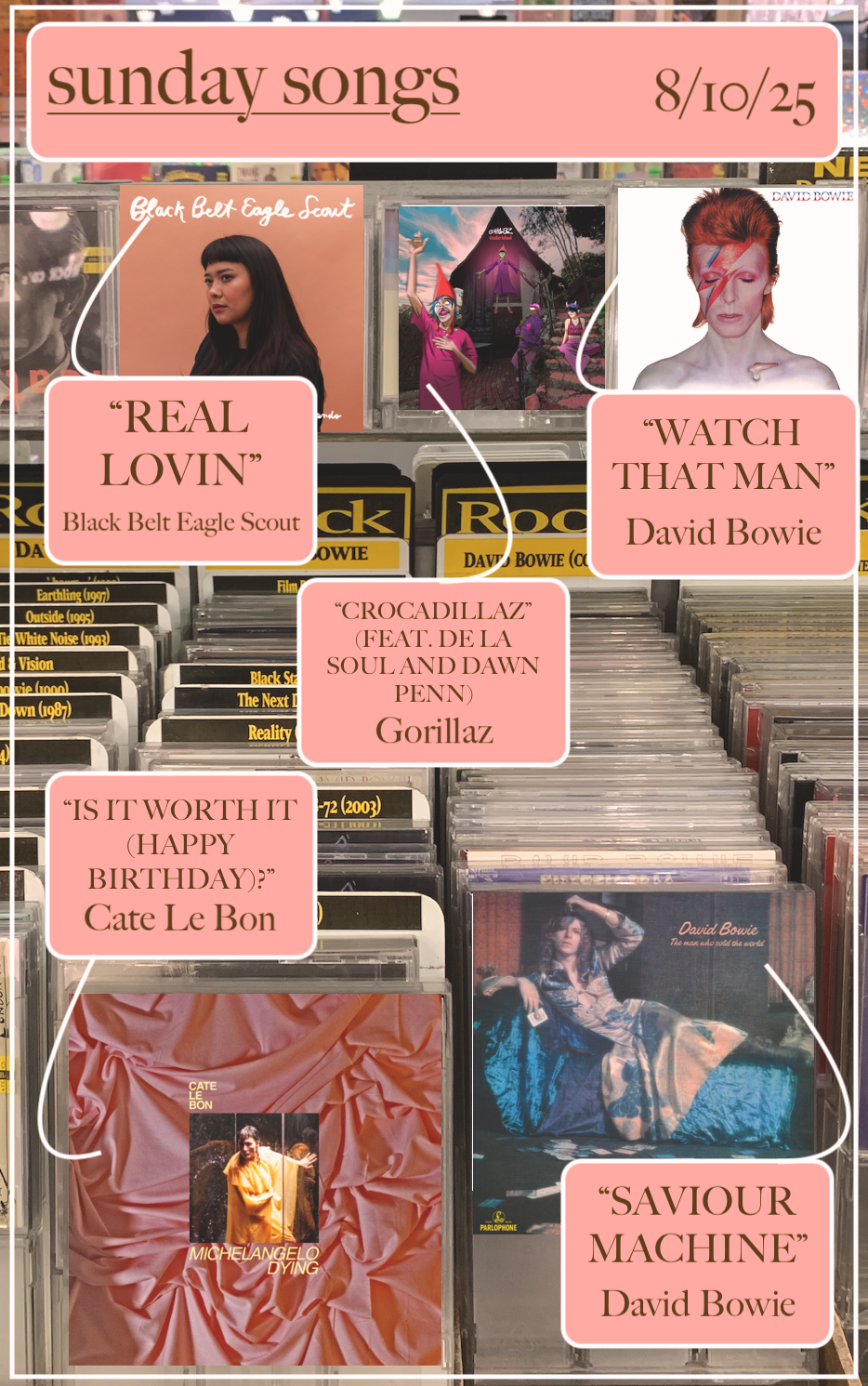
SUNDAY SONGS: 8/10/25
“Is It Worth It (Happy Birthday)?” – Cate Le Bon
I could really do with some more restrained excitement about Michelangelo Dying, but…these singles just aren’t letting me do it! They’re both so enchanting! I can’t get enough!! I’m really hoping they’re not the best of the bunch, but I have faith that Cate Le Bon has something quirkily artsy up her sleeve, if this and “Heaven Is No Feeling” are any indication.
“Is It Worth It (Happy Birthday)?” takes the palette of the album down a more subdued, melancholy route than “Heaven Is No Feeling,” trading the former’s synthy strut for glassy-eyed introspection. But even with the thematic shift, Le Bon’s signature modern touches are there. Awash in fizzling, electronic textures, this track is an outstretched bolt of lavish fabric, much like the pink background of the album cover. Silky and watery, it makes every instrument feel like it’s been drenched in sunlit water, from the gentle, barely perceptible bass to the saxophones. I’m not usually this big of a fan of saxophones, but the way Le Bon utilizes them, more for added sonic texture than for dramatic solos, make her world even more layered and delectable to pick apart. It’s distinctively her, but I can’t help but think of the dense, dreamy soundscapes of the Cocteau Twins when I listen to it. (“For Phoebe Still A Baby” jumps out in particular.) Yet drama is what this song quietly thrives on, as the lyrics muse on trying to make light out of abject sorrow: “Open up in hell/And dress the hall/It’s a holiday/It’s a birthday/Is it worth it?/Is it worth it?” The lyrics nearly get swallowed by the sheer magnitude of sounds woven into the production—including the signature, lilting cadence of Le Bon’s voice—but it almost seems exactly her intention. It feels both mean and inaccurate to call any of it window dressing, but next to the lyrics, all about trying to laugh heartbreak away and pretend it’s something that it’s not, it feels like exactly the kind of shrouding she’s singing about. At the end, she laments that she’s “Checking out/Even with my language in him,” just as the listener tries to extricate her from the vibrant sea of sound she’s crafted to shield herself. It’s easy to get washed away in, and if the rest of Michelangelo Dying is anything like this, I’ll be gladly losing myself in it come September.
…AND A BOOK TO GO WITH IT:
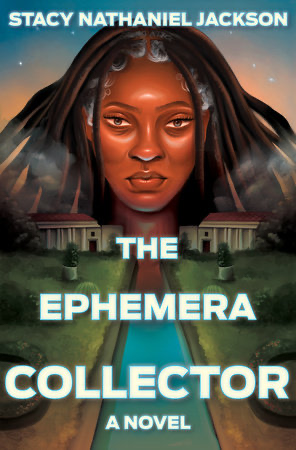
The Ephemera Collector – Stacy Nathaniel Jackson – “Open up in hell/And dress the hall/It’s a holiday/It’s a birthday/Is it worth it?”
“Saviour Machine” – David Bowie
“David Bowie predicted ChatGPT” would’ve been a good headline for this post, but as much as I love him, he was far from the first to ponder about AI. But really…this song does basically predict ChatGPT, and in this song it’s “President Joe” who introduces it to the world, which is kind of a crazy coincidence. Had to do a double take when I first heard the lyrics, for sure. Drawing from much of the sci-fi media of his time, Bowie’s version of AI comes in the form of The Prayer, an AI system introduced by President Joe to make the population’s decisions easier for them, from stopping wars to simply thinking themselves. However, it’s The Prayer itself that calls for its own destruction, going insane after having such decisions weighing on its shoulders and pondering: “Please don’t believe in me/Please disagree with me/Life is too easy/A plague seems quite feasible now/Or maybe a war/Or I may kill you all!” Life is too easy for sure, now that everyone’s trying to flirt and make art and music and go through school entirely with AI. Sorry, but can’t you idiots stop and forgo convenience to experience the tedious pleasures of the human experience? Embarrassing. Jesus Christ. Remember, kids: you can’t stake your life on a savior machine.
“Saviour Machine” rings reminiscent of short stories of the likes of Ray Bradbury, but it also reflects the much darker tone of The Man Who Sold the World. Though it wasn’t like he hadn’t trod into darker lyrical subjects before, going from something like “Uncle Arthur” to an album comprised of insane asylums, the Vietnam War, and gay sex with Satan in the span of three years is a whiplash-inducing left turn for anyone. I don’t think it’s the edginess of the subject matter that makes it feel more mature, but the exploration—The Man Who Sold the World represents a critical turning point in Bowie’s storytelling ability, and he was willing to explore places that he hadn’t explored before, pushing himself out of his typical territory in order to create something wholly unique. It feels to me what he said when he spoke about art: “If you feel safe in the area that you’re working in, you’re not working in the right area. Always go a little further into the water than you feel you’re capable of being in. Go a little bit out of your depth, and when you don’t feel that your feet are quite touching the bottom, you’re just about in the right place to do something exciting.” Darkness was coincidental, and of course, not all of the album is necessarily dark—it was merely territory that he hadn’t scoured before, and that challenge led him to create some of his most innovative work, time after time, album after album. “Saviour Machine” feels like the prelude to that storyteller’s attitude, one that would guide him to untold heights in his career.
…AND A BOOK TO GO WITH IT:
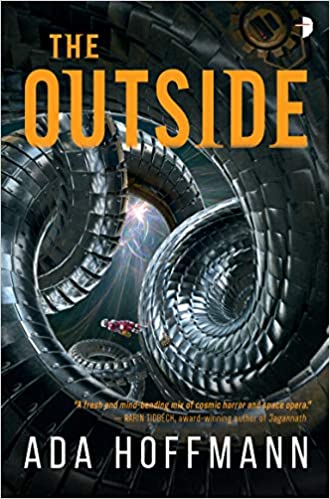
The Outside – Ada Hoffmann – A few centuries in the future, when something like The Prayer gets out of control…
“Real Lovin” – Black Belt Eagle Scout
Katherine Paul has a distinctly whispery voice—everything they sing sounds like they’re singing it into a cool breeze. Most of her music pre-The Land, the Water, the Sky suits it perfectly; though she’s become more adventurous with her vocal capabilities later on, a lot of her songs had a slower, softer demeanor that suited the airiness of her voice. But if there’s any song to be characterized by this, it would be this one. I’d forgotten all about “Real Lovin” for years—I initially listened to At the Party With My Brown Friends around five years ago—until it popped back into my shuffle out of nowhere. Though Paul’s voice soars with more volume towards the end of the track, her whisper-singing is perfectly suited to the quiet tenderness of the lyrics: “Now that you can dream/What is it you see/When you wake up in the folds of blankets in your bed/In your room/In your house/By yourself?” It’s the sound of a sliver of dewy light sliding through the slats of shutters in the early morning as you blink away the threads of sleep. Paul’s voice is a comfortable sheet over me as I listen, and she delivers what’s easily the softest, tenderest uttering of “well that’s bullshit” I’ve ever heard in a song. But no matter the intensity, which rises with every passing minute as the instrumentals build up, I never have a doubt that Paul means exactly what she’s saying.
…AND A BOOK TO GO WITH IT:
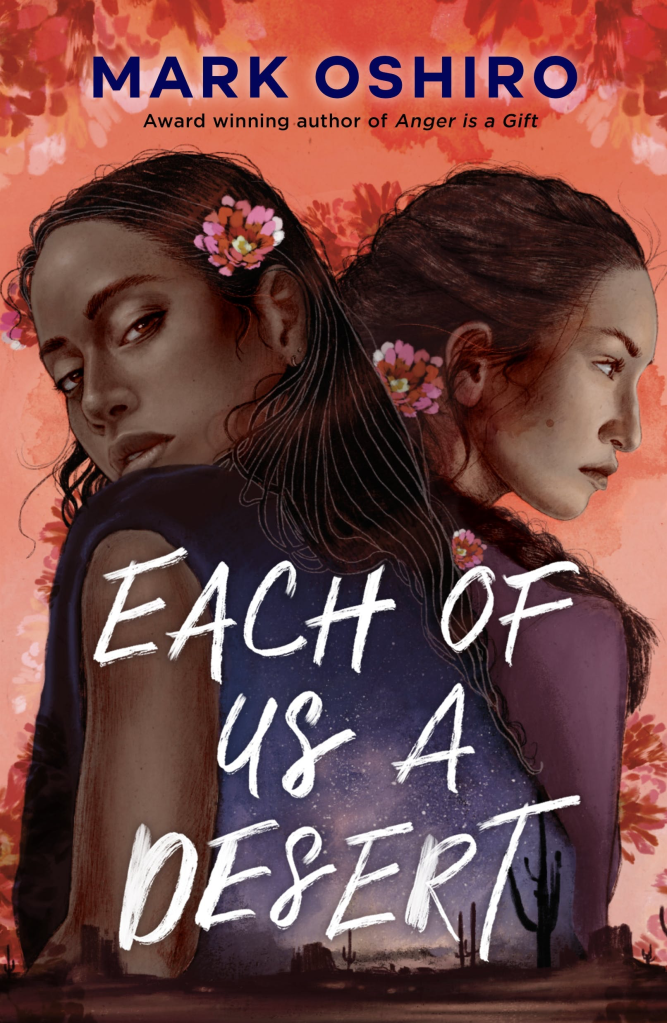
Each of Us a Desert – Mark Oshiro – “You’ve tried and tried/What seems a million times and you wonder how you’ll end up/Is it the moon?/Is it the stars?/Do they rule you and your heart?”
“Crocadillaz (feat. De La Soul and Dawn Penn)” – Gorillaz
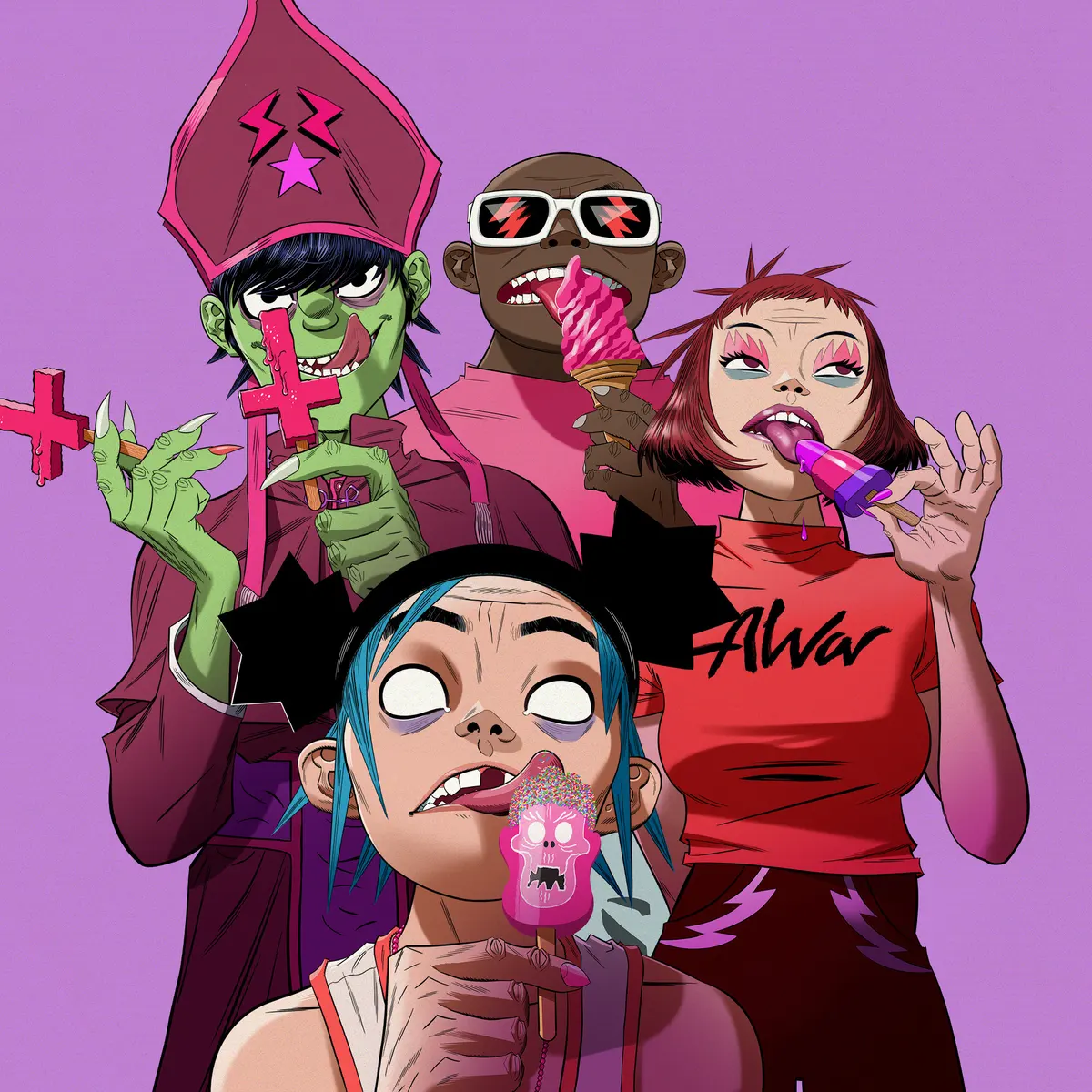
While I froth at the mouth that I can’t go to the Gorillaz exhibit in London, I figured it would be fitting to talk about them…for the millionth time on this blog.
It was a strangely pivotal moment when, a week after Cracker Island released back in early 2023, three more songs were added to the lineup. I had middling thoughts about the album up until then; for me, it represented the point at which Gorillaz (and later Blur with The Ballad of Darren) became nearly indistinguishable from Damon Albarn’s solo work. There were a handful of fun tracks, but as a whole, it failed to hold as much water as something like their first three records, even with the star-studded list of collaborators. And when it seemed all hope was lost…Del the Funky Homosapien and De La Soul returned! (Two years later, “Captain Chicken” has no business being so good for a song with such a goofy title AND samples of chicken clucks. God, it’s so good.) Disregarding the “Momentz” haters (heathens, all of you), every time De La Soul and Gorillaz collaborate, a special kind of magic happens. Even with Trugoy the Dove’s too-soon death hanging over it, “Crocadillaz” was one of the unmistakable highlights of the album. For a song about constantly looking over your shoulder and the trappings of fame, it has a steady, easy calmness to it, propelled by Dawn Penn’s “Doo-doo-doo-doo-doo-doo-doo” chorus, which gets delightfully stuck in my head more often than not. Trugoy and Penn make for an unlikely but smooth pairing for this song, with the former providing the sharp-edged, quick-witted verses and Penn’s smooth, resonant vocals giving the song a simultaneously retrospective and playful chorus. I’m not usually a fan of the “Gorillaz but it’s just the collaborators” songs, but with a pairing as talented as these two, it’s easy to excuse.
…AND A BOOK TO GO WITH IT:
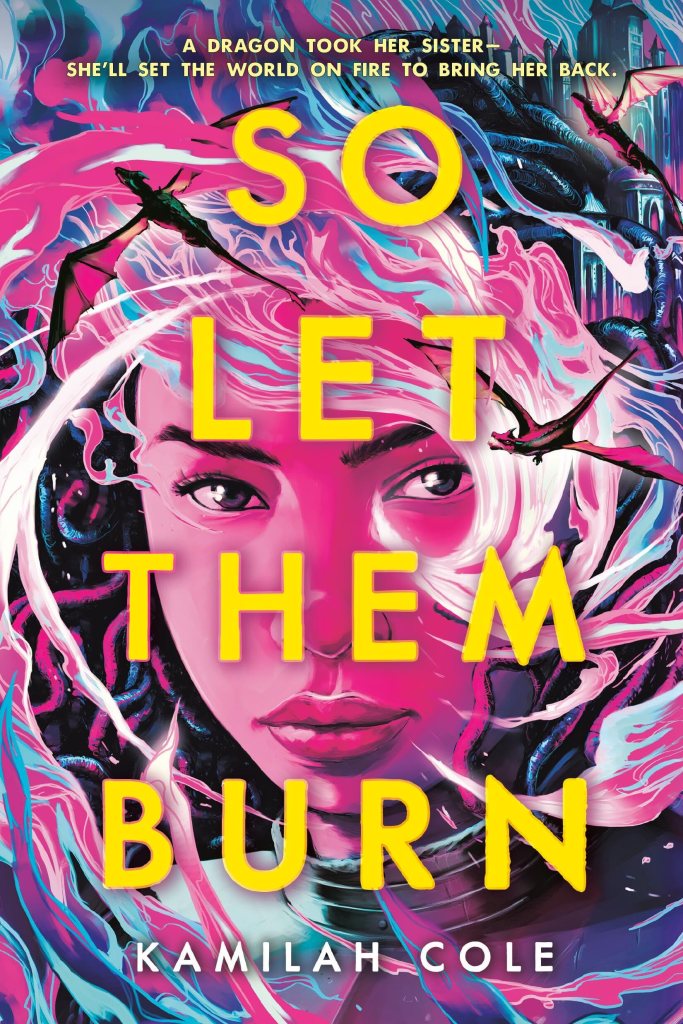
So Let Them Burn – Kamilah Cole – “Could play the sheep, but beware of the wolf’s eye/Hypnotized by the crocodile’s smiles/The exchange is brief, but watch for the teeth…”
“Watch That Man” – David Bowie
Aladdin Sane has to be the most iconic album cover in David Bowie’s catalogue. If you know any album cover, it’s that one—the nondescript, asleep-looking Bowie with a glittering lightning bolt slashing across the front of his face. And that silvery bit on his collarbone—I always thought it was a bone fragment when I was a kid, and my dad thought it was something like mercury pooling on his skin. It raises questions! It sticks in your head! And yet, the album cover gets talked about much more than the actual album. Sure, it’s probably the weakest if we’re grouping it in with Hunky Dory and The Rise and Fall of Ziggy Stardust and the Spiders from Mars, but that’s because you’re grouping it with two of the greatest albums of all time. But it’s really such a disservice that the album only gets remembered for the cover—there are so many excellent cuts from the album, even if it never usually makes the cut for hit Bowie songs (except for maybe “The Jean Genie”). It’s slick as hell, incredibly funky…it just rocks. Listen to the album and you just know. And “Watch That Man” is what sets the tone, a rollicking dance floor rocker that begs for you to shake your hips with every word—not just the “shakin’ like a leaf” bit. Inspired by seeing the New York Dolls live, “Watch That Man” follows a lively party, with the lyrical camera roving over every participant as the music blasts. I never had any particular problem with the mix, but it was one of the more rushed songs on the album, and on reflection, doesn’t sound as clean as some of the other tracks—it’s all a bit muddy, with most of the instruments, Bowie’s voice included, being at a very similar volume. But for a song meant to emulate the rush of a concert or being on a crowded dance floor, it gets the job done spectacularly.
…AND A BOOK TO GO WITH IT:

Kings, Queens, and In-Betweens – Tanya Boteju – dancing, parties, and no shortage of glitter and makeup.
Since this post consists entirely of songs, consider all of them to be today’s song.
That’s it for this week’s Sunday Songs! Have a wonderful rest of your day, and take care of yourselves!










 The Bookish Mutant