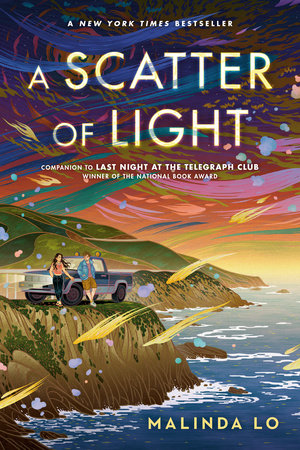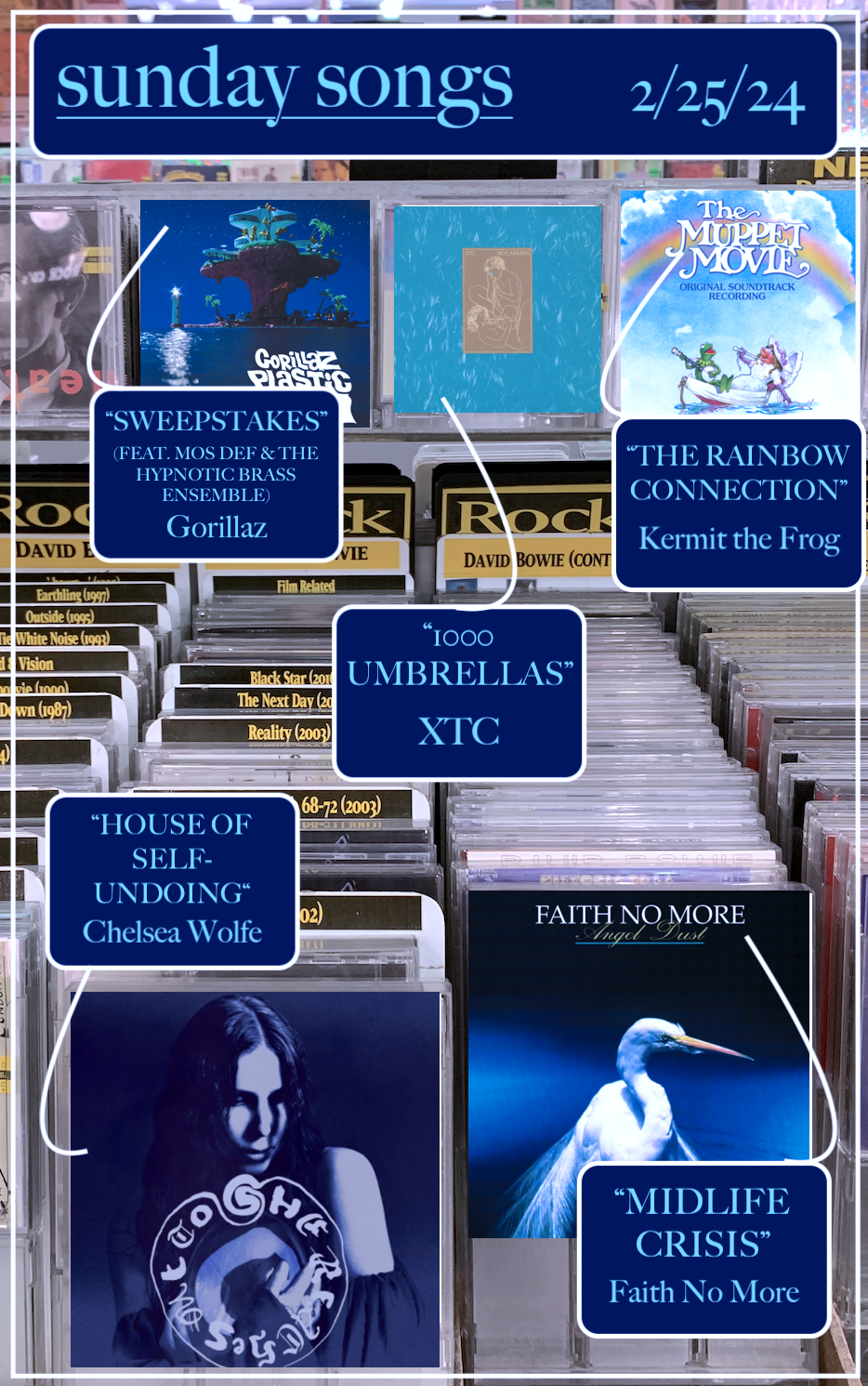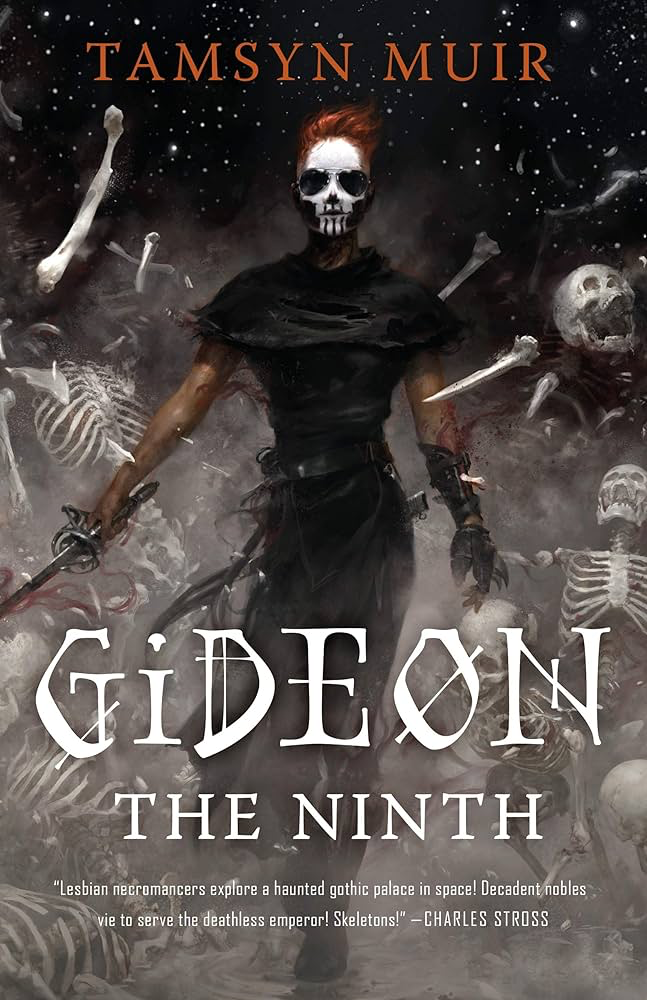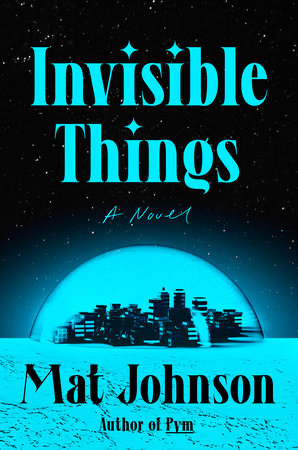
Posted in Sunday Songs

Sunday Songs: 1/18/26

Happy Sunday, bibliophiles! I hope this week has treated you well.

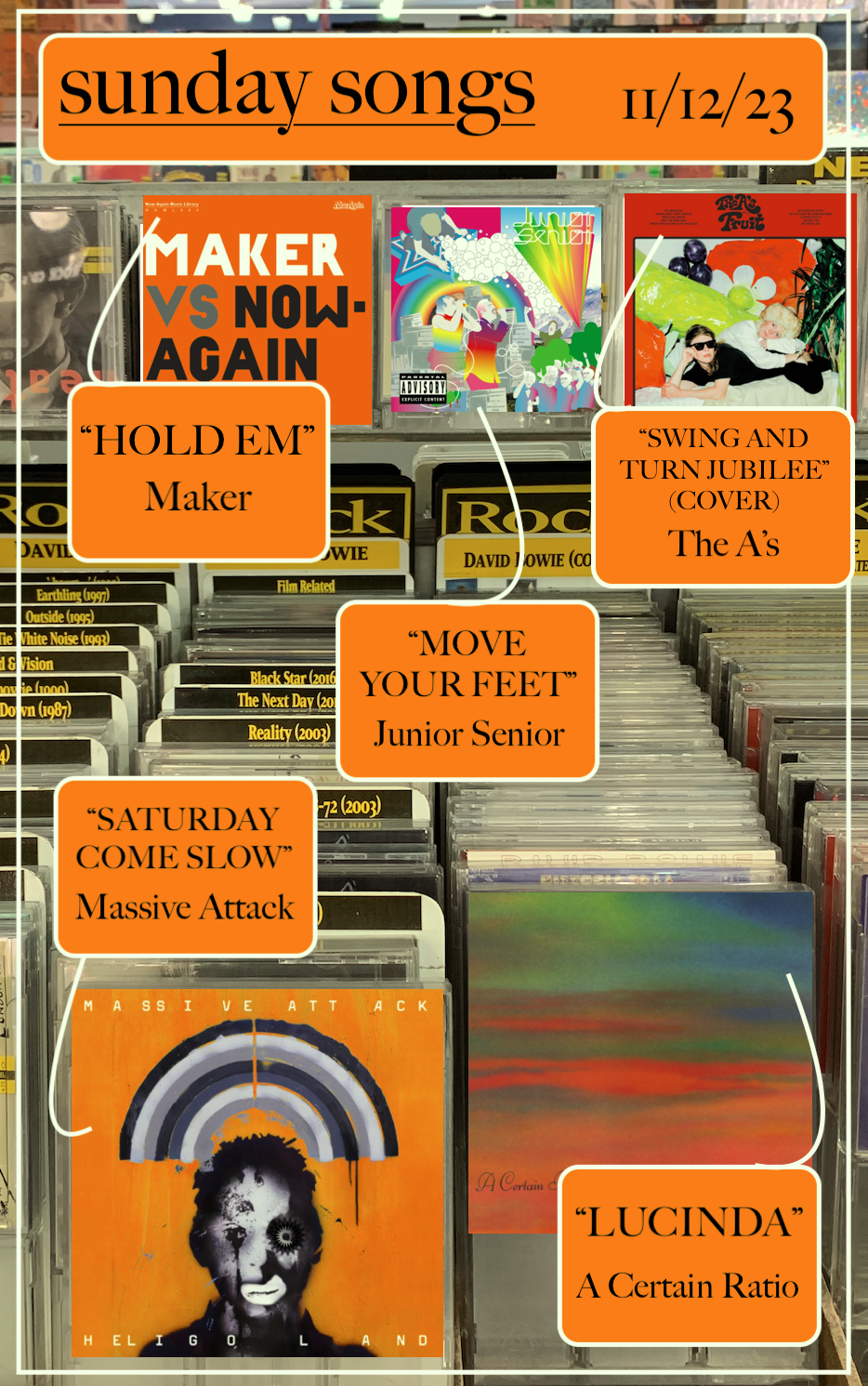
This week: two queens maximizing their joint slay, songs that get a little confusing in the discography next to each other, and unintentionally capitalizing (as if I earn any money from this blog) on gay hockey being the next big thing. Also, a shoutout is due to my mom, because I ended up getting 3/5 of these songs from a single car ride with her. Love you 🙂

Enjoy this week’s review!

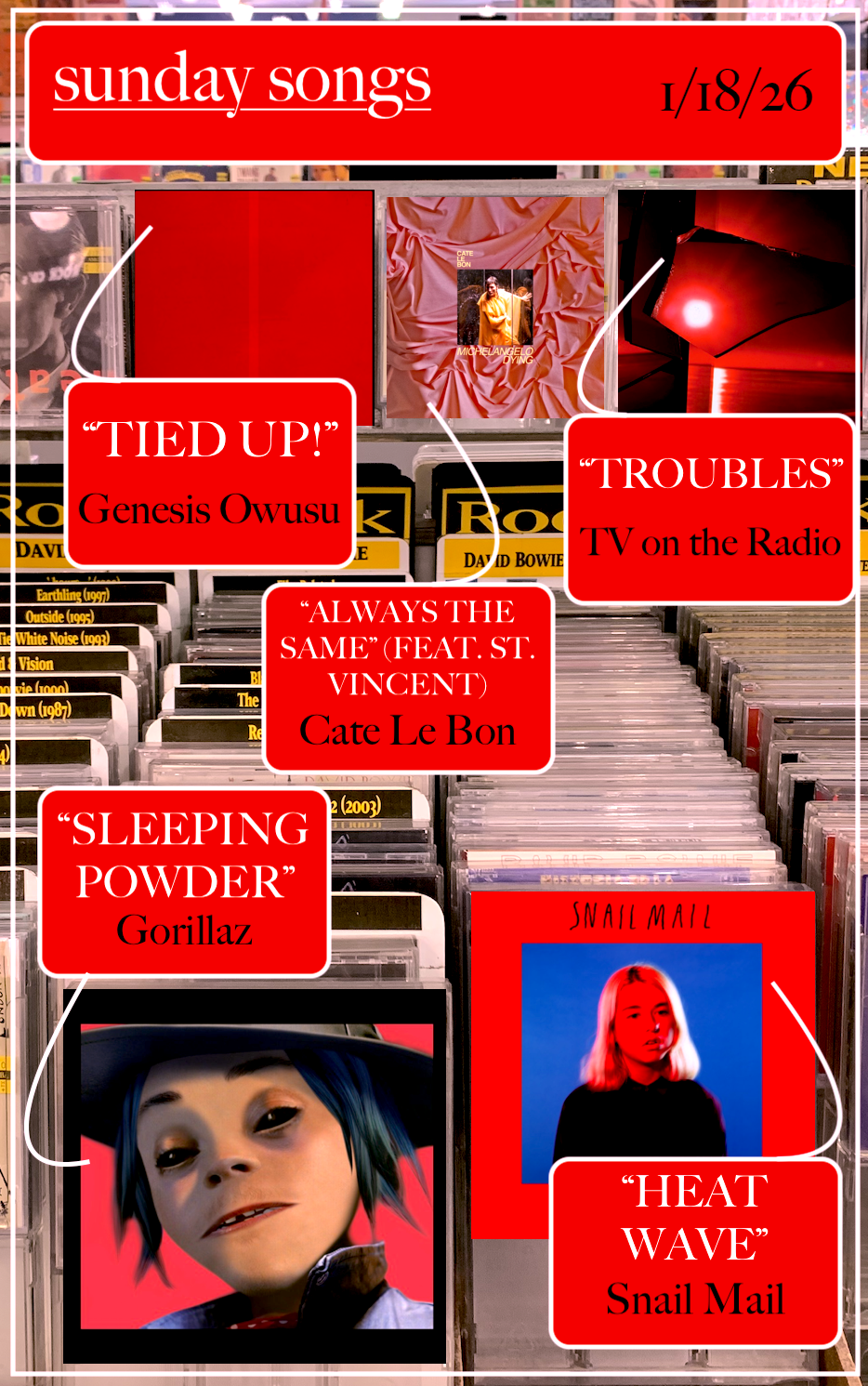
SUNDAY SONGS: 1/18/26

“Sleeping Powder” – Gorillaz

Here’s the thing about Gorillaz: I’ve talked extensively about how since 2018, they’ve become less Gorillaz and more about the collaborations, and it feels like they’ve lost themselves somewhere in the midst. The thing is that they’re fully still capable of returning to their roots and balancing the old with the new. Even though it sounds like it could’ve come from Plastic Beach, “Sleeping Powder” was released after Humanz came out in 2018. According to the official Gorillaz lore, 2D made this song behind the rest of the band’s back because he felt that he’d been excluded from the album (shhh, don’t tell Murdoc); the song is primarily about the character’s drug addiction, as evidenced by the music video, complete with the classic “this is your brain on drugs” sample and a 3D 2D (they said it couldn’t be done…) tripping balls and abusing his green screen privileges. It feels like a promise of what Gorillaz still could be; “Sleeping Powder” never feels like it could mesh with Blur or Damon Albarn’s solo work, as some of his more recent music does. It’s pure Gorillaz, channeling the urgency and grooves from their earlier eras but giving them a more modern flourish. Complete with a fusion of acoustic guitars and synths—and one of Albarn’s signature raspy howls—”Sleeping Powder” feels like a reminder that the core of Gorillaz exists—it’s just been buried, which, given how hit or miss their output has been since 2018, is a real shame.

…AND A BOOK TO GO WITH IT:

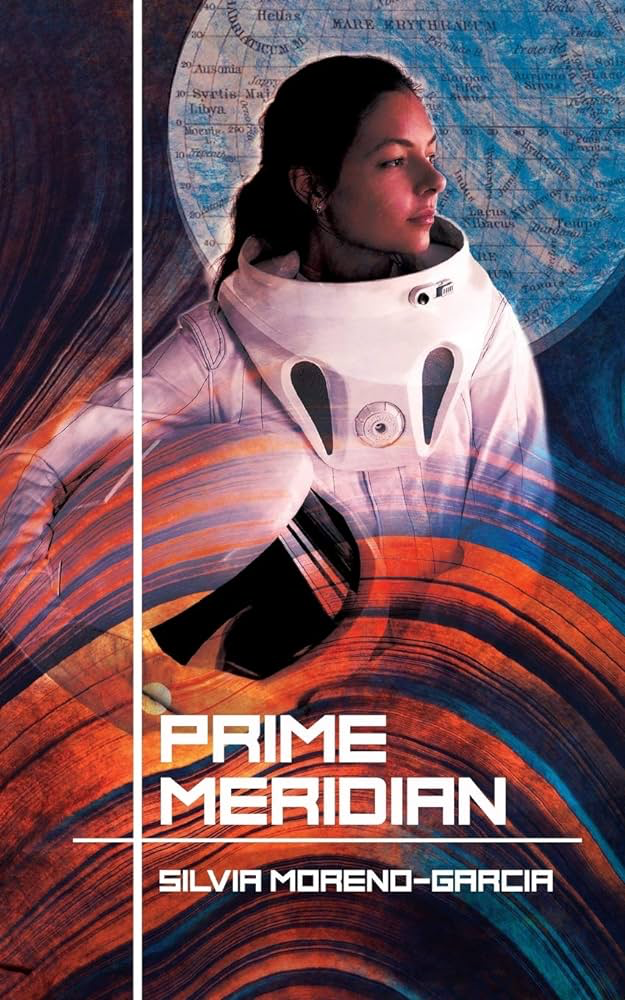
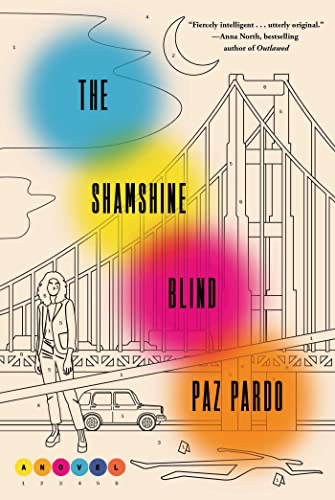
The Shamshine Blind – Paz Pardo“I get dropped from where I belong/I take my pills and I get in the mode/And I take five to get it to load in/Even in the place…”

“Heat Wave” – Snail Mail

Seems like this is a very advantageous time to write about this song, since a) the nearly 5-year Snail Mail drought is purportedly ending next Tuesday (!!!), and b) gay hockey is in. May I interest you in some lesbian hockey?

Hearing “Heat Wave” when I was 14 felt as though something in the world of music had cracked open like an eggshell, and the yolk of possibility had opened up for me. I’d just discovered Snail Mail on the cusp of her first album, Lush, and the first few singles instigated a seismic shift in me. Here was Lindsey Jordan, only 18 at the time, making such raw, fully-formed music with guitar at the forefront. She was openly gay, she wasn’t traditionally feminine, and she looked like somebody who I’d see in my brother’s high school class. But here she was, taking the indie world by storm.

It’s so oddly raw listening to “Heat Wave” now. I’m older than Jordan was in that video now. The lyrics are even more teenage now, but they hit almost as hard as they did when I was 14. At a show I saw her at when I was 16, Jordan admitted that she’d forgotten which song was about which girl; now, it hardly matters—she bottled that open-wound feeling of a fresh breakup and concentrated it so fully that its source is irrelevant. Concentrating that emotion so distinctly is a feat at any age, but at 18! 18! I was writing stories about weird spaceships with way too much purple prose at 18. Man. “Heat Wave” is so chock-full of emotion that it felt almost heady, like strong perfume, listening back to it after so many years; and yet, adorned with some seriously intricate and catchy guitar riffs (once again, AT 18, Jesus Christ), “Heat Wave” is such an indie gem, and Lush remains a testament to the sheer talent she’d worked so hard to cultivate.

Even if Valentine was weaker in retrospect, and even if this new single doesn’t turn out good, there’s still the Snail Mail I loved in 2018. She’s the main reason I picked up the guitar in the first place, and she gave me the courage to come out not long after I saw her at a tiny club in Denver. And I will always treasure that Snail Mail.

…AND A BOOK TO GO WITH IT:

Perfect on Paper – Sophie Gonzales“And I hope whoever it is/Holds their breath around you/Cause’ I know I did/And otherwise/If only sometimes/Would you give it up, green eyes?”

“Tied Up!” – Genesis Owusu

One word keeps popping up like a whack-a-mole every time I listen to “Tied Up!”, and that is “groovy.” Dear lord, this is such an expertly tight groove. There’s not really a genre I can definitively pin it to, and from the looks of it, the same is true for STRUGGLER, the critically-acclaimed album the it comes from. But either way, this song is neat as a pin—this is a groove, nothing more, nothing less.

Loosely centered around the character of The Roach, a struggler on the run from the manifestation of any antagonistic force you can think of, named God. (Sidenote: I love the bug-eyed sunglasses that Owusu wore when he toured for this album. Perfection.) Along with “Leaving the Light,” an adrenaline-fueled sprint away from God’s wrath (“I’m a beast I can feel them poaching/Stamp me down, but a roach keeps roaching”), “Tied Up!” embodies what feels like the mentality of this Roach character: no matter what God throws at him, roaches are famously unkillable, virtually impervious to apocalypse and mass extinction. Owusu declaring that he’s bleeding from his legs right on the heels of the most upbeat pop chorus is whiplash, but it embodies that feeling of taking pride in being unbeatable when you’re being beat down from all sides. Owusu chucks all manner of musical influences in the pot—hip-hop, pop, alt-rock—but they all come out feeling like something wholly new. Aside from a few weak lyrics here and there (“What other choice can I chose?” always trips me up), “Tied Up!” has no bumps in the road—it’s a slick groove all the way through.

…AND A BOOK TO GO WITH IT:

The Resisters – Gish Jen“I’m bleeding from my legs but it’s alright today/Better out here than the hell where I stay/I said my feelings start to wobble when I stare at the doves/I’m fighting through life, I have no boxing gloves…”

“Always The Same” (feat. St. Vincent) – Cate Le Bon

If there ever was an audio manifestation of “two queens coming together to maximize their joint slay,” then this is it. This is the only thing keeping the fabric of 2026 together. I can only hope that Cate Le Bon will follow in St. Vincent’s footsteps and retroactively announce a tour date near me.

Praise! We get a momentary extension of my favorite album of 2025, Michelangelo Dying! From the looks of it, there was a fruitful window where St. Vincent and Cate Le Bon were drawing from each other’s musical wells; back in 2024, Le Bon contributed backing vocals to “All Born Screaming.” Now, St. Vincent’s switched roles, providing a harmony for Le Bon on this track from the Michelangelo Dying sessions. “Always The Same” falls on the slower side of the album with songs like “Pieces of My Heart” or “Is It Worth It (Happy Birthday)?” and deals with the same heartbreak, although not in the heart-ripped-from-your ribcage way. What stands out to me about Michelangelo Dying is that it’s not a breakup album in the traditional sense—it’s not about the romance so much as it is about the gradual buildup leading to the break. There’s little rage or sorrow, but what there is in great amounts is exhaustion, repressed and built up in the chest until it makes you collapse. She’s not a fountain of blood in the shape of a girl so much as she is a river running dry.

“Always The Same” takes that same bleary-eyed exhaustion and draws it out; Le Bon describes her losing battle with her lover as “back and forth like a country/losing land to war,” shrinking herself until there’s nothing left of her at all. The background saxophones are almost unrecognizable as the instruments they are, made so ripply and strangely plastic by the production, expanding and contracting like a lung made of rubber. Both lyrically and instrumentally, it’s like watching a bundle of herbs dry out in the oven: something that was once green burns up and loses all its color. St. Vincent offers her higher harmonies to rise with Le Bon’s sonorous vocals, a devil on her shoulder to dismiss her pain, repeating: “she can bury it!”

…AND A BOOK TO GO WITH IT:

The Ephemera Collector – Stacy Nathaniel Jackson“I swallowed your memories/Like a morning prayer/I’m in your debt now/Almost there…”


“Troubles” – TV on the Radio

Nowadays, this song has to be a pain for TV on the Radio, since they put out a far more popular song called “Trouble” four years later. Oops. Hindsight is 20/20. At least “Troubles” is a bonus track, so it gets forgotten easily. Good for clarity, not good for a perfectly good song that deserves more attention. But if girlpool could make it work by having two completely different songs called “Pretty,” then TV on the Radio can too.

Either way, “Troubles” doesn’t deserve to get left in the dust; even if there are stronger tracks on Nine Types of Light, it’s a calm, steady track—the even-keeled instrumentals makes the chorus of “Despite all the heartbreak it brings/Our love is a surefire thing” feel just as anchored. With imagery of springtime fields and songbirds aplenty, it’s alight with flickers of hope amidst the plateau. It’s a vow to be the calm after somebody’s storm. Even if it’s more restrained than some of the more adventurous, intricate tracks on the album (see: “Killer Crane”), the vocal harmonies are as melodic and light as the songbirds they describe, and the flickers of horns and fluttering synths make for a song built like a dense greenhouse full of bright blooms.

…AND A BOOK TO GO WITH IT:

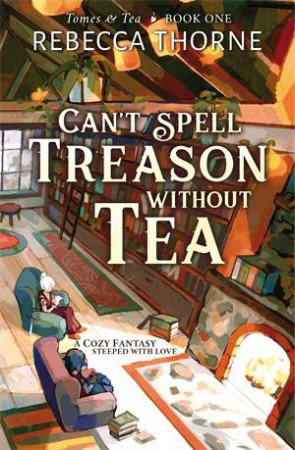
Can’t Spell Treason Without Tea – Rebecca Thorne relaxing and steady, with steadfast love and a pastoral, magical setting.

Since this post consists entirely of songs, consider all of them to be today’s song.

That’s it for this week’s Sunday Songs! Have a wonderful rest of your day, and take care of yourselves!

Posted in Sunday Songs

Sunday Songs: 8/10/25

Happy Sunday, bibliophiles! I hope this week has treated you well.

This week: a David Bowie double feature (who could’ve seen that coming?), upcoming artsy albums, and more reasons why I really just wish I had dual British citizenship, because apparently all of the good music related stuff happens exclusively in the UK.

Enjoy this week’s songs!

SUNDAY SONGS: 8/10/25

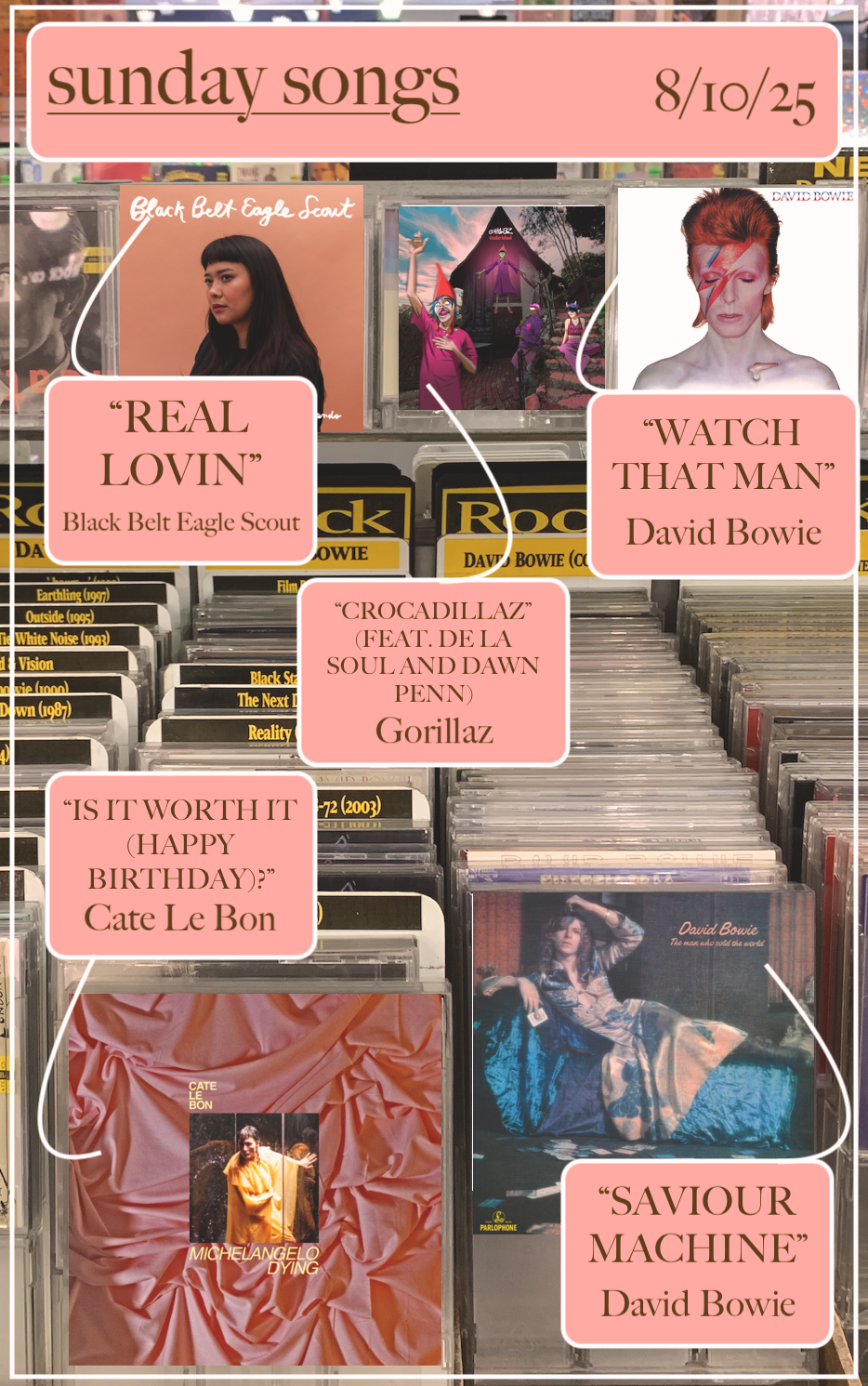
“Is It Worth It (Happy Birthday)?” – Cate Le Bon

I could really do with some more restrained excitement about Michelangelo Dying, but…these singles just aren’t letting me do it! They’re both so enchanting! I can’t get enough!! I’m really hoping they’re not the best of the bunch, but I have faith that Cate Le Bon has something quirkily artsy up her sleeve, if this and “Heaven Is No Feeling” are any indication.

“Is It Worth It (Happy Birthday)?” takes the palette of the album down a more subdued, melancholy route than “Heaven Is No Feeling,” trading the former’s synthy strut for glassy-eyed introspection. But even with the thematic shift, Le Bon’s signature modern touches are there. Awash in fizzling, electronic textures, this track is an outstretched bolt of lavish fabric, much like the pink background of the album cover. Silky and watery, it makes every instrument feel like it’s been drenched in sunlit water, from the gentle, barely perceptible bass to the saxophones. I’m not usually this big of a fan of saxophones, but the way Le Bon utilizes them, more for added sonic texture than for dramatic solos, make her world even more layered and delectable to pick apart. It’s distinctively her, but I can’t help but think of the dense, dreamy soundscapes of the Cocteau Twins when I listen to it. (“For Phoebe Still A Baby” jumps out in particular.) Yet drama is what this song quietly thrives on, as the lyrics muse on trying to make light out of abject sorrow: “Open up in hell/And dress the hall/It’s a holiday/It’s a birthday/Is it worth it?/Is it worth it?” The lyrics nearly get swallowed by the sheer magnitude of sounds woven into the production—including the signature, lilting cadence of Le Bon’s voice—but it almost seems exactly her intention. It feels both mean and inaccurate to call any of it window dressing, but next to the lyrics, all about trying to laugh heartbreak away and pretend it’s something that it’s not, it feels like exactly the kind of shrouding she’s singing about. At the end, she laments that she’s “Checking out/Even with my language in him,” just as the listener tries to extricate her from the vibrant sea of sound she’s crafted to shield herself. It’s easy to get washed away in, and if the rest of Michelangelo Dying is anything like this, I’ll be gladly losing myself in it come September.

…AND A BOOK TO GO WITH IT:

The Ephemera Collector – Stacy Nathaniel Jackson“Open up in hell/And dress the hall/It’s a holiday/It’s a birthday/Is it worth it?”

“Saviour Machine” – David Bowie

“David Bowie predicted ChatGPT” would’ve been a good headline for this post, but as much as I love him, he was far from the first to ponder about AI. But really…this song does basically predict ChatGPT, and in this song it’s “President Joe” who introduces it to the world, which is kind of a crazy coincidence. Had to do a double take when I first heard the lyrics, for sure. Drawing from much of the sci-fi media of his time, Bowie’s version of AI comes in the form of The Prayer, an AI system introduced by President Joe to make the population’s decisions easier for them, from stopping wars to simply thinking themselves. However, it’s The Prayer itself that calls for its own destruction, going insane after having such decisions weighing on its shoulders and pondering: “Please don’t believe in me/Please disagree with me/Life is too easy/A plague seems quite feasible now/Or maybe a war/Or I may kill you all!” Life is too easy for sure, now that everyone’s trying to flirt and make art and music and go through school entirely with AI. Sorry, but can’t you idiots stop and forgo convenience to experience the tedious pleasures of the human experience? Embarrassing. Jesus Christ. Remember, kids: you can’t stake your life on a savior machine.

“Saviour Machine” rings reminiscent of short stories of the likes of Ray Bradbury, but it also reflects the much darker tone of The Man Who Sold the World. Though it wasn’t like he hadn’t trod into darker lyrical subjects before, going from something like “Uncle Arthur” to an album comprised of insane asylums, the Vietnam War, and gay sex with Satan in the span of three years is a whiplash-inducing left turn for anyone. I don’t think it’s the edginess of the subject matter that makes it feel more mature, but the exploration—The Man Who Sold the World represents a critical turning point in Bowie’s storytelling ability, and he was willing to explore places that he hadn’t explored before, pushing himself out of his typical territory in order to create something wholly unique. It feels to me what he said when he spoke about art: “If you feel safe in the area that you’re working in, you’re not working in the right area. Always go a little further into the water than you feel you’re capable of being in. Go a little bit out of your depth, and when you don’t feel that your feet are quite touching the bottom, you’re just about in the right place to do something exciting.” Darkness was coincidental, and of course, not all of the album is necessarily dark—it was merely territory that he hadn’t scoured before, and that challenge led him to create some of his most innovative work, time after time, album after album. “Saviour Machine” feels like the prelude to that storyteller’s attitude, one that would guide him to untold heights in his career.

…AND A BOOK TO GO WITH IT:

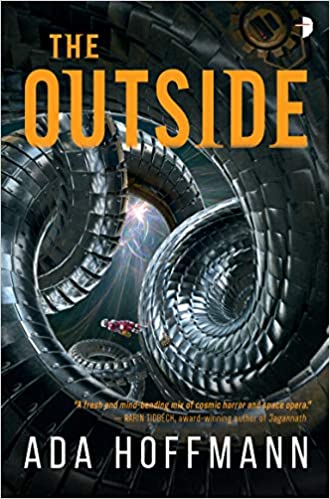
The Outside – Ada HoffmannA few centuries in the future, when something like The Prayer gets out of control…

“Real Lovin” – Black Belt Eagle Scout

Katherine Paul has a distinctly whispery voice—everything they sing sounds like they’re singing it into a cool breeze. Most of her music pre-The Land, the Water, the Sky suits it perfectly; though she’s become more adventurous with her vocal capabilities later on, a lot of her songs had a slower, softer demeanor that suited the airiness of her voice. But if there’s any song to be characterized by this, it would be this one. I’d forgotten all about “Real Lovin” for years—I initially listened to At the Party With My Brown Friends around five years ago—until it popped back into my shuffle out of nowhere. Though Paul’s voice soars with more volume towards the end of the track, her whisper-singing is perfectly suited to the quiet tenderness of the lyrics: “Now that you can dream/What is it you see/When you wake up in the folds of blankets in your bed/In your room/In your house/By yourself?” It’s the sound of a sliver of dewy light sliding through the slats of shutters in the early morning as you blink away the threads of sleep. Paul’s voice is a comfortable sheet over me as I listen, and she delivers what’s easily the softest, tenderest uttering of “well that’s bullshit” I’ve ever heard in a song. But no matter the intensity, which rises with every passing minute as the instrumentals build up, I never have a doubt that Paul means exactly what she’s saying.

…AND A BOOK TO GO WITH IT:

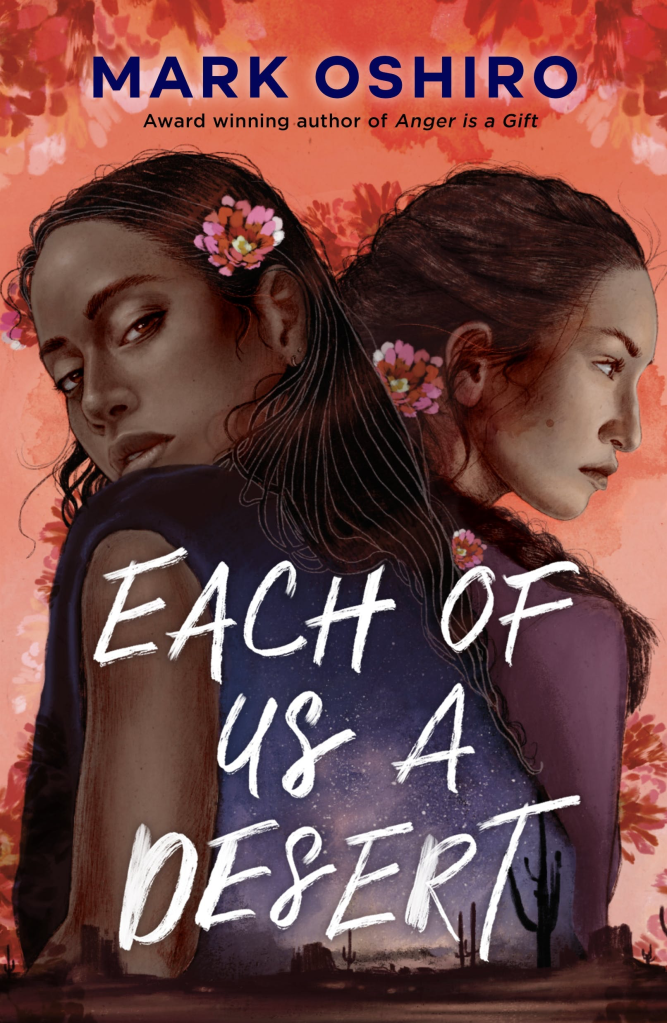
Each of Us a Desert – Mark Oshiro“You’ve tried and tried/What seems a million times and you wonder how you’ll end up/Is it the moon?/Is it the stars?/Do they rule you and your heart?”

“Crocadillaz (feat. De La Soul and Dawn Penn)” – Gorillaz

While I froth at the mouth that I can’t go to the Gorillaz exhibit in London, I figured it would be fitting to talk about them…for the millionth time on this blog.

It was a strangely pivotal moment when, a week after Cracker Island released back in early 2023, three more songs were added to the lineup. I had middling thoughts about the album up until then; for me, it represented the point at which Gorillaz (and later Blur with The Ballad of Darren) became nearly indistinguishable from Damon Albarn’s solo work. There were a handful of fun tracks, but as a whole, it failed to hold as much water as something like their first three records, even with the star-studded list of collaborators. And when it seemed all hope was lost…Del the Funky Homosapien and De La Soul returned! (Two years later, “Captain Chicken” has no business being so good for a song with such a goofy title AND samples of chicken clucks. God, it’s so good.) Disregarding the “Momentz” haters (heathens, all of you), every time De La Soul and Gorillaz collaborate, a special kind of magic happens. Even with Trugoy the Dove’s too-soon death hanging over it, “Crocadillaz” was one of the unmistakable highlights of the album. For a song about constantly looking over your shoulder and the trappings of fame, it has a steady, easy calmness to it, propelled by Dawn Penn’s “Doo-doo-doo-doo-doo-doo-doo” chorus, which gets delightfully stuck in my head more often than not. Trugoy and Penn make for an unlikely but smooth pairing for this song, with the former providing the sharp-edged, quick-witted verses and Penn’s smooth, resonant vocals giving the song a simultaneously retrospective and playful chorus. I’m not usually a fan of the “Gorillaz but it’s just the collaborators” songs, but with a pairing as talented as these two, it’s easy to excuse.

…AND A BOOK TO GO WITH IT:

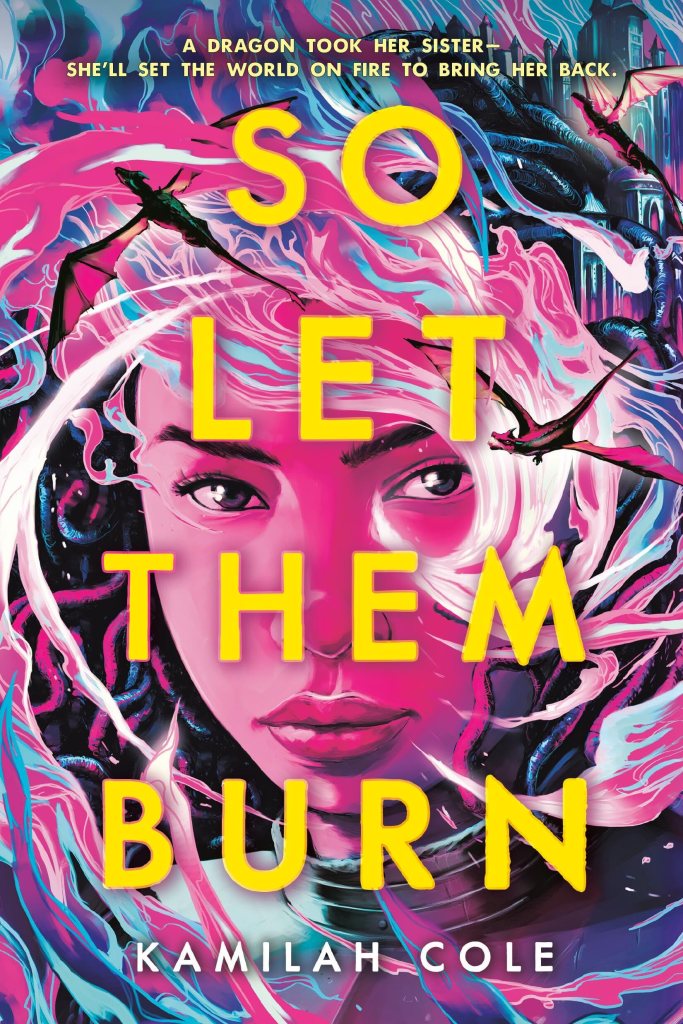
So Let Them Burn – Kamilah Cole“Could play the sheep, but beware of the wolf’s eye/Hypnotized by the crocodile’s smiles/The exchange is brief, but watch for the teeth…”

“Watch That Man” – David Bowie

Aladdin Sane has to be the most iconic album cover in David Bowie’s catalogue. If you know any album cover, it’s that one—the nondescript, asleep-looking Bowie with a glittering lightning bolt slashing across the front of his face. And that silvery bit on his collarbone—I always thought it was a bone fragment when I was a kid, and my dad thought it was something like mercury pooling on his skin. It raises questions! It sticks in your head! And yet, the album cover gets talked about much more than the actual album. Sure, it’s probably the weakest if we’re grouping it in with Hunky Dory and The Rise and Fall of Ziggy Stardust and the Spiders from Mars, but that’s because you’re grouping it with two of the greatest albums of all time. But it’s really such a disservice that the album only gets remembered for the cover—there are so many excellent cuts from the album, even if it never usually makes the cut for hit Bowie songs (except for maybe “The Jean Genie”). It’s slick as hell, incredibly funky…it just rocks. Listen to the album and you just know. And “Watch That Man” is what sets the tone, a rollicking dance floor rocker that begs for you to shake your hips with every word—not just the “shakin’ like a leaf” bit. Inspired by seeing the New York Dolls live, “Watch That Man” follows a lively party, with the lyrical camera roving over every participant as the music blasts. I never had any particular problem with the mix, but it was one of the more rushed songs on the album, and on reflection, doesn’t sound as clean as some of the other tracks—it’s all a bit muddy, with most of the instruments, Bowie’s voice included, being at a very similar volume. But for a song meant to emulate the rush of a concert or being on a crowded dance floor, it gets the job done spectacularly.

…AND A BOOK TO GO WITH IT:

Kings, Queens, and In-Betweens – Tanya Botejudancing, parties, and no shortage of glitter and makeup.

Since this post consists entirely of songs, consider all of them to be today’s song.

That’s it for this week’s Sunday Songs! Have a wonderful rest of your day, and take care of yourselves!

Posted in Sunday Songs

Sunday Songs: 7/27/25

Happy Sunday, bibliophiles! I hope this week has treated you well.

This week: Aquarium gravel music, driving-in-the-summer music, and music that I would’ve made a badly-animated Warriors AMV for in elementary school, if I had the capabilities.

Enjoy this week’s songs!

SUNDAY SONGS: 7/27/25

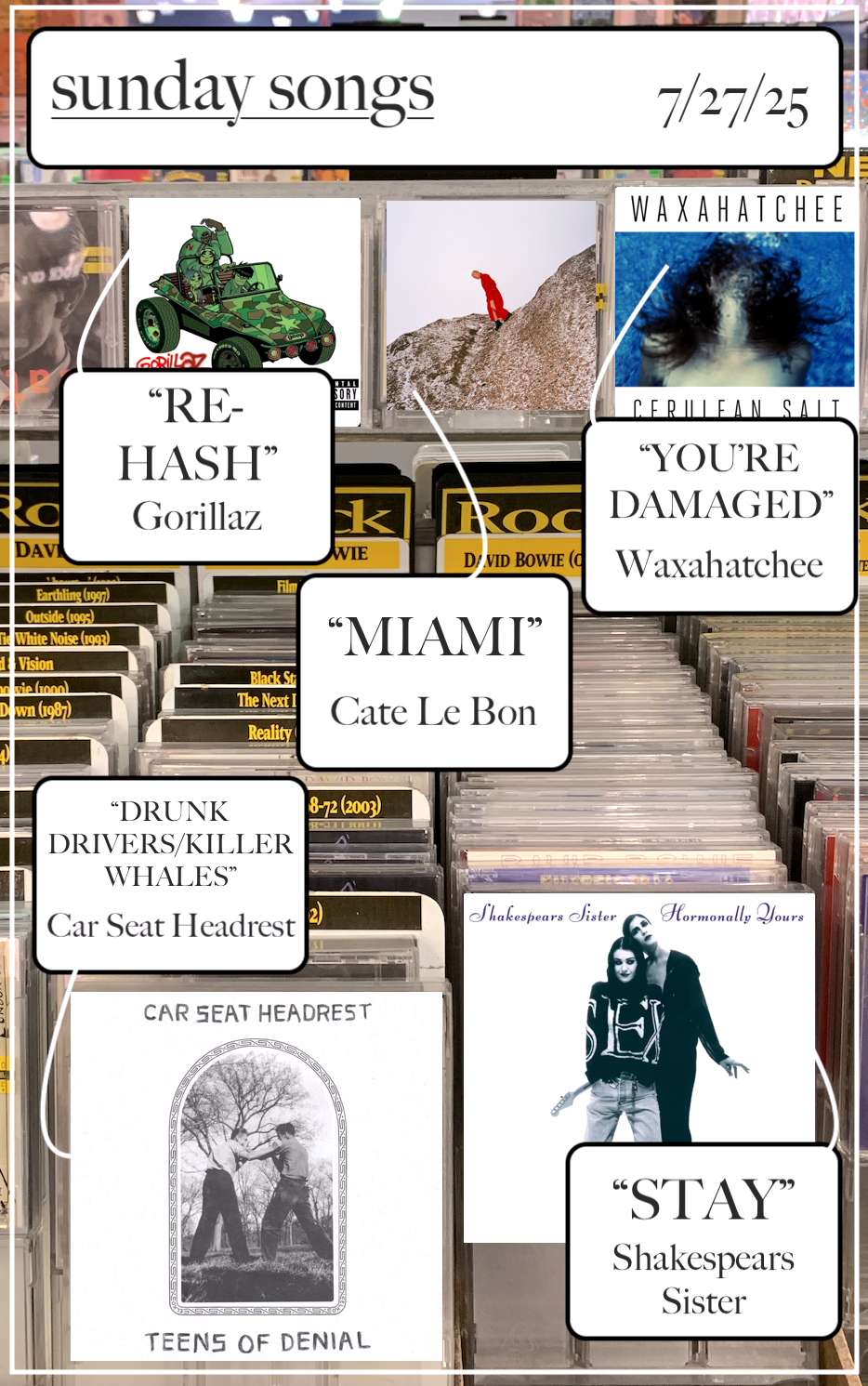
“Drunk Drivers/Killer Whales” – Car Seat Headrest

Yeah, yeah. I will not shut up about the Car Seat Headrest show two weeks ago. This is a threat. Consider this me gripping the sides of your head and forcing you to look at this screen and listen to a painfully awkward gay man’s earth-shattering voice cracks. You WILL listen.

After talking about how he doesn’t play much of his old music anymore, namely that of Teens of Denial, Will Toledo said that this song was one of the more optimistic songs he’d written during that period, where he described himself as an “angry young man.” This is going to sound incredibly corny, but stay with me. I knew all the words to “Drunk Drivers/Killer Whales” for years, but it wasn’t until then that it really hit me. That’s when I knew them. Granted, I was 13 and focused more on the enigmatic wails of Will Toledo and the raw wave of emotion that swept me up in the undertow, but I never quite considered that, in the midst of an album steeped in substance abuse, self-hatred, and depression, that this is a much more optimistic outlook on it all. (Speaking of said substance abuse, I really think that listening to Teens of Denial so much when I was younger was unironically very good drug prevention for me. Sure, a good 50-75% of their songs up to 2016 are about drinking and drugs, but they’re all about just how deeply miserable Toledo was while drinking and doing drugs. They need to implement this album in schools instead of D.A.R.E.) I wouldn’t be surprised if “Drunk Drivers/Killer Whales” was the last song of the album written; it takes a more retrospective look at the cycle of self-hatred and bad decisions that color Teens of Denial as a whole, and it offers a knowing look, a hug, and a rallying cry: “It doesn’t have to be like this.” From the outside looking in, Toledo looks at the wreckage of everything he’s done up to this point, and professes this to his own anxieties:

“Here’s that voice in your head/Giving you shit again/But you know he loves you/And he doesn’t mean to cause you pain/Please listen to him/It’s not too late/Turn off the engine/Get out of the car/And start to walk.”

GOD. OW. That’s another way homer. I suppose it’s taken years for it to hit me like it was likely intended to, but that’s probably for the best. I think of recent times, when I was so wrapped up in my own anxiety that I didn’t even realize that I could make the choice to work with it, to create a life for myself that would result in me being a happier, healthier person. I’m still on that road. Every day, it’s a little more effort. But it’s all worth it, brick by brick. As Toledo says, “But if we learn how to live like this/Maybe we can learn how to start again/Like a child who’s never done wrong/Who hasn’t taken that first step.” The power is always in your hands, whether you realize it or not. You can’t make every negative thing in your life disappear into thin air, but you can make those choices, take control of the wheel and start to steer your life in a better direction. It takes a monumental, gradual effort, but IT DOESN’T HAVE TO BE LIKE THIS. It never does. Looking back to a year ago, I can’t be more proud of myself for taking that leap, of leaning into my support system to try little by little to end the cycle of anxiety that I was falling into. This song couldn’t have come back to me at a better time. You can always learn to start again.

…AND A BOOK TO GO WITH IT:

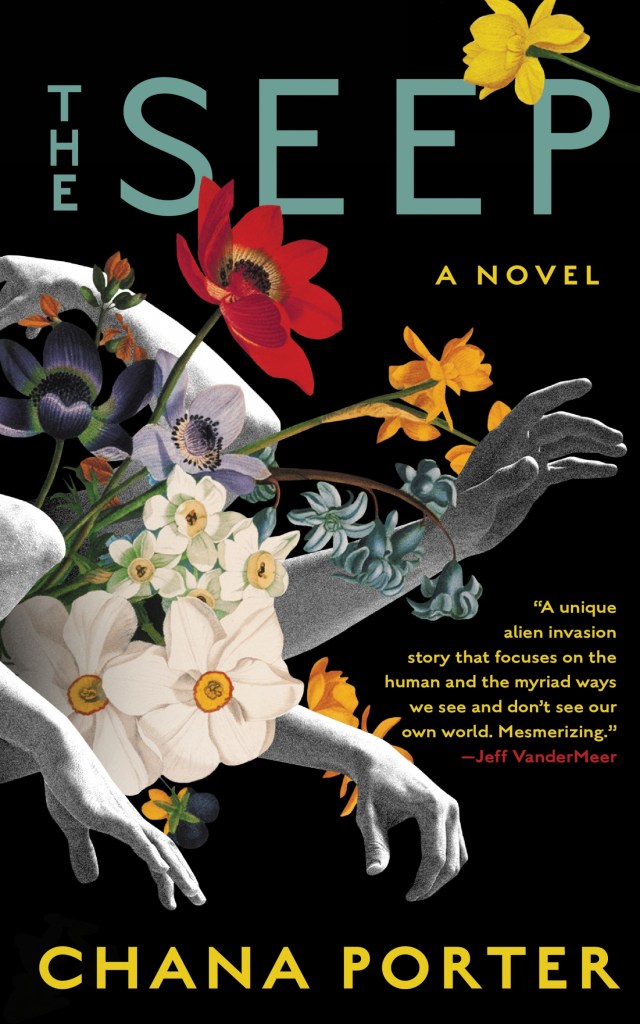
The Seep – Chana Porterlearning to break free of a state of societal complacency in disguise as betterment, and learning to live with grief, love, and every other complicated emotion.

“Stay” – Shakespears Sister

There’s a brief window in every decade where the signature sounds haven’t yet been cemented. It’s a limbo that allows for the final bastions of the last decade’s sound to grab ahold. This song comes to mind, because this is quite possibly the most ’80s song of the ’90s.

My mom knew exactly what she was doing when she played this for me. I feel like I was around 8 or 9 when she first played it for me. I wished I remembered more of the specifics, because I definitely had some kind of elaborate Warrior Cats AMV planned in my head set to this, but I remember just being so enraptured. It was one of those songs that instantly marked its place in my memory: I was in the backseat of the car, at a gas station, and the sky was overcast, and I’d just had a revelation. My mom and I are definitely interlinked at critical points in my music history, and the more I think about it, “Stay” was absolutely one of them. Like…how did I not know that the album was called Hormonally Yours? I mean, what else is there to say other than fuck yea, that’s an album title??

“Stay” is pure drama, and as over-the-top and gloriously camp as it is, in the right amount, that’s my absolute catnip. Funny that I should mention catnip, because despite the ubiquitous lyrics, it was meant to be part of a concept album, all based around [checks notes] this ’50s sci-fi movie called Cat-Women of the Moon. (Hence this song.) “Stay” was intended to be about the love story between one of said Cat-Women and one of the human male crew members of the ship to the moon, with Marcella Detroit being the Cat-Woman in love and Siobhan Fahey taking the part of, one of the other Cat-Women who shuns their romance. Despite Shakespear’s Sister not being able to execute the concept album as they wanted to, “Stay” retains the high drama and yearning present in the original idea. Over-the-top as it is, I can’t help but be enraptured by it, the same way that I was when I was a little kid. The dueling voices of Detroit and Fahey craft a story of operatic proportions, cranking the yearning up to 11.

Even though the Cat-Women of the Moon never saw the light of day, what did survive is glorious—namely the music video for “Stay.” Instead, we’ve got a vague sci-fi setting, where Detroit is doting over a comatose man, and Fahey is Death tempting the man to come to the other side, complete with a star crown and some absolute Harley Quinn crazy eyes. It’s so camp. God, I love it.

Jenny Joyce could never.

…AND A BOOK TO GO WITH IT:

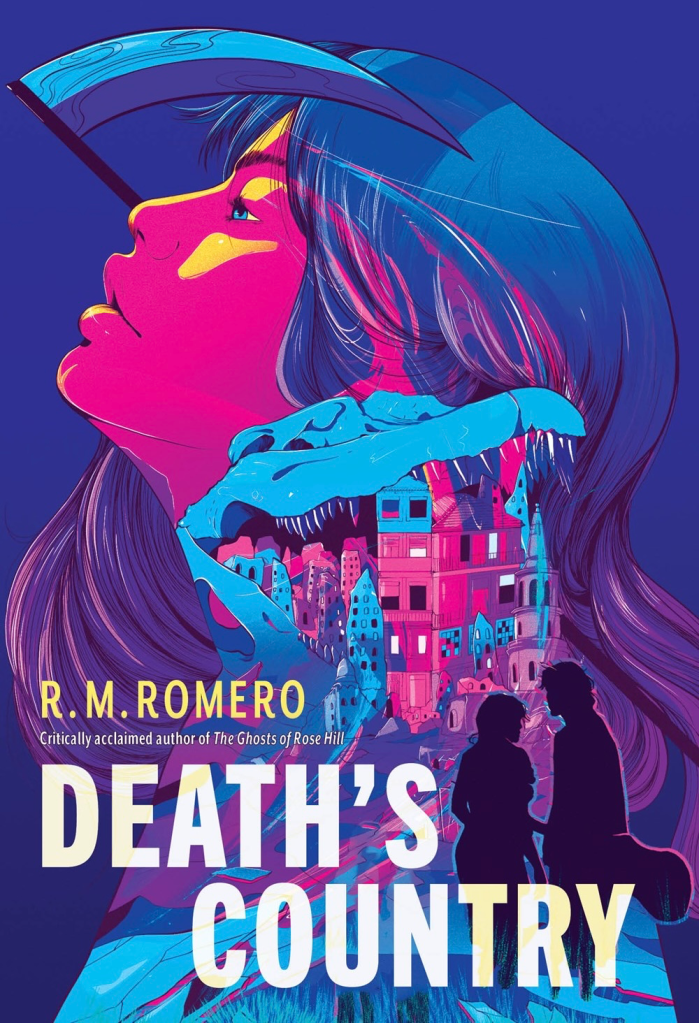
Death’s Country – R.M. RomeroI’m aligning more with the music video interpretation here, but what’s more high drama than going into the underworld to save your girlfriend from the brink of death?

“Re-Hash” – Gorillaz

Nothing like a great pop song about how much pop music sucks.

Gorillaz, at least in the early days, was a study in artificiality. The project famously came about because Damon Albarn and Jamie Hewlett had been watching a lot of reality TV and hearing the much more manufactured aspect of pop music at the time (“It’s the sweet sensation over the dub/A one-off situation that don’t wanna stop”), and wondered if they could take it to the extreme: an entirely artificial band. In a way, “Re-Hash” was them slyly taking a shot at what Albarn viewed to be the state of pop music at the time, before blowing it out of the water and making the most artful indie-pop music possible. That first album is almost a no-skip album, and there’s no shortage of tracks that I constantly revisit. I hadn’t listened to “Re-Hash” in quite some time, and I’d forgotten just how incredible of an opener it is. Admittedly, my association with their self-titled album will always be of summer, since I’m pretty sure I first listened to it in July or August back in high school, but everything about “Re-Hash” is soaked in sunshine, with a combination of acoustic guitars mixed with drum machines that begs for a rolled down window. That Ba-ba-ba-ba-ba-aaaaah repetition towards the last third of the song is just infectious—without a doubt, a very recent holdover the more playful side of Blur’s discography. What a propulsive start to such an iconic album.

…AND A BOOK TO GO WITH IT:

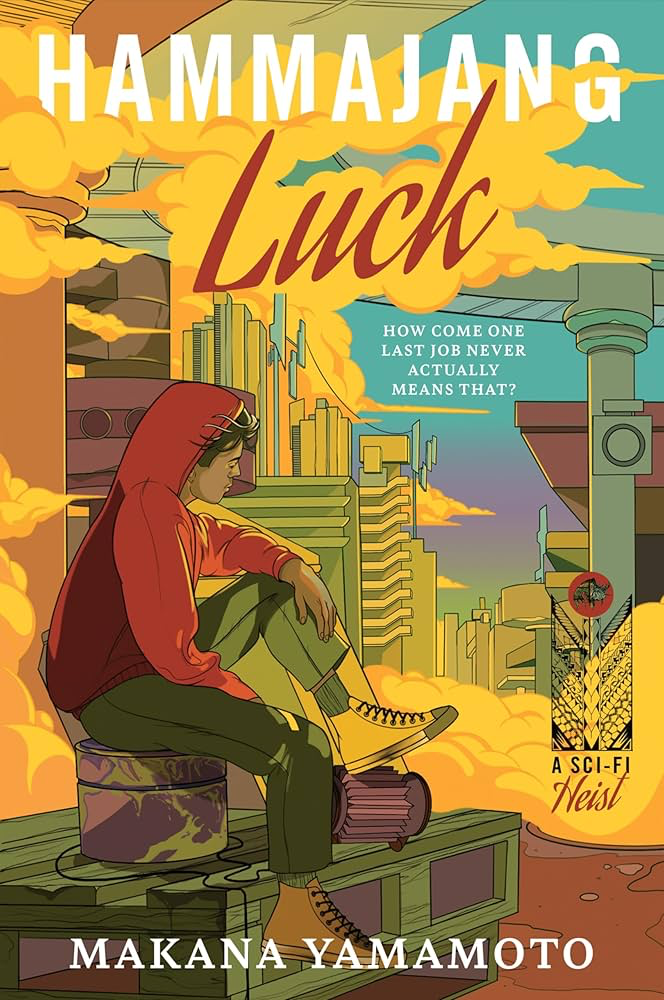
Hammajang Luck – Makana Yamamoto – I’m going more off of vibes and atmosphere than lyrics, but this would fit right in with the more lighthearted sides of Yamamoto’s sci-fi world.

“Miami” – Cate Le Bon

Oh my god, CATE LE BON!! Reward is an excellent album as a whole—I’d say that it’s just about equal to Pompeii as far as consistency, creativity, and the uniqueness of the soundscape. Although she’d begun to transition into the more synth-dominated part of her sound here, Reward has a more naturalistic feel to it. Even if the album cover didn’t have her bent over, walking over the contours of a time-worn cliff against an overcast sky, it has this inherent aura to it that feels like having the wind toss your hair as you walk along a pebbly beach as a storm brewing in the distance. The comparison that jumped out immediately to me was Damon Albarn’s The Nearer the Fountain, the More Pure the Stream Flows, an album with similarly rocky shore imagery on the album cover and throughout the lyrics. I wouldn’t expect such a feeling to brew in me from an album dominated by artsy brass and woodwinds and synth in equal measure (lots of great clarinet and saxophone action here, similar to Albarn).

In my exploration into her music, I’ve found a constant in Cate Le Bon’s more recent work: she’s damn good at making an opening track (see also: “Dirt on the Bed”). “Miami” sounds like being in a goldfish bowl. The bright, percussive synths in the background bubble like an aquarium filter, while others sound like water sliding against glass. Some of the more recognizable percussion hushes like aquarium gravel crunching in the palm of your hand. It’s all so strangely aquatic, even with the steady blast of saxophones in the background. It honestly feels far more appealing than the actual Miami, but then again, my only experience of Miami was a grotty hotel, so maybe that’s my overall Florida bias. But I’d be hard-pressed to think of a song on Reward that’s better suited to open up Le Bon’s peacefully avant-garde soundscape than this one. It lulls you into a state of calm while enticing you forward with breadcrumbs of her signature, off-kilter charm. The lilt of her voice is as much an element of the ecosystem as the brass or the synths; if anything, it’s the goldfish in this metaphor, her voice like the smooth, effortless flap of fins underwater.

…AND A BOOK TO GO WITH IT:

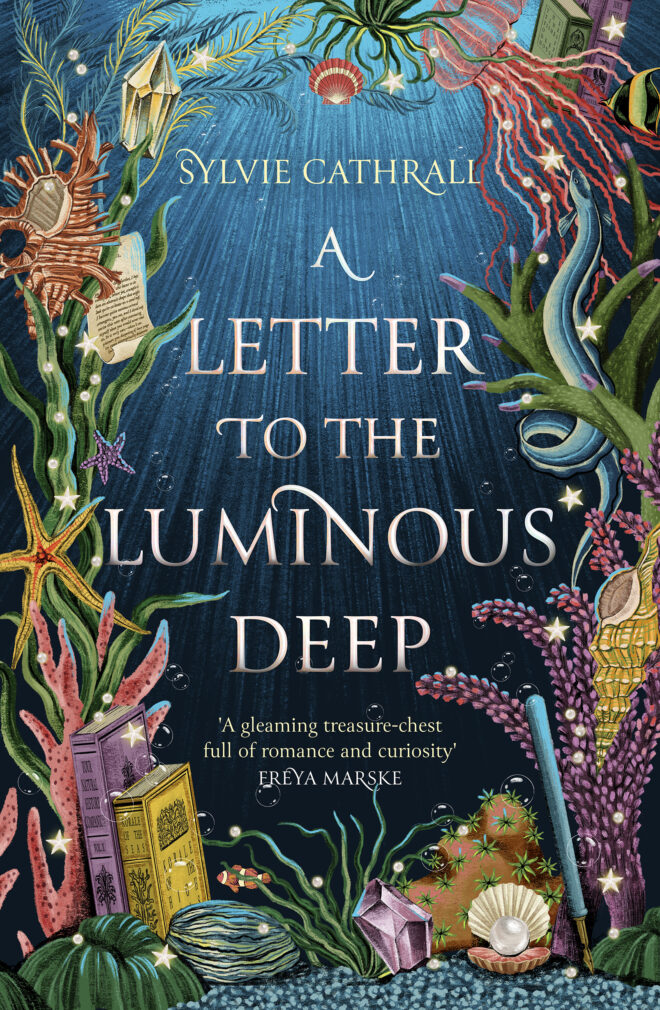
A Letter to the Luminous Deep – Sylvie Cathralla gentle and tender dispatch from a submerged world.

“You’re Damaged” – Waxahatchee

For all intents and purposes, I really should be into Waxahatchee. Stylistically, she’s often grouped in the company of Snail Mail, Adrianne Lenker, and Soccer Mommy, which should be a massive red cape to my sad indie rock bull. (In fact, my reigning association with her is this one tweet that reads “I would personally be afraid of snail mail because she’s friends with waxahatchee and waxahatchee looks like she open carries”) But the main thing that keeps me from enjoying her most of the time is her voice. It’s fully just personal preference, and I’m sure she’s very talented, but Waxahatchee feels like proof that singing in cursive isn’t exclusive to pop music. Please!! Sing without over-enunciating everything!! My god!!

Thankfully, there are exceptions to the rule. “You’re Damaged” fits snugly into the indie rock that I usually love, with Katie Crutchfield’s sparse, bare vocals. Here, her voice soars, free of expectations, dipping deftly from hard to soft as she runs circles around memories of a broken relationship: “And no I can not see into the future/No I cannot breathe underwater/Bit your last word, I call out to you/This place is vile, and I’m vile too.” It mirrors the album cover of Cerulean Salt, where Crutchfield is blurry and submerged underwater, her face obscured by her own hair and the ripples of the water; rambling through the misty glass shards of memory, she struggles to break away from an unhealthy relationship when she’s just as unhealthy as the other part, wanting them when everything around her screams for her to do the opposite. It’s the kind of song that only a raw voice and an acoustic guitar can capture, and it does so hauntingly.

…AND A BOOK TO GO WITH IT:

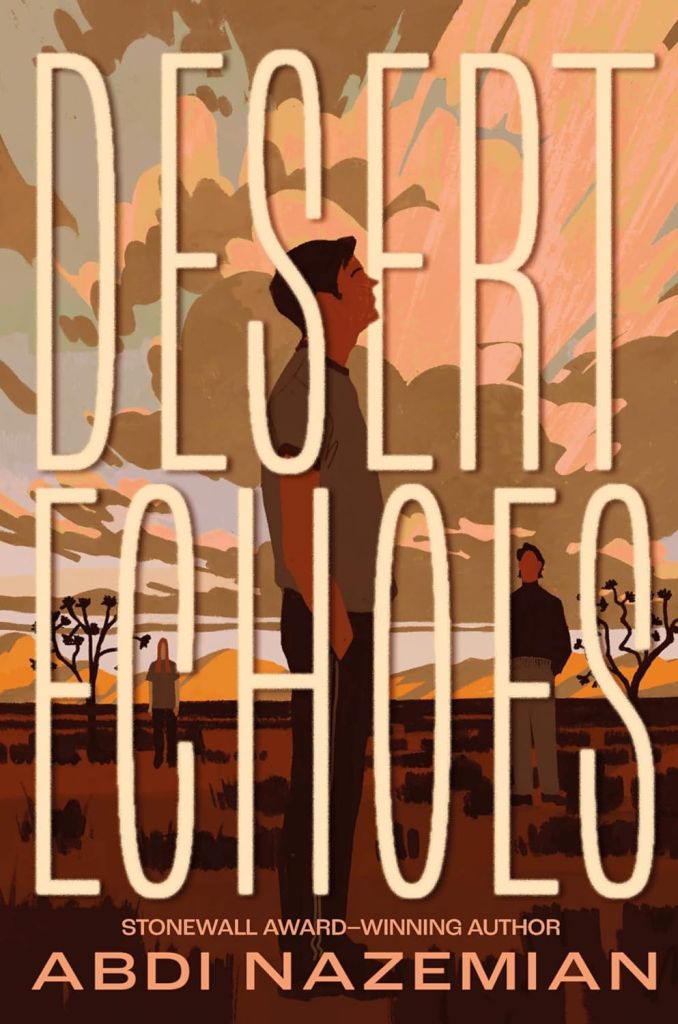
Desert Echoes – Abdi Nazemian – “And no I can not see into the future/No I cannot breathe underwater/Bit your last word, I Call out to you/This place is vile, and I’m vile too…”

Since this post consists entirely of songs, consider all of them to be today’s song.

That’s it for this week’s Sunday Songs! Have a wonderful rest of your day, and take care of yourselves!

Posted in Sunday Songs

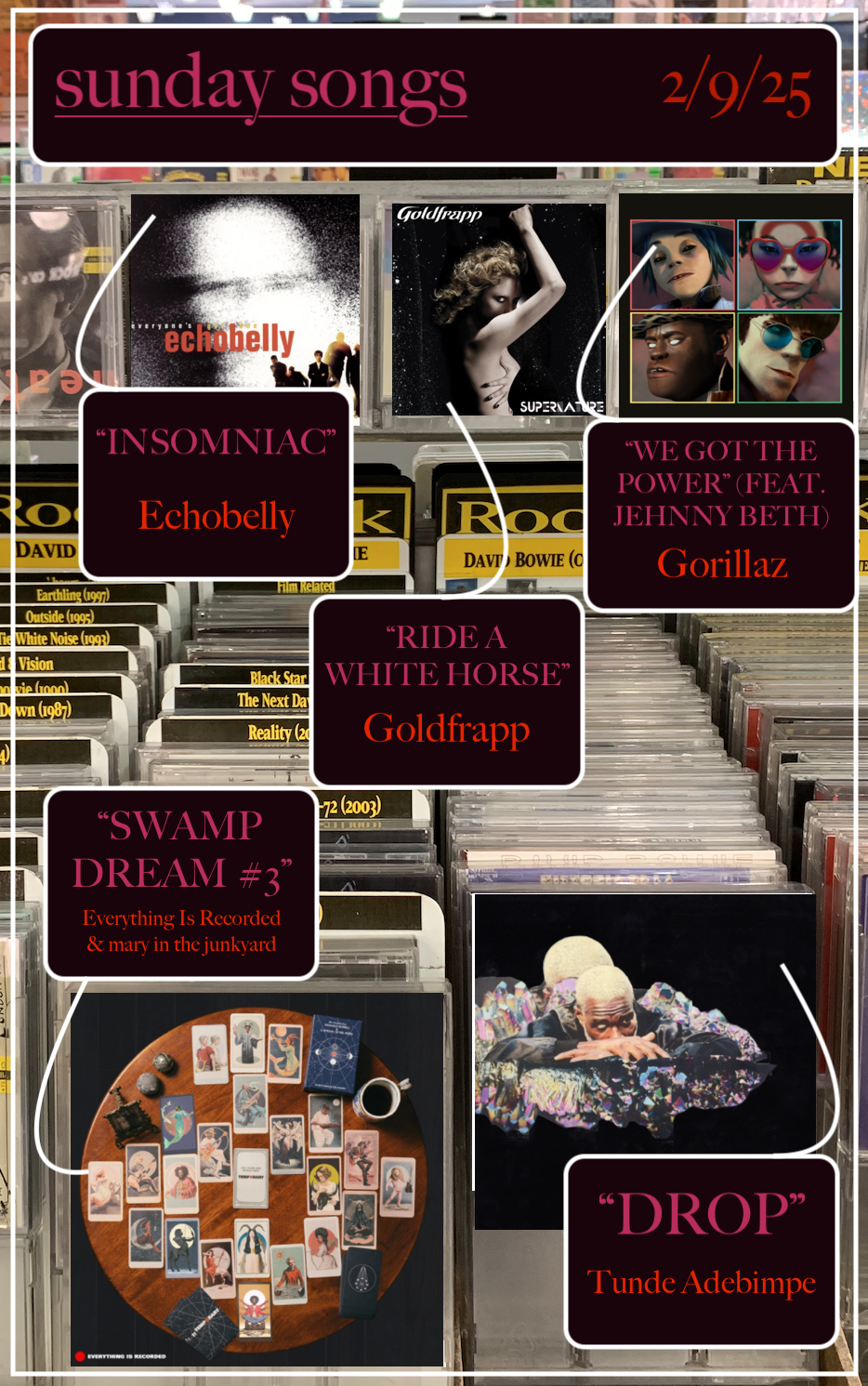
Sunday Songs: 2/9/25

Happy Sunday, bibliophiles! I hope this week has treated you well.

This week: there’s never a bad time to listen to Gorillaz, but I certainly could’ve timed when I listened to Humanz better.

Enjoy this week’s songs!

SUNDAY SONGS: 2/9/25

“Swamp Dream #3” – Everything Is Recorded & mary in the junkyard

We now return to some much-needed mary in the junkyard-posting. I suspect it’ll become consistent…at some point. Not to pressure them, but hopefully this year (or the next) holds a full-length album in the future?

In the meantime, we have an excellent collaboration between them and Everything Is Recorded, the stage name of producer Richard Russell (also the founder of XL Records); he’s produced several albums under the name, often amassing a wide variety of musicians and songwriters to bolster them in a Gorillaz-like way, minus the cartoon characters. His forthcoming album, Richard Russell is Temporary, includes the likes of Florence Welch, Kamasi Washington, Noah Cyrus, Roses Gabor (a.k.a. the singing voice of Noodle on “DARE”), Bill Callahan, and mary in the junkyard! Granted, I hadn’t heard of Everything Is Recored until mary in the junkyard announced this single, but if this guy’s the owner of a record label, I could only hope this would introduce this fantastic, burgeoning gem of a band to a wider audience.

If “Swamp Dream #3” becomes the band’s ambassador, I wouldn’t mind either. Even though it’s more electronic than most of their catalogue, it’s got a naturalistic, moss-covered feel to it that you can’t scrape off of their sound no matter how many synths you paste onto it. It has the juddering thrum of rusted machines, all at once simple and a doorway into a hidden world; although I love the music video, “Swamp Dream #3” is begging for some kind of stop-motion treatment. I imagine it as an outside view of a termite’s mound or a rabbit’s warren, with the camera panning over clay worms poking out of the dirt and tiny insects, moles, and other underground rodents traversing the vast network of tunnels. (The real worms and beetles suffice, though.) Clari Freeman-Taylor’s vocals bring a kind of wonder to the song, a curiosity that isn’t quite childlike, but still seeks to shove its hands into the sand and the dirt, searching for hidden pathways and possibilities: “Mystery of my own flesh/I’ll never stop wondering/Never stop/Turning inside out.” Needless to say, the chorus, a repetition of “into the dirt” backed by looped vocals and a stuttering drum machine, could not be a better fit for a song with hands dirtied from looking for earthworms in the ground.

…AND A BOOK TO GO WITH IT:

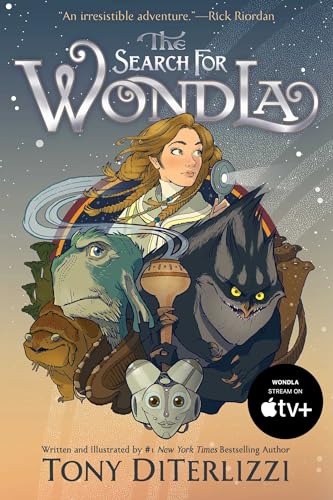
The Search for WondLa – Tony DiTerlizzi“You are from an old land/Crafted out of wet sand/What is it all about?/Staring at your hands…”

“Drop” – Tunde Adebimpe

NEW TUNDE ADEBIMPE JUST DROPPED!! THEE BLACK BOLTZ!! OUT THIS APRIL!! I’m not sure if anything will ever cure the decade-long TV on the Radio drought, but man, a new album from such a fantastic talent sure comes close.

I never got around to writing about “Magnetic,” but it felt so much like TV on the Radio to me—it was distinctly Tunde Adebimpe, but it had that same urgent propulsion that made their indie hits feel ageless. It’s one of those tracks that makes you see how far the footprints of one particular member of a band in their music. TV on the Radio bunched several people together with magic touches into a single band, which is startling, but this touch is unmistakably Adebimpe’s. But “Drop” is where his sound begins to branch out and diverge into something wholly new. It has a flavor that’s simultaneously ’80s and 2010’s indie pop. Once the beatboxing intro fades away, rhythmic as bubbles popping in midair, it becomes a much more relaxed yet introspective dive into Adebimpe’s mind. As the guitars—clean enough to almost sound like synths—radiate into the calm ripple of the track, he grapples with a sensation of awakening; “Drop” couldn’t be a more apt title for a song whose lyrics are steps away from launching off a daunting yet hopeful precipice: “I′m gonna try it for myself/I’m gonna need somebody′s help/Cast an extraordinary spell/And rise into the night.”

Together, “Magnetic” and “Drop” couldn’t make me more excited for the range of Thee Black Boltz. “Magnetic” was a perfect access point for the fans who were wanting something close to TV on the Radio 2: Electric Boogaloo (listen, it’s kind of a self-callout), but “Drop” represents the somewhat uncharted territory that we have yet to see Adebimpe cover fully.

…AND A BOOK TO GO WITH IT:

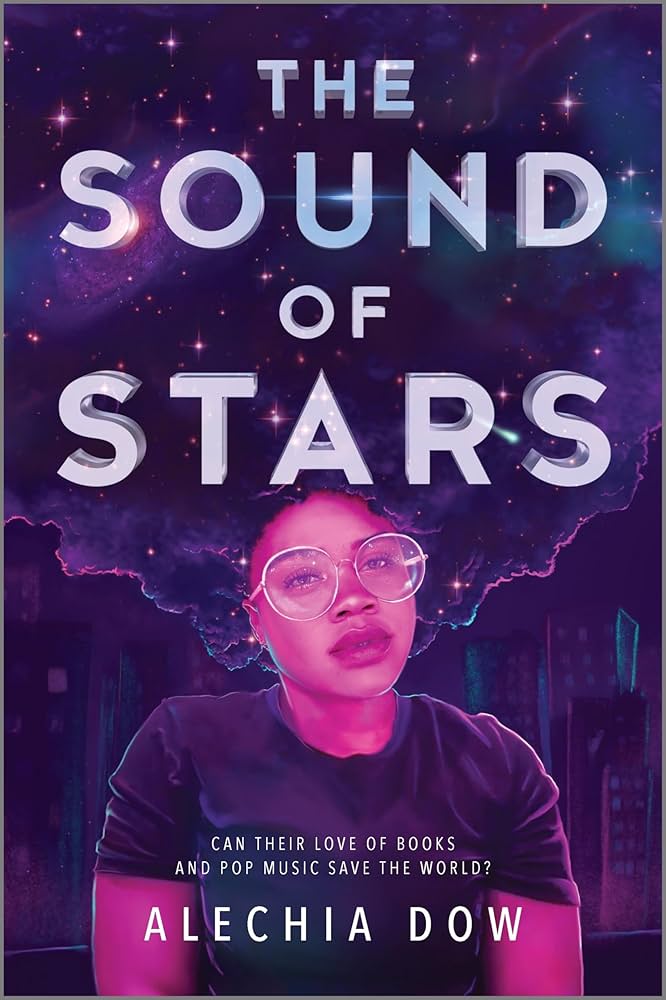
The Sound of Stars – Alechia Dow“We′re gonna feel it when we drop/Let′s go out where the visions never stop/There is a light/There’s a light just beyond this horizon/See it shine and rise into the night…”

“Insomniac” – Echobelly

Generally, the British were absolutely cooking with grease as far as rock music goes from about 1964 on, but there’s something so fruitful about the ’90s to me. If it’s from the period from 1992-1999 and it’s British, there’s a solid 75% chance that I’ll enjoy it. No, wait. Not exclusively the Brits, just because ’90s rock was so good, guys, but I just love the ’90s. To me, 1994 seems a particularly ripe crop of the vast harvest of the decade, especially the Britpop boom of the first half of the ’90s. Three out of the four of Britpop’s Big Four released albums: Blur with Parklife, Oasis (🤢) with Definitely Maybe, and Pulp with His ‘n’ Hers. But even if you look past the big players, 1994 is full of gems—”Insomniac” being one of them.

I just love Britpop, man. God. I talked a bit about Echobelly last year (with “Bellyache,” from this same album, Everybody’s Got One) with their propensity to take the genre’s penchant for social commentary a step further, as well as their much more diverse lineup compared to many Britpop bands of the time. (Not one but TWO women of color in a Britpop band was pretty much unheard of at the time) “Insomniac” is much more radio-friendly, but it embodies the “pop” of the Britpop, but never in a mindless way—more in the way that their contemporaries could wrap commentary in the most delicious guitar hooks. As Sonya Madan sings of her concerningly high subject (“I think we’ve lost control, dear/Whatever turned you on/You put it up your nose, dear”), the guitars absolutely knock you upside the head. You couldn’t wring the pure Britishness out of it if you tried (particularly the way that Madan sings “I swim in circles/In puddles/In trouble and then I go” like it’s a nursery rhyme…on a song about substance abuse), but you couldn’t wring the pure rock n’ roll out of it, either—this is what a hit should be.

…AND A BOOK TO GO WITH IT:

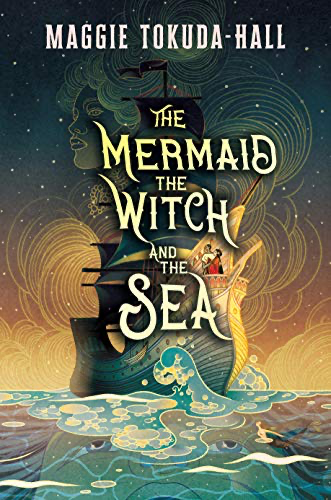
The Mermaid, the Witch, and the Sea – Maggie Tokuda-Halleven though Alfie gets a more sympathetic redemption arc in the final book, some of his relentless drug abuse certainly rings close to this song.

“Ride A White Horse” – Goldfrapp

“Ride A White Horse” is about as clean of a song you could get. It’s more than polished—it came out of the womb shinier than a disco ball, and its blinding sheen is made for dancing. Alison Goldfrapp has insisted that the title wasn’t a nod to T. Rex (but sort of was a reference to this), but the two songs couldn’t be further from each other—the dance-pop glamour of this song is about as far as Marc Bolan and company frolicking through the woods, but both have entirely distinct energies that differentiate themselves far beyond their respective choice of animals. Even for something made in 2006, Goldfrapp and Gregory’s work still sounds straight out of a club in the Blade Runner universe. Part of this is why I think the choice of making the music video for “Ride A White Horse” the epitome of dirty is kind of genius fit—it’s such a sanitized song, and yet Alison Goldfrapp sings it against superimposed backdrops of rotting food waste with scraps of toilet paper stuck to her heels, not to mention the cameo from what appears to be the proto-Trash Man. Even when there’s flies buzzing off of it, the polish of it never fades.

Also, because this popped up when I looked this up on YouTube, here’s a bit of unexpectedly delightful Goldfrapp content:

…AND A BOOK TO GO WITH IT:

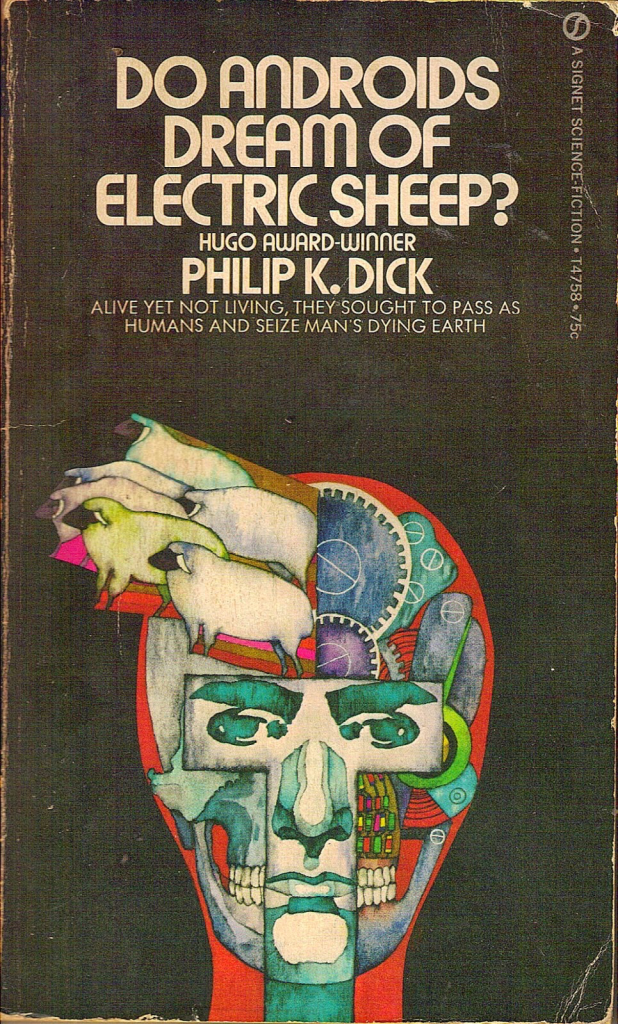
Do Androids Dream of Electric Sheep? – Philip K. Dickas much as I disliked this book, I can’t deny that it fits the atmosphere—more so of the movies, as I said before.

“We Got the Power” (feat. Jehnny Beth) – Gorillaz

In retrospect, it was probably a terrible idea to listen to Humanz for the first time mere days before the inauguration just because of the album’s conception. When telling Pusha T, one of the album’s plentiful collaborators, what the atmosphere of the album was, Damon Albarn described it as “a party for the end of the world if Trump wins.” Not only did he say this well before Trump was elected, but…well, y’know. We all know the mess we’re in. Humanz often gets lambasted by the fandom as their worst album. I wouldn’t say it’s bad, but I think it’s the nexus of modern Gorillaz, which is to say that it’s the point where their albums became increasingly devoted to their collaborators as opposed to the creative force of Albarn and Hewlett. Said collaborators are hit or miss, but most of the songs have a verse by Albarn with the exact same filter over his voice once the collaborators have had their place in the sun. Much as I love my guy Damon, it got slightly tiring after about 10 songs. But if it’s a party for the Trump-era hellscape, Humanz fulfills its purpose with flying colors, balancing social commentary with gloriously catchy pop songs. I feel like the thesis is perfectly encapsulated by Vince Staples’ chorus on “Ascension”: “The sky is falling, baby/Drop that ass before it crash.”

In spite of all that, the album ends on an anthemic note—”We Got The Power.” As simple as the lyrics are, simplicity is what this track needs. In times so overwhelmed with shock, horror, and doom, sometimes a more concise message is the best thing to cut through the noise. “We got the power to be loving each other/No matter what happens.” IT’S TRUE! It’s why “All You Need Is Love” has endured for so long. It’s simple, but it’s the kind of uniting message that we needed. If anyone should know that, with their history of cleverly packaged social commentary, it’s Gorillaz. Albarn is joined by Jehnny Beth (if I had a nickel for every time I’ve heard Jehnny Beth sing a French verse on a British band’s song, I’d have two nickels, etc., etc.) and an uncredited Noel Gallagher. I briefly mentioned it before it, but as much of an Oasis hater as I am, it really is beautiful that they were able to set aside the stupidest possible differences, realize how stupid they were, and join forces on a song about loving each other. You can’t not appreciate it. (To say nothing of Liam…) And as the closing track to an album about a party at the end of democracy, it’s a welcome light at the end of the tunnel, and a true light—it’s not the flashing club lights that shroud the fear of most of the album, but a real lodestar.

…AND A BOOK TO GO WITH IT:

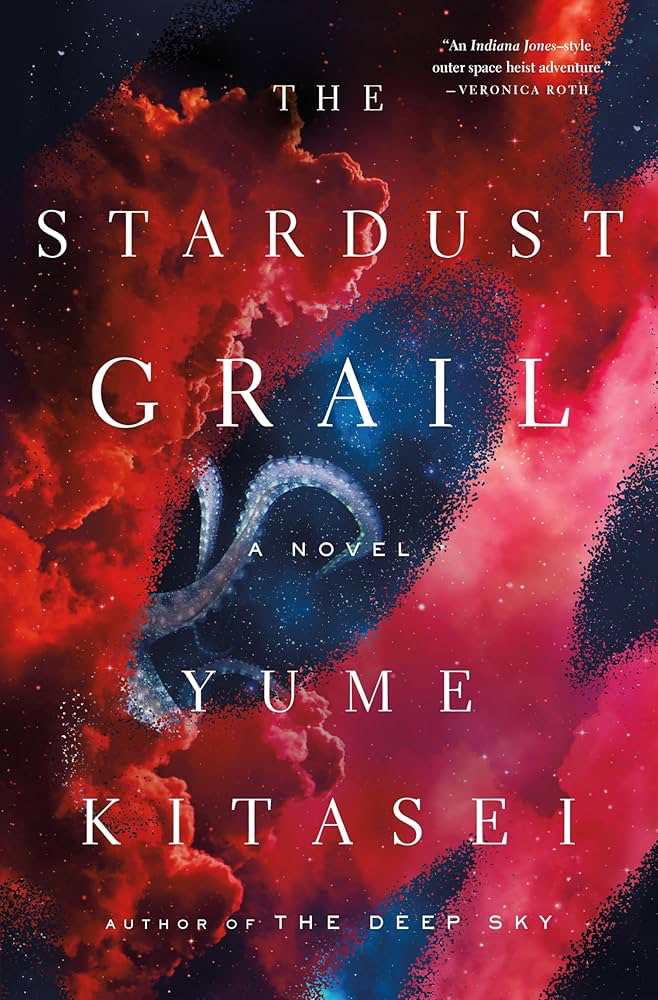
The Stardust Grail – Yume Kitasei“And we dream of home, I dream of life out of here/Their dreams are small/My dreams don’t know fear/I got my heart full of hope/I will change everything/No matter what I’m told…”

Since this post consists entirely of songs, consider all of them to be today’s song.

That’s it for this week’s songs! Have a wonderful rest of your day, and take care of yourselves!

Posted in Sunday Songs

Sunday Songs: 1/5/25

Happy Sunday, bibliophiles, and happy near year!

First post and the first Sunday Songs of 2025! No pressure. This week: new verses on new songs, new(ish) takes on old(er) songs, and…oh, god, Eric, please put your shirt back on—

Enjoy this week’s songs!

SUNDAY SONGS: 1/5/25

“POP POP POP (feat. Danny Brown)” – IDLES

Dread it…run from it…TANGK always arrives. One of the best albums of 2024, hands down. I already talked about “POP POP POP” back in March, but at the end of the year, IDLES added one more flourish to an already excellent track—a guest feature by Danny Brown. Of course, I say that knowing next to nothing about Danny Brown up until this point, but the spin he and IDLES put on one of the most prominent highlights of TANGK is an interesting one—and catchy, too. In places, the beat has been treated like an accordion, stretched out in some areas and compressed in others—the final, spoken-word monologue has been sped up, while the first five seconds are jumpstarted, recreating the static of plugging a guitar amp in. Meanwhile, Brown’s guest verse hurtles at breakneck speed; For me, there are some lines that come across rather corny (“On the surface/Looks like a circus/All these clowns around, pull the curtain”). However, at the very end, Brown’s lyrics align with the ethos of “POP POP POP” in the first place: an assertion of purpose, that purpose being staying true to yourself, spreading love, and being a source of protection for others. The final line sums it up nicely: “Took a couple wrong turns/Don’t know right from left/But found my way to the home that I strayed/And now I say everything is okay.” Can “POP POP POP” ever be improved? I highly doubt it, but I also doubt that this was meant to be an improvement—it’s more the kicking around with a preexisting idea with other collaborators, and in that experimentation, it creates an exciting take on one of the 2024’s best songs.

…AND A BOOK TO GO WITH IT:

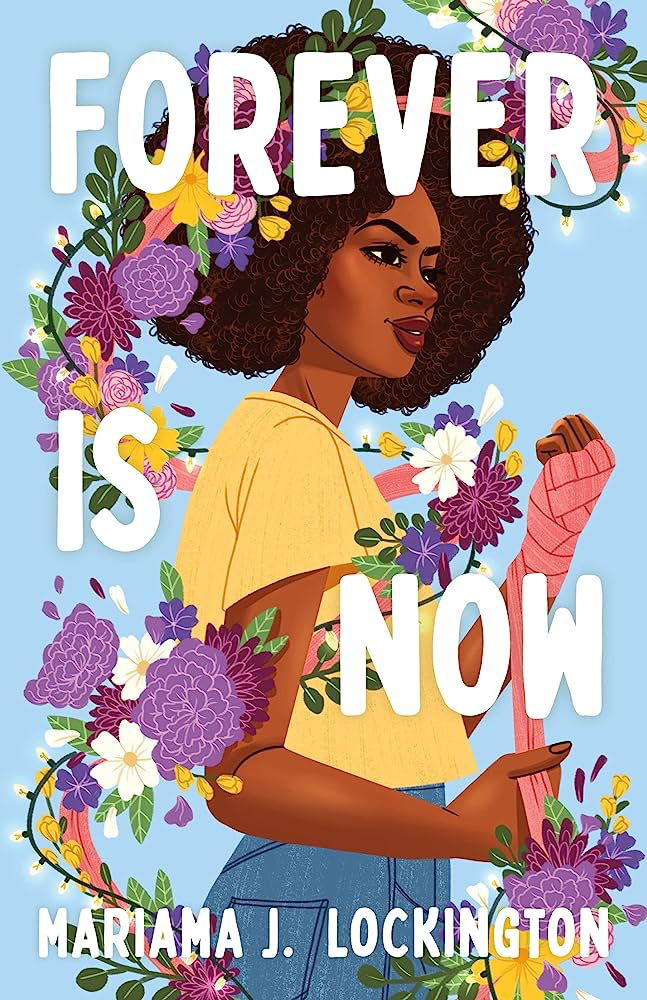
Forever Is Now – Mariama J. Lockington“Searching for something you cannot hide/Looked in the wrong place, but should search inside/Relied on things that just let me down
But now I see what its really ’bout…”

“Sugar in the Tank” – Julien Baker & TORRES

Personally, I’ve never quite gotten on board with the queer cowboy aesthetic, but I can respect how queer people have been taking it back. In the first place, I think any kind of cowboy mythos attracts the kind of people who want to forge their own trails and make their own way without the constraints of society, a Venn diagram that seems to attract, strangely enough, both conservative people wanting to go back to “traditional values” and queer people who see an out from heteronormative culture. Growing up in the mountains, my association with much of it came from the former, even in our fairly liberal town (I say fairly liberal because there was the odd confederate flag or “if you’re reading this, you’re in range” sign on someone’s house). But I don’t mind seeing a bedazzled cowboy hat or a boygenius photoshoot out in the desert every now and then. Evidently, I’m too much of a city slicker.

The reclamation of country by queer people has gone in much the same way, and I’ve never been one for country in the first place (same association as above), but what I will give a try 8 or 9 times out of 10 is anything that Julien Baker is involved in. Now here’s an example of queer cowboy/country reclamation done right: nothing better than two lesbians making a song with a title referring to slang for an effeminate man and turning it into something positive and sensual. Musically, there’s twang aplenty, but at least for me, Baker’s talent screams at you like a neon sign—she’s whipped out the banjo once more, and it contrasts with the hazy overdrive that TORRES has applied to her excellent guitar work. The boygenius fan is me is more partial to how Baker’s harmonies fit with Phoebe Bridgers and Lucy Dacus, but it’s clear that she’s well-matched with TORRES, musically and vocally. I’m not 100% on board with the more country direction—it’s more on the alt-country side, but very much country-sounding—but I’ll give it a chance for Baker.

…AND A BOOK TO GO WITH IT:

Road to Ruin – Hana Leewill something close to post-apocalyptic, biker cowboys suffice?

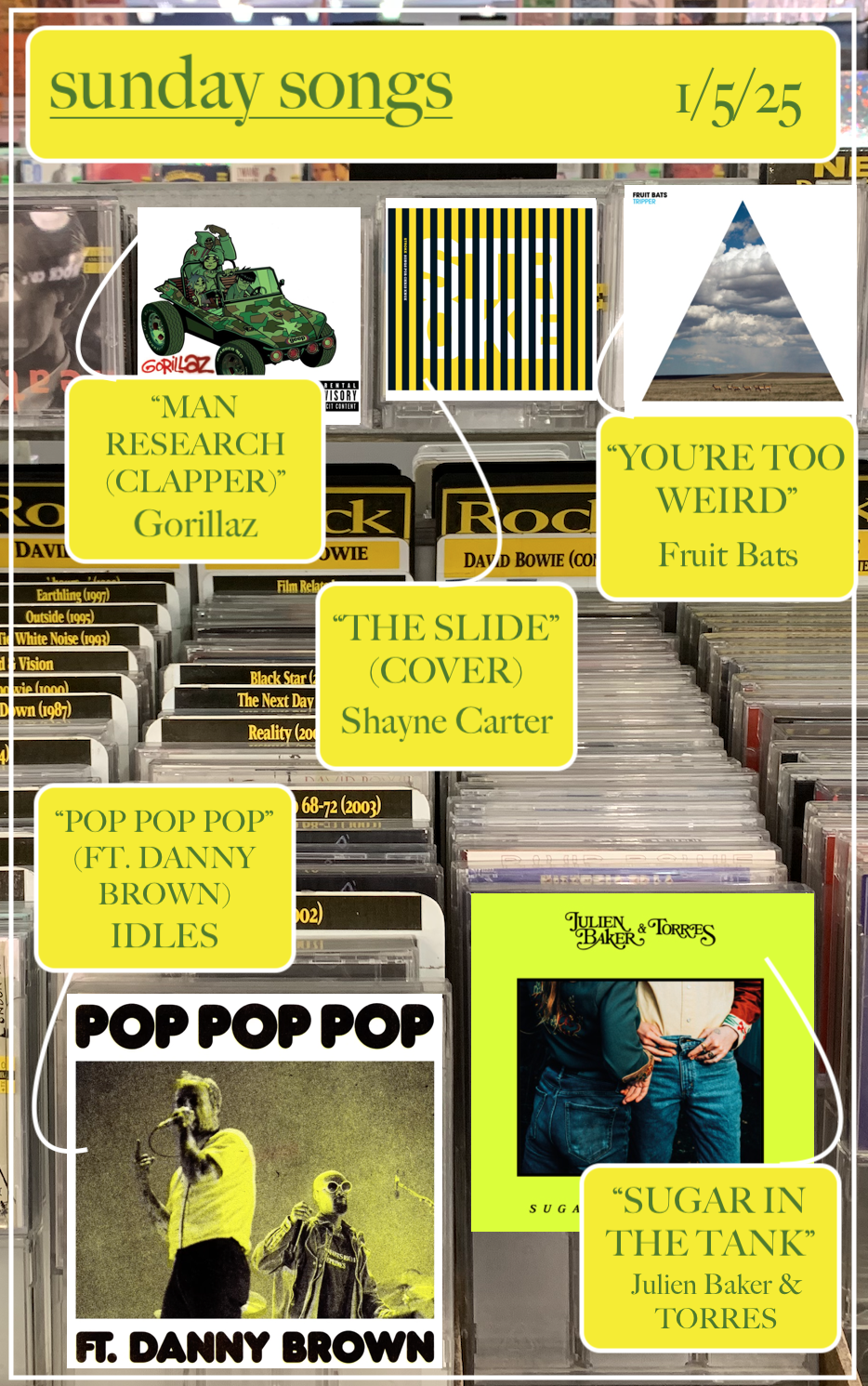
“Man Research (Clapper)” – Gorillaz

I remembered this track after getting into “Bill Murray” a few weeks ago; as wonderful an album as Gorillaz is, I often find myself forgetting about some of the songs sandwiched in the middle; this one has the job of following up “Clint Eastwood,” and with how many tidal waves that classic made in the early 2000’s, any track following that up, like “Bill Murray” and “Feel Good, Inc.,” has an exceedingly hard act to follow. But in much the same way as “Bill Murray” brings down the tempo but keeps the creativity, “Man Research (Clapper)” provides a bridge between some of the more energetic heavy-hitters—“Punk” comes up right after it. Buoyed by a sample from Raymond Scott’s instrumental piece “In The Hall of the Mountain Queen” (delightful, honestly—feels like the title screen music for an ’80s video game and not in a cheesy way), it’s dominated by the rasping repetitions of Damon Albarn pushing his higher vocals to their limits—maybe there’s the excuse for why I forgot about it. A good portion is just him going “yeah yeah yeah yeah yeah yeah,” but that’s the mark of a great musician—sure, he’s just going “yeah yeah yeah” in front of a sample and some record scratches, but I eat it up every time. There’s a smooth cohesion to his craft that makes every separate element seem as though this song is their final form, their ultimate destiny to be brought together.

…AND A BOOK TO GO WITH IT:

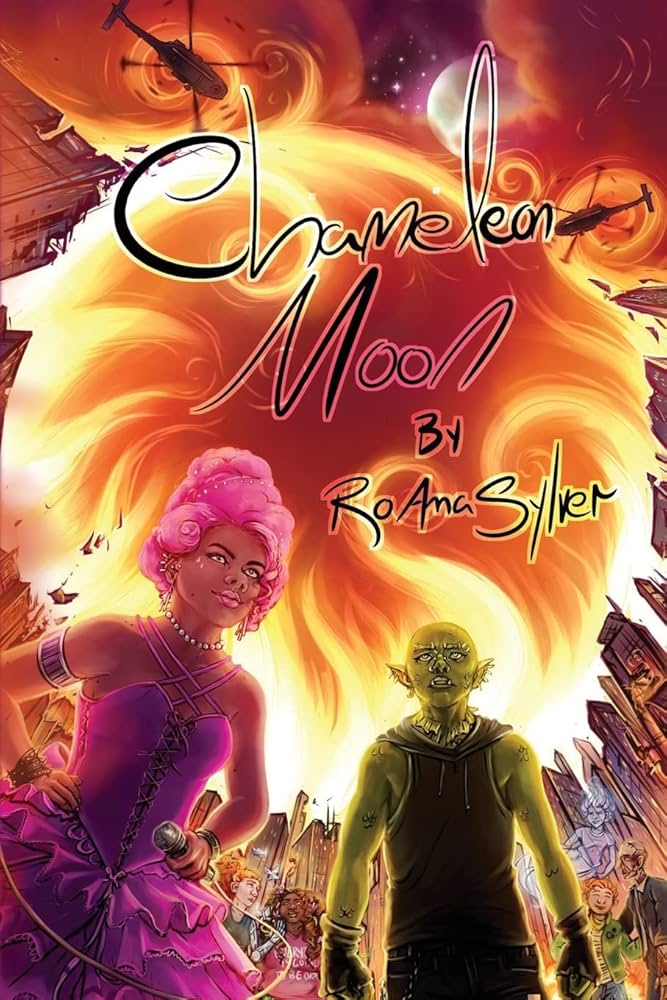
Chameleon Moon – RoAnna SylverI picked this one more for the atmosphere than the lyrics—a similar kind of hazy and raspy energy, but with an undercurrent of vitality.

“The Slide” (Tall Dwarfs cover) – Shayne Carter

Some covers prove that the singer understands some part of the song more than the original creators. Not to front on Chris Knox, incredibly talented and oddball songwriters as he is, but Shayne Carter’s cover gets to the heart of what Knox and co. were going for as far as the tone and the emotion of the lyrics.

Tall Dwarfs aren’t going to be anything but jangly, and their original version of “The Slide” is no exception. It’s got a psychedelic, ’60s sway to it, faintly sunny…and then you get to the lyrics. And then you get the whiplash from hearing those upbeat guitars against the lyrics: “The doctors should kill/She’s terminally ill.” I’m sorry, WHAT? I’m not saying that songs can’t have lyrics that don’t match the mood of their music, but in this case, Shayne Carter’s interpretation does the song more justice. In contrast to Knox’s upbeat instrumentals, Carter employs solemn pianos, muted strums of an acoustic guitar, and an electronic drone that begins to circle around you at the 1:58 mark as you listen like vultures circling carrion. The acoustics sound like they were recorded at 3 a.m. in an abandoned gym with walls covered in mold. That atmosphere captures how disturbing the lyrics are—sparsely told, it recounts the experience of an 80-year-old, terminally ill woman wasting away in an institution. That cold, chilling echo gives the song a much more tangible setting and emotional depth; the spareness of it all makes the setting so much more unforgivable, with its featureless walls and constant chill in the air. That Radiohead-like, droning dread comes about as close as I would imagine to capturing that imprisoned, monotonous feeling of your mind slip away and being powerless to do anything about it, all the while surrounded by nurses who barely want to be there. It’s a tragedy of a song—it was written in the 1990’s, and while I’m sure conditions have somewhat improved for patients, these situations are a reality for so many people, whether or not they have control of their minds. The pen that Chris Knox and co. put to paper was a respectful and sympathetic one, but Shayne Carter deserves so much praise for how much his musical interpretation brought out the original sentiment—and made it even more emotional.

Sadly, it’s a story that partially came true for Chris Knox; he suffered a stroke in 2009, and has had a limited vocabulary ever since. He’s made a handful of public appearances and performances in the last decade or so, but he’s largely off the radar these days. However, “The Slide,” alongside many more of his covers from both his solo work and of Tall Dwarfs, were compiled on Stroke: Songs for Chris Knox in order to initially help his family pay the medical bills. I hoped that he hadn’t accidentally predicted his own fate with “The Slide,” but it seems that his family has been going to great lengths to make sure he’s taken care of. Even amidst the horrors he described, there are bright spots worth celebrating—namely, the love of family and friends during unpredictable situations such as his.

…AND A BOOK TO GO WITH IT:

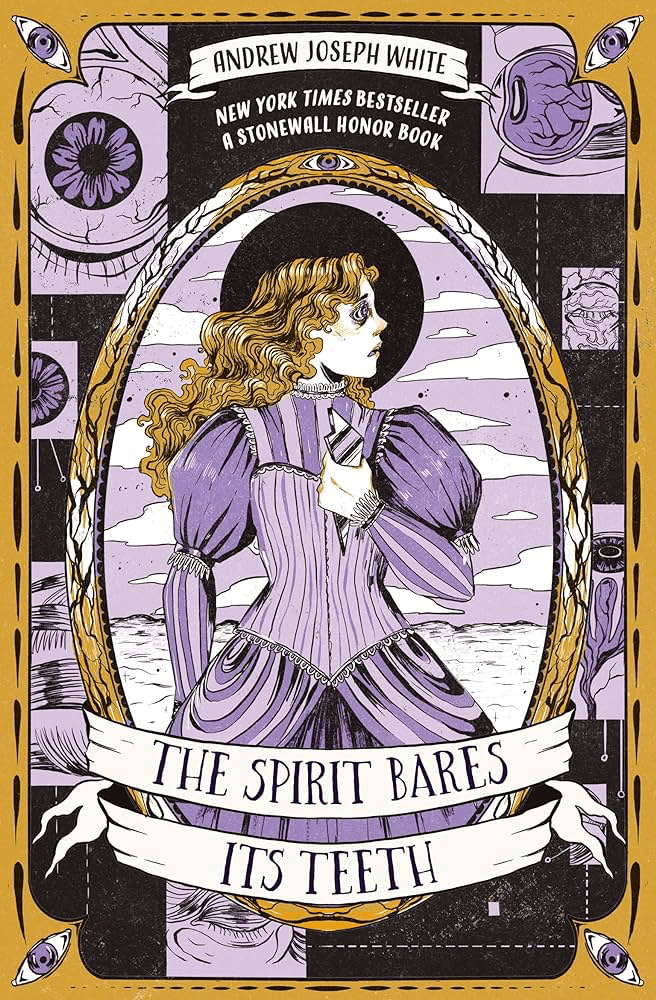
The Spirit Bares Its Teeth – Andrew Joseph Whitethe institutions in this novel are different than the one in the song, but it’s just as oppressive—and deeply haunting and eerie.

“You’re Too Weird” – Fruit Bats

…okay! Going into this, I didn’t expect to be that well-acquainted with Eric Johnson’s chest hair while he stared longingly into my eyes, but here we are? 😀 Don’t think I needed all that…thank you Eric, very cool

Either way, it’s all part of the ’80s-parodying cheese of the music video, complete with mullets, long pearl necklaces, everyone’s hair being artfully blown by an invisible fan, and even a keytar. The best part is that every single band member is fully leaning into the cheese, with every band member hamming it up whenever the camera is on them. If I can erase the strategic view of said chest hair via Johnson’s unbuttoned shirt, “You’re Too Weird” is a great little indie track; Johnson has one of the more distinctive voices in indie music that I can think of, and he takes it to some of its extremes, hitting higher notes than I’d expect even from him. Like the ’80s music and videos that “You’re Too Weird” takes cues from, it’s an endlessly catchy love song, peppered by a tasteful guitar solo and tambourine here and there. I’ll have to bring this back once the weather gets warmer—it’s the perfect song for staring out the car window on a summer evening.

…AND A BOOK TO GO WITH IT:

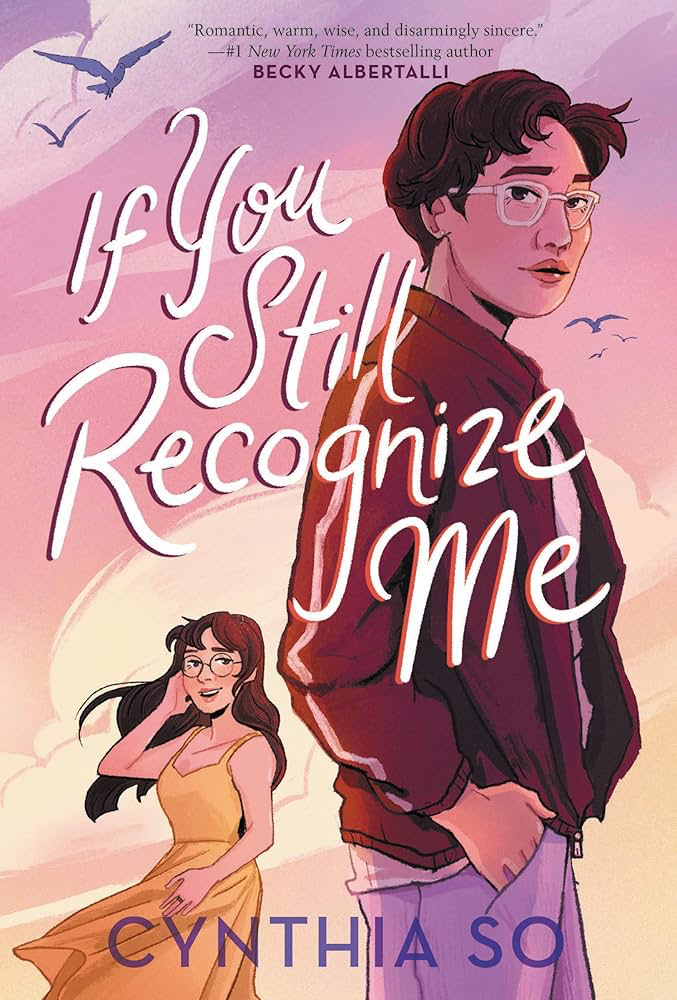
If You Still Recognize Me – Cynthia So“They say that I’m not supposed to be in love with you/They say that you’re too weird for me/And you’ll leave eventually/But then I’m the only one who ever believed in you…”

Since this post consists entirely of songs, consider all of them to be today’s song.

That’s it for the first Sunday Songs of the year! Have a wonderful rest of your day, and take care of yourselves!
Posted in Sunday Songs

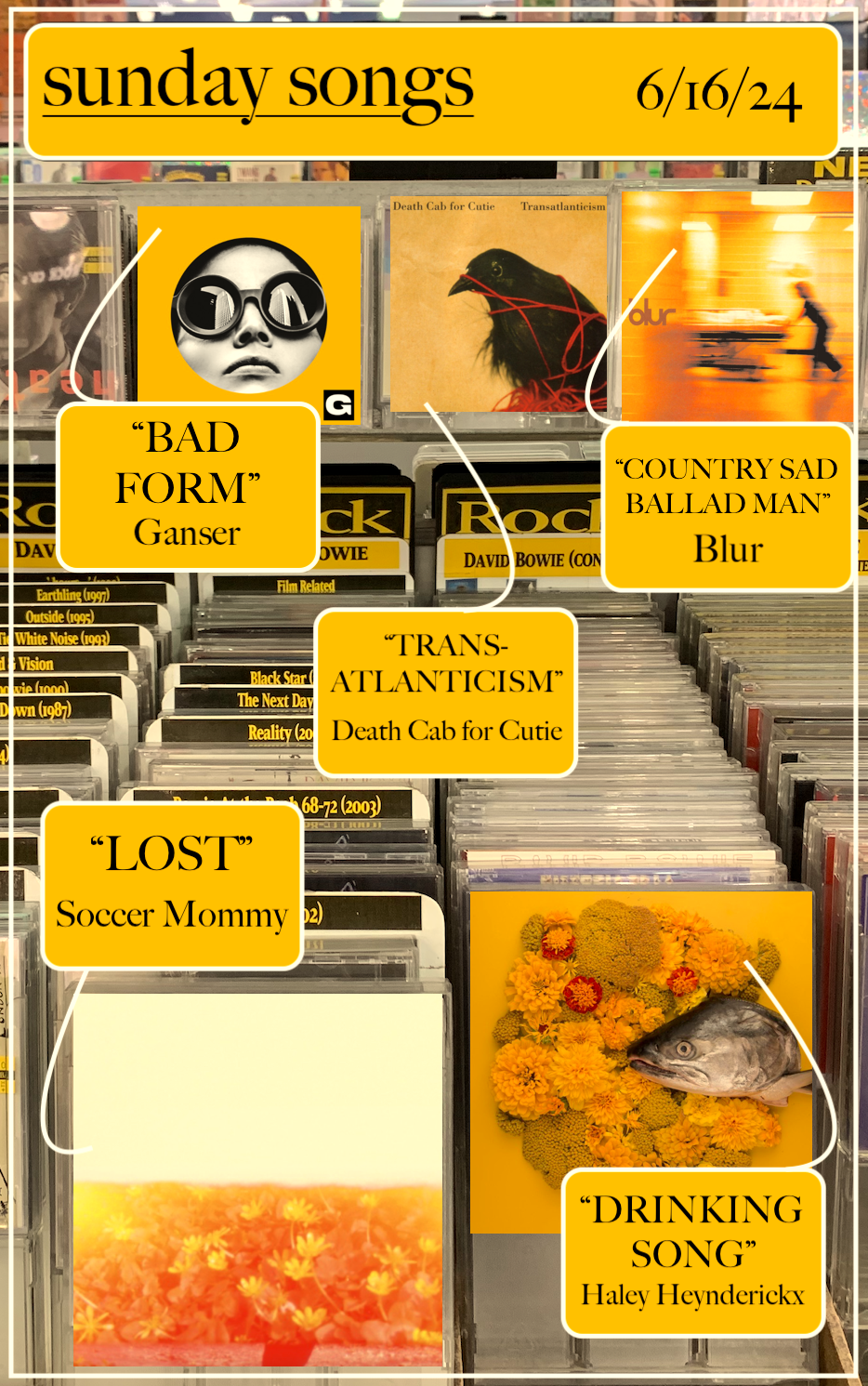
Sunday Songs: 6/16/24

Happy Sunday, bibliophiles!

First off: happy Father’s Day to my incredible dad! Not only are you such a wonderful role model for being a genuinely kind, accepting, and truly empathetic person, you’ve given me the gift of sharing music—what these posts are all about. To be able to share music with you back brings me all the joy in the world. I love you.

This week: 🚨SOCCER MOMMY HAS COME TO SAVE THE SECOND HALF OF 2024, THIS IS NOT A DRILL🚨

Enjoy this week’s songs!

SUNDAY SONGS: 6/16/24

“Lost” – Soccer Mommy

SOCCER MOMMY RETURNS!!! Given the short tour (that’s nowhere near me……..no, I’m totally not mad, no way) that she’s currently embarking on to support some of this new material, there’s a fourth album (sixth, counting the self-released albums) on the horizon, and hopefully on a happier date. Poor thing. I still haven’t gotten over the fact that her last album, Sometimes, Forever, was unintentionally released on the day that Roe v. Wade was overturned. Jesus.

Something that I’ve admired over the years about Soccer Mommy is her willingness to experiment with her production. At their core, her songs have never changed their essence: honest, tender confessions of the trials of heartbreak, grief, and mental health. But the dressing is never the same twice, from color theory’s color-coded tonal shifts and synth-dusted melodies to the darker, more distorted soundscape of Sometimes, Forever. With the latter, Chelsea Wolfe wasn’t somebody that I’d readily compare to Soccer Mommy, but then she comes along with “Unholy Affliction,” and the comparison, at least on that track, is as clear as day. Just when you think she’s playing it safe, she comes out of nowhere with instrumentation that you’d never imagine attributed to her name—and almost every time, it still feels like nothing but Sophie Allison. There’s a boldness to her that’s rare in the genre; there is an expectation of sameness in the kind of indie circles she’s in, an expectation to box yourself into the image that the record label deems as “authentic” in order to stay in their good graces—and the good graces of fans who cling to their raw lyrics. Julien Baker, although her first two albums adhered to that, took a similar leap with Little Oblivions, and that, for me, was her best album to date.

But Soccer Mommy can’t help but be herself. “Lost” strays nearer to some of her sparer, more traditionally indie roots, but with production that feels spun from silk; inside of the glowing cocoon where Allison resides, threads of synth, birdsong, and yearning strings coalesce in what can only be described as the musical form of a grainy polaroid, a sunset tinged with ink, film, and bygone memories. Bygone memories, like much of her other material, is at the core of “Lost,” specifically bygone memories of those bygone. Given the trajectory of “yellow is the color of her eyes,” some have speculated that “Lost” is about her mother’s death, although Allison has chosen to not disclose the subject. whatever the case, I’m glad that Soccer Mommy doesn’t have the kind of rabid Swiftie fanbase that would relentlessly strip away at the press and at Allison herself to get to the bottom of who she’s mourning, because…that’s her own business, dammit. I’m glad us…whatever Soccer Mommy fans are called (does this fanbase have a name?) have the heart to give a human being space to breathe, because, judging from the lyrics (and all of color theory, frankly), Allison needs it. “Lost” distills grief in the truths of the cliche that every movie seems to repeat about grief: “I wish I’d had more time.” Most media leans on that universal kernel to hold the weight of such a complex, unmappable sensation, but Allison scratches at its heart; her grief rests not just in tangible objects, but in the reminders of the time never spent: “I’ve got a way/Of keeping her with me where I go/But how she feels, I’ll never know/It’s lost to me.” The pain of this track is in the insurmountable truth of never being able to fully know a person; of course you can never fully, truly know a person beyond yourself, but grief exacerbates that unsurmountable summit—even if you tell yourself that you could be a cartographer of a brain outside your own, that chance has all but slipped through your fingers. Grief has unrealistic expectations of you; in its throes, it tells you that you could have made up for all of the missed regrets in your lifetime, and that’s half of the knife in your gut. Half of the pain isn’t what didn’t happen, but what can’t happen, even in the alternate reality it presents. When she repeats “If I had another chance/I’d ask her then,” it doesn’t feel like a throwaway from a stale funeral in the MCU—it feels like the testimony of something still putting down the compass and fountain pen, knowing that this expedition was doomed from the start.

So, what, you ask, might us sad girls do while we wait for Soccer Mommy’s fourth LP, which will inevitably destroy us? Watch Allison and fellow storied sad girl Phoebe Bridgers unite to cover Elliott Smith:

…AND A BOOK TO GO WITH IT:

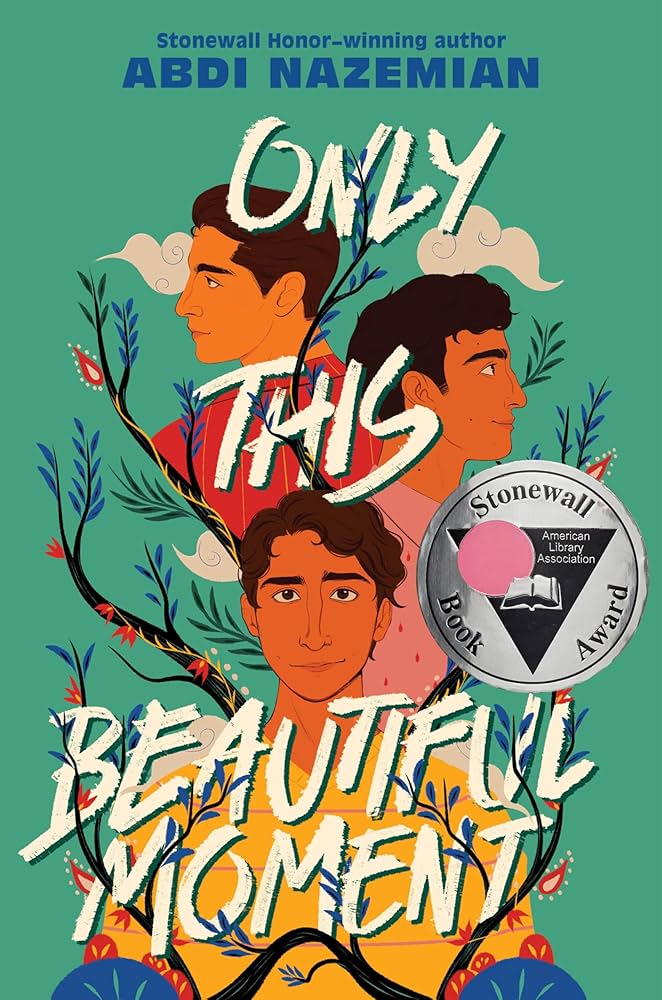
Only This Beautiful Moment – Abdi Nazemianbreaching generational lines to form an understanding of heritage, sexuality, and family.

“Drinking Song” – Haley Heynderickx

Contrary to the song title, Haley Heynderickx is (probably) not responsible for the kind of song that old men will sing in a pub while drunk for generations to come. I mean, that could be a possibility in some alternate universe. I’d like to see that. It’d make for an odd movie scene—nothing about this universe has changed, but instead of old Irish ballads, there’s a pub full of swaying people singing late-2010’s indie rock.

With a title like “Drinking Song,” I fully expected this song to be the prequel to “Oom Sha La La,” a telling of the period where “The milk [was] sour/I’ve barely been to college/And I’ve been doubtful/Of all that I have dreamed of.” Contrary to that, “Drinking Song” is a soft-spoken but resolute declaration of hope, delivered out a summer window while the crickets sing. Any darkness is the shroud of night, and all of the stars seem to bear witness to a constitution of better days to come: “And the edge of the world makes it seem/That everyone gone is still singing the same song/And I can believe in these things/That everyone’s singing along/The good and the bad and the gone.” There’s a kind of childlike optimism to the openness of Heynderickx’s declaration, but one with roots strong enough to hold it; with each repetition of “there’s a light at the end that I know,” that glow, like The Great Gatsby’s green light, pulses with more intensity with each incantation, until it becomes a portal to better times. It’s the opposite of negative overthinking; this song overflows with future vignettes of new cities to explore and new lovers to embrace, all held within the space of the back of your mind. “Drinking Song” is a snow globe containing every good future—all is too small to comprehend in the here and now, but with a little luck, you can hold them in your hands and watch them unfold before you.

…AND A BOOK TO GO WITH IT:

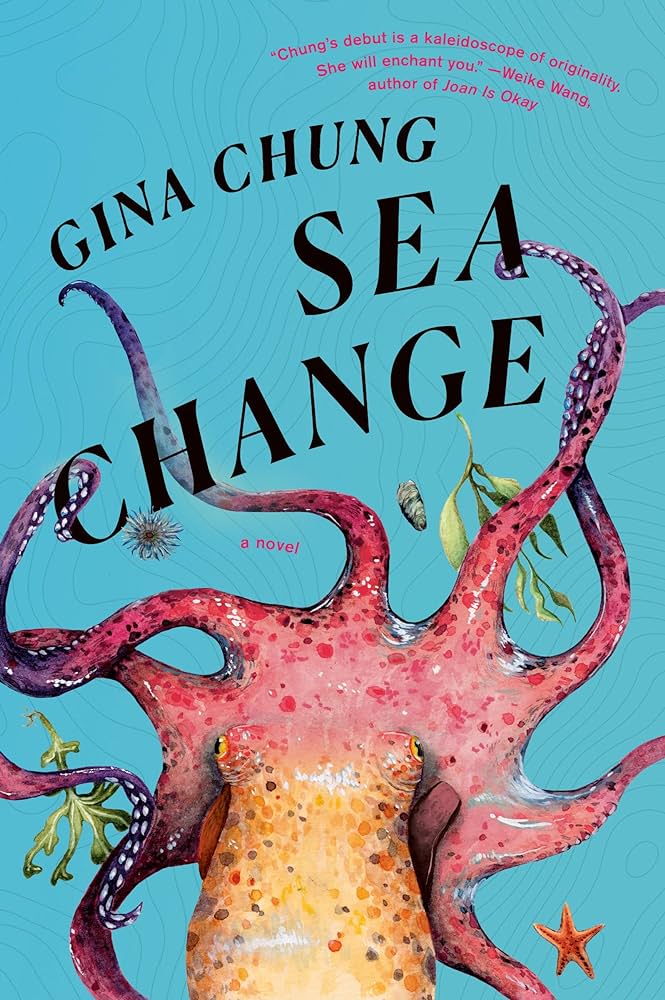
Sea Change – Gina Chungholding onto hope in a time of lovelessness and isolation.

“Bad Form” – Ganser

I like plenty of bands and artists whose catalogue consists of one or two songs tops (see: Wet Leg, Suki Waterhouse, etc.). What distinguishes said bands, for me, is that they’ve made a career out of making those two songs worth your time—they may only be two songs, but they play them well. Sure, “I Just Threw Out the Love of My Dreams” may be one of Weezer’s one, maybe two songs (and even that’s generous), but it’s such a bright and shining piece of machinery that you can’t help but gaze at said one song and know that, yeah, it may be the same song they’ve been peddling since 1994, but it’s one fantastic song.

The more I listen to Ganser, the more I realize that they fall into that camp. I hate to say that every time, but like I said, it’s not always an insult. Although they do have a good amount of deviation here and there, most of Just Look At That Sky, as much as I enjoyed it, is the same three off-kilter, drawled post-punk songs about being numb, exhausted, and angry, or some combination of the three. They’ve got a brand. Ganser, for me, stands out in that their three songs sound different enough from any given song that you can excuse them for relative lack of variety. None of their chords ever align pleasantly—it’s abrasive, grating, and honestly? Fun. As with “People Watching” (which I reviewed at the beginning of the month), Ganser makes the kind of punk that’s aware of how punk it sounds, and they lean into every inch of theatricality with their bleary-eyed drawls and itchy, buzz-saw guitar riffs, fuzzy and stinging like staring straight at the sun—just as like the climax of “Bad Form.” Ganser is a band that’s not afraid to make music that scratches your skin like un-filed, bitten nails, and if that’s their three songs, then three cheers for making three songs that are bold enough to sound unappealing.

…AND A BOOK TO GO WITH IT:

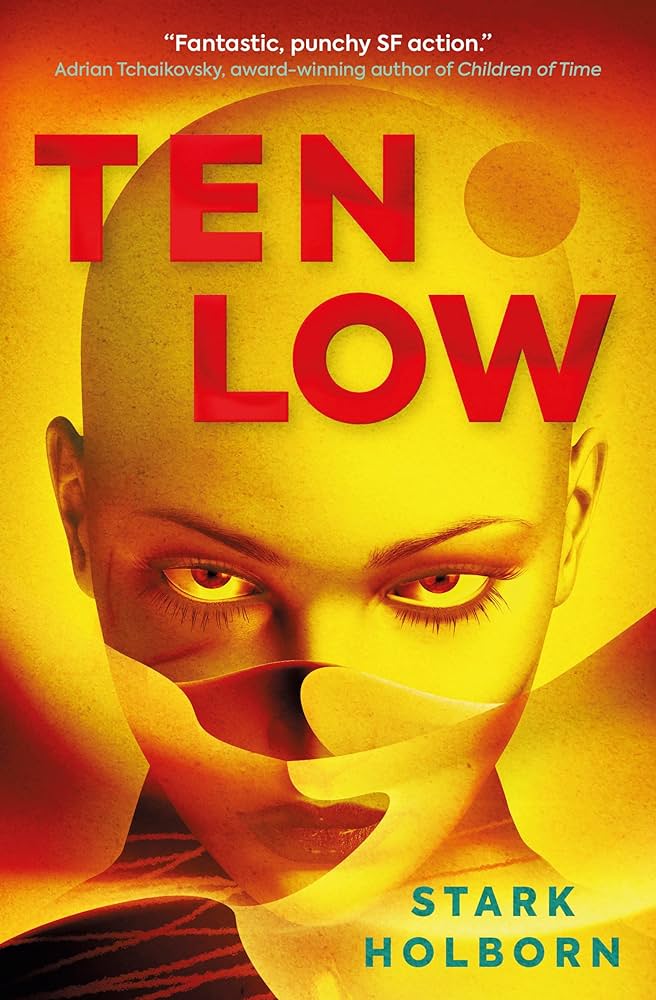
Ten Low (The Facts Sequence, #1) – Stark Holborn“I’m the other man/I’ll take the medicine/The room spins like a feather/Folding over and over…”

“Transatlanticism” – Death Cab for Cutie

I was first introduced to “Transatlanticism” when I was about 12 or 13. A few months after the first listen (and being irreparably entranced), I had an internship at a local flower shop, where the owner had Sirius XMU playing. This song came on at some point, and I’ll never forget the deeply concerned look she gave me when I told her, in the most 13-year-old way possible, how much I “loooooooooooved” this song. She was entirely justified.

Another thing that music criticism does that I’ve never understood: categorizing Death Cab for Cutie as emo. If I suspend my disbelief enough, I can see the basis being in the whine in Ben Gibbard’s voice, especially when he performs live, and the dramatic emotion is there, but…in what world does Death Cab for Cutie belong in the same breath as My Chemical Romance? Really? I could almost see them being the middle ground between emo and indie, with some of the lingering whine and drama, but the key with selling drama is what has always lost me with most emo music: it actually feels authentic. Never once does Gibbard sound like a suburban teenage boy who’s just discovered heartbreak and black eyeliner in one fell swoop. The whine, although it can fit into some of said teenage boy sensibilities (see: “We Looked Like Giants”), just seems more of a product of Gibbard’s natural range than it does a forced vehicle for airbrushed angst.

In theory, “Transatlanticism” fails my test of withstanding a long song; most of the time, in order for a long song to hold enough water past around the six minute mark, there has to be at least some sort of shift, whether that’s tonal, lyrical, or instrumental; it’s why “Cop Shoot Cop” by Spiritualized really feels like it’s over 17 minutes long, with its largely extended sleepwalk of monotony, whereas Nina Simone’s ten minute epic “Sinnerman” has the fervor and gusto, as well as an act structure similar to classical pieces, is a nail-biting journey that never lets go of your shirt collar. (To be fair to J. Spaceman, my guess is that the tedium is the intended effect, seeing as it’s about how his heroin addiction all but made him into a dead man walking. Knowing him, it’s fully intentional.) However, there’s songs like Blur’s “Tender”—nearly eight minutes long and without much change—that have the pure, undiluted heart to keep its sails billowing. You feel everything—it’s an IV drip straight through to the sparest, most instinctual emotions, heart-wrenching in its delicately-crafted simplicity. “Transatlanticism” takes a trick out of that same book; until the last third, all that accompanies Gibbard’s thinning, tender lament is about four piano chords, played over and over with a purposeful negative space between them. Come to think of it, negative space is exactly why “Transatlanticism” works so well. Transatlanticism as a whole is a concept album about long-distance relationships, and even without the lyrics, crushing as they are, you can sense the abyssal gulf cutting down the middle of this song. At the four-minute mark, after Gibbard has finished with the first repetition of “I need you so much closer,” a full minute passes of a single, instrumental strain: those same four chords, a spare guitar lick, and tiny tendrils of synth that faintly moan and rattle like dying machinery, as if trying to conceal their death rattles without bothering anyone. Transatlancism was aided with Brian Eno’s Oblique Strategies cards, and I wouldn’t be surprised if they drew the same cards that produced Bowie’s “Sense of Doubt”—”emphasize difference” and “try to make everything as similar as possible.”

The difference, in this case, is a shift in lyrical style; It’s all but silent compared to the lyrics in the first half, but that silence conveys the feeling of separation, of having a strand of your soul stretched across an ocean and not being able to see who’s on the other shore, just as heartbreakingly as words do. After Gibbard’s lament (“The rhythm of my footsteps crossing flatlands to your door/Have been silenced forevermore/The distance is quite simply much too far for me to row/It seems farther than ever before”), the exhaustion of sorrow leaves you with no strength to do anything but stare into the canyon wrought by distance, too far to even touch fingertips over. Simplicity is what kills me about this song; after that instrumental break, Gibbard repeats the “I need you so much closer” refrain, only to transform it to “I need you so much closer…so come on.” When all of the poetry’s drained, sometimes the most sparing lyricism destroys me. The ocean has spread its impossible distance before you, and all you can do is stare as far as you can, towards the bottom, with only the most baseline instincts of longing to keep you company. It’s such an artful buildup and approach to portraying such deep yearning—you feel that negative space as a tangible barrier. See what I mean about Death Cab for Cutie making their angst authentic? “Transatlanticism” hits me like a goddamn steam train every time without fail. Ow, dude, who kidnapped me and abandoned me in the onion-cutting factory?

…AND A BOOK TO GO WITH IT:

Aurora’s End (The Aurora Cycle, #3) – Amie Kaufman & Jay Kristoffow oof ow ouchie ow ow ow somebody hold me

“Country Sad Ballad Man” – Blur

And now, “Song 3.”

Blur’s self-titled album [slides Anthony Fantano glasses up bridge of nose] is an exercise in becoming the very thing you swore to destroy. After years of being right smack in the middle of the spotlight, participating in a manufactured battle of the bands, and pushing their mutual abuse of multiple substances to the edge, the band collectively decided that a change needed to be made. They packed their bags, temporarily relocated to Iceland, and hammered out a new album. The result was Blur, which had a much dingier, edgier, and altogether harder sound, with a lead single that famously parodied grunge, but then…circled around to being a smash success and an enduring stadium classic. That’s another story. (I’ll give you a hint: wooooooooohoo!) Yet, as much as they poked fun at American grunge, in all of its nihilistic, self-deprecating time in the sun, they slipped straight into the lifestyle, shedding their Britpop gloss for aggressive, alternative guitar, stubble, and, to the detriment of the whole band, excessive abuse of alcohol and heroin (see: “Beetlebum”).

Though the drug use is lamentable (to say the least), as all of the band members now agree, it was their mutual exhaustion and anger at being put through the British media meat grinder that allowed for such a hard—and delicious—left turn. On the verge of snapping, the band decided to put Parklife behind them and get grungy. It was bound to happen eventually, what with Graham Coxon’s adoration for the American alternative scene and the guitar sounds they were producing (should’ve listened to him earlier on that one…). Blur is all but absent of a bad track, crashing with the equivalent of a drum set tossed through a window one minute (“Chinese Bombs”) and slipping into acoustic melancholia in the next (“You’re So Great”). But “Country Sad Ballad Man,” for me, is a highlight I find myself sniffing out every six months or so. With one of the drier and more self-explanatory titles, this track feels like food left to rot out in a heatwave, festering and twangy. Every other lyric finds Damon Albarn stretching his voice into a creaky, scratching highs, as though mocking his own state of lying squarely at rock-bottom: “I haven’t felt my legs/Since the summer/And I don’t call my friends/Forgot their numbers.” The strings on Alex James’ upright bass come loose and unsteady, as though a few more takes of this song would’ve seen them snap off and collapse on the floor. Graham Coxon relishes in the alternative aggression that Britpop never fully allowed for, twisting riffs that seem to languish like drooping eyelids, dripping sweat and numbness. But the real freakout, one that must have been canned and compressed for ages, explodes in a vomit of wobbly distortion and screeching falsetto. It’s a vertigo-inducing outro that caves in like the mold-rotted roof of a wooden house, shattering in a hail of splinters and nails. In all of its spring-plucking chaos, there’s really no other lyric that fits it than Albarn’s self-aggrandizing, high-pitched screech of “I’ve done and fucked it!” yelled straight up from the well of rock bottom.

…AND A BOOK TO GO WITH IT:

So Lucky – Nicola Griffith“Yeah, I found nowhere/It got to know me…”

Since this post consists entirely of songs, consider all of them to be today’s song.

That’s it for this week’s Sunday Songs! Have a wonderful rest of your day, and take care of yourselves!
Posted in Sunday Songs

Sunday Songs: 5/19/24

Happy Sunday, bibliophiles! I hope this week has treated you well.

This week: in addition to my blue and black/white/gray periods, it’s become increasingly obvious that I also have a green period. On another note, food processors are great!

Enjoy this week’s songs!

SUNDAY SONGS: 5/19/24

“Advert” – Blur

The restraint I displayed by not blowing through Blur’s entire discography back in the last half of 2021 is restraint that I have yet to parallel, so it’s only now, almost three years after the initial Blur Breakdown, that I’ve gotten around to Modern Life is Rubbish (if there was ever a more British title). I did sort of sully it with the experience of listening to it while crawling under my bed while trying to exorcise the last of the dust bunnies from my dorm (and getting caught on the rain), but that’s all me—this is the first Blur album where they started to feel like themselves.

I’d never thought of Modern Life is Rubbish, Parklife, and The Great Escape (the final Blur album to surmount) as a trilogy until Trash Theory described it as such—from my understanding, this is what cemented their reputation as the foremost clever spectators of British life in the ’90s, peering out of every windowsill with a snappy remark about the passersby. Modern Life feels like Parklife just before it morphed into the masterpiece it would later be—all of the pieces were there, and all that was needed was to make it larger than life. The melted shoegaze of Leisure was hanging on by a thread (it’s much more evident in the special edition—see: “Peach”), and they’d shifted from staring off into the distance, bleary-eyed and exhausted, into taking out that exhaustion on whatever they saw fit. Straight off of the heels of the triumphant “For Tomorrow,” “Advert” opens with a soundbite from the commercial you’ve just heard (“Food processors are great!”) before launching into what feels like the genesis of Graham Coxon’s signature assault of pounding guitars that practically demand every crowd to jump up and down. This relentless guitar work feels like witnessing the larval stage of “Jubilee,” crashing and bouncing with unending abandon. And this kind of guitar that threatens to consume the track is perfect for the endless consumerism that “Advert” comments on—commercials everywhere, a flood of inescapable offers leeching off of the dissatisfaction of the ordinary man: “You need a holiday somewhere in the sun/With all the people who are waiting/There never seems to be one.” This consumerism leads to even more dissatisfaction, which leads to more consumerism to quell said dissatisfaction, which leads to…ah, capitalism. What could possibly go wrong?

…AND A BOOK TO GO WITH IT:

Early Riser – Jasper Ffordeconsumerism: the perfect diversion from an oppressive, unlivable winter!

“Abbey” – Mitski

LUSH, Mitski’s first album, was made for an end-of-year project when she was a junior in college; there’s an unverifiable TikTok rumor going around that she got a C on it, which, given the traction of the Mitski fandom, is just going to become an urban legend at this point. So it goes.

Either way, it’s both remarkable and understandable that she wrote all of these songs and had them produced while she was still in college. Remarkable, because just from “Abbey,” she clearly had the nascent talent for wringing emotion out like ice-cold water from a towel from a young age, and understandable, because sometimes being alone and sleepless in your dorm on the very first night of college brings out that flood of inner darkness. Leave it to TikTok to leave out the best part of the song for whatever trend it latched itself to; the slow, chanting a cappella that gained traction feels like a prayer to a void growing within your chest, a litany of acknowledgment to that which you want to reach, but cannot touch. As an instrument, Mitski’s voice, unaccompanied until halfway through the song, is a haunting, flitting machine, the slow peak and valley of a heart monitor. But once the digitized drums sweep through, it feels as though the sky has opened up. This prayer has transformed from a whisper into the confession box into a plea bellowed to the heavens. “Abbey” chronicles a search for the soul, a ravenous hunger that cannot be sated that lies just out of reach: “There is a light, I feel it in me/But only, it seems, when the dark surrounds me/There is a dream and it sleeps in me/To awake in the night, crying, ‘Set me free’/And I awake every night, crying, ‘Set me free.'” Hoowheee. God. Makes me want to travel back in time just to give her a hug, but it seems like she’s now far removed from that time in her life, emotionally: she described the version of herself that wrote the album as being “long gone,” so I can only hope that she’s been able to fill her heart, as much as the music industry has kept her from doing so.

…AND A BOOK TO GO WITH IT:

Hell Followed With Us – Andrew Joseph Whitea void within that only becomes hungrier the more it grows.

“Side By Side” – Crumb

AMAMA, which came out on the 17th, wasn’t at the top of my most anticipated albums of the year, but after only one listen, it’s cemented itself as one of the most exciting ones so far. It’s a side of Crumb that hasn’t been let loose until now, one that, instead of gently dribbling like age-old water from the precipice of a glacier, skitters around on the smallest legs, darting this way and that like a frightened millipede. The whole album feels like watching a bunch of beetles hopped up on sugar water run a race: their iridescent shells catch the light as they crawl about, scaling walls instead of the tiny racetrack and occasionally clambering over each other to get ahead. No wonder they named a whole song “The Bug”—I need the instrumentals of AMAMA just so that somebody can use them for a documentary about insects.

AMAMA‘s three openers—“From Outside A Window Sill,” this song, and “The Bug”—are its strongest links, and although the album never falters, these three shine the brightest. “Side By Side” ricochets with an energy that I never would have expected from the likes of Crumb; both the drum machine and the actual drummer are working overtime to create a scampering beat that frantically bounces like a honeybee trapped under a plastic cup. It’s a song that yearns to go, go, go, and go it does—the swirl of rapid-fire synth beats are unpredictable in their flight path, so much so that I feel a jittery, sugary rush just listening to it. For me, the most fascinating part of this change in speed for Crumb is how easily Lila Ramani’s voice adapts to the change; it’s not like I thought she couldn’t sing more quickly, but her voice only slightly seemed to change speed along with the music. Her voice is permanently trapped in a slurry of amber, unaffected by time or space—I feel like her vocals, no matter the speed, would mesh with any tempo. It retains that syrupy calm that made the rest of Crumb’s catalogue so soothing and laid-back—a quality that feels suspended in a space beyond time.

…AND A BOOK TO GO WITH IT:

A Half-Built Garden – Ruthanna Emrysskittering with life and energy (and some insectoid and arachnid aliens).

“Lusitania” (feat. St. Vincent) – Andrew Bird

It took me how long to find out that Andrew Bird had recorded a song with St. Vincent? I’m surprised that 12-year-old me didn’t find this drifting around somewhere, but to be fair, St. Vincent’s name isn’t listed on the official track.

In 2024, Andrew Bird and St. Vincent do seem like an odd couple; since 2012, Clark’s style has morphed so many times that it’s difficult to imagine her stylistically even going near Bird’s songbird-whistling, violin-dominated alternative folk. It makes sense that this was probably recorded sometime in 2011—post-Strange Mercy, but before the last dregs of Actor and Marry Me were out of her system. She’s still never been fully folk, but the intersection of the Venn diagram of her early style and Bird’s is wider than I thought it would be. With her guitar playing mostly absent, what shines in “Lusitania” is her voice; you can tell in the first half that she’s been quieted in post-production or that she’s holding back on completely dominating the track. “Lusitania” makes me miss those artsier sensibilities of 2008-2010 St. Vincent, the delicate turns of phrase and the more feathery clarion calls her voice twisted into. Just like that, I’ve got another song in my hypothetical playlist of songs where artists sing certain phrases in a way that scratches all the itches in my brain: in this case, her singing of “there’s no shame” at 2:44. Her warble seems to chain-link with Bird’s in a way that produces its own chord, something more than a harmony that feels like a tuning fork struck at my heart.

But why don’t I talk about Andrew Bird, though, since…y’know, he’s the one who made the bulk of this song, anyway? Totally unlike me to go on about St. Vincent…completely uncharacteristic. (I have not changed a bit since middle school.) The instrumentation doesn’t stand out to me on this one as much, save for the rising cymbals that nearly swallow both Bird and Clark’s voices. But it’s clearly to make way for the lyrics—a clever string of World War I metaphors, presumably about a relationship where one party suffers volley after volley of abuse, while the other doesn’t even think to recognize that their behavior is harmful: “If your loose and libel lips/Keep sinking all my ships/Then you’re the one who sank my Lusitania/But somehow it don’t register as pain at all.” As far as ship metaphors go, the Titanic has likely been used one too many times, but the Lusitania feels especially potent on several fronts. The use of such a large passenger ship (and its sinking) drives home the metaphor of weathering emotional abuse until it drowns you. What’s more effective still about the Lusitania was its eventual role in the First World War; since a significant number of its passengers were Americans, the sinking of the Lusitania by a German U-Boat was part of what pushed public opinion towards entering the war on the side of the British in 1917. Just like the boiling public outrage of the American public, the Lusitania was the straw that broke the camel’s back, an event so explosive that there could be no other option than to break away, no matter how many casualties it cost. “You laid mines along the shore” feels like the last gasp of this deeply harmful relationship, the claws that scored scars down the narrators back as they squirmed free of their bloodied grasp.

I really should have seen this collaboration coming, not because of my middle school obsession, but also because it slipped my mind that it wasn’t the first time. Here they are in 2009 performing “What Me Worry?” (15:51) and “Black Rainbow” (21:09).

…AND A BOOK TO GO WITH IT:

Fireheart Tiger – Aliette De Bodard“If your loose and libel lips/Keep sinking all my ships/Then you’re the one who sank my Lusitania/But somehow it don’t register as pain at all…”

“The Mainline Song” – Spiritualized

How I’ve never covered Spiritualized on Sunday Songs is genuinely beyond me. I did sort of discuss them when I talked about “Monster Love” last June, but that was more of a remix than anything. They’ve been in my top 5 artists of all time for at least 4 years now, but I suppose I blew through most of their catalogue before I started writing these posts. Mark my words, “Ladies And Gentlemen We Are Floating in Space” is always on in the background of everything else I’m listening to.

Everything Was Beautiful, which came out around two years ago, was some of J. Spaceman’s best work to date; at the time it came out, I remember describing it as Ladies And Gentlemen We Are Floating in Space but happy. Insane concept, I know…when was the last time you saw J. Spaceman and happiness in the same room together? Hardly ever, up until maybe 2017, right? Jesus. This poor man has to be the dictionary definition of “going through it.” Which is why the “happy Ladies And Gentlemen” hit me so deeply—all of the heroin, heartbreak, and near-death experiences have begun to fade away from his newer music, but the explosive, immersive creativity remains the same—you can really tell that these positive changes in his life have really begun to take root. And I am so glad. This man has been on the brink of death not once but twice. He doesn’t just deserve it: he needs it.

Like Ladies And Gentlemen, Everything Was Beautiful is always at the back of my mind, usually in the form of the uproariously celebratory “Always Together With You” and the nearly 10-minute long, haunting and cinematic closer “I’m Coming Home Again.” “The Mainline Song” lands on the side of euphoria, and thank god that it’s not heroin-induced this time (as much as “She Kissed Me (It Felt Like a Hit)” slaps). J. Spaceman’s immeasurable talent lies in how quickly he can not just create an atmosphere, but how he can create one that consumes so instantly. It’s not a building wave that darkens you with shadows before swallowing you whole: a more apt comparison would be falling into the core of a star, instant immersion with stardust sounds and white-hot flares roaring all around you. Every song is a universe contained in a spare amount of minutes. However, even if I did cast aside the part about there not being a build before the immersion, the buildup to “The Mainline Song” may just be its main draw. The build itself is part of the universe; J. Spaceman doesn’t even start singing until the halfway point, letting the song construct itself from fragments of stardust and train tracks as it swirls into being. It’s a song patched from the breeze of night, the kind you only find when sticking your head out of a car window, breathless and ecstatic. It’s a sprint through the streets as city lights blink like so many stars. It’s the wind parting your hair as you run to catch the bus, panting as you stumble inside with a fit of laughter. As many songs as there are about this kind of adventuring, none of them quite capture the hopeful feeling of “The Mainline Song.” No feeling necessitates J. Spaceman’s magical universe creation more—the swirl of horns, choir, and machinery bottle the feeling in all of its rapid euphoria, as blurry as the world passing by from the window of a train. Like nothing else, “The Mainline Song” captures the look you share with your friend as you reach a silent agreement to leave everything else and run. The destination isn’t what matters: it’s the breathless thrill of love.

…AND A BOOK TO GO WITH IT:

A Scatter of Light – Malinda Lowarmth, adventures in the city, and an unforgettable summer.

Since this post consists entirely of songs, consider all of them to be today’s song.

That’s it for this week’s Sunday Songs! Have a wonderful rest of your day, and take care of yourselves!

Posted in Sunday Songs

Sunday Songs: 2/25/24

Happy Sunday, bibliophiles! I hope this week has treated you well.

Took me this long to get to a blue period…it didn’t happened until almost three months in the year, but of course it’s the one that ends up having Faith No More and Kermit the Frog in the same breath. Duality of Madeline.

Enjoy this week’s songs!

SUNDAY SONGS: 2/25/24

“House of Self-Undoing” – Chelsea Wolfe

In an outcome that should be surprising to no one, Chelsea Wolfe’s new record, She Reaches Out To She Reaches Out To She, absolutely rocks. Dare I say it might be one of her best albums in years? Birth of Violence was a solid album, but I remember it having some lulls, but then again, I haven’t listen to it since its release in 2019. I haven’t listened to her entire discography, but I’ve never met a Chelsea Wolfe album I didn’t like, but there are some that nudge their way past the others to the tidal wave of goth revelry that she’s come to be known for. I’ve meant to review at least a handful of the excellent singles that came out of this album, but I remember specifically that “Whispers In The Echo Chamber” came out at a time when I got unexpectedly swamped…when there were a bunch of fantastic blue songs I wanted to talk about. Oopsie. No time like the present, amirite?

In terms of themes, Wolfe always has something poetic up her sleeve, whether she’s making the skeleton of her album out of Jungian analysis or Tarot. They’re all deeply personal, but She Reaches feels more intimately so; here, she grapples with separation of all kinds: from past relationships, from present systems, and from future pathways that her life could lead her down. But as she’s draining the gore of all the past messiness out of her system, she’s burning bridges and building her new phoenix of a self out of the charred remains. Back to “Whispers In The Echo Chamber,” where she declares “this world was not designed for us,” (GO OFF QUEEN), whispering like a mysterious necromancer into the ear of the magic-oblivious king. The album finishes on “Dusk” and its promises of “Watch[ing] this empire as it burns and dissipates/Haunted, on fire, on the wings that we create” (GO OFFFFFFFFFFFFFFF), with Wolfe finally detaching herself from this lowly, undeserving mortal plane, and giving a final, cold look to us mortals before disintegrating into a cloud of vampire bats. God, I love her. With such stacked competition, I was grasping for a real favorite on the album, but I cannot stop coming back to “House of Self-Undoing.” After the triumphant declaration of independence in “Whispers,” the second track finds Wolfe extricating herself from the turmoil that she sought to free herself from (“In the house of self-undoing/I saw your face”). Most of the heavier tracks on She Reaches are heavy in the way of Wolfe’s goth dark theatricality and billowing cloaks, but “House of Self-Undoing” is pure rock, grinding with percussion like speeding footsteps and guitars smoother than hotel bedsheets. There’s a nervous, frantic energy that claws its way out of every note, just as Wolfe’s lyrics point to, as the boldness of separation gives way to the physicality of fleeing the old and bursting into the new. It’s the journey of clawing up through the earth and spitting out the dirt in your mouth, before your caked fingernails break the surface to find the sunlight.

…AND A BOOK TO GO WITH IT:

Gideon the Ninth (The Locked Tomb, #1) – Tamsyn Muiras much of a disappointment Harrow the Ninth turned out to be, I can’t deny how fun this book was. The general underworld/undead imagery is already fitting enough, but the themes of separation from a past life are the icing on the cake.

“Midlife Crisis” – Faith No More

The only proper way to describe “Midlife Crisis” is something along the lines of a feat of acrobatics. There’s so many twists, turns, and midair flips that this song executes one after the other that just makes you wonder about the mad scientist’s lab that it was surely cooked up in, because surely something bizarre and outside of human comprehension went into polishing this track to a shine. God, it just goes so hard.

Like Post, “Midlife Crisis,” over 30 years after its release, sounds like everything and nothing, but in this case, what a decent portion of the world of hard rock took from Mike Patton’s vocal acrobatics and spit out was…nu metal. Jesus. Urgh. I’ll dispense from my rant about why nu metal gets on my nerves since it’s more of a personal vendetta than one that has any kind of logical basis (listen, you try and do 50 push-ups at Tae Kwon Do while Linkin Park is blasting through the speakers), but they would’ve had nothing if not for this song. You can hear exactly where Korn got their Cookie Monster gibberish-vocals from on a single go-around on this song. What sets Mike Patton apart from them, however, is the range that he crams into these astounding four minutes; you’ve got said grimy Cookie Monster vocals, but just as quickly, he turns a corner into a soaring smoothness that makes you wonder if somebody slipped him the world’s most powerful cough drop in the time it took him to switch over. Going from those kinds of extremes so quickly and seemingly without breaking a sweat…if that’s not talent, I don’t know what is. And the scorn that this song radiates—”You’re perfect, yes, it’s true/But without me, you’re only you.” DAMN. Also, for the longest time, I thought that the line afterwards was “you’re menstruating hard” and not “your menstruating heart,” which…yeah, the actual line makes much more sense, but somehow, I feel like Patton seems like the type of guy to just say a line like “YOU’RE MENSTRUATING HARD 🗣🗣🗣🗣” with that delivery out of the blue. It was ’90s hard rock. Somehow, it works. Faith No More struck gold with this gift of a song, for sure.

…and I haven’t even gotten to the synth breakdown at 2:22. Good lord. Speaks for itself, really.

…AND A BOOK TO GO WITH IT:

Invisible Things – Mat Johnson scorn, grime and polish in equal measure, and a bunch of alien abductees recreating Trump-era American in a bubble city on Europa. Time to party, right?

“Sweepstakes” (feat. Mos Def & The Hypnotic Brass Ensemble) – Gorillaz

I meant to talk more about Plastic Beach back in December when I first listened to it, but I can’t not come back to it, like most Gorillaz albums that I’ve listened to in full. (Maybe not Song Machine. Like…half of Song Machine. And not Cracker Island. Okay, the first three Gorillaz albums.) Besides being a sweeping showcase of both Albarn’s overflowing musical talent and the storytelling about a tech-invaded future and rampant consumerism, Plastic Beach, I think, is the first album that cemented their reputation for having a continuously stacked list of guest artists. I sincerely doubt that there will ever be another band to have Snoop Dogg, the surviving members of The Clash, and Lou Reed on the same album, and that’s not even because Lou Reed is no longer with us. The minute that I found out that there was a song that had both De La Soul and Gruff Rhys from Super Furry Animals on it, my soul just about left my body. There’s just no band quite like Gorillaz in the way they can unite and fuse genres and appeal to so many without selling their souls. I fully believe that Gorillaz are the people’s band. The arty people like them. The pretentious music nerds like them. The jocks like them. The alt people like them. I have a distinct memory of these two bros in my senior year chem class going through their Spotify, and then one of them declared “BRO, THIS IS OUR SONG,” and I fully expected something absolutely rancid, but no. It was “Dare.” DARE. Gorillaz is one of the few bands that have something for everybody, and not in the way that people say that they like “every genre” of music. Albarn’s many strengths in this part of his life hasn’t just been the varied influences that he brings to his music, but the way that he gives them a chance to have their say—Gorillaz is an amalgam of so many gems from so many places, and yet, save for some of their newer albums, hardly any of it doesn’t feel like them.

Onto “Sweepstakes.” This is one of the two Mos Def features on Plastic Beach (the other being “Stylo,” which was incredible live, by the way), and I’m frankly baffled that this one doesn’t get the attention that some of the other tracks on the album do. I’d risk it all to see this one live, especially if they actually bring out Mos Def and the Hypnotic Brass Ensemble onstage. In the video above, Mos Def comes out in…basically an Abraham Lincoln getup, if we count the beard, announcing prizes like a slick auctioneer, before launching into the truly charged, energy-pumped vibrations of this song. Energized is the only word you can ascribe to this song, really. From the beginning, the drum machine thrums a beat that hiccups so deliberately that you can’t help but start jumping. Bringing these three creative forces together on the song was the perfect recipe for a classic—Albarn’s penchant for engineering iconic dance beats, Mos Def’s commanding gravitas that he brings to each lyric, and the creeping, tidal force of the Brass Ensemble as the joyous, urgent burst of horns emerge from the curtain of synths like the chestburster clawing its way out of Kane’s body. It’s a song that begs to be heard, meant to be blasted down the streets in waves of confetti and marching feet—and that’s not just because of the brass that commands the latter half of the song. And for a song about mindless consumerism, exploitation and the duping of the working class by the rich (“‘Who’s the winner?’ Said the dealer/Every player, ‘Yeah, me'”), the infectious triumph is the most intentional thing about this track. Only fitting that The Hypnotic Brass Ensemble’s track “War” would be used for the Hunger Games movies only a few years after this. You’re a winner!

…AND A BOOK TO GO WITH IT:

Prime Meridian – Silvia Moreno-Garciatelling the working class that they can do anything they set their heart to while the ruling class ignores them completely and colonizes Mars, anyone? Sound familiar?

…oh, wait. Damn.

“1000 Umbrellas” – XTC

Guess I just can’t stop listening to XTC, huh? In case you were wondering (because you totally were, I’m sure), “The Ballad of Peter Pumpkinhead” continues to have me in an unbreakable chokehold, but this one is good competition.

’60s inspiration can be found in almost any XTC song you can pull out of a jar, even if you ignore The Dukes of Stratosphear, which were just them under another name marketed as a “lost find” of the ’60s (and then ended up outselling any of their XTC records…ouch). For me, “1000 Umbrellas” immediately screams The Beatles, specifically in 1967—somewhere between Sgt. Pepper and Magical Mystery Tour. It’s pure theatre; even if the album, Skylarking, wasn’t a vague concept album, it practically begs for some kind of dramatic performance. Can’t you just imagine a scene of an aerial view of a bunch of pedestrians holding umbrellas in the rain, and Andy Partridge right smack in the middle of them, lamenting the loss of love as the rain pours down on him? Maybe the umbrellas morph into those pastel, spinning teacup rides as Patridge sings “And one million teacups/I bet couldn’t hold all the wet/That fell out of my eyes/When you fell out with me?” I particularly love how the orchestral arrangements seem to rise and fall, tilting just barely out of neatness and into delirium as Partridge wails, stumbling right along with the beleaguered strings section. On the heels of “Ballet for a Rainy Day,” the rain turns from the kiss of spring to cold, damp misery (a word that he frequently drags out like a ridiculed prisoner in medieval times) and like the swells of the orchestra, Partridge moans and wails like an actor trudging across the stage, the spotlight following him as he holds his broken umbrella against the downpour. I swear that this song needs a broadway-style, “It’s Oh So Quiet” music video—the imagery is jus too vivid for it to go without it.

And then we’re right back to having a jolly old time with “Season Cycle.” Duality of Skylarking.

…AND A BOOK TO GO WITH IT:

Scattered Showers – Rainbow Rowellmessy love and a chance of rain.

“The Rainbow Connection” – Kermit the Frog

Yeah. Well. If you need me to pay for your insurance following this whiplash, I’ll fork it over. But this is more of a palate-cleanser, right? Guess I ought to keep you on your toes. Or maybe you just need a bit of a break from Mike Patton growling about your menstruating heart. Take a breather. Find the rainbow connection.

Honestly, this song came on here solely since I’ve been thinking about The Muppets lately, and how glad I am that I had such an absurd and clever slice of positivity in my childhood. There seriously will never be another creator quite like Jim Henson, but it’s worth it to take his felt-covered gospel to heart: to keep imagination and joy close to your heart, always, whether or not you have an equally whimsical puppet on your hand.

…AND A BOOK TO GO WITH IT:

Any comforting book from your childhood – whatever made you feel good when you were younger should do the trick.

Since this post consists entirely of songs, consider all of them to be today’s song.

That’s it for this week’s Sunday Songs! Have a wonderful rest of your day, and take care of yourselves!
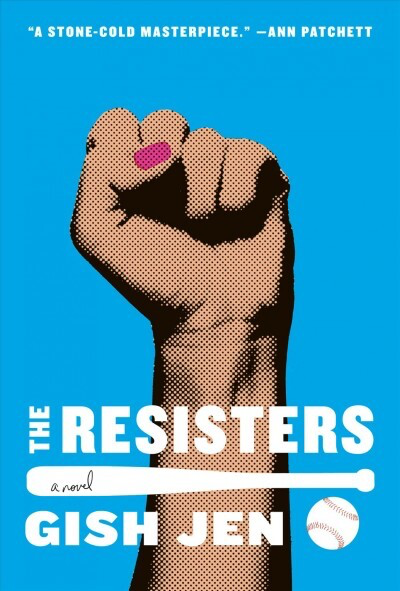
Posted in Sunday Songs

Sunday Songs: 11/12/23

Happy Sunday, bibliophiles! I hope this week has treated you well.

11/12/23: another satisfying date where the month and the day add up to the year. Glorious. Savor these days. And to soundtrack those days, why not listen to some nice, orange songs? (Half of which I stole from Wilco’s pre-show playlist, but that’s beside the point).

Enjoy this week’s songs!

SUNDAY SONGS: 11/12/23

“Saturday Come Slow” – Massive Attack

CONTENT WARNING FOR THE MUSIC VIDEO: most of the music video consists of an interview with a former Guantanamo Bay prisoner recounting the torture and inhumane conditions of the prison, so if this is triggering for you, proceed at your own discretion. That part of the video begins at 3:32.

I’m slowly (no pun intended) getting into Massive Attack, mostly thanks to my brother and my dad. This one is all thanks to my brother, who confessed to us while we were in line for Peter Gabriel last month that he had no idea until then who was singing on the track. His first thought was Gruff Rhys (makes sense), but apparently not—Damon Albarn does the lead vocals for this song.

That was all the convincing I needed to download it. You know me.

I’ve noticed a phenomenon in any later Damon Albarn project (of which there have been two this year) where there’s a point where it ceases to sound like Gorillaz or Blur, and just sounds like Damon Albarn. Gorillaz usually remedies some of this with its rotating cast of guest features, but on something like Blur’s newest album, The Ballad of Darren, there’s very little to distinguish it from his solo work. As I said in my initial thoughts on the album back in July, it’s still good music, but it lacks what makes Blur Blur, even though all the moving parts are present. But how does that flip when Damon Albarn is the feature instead of the one in charge of the features? “Saturday Come Slow” has an aura to it that could only be produced by the likes of Massive Attack; the slow build of it has an unmistakable air of foreboding, as if the Saturday coming slow is a shadow wiggling its too-long fingers over your shoulder. Fitting that Albarn croons about “the limestone caves/in the southwest lands,” imagery that calls to mind barren, sheer things towering over you. It’s a kind of eery creeping that meshes with the howling echo of his voice, but that you don’t quite get with Gorillaz or Blur; Gorillaz can get plenty spooky in a fun way, but they were never meant to be creepy—they’re a pop act at heart, and even though they’ve tread territory that pop hasn’t normally trod on for the 20+ years they’ve been active, it doesn’t have the foreboding build of this song. Blur, on the other hand, got plenty weird and unnerving in their experimental years (see: “Caramel,” “Trailerpark”), but their brand of unnerving came more from the claustrophobic atmosphere of off-kilter samples and synths that built up its cramped exoskeleton. The dread of “Saturday Come Slow” comes from how spacious it feels—like those limestone caves, that sense of foreboding comes from the primal sense of being surrounded by something larger than yourself—and being walled in by it, with only the echo of your voice to accompany you.

“Lucinda” – A Certain Ratio

This is the first of two songs this week that I stole from the playlist that played before Wilco’s phenomenal show at the Mission Ballroom back in October. An indicator of a really good show can be found in its playlist—if you keep going back and forth between you and everyone else who came along trying to Siri every song that comes on, then you know it’s gonna be a good show. Same thing happened with when I saw Spiritualized last year. That whole playlist was in heavy rotation for a solid month and a half afterwards. (Lesley Gore and Daniel Johnston: duality of man.)

The first thing that anybody has to notice about the song is the bass. That bass. Sweet Jesus, it’s so good. “Lucinda,” once the chorus kicks in, has not one but two basslines, all working in the thicket, most delicious tandem possible. Jez Kerr leads the charge with a sound that feels thick enough to cut with a butterknife—it propels the sound to new heights, taking what might have otherwise been a bare-bones, post-punk dance song to something hypnotically head-nodding. The bass might as well be the vocals—Martha Wilson’s tight vocals are soft and fleeting, but it’s Kerr’s bass that really takes center stage in “Lucinda.” It’s more than a head-nodder—it’s a whole-body-swayer, buttery and enigmatic enough to send waves through your whole system. Thanks, Wilco.

“Hold Em” – Maker

I’m not like other girls…I didn’t find out about this song through Abbott Elementary. I found out about it through my mom, who…found out about it through Abbott Elementary. It’s good stuff. The song and Abbott Elementary, from the laughter I’ve heard from the bedroom whenever she watches it.

Whatever the case, “Hold Em” was destined for theme music from the start. The beat and instrumentation has that kind of meticulous touch to it. Smooth really is the best word to describe it: the groove that persists through this song never wanes, but never feels the need to amp up the intensity. With the persistent but boxed-in drumbeat and the humbly soft bassline, it lulls you into an instant rhythm, but the kind of rhythm understated enough to allow for some freeze-frames and title screens as the opening credits roll through. And yet, it never feels understated: it’s bold. It feels like there’s constant pops of color bursting through your ears. It’s infectious. And that’s what would make it a great theme song: catchy enough to remember, but smooth enough to share the stage with a visual element.

“Move Your Feet” – Junior Senior

I have nothing to say for myself. It slaps. Just Dance 2 and its effects on society.

Look, the original spot for this slot was gonna be “The Day I Tried to Live,” but I figured we’d stave off that depression for a few weeks. I’m going to talk about it eventually (because it’s still a fantastic song), but it’s getting dark at 5pm and I still haven’t adjusted. We don’t need that energy right now. Move your feet. Feel united.

“Swing and Turn Jubilee” (cover) – The A’s

We’ll end on a softer note with the other song that I stole from Wilco, or, at any rate, whoever was behind their playlist. Drastically different than “Lucinda” (and most of this week’s songs), but nonetheless beautiful.

In the style of Kim Deal, The A’s are a side project of a side project; consisting of Amelia Meath and Alexandra Sauser-Monnig, the A’s came about after both of them took breaks from previous bands and solo careers—they both hail from North Carolina and had crossed paths in the music industry, and thus this project came to be. I haven’t listened to any of their work (save for…[checks notes] Sylvan Esso? That Sylvan Esso? The annoying Sirius XMU Sylvan Esso? Can’t be…) outside of this band, but the two of them together made for hauntingly beautiful harmonies. Watching them on their recent Tiny Desk Concert solidifies the image even more—they’re like charmingly unnerving cartoon characters, with their matching leaf-print dresses, black lipstick, and giant sunglasses. I wouldn’t be surprised if they eventually became those old ladies from Coraline in their latter years.

“Swing and Turn Jubilee” is part of their album Fruit, an album of almost all covers (save for the original song “When I Die”), ranging from cowboy and folk standards to Shelley Duvall (more on the latter in a few weeks, mark my words). Some of the other songs that they performed on Tiny Desk definitely get too into that yodel-ay-hee-hoo, Buster Scruggs a-capella vibe for me, but in any case, there’s no denying the magic that happens when their harmonies collide. “Swing and Turn,” even if I hadn’t first heard it from Wilco, would have been an instant stand-out, if a quiet one; their performance is just their voices, Sauser-Monnig on guitars, and Meath making percussion by tapping her thick-soled sneakers into a basket of stones. Doesn’t get much folkier than that. Most of these kinds of Appalachian folk songs that I hear from movies or from covers (so covered that the original songwriter is lost to time) are the kind that have a kind of desperate, underlying sorrow to them that permeates even the sweetest love song. Living in the bare bones of the U.S. just does that to a person, I guess. But there’s something about this take on “Swing and Turn” that turns the sorrow into tenderness. It doesn’t give me that icky, Dust Bowl malaise; to be fair, most iterations are faster and more upbeat than most other songs of its ilk, but the restrained, slow pace of The A’s take on it fooled me into thinking so. But it’s partly due t how plainly sweet the lyrics are: “Hardest work I’ve ever done/was working on a farm/Easiest work I’ve ever done/was falling into your arms.” The gentle honey of Meath and Sauser-Monnig’s soft harmonies seem to take me in their arms themselves, like I’m being rocked to sleep.

Either way, these kind of modern folk covers are just begging to be put somewhere in either Fargo (NEW SEASON IN A WEEK AND A HALF WHO’S HYPED) or the next Coen Brothers project. If your whole deal is melancholy covers of already melancholy and unnerving folk songs, you’re just asking for it, at that point.

Since this week consists entirely of songs, consider all of them to be today’s song.

That’s it for this week’s Sunday Songs! Have a wonderful rest of your day, and take care of yourselves!
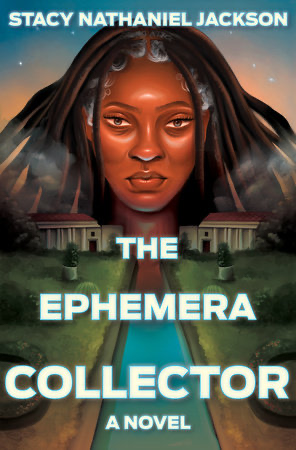
Posted in Sunday Songs

Sunday Songs: 8/13/23

Happy Sunday, bibliophiles! I hope this week has treated you well.
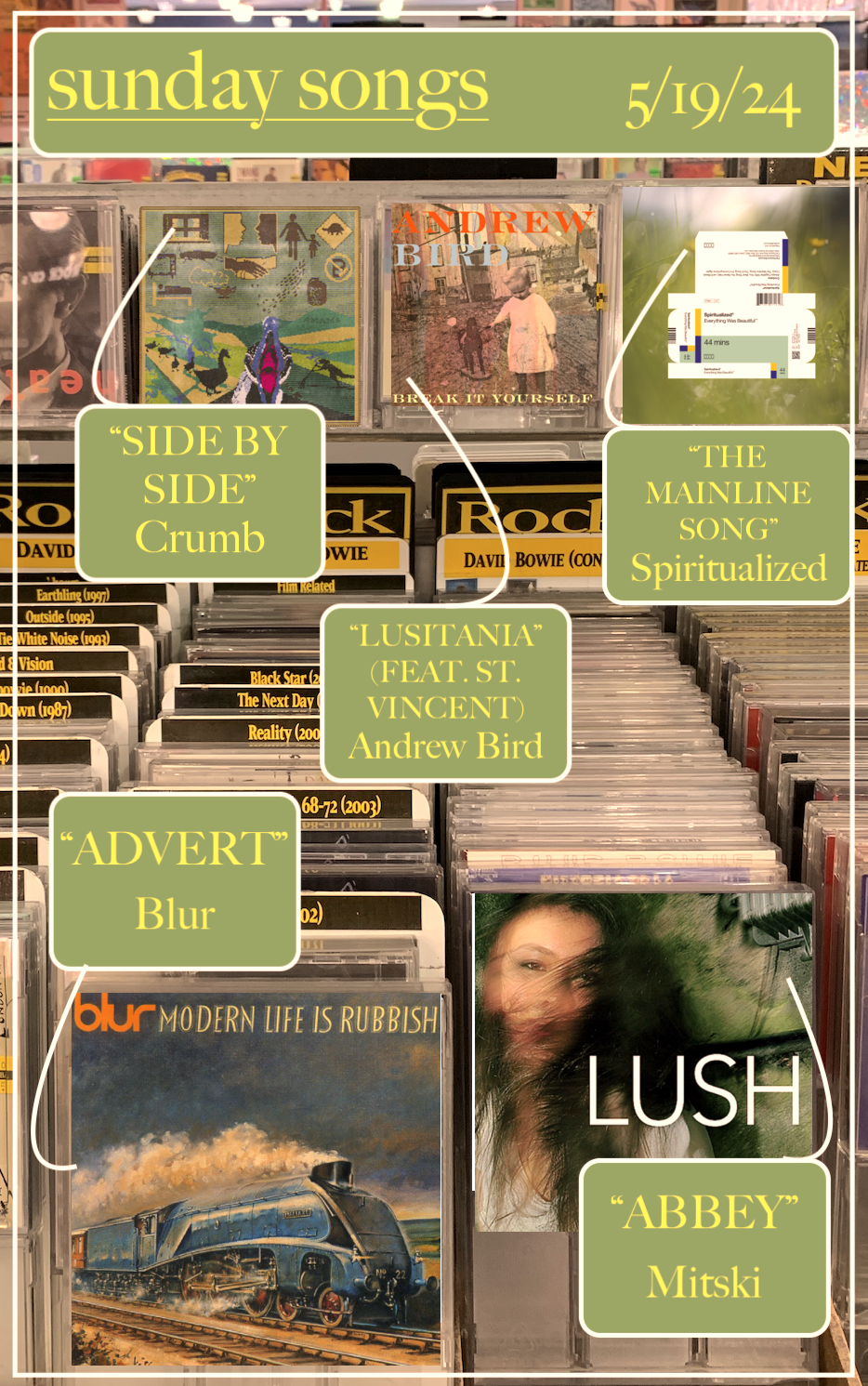
Since I’ve been making these Sunday Songs graphics for just over a year and writing about them for about half that time, I’ve noticed that there’s inevitably at least one light blue week per month. Different shades of blue, but there’s always at least one, and it’s always pale. Like this one. Or this one? Either way, here’s the court-ordered blue period for August. Bon appetit.

Enjoy this week’s songs!
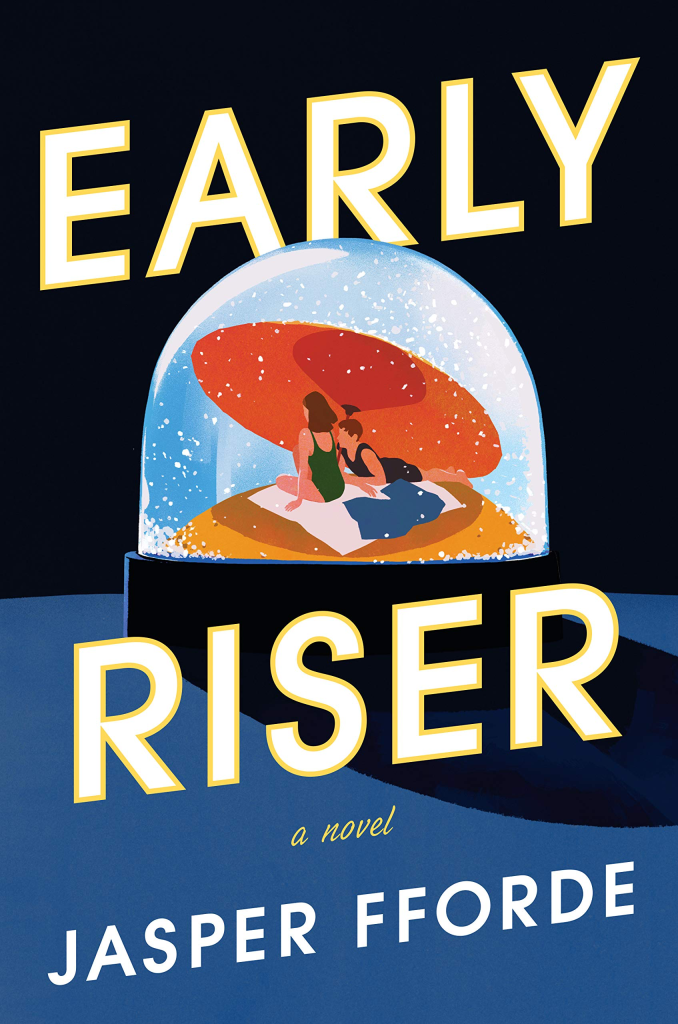
SUNDAY SONGS: 8/13/23

“1 Billion Dogs” – Jay Som

I listened to Everybody Works entirely on a whim, just to have something shorter to have as a soundtrack while I rearranged the bulletin board in my room. But I should’ve predicted that any given Jay Som record—much less this one—would be so much more than that. Perfect summer album, I have to say. Go listen to Everybody Works, guys.

Everybody Works is an album of many faces, from the chugging indie rock of “Take It” (which works way too perfectly with boygenius’ “Satanist“—can somebody with the ability to make mashups make this a reality?? please?? makes sense, seeing that she’s the bassist for boygenius’ touring band), the pop hooks of “The Bus Song” (BUT I LIKE THE BUS!), and the fever dream atmosphere of “(Bedhead).” But never once does it feel inconsistent or lacking cohesion—if I had to pick them from a crowd, all of these varied songs would still feel distinctly Jay Som. But amidst all of that, aside from the two tracks I already remembered from the album (“The Bus Song” and “Baybee”), “1 Billion Dogs” was an immediate standout. The title alone would have caught my eye on any other record, but strangely, even though it has nothing to do with dogs, much less billions of them, it has that feel to it. It fits. “1 Billion Dogs” is a song with an immediate urgency; even with Melina Duterte’s reserved voice almost melting into the instruments, it’s a song that grabs you by the shirt collar, then invites you to jump around and dance. But even the crashing rhythm guitars, steady bass, and just-so off-kilter riffs can’t take away from the electronic haze that never lifts from Duterte’s music. It’s a uniquely Jay Som flavor to me: dreamlike and fuzzy, like it’s cloaked in multicolored static.

“Evicted” – Wilco

September is shaping up to be a heavy hitter as far as albums go. I’ve already talked about tracks from Shakey Graves’ Movie of the Week and Mitski’s The Land is Inhospitable and So Are We, but I haven’t yet talked about the new Wilco, with their new album Cousin coming out on September 29! And only about a year and a half removed from their last double album, Cruel Country…Jeff Tweedy is just cranking ’em out, huh?
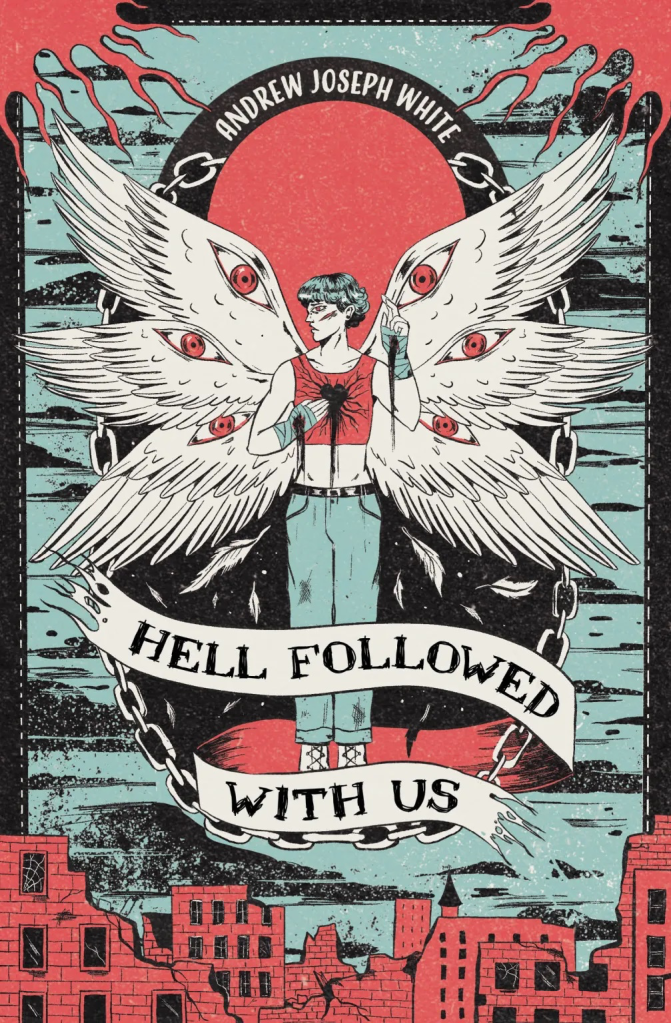
Tweedy and co. have advertised the upcoming Cousin as their art-pop/rock album. Wilco has always had a penchant for the experimental, but I feel like when they’ve previously advertised their albums as a certain genre, it doesn’t always fit the label. Take Cruel Country—”country” was literally in the name, but it felt like more of a folkier side of Wilco than anything, which, given their roots, wasn’t much of a stretch. Rather, as Tweedy said in his Starship Casual newsletter, “Cruel Country was our idea of country music and a lot of people went, ‘Huh?! this doesn’t sound like Colt Steed!’ (or some other plausible sounding country mega-star name).” So I’ll have to go into this album knowing that it’s Wilco’s idea of art-pop—and that’s certainly promising. And maybe I was screwing myself over when I saw “art rock” and immediately went into this song thinking it was gonna be “Art of Almost” 2. It isn’t. Even as much as I love Wilco, I feel like even that would be hard to reproduce. That’s not to say that “Evicted” is a bad song in any way—if there’s anything that Wilco has been in the last 10 years or so, it’s consistent. Regardless of our personal definitions of where this song fits into, “Evicted” is proof that Wilco’s ability to feel relevant and rock-solid will likely never fade. With its timeless guitars and the gently ethereal backing vocals and Nels Cline’s quietly glittering riffs rising like plumes of dust in the background, it’s a deceptively simple song—much like the Trojan Horse that Tweedy compared his definition of bubblegum pop to. And if I’ve learned anything from Cruel Country, it’s that I can’t judge an album by its first single. I’d be lying if I said that “Evicted” wasn’t an earworm. Jeff tweedy is true to his word.

Also, can I take Colt Steed as my new stage name?

“Crash” – Lisa Germano

EMERGENCY WEATHER REPORT: we regret to inform you that sad girl fall is scheduled to arrive two months earlier than expected. Hunker down, everybody.

A song that begins with the line “You could say I feel this way/’Cause it’s the way I feel” doesn’t seem terribly memorable at first glance. But that’s the thing. You have to wait. Not even that long of a wait, really. Because it’s followed up with “Or you could say I’m making it up/I want it to be real.” See? Have a little faith in Lisa Germano, in all of her raw, dilapidated-house-with-rusty-nails-lying-everywhere craft.

My introduction to Lisa Germano goes to show, once again, how deeply and wonderfully my dad knows me. Here I was, almost a year ago, when my dad made his annual birthday playlist for me (yep, that’s how cool of a dad he is), and played me “Victoria’s Secret” in the car; Immediately, I was lost in the eerie, spare-and-found-parts, and 90’s (in the best way…I really do love the 90’s) universe of Lisa Germano. (Guys. C’mon. “Victoria’s Secret” has her cat purring in the outro. It’s so good.) I listened to Slide in its entirety a few months later, during what we can actually call sadgirl fall (read: November), and bits and pieces of that record have constantly drifted around me ever since: specters, all of them, but welcome ones. Somehow, though, as much as I played tracks like “Way Below the Radio” and “Reptile,” I forgot about “Crash” until it came on shuffle not long ago. And now that I’ve listened to it more and more (you know it went STRAIGHT to the library playlist), I’m almost ashamed that I let it slip through my fingers, if only temporarily. On further listens, it’s so clear to me that it’s one of the best tracks off the whole album. “Crash” is a song that purposefully droops and lumbers, only faintly held together with fraying twine and half-intended promises. As Germano creates her oft-expressed lyrical landscape of languishing in depression and a lack of motivation (“Wonder why it’s so easy/to be the way I hate”), the instruments sit on the verge of falling apart; they all play in time, but they teeter enough to get the sense that it would only take one sneeze for them to collapse. Germano’s silk-thin voice is a gentle hand that barely caresses you, cool and ghostly, but undeniably present. And it wouldn’t be a Lisa Germano without an uneasy, 40-second piano outro. If there’s anything that she can do, it’s create an atmosphere. Slide was the perfect album to listen to in November, in retrospect; there’s something about this song (and most of her other songs that I’ve heard) that capture the melancholy limbo of that snowless but undeniably wintry chill.

“The Rabbi” – Blur

I’ve been conned. Again. And Damon Albarn is to blame. Twice this year, we’ve gotten albums from projects of his where the album as a whole has been disappointing, but then he comes back with the deluxe edition, and at least one song that would’ve made the original album SO MUCH better. Damon, you sly dog, you pulled a “Captain Chicken” on us AGAIN. (For reference: the other disappointing album happens to be Gorillaz’s Cracker Island.)

I wouldn’t call “The Rabbi” as good as “Captain Chicken,” but then again, it’s hard to replicate the chokehold that the latter had on me for at least 2 months after it came out. But amidst the decent but disappointingly flat expanse that was The Ballad of Darren, this new addition was a breath of fresh air and energy. Equipped with the jangly brightness that Blur has been the master of for 30+ years now, “The Rabbi” is an upbeat spark, and a welcome injection into the album. Graham Coxon’s guitar finally gets its time to shine outside of “St. Charles Square,” but where that recalled the grungy, disillusioned punch of their self-titled record, these joyful riffs feel more youthful, calling back to Parklife and even further back. Like “Barbaric,” the instrumentation of “The Rabbi” is nothing short of upbeat, but cleverly cloaks the underlying disillusionment and melancholy that permeates through the rest of The Ballad of Darren; as Coxon goes off with said jangly guitars, Damon Albarn drawls about how “‘Cause where’s the joy in this self-delusion?/We’re all practitioners of vague illusions/Hieroglyphics and pictures.” Even if I’ve come away from The Ballad slightly sore, at least I have one more song that I can actually nod my head along to and believe that it’s Blur. I refuse to shut up about “St. Charles Square,” though.

“Monkey” (Low cover) – Robert Plant

A reenactment:

The family car. Some time in the early evening. MADELINE and her family are driving on the highway. Robert Plant’s cover of “Monkey” plays over the speakers.

MADELINE: Huh, this song sounds like it could be in Legion.

EITHER MY DAD OR MY BROTHER (I FORGET): That’s because it was in Legion.

The realization hits MADELINE. Cue vine boom.

~

There have been many such moments in my life. But for all the ones that my brain decides to loop in the odd hours of the morning, at least I got a song out of this one.

Unlike my brother, the world’s biggest Legion fan in the world, I haven’t gone back and rewatched any of it since it came out. I’d rank it as my second favorite TV show, right behind Fargo, but I haven’t gone back to any of it in years, save for the fantastic Superorganism musical number in season 3. I don’t think it would ever be ruined by further rewatches (simply impossible for any Noah Hawley project, the man can do no wrong…okay, Anthem was a lot, but other than that), but it’s been like a beautiful, terrifying insect trapped in amber in my mind—it’s hard to replicate that feeling of sheer confusion, horror, and wonder when I had no idea what was going on with that show. But even with the mounting pile of shows and seasons that I need to catch up on, this song reminds me of Noah Hawley’s unmatched craft—and his unmatched music taste, along with the keen eye of Maggie Phillips, the show’s music supervisor. I can’t find the clip anywhere on the internet for the life of me, but this song is slipped into a chilling scene in season 1, episode 3, where a young David Haller chases after his wayward dog on Halloween night. It’s a scene that stressed me out, even if only for a few minutes’ rewatch—Cary did tell present David to “think of something stressful,” after all. And I can’t think of a better song to illustrate that pit-stomached sense of creeping dread than this. Low’s original version has that feeling of dread, but with an unmistakable urgency; Robert Plant’s version (and yes, it is that Robert Plant) swaps that urgency for a grinding, chugging sound that watches you from the darkest corner of the room. “It’s a suicide/Shut up and drive” would have been a blatantly chilling lyric in any other circumstance, but Plant’s strained, hollow whisper makes the chill up my spine all the more chilly. Patty Griffin’s backing vocals, somehow more audible than Plant’s, seem strangely sinister, even with the lightness of her voice. I can’t help but get a little anxious every time I listen to it—all the more reason that Hawley and Phillips were really onto something when they picked this one.

Since this post consists entirely of songs, consider all of them to be today’s song.

That’s it for this week’s Sunday Songs! Have a wonderful rest of your day, and take care of yourselves!