Posted in Book Review Tuesday

Book Review Tuesday (12/16/25) – Katabasis

Happy Tuesday, bibliophiles!

I’ve been a fan of R.F. Kuang’s work for years (though I’ve steered away from the Poppy War trilogy, given how many people I know have been emotionally eviscerated in its wake). As bored as I am with dark academia, if there’s anybody I trust with the genre, it’s Kuang—and for the most part, her latest venture into the bowels of academia (and Hell itself) was an adventurous success!

Enjoy this week’s review!
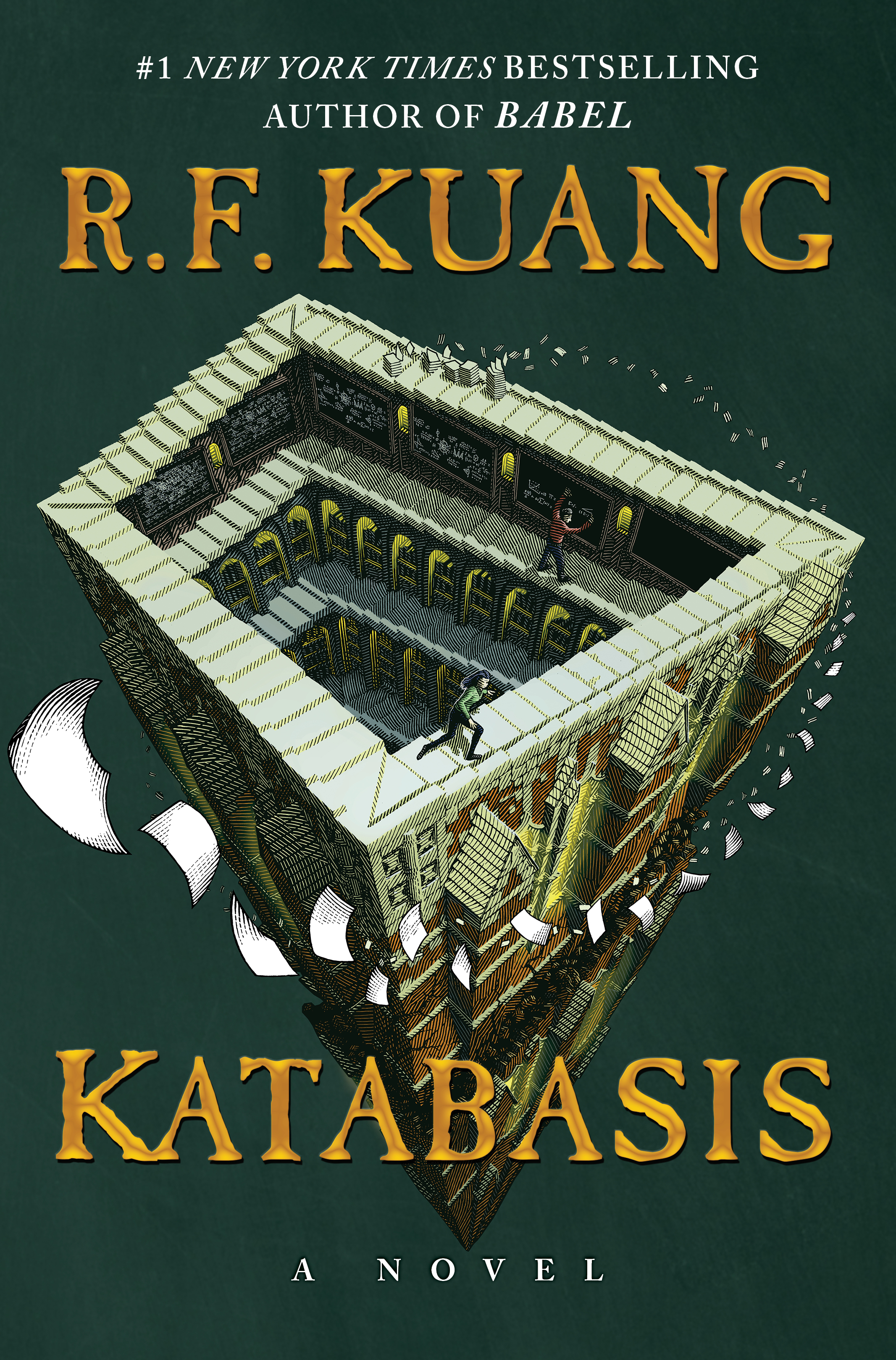
Katabasis – R.F. Kuang

Professor Grimes is going to Hell, and it’s all Alice Law’s fault.

After a backfired spell sends their advisor to an early grave, two rival Cambridge grad students find a way to enter Hell to bring back Professor Grimes. Braving all manner of demonic horrors beyond their wildest nightmares, Alice Law and Peter Murdoch have agreed to risk it all for their beloved professor. Yet the further they travel through Hell, they must come to grips with the man Professor Grimes was—and if the man they idolized was really worth going to Hell for.

TW/CW: violence, gore, loss of loved ones, sexual assault/harassment, suicidal ideation/suicide, ableism

There’s really nobody doing it like R.F. Kuang. She isn’t my favorite author of all time, but nonetheless, I don’t think I’ll ever find another fantasy book that has both spooky scary skeletons sending shivers up my spine AND a well-placed dig at Jacques Derrida. That’s how it’s done.

Right after it was released, Katabasis seems to have made a major splash in the book community (namely BookTok)—partly because Kuang’s next novel was bound to be highly anticipated, but partly because it sparked some debate about anti-intellectualism. But compared to something like Babel, which is practically footnotes upon footnotes, I feel like this…isn’t that bad? Sure, it’s very esoteric, but most everything is so easily searchable online? Or in the library? Granted, I understood a fair amount of this solely because I took a literary theory course for my English degree, but even then…just google what you don’t know! And maybe you’ll learn something fun! I don’t know how one would go into an R.F. Kuang book and not expect something academically-minded, but maybe this is just the people who were only used to the strictly realistic fiction of Yellowface? Who knows.

Either way, the academic aspect of Katabasis was such a fun element for me. Whether or not that’s because I’m so hopelessly English-majoring it out here, but I loved all of the subtle nods to world mythologies and literature. (The bit about postmodern and poststructuralist magic cracked me UP. Poststructuralism slander healed my soul. Thanks, literary theory.) But ultimately, I loved what Kuang said about academia; there’s the satirical part that it can be Hell, but also that it demands an inhumanity of you that is systemically supported and produces such spectacular burnout. Being the genius that people like Grimes wanted required students like Alice and Peter to relinquish their humanity in pursuit of knowledge and prestige, and that’s something that you shouldn’t have to sacrifice to get what you want. Given Kuang’s accolades and track record, I’m sure she’s experienced this firsthand, but it was a potent statement on the pressure that’s put on students, especially in the Ivy Leagues and other prestigious institutions, magical or not.

Katabasis had a wild version of Hell, and so much of the fun of the book was exploring it. Granted, it is rather all over the place, but I feel like it emphasizes Kuang’s initial rule of Hell: there are no rules in Hell. There’s the parts that are just Cambridge but in Hell, carnivorous hordes of Tim Burton-esque skeletons, deities from all kinds of mythologies, and one very lucky cat. (Shoutout to Archimedes, I’m glad he survived!) Entire sections of Hell are made out of M.C. Escher’s structures, there’s impossible shapes everywhere, and all of it serves to make Alice and Peter get as close to snapping as possible—exactly what you’d expect from Hell. Tonally, it was also kind of all over the place; some of it was genuinely horrific, while other parts bordered on Beetlejuice-esque camp. But all of these disparate elements made sense as a sort of archive of all possible Hells; it’s a very academic Hell, but beyond that, it seems like an exercise in writing that Kuang had tons of fun writing. That passion poured off every page!

Alice and Peter’s relationship formed the core of the novel, and I loved following them as characters. They made such an odd couple of rivals to friends to…something more, I’d imagine, and their personalities bounced so well off of each other. The perspectives that both of them brought to Kuang’s satire of academia—Alice’s struggles as a woman of color and Peter’s as a chronically ill person—really hammered the commentary home. My main criticism of Katabasis has to do with the 75% mark (more on that later), but I feel like part of why it felt so off-balance for me was that Peter wasn’t there. Alice was a compelling character on her own, but Katabasis leaned so much on their shared dynamic, the scholarly banter they bounced off of each other and the warring struggles that eventually coalesced as they realized their dual mistake in idolizing Grimes. They had such effortless chemistry both as rivals and friends, making them easy to root for.

Of course, when you’ve created a Hell this dizzyingly intricate and complex, you’re bound to get lost. Alice and Peter did, and so did Kuang herself. There’s a point at the 75% mark where the plot, along with the characters, gets hopelessly lost. By this point, we’ve moved on past “we’re here to get Grimes,” but it seems like none of the detours served the novel in any way. The real kicker is that this part of Hell isn’t even that new or interesting—it’s even more academic commentary, which, while I liked it at first, was just repetitive and regurgitated the same satire about academia that Kuang had already talked about in the first third of the book. I’m all for taking detours to explore an unknown realm, but this one didn’t even feel new at all. My edition of Katabasis is around 540 pages, mind you, so it’s not like cutting too much of this would’ve made it too short. I feel like not every little thing about a novel directly needs to serve the plot, but I feel like it should at least develop the characters or show us something new, and this part of Katabasis did none of those things. Thank goodness we were whisked out of Hell soon after that.

All in all, an inventive and satirical journey into the depths of Hell—which, as it turns out, looks an awful lot like Cambridge. 4 stars!

Katabasis is a standalone, but R.F. Kuang is the author of several other fantasy and fiction novels, including Yellowface, Babel, and the Poppy War trilogy (The Poppy War, The Dragon Republic, and The Burning God).

Today’s song:

I just need everybody to know that this cover exists. That’s it.

That’s it for this week’s Book Review Tuesday! Have a wonderful rest of your day, and take care of yourselves!

Posted in Book Review Tuesday

Book Review Tuesday (7/11/23) – The Whispering Dark

Happy Tuesday, bibliophiles!

I’m willing to go out of my genre comfort zone when it comes to finding books with good disability rep, and that was the case for this book; dark academia usually puts me off (see my review of Victoria Lee’s A Lesson in Vengeance for the gist of my gripes about it), but I’m always here for books by disabled authors! In this case, it was worth it, but the experience wasn’t the one that I think the author intended—The Whispering Dark was a mess, but in kind of a fun way. For the most part.

Enjoy this week’s review!

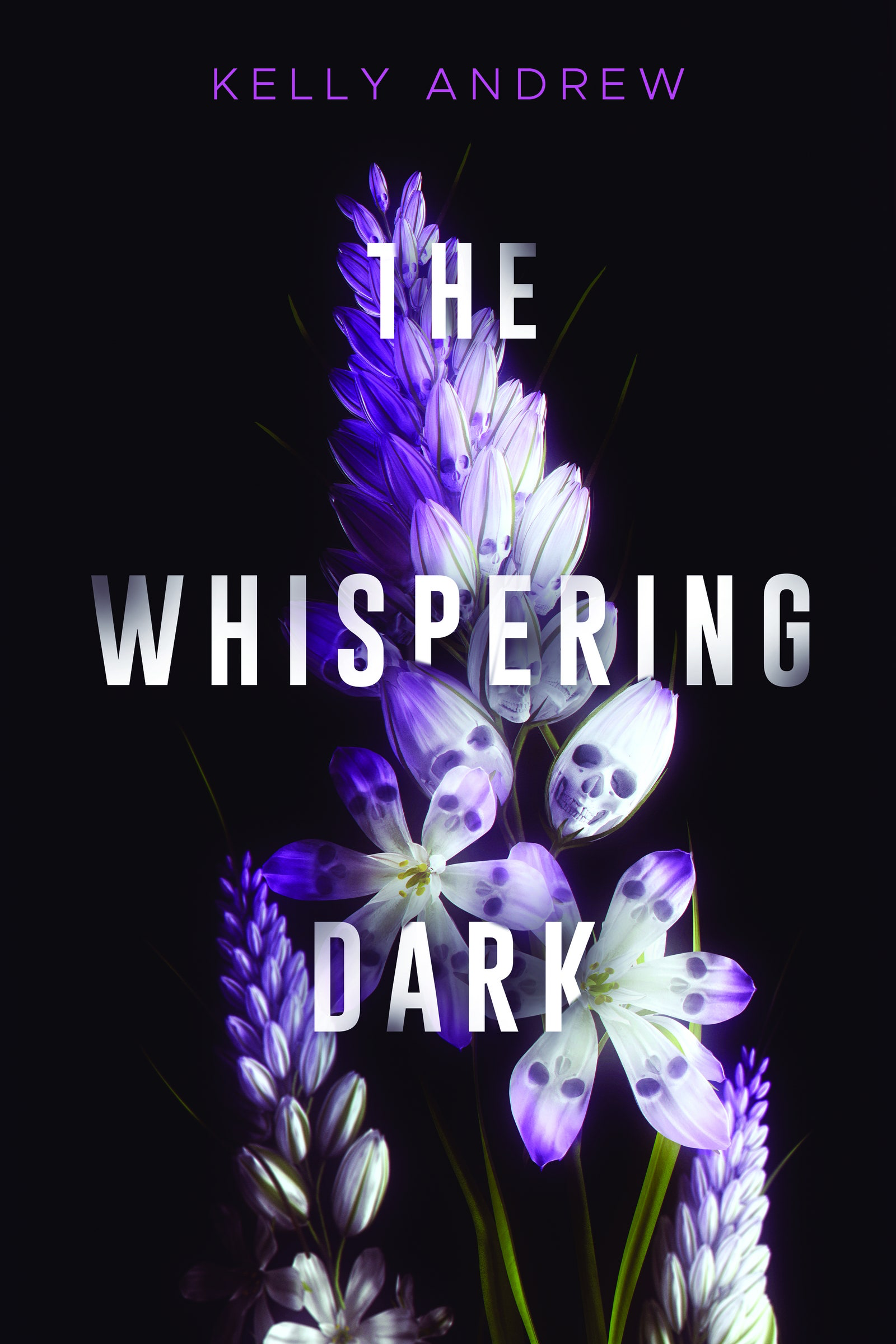
this cover is so goofy to me for no reason 💀

The Whispering Dark – Kelly Andrew

Delaney Meyers-Petrov is determined to prove herself. All of her life, people have perceived her as fragile because of her Deafness, but when she’s accepted into the famed, rigorous Godbole University, she knows that this is the ultimate chance to show the world what she’s really made of. But Godbole isn’t an ordinary college—its students are trained to jump between parallel worlds, tapping into arcane magic in order to travel through alternate dimensions. As Delaney faces ableism from her peers and professors, a boy from her past, and the pressure to get good grades, the sinister side of Godbole begins to show its face. For months, boys have been going missing, and the answer to their disappearance may be right in front of her. Will she be able to get to the bottom of what’s killing Godbole’s student body—and work with this mysterious boy?

TW/CW: ableism, murder, blood, gore, past descriptions of death, near-death experiences

Look, you slip the phrase “unholy affliction” into a sentence, and you’ll automatically make me think of Soccer Mommy. And the more I think about it, the more it feels like the vibe of that song is what this book really, desperately wanted to be, but…wasn’t. At all.

Normally, I steer clear of dark academia—the really bad stuff just feels like a bunch of Donna Tartt copycats writing about rich people being “morally gray” (read: smoking indoors, wearing turtlenecks and forming vague “secret societies”) and trying to capitalize off of a popular aesthetic. However, the fact that this one featured a disabled character written by a disabled author (!!!), convinced me to give The Whispering Dark a chance. Here’s the thing: the disability rep? It’s fantastic. Everything else? Not so much. The Whispering Dark was an absolute mess, but it got to the point where its utter ridiculousness was honestly kind of fun to read, so it wasn’t entirely a waste of time.

Let’s start off with the disability rep. Although I can’t speak to the accuracy of the specific rep (Delaney, the MC, is Deaf), it’s so refreshing to see disabled authors writing disabled characters—Kelly Andrew is also Deaf! And even without being Deaf, Andrew wrote some of the specificities of Delaney’s experience with her disability beautifully; I loved the details about how Delaney moved through life, from how the noises around her are described to subtle details like the change in sound when the battery runs out in her cochlear implant. Along with that, Andrew’s portrayal of being a disabled college student really resonated with me, from the nerves about personally confronting professors about accommodations to Delaney’s desire to prove herself.

Aside from that, it’s hard for me to find anything genuinely positive to say about The Whispering Dark. There are more positives in my eyes, to be fair, but they aren’t necessarily about how I think this novel was meant to be taken. In my experience, this book was SUPER campy, but the kind of campy that unintentionally resulted from taking itself so seriously that it becomes almost hilarious. I still can’t believe that all of this was played so straight—this book fell headfirst into every cheesy YA fantasy trope like a 5-year-old being pushed off of a diving board, and we were somehow expected to take it all seriously. You’ve got your edgy protagonist with her dyed hair and her edgy nickname, a mysterious, Ivy League school that teaches its students to jump between parallel worlds, students showing up dead, and a romance with a mysterious, dangerous older boy, who is compared by the MC to Patrick Bateman (I wish I was kidding), but still ends up being the one for whom the MC falls head-over-heels in love with. The way Andrew wrote it felt like she thought it was the most original idea in YA in the last decade, and honestly? I had to laugh. It felt like watching a terrible movie for the irony. Solid unintentional camp. I mean, look at how goofy that cover is.

And look—as campy as The Whispering Dark was, I at least expected there to be a little bit of worldbuilding. Here’s the thing: THERE WAS NONE. Interested in learning about Godbole University and how you can jump through parallel worlds with magic, according to Kelly Andrew? You’re outta luck. There aren’t any explanations for anything—you just get tossed around to parallel worlds without any explanation as to how. Want to know how the various types of magic factor into this world-hopping? Sorry, come back later. Want to know how the villain is using said world-hopping to kill unsuspecting students? Nope, looks like you’ve used up your three wishes. Again, it got to the point where it just felt so bad that it was funny—worldbuilding? Who is she? And it only proves my belief that dark academia, as a genre, suffers from “no plot, only vibes” syndrome time and time again.

All in all, a novel with great disability rep, but that took itself far too seriously for the campy train wreck that it was. We disabled readers deserve our mindless camp too. 3 stars.

The Whispering Dark is a standalone, and Kelly Andrew’s debut novel; her next novel, Your Blood, My Bones, is slated for release in 2024.

Today’s song:

That’s it for this week’s Book Review Tuesday! Have a wonderful rest of your day, and take care of yourselves!
Posted in Uncategorized

🏳️‍⚧️ LGBTQ+ Historical Icons Book Tag 🏳️‍🌈

Happy Wednesday, bibliophiles!

I’ve had a few pride-related book tags that I’ve been waiting to do since last June, so I figured I’d break this one out right about now. I found this one over at The Corner of Laura, who also created the tag.

Rules

  • Link back to the original creator (The Corner of Laura) and link back to this page (otherwise, the original creator won’t get a notification).
  • Thank whoever tagged you and link back to their post
  • (Optional) Use the graphics and don’t forget to credit the original creator (Text prompts are at the end of the tag if you’d prefer to use those)
  • (Optional) Tag 5 or more other people.

Let’s begin, shall we?

🏳️‍🌈THE LGBTQ+ HISTORICAL ICONS BOOK TAG🏳️‍⚧️

SAPPHO: Greek poet known for her lyric poetry which is believed to describe homoerotic feeling | A book of poetry (or written in verse)

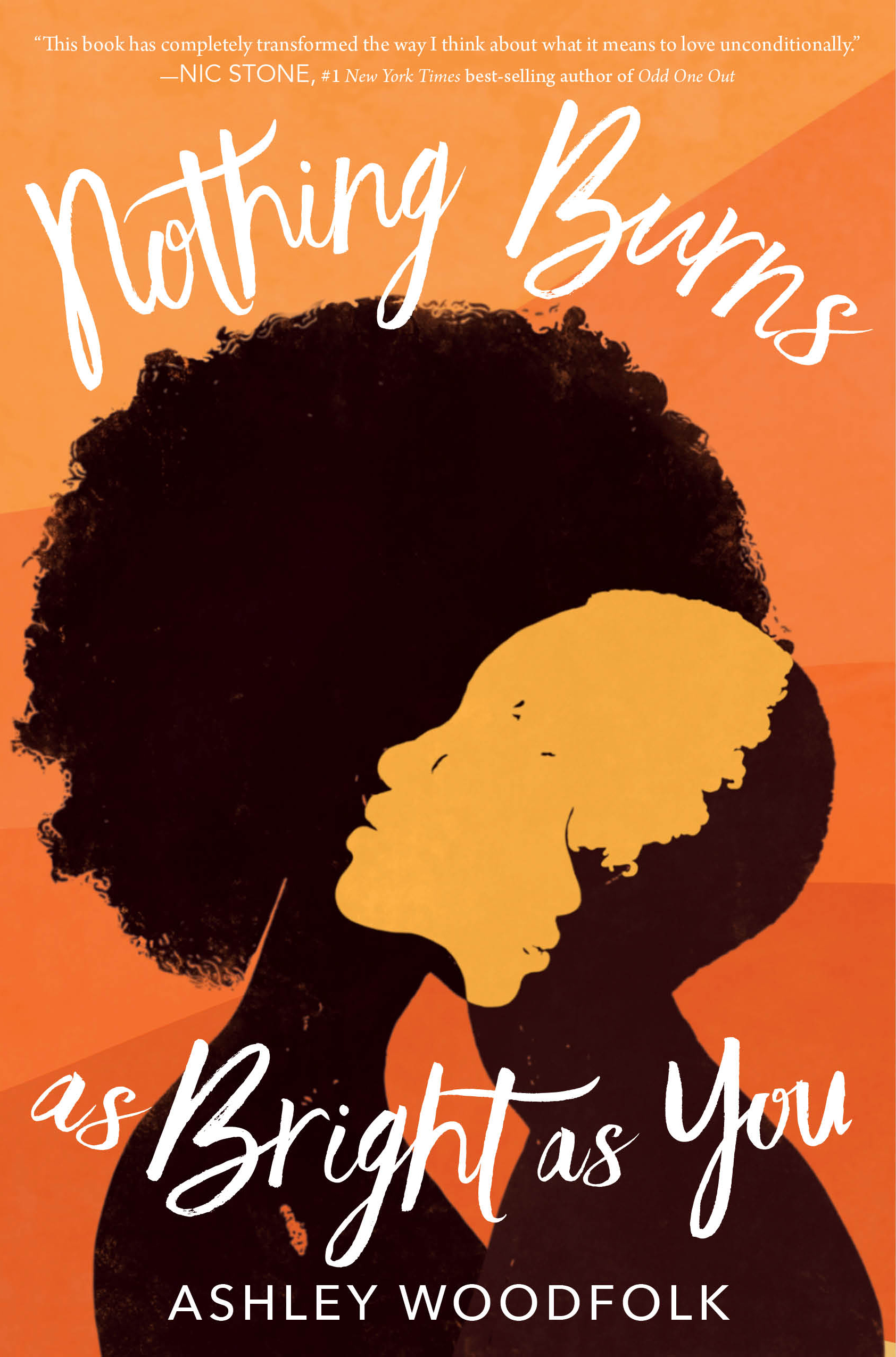
Nothing Burns as Bright as You is a beautiful novel in verse about the complicated relationship shared by two Black queer girls.

ALAN TURING: Mathematician known for cracking the Enigma code but who was persecuted for his homosexuality | A character who deserved better

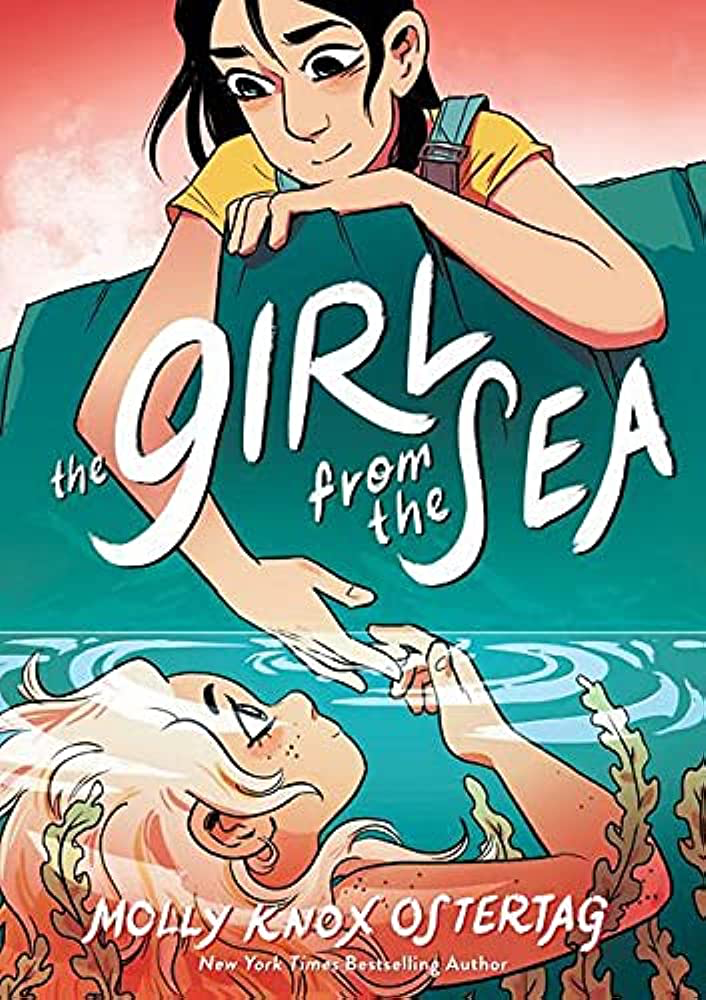
As sweet as The Girl from the Sea was, I found myself getting so stressed out about how Morgan treated Keltie in the beginning. She just kept pushing her around and neglecting her, and while it did resolve itself neatly and they fell in love, I still felt so bad for Keltie. She’s just an adorable creature, dude, she doesn’t need all that human baggage…

GILBERT BAKER: Creator of the rainbow Pride Flag | The most colorful book you own

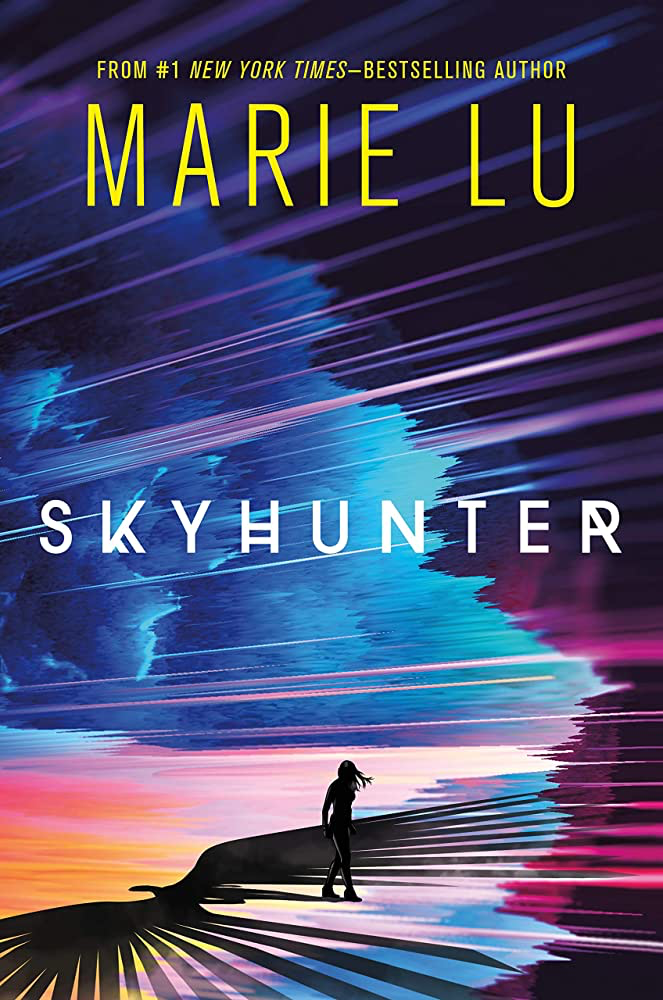
Skyhunter has one of my favorite book covers in my collection—it dazzles me every single time I look at it!

ANNE LISTER: Landowner, industrialist and considered to be the first modern lesbian | A book written as a diary (or includes diary entries)

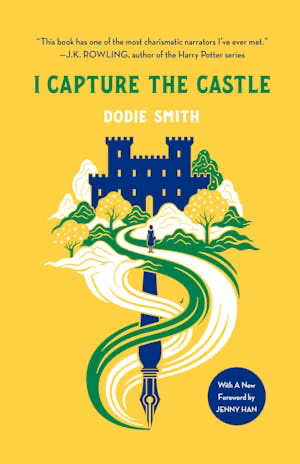
I have fond memories of reading the copy of I Capture the Castle that my mom bought for me while I was out sick years ago, and re-reading it several times since. It’s seriously the sweetest, most charming book—a big thank you to my mom for turning me on to this one.

MARSHA P. JOHNSON: Prominent figure in the Stonewall Uprising and founder of several LGBTQ rights organisations | A character you’d would want fighting at your side

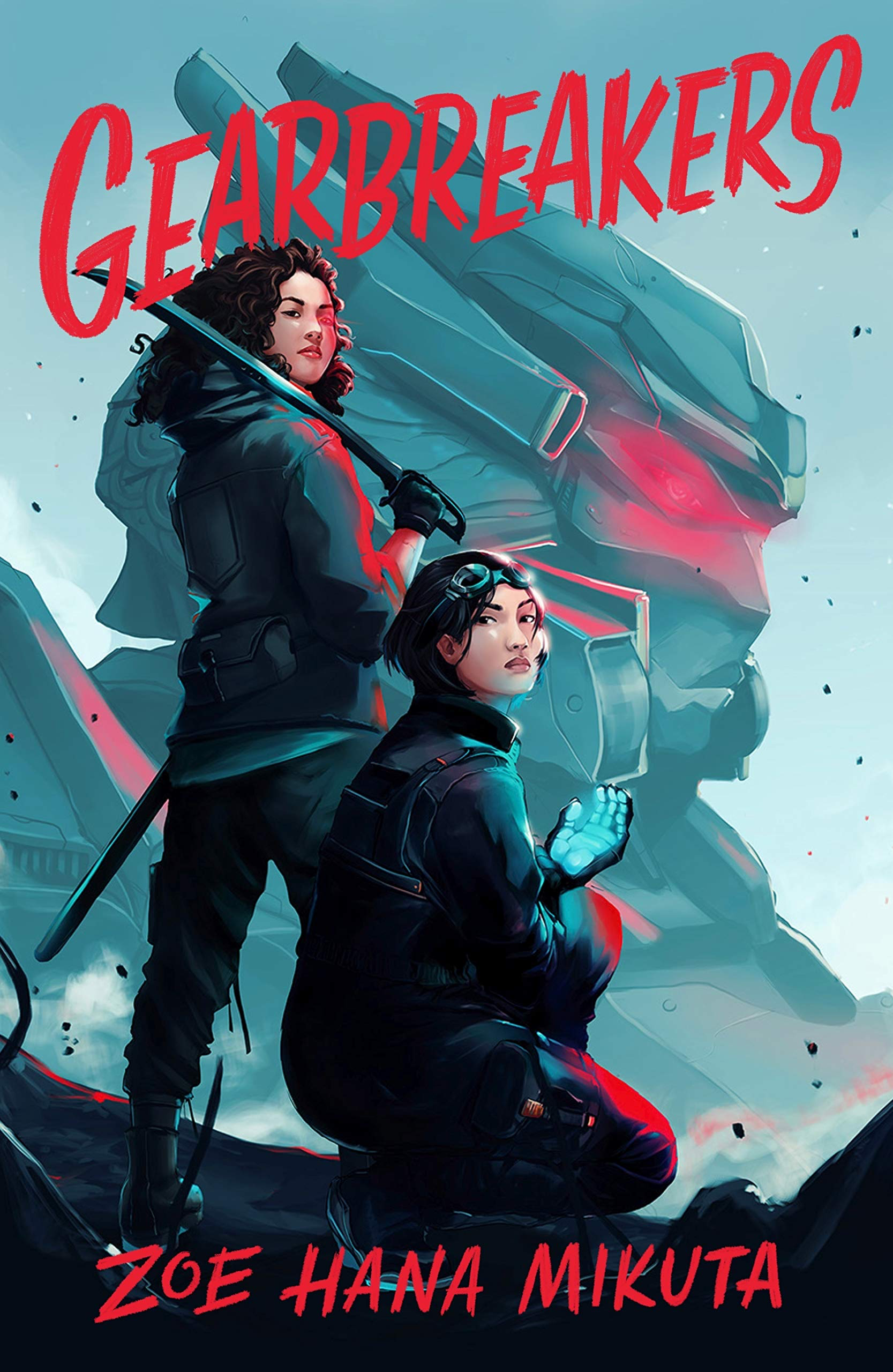
Sona and Eris from Gearbreakers are both formidable in their own ways—either one (or both) would be an easy pick to have fight at my side.

ALFRED KINSEY: Creator of the Kinsey scale | A book set in academia

I haven’t read a whole lot of books sets in academia (and I’ve never gotten the hype for dark academia, so I tend to steer clear of those), but Leigh Bardugo never misses, so obviously this prompt has to go to Ninth House.

LUCY HICKS ANDERSON: First trans woman to defend her identity in court | A book where a major scene takes place in court

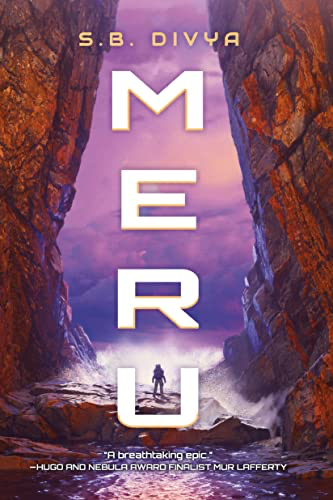
It was so hard to think of any books besides To Kill a Mockingbird (Laura’s answer) with a courtroom scene, but I read Meru not long ago, and it has a particularly climactic and poignant courtroom scene—a futuristic one, but a courtroom scene all the same.

OPEN PROMPT: Your choice | A book that inspires you

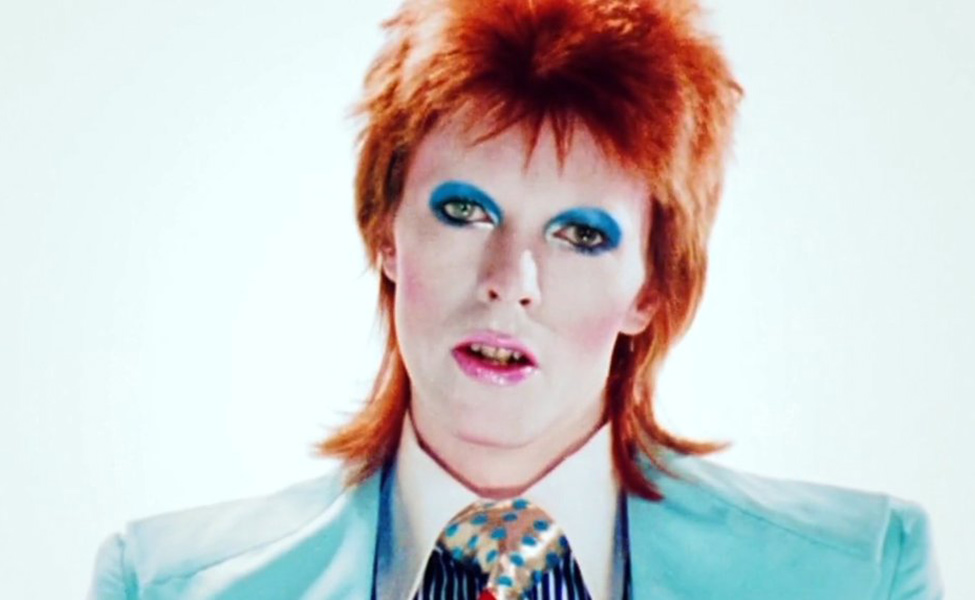
Of course, I’m going with David Bowie as my LGBTQ+ historical icon of choice—who else? He’s been a hero of mine for years, and a hero to so many. Even in the 60’s, before he rose to stardom, he was already breaking down barriers, and continued to do so in all aspects of his career thereafter. Calling somebody “ahead of their time” is thrown around quite often, but I really think that the world wasn’t ready—and wouldn’t be ready for today—for Ziggy Stardust. And personally, I can’t think of a better beacon of hope to me than him; I started getting into his music at a time when I was struggling to find my place and looking for a light at the end of the alternative weirdo tunnel. And here was Bowie, wearing dresses in the 70’s, openly declaring his bisexuality, and creating a cosmic persona that touched the hearts of so many people. I’ve certainly felt like an alien all my life, but he, if anyone, is to credit for teaching me to embrace that feeling—to quote him, “oh no, love! You’re not alone.” From one bisexual alien to another: thank you.

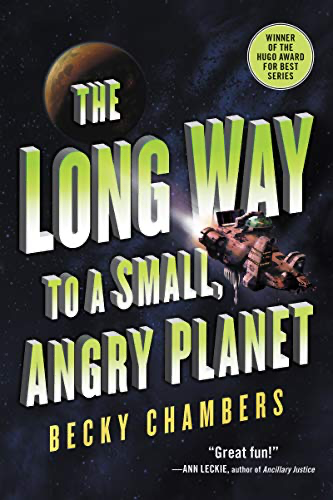
As for a book that inspires me, I’d easily give that title to Becky Chambers’ Wayfarers series. Sci-fi always seems defined by cosmic stakes and harrowing violence, and while that can work in moderation, these books really cemented the idea that a narrative doesn’t have to be centered around struggle or suffering to be worth reading—and writing. Here, Chambers has created a vast, creative space opera universe with complex political background noise and dozens of strange creatures, but they’re not embroiled in some lofty, intergalactic conflict: they’re just going about their lives. It’s something that almost no other piece of sci-fi media has ever done—it’s very common in realistic fiction, but the concept that happiness and healing as genuine plot points can exist alongside aliens and starships just blew my mind. I aspire to write at least one thing as comforting and cozy as Becky Chambers someday.

And remember, kids: grimdark is just as unrealistic as sunshine, lollipops and rainbows, because they represent opposite ends of the same literary spectrum. Making a book excessively dark and gritty doesn’t automatically make it deep, and giving a character an excess of trauma and a tragic backstory doesn’t automatically make them fleshed-out and well-written.

I tag:

Today’s song:

we love a good guitar freakout

That’s it for this book tag! Have a wonderful rest of your day, and take care of yourselves!
Posted in Book Review Tuesday

Book Review Tuesday (6/21/22) – A Lesson in Vengeance

Happy Tuesday, bibliophiles!

I really didn’t have much attachment to this book; I think I just put it on my TBR because I’d like Victoria Lee’s previous book, The Fever King, a decent amount, and I’d heard there was queer rep in it. I ended up fishing it out of my TBR to find specifically queer books for pride month, and it was available at my local library, so why not? To my dismay, A Lesson in Vengeance was one of the most frustrating books I’d read in a long time—it’s been a while since I’ve been this angry at a book.

Enjoy this week’s review!

A Lesson in Vengeance – Victoria Lee

Felicity Morrow carries a great burden: she may have been responsible for the untimely death of her girlfriend, Alex. After that fateful day, she took a semester off from the Dalloway School, a legendary—and perhaps haunted—boarding school deep in the mountains. But when she returns, a fascinating girl named Ellis has arrived, a teen author prodigy who came to the school to research for her next novel. Felicity and Ellis become entrenched in the history of occult and witchcraft tied to the Dalloway School, but the path they go down is one that could lead to death—or worse.

TW/CW: murder, gore, animal death, loss of loved ones, mental health issues (depression), grief, toxic relationships, descriptions of murder (hanging, burying alive, etc.)

I don’t think a book has made me this angry in ages. I should’ve DNF’d it, but I almost just finished it out of spite. I recognize that there’s so much work that goes into writing a book and putting it out into the world, so take this review as you will, but god. I have an absolute laundry list of gripes with this book, I’m sad to say.

A Lesson in Vengeance pretty clearly took inspiration from The Secret History, a book that I didn’t expect to enjoy as much as I did. But there’s a key aspect of The Secret History that A Lesson in Vengeance astronomically missed the mark on that could’ve made or broke it: it’s established early on that it’s a cautionary tale, and that these characters are either already horribly toxic people or that the book is their corruption arc. A Lesson in Vengeance misses that by miles, and these deeply flawed characters are romanticized. I’m not saying that I need “UNRELIABLE TOXIC NARRATOR” in skywriting, but the way that Lee romanticized Felicity deliberately going off her meds and dismissing her well-meaning therapists disgusted me. I’m all for “messy” queer characters, but this goes FAR beyond just “messy”—these are just straight-up horrible people, and it seemed like Lee didn’t recognize this or handle it properly.

Let’s talk more about the characters. Lee’s writing style is what earned the half-star from me, but their prose had a fatal flaw when it came to the characters; most of them are meant to be dangerous and alluring, but what was written as “mysterious writer girl with unorthodox methods” was more than anything just another toxic rich person added to the mix. All of the characters were clearly backstabbing, flawed people who solved their problems with drugs and alcohol, but again—it was all romanticized as part of the “dark academia aesthetic.” I’M SORRY, WHAT? How is rich people smoking indoors an “aesthetic?” More importantly, how is DELIBERATELY GOING OFF YOUR MEDS AN “AESTHETIC?” I’ve never been the biggest fan of dark academia, but I can’t deny that when it’s done well, it’s chilling; this, however, was just a mess of a book built off of an aesthetic that failed to realize its fatal shortcomings. I’m sorry, I don’t want to read about rich people smoking indoors for 370-odd pages.

Additionally, there wasn’t much keeping the plot together. I went in thinking that there would be a murder mystery hidden somewhere, along with witches, the occult, and a budding sapphic relationship. However, the book ended up being 60% rich people smoking and drinking themselves silly (uninteresting from the start) with a weak witchcraft sideplot that was sidelined for most of the book and was never really resolved. All of the diversity that this book promised, though well-intentioned, felt more like a checklist: Black character? Check. South-Asian character? Check. And the sapphic relationship that I was hinging on just ended up being a toxic mess of manipulation without any self-awareness of its nature: again, it was framed as an “alluring, mysterious” kind of thing, when in reality, it was just…borderline abusive and devoid of any emotional intelligence whatsoever.

All in all, a premise that had the potential to be mildly interesting, but did nothing more than romanticize its toxic characters and lend itself to a story centered more around a flimsy aesthetic than a plot. 1.5 angry little stars.

A Lesson in Vengeance is a standalone, but Victoria Lee is also the author of the Feverwake series (The Fever King and The Electric Heir, as well as the novellas The Traitor’s Crown and The Stars and Everything in Between) and the forthcoming The Girl That Time Forgot.

Today’s song:

That’s it for this week’s book review Tuesday! Have a wonderful rest of your day, and take care of yourselves!