Posted in Sunday Songs

Sunday Songs: 1/21/24

Happy Sunday, bibliophiles! I hope this week has treated you well.

The fact that all of January’s color schemes have been somewhat dreary is a complete coincidence, but it fits with all the dead foliage, snow, and misery outside. One of the suckiest months, without a doubt. But this week is more fun, at least: throwbacks of all kinds, British Invasion remnants, and my 6th grade hyperfixations coming back to haunt me.

Enjoy this week’s songs!

SUNDAY SONGS: 1/21/24

“Rattlesnake” – St. Vincent

Last week, I was overcome by the urge to re-listen to several of my favorite albums. The urge was mostly just me going through Hunky Dory and part of Aladdin Sane on David Bowie’s birthday (happy 77th, wherever you are on Mars), but I decided to put off the first new-to-me album until I got back to school. (More on that next week.) So, for the first time since…oh, probably middle school, I listened to St. Vincent’s self-titled album in full—my third favorite album of all time, only beaten out by OK Computer and Hunky Dory in my book. I have no doubt that I’d give it the same praise had it not been this way, but St. Vincent is just one of those albums that’s been such an unmistakable part of my life that it’s practically embedded in my genetic material. I played this album into oblivion back in middle school, and it’s impossible to pull out a single memory I have tied to it, since it’s painted the landscape of the time when I was 11 to when I was about 13 so distinctly. Car rides, plane trips, afternoons clutching my iPod—Annie Clark was always there. Somehow, I also used to be able to listen to music while playing minecraft, and that album (along with Hunky Dory) was the soundtrack to many a sloppy house dug into the side of a hill. But now, after so many years of growth, this album remains as truly glorious as my younger self thought it was. Not a single hair out of place, and not a single note that isn’t pumped with energy and fervor. Every soaring, jerking guitar solo still sends me into the stratosphere, and every bloody-lipped turn of phrase never fails to light up my brain. There’s just a sheer power that shakes the earth with every song; even in the quieter moments, you can’t help but be hypnotized by the chrome world that Clark created. The robed, silver-haired persona that Clark took on during this era was self-described as a “near-future cult leader,” and I’ve always liked that aspect, but I can’t help but fully understand now. I usually think I’m a levelheaded person, but I’d join that cult, no questions asked. This brand of exhilarating power puts me under a spell every single time. It’s still crazy to me that there were a whopping five bonus tracks beyond the initial 11. They must’ve had to physically restrain her from creating the most masterful pieces of music and throwing them all on the album on the first go. We weren’t ready.

Way back in 2014, “Rattlesnake” was the first song off of this album that captured me. (“Birth in Reverse” came soon after, and for some reason, it took me longer to grow on “Digital Witness,” but now I adore it to death as much as the others.) At this point, I’d gone all the way into clinging onto St. Vincent’s music like a leech. For this song in particular, it was in no small part due to the fact that it clicked into my middle school WondLa hyperfixation perfectly (see below), and at age 12, there was no higher praise that I could give a song, however abysmally I misinterpreted it. There have been many such songs over the years, but for once, my analysis of this one wasn’t all bad—the comparison still works. “Rattlesnake,” like its namesake, is prickly all over; from the opening synths to the burning, angular guitar riff towards the end, which was apparently so intense that she sliced her finger while recording it in the studio. It’s jagged like lightning—if you could touch this song, it would snap back at you with a jolt of electricity. And as Annie Clark recounts an autobiographical experience of a “commune with nature” in the middle of the desert, her breathless verses brim with beads of sweat and uncertainty as she turns tail: “Running, running, running, rattle behind me/Running, running, running, no one will find me.” In between the heatstroked repetitions, Clark hides one of the many golden lines on this album: “I see the snake holes dotted in the sand/As if Seurat painted the Rio Grande.” God, if that isn’t a stellar image. Like a feral cat, “Rattlesnake” brims with fear and flexing claws, skittish and ready to bolt at the slightest wrong move. It’s a song that palpably crackles with unbridled energy, unleashed from desperation and the desert heat.

…AND A BOOK TO GO WITH IT:
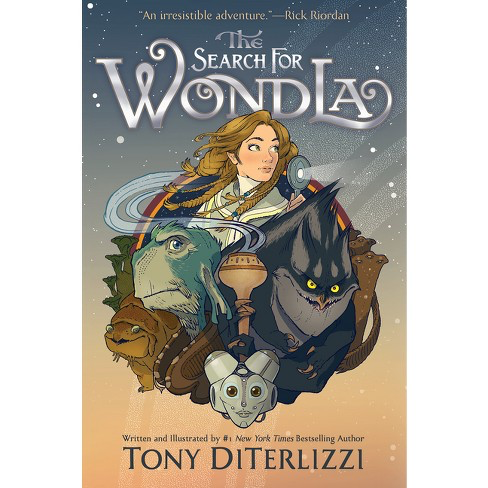
The Search for WondLa – Tony DiTerlizzilow-hanging fruit here (for me, at least), but for once, 6th grade me was onto something. It’s hard to find a song that fits this book better than the progression from “Am I the only one/In the only world?” to “I’m not the only one/In the only world.” (Ah ah ah ah ah ah ah, ah.) Healing my inner middle schooler.

“You’ve Got To Hide Your Love Away” – The Beatles

I’ve always wondered what the Help! album cover is supposed to mean—if I squinted, I thought they were spelling out the letters to “help” (Paul’s pose does look a bit like an L, but none of the others look like the right letters…); as it turns out, Robert Freeman, the photographer for the album cover, originally intended for them make the positions for spelling out “H-E-L-P” in flag semaphore, but he scrapped the idea since he thought that the Fab Four were distinctive enough no matter what pose they were striking, so he just had them…spell out gibberish in flag semaphore. The more you know.

Everything written about the versatility of the Beatles can’t be understated, but the more I listen to some of their earlier music, it’s clear that the kind of wild creativity that defined them was already gestating before they started getting into their more experimental period. Even if this is more of a tribute to Bob Dylan’s highly influential style than anything, they’ve still managed to make it so unmistakable Beatles. It’s one thing to be able to create a nice, downtempo folk tune with some scattered flutes and tambourine here and there, but even in such early days, the rhythm of “You’ve Got To Hide Your Love Away” is so salient that you can’t help but be bobbed by it like a bottle floating over the sea. The whole song has the sway of a flimsy wooden boat on the ocean, gently pitched up and down by the waves with every strum of the guitar. John Lennon’s wavering, raspy inflections are jutting and precise in all the strangest places, but that’s part of what makes this so memorable—it’d be easy to record a cover of this with a flat voice inflected with enough melancholy to sell it, but there’s an enchanting storyteller’s waver in every word. It’s the kind of song that could draw a crowd through the woods—added with the image of the four Beatles standing shoulder, I imagine a slowly expanding crowd circling around them as Lennon sings “Gather ’round, all you clowns/Let me hear you say/Hey! You’ve got to hide your love away…”

…AND A BOOK TO GO WITH IT:
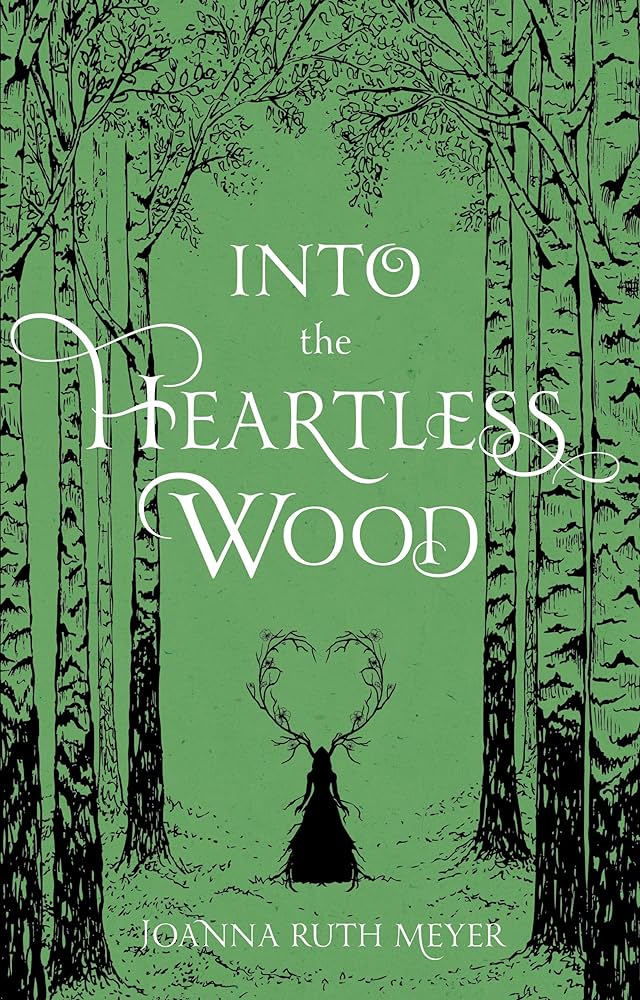
Into the Heartless Wood – Joanna Ruth Meyer“you’ve got to hide your love away” takes it pretty literally, but the both the melancholy folk sway and the uncertain, forbidden romance match this gorgeous modern fairytale.

“Come Lie Down With Me (And Sing My Song)” – Elf Power

We regret to inform you that I’m still riding the Elephant 6 high, even though I haven’t even seen the documentary yet. I’ll get to it eventually.

Unlike bands like the Apples in Stereo and the Olivia Tremor Control, Elf Power’s music usually doesn’t grab me instantaneously; there’s no denying their creativity, but it doesn’t often click with me the way that the other Elephant 6 bands do. Typically, I’ll just like the song, listen to it two or three times, and forget about it. Next to the raucous energy and whimsy of their compatriots, they seem more reserved. Reserved isn’t always a bad thing for me, but with the company they’re in, it seemed like they would have had something brighter to offer. “Come Lie Down With Me (And Sing My Song)” is similarly reserved, but it has an atmosphere that most of the other Elf Power songs I’ve listened to lack. Even if there wasn’t a mention of “rain on the sea,” this song is one of the rainier songs I’ve ever heard, practically the distorted gray of a windowpane streaked with falling rain. The acoustic, folksier approach is steeped in a strange, distant melancholy; the lyrics feel innocent enough—invitations of love in hidden spaces—but I can’t help but feel a sense of unease lurking in the background. It has the same eery air that a lot of age-old folk standards have, like something passed along during the Great Depression and whispered on the biting wind. It gives me the same lingering unease of a Syd Barrett song, like it wanted to be whimsical and innocent, but couldn’t deny some hidden darkness. And even if I’m not fully on the Elf Power bandwagon, there’s no denying that this feeling is a difficult one to replicate and successfully pull off.

…AND A BOOK TO GO WITH IT:
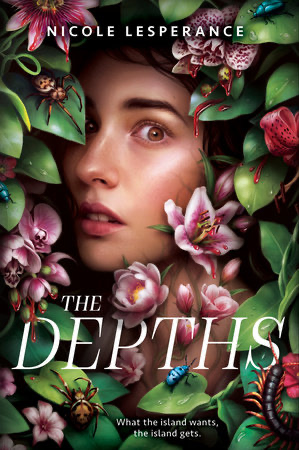
The Depths – Nicole Lesperancerain on the sea, vague discomfort looming large.

“All Nerve” – The Breeders

It’s always fascinating to see the exact ways that a talented singer’s voice changes as they age. The inevitable deepening, and often thickening, that comes for everybody, but just like how each of our voices are unique, each voice changes uniquely. There’s David Bowie’s voice expanding its horizons, deepening like an incomprehensible chasm until it began to quiver at the edges, the soft, sonorous rumble that’s slowly crept into Damon Albarn’s voice as he’s reached middle age, and the whispering rasp that laces the edge of Kate Bush’s voice in her most recent recordings.

For Kim Deal, it’s like some sort of invisible bottom has opened up, making her voice thicken like firm cake batter after a good round of stirring with a spatula. It feels strangely compressed, like most of the airiness has been squeezed out, leaving the back of the throat emotion to clamber through the crawlspace that’s been left behind. But what age never left behind for any of the Breeders was the youthful, reckless spirit that seems to have defined them. This could’ve easily been written back in the ’90s and been an alternative hit, but it works just as well as it worked six years ago. Age has not dulled the spitfire sensibilities of their songwriting—”All Nerve,” as both the title and the album suggest, is just as sparking and feral as much of their other catalogue. The stripped down instrumentation, mostly just bass, sparingly plucked guitar, and faint drums that linger at the corners of your eardrums, make the lust and desperation all the more lusty and desperate. The bare-bones feel of it all, for the first minute or so, at least, add to the feeling of gathering up all you have left—be it physical belongings or strength—to race across whatever wasteland lies ahead to see “you/Especially you.” And it’s just like the Breeders to add the song’s repeated sucker-punch of “I won’t stop” just as the guitars come crashing down like rocks on the highway.

…AND A BOOK TO GO WITH IT:
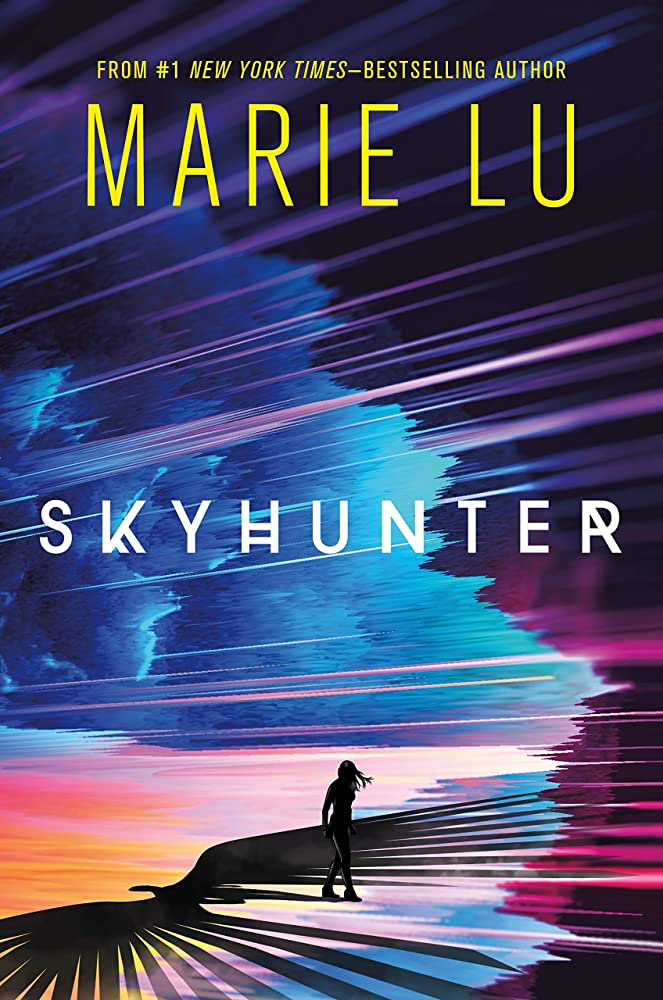
Skyhunter – Marie Ludesperate love in wartime, the feral kind with bloodied steel wings.

“Sunny Afternoon” – The Kinks

Not to bring it back to Britpop, but I’m bringing it back to Britpop. The oft-quoted difference between Blur and Oasis was that Oasis aimed to be the next Beatles (which…even if their music was any good, that would still be presumptuous), but Blur was more interested in delving into the quirkier side of the British Invasion era, namely the Kinks. And even though I’ve been hearing The Kinks in the car from a young age, the more I listen to them, the more I realize just how much Blur gleaned from their lyrical style. The minute I heard “Sunny Afternoon,” I just realized that this was “Country House” before “Country House” was a thing. Chronologically, I guess it’d be the “Country House” sequel after the character’s dissatisfaction blows up and he loses everything. Also fits with “Charmless Man” quite well.

Setting aside my recent habit of listening to music with even the briefest mention of sunshine to get myself through the January doldrums, there’s such a unique texture to “Sunny Afternoon” that pervades in so many of the artists that they influenced, Blur included. There’s a lingering taste of the hottest days of the year, squinting your eyes through the sunlight as the warmth bakes your skin. Maybe a lingering taste of lemonade, something sweet…I guess an ice cold beer, in this case, but overshadowing the summer sweetness is the knowledge that this is all that the narrator has left, now that “The taxman’s taken all my dough/and left me in my stately home.” It’s not full melancholy, but a sarcastic imitation of it that’s only there to humor the narrator—enough to hammer in the point that…yeah, whoever this dude is, he probably had it coming, even if he did lose everything. Yeah, “All I’ve got’s this sunny afternoon,” but I suspect that whatever your (ex) girlfriend told her parents about that “drunkenness and cruelty” wasn’t entirely baseless. The whole song is just “awww, you poor baby, you can’t sail your yacht? Go cry about it.” “Sunny Afternoon” has a sly sort of playfulness, the kind that makes you imagine the narrator imagined as a cartoon character, moping onscreen as you pass The Kinks themselves. (The camera would pan over to Ray Davies, who’d do some kind of silly, exaggerated frown as this rich dude slips on a banana peel, or something.) And amidst all this, you’ve got some of the prettiest harmonies I’ve heard on a Kinks song in the chorus—”Lazing on a sunny afternoon” sounds like it’s misting away like droplets of water coming out of a sprinkler, gently dissolving in the heat.

…AND A BOOK TO GO WITH IT:

The Chosen and the Beautiful – Nghi Vousually, most of the books here are ones that I’ve enjoyed, but sometimes, there’s no denying the way a book and a song pair, even if you didn’t enjoy the book. This one wasn’t my favorite, but it’s a retelling of The Great Gatsby, so you can see where the “dissatisfied rich people losing everything” thread comes in.

Since this post consists entirely of songs, consider all of them to be today’s song.

That’s it for this week’s Sunday Songs! Have a wonderful rest of your day, and take care of yourselves!

Posted in Sunday Songs

Sunday Songs: 12/31/23

Happy Sunday, bibliophiles!

Whew, here we are on New Year’s Eve! What a year it’s been, huh? The fact that there’s 2/5ths depressing songs in this batch was entirely unintentional, but I’m of the firm opinion that the last one is a good way to close out 2023. Also—no, somehow the Phoebe Bridgers song this week isn’t one of the depressing ones, bizarrely. Who would’ve thunk.

Enjoy the last songs of 2023!

SUNDAY SONGS: 12/31/23

“Garden Song” – Phoebe Bridgers

This song, like a good song does, came back like an old, loyal dog when I needed it most. But before I get into it, I remembered that I reviewed Punisher when it came out. So let’s see what I thought about it back in 2020:

This was the first single to be released out of the whole album. When I first listened to it, something about it got under my skin, but as I’ve listened to it more, something about it has grown on me (no pun intended). A nostalgic, dreamlike opener to the album. (Rating: 7/10)

…huh. Well, I thought I’d have…more to work with there, but 2020 me wasn’t necessarily wrong. I’d certainly bump up the rating up to at least an 8 or an 8.5, though. It’s what this song deserves, upon a few more years of reflection. It’s a way-homer once you get past the age of 16.

Yes, there is some sad bastard music coming soon in this post (buckle up), but contrary to what…95% of Phoebe Bridgers’ discography would have you believe, this isn’t one of them. Pigeonholing an artist into being just a “sad girl” has a multitude of pitfalls, but one of them is that automatically assuming that slow = sad. In fact, I think this is one of her most hopeful songs. I remember taking a while to warm up to it at first—the startlingly low, Matt Berninger-esque backing vocals, probably several octaves below Bridgers, felt off at first. (In fact, the voice belongs to Jeroen Vrijhoef, her tour manager, who she described as sounding like “Dutch Matt Berninger.”) It’s a stark contrast—Vrijhoef’s rumbling bass almost becomes the unstable ground that Bridgers’ frayed-silk high notes treads over, but it grows on you after a while.

One thing that writing these posts this year has taught me is that I can see more clearly how I approach music; it’s always the music itself first, and unless something immediately jumps out at me (or if I come in expecting it), the lyrics follow on subsequent listens. That’s certainly what’s happened with this song. The dreamlike calmness has never failed to soothe me, but the lyrics have a soothing quality to them as well. The sleepily rambling second verse, where Phoebe Bridgers describes a meandering dream, has the murmur that you would only expect when she’s just woken up and is scrawling the non-sequitur fragments into her journal. (Not to project onto a complete stranger, but I feel like she’s the kind of person to keep a dream journal. I just get that vibe.) But even beyond that, “Garden Song” really is about growth. It’s the soft space where you can look back on your life, recognizing the good and bad, and see it as the soil for other things to grow. It’s the sad smile that you can see as you recall the painful times in your life, but also the comfort in realizing that your sprout has gone beyond that and bloomed, and the hope that there’s blooming yet to do. I find myself going back to 2020, a few months after Punisher came out, when it seemed like all of the lead-weight things pinning my shoulders down would never lift, and inevitably feeling heavy again, but remembering where I’m sitting now, and where my feet have taken me since then. The path was winding and full of twists, but it led us all here. As Bridgers herself said, “…if you’re someone who believes that good people are doing amazing things no matter how small, and that there’s beauty or whatever in the midst of all the darkness, you’re going to see that proof, too. And you’re going to ignore the dark shit, or see it and it doesn’t really affect your worldview. It’s about fighting back dark, evil murder thoughts and feeling like if I really want something, it happens, or it comes true in a totally weird, different way than I even expected.” There’s no denying the darkness, but it is never all there is.

“Garden Song” came back to me towards the end of finals, and of course, I had to sit a while in my spinny chair and sit with it. To me, it’s the perfect song to take with us to the new year—to reflect on how you’ve grown through everything, and that there is so much left to grow through. I’ll leave it with these lines:

“I don’t know how, but I’m taller
It must be something in the water
Everything’s growing in our garden
You don’t have to know that it’s haunted
The doctor put her hands over my liver
She told me my resentment’s getting smaller
No, I’m not afraid of hard work
I get everything I want
I have everything I wanted.”

…AND A BOOK TO GO WITH IT:

The Long Way to a Small, Angry Planet – Becky Chamberseven if the gentle, muted instrumentals didn’t perfectly mesh with the homey atmosphere of this novel, the stargazingly hopeful attitude certainly would.

“Ruined” – Adrianne Lenker

Alright, here’s a blanket. This one’s from another sad girl, and it’s very much actually sad.

If there’s one thing that Adrianne Lenker can write well, it’s a heartbreak song. Unlike most of her solo work that I’ve listened to, there’s no acoustic guitar in sight. This time, Lenker has opted for something equally sparse and solemn: the classic solo piano ballad, aided by some faint, synthy notes in the background, apparently credited as “crystals.” It could’ve easily blended in with the acoustic-dominated landscape of most of her other music, but somehow, the slowly marching piano chords leave the song room to take every rattling breath. Thanks to the music video…I…yeah, I think I’ve now seen more of Adrianne Lenker than I ever needed to see, but this song provides more of that in the metaphorical sense, which I much prefer. She’s a soul-bearer. Something about the plaintive, ever-present waver in her voice seems to age her—it’s not like much time has passed between her solo work, but the shake in her voice seems to indicated that whatever inspired this song aged something inside of her, certainly. Poor thing. Whether or not this song will eventually be a part of an album or remain adrift in Lenker’s discography, it would make a wonderful, thematic addition to the end of an album—it wouldn’t even need to be the very last song, but it would fit in at least the final three or four. The opening lines lend themselves to an album fading into the ether, of both love and music slipping through your fingers—”I wish I’d waved when I saw you/I just watched you passing by.”

…AND A BOOK TO GO WITH IT:

Even Though I Knew the End – C.L. PolkI don’t think Adrianne Lenker would mind the inclusion of vampires, but this is certainly the kind of love that ruins you.

“I’m Not Feeling Human” – The Olivia Tremor Control

My musical wish for 2024: BRING BACK SLIDE WHISTLES, DAMMIT!

I’ve been riding off my dad’s high of Elephant 6 musicians after he recently watched the Elephant 6 Recording Co. documentary (hence the recent spike in Apples in Stereo-related content). There’s something so pure about so much of the music that they put out in the early days. Well…okay, maybe not on Neutral Milk Hotel’s part, but Robert Schneider (of the Apples) and Will Cullen Hart and Bill Doss (of The Olivia Tremor Control) certainly knew how to juice playful simplicity out of synths and all manner of catchy melodies. The Apples in Stereo have a space-age, almost scientific quality to their pop songs, but to me, The Olivia Tremor Control has always come across as something just as whimsical, but in the way of flat colors and simple shapes that bounce around. I’ll die on the hill that this song deserves some kind of Chicka-Chicka Boom Boom-style music video to go along with it. The patchwork of goofy instruments scattered around (including the aforementioned, glorious slide whistle) gives it a delightful whimsy that calls to mind stacks of building blocks. Even the slight discomfort of the lyrics seem to be delivered with a wry smile—”Don’t I feel, don’t I feel like a mineral?/Don’t I feel, don’t I feel like a vegetable?” Maybe it’s the rhymes, or maybe just the fact that I’ve always found the phrase “animal, vegetable, or mineral” funny for no reason (I blame it on what little I remember from The Magician’s Nephew), but even vague alienation has a childlike whimsy to it in the hands of The Olivia Tremor Control. Probably the slide whistle, though.

…AND A BOOK TO GO WITH IT:

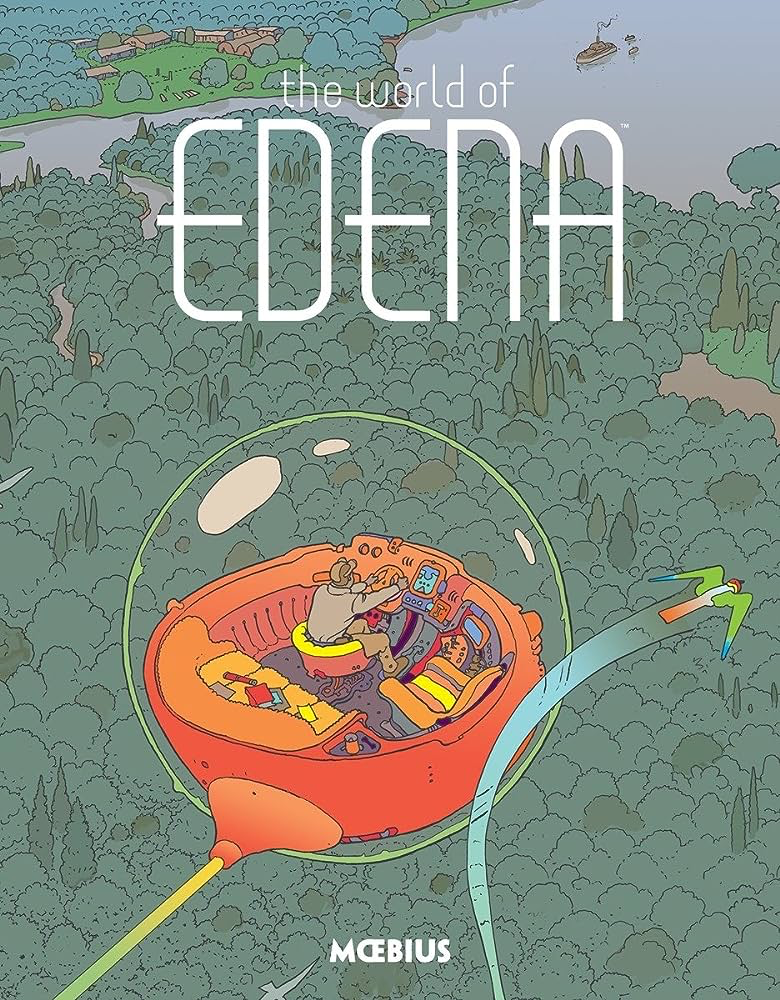
The World of Edena – Mœbiuscolored in with the same flat but vibrant colors that “I’m Not Feeling Human” is shaded in.

“Crash” – The Primitives

Okay, we’ve got one more peppy song before the depression hits…let’s ride the high while it lasts.

“Crash,” other than being a nostalgic, smiling thing popping up in my brain’s whack-a-mole system of remembering songs, feels like the better side of late ’80s pop. By then, the oversaturated synths and gated reverb had probably spread faster than the plague; I can’t speak from experience, given that…y’know, I wasn’t alive, but it had to have gotten obnoxious by that point. This song could have easily been that, but The Primitives seemed to know just the right balance to hit to make something instantly catchy, but that also managed to date itself in a way that wasn’t plasticky and corny. It’s distinctively ’80s without being distinctively ’80s, if you get what I mean. The guitars are bright, but not polished into oblivion, and yet there’s no denying the authentic, cartoon stars coming off of the opening riff. It’s practically begging to soundtrack a confident, reckless heroine with a slick jacket and and a pair of rollerblades, the kind with sparks that fly off with every turn she makes. Tracy Tracy, dolled up like some kind of new wave Marilyn Monroe in the music video, knows that she never needed to over-exaggerate her voice—the warmth of it, combined with the fiery embers self-contained in a tidy two and a half minutes, made for a song that’s unmistakable as a hit.

And they put this song in Dumb and Dumber? Huh?

…AND A BOOK TO GO WITH IT:

Little Thieves – Margaret Owen Vanja Schmidt is certainly the kind of reckless firebrand that doesn’t know when to slow down—and it takes her to some unexpected places…

“Motion Picture Soundtrack” – Radiohead

Another thing I have my wonderful dad to thank for: we watched a few episodes of Joseph Campbell’s The Power of Myth (it’s all on Youtube, go watch it), and besides the plentiful, earth-shattering truth bombs, for lack of a better phrase, about the nature of life and myth (and how those two aren’t really separate things after all), a quote from the second episode stood out to me when I was reminded of this song. At about 42:48, after he and Bill Moyers are discussing the manifestation of god in everything, and by extension, machines, Campbell examines the inner framework of a computer and remarks, “have you ever looked inside one of those things? You can’t believe it! It’s a whole hierarchy of angels…and those little tubes, those are miracles.” For the sake of not derailing this post so I can actually publish it on Sunday, I’ll holding back from expanding on all of the aforementioned Campbell capital-T Truth bombs, which he seems to produce with the same frequency as the other Campbell’s soup cans, but I can’t help but think of this song when I think of computers and angels. There’s no other word besides “angelic” to describe the distorted chorus of electric voices that begins at 2:15. That sound couldn’t have come from any other place save for the miraculous angel tubes. There’s some kind of gospel to this song, I swear.

Unless something absolutely drastic and apocalyptic happens, I doubt I’ll ever stop singing the praises of Radiohead. I’m long past caring about how inevitably insufferable I am as a result, but all the language I have about them ends up being hyperbolic. Kid A is probably somewhere amongst my favorite albums—I haven’t formally organized them past top 10, but I’d say that this lands somewhere in the 20s or 30s, at least. OK Computer, even if their chronological placement has doomed them to comparisons as long as there are music critics to do so, will always be the favorite child in my mind, but the special quality of this album can’t be understated. Like Punisher, another red, blue, and black-colored album that I listened to during the summer of 2020, it’s a signpost for a hyper-specific time in my life, and one of the most cohesive showcases of the talents of Thom Yorke and company. But as much as “Everything In Its Right Place” and “Idioteque” hold uncontested places in my heart, “Motion Picture Soundtrack” will wield the ultimate trophy as far as Kid A goes, and for my standards of music in general. Right now, it’s my favorite album closer of all time. (Before anybody says anything, I know, ackshually ☝️🤓 “Untitled” is technically the closer, but at this point, it’s basically a cooling-down extension to this song). As I brought up before, there’s an undeniable air of gospel about it—the synths that press in at the beginning sound like pipe organs run through a dystopian starscape, and if that’s the case, then the choir is certainly the angels dwelling just out of view in the pews.

“Motion Picture Soundtrack” was marinating in Thom Yorke’s massive cauldron of glorious music since the mid-nineties, where it was an acoustic lament befitting of The Bends. After that, it became a deeply solemn piano ballad somewhere in the depths of the OK Computer sessions, but I, for one, am glad that this is the definitive version, even if we were robbed of what was originally the third verse: “Beautiful angel/pulled apart at birth/Limbless and helpless/I can’t even recognize you.” (OW.) “Motion Picture Soundtrack” was always meant for cosmic grandeur; even though the opening mentions of “red wine and sleeping pills” ground us in the dim hours of planet Earth, the sprawling emotion of it all is the definition of all-consuming. It feels like the final leap off the cliff from death to rebirth, watching your feet slip and the gravel crumble beneath them as the electric, harp-like notes fill your ears like an endless field of stars. Within the infinite sprawl of sorrow, you can’t help but see the staggering beauty of life itself blossom in front of you. I’ll go out again and say it: I doubt we’ll ever come close to the tearjerking final line of Kid A: “I will see you in the next life,” and the pleading waver of Yorke’s soul-caressing voice makes it resonate all the more.

Kid A is probably the pinnacle of hopeless sad bastard music, but I can’t help but feel some kind of embryonic hope resting in the egg yolk of this song. “I will see you in the next life” is a release from all the mindless, sorrowful things that the rest of the verses lay out, and the promise of a starry new beginning. The closing of a chapter, the setting of a book back on the shelf, knowing that if you ever go back and read it, nothing will ever fully be the same, but knowing that isn’t always a bad thing.

What a way to end the year, huh? Just like “Garden Song,” I’m glad this song returned to me when it did. Radiohead is the gift that keeps on giving (me too many feelings to handle).

…AND A BOOK TO GO WITH IT:

The Darkness Outside Us – Eliot Schreferthis book takes “I will see you in the next life” very seriously. One of my favorite love stories of all time, and one of my favorite sci-fi books of all time as well.

Since this post consists entirely of songs, consider all of them to be today’s song.

That’s it for the last Sunday Songs of the year! Have a wonderful rest of your day, and take care of yourselves.