

Happy Tuesday, bibliophiles, and Happy St. Patrick’s Day! 🍀 Thankfully none of you can pinch me through the screen, but is a book with a bright green cover and “green” in the title enough for you?
I’ve had my eye on Greenteeth ever since it came out last year—the focus on Jenny Greenteeth and the gorgeous cover (shoutout to Leo Nickolls) caught my eye, but I’ve passed it up in favor of other books…until now. (Shoutout to the Boulder Bookstore, where I got myself a copy!) Though it had its fair share of flaws, Greenteeth was a touching, fantastical story of unlikely friendship.
Enjoy this week’s book review!
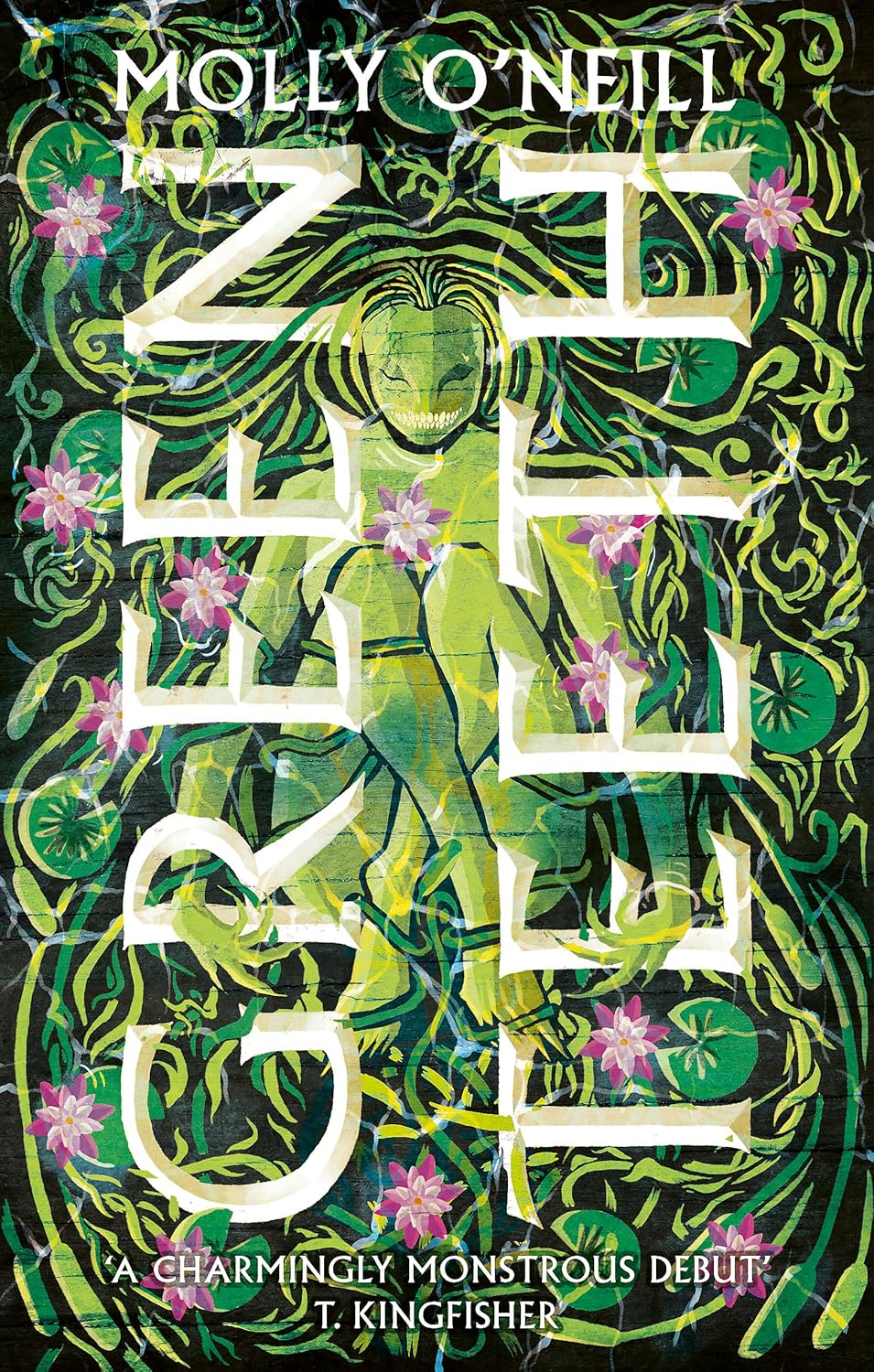
Jenny Greenteeth has lived in her lake for thousands of years. Most humans that she encounters are passing fascinations—or simply a meal. But when Temperance, a human witch sentenced to drown, comes upon her lake, Jenny decides to take her in. Temperance desperately wants to return to her family, and Jenny cannot break a promise. They decide to find a way back to Temperance’s family, but what they discover along the way may hint at a darker rift between the humans and the faerie realm—one that may lead Jenny to discover more about her monstrous lineage than ever before.
TW/CW: animal death, violence, blood, descriptions of injury, grief
For some reason, I thought that Greenteeth was going to have a sapphic element to it, but that’s fully on me constantly having the Gay Goggles on for everything. In retrospect, this might be the one time where having a queer relationship between the main characters would be a bad idea, because a) Temperance is happily married and b) Jenny’s at least 1,000 years older than her. God, that would’ve been a mess.
Greenteeth filled a void that I’ve felt in a lot of fantasy, and that’s the unabashed embrace of all of the weird parts of faerie folklore. I’ve been intrigued by Jenny Greenteeth ever since I read the incarnation of her that appeared in the Hellboy comics, and it’s safe to say that these adaptations of her are very close to the inherent weirdness of the original folklore. Said folklore of Greenteeth draws from classic British, Scottish, and Welsh folklore and Arthurian legend, both of which I indulged in. O’Neill introduces a delightful cast of characters and creatures, and makes the faerie realm feel truly weird, something that a lot of fantasy seems to miss. O’Neill’s atmospheric prose rendered this realm in vibrant color, and I loved every minute of the quest.
Jenny was obviously the heart of the story here, and O’Neill did an excellent job with her! She was just so lovable—like I said above, I love that she didn’t hold any punches with making her truly weird and monstrous. Jenny acts exactly like you’d expect a 1,000+-year-old creature that lives in the bottom of a lake and barely talks to anybody to act, which made Greenteeth a delight from the get-go. With Brackus as her foil and Temperance to teach her about the world, Jenny made for a charming protagonist. However, I’m not sure if O’Neill hinted at the reveals about her past (not the really big one—more on that later) well enough, because by the time they’d been established, it seemed out of character for her to hide something so drastically, lie about it so badly, or even convince herself that these things hadn’t happened at all; with her baby, I get not wanting to reveal that, but they were only revealed when we knew Jenny as a character who wouldn’t necessarily hide these parts of herself in the way that she did. I didn’t buy all of that, but aside from those unfortunate quirks, she was a delightful character. Plus, once we got over the hurdle of said reveals, her character arc became even more poignant.
What made Greenteeth suffer the most, I think, was the tonal shifts. Ultimately, I think it was indecisive about what kind of novel it wanted to be. A lot of reviewers have pegged this as cozy fantasy, and there are a few scenes that would lead me in that direction. However, with the rapid shifts into violence and decidedly more fast-paced and action-packed sequences, I really don’t think this fits the bill. (Also, I feel like most cozy novels wouldn’t pull the move of having a dog get stabbed unceremoniously and then completely brush over this in a few sentences. Not necessarily the dog-stabbing bit, but the fact that they basically go “Oh no! Anyway,” and move on. Justice for Cavall!) It was just so inconsistent in terms of the stakes; we only get to the real meat of the objective of the characters about halfway through. Frankly, I would’ve enjoyed Greenteeth whether or not it decided to be a more cozy, found family quest or an epic, Arthurian quest, but this novel could not decide which of the two it wanted to be. I’m not sure if the half-baked limbo between the two options was the way to go.
That being said…I could not get enough of the ending twist! Personally, it’s too good for me to spoil it, but without revealing anything big, I think it gave Jenny’s arc a deeply emotional conclusion. I’m no expert on Arthurian legend, but internally, I jumped out of my seat like a football fan when said Big Reveal got revealed. However, I think it added some oomph that Jenny’s arc was in need of; the reveals we get about Jenny’s backstory came too late and with too little preamble for the seemingly heartrending emotion that came along with them, but here, I think they reached the potential that they always needed. Jenny’s true origins gave her a real sense of purpose, and even though it was more of a symbolic gesture, it gave her proof of what she needed to hear all along: that she was a powerful, important being, full of love and the potential for greatness…as all of us are.
All in all, a heartwarming fantasy novel that faltered in parts of the plot, but blew it out of the water when it came to atmosphere and the tender relationships between its characters. 3.5 stars!
Greenteeth is a standalone, and Molly O’Neill’s debut novel. O’Neill is also the author of Nightshade and Oak, which came out this February.
Today’s song:
That’s it for this week’s Book Review Tuesday! Have a wonderful rest of your day, and take care of yourselves!


 The Bookish Mutant