Posted in Sunday Songs

Sunday Songs: 10/26/25

Happy Sunday, bibliophiles! I hope this week has treated you well.

This week: I think you’ve all been getting too comfortable with the lack of Björk in the past month or so…WOE, BJÖRK BE UPON YE

Enjoy this week’s review!
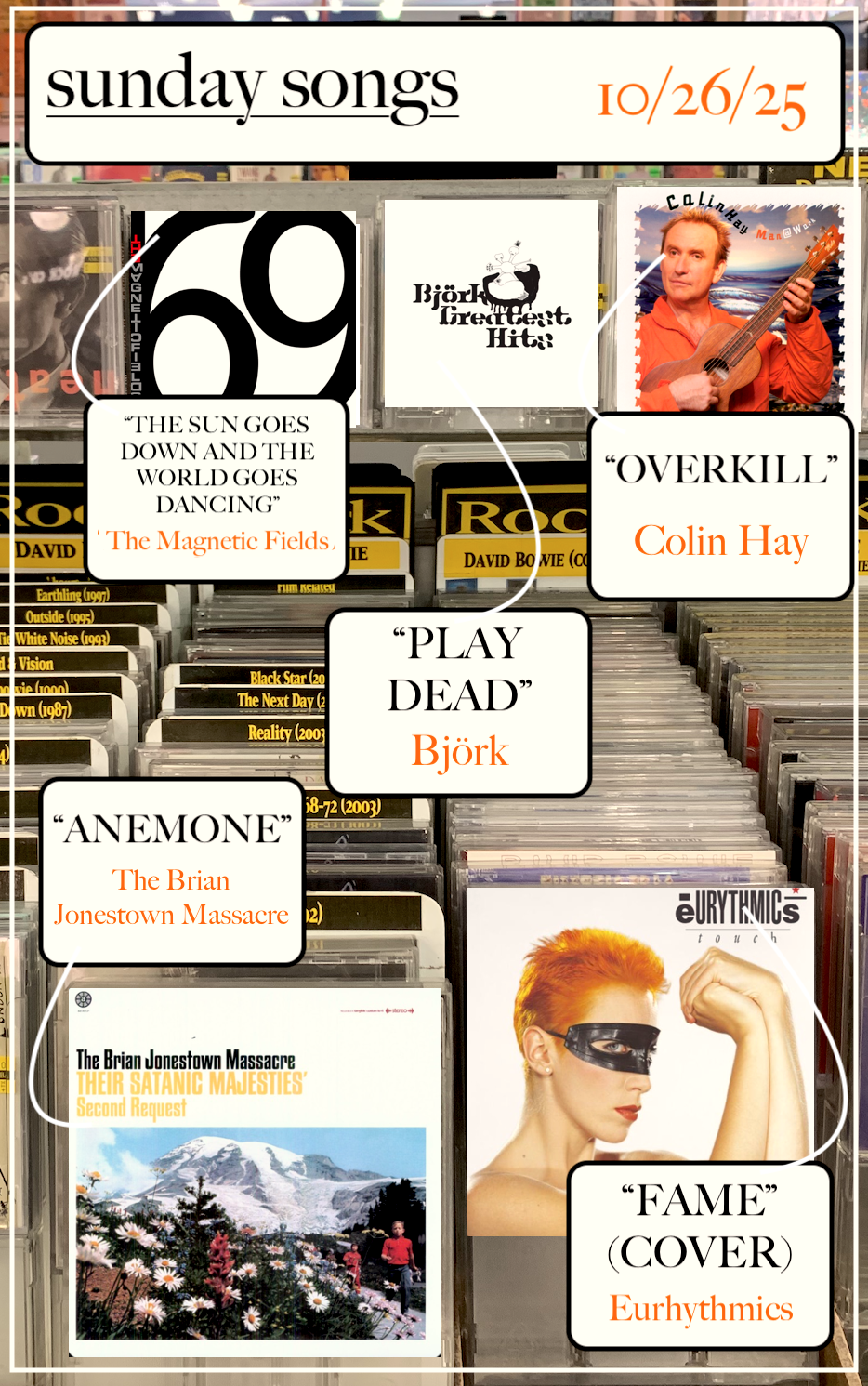
SUNDAY SONGS: 10/26/25

“Anemone” – The Brian Jonestown Massacre

I love a song that just envelops me. “Anemone” is one of those tracks were there’s nothing in the lyrics remotely related to anemones (or even the sea), but it just happens to be the right title, just from the feel of it. The production and instrumentation sound like the lazy swirl of a temperate ocean around you, like footage of Planet Earth with a shot panning over gentle waves making anemones’ tentacles wave in the wind like branches on a tree. “You should be picking me up/Instead you’re dragging me down,” in that frame of mind, feels like being pulled under by a rogue wave and surrendering to the current.

Anton Newcombe’s voice feels like a backup instrument and not the lead vocal, somehow just as ethereal and misty as the faintly distorted rhythm guitar. That’s probably because the lead guitar, also played by Newcombe, is so distinct that it feels more like the voice of the song. From the beginning, it makes intricate loops and twists, like an animation of yarn curling in on itself—or the tendrils of an anemone slowly reaching out to you. It starts off almost uneasy, as if trying not to intrude on the melody, but once it expands, it takes the song from dewy cobwebs to a fully-defined spiderweb of dreamlike sound.

…AND A BOOK TO GO WITH IT:
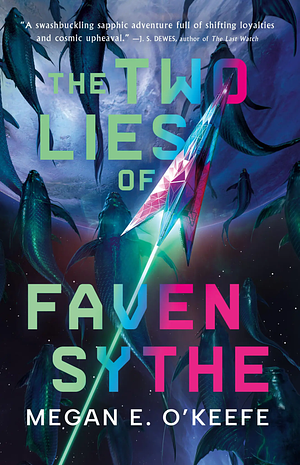
The Two Lies of Faven Sythe – Megan E. O’Keefea twisty, surreal world of crystals and secrets—befitting of a dreamlike song like this.

“Fame” (David Bowie cover) – Eurhythmics

The other day, a good friend of mine (and one of the only people I know who’s just as obsessed with David Bowie as me, which is really saying something) and I were volleying back and forth about David Bowie covers. I wish I were as open-minded like them, but I think I was just burned by the aftermath of Bowie’s death when every single radio station decided that it was the right time to play nothing but the shittiest Bowie covers known to man. You can’t blame me for being a little suspicious at first. If you have that seismic of an impact on music, you’re bound to spawn a ton of bad covers. Plenty of good ones too, though! (For your perusal, and also the ones I sent said friend: Warpaint’s cover of “Ashes to Ashes,” TV on the Radio’s cover of “Heroes,” Lisa Hannigan’s cover of “Oh! You Pretty Things,” and Karen O and Willie Nelson’s cover of “Under Pressure.”)

But when they said that Eurhythmics had done a cover of “Fame” back in the early ’80s, I knew it was going to be good. (So thank you, said friend!) After all, Annie Lennox did take up the mantle of resident British, orange-haired, androgynous pop star from Bowie after Ziggy Stardust had been put to bed. I knew she was going to be cooking something. Bold, daring covers are few and far between, but if anyone can do it, it’s Eurhythmics. Lennox and Stewart transmuted Bowie’s plastic soul into a wholly different sound. It’s slicker than chrome, and so, so ’80s in the best way. Sped up and dominated by synths that sound like liquid mercury, Lennox’s vocal take on “Fame” turns the meditation into a song that feels like it belongs in a movie montage, walking through a crowded ballroom full of shallow, Hollywood types. Her mocking laugh echoes through the repetition of “Fame” in the chorus, hammering down Bowie’s original message of fame and the mercurial music industry wringing creative talents dry.

…AND A BOOK TO GO WITH IT:
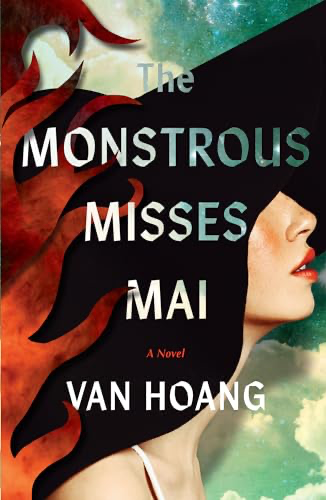
The Monstrous Misses Mai – Van Hoang“Fame (fame)/What you like is in the limo/Fame (fame) what you get is no tomorrow/Fame (fame) what you need, you have to borrow…”

“The Sun Goes Down and the World Goes Dancing” – The Magnetic Fields

Dammit…I almost slipped into my usual “I need to set aside 3 hours to listen to 69 Love Songs in its entirety” intro for yet another song from 69 Love Songs. 3 hours? In this economy? With my Instagram-rotted goldfish attention span? Kidding, kidding…only partly. I need to shut up and just listen to the album.

In the meantime, I seem to have gathered a stash of assorted songs from 69 Love Songs like a squirrel gathering acorns for the winter and hiding them in the most random places. Yet I do not have the uncanny acorn memory of a squirrel, so I’m fully surprised every time the Magnetic Fields Instagram account soundtracks one of their posts from the 69 Love Songs 25th Anniversary Tour with one of these songs. “The Sun Goes Down and the World Goes Dancing” was a recent favorite from the start. I fully mean this as a compliment, but there’s something about the production that makes the song sound like it’s been played on toy instruments. You can’t tell me that those clacks in the background aren’t plastic. Given the absolute laundry list of instruments listed under Stephin Merrit’s name on the Wikipedia page for 69 Love Songs, it wouldn’t be out of the ordinary for him to have thrown some in for fun. Another fun fact: Daniel Handler, a.k.a. Lemony Snicket (yes, that Lemony Snicket) played several instruments on the album and arranged “Asleep and Dreaming.” I feel like it’d take an archaeologist to deconstruct the sheer amount of lore that this album has.

And yet that toylike quality makes the rusty charm of this song, from the thin mandolin strums and the hollow, clinking percussion. It’s uncharacteristically devoid of the usual lovelorn frustrations that Merritt usually displays—it’s nothing but breathless, dizzy joy. “The Sun Goes Down and the World Goes Dancing” is a snapshot in motion of rapidly twirling lovers careening across a dim dancefloor, relishing in the warm glow of the lights. It’s the faint smell of the night air as you squeeze someone’s clammy hand, a leap of faith into someone else’s arms. The beat seems to all but gallop like a trained pony with a collar adorned with jingle bells, brushed to perfection but nothing but happy about it.

…AND A BOOK TO GO WITH IT:

Heartstopper, vol. 1 – Alice Osemandon’t tell me that this song isn’t befitting of some little animated leaves and fireworks.

“Play Dead” – Björk

There’s something so singularly admirable about Björk that makes even her more commercial songs feel so uproariously her. Even a relatively sparse music video, not directed by her and interspersed with clips from the film it was from, The Young Americans, couldn’t tamp down the raw power of her voice. Even when given a formula, Björk played around with it in every way that she could—from all accounts, the opportunity was an experiment for her. On writing “Play Dead,” Björk said that writing the song was “fun because the character in the film was suffering and going through hardcore tough times and at the time I was at my happiest. It was quite liberating to sit down after writing a whole album to write from someone else’s point of view.”

Aided by David Arnold, who composed the film’s score, and Jah Wobble (of Public Image Ltd) contributing the (gloriously slick) bass, “Play Dead” reminds me, at best, of what I like so much about trip-hop. It’s so seductive and slick, and even with the lyrics aching with numbness, it’s so brimming with life. Sure, that’s in no small part due to the cinematic orchestral swells that punctuate the background, but Björk’s voice makes it from a song into a true performance on every listen—even the most melancholy lyrics from her are blood vessels full of life. Nothing could ever suck the energy out of her performances, much less this one.

…AND A BOOK TO GO WITH IT:
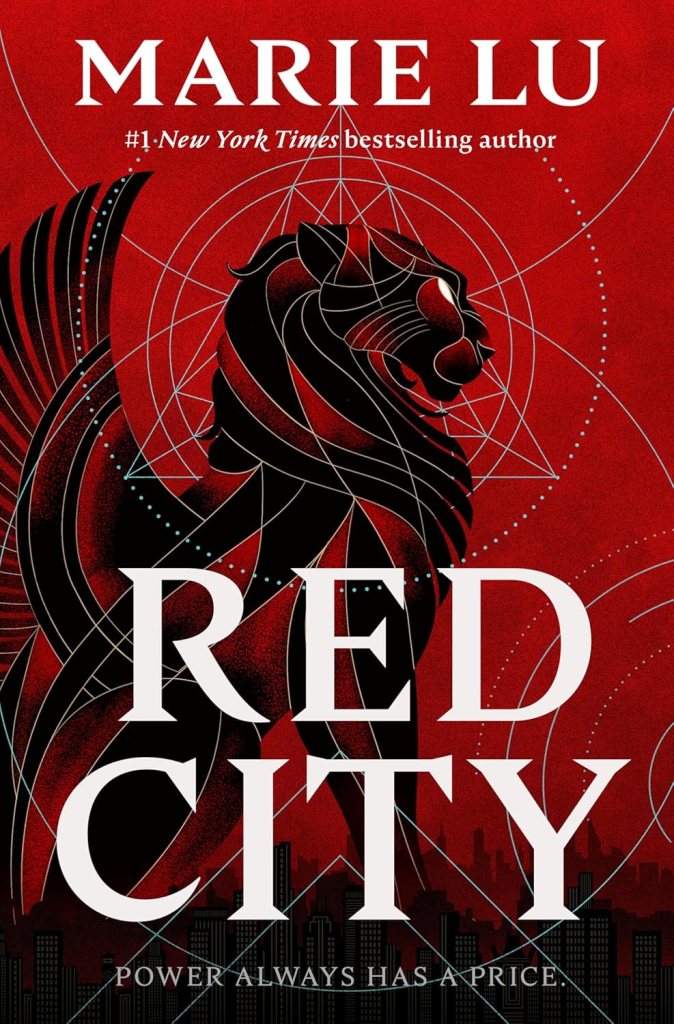
Red City – Marie Lu“I belong to here where/No one cares, and no one loves/No light, no air to live in/A place called hate/The city of fear…”

“Overkill” – Colin Hay

[BANGING FIST ON THE TABLE, IN TEARS]

HE JUST LIKE ME FR

…AND A BOOK TO GO WITH IT:
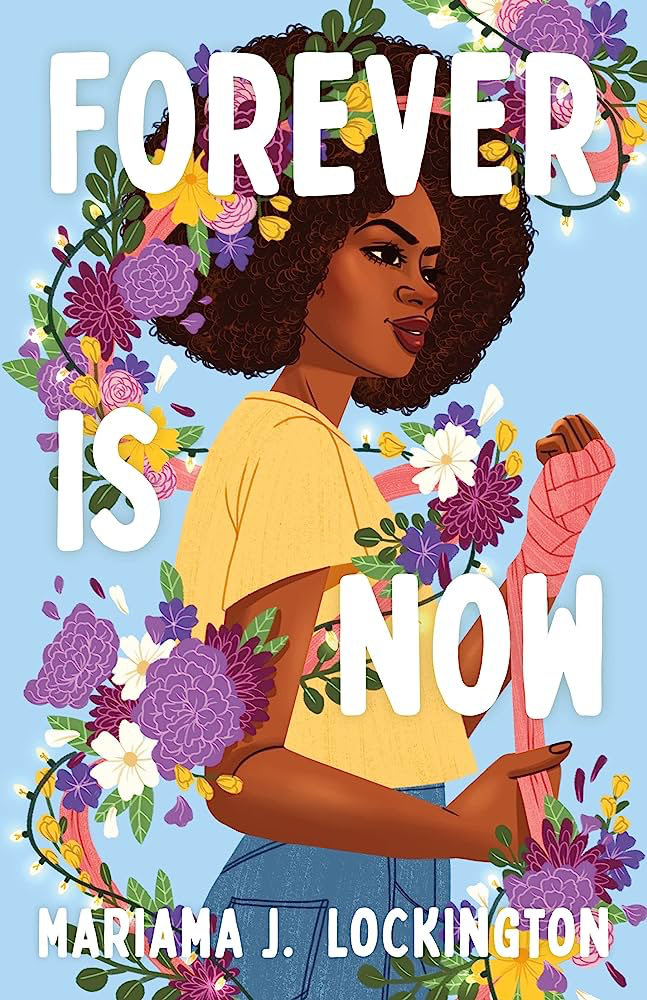
Forever is Now – Mariama J. Lockingtona poignant, honest depiction of a young Black girl dealing with chronic anxiety.

Since this post consists entirely of songs, consider all of them to be today’s song.

That’s it for this week’s Sunday Songs! Have a wonderful rest of your day, and take care of yourselves!


Posted in Sunday Songs

Sunday Songs: 2/18/24

Happy Sunday, bibliophiles! I hope this week has treated you well.

Welp. Back to the black and white (mostly) color palettes again. Oops. But ’70s David Bowie heals all wounds, right? Right?

Enjoy this week’s songs!

SUNDAY SONGS: 2/18/24

“Do You Want To” – Franz Ferdinand

From all accounts, it seems like Franz Ferdinand peaked at this album, You Could Have It So Much Better. But I feel like it’s understandable, on some level. You try to replicate something as iconic as “Take Me Out” or this, and you risk flying too close to the sun. Lightning can’t strike twice. Well, I guess it can, if you count this and “Take Me Out,” but…okay, three times?

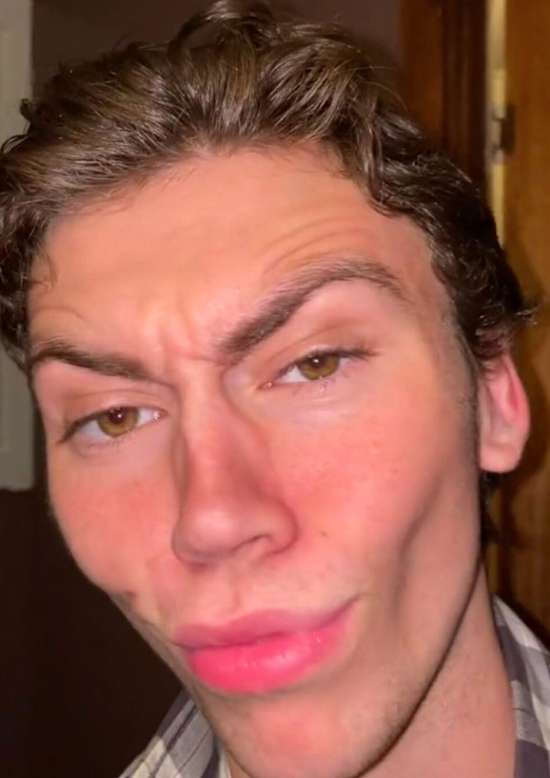
This song. It’s so stuffed with infectious hooks that it’s practically a thanksgiving turkey. It’s pumping with allure and adrenaline, and not a single bit feels wasted. You hear the first 20 seconds and think “oh, that’s a great start to the song,” but lo and behold, every single band member pulls of their top hats to reveal a second, even more spectacular hook to propel it to unforeseen heights. And from that meteoric rise, “Do You Want To” feels like the most delightfully slick, guitar-driven gold mine of 2000’s indie rock. It’s a song that wrenches you by the hand into a nighttime world of leather jackets, impeccable hair, and shiny guitars. Lyric-wise, it’s nothing that the band hasn’t covered, but lyrics were never their legacy—the absolute sheen of it all overpowers the rest of it, and it’s the kind that you can keep on repeat for hours and never get tired of. For a few years, Franz Ferdinand seemed to have perfected that kick of leather-jacket, smooth indie rock, and even though it seemed to have burned out a decade or so down the line, for a moment, their talent was clear—and explosive. The only sin that “Do You Want To” ever committed was not having a third hook hidden beneath their other top hats—the last thirty seconds (“Lucky, lucky/You’re so lucky”) are just begging for at least one more burst of smooth guitar that sounds like it’s been fired out of a cannon. It’s such a frustrating ending. With that kind of buildup, how could they not be extending the song for a finale as glorious as the entrance? Either way, the three and a half minutes that we do have is joyous enough. Almost enough to make me forgive Alex Kapranos for permanently freezing his face in this expression for no good reason:

…AND A BOOK TO GO WITH IT:

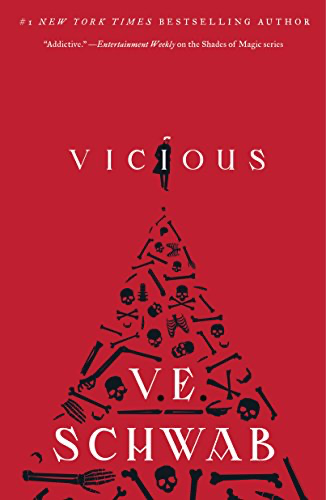
Vicious – V.E. Schwabcome to think of it, a lot of V.E. Schwab’s male protagonists fit a similarly charismatic and boundary-pushing (mostly in terms of magic and science, anyway), but this novel absolutely fits the slick, Franz Ferdinand vibe.

“Fascination” – David Bowie

Frustrated that “Do You Want To” ends right before it should theoretically go on for at least two more minutes? Fear not! At least David Bowie wasn’t afraid to make his timeless grooves almost six minutes long.

Welp. I don’t know how Young Americans wasn’t on my album bucket list already, but it sure is on it now. The iconic title track and “Fame” should’ve convinced me, but somehow it was “Fascination” that pushed me over the edge. It reminds me just what I love about the ’70s; the production is nothing but slick and slinky, full of vibrance and a groove that never even comes close to sputtering out for all five minutes and 48 seconds. God, the saxophone. I don’t usually find myself saying that about saxophones, but oh my god. It’s not a song that just makes you feel like dancing—you’re all but transported to a dance floor somewhere, amidst loose ties and sunglasses and warm lights bathing everyone’s faces. Strangely, the only thing that doesn’t scream vibrant or groovy is Bowie’s voice. The more you focus on it, the eerier it feels. Even though his voice was a decade or so from becoming as rich and resonant as he was later known for, it had thinned out even more so that he was in his youth. Young Americans was recorded during the height of his crippling cocaine addiction, and you can hear it in this song more than any other on the album. I could just be projecting, given how he was able to belt out the classic “ain’t there one damn song that can make me…break down and cry?” on the same album, but whether or not it was purposeful to add to the slick, sultry air of the album and his persona, it’s not a stretch to make. His voice often takes a back seat to the sheer power of the backup singers, and despite the seduction written all over “Fascination,” I can’t help but think of the exhaustion that eventually led him to pack his bags for Berlin in a few years’ time. No judgement, but it’s kind of the reason why I’m always a little suspicious of people who say that The Thin White Duke is their favorite Bowie persona. Iconic as all the others in both looks and musical output, but…I don’t know, it feels like a red flag that the Bowie you remember most fondly is the Bowie that was characterized by exhaustion, excessive substance abuse, and behaviors that he later condemned as a byproduct of the worst period of his life. I just feel like if that’s your favorite Bowie…again, no judgment, but calm down, you edgelord. You’re not impressing anybody. Music isn’t automatically deep just because the artist was at rock bottom when they made it.

Nonetheless, it is a truly fantastic, masterful song. David Bowie was just almost incapable of having an album without at least one good song, even if it was the more commercial ’80s albums.

…AND A BOOK TO GO WITH IT:

The Final Revival of Opal & Nev – Dawnie Waltonsteeped in mid-’70s rock, I suspect the fictional music that Opal & Nev made was partially inspired by Bowie’s work around the same time.

“A Gospel” – IDLES

TANGK is a bizarre album in the best possible way. IDLES seem to have partially (but never fully, this is still IDLES we’re talking about) shed the punk sensibilities that they’re known for, and in its wake, Joe Talbot and company have gone on to explore uncharted territory for the band. Tracks like “Gratitude” and “Hall & Oates” prove that they’ll never stop being their aggressively positive selves, but TANGK has given them room to grow. How much of it we can credit to Nigel Godrich is up in the air, but either way, it’s a fascinating evolution.

Emotional vulnerability and healthy masculinity have always been cornerstones of the IDLES image, but never have they been so soft and bare on “A Gospel.” Looking back, the Ultra Mono track “A Hymn” feels like its spiritual predecessor, both in title and nature, but even then, this is the first time that IDLES have ever felt quiet. No screaming, no bass, no rasp roughening Talbot’s voice. “A Gospel” presumably finds Talbot after his recent divorce, solemnly wallowing in the aftermath: “Delete my number/I’m no more/Ignore my eyes, babe/They’re just sore.” (“I’m not crying, it’s just been raining…on my face…”) But true to IDLES’ commitment to love and mutual understanding, he harbors no ill will towards his own partner, gently offering solace and closure instead of the biting words that are all too common in these kinds of songs: “I know you better/I’m your half/Just tell me darling/And I’ll be your past.” It’s sad that it’s so rare that you find songs about relationships that aren’t malicious towards the partner in some way; in some cases, the other party is in the wrong, but we’ve had so many songs about conniving women (from men who are likely the problem) and whatnot that finding a song like this feels like a needle in a haystack. “A Gospel” seems to come, refreshingly, from a place of genuine remorse; you can feel the embarrassment in Talbot’s confessional lyrics, but they’re never overly self-deprecating or, on the other hand, aggressive. It’s a melancholy song, but it feels like the most amicable breakup song I’ve heard. Talbot has repeatedly said that the thesis of TANGK revolves around love, and although “A Gospel” takes it from a more distraught angle, it’s still love—being able to step away from a situation where you know you’re in the wrong, and encouraging a peaceful resolution.

…AND A BOOK TO GO WITH IT:

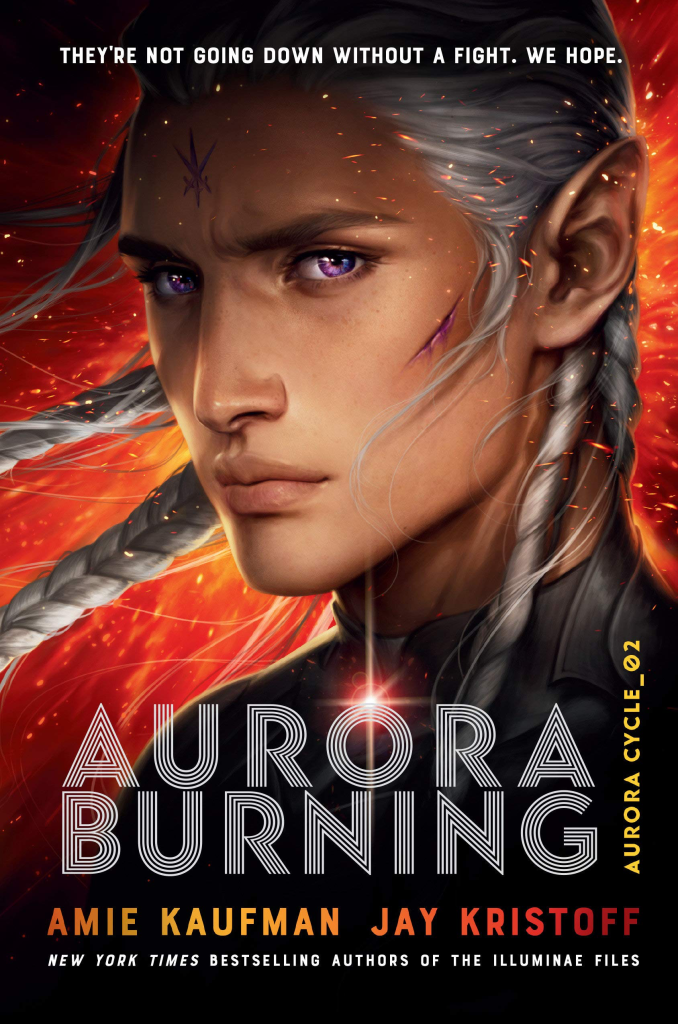
Aurora Burning (Aurora Cycle, #2) – Amie Kaufman and Jay Kristoffno spoilers, but I was distinctly reminded of a certain character after the fallout of a certain reveal near the end of the novel. Ouch.

“Virginia Woolf Underwater” – Chelsea Wolfe

No matter what Chelsea Wolfe album I listen to (you’ll definitely be hearing about her latest next week), it almost always makes me come back to some of the material off of Unknown Rooms. I adore Chelsea Wolfe’s shreddier, overtly goth style, but unfortunately, I drank the sad girl Kool-Aid long ago and I can never come back, so here I am, back at the acoustic album. There’s no doubt that Wolfe can wring out emotion whether or not she’s playing electric or acoustic. She’s at her best when she’s conjuring a swarm of bats from oblivion with a full assault of instrumentals, but the power always lingers. Like my favorite of her songs, “Boyfriend” (also from this album): naught but guitar and Wolfe’s ghostly rasp, it evokes the same rise of power and overwhelming emotion as anything else she’s written. In the end, it all feels cavernous.

“Boyfriend” is plenty bleak, but there’s something about “Virginia Woolf Underwater” that feels so much more so; although it’s just as sparse as any other track on this album, the discordant nature of it all ties the despair of it together, with off-kilter chords punctuated by a tambourine. Only later do the orchestral strings come in, but they feel just as cold as the rest of the song. Alluding to Virginia Woolf’s early death by drowning, the song feels as distorted as voices floating in the water. Wolfe’s voice drifts in and out of focus. The lyrics imagine Woolf’s state: “Everything you’ve owned is gone/Everything you know is wrong/Everyone you’ve loved has left/Everything you’ve touched is dead.” Given Woolf’s struggles with depression and trauma from the second World War towards the end of her life, it’s not a stretch to think that she was thinking thoughts along these lines. That’s what makes the song tragic, but there’s something touching about how Chelsea Wolfe was able to connect to her all these years later, and was moved enough to write her an elegy of sorts. It’s a cross-temporal love letter, a call through the ether to tell not just Woolf that she understands, but for others to relate to and know that they are not alone in their experiences. Only fitting that now, 12 years after the release of Unknown Rooms, that her newest album is titled She Reaches Out To She Reaches Out To She. What better way to sum up Chelsea Wolfe’s brilliant career?

…AND A BOOK TO GO WITH IT:

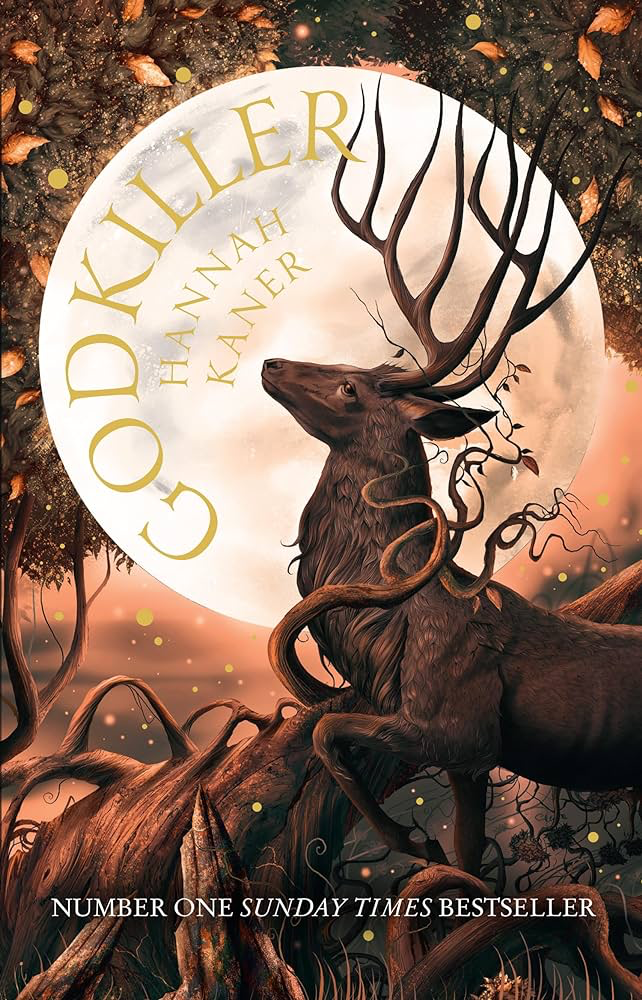
Godkiller (Fallen Gods, #1) – Hannah Kanerthis story similarly begins with Kissen, who has lost everything, and the novel follows her finding her purpose…with some killing gods on the side.

“Floating on a Moment” – Beth Gibbons

I feel like I should be more invested in the fact that Beth Gibbons is releasing a solo album this May. Then again, I still haven’t picked myself up and listened to Dummy, so I feel like that’s the top priority. The only thing keeping me from it is the Sisyphean album bucket list I’ve created for myself, so we’ll see when I get around to it. Soon, given that at least a quarter of it had me in a nearly unbreakable chokehold in early 2022.

“Floating On A Moment” feels further removed from the trip-hop that Portishead was known for, opting for a more stripped-down form. Synths and samples have been exchanged for acoustic guitars and a choir, and the result is slow and gentle, like water trickling from the gutter. Admittedly, I expected something weirder from Gibbons, but I don’t not like this song—it’s good, but it’s not the kind of slow that’s always compelling (that would be Portishead). It’s good when you’re in the moment (no pun intended) and listening to it, but on the outside…I hate to say it, but it feels a little predictable? The fact that it’s track two on Lives Outgrown seems kind of bizarre unless the whole album is going to be this slow, or if it just has a slow start. What’s weirder is that “Floating On A Moment” is centered around the fleeting nature of time and staying in the present, and yet it’s so slow…I guess it could fit with the image of time slipping through your fingers, but this song feels anything but fleeting. If anything, it’s the slow drip of a memory recalled, an alternate reality pondered, a gradual crawl through the recesses of the mind. All that’s to say that this isn’t a bad song. For what it is, “Floating On A Moment” is as gentle as they come, something to have in the background. Again: I hate that I’m saying that about Beth Gibbons, of all people, but we don’t have the whole picture of Lives Outgrown. We’ll see what she’s got up her sleeve.

Even though the pervasion of AI art in music videos is maddening to me (at this point, it’s less about the fact that it’s AI and more that the “style” just looks objectively ugly), the AI elements of the music video for “Floating On A Moment” suit how the song feels; everything melting into a gloopy mess is a hallmark of AI animations at this point, but that kind of melting, combined with the real-life footage of Gibbons, melds surprisingly well with the slick, melting quality of the song.

…AND A BOOK TO GO WITH IT:

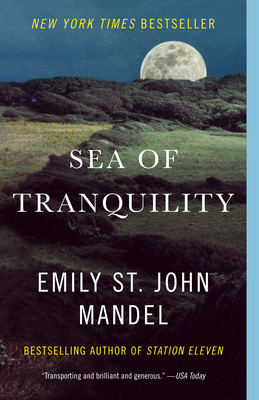
Sea of Tranquility – Emily St. John Mandela quiet and understated but detailed vision of past, present, and future.

Since this post consists entirely of songs, consider all of them to be today’s song.

That’s it for this week’s Sunday Songs! Have a wonderful rest of your day, and take care of yourselves!