
Happy first Sunday of 2024, bibliophiles! I hope the first week of the year has treated you well.
We’re starting off the year with: songs I’ve rediscovered from scattered parts of my childhood, songs that feel like childhood, and more song titles referencing Norway in a single album than anybody bargained for. Certainly not me. Only thought that Kevin Barnes only sprinkled them in three at a time.
Enjoy this week’s songs!
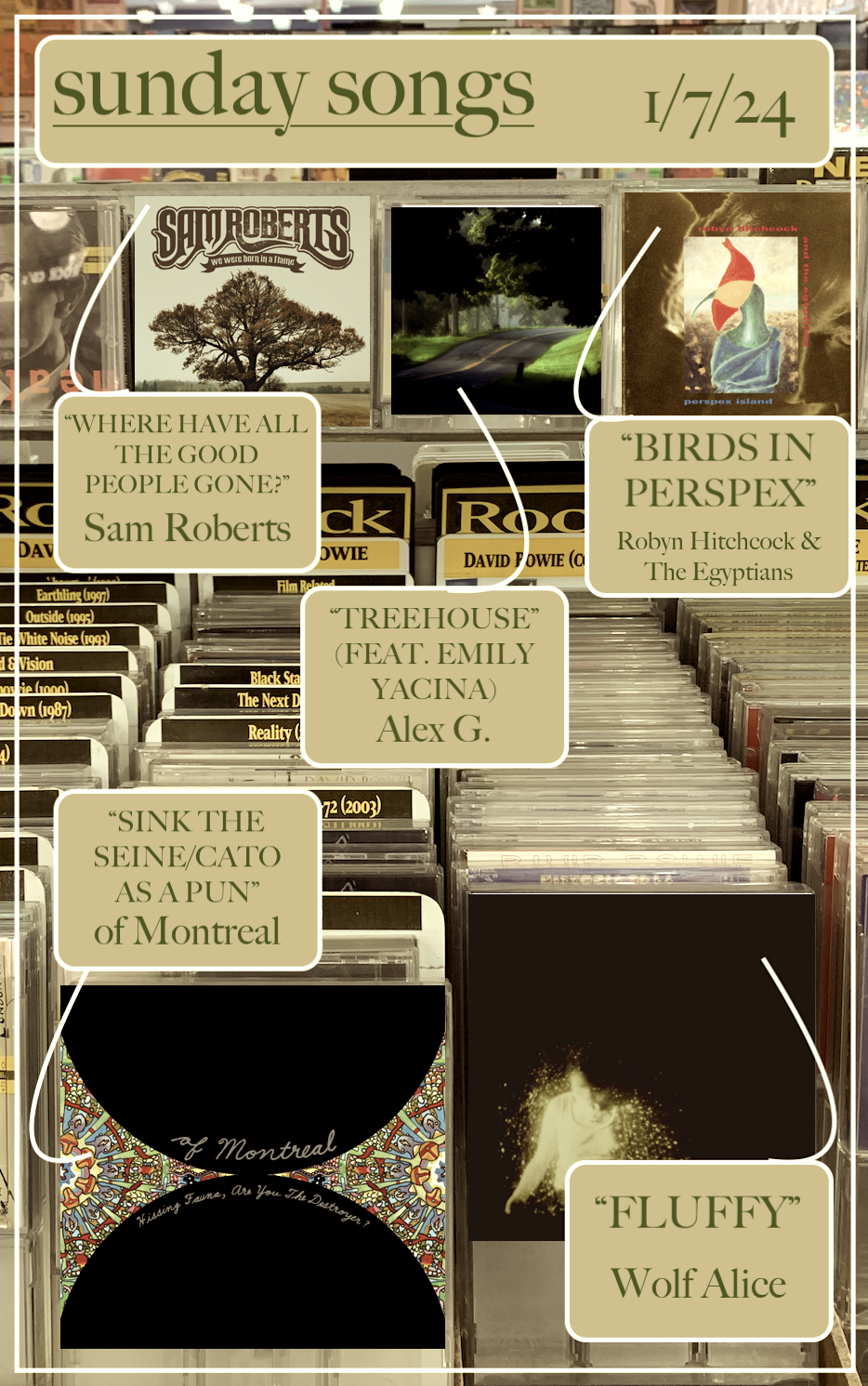
SUNDAY SONGS: 1/7/24
“Sink the Seine/Cato as a Pun” – of Montreal
I don’t know how it took me this long to listen to Hissing Fauna, Are You the Destroyer? given how much of Montreal dominated my taste in my freshman year of high school. Chances are it’s because Radiohead came along shortly after and I never recovered, but it’s still taken me an embarrassingly long time to come back to this album in its entirety. And yes, it’s pretentious as all get out—the album (as well as anything from of Montreal’s catalogue) is full of songs with titles like “Heimdalsgate Like a Promethean Curse,” “A Sentence of Sorts in Kongsvinger” and “We Were Born Mutants Again with Leafling.” (There is a song that’s over 10 minutes long in the mix, how’d you guess?) But aside from the in-built pro that you don’t need to put “of Montreal” after the song titles when you google them (I’d be hard-pressed to find another, completely original song called “Labyrinthian Pomp”), it’s pretentiousness that I can indulge in; there’s no denying that Kevin Barnes is showing off their literary/historical/etc. chops, but it’s both so clever and so catchy that there’s no denying the goodness in it.
Even within an album where almost every title warrants English class-level analysis (and then turns out to be not that deep half the time), there’s always time to dance. (Go back to “Heimdalsgate” and “Sentence.”) If there’s anything that Barnes has mastered in their prolific career, it’s how to make any kind of crisis catchy, be it religious, romantic, existential, or otherwise. I’ve lumped “Sink the Seine” and “Cato as a Pun” together because they’re essentially the same song, but I don’t mean that in a derogatory way at all—although the album is made so that each song smoothly transitions into the other, the brevity of “Sink the Seine” and the underlying themes that bleed into “Cato as a Pun” make it a very singular narrative within the plentiful dirty laundry aired in Hissing Fauna. “Sink the Seine” starts out with an almost fawn-voiced Barnes searching for the person they once knew after distance has grown between them—I’m assuming the Seine they’re referring to is the river, but there’s a desperate drowning that they’re at first willing to do—the impossible task of sinking a river in their quest to find the past in a present form. But by the time “Cato as a Pun” rolls around—and, contrary to the people arguing on lyric websites here and there, is apparently just referring to someone’s cat named Cato—it’s much more bitter and up-front; now, the desperation has grown into wanting this person to “play with [their] head” just to obscure the fact that so much of a gulf has grown between them. Barnes has frequent, literary bangers when it comes to their usually purple prose-y lyrics, but there’s no denying that their talent is no less evident in their undressed lyrics—”What has happened to you and I?/And don’t say that I have changed/’Cause man, of course I have.” Efficacy in getting your message across isn’t a one-way street—just ask Kevin.
…AND A BOOK TO GO WITH IT:
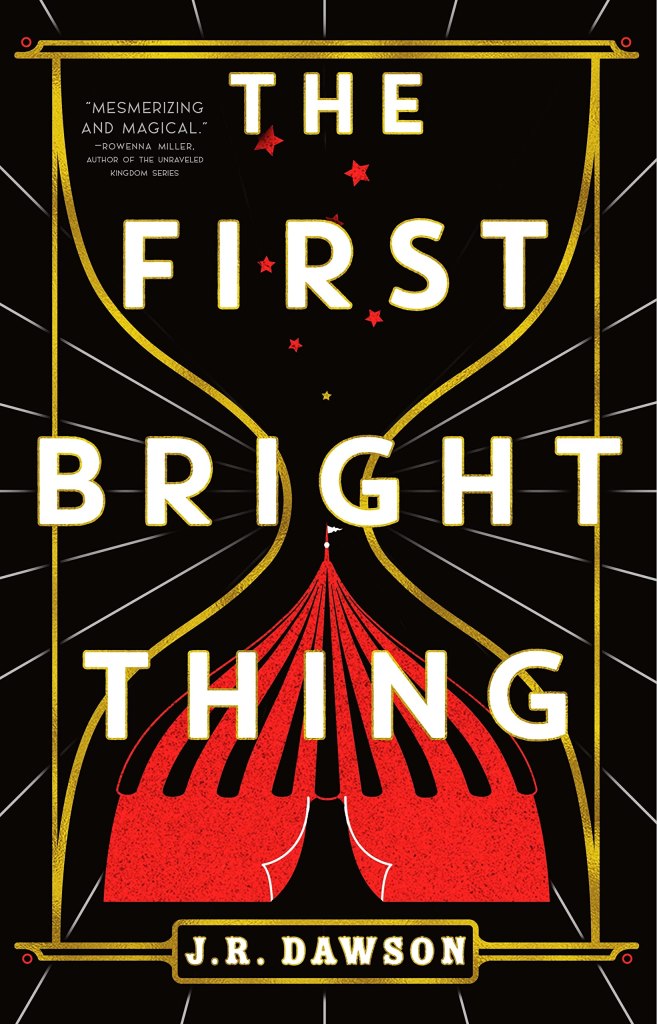
The First Bright Thing – J.R. Dawson – both of these songs combined bring the complicated relationship between the Ringmaster and the Circus King in this novel—especially the distance and plentiful mind games.
Nothing like a neutered cat to inspire a song, huh? Or at least the video, at any rate…either way, it’s funny. Pour one out for poor old Fluffy.
I may not be a fan of pop-punk (why does it even exist? It’s like they just said “let’s make punk commercial, even though that’s exactly what punk isn’t supposed to be”), but I’m still a sucker for a loud, screamy song about recklessness and breaking away from the mold. It’s the kind of music that makes for good additions to character playlists. This one’s gonna wind up on one of mine someday, mark my words. Up until this point, my introduction to Wolf Alice was through what seems to be the more disparate ends of their musical spectrum; way back in middle school, I got attached to their indie friendship anthem “Bros” through the radio (and what a joy it was to hear it again in season 2 of Heartstopper), and a few years back, I heard the much more refined, but heavier “Smile,” from their most recent album, Blue Weekend. “Fluffy” is on the heavier side, for the most part, and it feels like one of the better takes on the age-old “I wanna get out of this town” song (see again: pop-punk). It’s got none of the whine that usually comes along with the subject matter, and the jagged, bitter bite that it was missing all along. You really do feel like this song was born in a dilapidated junkyard, or even the rusty back alley that parts of the music video were filmed in. If anyone else did the sarcastic shout of “Sixteen/so sweet!” in the chorus, I’d roll my eyes without a doubt, but Ellie Rowsell gives it the raspy, pent-up rage that many a musician has been going for. And there’s nothing like pounding, crunchy guitars to accompany that. This is angst done right, for sure.
…AND A BOOK TO GO WITH IT:
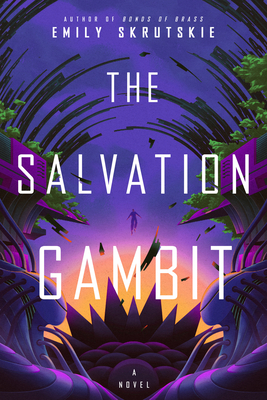
The Salvation Gambit – Emily Skrutskie – the thrill-seeking lyrics, combined with all those crunching guitars, are the perfect fit for Murdock, this novel’s fiery protagonist, in both the past and the present.
“Where Have All The Good People Gone?” – Sam Roberts
Here’s another one I have to thank my dad for—somehow, I find myself missing this song, even though it’s finally in my ears after going so long without hearing it.
“Where Have All The Good People Gone?” was a distant drifter in my childhood—I swear that I have a memory gathering cobwebs in the back of my mind of hearing this song playing from the speaker on our old TV, back when we played our music from my parents’ chunky iPod. And I feel like even if I had known Sam Roberts’ name (and the name of this song) beforehand, I wouldn’t have thought anything of it. Poor dude’s cursed with one of the ultimate “just some guy” names aside from…I dunno, John Smith? When you google his name, this particular Sam Roberts, as far as his solo career is concerned, doesn’t show up until the 5th link. (At least his Sam Roberts Band shows up first. There’s that. Then it’s mostly a radio personality named Sam Roberts??) But it seems like he has plenty of acclaim in his native Canada, so I guess we Americans are most of the ones scratching our heads to try and come up with his name. Even this song didn’t pop out to me as familiar until I heard him sing the chorus—”where have all the good people gone?” And then it clicked. Random childhood memory that I didn’t even know that I’d stored: accessed. Elvis Costello was the comparison that immediately came to mind—it certainly has a much more distinctly 2000’s indie/folk-rock flavor, but lyrics like “Oh, the Milky Way/Has gone a little sour/The leaves dried and the flower fell away” or “The modern world is a cold, cold world/And all I meet are cold, cold girls” (maybe you’re the problem? Kidding, but…) just reek of that practiced tightness that Costello represents for me. But as opposed to the smart suits and sunglasses of Costello (or…the green shirts, even),”Where Have All The Good People Gone?” is all stomping boots, jean jackets, and patches of dust, and not in the country pastiche kind of way. It has no trouble feeling exactly how it wants to feel.
…AND A BOOK TO GO WITH IT:
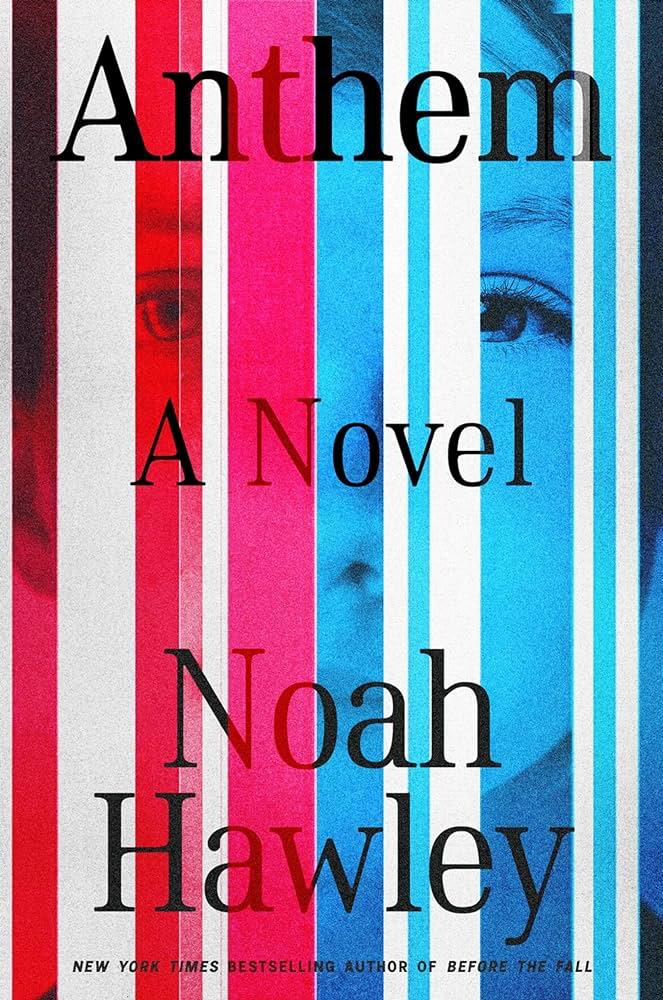
Anthem – Noah Hawley – this book is decidedly leagues more bleak and fatalistic than Sam Roberts seems to be, but at its core, it asks the same question: where have all the good people gone?
“Treehouse” (feat. Emily Yacina) – Alex G.
Somehow, this didn’t surface in the weeklong period in early 2020 where I ferreted through a few Alex G songs on a whim and then forgot about him. He’d always been a specter on my Apple Music—every time I went back to Car Seat Headrest, he was always lurking there in the “similar artists” bar. What I’ve listened to of his sort of gleans that comparison, but from the looks of it, his earlier stuff seems more reminiscent of Car Seat Headrest. Thus why I’m almost a little scared to get in too deep with his music, after the irreparable change in my brain chemistry that happened when I first heard “Drunk Drivers/Killer Whales” on the radio when I was 13. I’m an adult now, I doubt I can have that kind of pure, concentrated angst keeling me over without major consequences…
Yet in spite of all that, this song is one of the most calmingly innocent things I’ve encountered in the past few months. I don’t know how much of it is because Alex G himself isn’t fully at the wheel—all of the vocals are sung by Emily Yacina, and from my limited scope of Alex G, I feel like his flat, indie drawl doesn’t quite fit with the playful, childlike quality of this song, but I guess he recognized that enough to put this song in Yacina’s hands. Somehow, the bedroom construction of this song—nothing but synths and drums machines—distorts Yacina’s voice in such a way that she sounds like she has braces, which makes the song feel even more like a vignette of childhood—”What do you think of my treehouse?/It’s where I sit and talk really loud/Usually, I’m all by myself.” It makes me feel like there should be a slightly off-putting Tim Burton character (probably voiced by Winona Ryder) inviting you into her treehouse and playing games with you; it’s easy to get the feeling that the character in the song is eager to have any kind of friendship. It’s pure, but never in a saccharine way—it’s like someone put some footage from a home video into song, just kids running off into the woods and playing with sticks.
…AND A BOOK TO GO WITH IT:
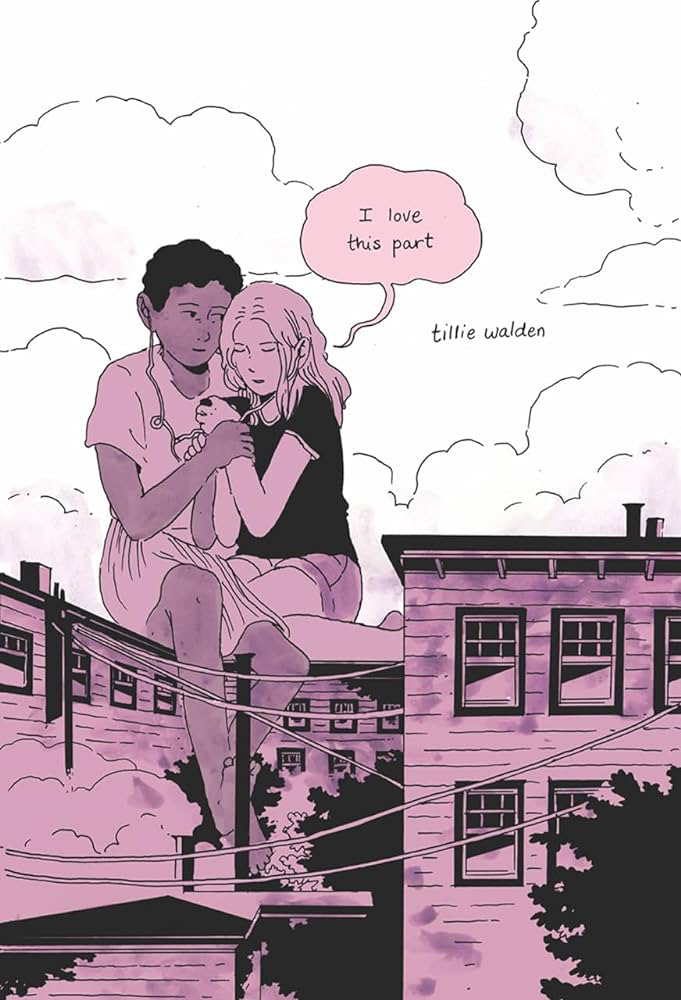
I love this part – Tillie Walden – like Jay Som, Tillie Walden’s style of beauty in simplicity lends itself to this kind of doe-eyed bedroom pop.
“Birds in Perspex” – Robyn Hitchcock and the Egyptians
I’m not about to rescind my statement about how of Montreal’s quirky song titles make them much easier to search on YouTube, but they’re not the only ones. Again, I ask: who else has made a completely original song called “Birds in Perspex”?
Over the past few months, I’ve been picking up Robyn Hitchcock songs here and there in an attempt to school myself before I see him at the end of the month (!!). Most of what I end up skimming around, save for his more recent material (he’s been consistently cranking out music with various bands and as a solo artist since the ’70s…absolutely prolific king), ends up turning up as some nostalgic tidbit from my childhood that I’d entirely forgotten about. Riffling about his catalogue almost feels like I did when I was a kid looking for bugs in the yard—there’s something odd and wonderful hidden under every rock. Take “Birds in Perspex.” I clicked on it on iTunes just because of the oddball title, but I didn’t expect for the full force of miscellaneous childhood car rides to come speeding back at me. Like my faint recollection of “Tender” before I heard it again in high school (for at least a decade, all I remembered was the “come on, come on, come on/get through it” part), the tiniest slice of the chorus had been bonking around in my head on and off for years—I recognized “Birds in Perspex” the minute I heard “come alive” in the chorus. Just like most of his songs, there’s a charmer’s whimsy about it that, it seems, has never faded with age; behind the glossy, folky strumming, Hitchcock immediately admits that “Well I take off my clothes with you/But I’m not naked underneath/I was born with trousers on.” Y’know. Just another day at the office. Presumably after a rather eventful encounter with Balloon Man. As the song goes on, it’s so bizarrely romantic that you feel like you’d be seduced if he’d written this song about you. Robyn Hitchcock has the kind of voice fit for a black turtleneck. a cigarette, and love notes stuffed with rose petals, but I’m honestly so much more glad that he stuck with his whimsical weirdo style.
…AND A BOOK TO GO WITH IT:
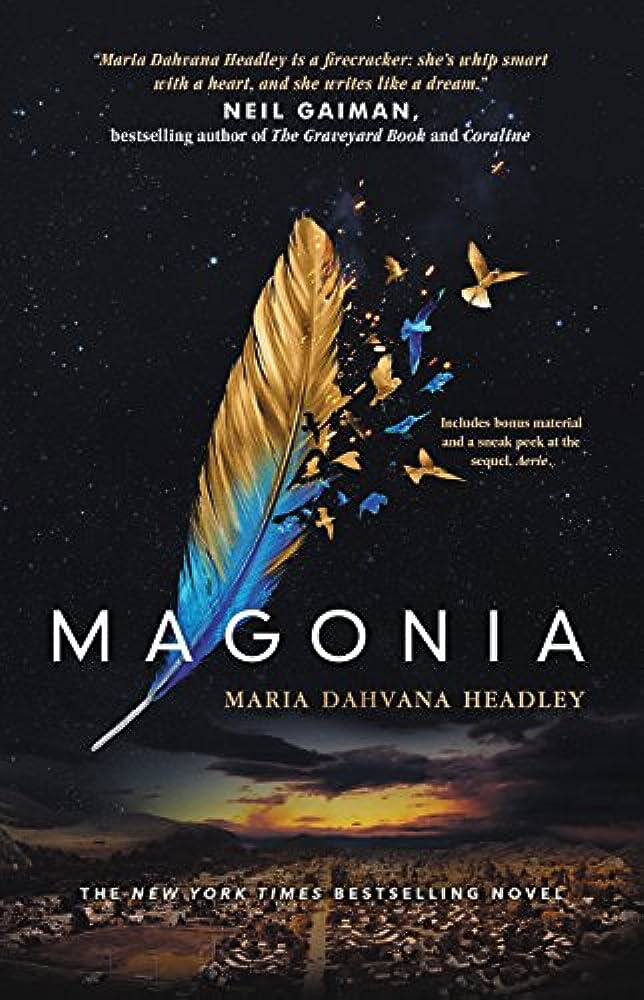
Magonia – Maria Dahvana Headley – an equal amount of confident weirdness and birds to Hitchcock and co. Also, giant bats.
Since this post consists entirely of songs, consider all of them to be today’s song.
That’s it for this week’s Sunday Songs! Have a wonderful rest of your day, and take care of yourselves!


 The Bookish Mutant