

Happy Tuesday, bibliophiles!
Continuing with Latine Heritage Month, here’s a novel that came on my radar last year when it was released. Literary fiction isn’t my go-to, but I do love some magical realism sprinkled in, so I was interested. What resulted was something deeply impacting. The Volcano Daughters pulls no punches, and yet cares so deeply for its protagonists—and for everyone whose voice is silenced.
Enjoy this week’s review!
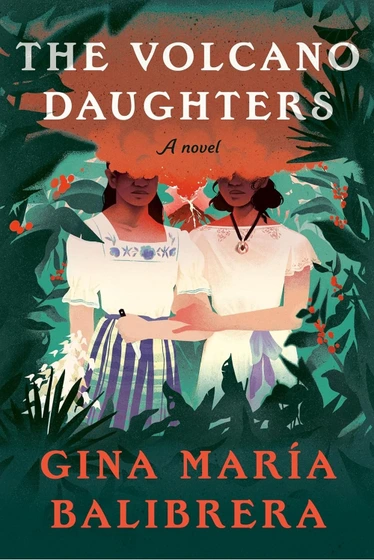
The Volcano Daughters – Gina María Balibrera
Graciela grew up in El Salvador, among their family of Indigenous women. But when the cronies of a rising dictator steal her away to be his oracle, she’s torn away from everything she knows and loves. In the dictator’s palace, she meets Consuelo, her stolen sister who is also indentured in the palace, made to sit by as the government dabbles in faulty magic and formulates a plan to commit genocide on her Indigenous community. Now young women, Consuelo and Graciela free for their lives, both thinking the other dead.
Darting between America and France, Consuelo and Graciela fight to forge new lives for themselves. But can they ever leave the past behind—or each other?
TW/CW: rape, genocide, colonialism/imperialism themes, racism, misogyny, miscarriage, violence, murder, deportation/kidnapping
My main gripe with literary fiction at large is that it’s a breeding ground for novels that are unrealistically miserable in the thought that misery and depression automatically make it “deep.” I’ve read enough of said books and been in fiction workshops long enough that just the thought of sadness being equated to depth makes me want to throw up in my mouth. Is The Volcano Daughters a sad, literary novel? Yes. And yet the sadness is there to tell a powerful story, not just to sell. It’s the story of silenced women, but also a story of resilience and sisterhood and so much more. It’s what literary fiction should be.
After this novel, I’m sure I’ll read more from Gina María Balibrera, but…god, in the right headspace, for sure. The Volcano Daughters is a heavy novel, and for good reason. I didn’t put these trigger warnings there lightly. But Balibrera’s prose is seriously something to behold. Just as Consuelo and Graciela view the world through the lens of artists, so too does Balibrera. Every detail is truly luscious; the many places that The Volcano Daughters travels through are realized in such vivid detail that I swear I could almost smell the air. No stone is unturned, and no metaphor is treated lightly—Balibrera puts even the most minor details under a microscope and crafts them into the most lush language, almost bordering on poetry in the more metaphorical moments.
There’s something so special about the way that Balibrera treats Consuelo and Graciela as characters. I hesitate to call them fully tragic characters, but their lives are largely dictated by one tragedy after another. Yet no matter what happened to them, I always sensed that Balibrera would have something waiting for them at the end. It wasn’t an ending that was tied up with a nice bow, but it was a speckle of hope on the horizon. They were still suffering, but their justice was just out of reach, but still visible. Had she gone too far in one direction, it would’ve felt like needless plot armor, especially in the climate(s) that Consuelo and Graciela lived in; too far in the other, and it would’ve strayed into trauma porn territory. Balibrera treats her characters in the most realistic and yet the most caring way; though they have endured so much and have so much more to endure, she makes you cling to that sliver of hope, gives you glimpses of incremental lives that they might live in a few years’ time, because it is all that is left. As somber of a book as this is, I did appreciate that there was a very tangible inkling of better days to come.
What seems to hook most readers about The Volcano Daughters is the ghosts, which…yeah, that’s what hooked me too. But it’s one of the most original and compelling aspects of this book; in between the present narrative, the story has frequently interjections from four ghosts: Consuelo and Graciela’s other sisters who were murdered during the genocide. Like the other characters in this novel, they’re so vibrant and full of sass and wisdom in equal measure. Their role is often to come in and drag the reader back to the embarrassing reality when somebody’s inner monologue gets too self-absorbed or when someone’s telling the story wrong. (Nobody can quite agree what’s really right, and that’s what makes them so funny.) At times, the humor didn’t quite land (I found it hard to believe that a ghost who got killed in the ’30s would use “Boom!” as an exclamation like it’s the 2010’s), but they all had such distinct voices that I could almost let it slide. Yet they are also there to be incorporeal forces of justice, metaphysical representations of the voiceless, the forgotten of history who have been brushed aside. They are the deliverers of the justice they never got, and they form the emotional backbone of The Volcano Daughters.
The part that the ghosts emphasize for me is how Balibrera examines the theme of storytelling and whose stories are told—and the power structures that ensure that some stories are either untold or told incorrectly. Names are deeply important: every murdered Indigenous woman is given a specific name, whereas the dictator of El Salvador is only referred to as “El Gran Pendejo”; similarly, El Gran Pendejo’s entire regime operates on stories, ones that are told to reinforce a racist narrative. Graciela acts out stories about marginalized people in order to further the United States’ racist stereotypes of various groups. And yet here are the ghosts, who take the story into their own hands to deliver the complicated, messy, yet real narrative. The ghosts are there to be the voice of every marginalized person who has ever been deliberately erased from history, every marginalized person who has had to bear the pain of having their history warped and their country slandered. Both the ghosts and the central sisters are stars of the novel because they are precisely the kind of people that history forgets. The Volcano Daughters tells us that history surrounds us—and that there will always be someone to tell the truth.
Overall, a deeply moving and emotional novel of sisterhood and distance that serves as a righteous megaphone for those who have had their voices stolen. 4 stars!
The Volcano Daughters is a standalone and Gina María Balibrera’s debut novel.
Today’s song:
That’s it for this week’s Book Review Tuesday! Have a wonderful rest of your day, and take care of yourselves!

 The Bookish Mutant