Posted in Book Review Tuesday

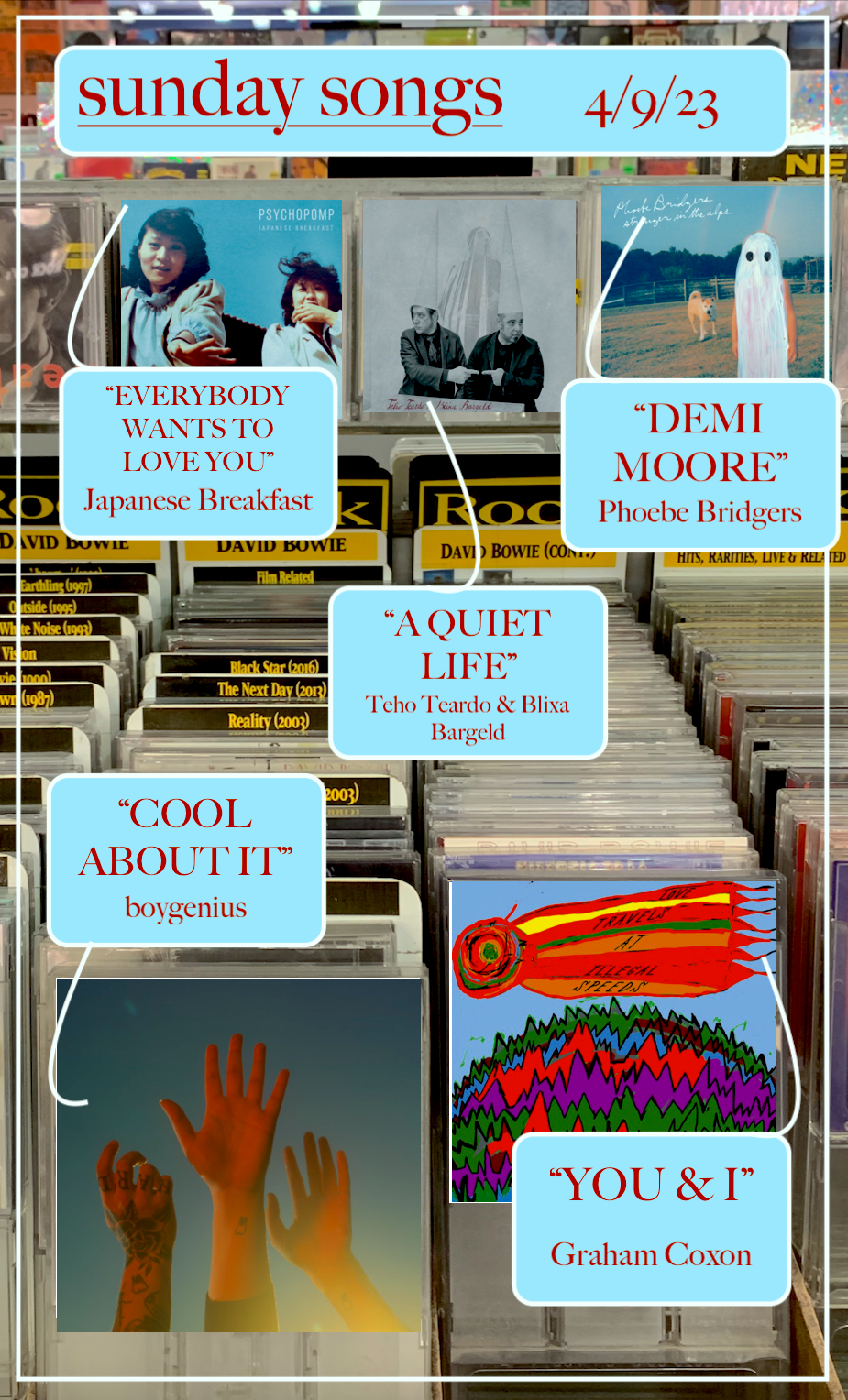
Sunday Songs: 7/20/25

Happy Sunday, bibliophiles! I hope this week has treated you well.

This week: I get more heated than I ever expected to be about Edvard Grieg, my middle school sad bastard music comes out of its cave, and, uh…what’s that? LOVE SHACK, BABY! More at 6.

Enjoy this week’s songs!
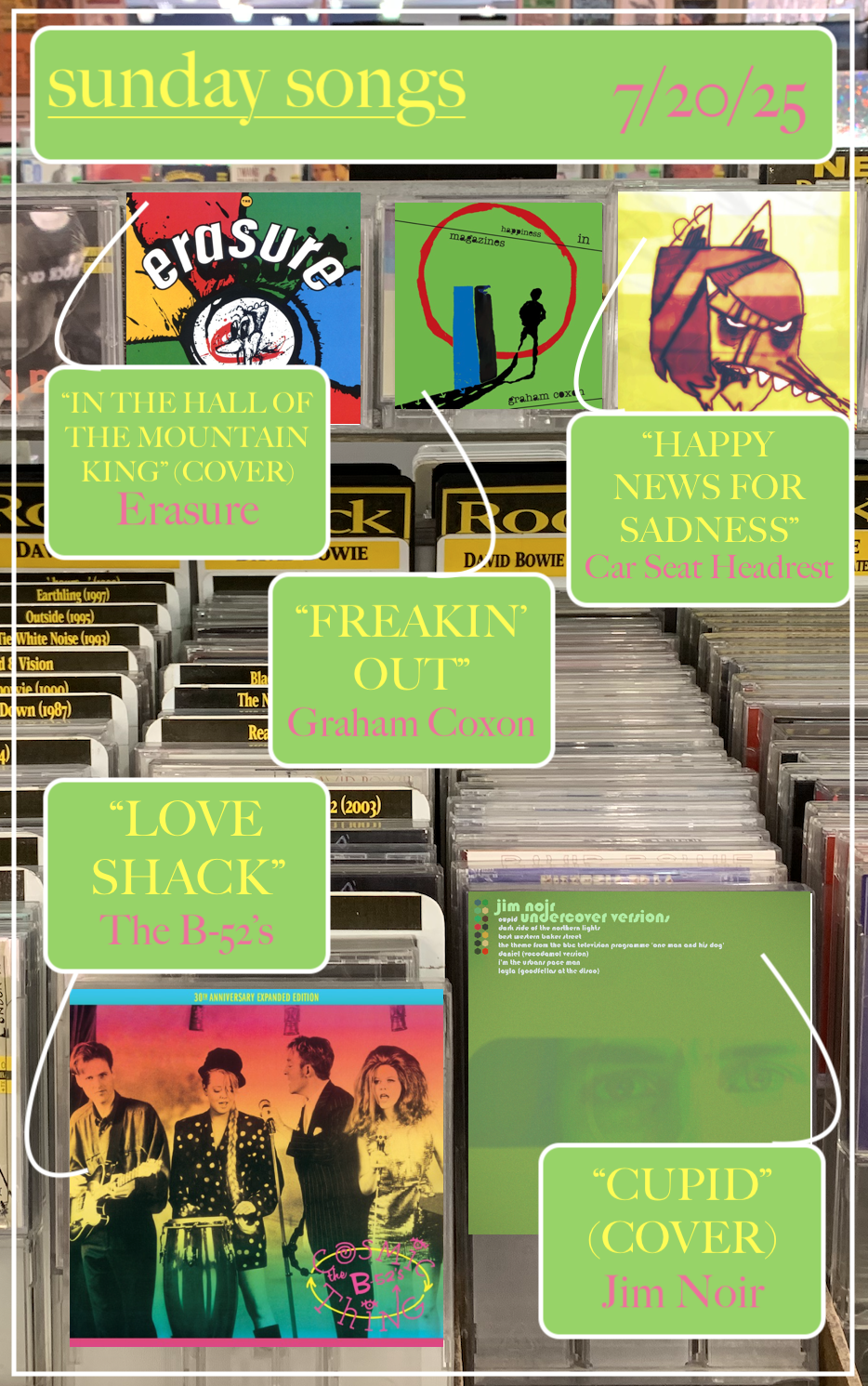
SUNDAY SONGS: 7/20/25

“Love Shack” – The B-52’s

This one came late because of, once again, my insistence on sticking to these (loose) color palettes. But god, I was having a blast listening to this on repeat during Pride Month. I couldn’t go to any pride parades or anything because of a) preexisting plans and b) it was, quite literally, as hot as an oven. But the amount of times I listened to “Love Shack” honestly made up for it.

Sure, this isn’t nearly as weird as some of The B-52s’ other songs—in fact, it’s probably their most accessible song—but it really is fitting as one of their signature songs. The pop joy isn’t just a product of them being upbeat for airplay—it really was a triumphant moment for them, their comeback after tragedy struck the band in 1985 after the death of Ricky Wilson from AIDS-related complications. It was them coming back from the brink and declaring that in spite of tragedy, they would stick to their mission of bringing gleefully weird pop music to the world. It’s a catchy pop song, sure, but it was also a commitment to celebrate togetherness in spite of the greatest hardship a band could possibly endure. And for a song that’s mainly just remembered as the product of a particularly weird party band, that’s such a beautiful legacy to leave. But beyond that…oh my god, it’s just so camp. It’s just so fun! How can you not grin constantly when you hear this song? Fred Schneider’s just being Fred Schneider, Kate Pierson and Cindy Wilson are producing some of the best harmonies in pop music, and the whole “bang, bang, bang, on the door, baby” bridge? Who ISN’T shivering with antici……..pation at that? (And yes, that is RuPaul right there at 2:03 in the music video, as if this song couldn’t get any queerer.) I’m tempted to dismiss my instincts to get all women and gender studies with it about “Love Shack,” but if this isn’t queer joy—coming together in the face of a widespread tragedy that affected the LGBTQ+ community so fundamentally—then what is? LOVE SHACK, BABY!

…AND A BOOK TO GO WITH IT:
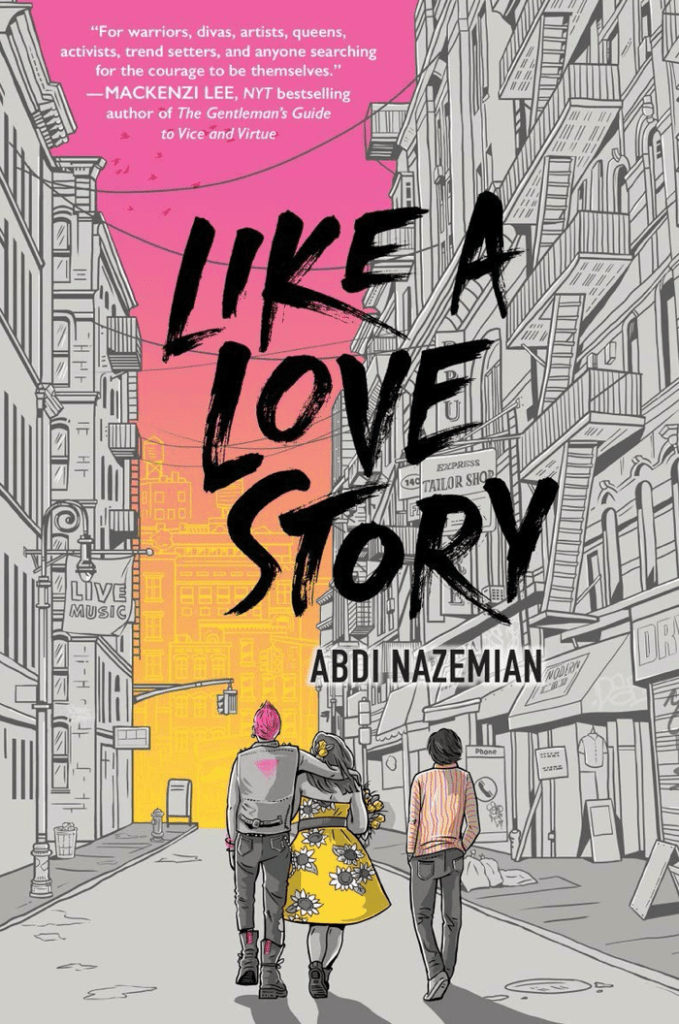
Like a Love Story – Abdi NazemianThe B-52’s aren’t the focus of this book (Madonna is, though), but this novel is set in 1989—the same year “Love Shack” was released—and centers around similar themes of queer identity and togetherness in the face of tragedy.

“Cupid” (Sam Cooke cover) – Jim Noir

While we all wait for Jimmy’s Show 2 to come out, Jim Noir has released an EP of covers, available on his Patreon! (It also includes a mashup of Pink Floyd’s “Breathe” and Super Furry Animals’ “Northern Lites,” which is pretty amazing.) He posted this cover of Sam Cooke’s “Cupid” several months before hand, and I lamented that he hadn’t made it available for release, because unexpectedly, it was perfectly suited for him. Jim Noir’s music is full of ’60s influences, but until now, I mostly thought it was reserved for bands like The Beatles or the Beach Boys, which more readily come through in his sunnier, twinklier melodies. I should’ve known how easily that would translate to another part of the ’60s—Sam Cooke’s classic love song. It’s hard to touch any of his songs for me, not necessarily because they hold a particularly special place in my heart, but because they’re so ubiquitously him—Cooke’s songs have a quality about them that make them feel fully-formed, able to be made by nobody but him. The key to Jim Noir’s success with the cover is that he doesn’t overdo it—he’s just Jim Noir, not Sam Cooke. It’s an understated cover, but that quality makes it more intimate and calming to me—there’s a soothing quality about it, from his harmonies to the soft background strings. That’s what makes it such a genius cover—Jim’s not being anyone but him, but staying true to the spirit of the original.

…AND A BOOK TO GO WITH IT:
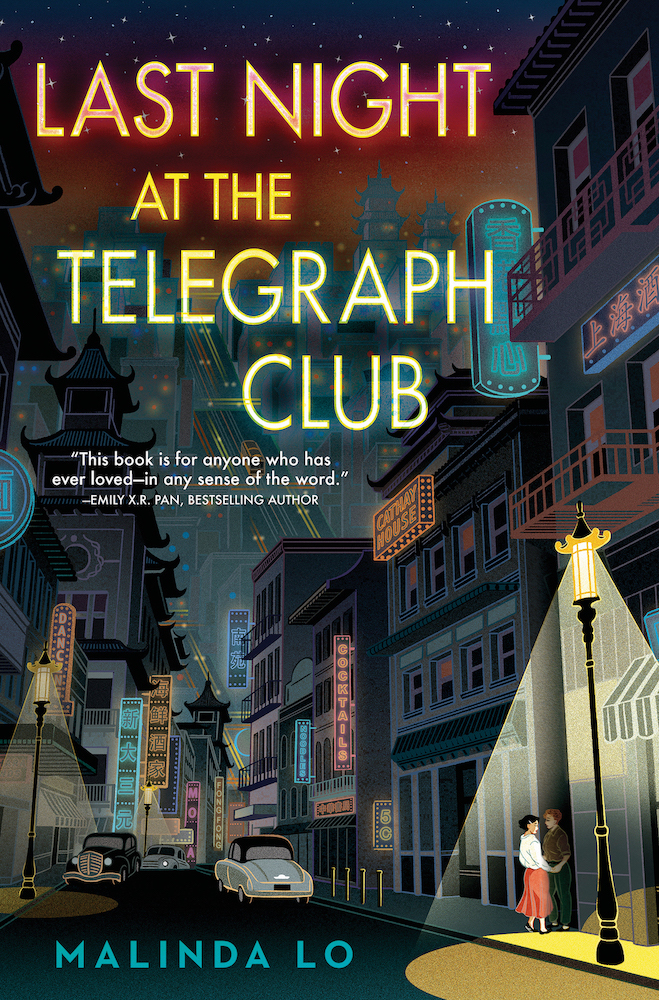
Last Night at the Telegraph Club – Malinda LoI’m a few years off as far as the dates go, but give it a few years, and this would fit right in with the more tender, quiet moments of this novel.

“In The Hall of the Mountain King” (Edvard Grieg cover) – Erasure

I had no idea that this existed until a few days ago, and y’know what? It’s an absolutely wild pairing as far as covers go, but trust me, it sounds exactly how you’d picture it sounding. It’s just “In The Hall of the Mountain King” done entirely with synths. I do enjoy it, but I feel like it betrays the original song in a key way. The thing that most people remember about “In The Hall of the Mountain King” is that point (you know the one) where it goes absolutely, truly, off-the-wall bonkers, like they crammed chaos incarnate into whatever concert hall it was performed in. It’s about the gradual buildup!! The payoff!! It feels like a whole pack of firecrackers going off and ricocheting off the walls!! And Erasure…barely sped up the tempo? Which is a crazy move to pull when covering this…like, how does one cover “In The Hall of the Mountain King” and not go fucking nuts with it? You do you, Erasure, I guess, but…man, you already pulled the move of putting an Edvard Grieg cover as a bonus track, might as well go crazy with it!!

…AND A BOOK TO GO WITH IT:
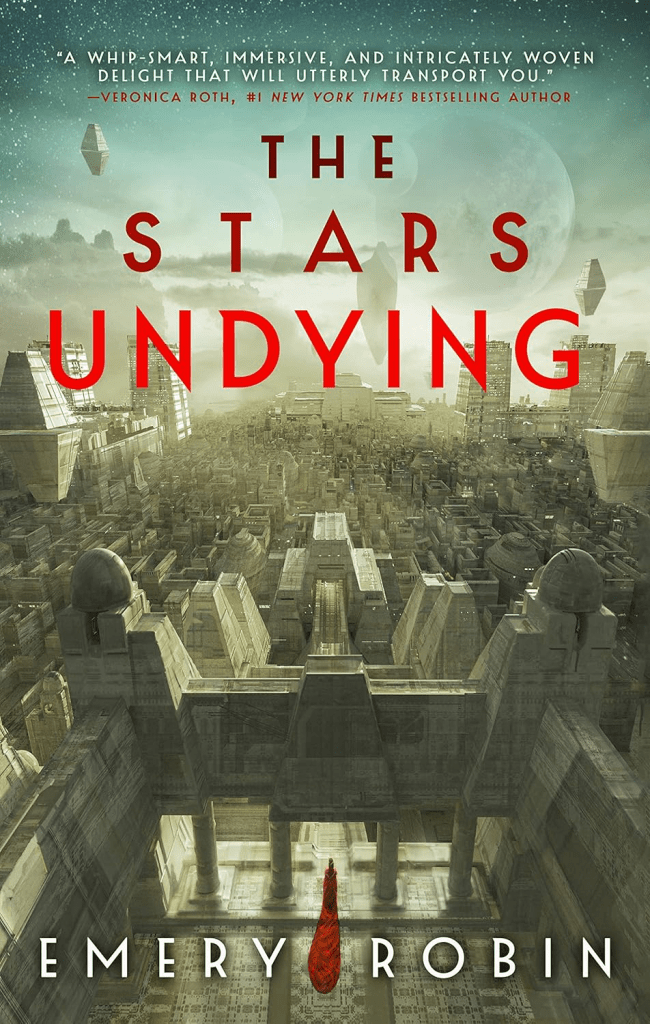
The Stars Undying – Emery Robin…kinda hard to recommend a book to pair with a synth cover of classical music, but, uh…how about a sci-fi retelling based on the stories of Cleopatra and Julius Caesar? Will that suffice? Help me out here…

“Freakin’ Out” – Graham Coxon

So here’s what Graham Coxon was doing all that time when Blur was making Think Tank, which was…doing exactly what was barely on Think Tank: guitar freakouts (no pun intended). While his former bandmates were reveling in some of the more experimental sides of their musical taste and abilities, Coxon was sticking to what he loved and did best. Part of why I got so attached to Blur was his propulsive guitar playing, whether it was his bright, chugging melodies on Parklife or the darker, grungier sounds of their self-titled album or 13. “Freakin’ Out” isn’t his lyrically strongest song, but it’s got this driving, punk-inspired beat that never lets you go. Of course, in true Graham Coxon, he’s in a suit and glasses while playing all this—Weezer who? If there’s anything that Graham Coxon has committed to in the last few decades, after spending time with Blur during the height of Britpop and being pressured to conform to pop music standards, it’s being nothing but himself. We’re all better for him being a quiet, introspective person playing loud, upfront music.

…AND A BOOK TO GO WITH IT:
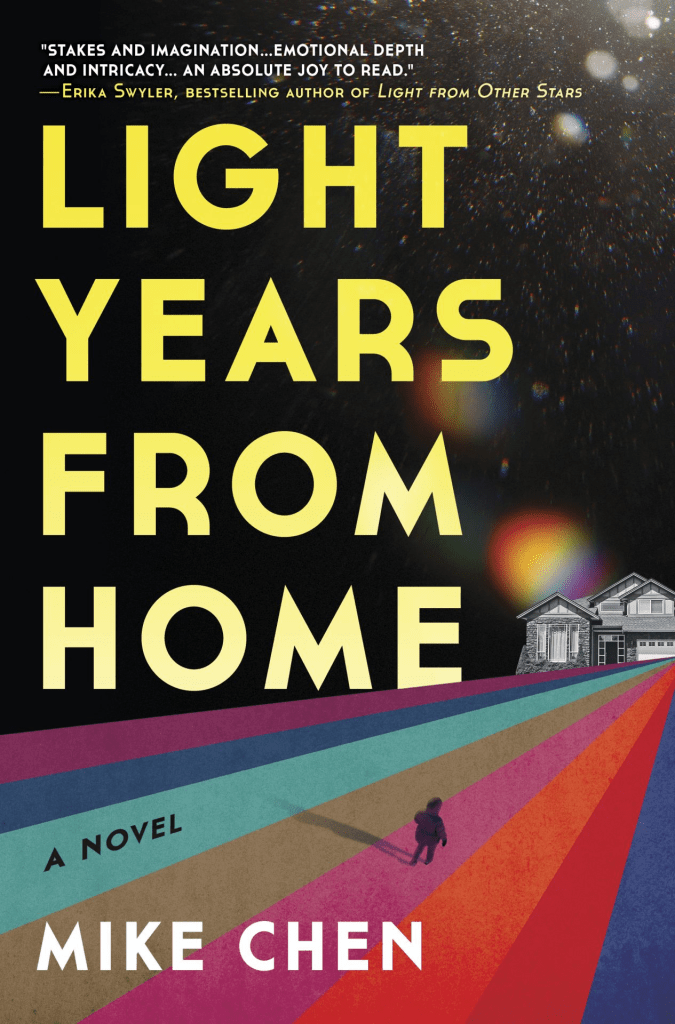
Light Years from Home – Mike Chen“Nothing to be, nothing to fear/Nothing to prove, nothing to say/Nothing to lose, nothing to gain/Nothing to feel, nothing to hate/Nothing is real, it’s all too late…”

“Happy News for Sadness” – Car Seat Headrest

The Car Seat Headrest I saw when I was 14 was a very different Car Seat Headrest than the one I saw last week. At one point in the show, Will Toledo opened up about how he didn’t like playing some of his older material, particularly that from Teens of Denial, because he was, as he said, “an angry young man of 23.” It struck me as so humble that he’s willing to admit that he’d moved on from that anger and strife and that he was committed to being in a stabler, happier place in his life. Teens of Denial remains one of my favorite albums of all time, an album that was at my side at my most lost and confused moments when I was a young teenager. Sure, I would’ve loved to hear “Cosmic Hero” (if not just to replace my video from 2018 where my off-key screeching drowned out the actual song) or something, but I’m happy that Will Toledo’s happy. And all of this was the preface for “Drunk Drivers/Killer Whales,” which he played to a crowd that knew all the words. Myself included. It was one of those nights where I could feel my younger self peering out from my chest, wiping the smudge away from her glasses, and dancing. I felt her dancing with me. I danced as hard as I could that night. It’s one of those times where a concert has felt, more than anything, like a warm hug, a reassurance across time to that little girl that she would be okay.

Car Seat Headrest has a notoriously rabid fanbase, small but mighty, the kind of people who’d unironically go up to you and say something like “Oh, you haven’t listened to the absolutely crusty-sounding old recordings he put out on Bandcamp and labeled ‘just awful shit?’ Fuckin’ poser!” And…yeah, with the kind of discography that Will Toledo has, it does lend itself to the kind of Charlie Kelly conspiracy theory board types. But the other side of that coin is that you get people who will ardently do the wave to a song that’s only available on Patreon. And that’s what made the show so riotously fun—the fervor of the fans for songs old and new, whether it was the stirring intro of “CCF (I’m Gonna Stay With You)” or the extended medley of older songs. (I’ll admit to being awakened like a sleeper agent when they started playing “Something Soon.”)

“Happy News for Sadness” was one of the excerpts from medley of older songs that they did for the encore, one that somehow escaped my unending curiosity when I was in middle school. I’d already found “No Passion” and “Sunburned Shirts,” so who knows how this slipped through my fingers. I feel like it might’ve been for the best, because I have a feeling that earsplitting, lower-than-lo-fi “BWEEEEEEEEEEEEEEEEEEEARGH” at 1:52 would’ve killed my headphones. “Happy News For Sadness” is as clear a glimpse into the sadder, angrier young man that defined much of Will Toledo’s career—the central chorus of “You can never tell the truth/But you can tell something that sounds like it” speaks to a lingering depression that’s been ever-present throughout his catalogue. Meandering through malaise and expired food doesn’t seem like something Toledo would revisit, given the speech he gave about Teens of Denial, but the fact that he’s able to reconcile with different eras of his own art in different ways feels like a mode of communication with the past. His songwriting was his way of telling the truth, and that truth resonated with so many people. To bridge that connection, to be able to look back and sing altered versions of the same song, is likely his way of making peace with it. Healing that younger part of yourself is different with each angle you tackle it from, but committing to that seems to be Toledo’s ongoing mission. I’m just lucky to be able to heal along with him and alongside hundreds of people.

…AND A BOOK TO GO WITH IT:

The Bad Ones – Melissa Albert“Nobody cares about/(But I’m still ugly on the inside)/Your life and the people in it/(But I’m still ugly on the inside)/So you can stop telling me it gets better…”

Since this post consists entirely of songs, consider all of them to be today’s song.

That’s it for this week’s Sunday Songs! Have a wonderful rest of your day, and take care of yourselves!

Posted in Sunday Songs

Sunday Songs: 5/19/24

Happy Sunday, bibliophiles! I hope this week has treated you well.

This week: in addition to my blue and black/white/gray periods, it’s become increasingly obvious that I also have a green period. On another note, food processors are great!

Enjoy this week’s songs!

SUNDAY SONGS: 5/19/24

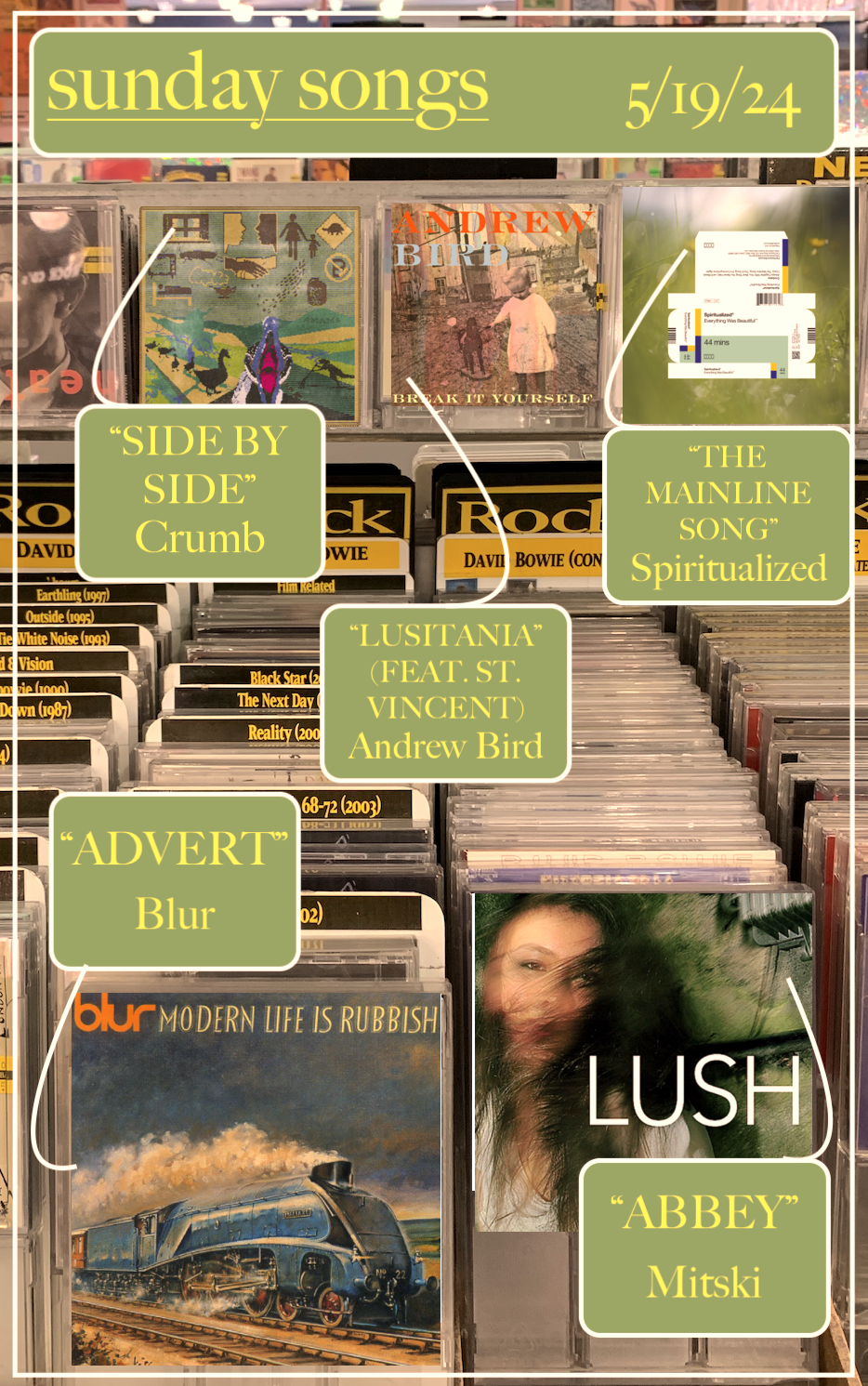
“Advert” – Blur

The restraint I displayed by not blowing through Blur’s entire discography back in the last half of 2021 is restraint that I have yet to parallel, so it’s only now, almost three years after the initial Blur Breakdown, that I’ve gotten around to Modern Life is Rubbish (if there was ever a more British title). I did sort of sully it with the experience of listening to it while crawling under my bed while trying to exorcise the last of the dust bunnies from my dorm (and getting caught on the rain), but that’s all me—this is the first Blur album where they started to feel like themselves.

I’d never thought of Modern Life is Rubbish, Parklife, and The Great Escape (the final Blur album to surmount) as a trilogy until Trash Theory described it as such—from my understanding, this is what cemented their reputation as the foremost clever spectators of British life in the ’90s, peering out of every windowsill with a snappy remark about the passersby. Modern Life feels like Parklife just before it morphed into the masterpiece it would later be—all of the pieces were there, and all that was needed was to make it larger than life. The melted shoegaze of Leisure was hanging on by a thread (it’s much more evident in the special edition—see: “Peach”), and they’d shifted from staring off into the distance, bleary-eyed and exhausted, into taking out that exhaustion on whatever they saw fit. Straight off of the heels of the triumphant “For Tomorrow,” “Advert” opens with a soundbite from the commercial you’ve just heard (“Food processors are great!”) before launching into what feels like the genesis of Graham Coxon’s signature assault of pounding guitars that practically demand every crowd to jump up and down. This relentless guitar work feels like witnessing the larval stage of “Jubilee,” crashing and bouncing with unending abandon. And this kind of guitar that threatens to consume the track is perfect for the endless consumerism that “Advert” comments on—commercials everywhere, a flood of inescapable offers leeching off of the dissatisfaction of the ordinary man: “You need a holiday somewhere in the sun/With all the people who are waiting/There never seems to be one.” This consumerism leads to even more dissatisfaction, which leads to more consumerism to quell said dissatisfaction, which leads to…ah, capitalism. What could possibly go wrong?

…AND A BOOK TO GO WITH IT:

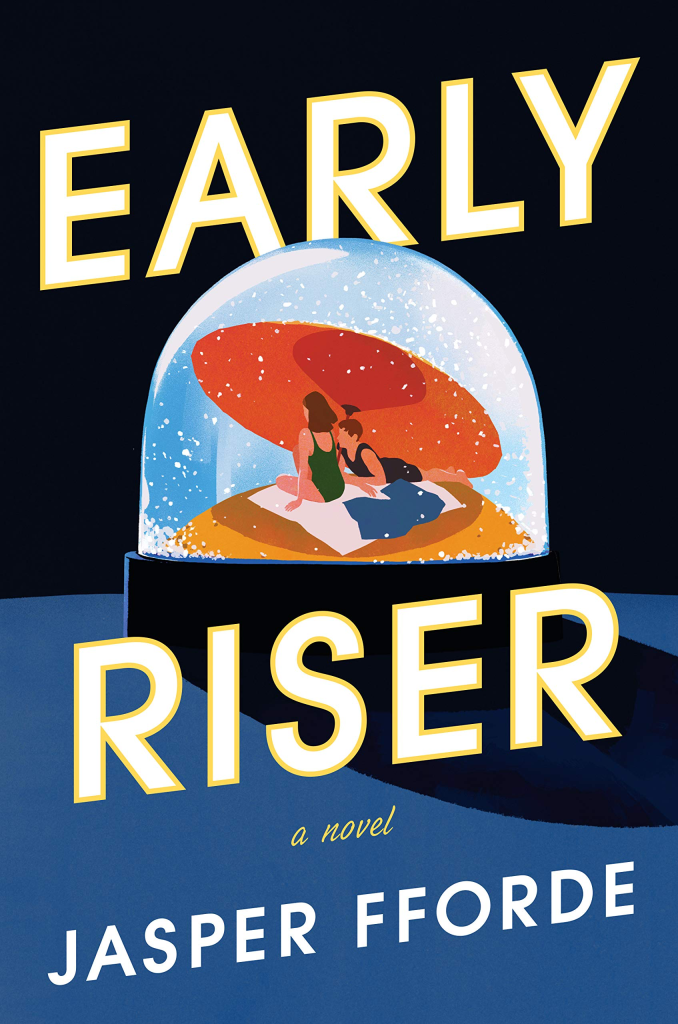
Early Riser – Jasper Ffordeconsumerism: the perfect diversion from an oppressive, unlivable winter!

“Abbey” – Mitski

LUSH, Mitski’s first album, was made for an end-of-year project when she was a junior in college; there’s an unverifiable TikTok rumor going around that she got a C on it, which, given the traction of the Mitski fandom, is just going to become an urban legend at this point. So it goes.

Either way, it’s both remarkable and understandable that she wrote all of these songs and had them produced while she was still in college. Remarkable, because just from “Abbey,” she clearly had the nascent talent for wringing emotion out like ice-cold water from a towel from a young age, and understandable, because sometimes being alone and sleepless in your dorm on the very first night of college brings out that flood of inner darkness. Leave it to TikTok to leave out the best part of the song for whatever trend it latched itself to; the slow, chanting a cappella that gained traction feels like a prayer to a void growing within your chest, a litany of acknowledgment to that which you want to reach, but cannot touch. As an instrument, Mitski’s voice, unaccompanied until halfway through the song, is a haunting, flitting machine, the slow peak and valley of a heart monitor. But once the digitized drums sweep through, it feels as though the sky has opened up. This prayer has transformed from a whisper into the confession box into a plea bellowed to the heavens. “Abbey” chronicles a search for the soul, a ravenous hunger that cannot be sated that lies just out of reach: “There is a light, I feel it in me/But only, it seems, when the dark surrounds me/There is a dream and it sleeps in me/To awake in the night, crying, ‘Set me free’/And I awake every night, crying, ‘Set me free.'” Hoowheee. God. Makes me want to travel back in time just to give her a hug, but it seems like she’s now far removed from that time in her life, emotionally: she described the version of herself that wrote the album as being “long gone,” so I can only hope that she’s been able to fill her heart, as much as the music industry has kept her from doing so.

…AND A BOOK TO GO WITH IT:

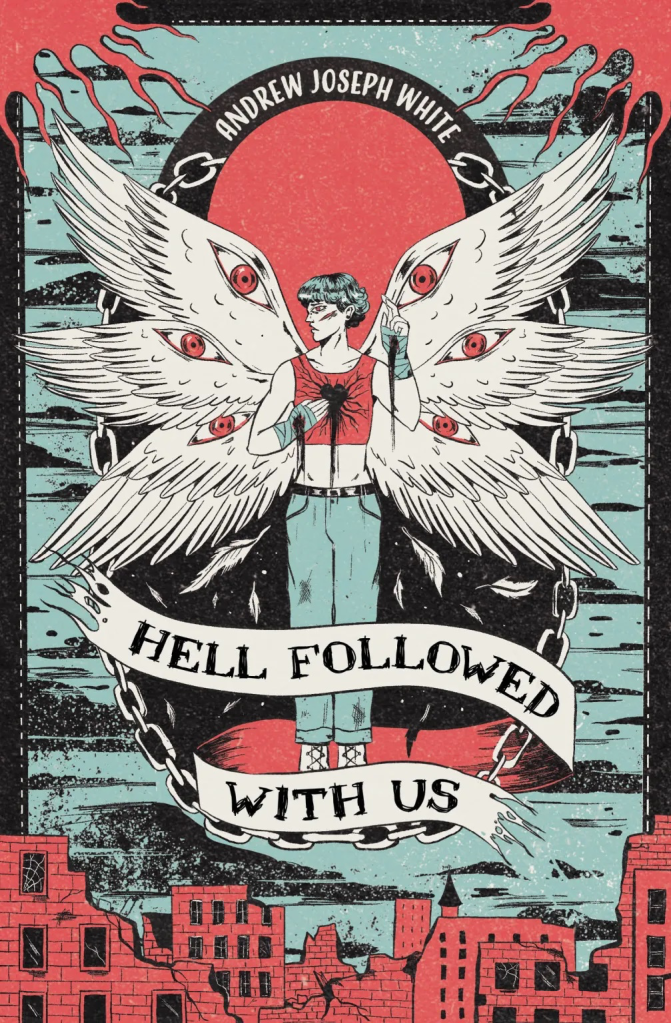
Hell Followed With Us – Andrew Joseph Whitea void within that only becomes hungrier the more it grows.

“Side By Side” – Crumb

AMAMA, which came out on the 17th, wasn’t at the top of my most anticipated albums of the year, but after only one listen, it’s cemented itself as one of the most exciting ones so far. It’s a side of Crumb that hasn’t been let loose until now, one that, instead of gently dribbling like age-old water from the precipice of a glacier, skitters around on the smallest legs, darting this way and that like a frightened millipede. The whole album feels like watching a bunch of beetles hopped up on sugar water run a race: their iridescent shells catch the light as they crawl about, scaling walls instead of the tiny racetrack and occasionally clambering over each other to get ahead. No wonder they named a whole song “The Bug”—I need the instrumentals of AMAMA just so that somebody can use them for a documentary about insects.

AMAMA‘s three openers—“From Outside A Window Sill,” this song, and “The Bug”—are its strongest links, and although the album never falters, these three shine the brightest. “Side By Side” ricochets with an energy that I never would have expected from the likes of Crumb; both the drum machine and the actual drummer are working overtime to create a scampering beat that frantically bounces like a honeybee trapped under a plastic cup. It’s a song that yearns to go, go, go, and go it does—the swirl of rapid-fire synth beats are unpredictable in their flight path, so much so that I feel a jittery, sugary rush just listening to it. For me, the most fascinating part of this change in speed for Crumb is how easily Lila Ramani’s voice adapts to the change; it’s not like I thought she couldn’t sing more quickly, but her voice only slightly seemed to change speed along with the music. Her voice is permanently trapped in a slurry of amber, unaffected by time or space—I feel like her vocals, no matter the speed, would mesh with any tempo. It retains that syrupy calm that made the rest of Crumb’s catalogue so soothing and laid-back—a quality that feels suspended in a space beyond time.

…AND A BOOK TO GO WITH IT:

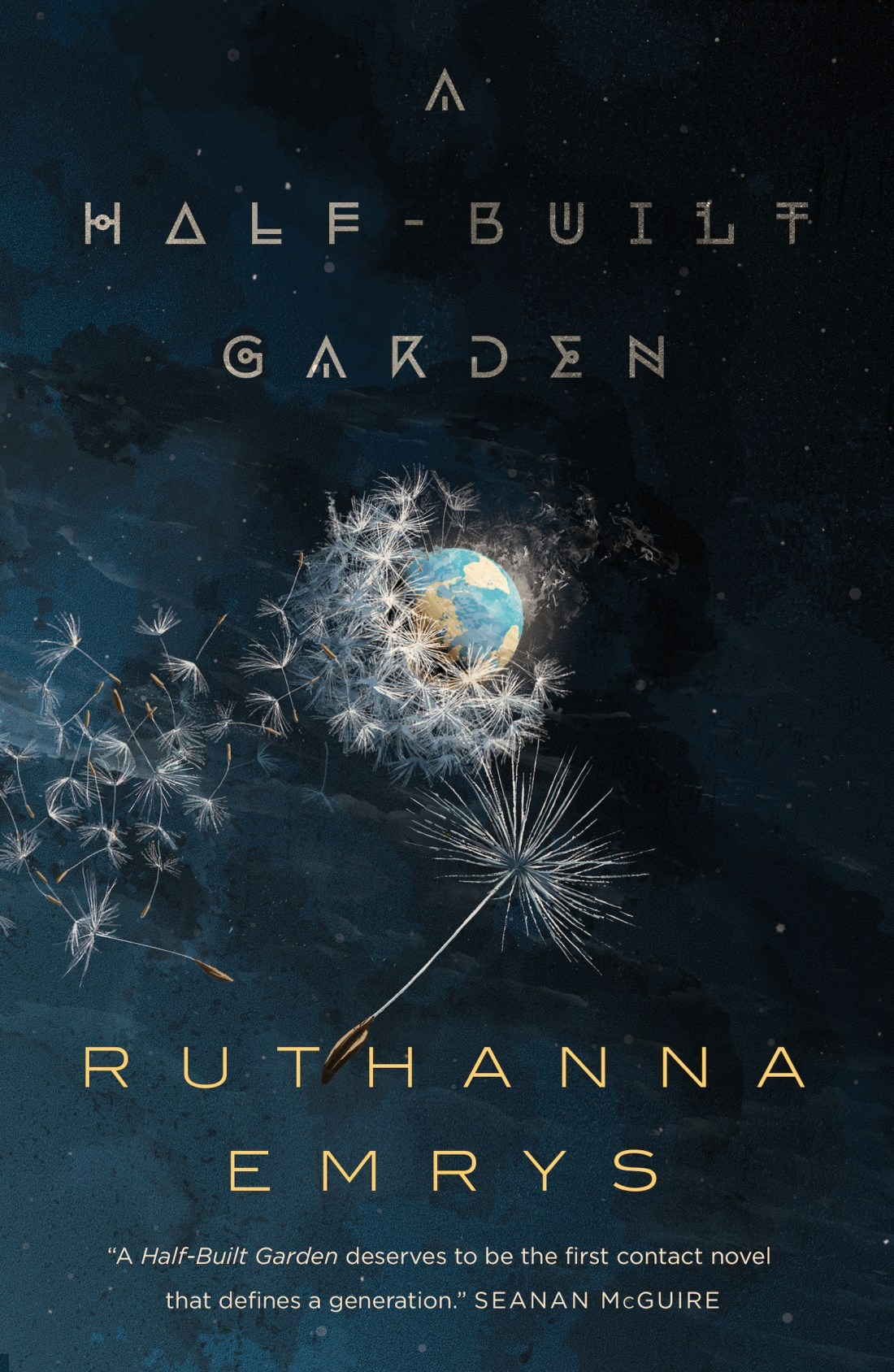
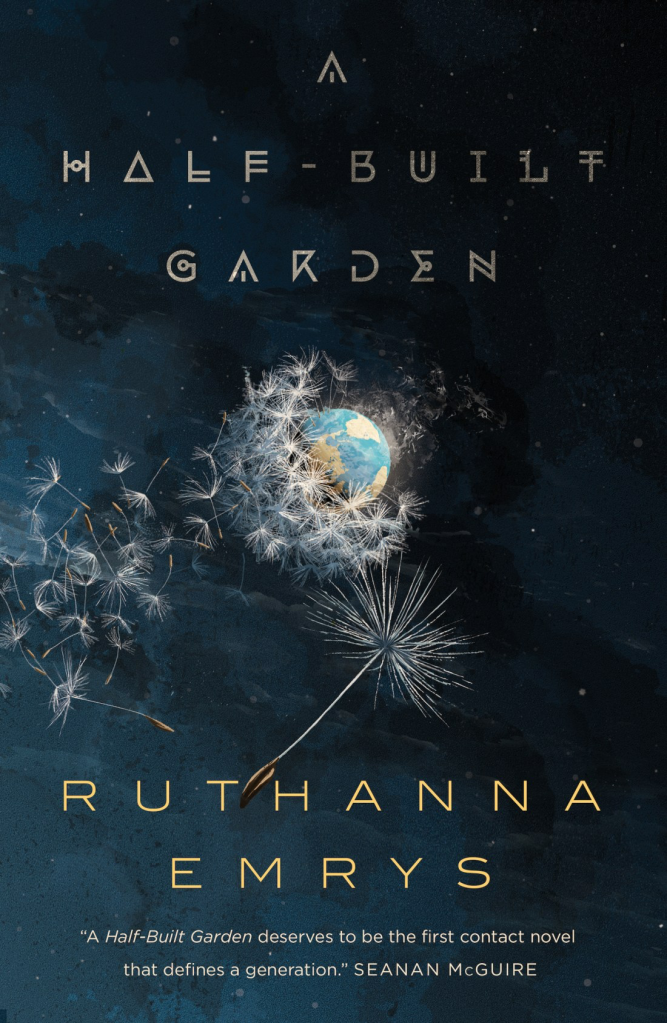
A Half-Built Garden – Ruthanna Emrysskittering with life and energy (and some insectoid and arachnid aliens).

“Lusitania” (feat. St. Vincent) – Andrew Bird

It took me how long to find out that Andrew Bird had recorded a song with St. Vincent? I’m surprised that 12-year-old me didn’t find this drifting around somewhere, but to be fair, St. Vincent’s name isn’t listed on the official track.

In 2024, Andrew Bird and St. Vincent do seem like an odd couple; since 2012, Clark’s style has morphed so many times that it’s difficult to imagine her stylistically even going near Bird’s songbird-whistling, violin-dominated alternative folk. It makes sense that this was probably recorded sometime in 2011—post-Strange Mercy, but before the last dregs of Actor and Marry Me were out of her system. She’s still never been fully folk, but the intersection of the Venn diagram of her early style and Bird’s is wider than I thought it would be. With her guitar playing mostly absent, what shines in “Lusitania” is her voice; you can tell in the first half that she’s been quieted in post-production or that she’s holding back on completely dominating the track. “Lusitania” makes me miss those artsier sensibilities of 2008-2010 St. Vincent, the delicate turns of phrase and the more feathery clarion calls her voice twisted into. Just like that, I’ve got another song in my hypothetical playlist of songs where artists sing certain phrases in a way that scratches all the itches in my brain: in this case, her singing of “there’s no shame” at 2:44. Her warble seems to chain-link with Bird’s in a way that produces its own chord, something more than a harmony that feels like a tuning fork struck at my heart.

But why don’t I talk about Andrew Bird, though, since…y’know, he’s the one who made the bulk of this song, anyway? Totally unlike me to go on about St. Vincent…completely uncharacteristic. (I have not changed a bit since middle school.) The instrumentation doesn’t stand out to me on this one as much, save for the rising cymbals that nearly swallow both Bird and Clark’s voices. But it’s clearly to make way for the lyrics—a clever string of World War I metaphors, presumably about a relationship where one party suffers volley after volley of abuse, while the other doesn’t even think to recognize that their behavior is harmful: “If your loose and libel lips/Keep sinking all my ships/Then you’re the one who sank my Lusitania/But somehow it don’t register as pain at all.” As far as ship metaphors go, the Titanic has likely been used one too many times, but the Lusitania feels especially potent on several fronts. The use of such a large passenger ship (and its sinking) drives home the metaphor of weathering emotional abuse until it drowns you. What’s more effective still about the Lusitania was its eventual role in the First World War; since a significant number of its passengers were Americans, the sinking of the Lusitania by a German U-Boat was part of what pushed public opinion towards entering the war on the side of the British in 1917. Just like the boiling public outrage of the American public, the Lusitania was the straw that broke the camel’s back, an event so explosive that there could be no other option than to break away, no matter how many casualties it cost. “You laid mines along the shore” feels like the last gasp of this deeply harmful relationship, the claws that scored scars down the narrators back as they squirmed free of their bloodied grasp.

I really should have seen this collaboration coming, not because of my middle school obsession, but also because it slipped my mind that it wasn’t the first time. Here they are in 2009 performing “What Me Worry?” (15:51) and “Black Rainbow” (21:09).

…AND A BOOK TO GO WITH IT:

Fireheart Tiger – Aliette De Bodard“If your loose and libel lips/Keep sinking all my ships/Then you’re the one who sank my Lusitania/But somehow it don’t register as pain at all…”

“The Mainline Song” – Spiritualized

How I’ve never covered Spiritualized on Sunday Songs is genuinely beyond me. I did sort of discuss them when I talked about “Monster Love” last June, but that was more of a remix than anything. They’ve been in my top 5 artists of all time for at least 4 years now, but I suppose I blew through most of their catalogue before I started writing these posts. Mark my words, “Ladies And Gentlemen We Are Floating in Space” is always on in the background of everything else I’m listening to.

Everything Was Beautiful, which came out around two years ago, was some of J. Spaceman’s best work to date; at the time it came out, I remember describing it as Ladies And Gentlemen We Are Floating in Space but happy. Insane concept, I know…when was the last time you saw J. Spaceman and happiness in the same room together? Hardly ever, up until maybe 2017, right? Jesus. This poor man has to be the dictionary definition of “going through it.” Which is why the “happy Ladies And Gentlemen” hit me so deeply—all of the heroin, heartbreak, and near-death experiences have begun to fade away from his newer music, but the explosive, immersive creativity remains the same—you can really tell that these positive changes in his life have really begun to take root. And I am so glad. This man has been on the brink of death not once but twice. He doesn’t just deserve it: he needs it.

Like Ladies And Gentlemen, Everything Was Beautiful is always at the back of my mind, usually in the form of the uproariously celebratory “Always Together With You” and the nearly 10-minute long, haunting and cinematic closer “I’m Coming Home Again.” “The Mainline Song” lands on the side of euphoria, and thank god that it’s not heroin-induced this time (as much as “She Kissed Me (It Felt Like a Hit)” slaps). J. Spaceman’s immeasurable talent lies in how quickly he can not just create an atmosphere, but how he can create one that consumes so instantly. It’s not a building wave that darkens you with shadows before swallowing you whole: a more apt comparison would be falling into the core of a star, instant immersion with stardust sounds and white-hot flares roaring all around you. Every song is a universe contained in a spare amount of minutes. However, even if I did cast aside the part about there not being a build before the immersion, the buildup to “The Mainline Song” may just be its main draw. The build itself is part of the universe; J. Spaceman doesn’t even start singing until the halfway point, letting the song construct itself from fragments of stardust and train tracks as it swirls into being. It’s a song patched from the breeze of night, the kind you only find when sticking your head out of a car window, breathless and ecstatic. It’s a sprint through the streets as city lights blink like so many stars. It’s the wind parting your hair as you run to catch the bus, panting as you stumble inside with a fit of laughter. As many songs as there are about this kind of adventuring, none of them quite capture the hopeful feeling of “The Mainline Song.” No feeling necessitates J. Spaceman’s magical universe creation more—the swirl of horns, choir, and machinery bottle the feeling in all of its rapid euphoria, as blurry as the world passing by from the window of a train. Like nothing else, “The Mainline Song” captures the look you share with your friend as you reach a silent agreement to leave everything else and run. The destination isn’t what matters: it’s the breathless thrill of love.

…AND A BOOK TO GO WITH IT:

A Scatter of Light – Malinda Lowarmth, adventures in the city, and an unforgettable summer.

Since this post consists entirely of songs, consider all of them to be today’s song.

That’s it for this week’s Sunday Songs! Have a wonderful rest of your day, and take care of yourselves!
Posted in Mini Reviews

MINI REVIEWS | Birthday Books (Gifts + What I Blew my Paycheck On)

Happy Tuesday, bibliophiles!

It might still be a week or so before I completely return to some semblance of my normal schedule, but I’m starting to get to the point where I know where I’m going and what I’m doing. And as much as I hate the constant home football games we’ve been having, at least it means that my already quiet floor is even quieter, so I can get my homework done in a serene environment—and write these reviews as well!

Since my birthday last month, I’ve taken all of the books I got—ones that I bought on my birthday and gifts from family—back to my dorm, where I slowly (yes, slowly, settling into college is weird) devoured them over the course of several weeks. I’m happy to say that it was a fantastic batch—not every one was the best book I’ve ever read, but it’s chiefly in the 4-star range. I got a 5-star book out of these as well! And now they sit proudly on my little dorm bookshelf, ready to be reviewed.

Let’s begin, shall we?

THE BOOKISH MUTANT’S BIRTHDAY MINI REVIEWS

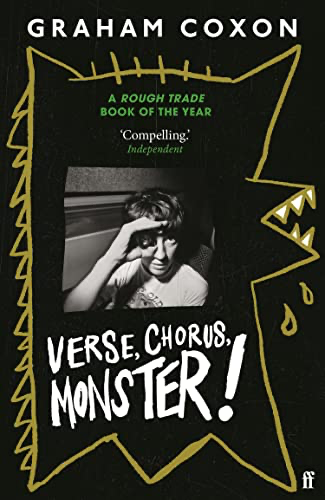
Verse, Chorus, Monster! – Graham Coxon

from Goodreads:

Verse, Chorus, Monster! is the memoir of iconic British musician and Blur co-founder Graham Coxon, charting a life of music, fame, addiction and art. Before the noise and clamour of the Britpop era, Coxon was a shy Army kid tempering his anxiety through painting and a growing love of music. As he honed his artistic skill at school, his band with school friend Damon Albarn, fellow student Alex James, and a drummer called Dave Rowntree began to get noticed. But there are things they don’t tell you before you get famous. There are monsters out there. And some may even be lurking inside yourself.

TW/CW: substance abuse/addiction, themes of mental health issues

I’ve been trying to branch out into more nonfiction over the past few years, but even if I wasn’t, I would have picked this up eventually either way. My Blur awakening back in 2021 made sure of that. So of course I was excited to see that Graham Coxon was coming out with a memoir—he’s always struck me as such a sensitive, creative person, and Verse, Chorus, Monster! fortunately cemented that, for the most part!

I always have a lingering fear that celebrity memoirs will somehow ruin my image of them, but with this one, I still hold that Graham Coxon seems like such a deeply insightful and sensitive soul. This glimpse into his mind was all at once raw and touching; the frequent sections about his struggles with anxiety and alcoholism were difficult to read, but I’m so glad to have verbal confirmation that he’s been getting better as of late, and that he’s starting to work on himself in that respect. Beyond that, there’s just so much about this memoir that was immediately endearing. The insight into one of the main creative forces behind one of my favorite bands (and a fantastic solo artist in his own right) was fascinating to hear from the front lines, and I loved the pieces we got of his creative process—opening the book with the spark of inspiration that lead to the hook of my favorite song (“Tender”) was the quickest possible way to win me over. And it’s easy for memoirs to have a sense of humility that’s manufactured, but Coxon’s personality really did come off as genuinely humble.

All in all, an excellent memoir by a truly admirable creative force—and a refreshingly humble one. 4 stars!

This is How You Lose the Time War – Amal El-Mohtar and Max Gladstone

from Goodreads:

In the ashes of a dying world, Red finds a letter marked “Burn before reading.”

So begins an unlikely correspondence between two rival agents in a war that stretches through the vast reaches of time and space.

Red belongs to the Agency, a post-singularity technotopia. Blue belongs to Garden, a single vast consciousness embedded in all organic matter. Their pasts are bloody and their futures mutually exclusive. They have nothing in common—save that they’re the best, and they’re alone.

Now what began as a battlefield boast grows into a dangerous game, one both Red and Blue are determined to win. Because winning’s that you do in war. Isn’t it?

A tour de force collaboration from two powerhouse writers that spans the whole of time and space.

TW/CW: blood, violence, murder, self-harm, descriptions of bodies/corpses, torture, poisoning, war

Hoowhee, brother. This one was good.

Time War had floated on the edges of my radar for years ever since it came out, but I ultimately decided to pick it up on the recommendations of one of my professors and one of my best friends. And their high praise—and the high praise of so many others—was more than well-deserved.

For such a short novella, Time War packs a truly unforgettable gut punch, vibrant and rich with emotion. Who knew that these two characters identified only by colors would consume so much of my days when I read this? I can’t praise this book enough. The prose is beyond rich, truly enchanting and expansive, fitting for the cosmic scale that this story is set in. It has an almost gothic sensibility to it, even with the firmly sci-fi trappings—what’s more romantic, dramatic, and emotional than two lovers reaching for each other across the vastness of space and time itself? But even with this grand scale, This is How You Lose the Time War is one of the most deeply human stories that I’ve read in ages. It taps into that innate desire to love and be loved, or even to just have someone to talk to as the world around you is collapsing. In spite of the grand, cosmic conflict and multiple universes colliding, nothing can come in the way of our desire for love and connection. It’s one of those stories where plot details—names and how this time-spanning war started—mean nothing in the face of the deep resonance of the characters.

Hold me. I need a minute…

What else is there to say? Go read this, what are you even doing? 5 stars!

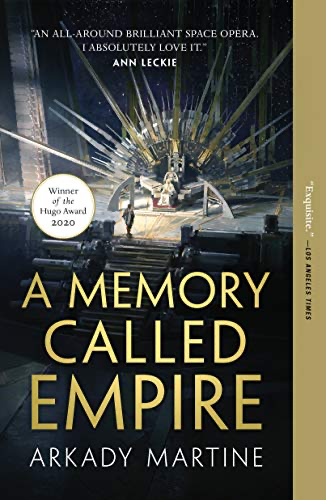
A Memory Called Empire – Arkady Martine

from Goodreads:

Ambassador Mahit Dzmare arrives in the center of the multi-system Teixcalaanli Empire only to discover that her predecessor, the previous ambassador from their small but fiercely independent mining Station, has died. But no one will admit that his death wasn’t an accident—or that Mahit might be next to die, during a time of political instability in the highest echelons of the imperial court.

Now, Mahit must discover who is behind the murder, rescue herself, and save her Station from Teixcalaan’s unceasing expansion—all while navigating an alien culture that is all too seductive, engaging in intrigues of her own, and hiding a deadly technological secret—one that might spell the end of her Station and her way of life—or rescue it from annihilation.

TW/CW: themes of colonialism/imperialism, murder/attempted murder, violence

College isn’t all sunshine and rainbows, but man, it’s fun sometimes. I got an A on a literary theory assignment where I compared this book to an essay we read in class. I love being an English major.

If the fact that I used A Memory Called Empire for a literary theory assignment doesn’t make you think that there’s a ton of great stuff to chew on in this book, I’m not sure how else to convince you. It’s fantastic space opera, but it errs more on the side of a political thriller—a common enough combination these days, but one that was so well-executed in this case. Reckoning with the history of colonialism in science fiction has been on the rise—and for a very good reason—but A Memory Called Empire had such an interesting take on it. This is the first of these kinds of novels that I’ve seen tackle the seduction of colonialism; along with the actual murder mystery afoot, Mahit Dzmare is also being pulled—both physically and mentally—into the clutches of the reigning Teixcalaanli Empire, and is being groomed into the ruling culture as she tries to stay afloat and protect her space station from imminent colonization. The character work is nothing short of excellent, the worldbuilding is top-notch, and the suspense is palpable from start to finish. It’s all a treat.

This book has gotten quite a lot of hype over the years, but it really is all that—alluring, suspenseful, and nothing short of insightful. 4 stars!

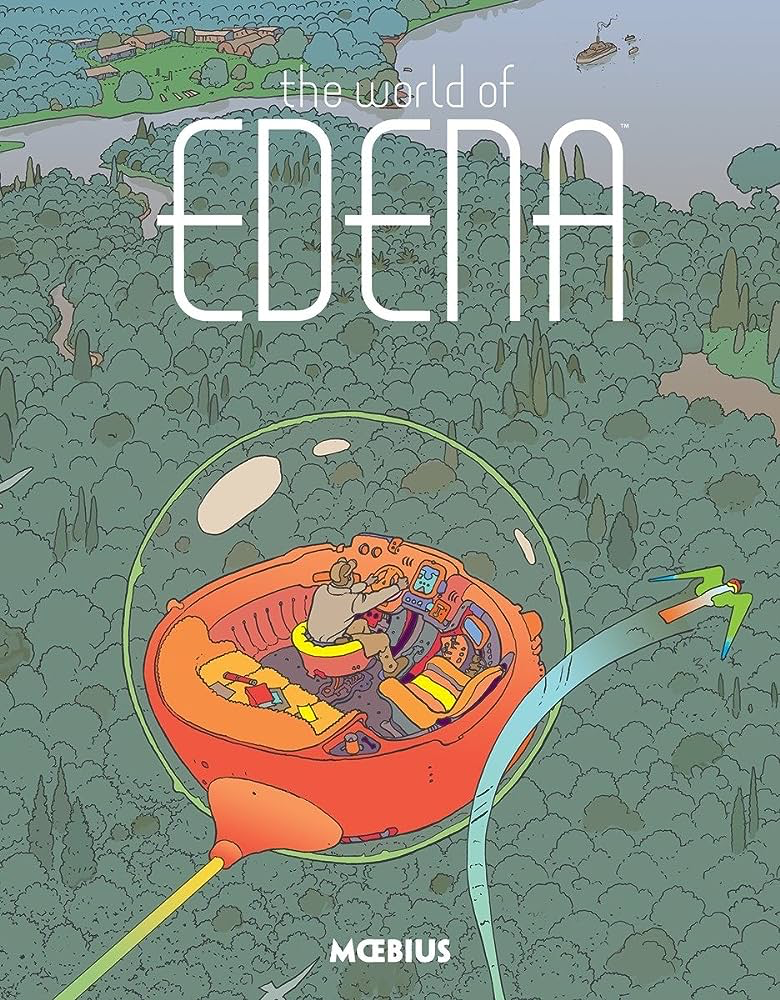
The World of Edena – Mœbius

from Goodreads:

Stel and Atan are interstellar investigators trying to find a lost space station and its crew. When they discover the mythical paradise planet Edena, their lives are changed forever. The long out-of-print Edena Cycle from Moebius gets a deluxe hardcover treatment! Moebius’s World of Edena story arc comprises five chapters–Upon a Star, Gardens of Edena, The Goddess, Stel, and Sra–which are all collected here.

TW/CW: nudity, mild sci-fi action

I’ve been meaning to get into Mœbius for years now; ever since I reactivated my pinterest and went on a deep dive of sci-fi art, I’ve been drawn to the enigmatic, meticulous, and downright wondrous quality of his art. (I feel like it would’ve happened eventually—turns out that he was a major influence on Tony DiTerlizzi, and especially his inking style in the Search for WondLa trilogy, which has shaped me beyond repair.) I started here with Edena, and I put it on my birthday list.

I still hold that he may be one of my favorite artists. His style is so ethereally captivating, and I found many a piece that I’ve used for my desktop wallpaper in the past few years inside Edena. His landscapes are instantly transporting, and there’s not a single character design lacking in whimsical charm. The story itself…slightly less so? It’s like a sci-fi Yellow Submarine, but if the script was due in an hour and he’d forgotten all about it until then. Given the circumstances, it’s understandable; Edena apparently started out as a car ad (???), and then it took on a life of its own, completely unplanned. There’s inconsistencies aplenty with both the story and the art, but for the most part, it was just so wild that I enjoyed the ride. If it gives you some idea of what happens, Mœbius pulls the classic “IT WAS ALL A DREAM” move that ends up resolving (if you can call it that) the whole mess. It’s nuts. But there were so many pockets that I wished we could have explored more. There were some super interesting gender themes going on—I wish we got to know why Stel and Atan were on their gender-neutral hormone supplements, for a lack of a better word, but the resulting transformation into their Adam and Eve roles (hence the name) was so fascinating, especially since this only came out in the late eighties or so. (Of course, Atan/Atana effectively becomes a damsel in distress post-transformation, but that’s a whole other can of worms. Ouch.)

In short, The World of Edena was beautiful, if not a bit of a mess. Luckily, the mess was endearing, for the most part, or at least fun. 3.75 stars, rounded up to 4!

Firekeeper’s Daughter – Angeline Boulley

from Goodreads:

As a biracial, unenrolled tribal member and the product of a scandal, Daunis Fontaine has never quite fit in—both in her hometown and on the nearby Ojibwe reservation. When her family is struck by tragedy, Daunis puts her dreams on hold to care for her fragile mother. The only bright spot is meeting Jamie, the charming new recruit on her brother’s hockey team.

After Daunis witnesses a shocking murder that thrusts her into a criminal investigation, she agrees to go undercover. But the deceptions—and deaths—keep piling up and soon the threat strikes too close to home. How far will she go to protect her community if it means tearing apart the only world she’s ever known?

TW/CW: racism, murder, sexual harassment and assault, misogyny, rape, death, gun violence, descriptions of injury, substance abuse

Originally, I put off reading this book because a) I’m not usually much of a YA mystery/thriller person, and b) the mountain of hype was certainly intimidating. I ended up reading Warrior Girl Unearthed because the plot fascinated me more from the start, and I loved it so much that I ended up buying Firekeeper’s Daughter after all. And, once again, I’ve been struck with the luck of hyped books being all worth the hype.

Every part of Firekeeper’s Daughter is excellent, from the effortless way that Angeline Boulley weaves a scene and setting together to the never-ending suspense that kept me guessing for page after page, twist after twist. Making a setting as tangible and populated as hers was is no easy feat—and it suited every other aspect of this book in every conceivable way. You can’t have a corrupt, hidden history of a town without the town itself. The sense of community—and the rifts driven into it—were some of the best I’ve seen in YA fiction in quite a while. Part of that wouldn’t have been possible without Boulley’s equally excellent character work; Just like their community, every character feels nothing short of authentic and multilayered. This all made the twists so much more effective—with such layered characters, I learned to expect the unexpected. And even with the ongoing expansion of diversity in YA as a whole, I feel like I haven’t seen as many novels centering Native American or Indigenous characters and stories, so I’m glad that this book exists in that sense as well. (Shoutout to Darcie Little Badger and Moniquill Blackgoose as well!) And Daunis is mixed-race as well! Yay!!!

If you’re questioning whether or not Firekeeper’s Daughter is worth the never-ending hype: trust me, it’s worth a read. 4 stars!

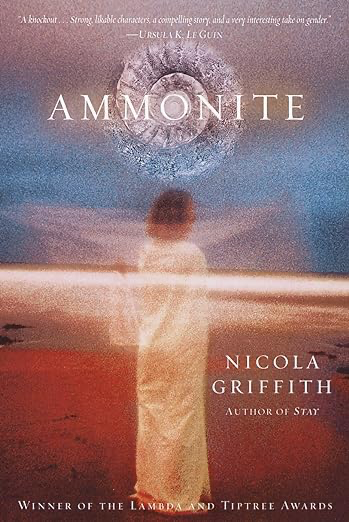
Ammonite – Nicola Griffith

from Goodreads:

Change or die. These are the only options available on the planet Jeep. Centuries earlier, a deadly virus shattered the original colony, killing the men and forever altering the few surviving women. Now, generations after the colony has lost touch with the rest of humanity, a company arrives to exploit Jeep–and its forces find themselves fighting for their lives. Terrified of spreading the virus, the company abandons its employees, leaving them afraid and isolated from the natives. In the face of this crisis, anthropologist Marghe Taishan arrives to test a new vaccine. As she risks death to uncover the women’s biological secret, she finds that she, too, is changing–and realizes that not only has she found a home on Jeep, but that she alone carries the seeds of its destruction. . .

TW/CW: death, violence, animal death, gore

I picked this one up after how much I loved So Lucky, also by Griffith. Thing is, I had no idea that a) this book was written almost 30 years before So Lucky (although this cover should’ve tipped me off to that), and b) that, even with the genre difference, that this would be a very different kind of book. At this point, nothing tops So Lucky for me, but Ammonite was still a fascinating book in its own right.

If you’re going into this book expecting what most would consider traditional science fiction, you’ll be sorely disappointed. Most of it follows Marghe, who is tasked with delivering a vaccine to an isolated colony of women whose community was decimated by a mysterious illness that wiped out all of the men. At its heart, Ammonite is firmly a survival story; it’s a story of the wilderness, of venturing into the unknown, and adapting to the world around you. There are moments of suspense, moments of tenderness, and moments of absolute fear. Another reviewer described it as “Dune but gay,” and other than the more traditionally sci-fi elements of the former, the comparison was spot-on. Ammonite also has the fact that it’s much slimmer than Dune going for it, but given how long Dune is, that’s not saying much. But I think what has seemed to make this book so groundbreaking is its take on gender dynamics. The cast is entirely women, but when all of the men are taken by the illness, the remaining women don’t automatically form a pacifist, hippie commune; there are flawed women, there are good-hearted women, there are warlike women, and everything in between. This banishing of broad generalizations about gender, I think, is what makes Ammonite feel so ahead of its time.

Sidenote: this was written in the nineties, so Nicola Griffith had to have known about goth people…right? Just saying, calling the barely-described alien megafauna “goths” made me envision a giant, towering version of Robert Smith, not, y’know, whatever she wanted us to picture.

All in all, a very unique take on sci-fi and survival with some groundbreaking gender dynamics that have held up for the past 30 years. 3.5 stars!

Abe Sapien, vol. 4: The Shape of Things to Come – Mike Mignola

from Goodreads:

A mutated Abe Sapien fights carnivorous monsters crawling out of the desert sand, a fortified militia that’s walled Phoenix off from the rest of the world, and a vicious zombie swarm, while a mad necromancer rises over the monster-infested ruins of Seattle. Collects issues #6-#7 and #9-#11 of the series.

TW/CW: gore, blood, violence, racism, body horror

I haven’t caught up on the actual Abe Sapien series since…[checks notes], eight grade, I think. Jesus. I just remembered flying to New York when I was about 14 and reading the first volume. But even then, I think I subconsciously chose a good place to pick up with it, since there’s a pretty clear gulf between the first three and vol. 4—before and after Abe gets mutated, shot, and quits the B.P.R.D. Just another day at the office for the guy, y’know?

Suffice to say, I was somewhat disappointed by this volume. It was still enjoyable, and even though I was never the biggest fan of Fiumara’s art, the more stylized look suits Abe’s stretched-out, mutated form. Other than that, there wasn’t a whole lot here that I found terribly memorable. Abe goes through the exact same arc as Hellboy upon leaving the B.P.R.D., but it never seems to culminate in much development on his end. Plot-wise, it’s the same ol’, I’m afraid—Abe goes into a random, apocalypse-ravaged town in the middle of nowhere, and, surprise surprise, it’s time to fight some zombies and witness a copious amount of fungus-related body horror. Somehow, the latter works better when it’s the whole B.P.R.D. trying to deal with it—the group dynamic is what makes B.P.R.D. consistently shine, and as much as I love Abe, I’m not sure if he could carry a story like that when it’s the same format they’ve been using on and off for several years. Abe is one of my favorite Mignolaverse characters, and it’s such a shame that he’s never gotten to shine as much in his solo comics. And judging from the reviews on the later volumes, it seems like the quality tanked until we got the band back together for The Devil You Know. Shame.

All in all, an entetraining trade, but one that ultimately did a disservice to one of the Mignolaverse’s most beloved characters. 3.25 stars.

Today’s song:

I swear, this has to be some of Mitski’s best work in YEARS

That’s it for this batch of mini reviews! Have a wonderful rest of your day, and take care of yourselves!

Posted in Monthly Wrap-Ups

August 2023 Wrap-Up 🎂

Happy Friday, bibliophiles!

I just finished my first week back to school, but after this, chances are I’ll be somewhat radio silent until I can get fully settled into my routine. The only reason that this post is seeing the light of day is that I start working on my wrap-up posts about a week in advance, so here we are.

Let’s begin, shall we?

GENERAL THOUGHTS:

Summer’s officially over, but the weather sure doesn’t seem to think so. Hopefully I won’t have to endure much more of my (long) walk to class in this 90+ degree heat.

That aside, I’ve had a good August, for the most part. My initial “yay, I’m going back to college!” got partially replaced by “oh god, I’m going back to college” closer to move-in, but I’m feeling better now. (The fact that I’m in a much nicer dorm than I was last year certainly helps. It doesn’t constantly reek of weed in here! Huzzah!) I had the opportunity to soak up the last dregs of summer beforehand, at least. I finished up my summer job at the library, bought a catnip toy for my cat for his sweet 16, completed another trip around the sun, and blew part of my paycheck on books to celebrate said trip around the sun. Worth it.

My blogging’s been a tad slower since I’ve been trying to get everything together before I moved in, but I feel like I’ve still been able to be productive. I’ve enjoyed reviewing all of my books this month and putting together graphics and going off about music. And I got in one book tag that WordPress screwed up and I had to recreate from scratch, but it was fun in the end. Once my schedule figures itself out, I’ll get back on the writing train, but for now, I’m mapping out the best route to my class in That One Building on the other side of campus.

Other than that, I’ve just been drawing, watching Only Murders in the Building (for the love of god, can we just stop pairing Mabel with people who have zero chemistry with her 😭). Good Omens (pain, suffering, even), Heartstopper (Lucy Dacus and Wolf Alice paying in the same episode >>>>>>>), and Taskmaster (“you’ve got no chutzpah”), and reveling in the fact that my new dorm has air conditioning. It’s the (not so) small things.

READING AND BLOGGING:

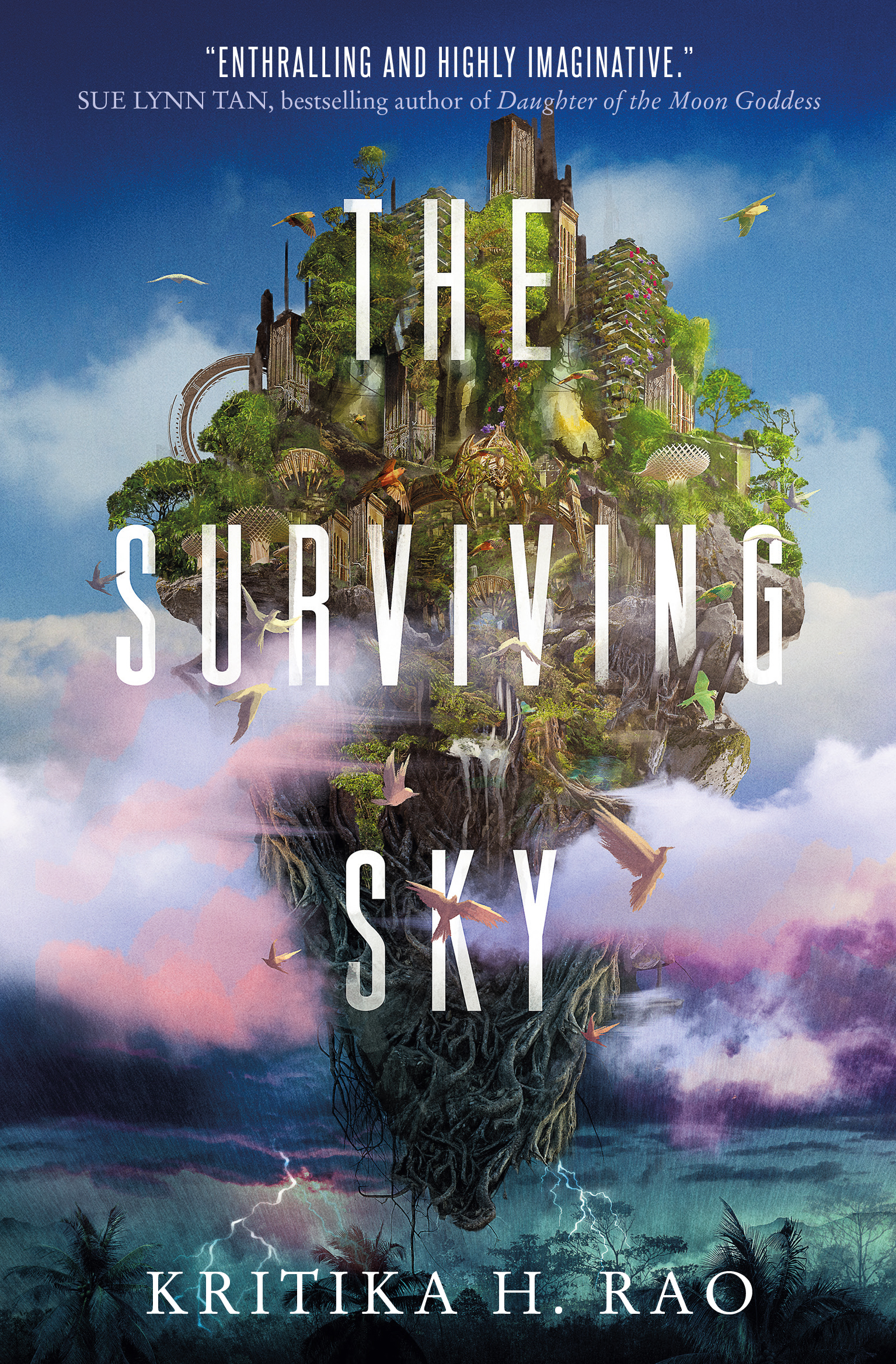
I read 17 books this month! Other than the one stinker in the batch (sorry, The Surviving Sky), it’s been a great reading month in terms of quality and in terms of quantity. Expect some kind of mini-review post for all of the books I bought for my birthday and the books I got as gifts, because they’ve all been fantastic so far.

1 – 1.75 stars:

The Surviving Sky

3 – 3.75 stars:

The World of Edena

4 – 4.75 stars:

A Half-Built Garden

5 stars:

Thi is How You Lose the Time War

FAVORITE BOOK OF THE MONTH: This is How You Lose the Time War 5 stars

POSTS I’M PROUD OF:

POSTS FROM OTHER WONDERFUL PEOPLE THAT I’VE BEEN ENJOYING:

SONGS/ALBUMS THAT I’VE BEEN ENJOYING:

UNDERRATED ALBUM ALERT
the catchiest
guess who blew through season 2 of Heartstopper in less than a week
too groovy to clean the bathroom to
good lord I love Lisa Germano
this song tickles my brain in the most pleasant way possible
man I need to listen to more P.J. Harvey

Today’s song:

deliciously 90’s earworm

That’s it for this month in blogging! Have a wonderful rest of your day, and take care of yourselves!

Posted in Sunday Songs

Sunday Songs: 8/13/23

Happy Sunday, bibliophiles! I hope this week has treated you well.

Since I’ve been making these Sunday Songs graphics for just over a year and writing about them for about half that time, I’ve noticed that there’s inevitably at least one light blue week per month. Different shades of blue, but there’s always at least one, and it’s always pale. Like this one. Or this one? Either way, here’s the court-ordered blue period for August. Bon appetit.

Enjoy this week’s songs!

SUNDAY SONGS: 8/13/23

“1 Billion Dogs” – Jay Som

I listened to Everybody Works entirely on a whim, just to have something shorter to have as a soundtrack while I rearranged the bulletin board in my room. But I should’ve predicted that any given Jay Som record—much less this one—would be so much more than that. Perfect summer album, I have to say. Go listen to Everybody Works, guys.

Everybody Works is an album of many faces, from the chugging indie rock of “Take It” (which works way too perfectly with boygenius’ “Satanist“—can somebody with the ability to make mashups make this a reality?? please?? makes sense, seeing that she’s the bassist for boygenius’ touring band), the pop hooks of “The Bus Song” (BUT I LIKE THE BUS!), and the fever dream atmosphere of “(Bedhead).” But never once does it feel inconsistent or lacking cohesion—if I had to pick them from a crowd, all of these varied songs would still feel distinctly Jay Som. But amidst all of that, aside from the two tracks I already remembered from the album (“The Bus Song” and “Baybee”), “1 Billion Dogs” was an immediate standout. The title alone would have caught my eye on any other record, but strangely, even though it has nothing to do with dogs, much less billions of them, it has that feel to it. It fits. “1 Billion Dogs” is a song with an immediate urgency; even with Melina Duterte’s reserved voice almost melting into the instruments, it’s a song that grabs you by the shirt collar, then invites you to jump around and dance. But even the crashing rhythm guitars, steady bass, and just-so off-kilter riffs can’t take away from the electronic haze that never lifts from Duterte’s music. It’s a uniquely Jay Som flavor to me: dreamlike and fuzzy, like it’s cloaked in multicolored static.

“Evicted” – Wilco

September is shaping up to be a heavy hitter as far as albums go. I’ve already talked about tracks from Shakey Graves’ Movie of the Week and Mitski’s The Land is Inhospitable and So Are We, but I haven’t yet talked about the new Wilco, with their new album Cousin coming out on September 29! And only about a year and a half removed from their last double album, Cruel Country…Jeff Tweedy is just cranking ’em out, huh?

Tweedy and co. have advertised the upcoming Cousin as their art-pop/rock album. Wilco has always had a penchant for the experimental, but I feel like when they’ve previously advertised their albums as a certain genre, it doesn’t always fit the label. Take Cruel Country—”country” was literally in the name, but it felt like more of a folkier side of Wilco than anything, which, given their roots, wasn’t much of a stretch. Rather, as Tweedy said in his Starship Casual newsletter, “Cruel Country was our idea of country music and a lot of people went, ‘Huh?! this doesn’t sound like Colt Steed!’ (or some other plausible sounding country mega-star name).” So I’ll have to go into this album knowing that it’s Wilco’s idea of art-pop—and that’s certainly promising. And maybe I was screwing myself over when I saw “art rock” and immediately went into this song thinking it was gonna be “Art of Almost” 2. It isn’t. Even as much as I love Wilco, I feel like even that would be hard to reproduce. That’s not to say that “Evicted” is a bad song in any way—if there’s anything that Wilco has been in the last 10 years or so, it’s consistent. Regardless of our personal definitions of where this song fits into, “Evicted” is proof that Wilco’s ability to feel relevant and rock-solid will likely never fade. With its timeless guitars and the gently ethereal backing vocals and Nels Cline’s quietly glittering riffs rising like plumes of dust in the background, it’s a deceptively simple song—much like the Trojan Horse that Tweedy compared his definition of bubblegum pop to. And if I’ve learned anything from Cruel Country, it’s that I can’t judge an album by its first single. I’d be lying if I said that “Evicted” wasn’t an earworm. Jeff tweedy is true to his word.

Also, can I take Colt Steed as my new stage name?

“Crash” – Lisa Germano

EMERGENCY WEATHER REPORT: we regret to inform you that sad girl fall is scheduled to arrive two months earlier than expected. Hunker down, everybody.

A song that begins with the line “You could say I feel this way/’Cause it’s the way I feel” doesn’t seem terribly memorable at first glance. But that’s the thing. You have to wait. Not even that long of a wait, really. Because it’s followed up with “Or you could say I’m making it up/I want it to be real.” See? Have a little faith in Lisa Germano, in all of her raw, dilapidated-house-with-rusty-nails-lying-everywhere craft.

My introduction to Lisa Germano goes to show, once again, how deeply and wonderfully my dad knows me. Here I was, almost a year ago, when my dad made his annual birthday playlist for me (yep, that’s how cool of a dad he is), and played me “Victoria’s Secret” in the car; Immediately, I was lost in the eerie, spare-and-found-parts, and 90’s (in the best way…I really do love the 90’s) universe of Lisa Germano. (Guys. C’mon. “Victoria’s Secret” has her cat purring in the outro. It’s so good.) I listened to Slide in its entirety a few months later, during what we can actually call sadgirl fall (read: November), and bits and pieces of that record have constantly drifted around me ever since: specters, all of them, but welcome ones. Somehow, though, as much as I played tracks like “Way Below the Radio” and “Reptile,” I forgot about “Crash” until it came on shuffle not long ago. And now that I’ve listened to it more and more (you know it went STRAIGHT to the library playlist), I’m almost ashamed that I let it slip through my fingers, if only temporarily. On further listens, it’s so clear to me that it’s one of the best tracks off the whole album. “Crash” is a song that purposefully droops and lumbers, only faintly held together with fraying twine and half-intended promises. As Germano creates her oft-expressed lyrical landscape of languishing in depression and a lack of motivation (“Wonder why it’s so easy/to be the way I hate”), the instruments sit on the verge of falling apart; they all play in time, but they teeter enough to get the sense that it would only take one sneeze for them to collapse. Germano’s silk-thin voice is a gentle hand that barely caresses you, cool and ghostly, but undeniably present. And it wouldn’t be a Lisa Germano without an uneasy, 40-second piano outro. If there’s anything that she can do, it’s create an atmosphere. Slide was the perfect album to listen to in November, in retrospect; there’s something about this song (and most of her other songs that I’ve heard) that capture the melancholy limbo of that snowless but undeniably wintry chill.

“The Rabbi” – Blur

I’ve been conned. Again. And Damon Albarn is to blame. Twice this year, we’ve gotten albums from projects of his where the album as a whole has been disappointing, but then he comes back with the deluxe edition, and at least one song that would’ve made the original album SO MUCH better. Damon, you sly dog, you pulled a “Captain Chicken” on us AGAIN. (For reference: the other disappointing album happens to be Gorillaz’s Cracker Island.)

I wouldn’t call “The Rabbi” as good as “Captain Chicken,” but then again, it’s hard to replicate the chokehold that the latter had on me for at least 2 months after it came out. But amidst the decent but disappointingly flat expanse that was The Ballad of Darren, this new addition was a breath of fresh air and energy. Equipped with the jangly brightness that Blur has been the master of for 30+ years now, “The Rabbi” is an upbeat spark, and a welcome injection into the album. Graham Coxon’s guitar finally gets its time to shine outside of “St. Charles Square,” but where that recalled the grungy, disillusioned punch of their self-titled record, these joyful riffs feel more youthful, calling back to Parklife and even further back. Like “Barbaric,” the instrumentation of “The Rabbi” is nothing short of upbeat, but cleverly cloaks the underlying disillusionment and melancholy that permeates through the rest of The Ballad of Darren; as Coxon goes off with said jangly guitars, Damon Albarn drawls about how “‘Cause where’s the joy in this self-delusion?/We’re all practitioners of vague illusions/Hieroglyphics and pictures.” Even if I’ve come away from The Ballad slightly sore, at least I have one more song that I can actually nod my head along to and believe that it’s Blur. I refuse to shut up about “St. Charles Square,” though.

“Monkey” (Low cover) – Robert Plant

A reenactment:

The family car. Some time in the early evening. MADELINE and her family are driving on the highway. Robert Plant’s cover of “Monkey” plays over the speakers.

MADELINE: Huh, this song sounds like it could be in Legion.

EITHER MY DAD OR MY BROTHER (I FORGET): That’s because it was in Legion.

The realization hits MADELINE. Cue vine boom.

~

There have been many such moments in my life. But for all the ones that my brain decides to loop in the odd hours of the morning, at least I got a song out of this one.

Unlike my brother, the world’s biggest Legion fan in the world, I haven’t gone back and rewatched any of it since it came out. I’d rank it as my second favorite TV show, right behind Fargo, but I haven’t gone back to any of it in years, save for the fantastic Superorganism musical number in season 3. I don’t think it would ever be ruined by further rewatches (simply impossible for any Noah Hawley project, the man can do no wrong…okay, Anthem was a lot, but other than that), but it’s been like a beautiful, terrifying insect trapped in amber in my mind—it’s hard to replicate that feeling of sheer confusion, horror, and wonder when I had no idea what was going on with that show. But even with the mounting pile of shows and seasons that I need to catch up on, this song reminds me of Noah Hawley’s unmatched craft—and his unmatched music taste, along with the keen eye of Maggie Phillips, the show’s music supervisor. I can’t find the clip anywhere on the internet for the life of me, but this song is slipped into a chilling scene in season 1, episode 3, where a young David Haller chases after his wayward dog on Halloween night. It’s a scene that stressed me out, even if only for a few minutes’ rewatch—Cary did tell present David to “think of something stressful,” after all. And I can’t think of a better song to illustrate that pit-stomached sense of creeping dread than this. Low’s original version has that feeling of dread, but with an unmistakable urgency; Robert Plant’s version (and yes, it is that Robert Plant) swaps that urgency for a grinding, chugging sound that watches you from the darkest corner of the room. “It’s a suicide/Shut up and drive” would have been a blatantly chilling lyric in any other circumstance, but Plant’s strained, hollow whisper makes the chill up my spine all the more chilly. Patty Griffin’s backing vocals, somehow more audible than Plant’s, seem strangely sinister, even with the lightness of her voice. I can’t help but get a little anxious every time I listen to it—all the more reason that Hawley and Phillips were really onto something when they picked this one.

Since this post consists entirely of songs, consider all of them to be today’s song.

That’s it for this week’s Sunday Songs! Have a wonderful rest of your day, and take care of yourselves!
Posted in Sunday Songs

Sunday Songs: 7/23/23

Happy Sunday, bibliophiles! I hope this week has treated you well.

What a momentous few days it’s been. Barbenheimer weekend (I HAVEN’T SEEN EITHER YET NO SPOILERS), two highly anticipated albums coming out within a week of each other, and entirely too much heat. So how do we celebrate? With resurrected memes and cryptids, of course!

Enjoy this week’s songs!

SUNDAY SONGS: 7/23/23

“Barbaric” – Blur

And here we are…Blur’s reunion album is finally here! My mom and I listened to it all the way through twice on the day it came out, continuing our recent tradition of supercharging my car with the music of Damon Albarn and co. But after both of those listens (and some change), I’m divided on how to feel about it. Albarn called it Blur’s “first legit album since 13,” which…if that isn’t a surefire way to get hype, then I don’t know what is. But it makes sense—only 3/4 of Blur recorded and performed 2003’s Think Tank after their pseudo-split in 2000, and the recording of 2015’s The Magic Whip was completely by chance after the cancellation of a festival that left them in Hong Kong. And with the dubious connections between 13 and Ballad (the former is definitively about a breakup, while the latter is more of a rumor), it’s not impossible to try and connect the dots, even if the dots may or may not be even there.

But as with “The Narcissist,” The Ballad of Darren is largely a solid album, but it rarely feels like Blur. Save for the obvious best track (that would be “St. Charles Square”), it doesn’t feel like anything more than Damon Albarn’s solo work. For all of the buzz around their reunion, it lacks the equilibrium that they had down pat until around 2000—that’s when it felt like Blur was a four-man band, not just Damon Albarn with the occasional hint of Graham Coxon’s backing vocals. And given how Coxon’s guitar work, James’ iconic bass lines, and Rowntree’s precise drumming all contribute, it doesn’t feel like a “legit” Blur album at all. Even The Magic Whip, as fan service-y as it was, felt like Blur. I’m sure it’ll grow on me, but I can’t help but be a little disappointed.

However, that’s not to say that it isn’t a good album. It is good, but it rarely strays beyond just good and into great or fantastic. And it does have some moments—this song included. “Barbaric,” despite the fact that it could pass just as well for a more recent Gorillaz or solo Albarn effort, is still a catchy, deceptively bubbly song. With the marriage of its synths and guitars, the music brims with new summer radiance, Coxon’s few moments of guitar making the edges glitter. But it wouldn’t be Damon Albarn’s midlife crisis/breakup album without an upbeat, joyful sounding song that betrays lyrics positively dripping in melancholy. Nothing like bopping your head to this song in the car and then realizing that the chorus starts out with “I have lost the feeling that I thought I’d never lose/Now where am I going?” YIKES. You wouldn’t expect a song as musically upbeat as this to describe an “empty grove, winter darkness,” would you? I certainly didn’t. “And I’d like, if you’ve got the time/To talk to you about what this breakup has done to me” is no “No Distance Left to Run” in terms of Blur breakup songs, but in the midst of several solid songs whose slowness matches their lyrics, “Barbaric” is one of the few pleasant surprises on this album.

Probably for the best that we didn’t get “No Distance Left to Run” 2, though. Yeesh. Rough ride, that one. Wouldn’t wish that on Damon.

“Head Like Soup” – Palehound

I’ve already talked about this song and Eye on the Bat in general on my review of the album (gave it 5 points more than Pitchfork did bwahaha) but I still find myself coming back to this song again and again.

Eye on the Bat saw a return to El Kempner’s earlier form, weaving intricate, punchy riffs into meticulously-crafted indie rock songs. The meticulous approach to every lyric never stopped, but I did find myself missing some of Kempner’s more riotous guitar work, as in “Molly.” (I feel like I always go back to that song when I talk about Palehound. I swear it’s the blueprint.) But Eye on the Bat was a welcome return to shreddy form, and if “The Clutch” wasn’t convincing enough, then “Head Like Soup” should do the trick. The whole song brims with bits of creative experimentation; as Kempner sings of sacrificing herself for her partner’s sake (“I live to fill you up/And I burn unwatched”) and doing all of the work to support them as they seem to do nothing for her (“Holding your body like a paperweight/heavy glass resting in my hand/changing something in me”), the instrumentation is as vibrant as ever. From the pounding guitars that smash into the chorus to the synths that leave their marks like insect feet over the second verse. It’s a song that constantly keeps you guessing, and keeps you nodding your head all the way. And there’s nothing like letting your distorted guitar ring out for the final seconds of the song—nothing gets the serotonin a-flowin’ quite like that.

“Hindsight” – Built to Spill

Before I get into the actual song—can we take a moment to appreciate the looming cryptid on the album cover of There Is No Enemy? Faceless, barely has any form, the height of at least two and a half to three of the houses on the cover…does it get any better than that? There Is No Enemy was clearly the right name to assign to the album—of course that thing isn’t an enemy. He’s just a guy. Just stopping by to see if you he could use the phone or borrow a bag of chips for the block party next week. He’s just your friendly neighborhood eldritch horror.

Built to Spill is one of those bands that’s been ever-present in my life, but I’ve only started to appreciate them in the past few years. Even though I did like some weird stuff as a kid (I remember asking my parents to play “Circuit” by The Apples in Stereo on repeat when I was 5), I guess my ears hadn’t been fine-tuned to the hipster frequency just yet. But once I did, I found that there was so much to unravel: “When I was a kid, I saw a light/Floating high above the trees one night/Thought it was an alien/Turned out to be just God.” In such an already meticulously-crafted song (“Goin’ Against Your Mind”), atmospheric, multilayered lines like that are an experience in and of themselves. But “Hindsight” isn’t exactly like that; it’s a gentler, janglier tune, slow and meandering. And yet, it feels just as meticulous, even with its simplicity. I’ve come to realize that I’m a sucker for songs about dwelling on the past and the future (see also: “Darkness”)—maybe that was what drew me to “Hindsight,” with its old folks reunion music video and the smack in the face of the first verse: “Hindsight’s given me/Too much memory/There’s too much never seen/It’s always there.” And Doug Martsch comes to the same, grounding conclusion that I always have to tell myself when I get in that headspace: “Now I’ve come to find/That tricks are played/With human brains.” Sometimes, when you can’t smack yourself upside the head yourself, you’ve got to find a song. So thanks, Martsch and co.

…hold on, you’re telling me that Bob Odenkirk directed this music video? That Bob Odenkirk?

“The Recipe” – Shakey Graves

I’m glad to live in a world where, occasionally, quoting “We’re Not Gonna Take It” in a song actually feels clever. As is with everything: leave it to Shakey Graves to pull it off.

With the exception of July 9th, I’ve had a Shakey Graves song per week this month (nothing next week, though, whoops). It can definitely be owed to seeing him live this summer; I’ve been picking bits and pieces more from his catalog ever since, whether or not he actually played them live when I saw him. (And now we’ve got a new album due in mid-September! The harvest is bountiful this year!) “The Recipe,” taken from his 2020 EP Look Alive, was one that I’d been meaning to check out, but had never gotten around to downloading. The only percussion for half of the song is Rose-Garcia’s muted guitar strums, dragging out a scratchy, hazy beat as grainy as the filter and fog machine smoke on the album cover. It’s a really scratchy song, a song that creaks and groans like stepping on old wooden floorboards. Rose-Garcia’s voice never rises above a haunted whisper, humming above the percussive guitar in discordant harmony with himself. And “haunted” is the perfect word to describe this song, detailing an aimless journey through substance abuse, ruin, and unease as time passes. But as with any Shakey Graves song, it’s a cleverly-penned journey. There’s some kind of self-contained perfection to the fourth verse: “Finally a beggar down on King Street/Tryin’ hard to tune my E string/Singin’, “We’re Not Gonna Take It” for a dollar in a jar/I only know the chorus, but it’s gotten me this far.” Rarely does a simple set of rhymes get me that excited, but the eerie delivery of it makes the genius of it shine even more than it already did. And then the faint singing of said chorus of “We’re Not Gonna Take It” at the 4:25 mark?Pure spooky genius.

“Pegasus” (feat. Phoebe Bridgers) – Arlo Parks

This one was due to appear in a Sunday Songs post for at least a few weeks; my dad has sent me several songs with Phoebe Bridgers featuring in them over the years since I got into her (one of the infinite reasons why I love him & sharing music with him), and this was one of them, right before we went on vacation in Washington. Since then, it’s become a staple of my library playlist, the perfect combination of soft and sweet that fits right into the atmosphere.

I’m slowly starting to dig into more of Arlo Parks’ music, but this was my first real exposure, save for seeing her play piano with Phoebe Bridgers on their cover of Radiohead’s “Fake Plastic Trees.” Park’s distinctive voice is only a whisper on the chorus there, and three years later, it seems as though the two have come full circle. Now, on Parks’ new album My Soft Machine (which is an excellent album title, if I’ve ever seen one), their roles have reversed: Parks takes center stage, where Bridgers’ haunting whisper provides drifting backing vocals that seem to peer behind the curtain of the music. It’s not often that I feel like a musician’s voice is truly unique, no matter how powerful it may be, but Arlo Parks has struck me as having a strange combination of sounding simultaneously high-pitched and thick, almost nasally, but delightfully unique enough to sound like some sort of woodland fairy. And those vocals, paired with Parks’ arrangement of humming, synth-heavy instrumentation, make for a dreamy slice of indie pop. As Parks adds spliced moments with her partner into her collage (“holding your puppy in your Prussian blue sheets” or “blue jewels round your neck”), it all swirls in a song that feels like it holds the soft glow of sunlight—not enough to blind you, but just the right amount to make you feel all warm and sappy on the inside.

Since this post consists entirely of songs, consider all of them to be today’s song.

That’s it for this week’s Sunday Songs! Have a wonderful rest of your day, and take care of yourselves!
Posted in Sunday Songs

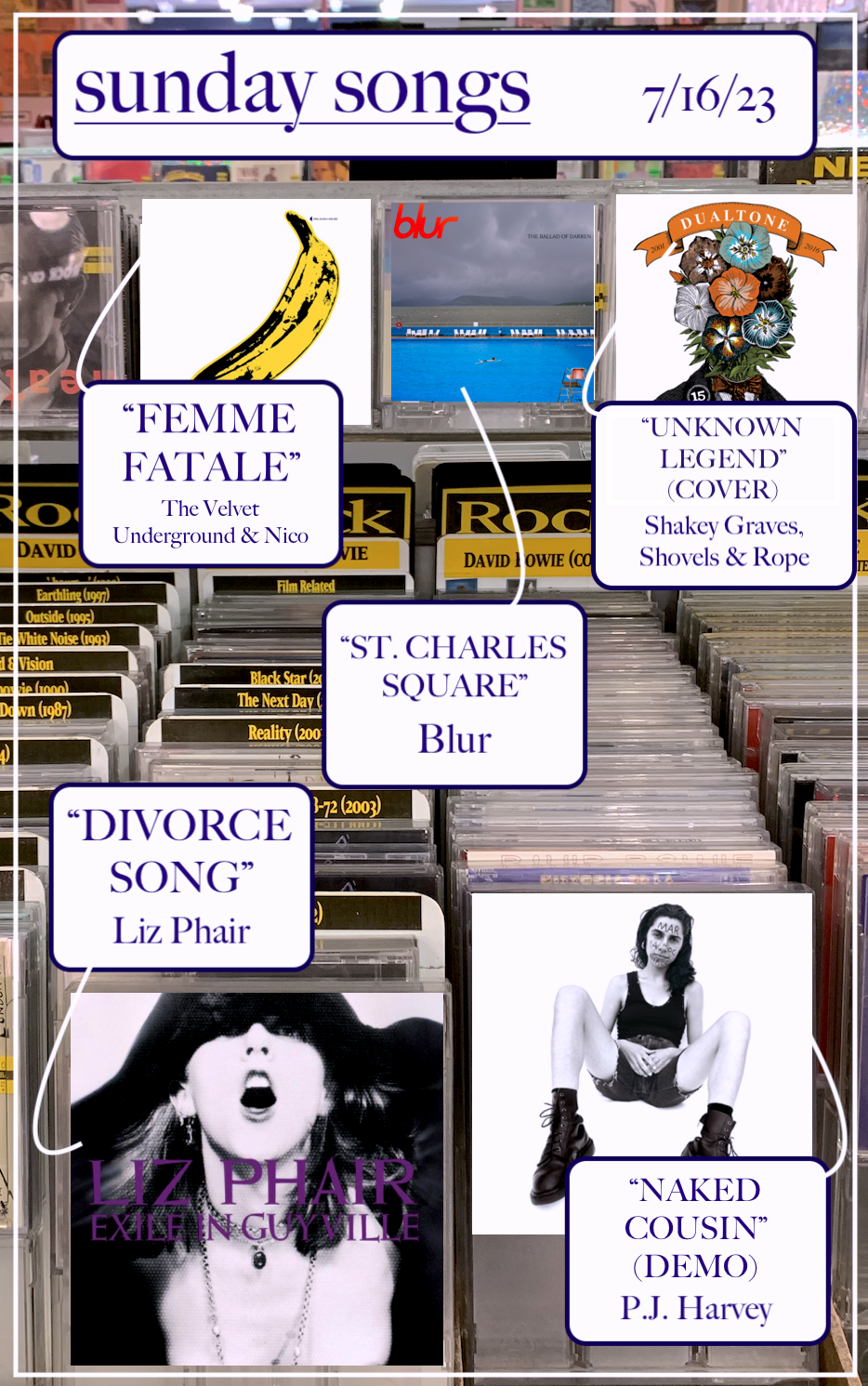
Sunday Songs: 7/16/23

Happy Sunday, bibliophiles! I hope this week has treated you well.

Sparklehorse also posthumously released “The Scull of Lucia” this week, and it would’ve fit the color scheme, but I just know that it’s gonna make me too sad to write about. Love you, Mark, but I’m trying to preserve my sanity.

Enjoy this week’s songs!

SUNDAY SONGS: 7/16/23

“Divorce Song” – Liz Phair

I guess this week’s batch is starting out on a sour note, but I just have not stopped listening to bits and pieces of this album for weeks, so get Liz Phair’d. My advice, though: as we are in the peak of road trip season, this is the absolute worst song to put on a road trip playlist, as good as it is. Regardless of whether or not you’re in a romantic relationship on said road trip, I feel like it’s just a horrible omen either way.

Speaking to Rolling Stone, Liz Phair said that she wasn’t surprised that this song became a fan favorite from Exile in Guyville: “…[‘Divorce Song’] has that deadpan delivery. It’s an ordinary person doing ordinary things…the song is really just about relating to another person. It feels like an action-packed song. You’ve done a lot…but really it’s just two personalities trying to be intimate and bumping up against each other on a road trip and that’s all that happens.” The concept of lyrical storytelling is, for some reason, always equated to having some grand, lofty narrative, as if stories about ordinary things somehow don’t make the cut. But that’s exactly what makes “Divorce Song” such a powerful song—it’s a linear narrative about a road trip gone south, and yet it packs the same punch of a narrative spanning multiple songs. You can tangibly feel the trapped heat of the inside of a car, the humid desolation of a cramped hotel room, and the sinking realization that “it’s harder to be friends than lovers/and you shouldn’t try to mix the two/’cause if you do it and you’re still unhappy/then you know that the problem is you.” Against the backdrop of Phair’s turmoil, small details create a painfully fleshed-out picture (“and it’s true that I stole your lighter/and it’s also true that I lost the map”), the images of this song feel as real as if I were watching them unfold on a movie screen; that really should be the bare minimum, but honestly, in the age of mass-produced, filtered music dominating the airwaves, this song feels like a breath of fresh air, even 30 years later. (Not too sound like a boomer there. I’ve just been inundated for the past few days because Taylor Swift was in town this weekend.) Contrary to Pitchfork contributor Scott Plagenhoef’s assertion that Exile would come off as dated to this generation because we’re so used to explicit sexual content in mainstream music…it’s not dated in that sense? At all?? Sure, we are exposed to more of it, but that doesn’t diminish the value of one of the first female artists to bring these kind of raw, unapologetic, and honest lyrics to the indie rock scene and owning it. It’s not like it’s impossible to see that empowerment shining through, whether it’s in the context of 1993 or 2023.

Seriously, Pitchfork…whose grand idea was it to have a man write a review of the 15th Anniversary Edition of Exile in Guyville? Not that men can’t write reviews of music by women and vice versa, but this one? The album that specifically came about to critique the boy’s club of indie rock? That’s just a war crime, if I’ve ever seen it. The review is from 2008, but…no, they had definitely had women on board at Pitchfork by then. There’s no excuse. Jesus Christ…

“Naked Cousin” (demo) – P.J. Harvey

uhhhhhhh tommy shelby sigma male octillionaire grindset cillian murphy moment

No, I haven’t watched Peaky Blinders yet, but my parents recently going through the whole show (and getting close to finishing it) has me almost convinced to watch it?? If anything will convince me, though, it’s the absolutely loaded soundtrack: Radiohead? The White Stripes? The Kills? I mean, come on. Perfection. And this too!

And, it’s reminded me that I need to get into P.J. Harvey. Somehow, I always forget about her, but every time I hear a song of hers, it’s instantly gripping, whether it’s the grinding jumpscare of “Rid Of Me” or what is hands down the best cover of The Rolling Stones’ “(I Can’t Get No) Satisfaction” ever performed, along with our queen Björk:

If that doesn’t make you want to worship the ground that they both walk on, just for a moment, I’m not sure what possibly will. The sheer power they both wield.

Again, there’s no excuse for me not to get into more P.J. Harvey right this minute, except for my pileup of albums waiting to be listened to. But for now, I at least have this song—and it’s a demo? How is this a demo?? Lucy Dacus, on her episode of Amoeba Records’ YouTube series What’s In My Bag? picked an album of Harvey’s 4-track demos, and remarked about how she wished that her demos were “remotely shareable” in comparison. Either way, I’m so glad that this demo is out in the world. Even with my limited P.J. Harvey knowledge, raw power is what characterizes what I’ve heard of her music—raw-throat screaming, instrumentals that bear down on you like an onslaught. “Naked Cousin” is just that; the slightly grungier (not necessarily grungy in the Nirvana way, but in both the musical and non-musical sense of the word), grimier sound quality coming from the demo enhances its atmosphere. It’s an eerily sinister song, the dirtiness of the instrumentation matching the lyrical image of discomfort that Harvey weaves: “I hate his smell and/I hate his company, but/But most of all, I hate that he/He looks just, just like me.” It’s a deeply uncomfortable song—Harvey really enhances the tangible feel of someone lingering over you, the feeling of their hot, sour breath pressing against your skin. She can certainly create an atmosphere, even if it’s the last one you’d want to be surrounded by.

“Femme Fatale” – The Velvet Underground & Nico

Since I’ve started working at the library, I’ve made a playlist for myself to listen to while I’m shelving books. It’s all soft, slow songs, both so I don’t get distracted and so it matches the atmosphere of the library. So there’s a lot of Phoebe Bridgers, Radiohead, Wilco, some older St. Vincent, et cetera. “Femme Fatale” went on there almost immediately, but not just because it fit those criteria: nothing makes you feel more like a character in an indie movie than listening to The Velvet Underground in a library.

Nico’s vocals take the lead on “Femme Fatale,” leaving Lou Reed to the backing vocals on the chorus. I already talked a little about the power of her voice back when I first listened to The Velvet Underground & Nico back in April with “All Tomorrow’s Parties,” but those two songs together are emblematic of her vocal range. Next to the looming, encroaching presence on the former (although it comes later in the album), “Femme Fatale” sees Nico dipping into a gentle whisper, her voice fading to an almost imperceptible hiss at the very end of each chorus as she says “hear the way she talks.” As massive of a presence as her famously low, resonant voice is, she slips into the quiet so easily (see also: “I’ll Be Your Mirror”), and yet retains the same cavernous quality—even as her voice drifts through the enchantingly gentle intro of guitar and tambourine, you can instantly feel it in your chest, making your bones vibrate. Or maybe the latter is just the mixing of this song—famously headphone-vibrating, if the YouTube comments are any indication. It’s the perfect fit for a film—the only movie I can seem to find with it is Bandslam, which I’ve never heard of, but Wes Anderson really needs to get on it. Past time that he used it for something, although maybe he filled his personal Nico quotient in The Royal Tenenbaums?

One Nico song seems like a small quotient, but who am I to judge Wes Anderson? He’s Wes Anderson, after all.

“St. Charles Square” – Blur

Gather ’round, my fellow Americans, let us all cry and watch videos of Blur performing in Wembley Stadium, and hope for the best that they’ll just get over themselves and announce a North American tour. Grab your tissues. Cry with me.

But this. THIS. This is the Blur that I’d been missing! “The Narcissist” was a solid song, but “St. Charles Square” is a much better showcase of their talents—and brimming with so much more creativity. Unlike the former single, which sounded as though it could be a solo Damon Albarn track, “St. Charles Square” finally feels like Albarn, Coxon, James, and Rowntree have reformed as a truly cohesive unit, their unique talents blending as seamlessly as they did in the 90’s. Whether or not Damon Albarn’s “OI!” at the beginning is a callback to “Parklife” (aaaaaaaaaall the people) or just him being British is up for debate, but even if it is nostalgia bait, you bet I’m biting it. You guys have no idea how many times my mom and I have car-danced to that song. I’ll gladly be a nostalgic shill for a bunch of white, middle-aged British guys. And finally, finally, Graham Coxon’s signature guitar playing has returned to the spotlight! His riffs are as power-laden and punchy as ever, and he’s adopted an echoing tone that calls back to David Bowie at the very beginning of the 80’s, right as he released Scary Monsters (And Super Creeps). And this song is full of scary monsters and super creeps of its own—the delightfully eerie lyrics are rife with “ghosts come back to haunt me” and “something down here/And it’s living under the floorboards/Its grabbed me round the neck with its long and slender claws.” With all that to work with, it’s no wonder that Albarn’s flair for showmanship shines in this track: I’d be lying if I told you that his piercing, werewolf howl at 1:40 didn’t make me giddy on every single listen. It’s a spooky delight all the way through.

“Unknown Legend” (Neil Young cover) – Shakey Graves, Shovels & Rope

I didn’t know until I started looking into this song that it was a cover—Shakey Graves was the main draw, I only knew of Shovels & Rope because they always come up as similar artists when I search for Shakey Graves on Apple Music, and I can only remember one (1) Neil Young song off the top of my head. And normally, I wouldn’t be one for folk-country songs describing a blonde woman riding through the desert on a Harley-Davidson that rhymes “diner” with “finer” (in reference to said woman), but, again: Shakey Graves.

iTunes has this song labeled as Shakey Graves & Shovels & Rope (and my English major brain wants to separate them with a comma or “and,” not a second ampersand, for the love of god 😭), but I was surprised to see that YouTube lists it as Shovels & Rope feat. Shakey Graves; if anything, there’s far more Shakey than Shovels—Alejandro Rose-Garcia is clearly taking the lead on vocals here. (I guess that this song was also included on Shovels & Rope’s covers album, Busted Jukebox, vol. 1, so that’s probably why.) Either way, the harmonies on this rendition of Neil Young are my main draw. Rose-Garcia’s voice has this distinct, irreplaceable rasp to it, rough and raw-throated at the edges, but never losing its power. Combined with the husband and wife duo of Michael Trent and Cary Ann Hearst (is it bad to ask who’s the shovel and who’s the rope in this relationship?), their voices form a resonant group of harmonies, with Hearst’s high notes elevating the thrill of the music and Trent providing a steady wall for it to anchor itself against. Whether they’re hitting the highest of high notes or gently drifting away from the chorus with their whispered repetition of “the air she breathes.” Again: I’m not usually one for the folky covers with the obligatory harmonica solo at the end, but Shakey Graves will convince me.

Since this post consists entirely of songs, consider all of them to be today’s song.

That’s it for this week’s Sunday Songs! Have a wonderful rest of your day, and take care of yourselves!
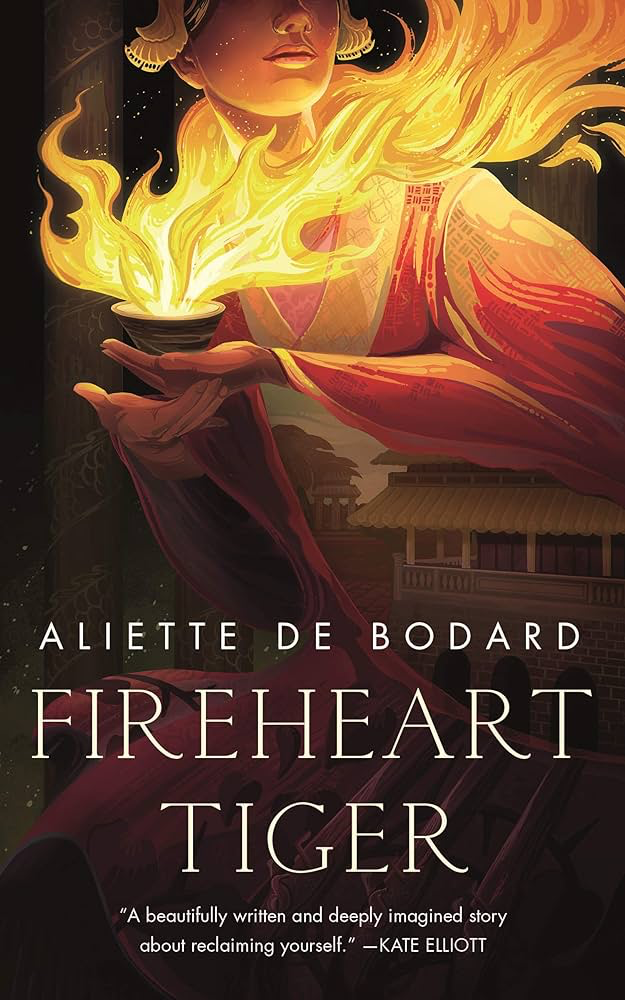
Posted in Sunday Songs

Sunday Songs: 5/28/23

Happy Sunday, bibliophiles! I hope this week has treated you well. 🫶🏻

This is gonna be a fun one. By coincidence, the fault lines of Palehound Panic™️ and my recently reawakened Blur Breakdown™️ have collided in the span of a week. Let’s hope the results won’t be cataclysmic.

Enjoy this week’s songs!

SUNDAY SONGS: 5/28/23

“Black Friday” – Palehound

I’ve finally finished my quest to catch up on Palehound (the albums, at least) before Eye on the Bat. Over the past week or so, Black Friday has been in heavy rotation—it feels like El Kempner’s most cohesive and lyrically strong album, and it might just be my favorite of theirs so far. It was a feat to pick just one song from this album—“Worthy,” “Aaron,” and “Killer” were all strong contenders (GO LISTEN THEY’RE ALL SO GOOD)—but the title track, “Black Friday,” stuck out to me in so many ways.

Palehound often leaves the introspection for a handful of songs at the end of each album, but the personal threads run deep throughout the entirety of Black Friday. This song in particular hits a particularly emotional note—it’s a continued story of catching up with old friends, all the while having a nagging feeling that they don’t care about you now, and that they never cared much about you before, either. Yet somehow, you still feel tied to them by some kind of desperate obligation, a lingering thought that maybe things can change, but knowing they won’t; Kempner sings that “I’ll take being the last one that you call/You’re Black Friday and I’m going to the mall.” The chorus of “Before you said we’d keep in touch/I don’t hear from you too much/If you need to call me, I’m too weak to hold a grudge,” with Kempner’s layered harmonies, glitter like the edges of stars and ring out like a faint sound of a jet flying overhead. It was a song that felt like a punch in the stomach, all while I was just trying to give myself a nice manicure. Afterwards, I had to sit back for a minute…there will always be those songs that hit a little too close to home for comfort, and they always come when you least expect them to. But songs like “Black Friday” give a voice to the feelings that we think, in our darkest moments, are isolated only to only us. So thank you for that, El Kempner. Here’s to making friends with people who really do care, and not chasing after people who don’t.

“The Narcissist” – Blur

All is right in the universe. Nature is healing. We’ve got a new Blur album out in July…everything’s okay again…

…and this song is testing my ability to spell the word “narcissist.” I could’ve sworn that there was another ‘c’ in there somewhere…

I’ve got to hand it to Damon Albarn at this point—he’s having not one, but two of his projects (this and Gorillaz) releasing albums this year, and even if Cracker Island was a bit of a disappointment, the sheer creativity and talent is all there regardless. Knowing that the forthcoming The Ballad of Darren was a spur-of-the-moment kind of reunion makes it all the more impressive—they didn’t plan on making another album in the first place, and then they come out with this?

That being said…I’m not sure if it’s Blur’s best, but it’s still a great song. I didn’t listen to it on repeat while cleaning out my closet last week for no reason. It’s such a catchy tune—the instrumentals are a little understated, but it’s clean, it’s smooth, and it’s proof that Blur have mastered the art of a polished Britpop tune. My only problem, as much as I’ll sing praises for Damon Albarn, is that there’s too much Damon Albarn. It’s not something that I’d ever picture myself saying, but we live in strange times. “The Narcissist,” delightful earworm that it is, feels more like a solo Damon Albarn effort than a Blur song. Even though we do get Graham Coxon’s backing vocals, I find myself missing his captivating, intricate riffs. You can hardly hear the presence of Alex James’ iconic basslines. And Dave Rowntree’s precise drumming is still there, but again: understated. I just want more Blur, less Damon Albarn.

All that is to say that, for once, the fact that we’re getting a whole new Blur album overshadows most of the nitpicks I have about “The Narcissist.” I have a feeling that I’m gonna enjoy Hot Blur Summer.

“I Need Some Fine Wine and You, You Need to Be Nicer” – The Cardigans

If I didn’t know any better, I would’ve thought this was a Giant Drag song—it’s got a very similar kind of bite. I’ve only listened to First Band on the Moon, but this song has me wondering what happened between that and their final record, Super Extra Gravity. I wouldn’t call it a sea change—it’s still got the pop sensibility that Nina Persson perfected to a science, but there’s an undeniable roughness to the song that pushes it more towards the edges. Persson’s voice, although it retains her signature, dainty tone, curls into a rasp as the song begins with half-spoken dog commands—”Sit/good dog/stay/bad dog/down/roll over.” The rest of that song is as bitter as the intro suggests, singing of a relationship gone sour, dulled by alcohol and fleeting visions of lost love. The Cardigans have toyed with these kinds of songs, but this one really makes the feel come through—it’s still a pop song through and through, but the sharpening of the guitars on this one make the image really come to life. “I Need Some Fine Wine” is, in short, Nina Persson’s hairdo in most of the video—it coexists as the neatly braided crown and the spiky hairs coming out all at once.

“Sinnerman” – Nina Simone

Full disclosure: I hoard reaction images. Too many. But even a refined reaction image connoisseur such as myself knows that some images are only suited for very specific, sacred times. You can’t go about wasting them willy-nilly, even if they are just…well, sitting on your phone. It’s not every day that something can evoke the feeling contained in this image, for instance:

But that’s how “Sinnerman” feels. All the way through.

Every TV show and film that this song has been featured in has cut it tragically short; and no, I don’t mean to call Gerard Way and Taika Waititi cowards, because they clearly aren’t, but also…if you’re going to include this song in anything, you have to go the whole mile—the 10:19 mile, to be exact. And if there’s any song that commands the listener to sprint through its entire length, it’s this one.

I can take longer songs, but there’s a specific art to crafting them: for me, if a song goes past the 6 or 7 minute mark, there has to be something that keeps me listening—that applies to any song, technically, but if you have that long of a song that mostly consists of repetition, you’ve started to lose me (lookin’ at you, LCD Soundsystem…you can pull it off sometimes…). Oingo Boingo’s sprawling, nearly 16 minute long swan song “Change,” for instance, has plenty of recurring musical motifs, but it keeps you on your toes, whether that be with artfully-placed oddball instrumentation or bizarre samples. But there’s a way that long song repetition can be done—my favorite song of all time, in fact, does just that; Blur’s “Tender” has a somewhat tidier format, but they bypass the LCD Soundsystem syndrome not just with breaks for Graham Coxon’s bluesy riffs and choir, but by fueling it with nothing but Emotion with a capital E—”love’s the greatest thing,” after all.

“Sinnerman,” however, does both of those things—it’s essentially the mother of every epic, extensively long song that you can think of. Even knowing the years that Nina Simone was active, it still amazes me that this was released in 1965. I could almost understand it if it had been the late sixties, when everybody started to realized how freeing musical experimentation was. Simone’s musical career was defined by pushing against so many barriers, from her protest music to her incredible piano skills, but this song pushed the envelope in such a wildly different way. Through all 10+ minutes, there’s an energy that seems to live and breathe and never stop—even when the music begins to die down in favor of Simone’s piano and a chorus of clapping. It’s a song on a desperate mission, one that takes no prisoners and never stops to catch its breath. Even though the song is an amalgamation of scattered 50’s songs, gospel, African spirituals, and remnants from her own religious upbringing, it can be easily reduced to a single word, one that Simone famously belts out near the song’s climactic ending—”power.” I can’t think of many other songs that grab you by the shirt collar and keep you hanging there quite like this—nothing comes close to how propulsive Simone is, with how purely propulsive both her voice and her piano playing are. Again—take my word with a grain of salt, but this really is a masterpiece. And knowing that she used to end her live shows with this song…WHEW. What a song.

“Sea of Blood” – Palehound

Whether or not it was intentional, it’s fitting that this song shares space with a song called “YMCA Pool.” Two dubious bodies of liquid on one single.

With some songs that end up as singles after the released of an album, you’re left wanting—what could’ve changed if that track was on the album, as originally intended? (see: “Bicycle”) But some songs were made to be tiny, standalone packages, never leftovers for works past or teasers for what’s to come. “Sea of Blood” works exactly this way—it’s got the sprightly beats and guitar work of something circa Dry Food or even Bent Nail – EP, but there’s something about the short, snappy atmosphere of it that doesn’t confine it to any of Kempner’s previous works. It might fight the catchier, brighter side of Dry Food, but it doesn’t quite match the introspection. It’s got the experience that Bent Nail hadn’t fully achieved yet. And yet it still sounds like a home demo, but so fully realized—a neat drum machine accompanies Kempner’s signature rasp, sharp lyrics, and climbing guitar fingerings all come together in what has the sound quality just above an iPhone voice memo, but the polish that comes from nurturing a tune like this for a long time. And leave it to Palehound to name a song something like “Sea of Blood,” a title you’d expect to come with throat-burning, heavy metal screaming, but start off the song with a line as innocuous as “I’m every bit as fragile as a baby bird.” You sly dog, you…hound?

Since this post consists entirely of songs, consider all of them to be today’s song.

That’s it for this week’s Sunday Songs! Have a wonderful rest of your day, and take care of yourselves!
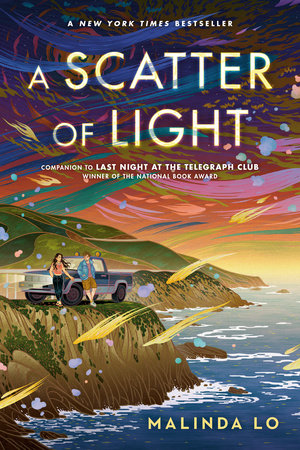
Posted in Uncategorized

Sunday Songs: 4/9/23

Happy Sunday, bibliophiles, and happy Easter for those celebrating! 🐣

I’m still riding the boygenius high, and I will most certainly be riding it for much longer (that is a threat), but I promise I’m listening to a few more songs…maybe…

Enjoy this week’s songs!

SUNDAY SONGS: 4/9/23

“Cool About It” – boygenius

Never in a million years would I have predicted having a song with banjo in it constantly on repeat, but life is full of surprises. All the better if said songs are delivered by the likes of boygenius.

I’ll surely be raving about boygenius’ recently released full-length debut the record for the next month, but this song, after their first four singles, is taking center stage in my head constantly. With a melody inspired by Simon & Garfunkel’s “The Boxer” and sparse, gentle instrumentation that lets each member of the supergroup bathe in the spotlight, it’s a quiet, introspective highlight. Julien Baker, Lucy Dacus, and Phoebe Bridgers take turns reflecting on the mixed emotions of painful, strained reunions with exes and old friends, hidden lyrics shine through in not-so-hidden lyricism—”I can walk you home and practice method acting/I’ll pretend that being with you doesn’t feel like drowning,” in Bridger’s final words. boygenius have let their joint talents meld together in a handful of different structures, but somehow, this neat, boxed-in sections where one singer takes the lead per verse make for a song that truly feels like all of them. And as gently as bubbling water in a creek, their harmonies rise as one for each chorus—my heart can’t help but leap a little when each of them harmonize to the final line of each verse: “even though we know it isn’t true…”

[fanning face] The power they have, I swear…

“You & I” – Graham Coxon

I’ve been meaning to get more into Graham Coxon’s solo work ever since my 2021 Blur frenzy, and through the nuggets of song titles that I seem to remember completely at random, I’m getting more and more excited about it. The only song of his that I know that isn’t a cover or from the soundtrack of The End of the F***ing World (which I still need to watch…), it’s an unadulterated dose of tight, anxious Britpop straight to the veins; even without Blur and all of the detriments that came with its fame, it’s clear that this is the kind of music that Coxon was meant to play. And he plays it well. Each punchy chord feels laid out on a precise grid, and from what I can gather about him, it seems like something he would do. “You & I” is a distinctly polished song—not in the way that an over-produced, Top 40 hit is, but polished in the way that every edge has been meticulously sanded down to perfection, not a note out of line. These nervous, uptight white guys know their stuff sometimes…

“Everybody Wants To Love You” – Japanese Breakfast

I’ve gotten bits and pieces of Japanese Breakfast over the years—I remember being in the car all the way back in middle school and hearing a piece of NPR about her debut album, Psychopomp, and being interested, but I don’t think I ever got around to listening to it then. With all the buzz around Jubilee and her acclaimed novel Crying in H-Mart, I figured I might get around to giving Michelle Zauner and company a listen. Like “You & I,” I remembered the title of this song at random, and I’m so glad I did!

“Everybody Wants To Love You” feels like the 2010’s, indie rock answer to a poppy love song of the 50’s or the 60’s. Everything about it feels cheery—the bright, practically glittering guitar tones, the sharp pep of Zauner’s voice, and the starry synths that seem to leave sparkling trails over every second of the song. Add a wonderfully catchy guitar riff and package it into the pop-standard 2 and a half minutes, and you’ve got something that feels like it could come out of any era. Well…maybe not any era—some of those lyrics definitely would not have flown in the mainstream before the 60’s, but that’s not the point. It’s just 2 and a half minutes of joy, purely and simply.

“A Quiet Life” – Teho Teardo & Blixa Bargeld

Over break, I went through the first season of Netflix’s Dark with my family, and ever since, I’ve ripped a solid half of the songs from that show and slapped them haphazardly into my music taste. Seems like that’s largely the case for a lot of the commenters on this video too (all of the Dark references have passed the vibe check with absolutely flying colors), and, among other things, Dark reminds me how good it feels to be so invested in every part of a show—not just the story itself, but every little detail that goes into it. Like the music.

I won’t go into how perfectly this song melds with the overall themes and the last episode of season 1 of Dark for fear of spoiling something so wonderfully intricate, but it’s chilling on its own as well. Blixa Bargeld boasts such a rich voice—it reminds me a lot of Jarvis Cocker, with that same rasp at the edges of the resonance you can feel in your chest. Just like Dark’s absolutely disturbing score, Bargeld’s vocals seem to buzz in moments, turning from something human into the hum of putting your ear next to a beehive. There’s a deeply poetic feel to everything in this song’s atmosphere, with the orchestral composition forming in the background and the gloom that seems to settle over every note like fog. It creeps along like frost, painted in the same grays as the album cover. What I’m trying to say here is this: whoever was in charge of the music direction for Dark—I SALUTE YOU. BLESS YOU.

“Demi Moore” – Phoebe Bridgers

Phoebe Bridgers is a distinctly 2020 artist in my musical canon. I first listened to Stranger in the Alps in the early months, before everything went…y’know, and Punisher came out that summer. But unlike Punisher, an album that’s a no-skip for me to this day, some of the songs on Stranger in the Alps didn’t do it for me on the first few listens. It’s understandable—Stranger was her debut, and with Punisher, she had more time to hone her craft and sound. But I’ve recently come back to some of those songs that I didn’t warm up to the first time; some of them still don’t impress me, but “Demi Moore,” along with the harrowing “Killer,” took a while to grow on me.

With a title borne from a misheard lyric (“I don’t wanna be stoned anymore” became “stone Demi Moore,” this song, like many of her others, lingers in the hazy, middle-of-the night lairs of vulnerability. Especially on Stranger, the instrumentals often take a backseat to Bridgers’ singing, letting the emotional side speak for itself amidst quiet synths that flicker like satellites in the night sky. Phoebe Bridgers’ voice floats along like misty fog over a creek, all at once thin and full of emotion.

And again—normally I can’t stand banjos, but these somehow work because of how…quiet they are? Sorry for the banjo slander here, but…I can’t help it, I’m sorry. I was forced to learn in 7th grade for school, but I didn’t enjoy much of it, save for trying to pluck out a rendition of “It’s A Wonderful Life” from memory. I’ll begrudgingly admit that it did help me get a bit of head start on playing guitar, but I still have a vendetta with the instrument. I digress.

Since this post consists entirely of songs, consider all of them to be today’s song.

That’s it for this week’s Sunday Songs! Have a wonderful rest of your day, and take care of yourselves!

Posted in Book Review Tuesday, Mini Reviews

Book Review Tuesday (3/28/23) – #TransRightsReadathon mini reviews

Happy Tuesday, bibliophiles!

As some of you may know, last week (March 20-27) was when the #TransRightsReadathon was hosted in response to a dangerous increase in anti-trans legislation across the U.S. Created by Simi Kern, the goal of the readathon was to give the spotlight to as many trans books and authors as possible to bring them awareness and support in light of the rampant transphobia across the country and beyond. It’s been frightening and heartbreaking to see what’s happening in other states, and I want to support my trans siblings in any way possible. So I’ve decided to include shorter reviews of all of the trans books I read this week—all of which were good!

PLACES TO DONATE (U.S.):

Enjoy this week’s mini reviews!

A Million Quiet Revolutions – Robin Gow

summary from Goodreads:

For as long as they can remember, Aaron and Oliver have only ever had each other. In a small town with few queer teenagers, let alone young trans men, they’ve shared milestones like coming out as trans, buying the right binders–and falling for each other.

But just as their relationship has started to blossom, Aaron moves away. Feeling adrift, separated from the one person who understands them, they seek solace in digging deep into the annals of America’s past. When they discover the story of two Revolutionary War soldiers who they believe to have been trans man in love, they’re inspired to pay tribute to these soldiers by adopting their names–Aaron and Oliver. As they learn, they delve further into unwritten queer stories, and they discover the transformative power of reclaiming one’s place in history.

TW/CW: transphobia, dysphoria, misgendering/deadnaming, homophobia, off-page sexual assault, religious bigotry

Novels in verse always get me when they’re done well, and A Million Quiet Revolutions was no exception. The story of Aaron and Oliver is one that was essential to be told, and it resulted in a beautifully poignant piece of verse!

The growing relationship between Oliver and Aaron felt so genuine, and the combination of pseudo-epistolary format (oh god, that sounded pretentious…) with verse emphasized the way that their relationship transcended barriers of both place and time. The interweaving of the past with the present gave me an insight into a queer part of history that I’m almost embarrassed that I didn’t consider until reading this—better late than never, I suppose. Their voices both leapt off the page, and the easy flow of Gow’s verse made the reading experience feel effortless, drifting like wind—good poetry, to me, doesn’t quite feel like poetry; the rhythm remains, but it doesn’t feel like going line by line in such a rote way.

Above all, the message of this novel in verse is one that’s so important, especially in a time where the narrative of LGBTQ+ people being trendy and new is being pushed so often—queer people have always been here, and we will always be here. Aaron and Oliver’s journey of researching their trans namesakes—cross-dressing soldiers in the Revolutionary War—was one that’s so necessary for understanding our own roots. The key to belonging is realizing that you have always been a part of history, no matter how many pains historians have taken to ignore or deliberately erase the queerness and transness that has always been there. For me, that’s why A Million Quiet Revolutions is such an important read.

Brimming with history and rich verse, A Million Quiet Revolutions is an ode to discovering your own roots, and finding solace in hidden histories. 4 stars!

💙💗🤍💗💙

The Many Half-Lived Lives of Sam Sylvester – Maya MacGregor

summary from Goodreads:

In this queer contemporary YA mystery, a nonbinary teen with autism realizes they must not only solve a 30-year-old mystery but also face the demons lurking in their past in order to live a satisfying life.

Sam Sylvester’s not overly optimistic about their recent move to the small town of Astoria, Oregon after a traumatic experience in their last home in the rural Midwest.

Yet Sam’s life seems to be on the upswing after meeting several new friends and a potential love interest in Shep, the pretty neighbor. However, Sam can’t seem to let go of what might have been, and is drawn to investigate the death of a teenage boy in 1980s Astoria. Sam’s convinced he was murdered–especially since Sam’s investigation seems to resurrect some ghosts in the town.

Threatening notes and figures hidden in shadows begin to disrupt Sam’s life. Yet Sam continues to search for the truth. When Sam discovers that they may be closer to a killer than previously known, Sam has a difficult decision to make. Would they risk their new life for a half-lived one?

TW/CW: transphobia, ableism, self-harm, homophobia, biphobia, misgendering, anaphylactic shock, hate crimes (past), murder

…why does Goodreads still list the title wrong 😭

My ultimate hope was that this book would be as well-crafted as its cover, and for the most part, it lived up to my expectations! The Many Half-Lived Lives of Sam Sylvester deftly toes the line between a coming-of-age story and a decades-old mystery, buoyed by a diverse and lovable cast.

Sam Sylvester has a batch some of the most diverse representation I’ve seen in a realistic fiction/mystery novel in a while—aside from having a nonbinary, asexual, and Autistic protagonist (more neurodivergent protagonists, please!!), there were so many different characters that were incredibly intersectional—queer, POC, and disabled characters all across the board, and not just the teen characters too! All of these identities were woven so well into the story, and I loved the journey of self-acceptance and reckoning that Sam experiences throughout the novel as they unravel the mystery of the boy who died in their room 30 years ago.

That being said, although I liked most every aspect of this novel, this really feels like a novel that’s going to date itself. I enjoyed a handful of the references (always extra points for David Bowie), but a lot of the more recent ones—the references to Tumblr, Gen Z slang, internet culture, and a Steven Universe gag every other page, read as very hackneyed and stilted. As authentic as the rest of Sam Sylvester was, those parts dragged down what would have otherwise been powerful and realistic dialogue. Most of the writing did its job and did it well, but the attempt to ground it in the present day only ended up making a novel that’s going to date itself far quicker than it was probably intended to.

Despite that, I’d say that Sam Sylvester is still a must-read—for the excellent representation, for the mystery, and for the coming-of-age story. 3.75 stars, rounded up to 4!

💙💗🤍💗💙

The Thirty Names of Night, Zeyn Joukhadar

summary from Goodreads:

The author of the “vivid and urgent…important and timely” (The New York Times BookReview) debut The Map of Salt and Stars returns with this remarkably moving and lyrical novel following three generations of Syrian Americans who are linked by a mysterious species of bird and the truths they carry close to their hearts.

Five years after a suspicious fire killed his ornithologist mother, a closeted Syrian American trans boy sheds his birth name and searches for a new one. He has been unable to paint since his mother’s ghost has begun to visit him each evening. As his grandmother’s sole caretaker, he spends his days cooped up in their apartment, avoiding his neighborhood masjid, his estranged sister, and even his best friend (who also happens to be his longtime crush). The only time he feels truly free is when he slips out at night to paint murals on buildings in the once-thriving Manhattan neighborhood known as Little Syria.

One night, he enters the abandoned community house and finds the tattered journal of a Syrian American artist named Laila Z, who dedicated her career to painting the birds of North America. She famously and mysteriously disappeared more than sixty years before, but her journal contains proof that both his mother and Laila Z encountered the same rare bird before their deaths. In fact, Laila Z’s past is intimately tied to his mother’s—and his grandmother’s—in ways he never could have expected. Even more surprising, Laila Z’s story reveals the histories of queer and transgender people within his own community that he never knew. Realizing that he isn’t and has never been alone, he has the courage to officially claim a new name: Nadir, an Arabic name meaning rare.

As unprecedented numbers of birds are mysteriously drawn to the New York City skies, Nadir enlists the help of his family and friends to unravel what happened to Laila Z and the rare bird his mother died trying to save. Following his mother’s ghost, he uncovers the silences kept in the name of survival by his own community, his own family, and within himself, and discovers the family that was there all along.

TW/CW: transphobia, xenophobia, racism, Islamophobia, miscarriage, grief, sexual assault, animal death, loss of a parent

I didn’t go into The Thirty Names of Night with any expectations, but I was stunned by the writing! This novel is one of the best magical realism novels I’ve read in recent years, with writing as rich as a tapestry and a story that’s just as well-woven.

Joukhadar’s writing style was the star of Thirty Names; this is the first of his novels that I’ve read, but he has such a unique talent for finding unlikely comparisons and weaving them into the richest, most obvious but out-of-sight metaphors imaginable. I would never have compared the gray sky on a foggy day to the color of a kitchen knife, and somehow, it was right in front of me. His talent for metaphor suited the emotional depth of this story, as well as the almost fantastical element of the birds in New York—I will never claim to be the expert on him, but if there was any story that was suited for Joukhadar to tell, it’s this one.

That writing also made the emotional core of this story possible. There’s so much to Thirty Names: gender identity, grief, heritage, family, and the body itself, but all of it was handled with such grace and aplomb that made the story feel really, truly real. I might’ve even passed the aspect of the birds by as something that could feasibly happen with how this story was written. Every part of this novel is deeply moving, raw and beautiful, and the prose flows as smoothly as air over a bird’s wings.

All in all, a beautiful, literary tale of connections—to family, to gender, and to the world around us at large. 4.25 stars!

💙💗🤍💗💙

The City in the Middle of the Night, Charlie Jane Anders

summary from Goodreads:

“If you control our sleep, then you can own our dreams…And from there, it’s easy to control our entire lives.”

From the brilliant mind of Charlie Jane Anders (“A master absurdist”—New York Times; “Virtuoso”—NPR) comes a new novel of Kafkaesque futurism. Set on a planet that has fully definitive, never-changing zones of day and night, with ensuing extreme climates of endless, frigid darkness and blinding, relentless light, humankind has somehow continued apace—though the perils outside the built cities are rife with danger as much as the streets below.

But in a world where time means only what the ruling government proclaims, and the levels of light available are artificially imposed to great consequence, lost souls and disappeared bodies are shadow-bound and savage, and as common as grains of sand. And one such pariah, sacrificed to the night, but borne up by time and a mysterious bond with an enigmatic beast, will rise to take on the entire planet–before it can crumble beneath the weight of human existence.

TW/CW: animal attack/animal death, police brutality, body horror

Alright, so the only explicitly stated Latinx characters, specifically of Mexican ancestry, are named…Carlos and Maria? So most everybody else gets semi-unique names, but not them? It’s like Cho Chang all over again…[LOUD INCORRECT BUZZER}

If I hadn’t read Victories Greater Than Death beforehand, I would’ve been more suspicious, but it seems like Anders has gotten a lot better with diversity on that front, but…still iffy. Just saying.

That aside, The City in the Middle of the Night was one of the more inventive dystopias that I’ve read recently, but it fell victim to very convoluted writing. It’s obvious from every page that Anders put so, so much work into creating a fleshed-out world with an equally fleshed-out history—that was a riotous success on her part. The premise of society being divided by a tidally-locked planet felt eerily feasible, and I absolutely ADORED all of the alien life forms on the night side of January—the Gelet were obviously my favorites, but I would’ve liked to have seen more creatures. ALWAYS MORE CREATURES.

However, Anders’ writing choices ended up making parts of The City in the Middle of the Night something of a struggle. The story itself ended up being rather convoluted and tangled, and I found myself getting lost and confused about wait, which side of the planet are we on again? Why are we here in the first place? The additions of a boatload of characters that ended up having very little consequence to the plot at large didn’t help either. This story had the potential to be incredible, but it ended up getting so lost in itself that it became an ordeal to figure out where I was.

All in all, an inventively-conceived dystopia that excelled in worldbuilding but floundered in its writing. 3.25 stars.

Tell me what you think! Did you participate in the #TransRightsReadathon, and if so, what books did you read? What do you think of these books? Let me know in the comments!

Today’s song:

That’s it for this week’s Book Review Tuesday! Have a wonderful rest of your day, and take care of yourselves!