Happy Sunday, bibliophiles, Happy Trans Day of Visibility, and Happy Easter for those celebrating!
Mentally, I’m still at the beginning of the semester, but somehow midterms are over and I’ve just gotten back from break…ignoring that…
Let’s begin, shall we?
GENERAL THOUGHTS:
I’ve continued to be busy in most of my academic aspects of life, but I’ve managed to stay on top of it—midterms season wasn’t as bad as I thought it was going to be, and it certainly helped that we got an accidental four-day weekend thanks to a snowstorm so drastic that my college called two snow days in a row. I’ve lived in Colorado my whole life, and I’ve never experienced a double snow day…good times, gotta say. I didn’t leave my dorm for all of that Thursday and spent my time playing Minecraft and drinking hot chocolate. A win is a win. But now, the weather’s warming up, and I’m looking forward to soaking it all in.
I honestly thought that this month was going to be my worst reading month, but I read a lot more than I expected; spring break definitely gave me a boost, and March has ended up being my best reading month of 2024 so far! Rating-wise, it’s a different story (certainly more stinkers in this batch), but there were plenty of excellent reads before and after my brief reading slump. Blogging has been about the same—again, school has made it so that I’m mostly sticking to my usual book reviews and Sunday Songs, but I’ve had fun writing them all the same.
Other than that, I’ve just been drawing, playing Minecraft (WE’RE FINALLY GETTING THE DOG UPDATE), studying, watching The Bear, The Completely Made-Up Adventures of Dick Turpin (STAND AND DELIVAH), Abbott Elementary, and Constellation (I haven’t been this stressed out and baffled by a show since Dark, and that’s really saying something), series 17 of Taskmaster, Dune: Part 2 (may thy knife chip and shatter), seeing Chelsea Wolfe live (!!!!! THE QUEEN), and reverting from human to hibernating grizzly bear the minute snow started falling.
READING AND BLOGGING:
I read 19 books this month! I thought it would end up being a lot less than that, but spring break gave me much more time to read. As far as ratings, this has probably been my worst reading month (first DNF and 1-star rating of the year…), but that doesn’t mean that I didn’t read a ton of fantastic books!
Happy Sunday, bibliophiles! I hope this week has treated you well.
Happy St. Patrick’s Day! Despite appearances, you theoretically would not actually be able to pinch this week’s graphic for not wearing green, despite wearing mostly brown. Please give it up for Lucy Dacus and her green top.
Also, most of the songs this week are either bittersweet or just………flat-out sad, so…apologies in advance.
I knew it. I knew I’d fall into the Alex G trap eventually. My Car Seat Headrest-poisoned brain finally succumbed to another sad white guy with voice cracks and bedroom recording equipment. It was only a matter of time.
I genuinely can’t decide if “Sarah” is fully tragic, or if there’s some sweetness in there. The atmosphere that Alex G creates certainly leans toward the former; listening to this song is a blur from a car window, sticky with the humidity of the South as you drive past flat, dismal lawns and white-painted houses that have stood there so long that the paint has peeled and molded to brown in the corners. It dwells in a kind of dream-space where the narrator is hesitant to leave, knowing that the consequences will crash down upon them the minute they step foot into the less-green grass on the other side of the fence. Again, my mind has permanently been altered by listening to too many of the earlier, lo-fi Car Seat Headrest songs when I was at the tender, impressionable age of 14, but there’s an enchanting melancholy of the cheap distortion on the guitar and the synths that drift like ribbons underwater, each note trailing off like a thought unsaid. In a way, “Sarah” is a kind of love song, but with a love that’s overshadowed by the damning realization that you’re not the right person for the one you love. And yet, the narrator cannot extricate themselves from Sarah, wanting to cling to her desperately, but knowing that the more they stay, the more they’ll destroy her. It doesn’t feel like a self-hating, depreciating kind of awareness—it’s a crushing realization that the narrator really is, in some way, in a place where they’ll only drag the people they love down with them, against all of their wishes. That’s what makes it tragic to me; Alex G sings half of the song in a higher pitch that drives his voice to shattering cracks, and you can hear his voice break as he sings the line “she loves me like a dog.” The distorted howl of “did I make a mistake?” feels like it drifts up into a smoky, firework-scented sky as it dissipates into digital nothingness, an anguished thought birthed in the depths of introspection.
…AND A BOOK TO GO WITH IT:
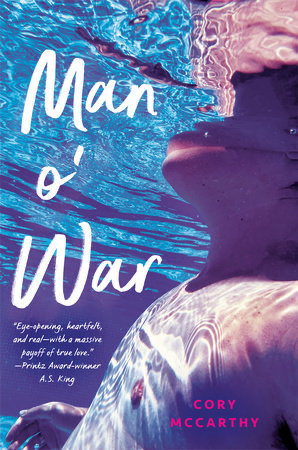
Man o’ War – Cory McCarthy – a painful and poignant journey of learning to love yourself and other people.
Two years ago, I doubt I would have listened to The Dreaming in full. I warmed up to Kate Bush’s earlier stuff more easily, but with the onset of the most recent season of Stranger Things, I was just kind of Kate Bush’d out, which, for a woman of her insane talent, it kind of embarrassing to say. I just couldn’t turn a corner without hearing “Running Up That Hill”—as objectively good a song as it is, the omnipresence of it turned me off. But two years, a listen to The Kick Inside, and more than a good word from my brother (the world has never seen a more fervent Kate Bush superfan), and I finally found myself here. I’m glad I listened to it now—even though my love for “Suspended in Gaffa” (still my favorite track) persisted through the summer of 2022, there was so much weirdness and artistry to the album that it was almost overwhelming—more than once it felt like that in a “mom, come pick me up, I’m scared” way (see: “Get Out of My House”), but overall, that was all apart of the package deal. Admittedly, I can’t fully get on board with all of it; as much as I love the lyrics to “Sat in Your Lap,” that song has irrationally annoyed me since I was a kid, and that quality hasn’t exactly faded—I wish it had, but it’s in the minority of songs that I actively skip on this album. After three albums, this almost feels like Bush’s Hunky Dory: the moment where she had honed her skills and image and officially started going absolutely bonkers.
One such aspect that Bush had nailed by the time that The Dreaming came around was channeling raw, untapped emotion; you can almost feel the bewildered, shaking tears slipping from her eyes as she is faced with something divine in “Suspended in Gaffa” and the feral release in the form of braying like a mule at the end of “Get Out of My House.” It’s overwhelming because it’s exactly what you’re supposed to feel—both of these songs are about separately intense and overpowering emotions, and I believe there’s very few musicians out there who can make that tidal wave translate from the music to the body. That’s already a feat, but given that she was 24 when she released this album…okay, I need to stop googling “how old was Kate Bush when she released [insert album],” because I inevitably get existential. Either way, it’s talent—and “Houdini,” the album’s grief-drenched penultimate track, is testament to that. Recounting the story of Houdini’s wife, Bess, who tried to contact him through seances with a code that the two had devised to ensure that it was him (“Rosabel, believe”); contact was allegedly made in 1929, but she lated believed the code to be the result of trickery from beyond the grave. It’s a deeply tragic story, and Kate Bush pulled no punches in drowning “Houdini” in sorrow. Soft piano dominates the piece, but when it isn’t demure and solemn, Bush lets out a mourner’s wail so convincing that I’d easily believe that she’s channeling Bess Houdini’s bereaved spirit as she bellows out “With your life/The only thing in my mind/We pull you from the water!” That image, of Houdini passing the key to his chains to Bess through a kiss, was what made it on the cover art—I thought it was a wedding ring for the longest time, but to be fair, only the round part is visible on her tongue, and the rest is concealed behind her lips.
Alright. That’s enough of the abject depression for now. Here. Sit down on the bench beside me. Here’s $20, go see a Big Thief.
I’d like to think that I’ve found out about all of these separate Big Thief songs independently, but in reality, all of the songs I end up listening to are the ones brought up by my fantastic brother’s equally fantastic girlfriend, so once again: thank you. If there was ever a song to describe this time of year—nearly spring, almost warm, and the grass is still brown but peppered with sprouts pushing through—it would be “Objects.” Each pluck on the guitar feels like worms and beetles gently crawling through crumbly earth, the shifting of tiny pebbles and dead leaf fragments as they bore tunnels through the ground. This was only recorded about eight years ago, but there’s already a stark difference in Adrianne Lenker’s voice; when I think of this song and earlier songs (see also: “Velvet Ring”), her voice sounds papery, thinner than thumbnails and soft enough to fold into simple origami. It’s gotten simultaneously more feathery, more feral, and richer with the years, but what I’ve heard of these first two Big Thief albums feel like time capsules in her vocal evolution. And like the springtime that “Objects” evokes, the lyrics are all about the spillover of love as it begins to blossom; like the same sprouts that push their way to the sunlight, the object of affection inspires the narrator to “[Leave] the familiar/Air is getting chillier/Stepping outside your skin.” It’s not just Lenker’s voice that feels understated—all of the instruments feel restrained and green, but it conveys that fizzy, bashful feeling of the beginnings of love.
I generally have Joe Talbot of IDLES to thank for a lot of things, namely the musical positivity he’s brought into my life, but I also have him to thank for finding this song. Recently, Talbot was featured on BBC’s CBeebies bedtime story segment, where, after reading the picture book Under the Love Umbrella, he listed off some songs to soothe children. This was one of them, and the minute I heard it, I understood completely.
This song is a very sparing one. In a sense, “Your Young Voice” is barely a song at all. It’s only two lines that repeat for almost three and a half minutes: “And it’s your young voice that’s keeping me holding on/To my dull life, to my dull life.” And yet, it tugs at the heartstrings more than some songs with a full verse-chorus structure of the same length. The lyrics are so simple, and yet, their repetition weaves together what a mountain of unnecessary stanzas do in any other piece; their repetition feels like a promise, a mantra—you get the sense that whoever’s young voice is keeping the narrator anchored, the only thing keeping them clinging to the end of their fraying rope. Repeated over these three and a half minutes, it feels like a prayer to remember why they’re enduring this life in the first place. King Creosote (a.k.a. Kenny Anderson…King Creosote is a fantastic stage name, if I’ve ever seen one) has a voice with a constant, shuddering waver that whispers over your ears like cold wind over the plains, and that waver is what cements that image of frailty and unconditional love for me. “Your Young Voice” is also simple in its composition—mostly acoustic guitar, with some piano that fades into the ending as Anderson’s voice dissipates into the fog, but this song is all about dredging the well of deep emotions from a place of emotions stripped bare: there’s no need for embellishment or flair. No matter if your interpretation of the young voice is a parent to a child or teenagers falling in deep (not the interpretation that would’ve come to mind first, but that’s how Sex Education took it, although they used a cover…not nearly as good as the original, in my opinion), this song is love, boiled down to its tearful essence.
When I was thinking about organizing this graphic, I was just loosely going off of looks, not necessarily what order the songs are in. That’s generally how the process goes. However, there are times where I end up shooting myself in the foot and then turning around and shooting the feet of everybody else who might happen upon this post. I mean…I guess “Houdini” or “Sarah” would been kind of an awful way to end this batch, but it looks like we’re bringing down the house with…Lucy Dacus ruminating on the complicated relationship between her and her mother. Real light stuff to go with your Sunday morning cup of coffee, huh? My bad, guys.
2019, the album where “My Mother & I” appears, is part cover album, part original material, each song released to coincide with a holiday—“La Vie en Rose” for Valentine’s Day, “Dancing in the Dark” for the shared birthday of her father and Bruce Springsteen, and “In The Air Tonight” for Halloween (Lucy, it’s a good cover, but…that’s the song you cover for Halloween? Out of all the objectively spookier songs that exist?), etc. “My Mother & I,” as you probably gathered, was released on Mother’s Day, and also to coincide with Taurus season—both Dacus and her mother are Tauruses, part of what the song anchors itself around (“The stars have a lot to say/About women born in the month of May”). It’s a beautiful song, but I find myself glad that I haven’t been able to connect to it fully; the relationship that Dacus describes with her mother, the distance and later connection emphasized by the fact that Dacus was adopted, is one that seems to be full of fractures, but scored by the love that ultimately tethers them. I’m so close to my own mother that it makes me thankful that, even if I had the aspiration to write music, the only feeling that would come up is gratitude because I have the honor of being her daughter. There’s a restrained kind of sorrow that hints at places where Dacus seems to have needed the guidance of her mother (“They called me an old soul/When I was too young to know/The difference between a soul and a ghost/I feared what was inside/Trapped in my body, kept from the other side/A spirit searching for a second life”). “My Mother & I” comes from a place of wistful rumination, but ultimately reaches for a sense of forgiveness and commonality—Dacus branches beyond the Taurus connection to a wholly human one—”We want love, warm and forever/We want to die in the presence of our loved ones/My mother and I.” It’s…ow. Yeah. I don’t know why I went into a Lucy Dacus song that I hadn’t heard and not thought “hmm, surely it won’t be emotionally crushing!” But in this case, the emotional core comes from a kind of forgiveness that has taken years to spread its roots, but has only grown stronger in the dirt with age. And it seems that the forgiveness is mutual, since she’s since performed this song with her mother on backing vocals:
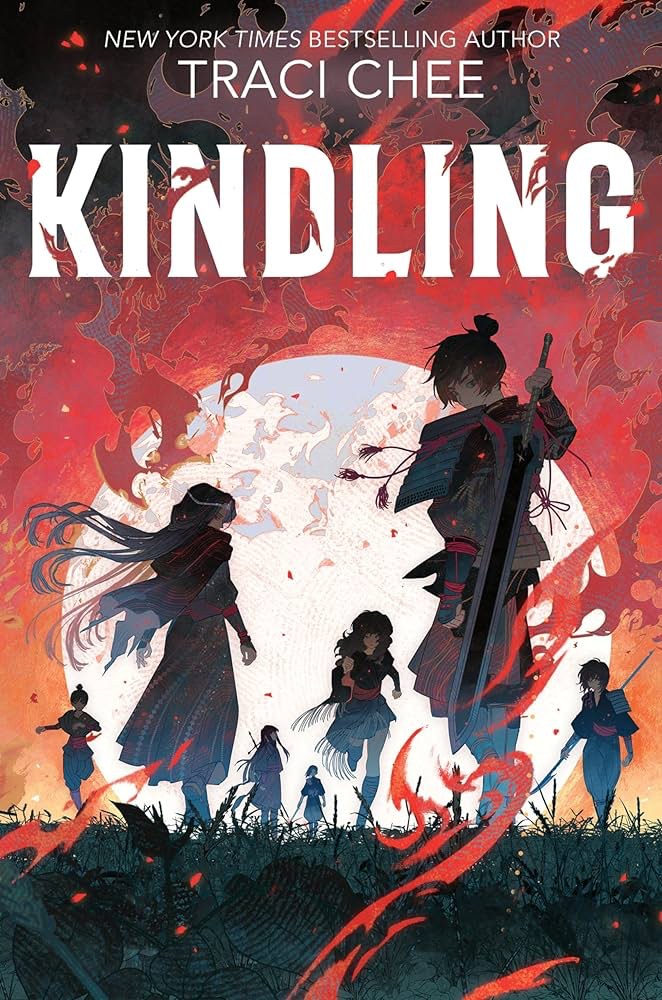
And you may ask yourself…me? Doing ARC reviews again? Kind of. I did stop doing them in late high school because my schedule was getting too busy to stay on top of them, and now, I’m even busier than I was back then, so I doubt I’ll go back to Edelweiss. But I entered myself into a Goodreads giveaway for Kindling, and I was lucky enough to receive a physical ARC! I’m glad to say that Traci Chee’s latest fantasy novel doesn’t disappoint—innovative and heartbreaking in equal measure.
The war is over, but in the wreckage are kindlings. They are child soldiers, pawns imbued with unimaginable powers who fought and died on the front lines, all for a war effort they could not comprehend. Now, there is peace, but it is uneasy—the violence has not ceased, and those who were left stranded by the war have nowhere left to go. From the ashes, seven former kindlings have come out of the woodwork, ready to fight one last battle to ensure the safety of their country—and their futures.
I received this copy in a Goodreads giveaway. Thank you to HarperCollins publishing and Goodreads for this ARC!
TW/CW: graphic violence, child soldiers, blood, war themes, PTSD, loss of loved ones
Without a doubt, this is Traci Chee’s most experimental—and most tragic—book to date. It’s a book that manages to execute so many feats of acrobatics and lands every single one of them; in every way, Kindling is a success!
First off: the element that probably grabbed everyone straightaway. Not only does Kindling have seven POVs, all of them are written in second person. Both of those tricks are already a hefty load to take on, but to execute them both at the same time? That’s just madness. And yet Traci Chee pulls it off with flying colors. A lot of second-person fiction that I’ve read uses it as a way to draw the reader in, but after that, there’s nothing innovative about the story beyond a difficult POV to the story. But Chee utilizes it in such a unique way—it’s not just a clever trick, but a way to make us feel closer to these characters. You are the one witnessing these atrocities, war ravaging the land. You are the one watching your friends die. There’s an instant connection. And for the most part (with some exceptions), Chee manages to make all of the characters feel distinct while pulling off second person. Now that’s impressive.
I always love novels that explore the aftermath of war, or at least some kind of conflict; in a sea of both fantasy and sci-fi novels that have neat, happy endings in the wake of devastating wars, Chee really seems to understand the messiness of picking up the pieces after such a tragedy has ripped the world of Kindling apart. Everything happens after the war that changed the characters’ lives, and everything is still in chaos and turmoil. Aside from the “one last fight” trope, used as an homage to the inspirations for this novel (Seven Samurai and The Magnificent Seven), it gave a ripe opportunity to explore trauma—not just the inherent trauma that comes with being a child soldier, but the trauma of grappling with PTSD at a very young age, and the trauma of being deified by the war effort, in Amity’s case. Never at any point is Kindling an easy read—and that’s exactly the way it should be.
Kindling is squarely a found family novel, but Chee explores an aspect of it that is often overlooked—found families formed through trauma. Each of the characters, most of which are appropriately fleshed out, are given the individuality and arcs that they deserve, but all of them are informed by the war, and their status as ex-Kindlings is what binds them—and motivates them. They’re sticking together for survival, but the friendships that they form in the heart of hardship are what makes the core of this novel so emotional. There are so many tender moments shared between the characters, and they made the stakes of this novel so much more palpable—you felt, more than ever, that they really were children, and that they would never be the same after being used as pawns of war.
SPOILERS AHEAD
Tragically, Traci Chee also demonstrates in this novel the two most crushing ways of writing fictional deaths. Particularly with Emara and Amity, Chee is skilled at timing them just right to make the most impact on both the reader and the characters. Emara’s death was the most sudden, and it having it happen so quickly after building up that she might have been safe was a way to not just shake the characters, but up the stakes—if Emara wasn’t safe, then neither were the rest of them. Amity, on the other hand, was set up from the beginning to die from Kindling burnout (the result of overuse of her magical powers), but you got to know her so deeply and intimately that, even though you knew from the beginning that she was doomed, her death felt just as tragic as it would have been if it was completely unexpected, like Emara. What I’m trying to say is that this book destroyed me. Traci Chee knows how to do it a little too well.
All in all, a novel that balanced tenderness and tragedy in equal amounts, making for a poignant novel about war and the bonds that bind us. 4 stars!
Release date: February 27, 2024
Kindling is a standalone, but Traci Chee is also the author of the Sea of Ink and Gold trilogy (The Reader, The Speaker, and The Storyteller), We Are Not Free, and A Thousand Steps Into Night.
Today’s song:
That’s it for this week’s book review! Have a wonderful rest of your day, and take care of yourselves!



 The Bookish Mutant