

Happy Sunday, bibliophiles! I hope this week has treated you well.
This week: it’s always the theme of this blog, but I feel like this roundup is a celebration of weirdos who are unafraid to express themselves in wild, creative ways. (Why yes, I am talking about Björk again, how did you guess?)
Enjoy this week’s review!
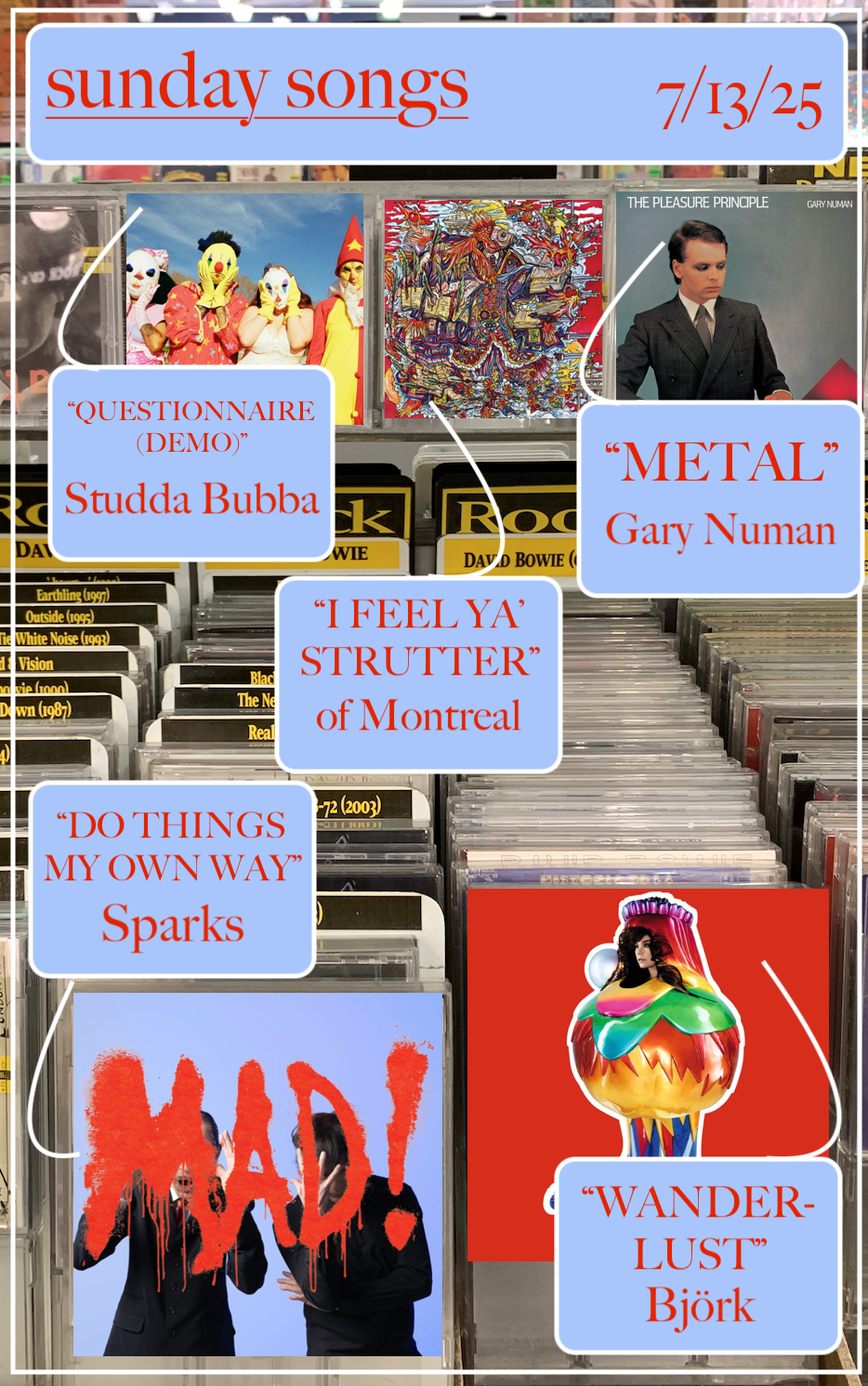
SUNDAY SONGS: 7/13/25
“Do Things My Own Way” – Sparks
I aspire to be like Sparks. I’m not even a die-hard fan or anything, but they just seem so aspirational in what they’ve done with their long, creative career. They’ve recently come out with their 26th (!!!) album at ages 79 (Ron) and 76 (Russell), and by all accounts, they’ve continued on their decades-long streak of doing nothing but their own thing. They haven’t achieved super mainstream fame, but the brothers have been producing their own brand of creativity, drawing from what seems to be their own never-ending well and the well of the present. Just look at their episode of What’s In My Bag? — I seriously haven’t seen an episode of these with such a wide and diverse range of music, from K-Pop to John Coltrane to Kate Bush. They don’t seem to be stuck in the past—their personal brand of weirdness has just evolved over the decades.
At this point in their career, “Do Things My Own Way” feels like a statement of purpose from them, a propulsive anthem of confidence and being authentically yourself. Standing firm in its defiance, the track strides forward without a care for anyone or anything—nothing will shake the Mael brothers in their creativity. Anyone who’s in the way of them doing their thing is getting pushed out of the way—they’re not answering to anyone anymore. But even in that confidence, they acknowledge the rocky road that staying committed to yourself brings: “My advice, no advice/Gonna do things my own way/Roll the dice, roll the dice/Gonna do things my own way.” It’s always a gamble—there will always be people who look down at art like this as commercially inviable or not worth making. But as Sparks’ career has shown, it’s a risk worth taking. “Anywhere, anytime/Gonna do things my own way/I don’t care, I don’t care/Gonna do things my own way.” Another fantastic weirdo anthem for the books—thank you, Ron and Russell.
…AND A BOOK TO GO WITH IT:
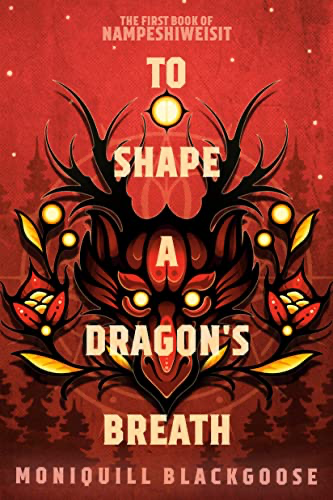
To Shape a Dragon’s Breath – Moniquill Blackgoose – “My advice, no advice/Gonna do things my own way/Roll the dice, roll the dice/Gonna do things my own way…”
The Björk deep dive continues…although this is about two weeks after I actually listened to the album, owing to the color palette rules I’ve imposed on myself. Both Volta and Medulla seem to spar in the Björk fandom for one of her least-liked albums, and every time I remember that, I’m baffled. I guess Timbaland’s more pop-sounding production isn’t for everyone, but if this is pop (yeah yeah), then this is the most bizarre pop I’ve ever listened to. Recorded during Björk’s time spent on a houseboat with her family, there’s a stark juxtaposition of the natural with the mechanical. It works both as a sonic tool and as political statement, given this album’s threads of anti-war (“Earth Intruders”) and anti-imperialism (“Declare Independence”) sentiments. It’s so delicious to me as a musical statement; even though she’s spent her whole career melding electronic music with nature, she’s turned it into a strong statement that war and colonialism are invasive and fundamentally against nature. God, I love Björk. I can’t believe I’m the kind of person who would unironically say “erm, ackshually, the foghorn noises contribute immensely to the album’s narrative,” BUT THEY DO. THEY’RE LIVE RECORDINGS OF WHEN SHE WAS ON THE HOUSEBOAT!! GUYS!!
Björk has called “Wanderlust” the heart of Volta, and it’s easy to see why. In a fairytale kind of way, it streamlines her statement of purpose, both in her personal life and in her musical career. Even though “Earth Intruders” is the first track on the album, “Wanderlust” tells its story: “I am leaving this harbor, giving urban a farewell/Its habitants seem too keen on god, I cannot stomach their rights and wrongs/I have lost my origin and I don’t want to find it again/Whether sailing into nature’s laws and be held by ocean’s paws.” I don’t blame her, especially since the move was prompted by living in New York with her family during the Bush administration. But after she breaks free, she revels in exploration and cliff-diving into the unknown, relishing in the act of discovery and intrepid daring. It’s an unabashed ode to not just stepping, but full-on leaping out of your comfort zone and being unafraid to dive headlong into the new and strange.
I originally saw the music video back in May during the Alamo Drafthouse’s Birth, Movies, Death for The Legend of Ochi (a very underrated fairy-tale/finding a creature film with lots of top tier critters, setpieces, and Willem Dafoe deftly proving that masculinity is a very silly construct). Isaiah Saxon co-directed it, and it might be one of my favorite of Björk’s music videos. Dressed in a Studio Ghibli-looking costume, Björk races down the river on the back of a herd of musk oxen, with fantastical scenery that accompanies her as a fabric-like torrent of water pushes her ever-forward into the unknown. After seeing The Legend of Ochi, I can say that yeah, it’s very Isaiah Saxon, but more than that, it’s so Björk. I can’t think of a better pairing for the spirit of the song.
…AND A BOOK TO GO WITH IT:
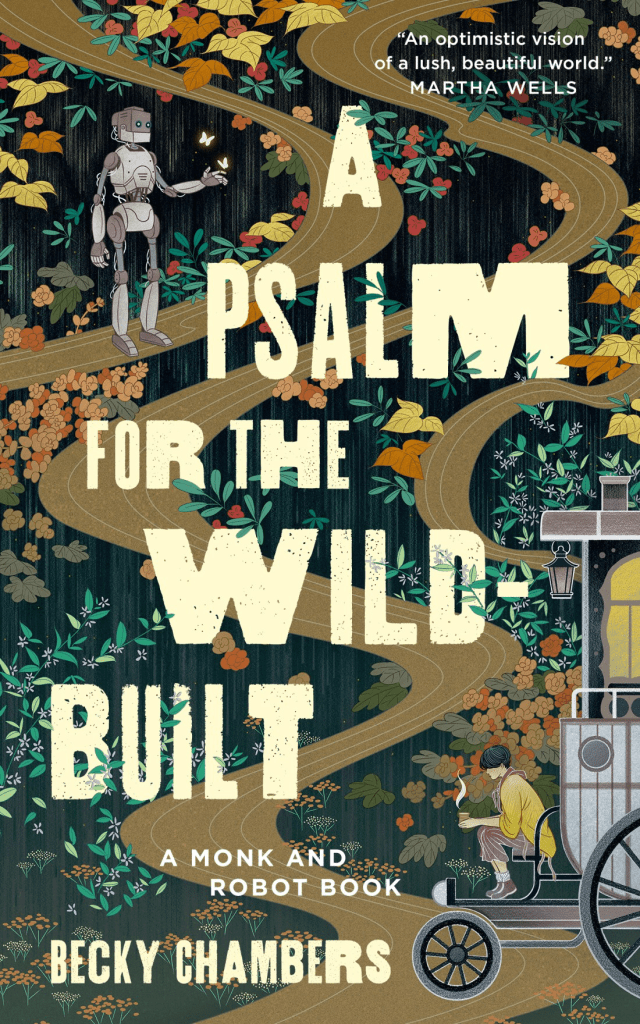
A Psalm for the Wild-Built – Becky Chambers – “I am leaving this harbor, giving urban a farewell/Its habitants seem too keen on god/I cannot stomach their rights and wrongs/I have lost my origin and I don’t want to find it again/Whether sailing into nature’s laws and be held by ocean’s paws…”
“Questionnaire (Demo)” – Studda Bubba
No, this isn’t Instagram Reels music, although in the most abstract sense…I did find it on the Instagram explore page. But listen, if my Instagram is recommending me quirky little folk songs made by a group of Indigenous, trans clowns, then shit, maybe I am giving off the right vibe to the algorithm after all. Amidst the hellscape that is social media, at least sometimes I can find spots of humor and creativity. For once, I found someone with the whimsy in their soul to center the chorus a folk song around the concept of opening up a hyper-capitalist factory and paying workers with the meager stipend of a single NFT. It’s a tender balance between their soft harmonies and the abject silliness of their lyrics (they managed to slip “you wouldn’t download a car” in), but maybe that whimsy is part of what holds the glue of whatever good is left in the rotting, festering wound that is social media. Anything to get us through all this.
…AND A BOOK TO GO WITH IT:
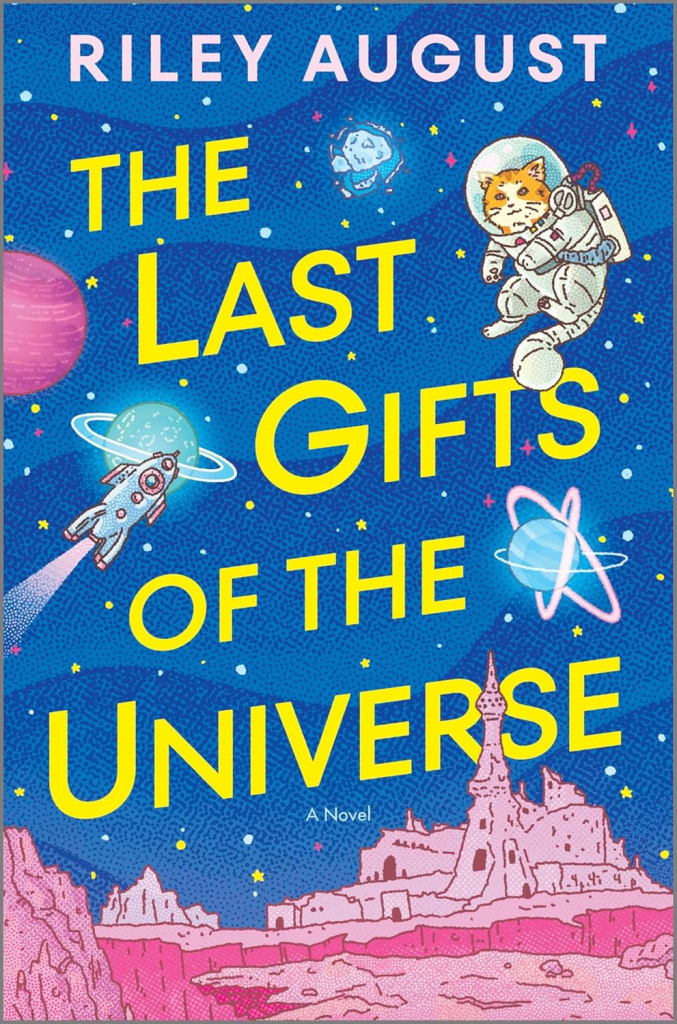
The Last Gifts of the Universe – Riley August – soft and tender, the kind of music I’d imagine playing in the quiet scenes with Scout and Kieran on their ship.
“I Feel Ya’ Strutter” – of Montreal
A late pride month addition, but every month is pride month…especially on this blog. And there’s not a whole lot that’s gayer than a) an of Montreal song, and b) an of Montreal song that absolutely reeks of the ’80s output of both David Bowie and Prince. This is easily one of the grooviest of Montreal tracks that I’ve heard—it doesn’t have the quaint, plinking synth soundscape of something off of Hissing Fauna, Are You the Destroyer?, but instead boasts more of a slinky, guitar-driven sound. However, nothing can keep Kevin Barnes from having the most delightfully convoluted lyrics. During the verses, her rapid-fire delivery of the lyrics is almost dizzying, as though she crammed in as much as she possibly could: “I know there ain’t no one person that/Everybody else in the world hates or wants to die/Sometimes I do think it’s me/Like, I’m in a flight simulator/And I am crushing the birth of any potential memory, hey.” Like whew, take a breather! You deserve it! But it works once he pivots to the smoother tones of the chorus, where his Prince-like howl is on full display—and he works it. It’s an infectiously catchy tune that never feels to get me on my feet. Never in a million years would I think that the lyrics “We spoke of frontal lobe regression/This is not one of those” would make me shiver with antici…pation before such a wonderful breakdown. That’s the power of Kevin Barnes, right there.
…AND A BOOK TO GO WITH IT:
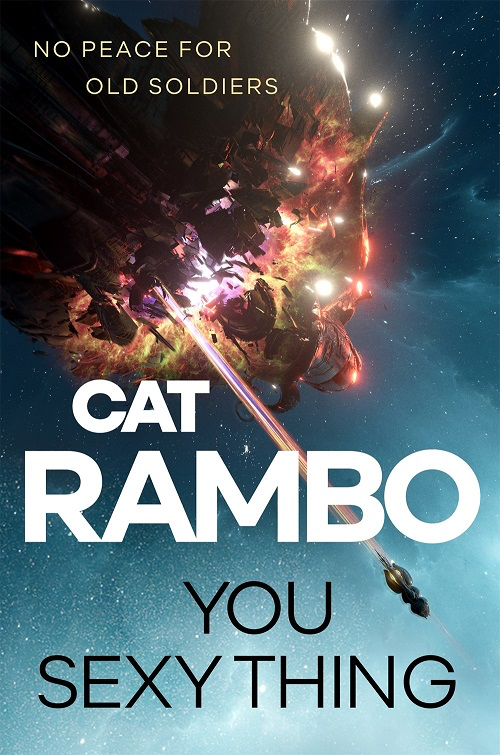
You Sexy Thing – Cat Rambo – ’70s/’80s music homage, passion, queerness…all in space.
Happy Disability Pride Month, and remember, kids: you wouldn’t have synth pop as we know it without autism.
It’s often a negative trope to view certain autistic people as like robots; the comparison has long been used to dehumanize those who simply have trouble interacting with neurotypical society, equating a flat affect or a lack of outward emotion to being outright heartless. But if there’s anyone in pop culture who’s turned this on its head and embraced it, it’s Gary Numan. A key figure in new wave music and one of the pioneers of what we now know as synth-pop, Numan often used metaphors of machinery, robots, and androids to relate to his own experience growing up autistic. My sci-fi brain immediately latches onto the lyrics—it’s all a very classic, Do Androids Dream of Electric Sheep? story of a robot being created in a strange factory by ominous “liquid engineers” who tries to assimilate to human life, but is painfully conscious of the fact that “Here inside, I like metal/Don’t you?” It’s a very abjectly dystopian world, complete with the protagonist explaining that “I need my treatment, it’s tomorrow that they send me/Singing ‘I am an American’/Do you?”
But it’s the framing of the lyrics—all questions—that stand out to me in the context of neurodivergence, and of outsiderness in general. Almost all of them end in either a question (“do you?/did you?”) or an assumption of normalcy (“like you”). The protagonist has lived its life thinking that everything that has happened to it (being grown in a factory and having a heart made of batteries) is normal, and once it interacts with the human world, it slowly realizes that its experience is not a normal human experience, fundamentally out of sync with everyone else. And yeah, they’re robots, but if this isn’t a picture-perfect summation of what it feels like to be neurodivergent, I don’t know what is. I haven’t had this experience to the extent that Numan seems to have, but it’s always such an alienating feeling to realize that the way you interact with the world is fundamentally counter to most of the other people around you. It’s taken a long time for me to realize that I’m just operating on a different code, if you will, but there’s always the lingering feeling, enforced by so many people around you, that the way you interact with the world isn’t correct. Numan’s utterance of “I could learn to be a man/Like you” feeds into that desperation that somehow there’s a way to figure out how to operate neurotypically, what the secret is that they’ve all got down and you were never told. But here Numan is today, still touring in his sixties, gaining all kinds of accolades, and embracing his own autism. Here, he’s turned the outside view of him being inhuman into a way of understanding himself and the world around him, and made an iconic brand out of it—a brand no one could replace.
…AND A BOOK TO GO WITH IT:
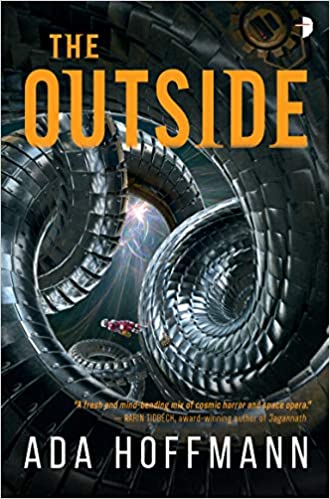
The Outside – Ada Hoffman – though I suppose Yasira is less robot and more liquid engineer, this is a similar story of an autistic woman and her quest to put the universe to rights.
Since this posts consists entirely of songs, consider all of them to be today’s song.
That’s it for this week’s Sunday Songs! Have a wonderful rest of your day, and take care of yourselves!


 The Bookish Mutant