Finally summer! Finally, more time to read…and most of what I’ve read this month has been good, I’d say.
Let’s begin, shall we?
GENERAL THOUGHTS:
Save for the first week of the month, May has been the first month where I’ve been able to relax somewhat! Finals were over and I’d moved out of my dorm before I knew it. Straight A’s and finally being free of my STEM requirements isn’t too shabby, I’d say! I’m so proud of what I’ve accomplished this year—and I’m so glad that I can have some downtime. And I’ve made good use of it so far—May has been my best month in terms of amount of books read (although the quality of…some of said books is another story), and I’ve definitely benefitted from the time spent reading! I’ve also been trying to focus more on art this summer, and consciously taking a slice out of each day to draw has been an adventure so far. I had a solid week where I had three or four blog posts all on the back burner simultaneously, so I unintentionally made a loose schedule for blogging every day as well, so I’m getting some writing in while I recover from writing two short stories and a 20,000 word novella all in one semester. I’ve also been pruning my Goodreads TBR…I’ve managed to cut it down from around 770 to around 720, so I’d say that’s been a success?
Other than that, I’ve just been cleaning things out of the dorm and bringing them back to my house, sleeping, watching Abbott Elementary (THEY FINALLY DID IT!!! THEY FINALLY LET THEM KISS!!!), Taskmaster, and Hacks (we love Jean Smart in this house), and relishing in the warm weather and the beginning of summer. I feel like every time I’m in the car with my family, I just pass the hills and feel the need to comment on how much I love that shade of green that summertime brings. But it’s so beautiful. Every single time. It never gets old. Thank you, shades of summer green.
READING AND BLOGGING:
I read 19 books this month! I’ve been oscillating between both ends of the spectrum this month, for sure—I read one of the worst books I’ve read this year, but also two of the very best. Somehow, it’s pretty evenly split as far as ratings go when I’ve lined them all up that way, but it’s been up and down all month, but on a track towards betterment midway through. I focused on AAPI books for May, and I found some fantastic books as a result from both familiar and new-to-me authors!
The only good part of 2016 was, without a doubt, the music. Blackstar remains unlistened-to just because I know that listening to it all in one sitting will destroy me (I’m only delaying the inevitable), but nothing will top that, I’m sure. Everything else, though. Teens of Denial? A Moon-Shaped Pool, which I also haven’t listened to all the way because it will similarly put me in the fetal position? Something was in the air, that’s for sure. Chances are that said somethingwas the incomprehensibly crushing weight of grief and existential dread, but my sad bastards make do.
Santigold, thankfully, never got that memo, and saved 2016 early on with 99 Cents, full of gleeful odes to self-love and living to fight another day. It’s hard to think of people that really are cooler than her—if her music wasn’t enough to convince you, then consider her episode of What’s In My Bag, in which she’s wearing a Bauhaus shirt, casually mentions that she’s on a first-name basis with Mos Def, and talks about channeling Kate Bush all in one video. Even without all that, both the music she makes and the energy that she radiates is nothing but positivity, and not the shallow kind that denies some of the darker truths of life, but the positivity cultivated by a truly good and kind spirit that wants nothing but to share some of her goodness with the world. I’ve had bad luck trying to see her live (a 16 and older venue when I was 15, a canceled tour, and bad weather, in order), but part of why I thought last time wouldn’t happen was her posting before the concert that she had a broken leg. Wouldn’t you know it, she was bouncing around onstage with her leg in a cast. That’s just the kind of person she is. She’s a creator that makes odes to the joy of creativity, and her indomitable spirit never seems to let up, even in the face of adversity. And yet, she humanly recognizes the real-time taxes of the music industry—that canceled tour I mentioned was so that she could spend time with her kids. She’s really a rare kind of musician: her authenticity comes not just from her attitude, but her willingness to be true and kind to herself.
Even when she’s being critical, it still sounds as cheerful as ever. “All I Got” is practically covered in multicolored party streamers, the kind of thing you’d hear blasting at a pride parade (anybody wanna start Queers for Santigold with me?). But it’s delightfully petty—I’m almost embarrassed at how many of the lyrics I mixed up before l looked them up, but what I found was even better than what I thought she was singing. “All I Got” is the auditory equivalent of watching somebody dressed in the puffiest, brightest neon clothes and the sparkliest makeup promptly flip you off before gleefully running off into the sunset surrounded by a gaggle of similarly dressed friends. Santigold openly throws darts at the kind of figures that have spread like wildfire in the 1% of society—those who have the most, but barely worked for what they have: “I should ask but don’t want to know/How you get something for nothing at all/Build an empire for yourself/Don’t take this personal: go to hell.” Oh, it’s very personal, I’d argue. Whether that “something” is fame, acclaim, or money, it’s a smiling takedown of people who have never worked a day in their lives and yet earn more than the creative people who get less than the recognition that they deserve—somebody like Santigold, I’d argue, who has the kind of sound that should theoretically have been topping the charts since 2008, but most of her recent acclaim in mainstream culture was born and died with a namedrop from Beyoncé. Maybe modern pop can’t take more than one genuinely kind person with the creativity to match before the industry just implodes. She’s simply too powerful for them. Her talent is best spent on whatever she sees fit, recognition or not. And that’s exactly what “All I Got” declares—she’s blazing a path of her own, straight through the undeserving.
beabadoobee recently announced a new album, This Is How Tomorrow Moves, out in mid-August! Is it promising? Yes. How about the album cover? Eh…compared to the cover for the single, it just looks like an outtake? Like they just snapped a picture while she was mid-sentence, put a nice filter on it and just called it a day? Welp…you win some, you lose some.
Either way, “Take A Bite” mostly makes up for the lack of a good album cover. It seems like a return to form—at least, of one of the forms she seems to have taken over the years. Thankfully, it’s the form I’ve liked best—the ’90s alternative-informed rock, with a dollop of slick vocals and production made for pop. “Take A Bite” oozes with tired dissatisfaction, with a minor key glossed to a sparkling shine, a coat of wine-red nail polish with a glittering overcoat. Kristi takes boredom and the dregs of an old flame with a sultry, heart-sore twist, drifting through her own imagination to make up for the color drained away by a breakup: “Indulging in situations that are fabricated imaginations/Moments that cease to exist/Only want to fix it with a kiss on the lips/But I think I might take a bite.” I suppose after “the way things go” (which I reviewed back in July), she’s moved from denial, dipped her toes in anger, and barreled straight into bargaining, making deals with her own mind to pull her out of this earthly plane. Her only sustenance is in her own head, and as she twists further inside, the instrumentals appropriately intensify, the background noise bleeding through the sheet of the background of sharp guitars as the unreal seeps into the real—or vice versa? The imagery in the music video isn’t exactly subtle, but either way, I love the shift between the bland, harsh daytime and the softer, sultrier nighttime worlds that Kristi straddles with a simple step through the alleyway. It’s sour and brittle, especially in the last, sore-throated mumbling of “do it all over again,” but like the skin of a cherry, it’s so smooth that you can’t resist at least one bite of the forbidden fruit.
…AND A BOOK TO GO WITH IT:
While You Were Dreaming – Alisha Rai – when a fabricated image and reputation falls apart, it takes the truest form of yourself to mend the pieces.
Babe, wake up, NEW MASTERS OF REALITY JUST DROPPED?? MASTERS OF REALITY? For the first time since 2009? Wow. That wasn’t on my hypothetical 2024 bingo card.
Either way, they returned from their 15 year extended hiatus with “Sugar” in early May, much to the surprise of…well, everyone. I haven’t followed them closely, but I thought that they’d all but disappeared from the face of the music scene. In the YouTube description, it’s followed up with a promise of a new album (?) but they haven’t revealed much else save for that and some ongoing European tour dates this summer. According to an interview with Louder, Chris Goss said that “Sugar” has been forming since the late ’90s, and it came into being out a desire to “become less esoteric and more directly personal.” Which…okay. Again, I’m not terribly familiar with the band beyond Sunrise on the Sufferbus (now that’s a top 10 album title right there), but “esoteric” is not among the words I’d use to describe the Masters of Reality. Musically? Not necessarily. It’s not the kind of music I’d expect for a pretentious music bro to go “you just don’t get it” to—a lot of standard blues rhythms, and not the kind of odd time signatures or chord combinations that might sound esoteric. And the lyrics? Does a song about a bitey but lovable cat really scream “esoteric?” It’s great! I’d even call it the perfect theme song for my cat. But esoteric it is not. I’m not Chris Goss, but I can’t help but be confused. Either way, I applaud the desire to be more personal for his music—it never hurts to write from the heart. Good on you, man.
Neither complex lyrics nor complex music are things I’d put as hallmarks for the band’s sound, but they do have an uncanny ability to make their music sound so neatly consuming. “100 Years (Of Tears To The Wind)” (another top 10 song title) feels like a wave curling into itself, with instrumentals that don’t just circle, but drown you as they do so—it’s a neat rhythm, but one made to swallow you, not unlike the soundscapes of Spiritualized. When my dad reintroduced us to this song to my brother and I a few years back, we all kept marveling about even though every aspect of this song was so simplistic, it was just so wholly effective in what it does. How does a song with lyrics like “I move, like syrup slow/I move, I didn’t know” feel as powerful as a full orchestra? No matter the personal changes that Goss has vowed to make in his music, I’m glad he stuck that quality; though “Sugar” has a slow, steady build, but by the time the chorus hits you, you’re caught in a swirling riptide of distorted guitars, strings, and chimes, building like a tornado in slow motion around you as your feet remain planted on the ground. The lyrics themselves still feel simple: “Sugar ain’t happy, Sugar ain’t sad/But Sugar got something, and something ain’t bad.” And yet, the shift is easy to see—even if the word choice is more simplistic than not, there’s a clear story, and one that makes a compelling song. Although it’s unclear whether the character of Sugar is drawn from Goss’ personal life or simply fictional, Goss said this about the lyrics: “[It reflects] on intelligent women trying to find their place somewhere in the mess…a real picture of what real people feel. The inner emotional reality of one life and its relevance to many lives.” And that ubiquity is what makes the narrative work: it’s a story that conjures up images of a woman dead-set on paving her own path, however winding it may be. My mind goes to images of a woman alone with her car, filling up the gas tank as the sun sets, her mind wandering about where she’s been as she contemplates where her journey will take her next. That journey will be difficult, but “my Sugar don’t care.” There’s beauty to be found in Goss’ sparse lyricism—it reinforces that your word choice doesn’t have to be eloquent to tell a story worth telling or conjure vivid imagery. All that matters is the heart that you put to page—or song.
…AND A BOOK TO GO WITH IT:
Camp Zero – Michelle Min Sterling – “Sugar got born, Sugar got raised/Left her hometown, got lost in a maze/Met lots of men, none of them worked/To just find a place where happiness lurked…”
So. I Love My Mom. I only put off listening to it because of my tradition of drawing album covers on the whiteboard on my door at school. I know, it’s college, nobody cares, but I would’ve felt weird having skeleton tiddies on display on my door for two weeks, and I doubt it would’ve gone over well with the RA. So there you have it. But now, I am free of such shackles, listening to skeleton tiddy music at my behest.
But lord, what an album. Not only does it feed both my sad bastard and occasionally raw and shouty sensibilities, but Indigo De Souza is seriously a poet. The lyrics on almost every track jumped out at me like cartoon eyes, with that slack-jawed ba-zooooooooing as the reality sets in while I scrubbed my bathroom sink. School really is a better environment for me to process albums, because leaning over to scrub some leftover gunk from the mirror was not the ideal position to let “And there was no one home in that plastic box/In that widow’s womb with the childproof locks” set in. “What Are We Gonna Do Now,” which I reviewed back in March, is still the highlight of I Love My Mom for me, but “Sick in the Head” displays some of De Souza’s most bitingly vibrant poetry. Like…doesn’t “And now that house is gone/There’s a golden lawn/And there’s a silver spoon/Someone’s been choking on” hit you like a sucker punch? But beyond that, I’m so glad that I found this song when I did, because the lyrics resonate at this age. “Sick in the Head” feels to me like a journey through the bramble back to the past, but not necessarily of the painful memories, but the childhood ethos that’s been lost and found again: “Since then our bodies have warped and bent/And now we are gray/I go back to that house sometimes/To say what I need to say.” Whew, preach. It left me wondering how old De Souza was when they wrote this song, and…turns out they were around my age, at least when I Love My Mom came out. Oh. Wow. So I’ve never had an original experience in my life, huh? But I love the imagery of this space being an empty house, and going through some sort of thorny, vine-choked gauntlet to find the part of you that now retreats in a corner, ready to be received when what is right needs to be remembered. And the quest is set off by this essential problem of growing up: “We’re going cause we’re too damn old/And nothing’s making sense anymore.” Sometimes, it’s not the wisdom of age that needs to be consulted to put yourself back on the path: it’s the little kid in you, the one that didn’t yet know that they were being perceived, and just did what they wanted to. And it’s true. My art is truest when I ask myself what my younger self would have wanted to see. It’s so easy to dismiss the stuff that your child self pointed at and said declared cool as childish and the product of an unrefined mind; Sometimes, that might be the case, but too often, we overlook the merit of how much joy that reconnecting with that urge produces. I’m working on being less critical of my writing and art, but I try to think of how little Madeline would’ve thought of how cool current Madeline’s achievements are. There may be nobody home, but there is something beyond a body that lingers in that empty house: the essence of youth and love, that, if nurtured, will guide you to the light.
I’m too scared to fully go into any kind of mommy blogging discourse just from the horrific baby names that it’s spawned, but sometimes that’s what Instagram spits out for me…for whatever reason. But in the age of iPad kids and Cocomelon, it’s comforting to see that some of the shows of my childhood are having a resurgence among new parents, particularly because of their low stimulation. In an age where kids are rapidly being fed…well, crap, basically, at incomprehensible speeds, and some parents have moved from using the TV as a babysitter to just getting their children an iPad fresh out of the womb (surely that won’t affect them 10 years down the line), some parents are reverting back to the lower-stimulation shows of yesteryear. Sure, not every single show in my childhood and beyond was angelic and perfect, and not every show now is ultra-high stimulation (I’ve heard Bluey has become gen alpha’s Blue Dog to Guide the Generations, taking the torch from Blue’s Clues), but I’m glad that the low-stimulation comfort that my parents raised me on, as well as some of the shows like Sesame Street that they were raised on, are helping kids this far down the line.
I’ve only seen Oswald come up in very few of these discussions, but I just remembered it the other day, and how quiet it was. It’s just so pure to me. Sure, Blue’s Clues and Zoboomafoo topped it, but there’s something to be said for how gentle and quaint it was. Comforting character design. Evan Lurie’s soft piano theme. Two British eggs who say “yeeees, yeeeeees” like some character that Blur parodied on Parklife. A little dachshund that looks like a hot dog. It’s just so…gentle. Thanks, Dan Yaccarino.
Squire has faintly been on my radar on-and-off for the two years that it’s been out. I figured it would be something fun, but I didn’t expect such a hard-hitting, timely, and wholly beautiful graphic novel full of vibrant characters and sharp social commentary.
Aiza wants nothing more than to be a Squire—she’ll be able to become a knight revered in legends and lore and send money home to her family, who are barely scraping by. And as a member of the Ornu ethnic group, she’s considered a second-class citizen by the empire of Bayt-Sajji, and becoming a Squire and joining the Knighthood is the only way to become a citizen. At first, she’s elated to join the ranks of the recruits, but after failing her first test, she’s relegated to the night watch. But she’s soon discovered by Doruk, the groundskeeper, whose past may lead her to discoveries about the Knighthood that may change everything. Soon, Aiza realizes that she’s become a part of the same machine that’s destroying her people, and must make a decision—loyalty to her heritage, or loyalty to the empire.
art by Sara Alfageeh
TW/CW: war themes, racism, violence, colonialism/imperialism themes, amputation (forced)
Whew. This hit me so much harder than I anticipated. But I am all the better for it—I’m so, so glad that this graphic novel exists, especially since it’s aimed at a younger YA audience.
Squire has some of the sharpest critique of imperialism in YA that I’ve seen since Maggie Tokuda-Hall’s The Mermaid, the Witch, and the Sea duology. It’s all the more poignant since the main character is so young—we never get an estimate, but it seems Aiza is on the younger side of the 12-17 age range for Squires. It’s an intimate portrait of watching everything you know about patriotism, faith, and empire be deconstructed in front of your eyes, and how that radicalizes a person—especially a young person—into enacting positive change. It holds no punches, and that’s exactly what it’s meant to do: imperialism is not something to be sugarcoated, even for younger reasons, and Squire does all of this and more.
Seeing all of this through Aiza’s eyes was what made Squire so unique. Her journey throughout the novel is as complicated as they get; at a young age, she has to grapple with the fact that the only way to gain recognition and help her family survive is to betray her own people. It’s a decision that she feels is straightforward at first, but having been fed on heroic, medieval-style propaganda, she feels in her heart that she’s right. It’s only when she fails to meet the standards of the empire that she sees the error in her ways, and her crisis begins: how can she hold an empire that she’s been groomed to love and an identity that has shaped her life in equal regard? Not such a simple decision, especially when you’re 13 or 14—and when you realize that this empire has been carrying out raids on the very same people that you once called family and friends, who the empire likens to mongrels and scum. Alfageeh and Shammas executed her journey, in all of its emotional messiness, with such care and beauty; you really feel for Aiza as she watches the reality that the empire constructed for her crumble, and her eventual mission to pursue justice was a truly resonant call to action for our times.
For the first 30% of Squire, I didn’t think that I would end up rating it 5 stars. I loved Alfageeh’s art, toeing the line of stylized and realism with ease, with each character displaying a unique emotional range. For the first third of Squire, it’s mostly seeing Aiza go through her training—a lot of running around in the countryside and playing at being a Knight. But the minute the tone shifts, it shifts dramatically—and for good reason: this is when Aiza’s image of the empire is turned to dust. Never once did the tone shift feel unrealistic; not only did it represent the drastic fall of Aiza’s faith in herself (and the Knighthood) after failing her first round of tests, but it felt true to her age and situation. If I’d been in the same situation at that age, I would have lashed out just like she did, that classic mix of sadness, anger, and deep-seated frustration at trying so hard, only to miss your goal by a hair.
Squire’s cast of characters were equally vibrant, and beautifully rendered by both Alfageeh and Shammas. Shammas’ writing made them feel like real teenagers grappling with circumstances out of their control. Like Aiza, each of them went through a complicated journey before joining Aiza and her cause; some had reason to believe that empire was beneficial to them, others never wavered in their faith until the end. Above all, they felt like confused kids—and that’s what they were. But the relationship that stood out most to me was that of the mentor relationship between Aiza and Doruk. After some hesitation, Doruk begins to see himself in Aiza—a child abandoned by the empire and forced to see the might that she once viewed as heroic being turned against her own people. I’m always a sucker for stories with ambitious, energetic kids being guided by disgruntled, older mentors, but in this case, it was a relationship that was crucial to Aiza’s development. Here was someone who had been ground through the same machine as she was and come out the other side knowing the truth; Doruk knew he had the power to change things, and mentoring Aiza in secret was his way of rebelling: teaching. God. God. Somebody hold me.
Squire’s climax was one of the book’s strengths, not just in its execution but in its symbolism, if the latter was in your face. (I’d argue that it’s supposed to be in your face—explosively annihilating a symbol of imperialism doesn’t really scream “quiet” to me.) The unity of Aiza and her band of misfits shone through after page after page of delicate development, and the conclusion, as dramatic as it was, really was the only way the book could end: in flames. What a beautiful note to end on—the physical representation of imperialism and blind patriotism, both as a character and a location, going up in flames as a result of the justice and drive of ordinary people. Yes. YES! I’ve seen some reviews that it’s a very straightforward way of going about imperialism as a whole, but I think what Squire has the power to do is be an introduction to the horrors of imperialism for younger readers just getting into the genre. Especially in these horrific times, Squire gives older MG and younger YA readers a picture of imperialism digestible enough to apply to both history and the present (especially the present). And I can’t think of any other novel fitting of the job: it’s a heavy load to carry for so many young readers, but I am so, so glad that Squire exists.
All in all, a timely and deeply emotional portrait of imperialism and war that is sure to touch the hearts of readers young and old. 5 stars!
And by the way, if it wasn’t already clear: Free Palestine.
Squire is a standalone; Nadia Shammas is also the author of Ms. Marvel: Stretched Thin, Confetti Realms, Where Black Stars Rise, and several other comics. Sara Alfageeh is also the illustrator of Not Yet: The Story of an Unstoppable Skater, and has contributed to Once Upon an Eid, Bingo Love, vol. 1: Jackpot Edition, and many other comics.
Today’s song:
I LOVE MY MOM!! (in the sense that I love my mom, and also this album, I Love My Mom.)
That’s it for this week’s Book Review Tuesday! Have a wonderful rest of your day, and take care of yourselves!
Happy Sunday, bibliophiles! I hope this week has treated you well.
This week: spring green for March, old dogs, and the consequences of the fact that at least 90% of my friends are gay and their music tastes rub off on me.
This just in: the sad girl kool-aid has never left my system, and it likely never will. Buckle up.
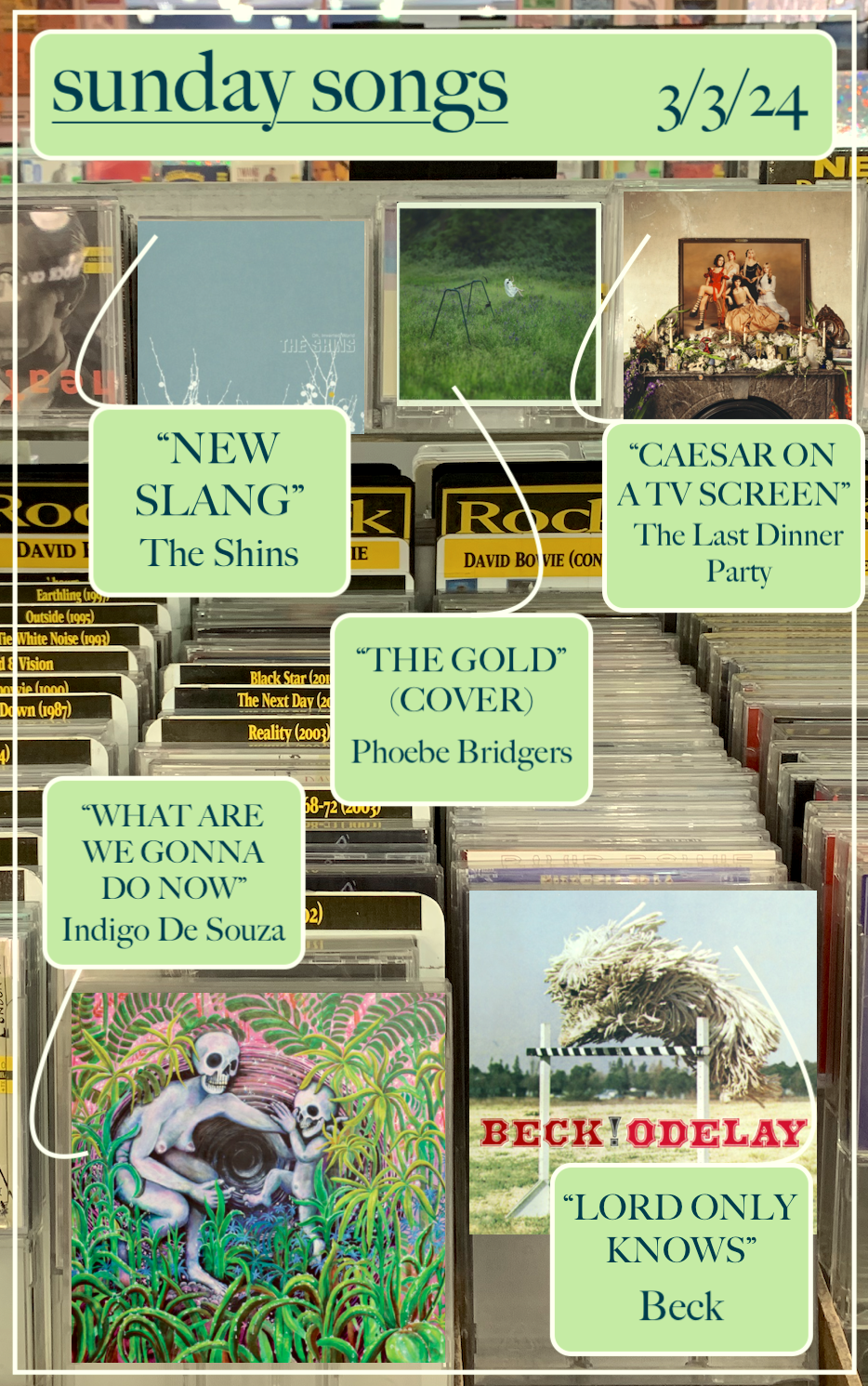
“What Are We Gonna Do Now” lives squarely in the liminal space of uncertainty, as the title implies. It feels like the tense opening to a film; I could just be stuck on this imagery of the line “and we’re still on call with the nurses,” but I can’t help but imagine an opening shot panning out from the slow spikes of a heart monitor, slowly letting out beeps as Indigo De Souza’s voice gently drips like an IV with that lingering, trailing question: “what are we gonna do now?” Almost everything is gradual about this song, as if the verses were frozen in time: a picture of a person standing on the street while snowflakes suspended in midair decorate the space around them. De Souza’s voice dips and dives into nooks and crannies that only a cat could fit into, army-crawling through the shadows as she describes the wear and tear of a relationship in the middle of turmoil—not necessarily on the verge of a fracture, but in the middle of the storm that they aim to push through together. Exhaustion and frustration tinges it (De Souza’s delivery of “and I’m never cooking up what you’re craving” remains one of my favorite parts of the whole song), but it’s never the kind so intense that would throw their love out the window—it’s the determination of trying to find out exactly how to fix things, and scrabbling around, searching for answers in desperation. Like the ebb and flow of love, the instrumentals swerve from a near standstill to a rousing, guitar-driven chorus and back to quiet again, but after the first verse, nothing is the same; it has the same kind of barely-contained chaos of songs like Wilco’s “Via Chicago” and Mitski’s “The Deal,” with a sense that the anxiety of making amends and grasping for solutions. As De Souza’s airy voice rises like she’s gasping for air after emerging from the ocean, trembling drums and tambourines slip in and out of time, ever so slightly off-kilter and teetering, like one sneeze would send them all into disarray. Unlike the former two songs, though, it never fully gives in, but the unraveling is always at the back of the song’s mind, like an overflow of fearful thoughts as they try to pick up the pieces, but a sense of deep-breathing control as De Souza picks themselves back up.
Full disclosure: I definitely ruined this album for myself. I knew it was going to be a good album, and it 100% is, but I’d already listened to about 3/4 of it, so there were no surprises left. All of the songs I remembered were already favorites, and the ones I hadn’t yet discovered weren’t as instantly classic as the others (sorry, “Derelict”). But that’s on me. Maybe on my parents for playing it so much in the car over the years, but mostly on me. Whoops.
That’s not to say that Odelay is a bad album at all—in fact, it’s quite the opposite. It makes me miss the old Beck, the one who didn’t scrub everything to an unnecessary polish, but instead made his music like a sculpture made from bits and bobs found in the junkyard—a bit of a tire here, an old, rusty car hood there, some nuts and bolts sprinkled on top for a finishing touch. It’s a collage, but not necessarily in the way that artists like De La Soul or The Beastie Boys make their collages: while their infinitely clever concoctions feel like they oil every sample into a unified organism of unlikely pieces, Beck’s method (for a while, at least) was to make every spare and found part stick out like sore thumbs, but so much so that all those sore thumbs eventually made a hand so absurd that it makes you think how does that even function as a hand? And yet it’s the perfect hand. There’s no other way that “Hotwax” would work without “I’m the enchanting wizard of rhythm.” In fact, the absurdity of all these samples make this mutant (no pun intended) record so memorable—nobody was doing it quite like Beck. Take this song, which starts out with a rasping scream, then descends into twangy and almost docile acoustic-guitar driven rock. It’s not the heat-waved calm that “Jack-Ass” (my favorite track on the album) exudes, but it’s got that same lazy drawl to it, every word curled at the edges like scraps of paper singed by a campfire. Odelay hadn’t yet reached critical mass of clever silliness that made ’90s-2000’s Beck so fun (that would be Midnite Vultures), but he had plenty of fun to spare—I always find myself laughing at the final lines that Beck sings as the track fades out like a car driving out of view, obscured by the wobbling lines of a heat wave: “Going back to Houston/Do the hot dog dance/Going back to Houston/To get me some pants.” You just can’t deliver the word “pants” with that much emphasis and have it not be funny. Them’s the rules. I apparently have the humor of a five-year-old, but evidently, so does Beck, and we’re all the better for it.
Whenever I go to write about The Shins, I always end up going straight for the purple prose. It’s like the way I get with Radiohead, except they invoke something akin to religious fervor in me. I’m too far gone. But there’s something about James Mercer and his perpetually rotating cast of characters that evokes the lyrical side of my writing. Perhaps it’s that part of me connecting to that part of him, because he’s certainly got songwriting chops for days.
“New Slang” has been lingering in my life for decades; I faintly associate it with a period sometime in elementary or middle school. I think it may have been at the end of a playlist I listened to frequently. The Shins are never all that far from my mind, but this was the perfect song to shuffle out of the blue, soft and smiling like an old dog with white patches threaded into the fur of its snout. And I ran right up to pet that dog—god, I missed this song. Hello, old friend. Mercer has long since mastered the art of the old heartstring-tugging acoustic song, and while its as hipstery as it gets, there’s a calmness to it, a serenity like no other. And yet, for all intents and purposes, it’s James Mercer’s equivalent of a pop-punk “I’m getting out of this town” song; the lyrics were inspired by his experiences separating from Albuquerque, New Mexico, where the first iterations of The Shins had tried to take root. Disillusioned by a scene that he described as “macho, really heavy, and aggressive,” Mercer and company branched outwards, where their lyrical folk could have more meaning. “New Slang” was Mercer’s way of “flipping off the whole city,” as he described it (“Gold teeth and a curse for this town”), but there’s something beautiful in how quietly this song shoots its bitter middle finger. It’s not the jerky angst of separation that pop-punk lends to the subject, but instead the moment of looking back into the sunset, knowing that everything you’ve left behind is in the dust with the approaching night. Perhaps that’s where that serenity I feel comes from—the serenity of knowing that what’s in the past is in the past, and that it has no control over your life anymore. It’s underfoot, only tire tracks in the dirt now. You can’t help but feel a wave of peace at the thought.
…AND A BOOK TO GO WITH IT:
Trouble Girls – Julia Lynn Rubin – while Lux and Trixie’s reasons for ditching their town are more complicated, there’s no less of a feeling that they’re giving it the finger the whole way out.
Full disclosure: I hate the original version of this song. Hate it. It stinks of that kind of that faux-earnest, country-leaning pop that forced itself down everyone’s throats in the mid-2010’s like a contagion. If this weren’t obviously a breakup song, I know my music teacher would have made my 5th grade class sing this. I hate to relentlessly dog on a song, but also…Christ. This made me throw up in my mouth a little.
Phoebe Bridgers, on the other hand? A godsend. Leave it to her to make the original lyrics, some of which were actually good sound good, and not like they were being shoved down through the godforsaken Mumford & Sons strainer. I will give Manchester Orchestra (posers, they’re not even from Manchester…) some credit: “you’ve become my ceiling” is genuinely a beautiful lyric. But I just wish it wasn’t being delivered with that smarmy, offensive excuse for authenticity. Again: Phoebe Bridgers is our savior. She grounds this song enough to make the turmoil within it feel real. Never once did this song need belting, stadium-rock grandeur: it needed clarity, a sense of calm amidst the chaos, and a steady hand on an acoustic guitar. It’s got slightly more effects than Bridgers usually allots to a song of this tempo, but it hits the balance of flourish and that acoustic sincerity that she’s come to be known for. It’s a breakup song, but although some of those call for grandiose declarations of sorrow, some of them need time to sit in silence and wallow it in, and that’s exactly the treatment that Bridgers gave “The Gold.” I’ll just go ahead and pretend that she wrote it. Yup. Manchester Orchestra? Who is she?
…AND A BOOK TO GO WITH IT:
Vinyl Moon – Mahogany L. Browne – similarly, this novel in verse deals with the fallout of a relationship built on mistrust.
Before I listened to the full song, I distinctly remember seeing a snippet of this song advertised somewhere on Instagram and thinking something along the lines of “god, this is pretentious.” And I stand by that. It’s still pretentious. But in context, it’s a good listen.
I’ve heard a decent amount of buzz surrounding The Last Dinner Party, usually falling in one of two camps: that they’re out to save rock and roll and bring it back to its glory days, or that they’re just…okay? The former argument, while I like it in concept, reeks of the kind of mentality that “modern music isn’t good anymore” because it’s not all Pink Floyd, which…okay, cool if you like Pink Floyd, but also…creative rock didn’t die as soon as Y2K hit? You just have to look a little harder now that rock isn’t the reigning influence on popular music anymore. In the modern day, we treat rock music like we often treat women: as something to be saved, when all along, it’s been doing just fine, thank you. I doubt we’ll ever go back to those days, and maybe we shouldn’t—there’s no way you can completely replicate a movement in its full, temporal context, and maybe that’s okay. I’m all for bringing back glam rock, but chances are, anything you try to resurrect is going to feel displaced in our modern day context. You can take inspiration from them, but personally, it’s a hard thing to recreate in all of its flesh and blood.
Which…seems like a good deal of what The Last Dinner Party are going for. Frontwoman Abigail Morris has regularly emphasized how much she and the band enjoy being pretentious (if having their debut album titled Prelude to Ecstasy wasn’t enough of an indication), and if that’s what’s bringing them joy, then all power to them! They’re talented musicians, for sure. Weirdly, the other two songs of theirs that I listened to just sounded like…any old indie pop song, which I kind of hate to say, but if you’re all about “saving rock n roll” and just putting out that, then I feel like you have to keep your mission consistent. But you certainly get that feel from “Caesar on a TV Screen.” As far as the structure goes, it feels slightly disjointed, but the more I watch the music video, I get what they’re going for—a song with a distinct, three-act structure, emulating the epic, Shakespearean twists and turns that inspired it. There’s loads of drama to spare, from the rush of strings in the third act to Morris’ impassioned howl of “everyone will like me!” at the song’s exiting flourish, like she’s brandishing a prop sword with every word. It’s dripping with that kind of theatrical, ’70s and ’80s drama—there’s Queen written all over it, and I can’t help but think that some of that drama was informed by Kate Bush. And…yeah, Freddie Mercury, Kate Bush, and David Bowie, the latter of whom the band have repeatedly cited as one of their primary influences, are probably some of the most colossal shoes to fill in terms of musical artistry. But there’s no doubt that The Last Dinner Party are a skilled bunch in their own right—and god, they look like they’re having the time of their lives. It’s exactly the kind of excess, maximalism, and drama that their band name implies.









 The Bookish Mutant