Posted in Book Review Tuesday

Book Review Tuesday (7/2/24) – The WondLa Trilogy: A Re-Read Retrospective

Happy Tuesday, bibliophiles!

This is going to be different from my normal Book Review Tuesdays, as I’m reviewing an entire trilogy. Normally, that would be a tall order for a single post, but this trilogy is different. It’s a series that I read so often in middle school that even the teachers started to recognize the cover when I brought it in. It’s a series that has woven itself into the fabric of my life, just as Arius’ metaphor of time as a braided rope. It’s a series that inspired me to pursue writing—specifically writing science fiction.

In light of the new (and deeply disappointing) Apple TV+ series, I decided to re-read the series for the first time in six and a half years. Some novels you loved when you were younger don’t age well, but after I devoured all three books in the span of a day each, I can say that Tony DiTerlizzi’s WondLa trilogy has stood the test of time.

Enjoy this week’s reviews!

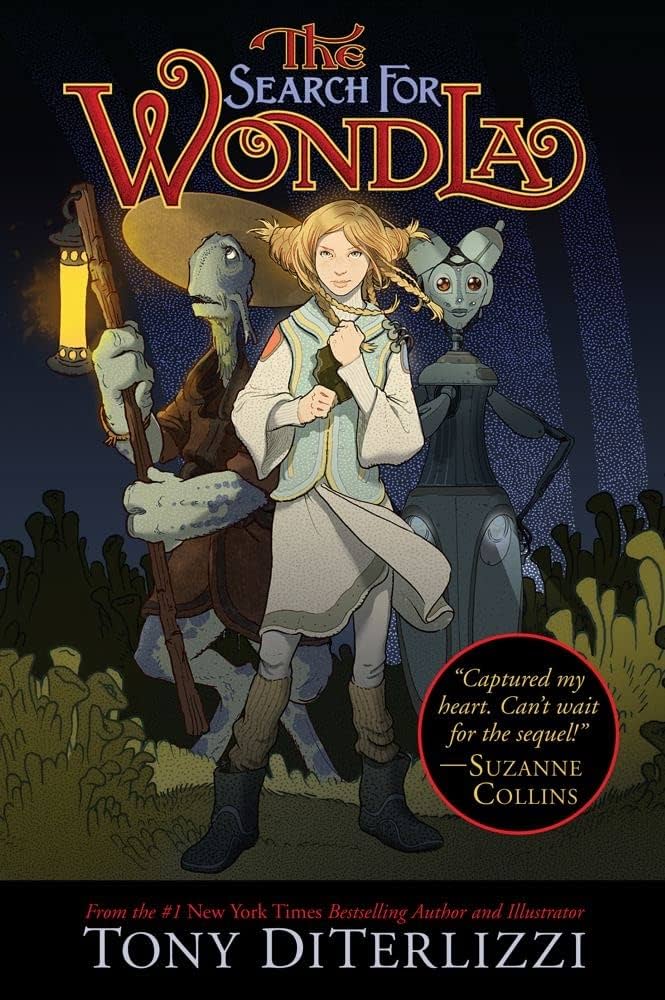
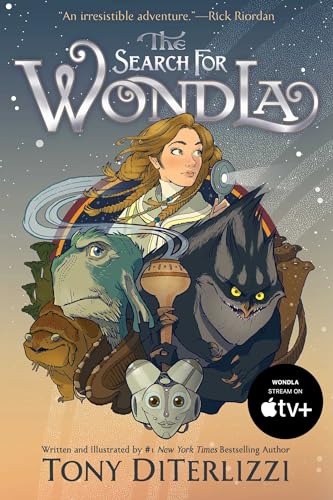
The Search for WondLa (The Search for WondLa, #1) – Tony DiTerlizzi
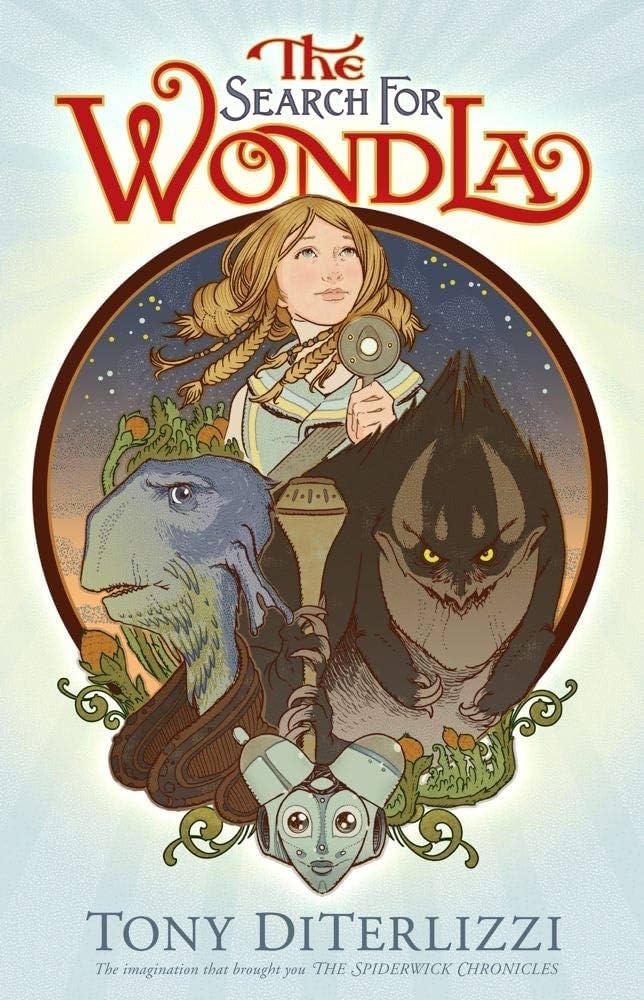
Summary from Goodreads:

When a marauder destroys the underground sanctuary that Eva Nine was raised in by the robot Muthr, the twelve-year-old girl is forced to flee aboveground. Eva Nine is searching for anyone else like her: She knows that other humans exist because of an item she treasures—a scrap of cardboard on which is depicted a young girl, an adult, and a robot, with the strange word, “WondLa.”

There definitely wasn’t an ulterior motive to me re-reading this series…totally not just to replace my reviews on Goodreads from 2016 (“OMG BEST BOOK EVER SQUEEEEEEEEEEEE but BIG FEELS”). Yeah.

The Search for WondLa is the reason why I decided that I wanted to write science fiction. It introduced me to a vast world of sci-fi literature that would become my favorite genre. It showed me a rich world full of bizarre, wonderful creatures and told me that I, too, had the power to foster such weirdness in my heart and bring it into the world. When I say that I don’t know where I would be without the WondLa trilogy, I’m not exaggerating in the slightest. Tony DiTerlizzi truly has, like Arius, given gifts to the world in the form of these novels.

The Search for WondLa coexists as a startlingly original piece of worldbuilding while also paying homage to a number of novels and stories—The Wonderful Wizard of Oz, of course, but also the older sci-fi that has inspired DiTerlizzi throughout his career, from Dune to Star Wars and others. There’s Jim Henson lurking in his fanciful creatures, Hiyao Miyazaki in his alien landscapes, and Ray Bradbury in his matter-of-fact, bombastic dialogue. On the subject of both Miyazaki and dialogue, what always cracks me up about this series (affectionately) is the various names DiTerlizzi gives to his characters and places. When I watched Nausicaä of the Valley of the Wind for the first time, my brother and I agreed that the long chunks of expository dialogue were all part of the hokey charm of the movie—it’s distinctly old sci-fi, and it’s so silly that it becomes charming. The same can be said for DiTerlizzi’s naming process…which is so unsubtle that it’s hilarious. Besteel? Surely he’s not a beast-like, predatory character. A fishing village by a lake? Can’t be anything but Lacus, right? Cæruleans? You’re not gonna believe what color these aliens are…but it’s WondLa’s charm. Intentional or not, these names might be one of the most faithful homages to the sci-fi genre.

Even if The Search for WondLa was the only book in the series, some of the character arcs are so expertly resolved within the span of a single book that it would be a satisfying standalone. Muthr’s may be the most clear-cut, but it’s nonetheless deeply impactful; her journey of battling with her own programming and beliefs and embracing the perilous, unknowable beauty of the natural world forms a key piece of the novel’s emotional anchor. She’s clearly the Tin Man, and although she can never fully adapt, by the end of her story, she has most definitely grown a heart. I think Rovender Kitt is the reason why I love the trope of gruff, older characters who reluctantly end up taking children under their wing on a fantastical journey. His development oscillates between heartbreaking and heartwarming in equal measure; Eva helped him remember to have empathy, and he, in turn, became the father figure that she never had. He never stops being gruff and sarcastic, but he rediscovers his caring core. The last few chapters of the novel are brutal for clear reasons, but Rovender’s breakdown, wracked with grief and survivor’s guilt, guts me every time. It’s a drastic shift from the Rovender we see at the beginning of the novel, but almost 500 pages is enough time for him to become the series’ epicenter of guidance and wisdom.

Part of my motivation to re-read the series was because of the Apple TV+ series (spoiler alert: it’s awful. They turned Eva into an adorkable Disney princess. Skip it.), but watching and reading them closely together made me realize what the show fundamentally gets wrong about the series: it’s weird, and it’s unafraid of being weird. All of the aliens have unique, truly otherworldly designs, with no punches held just because the target audience skews younger. Eva Nine is so far from perfect, even by the standards of young girls: her hair’s a mess, she doesn’t have a clue about surviving in the outside world, and yet confidently asserts that she can talk to animals, something that most would have left behind by the time they turn 12. But it’s all true! She’s unafraid of being weird, but that’s where her loneliness arises: she’s not just looking for humans, she’s looking for someone who understands the circumstances that molded her into the confidently strange person that she is…

Somebody hold me. No wonder I read this book to death when I was 12…

For its undeniable role in shaping the course of my life, 5 stars.

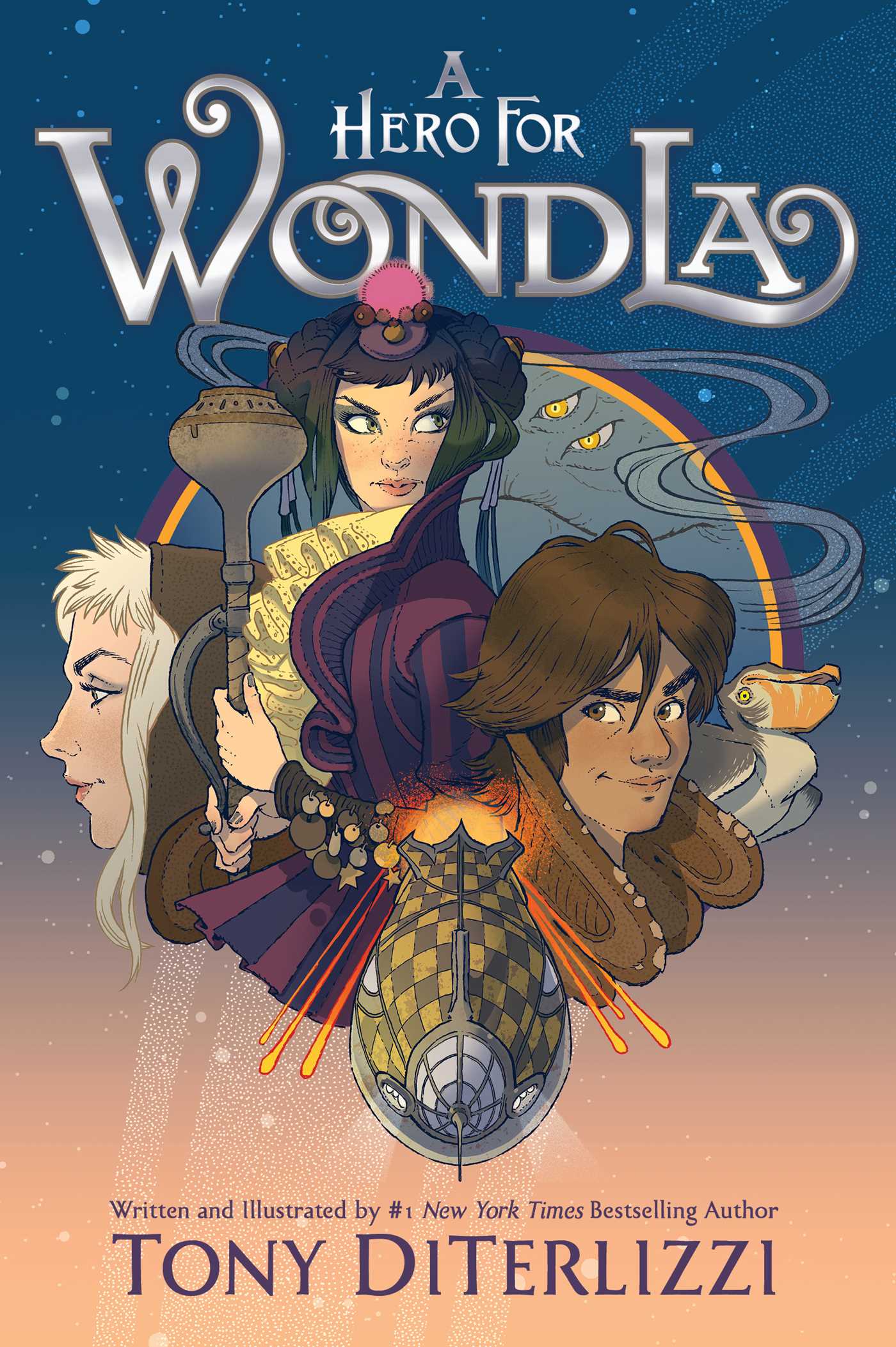
A Hero for WondLa (The Search for WondLa, #2) – Tony DiTerlizzi
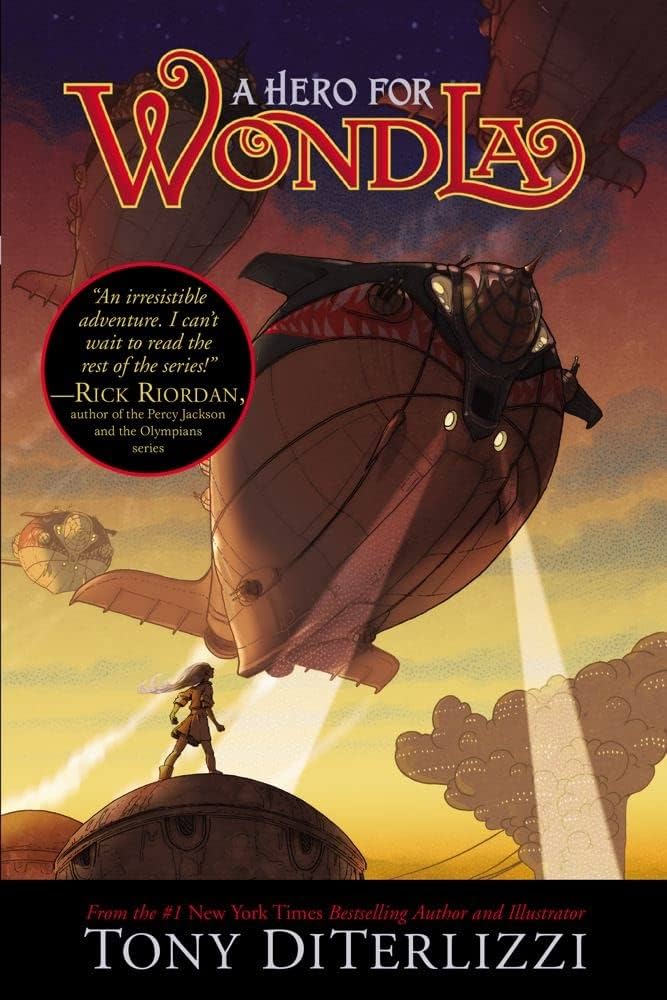
Summary from Goodreads:

Before the end of The Search for WondLa , Eva Nine had never seen another human, but after a human boy named Hailey rescues her along with her companions, she couldn’t be happier. Eva thinks she has everything she’s ever dreamed of, especially when Hailey brings her and her friends to the colony of New Attica, where humans of all shapes and sizes live in apparent peace and harmony.

But all is not idyllic in New Attica, and Eva Nine soon realizes that something sinister is going on—and if she doesn’t stop it, it could mean the end of everything and everyone on planet Orbona.

A Hero for WondLa is a truly worthy predecessor to book 1 for so many reasons, but what struck me the most upon re-reading it is how painfully accurate—and beautiful—Tony DiTerlizzi’s depiction of weird middle school girlhood is. I had to stop and remember that yes, this is a middle-aged man writing this, and yes, he has a daughter, but she was still a toddler when he wrote this…and yet he nails it. Right down to the smallest details.

A Hero for WondLa follows Eva Nine’s journey after she’s discovered that she’s not the only human. She visits New Attica, the pristine, final stronghold of the human race, where technology rules all. Eva’s first instinct is to fit in; she’s taken under the wing of Gen Pryde and her Mean Girls 2049 posse of identical, plastic friends, who are intent on making her fit in—they giggle at her sanctuary-born eccentricities, and she’s only praised when they mold her to look just like them. Even after that, they’re laughing behind their hands. She flees their false promise of friendship and into the arms of Eva Eight, her long-lost sister who has waited 100 years for her arrival. Eight hates New Attica and all of its lies, and promises Eva that she’s just like her. And yet, despite this insistence, Eva fails to find solace in her, either. It’s only when she becomes one with the Spirit of the Forest that she becomes her truest self—putting that which gives her power front and center. Like The Wizard of Oz, the (emerald) city she has spent her whole journey looking for is nothing but a sham, and in the end, there’s no place like “home”—the person that she is most comfortable being.

Oh, god. I need a minute. Ow. No other book I can think of captures the limbo of being 13 and not knowing who your real friends were lodged so deeply into my heart. Eva, like me, was so desperate for friendship and human connection that both attempts ended in complications, but through it all, everything came back to the found family she has built—the outcasts, the prisoners, the exiled. The ones who had her back. The ones who were just as confused as she was, but joined her journey after realizing the error in their ways.

The aesthetic language of A Hero for WondLa is drastically different than book one, with its pristine, plastic city of humans living in a bubble. Even the clean walls of Sanctuary 573 had a retro feel to them—likely centuries outdated from New Attica’s tech—but all of this is so blindingly new. None of the robots and automatons have the same old-fashioned friendliness as Muthr, trading approachability for sleekness and monstrous amounts of wires and tentacles. But along with it is a sinister aspect that DiTerlizzi doesn’t shy away from; I’d forgotten that, although the discussion is brief, that it’s implies that among all of the mind-control and executions that Cadmus Pryde is carrying out eugenics is casually a part of his long list of crimes against the last of humanity. The WondLa trilogy isn’t one to shy away from darkness (part of why it’s stood the test of time for me), but that aspect stood out, especially since this is science fiction we’re talking about, a genre that has a long history of portraying the eradication of disabilities as a sign of progress. I’d remembered that there are a handful of disabled characters, but having that as a clear signifier of evil in a middle-grade novel is something I can’t praise enough.

The Search for WondLa is a very self-contained story; although book sequels surpass it, in my opinion, the conclusion that it ended on (minus the epilogue) was hopeful and wrapped-up enough that it could have been a reasonable end to Eva Nine and Rovender’s journey. But this novel does such an excellent job of intensifying the stakes in so many ways. As Eva learns of a conflict that could soon entrench the whole planet in war, we get so many of the real time costs. Foreshadowed details, hinted at from the start of the series, metamorphose into sinister threats. Interpersonal relationships become tangled in this vast, interspecies conflict—nobody knows the truth. Side characters (although all but one do end up surviving in the end) often die mere chapters after they’re introduced. It’s a very tense book in and of itself, but as the setup to the massive conflict in the final book, it’s a masterclass in building up both physical and emotional stakes.

And…good god, all of Rovender’s emotional moments always kill me the most. Without going too in-depth, the scene of his complicated reunion with Antiquus destroyed me when I was younger, and it might have destroyed me even more…

It reminds me of another song that similarly destroys me:

“There will come a day/When the Earth will cease to spin/You’ll hold me close and say: ‘my God, where have you been?'” (Shakey Graves, “Chinatown”)

For the deeply emotional journey, then and now, 5 stars.

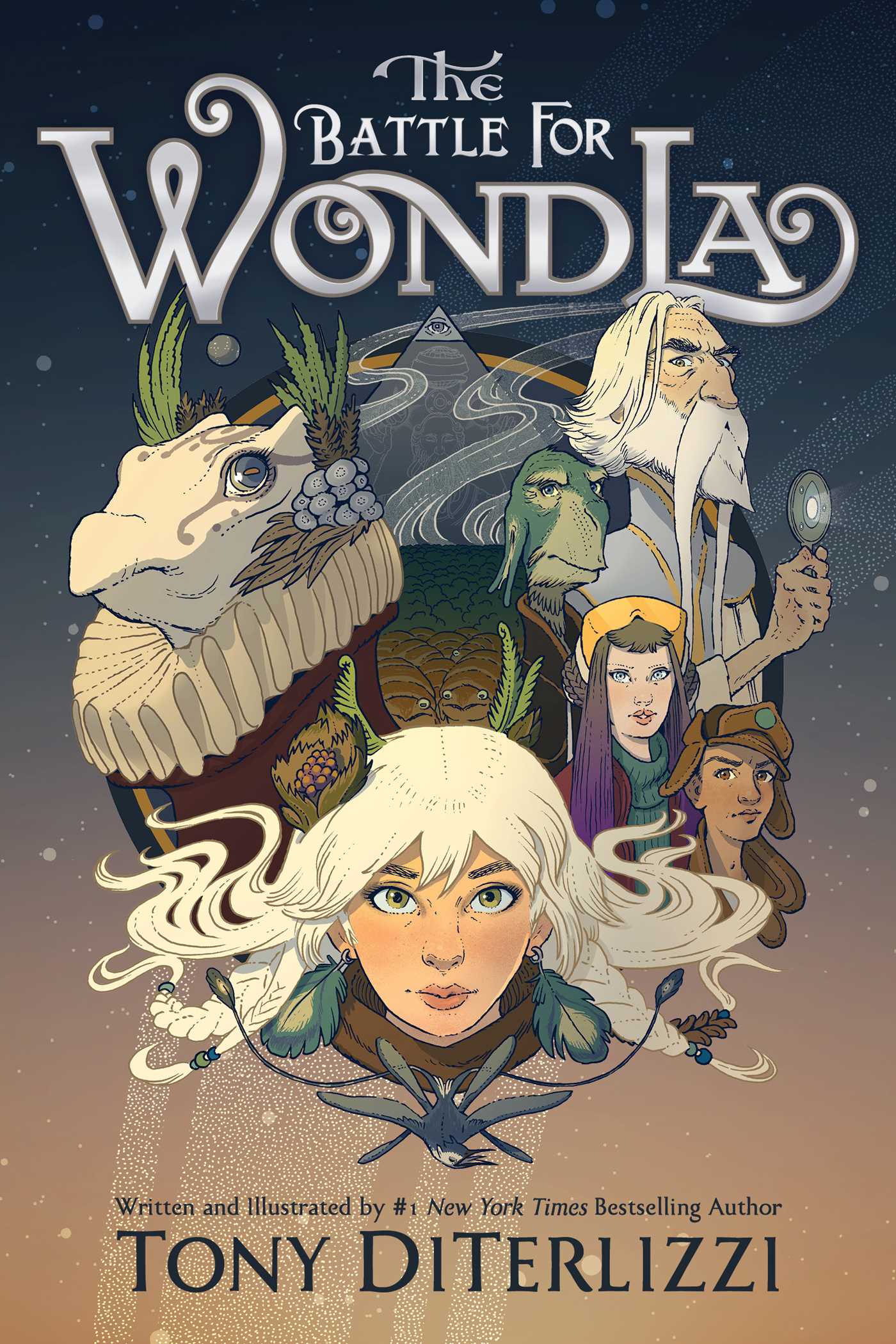
The Battle for WondLa (The Search for WondLa, #3) – Tony DiTerlizzi
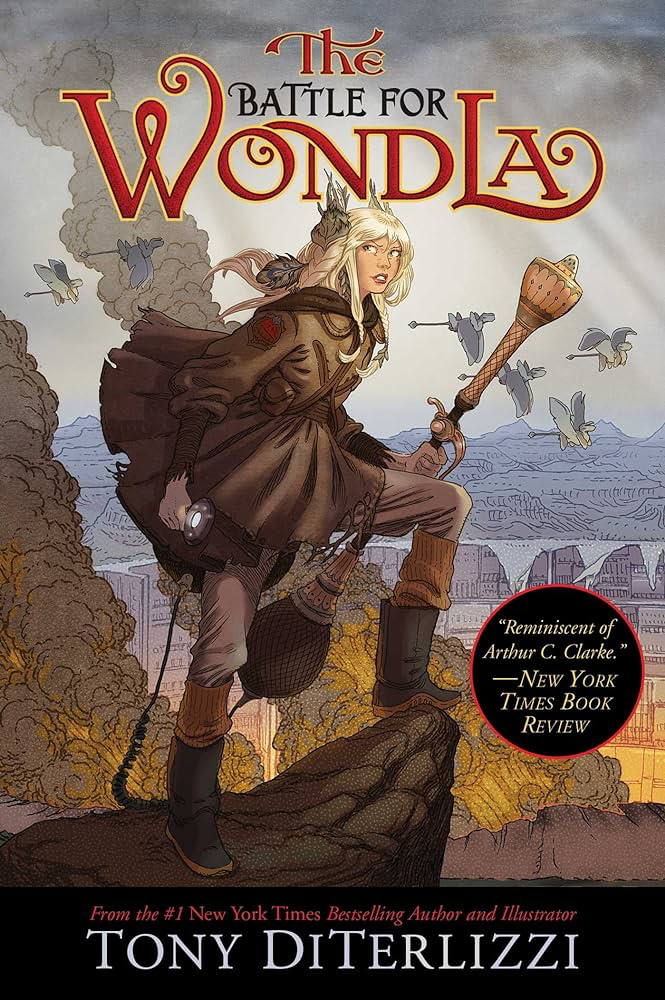
Summary from Goodreads:

All hope for a peaceful coexistence between humankind and aliens seems lost in the third installment of the WondLa trilogy. Eva Nine has gone into hiding for fear of luring the wicked Loroc to her companions. However, news of the city Solas being captured by the human leader, Cadmus Pryde, forces Eva into action once again. With help from an unlikely ally, Eva tries to thwart Loroc’s ultimate plan for both mankind and the alien life on Orbona.

The Battle for WondLa was my favorite book of the trilogy when I first read it, and I find myself agreeing with the sentiment almost a decade later. Was this influenced by the fact that, in retrospect, the original book cover almost certainly contributed to my bisexual awakening at age 12? Maaaaaaybe. In all seriousness, it’s such a brutal, beautiful, and downright exhilarating conclusion to a series like no other.

This incarnation of Eva Nine, as matured as we see her in the trilogy, has always been my favorite. After she embraces her powers and connection to the natural world, she’s such a fascinating hero to follow, partly because she never fully gives up her younger traits. In fact, her powers lie in what made her a target in the first novel—her sensitivity and empathy. Now that she can communicate with all of the creatures of Orbona, she uses her sensitivity to find it within herself to accept the machinations of the natural world and show mercy for even the most frightening of beasts. Sensitivity is her superpower, and that is such an important lesson for younger readers—especially young girls. It’s overwhelming to feel everything all of the time, especially when you’re Eva’s age, but having a heroine who wrestles with that and learns to fine tune her all-seeing empathy and use it to her advantage is so, so crucial. I’m likely among a majority when I say that my sensitivity was often treated as a weakness growing up, so having a heroine whose sensitivity saves the world is just about the best role model you could write for a young girl.

As the title suggests, The Battle for WondLa boasts some of the best battle scenes in the whole trilogy. I’m not talking about the massacre of New Attica, although that remains truly brutal, but the ones that display Tony DiTerlizzi’s talent the most is the scenes where Eva uses the sheer might of the forest to win her battles. Now that I’m older, I’ll inevitably associate WondLa with Björk for a number of reasons, but Eva Nine goes from that precocious, earlier “Human Behaviour” Björk straight into “Nattúra” as her development goes on—unflinching femininity channeling the incomprehensible power of nature. Does it get any better than that, folks? Actually, it does—watching Eva Nine take down a squadron of Warbots with the help of a herd of giant water bears. “My herd…help me.” COME ON. Eva getting injured and then being carried back into battle by the mother sand-sniper that she freed from the menagerie? GIVE IT TO ME!! A highlight of the novel, without a doubt.

What stands out to me about Battle is this novel’s willingness to make complicated characters. Whether they’re the culmination of arcs of characters who have been in the series for multiple books or side characters that only show up in the latter half of the novel, there’s something to be said for how unflinchingly complex everyone is, and how that further complicates Eva’s quest to unite humans and aliens on Orbona. Hailey, with whom Eva is still (justifiably) bitter over her treatment in New Attica, sheds his tough, cocky exterior to reveal a loyal, humble friend by the end of the novel. Zin’s scientific distance becomes a detriment to him in the wake of the death of his family—and the threat exerted by his power-hungry brother, making him realize the error in his lack of emotional intelligence. Redimus, who unintentionally caused nearly all the dominoes for the entire series to play out against Eva, is never written as fully black or white; Eva can never fully bring herself to forgive him, but she learns to accept his attempt to, in his own words, “rectify his past actions,” and to accept that everyone is a web of decisions and consequences that never fully align with each other. And that’s what makes her journey feel so much more earned.

At the heart of The Battle for WondLa is connectivity—it’s all very “I/O” to me. Loroc’s ultimate goal is to unite Orbona, but unity in the form of everyone, human and alien, being either enslaved or consumed by him. He tricks his allies with promises of harmony, only for them to realize that harmony ends up being the harmony of being together…inside of his stomach. Eva wins by championing the fact that it’s the uplifting of everyone’s unique strengths that makes a community strong, whether it’s the unity of the aliens or the interconnectedness of all of the plants and animals of Orbona. We are each an integral part of a community, whether it’s a food web or a village, and it is those unlikely connections that make us stronger. As with today, the greatest mistake that any civilization can make is thinking that we are separate from nature. To once again quote Peter Gabriel, “I’m just a part of everything,” and that is where strength—and love—come from.

All in all, an unforgettable finale for a series that changed the trajectory of my life overwhelmingly for the better. 5 stars.

Tony DiTerlizzi is the author of several books for both early readers (Adventure of Meno, Ted, Jimmy Zangwow’s Out-of-This-World Moonpie Adventure, G is for One Gzonk!) and middle grade (Kenny and the Dragon and The Spiderwick Chronicles, co-authored with Holly Black). All seven episodes of WondLa are now streaming on Apple TV+*.

*I could only make it through 5/7 episodes before I had to quit. Only watch it out of morbid curiosity or if you have intentions to read the books and see how you got robbed.

Today’s song:

thank you to my brother for turning me on to this one!!

That’s it for this week’s Book Review Tuesday! Have a wonderful rest of your day, and take care of yourselves!

Posted in Sunday Songs

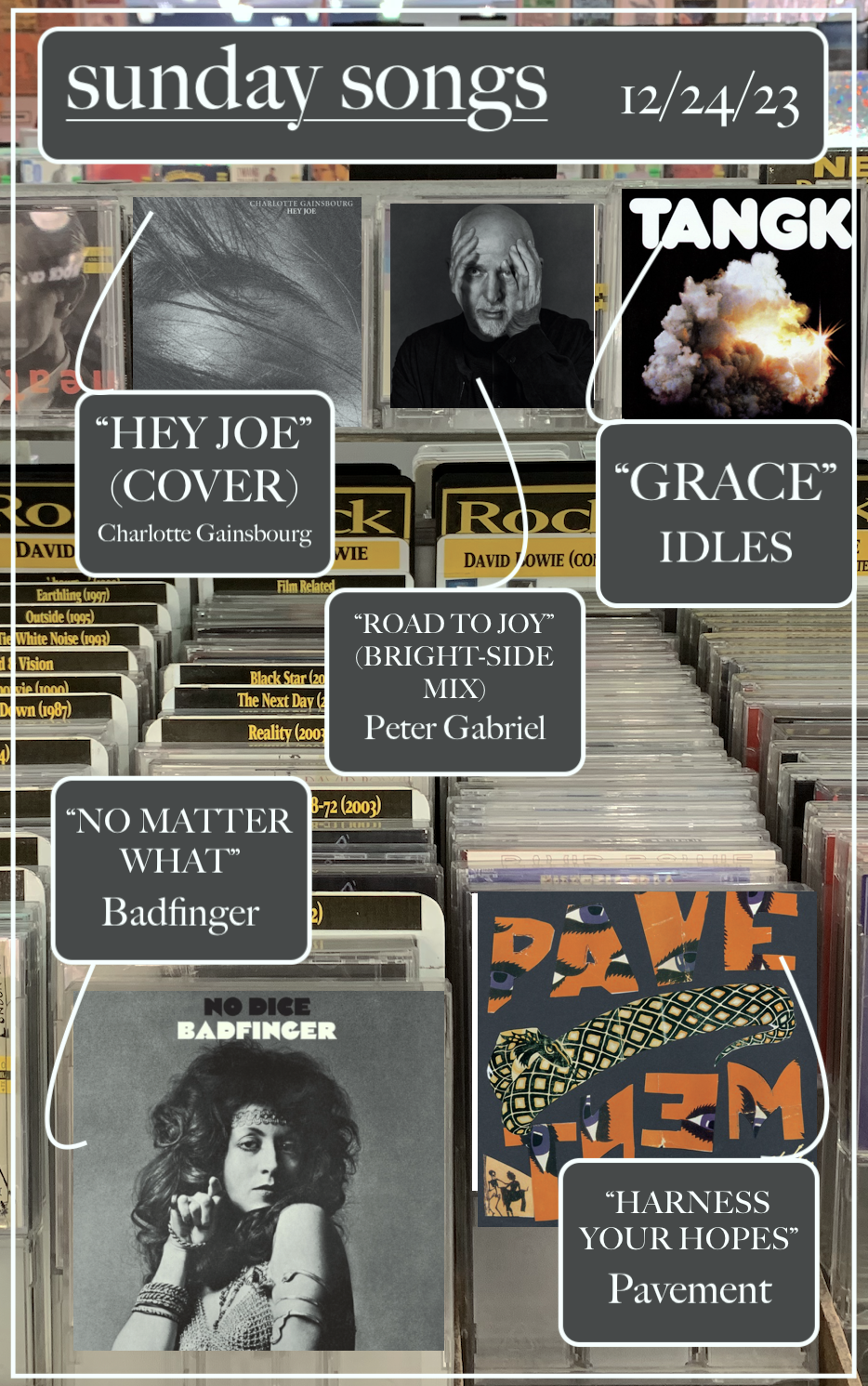
Sunday Songs: 12/24/23

Happy Sunday, bibliophiles, and a very merry Christmas Eve to all those celebrating!

As far as my book reviews go…yeah, well, I’ve been a bit of a Scrooge, but you can’t blame me. The finals reading slump comes for us all. Some days you just have to air out the dirty laundry. But despite the dreary color palette that ended up happening this week, I hope there’s enough jolliness here to assure you that yes, my festive cheer remains steadfast, and so does my love of ’70s guitars.

Enjoy this week’s songs!

SUNDAY SONGS: 12/24/23

“No Matter What” – Badfinger

1970 was probably the worst year for trying to beat the “copying the Beatles” allegations, and the fact that these guys named themselves after an early title for “With A Little Help from My Friends” (originally titled “Bad Finger Boogie”…yeah, the name change was a good idea, John) doesn’t help their case. But I feel like being signed to Apple Records and having both Paul McCartney and George Harrison separately produce two of their other hits gets them a Get Out of Jail Free card. This once.

That aside, it also doesn’t help their case that Pete Ham sounds like the slightly growly middle ground between Paul McCartney and John Lennon, and the same nearly goes for the backing vocals, which try to hit somewhere between Lennon and Harrison. But it’s not every day that you can hit it that close to such legends, and it’s commendable no matter how (oops) you look at it. I’ve really underhyped all of this, but…there’s seriously something about this song. I swear that “No Matter What” is laced with something…oh, maybe it’s the guitars. My god, it’s barely 1970, and the ’70s guitars already sound so crisp…so full…do not get me started. But even if the guitars weren’t so sharp and full of dance-inducing warmth, there’s something so undeniably pure about this song. It’s no lyrical groundbreaker or generational anthem, but there’s a contagious joy to it—a good pop song does that. ”No Matter What” is the perfect end-credits song—the guitars start chugging in at the final shot of the movie, and everything goes black the minute that Pete Ham begins to sing. Come on, now. You can’t not go along with the clapping at 2:18. Beauty in simplicity. These guys get a pass for having either the best or the worst band name of all time. I genuinely can’t decide.

…AND A BOOK TO GO WITH IT:

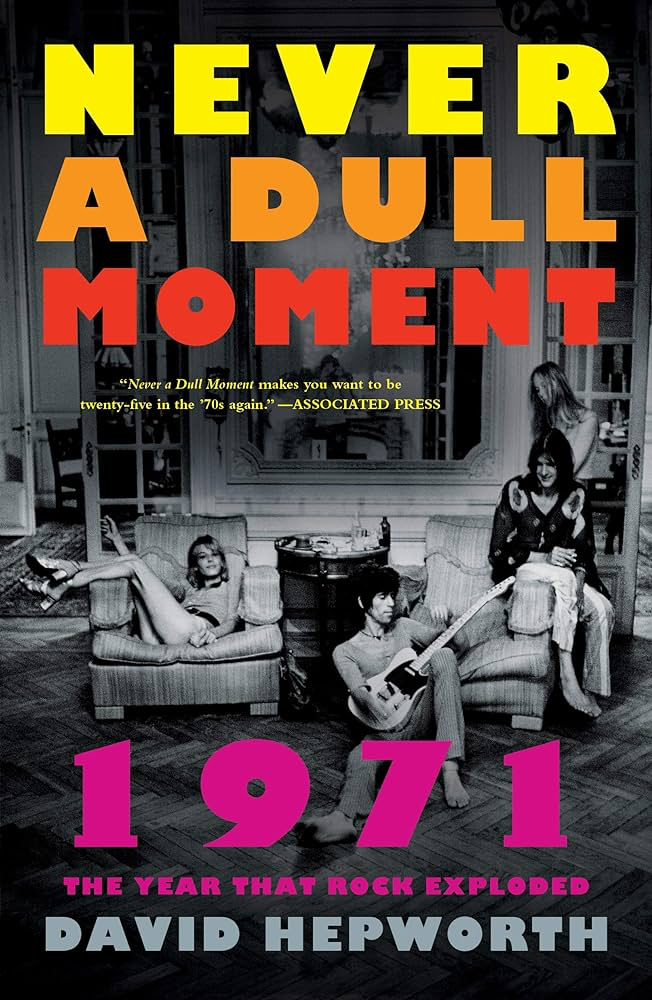
1971 – Never a Dull Moment: The Year Rock ExplodedI…dammit. I totally thought No Dice came out in 1971. I was two months off—November of 1970. Oops. But either way, this book is a little drily written for a book that claims to “never have a dull moment,” but it’s nonetheless a fascinating insight into the absolute goldmine of good music in 1971. (There was never a better high note than ending the year with the release of Hunky Dory.)

“Harness Your Hopes” – Pavement

Apparently I have another “I Just Threw Out the Love of My Dreams” situation on my hands here, since this blew up on TikTok sometime back in 2020 (after Spotify’s autoplay seems to have dug it up out of nowhere), and I didn’t find out until now. Maybe that was the period when the thumbnail for the music video kept popping up on YouTube and I ignored it until it went away? Little did I know what I was in for…

Also like “I Just Threw Out the Love of My Dreams,” I can only describe “Harness Your Hopes” as pure, bottled joy. As soon as the sighing, psychedelic-tinged intro gives way to some truly squeaky-clean guitars, I felt a rush of sheer happiness course through me. Stephen Malkmus seriously pumped this song with nothing but whimsical joy…and yet it was a B-Side? Not only that, but a B-Side that faded into more obscurity than the indie obscurity they were (probably) going for, so much so that Malkmus didn’t even recognize it when he heard it playing in a bakery? Nuts. Seriously. Not that I have any beef with the guy, but when you produce something as curiously delightful as this, you don’t let it slip through your fingers. It has that freeform, Marc Bolan kind of nonsensical lyricism written all over it, with more than a little pretentious affectation (“Leisure, a leisure suit is nothing/It’s nothing to be proud of/In this late century”), but somehow, it feels less pretentious when most of the lyrics don’t make a ton of sense as a whole. (Or maybe there’s some super deep hidden meaning that only Stephen Malkmus and co. can decipher, and it’s nothing to us normies…who knows) And like Bolan, it’s the kind of wordplay that occasionally leads to something unexpectedly romantic—”And I’m asking you to hold me/Just like the morning paper/Pinched between your pointer, your index, and your thumb.”

And paired with Malkmus’ strained, cracking voice on one end and the guitars (so clean that they’re practically still kicking up bubbles) on the other, it’s a capsule of warmth, practically radiant. Bottled joy, truly.

Speaking of Stephen Malkmus’ voice…

skip to 2:11

Please tell me I wasn’t the only one in theaters who laughed way too hard at this (besides my mom). Please.

…AND A BOOK TO GO WITH IT:

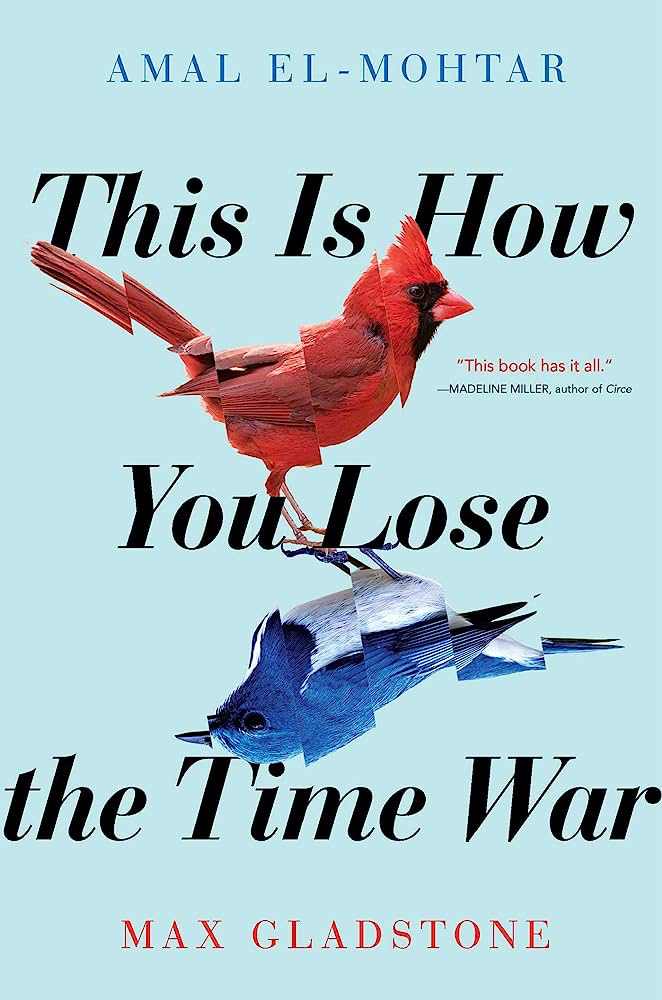
This Is How You Lose the Time War – Amal El-Mohtar and Max Gladstonefor the most part, this novel lends itself more to something more cosmically sweeping and Romantic in both senses of the word (probably Spiritualized?), but lines like “and I’m asking you to hold me/Just like the morning paper/Pinched between your pointer, your index, and your thumb” might as well be straight out of the letters between Red and Blue.

“Hey Joe” (cover) – Charlotte Gainsbourg

hnnnnnnnnnnngh me when Noah Hawley puts a song in Fargo that connects thematically in a deeply creative way hnnnnnnngh

good god I love this season of Fargo. no complaints, this show has made me feel alive again

where were Roy and Gator Tillman on January 6th

…AND A BOOK TO GO WITH IT:

A Conspiracy of Tall Men – Noah Hawleymaybe I’m cheating since I got this song from Noah Hawley. It’s fiiiiiiine. To be fair, this is his debut novel and predates the first season of Fargo by a full 16 years (it’s kind of a mess, but lovably so…mostly), but it’s got all the cross-country conspiracies and paranoia you could ever want.

“Road to Joy” (Bright-Side Mix) – Peter Gabriel

I meant to review this all the way back in June or July, when this single was first released…I forget what about it made it slip out of the roster, but I knew that it had to come back eventually. Now that all of I/O is out…it’s a great album, but I can’t help but be a little disappointed at how it was constructed. I thought that the deal was that the final organization of the songs was going to be a surprise, and that they’d be reshuffled from the order they were released in with each full moon this year, but the order just ended up being the same order they were released in. (I stand by my belief that “Playing for Time” would have been the perfect closing track.) I have similarly mixed feelings about the Bright/Dark-Side Mixes—I haven’t listened to the In-Side mix yet, but I also thought that each mix of the 12 songs would be more radically different, but the differences between the mixes are often very subtle. Some of them fit more clearly than others (ex. “I/O” is clearly more fit for Bright-Side, while “The Court” lends itself more to Dark-Side), but the tweaks between mixes are sometimes barely distinguishable.

That’s not to say that I/O isn’t a great album—it’s a beautiful picture of one of the most innovative artists alive today moving into old age and still being able to produce a relentlessly creative vision of love, mortality, and the nature of connectivity. Now that I’ve seen it live, the experience is all the more enriched, what with the stunning visuals that went along with it, as well as Peter Gabriel toeing the line between a theatrical showman (how’s reenacting the creation of life itself for a show opener?) and the wise, humble figure we’ve known him to be over the years. Songs like this one really showcased both the energy and creativity that clearly haven’t waned with age. “Road to Joy” is a highlight, without a doubt; for me, this one lends itself more to the Bright-Side mix, with the funky, “Fame”-esque guitar riffs and energetic burst of the chorus, like Gonzo firing off cannons without warning. But if the pink-shaded joy doesn’t immediately jump out at you, you know what should? The fact that this song is proof of yet another deeply creative project that Peter Gabriel’s been cooking up since the production of OVO—so, give or take, around 23 years. The man just can’t be stopped. But according to Gabriel, “Road to Joy” is part of a story about the human mind, and this song chronicles a character being woken up after experiencing locked-in syndrome; the triumphant declaration of “You were sure I was gone” has the defiant flair of someone beating the odds, and it’s impossible not to feel the joy from that.

…AND A BOOK TO GO WITH IT:

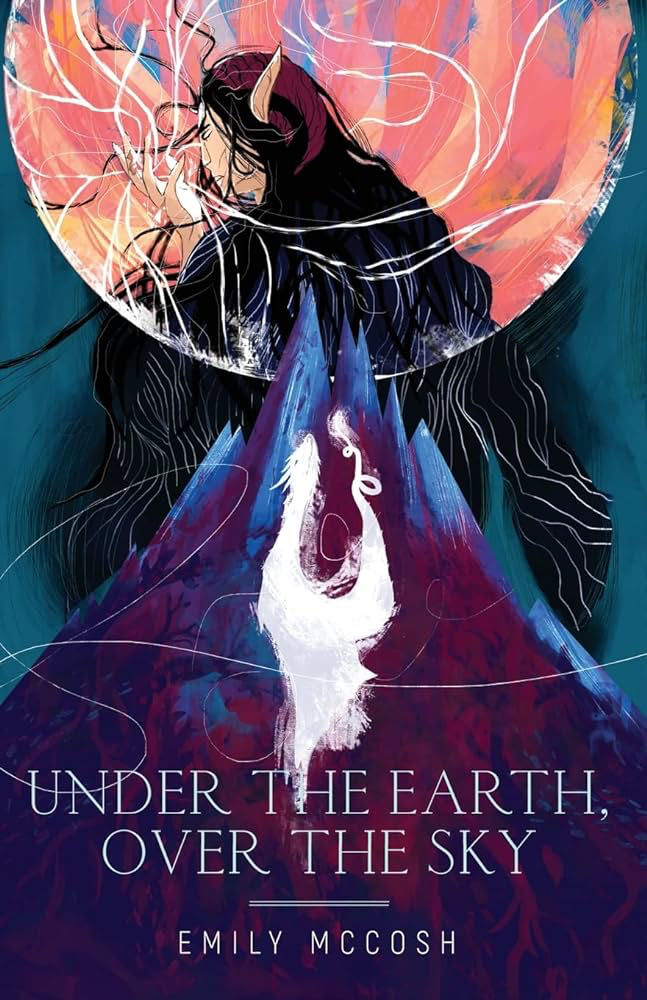
Under the Earth, Over the Sky – Emily McCoshnothing like adopting a human son to awaken your frosty, dormant heart and put you on…the road to joy, maybe? Certainly some “love call[ing] through the walls.”

“Grace” – IDLES

“Grace” has made my expectations for TANGK skyrocket, but whether or not the album turns out to be as adventurous as I feel like it’s going to be, I think I’m almost certainly going to enjoy it. It’s a change in form, even if a fleeting one.

I thought I knew what Joe Talbot sounded like when he wasn’t singing; “A Hymn” certainly gives us a hint, but there’s still the restrained growl to it that roars to life when he’s normally screaming on every other song. But “Grace” showcases his voice at its most vulnerable. Somehow, before the chorus kicked in, I almost mistook it for Mike Hadreas from Perfume Genius. I was scrambling to find the featured list for this, because…there was no way that this is the same guy who screamed at us all to never fight a man with a perm all those years ago. And I love this change in form. IDLES always mean bah-bah-business (in case you cannot tell from their tone) with their message, but this stripped-down feel that “Grace” shifts into suits their ethos just as well as their harder songs—Talbot described the song as “a call to be held,” and the quiet vulnerability really does feel like a gentle embrace. And it’s here that you can see what their change in producer has done to the sound—TANGK was co-produced by none other than Nigel Goodrich (of Radiohead fame!!), and the staccato of the drum machine and the wash of cloudy haze peeking out from under the curtain shines in the quiet places on this track. Talbot’s voice lowers into wavering smoothness, as though he’s singing from a place where no one can hear him, save for when he declares the song’s rallying cry: “No God/No king/I said, love is the fing.”

Man…I’m so excited for this album. IDLES have said repeatedly that their mission was to make an album that was purely about love and warmth—as Talbot said, “I needed love. So I made it. I gave love out to the world and it feels like magic. This is our album of gratitude and power. All love songs. All is love.” And if that isn’t exactly what we need…not to be all hippy-dippy about it, but as much as I indulge in my sad bastard music, I’m gonna go out there and say that IDLES is exactly what we need right now. I hate it that I have to say “not to be all hippy-dippy” when I’m talking about love and warmth and being kind and loving life…you’ve heard me go off about grimdark and frankly, how astoundingly dumb it is that we often think that sadder = deeper and that being happy or consuming happy media equates to stupidity somehow, but I’ll say it again. There’s nothing stupid or naïve about wanting love, giving love, and having love in your heart. IDLES get it. Love is the fing.

…AND A BOOK TO GO WITH IT:

Since this post consists entirely of songs, consider all of them to be today’s song.

That’s it for this week’s Sunday Songs! Have a wonderful rest of your day, and take care of yourselves!

Posted in Monthly Wrap-Ups

October 2023 Wrap-Up 🧛🏼‍♀️

Happy Tuesday, bibliophiles, and more importantly, happy Halloween!

I really should be used to this by now, but getting this much snow two days before Halloween always feels so wrong. I like snow this time of year generally, but not when I have a costume to wear.

Let’s begin, shall we?

GENERAL THOUGHTS:

Usually a month this busy would dampen my overall feeling of it, but for once, it really hasn’t! That’s the magic of the Halloween season, I suppose. I’ve had a ton more stuff to do on the heels of midterm season, and even though I’m still somewhat busy (hence the scant amount of posts I’ve been able to make this month), I’m still enjoying myself.

However, even though most of the month has been favorable for me, my reading…hasn’t been as much so. Since the beginning of the month, I’ve been in a slump that I’ve only just been able to get out of in the last week or so. After the first few days, I just fell into a bad spell of especially mediocre books—for a solid two weeks, I didn’t run into much that I ended up rating higher than 3.5 stars. But I’ve slowly gotten out of the dry spell, and the end of the month has been filled with some fantastic reads!

I’ve also tried to get back into the rhythm of fiction writing, since I’ve fallen off the wagon for that since school started. Although I haven’t been able to adhere to the schedule to a T, I’ve allotted a good time of night towards writing at least 1,000 words a day, and that got me to the end of my first draft of the second book in my main sci-fi project! This one ended up being almost 82,000 words! Pretty proud of myself. Sadly, as I’m getting older, November has become a worse and worse year to try and crank out 50,000 words, so I’m not doing NaNoWriMo this year. The July Camp is a much more reliable time for me. In the meantime, I’m hoping to polish up some of my short stories to send off for publication…

Aside from that, though, there have been SO many fantastic things going on. First off, Sir Patrick Stewart (!!!!!) stopped by my school for his book tour, and it was incredible! I wish I had more pictures to show for it (we weren’t allowed to take any), but he just had the kindest, warmest presence, and it was such an honor to hear him speak about his life. What an incredible man.

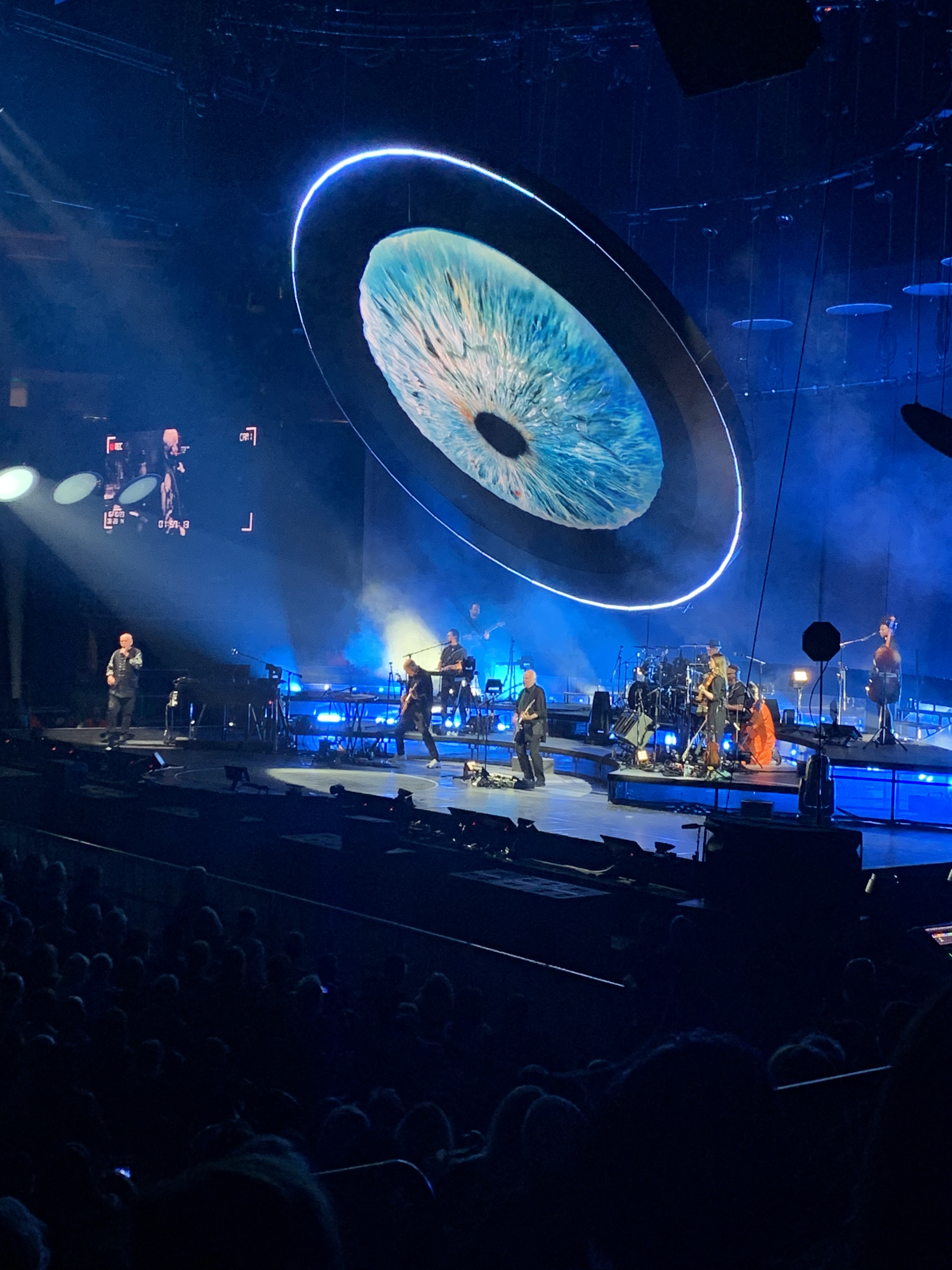
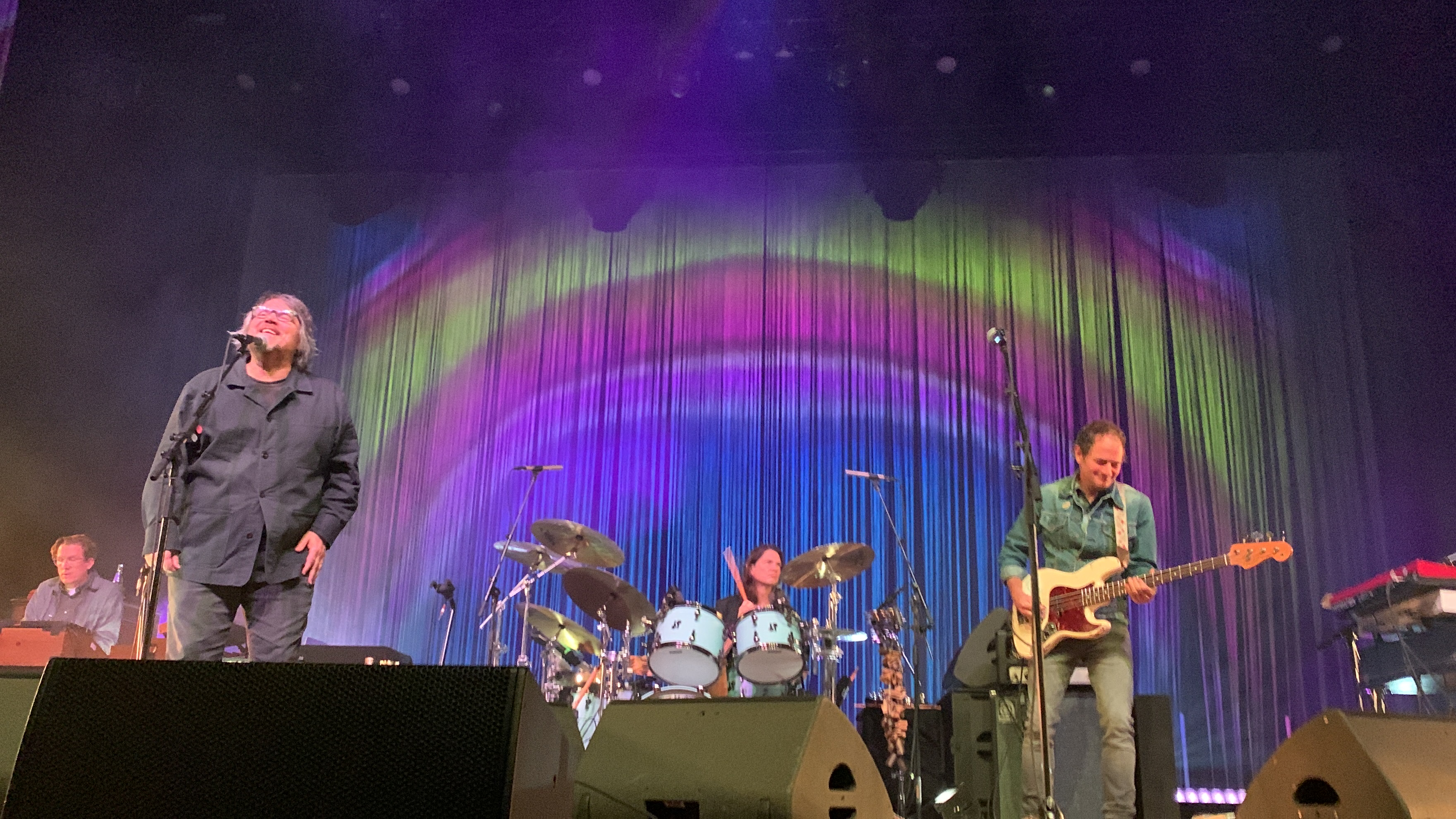
After that, I had the amazing luck of being able to see Peter Gabriel and Wilco in the same week! Both were such phenomenal shows in their own ways—seeing Peter Gabriel when I thought I’d never even see him tour was the most transformative, beautiful experience, and seeing one of my favorite bands perform their best setlist yet (and seeing them from the front row!!) was just as wonderful.

Peter Gabriel at the Ball Arena
Wilco at the Mission Ballroom

Other than that, I’ve just been getting back in the rhythm of drawing, playing some guitar now and then, taking far too many pictures of the pretty leaves on campus, drinking my fill of apple cider, watching Taskmaster (FINALLY GOT THROUGH SEASON 15! THE BINGING HAS CEASED!) and catching up on Only Murders in the Building (please stop pairing Mabel up w randos, she deserves so much better), and soaking up the fall weather. At least I was until we got snow 2 days before Halloween. Oops.

READING AND BLOGGING:

I read 16 books this month! This month was slow going, and I ended up in a somewhat extended reading slump, but there were bright spots here and there.

2 – 2.75 stars:

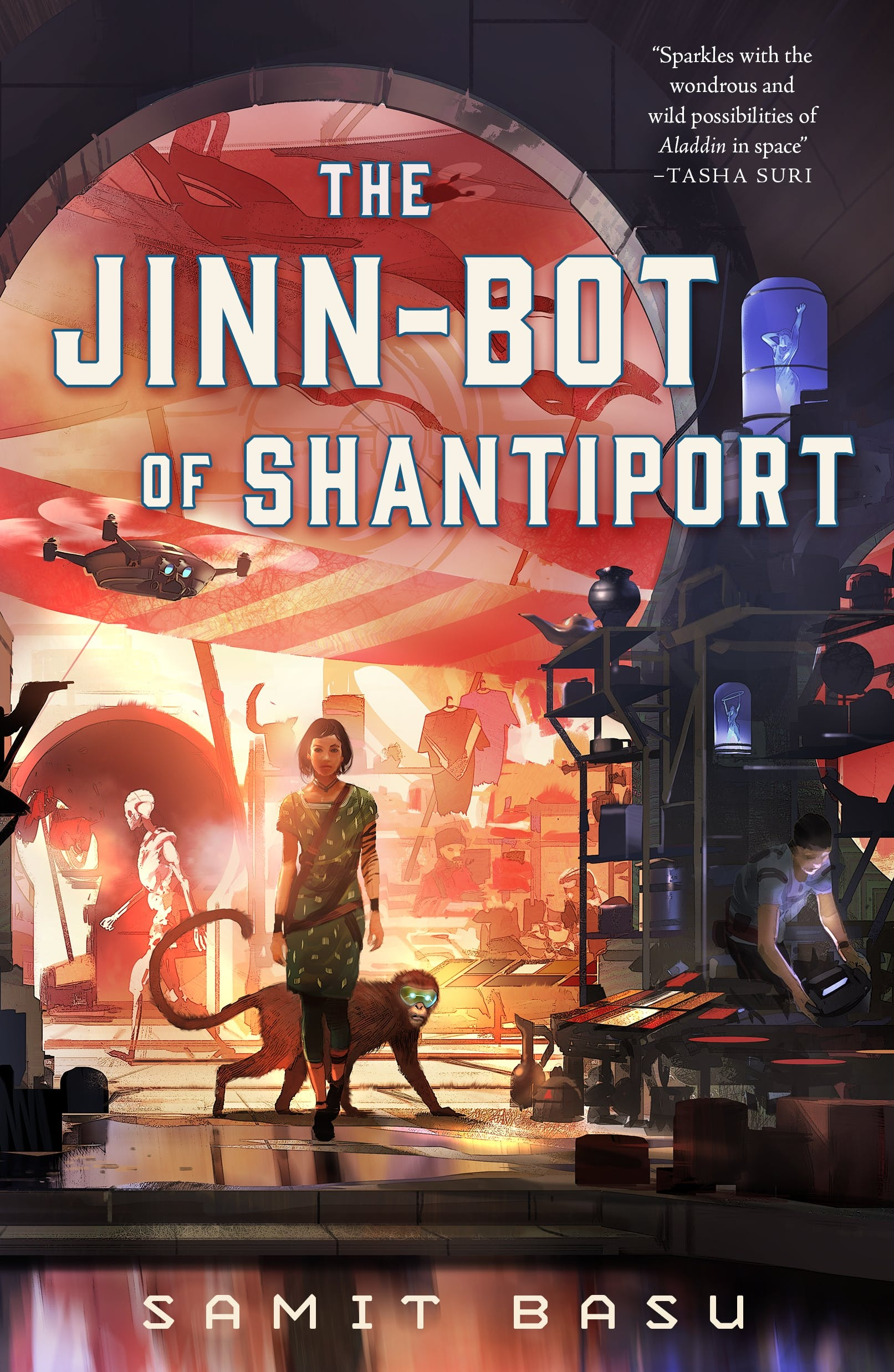
The Jinn-Bot of Shantiport

3 – 3.75 stars:

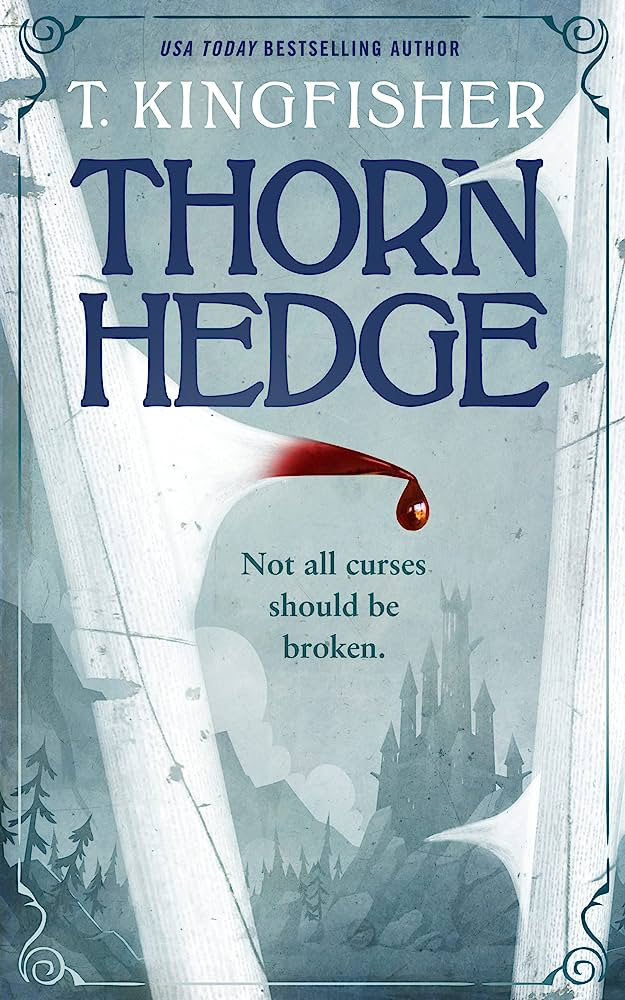
Thornhedge

4 – 4.75 stars:

The Thursday Murder Club

FAVORITE BOOK OF THE MONTH: Under the Earth, Over the Sky4 stars

POSTS I’M PROUD OF:

[cough] not a whole lot here, but:

POSTS FROM OTHER WONDERFUL PEOPLE THAT I’VE BEEN ENJOYING:

Again, I haven’t had as much time to blog-hop, but:

SONGS/ALBUMS I’VE BEEN ENJOYING:

LOVING the new Wilco
this song makes my soul leave my body
this album was just as wonderful (and uncomfortable) as I thought it would be
WAAAAAAAAAAAAAAAAAAAA
yeah I love OK Computer with every cell of my being, but there’s something to be said for the good ol’ Bends-era Radiohead
seeing Peter Gabriel live was truly magical :,)

Today’s song:

HAPPY HALLOWEEN EVERYBODY

That’s it for this month in blogging! Have a wonderful rest of your day, and take care of yourselves!

Posted in Uncategorized

Sunday Songs: 4/23/23

Happy Sunday, bibliophiles! I hope this week has treated you well.

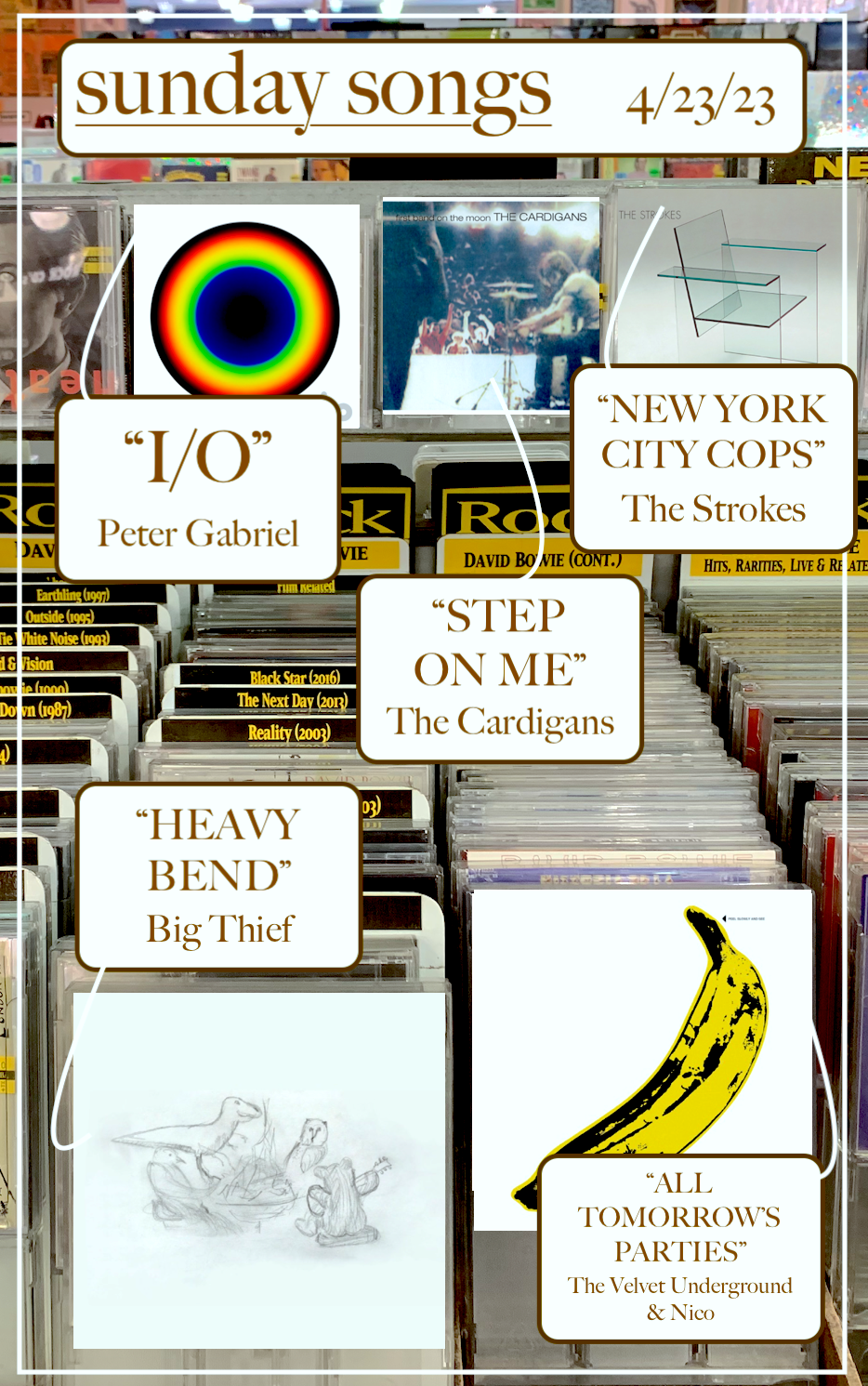
I may be slightly sick, but I did not lose my lack of coherence, so today, I give you a very famous banana, Wall-E, and the only band that can make a Black Sabbath song sound dainty. Have fun trying to bring it all together. I certainly did.

Enjoy this week’s songs!

SUNDAY SONGS: 4/23/23

“Heavy Bend” – Big Thief

With full sincerity, I mean this in the absolute nicest way possible: the beginning of this song sounds like an Apple ringtone. An Apple ringtone, but the kind that has no business being as much of a banger as it is. Like the Piano one. Did any of that make any sense? I need a Taskmaster-style choreography to this one now. Would this give Noel Fielding shrew vibes?

My Big Thief/Adrianne Lenker conversion has begun, thanks to my brother and his girlfriend, and every day I’m inching closer to listening to Dragon New Warm Mountain I Believe In You. But this song is unique—everything, from the echo of Adrianne Lenker’s sighing into the microphone to the hypnotic, harp-like strums that feel like the auditory answer to dew-covered spiderwebs in the early morning. That hypnotic quality reminds me a lot of “Bicycle,” another song that I raved about a few months ago, that shares the quality of feeling enchantingly impressionistic, like a painting imbued with motion. And as much of a cliche as this is, “Heavy Bend”‘s biggest crime is being too short. Some songs work as short and snappy (see “We’ve Got a File on You,” “Pam Berry,” “A Little Bit of Soap,” etc.), but this song feels like it’s begging for a key change, a bridge, just something to propel it beyond a minute and 36 seconds. On the other hand, that makes it tantalizingly easy to play on repeat. If you play it enough times on loop, you can just pretend that it’s longer. Denial is the first stage of grief.

“All Tomorrow’s Parties” – The Velvet Underground & Nico

nothing like cackling at niche jokes alone in your dorm, amirite?

I’ve finally got around to listening to another classic album—one that I’d heard about half of beforehand anyway, but still enjoyed, for all of its legend, discomfort, and strange beauty. A classic story of a disaster and a sales flop becoming a tried-and-true classic, every song feels like its own world—a very seedy, eerie, and hazy world, but a world all the same. I doubt anybody will ever describe Nico’s voice better than the journalist Richard Goldstein, who described it as “something like a cello getting up in the morning.” I wouldn’t automatically put it on my top 10, but it’s clear that its lasting legacy isn’t without reason.

“All Tomorrow’s Parties” is one of the songs that was relatively new to me, and it quickly became my favorite of the album. There are so many layers to it, more than the peelable, bruised, Andy Warhol banana on the album cover. It chugs along like a great machine, elephantine in its size, slow in its looming progress. Nico’s distinct voice, thick, resonant and cavernous, plows it along, drawing a long shadow over the music. Each piano chord seems to plod along, even with how rapid each chord is. It almost feels like a dirge in the way it seems to crawl, certainly for the fate of said “poor girl” that the song describes. Unlike “Heavy Bend,” this song is the perfect length—the typical 3 minutes doesn’t give it enough time to loom over the listener, but just over six minutes gives it all the time in the world.

“I/0” – Peter Gabriel

“gay rights” – Peter Gabriel 2023

Oof, another beautiful one…I’m just glad this one is easier to swallow than “Playing for Time,” but it’s just as powerful.

Peter Gabriel’s had his fair share of movie involvement, from writing various film soundtracks to providing the tearjerking end-credits song “Down to Earth” for Pixar’s Wall-E. So it’s not surprising how easily he can slip into that cinematic smoothness with such ease. Certainly helps that the Soweto Gospel Choir, the same choir that performed with him on “Down to Earth,” provided backing vocals for “I/O” as well. Even though every song from the forthcoming i/o (stop trying to capitalize the i STOP TRYING TO CAPITALIZE THE i) has been paired with a visual so far, this one is practically begging for its own Pixar movie, or even just some animated music video. You can feel every bit of nature creeping through this song, from every creature mentioned in the lyrics to running water and green hills.

was this another gateway to sci-fi for baby Madeline? probably.

If we’re keeping with the Pixar theme, that would be two Pixar movies that he would hypothetically contribute to with a deeply environmentalist message. I’ve never been a die-hard Disney or Pixar fan, but Wall-E is special to me in so many ways—it was one of the first movies that I ever saw in theaters as a kid, and 15 years later (Jesus, I feel old), it reflects on humanity’s disconnect from nature, and the dangers of thinking that we’re the masters of everything that we can grab at. The scene where Wall-E reaches up to touch the stars still fills me with incredible awe. But, as with everything, we didn’t listen, and now we’re in the landscape where a handful of corporations are responsible for polluting a large part of our planet. And that is why we’ve become disconnected: as soon as we forget that we’re as much a part of the Earth as every other plant, animal, and other entity, we think that we can get away with all of this. And that’s what Wall-E tried to tell us in 2008, and it’s what “I/O” is telling us now: “So we think we live apart/because we’ve got two legs, a brain and a heart/we all belong to everything/to the octopus suckers and the buzzard’s wing.” Here and now, I’m glad that at least one other old white guy besides David Attenborough recognizes this. Happy belated Earth Day.

“Step On Me” – The Cardigans

I can’t pull the “I LiKEd tHiS sOnG bEFoRe IT wAS a tIKtOk sONG” card because I technically didn’t know this song in particular, but with David Bowie as my witness, I can swear that I did grow up listening to The Cardigans in the car quite a bit. I’ve had the luck of having very few songs I know become “tiktok songs,” but I’ve found that it’s no use griping over it and insisting that “[you] liked it before it was cool.” People are just going to assume that you got a song from some popular place, and that is the case sometimes, as much of a pretentious hipster I am. I vehemently despise tiktok’s obsession with speeding up every song that gets popular (WHY), but either way, it led me back to The Cardigans and to First Band on the Moon, and I’m happy with that—and happy that everybody else seems to be enjoying it.

(Does anybody know if this song was attached to a certain trend? I know that it’s vaguely trending, but I’m not sure how or why—I’ve just seen it with a few unrelated art videos…)

“Step On Me” is one of many lovely bites of pop on First Band on the Moon, and one of the best—certainly my favorite track on the album. Nina Persson casually just created the national anthem for people-pleasers with this one—a song about dodging your own needs, letting people walk (sorry, step) all over you: “go on and step on me,” even as the object of the song stands on her left foot and breaks it. With a crunching, muted intro that continues to punctuate the end of every chorus, everything about this song is proof that The Cardigans. got the recipe for a good pop song down to a science back in the 90’s—Nina Persson’s deceptively delicate, ringing voice, no shortage of hooks and catchy lyrics, and radio friendliness without over-simplicity. Every time the scratchy, muted intro comes on shuffle, I can’t help but drop everything and turn up the volume. Like I said—The Cardigans had pop music down to a science. No wonder they’re trending again. If you can make a Black Sabbath cover sound dainty (MULTIPLE TIMES), you can pretty much do anything.

“New York City Cops” – The Strokes

Like Jack White, Julian Casablancas is just one of those musicians who I really want to hate, but then I hear songs like this that are just so undeniably catchy that I just can’t hate him all the way. That being said, the thought of him still makes me want to roll my eyes all the way back in my head, mainly because of flashbacks of him taking over Sirius XMU and saying something along the lines of “now, this next song is from a 60’s punk band from Peru…oh, you don’t know them?” I really wish I was kidding.

Even though the beginning feels a little manufactured to me (the staged-feeling quality of Casablancas screaming, then going back on it: “ahahaha………didn’t mean that at all 🫦”…oh, please), the rest of the song is a masterfully tight piece of post-punk (oh, post-punk revival…okay, fine). It’s delightfully uptight—it all feels boxed in a cramped room, but it takes the confines of that room runs with it, never once loses momentum after the first drumbeat. The rough edges of Casablancas’ voice contrast perfectly with each scratchy guitar chord, a constant buffet of sound that never loses its sandpapery texture. I mean that as a compliment—it’s not a grating sandpaper, but more of the hard-edge, punk sandpaper that makes The Strokes sound the way they do. And although this song was subject to some abysmally bad timing in the U.S. (the song was initially removed from the U.S. release because the album was released so close to 9/11—the chorus of “New York City cops/but they ain’t too smart” was, understandably, a massive no-no so close to such a tragedy, even if it was completely unintentional), I’m glad “New York City Cops” ended up seeing the light of day a significant amount of time after the fact.

Since this post consists entirely of songs, consider all of them to be today’s song.

That’s it for this week’s Sunday Songs! Have a wonderful rest of your day, and take care of yourselves!

Posted in Music, Sunday Songs

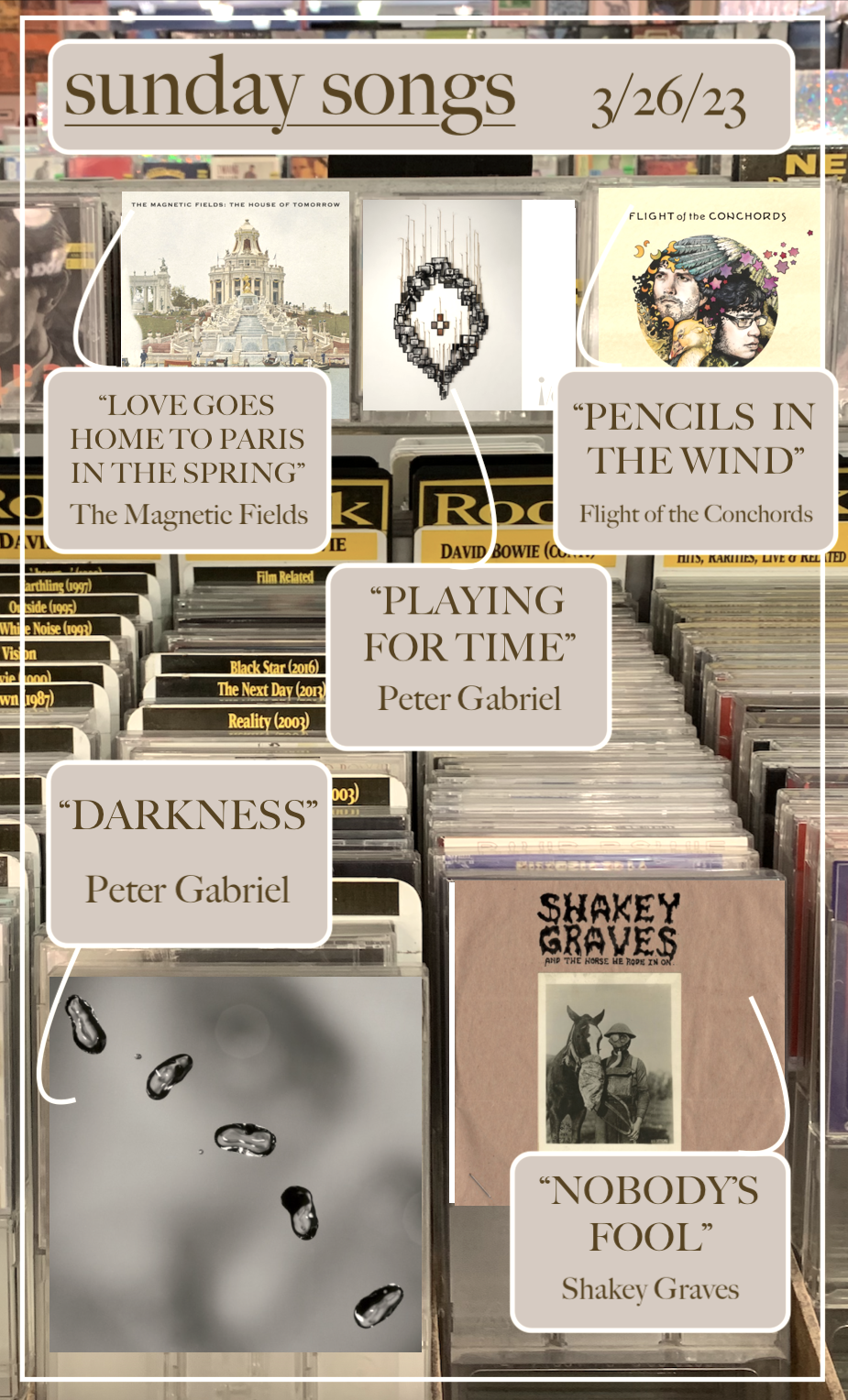
Sunday Songs: 3/26/23

Happy Sunday, bibliophiles! I hope this week has treated you well.

It’s finally spring. Sprouts are crawling out of the crumbly earth, the fog is lifting, and I have a depressingly gray color scheme to show for it. My overexcitement for getting Peter Gabriel tickets (HUUUAUAAAAAAAAAAAAGGHGHGH BIG THANK YOU TO MY PARENTS) trumps any hope of a springtime aesthetic for this post.

Enjoy this week’s songs!

SUNDAY SONGS: 3/26/23

“Darkness” – Peter Gabriel

Picture this. It’s early in the morning. You have a 9 AM class you have to get ready for. You’ve decided to listen to Up, so you put it on while you start putting your makeup on. Track 1. You turn the volume up, because nothing much seems to be happening. 0:29 hits. All hell breaks loose.

And yet, even though I do my SPD jumpscare dance every time it rolls around, I find myself listening to this song like an adrenaline junkie. Peter Gabriel knows how to open an album—lulling you into near-silence, then hitting you with a concentrated, almost industrial opening that probably keeps Trent Reznor up at night wondering how he could top it. More than that, “Darkness” is another song I’ve added to my internal list of reasons why Gabriel is such a uniquely talented musician—he makes creating a musical atmosphere that mirrors the lyrical story look so easy. As he speaks of being consumed by fear, the instrumentals crash in, enveloping all else as his voice grinds to a gravel-edged plea for solace. It was enough to give me a heart attack, and, if I’m going by the YouTube comments, enough to give people nightmares. Gabriel whispers of fearing “swimming in the sea/dark shapes moving under me/every fear I swallow makes me small,” and in the edges of the near-silence, a strained moan sounds, like a distant whale call or the grinding of a boat. The imagery is startling in its clarity—if I had the patience, I’d jump at the chance to make some kind of stop-motion or claymation music video. Unlike other artists, Gabriel’s instrumentally darker, more abrasive side doesn’t surprise me—after the first listen, all I could think of is that it was the next natural evolution of “Intruder.”

But over two decades after the release of “Intruder,” (which, unlike this song, was enough to keep me up at night—on the first night alone in my dorm, no less…good times) Gabriel has a deeply nuanced understanding of fear. Even as these fears swallow him like the whale in Pinnochio, he finds a way through the tangled woods, knowing that fear will pass—”I have my fears/but they do not have me.” Well. I needed to hear that. Sometimes it’s hard to hear these things when we’re swallowed up so easily—which I can relate to a little too well, with my experience with general fear over various things, as well as the truckload of anxiety that came along with making the move to college—but as the song ebbs and flows from monstrous crescendos to something more bare and gentle, so too do our fears. It’s all too easy for me to think that there’s no light at the end of the tunnel when I get in a place like this, but fear, like everything else, is impermanent. And when we look back, like Gabriel, we can “cry until [we] laugh.” Maybe that’s why I find myself seeking out this song so much—I love when I can give myself a musical mantra. It has no control over me.

“Nobody’s Fool” – Shakey Graves

I’ve been meaning to listen to Shakey Graves and the Horse he Rode In On solely because of how much I love that name, but I’ve got more motivation (not that I didn’t have any—the eternal album bucket list waits for no man) after hearing this one in my brother’s girlfriend’s car. Shakey Graves can make anything seem natural, be it the more experimental wanderings of Can’t Wake Up to the classic folkiness of this song. And like a classic folk song, there’s something inherently haunting about it—even without the lines about drinking and deep-seated regret, there’s an off-kilter waver to “Nobody’s Fool,” a shadow creature that’s emerged from under the bed, hanging over Alejandro Rose-Garcia’s shoulder. If that’s the case, he’s probably given said creature a banjo or something since this song, but here, it lingers. “Nobody’s Fool” is a song so atmospheric that it feels like there’s a tangible coat of dust over it—again, the lingering eeriness about it, but something of a good kind of dust, given this song’s bizarre pull.

“Love Goes Home to Paris in the Spring” – The Magnetic Fields

I love the irony in the fact that I just got an ad claiming that “99.9% of women will chase you when you do this” above the search results for this song. At that point, you can’t even say that YouTube has bad gaydar—it just doesn’t have any gaydar whatsoever…

There’s a solid chance that I’ll be blabbing about The Magnetic Fields for the next week or two afterwards, but I had the incredible privilege of seeing them last Friday night! At a small venue, too—no annoying drunk people, no jostling for a good view, just cellos, sad gay breakup songs, and Stephin Merritt’s three mugs of tea. And other than the pure genius of playing “The Book of Love,” getting everbody sobbing (it’s me I’m everybody), and then launching into “The Biggest Tits in History” (IT’S ABOUT THE BIRD IT’S ABOUT THE BIRD I SWEAR GUYS GUYS) directly after, this show made me remember how many pockets of Merritt and co.’s genius that I hadn’t heard of, or just forgotten about. Take this song; with the amount of wry, folky breakup songs that they’ve produced, you’d expect for there to be an eventual formula. Bitterness is a constant, but it’s delivered in such a clever, creative way that I can’t help but smile and nod along as if Stephin Merritt is singing about rainbows and kittens. He’ll never outright say “you broke my heart” or “I can’t forgive you for what you did”—like clay, he pulls that core emotion into “don’t you know love/goes home to Paris in the spring?” That’s the kind of wry, tongue-in-cheek magic that draws me to The Magnetic Fields again and again—Stephin Merritt never has any boring ways of interpreting love and heartbreak. Still, it’s been a few decades since they’ve started the band—I just hope he isn’t in for any “I Don’t Believe in the Sun” relationships anymore. Dude deserves a break.

“Playing for Time” – Peter Gabriel

Before I get into the song itself…another reason why I admire Peter Gabriel so much—skip to 1:00 in the video and you’ll see him performing an early, unfinished version of “Playing for Time” without any lyrics. The prospect of performing…well, anything is already nerve-wracking enough for me, but playing something that you haven’t even finished live? That’s a feat, but I guess you can just do that when you’re Peter Gabriel. I can barely even make myself share in-progress bits of writing with friends.

Onto the song itself…I’m not gonna survive this album. I barely survived this song. Gabriel’s ability to dig into our most base emotions has never faded away, and “Playing For Time” is no exception. It’s a meditation on aging, on time, and on the memories we share between loved ones. He envisions a planet comprised of the memories made by a couple— “any moment that we bring to life/will never fade away.” It’s a song that came tragically late for Arrival, but maybe that’s the way it should’ve been—the movie, and the message that mirrors this song, already made me ugly cry three separate times. I could barely hold it together after listening to this twice. But along with this song and this movie, it’s something that I’ve been thinking about a lot; I’ve always treasured moments with my loved ones, but moving to college and being alone and independent for the first time has made me realize how precious it really is. But it’s also made me realize that these memories really do never quite go away, as long as we keep them close. Don’t let these things pass you by.

Okay, I need to stop. I think one sitting is the only time frame that I can listen to this song without curling up in a ball.

I need a minute…

“Pencils in the Wind” – Flight of the Conchords

“And people are like paper dolls/paper dolls and people, they are a similar shape…”

“Hey Jude” who? Paul McCartney wishes he could’ve come up with a line as raw as that. The voices of a generation, truly peerless.

Since this post consists entirely of songs, consider all of them to be today’s song.

That’s it for this week’s Sunday Songs! Have a wonderful rest of your day, and take care of yourselves!

Posted in Music, Sunday Songs

Sunday Songs: 2/26/23

Happy Sunday, bibliophiles! Hope this week has treated you all well.

Here we are at the end of the shortest month of the year, and we’ve got a bit of a…chaotic mishmash of songs for the occasion this week. I suppose it always is, but even though the album covers are somewhat coordinated, the songs were strung together like angry children reluctantly getting shoved into a family photo. I like them all, though, and I hope you do too. Climb aboard the (emotional) rollercoaster, you never know what’ll hit you. Hopefully not whiplash.

Enjoy this week’s songs!

SUNDAY SONGS: 2/26/23

“The Court (Dark-Side Mix)” – Peter Gabriel

“Justice is a luxury for the rich” HERE KING YOU DROPPED THIS 👑

I end up sacrificing color schemes for chronology in these posts more than not, but in the end, it’s more about talking about the music I’m generally liking, so I’ve abandoned the guilt at this point, even though we’re closer to the next full moon to when “The Court” actually came out. Anyway.

I talked a bit about “Panopticom” last month, and I liked it, but it felt like there was something missing. Turns out that this song was what was missing—I was already excited for i/o, but “The Court” is getting my hopes up. From the barely audible, slowed-down laughter hidden in the intro, there’s a creeping, sinister feel to the whole song; you can almost feel a shadow being cast across your body when the chorus echoes with “And the court/Will rise/While the pillars all fall.” It’s a slow build, but unlike “Panopticom,” which left a sort of void that I was waiting for the entire time, “The Court” weaves into an ominous spectacle, that, regardless of the Dark-Side or Bright-Side mix, wraps you up in a cloud of smoke. A bit of theatricality, almost reminiscent of some of Gabriel’s orchestral reimaginings of his earlier songs, creeps into the bridge as his voice (still just as rich even when he’s in his 70’s…oh, happy belated birthday, by the way!), making for a song that functions as an individual piece, but has the feeling of a great album opener. I’m not even sure. I think it would be a good opening, but we won’t have any semblance of order for i/o until the end of the year, so we’ll see…

“MFSOTSOTR” – Sidney Gish

As of now, it’s been a few weeks since the actual announcement, but Sidney Gish is back!! She’s been teasing a new album that was originally set to be released in January, but as of now, is still being worked on. But for now, she’s released two singles as part of the Sub Pop Singles Club—this song and “Filming School,” which is just as great. On the process of writing “MFSOTSOTR,” Gish said that “the lyrics were freestyled while staring at a meme of a buff man wearing high-waisted jeans. No edits were ever made to ‘MFSOTSOTR.’ It has haunted my hard drive for three years.” And if that doesn’t sum up the wonderfully oddball spirit of Sidney Gish both in her songwriting and personality, then I don’t know what does. Even though it’s barely a minute long, this song is packed with everything that endeared Gish to me back in 2019—it’s the definition of carefree, building off of freestyle riffing without any worry about meaning. From the deliberate mispronunciation of “question” to the delicate layering of Gish’s harmonies, it’s made me so excited for what the future has in store for her—let’s hope that album comes out soon (whenever she feels like it’s ready, of course), but for now, we have some bite-sized, joyful weirdness to enjoy for the time being.

“Enter One” – Sol Seppy

And now we’re at the polar opposite of the spectrum of sadness. Whoops. Apologies for the emotional whiplash.

I can thank my mom for this one after she found it in the soundtrack of Dark (which I still haven’t seen, oops), and all I can say is that it’s heartbreakingly beautiful. This is my first exposure to Sol Seppy (a stage name for Sophie Michalitsianos), but knowing that she was part of Sparklehorse’s backing band for several years (most notably on their 2001 album It’s a Wonderful Life) makes the sound of this song make even more sense. It has the same bare, melancholic sparseness, with a delicate piano as the only instrumentation for most of the song. That should be enough to signal how rough of a ride this song is, but I digress. Seppy’s voice does no small amount of heavy lifting as its layered over each other, rising like an impending tidal wave that casts a long, creeping shadow over the beach. And given that, from what I can sort of glean from the lyrics, it seems to be about letting go and welcoming/coming to terms with death (“Fear not this light/We are on this light divine/Welcome/Enter one”), the atmosphere is palpable—it’s a painfully beautiful song, and it’s difficult to listen to, but nonetheless a gorgeously written piece of music. I guess that’s why at least 3 different death (or somehow emotional) scenes from several different movies or TV shows came up when I searched it on YouTube…

“Rotten Ol’ me” – Shakey Graves

Alright, here we go. Back to happy times again. The dark clouds have parted, and in the sunshine comes Shakey Graves.

I haven’t had the time to listen to Deadstock – A Shakey Graves Day Anthology in its entirety, but I decided that I’d listen to the iTunes previews of the songs that sounded promising to me. I sifted a handful out of that initial listen, but “Rotten Ol’ me” has quickly risen to my favorite of the bunch. The opening riff perfectly captures the feel of this song—darkly mischievous and playful, with the feeling of a tiny devil with a pointy goatee sitting on your shoulder with a guitar. (Or maybe the giant, hovering skull on the album cover instead? Either one fits the vibe, really.) Alejandro Rose-Garcia is, without a doubt, one of the more innovative alternative/folk musicians to come out of the past few decades, and that’s not even talking about some of his drum techniques, but “Rotten Ol’ me” is proof of his sheer guitar prowess. With its multilayered melodies and a rapid plucking style that makes my fingers hurt just think about it, each note feels like a thread in a giant tapestry, each one knotted to the other to create a lively folk song full of hooks.

“D.I.Y.” – Peter Gabriel

I thought I was done doubling up after two weeks ago, but Peter Gabriel will always be just that good. This one’s worlds away from the feel of “The Court,” and it comes off of his second album, Peter Gabriel 2: Scratch (you know, the one where he’s got the frighteningly long acrylics—oh, those are scratches, you say?). My first thought upon listening to this was that it reeked of Berlin Trilogy-era David Bowie (Low, “Heroes,” and Lodger, for reference). Scratch was released just a year after both Low and “Heroes,” so there’s no doubt that this guy was leaning over Bowie’s shoulder and taking notes and hoping that he wouldn’t notice. Robert Fripp produced this album and worked with Bowie around the same time as well, so I guess there weren’t any hard feelings. Still a few years fresh off of Genesis, “D.I.Y.” is full of art-rock defiance, jangling and bright but ready to spit in the face with it’s pre-chorus: “Come up to me with your ‘What did you say?’/And I’ll tell you, straight in the eye, hey!/D.I.Y.” With its climbing instrumentation and Gabriel’s simultaneously bright and rich vocals, it’s instantly catchy, proof of his versatility even that early on in his career.

Since today’s post consists entirely of songs, consider all of them to be today’s song.

That’s it for this week’s Sunday Songs! Have a wonderful rest of your day, and take care of yourselves!

Posted in Book Review Tuesday

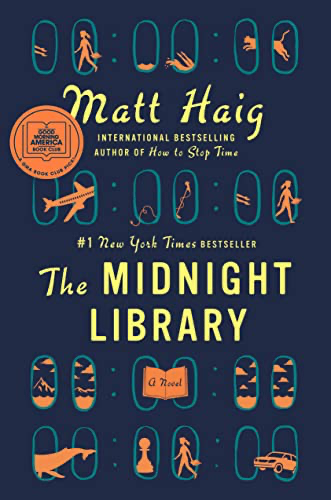
Book Review Tuesday (2/7/23) – The Midnight Library

Happy Tuesday, bibliophiles!

I’ve had this book on my radar for a few years now, but I wanted to read it after the ocean of hype died down. I forgot about it for a while, and I found a copy at my college’s library, and figured that it might be worth a try—I read The Humans, also by Matt Haig, and thought it was decent, so I decided to take a stab. I lowered my expectations to average from all of the hype, but The Midnight Library ended up being even worse than I thought—insultingly un-nuanced and a wholly frustrating read.

Enjoy this week’s review!

The Midnight Library – Matt Haig

Nora Seed has reached what seems to be a dead end in her life. All of her childhood dreams never came to fruition, and now she’s stuck in her thirties with nowhere to go. But after she attempts to take her own life, Nora finds herself in the Midnight Library, where every book on the endless shelves contains an alternate life—lives where she pursued different dreams, different boyfriends, and every other imaginable outcome. As she travels through a multitude of alternate realities, Nora must come to terms with herself and how she wants to live her life—full of regrets, or full of hope?

TW/CW: suicide/suicidal ideations, animal attack, loss of a loved one, depression, panic attacks, animal death, substance abuse, cancer

A recurring thought that came to me while reading The Midnight Library was that it was like if you sucked every ounce of nuance and complexity out of Everything, Everywhere, All At Once. I know full well that Everything came out two years after this novel, but my point still stands. In the abstract, the message of The Midnight Library was good, but it had all the subtlety of a sledgehammer to the face, which made for an exceedingly unpleasant reading experience.

The Midnight Library is a case study in the effect of good or bad execution of a story idea. If you have a good idea but don’t execute it well, the idea itself gets bogged down in all of the structural flaws of the writing itself. The message that Matt Haig tried to get across was a good one—focusing on living your life, not getting bogged down with regrets, and giving yourself a chance to change—but it was so ham-handed in its delivery that all of the nuance (of which there was SO much potential) was erased entirely. It was so clear that The Midnight Library was trying to say something, but without any complexity, it ended up spitting out nothing that we haven’t heard before.

For instance, in one life, Nora Seed is a world-famous rockstar selling out arena shows all around the world. However, as Nora progresses through this alternate timeline, she realizes that this alternate self is feeling empty inside, and that fame has left her a barren shell of what she once was. That’s all well and good, and it’s a good message that fame does not automatically equal happiness. But at the end of the chapter, this message was digestibly packaged into a short platitude, right above Nora’s hypothetical follower count on social media. It was almost insulting how it was delivered—what was the point of that when Haig showed it through his writing just a page before? Even if you’re not a writer, if you’re ever taught about writing in school, “show, don’t tell” is one of the first principles that you’re taught. As a reader, it feels insulting to one’s intelligence: I got the message just fine, why be that redundant and blatantly obvious?

Furthermore, a lot of the potential lives, even though they were neatly and obviously packaged to the reader to teach them a lesson, ended up contributing nothing to the plot. When they did contribute, the message was reiterated by the all-knowing librarian, as if I’m watching a children’s show, each episode ending with an “and what did we learn today, kids?” kind of message. The Midnight Library isn’t all that long of a book, but a good quarter of the misadventures through Nora’s alternate lives didn’t serve any purpose, even though that was the obvious intent.

Lastly—Matt Haig isn’t at fault for this first part, but dear lord, do not let the synopsis fool you. This is not a feel-good book. The inciting incident for The Midnight Library is Nora attempting suicide, and that got glossed over so much in the marketing of the book. For the first part of the book, I feel like Nora’s mental health issues, although they aren’t explicitly named, were dealt with respectfully, but once it got to the end of the book, it took a turn for the worse. As if by magic, Nora’s depression is cured, and she now has the will to live again, after glimpsing all of her alternate lives. It really felt harmful—yes, this is a sci-fi/fantasy book, but depression and other mental health issues don’t magically disappear after a romp through alternate realities. Downplaying something as serious as depression and suicide really didn’t sit right with me, and it felt like the ending of the book erased something that should have been acknowledged far more in this book.

All in all, a disappointing book that decided to take its well-intentioned message and knock you over the head with it, thereby erasing all attempts at nuance and complexity. 2 stars.

The Midnight Library is a standalone, but Matt Haig is also the author of The Humans, How to Stop Time, The Radleys, and several other books.

Today’s song:

I like this one even more than Panopticom—I can’t wait to see what else this album brings!!

That’s it for this week’s Book Review Tuesday! Have a wonderful rest of your day, and take care of yourselves!
Posted in Sunday Songs

Sunday Songs: 1/15/23

Happy Sunday, everyone! I hope you all had a wonderful week.

Winter break is over for me, but I’m assuming that the first week back to college will be low-key (ish? probably lots of syllabuses…syllabi?), so I should be able to keep up the schedule for a little while. In the meantime, here’s another mishmash of my music. Still sort of in the maroon/burgundy colored aesthetic for the second week running, I guess. Whoops.

Enjoy this week’s Sunday Songs!

SUNDAY SONGS: 1/15/23

“Angel” – Gavin Friday

I’d consider this song to be one of many mainstays of my childhood; if I think of being in my dad’s car at night, watching the moon pass by my window and wondering why it seemed to follow me, or even just pulling up to the bank parking lot, chances are, I’ll find this song lurking there. Even if it hadn’t been there for most of my life, “Angel” would be a memorable song either way. I’ve only heard a handful of Gavin Friday’s songs (and half of the ones I can think of are covers), but I can safely say that he has one of the most unique singing voices that I’ve ever heard; he can switch from a breathy, ethereal hum to a thick wail in a matter of seconds, and it dips down to a raspy whisper in the quiet moments in between. (“Shag Tobacco” comes to mind for the latter.) The musical range in just 6 minutes perfectly matches his mercurial voice, from the twinkling, starlike notes at the beginning to the humming synth undercurrent. It’s a musical patchwork quilt, but one so seamless that you couldn’t see the stitches in between each scrap of fabric. Beautiful.

“She’s My Collar (feat. Kali Uchis)” – Gorillaz

I tried. I tried not to double up on Gorillaz after “Left Hand Suzuki Method” last week. They’re just so good………guys……………..guys….

From what I know of the general opinions around Gorillaz, the fandom seems to direct a fair amount of ire towards this album, Humanz; most of the criticism seems to have come from the excess of collaboration that the band is now known for. My question is how that wasn’t applied to the hit-or-miss Song Machine Season 1, an album that heavily relied on…the exact same thing? Okay?? And yet, every single song I’ve heard off of Humanz has had me in a vice grip at some point or another—I haven’t listened to the whole album yet (soon, I swear), but songs like “Momentz (feat. De La Soul)” and “Charger (feat. Grace Jones)” feel like Gorillaz embracing the infectious, instantly danceable fun that makes their music almost never fail. “She’s My Collar” is another prime example—pushed along by a driving drumbeat that makes it impossible not to nod your head, Damon Albarn’s breathy vocals make for a song with the power to instantly cheer you up. My only minor nitpick is Kali Uchis; I don’t know a whole about her, granted, but her verse did feel slightly weak and almost off-key in places. Luckily, when her voice fades into the synths with a ghostlike quality, making itself as much an instrument as anything else in the background, it brings the song back to its cohesive, catchy glory. It’s been…three days now, I think, and I’ve barely been able to listen to anything else.

“Buses Splash With Rain” – Frankie Cosmos

It’s the classic sadgirl setup: “I’m the kind of girl/Buses splash with rain.” But like the Zentropy album cover, with its crusty white dog wearing a knitted hat and “Frankie Cosmos” written in bright, neon colors, Greta Kline juxtaposes her self-deprecating lyricism with her characteristic musical whimsy and brightness. Frankie Cosmos songs can be deceptive that way; although I haven’t listened to Zentropy in full, their songs often pair melancholy with the kind of instrumentation that brings to mind cartoon doodles of frogs and suns drawn on the corner of the page with little squiggly lines for the rays. Although this is only their first album, it’s easy to see from “Buses Splash With Rain” that Greta Kline and company had already begun to master what has become their signature style—short, bright indie pop songs that seem to radiate pastel colors amidst lyrical boredom or melancholy. The only downside to their music is that, because they’re so short, they sometimes blend together, but this one is certainly memorable enough to stand out from the barely two minute long crowd.

“Panopticom (Bright Side Mix)” – Peter Gabriel

Peter Gabriel’s releasing a song from his new album every full moon this year? Are us Peter Gabriel fans just werewolves now? Not that I’m complaining. Lycanthropy sounds fun. Maybe.

The news broke recently that Peter Gabriel would be releasing his first album in over 20 years this year, and what else should I have expected than for him to come straight out of the gates, bouzouki in hand, with relentless creativity at the ready? It’s been a week since “Panopticom” came out, and it’s taken a little while to grow on me—to be fair, with how much of a chokehold songs like “Come Talk to Me” and “Not One Of Us” have had on me, he’s inevitably got big shoes to fill. But once it sunk in, Gabriel’s musical powers became all the more evident. The concept itself stands out as an antithesis to the concept of the panopticon, rather a means of us observing the theoretical Big Brother figure instead of the other way around. Surrounding it is an unexpected collage of music, beginning with lighter synths and descending into driving guitars that recall his earlier works. It’s songs like these that make me want to be somebody like Peter Gabriel once I’ve reached his age, continuing to be creative when I’m much, much older. You go, dude. We’re all waiting until the next full moon very anxiously…

“I Can’t Stand the Rain” – Ann Peebles

Two songs with ‘rain’ in the title? In one week? It’s more likely than you think.

After realizing last week that this is the sample from Missy Elliott’s “The Rain (Supa Dupa Fly),” I have NOT been able to stop listening to it. Once the famous sampled section at the beginning starts to fade is where it kicks in—right at 0:18, with its chorus of steady drums and slowly rising brass. It’s an instant head-nodder that makes it impossible to move at least some of your body while you’re listening the second that the band invites itself in. Peebles’ crooning voice soars all the way through, selling every feathery waver as she calls to mind the pitter-patter of rain against a windowpane as she remembers an ex-lover. The only song that this song commits is being so short, but maybe that’s how it’s meant to be—a perfect, short-and-sweet classic. Without knowing much else about Ann Peebles, it’s easy to see how this became her biggest hit—it’s consistently catchy and pleasing to the ears in every way. Given how short it is, I won’t be surprised if this comes up in my apple replay once it starts up…this and “She’s My Collar” are gonna be WAY up there, I can’t stop listening to either of them…

Since this post consists of all songs, consider all of them to be today’s song.

That’s it for this week’s Sunday Songs! Have a wonderful rest of your day, and take care of yourselves!