Posted in Sunday Songs

Sunday Songs: 6/15/25

Happy Sunday, bibliophiles, and more importantly, Happy Father’s Day!! I always end up writing one of these posts on Father’s Day, what with it landing on a Sunday and all, but it’s fitting, given that my amazing dad is the one who not only is responsible for a lot of my music taste, but was also the one to encourage me to write these posts and wanted to hear my thoughts. So thank you to him, for all of the gifts he’s given to me, and to my family. I love you. 🩵

This week: before I go radio silent for a week for a road trip, how about a random kick in the pants from 2019? Plus, new Cate Le Bon, old(ish) Shins, and others.

Enjoy this week’s songs!
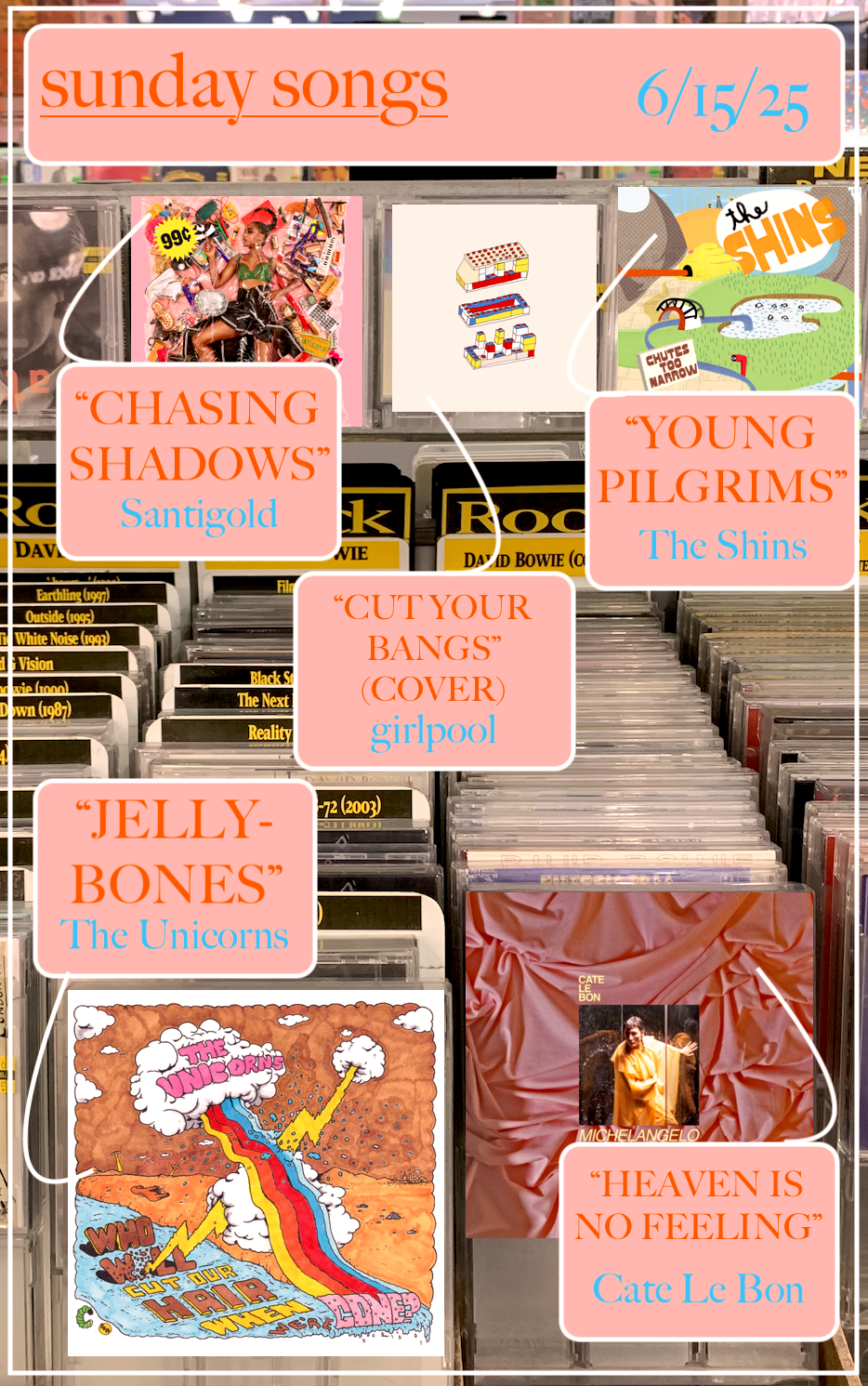
SUNDAY SONGS: 6/15/25

“Jellybones” – The Unicorns

Chances are, given my proclivities for Car Seat Headrest and other like lo-fi, awkward white boys, I probably would’ve stumbled upon The Unicorns eventually. It was an inevitability. Either way, I was introduced to it via Black Country, New Road’s episode of What’s In My Bag?, and I can’t call it much else other than a delight in the many times that I’ve listened to it since. “Jellybones” is a whimsical title as it is, but the rest of the song stays true to that silliness, complete with bone-related puns (“Drove up in my bone-ca-marrow,” ba-dum tsss); the entire song revolves around jellybones (an obscure sort of expression for nervousness) being a genuine malady worthy of going to the hospital and getting limbs amputated for. Everything has a juddering, garagey sound to it, from the engine-like startup to the guitars to the keyboards, which the intro warps into the sounds I feel like I’d hear aboard a clunky, malfunctioning spaceship on the cover of a ’50’s pulp magazine. 2:43 feels simultaneously too short and the perfect length for “Jellybones”—I need more, and yet this song could only ever be a sputtering little firecracker, spurting out sparks and then gently slipping out of existence.

…AND A BOOK TO GO WITH IT:
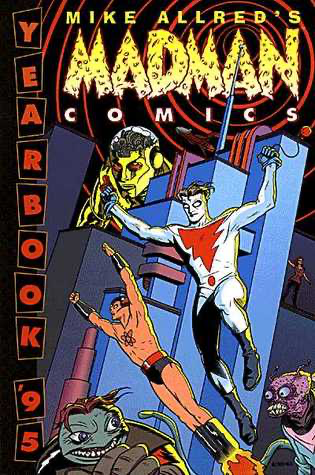
Madman Comics Yearbook ’95 – Mike AllredJellybones definitely seems like it could be a genuine illness in the Madman universe. (Least wacky Dr. Boiffard subplot, maybe?) Either way, the lyrics definitely fit with the kind of silliness in these comics.

“Heaven Is No Feeling” – Cate Le Bon

Getting the one-two punch (positive) of new Big Thief (to be discussed) and Cate Le Bon on the same day was almost too much…and just when I thought that we were finished with all of my most anticipated albums of the year! Cate Le Bon’s new album, Michelangelo Dying, comes out this September, and suffice to say, if it’s anything like this song, I’m all ears.

Taking cues from the synth-heavy sound of Pompeii, “Heaven Is No Feeling” opens with an intro too good for a track that’s right in the middle of the album: a murmur of “What does she want?” before launching into a flurry of rippling, watery synths and guitars slathered in enough effects to make them camouflage with the synths. In line with her very ’80s sound, there’s plenty of saxophone, but not enough that it overpowers any of the rest of the song. Gently groovy and keenly observational, Le Bon takes the position of a wallflower: there is a kind of emotional distance to it as she watches the subjects as they move like pawns across a chessboard: “I see you watch yourself/Walk the room/Stroking the air/Like this paint won’t dry.” As she observes the distant fallout of a failed love, the song feels like she’s watching someone through security camera footage, pretending to be distanced when she hasn’t fully gotten over the wreckage—much like the music video, where a buzzcutted Le Bon watches herself on an old TV. Every repetition of “I see you watch me” feels like a degree of separation from the body and from her feelings (surely that’ll end well…), and “heaven is no feeling” becomes a kind of blissful removal from one’s own emotions.

…AND A BOOK TO GO WITH IT:
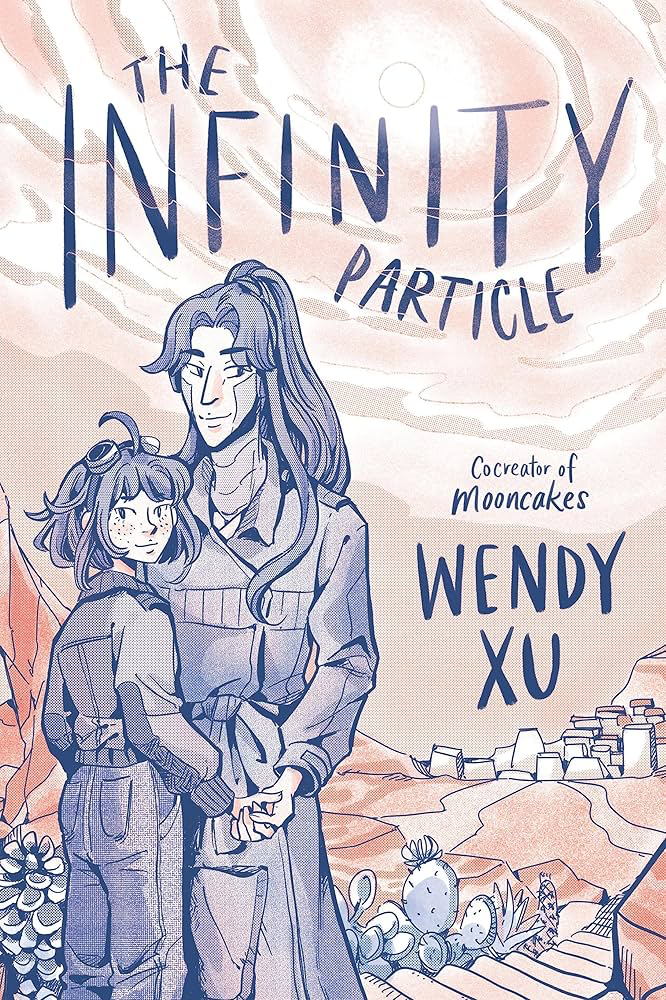
The Infinity Particle – Wendy Xu“I see you watch me watch you/Watch me move away/You occupy the space/Like a ribbon untied…”

“Chasing Shadows” – Santigold

Santigold, man. Nobody’s doing it like her. I often think of 99 Cents as being one of the only happy albums of 2016, but next to Blackstar, A Moon-Shaped Pool, and Teens of Denial, anything looks happy. But what makes me keep coming back to songs from 99 Cents is how she used the veneer of happy, bubblegum pop songs to further her message—they remain peppy pop songs, but they’re all armed with critiques about consumerism and the music industry. Santigold has often talked about her negative experiences in the music industry, whether it’s how unaccommodating the industry is to mothers, especially where touring is concerned, or how her music did not qualify to some critics as “Black music.” Despite how candid she’s been about the physical and mental toll it’s taken on her, Santigold has only used that to become even more herself than ever. Her last album, Spirituals, went fully into Afrofuturism and current politics, and she’s expanded her creativity into a podcast, Noble Champions, where she brings guests to talk about everything from said nebulous category of “Black music” to social media addiction. (From the episodes I’ve intermittently listened to, she’s also had a whole host of amazing guests, including Yasiin Bey, Questlove, Tunde Adebimpe, Mary Annaïse Heglar, and so many more. The only problem is that there’s not more Santigold, frankly.) I saw her perform live last August, and it’s one of the only concerts I can think of where a singer has been truly kind and candid with her audience; decades in the industry didn’t stop her from signing people’s records in between songs.

Like the album cover, where Santigold is shrink-wrapped and slapped with a price tag along with all manner of plastic junk, “Chasing Shadows” reckons with the human toll of commodifying artists. Contrary to Pitchfork’s assessment that the song “basically plods along inoffensively until it ends” (I’m sorry, the fuck?), it’s one of the more steadfast songs on the album, still fast-paced but providing a cooldown between some of the more in-your-face pop songs. Rostam Batmanglij (formerly of Vampire Weekend) produced the track, and knowing that, I can hear him all over the beat—I say this affectionately, but it’s the most 2016 pairing ever. I love it. Through rapidly-uttered lyrics, Santigold reflects on how quickly the industry moves on so quickly from artists once they’re out of fashion, summarized by one of the finals the second verse: “Why they eating they idols up now/Why they eating they idols up, dammit?” Reflecting on seemingly being left behind, her solution, as always, is to defy the standard, continuing to do what she’s doing. The video mirrors this back: she asserts herself in multiple places inside various houses: at the head of a table at a decadent Christmas feast, standing upright and fully clothed in a bathtub, and towering over a child-sized table with a child-sized tea set. No matter the location, she stands firm, defiantly staring the camera, returning the gaze—of the music industry who tried to put her in a box, to racist and misogynist detractors, or to anyone who has ever doubted her. No matter what, she’s looking directly at you, as though to cement her irreplaceable space of individuality that she’s created for herself.

…AND A BOOK TO GO WITH IT:

Victories Greater Than Death – Charlie Jane Anders“One thing about time, it waits for nobody, you told me, isn’t that what they say/Been batting ‘gainst it and getting nowhere, just racin’ got nothing to say to nobody…”

“Cut Your Bangs” (Radiator Hospital cover) – girlpool

What in the 2019 did my shuffle just pull? I hadn’t even thought of this song in years, and boom, suddenly I’m back in high school art class, diligently obeying the “only one earbud in if you want to listen to music” rule while drawing X-Men fanart because I blew through whatever I was actually assigned. God.

High school…and my first introduction to girlpool through Apple Music. Sure, I’m fully on board with the fact that streaming has harmed musicians more than it has helped them, but for a lot of people, myself included, it opened the floodgates for discovering so many musicians back when I was in high school. girlpool was one of the big ones, prominently soundtracking my sophomore year of high school, from their earlier work on Before the World Was Big (which turns 10 this year, Jesus) to their more current (at the time) What Chaos is Imaginary. Almost six years after I discovered them, girlpool since released one final (disappointing) album, Forgiveness, broken up shortly after, and then…Avery Tucker’s come back with a good solo single, but Harmony Tividad seems to have pulled a Gwen Stefani and now makes pop songs with the most chronically online lyrics you’ve ever heard. How the times have changed. But good for her, I guess? You do you…

Even though girlpool had moved past this inception of their music by the time I got into them, they fit too perfectly into the sad, acoustic indie that comprised most of my music taste, and still kinda does today. “Cut Your Bangs” is a cover, but to this day, it remains one of the best parts of this inception of girlpool. In contrast to the faster, more rock sound of the original by Radiator Hospital, girlpool take the chorus’ ending of “the small stuff” literally, slowing it to a crawl in order to wring the most out of the quietly introspective lyrics. I remember not liking the original when I first heard it, and on reflection, I don’t hate it, but I still think it’s a situation where girlpool knew exactly what to do with it. All of the lyrics need a gentler space to breathe, and the twin harmonies of Tividad and Tucker make them stand out. To this day, the way their voices know exactly which lyrics need a plaintive murmur and which ones need a higher-pitched belt feels almost telepathic—at their best, what made girlpool so successful is that they had such an instantaneous communication that allowed them to switch from gentle to jagged in the blink of an eye, but never once lose their synchronicity.

…AND A BOOK TO GO WITH IT:
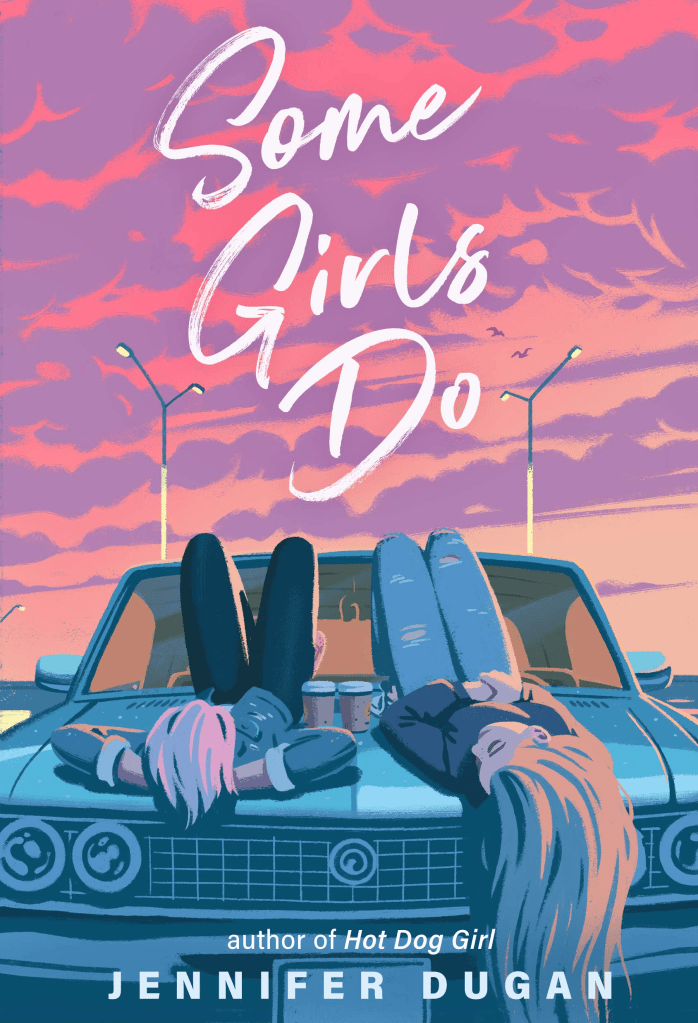
Some Girls Do – Jennifer Dugan“You say you’ll cut your bangs, I’m calling your bluff/When you lie to me, it’s in the small stuff…”

“Young Pilgrims” – The Shins

James Mercer just has such a unique way with words. As music history (and my personal music library) proves, there’s practically a million ways to say a sentiment along the lines of “I’m dissatisfied with my life and it’s cold and wet outside and I’m also depressed.” Mercer saw that and gave us these iconic lines:

“A cold and wet November dawn/And there are no barking sparrows/Just emptiness to dwell upon/I fell into a winter slide/And ended up the kind of kid who goes down chutes too narrow…” HE SAID THE LINE! GUYS, HE SAID THE LINE! CHUTES TOO NARROW!

Said barking sparrows came back to me completely at random, in the way that especially sharp lyrics or melodies do. Although Mercer’s narrator envies the “eloquent young pilgrims” passing by him, I struggle to find words other than eloquent to describe how he articulates such a near-universal feeling, a mess of regret and stagnation and the emptiness that comes with control slipping through your fingers and wanting to regain it. In a simple duet of acoustic and electric guitars, Mercer wrings some absolute poetry out of such a stagnant state, drawing every possible image from ice melting on a train window and the desire to “grab the yoke from the pilot and just/fly the whole mess into the sea.” I love a good literary-minded songwriter, which I guess it’s no surprise that I latched onto The Shins from such a young age. But with age, I appreciate the lyrics even more—James Mercer is one of those songwriters who prove that, at its best, music is eloquent poetry set to music. It doesn’t need to be (and rarely is), but when it hits that spot, I can’t help but relish it.

…AND A BOOK TO GO WITH IT:
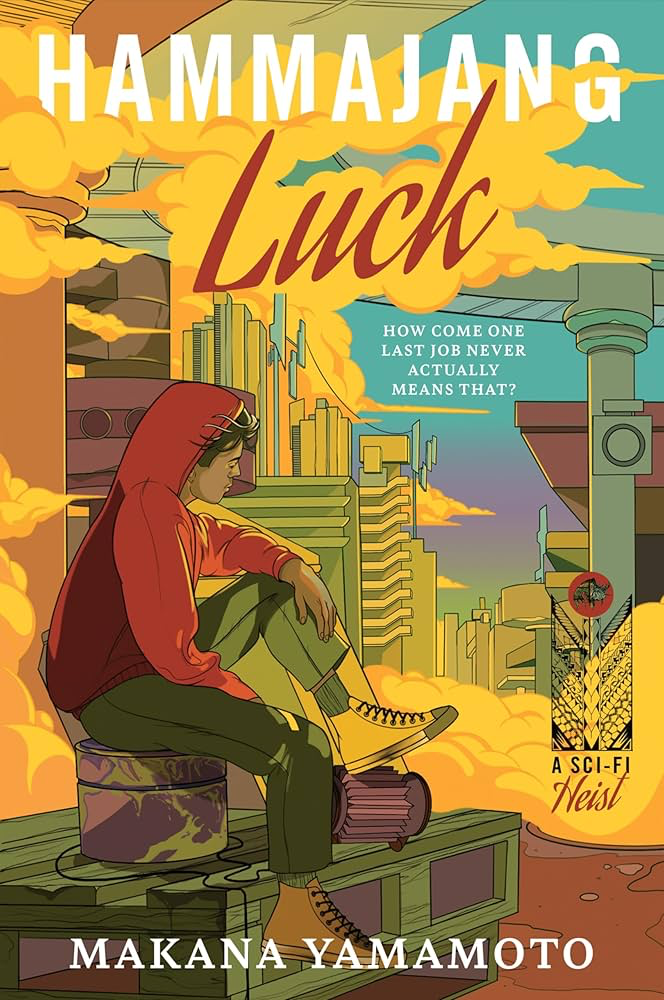
Hammajang Luck – Makana Yamamoto“But I learned fast how to keep my head up, ’cause I/Know there is this side of me that/Wants to grab the yoke from the pilot, and just/Fly the whole mess into the sea…”

Since this post consists entirely of songs, consider all of them to be today’s song.

That’s it for this week’s Sunday Songs! Have a wonderful rest of your day, and take care of yourselves!

Posted in Sunday Songs

Sunday Songs: 3/3/24

Happy Sunday, bibliophiles! I hope this week has treated you well.

This week: spring green for March, old dogs, and the consequences of the fact that at least 90% of my friends are gay and their music tastes rub off on me.

Enjoy this week’s songs!

SUNDAY SONGS: 3/3/24

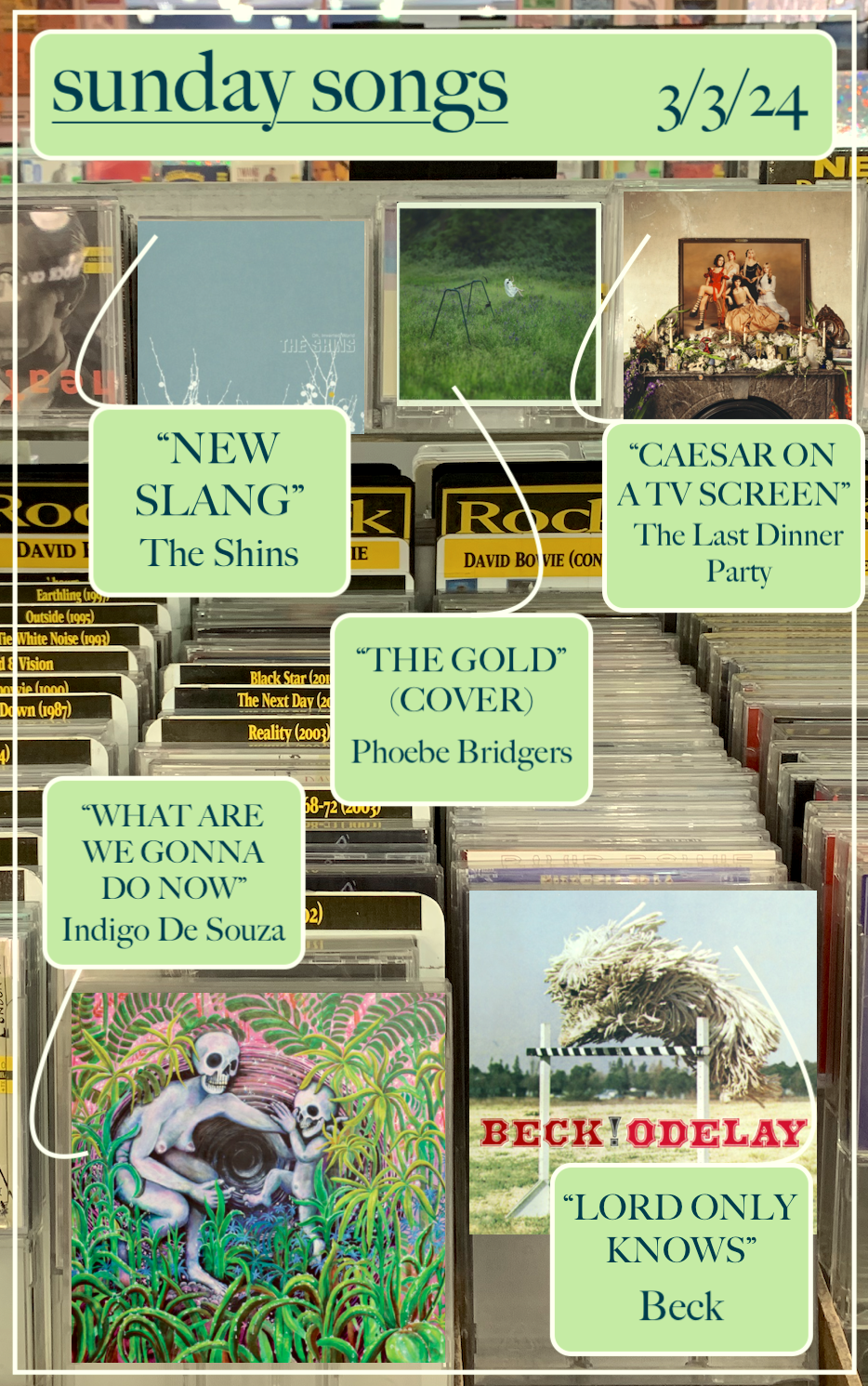
“What Are We Gonna Do Now” – Indigo De Souza

This just in: the sad girl kool-aid has never left my system, and it likely never will. Buckle up.

“What Are We Gonna Do Now” lives squarely in the liminal space of uncertainty, as the title implies. It feels like the tense opening to a film; I could just be stuck on this imagery of the line “and we’re still on call with the nurses,” but I can’t help but imagine an opening shot panning out from the slow spikes of a heart monitor, slowly letting out beeps as Indigo De Souza’s voice gently drips like an IV with that lingering, trailing question: “what are we gonna do now?” Almost everything is gradual about this song, as if the verses were frozen in time: a picture of a person standing on the street while snowflakes suspended in midair decorate the space around them. De Souza’s voice dips and dives into nooks and crannies that only a cat could fit into, army-crawling through the shadows as she describes the wear and tear of a relationship in the middle of turmoil—not necessarily on the verge of a fracture, but in the middle of the storm that they aim to push through together. Exhaustion and frustration tinges it (De Souza’s delivery of “and I’m never cooking up what you’re craving” remains one of my favorite parts of the whole song), but it’s never the kind so intense that would throw their love out the window—it’s the determination of trying to find out exactly how to fix things, and scrabbling around, searching for answers in desperation. Like the ebb and flow of love, the instrumentals swerve from a near standstill to a rousing, guitar-driven chorus and back to quiet again, but after the first verse, nothing is the same; it has the same kind of barely-contained chaos of songs like Wilco’s “Via Chicago” and Mitski’s “The Deal,” with a sense that the anxiety of making amends and grasping for solutions. As De Souza’s airy voice rises like she’s gasping for air after emerging from the ocean, trembling drums and tambourines slip in and out of time, ever so slightly off-kilter and teetering, like one sneeze would send them all into disarray. Unlike the former two songs, though, it never fully gives in, but the unraveling is always at the back of the song’s mind, like an overflow of fearful thoughts as they try to pick up the pieces, but a sense of deep-breathing control as De Souza picks themselves back up.

…AND A BOOK TO GO WITH IT:

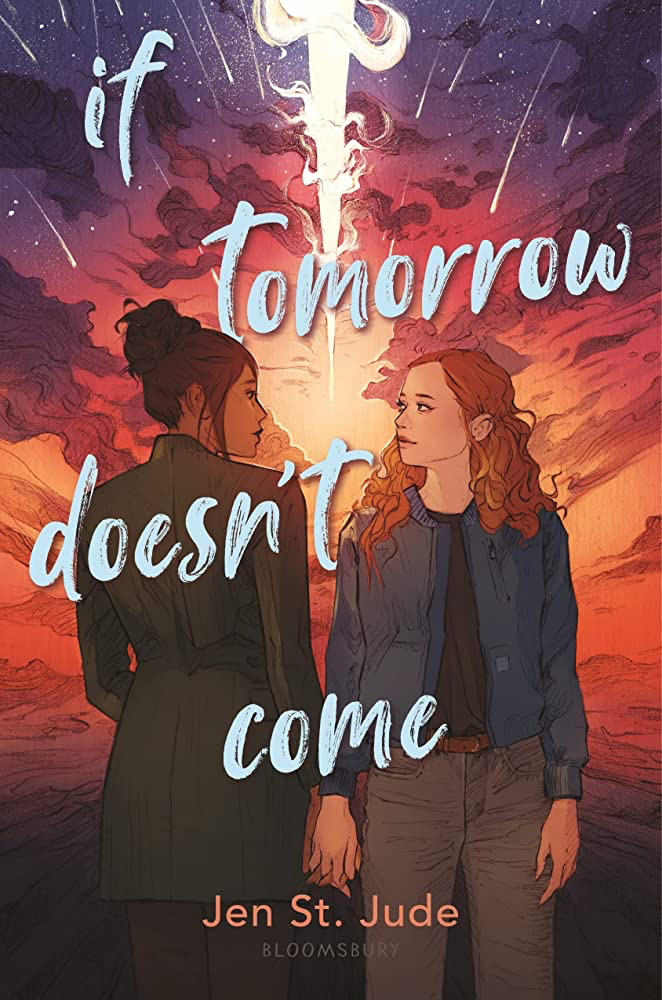
If Tomorrow Doesn’t Come – Jen St. Judeone of the few apocalypse novels that really makes it a mission to focus on the human aspect.

“Lord Only Knows” – Beck

Full disclosure: I definitely ruined this album for myself. I knew it was going to be a good album, and it 100% is, but I’d already listened to about 3/4 of it, so there were no surprises left. All of the songs I remembered were already favorites, and the ones I hadn’t yet discovered weren’t as instantly classic as the others (sorry, “Derelict”). But that’s on me. Maybe on my parents for playing it so much in the car over the years, but mostly on me. Whoops.

That’s not to say that Odelay is a bad album at all—in fact, it’s quite the opposite. It makes me miss the old Beck, the one who didn’t scrub everything to an unnecessary polish, but instead made his music like a sculpture made from bits and bobs found in the junkyard—a bit of a tire here, an old, rusty car hood there, some nuts and bolts sprinkled on top for a finishing touch. It’s a collage, but not necessarily in the way that artists like De La Soul or The Beastie Boys make their collages: while their infinitely clever concoctions feel like they oil every sample into a unified organism of unlikely pieces, Beck’s method (for a while, at least) was to make every spare and found part stick out like sore thumbs, but so much so that all those sore thumbs eventually made a hand so absurd that it makes you think how does that even function as a hand? And yet it’s the perfect hand. There’s no other way that “Hotwax” would work without “I’m the enchanting wizard of rhythm.” In fact, the absurdity of all these samples make this mutant (no pun intended) record so memorable—nobody was doing it quite like Beck. Take this song, which starts out with a rasping scream, then descends into twangy and almost docile acoustic-guitar driven rock. It’s not the heat-waved calm that “Jack-Ass” (my favorite track on the album) exudes, but it’s got that same lazy drawl to it, every word curled at the edges like scraps of paper singed by a campfire. Odelay hadn’t yet reached critical mass of clever silliness that made ’90s-2000’s Beck so fun (that would be Midnite Vultures), but he had plenty of fun to spare—I always find myself laughing at the final lines that Beck sings as the track fades out like a car driving out of view, obscured by the wobbling lines of a heat wave: “Going back to Houston/Do the hot dog dance/Going back to Houston/To get me some pants.” You just can’t deliver the word “pants” with that much emphasis and have it not be funny. Them’s the rules. I apparently have the humor of a five-year-old, but evidently, so does Beck, and we’re all the better for it.

…AND A BOOK TO GO WITH IT:

Fortuna (Nova Vita Protocol, #1) – Kristyn Merbethall of the same lazy, summer-eyed charm, but make it space opera (as things usually are on this blog).

“New Slang” – The Shins

Whenever I go to write about The Shins, I always end up going straight for the purple prose. It’s like the way I get with Radiohead, except they invoke something akin to religious fervor in me. I’m too far gone. But there’s something about James Mercer and his perpetually rotating cast of characters that evokes the lyrical side of my writing. Perhaps it’s that part of me connecting to that part of him, because he’s certainly got songwriting chops for days.

“New Slang” has been lingering in my life for decades; I faintly associate it with a period sometime in elementary or middle school. I think it may have been at the end of a playlist I listened to frequently. The Shins are never all that far from my mind, but this was the perfect song to shuffle out of the blue, soft and smiling like an old dog with white patches threaded into the fur of its snout. And I ran right up to pet that dog—god, I missed this song. Hello, old friend. Mercer has long since mastered the art of the old heartstring-tugging acoustic song, and while its as hipstery as it gets, there’s a calmness to it, a serenity like no other. And yet, for all intents and purposes, it’s James Mercer’s equivalent of a pop-punk “I’m getting out of this town” song; the lyrics were inspired by his experiences separating from Albuquerque, New Mexico, where the first iterations of The Shins had tried to take root. Disillusioned by a scene that he described as “macho, really heavy, and aggressive,” Mercer and company branched outwards, where their lyrical folk could have more meaning. “New Slang” was Mercer’s way of “flipping off the whole city,” as he described it (“Gold teeth and a curse for this town”), but there’s something beautiful in how quietly this song shoots its bitter middle finger. It’s not the jerky angst of separation that pop-punk lends to the subject, but instead the moment of looking back into the sunset, knowing that everything you’ve left behind is in the dust with the approaching night. Perhaps that’s where that serenity I feel comes from—the serenity of knowing that what’s in the past is in the past, and that it has no control over your life anymore. It’s underfoot, only tire tracks in the dirt now. You can’t help but feel a wave of peace at the thought.

…AND A BOOK TO GO WITH IT:

Trouble Girls – Julia Lynn Rubinwhile Lux and Trixie’s reasons for ditching their town are more complicated, there’s no less of a feeling that they’re giving it the finger the whole way out.

“The Gold” (Manchester Orchestra cover) – Phoebe Bridgers

Full disclosure: I hate the original version of this song. Hate it. It stinks of that kind of that faux-earnest, country-leaning pop that forced itself down everyone’s throats in the mid-2010’s like a contagion. If this weren’t obviously a breakup song, I know my music teacher would have made my 5th grade class sing this. I hate to relentlessly dog on a song, but also…Christ. This made me throw up in my mouth a little.

Phoebe Bridgers, on the other hand? A godsend. Leave it to her to make the original lyrics, some of which were actually good sound good, and not like they were being shoved down through the godforsaken Mumford & Sons strainer. I will give Manchester Orchestra (posers, they’re not even from Manchester…) some credit: “you’ve become my ceiling” is genuinely a beautiful lyric. But I just wish it wasn’t being delivered with that smarmy, offensive excuse for authenticity. Again: Phoebe Bridgers is our savior. She grounds this song enough to make the turmoil within it feel real. Never once did this song need belting, stadium-rock grandeur: it needed clarity, a sense of calm amidst the chaos, and a steady hand on an acoustic guitar. It’s got slightly more effects than Bridgers usually allots to a song of this tempo, but it hits the balance of flourish and that acoustic sincerity that she’s come to be known for. It’s a breakup song, but although some of those call for grandiose declarations of sorrow, some of them need time to sit in silence and wallow it in, and that’s exactly the treatment that Bridgers gave “The Gold.” I’ll just go ahead and pretend that she wrote it. Yup. Manchester Orchestra? Who is she?

…AND A BOOK TO GO WITH IT:

Vinyl Moon – Mahogany L. Brownesimilarly, this novel in verse deals with the fallout of a relationship built on mistrust.

“Caesar on a TV Screen” – The Last Dinner Party

Before I listened to the full song, I distinctly remember seeing a snippet of this song advertised somewhere on Instagram and thinking something along the lines of “god, this is pretentious.” And I stand by that. It’s still pretentious. But in context, it’s a good listen.

I’ve heard a decent amount of buzz surrounding The Last Dinner Party, usually falling in one of two camps: that they’re out to save rock and roll and bring it back to its glory days, or that they’re just…okay? The former argument, while I like it in concept, reeks of the kind of mentality that “modern music isn’t good anymore” because it’s not all Pink Floyd, which…okay, cool if you like Pink Floyd, but also…creative rock didn’t die as soon as Y2K hit? You just have to look a little harder now that rock isn’t the reigning influence on popular music anymore. In the modern day, we treat rock music like we often treat women: as something to be saved, when all along, it’s been doing just fine, thank you. I doubt we’ll ever go back to those days, and maybe we shouldn’t—there’s no way you can completely replicate a movement in its full, temporal context, and maybe that’s okay. I’m all for bringing back glam rock, but chances are, anything you try to resurrect is going to feel displaced in our modern day context. You can take inspiration from them, but personally, it’s a hard thing to recreate in all of its flesh and blood.

Which…seems like a good deal of what The Last Dinner Party are going for. Frontwoman Abigail Morris has regularly emphasized how much she and the band enjoy being pretentious (if having their debut album titled Prelude to Ecstasy wasn’t enough of an indication), and if that’s what’s bringing them joy, then all power to them! They’re talented musicians, for sure. Weirdly, the other two songs of theirs that I listened to just sounded like…any old indie pop song, which I kind of hate to say, but if you’re all about “saving rock n roll” and just putting out that, then I feel like you have to keep your mission consistent. But you certainly get that feel from “Caesar on a TV Screen.” As far as the structure goes, it feels slightly disjointed, but the more I watch the music video, I get what they’re going for—a song with a distinct, three-act structure, emulating the epic, Shakespearean twists and turns that inspired it. There’s loads of drama to spare, from the rush of strings in the third act to Morris’ impassioned howl of “everyone will like me!” at the song’s exiting flourish, like she’s brandishing a prop sword with every word. It’s dripping with that kind of theatrical, ’70s and ’80s drama—there’s Queen written all over it, and I can’t help but think that some of that drama was informed by Kate Bush. And…yeah, Freddie Mercury, Kate Bush, and David Bowie, the latter of whom the band have repeatedly cited as one of their primary influences, are probably some of the most colossal shoes to fill in terms of musical artistry. But there’s no doubt that The Last Dinner Party are a skilled bunch in their own right—and god, they look like they’re having the time of their lives. It’s exactly the kind of excess, maximalism, and drama that their band name implies.

…AND A BOOK TO GO WITH IT:

Strike the Zither (Kingdom of Three, #1) – Joan He“When I was a child, I never felt like a child/I felt like an emperor with a city to burn” HMMM…

Since this post consists entirely of songs, consider all of them to be today’s song.

That’s it for this week’s songs! Have a wonderful rest of your day, and take care of yourselves!
Posted in Sunday Songs

Sunday Songs: 11/19/23

Happy Sunday, bibliophiles! I hope this week has treated you well.

This week: another song I stole from Wilco, and a smattering of calm, autumnal folk. And then there’s IDLES.

Enjoy this week’s songs!

SUNDAY SONGS: 11/19/23

“You Got the Stuff” – Bill Withers

Even though he isn’t here to read this (rest in peace), and I doubt he would even if he was, I owe an apology to Bill Withers. When I asked Siri about the insanely funky song that Wilco was playing before their show back in October, I thought…Bill Withers? Like…the “Lean On Me” Bill Withers? The song we all had to sing in either elementary school or at camp? From here on out, I take back any preconceived notions I’ve had about the man, because this song slaps. I severely underestimated him.

To be fair, from the looks of it, “You Got the Stuff” seems funkier than most of his R&B/Soul-leaning catalogue, but when he did funk, he made it the funkiest funk possible. The minute the drum machine fades and the thick, bass-like synths kick in, it’s like I’ve been possessed to move my body for exactly seven minutes and 16 seconds. I haven’t heard of a contagious groove like this song has in ages, something so instantly captivating that hooks you and immediately tosses you on the dance floor. And it’s seven minutes of this. And the last three and a half minutes of that seven minutes is just bass and an absolutely glorious flexatone. (Many embarrassing google searches went into finding the source of that comically cartoonish “doi-oi-oi-oing” noise. I’m not proud of what I did.) It really is a cartoonish sound that this instrument makes, and yet it fits right in with the thumping bass and Bill Withers’ faint, rhythmic breathing and the occasional “ooh, baby.” Three and a half minutes of just that. It feels like a buildup to something bigger, but it doesn’t need to build up to anything—the unique rush of that stretch of the song keeps the funk alive for longer than I thought it could. And it’s crazy to think that this was chosen as a single for this album (‘Bout Love)—even for someone like Withers, putting the one song that goes over seven minutes long as one of the lead singles is a bold move. It did only get to #85 on the Billboard charts at the time, but it’s a hit in our hearts.

What I’m trying to say is that Bill Withers is forgiven for the setlist of my 3rd grade program. Good god, I love this song.

“Dancer” – IDLES & LCD Soundsystem

As much as I, in theory, dress a fair bit punk (on the days where I have my pin jacket) and generally like the leanings of the political attitude, I’ve never been able to get fully behind it—the combination of the abrasion (both musical and lyrical) and the contrarian, infighting parts of it have made it so I’ve never felt fully aligned with it. I’m only punk up to my jacket, my boots (they’re not very good for extended walking, so I wear them sparingly…there’s only so long I can commit to the bit), and my socialist tendencies. More in spirit than anything else. Same reason that even though I regularly have at least one day a week where I dress in all black and go all out on the eyeliner, I can’t fully commit to being goth, because I’ll then go up to my friends and say “HIIIIIIIIIIIIII :)” in the most decidedly un-goth way. And plus, contradicting everything about yourself sounds kinda tiring, unless you’re Hobie Brown and you make it look cool (and that’s because he was this cool the whole time). And yet, every single IDLES song makes me absolutely foam at the mouth. I love them. I’ve been putting off actually listening to a full album of theirs for who knows why, but their spin on punk—still plenty aggressive, but resoundingly hopeful and positive in their ethos (see “Mr. Motivator”). Joe Talbot himself has repeatedly insisted that they aren’t a punk band, so…okay, I’m not all that punk. But that combination of all the fiery energy of punk with their riotous joy and their wholehearted embrace of vulnerability and love is what endears me to them so much. The absolutely delicious Britishness and bisexuality of it all certainly helps too.

Hearing that “Dancer” was a collaboration with LCD Soundsystem kind of floored me—where could the epitome of tight, high-strung white boy music fit in with this? The mesh, however, is as smooth as it could ever be. There’s a constrained tightness about the opening riff that feels all at once caged in and expansive—the James Murphy touch reveals itself more and more on each listen, aside from the obvious backing vocals on the chorus. Either way, “Dancer” has just about everything I love in an IDLES song. Joe Talbot’s signature aggressively theatrical line deliveries never fail to put a smile on my face—every repetition of “and the sweat” (I can almost hear him raising his eyebrows every time he says sweat) and “so to speak” (imagine that as spitty and Britishly as you will) make listening to the whole song feel like an elaborate performance, a…dance, if you will. There’s an undeniably sensual feel of it all, a visceral pulse to the calculated choreography of each line. It’s a song I’ve never been able to skip since I downloaded, and even though I’ve still yet to listen to any of their full albums (SOON, though), I’ve got hope that Tangk will be more of the same.

New IDLES and The Smile next January…man, I’m gonna implode. It’s been fun, everybody.

“Black Wave” – The Shins

…this is certainly an interesting transition. Whoops.

Certain bands are often seasonal for me—some bands are more spring, summer, fall, or winter than others. (Hence my seasonal playlists). But some bands immediately evoke a more specific point in time. For me, The Shins were always a late fall, early winter band; they feel like fall, but only after the first frost has crept in and stripped the trees bare. There a few leaves left, but they’re all brown and brittle, crumpled underfoot. It’s snowing, but not a January blizzard—maybe just sleet that doesn’t accumulate, if you’re lucky. You’re warm, sitting by the fire. The trees look skeletal now.

So I’m glad I rediscovered “Black Wave” when I did—it’s one of those songs that lingered in my periphery for years (I grew up in a very pro-Shins household), but I’d gotten so complacent in hearing it everywhere that I didn’t even think to ask about its name. But it’s the perfect November song—as most of what I’ve heard from the spectacularly titled Wincing the Night Away is. James Mercer layered effects over his gentle, wordless warble as the song begins, making a rippling, Bon Iver-like echo. Even with a colored named in the title, “Black Wave” is decidedly painted in deep, warm colors; shades of brown and maroon, accented by orange and gray. The opening image of “this goose is cooked” cements the feeling of being huddled around a fire; I imagine the goose being cooked on a spit, the skin crackling as the embers lick it. Mercer’s voice drifts and out of focus, as though on a chilly wind. And like the wind, the song doesn’t so much end as disappear, like the image of a cryptid shifting through blurry footage to fade into the winter woods beyond.

“More Than This” – Peter Gabriel

Since I first listened to Up back in March (oh, the album art is just some water droplets on a gray backgr—oH MY GOD PETER WHY ARE YOU LOOKING AT ME LIKE THAT), it’s been an album that I always fall back on. “Growing Up” was already a faint childhood memory and “Darkness” immediately stole my heart, but the more I listened, the more songs I’ve stuffed in my back pocket—the grossly timely, sleazy groove of “The Barry Williams Show” and the chest-rattling resonance of “Signal to Noise” that makes my soul leave my body every time I hear it. (Real chill stuff for walking to class, amirite?)

There’s something to be said for my hypocrisy of creating dozens of oddly specific playlists and then just listening to my whole library on shuffle, but shuffle always revives songs like this. (Although this one did go on my oddly specific clone playlist next to Roxy Music.) So much of Up has this graying, industrial feel to it, but Peter Gabriel, the genius that he is and continues to be, uses that gravelly darkness (no pun intended) not necessarily to be edgy, but to convey that feeling of hopelessness—the consumption of fear in “Darkness” and the betrayal and desperation of “Signal to Noise.” “More Than This” opens with imagery of “I woke up and the world outside was dark/All so quiet before the dawn/Opened up the door and walked outside/The ground was cold.” I can’t help but think of the quiet bridge of “Darkness,” where the fear wanes and he walks into the woods to find his fear “curled up on the floor/just like a baby boy.” That industrial atmosphere—furthered by distorted, grainy samples of guitars that he and Daniel Lanois messed with in production for the album—immediately sends a hood of coldness over you, the roughness of concrete and frozen ground. And yet, amidst said cold ground and sinking ships, this is where Gabriel finds connection—in the absence made by everything hopeless about this world, there is still a beating heart pulsing beneath our feet, and it’s not the Telltale Heart kind. It’s the connection in knowing that you are surrounded by a community, and surrounded by the love that it breeds. Amidst it all, there’s more than this. It feels like the answer to Roxy Music’s “More Than This”—that song pondered what could exist outside of the all-consuming sorrow, and Peter Gabriel blows aside the curtain of fog to show the many arms reaching out to you, offering their guidance and warmth. It also feels like the prequel to “i/o”—”More Than This” song is the realization of connectivity, and “i/o” fully embraces it, going from a community of people to the connectivity to the Earth and all of its creatures.

“More Than This” was a wonderful surprise to re-stumble upon—the music recaptured me at first, but with every listen, it feels more like an anthem. Not only are you not alone, you have never been alone, and if you can only look beyond yourself, you can find joy in connection. The choir slowly snaking into the backing vocals towards the end of the song…almost gets me choked up, like you’re seeing the fog lifted and the love revealed.

“Fellows” – Daughter of Swords

Another calm one to end this week’s song lineup. It’s getting cold outside, the hearth is ready, and I intend to rock you to sleep with this gentle melody. Grab your blankie, kids.

My halfway deep dive into The A’s (see last week’s songs) only went as far as a few songs on the album, but it also led me to Daughter of Swords, Alexandra Sauser-Monnig’s solo work with a gloriously tarot-sounding stage name. Like The A’s, the tidbits I skimmed through from her album Dawnbreaker (title also goes hard) ventured into territory that was too twangy for my taste, but quiet moments like “Fellows” stood out to me in their calmness. The sea of lo-fi graininess that “Fellows” is drowning in coats the acoustic guitar plucking in a state of drifting, only anchored by the gentle, lilting waver of Sauser-Monnig’s voice. From the moment that faint, ominous noise scratches at the background (it sounds like a train whistle to me, but I could be wrong), you feel like you’re stepping into a sepia-tinted photograph, all hazy edges and soft, grassy ground. Alexandra Sauser-Monnig has the perfect voice for this kind of folk—as she sings about all of said fellows (who get noticeably taller and skinner as the song goes on…I guess she’s figuring out her type? Is Jack Skellington next? No judgment, but he’s taken…), her voice rings out amidst the grainy sea. It can ring when it needs to, but it has the effect of bedtime tea: calm enough to rock you to sleep, but rich enough to savor the herbal flavor as you close your eyes.

Since today’s post consists entirely of songs, consider all of them to be today’s song.

That’s it for this week’s Sunday Songs! Have a wonderful rest of your day, and take care of yourselves!