Posted in Book Review Tuesday

Book Review Tuesday (2/4/25) – Death of the Author

Happy Tuesday, bibliophiles!

I’ve been a longtime fan of Nnedi Okorafor, albeit on and off—I picked up Akata Witch back when I was in middle school, and then discovered her adult books when I was in high school. Since then, I’ve been a fan of her quirky brand of Africanfuturism. You can imagine my surprise when I found out that Death of the Author was not an addendum to her long sci-fi fantasy canon, but instead literary fiction—albeit, with a dash of sci-fi. Either way, the switch from genre to genre is as smooth as I’d expect from Nnedi Okorafor.

Enjoy this week’s review!
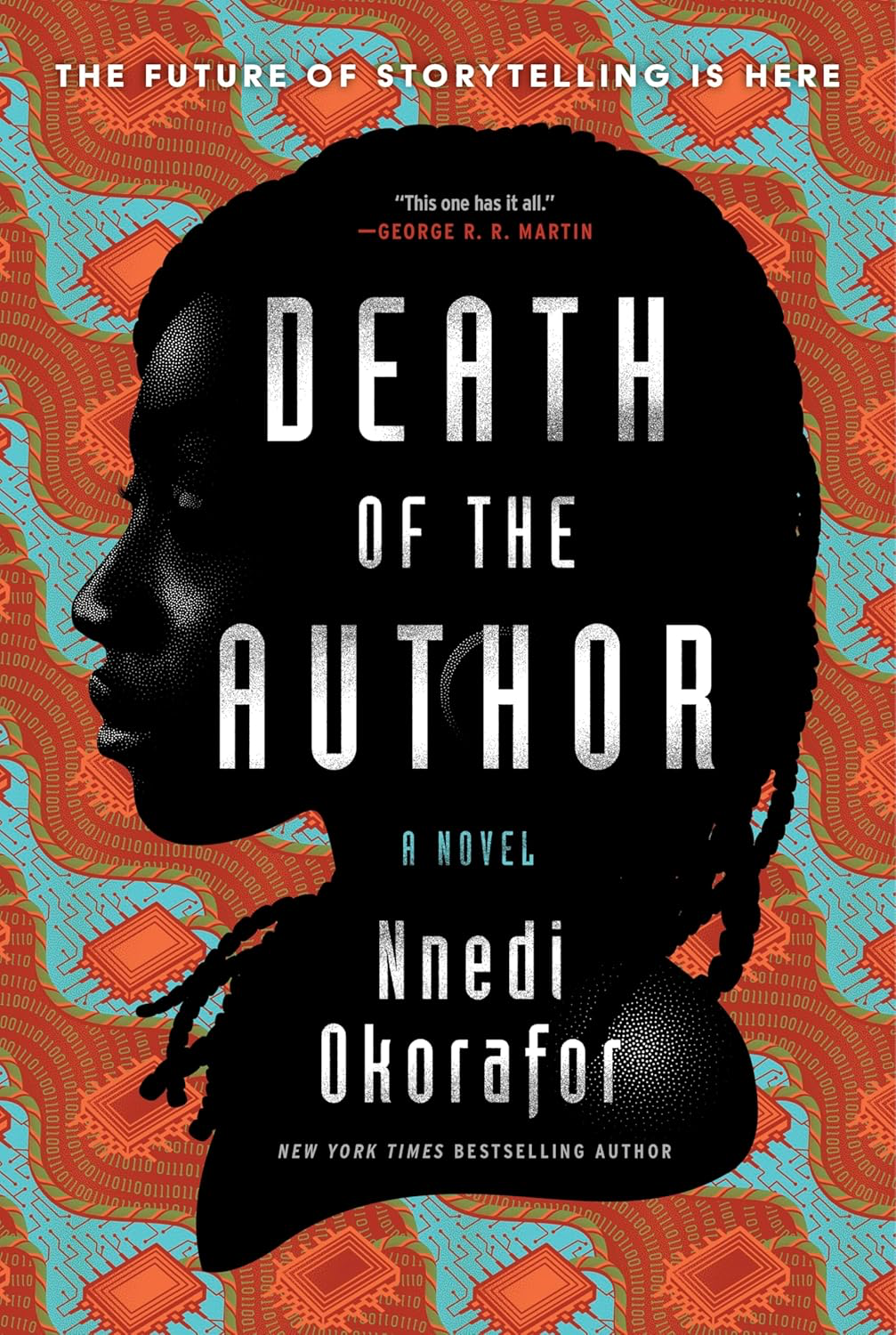
Death of the Author – Nnedi Okorafor

Zelu is on the verge of giving up her dream to be a writer. After a pile of rejected manuscripts and a botched job as a professor, she moves back in with her overbearing, judgmental family as she attempts to get back on her feet. But when a spark suddenly comes to her, she has a bestseller on her hands: Rusted Robots. As she grapples with the price of fame and the mobility—and simultaneous lack thereof—Zelu must come to terms with her own identity as she explores the fabrication of it that the public has created for her.

TW/CW: substance abuse, ableism (external & internalized), loss of a parent, near-death situations, kidnapping

Of all people, I didn’t expect Nnedi Okorafor to take the leap into literary fiction, and after I found out the switch in genre, I didn’t expect to enjoy Death of the Author as much as I did. Thankfully, it’s only really literary in the sense that it’s contemporary, realistic fiction…mostly. The woven tapestry of Zelu’s real life and her creation, Rusted Robots, turned out to be a powerful meditation on the nature of art and identity.

Once again, make no mistake: this is fiction, but it’s not entirely just fiction. The assumption is that it’s a handful of years in the future; Zelu has fairly futuristic, adaptive prosthetics that are still in beta testing, and she tests out an automated cab service that’s been newly introduced to the streets of Chicago. Yet Okorafor takes the same skilled hand that she uses to craft intricate, far-future worlds and translates it into the idiosyncrasies of modern life, from the gauntlet of social media fame (and harassment) to being in the confines of a chaotic, judgmental family. For every character that was introduced, Okorafor matched them with an unforgettable personality, even if they only appeared for a few pages. All of the complex, rapidly fluctuated emotions were depicted with sensitivity, from the highest joys to the deepest pits of anguish and the plentiful uncertainty in between. Even without her talent for worldbuilding, Okorafor is a force to be reckoned with, and Death of the Author is proof.

I was hesitantly optimistic that Okorafor was writing a disabled main character again; Noor was a great novel, but from my memory, there was quite a bit of internalized ableism in the main character that went unaddressed. (However, somehow I didn’t know that Okorafor has experience with disability and was herself temporarily paralyzed, so my bad.) The setting couldn’t be more different for Death of the Author, but Okorafor has certainly stepped up her game as far as writing disabled characters—and part of it is that Zelu is unlikable. More often than not, you can at least sympathize with her, but at times, you can see her for the insufferable, argumentative, reckless stoner that her family sometimes sees her as. Of course, not every disabled character has to be likeable, but her relative un-likeability made some of the novel’s most powerful commentary shine even more. As she grapples with her meteoric rise to literary fame, Zelu’s fans place the burden of her being a “role model” for a number of communities: Black, woman, Nigerian-American, disabled. Being a role model can be powerful, but as soon as people saw Zelu as more of a role model than a person, it disregarded her humanity in an entirely different way. She became an example, not an autonomous being—something that is intimately tied to what many disabled people experience. In that way, Zelu represents a leap in how Okorafor writes her disabled protagonists—not just independent, but human.

I don’t have a ton of experience with meta-fiction—it’s not a matter of me not liking it, I just hardly get around to reading much of it—but Death of the Author pulls it off with ease. If you’re still not convinced that Okorafor’s literary fiction isn’t for you, you’ll at least be tided over by her signature brand of Africanfuturism, complete with the landscape of a futuristic Nigeria, robots, and appearances from Udide. It’s somehow a delightful vision of the future, where types of robots have proliferated across the face of the Earth in the face of the extinction of the human race. It’s threaded into Zelu’s life, yet it’s also a clever distillation of the novel’s themes; Ankara’s struggle with coexisting with Ijele inside of his head, as well as the changing world around him, spoke to the themes of embracing collaboration and the blurry relationship between creator and reader.

Which brings me to the whole “death of the author” part. I’ll admit, the Roland Barthes quote from the (original) “Death of the Author” gave me literary theory flashbacks. But as a grounding concept for the book, I love how Okorafor’s Death of the Author playfully pokes fun at the concept. Here, it’s as though the concept has been subsumed by the publishing industry; instead of taking Zelu’s novel as tied to her heritage and her disabled identity, the world swallows it and regurgitates a whitewashed, Americanized movie adaptation that the public eats up. (“Look what they’ve done to my song, Ma…”) Yet at the same time, Zelu is confronted by readers who insistently pester her, insisting that everything in the novel is fully tied to her identity and selfhood. Death of the Author’s strength is the clarity it finds in the balance. Zelu’s work is intimately tied to her identity, but just as intimately tied to her imagination. Her being marginalized meant that people saw her work as surely being solely about her identity, but that wasn’t the whole story either. (The note in the acknowledgements about Okorafor talking to her daughter about worrying that readers would think that Zelu is her makes the point all the more clear.) In this case, fence-sitting is the most reasonable position I can think of—to consider reader interpretation first and foremost can have fruitful results, but to deny the lived experience veers into foolishness, and vice versa; Okorafor’s embrace of the area in the middle is what made the message so clear. Reading and world-creation is a twin act, created both by ourselves and those who receive our work—it’s not a simple question of one or the other.

All in all, a surprising novel that at first seemed like a left turn, but turned out to be another testament to Nnedi Okorafor’s enduring talent. 4 stars!

Death of the Author is a standalone, but Nnedi Okorafor is also the author of several books for adults, teens, and children, including the Binti trilogy (Binti, Home, and The Night Masquerade) the Nsibidi Scripts series (Akata Witch, Akata Warrior, and Akata Woman), Lagoon, Noor, the Desert Magician’s Duology (Shadow Speaker and Like Thunder), and many more.

Today’s song:

ADORE this album

That’s it for this week’s Book Review Tuesday! Have a wonderful rest of your day, and take care of yourselves!

Posted in Uncategorized

January 2024 Wrap-Up 🎇

Happy Wednesday, bibliophiles! I hope this month has treated you well.

First month of the year is over, whew! I don’t wanna jinx it, but I think the rest of the year will be good.

Let’s begin with the first wrap-up of 2024, shall we?

GENERAL THOUGHTS:

January’s been a good start to the year so far, I’d say. The first half was wonderfully relaxing, what with the joys of how long winter break is in college, so I was able to recharge, catch up on reading, and get some sleep in before school started back up again. As for school, I think it’s shaping up to be a great semester! I’m finally taking some classes for my newly declared women and gender studies minor, and I’ve been enjoying those, along with the amazing English classes I’m taking for my major. It was disgustingly cold for a solid week, but at least my school had the sense to call a delay (would’ve preferred a snow day, but beggars can’t be choosers, I guess), but now it’s…unusually warm? It’s nice to be able to wear a t-shirt in the afternoons, if you ignore climate change.

As I said, January has given me the chance to get back on my old reading and blogging schedule. I still didn’t blog as much outside of my regular schedule (these scholarships I’m applying for aren’t gonna write themselves), but it was much nicer not having to do that outside of schoolwork. Fingers crossed, my workload is reasonable at the moment, so I’m soaking up all the time in the honeymoon period of the semester that I can. The reading batch I had was fantastic, for the most part! I had a streak of no books that I really didn’t like for a solid three weeks, and even after that, it’s mostly been 3-5 star reads all around! Anticipated reads, books I’ve been meaning to read for a while, and re-reads—it’s been a good bunch this month. I put my reading goal at 150 books this month, which my middle school self would probably declare something along the lines of “cowardly,” but to her I’d say to wait until college.

Other than that, I’ve just been catching up on sleep (for the first half of the month, anyway), drawing, watching Abbott Elementary (so comforting and delightful!), seeing Robyn Hitchcock live (dude’s a complete weirdo, but an insanely talented weirdo), and stocking up on hot chocolate and tea in equal measure in preparations for the permanently indecisive Colorado weather. Somebody’s gotta keep us on our toes.

READING AND BLOGGING:

I read 18 books this month! Winter break gave me a good head start for the first half of the month, but I’ve been able to keep up some of the momentum through the end. And it’s been a great batch too—I’ve only read one book this month that I really didn’t enjoy, and I re-read a favorite that got even better on the second go-around!

2 – 2.75 stars:

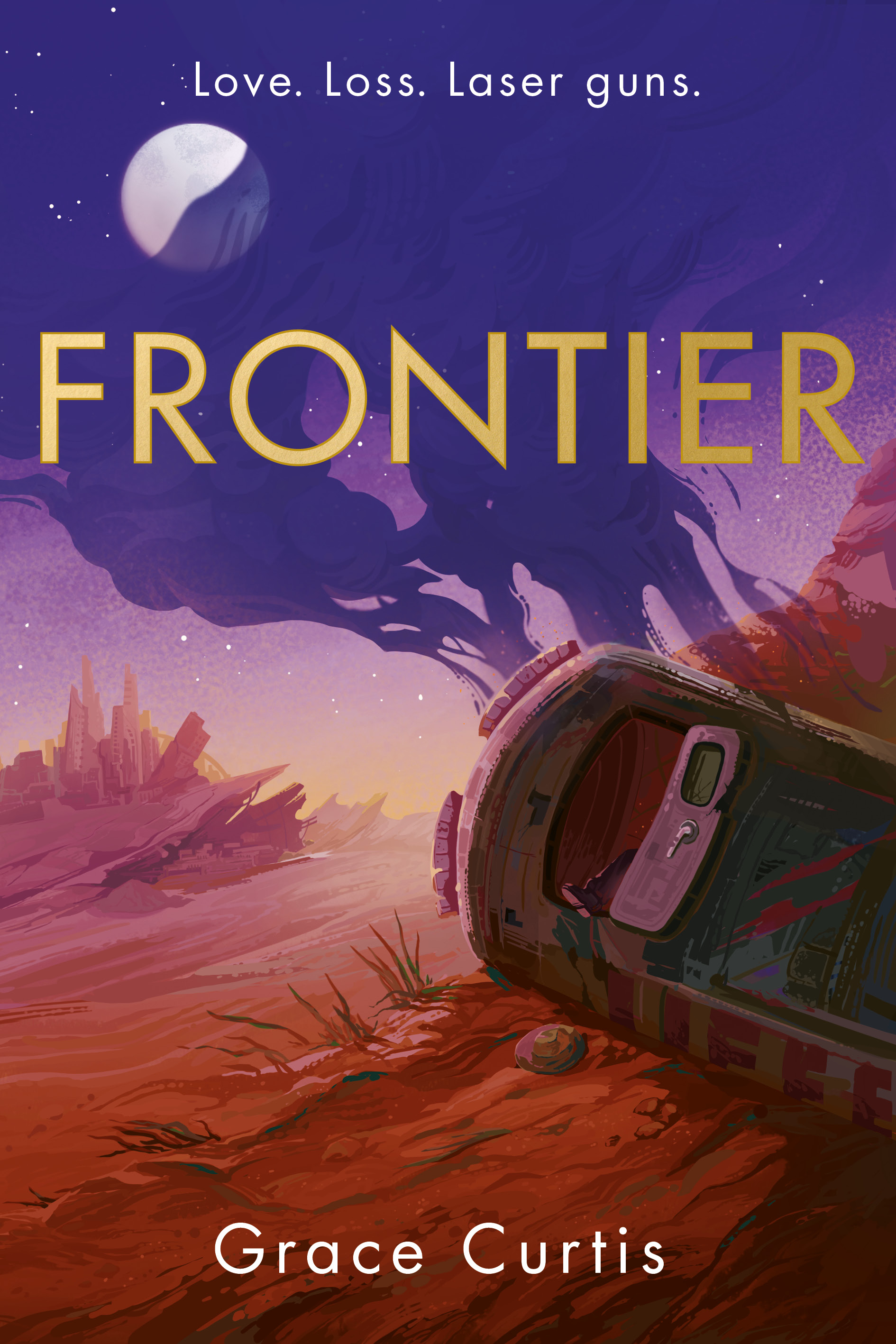
Frontier

3 – 3.75 stars:

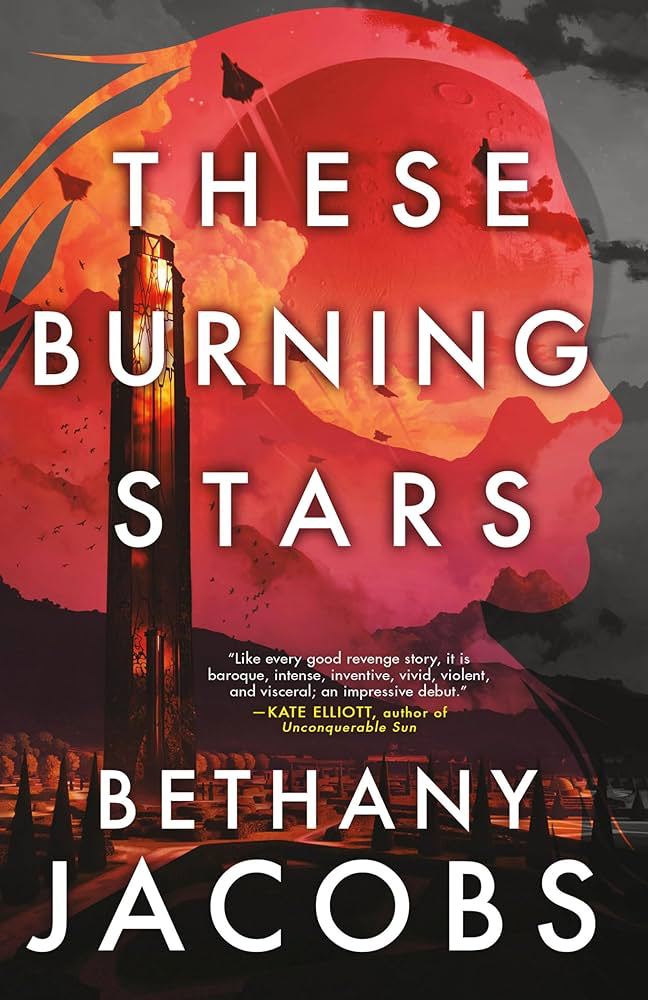
These Burning Stars

4 – 4.75 stars:

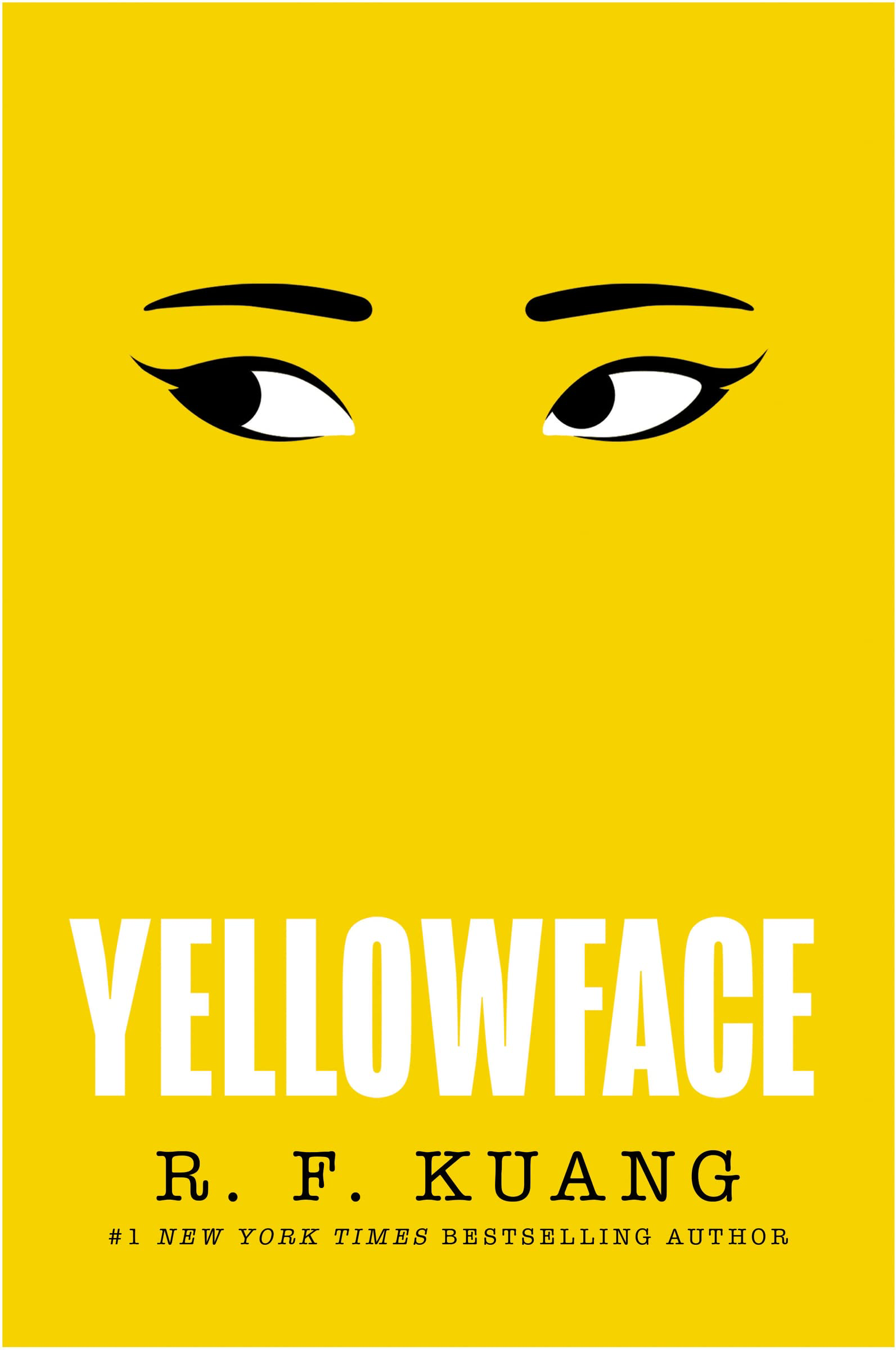
Yellowface

5 stars:

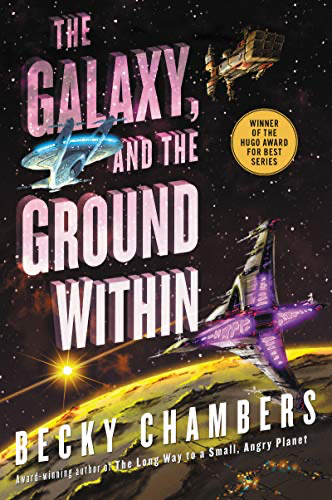
The Galaxy, and the Ground Within

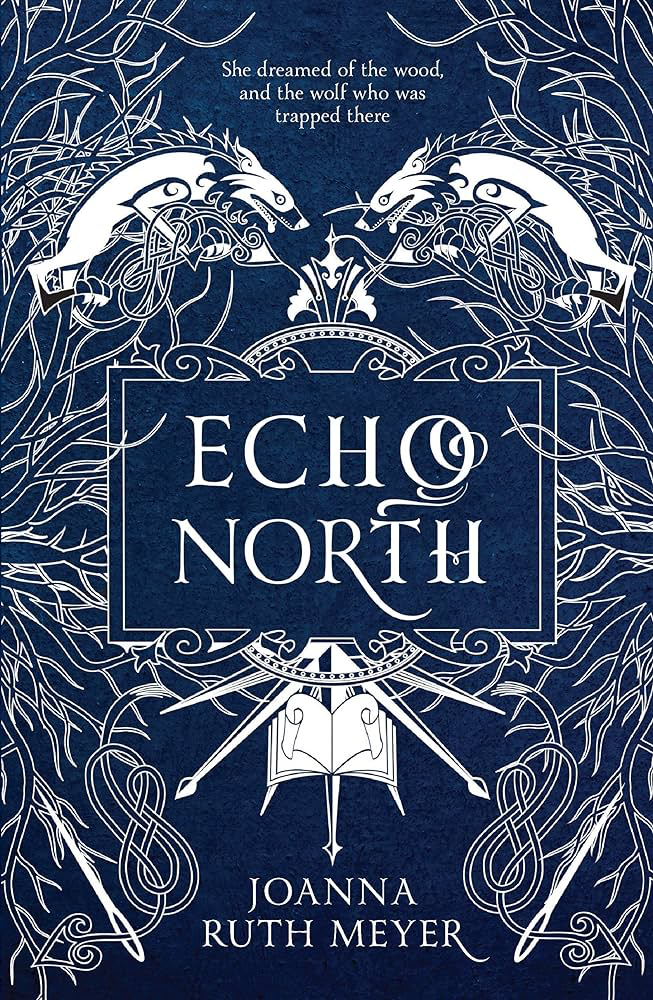
FAVORITE BOOK OF THE MONTH (not counting re-reads): Echo North4.5 stars

Echo North

POSTS I’M PROUD OF:

POSTS FROM OTHER WONDERFUL PEOPLE THAT I ENJOYED:

SONGS AND ALBUMS I’VE BEEN ENJOYING:

sobbing rn
nostalgia that I didn’t even know that I missed
and she got this song out of “lol my cat is cute”?????
first new-to-me album I’ve listened to this year!!
this album was very nearly everything I wanted it to be!!
THIS ALBUMMMMMMMM

Today’s song:

nonstop björkposting this week

That’s it for this first month of 2024 in blogging! Have a wonderful rest of your day, and take care of yourselves!

Posted in Book Review Tuesday

Book Review Tuesday (1/9/24) – Like Thunder (The Desert Magician’s Duology, #2)

Happy Tuesday, bibliophiles!

After I finished Shadow Speaker back in December, I was eager to see what the newly published sequel, Like Thunder, had in store. It was finally available at the library recently, and it was one of my first reads of this year. And though it retained some of the issues that Shadow Speaker had, it was still a worthy sequel and end to the duology.

TREAD LIGHTLY! This review may contain spoilers for book one, Shadow Speaker. If you haven’t read it and intend to, read at your own risk.

For my review of Shadow Speaker, click here!

Enjoy this week’s review!

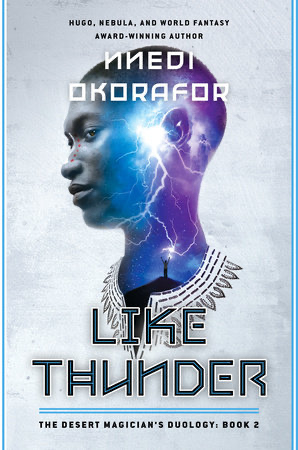
Like Thunder (The Desert Magician’s Duology, #2) – Nnedi Okorafor

2077. Three years after Ejii and Dikéogu saved Earth from the threat of Chief Ette and forced him to sign the truce to bring no harm to the Changed, Dikéogu has realized that the fight is not over. Estranged from his parents and living on his own, he knows that the truce is due to expire, and that the humans are growing more hostile to the Changed by the day. After disaster strikes and puts those that he love in danger, he sets off to find the one person he knows that can help save the day: Ejii. But when they reunite, saving the world—for the second time—is more difficult that either of them bargained for.

TW/CW: genocide, slavery, ableism, murder, death, loss of loved ones

In general, I was still a fan of this book, but strangely, even though a lot of my minor gripes with Shadow Speaker were resolved, they were often filled in with elements that ended up bringing down the narrative. That’s not to say that Like Thunder wasn’t a worthy sequel—it absolutely was, and it was a fitting way to finally end the Desert Magician’s Duology, all these years after Shadow Speaker was initially published.

The worldbuilding was, without a doubt, the strongest aspect of Shadow Speaker, and Like Thunder expanded on it in all the ways that it should have! Through Dikéogu’s eyes, we get to see parts of the Desert Magician world that Shadow Speaker left behind, and they greatly enhanced the ongoing narrative of change and prejudice. Not only do we get an expansion of the effect of what kind of powers possessed by the Changed, we also see the direct effects that being Changed has on people apart from the main characters that we saw in book one. Time was clearly on Nnedi Okorafor’s side here, since she presumably had so many years apart from Shadow Speaker to craft all of the world’s eccentricities, but even if there wasn’t such a large gap between now and then, I have faith that her worlds would have been fleshed out anyway—if there’s one thing that Okorafor has excelled at over the years, it’s crafting a detailed world.

A lot of this worldbuilding contributed to the themes that Like Thunder built up, and it serves as an incredibly powerful narrative about genocide. Now that the three-year treaty between Chief Ette and the Changed has expired, he doesn’t hide the hostility that he’s been waiting to unleash since then. No matter what perspective that it’s written from, genocide is always a difficult and delicate subject to write about, and Okorafor took great care in depicting it unapologetically—it’s brutal, authentic, and horrifying, just as it should have been. In general, I preferred Ejii’s perspective to Dikéogu’s (more on that later), but Dikéogu’s voice was well-suited to handling this kind of subject matter; he had the anger that the subject warrants, and his rage not only fueled his journey, but the emotion behind this depiction.

That being said, I wasn’t the biggest fan of Dikéogu being the main POV character in Like Thunder. Although seeing the effects of the treaty dissolving through his eyes was enlightening and his anger fueled much of the novel (and for good reason), in much of the down time of the novel, I found him to be borderline obnoxious. Most of it manifested in his treatment of a lot of the female characters in the novel—once he reunited with Ejii, he had this attitude that he was still owed her after all these years, and it got on my nerves to no end. I wouldn’t have minded a romantic subplot between the two of them, but Dikéogu’s insistence on being incredibly possessive of her soured the whole thing for me. His perspective was needed to a point, but I felt like he worked better as a side character.

Going off of that, there were a lot of cheap elements in Like Thunder that sullied the narrative for me. When I think of Nnedi Okorafor, I think a lot about subversion—subversion of genre conventions, subversion of tropes, etc. But throughout the novel, there were just so many elements that felt pointless and served no purpose—and were so common that it almost seemed beneath Okorafor to add them in the first place. We get the age-old “killing the main man’s girlfriend for the plot” trope; I think it was meant to convey some of the horrors of the genocide going on, but it was already pretty evident that Dikéogu’s life was significantly changed and he already knew the horrors of genocide firsthand, so there was no point in having that subplot at all, especially since it was blatantly shoved in there to try and advance Dikéogu’s narrative arc. And the love triangle…why? Why? Once we got to that part, combined with Dikéogu’s possessiveness of Ejii, it just felt like filler drama—it didn’t advance the plot at all, and it seemed like a cheap way to generate drama as well. It just seemed like a disservice to Okorafor’s inexhaustible creativity.

All in all, a satisfying conclusion to a solid sci-fi/fantasy duology that excelled in its worldbuilding, but suffered in its use of overused and stale tropes. 3.5 stars!

Like Thunder is the second and final installment in the Desert Magician’s Duology, preceded by Shadow Speaker. Nnedi Okorafor is also the author of Lagoon, the Binti series (Binti, Home, and The Night Masquerade), Noor, Remote Control, and several other books for teens and adults.

Today’s song:

NEW SMILE WOOOOOOOOOOOOOOOO

That’s it for this week’s Book Review Tuesday! Have a wonderful rest of your day, and take care of yourselves!
Posted in Book Review Tuesday

Book Review Tuesday (12/12/23) – Shadow Speaker

Happy Tuesday, bibliophiles!

I’ve been a fan of Nnedi Okorafor for several years now, but it wasn’t until about a month ago that I found out that one of her first novels, which originally went out of print, was being reissued with new content and a new cover! (Gorgeous cover, by the way.) I ended up buying it, and though it wasn’t her best (what else would you expect from one of her very first books), but it’s not just a fun ride—it’s a glimpse into an incredibly talented author coming into her own.

Enjoy this week’s review!

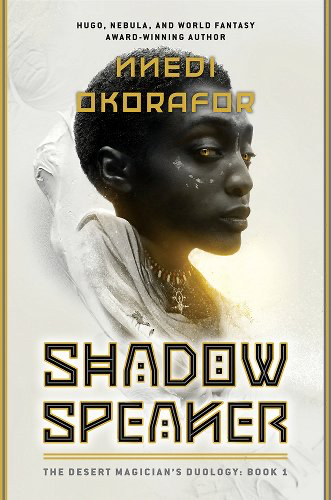
Shadow Speaker (The Desert Magician’s Duology, #1) – Nnedi Okorafor

Niger, 2074. In the wake of a nuclear disaster, both humanity and the natural world have developed powers far beyond their imaginations. These Shadow Speakers have been given strange abilities by the aftershocks of nuclear war. Born into this world is 15-year-old Ejii, gifted the abilities of advanced sight and hearing the thoughts of animals. When she was young, her father, a corrupt politician, was assassinated. All these years later, Ejii decides that, regardless of the horrific legacy her father left behind, she must journey out into the Sahara Desert to search for his killer.

TW/CW: murder, beheading, fatphobia

Being a (somewhat) longtime fan of an author and reading their debut or earlier works further down the line is always an eye-opening experience. I was expecting something along those lines when I bought Shadow Speaker the other day, but…man, I really had no idea what I was in for. Shadow Speaker was honestly kind of bonkers, but in the best possible way. Quite plainly, it’s one of the boldest debut novels that I can think of.

Shadow Speaker was Nnedi Okorafor’s first novel (published all the way back in 2008), and it really does feel like a debut. I said eye-opening before because you can see the through lines where Okorafor hadn’t yet hit her stride in terms of writing; in contrast to the tight organization of most of her other novels, we still get chunks of worldbuilding delivered paragraph by paragraph. Her prose has the same bold brightness and whimsical spirit that really stands out as her signature, but it hasn’t been refined as much. And with the re-release this November, despite apparent rounds of editing, there’s still a few things that haven’t aged well from 15 years ago (ex. the villain’s evilness explicitly being tied to him being fat…mmmm, yikes…). All debuts are bound to have flaws, but the latter ones could have probably been edited out. But unlike that, I feel like it’s worth keeping some of the writing as it is—reading this novel was a time capsule into the mind of a younger writer.

And yet, Shadow Speaker is still one of the boldest books I’ve read in a long time, debut or not. Everything about is really and truly nuts, and that was the best part about reading it. Once you get the exposition of Ejii’s post-apocalyptic, magical world out of the way, at no point did I know where this novel was going, and at a certain point, I ceased to even care. There’s the spread of X-Men-like powers caused by a nuclear disaster, a talking camel (also because of the nuclear disaster, how did you guess?), gods and goddesses roaming across the land…you get the idea. Actually, no. You don’t get the idea. And that’s the point of this book, from what I can tell—Ejii and her ragtag band of nuclear magicians don’t know where they’re going either, and that’s where the fun of Shadow Speaker lies.

Over the years, Nnedi Okorafor has proven herself to be an absolute master of Afrofuturism (more specifically Africanfuturism and Africanjujuism, in her words), and the latter (a term that she coined to describe a subgenre of fantasy that is specifically Afrocentric and is inspired by the mythologies of Africa) really describes this novel to a T; although the inciting incident and the introduction of powers has a distinctly sci-fi feel, Shadow Speaker is so clearly fantasy. It’s hard to do that kind of genre-bending so effortlessly in a debut, but already, Okorafor make it look easy. Every element, whatever genres you want to ascribe them to, is blended seamlessly into the world of the Desert Magician Duology as smoothly as stirring together the ingredients of a cake. It’s an impressively distinct world, and despite its flaws, I’m glad this book was brought back into print.

Part of the reason for re-releasing Shadow Speaker is that Nnedi Okorafor just published its intended sequel, Like Thunder, this November. Hopefully I can get my hands on it soon, but it’ll certainly be interesting to see the leap in writing style between the two, given how much time has passed…

All in all, a bold and wild debut from one of science fiction’s most original writers active today. 3.5 stars!

Shadow Speaker is the first book in the Desert Magician’s Duology, followed by the new sequel, Like Thunder, which came out this November. Nnedi Okorafor is also the author of many books for adults, teens, and children, including Lagoon, the Binti series (Binti, Home, and The Night Masquerade), Noor, Remote Control, and many others.

Today’s song:

this song makes me ridiculously happy

That’s it for this Book Review Tuesday! Have a wonderful rest of your day, and take care of yourselves!