

Happy Sunday, bibliophiles! I hope this week has treated you well.
This week: British women dominating rock music for decades, American women giving the gays what they want, and Thom Yorke’s seeming inability to make a bad song since 1995.
Enjoy this week’s songs!

SUNDAY SONGS: 2/23/25
Finally, finally, I’ve listened to a full PJ Harvey album! Took me long enough. Me and my arbitrary rules for listening to albums that I break half the time. Anyway. To Bring You My Love? I know this is the most vague descriptor you could give for an album, but it truly ROCKS. So many of these tracks embody the raw power that rock n’ roll can have. Not just that, but it feels like a love letter to the rich ancestry of the blues in rock n’ roll. Even without as much background knowledge of the blues, you can just feel the grimy, grungy crawling with threads of DNA in the history of blues in every growl that Harvey lets out. The desperation and wayward storytelling of “To Bring You My Love” and “Teclo” could’ve been fragments lost in the American south from decades before Harvey released the album. It feels to me like an example of the enduring power of any kind of music—here we have a white British woman in the mid-’90s taking inspiration from music from the ’20s-’40s made primarily by Black people all the way across the ocean, here in the States. Who would’ve thought.
One caveat with me saying that the album rocks: it’s got a relatively slow tempo, and we don’t get into the real guitars-going-crazy rock for a few songs. “Long Snake Moan” is one such song, and it knows it—Harvey’s sly “mmm-hmm” before the guitars slam into you like the brunt force of an avalanche is more proof of a smirk than a visual could ever be. She knows she’s about to absolutely wallop her listeners. And “Long Snake Moan” is one of the most enduring songs on the album. The title is a nod to Blind Lemon Jefferson’s “Black Snake Moan,” and though the sound differs, the desire of it is what fuels both; Harvey recalls a lust so all-consuming that “You’ll be drowning/Hell’s below, God above/All drunk on my love.” With every impassioned bellow, you can feel the ragged passion sloughing off every note, desperate yet distinctly conscious of its towering presence and power.
…AND A BOOK TO GO WITH IT:

The Familiar – Leigh Bardugo – “In my dreaming/You’ll be drowning/Hell’s low, God above/All drunk on my love…”
I was this close to calling The Vines Britpop, but as it turns out, they’re technically nothing of the sort. Not because of the sound, which very edges closer to the rockier side of Britpop, but because they’re Australian. I don’t want to risk the wrath of any Australians, so consider myself checked before I’ve gotten hypothetically wrecked. Oops.
Regardless of whether or not they wanted to hop on the bandwagon, “Ride” feels firmly between Blur’s grunge-parody-that-became-kinda-grunge self-titled album and Supergrass. (Craig Nicholls also kinda has that Britpop, bad-boy frontman look on lock. The bangs, the smolder…) And “Ride” is such an adrenaline rush of a rocker. Guitar tone? Heavy and clean in perfect balance. Vocals? Though Nicholls’ voice doesn’t stand out to me, that distorted scream in between the chorus reminds of the best of 2000’s rock. The art of the rock scream is a sacred one—a well-placed scream can make or break a song, and Nicholls’ is simultaneously put in the spotlight and tucked into the crashing rhythms of the chorus, a grungy accent that drives up the fuel-burning energy of the track. It’s got a rasp that’s perfect for just what it is—a headbangable, garage-y rock track begging for a flimsy stereo speaker to be blasted from.
…AND A BOOK TO GO WITH IT:

Victories Greater Than Death (Unstoppable, #1) – Charlie Jane Anders – the adrenaline-rushed, breakneck pace of this novel matches the reckless, rocking urgency of this track.
This video is so cute and gay that I can almost ignore how annoying Cara Delevingne is…oh, no, wait, she’s caressing Lucy Dacus and hamming it up for the camera. Of course.
Either way, 2025 is shaping up to be an excellent year for music about tender love between queer women, between Send a Prayer My Way and everything that Lucy Dacus is putting out (aside from “Limerence”…oof). As much as Dacus’ emotional hard-hitters have a soft spot in my heart (was my 18-year-old brain permanently altered by the “Night Shift” belt? Perhaps), she makes tender, gentle love songs look easy. It rings similarly to her pair of Carole King covers (“Home Again” and “It’s Too Late”) from 2022, with the same slow rhythm and inner warmth; even with the fleeting mentions of over-the-moon obsession (“Tracing your tan lines/Making you mind/If this doesn’t work out/I’ll lose my mind”), it’s a very grounded, worldly kind of love song, in typical Dacus fashion. The first verse of the song centers around caressing the more physical aspects of her lover’s body, but it almost immediately professes that “I love your body/I love your mind/They will change/So will I.” So simply stated, but immediately after that, Dacus professes her undying love. That to me, feels like real love—appreciating your partner for everything that they are, impermanent as it may be. It shouldn’t be groundbreaking lyrical ground, and I don’t think it is, but it’s always refreshing when it comes up, with so many love songs focusing on youth and impermanent, surface-level qualities of people. Plus, “Best Guess” is just such a lovely, catchy song. That guitar riff at the end? Absolutely SUCCULENT. Waiter, more Lucy Dacus guitar work, please! Best-of lists are inevitably subjective, but you didn’t get named the 213th best guitarist of all time by Rolling Stone for nothing, queen! Plus, again…it’s gay. More music videos full of queer people AND queer people being happy, please!!
…AND A BOOK TO GO WITH IT:
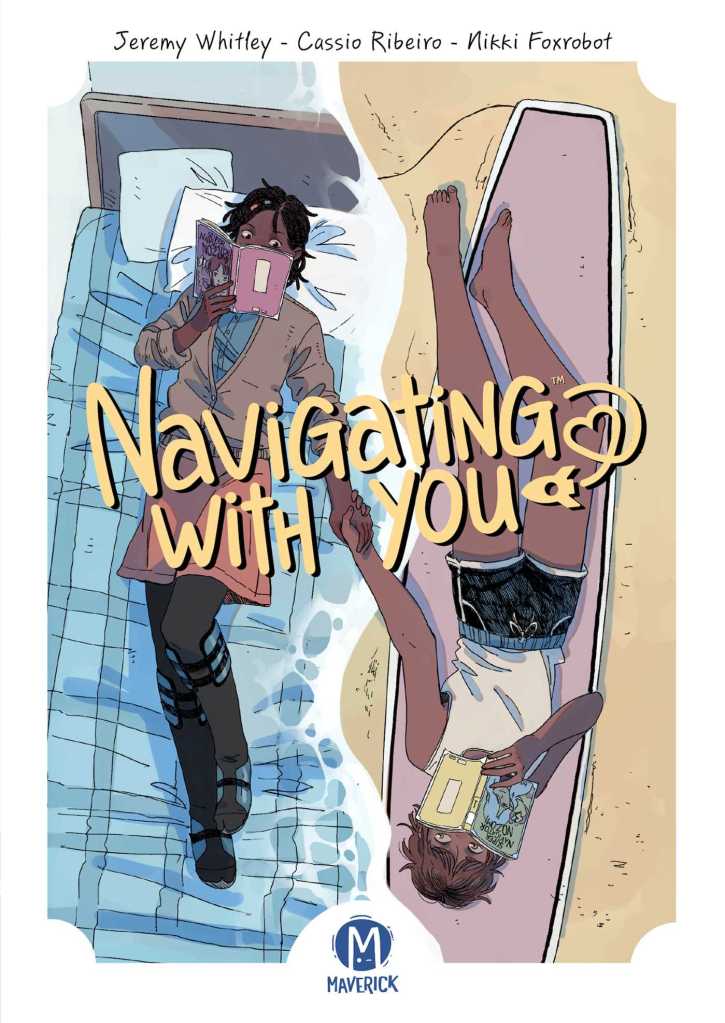
Navigating With You – Jeremy Whitley and Cassio Ribeiro – soft, tender, sapphic love…and bonding over manga.
It always comes back to Radiohead. I don’t talk about music videos as extensively as much as I do the songs themselves, but “There, There” has to be one of my favorite Radiohead music videos of all time. Maybe my favorite? Not sure. Directed by Chris Hopewell, it shows Thom Yorke, his movements edited to give the appearance that he’s a stop-motion puppet, wandering into a Beatrix Potter storybook; after peering into miniature houses hollowed into trees, he finds squirrels smoking pipes, a weasel riding a Penny-farthing, all manner of rodents having a feast, and a cat couple’s wedding ceremony officiated by a crow. Of course, Thom Yorke breaks the first rule of the Brothers Grimm (from which he and Hopewell drew inspiration for the video), that being “don’t steal the shiny clothes off of that ominous-looking tree.” You can imagine how well that goes for him. It goes contrary to the largely technological, dystopian aesthetic that has endured throughout Radiohead’s discography, despite their many changes in sound. Up until The King of Limbs, their music was rarely associated with such naturalistic imagery, but that kind of fairytale darkness, paired with the lyrics, makes for a different kind of eeriness than what they usually brew. It all makes the song’s alternate title, “The Boney King of Nowhere,” all the more fitting.
Now, the lyrics…”We are accidents waiting to happen?” WHEW. I always forget about that one…for a band that seems to churn out unforgettable lyrics at a concerning rate, even this feels like one of the most masterful lines they’ve ever come up with. Like the gleaming coat and boots that Yorke finds in the forest, “There, There” is a song of being tugged in a myriad of directions—likely all the wrong ones. In typical Radiohead fandom fashion, most people seem to be divided about what kind of temptation it’s specifically talking about—general religious, personal relationships, you get the picture. The emphasis on the personal pronouns—”I go walking in your landscape,” “We are accidents waiting to happen”—lead me to believe closer to the latter, though I and We can easily be other concepts. There’s an intoxication to “There, There,” a painfully magnetic urge to enter into something dangerous, something that will by all accounts destroy you, but the irresistible temptation remains: “There’s always a siren/Singing you to shipwreck/Steer away from these rocks/We’d be a walking disaster.” One part of you cries “Heaven sent you to me,” the other cries “We’d be a walking disaster.” The chorus of “Just ’cause you feel it/Doesn’t mean its there” is the perfect embodiment of keeping up the façade of devotion—or any kind of emotion that has such a sway that you’re convinced of its reality, even when it has no roots. The whole band makes this spectacle of temptation feel like a trek deep into the mouth of a cave; Phil Selway leans on the thumping of the tom-toms, creating a truly cavernous shell for the song, while the reverb on Jonny Greenwood’s and Ed O’Brien’s guitars echo as though confined by the same dappled walls.
I get so hyperbolic with Radiohead. God, I know I do. I swear that past a certain point (1995?), a good 75% of their songs are tiny masterclasses in how to be creative—how to craft an atmosphere, how to write a gut-punching lyric, how to make music that sticks.
…AND A BOOK TO GO WITH IT:

Someone You Can Build a Nest In – John Wiswell – “Why so green and lonely?/Heaven sent you to me/We are accidents waiting to happen…”
“The World’s Biggest Paving Slab” – English Teacher
So listen. I haven’t seen Frank. The one with Michael Fassbender, right? I’ve been meaning to watch it for years, but I haven’t gotten around to it. Should this music video give me enough of an idea?
My entirely arbitrary album listening system Destiny has not yet decided whether or not English Teacher will end up being a band I actually get into, or if I’ll resign myself to going “oh, this song is GREAT” and put off listening to them for another three to five business years. They’ve only got one album, This Could Be Texas, so I really don’t have an excuse. It’s on the list, though. And that one album won last year’s Mercury Prize, so it has to be worth it—not necessarily by virtue of being award-winning, but beating out Beth Gibbons and Charli XCX isn’t exactly an easy feat, even for an award that seems to cater more to alternative artists. Either way, “The World’s Biggest Paving Slab” is proof that no matter what, some part of me will always be attracted to any kind of alt/indie rock coming out of the UK. Something must be in the water there. Or maybe I inherited the gene from my dad, who spent his high school days listening to Julian Cope. Probably both.
Even just from this glimpse, I can already see how much of an avant-garde sensibility that Lily Fontaine and company have; their chord progressions seem to slant ever so angularly, prickly and particular, until the chorus lets them dissipate like fog. The lyrics are a collage of people and curios from Fontaine’s hometown of Colne; being at university for four years gave her the space to look back on it: “witnessing the social, economic and political issues that exist around there in juxtaposition with the beauty of the landscape and the characters that live within in it.” “The World’s Biggest Paving Slab” evokes everything from banks to remnants of the witch trials and a far-right terrorist—a complex history within what, as far as I can tell, is an unassuming, rural place on the surface. Through Fontaine, Colne itself announces its presence as something to be “Walk[ed] all over,” yet also as something containing multitudes beneath the time-weathered stone, for those who care to notice. Fontaine’s vocals switch from airy in the chorus to spoken-word in the blink of an eye, but both ring equally as cries of complicated pride: “I am the world’s biggest paving slab/And the world’s smallest celebrity.”
…AND A BOOK TO GO WITH IT:
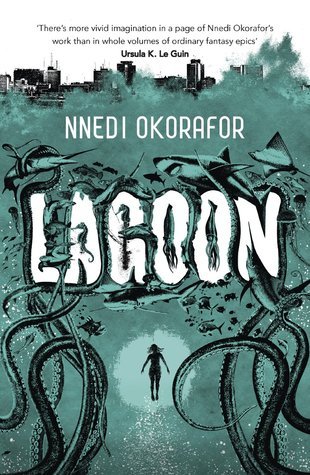
Lagoon – Nnedi Okorafor – the place couldn’t be further away, but it’s a similar concept united around the soul of a place—in this case, Lagos, Nigeria.
Since this post consists entirely of songs, consider all of them to be today’s song.
That’s it for this week’s Sunday Songs! Have a wonderful rest of your day, and take care of yourselves!


 The Bookish Mutant