

Happy Tuesday, bibliophiles!
It’s always the best feeling when you find an extra cool-looking book at a bookstore that you’ve never even heard of before. (It’s a rare feeling for me, since I spend too much time reading and engaging with content about reading. Oops. I need to get out more.) That’s what happened with The Republic of Memory, and I recently bought myself a copy (shoutout to the Boulder Bookstore!).The Republic of Memory boasted so many inventive concepts, and it was such an original novel!
Enjoy this week’s book review!
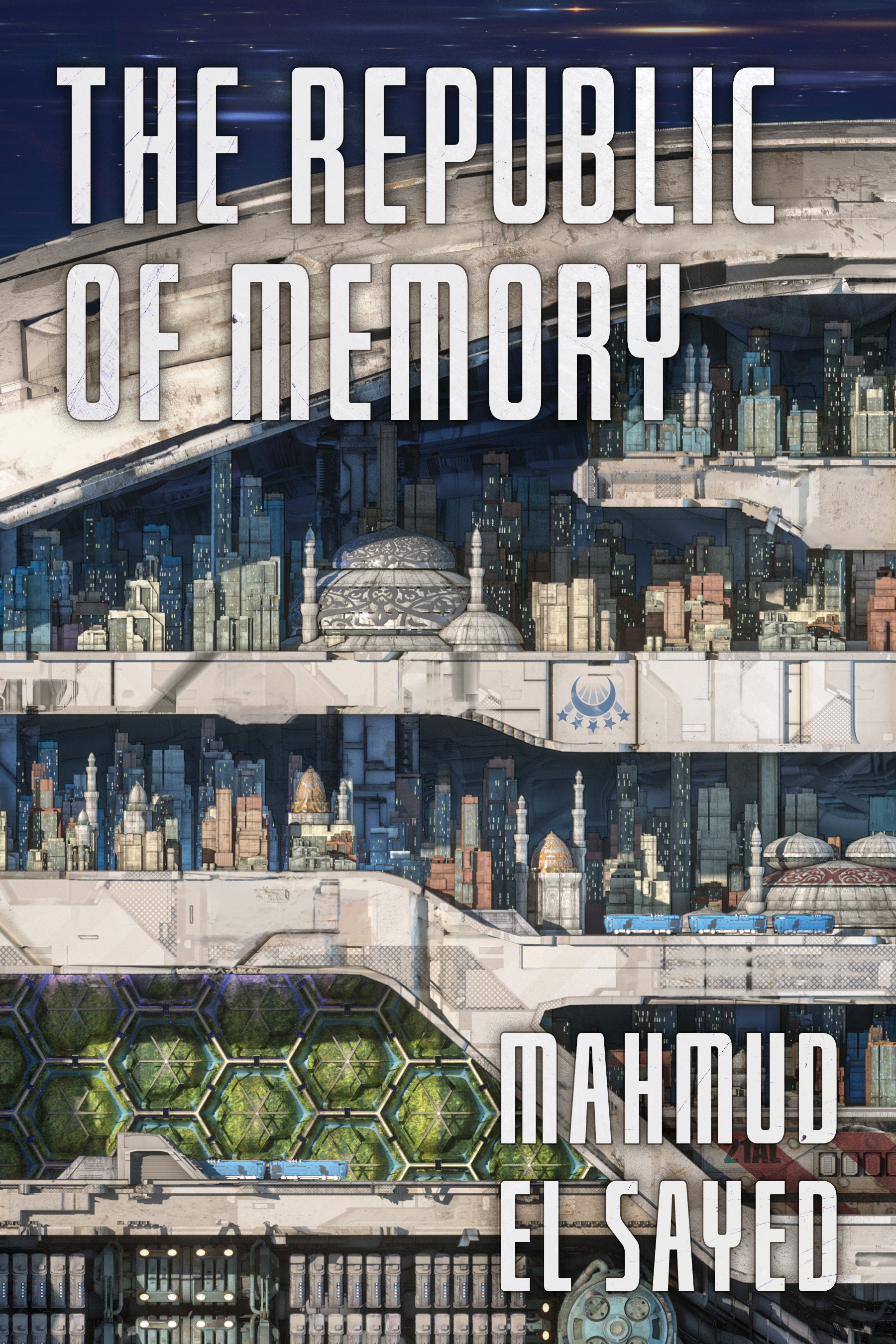
The Republic of Memory (Song of Safina, #1) – Mahmud El Sayed
Onboard the Safina, a generation ship on a 400 year journey, revolution is brewing. Factioning based on one’s language and the tyrannical rule of the Captain have begun to chafe on the thousands of crew members. But when the Safina is plagued by a series of targeted blackouts, many of the disparate crew must come to terms with the fact that the foundations of their ship—and their journey—are about to change forever.
TW/CW: violence, police brutality, xenophobia, murder, homophobia, infertility, sexual content, suicide
Without a doubt, The Republic of Memory is one of the more original sci-fi novels that I’ve read recently. It’s in a subcategory that Mahmud El Sayed calls Arabfuturism, and though I’ve read speculative fiction by Arab authors, it was so fascinating to see all of the cultural aspects integrated into this classic sci-fi setting. The worldbuilding is top-notch, and El Sayed did an amazing job of making the vast, interconnected world of the Safina into such a lived-in place brimming with history. I loved how El Sayed explores the idea of linguistics and language; the Safina is stratified based on language, and he gets into every possible outcome of separating people and groups based on language. Not only that, he gets into so much detail on how this has affected the culture aboard the Safina in the past few centuries, from how translators have become bureaucratic annoyances to a con-lang that mixes at least six different languages becomes a form of resistance. To say that El Sayed put so much thought into The Republic of Memory is a major understatement—this is a massive worldbuilding undertaking that was nothing short of phenomenal.
This novel dissects the beginnings of revolutions like very few others I’ve read have done. Until the end, it’s not terribly action-packed, but I loved that about it; it’s very much in the vein of a political thriller, and you get to see the revolution boiling over and eventually erupting through a kind of slow-burn, tense series of incidents all across this centuries-old generation ship. Along with El Sayed’s expert worldbuilding, there was such an incredible attention to detail paid to every aspect of what could trigger a revolution. We get a complicated, messy history of the Safina and all of the circumstances leading up to it, and The Republic of Memory is, in a way, a trail of hundreds of separate dominoes leading to the climax. It felt like a very honest depiction of how a revolution begins: not in a single, concentrated burst of activity, but a slow implosion over the course of years—in this case, centuries.
The Republic of Memory juggles dozens of POV characters. It’s a hard task, but I think it partially worked. It reminded me of Grace Curtis’s Floating Hotel, which is admittedly a very different book, but it has the same structure of including lots of POV characters in service of telling the story of the vast setting. For El Sayed, it wasn’t the setting that was told through the characters, but the story of a revolution from dozens of different perspectives. Although I wish some of the characters had been developed more, I loved how El Sayed examined the rumblings of a budding revolution through characters of all walks of life. Not all of the characters were likable or necessarily compelling, but I liked how they contributed to different views of how the revolution aboard the Safina was brewing. The execution wasn’t perfect, but I liked the approach that El Sayed took with the characters.
Unfortunately, the big ideas that made The Republic Memory so compelling also became its downfall. El Sayed has so much to say about the nature of language, resistance, and ideologies; for the most part, he’s successful in getting his ideas across. But there was a point when those ideas got so tangled up in the already complex plot that they made said plot even more convoluted than it already was. There were moments where El Sayed was so clearly so deep in his head that he thought it would be perfectly fine to frequently have nigh-incomprehensible chapters in the main con-lang of this novel, which were dizzying, to say the least. (To be fair, said con-lang incorporates elements from at least six different languages, so there’s bits and pieces that you eventually understand, but boy, it takes a long way to get there. And I’m not sure if it was worth it.) In addition, I’m not sure there was enough payoff for all of the established ideas; granted, The Republic of Memory is the first in a duology, but I think El Sayed ran into the classic issue of wanting to have lots of Big Statements on said Big Themes, but there wasn’t nearly enough time to get into everything that he established at the beginning of the novel. It’s a very ambitious novel, but not everything in it was executed neatly enough. I have faith in book two though.
All in all, a densely-packed sci-fi novel with lofty ideas to spare, which was both its strength and its weakness. 3.75 stars!
The Republic of Memory is Mahmud El Sayed’s debut novel, and the first book in the Song of Safina duology; the release date of the sequel has not yet been announced.
Today’s song:
That’s it for this week’s Book Review Tuesday! Have a wonderful rest of your day, and take care of yourselves!


