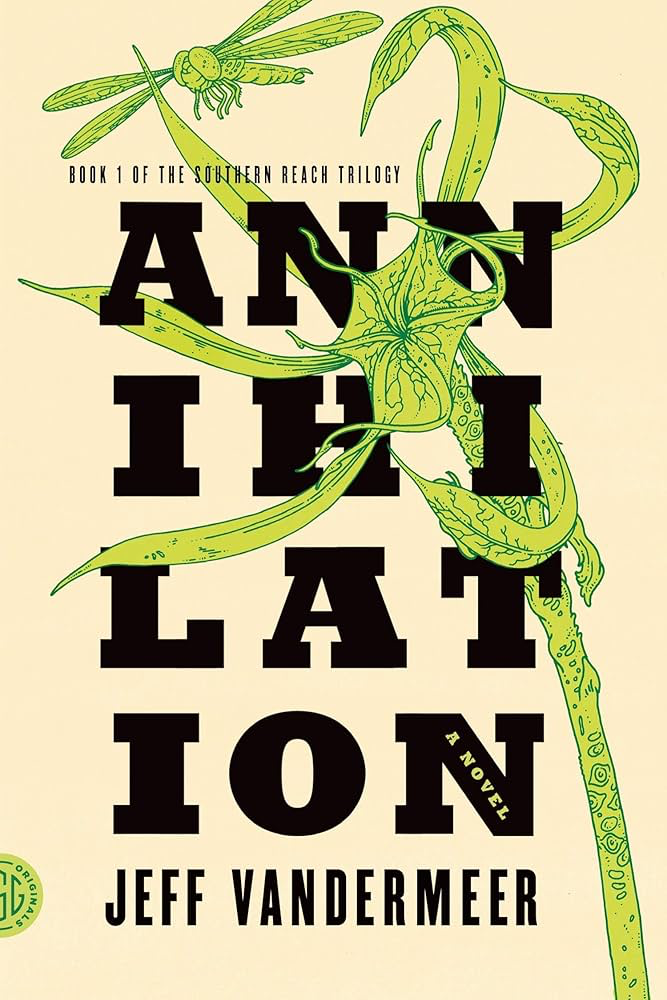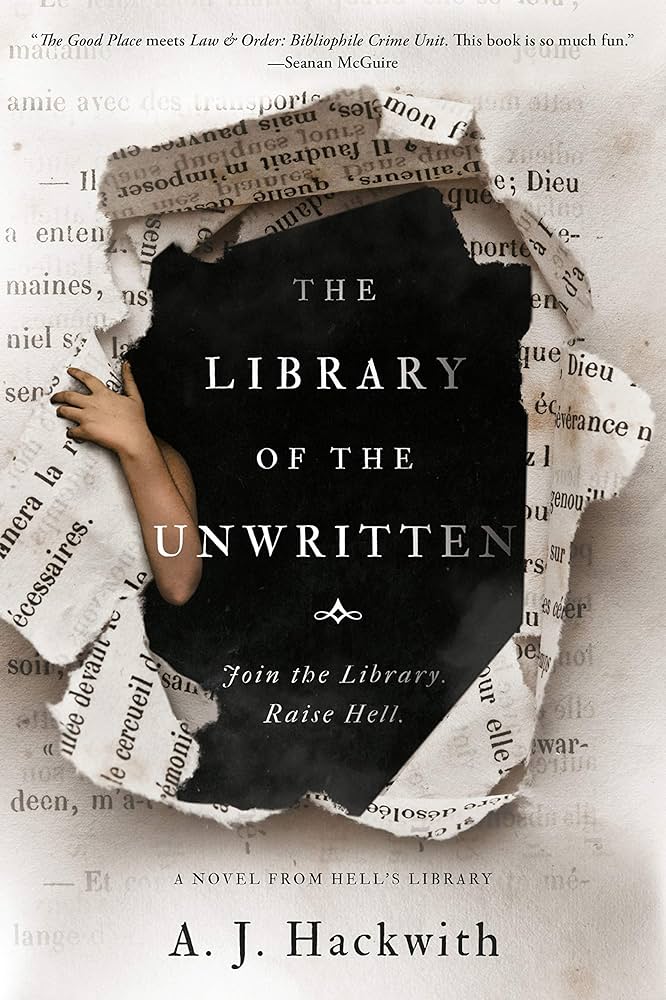
Posted in Book Review Tuesday

Sunday Songs: 3/17/24

Happy Sunday, bibliophiles! I hope this week has treated you well.

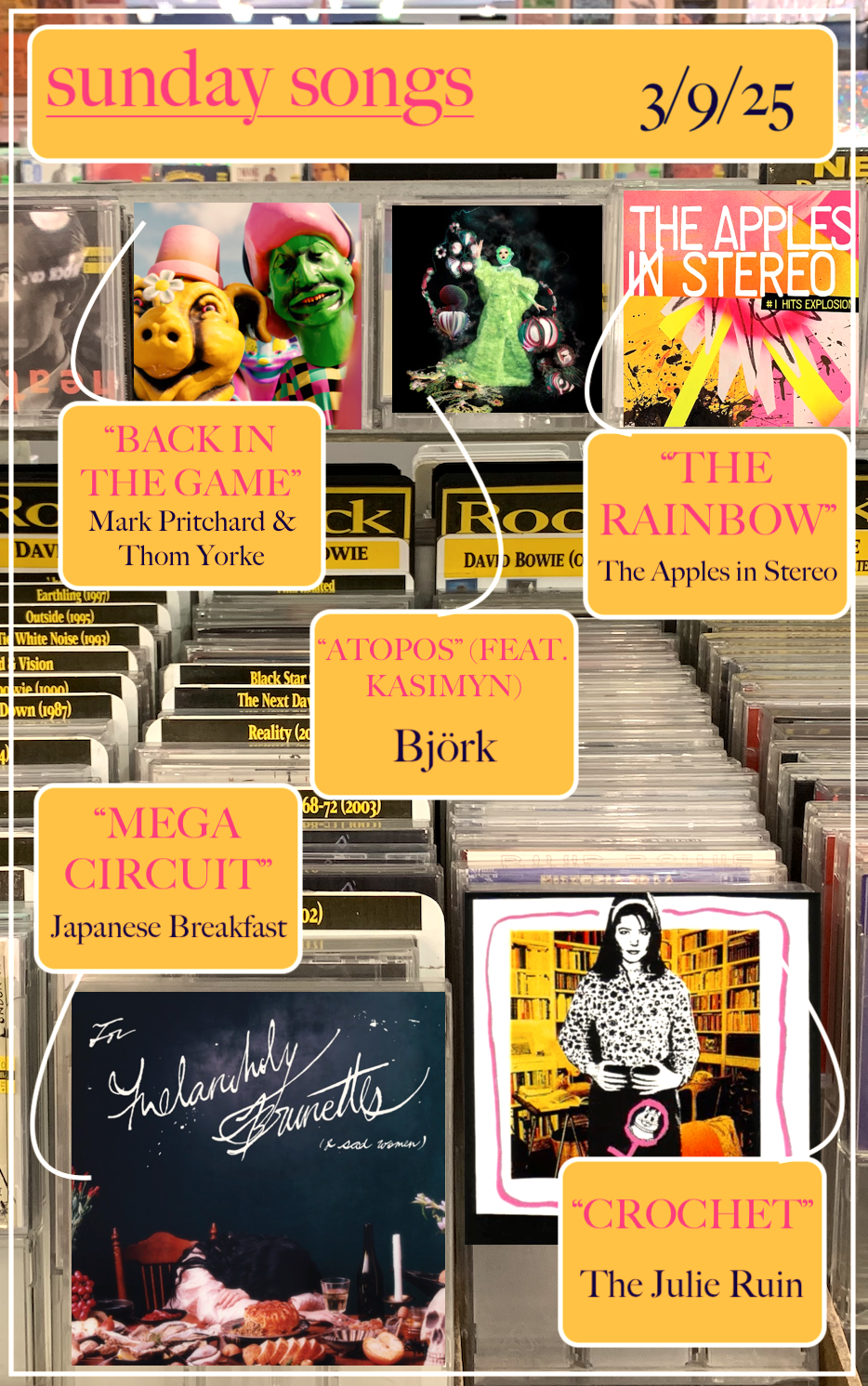
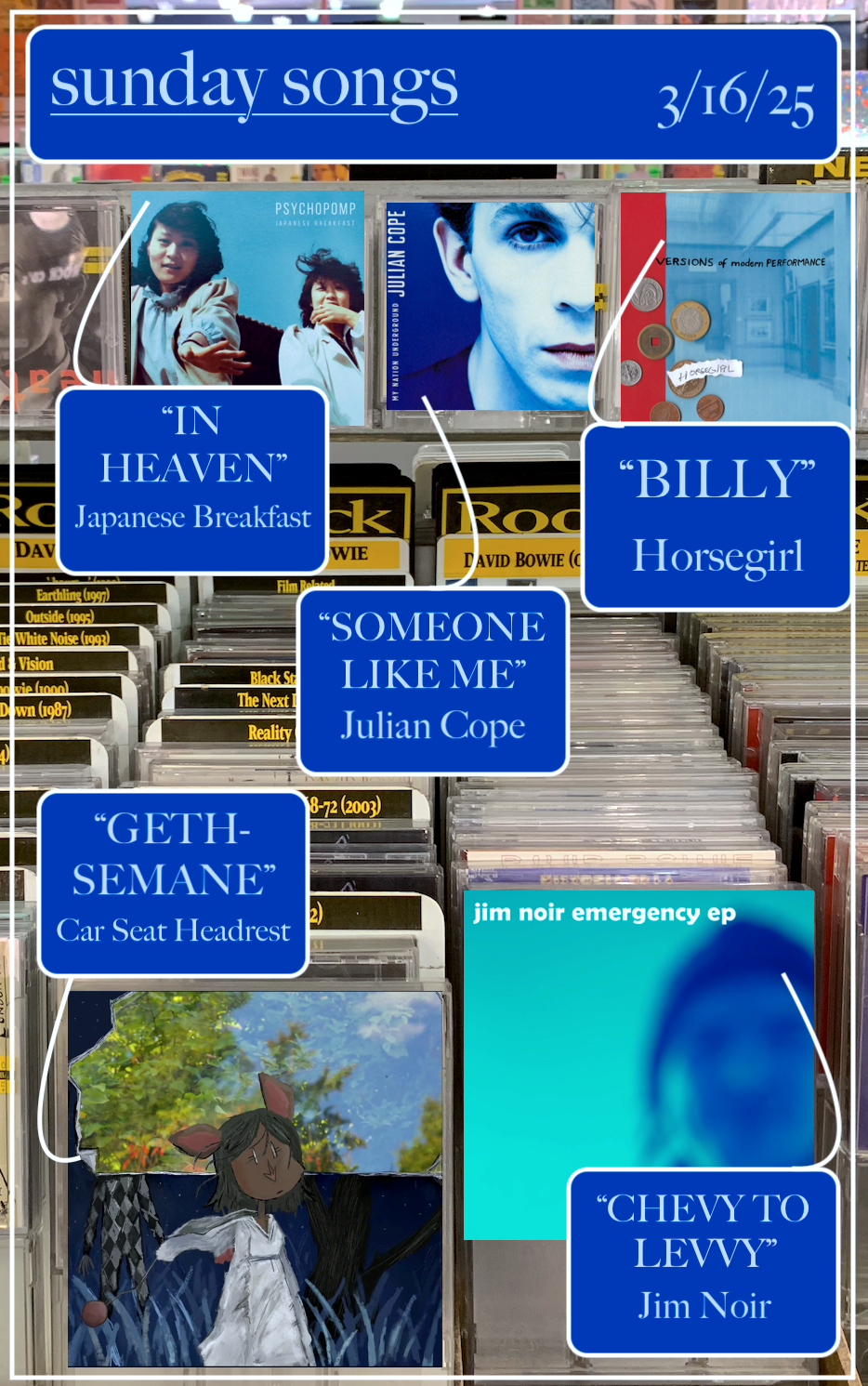
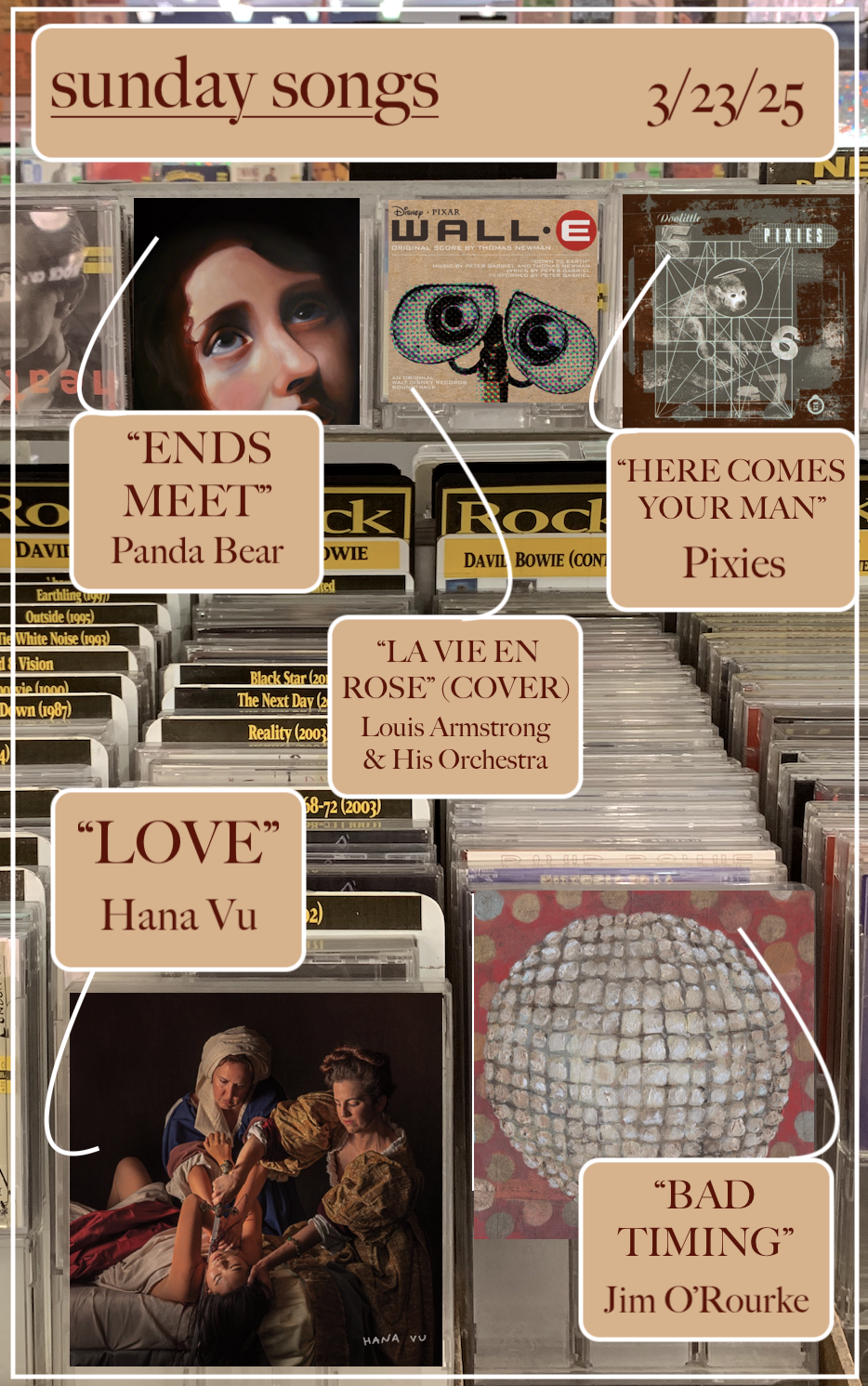
Happy St. Patrick’s Day! Despite appearances, you theoretically would not actually be able to pinch this week’s graphic for not wearing green, despite wearing mostly brown. Please give it up for Lucy Dacus and her green top.

Also, most of the songs this week are either bittersweet or just………flat-out sad, so…apologies in advance.

Enjoy this week’s songs!

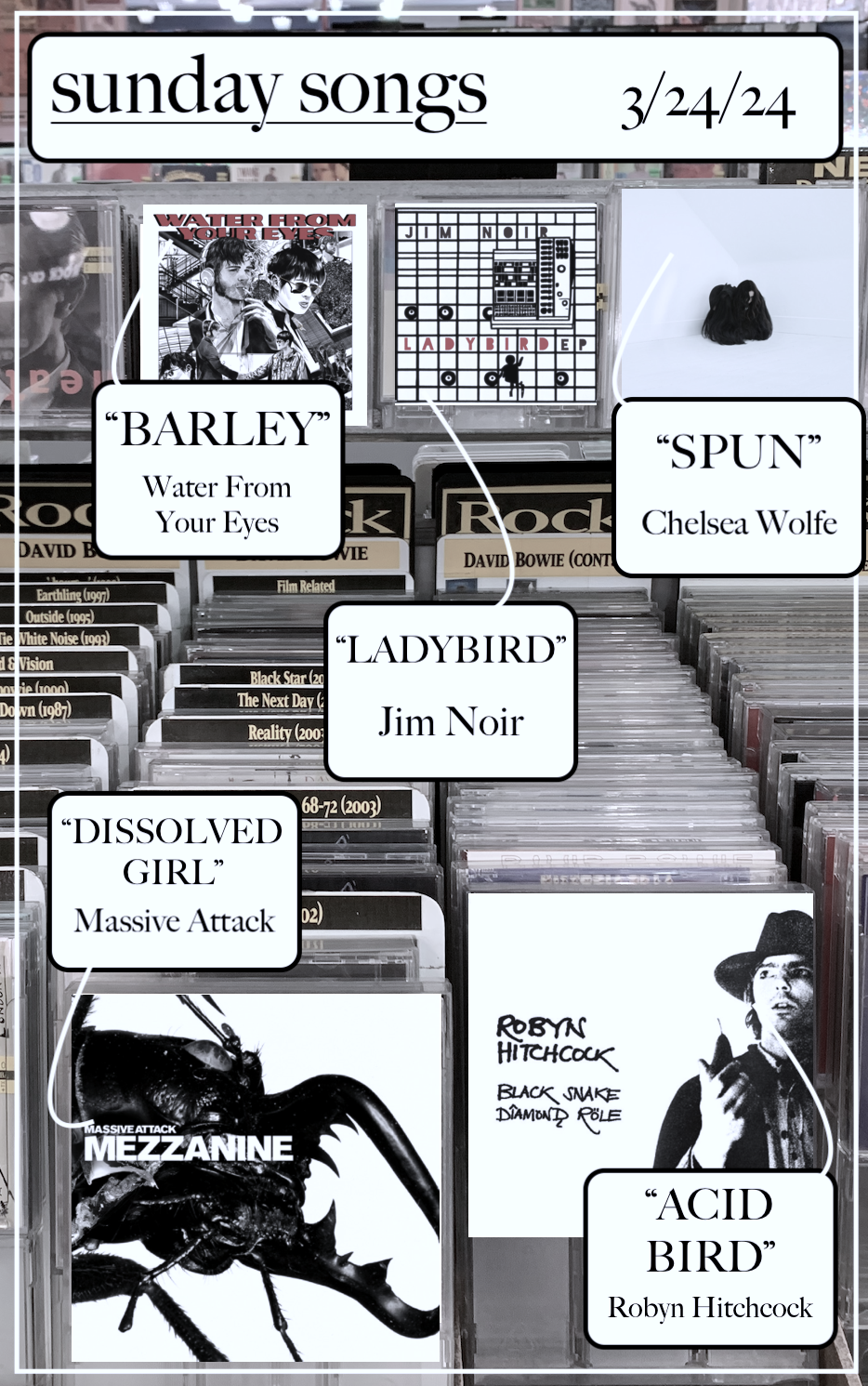
SUNDAY SONGS: 3/17/24

“Sarah” – Alex G

I knew it. I knew I’d fall into the Alex G trap eventually. My Car Seat Headrest-poisoned brain finally succumbed to another sad white guy with voice cracks and bedroom recording equipment. It was only a matter of time.

I genuinely can’t decide if “Sarah” is fully tragic, or if there’s some sweetness in there. The atmosphere that Alex G creates certainly leans toward the former; listening to this song is a blur from a car window, sticky with the humidity of the South as you drive past flat, dismal lawns and white-painted houses that have stood there so long that the paint has peeled and molded to brown in the corners. It dwells in a kind of dream-space where the narrator is hesitant to leave, knowing that the consequences will crash down upon them the minute they step foot into the less-green grass on the other side of the fence. Again, my mind has permanently been altered by listening to too many of the earlier, lo-fi Car Seat Headrest songs when I was at the tender, impressionable age of 14, but there’s an enchanting melancholy of the cheap distortion on the guitar and the synths that drift like ribbons underwater, each note trailing off like a thought unsaid. In a way, “Sarah” is a kind of love song, but with a love that’s overshadowed by the damning realization that you’re not the right person for the one you love. And yet, the narrator cannot extricate themselves from Sarah, wanting to cling to her desperately, but knowing that the more they stay, the more they’ll destroy her. It doesn’t feel like a self-hating, depreciating kind of awareness—it’s a crushing realization that the narrator really is, in some way, in a place where they’ll only drag the people they love down with them, against all of their wishes. That’s what makes it tragic to me; Alex G sings half of the song in a higher pitch that drives his voice to shattering cracks, and you can hear his voice break as he sings the line “she loves me like a dog.” The distorted howl of “did I make a mistake?” feels like it drifts up into a smoky, firework-scented sky as it dissipates into digital nothingness, an anguished thought birthed in the depths of introspection.

…AND A BOOK TO GO WITH IT:

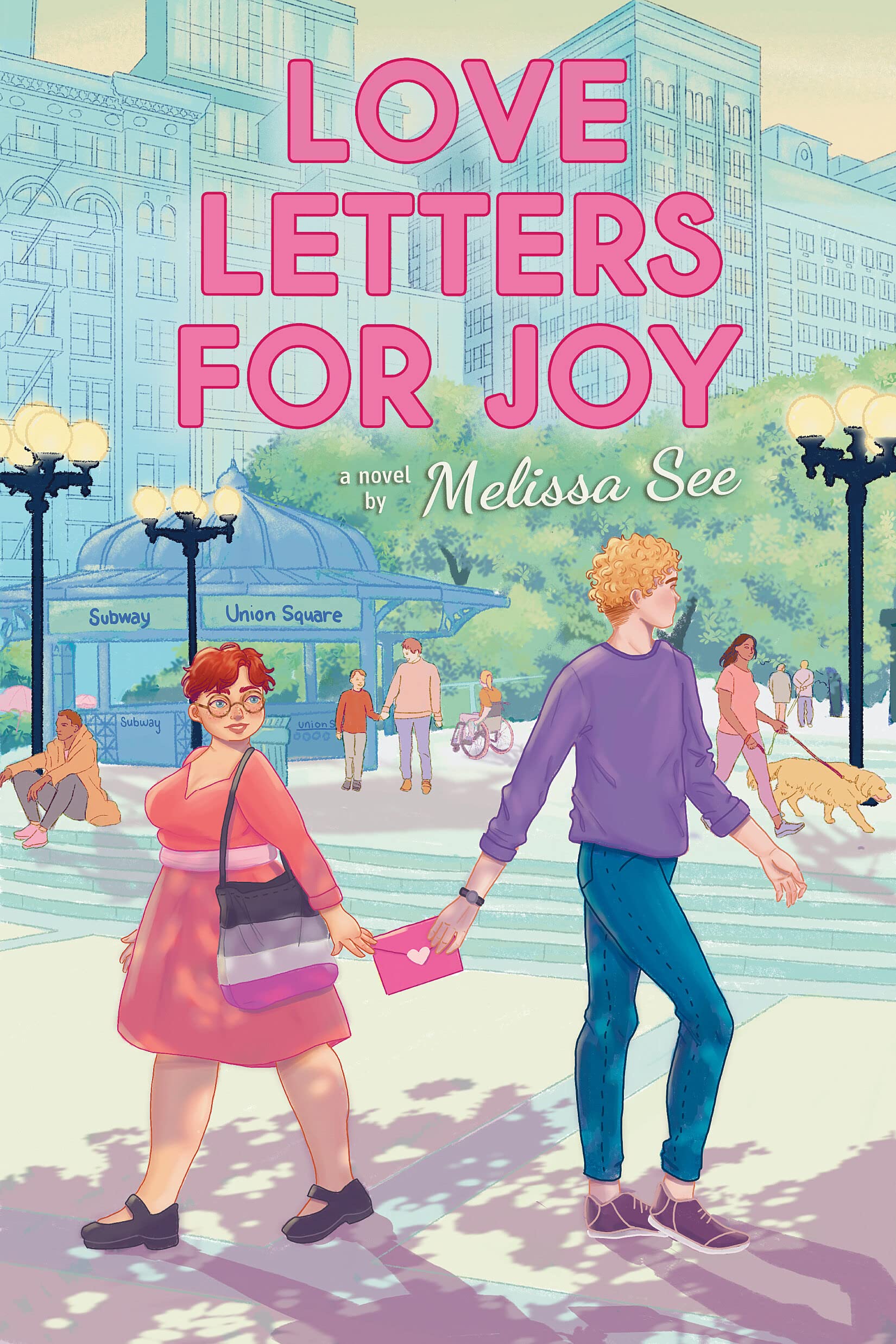
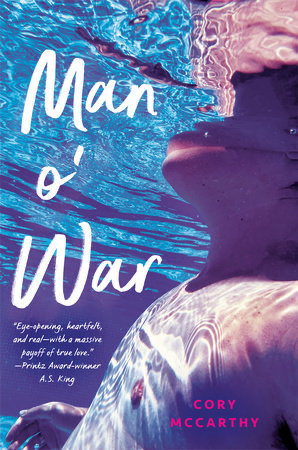
Man o’ War – Cory McCarthya painful and poignant journey of learning to love yourself and other people.

“Houdini” – Kate Bush

Two years ago, I doubt I would have listened to The Dreaming in full. I warmed up to Kate Bush’s earlier stuff more easily, but with the onset of the most recent season of Stranger Things, I was just kind of Kate Bush’d out, which, for a woman of her insane talent, it kind of embarrassing to say. I just couldn’t turn a corner without hearing “Running Up That Hill”—as objectively good a song as it is, the omnipresence of it turned me off. But two years, a listen to The Kick Inside, and more than a good word from my brother (the world has never seen a more fervent Kate Bush superfan), and I finally found myself here. I’m glad I listened to it now—even though my love for “Suspended in Gaffa” (still my favorite track) persisted through the summer of 2022, there was so much weirdness and artistry to the album that it was almost overwhelming—more than once it felt like that in a “mom, come pick me up, I’m scared” way (see: “Get Out of My House”), but overall, that was all apart of the package deal. Admittedly, I can’t fully get on board with all of it; as much as I love the lyrics to “Sat in Your Lap,” that song has irrationally annoyed me since I was a kid, and that quality hasn’t exactly faded—I wish it had, but it’s in the minority of songs that I actively skip on this album. After three albums, this almost feels like Bush’s Hunky Dory: the moment where she had honed her skills and image and officially started going absolutely bonkers.

One such aspect that Bush had nailed by the time that The Dreaming came around was channeling raw, untapped emotion; you can almost feel the bewildered, shaking tears slipping from her eyes as she is faced with something divine in “Suspended in Gaffa” and the feral release in the form of braying like a mule at the end of “Get Out of My House.” It’s overwhelming because it’s exactly what you’re supposed to feel—both of these songs are about separately intense and overpowering emotions, and I believe there’s very few musicians out there who can make that tidal wave translate from the music to the body. That’s already a feat, but given that she was 24 when she released this album…okay, I need to stop googling “how old was Kate Bush when she released [insert album],” because I inevitably get existential. Either way, it’s talent—and “Houdini,” the album’s grief-drenched penultimate track, is testament to that. Recounting the story of Houdini’s wife, Bess, who tried to contact him through seances with a code that the two had devised to ensure that it was him (“Rosabel, believe”); contact was allegedly made in 1929, but she lated believed the code to be the result of trickery from beyond the grave. It’s a deeply tragic story, and Kate Bush pulled no punches in drowning “Houdini” in sorrow. Soft piano dominates the piece, but when it isn’t demure and solemn, Bush lets out a mourner’s wail so convincing that I’d easily believe that she’s channeling Bess Houdini’s bereaved spirit as she bellows out “With your life/The only thing in my mind/We pull you from the water!” That image, of Houdini passing the key to his chains to Bess through a kiss, was what made it on the cover art—I thought it was a wedding ring for the longest time, but to be fair, only the round part is visible on her tongue, and the rest is concealed behind her lips.

…AND A BOOK TO GO WITH IT:

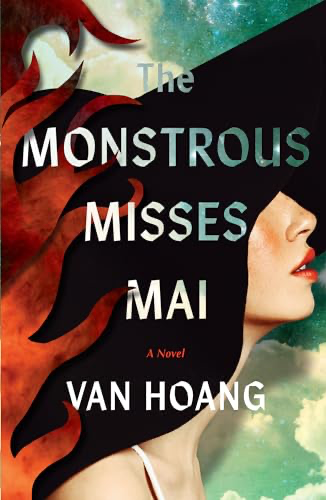
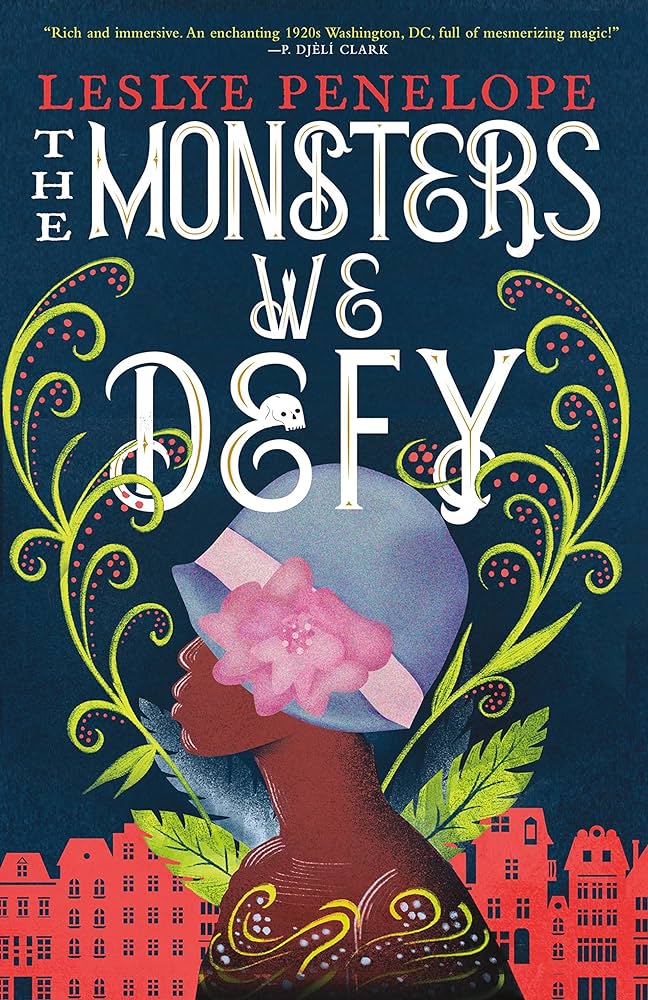
The Monsters We Defy – Leslye Peneloperomance, daring, and communicating with spirits beyond the veil.

“Objects” – Big Thief

Alright. That’s enough of the abject depression for now. Here. Sit down on the bench beside me. Here’s $20, go see a Big Thief.

I’d like to think that I’ve found out about all of these separate Big Thief songs independently, but in reality, all of the songs I end up listening to are the ones brought up by my fantastic brother’s equally fantastic girlfriend, so once again: thank you. If there was ever a song to describe this time of year—nearly spring, almost warm, and the grass is still brown but peppered with sprouts pushing through—it would be “Objects.” Each pluck on the guitar feels like worms and beetles gently crawling through crumbly earth, the shifting of tiny pebbles and dead leaf fragments as they bore tunnels through the ground. This was only recorded about eight years ago, but there’s already a stark difference in Adrianne Lenker’s voice; when I think of this song and earlier songs (see also: “Velvet Ring”), her voice sounds papery, thinner than thumbnails and soft enough to fold into simple origami. It’s gotten simultaneously more feathery, more feral, and richer with the years, but what I’ve heard of these first two Big Thief albums feel like time capsules in her vocal evolution. And like the springtime that “Objects” evokes, the lyrics are all about the spillover of love as it begins to blossom; like the same sprouts that push their way to the sunlight, the object of affection inspires the narrator to “[Leave] the familiar/Air is getting chillier/Stepping outside your skin.” It’s not just Lenker’s voice that feels understated—all of the instruments feel restrained and green, but it conveys that fizzy, bashful feeling of the beginnings of love.

…AND A BOOK TO GO WITH IT:

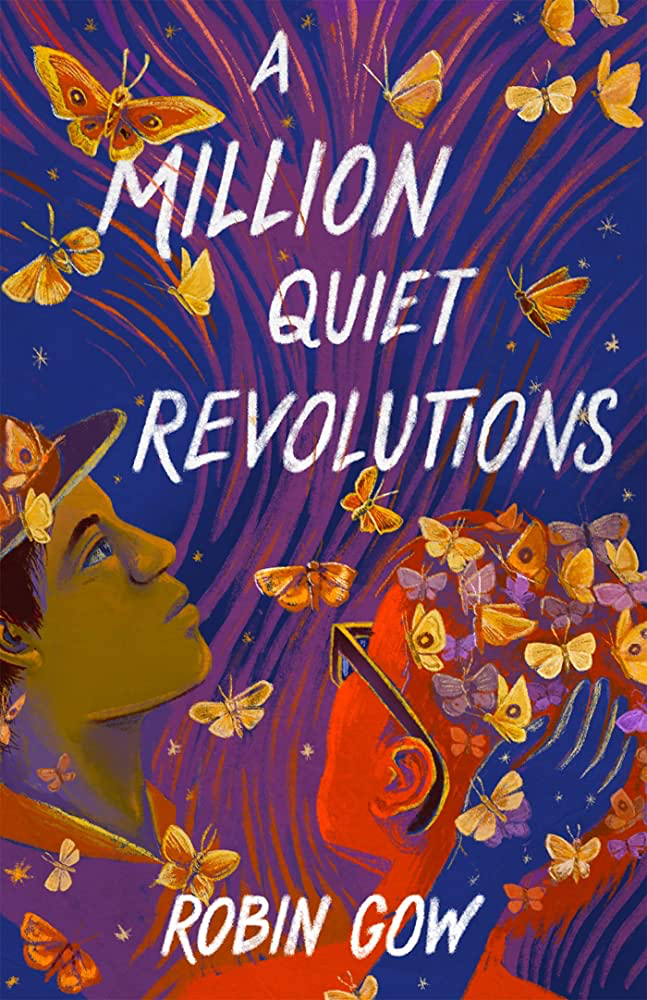
A Million Quiet Revolutions – Robin Gowqueering the Revolutionary War, and the blossoming of young love.

“Your Young Voice” – King Creosote & Jon Hopkins

I generally have Joe Talbot of IDLES to thank for a lot of things, namely the musical positivity he’s brought into my life, but I also have him to thank for finding this song. Recently, Talbot was featured on BBC’s CBeebies bedtime story segment, where, after reading the picture book Under the Love Umbrella, he listed off some songs to soothe children. This was one of them, and the minute I heard it, I understood completely.

This song is a very sparing one. In a sense, “Your Young Voice” is barely a song at all. It’s only two lines that repeat for almost three and a half minutes: “And it’s your young voice that’s keeping me holding on/To my dull life, to my dull life.” And yet, it tugs at the heartstrings more than some songs with a full verse-chorus structure of the same length. The lyrics are so simple, and yet, their repetition weaves together what a mountain of unnecessary stanzas do in any other piece; their repetition feels like a promise, a mantra—you get the sense that whoever’s young voice is keeping the narrator anchored, the only thing keeping them clinging to the end of their fraying rope. Repeated over these three and a half minutes, it feels like a prayer to remember why they’re enduring this life in the first place. King Creosote (a.k.a. Kenny Anderson…King Creosote is a fantastic stage name, if I’ve ever seen one) has a voice with a constant, shuddering waver that whispers over your ears like cold wind over the plains, and that waver is what cements that image of frailty and unconditional love for me. “Your Young Voice” is also simple in its composition—mostly acoustic guitar, with some piano that fades into the ending as Anderson’s voice dissipates into the fog, but this song is all about dredging the well of deep emotions from a place of emotions stripped bare: there’s no need for embellishment or flair. No matter if your interpretation of the young voice is a parent to a child or teenagers falling in deep (not the interpretation that would’ve come to mind first, but that’s how Sex Education took it, although they used a cover…not nearly as good as the original, in my opinion), this song is love, boiled down to its tearful essence.

…AND A BOOK TO GO WITH IT:

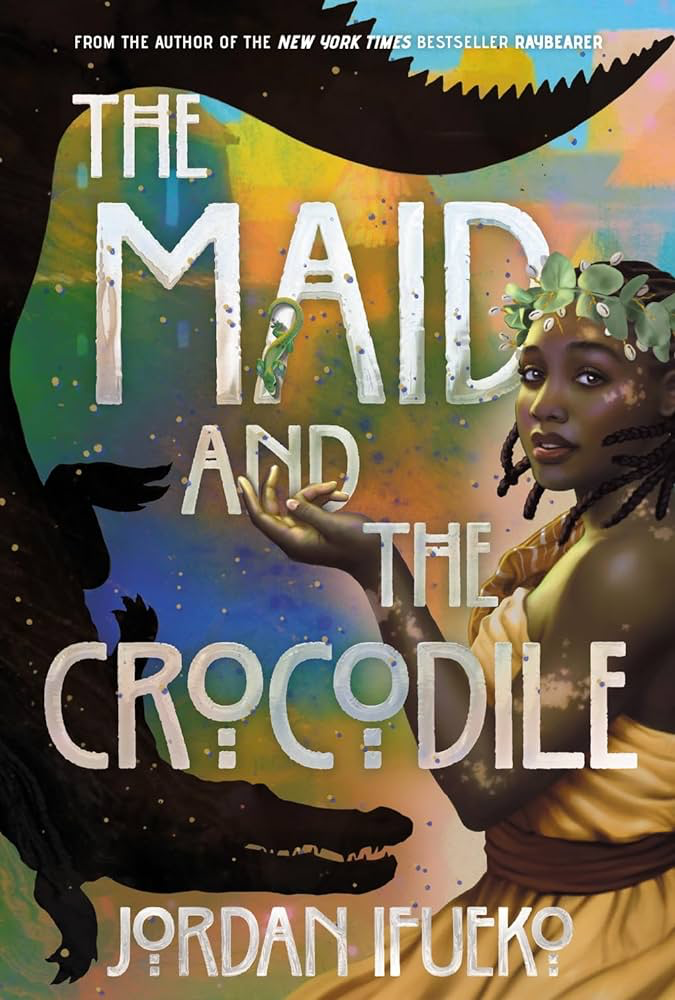
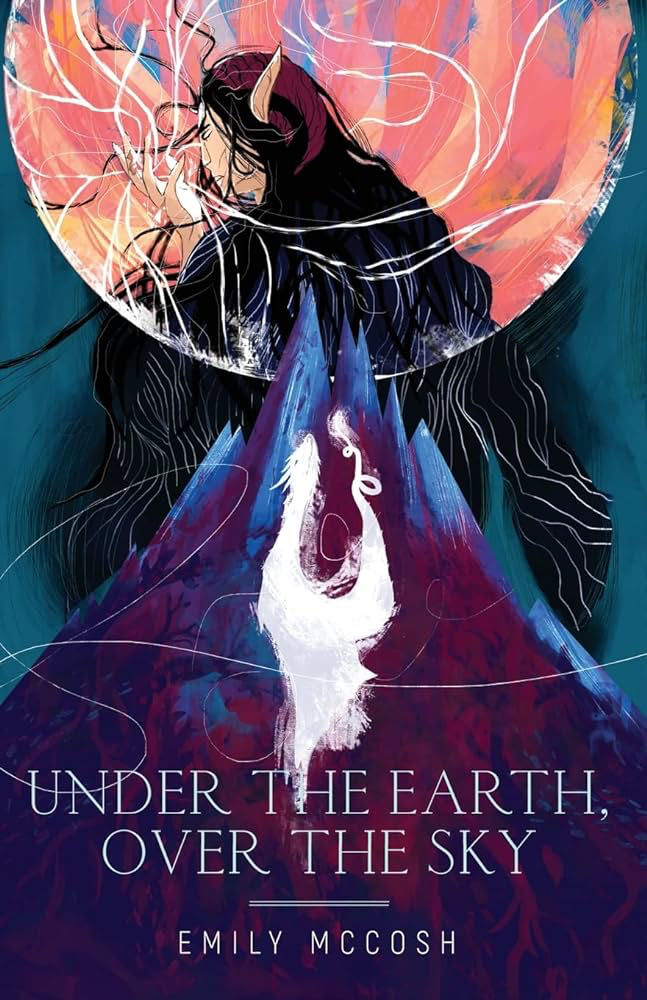
Under the Earth, Over the Sky – Emily McCoshnot to double-dip on the pairings (it’s been three months, it’s fine), but this one is an even better fit, in my opinion—the bare tenderness of the father-son relationship at the heart of this novel was made to be listened to with this song.

“My Mother & I” – Lucy Dacus

When I was thinking about organizing this graphic, I was just loosely going off of looks, not necessarily what order the songs are in. That’s generally how the process goes. However, there are times where I end up shooting myself in the foot and then turning around and shooting the feet of everybody else who might happen upon this post. I mean…I guess “Houdini” or “Sarah” would been kind of an awful way to end this batch, but it looks like we’re bringing down the house with…Lucy Dacus ruminating on the complicated relationship between her and her mother. Real light stuff to go with your Sunday morning cup of coffee, huh? My bad, guys.

2019, the album where “My Mother & I” appears, is part cover album, part original material, each song released to coincide with a holiday—“La Vie en Rose” for Valentine’s Day, “Dancing in the Dark” for the shared birthday of her father and Bruce Springsteen, and “In The Air Tonight” for Halloween (Lucy, it’s a good cover, but…that’s the song you cover for Halloween? Out of all the objectively spookier songs that exist?), etc. “My Mother & I,” as you probably gathered, was released on Mother’s Day, and also to coincide with Taurus season—both Dacus and her mother are Tauruses, part of what the song anchors itself around (“The stars have a lot to say/About women born in the month of May”). It’s a beautiful song, but I find myself glad that I haven’t been able to connect to it fully; the relationship that Dacus describes with her mother, the distance and later connection emphasized by the fact that Dacus was adopted, is one that seems to be full of fractures, but scored by the love that ultimately tethers them. I’m so close to my own mother that it makes me thankful that, even if I had the aspiration to write music, the only feeling that would come up is gratitude because I have the honor of being her daughter. There’s a restrained kind of sorrow that hints at places where Dacus seems to have needed the guidance of her mother (“They called me an old soul/When I was too young to know/The difference between a soul and a ghost/I feared what was inside/Trapped in my body, kept from the other side/A spirit searching for a second life”). “My Mother & I” comes from a place of wistful rumination, but ultimately reaches for a sense of forgiveness and commonality—Dacus branches beyond the Taurus connection to a wholly human one—”We want love, warm and forever/We want to die in the presence of our loved ones/My mother and I.” It’s…ow. Yeah. I don’t know why I went into a Lucy Dacus song that I hadn’t heard and not thought “hmm, surely it won’t be emotionally crushing!” But in this case, the emotional core comes from a kind of forgiveness that has taken years to spread its roots, but has only grown stronger in the dirt with age. And it seems that the forgiveness is mutual, since she’s since performed this song with her mother on backing vocals:

…AND A BOOK TO GO WITH IT:

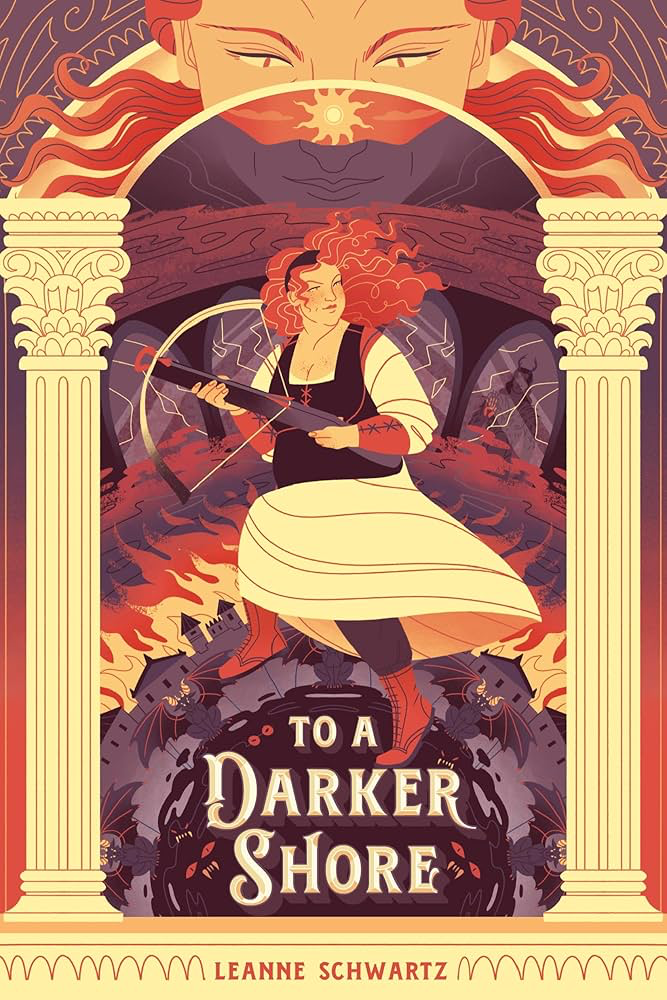
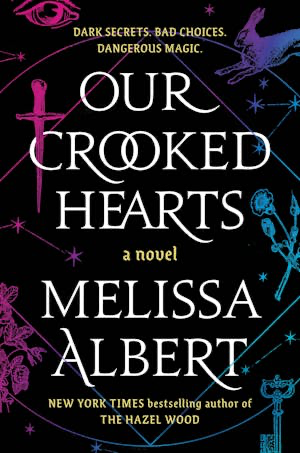
Our Crooked Hearts – Melissa Albertforbidden magic with lineage through a flawed mother and a daughter left to pick up the pieces.

Since this week’s post consists entirely of songs, consider all of them to be today’s song.

That’s it for this week’s Sunday Songs! Have a wonderful rest of your day, and take care of yourselves!

Posted in Book Review Tuesday

Book Review Tuesday (3/12/24) – Our Crooked Hearts

Happy Tuesday, bibliophiles!

I’ve been a huge fan of Melissa Albert ever since I fell in love with The Hazel Wood series way back when (2018? No way…I feel old…). I forget how or why it’s taken me so long to pick up her follow-up, Our Crooked Hearts, but it was worth the wait—this novel made me remember exactly what endeared me to Albert’s writing in the first place!

Enjoy this week’s review!

Our Crooked Hearts – Melissa Albert

Ivy has found herself at the center of string of unexplainable events. An eviscerated rabbit in her driveway. Secrets buried in the backyard. And now, a nude woman in the middle of the road that Ivy and her boyfriend almost hit with their car. The more she digs into these strange happenings, the more they lead to her mother, who dabbled in forbidden magic when she was a teenager. Ivy, now the age that her mother was when she started tapping into the supernatural, wonders if this magic has come back with a vengeance—and if there’s a way to control it before it comes back for her mother.

TW/CW: animal death/abuse/torture, blood, gore

I don’t know why it took me this long to pick up Our Crooked Hearts and how I could’ve possibly gone three years without reading something of Melissa Albert’s, because wow. This one toes the line between magical realism and horror, but either way you took it, there’s no doubt that Albert is the master of YA magical realism!

Let’s start with Albert’s obvious strength: the lyrical nature of her prose. Though Our Crooked Hearts wasn’t steeped in fairytales like the Hazel Wood duology was, it was no less enchantingly written. Every line feels like its own fairytale, full to bursting with metaphors so unique I found myself highlighting up and down the page. Albert has the ability to weave magic into the smallest of things, from the small moments in the suburbs to the unexplainable events that litter the plot like strange trinkets found on the side of the road. The Hazel Wood was already luscious, but Our Crooked Hearts feels like a maturation of everything that makes Albert’s writing good: a recognition of the magic in everything, but also of the darkness behind the glitter.

The way that Albert writes magic itself was just as compelling! Though the magic system itself is not gone into depth, it’s understood to be the kind of magic that only awakens in the shadows, summoned by girls left to their own devices without any clue of the consequences. I understood some of the unexplained bits to be a byproduct of how little Dana, Fee, and Marion understood of what they were getting themselves into—they knew about as much as we do. Like the relationships running through this novel (more on that later), it is an undercurrent to every decision that they make, rooted in revenge but later a series of bandages to throw over every little breadcrumb they leave behind by accident. On that note, I loved that this wasn’t simply a revenge story—it started as such, but that revenge grew into something so monstrous that it was spread down through generations. Hmm, sure feels like a metaphor to me…

Our Crooked Hearts is written in a dual POV between timelines, following our protagonist, Ivy, and her mother, Dana; Ivy’s perspective finds her in a quiet suburb, while Dana’s perspective is set in Chicago in the ’90s. I loved how the two of them evolved in tandem—dual POVs aren’t especially difficult to pull off, but having them set in different timelines was such a wonderful move to not only elevate the story, but deepen the mother-daughter relationship at the heart of the novel. In terms of literary fiction, I feel like there’s a trend of multigenerational novels (somehow they’re all set in New York) where they hop between time periods and family members; sometimes they’re successful (see: Elizabeth Acevedo), but often, they miss the nuance of familial connection and just focus on being literary. This is far from literary fiction (complimentary), but what this novel does that a lot of others don’t is make the timelines feel distinct. Ivy and Dana have radically different personalities, and though their journeys of dabbling in forbidden magic are similar, their goals—and endpoints—were so different that I found myself fully invested in both of them.

Mother-daughter relationships are at the heart of Our Crooked Hearts, and the dual POV makes for such a fascinating examination of when such relationships become toxic, and the events building up to the toxicity once Dana began raising Ivy. Dana’s perspective was one of constantly being pulled along—by her friends, by authority figures, and by forbidden magic beyond her comprehension. The guilt that resulted from living a life predicated almost entirely on the decisions of other people tragically informed how Ivy grew up—picking up the pieces, and discovering the pieces of her mother along the way. Without spoiling the ending, I loved how it was resolved—there’s no immediate absolution of guilt once familial ties are brought up (unlike a certain recent Disney film beginning with E), but there’s an understanding to how and why things turned out the way they did. Ivy is still left to sift through the wreckage, but all that she thought was lost was not far beyond reach.

Also, one thing that Melissa Albert can always be counted on is top-tier music references. All she had to do was mention Dana putting Liz Phair on the jukebox, and I was already foaming at the mouth.

All in all, a horrific and lyrical observation on magic and teenage girlhood, mothers and daughters. 4 stars!

Our Crooked Hearts is a standalone, but Melissa Albert is also the author of The Hazel Wood duology (The Hazel Wood, The Night Country, and the companion novel Tales from the Hinterland) and The Bad Ones. She is also the founder of the Barnes & Noble Teen Blog.

Today’s song:

That’s it for this week’s Book Review Tuesday! Have a wonderful rest of your day, and take care of yourselves!

Posted in Sunday Songs, Uncategorized

Sunday Songs: 3/10/24

Happy Sunday, bibliophiles! I hope this week has treated you well.

Don’t let the black color scheme full you—we’ve got a mostly joyful bunch, and if not joyful, at least upbeat. This week: what happened when I listened to Apple Music’s “Love” station on a whim, things that are wholly good and pure, and reflecting on the things that made middle school survivable.

Enjoy this week’s songs!

SUNDAY SONGS: 3/10/24

“After Hours” – The Velvet Underground

The story of “After Hours” famously goes that Lou Reed wrote this song, but knew it was too pure and innocent for him to possibly sing, so he enlisted Mo Tucker, the Velvet Underground’s drummer, for the task. As much as I love Lou Reed, he did the world a great service by not singing this song—in his hands, there’s no doubt that it would’ve felt like some kind of melancholic “Perfect Day” prequel, but at least he was self-aware enough to realize it. And there’s nobody more fit to sing it than Tucker. Her voice is beautiful, but it’s the voice of someone who rarely sings, if at all, and sings softly when she does. But that’s exactly the kind of voice that “After Hours” calls for. It’s a bashful, rosy-cheeked song, the kind that shyly peers out from behind the curtain to watch the bustling city below. There’s an embarrassment to it, but not the kind that makes you wince—it’s a diary confession written as the last threads of light are fading from the sky, the last pure thoughts filtering out of your brain. It’s so simple, and yet that’s why it digs at such a unique place in my heart—it’s not quite universal, but it’s just the kind of special to nestle up against me like a drowsy cat. There’s practically no end to the influence that The Velvet Underground has had on rock music, but I feel like “After Hours” is overlooked in that aspect—without it, where would the glorious pantheon of wistful women and their acoustic guitars come from?

Bonus: because somewhere down the line we collectively recognized that this song is best performed by female drummers, here’s a performance by Meg White of the White Stripes:

…AND A BOOK TO GO WITH IT:

Heartstopper – Alice Osemananother pure, sweet morsel of tenderness.

“Broken Man” – St. Vincent

It’s happening. IT’S HAPPENING. IT’S HAPPENING!!!

All Born Screaming? Uh, yeah, I sure am. The squeal I let out at 7 A.M. when my mom shared this new single could probably be heard through my whole dorm. I’m just glad that my RA didn’t catch on. After a solid month of teasing, first with the ceremonial removal of the Daddy’s Home blonde wig, then with throwbacks to her performance of “Lithium” with the surviving members of Nirvana at the Rock and Roll Hall of Fame (to the people saying “oH, shE’s sO oFf-KeY” about this one: did you all just forget how Kurt Cobain sang, or what?) and her performance of “Krokodil” at Coachella in 2012, we finally have the St. Vincent rock album that we’ve always wanted. I’ve gone past the point of trying not to hype myself up for this one—somehow I feel like it’s not gonna be another MASSEDUCTION incident, because everything about this album— the aesthetic around it, and its collaborators (Dave Grohl on drums in this track, and Cate LeBon featuring on another)—feels like it’s going to rock. Annie Clark always seems to have a clever, cheeky album title up her sleeve, but All Born Screaming has to be one of the harder ones. And the album art…well, yeah. Let’s get the elephant out of the room—it’s great album art, but the timing was…not good, as it came just days after Aaron Bushnell self-immolated to call attention to the ongoing Palestinian genocide. (Rest in power. Chip in where you can.) But at the same time, there’s no way that Clark or her team could have predicted that kind of thing. I really don’t feel like she’s at fault here—it’s bad timing, sure, but none of us can be expected to foresee everything in the news.

Back to the song…I need to be stopped. Somebody needs to hold me back…or, at any rate, somebody should’ve held me back on the Thursday morning when “Broken Man” came out, because I listened to nothing but that song from approximately 7-11 A.M, and I had to go about three days before I could listen to it again. I’ve learned nothing. But now that I’ve ridden the initial high, I’m reveling in the new direction that St. Vincent has started to go towards with All Born Screaming. Most of the comparisons I’ve seen wind up somewhere in the neighborhood of Nine Inch Nails, P.J. Harvey, and Rage Against the Machine, and I can see all of those, especially with the former two—the industrial grind of Trent Reznor and the feral, growling vocals of P.J. Harvey are wound all over this track. Like the album art, it’s painted in the colors of ashes, still hot to the touch and rough between your fingertips. Clark has toed this line more often than not (see “Krokodil”), but we’ve gotten an album where she’s fully embraced her heavier side—one that she’s always had the capacity for, but somehow bottled up before throwing herself into All Born Screaming, the first album that she produced herself. It oscillates smoothly between hectic, metronome-ticking pop, uncomfortably sung from inside of a steel crate as she taunts the listener with her head peering out of the lid. It feels like a callback to the frenetic, pent-up energy of her self-titled record [slides Anthony Fantano glasses up the bridge of my nose], but with even more fury—every other lyric feels like a spit-laden taunt: “Who the hell do you think I am?/Like you’ve never seen a broken man?” With each verse that goes by, every word is spat with more intention, more vitriol, swerving between her silky, whisper-vocals to a full-on, sweat-drenched growl as the song closes. And this song’s breakdown is one of the most exciting of her songs in recent years; crashing in with Dave Grohl’s legendary drumming, you can’t describe this song with anything other than “fiery”: it’s a primal scream of a song, burning, biting fervor engulfed in flames. And I can’t help but get excited about the choreography in the music video—as flames dance across her neat, white button-up and slicked-back ponytail, her arms play a game of “the floor is lava” with her torso, jerkily twisting to avoid some point of contact. An eagle-eyed YouTube commenter compared it to her choreography for “Rattlesnake,” and…oh god, now I’m way too excited. Daddy’s Home is the best of her more recent work, if we’re going post-self-titled [slides glasses up even further] but…don’t do it. Don’t give me hope.

…AND A BOOK TO GO WITH IT:

Gearbreakers – Zoe Hana Mikuta – industrial landscapes abound and all-around badassery to spare.

“Red’s Ok” (from Hellboy II: The Golden Army) – Danny Elfman

Fast-forward to 8:20 for “Red’s Ok.”

Hi. Gonna try and be calm about this one. As calm as I can be when I feel the raw, untamed power of my middle school Hellboy hyperfixation coursing through my veins. The deluxe edition of the Hellboy II soundtrack showing up on my Apple Music suggestions on an unsuspecting Sunday morning was certainly a kick in the pants that sent me hurtling back to 2017 at alarming speeds, and I have yet to reach terminal velocity.

I don’t know what prompted the release—last year would’ve been fine, given that Hellboy II turned 15 that July. Who knows. Just up and popped out of nowhere. But man, I am so glad that it did. Having this expanded edition just goes to show how many gaps were left out of the original soundtrack, even if many of them (including this song) are under a minute long. I’m convinced that there was some kind of rush in putting together the original soundtrack, since now we know that the random tidbits that didn’t seem to come from anywhere that were tacked onto the end of “Finale” were, in fact, two alternate versions of songs that were almost used in the troll market scene. Again: who knows how that happened. But now, the score feels as whole as ever—those short-and-sweet tidbits fill in the crucial gaps, the silly, almost jazzy flourishes to plump up some moments of witty banter (of which there are many), fleshed out a soundtrack that’s cemented itself in the nostalgia catalogue of my mind. “Red’s Ok,” in particular, is the wonderful variation on the tasteful electric guitar motif, shown just as we see Hellboy emerging from the wreckage of a car he’s just landed on top of, wielding the Good Samaritan in the film’s most honest-to-god movie poster moment. And we get the full, 7-minute long cut of “Where Fairies Dwell.” I was born in the right generation. Born too late to see the rockstars I like, born too early to explore space…but born just in time to be able to listen to “Fuck-Used”. Bless.

My good feelings towards Elfman himself have started to fade after the allegations that came out last year, and this doesn’t change that, but I can’t deny the talent that went into this soundtrack, as well as the countless others he’s crafted over the years. Admittedly, his work has become so entangled in my life that, even though I’m all for theoretically separating the art from the artist, the truth is often far more complicated than putting the allegations in one box and their art in the other. I don’t necessarily know if it’s a personal flaw that I can’t detach from people that easily (lord knows I haven’t been able to listen to Arcade Fire as often as I used to without feeling a little moral revulsion). It’s not like J.K. Rowling’s transphobia and other prejudices manifested out of thin air directly after she wrote Harry Potter. And yet, I’d be the world’s worst liar if I denied how dear this film is to me. 13-year-old me saw this and saw an image of found family, of freaks who banded together in a world that was bent on destroying them, of freaks showing affection and forgiveness towards the world and each other, and it stuck. It did something to me. It showed me a possibility of a future that I could live out. At least it’s just the soundtrack in this case, and not the film itself. That’s all safe. I don’t even want to entertain the notion of Guillermo del Toro having any metaphorical skeletons in his closet, because given what the guy’s house looks like, he definitely has some plastic ones lying around. But it seems like he’s the type to keep it to that.

So I’ll be excited for the middle schooler in me. When this came out, I painted my nails and listened to this as they dried, remembering that there was a part of me back then that should be cherished—the one that didn’t care what anybody thought, and the one that watched this movie at least once a month.

…AND A BOOK TO GO WITH IT:

Hellboy II: The Art of the Movie – Guillermo del Toro yeah, this was the obvious pick, but what else was I gonna do? Put in the movie novelization? Imagine swapping out “Dr. Manning, suck my ectoplasmic schwanzstucker” for “Manning, you’re a jerk.” Unconscionable.

“POP POP POP” – IDLES

It’s been almost a month since TANGK was released, and I find myself drawn to it over and over again, simply because it’s so IDLES in a way that I haven’t seen from them. Like I said when I talked about “A Gospel” back when the album was released, it’s a beast that’s half old and half new, but brimming with the same ethos of kindness with a hard-edged sound. While “A Gospel” and “Grace” were the album’s pinnacles of vulnerability, “POP POP POP” just seems like the place where Nigel Godrich went nuts—it feels like IDLES trying to make a Radiohead song, but never once does it feel like a blatant imitation. It has an angular, jerky smoothness to it, with the combination of synths that buzz like a hive of insects with Joe Talbot’s voice—the lyrics aren’t screamed like he tends to do, but with a dry, disaffected drawl that signals irony, but knowing IDLES, it’s a sign of bare sincerity just as any other bellow he lets out. On the inside, the lyrics are similar to most of the material on this album—a shield of kindness against a wave of hatred: “Strong like bull/Vulnerable (vulnerable)/Keep my people up/That’s my tool.”

But there’s something resolute about the way that “POP POP POP” is delivered—it’s almost like he’s drawing not from a place of repeating himself, but convincing himself of his mission. I’ve seen a fair amount of people in internet music circles roll their eyes at IDLES for acting like their lyrics are more radical than they are, which…I halfway understand. A lot of their subject matter in their music isn’t exactly new in terms of political fodder to spin into music. But is there really anything new, political or otherwise, that you can write a song about? I find myself thinking of Audre Lorde and her essay “Poetry is Not a Luxury,” where she states that “…there are no new ideas. There are only new ways of making them felt, of examining what our ideas really mean on Sunday morning at 7 AM…[while] making war, giving birth.” I get why people are put off by IDLES seemingly acting like their ideas are new (I’ve never gotten that impression, but that’s just me), but personally, that was never what was radical about them—it’s their approach to kindness. It’s unclear whether this is the exact criticism that may have spawned “POP POP POP,” but the final verse, chanted like a prayer as the hive of synths descends into a buzzy, Kid-A maelstrom, feels like Talbot convincing himself of the message that he and the band have always pioneered: “Imposter, imposter, living in my head/Am I the spider in your bed?/A dead canary and a thief for a king/A cheerleader valiant/But I will sing about love, love…” And as his voice gets overlaid, the final chant that rings out is the tagline for the later track “Grace” and this album’s tour: “love is the fing.” It feels like reassurance in a sea of self-doubt, a reminder of a message to be held dear, a mission statement lost in the mist but found again when it came time to look back and remember why they created it in the first place. And as with the ending of this song, what persists is four essential words: “love is the fing.” You look back into all of the mess that your creativity has taken you, and what you find at the center is the love that motivated you to create in the first place.

…AND A BOOK TO GO WITH IT:

Kindling – Traci CheeI just reviewed this one, so it’s pretty fresh in my mind, but the last, more distorted lyrics made me think of these characters and their struggles to grow out of their trauma and persist—”Imposter, imposter, living in my head/Am I the spider in your bed?/A dead canary and a thief for a king/A cheerleader valiant/But I will sing about love, love…”

“Just One Look” – Doris Troy

The other day, I decided to listen to Apple Music’s Love station on a whim—I was drawing before bed, and I wanted something new to listen to. It ended up having mostly hits, some misses (one of the hits was “After Hours,” but I’m honestly concerned about the fact that there was…an Elliott Smith song on there? Not the weirdest Apple Music pick, but I don’t know if that screams “love”…), but it was the reason that I stumbled upon this song, which I am so grateful for. Scratch that—I’m grateful, but more than anything, I’m more surprised than anything that I’d never heard of her before then, given the company that she kept: she was first discovered by James Brown, and later collaborated with everybody from The Rolling Stones to Pink Floyd (she contributed backing vocals to Dark Side of the Moon, my god…). With all that, a musical based on her life, and a number one hit, you’d think we would be hearing more about her, but alas, nope. Whether or not that’s just another testament to how history treats Black women or the fact that she stepped away from the mainstream music industry after the ’70s is up in the air, but either way, I’m glad the Love station brought me to her.

I’ve always had a soft spot for that late ’50s-early ’60s soul. As much as I laud other artists for having intricately crafted lyrics, sometimes, it’s simplicity that wins out—and that was exactly what labels like Motown were the best at producing. Artists like The Temptations, the Ronettes, and others feel like they’ve distilled love—one of the most complex human emotions—down to its barest essentials. Every song becomes something so tender and universal that it feels like a warm blanket for the soul. Along with the rich vocals that often came with it, and you’ve got one of my favorite musical soft spots—I’ll take shreddy guitars any day, but sometimes, all I need is some wholesome love. That’s exactly how “Just One Look” feels—brimming with warmth, and the perfect tempo for slow-dancing in the kitchen. Only seconds into the song, and you can hear exactly why Troy’s fans gave her the nickname “Mama Soul”—soulful is the only adequate word to describe her rich, soaring voice. Combined with the air light touch on the piano keys, and I’ve got another comfort song in my collection—there’s something to be said for simplicity.

…AND A BOOK TO GO WITH IT:

DC: The New Frontier, vol. 1 – Darwyn Cookethe lyrics for this song are so universal that they could cover any kind of romance, so instead, I went for the time period; the late ’50s-early ’60s setting of The New Frontier is settled right in the same era.

Since this post consists entirely of songs, consider all of them to be today’s song.

That’s it for this week’s Sunday Songs! Have a wonderful rest of your day, and take care of yourselves!
Posted in Books

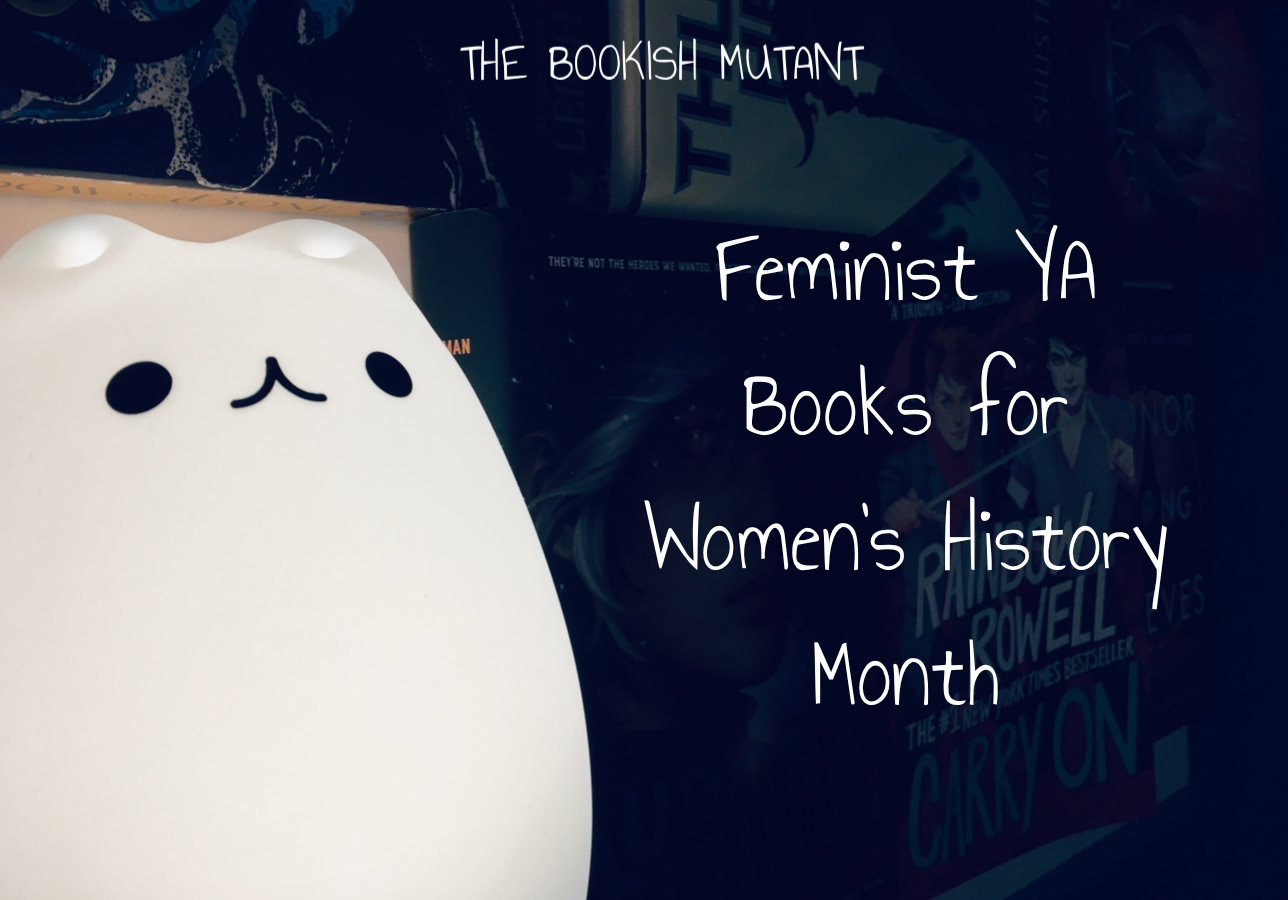
The Bookish Mutant’s Feminist Books for Women’s History Month (2024 Edition)

Happy Friday, bibliophiles, and more importantly, Happy International Women’s Day!

Here in the U.S., March is Women’s History Month! In the years since I’ve started making these posts, the amount of attacks on women—in terms of laws attacking our bodily autonomy (as well as the bodily autonomy of trans and nonbinary people) and worldwide violence—has only increased. And amidst all of this turmoil, all I can take from this is that now, more than ever, we need feminism. We need to educate people, we need to help people to become less ignorant about the litany of issues plaguing marginalized groups here in the states and elsewhere. That, to me, is the most insidious consequence of the book bans spreading across the country: you take away a child’s ability to learn about perspectives outside of their own, and you produce an ignorant generation that does not question authority. In the absence of sound authority figures, books, more than ever, are our most valuable teachers.

Another change from my lists in previous years is that since my reading tastes have expanded, I’ve added adult and nonfiction books to this list—all of which I believe are just as valuable to feminism as any other book I’ve included. Enjoy!

For my previous lists, click below:

Let’s begin, shall we?

THE BOOKISH MUTANT’S FEMINIST BOOKS FOR WOMEN’S HISTORY MONTH (2024 EDITION)

SCIENCE FICTION:

FANTASY:

*NOTE: The Siren, The Song, and the Spy is book 2 in a series, but I feel it should be included on this list for the feminist themes included in this book in particular.

REALISTIC FICTION:

NONFICTION:

TELL ME WHAT YOU THINK! Have you read any of these books, and if so, what did you think of them? What are your favorite feminist books? Let me know in the comments!

Today’s song:

never thought I’d go through this whole album bc I was so Kate Bush’d out in 2022 but this one’s fantastic almost all the way through

That’s it for this list! Have a wonderful rest of your day, and take care of yourselves!

Posted in ARC Reviews

ARC Review: Kindling – Traci Chee

Happy Tuesday, bibliophiles!

And you may ask yourself…me? Doing ARC reviews again? Kind of. I did stop doing them in late high school because my schedule was getting too busy to stay on top of them, and now, I’m even busier than I was back then, so I doubt I’ll go back to Edelweiss. But I entered myself into a Goodreads giveaway for Kindling, and I was lucky enough to receive a physical ARC! I’m glad to say that Traci Chee’s latest fantasy novel doesn’t disappoint—innovative and heartbreaking in equal measure.

Enjoy this ARC review!

Kindling – Traci Chee

The war is over, but in the wreckage are kindlings. They are child soldiers, pawns imbued with unimaginable powers who fought and died on the front lines, all for a war effort they could not comprehend. Now, there is peace, but it is uneasy—the violence has not ceased, and those who were left stranded by the war have nowhere left to go. From the ashes, seven former kindlings have come out of the woodwork, ready to fight one last battle to ensure the safety of their country—and their futures.

I received this copy in a Goodreads giveaway. Thank you to HarperCollins publishing and Goodreads for this ARC!

TW/CW: graphic violence, child soldiers, blood, war themes, PTSD, loss of loved ones

Without a doubt, this is Traci Chee’s most experimental—and most tragic—book to date. It’s a book that manages to execute so many feats of acrobatics and lands every single one of them; in every way, Kindling is a success!

First off: the element that probably grabbed everyone straightaway. Not only does Kindling have seven POVs, all of them are written in second person. Both of those tricks are already a hefty load to take on, but to execute them both at the same time? That’s just madness. And yet Traci Chee pulls it off with flying colors. A lot of second-person fiction that I’ve read uses it as a way to draw the reader in, but after that, there’s nothing innovative about the story beyond a difficult POV to the story. But Chee utilizes it in such a unique way—it’s not just a clever trick, but a way to make us feel closer to these characters. You are the one witnessing these atrocities, war ravaging the land. You are the one watching your friends die. There’s an instant connection. And for the most part (with some exceptions), Chee manages to make all of the characters feel distinct while pulling off second person. Now that’s impressive.

I always love novels that explore the aftermath of war, or at least some kind of conflict; in a sea of both fantasy and sci-fi novels that have neat, happy endings in the wake of devastating wars, Chee really seems to understand the messiness of picking up the pieces after such a tragedy has ripped the world of Kindling apart. Everything happens after the war that changed the characters’ lives, and everything is still in chaos and turmoil. Aside from the “one last fight” trope, used as an homage to the inspirations for this novel (Seven Samurai and The Magnificent Seven), it gave a ripe opportunity to explore trauma—not just the inherent trauma that comes with being a child soldier, but the trauma of grappling with PTSD at a very young age, and the trauma of being deified by the war effort, in Amity’s case. Never at any point is Kindling an easy read—and that’s exactly the way it should be.

Kindling is squarely a found family novel, but Chee explores an aspect of it that is often overlooked—found families formed through trauma. Each of the characters, most of which are appropriately fleshed out, are given the individuality and arcs that they deserve, but all of them are informed by the war, and their status as ex-Kindlings is what binds them—and motivates them. They’re sticking together for survival, but the friendships that they form in the heart of hardship are what makes the core of this novel so emotional. There are so many tender moments shared between the characters, and they made the stakes of this novel so much more palpable—you felt, more than ever, that they really were children, and that they would never be the same after being used as pawns of war.

SPOILERS AHEAD

Tragically, Traci Chee also demonstrates in this novel the two most crushing ways of writing fictional deaths. Particularly with Emara and Amity, Chee is skilled at timing them just right to make the most impact on both the reader and the characters. Emara’s death was the most sudden, and it having it happen so quickly after building up that she might have been safe was a way to not just shake the characters, but up the stakes—if Emara wasn’t safe, then neither were the rest of them. Amity, on the other hand, was set up from the beginning to die from Kindling burnout (the result of overuse of her magical powers), but you got to know her so deeply and intimately that, even though you knew from the beginning that she was doomed, her death felt just as tragic as it would have been if it was completely unexpected, like Emara. What I’m trying to say is that this book destroyed me. Traci Chee knows how to do it a little too well.

All in all, a novel that balanced tenderness and tragedy in equal amounts, making for a poignant novel about war and the bonds that bind us. 4 stars!

Release date: February 27, 2024

Kindling is a standalone, but Traci Chee is also the author of the Sea of Ink and Gold trilogy (The Reader, The Speaker, and The Storyteller), We Are Not Free, and A Thousand Steps Into Night.

Today’s song:

That’s it for this week’s book review! Have a wonderful rest of your day, and take care of yourselves!

Posted in Sunday Songs

Sunday Songs: 3/3/24

Happy Sunday, bibliophiles! I hope this week has treated you well.

This week: spring green for March, old dogs, and the consequences of the fact that at least 90% of my friends are gay and their music tastes rub off on me.

Enjoy this week’s songs!

SUNDAY SONGS: 3/3/24

“What Are We Gonna Do Now” – Indigo De Souza

This just in: the sad girl kool-aid has never left my system, and it likely never will. Buckle up.

“What Are We Gonna Do Now” lives squarely in the liminal space of uncertainty, as the title implies. It feels like the tense opening to a film; I could just be stuck on this imagery of the line “and we’re still on call with the nurses,” but I can’t help but imagine an opening shot panning out from the slow spikes of a heart monitor, slowly letting out beeps as Indigo De Souza’s voice gently drips like an IV with that lingering, trailing question: “what are we gonna do now?” Almost everything is gradual about this song, as if the verses were frozen in time: a picture of a person standing on the street while snowflakes suspended in midair decorate the space around them. De Souza’s voice dips and dives into nooks and crannies that only a cat could fit into, army-crawling through the shadows as she describes the wear and tear of a relationship in the middle of turmoil—not necessarily on the verge of a fracture, but in the middle of the storm that they aim to push through together. Exhaustion and frustration tinges it (De Souza’s delivery of “and I’m never cooking up what you’re craving” remains one of my favorite parts of the whole song), but it’s never the kind so intense that would throw their love out the window—it’s the determination of trying to find out exactly how to fix things, and scrabbling around, searching for answers in desperation. Like the ebb and flow of love, the instrumentals swerve from a near standstill to a rousing, guitar-driven chorus and back to quiet again, but after the first verse, nothing is the same; it has the same kind of barely-contained chaos of songs like Wilco’s “Via Chicago” and Mitski’s “The Deal,” with a sense that the anxiety of making amends and grasping for solutions. As De Souza’s airy voice rises like she’s gasping for air after emerging from the ocean, trembling drums and tambourines slip in and out of time, ever so slightly off-kilter and teetering, like one sneeze would send them all into disarray. Unlike the former two songs, though, it never fully gives in, but the unraveling is always at the back of the song’s mind, like an overflow of fearful thoughts as they try to pick up the pieces, but a sense of deep-breathing control as De Souza picks themselves back up.

…AND A BOOK TO GO WITH IT:

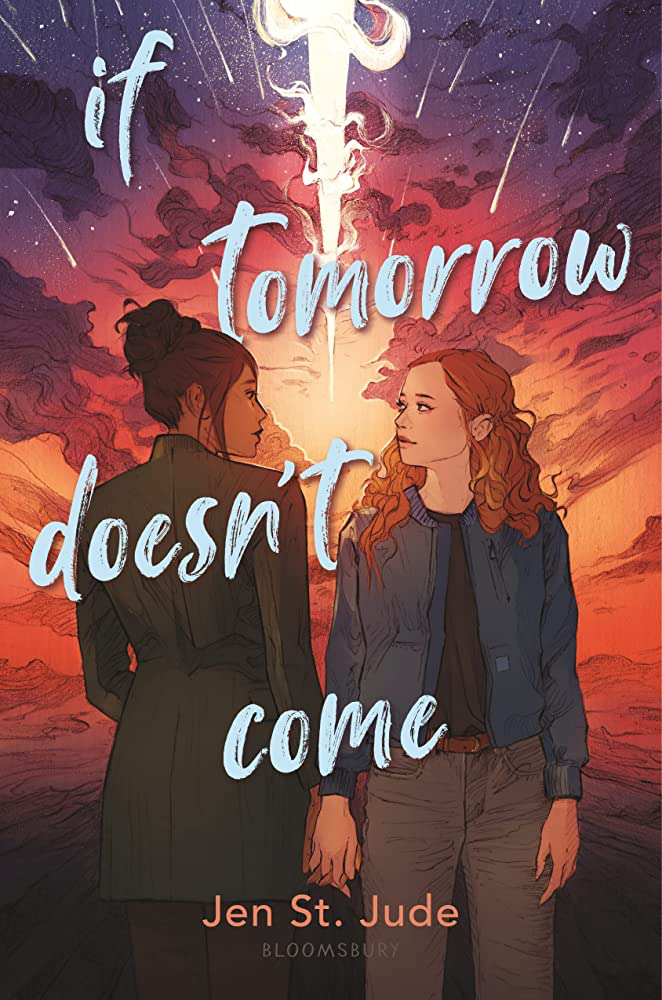
If Tomorrow Doesn’t Come – Jen St. Judeone of the few apocalypse novels that really makes it a mission to focus on the human aspect.

“Lord Only Knows” – Beck

Full disclosure: I definitely ruined this album for myself. I knew it was going to be a good album, and it 100% is, but I’d already listened to about 3/4 of it, so there were no surprises left. All of the songs I remembered were already favorites, and the ones I hadn’t yet discovered weren’t as instantly classic as the others (sorry, “Derelict”). But that’s on me. Maybe on my parents for playing it so much in the car over the years, but mostly on me. Whoops.

That’s not to say that Odelay is a bad album at all—in fact, it’s quite the opposite. It makes me miss the old Beck, the one who didn’t scrub everything to an unnecessary polish, but instead made his music like a sculpture made from bits and bobs found in the junkyard—a bit of a tire here, an old, rusty car hood there, some nuts and bolts sprinkled on top for a finishing touch. It’s a collage, but not necessarily in the way that artists like De La Soul or The Beastie Boys make their collages: while their infinitely clever concoctions feel like they oil every sample into a unified organism of unlikely pieces, Beck’s method (for a while, at least) was to make every spare and found part stick out like sore thumbs, but so much so that all those sore thumbs eventually made a hand so absurd that it makes you think how does that even function as a hand? And yet it’s the perfect hand. There’s no other way that “Hotwax” would work without “I’m the enchanting wizard of rhythm.” In fact, the absurdity of all these samples make this mutant (no pun intended) record so memorable—nobody was doing it quite like Beck. Take this song, which starts out with a rasping scream, then descends into twangy and almost docile acoustic-guitar driven rock. It’s not the heat-waved calm that “Jack-Ass” (my favorite track on the album) exudes, but it’s got that same lazy drawl to it, every word curled at the edges like scraps of paper singed by a campfire. Odelay hadn’t yet reached critical mass of clever silliness that made ’90s-2000’s Beck so fun (that would be Midnite Vultures), but he had plenty of fun to spare—I always find myself laughing at the final lines that Beck sings as the track fades out like a car driving out of view, obscured by the wobbling lines of a heat wave: “Going back to Houston/Do the hot dog dance/Going back to Houston/To get me some pants.” You just can’t deliver the word “pants” with that much emphasis and have it not be funny. Them’s the rules. I apparently have the humor of a five-year-old, but evidently, so does Beck, and we’re all the better for it.

…AND A BOOK TO GO WITH IT:

Fortuna (Nova Vita Protocol, #1) – Kristyn Merbethall of the same lazy, summer-eyed charm, but make it space opera (as things usually are on this blog).

“New Slang” – The Shins

Whenever I go to write about The Shins, I always end up going straight for the purple prose. It’s like the way I get with Radiohead, except they invoke something akin to religious fervor in me. I’m too far gone. But there’s something about James Mercer and his perpetually rotating cast of characters that evokes the lyrical side of my writing. Perhaps it’s that part of me connecting to that part of him, because he’s certainly got songwriting chops for days.

“New Slang” has been lingering in my life for decades; I faintly associate it with a period sometime in elementary or middle school. I think it may have been at the end of a playlist I listened to frequently. The Shins are never all that far from my mind, but this was the perfect song to shuffle out of the blue, soft and smiling like an old dog with white patches threaded into the fur of its snout. And I ran right up to pet that dog—god, I missed this song. Hello, old friend. Mercer has long since mastered the art of the old heartstring-tugging acoustic song, and while its as hipstery as it gets, there’s a calmness to it, a serenity like no other. And yet, for all intents and purposes, it’s James Mercer’s equivalent of a pop-punk “I’m getting out of this town” song; the lyrics were inspired by his experiences separating from Albuquerque, New Mexico, where the first iterations of The Shins had tried to take root. Disillusioned by a scene that he described as “macho, really heavy, and aggressive,” Mercer and company branched outwards, where their lyrical folk could have more meaning. “New Slang” was Mercer’s way of “flipping off the whole city,” as he described it (“Gold teeth and a curse for this town”), but there’s something beautiful in how quietly this song shoots its bitter middle finger. It’s not the jerky angst of separation that pop-punk lends to the subject, but instead the moment of looking back into the sunset, knowing that everything you’ve left behind is in the dust with the approaching night. Perhaps that’s where that serenity I feel comes from—the serenity of knowing that what’s in the past is in the past, and that it has no control over your life anymore. It’s underfoot, only tire tracks in the dirt now. You can’t help but feel a wave of peace at the thought.

…AND A BOOK TO GO WITH IT:

Trouble Girls – Julia Lynn Rubinwhile Lux and Trixie’s reasons for ditching their town are more complicated, there’s no less of a feeling that they’re giving it the finger the whole way out.

“The Gold” (Manchester Orchestra cover) – Phoebe Bridgers

Full disclosure: I hate the original version of this song. Hate it. It stinks of that kind of that faux-earnest, country-leaning pop that forced itself down everyone’s throats in the mid-2010’s like a contagion. If this weren’t obviously a breakup song, I know my music teacher would have made my 5th grade class sing this. I hate to relentlessly dog on a song, but also…Christ. This made me throw up in my mouth a little.

Phoebe Bridgers, on the other hand? A godsend. Leave it to her to make the original lyrics, some of which were actually good sound good, and not like they were being shoved down through the godforsaken Mumford & Sons strainer. I will give Manchester Orchestra (posers, they’re not even from Manchester…) some credit: “you’ve become my ceiling” is genuinely a beautiful lyric. But I just wish it wasn’t being delivered with that smarmy, offensive excuse for authenticity. Again: Phoebe Bridgers is our savior. She grounds this song enough to make the turmoil within it feel real. Never once did this song need belting, stadium-rock grandeur: it needed clarity, a sense of calm amidst the chaos, and a steady hand on an acoustic guitar. It’s got slightly more effects than Bridgers usually allots to a song of this tempo, but it hits the balance of flourish and that acoustic sincerity that she’s come to be known for. It’s a breakup song, but although some of those call for grandiose declarations of sorrow, some of them need time to sit in silence and wallow it in, and that’s exactly the treatment that Bridgers gave “The Gold.” I’ll just go ahead and pretend that she wrote it. Yup. Manchester Orchestra? Who is she?

…AND A BOOK TO GO WITH IT:

Vinyl Moon – Mahogany L. Brownesimilarly, this novel in verse deals with the fallout of a relationship built on mistrust.

“Caesar on a TV Screen” – The Last Dinner Party

Before I listened to the full song, I distinctly remember seeing a snippet of this song advertised somewhere on Instagram and thinking something along the lines of “god, this is pretentious.” And I stand by that. It’s still pretentious. But in context, it’s a good listen.

I’ve heard a decent amount of buzz surrounding The Last Dinner Party, usually falling in one of two camps: that they’re out to save rock and roll and bring it back to its glory days, or that they’re just…okay? The former argument, while I like it in concept, reeks of the kind of mentality that “modern music isn’t good anymore” because it’s not all Pink Floyd, which…okay, cool if you like Pink Floyd, but also…creative rock didn’t die as soon as Y2K hit? You just have to look a little harder now that rock isn’t the reigning influence on popular music anymore. In the modern day, we treat rock music like we often treat women: as something to be saved, when all along, it’s been doing just fine, thank you. I doubt we’ll ever go back to those days, and maybe we shouldn’t—there’s no way you can completely replicate a movement in its full, temporal context, and maybe that’s okay. I’m all for bringing back glam rock, but chances are, anything you try to resurrect is going to feel displaced in our modern day context. You can take inspiration from them, but personally, it’s a hard thing to recreate in all of its flesh and blood.

Which…seems like a good deal of what The Last Dinner Party are going for. Frontwoman Abigail Morris has regularly emphasized how much she and the band enjoy being pretentious (if having their debut album titled Prelude to Ecstasy wasn’t enough of an indication), and if that’s what’s bringing them joy, then all power to them! They’re talented musicians, for sure. Weirdly, the other two songs of theirs that I listened to just sounded like…any old indie pop song, which I kind of hate to say, but if you’re all about “saving rock n roll” and just putting out that, then I feel like you have to keep your mission consistent. But you certainly get that feel from “Caesar on a TV Screen.” As far as the structure goes, it feels slightly disjointed, but the more I watch the music video, I get what they’re going for—a song with a distinct, three-act structure, emulating the epic, Shakespearean twists and turns that inspired it. There’s loads of drama to spare, from the rush of strings in the third act to Morris’ impassioned howl of “everyone will like me!” at the song’s exiting flourish, like she’s brandishing a prop sword with every word. It’s dripping with that kind of theatrical, ’70s and ’80s drama—there’s Queen written all over it, and I can’t help but think that some of that drama was informed by Kate Bush. And…yeah, Freddie Mercury, Kate Bush, and David Bowie, the latter of whom the band have repeatedly cited as one of their primary influences, are probably some of the most colossal shoes to fill in terms of musical artistry. But there’s no doubt that The Last Dinner Party are a skilled bunch in their own right—and god, they look like they’re having the time of their lives. It’s exactly the kind of excess, maximalism, and drama that their band name implies.

…AND A BOOK TO GO WITH IT:

Strike the Zither (Kingdom of Three, #1) – Joan He“When I was a child, I never felt like a child/I felt like an emperor with a city to burn” HMMM…

Since this post consists entirely of songs, consider all of them to be today’s song.

That’s it for this week’s songs! Have a wonderful rest of your day, and take care of yourselves!

Posted in Monthly Wrap-Ups

March 2023 Wrap-Up 🌬

Happy Friday, bibliophiles!

How is March already almost over?? Mentally I’m still in the first week…but it’s spring break, so that’s always good. And although I woke up sick this morning, at least I have boygenius, the cure for all that ails. Maybe their queer antibodies will help me fight this nastiness off before I have to go back to school.

[shaking the image file for the record on my iTunes library] c’mon, man, do your thing…

GENERAL THOUGHTS:

I still can’t bring myself to believe that I’m almost done with my first year of college. It feels like I should have at least 5 months left, or something…how? Either way, it’s been much easier on me taking mostly humanities classes, and even with midterms, I’ve been able to keep my head above the water. The weather’s slowly but surely starting to warm up—there were a few days were it felt like early summer, and then we got snow the very next day, and if that isn’t Colorado weather in a nutshell, then I don’t know what is. But I’ve savored the little moments—the bits of sunshine that come through the trees in the morning, the view from my dorm, and the day I had both my classes off, so I visited my friend at my dorm for next year and got coffee on the way back.

My reading’s been a little bit slower, I suppose since I’ve had several books to read for at least 3 classes, so I’ve had to read a lot of them in smaller chunks. They’ve been very different but all very good books—again, what I love about college (or at least being an English major) is that I’ve been reading books I’d never imagine reading in an academic setting—Annihilation and Harley Quinn: Breaking Glass were both on my reading list this month. I’ve managed to get some other great reads in as well, even though I had to slow down for midterms. It was harder to see since I slowed down more than usual, but it was a pretty solid reading month—only 2 books in the 2-star range, so that’s always a plus in my book (no pun intended).

Other than that, I’ve just been drawing, playing Minecraft over break (you have NO IDEA the absolute havoc some loose axolotls can do to an ocean ecosystem), watching Flight of the Conchords (as hilarious as I imagined it being), season 2 of Shadow & Bone, and Dark, and wishing for all this snow to melt. I swear that one pile of slush outside of the dining hall has been there since January…

READING AND BLOGGING:

I read 18 books this month! Better than I thought I’d done, given midterms. I found my first 5-star read of the year, though, and I also participated in the #transreadathon for the week of March 20-27, and found some great reads as a result!

2 – 2.75 stars:

Spin

3 – 3.75 stars:

The Many Half-Lived Lives of Sam Sylvester

4 – 4.75 stars:

The Thirty Names of Night

5 stars:

Story of Your Life

FAVORITE BOOK OF THE MONTH: Story of Your Life5 stars

Story of Your Life

POSTS I’M PROUD OF:

POSTS FROM OTHER WONDERFUL PEOPLE THAT I ENJOYED:

SONGS/ALBUMS THAT I’VE BEEN ENJOYING:

DE LA SOUL IS ON STREAMING GO LISTEN GO LISTEN
John Lennon put everything into that inhale huh
the only musical jumpscare that I find myself actively seeking out
SUCH a good EP
the fact that this song only took a week to get to #3 on my most played songs on apple music should say something about it…or me
delightful song, gorgeous video, solid album!!

Today’s song:

TODAY’S THE DAAAAAAAAAAAY

That’s it for this month in blogging! Have a wonderful rest of your day, and take care of yourselves!

Posted in Music, Sunday Songs

Sunday Songs: 3/26/23

Happy Sunday, bibliophiles! I hope this week has treated you well.

It’s finally spring. Sprouts are crawling out of the crumbly earth, the fog is lifting, and I have a depressingly gray color scheme to show for it. My overexcitement for getting Peter Gabriel tickets (HUUUAUAAAAAAAAAAAAGGHGHGH BIG THANK YOU TO MY PARENTS) trumps any hope of a springtime aesthetic for this post.

Enjoy this week’s songs!

SUNDAY SONGS: 3/26/23

“Darkness” – Peter Gabriel

Picture this. It’s early in the morning. You have a 9 AM class you have to get ready for. You’ve decided to listen to Up, so you put it on while you start putting your makeup on. Track 1. You turn the volume up, because nothing much seems to be happening. 0:29 hits. All hell breaks loose.

And yet, even though I do my SPD jumpscare dance every time it rolls around, I find myself listening to this song like an adrenaline junkie. Peter Gabriel knows how to open an album—lulling you into near-silence, then hitting you with a concentrated, almost industrial opening that probably keeps Trent Reznor up at night wondering how he could top it. More than that, “Darkness” is another song I’ve added to my internal list of reasons why Gabriel is such a uniquely talented musician—he makes creating a musical atmosphere that mirrors the lyrical story look so easy. As he speaks of being consumed by fear, the instrumentals crash in, enveloping all else as his voice grinds to a gravel-edged plea for solace. It was enough to give me a heart attack, and, if I’m going by the YouTube comments, enough to give people nightmares. Gabriel whispers of fearing “swimming in the sea/dark shapes moving under me/every fear I swallow makes me small,” and in the edges of the near-silence, a strained moan sounds, like a distant whale call or the grinding of a boat. The imagery is startling in its clarity—if I had the patience, I’d jump at the chance to make some kind of stop-motion or claymation music video. Unlike other artists, Gabriel’s instrumentally darker, more abrasive side doesn’t surprise me—after the first listen, all I could think of is that it was the next natural evolution of “Intruder.”

But over two decades after the release of “Intruder,” (which, unlike this song, was enough to keep me up at night—on the first night alone in my dorm, no less…good times) Gabriel has a deeply nuanced understanding of fear. Even as these fears swallow him like the whale in Pinnochio, he finds a way through the tangled woods, knowing that fear will pass—”I have my fears/but they do not have me.” Well. I needed to hear that. Sometimes it’s hard to hear these things when we’re swallowed up so easily—which I can relate to a little too well, with my experience with general fear over various things, as well as the truckload of anxiety that came along with making the move to college—but as the song ebbs and flows from monstrous crescendos to something more bare and gentle, so too do our fears. It’s all too easy for me to think that there’s no light at the end of the tunnel when I get in a place like this, but fear, like everything else, is impermanent. And when we look back, like Gabriel, we can “cry until [we] laugh.” Maybe that’s why I find myself seeking out this song so much—I love when I can give myself a musical mantra. It has no control over me.

“Nobody’s Fool” – Shakey Graves

I’ve been meaning to listen to Shakey Graves and the Horse he Rode In On solely because of how much I love that name, but I’ve got more motivation (not that I didn’t have any—the eternal album bucket list waits for no man) after hearing this one in my brother’s girlfriend’s car. Shakey Graves can make anything seem natural, be it the more experimental wanderings of Can’t Wake Up to the classic folkiness of this song. And like a classic folk song, there’s something inherently haunting about it—even without the lines about drinking and deep-seated regret, there’s an off-kilter waver to “Nobody’s Fool,” a shadow creature that’s emerged from under the bed, hanging over Alejandro Rose-Garcia’s shoulder. If that’s the case, he’s probably given said creature a banjo or something since this song, but here, it lingers. “Nobody’s Fool” is a song so atmospheric that it feels like there’s a tangible coat of dust over it—again, the lingering eeriness about it, but something of a good kind of dust, given this song’s bizarre pull.

“Love Goes Home to Paris in the Spring” – The Magnetic Fields

I love the irony in the fact that I just got an ad claiming that “99.9% of women will chase you when you do this” above the search results for this song. At that point, you can’t even say that YouTube has bad gaydar—it just doesn’t have any gaydar whatsoever…

There’s a solid chance that I’ll be blabbing about The Magnetic Fields for the next week or two afterwards, but I had the incredible privilege of seeing them last Friday night! At a small venue, too—no annoying drunk people, no jostling for a good view, just cellos, sad gay breakup songs, and Stephin Merritt’s three mugs of tea. And other than the pure genius of playing “The Book of Love,” getting everbody sobbing (it’s me I’m everybody), and then launching into “The Biggest Tits in History” (IT’S ABOUT THE BIRD IT’S ABOUT THE BIRD I SWEAR GUYS GUYS) directly after, this show made me remember how many pockets of Merritt and co.’s genius that I hadn’t heard of, or just forgotten about. Take this song; with the amount of wry, folky breakup songs that they’ve produced, you’d expect for there to be an eventual formula. Bitterness is a constant, but it’s delivered in such a clever, creative way that I can’t help but smile and nod along as if Stephin Merritt is singing about rainbows and kittens. He’ll never outright say “you broke my heart” or “I can’t forgive you for what you did”—like clay, he pulls that core emotion into “don’t you know love/goes home to Paris in the spring?” That’s the kind of wry, tongue-in-cheek magic that draws me to The Magnetic Fields again and again—Stephin Merritt never has any boring ways of interpreting love and heartbreak. Still, it’s been a few decades since they’ve started the band—I just hope he isn’t in for any “I Don’t Believe in the Sun” relationships anymore. Dude deserves a break.

“Playing for Time” – Peter Gabriel

Before I get into the song itself…another reason why I admire Peter Gabriel so much—skip to 1:00 in the video and you’ll see him performing an early, unfinished version of “Playing for Time” without any lyrics. The prospect of performing…well, anything is already nerve-wracking enough for me, but playing something that you haven’t even finished live? That’s a feat, but I guess you can just do that when you’re Peter Gabriel. I can barely even make myself share in-progress bits of writing with friends.

Onto the song itself…I’m not gonna survive this album. I barely survived this song. Gabriel’s ability to dig into our most base emotions has never faded away, and “Playing For Time” is no exception. It’s a meditation on aging, on time, and on the memories we share between loved ones. He envisions a planet comprised of the memories made by a couple— “any moment that we bring to life/will never fade away.” It’s a song that came tragically late for Arrival, but maybe that’s the way it should’ve been—the movie, and the message that mirrors this song, already made me ugly cry three separate times. I could barely hold it together after listening to this twice. But along with this song and this movie, it’s something that I’ve been thinking about a lot; I’ve always treasured moments with my loved ones, but moving to college and being alone and independent for the first time has made me realize how precious it really is. But it’s also made me realize that these memories really do never quite go away, as long as we keep them close. Don’t let these things pass you by.

Okay, I need to stop. I think one sitting is the only time frame that I can listen to this song without curling up in a ball.

I need a minute…

“Pencils in the Wind” – Flight of the Conchords

“And people are like paper dolls/paper dolls and people, they are a similar shape…”

“Hey Jude” who? Paul McCartney wishes he could’ve come up with a line as raw as that. The voices of a generation, truly peerless.

Since this post consists entirely of songs, consider all of them to be today’s song.

That’s it for this week’s Sunday Songs! Have a wonderful rest of your day, and take care of yourselves!
Posted in Uncategorized

Sunday Songs: 3/15/23

Happy Sunday, bibliophiles! I hope this week has treated you well. 💗

I’m not even touching the fact that we’re somehow already halfway through March, but the passage of time is fine, right? Right? Hopefully the shades of red in this week’s songs are blinding enough to distract you from the fact. Would’ve been a more fitting color scheme for Valentine’s Day, but I’m a non-conformist if nothing else.

Enjoy this week’s songs!

SUNDAY SONGS: 3/15/23

“To Love” – Suki Waterhouse

It’s been a few years since I found out about Suki Waterhouse via Apple Music and “Johanna,” but now, I’ve come to the conclusion that she’s only ever made…one or two different songs. Is she good at it? I’d say so. A good 90% of the time, at least. Strangely, her songs work better solitarily for me; after listening to her debut album I Can’t Let Go in full, I had a decent listening experience, but, again—same song 10 times. It got a little tiring, but I got some nuggets of goodness out of it.

So after I found out that “To Love” had been released, I went in expecting more of the same. Lyrically, it’s still the same song, but it’s gotten me so excited that the instrumentation has started to change! Waterhouse has embraced sweeping maximalism in this song, with starry guitar tones reminiscent of the 70’s, an orchestral hum in the chorus, and no shortage of grandeur as she sings of losing herself in a once-in-a-lifetime love. And with all of her songs, her airy, sparkling voice provides an anchor for the journey that the instrumentation goes on—light on one verse, then diving straight into an ocean of orchestral wonder. It easily separates itself from most of her other catalogue, and although I can easily see her riding the same wave for the rest of her musical career, part of me is still holding onto hope that she’ll embrace this feel.

“Heather” – Sorry

After I heard about Sorry and “Starstruck” from my brother a few weeks back, I went on a brief frenzy and downloaded a handful of songs from their 2020 album 925 and then left it alone. I still need to listen to said album, but when the dust settled, I was left with “Heather” as one of the standouts. In contrast to the wry, post-punk sensibilities of “Starstruck,” “Heather” gently sways, a listless stare out the window as a spring drizzle trails down the glass. Threads of chaotic instrumentation linger in the background, but the song remains a gently rocking hammock, keeping momentum but never snapping loose. Asha Lorenz’s voice comes off continuously tired, slipping at the edges, but it’s the perfect fit for this song, singing of “The only one you’d choose/to spend your rainy days with.” Somehow, this song is able to make the line “we’ll lie like dead birds in the heather” sound bizarrely romantic, just as innocuous as the acoustic guitar strums. Even with Lorenz’s voice croaks in the background of the chorus, there’s still a gentle whimsy to it, an easy head-nodder to stare up at a sunset to.

“Black Math” – The White Stripes

The cycle never ends. I see any interview with Jack White. I want to hate his guts. And then this comes on shuffle, and I really can’t…WHY DO YOU KEEP DOING THIS TO ME? CAN YOU NOT BE SO OBNOXIOUS SO I CAN PROPERLY APPRECIATE HOW FANTASTIC OF A GUITARIST YOU ARE, DUDE? He’s the kind of guy with the misplaced bravado to say that, on the eve of him filming the documentary “It Might Get Loud” alongside The Edge and Jimmy Page, they would probably “get in a fistfight.” Most of the time, that kind of bravado doesn’t have the talent to back it up. I’m not justifying…him™️ at all, but for once, he has the sheer musical talent to back it up. There’s a reason that he was put alongside the likes of The Edge and Page.

Just like the way it unexpectedly appeared on my shuffle not too long ago, “Black Math” immediately kicks in with a sudden and propulsive burst of guitar. White’s fuzzed-out notes, all at once tightly controlled and wild and reckless, never steer off course—every intricate riff tossed in feels intentional, as though they were lined up like chess pieces, stationary but ready to attack at any second. Though the momentum skids into a sludgier, crunchy, slow-tempo area in places, there’s never a sense that either White or White (that’s not confusing at all, and again, Jack White specifically did not have to make it even more so…really, dude, why) have let the reins go free, still holding a tight grip on a timelessly tight song.

“Burgundy” – Warpaint

Black? Burgundy? We’ve got an interesting musical color scheme here…surely I won’t be piling both of these songs on my “songs with color names in the title” playlist that I made because I got bored…nuh uh…

My tendency to give mediocre to bad things “just one more chance” hasn’t led me anywhere 95% of the time. It applies to way too many parts of my life. But sometimes, there’s that 5% off-chance that an artist will prove me wrong, dredging up an occasional offering of brightness, and that’s what I’ve found here. Hopefully, this won’t be the reason that I keep doing it with music, but…

Most of what I know of Warpaint boils down to two songs. I’ve loved their cover of David Bowie’s “Ashes to Ashes,” which my dad turned me onto shortly after Bowie passed away, and when we still had the radio in my mom’s car, “New Song” was on heavy rotation on the indie station. I tried to listen to their 2014 self-titled album a few years back, and though the details of the music itself are fuzzy, the disappointment I felt was distinct—nothing about it really did anything for me like I thought at least one song would. And yet, when I saw this appear on an Apple Music playlist the other day, I had a morbid curiosity to see if there was anything of worth in this song—lo and behold, there was. Bare and quiet, it ambles along gently, with Stella Mozgawa’s subtly syncopated drums. Emily Kokal seems content to let her vocals fade into the soft, unseen corners of the song’s musical landscape, making for an atmosphere that seems to drift like fog around your hear, constantly evaporating and reforming itself, ever-changing. It may not be enough to give the band as a whole another chance, but “Burgundy” is a song that I’ll surely keep in my back pocket.

“Of Course” – Jane’s Addiction

I suppose we’re ending on a weighty one, aren’t we?

Jane’s Addiction is one of those bands that’s been ever-present in my life, but they only land with me every few songs. It took me a long time for this one to grow on me, as most of their songs do, but upon listening to it again, I was first struck by just how fantastic this violin is—I never knew his name before this song, but can we appreciate Charlie Bisharat for a moment? Against the rolling-wave, cyclical feel of the song (more on that later), his playing is fiercely frenetic, all at once jagged and rich with vibrancy, brighter than the red on the borders of the album cover for Ritual De Lo Habitual. Even when the other instruments take center stage, Bisharat’s playing shines through, translating itself into the lyrics themselves—I love how sharp and stinging the notes become after the line “When I was a boy/My big brother held onto my hand/And he made me slap my own face”? I’m a sucker for instances where the instruments become just as much a part of the lyrics as the lyrics themselves.

Lyrically, on a surface-level listen, it would be easy to take this song cynically—there’s images aplenty of human animals eating and clawing at each other to reach the top, the constant motif of getting slapped in the face. But the slap in the face is key here—all of that dog-eat-dog cynicism is flipped to the chorus of “a sensation not unlike slapping yourself in the face.” All you’re doing with that violently competitive mentality is screwing yourself over. It’s easy to miss, but it’s an important distinction to make—I could go on for ages about how capitalism has infected so many of us, especially in the U.S., with this mentality, but beyond the song, I like to take it as proof that working against each other is what will drive us into the ground. It’s become a little too relevant in the past few years, but even though “Of Course” has a somewhat universal message, it’s one that resonates a lot with these troubled times. Biting at each other’s heels is never getting us anywhere, and it never has. Jane’s Addiction may be generally hit-or-miss for me, but they struck gold when they put this out into the world.

Since this post consists entirely of songs, consider all of them to be today’s song.

That’s it for this week’s Sunday Songs! Have a wonderful rest of your day, and take care of yourselves!
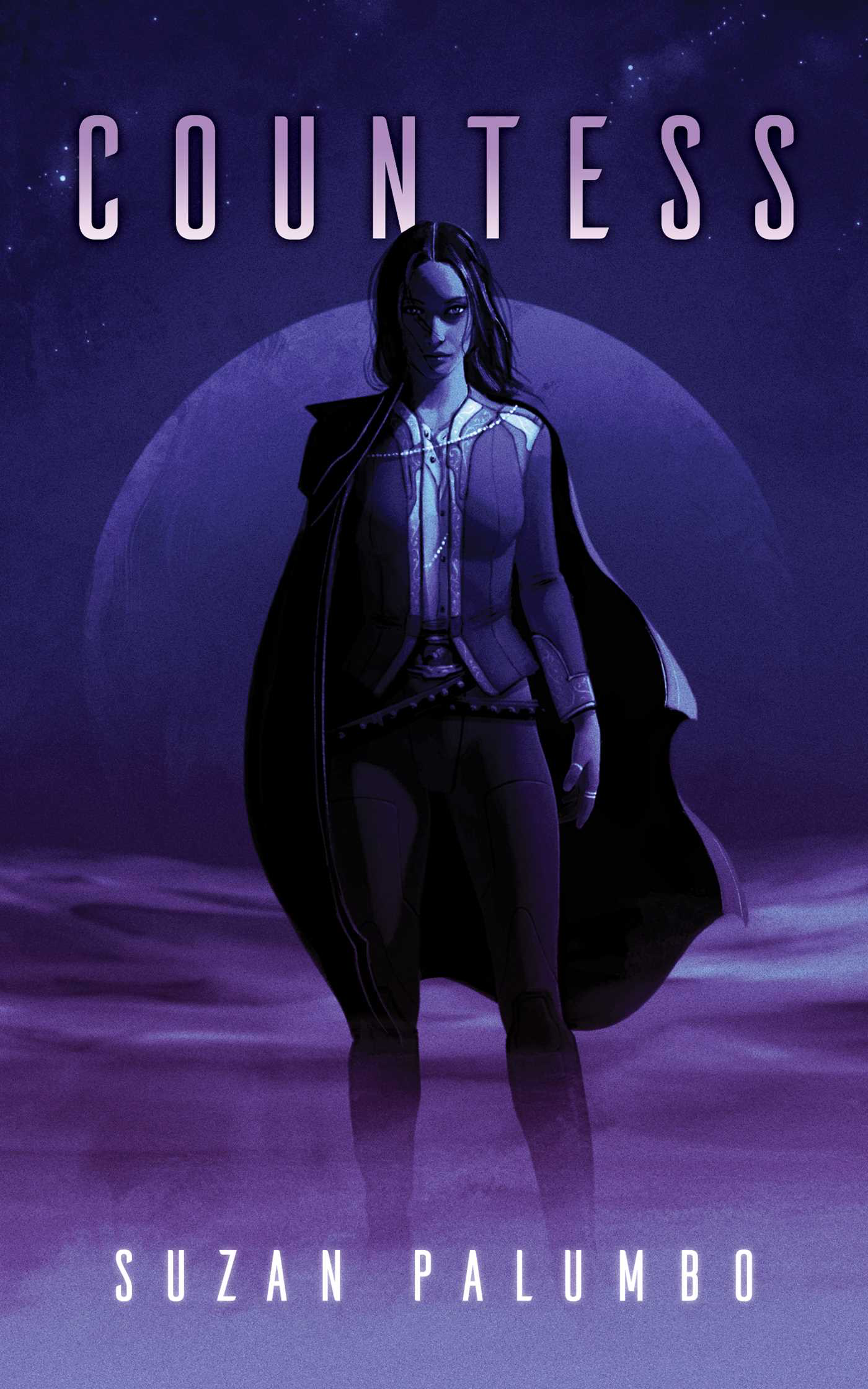
Posted in Music, Sunday Songs

Sunday Songs: 3/12/23

Happy Sunday, bibliophiles! I hope this week has treated you well.
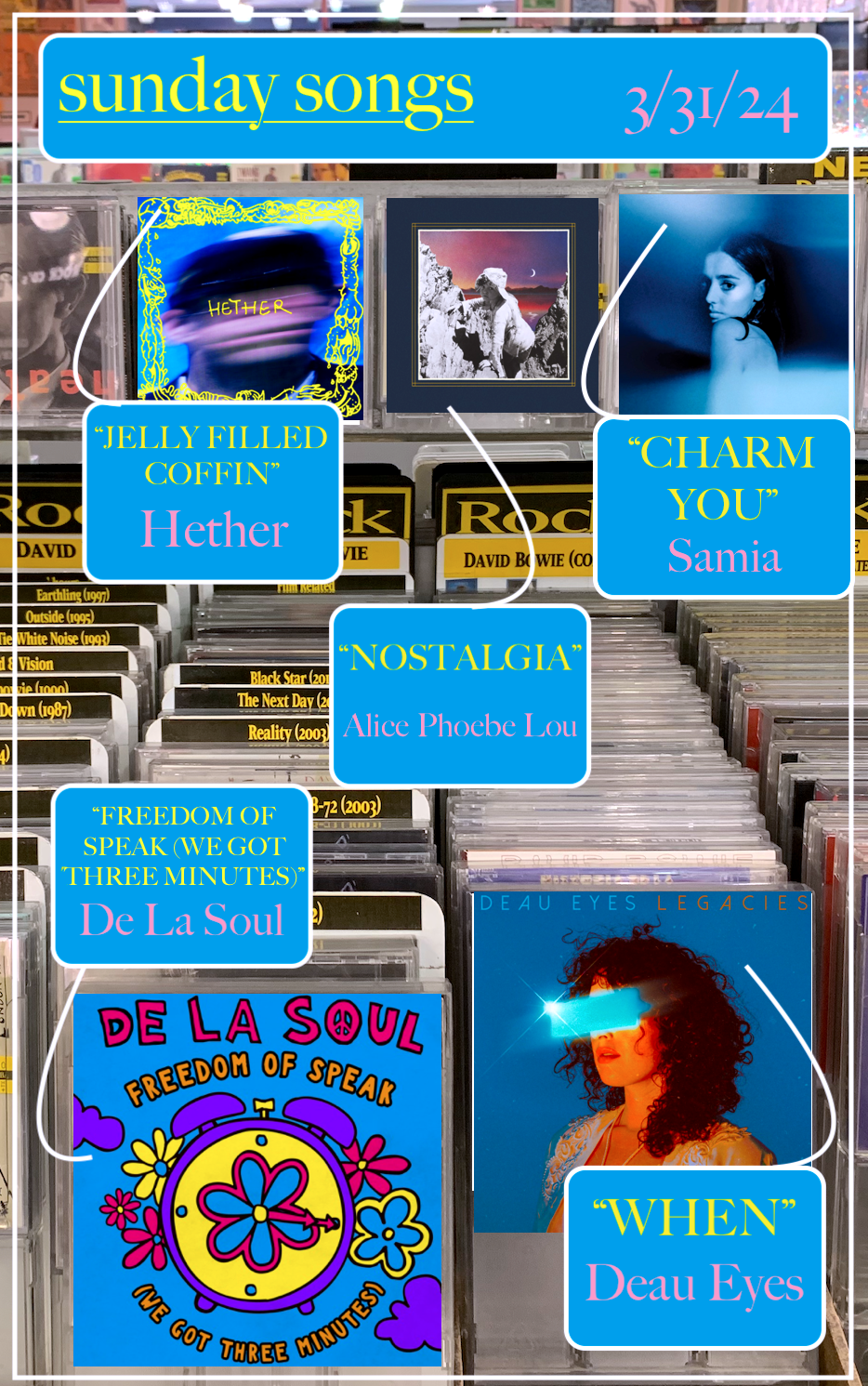
It’s finally starting to feel like spring again. The birds are singing, the grass looks much less dead, the sky is bright and decidedly un-cloudy, and Those Dudes™️ are still wearing nothing but tank tops, shorts, and flip flops in 30 degree weather. Which, I should clarify, is an outfit choice that has not changed from a few weeks ago, when it was cold enough for ice to form in my water bottle. I wish I was kidding.

But we are filled with springtime warmth and joy this week! The sun is shining! For once! Joyous whimsy prevails!
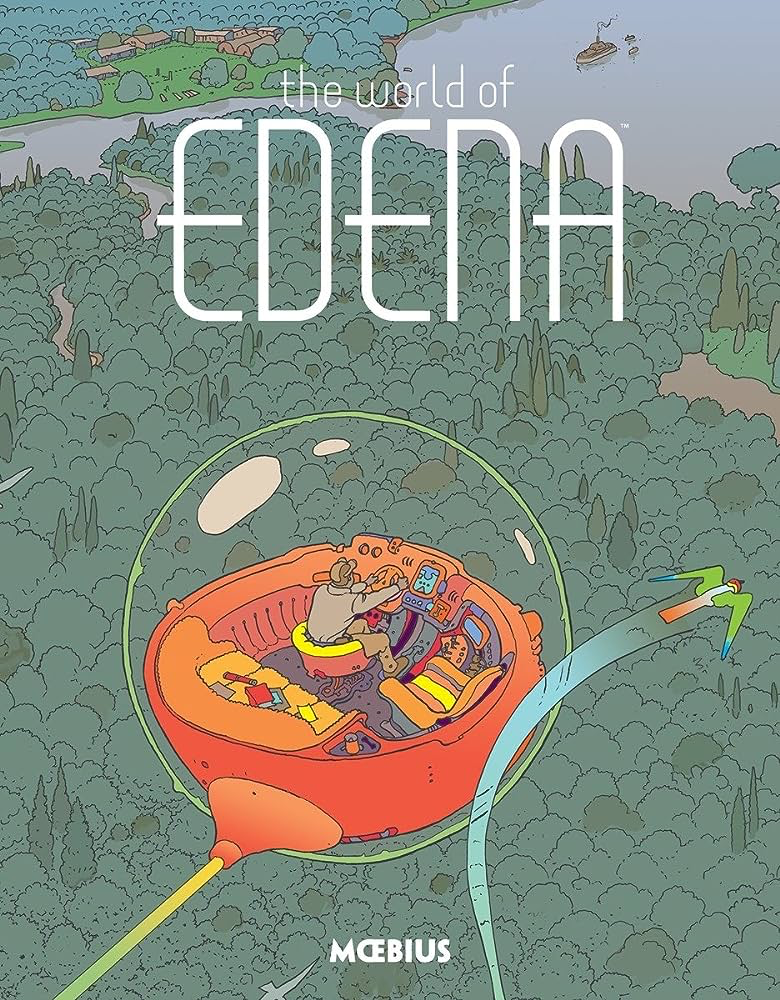
Enjoy this week’s songs!
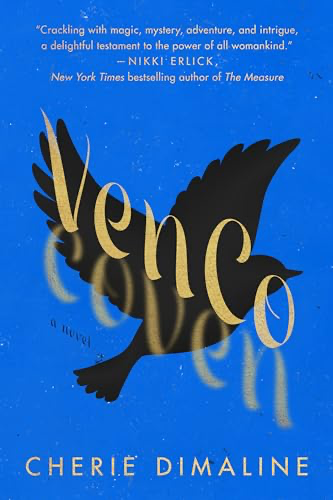
SUNDAY SONGS: 3/12/23

“A Little Bit of Soap” – De La Soul

Like a many other music nerds out there, I celebrated last Friday (March 3) by listening to De La Soul’s 3 Feet High and Rising, finally back on streaming, along with their other first 5 albums, after decades of legal troubles. I’d been hearing tracks like “The Magic Number” and “Me Myself and I” from early childhood, and I got worried that I’d hyped myself up far too much, but this album is as groundbreaking is as everybody says it is. Despite the years of misinterpretation and the record label’s hippie branding of the group (and “Me Myself and I” becoming their equivalent of “Creep,” so much so that all of their non-televised performances of it are always introduced by them telling the crowd to chant “we hate this song!”), it’s been taken all the way to the Library of Congress as a pivotal piece of music history. I’m not up to date on my hip-hop history, but even without that context, it’s easy to see what a sea change this was for a genre—it’s the work of three friends, barely out of high school, with the goal of having fun and playing with samples. And it’s a masterpiece.

This spirit is something that the delightfully goofy “A Little Bit of Soap” embodies. It’s not even a minute long (part of which is still taken up by a piece of the game show skit that continues through the album), it samples an obscure 60’s pop song of the same name, and the lyrics are just about B.O. And it’s GREAT. It proves that those middle school boys who barely showered and used AXE body spray to cover up the shame have existed since time immemorial. There’s something to be said about shorter songs like this, ones that clearly exist just for fun—creativity, for me at least, is primarily to amuse myself before it turns into something else. And that seems like exactly what Posdnuos, Trugoy, and Maseo were trying to do—having fun with each other, and making something innovative in the process. Happiness and genuine joy and fun should never be dismissed as low art just because it’s not “deep”—that mentality is the enemy of creativity.

And it’s been a month now since we’ve lost Trugoy the Dove. One the one hand, it’s deeply tragic that he never got to live to see his music return to the world, but I’m comforted by the fact that he at least could rest easier knowing that the years of legal battles had come to an end, and that De La Soul would finally be able to reach the wider audience that it always deserved. You will be missed. 💗

“Mutha’uckas” – Flight of the Conchords

When Bret said “Then ************ Granny Smith ******** ******** ** an avocado ********mango ********” ? Man, I felt that. I really did. “He’s gonna wake up in a smoothie”? Never before has such an assertive display of power and dominance been made in music history. Bret McKenzie is the ultimate alpha male. Sigma, even. Take notes. Fear him. It’s gonna get vicious and malicious. (He wants his Red Delicious.)

“Captain Chicken” (feat. Del the Funky Homo Sapien) – Gorillaz

I already talked about this song briefly in my review for Cracker Island, but I can’t praise this song enough. Never in my very brief years of Earth would I predict that I would have a song with looped chicken clucking sound effects on repeat, but life is full of surprises, and Gorillaz is here to deliver. I thought the days of Gorillaz collaborating with Del the Funky Homo Sapien (as Del the Ghost Rapper) were gone before my time, and whether or not this is a nostalgia grab, the 20+ years of waiting has paid off. Just like every track they made together on Gorillaz, Albarn and Del have created another pop masterpiece, just under two minutes but packing a punch than most of Cracker Island itself. Some songs are too long or too short for their own good, but like “A Little Bit of Soap,” “Captain Chicken” is the perfect, short-and-sweet time capsule of two exceptional musicians sounding like they’re both having the time of their lives. This is the fun, pure Gorillaz spark that most of Cracker Island was missing for me, but this song is out now, and I don’t think it’s a reach to say that we’re all grateful for this little gem.

“Girl” – The Beatles

I’ve got a confession—I love all of the Beatles in their own way to some extent, but I’d put John Lennon as my least favorite, as much as I love his voice. Probably heresy, and who wouldn’t love his message of peace, but after watching Get Back recently, he just seemed kind of insufferable? There’s no denying his musical genius, but every joke he made there just felt more like trying to be funny than actually being funny. And I haven’t even gotten to the wife-beating aspect. Yech. Don’t go deep-diving into 50% of singers from the 50’s to the 90’s, kids. Disappointment awaits.

None of that is excused, but it’s songs like this that make me go back on the obvious musical prowess of people like John Lennon. I think Rubber Soul is the only Beatles album left on my list that I want to listen to, and it’s songs like “Girl” that make me want to listen to it. In this day and age, it’s hard to see how groundbreaking it was, but at the time, it was rare for a pop band as big as they were in 1966 to make a love song quite like this. It’s not the (undoubtedly catchy) sunshine and rainbows of their first few albums; it’s more than a little folksy, and it starts to dig into a melancholia that the genre had barely touched with a ten-foot pole at that point. Every detail makes it such a strange, wonderful pop song—John Lennon’s hissing inhalations in the chorus, the eerily beautiful harmonies of Lennon, McCartney and Harrison (which I can never praise enough), and the guitar work, which was apparently played with the capo extra high on the neck to make the sound resemble a bouzouki. From what I’ve heard, Rubber Soul served as the Beatles’ gateway into their truly innovative work, delving into pure psychedelia on Revolver, which came out later that same year, and to this day, “Girl” and many of the album’s other track are a time capsule to the Beatles just before they leapt off the precipice and into the musical unknown.

“Life’s a Happy Song” (from The Muppets) – Amy Adams, Jason Segel, & Walter

Nothing like the realization that Amy Adams was in this movie hitting you like a train directly on the heels of ugly crying to Arrival, amirite? That’s some whiplash. Needless to say, that’s some impressive range.

And if you take one thing away from both this song and this post, it’s that Bret McKenzie did NOT have to go that hard with the Muppets soundtrack. I’m just picturing the guy just coming into the studio with a notepad, eyes glowing red and levitating, and laying the lyrics to this and/or “Man Or Muppet” down on the table, and everybody just refusing to question it. I can still remember having this as the first song on a scratchy CD, and only ending up hearing it and “Eight Days a Week” because it conked out on me after track 2. I have many fond memories of sunny afternoons listening to this song while organizing the Calico Critters house that I got for my birthday that year. The voice of a generation. What can I say? Life’s a fillet of fish.

Since this post consists of all songs, consider all of them to be today’s song.

That’s it for this week’s Sunday Songs! Have a wonderful rest of your day, and take care of yourselves!