Posted in Sunday Songs

Sunday Songs: 3/2/25

Happy Sunday, bibliophiles! I hope this week has treated you well.

This week: were it not for me yapping about Horsegirl earlier this week, this post would be unfathomably long…sorry. Stick around for my rambling hitting concerning levels the minute I have more free time.

Enjoy this week’s songs!
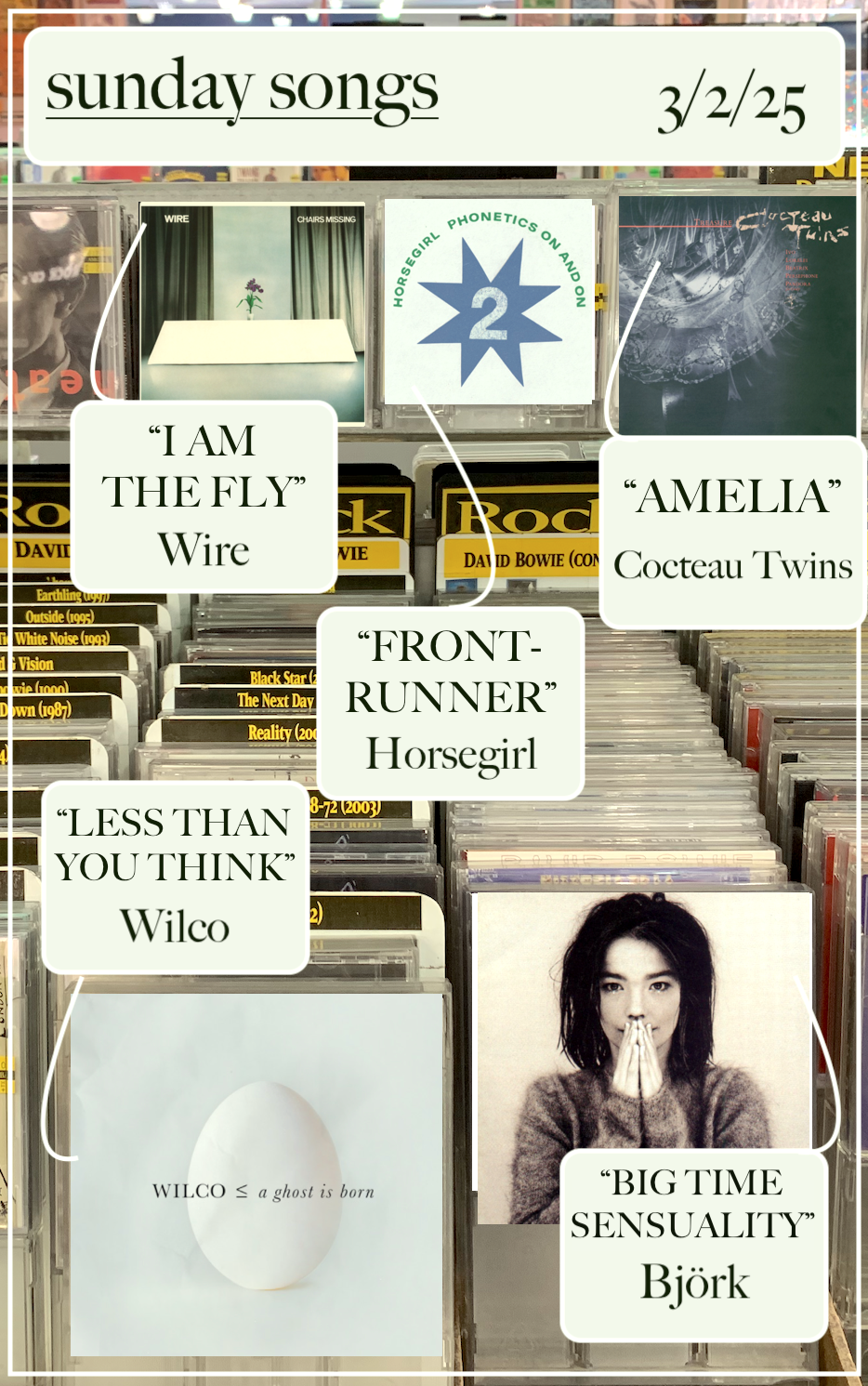
SUNDAY SONGS: 3/2/25

“Less Than You Think” – Wilco

Since A Ghost Is Born got its anniversary reissue a few weeks back, I took the time to listen to the album in its entirety for the first time…surprising, I know! That being said, I’d basically listened to all but two tracks on the album, but I hadn’t gotten to listen to it all the way through in the right order. After a childhood being fed Wilco by my dad about as much as I was fed milk as a baby (both were nourishing and necessary for my development), only two tracks remained: “Wishful Thinking” and this track. It’s songs like “Less Than You Think” that make me remember how much of a poet Jeff Tweedy is. I don’t say that about every singer; in the abstract, music is poetry set to song, but it doesn’t often feel that way. In this case, it’s understandable that the poetry of “Less Than You Think” gets lost in the other masterpieces in Wilco’s catalogue. But it’s not just a case of an underrated track—there’s a reason this one gets lost in the fray so often. For three minutes, it’s any normal Wilco song—one of their sadder ballads, but standard Wilco fare…

…and then you realize that there’s 12 minutes left.

That 12 minutes is entirely composed of a shrill, grating stretch of electronic droning and background noise from the studio. To say that it’s excruciating to listen to, especially with the volume up after listening to the actual song part, is almost an understatement. It’s unpleasant in every sense of the word. Yet that’s precisely the point. Not to be the “🤓☝️ erm ackshually, this nigh-unlistenable 12 minutes of noise has a deep meaning that’s essential to the understanding of the song,” but…it does. It’s unlistenable because it’s meant to be unlistenable—Tweedy and the rest of the band used this song to recreate the experience of having chronic migraines, a condition Tweedy has had all his life, but was exacerbated by his painkiller addiction: “I don’t know why anyone would need to have that expressed to them musically. But it was all I had.” Tweedy put “Less Than You Think” out anyway, knowing that it’d be “the track everyone will hate,” saying that “I know ninety-nine percent of our fans won’t like that song, they’ll say its a ridiculous indulgence. Even I don’t want to listen to it every time I play through the album. But the times I do calm myself down and pay attention to it, I think it’s valuable and moving and cathartic. I wouldn’t have put it on the record if I didn’t think it was great.” And he’s right. Being so experimental with this catharsis brings us so much closer to the experience than words ever could, as much as a master wordsmith as Tweedy is. Catharsis for a pain as profound as this doesn’t have to be listenable or tolerable to be worth putting out into the world—it’s catharsis, after all. Sure, I’ve skipped it every time I’ve listened to it since, but once again…that’s the point. We’re meant to sympathize with Tweedy’s pain, but even he admits that it’s not exactly easy listening. (Some absolutely diabolical individual in the YouTube comments called it “the best song to tee up on the bar jukebox right before you leave…” Satan, is that you?)

But that glorious, incandescent three minutes before you get the worst headache you’ve ever experienced? Deeply moving, in an entirely different way. They got me. They got me good with the sad bastard music. The piano is played with such a heaviness that you can only imagine it being played with lead weights strapped to each finger. Delicate taps of the dulcimer climb up an invisible ladder, each strike coinciding with Tweedy’s repetition of “Lightly tapping/a high-pitched drum.” And for a song that Tweedy knew would be an instant skip for most of his listener, he packed it with some of A Ghost is Born‘s most downright poetic lyrics:

“As your spine starts to shine
You shiver at your soul
A fist so clear and climbing
Punches a hole in the sky
So you can see
For yourself
If you don’t believe me
There’s so much less
To this than you think…”

Yeah, I pulled a Lisa Hannigan again. I’m tempted to just copy and paste all of the lyrics. Punches a hole in the sky? More like punches a hole in my soul, ow. Though the lyrics toy with the chaos of the universe and the clarity of realizing that maybe everything hasn’t been choreographed by a higher power, I can’t help but connect it with Tweedy’s migraines—all the talk of shivering and “Your mind’s a machine” sounds an awful lot how I imagine living with both migraines and addiction must feel: a cycle of dullness and excruciating pain, exposing how much of the brain has been devoted to going through the motions. As for the solemn resignation to atheism, it connects to that experience—it seems pain that immeasurable makes you either seek out or entirely swear off of religion without a happy medium. With or without words, Tweedy conjures a pain he had to exorcise from his person, yet is able to resonate if you’re willing to dig through the earth to find it. Sometimes you have to make art from agony in order to make the burden lighter, whether or not you give it to the world. In any case, Jeff Tweedy makes the pain worth weathering.

…AND A BOOK TO GO WITH IT:
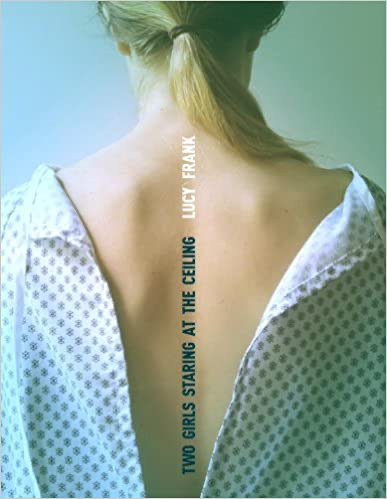
Two Girls Staring at the Ceiling – Lucy Franktold in sparse verse, these two characters go through a similar pain as they work through chronic pain diagnoses in the same hospital.

“Big Time Sensuality” – Björk

Today, on: Madeline listens to Björk’s discography wildly out of order…we’ve come to Debut. It’s another one of those albums that I’d listened to about half of already, but it was just track after track of honed energy and happiness…seriously, this album couldn’t have come at a better time in my life. I think listening to Post about this time last year and Debut now feel aligned with my life in some way. A lot of Björk’s experience at the time was drawn from moving from Iceland to the UK in her late twenties, and being adventurous, putting out her feelers, and embracing the newness of it all, taking everything in (see: “Enjoy”). In some ways, I feel a connection to that kind of exploration. Now that I’ve shed most of the apprehension of freshman year (though definitely not all), I feel like I’m slowly beginning to grow into a new place, a new home, a new environment. I know I’m a little dramatic about that…I’m going to a college that’s less than an hour away from my hometown, so I can’t quite compare. But there came a time when I realized I was living in a whole new place, and I’d barely scratched the surface of everything in it. After the initial crisis, I’ve begun dragging my friends to whatever new place that I can find. Baby steps, but I’m slowly cataloguing new restaurants that I’ve tried. New routes to class. New coffee places on campus, now that Starbucks jumped on the DEI-stripping bandwagon. I’m not throwing myself headfirst into a new city, immersing myself in the early ’90s rave nightlife like Björk did, but I can’t help but connect to that apprehension, that excitement of really knowing you’re somewhere new, physically and emotionally. I’d do well to take it to heart the more I grow up.

“Big Time Sensuality” embodies Björk’s absorption of ’90s house music while in London, and even though it’s far from the weirdest part of her catalogue, you can’t take the weird out of Björk. Even amidst the house beats behind her, you can’t erase the skyrocketing highs and growls that, even for her firs solo effort, were already staples of her vocal style. Despite what the title would have you believe, there’s nothing necessarily sexual about it, yet it retains the ecstasy you’d think it would have. This ecstasy, however, comes from a common theme on Debut: reaching out and taking risks to soak the fullest out of life: “I don’t know my future after this weekend/And I don’t want to.” Its heart is imbued with the rush of friendship, throwing your passion into your music, and independence in a few environment: Björk told David Hemingway that the song’s inspiration came from “[Creating] pretty deep, full-on love relationships with friends…I can be a coward a lot of the time and there comes a moment when I write a song when I get quite brave.” “Big Time Sensuality” throws itself face first into uncharted waters, all with a dimple-stretching grin. Björk’s already diverse vocal range embodies the chorus of “It takes courage to enjoy it/The hardcore and the gentle.” And the music video, directed by Stéphane Sednaoui, embodies that daring joy, with Björk dancing on the back of a truck bed driving through New York City, baring her grin for all to see.

…AND A BOOK TO GO WITH IT:
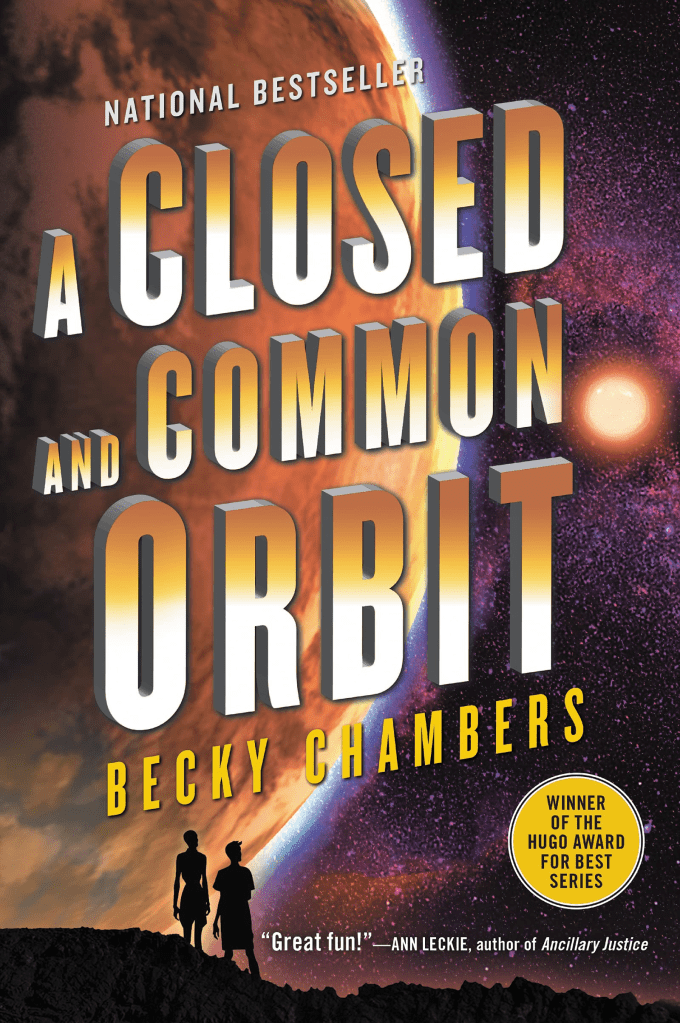
A Closed and Common Orbit (Wayfarers, #2) – Becky ChambersLovelace’s journey of having a body, separating herself from her old identity, and being a part of the sapient world mirrors much of the eager excitement of Debut.

“I Am The Fly” – Wire

All the cool people like Wire. I’m not saying that to assert that I’m [snaps fingers] hip (that alone proves that I’m really not). It’s more that if you rattle off any creative, clever band from the past three to four decades, they all name Wire as an influence–Sonic Youth, R.E.M., and Soundgarden are just a handful of people touched by their music, and you can hear their genealogy in grunge, hardcore punk, and even Britpop. (Heavy on the Britpop. See Elastica’s “Line Up,” one of several songs that Wire took Elastica to court over claims of plagiarism.) Want proof? How about Wire playing with Jon Spencer and St. Vincent back in 2015? See what I mean? They’re the great uniters. All the cool people like Wire.

For all intents and purposes, Wire left their more punk sound behind with Pink Flag (see “12XU”), trading it for a minimalist, synth-dominated sound on Chairs Missing. To my ear, it sounds like the musical equivalent of brutalism; to the touch, every texture is rough as concrete, but every edge is sanded down to absolute straightness. Graham Lewis’ thick bass dominates the sound, rippled through with guitars, handclaps, and a wall of synth so dense that it becomes more percussion than the actual drums. I can’t help but hear some leftover punk not in the sound, but in the lyrics. Houseflies don’t sound particularly punk at first glance (nor does Graham Lewis’ apparent thing for writing about winged insects on this album)—they’re more for being stepped on by a pair of massive docs than the subject of a song. But yet, this simple animal becomes so deeply punk: “I am the fly in the ointment/I can spread more disease than the fleas/Which nibble away at your window display.” At its core, punk is has always been about disruption, whether that’s in the abrasive quality of the music or grating against the establishment. A fly is a fundamental nuisance, a tiny speck of a creature that, as the song says, spreads disease so easily, ripping up the threads in the fabric of something pristine and perfect. No matter how many swings you take at them with a flyswatter, they always come out, reproducing rapidly…just like disease, and just like resistance. Even with the dry intonation of the lyrics, it reads to me as a deeply proud song, a finger crossed behind the back and a smirk on the face as the time bomb counts down its last second. It’s a promise, and it’s a declaration of purpose: disturbance.

…AND A BOOK TO GO WITH IT:
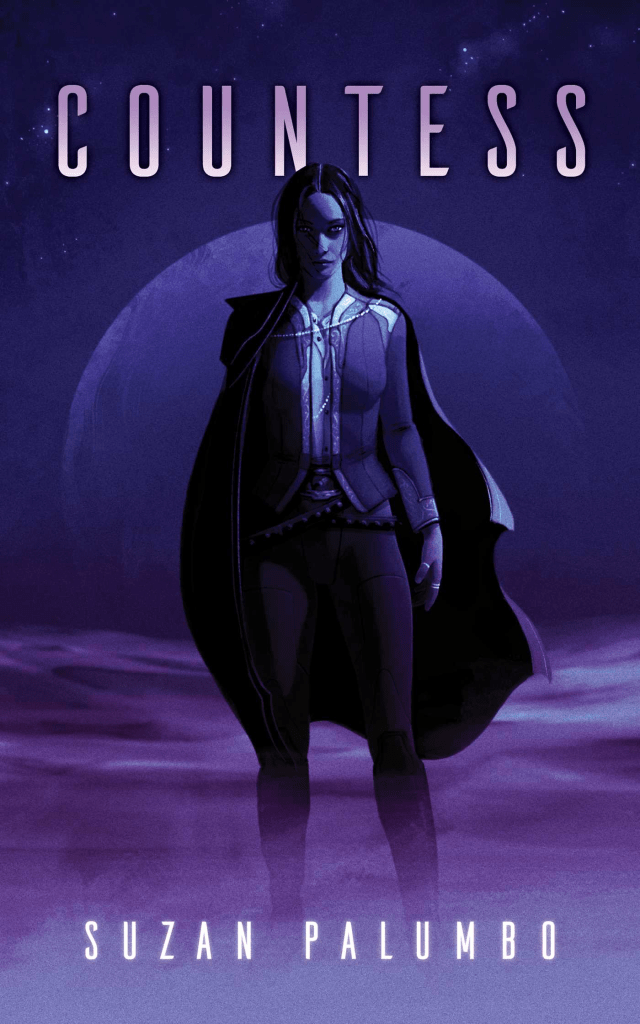
Countess – Suzan Palumbo“But there’s an air-pellet hole/I can crawl through to you/I am the fly in the ointment/I can spread more disease than the fleas/Which nibble away at your window display…”

“Frontrunner” – Horsegirl

See my review of Horsegirl’s new album, Phonetics On and On; bottom line, I LOVE HORSEGIRL. WE ARE BETTER FOR THEIR EXISTENCE.

…AND A BOOK TO GO WITH IT:

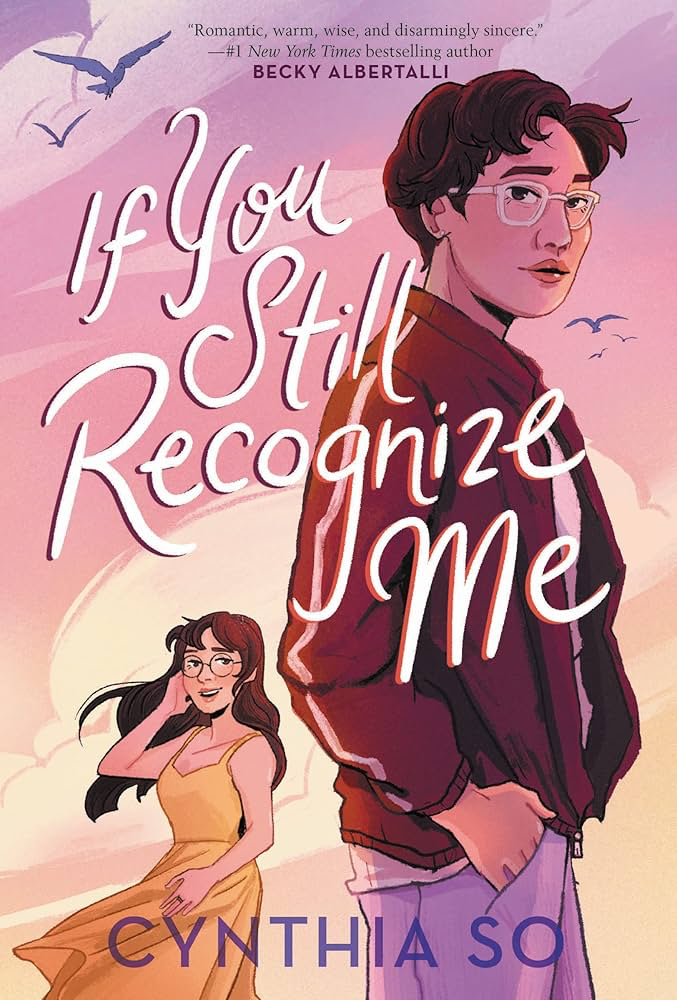
If You Still Recognize Me – Cynthia So“In the morning, when you’re sleeping/I can’t wait and I can’t wait to compromise…”

“Amelia” – Cocteau Twins

How does it feel? How does it feel for those of you with the right names to share a name with a Cocteau Twins track? For all of the Loreleis, Amelias, Beatrixes, Ivos, Carolyns, etc…do you realize how lucky you are?

Out of all of the Cocteau Twins songs I’ve heard, “Amelia” is one that embodies their general qualities the most, taken almost to an extreme. Regardless of whether or not I could hear the lyrics even if they weren’t nonsensical, they’re sunken so deep into the production that they become a kind of fog-like mist. The unmoored, bass-less flow of the track reminds me of something off of Victorialand, a record where bassist Simon Raymonde was notably missing. Liz Fraser’s vocals are as textural as ever, uttering a whole menagerie throat-fluttering bird calls amidst a barrage of gated reverb that descends upon you like the patter of heavy rain on a windshield. Next to some of their other tracks, it feels slightly less cohesive—the intensity of the gated reverb, reverb’d into high heaven as it is, doesn’t completely mesh with the airiness of the vocals or the other instrumentation. Somehow, it’s almost comforting—the Cocteau Twins stand out to me as a band who truly found their niche and stuck to it, digging in their heels to make that niche as unique and them as possible in the most artistic and adventurous way. Weirdly, it comforts me that it took them time to get their rhythm down, and even then, their earlier steps still blow me away. “Amelia” certainly does—the sheer variety of vocal styles that Fraser layers over one another is proof that even on a record that the band famously hated, their nascent talent couldn’t help but shine in its own way.

…AND A BOOK TO GO WITH IT:
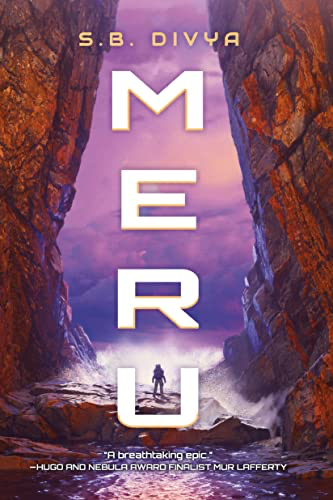
Meru – S.B. DivyaI can only imagine that the experience of being a god-like Alloy and floating in space sounds something like the Cocteau Twins.

Since this post consists entirely of songs, consider all of them to be today’s song.

That’s it for this week’s Sunday Songs! Have a wonderful rest of your day, and take care of yourselves!

Posted in Books

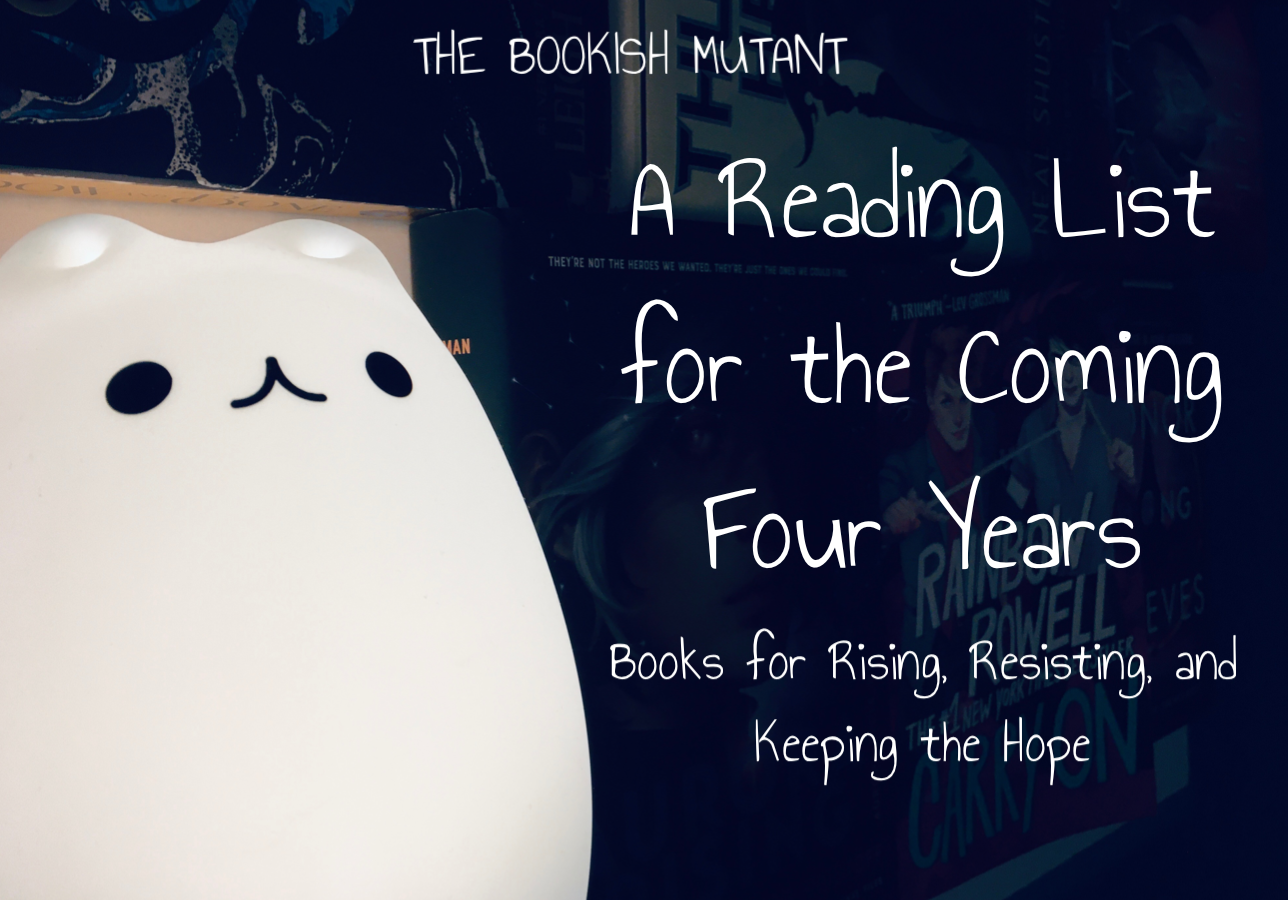
A Reading List for the Coming Four Years | Books for Rising, Resisting, and Keeping the Hope

Happy Monday, bibliophiles…sort of. We’re in for a long four years.

It’s already been said what a slap in the face it is to have Trump sworn in on the day we normally set aside to commemorate Martin Luther King Jr., one of America’s preeminent champions of civil rights. (I’m sure the administration will find some way to spin it in their favor, the same way that Trump spun the Women’s March. Eurgh.) I’m grieving. I will continue to grieve, so long as our country is once again helmed by a tyrant who uplifts the wealthy and bigoted while the marginalized are squashed underfoot. My processing this won’t end until we get him out of office (because I refuse to believe that this is the end), and that’s okay.

But today, as with most of the activity on this blog, I’d like to talk about books.

Anyone who has even had a semblance of a pulse on the news in the last five years or so has seen the increased hateful rhetoric surrounding books—particularly those concerned with promoting diverse voices. Mass book bans have swept the country, with everything from the most innocuous picture books to critical feminist knowledge being stricken down across the board, all in the name of “protecting the children.” The process of objecting to a book is frighteningly simple and straightforward, leading to bans on the basis of misinformation—just look at the time Amanda Gorman’s The Hill We Climb was challenged after a single complaint…and attributed to Oprah Winfrey (ah, yes, because all Black women are the same person, apparently). Apologies for the strong language here, but to quote a great button that I have on one of my jackets, “you know these fuckers banning books don’t read shit.” It’s true. Rarely do those in charge of banning, especially those in the highest offices in the country, consider the actual contents of the books—they simply get a whiff of anything that smells to them of D.E.I. or the “woke groomer agenda” and try to smite it out of the public consciousness.

It was never about the children. The majority of the books that are being banned to “protect children” aren’t even aimed at children. And even if they are, it’s only for superficial reasons—inclusions of, god forbid, diverse perspectives (LGBTQ+, POC, disabled, etc.) or acknowledgments that maybe, just maybe, America is not perfect and has never been perfect. It truly is dangerous. We’ve seen how the Trump campaign was built on twisting and exaggerating lies about this country, feeding its supporters that we must go back to some nonexistent, golden age. Of course it never existed, but the way that they do it is by blocking off access to information on all levels—perpetuating lies and attacking those who spread the truth. Book bans are how this is done at the largest level; it starts with the very youngest, and they claim to “protect the children” as they restrict their access to learning about how this country—and the world—truly is. The regimes that put blinders on its populations—especially the ones banning or burning books—never land on the right side of history.

I believe that the best way that you can combat this deliberate shielding of the truth is to read. In a world where the ruling class relies on you being complacent enough to accept their lies as fact, reading is the ultimate form of rebellion. We read to learn: about other kinds of living, other kinds of people, and possibilities in the imaginations of people you know nothing about. Literature is the site of change because it shows us this possibility—if you can imagine an alternative world, you can put it into action. When you feel powerless, remember that you have boundless knowledge at your fingertips.

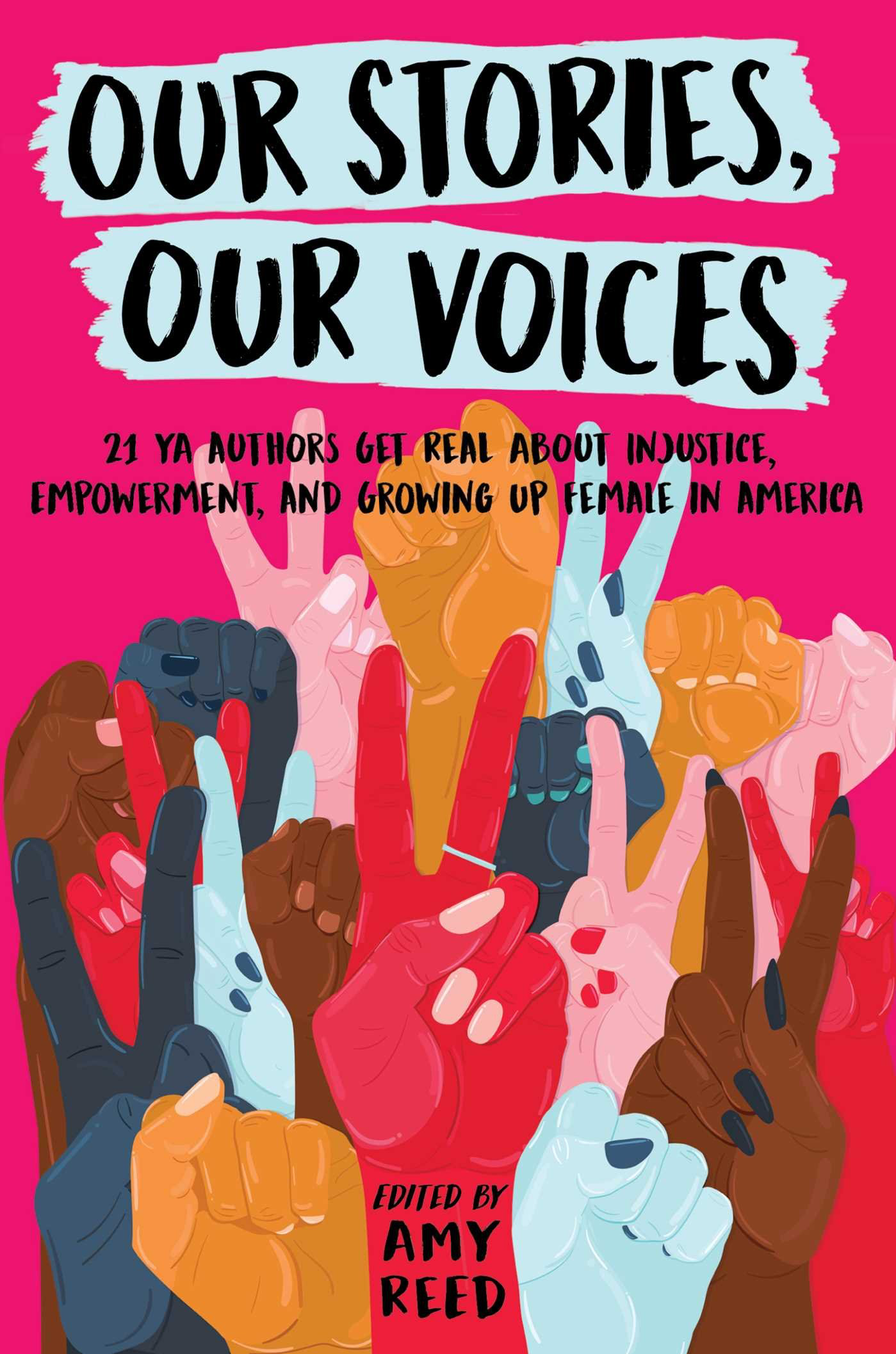
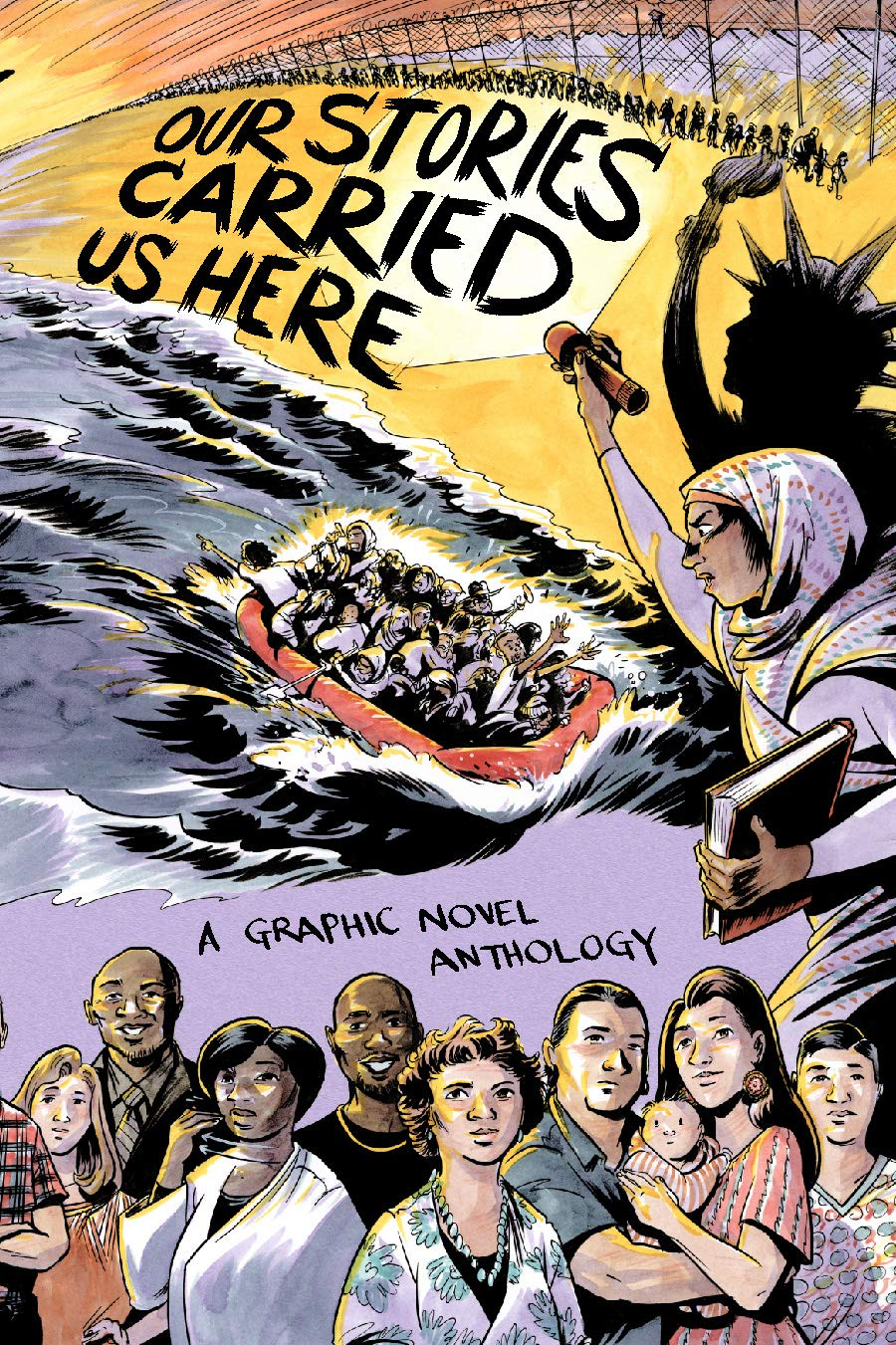
So I’ve compiled this reading list for anyone looking to rebel. I’ve gathered books of all age levels and from all kinds of diverse voices that Trump and his cronies would have you believe neither matter nor exist. Whether your stance is to directly fight the power or quietly rebel by imagining a way out, there are books here for you. Fiction and nonfiction, here are the tools you need to combat misinformation, bigotry, and hatred—and have a great read, too.

A READING LIST FOR THE COMING FOUR YEARS | Books for Rising, Resisting, and Keeping the Hope

FOR THE FIGHT:

These are the books about resistance, in the real world and in imagined worlds. If you need the motivation to stand up and fight for your rights and the encouragement to not pull punches when doing so, these are the books for you.

FOR A BETTER TOMORROW:

Here is something I want to emphasize going forward: it’s important to fight, but not all of us have the strength to do so—and that’s okay! Plenty of people aren’t ready to get out into the streets, and we need to respect that perspective. (This is coming from someone who isn’t quite ready either.) What we need the most in these times is hope, and though there is injustice in these books, they present stories where, despite hardships, joy prevails. They also present vital alternatives to the now—one of the most powerful ways of resisting, in my opinion, is to have the ability to imagine a better tomorrow, whether it’s alternate history, the distant future, or simply a kinder present.

FOR KNOWLEDGE:

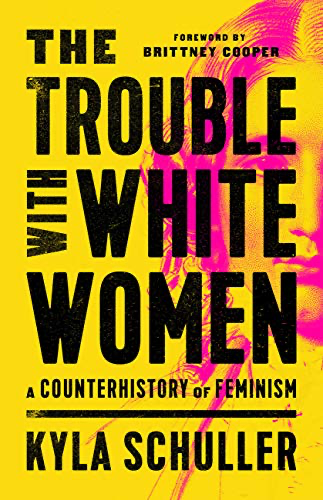
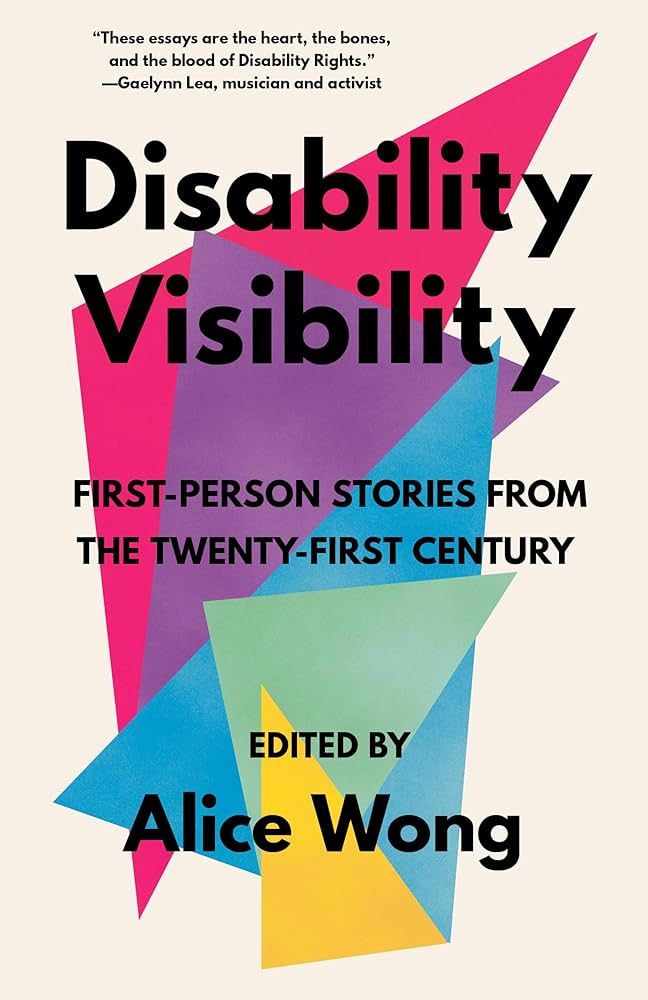
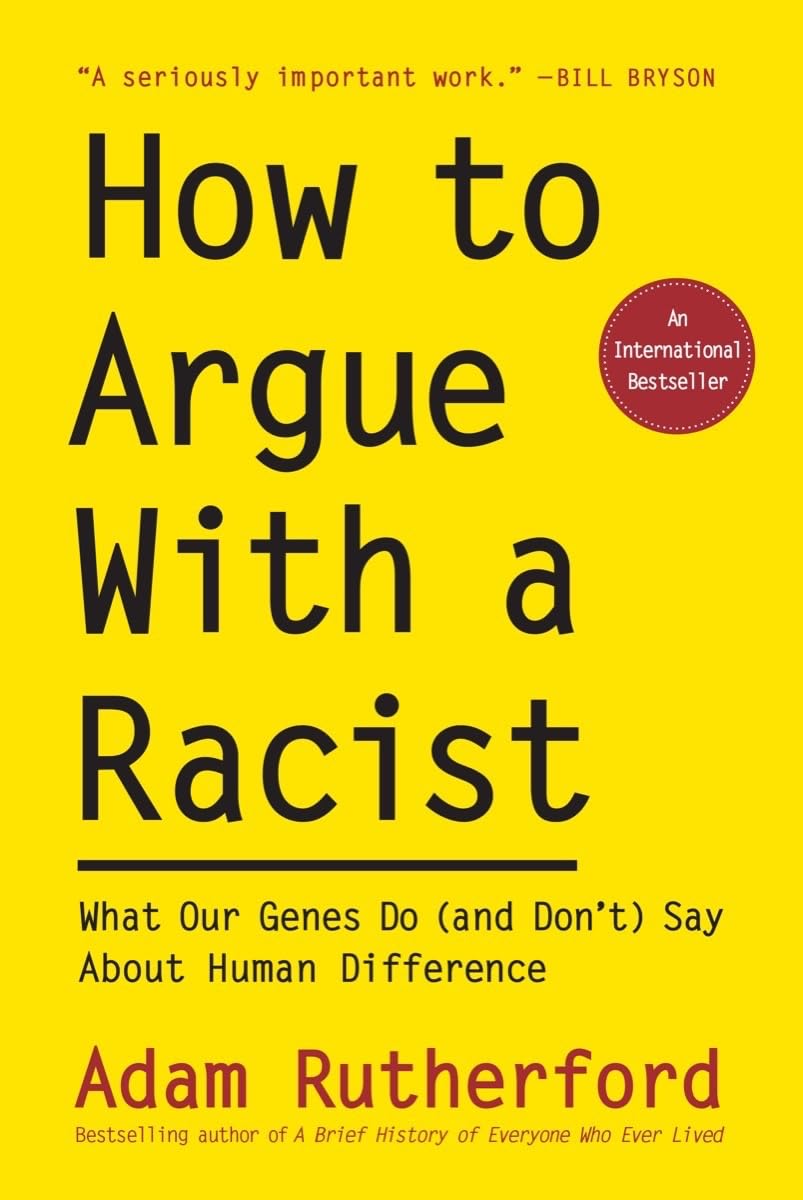
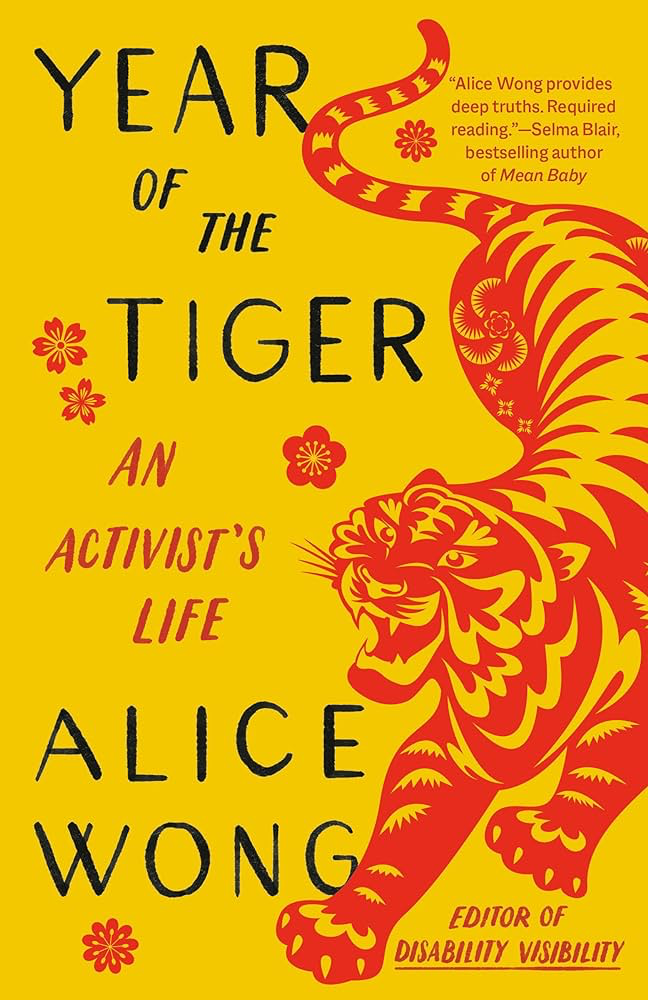
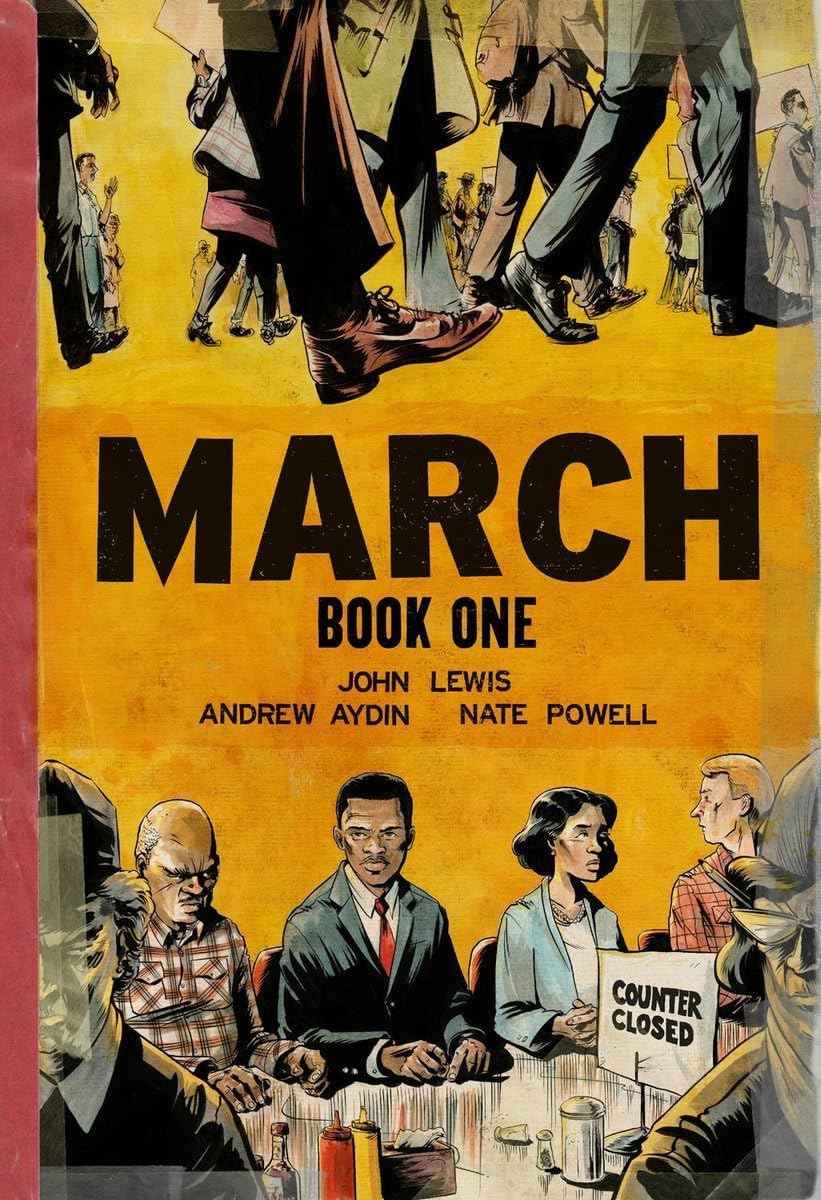
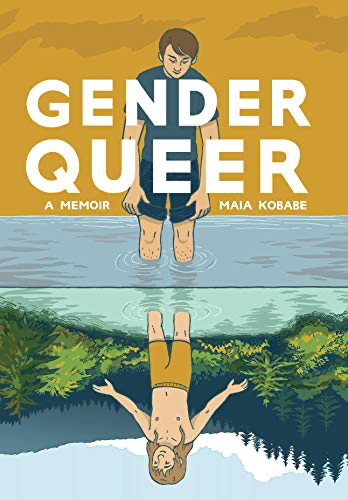
The best way to combat misinformation is to inform yourself. Here are some of my favorite nonfiction books about resistance and feminism and its many facets—race, sexuality, gender, ability, and more. Ranging from revered feminist scholars to more contemporary perspectives, I hope there is something for everybody here.

A SELECTION OF GREAT BOOKS BANNED FOR RIDICULOUS REASONS:

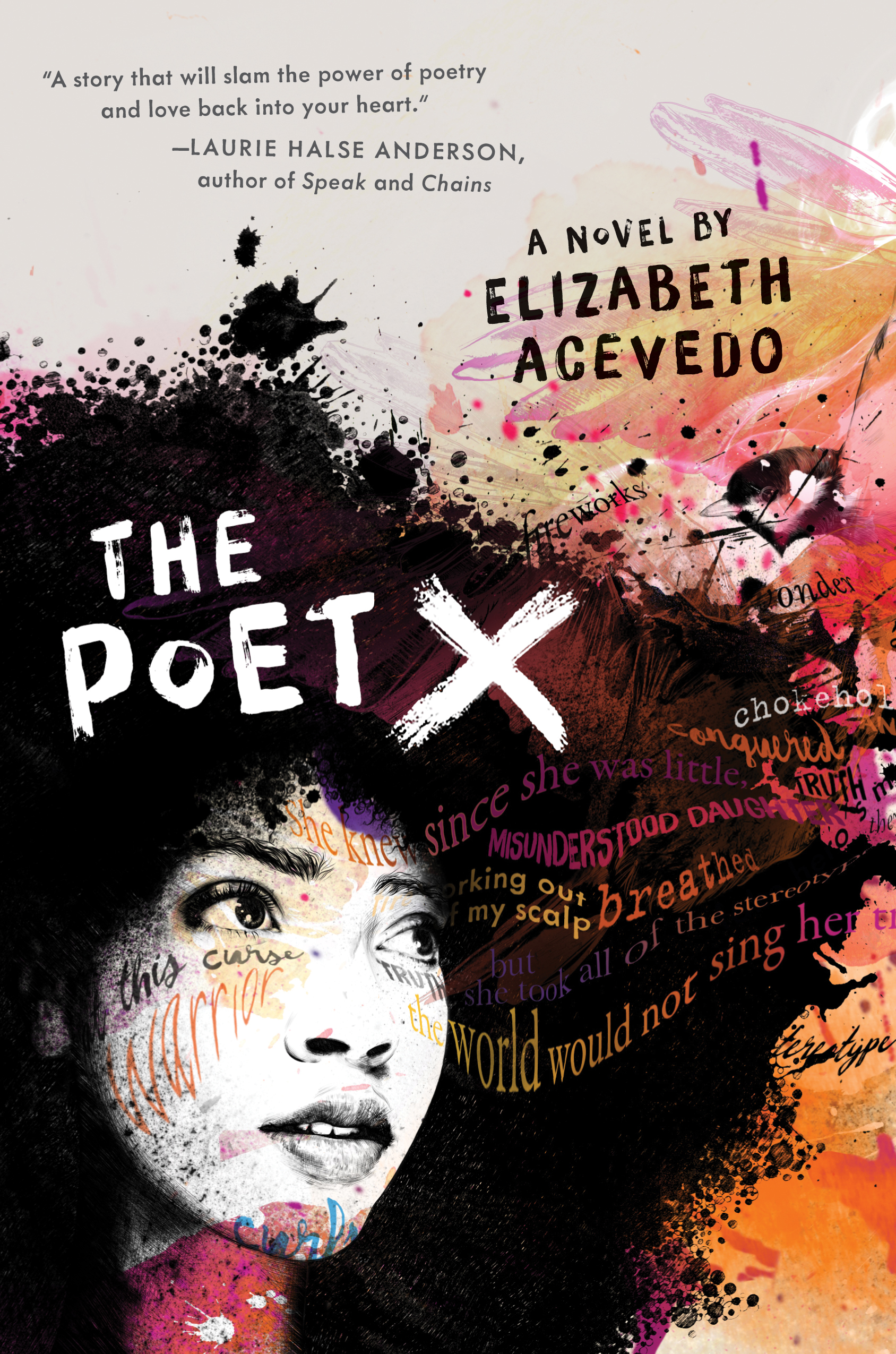
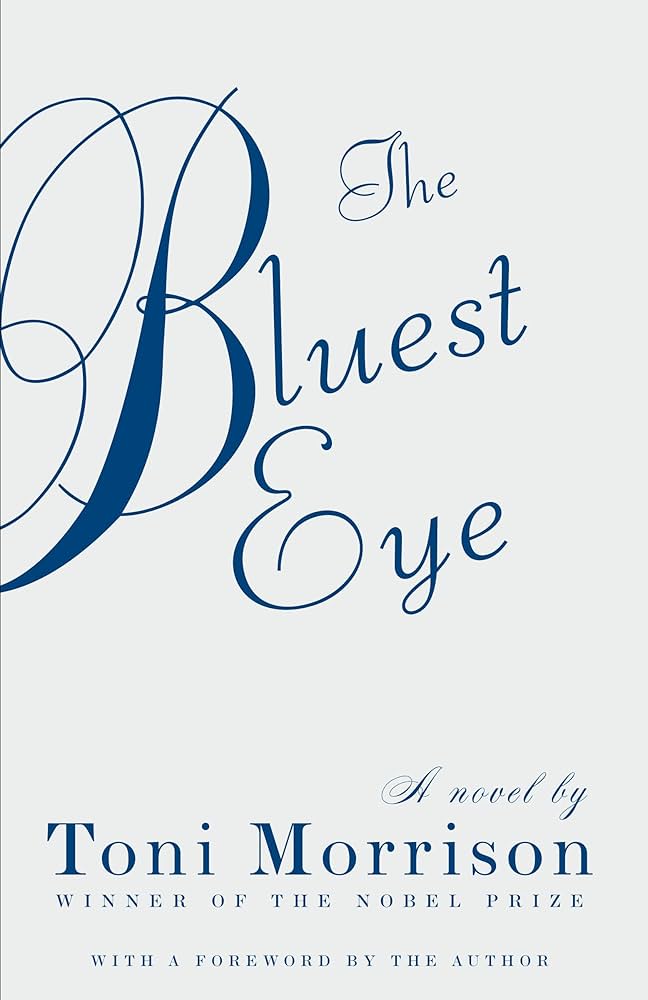
Here in the U.S., we’ve seen a deeply disheartening uptick in book bans for a number of reasons—none of them valid. Standing up to book bans is essential in these times, and through it, you can discover some excellent literature, whether they’re classics like Maus and The Bluest Eye or newcomers like The Poet X.

RESOURCES FOR FIGHTING AGAINST CENSORSHIP:

  • PEN Americaif you’ve been paying attention to efforts against book banning, you’ve likely seen PEN America come up, and for good reason—they are one of the foremost organizations fighting for the rights of authors and journalists, as well as the freedom to read and write.
  • Authors Against Book Bans – self-explanatory, but this organization has a variety of resources on how you can fight against book bans around the country.
  • M.K. England (Substack)although my list didn’t end up containing any of their books (sorry 😬), England has provided a comprehensive list of ways you can fight back against the potential threat of Project 2025 in terms of queer literature for younger (MG and YA) audiences.
  • SUPPORT! YOUR! LOCAL! LIBRARY! Wherever you are in this country, use as many of your library’s resources as you can! Whether you’re checking out books physically or digitally, or using their non-book services, libraries need all the support that they can get in these coming years.

That being said, this list is by no means exhaustive! I encourage you to look beyond this list to find even more books you love that live up to these principles. Scour the internet and your local library, and you are sure to find many more examples. Let me know in the comments what your favorite books about making change, resisting, and keeping hope are!

Today’s song:

it’s a relevant song for this post, but also, I did just listen to Humanz for the first time over the weekend. Not their best, but this was one of the highlights; as much as I despise Oasis, I do find it poetic that Albarn and Noel Gallagher sang together on this one after having the most ridiculous, decades-long rivalry. (To say nothing of Liam…)

That’s it for this post! Have a wonderful day, and…I know I put this at the end of every post, but please take care of yourselves. I love you.

Posted in Book Review Tuesday

Book Review Tuesday (11/19/24) – Loka (The Alloy Era, #2)

Happy Tuesday, everyone!

…so. Elephant in the room here, quite literally. I’ll venture to say that last Tuesday was one of the worst Tuesdays in American history. Hence, no activity. (Also, I had a whole cocktail of midterms to study for and papers and annotated bibliographies to write.) I needed the time to grieve. Let me tell you the truth: I’m so scared. I’m betrayed. Being in my formative years under a president who systematically mocked the identities of everyone who isn’t him—not just the ones that comprise my family—forced me to confront the fact that America had no regard for me. If there was change to be made, I had to do it myself, and with the help of the communities around me. So I started writing. I started educating myself. The process is never over, and will continue until my dying day; even with the sort of beef that I have with Sara Ahmed (yeah, killjoy etc. etc. etc., I’m on board with 50% of it, but can’t feminism be gleeful sometimes?), I look back to her words: “To become a feminist is to stay a student.” I am always learning. I am far from perfect, but I am trying. The key here is motion: we can’t afford to stay static, not in our ideas or in our actions. Resistance comes in many forms (and don’t let anybody tell you that there’s one right way to fight), but the key is that we must always keep moving. Donate. Protest. Pay someone a compliment. Make art. Write with hope in your heart. Trump and his ilk win when we’re too far into the quicksand of hopelessness.

Never lose hope and never lose love, because that is what the Trump administration lacks. Grieve, and grieve on your terms. I certainly did. The last thing I wanted was a repeat of that November morning when, at the age of 13, I woke up to my dad hanging his head over the kitchen counter as he made lunches for my brother and I. I remember clinging to him tighter than I ever had, frightened of every horrid possibility. Some of them came true. Some of them didn’t. I called both of my parents. I cried the same tears to them that I cried when I was young. Cry the same tears, but remember that they are the same tears. I’m frightened. But if we can resist Trump once, we can do it again. We can fight the same good fight. I love you.

All this is to say that, even though my output has been lessened lately (college!), this won’t change a thing. I’ll still be reviewing queer books aplenty, and no election will change that. Gather ’round.

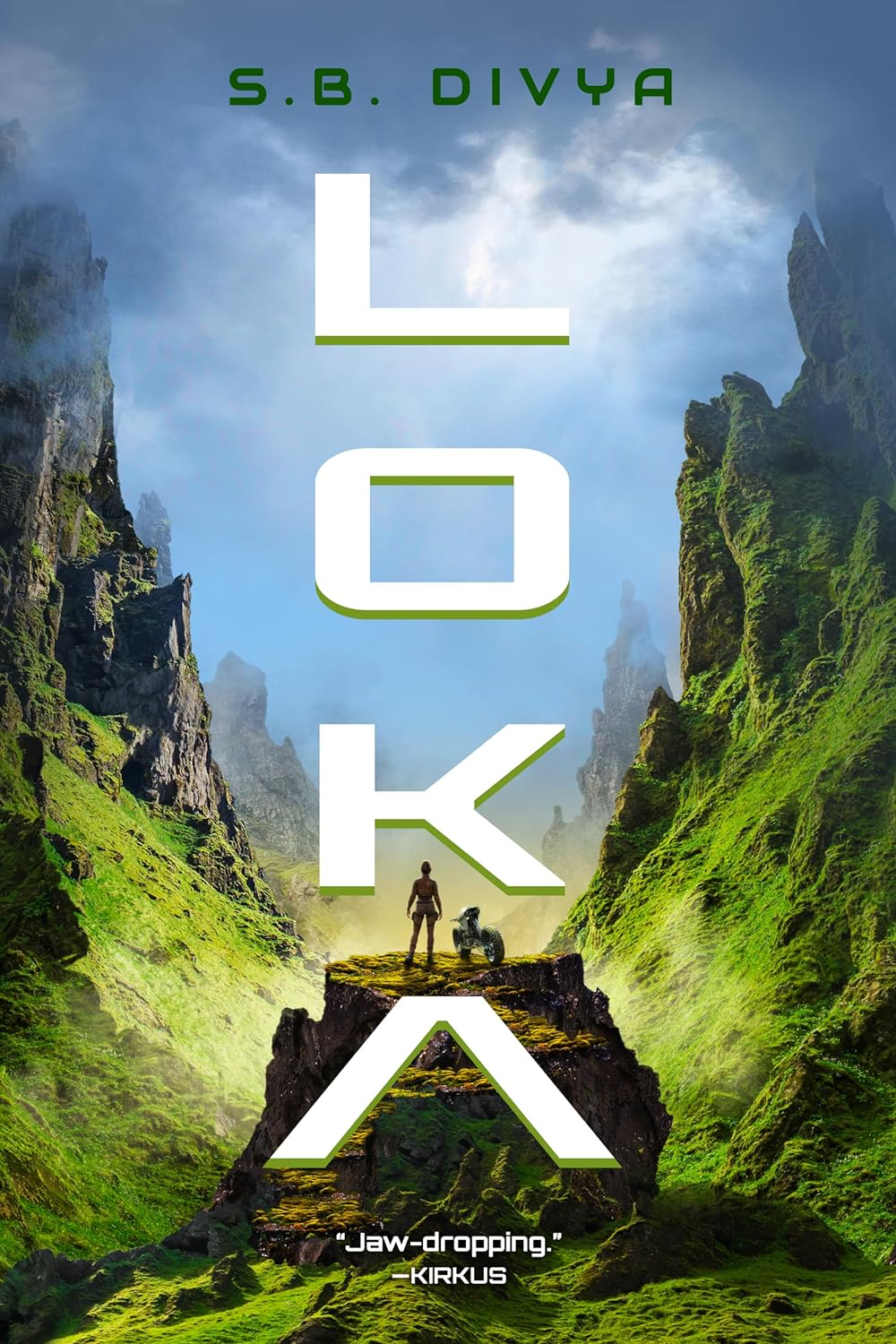
After a solid two weeks of reading nothing but fluff to keep my mind off of everything, I remembered that Meru, one of the more innovative new sci-fi novels I read last year, had a sequel that was finally out! I was eager to re-immerse myself into S.B. Divya’s endlessly creative futuristic landscape, and Loka found itself on my Kindle in no time. Loka turned out to be contrary to my expectations and a very different book to Meru—it was a mixed bag at first, but by the final third, I’m happy to say that it stuck the landing in a deeply moving way.

Now, TREAD LIGHTLY! This review contains spoilers for Meru, book one in The Alloy Era series. If you haven’t read Meru and intend to do so, read at your own risk!

For my review of book one, Meru, click here!

Enjoy this week’s review!

Loka (The Alloy Era, #2) – S.B. Divya

Akshana is a child that defies all existence. Her mother is human, and her maker is an Alloy—a post-human being with godlike powers. The ruling Alloy government condemns her very existence. For years, she has lived a sheltered existence on the planet Meru, raised by her human mother. But once Akshana turns 16, she heeds the call of Earth, the ancient homeworld of humankind. With the help of her friends, she takes up the rigorous Anthro Challenge: a trek to circumnavigate the habitable zone of Earth. As she navigates foreign terrain, Akshana comes to terms with how she was born and created—and where her destiny lies.

TW/CW: near-death situations, medical emergencies (related to sickle-cell anemia), xenophobia/discrimination (fictional), life-threatening storms

I thought that Meru had scared off all of the people who thought that S.B. Divya invented neopronouns, but apparently people are still complaining about it in the reviews for Loka? Did you just…miss book one in its entirety, or what?

I’ll get my main gripe about Loka out of the way first. The more I think about it, the more that I realize that my issue with Loka is that to some extent, it has the exact same stakes as Meru: a young girl/woman has to take a daring trek onto a foreign landscape, all the while facing prejudice from the outside world and alien, terrestrial dangers from the ground beneath her feet. S.B. Divya remains an excellent writer and crafter of worlds, but in terms of plot, in this case, lightning couldn’t strike twice. Aside from Akshana’s differing personality and the novelty of Earth 1,000 years in the future, there wasn’t as much to distinguish the two plots once I broke them down.

I wasn’t crazy about the main plot of the Anthro Challenge. In the future landscape of Loka, this challenge is designed for humans and Alloys to circumnavigate the landscape of Earth as humans did millennia ago. Only a few strips of Earth remain habitable (forming ringed borders around the world), but the brave adventurer must cross swaths of the Southern hemisphere and the Atlantic and Pacific Oceans in order to complete the challenge. In concept, it’s a great bit of worldbuilding, but it didn’t make for a very compelling of a plot. For the first half of the novel, it felt like the same regurgitation of 1) reach new landscape, 2) inter or intra-personal conflict within the friend group, and 3) make a harrowing trek to the next stop on the Challenge. This was rinsed and repeated with less change than I wanted; even with the new landscapes, none of the side characters had much time to develop, and they seemed to encounter almost the exact same problems for a solid 100 pages. It bordered on feeling cheap, given how innovative Meru was.

That being said, even though the plot faltered, Divya’s writing never did. You’ve just got to trust in her abilities at this point, because she can write some fantastic sci-fi, even if the foundation of the plot is flimsy. Her voice for Akshana perfectly captured that teenage urge to explore beyond your parents’ backyard and prove everyone wrong. Divya’s descriptions of future Earth, from the raging seas to the lush greenery to the plains of a futuristic America, immersed me instantly in a vibrantly crafted vision of the future. I’ll get to the specifics of the emotional core of Loka later, but that was perhaps the best part of the novel—S.B. Divya’s brand of space opera borders on hard sci-fi for me, but it keeps the emotional center that so many other hard sci-fi novels forget to consider.

The subject of disability was one of the more compelling aspects of Meru; in a genre rife with eugenic practices that get dismissed as signs of a “progressive” society, Divya changed the game by creating Jayanthi, who, in a future when most disabilities were edited out of the gene pool, was specifically engineered to have sickle-cell anemia. More than that, her sickle-cell anemia was advantageous for surviving the landscape of Meru. Fast-forward 16 years, and Akshana is experiencing, as I said before, the same plot, but her sickle-cell anemia presents unique challenges on Earth, leading to many a close scrape when she exhausts herself to near-fatal levels. She has thoughts of resentment towards her mother, who made a conscious decision to pass this gene down to her. S.B. Divya said that Loka was inspired by their experience being a disabled parent, and that shone through in Loka; eugenicists would have you believe that this would constitute cruelty on the highest level, but Akshana comes to reconcile with—and understand—her mother’s logic. By erasing this gene and others from the gene pool, the Alloys past erased entire cultures, as well as the ways in which they moved about in the world. Being disabled is challenging, to say the least, and in my experience, bothersome and at times taxing to deal with on a daily basis. Yet it has shaped my life in ways that I will never regret. Akshana comes to realize that her mother, even though the road to this decision was rocky, merely wanted her to know that individuality, adversity, and culture cannot be erased by a purging of the gene pool.

Which brings me to the ending. The buildup of Loka concerns the mounting pressure and prejudice surrounding daring Akshana and her friends as they complete the challenge and return to a world that wants to erase their bravery and ban the Anthro Challenge altogether. Not only has she come to terms with her disability, she has come to reckon with her status as a half-human, half-Alloy being in a galaxy where neither party wants her to exist. Yes, there was the physical challenge, but the real Anthro Challenge is the identity crisis you have along the way, amirite? All jokes aside, that was the real hurdle to overcome. I know how corny I sound, but the real journey was Akshana’s journey to self-acceptance in all of the facets of her identity. At the end of the treacherous paved with prejudice and hatred, Akshana learns that the only way to survive is to be yourself, unapologetically so. As she says, in Loka’s stunning final lines:

“Our bodies don’t have a true end. Subatomic particles bounced between skin and air continually. So what did that make me, or any person? If I coexisted with everything and everyone, then part of me was also part of them, and vice versa. To some people, I would never be human enough. To others, I would always be too human. In the end, I had no choice by to be myself.”

And if anything could save Loka from being a letdown, it would be this, and the character arc it coincides with. Excuse me for a moment…no, I’m not crying, it’s just raining on my face.

All in all, a sequel with a plot that nearly dragged the novel down, but just like Akshana completing the Anthro Challenge, beautifully stuck the landing after a rocky journey. 4 stars!

Loka is the second book in The Alloy Era series, preceded by Meru. S.B. Divya is also the author of Machinehood, Runtime, and several other science fiction short stories.

Today’s song:

NEW HORSEGIRL IN FEBRUARY? ON VALENTINE’S DAY? PRODUCED BY CATE LE BON? today is a GOOD day

That’s it for this week’s Book Review Tuesday! Have a wonderful rest of your day, and take care of yourselves!
Posted in Books

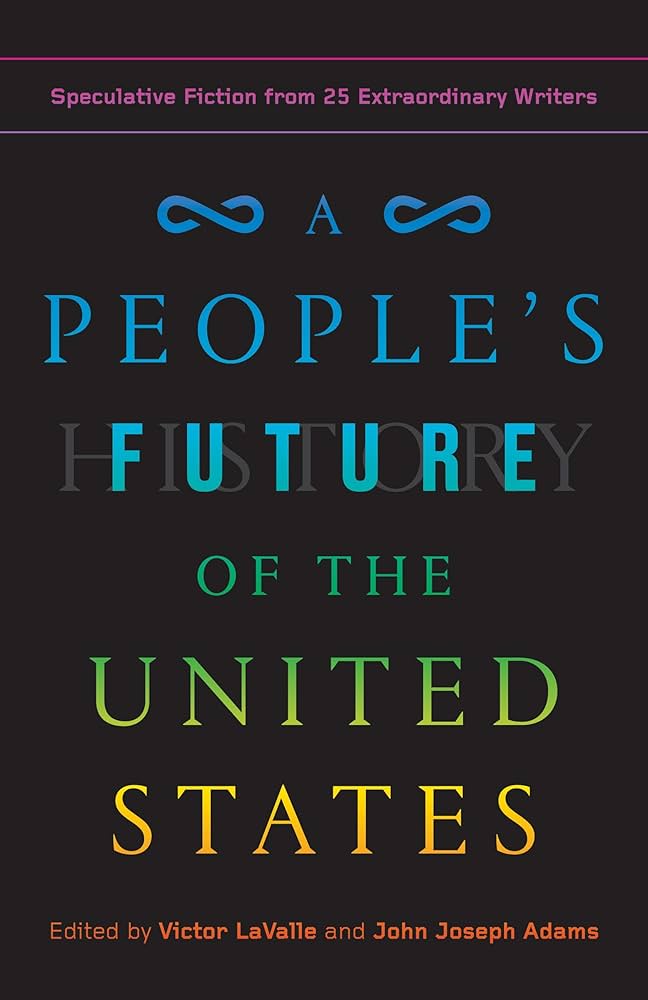
🏳️‍🌈🏳️‍⚧️The Bookish Mutant’s Books for Pride Month (2024 Edition) 🏳️‍⚧️🏳️‍🌈

Happy Wednesday, bibliophiles!

Here in the U.S., June is Pride Month! And every month, I find myself having a downer of an introduction, just because the world only gets kinder to queer people in the smallest increments, it seems. The vocal minority in this country are still bent on erasing all evidence that queer people exist in the first place, like an offending stain on a white tablecloth. (A note to homophobes: has it ever occurred to you that you don’t have to look at pride flags or queer couples? You can just look away and not make it anybody else’s problem…life is so short, man.) But our community is one characterized by resilience: no amount of book bans, culture wars, or bigotry will wipe us off the map. We are are here, we have always been here, and we will always be here. Nothing you do will make us disappear. Don’t let the vocal minority distract you from the beauty created and progress made by our community.

So once again, here’s a list of YA and Adult books with queer characters and themes, curated by your local bisexual. I also added the specific representation of each book.

Just a refresher on my key:

MC: Main character

LI: Love interest

SC: Side character(s)

For my previous lists, see below:

Enjoy these book recs!

🌈THE BOOKISH MUTANT’S BOOKS FOR PRIDE MONTH (2024 EDITION)🌈

FANTASY

SCIENCE FICTION

REALISTIC FICTION:

TELL ME WHAT YOU THINK! Have you read any of these books, and if so, did you enjoy them? What are some of your favorite queer books that you’ve read in the last year? Let me know in the comments!

Today’s song:

That’s it for this year’s pride recommendations! Have a wonderful rest of your day, and take care of yourselves!

Posted in Books

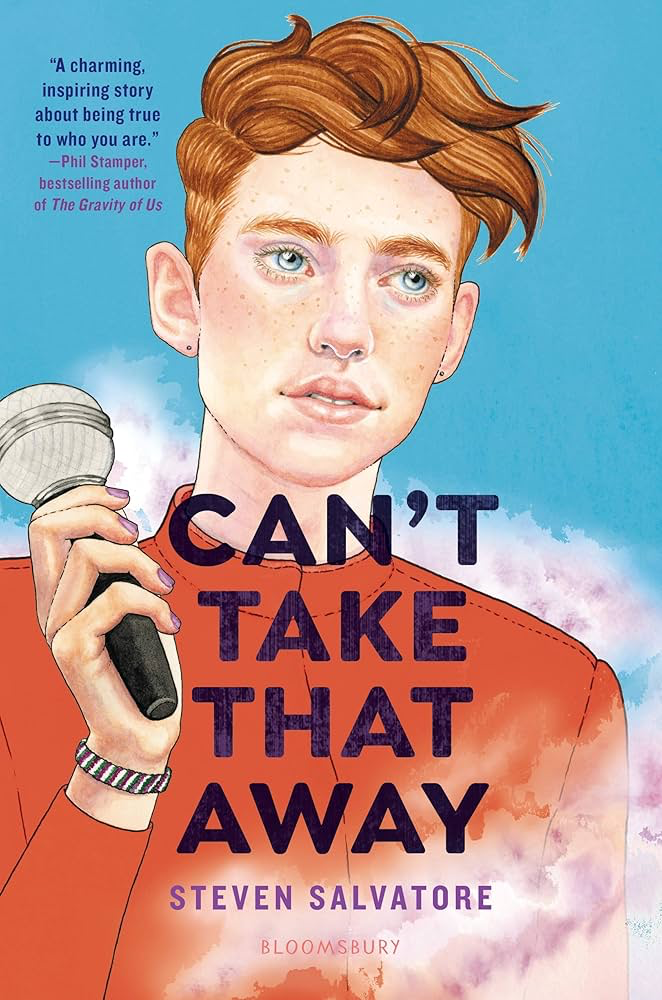
The Bookish Mutant’s Books for AAPI Heritage Month (2024 Edition)

Happy Monday, bibliophiles!

Here in the U.S., May is Asian American and Pacific Islander Heritage Month! This is my fourth year making this particular list, and I’ve found and read so many incredible books since then. As always, diverse reading shouldn’t be restricted to one month only, but here at The Bookish Mutant, I try to take any opportunity I can to shift the focus to marginalized voices—and to recommend fantastic books. It feels especially important to make these lists in the past few years, what with the book bans that are not-so-subtly targeting almost exclusively POC and queer voices—read between the lines. Freedom to read is freedom to resist.

As with last year’s list (see below), I’ve now expanded them to included both YA and Adult titles, organized by genre.

For my past lists, click below:

Let’s begin, shall we?

THE BOOKISH MUTANT’S BOOKS FOR AAPI HERITAGE MONTH (2024 EDITION)

FANTASY:

SCIENCE FICTION

REALISTIC AND HISTORICAL FICTION:

TELL ME WHAT YOU THINK! Have you read any of these books, and if so, did you enjoy them? What are your favorite books by AAPI authors? Let me know in the comments!

Today’s song:

NEW BEABADOOBEE????? I’m seated—

That’s it for this recommendations post! Have a wonderful rest of your day, and take care of yourselves!
Posted in Books

The Bookish Mutant’s Feminist Books for Women’s History Month (2024 Edition)

Happy Friday, bibliophiles, and more importantly, Happy International Women’s Day!

Here in the U.S., March is Women’s History Month! In the years since I’ve started making these posts, the amount of attacks on women—in terms of laws attacking our bodily autonomy (as well as the bodily autonomy of trans and nonbinary people) and worldwide violence—has only increased. And amidst all of this turmoil, all I can take from this is that now, more than ever, we need feminism. We need to educate people, we need to help people to become less ignorant about the litany of issues plaguing marginalized groups here in the states and elsewhere. That, to me, is the most insidious consequence of the book bans spreading across the country: you take away a child’s ability to learn about perspectives outside of their own, and you produce an ignorant generation that does not question authority. In the absence of sound authority figures, books, more than ever, are our most valuable teachers.

Another change from my lists in previous years is that since my reading tastes have expanded, I’ve added adult and nonfiction books to this list—all of which I believe are just as valuable to feminism as any other book I’ve included. Enjoy!

For my previous lists, click below:

Let’s begin, shall we?

THE BOOKISH MUTANT’S FEMINIST BOOKS FOR WOMEN’S HISTORY MONTH (2024 EDITION)

SCIENCE FICTION:

FANTASY:

*NOTE: The Siren, The Song, and the Spy is book 2 in a series, but I feel it should be included on this list for the feminist themes included in this book in particular.

REALISTIC FICTION:

NONFICTION:

TELL ME WHAT YOU THINK! Have you read any of these books, and if so, what did you think of them? What are your favorite feminist books? Let me know in the comments!

Today’s song:

never thought I’d go through this whole album bc I was so Kate Bush’d out in 2022 but this one’s fantastic almost all the way through

That’s it for this list! Have a wonderful rest of your day, and take care of yourselves!

Posted in Book Review Tuesday

Book Review Tuesday (8/8/23) – Machinehood

Happy Tuesday, bibliophiles!

After I read Meru back in June, I immediately went through the rest of S.B. Divya’s full-length books and put them on my TBR. Even though sci-fi is my favorite genre, I don’t readily jump for sci-fi thrillers quite as often, but after loving Meru, I was willing to give this one a chance. And while it wasn’t without its flaws, Machinehood was an incredibly detailed and twisty novel!

Enjoy this week’s review!

Machinehood – S.B. Divya

2095. In Welga Ramirez’s world, humans and machines work in an uneasy symbiosis. Artificial intelligence has become so advanced that humans must take all manner of pills, not only for them to keep from getting sick, but to be strong enough to compete with the machine labor force. Welga has intentions to retire from being a bodyguard. But after a client is killed in front of her and a hybrid human-machine terrorist group called the Machinehood is to blame, she must track down her killer—and the members of the Machinehood that have threatened to attack every major pill funder until production comes to a standstill.

TW/CW: violence, murder, racism, substance abuse, abortion/forced pregnancy, miscarriage

You ever finish a book that’s so detailed in its worldbuilding that not only can you imagine all of the described conventions and their ramifications, but the massive google doc that was probably behind it all? That’s how Machinehood felt to me—aside from the one other S.B. Divya book that I’ve read so far, Machinehood was one of the most thoughtfully-crafted books I’ve read in a long time.

At its best moments, Machinehood felt like a good Christopher Nolan movie. There was no shortage of suspense, and while it was difficult to keep up with at times, it was always an enjoyable read. I don’t gravitate towards sci-fi thrillers as much, even though sci-fi is my favorite genre, but this novel reminded me of what the really well-written ones are capable of doing; the suspense kept me guessing, the tension hardly ever let up, and there were twists aplenty to satisfy any sci-fi reader’s appetite. And of course, nothing makes a thriller like a main character about to retire, and then has to do that One Last Mission™️. When it’s not a part of a huge franchise, it works for me.

Machinehood is S.B. Divya’s first novel, and even then, it’s easy to see the threads from where they eventually branched off to Meru. The most prominent of those was, by a long shot, the worldbuilding. Like Meru, the dystopian, AI-dominated world of Machinehood is painstakingly detailed, down to the most minute consequence of any given sociopolitical ramification. I wouldn’t be surprised if Divya had some kind of Pepe Silvia-style conspiracy cork board to keep track of all the possibilities of this world that they created. There truly was no stone left unturned, and for the most part, it was a positive experience—between the moments of suspense, it was fascinating to see these possibilities unfold. From the myriad of pills that keep humans competing with the AI labor force to the ways that genetic and physical modification advanced, there was nothing that Divya didn’t think of, and that created one of the most fleshed-out sci-fi worlds that I’ve read recently.

Unfortunately, the downside of all of that excellent worldbuilding was its delivery. Having read Meru first, it’s easy to see how Divya improved on this delivery from Machinehood to there. Meru deftly toed the line between explaining its complex worldbuilding and dumping it all in one sitting. Machinehood, on the other hand, could have used some work in that department. As much as I enjoyed how richly layered the worldbuilding was, Divya had a frequent tendency to ramble on about said worldbuilding; even with all of the suspenseful plot points falling into place, this novel took frequent breaks to explain why [x] was a result of [y] and [z], which took away from the tension built up during the parts where the actual plot occurred. It’s a pitfall that I can almost excuse, given that a) Divya’s worldbuilding is obviously top-tier, and b) this was their debut novel, but it definitely took away from some of my enjoyment of the book as a whole. This novel probably would’ve gotten the full 4 stars from me if not for all of this.

All in all, a twisty and suspenseful debut with extensive worldbuilding that sometimes suffered from just as extensive rambling. 3.75 stars, rounded up to 4!

Machinehood is a standalone, and S.B. Divya’s first novel. Divya is also the author of the Alloy Era series (Meru, Loka, and an untitled third book) and Runtime, and has contributed to many short story collections.

Today’s song:

been listening to this song a bunch again, we’re levitating over here

That’s it for this week’s Book Review Tuesday! Have a wonderful rest of your day, and take care of yourselves!
Posted in Books

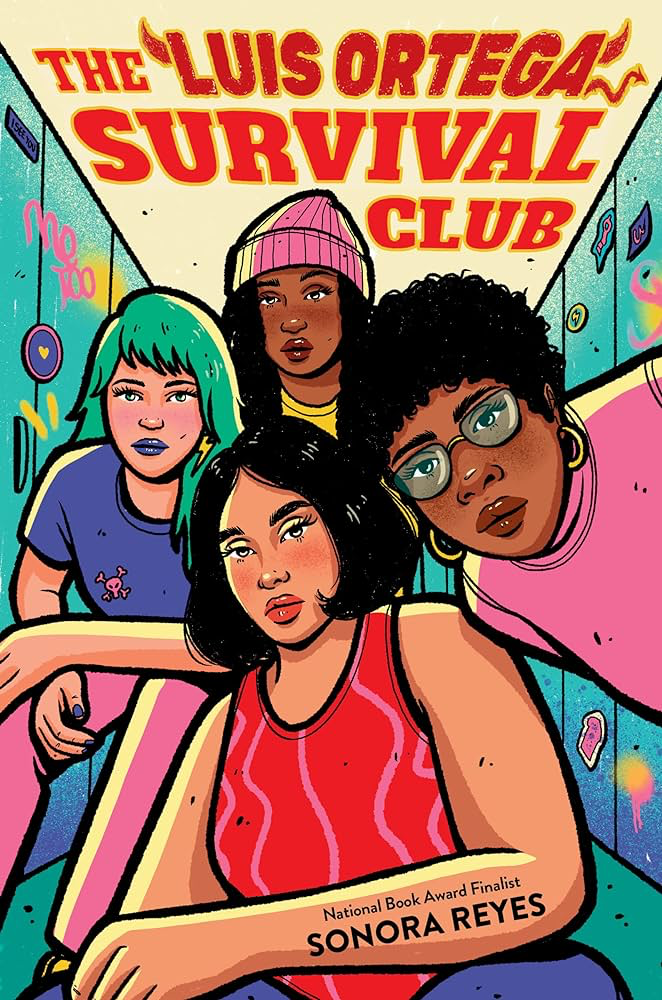
The Bookish Mutant’s Books for Disability Pride Month (2023 edition) ♿️

Happy Friday, bibliophiles!

Here in the U.S., July is Disability Pride Month! Although I’ve seen some more recognition for it in the past few years, I find myself saying this over and over—disability issues are left behind in intersectional feminism far too often. The larger representation in media of disabled people as otherwise white and cishet, the lack of accessibility at many pride events, and the hurdles that most disabled students have to go through in order to get accommodations at school is proof. And yet, around 27% of Americans have some sort of disability—myself included. As the literary world has slowly shown more stories with disabled characters, it’s more important than ever to uplift disabled voices.

Like some of my other themed lists this year, I’ve decided to expand it beyond YA, because I’d be remiss if I didn’t include some of the amazing Adult and MG reads with disabled rep over the years. I’ve separated all of these recs by age group, and included their genres, my rating, and the type of disability rep.

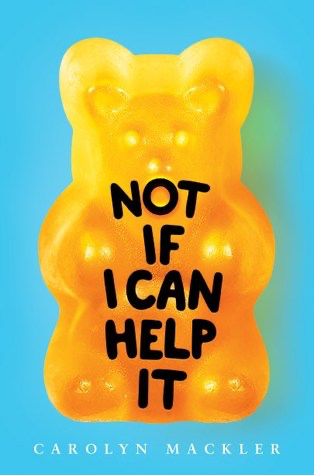
(SHOUTOUT TO NOT IF I CAN HELP IT, I FINALLY HAVE A MORSEL OF SPD REP)

for my lists from previous years, click here:

  • 2022 (+ on having SPD and the lack of representation)
  • 2021

Let’s begin, shall we?

THE BOOKISH MUTANT’S BOOKS FOR DISABILITY PRIDE MONTH (2023 EDITION)

YA:

ADULT:

MIDDLE GRADE:

TELL ME WHAT YOU THINK! Have you read any of these books, and what did you think of them? What are your favorite books with disabled rep? Let me know in the comments!

Today’s song:

That’s it for this year’s Disability Pride recs! Have a wonderful rest of your day, and take care of yourselves!
Posted in Monthly Wrap-Ups

June 2023 Wrap-Up 🏳️‍🌈

Happy Friday, bibliophiles!

And just like that, we’re halfway through the year…I don’t want to jinx it, but I feel like it’s been a good one so far. Other than being sick for all of April, basically, but that’s in the past. Now the pollen allergies are kicking in!! Whee!!

Let’s begin, shall we?

GENERAL THOUGHTS:

June has been on the busier side, but in a good way, for the most part. I got my very first job as a page at my local library (!!!), and I’ll be working there part-time until school starts back up. As of today, I’ve just gotten my first paycheck!!

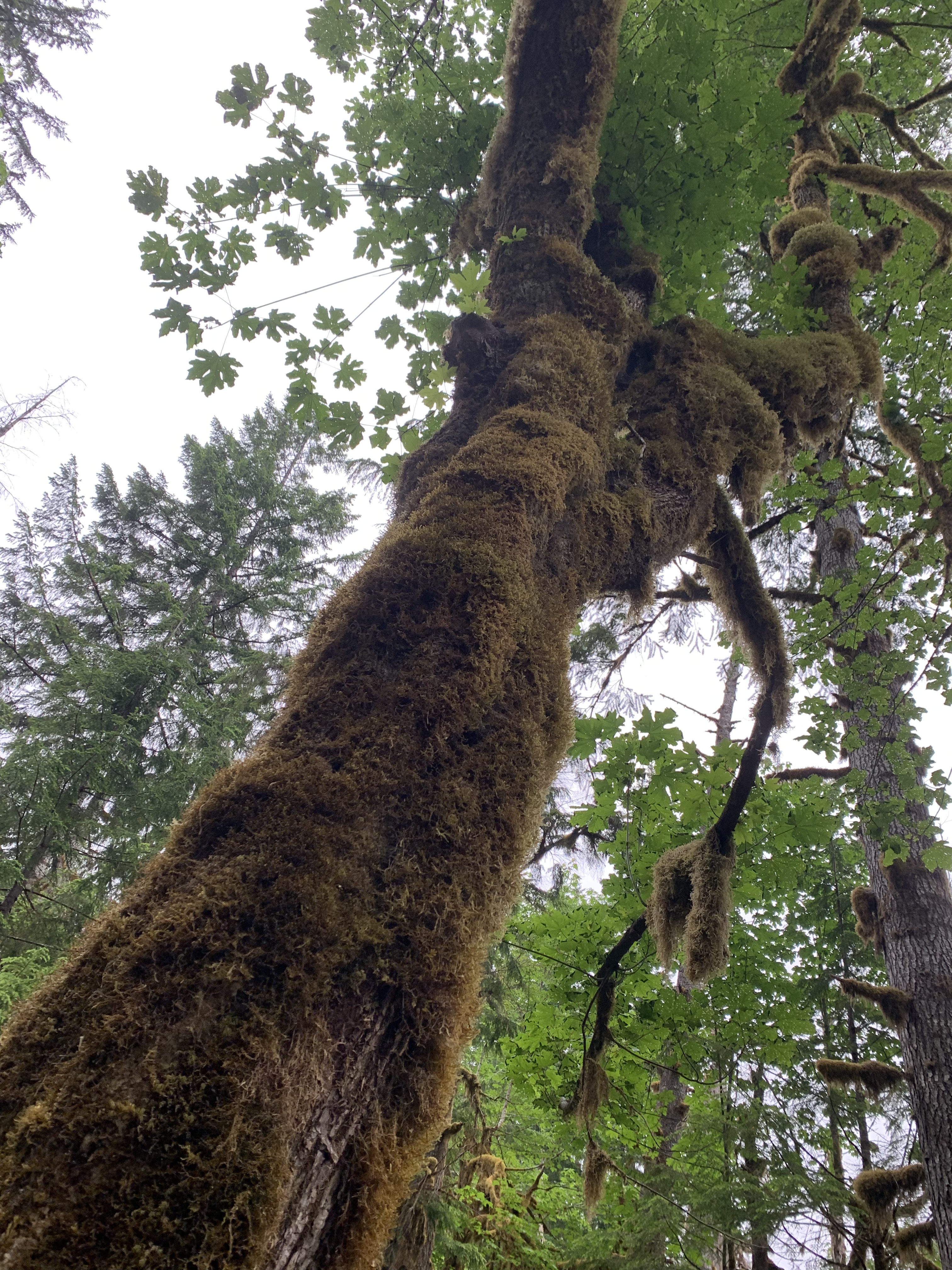
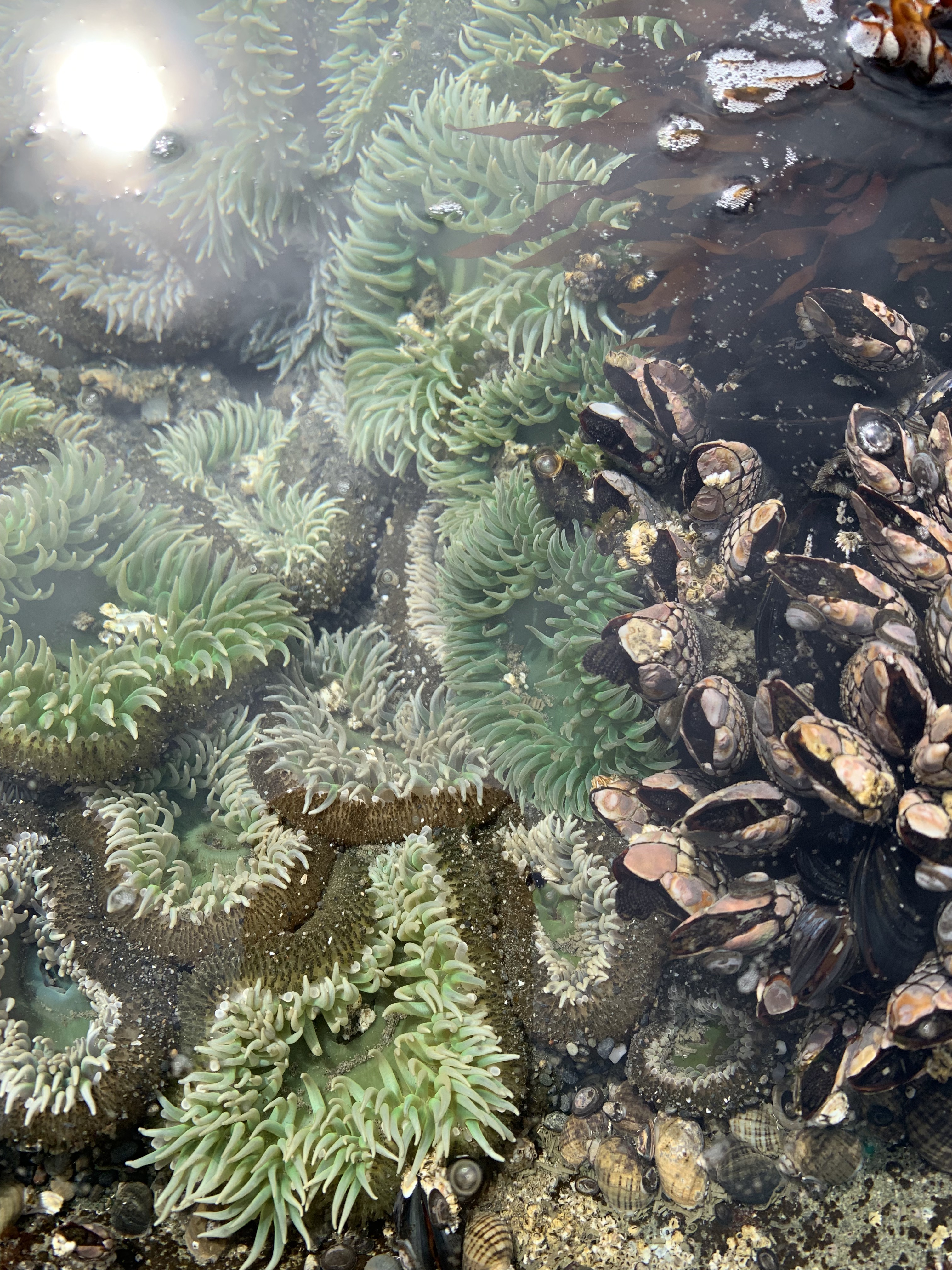
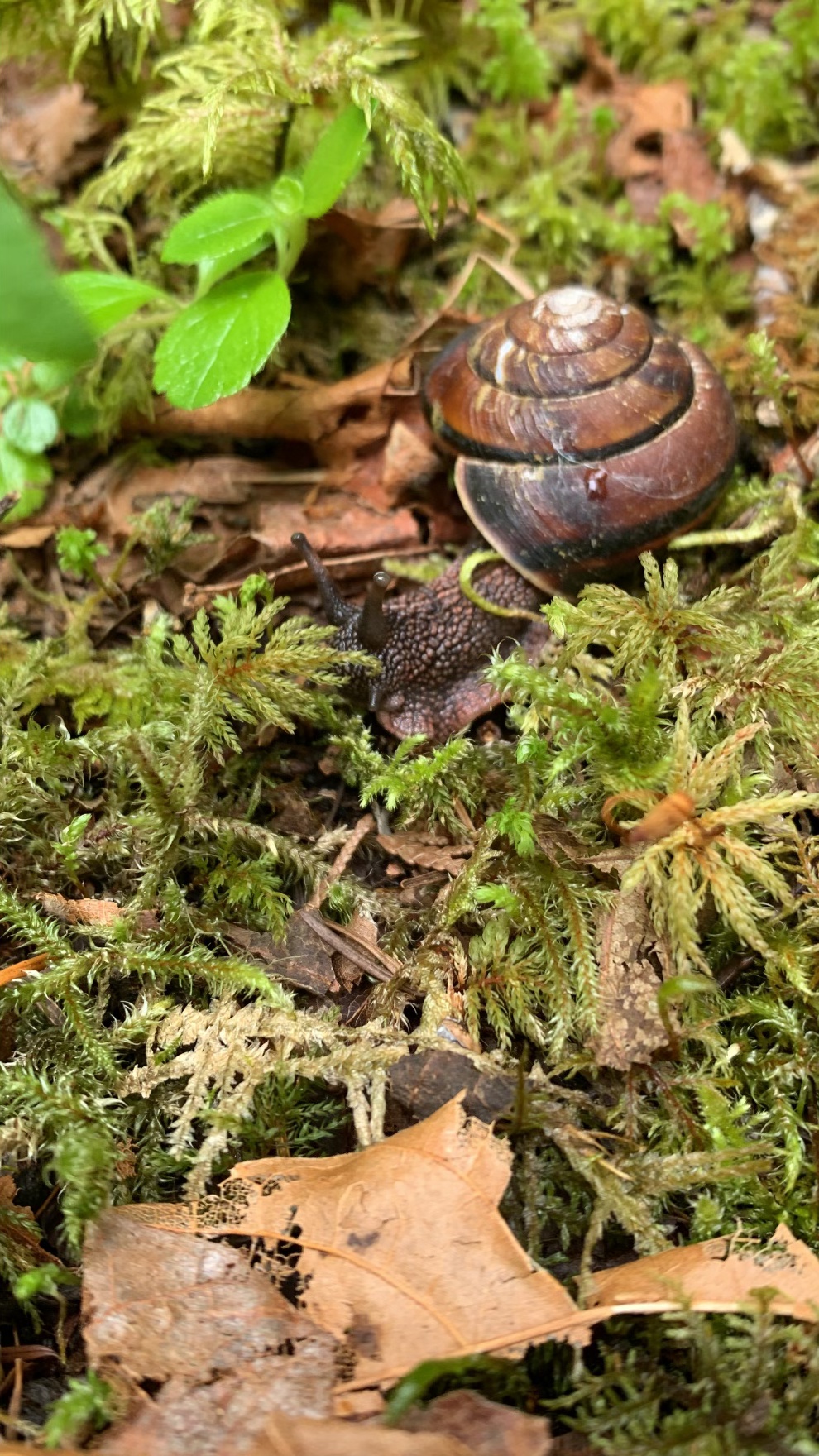
Right after that, I went on vacation in Olympic National Park! Washington is the prettiest—I loved seeing the rainforest and the ocean, and all of that nature really got my creative juices going.

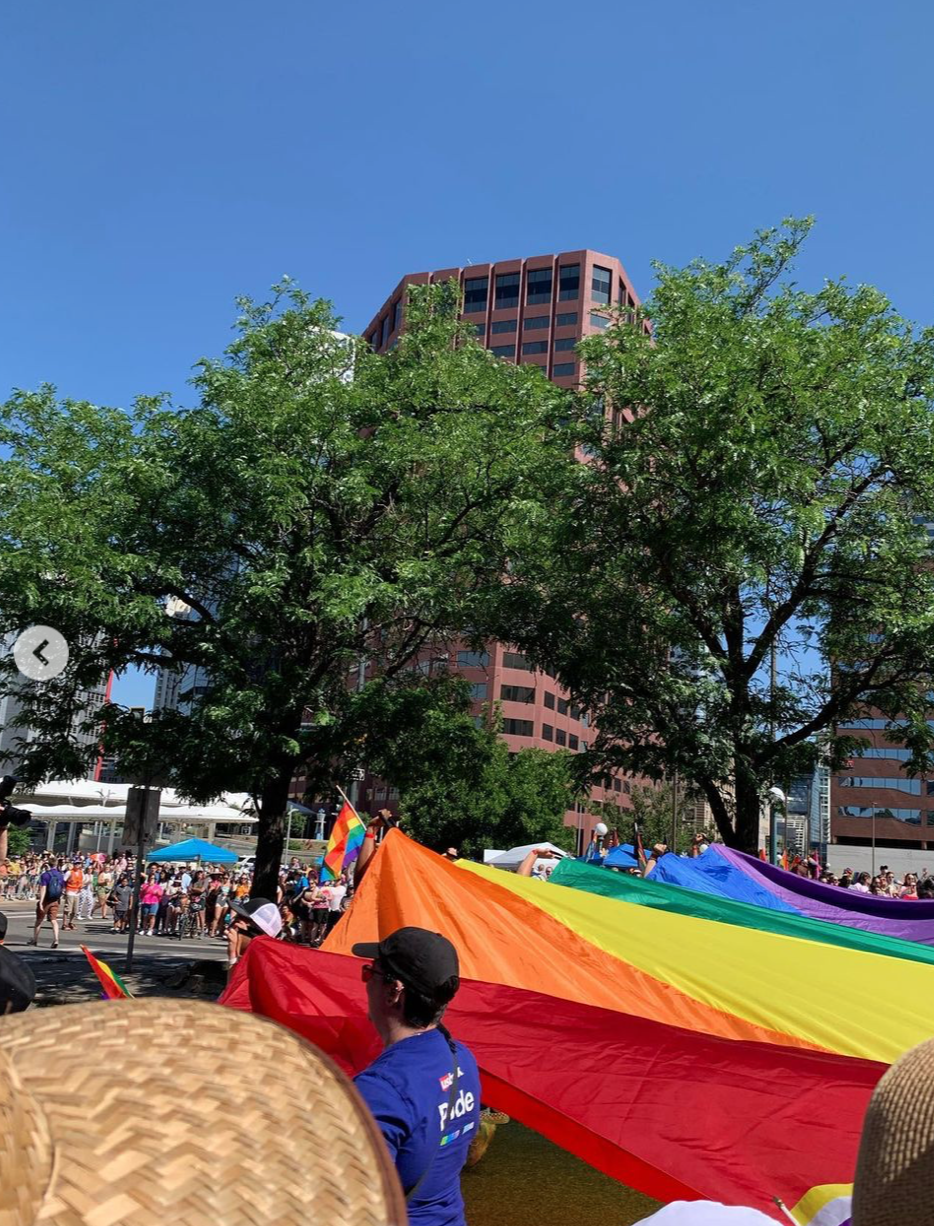
I also went to my very first pride parade last weekend!! I only stayed for an hour to watch the parade itself (that’s on sensory issues), but it made me so incredibly happy to see my community gathered there and spreading so much joy. Unforgettable experience.

Now that I’m off school, I’ve tried to get back into my writing routine. I started on the first draft to the sequel of my main WIP. I’ve made some good progress so far, but I’m planning on taking it to Camp NaNoWriMo tomorrow! I’m shooting for the full 50,000 this time, so wish me luck!

Other than that, I’ve just been drawing, practicing guitar, seeing the Yeah Yeah Yeahs and Shakey Graves live (both of which were AMAZING GAAAH) binging even more Taskmaster (just finished season 6, looking forward to seeing how unreasonably angry James Acaster gets in season 7), watching Across the Spiderverse (can’t remember the last time a movie changed my brain chemistry THIS much, so beautiful) and Asteroid City (another win from Wes Anderson), and trying not to inhale every single mote of pollen in my room. Allergy season is a real Fun Time.

READING AND BLOGGING:

I read 16 books this month! June wasn’t off to a great start (see the DNF below), but I ended up reading a ton of fun books for pride month! You’d think that vacation would’ve given me more time to read, but I ended up buying three books on my Kindle, all of which were rather chunky, so…

1 – 1.75 stars:

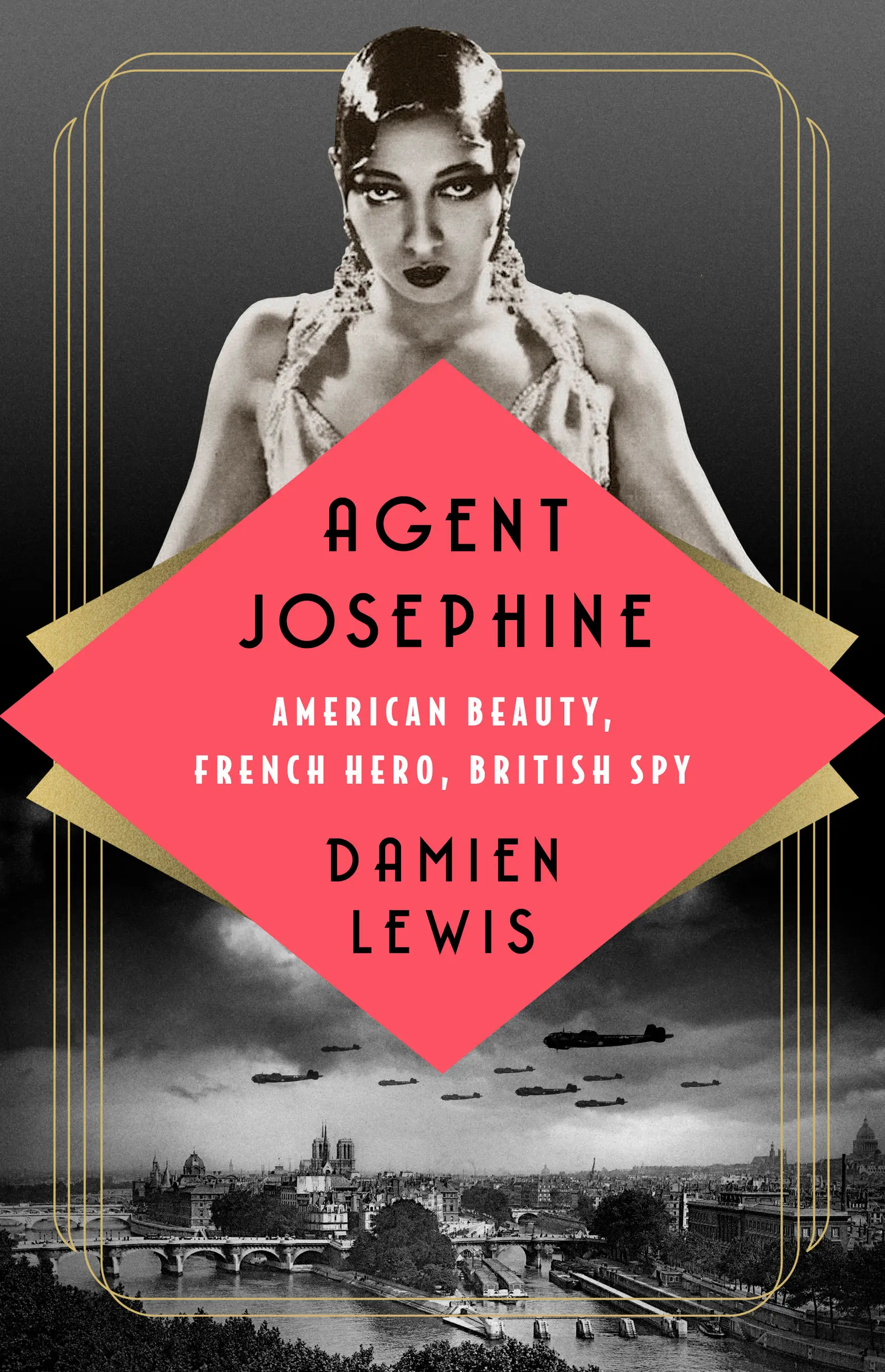
Agent Josephine

2 – 2.75 stars:

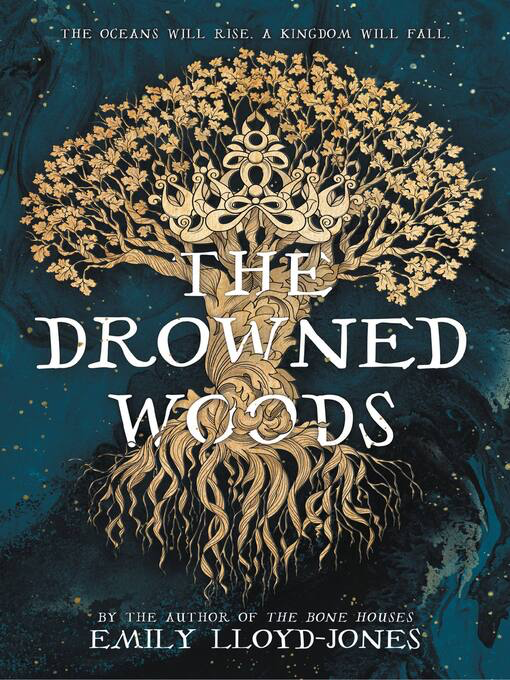
The Drowned Woods

3 – 3.75 stars:

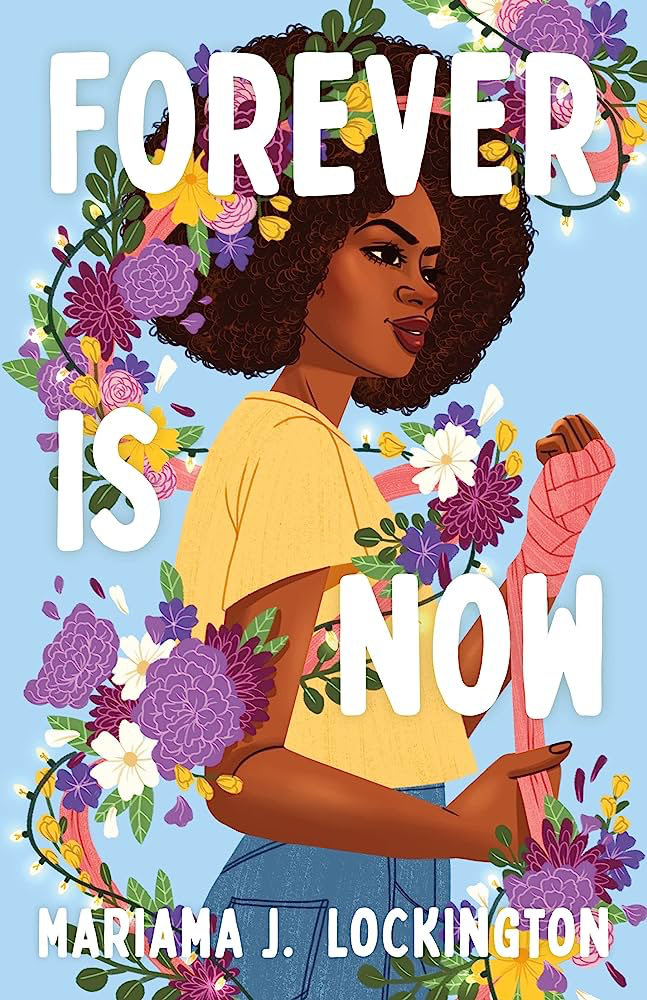
Forever is Now

4 – 4.75 stars:

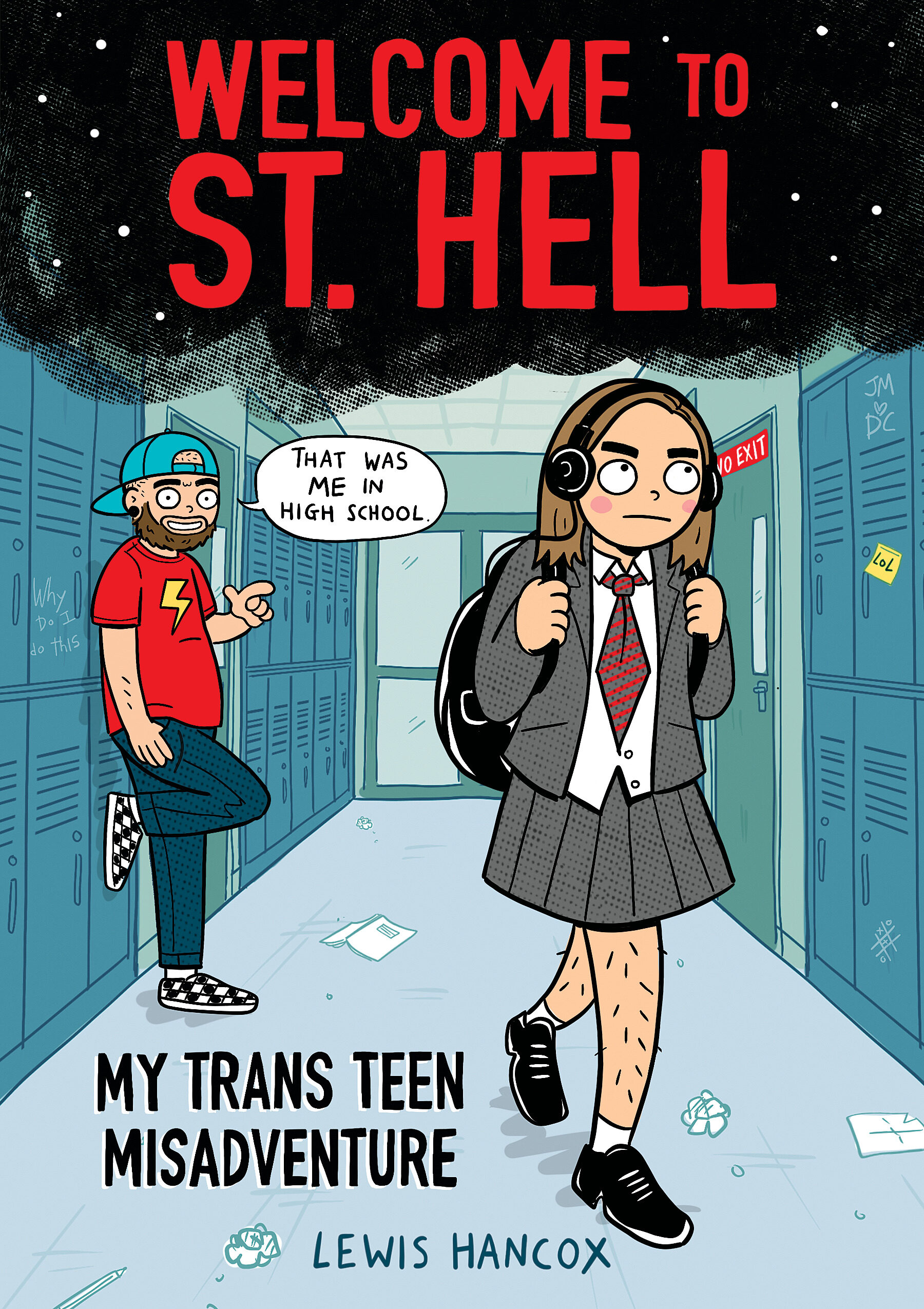
Welcome to St. Hell

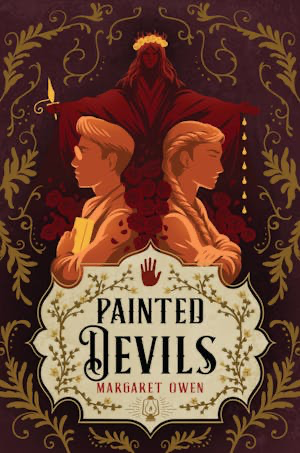
FAVORITE BOOK OF THE MONTH – Painted Devils4.25 stars

Painted Devils

POSTS I’M PROUD OF:

POSTS FROM OTHER WONDERFUL PEOPLE THAT I’VE ENJOYED:

SONGS/ALBUMS THAT I’VE BEEN ENJOYING:

obSESSED thanks Max
ever since this came to Bandcamp I have Not Been Okay
brain chemistry-altering movie, 10,000/10
delightfully weird album
NEW SMILE I REPEAT NEW SMILE
WHUHHHHHHHWHWHWHHWHWHHH LOVE THIS ALBUM

Today’s song:

now THIS is the Blur I missed

That’s it for this month in blogging! Have a wonderful rest of your day, and take care of yourselves!
Posted in Uncategorized

🏳️‍⚧️ LGBTQ+ Historical Icons Book Tag 🏳️‍🌈

Happy Wednesday, bibliophiles!
I’ve had a few pride-related book tags that I’ve been waiting to do since last June, so I figured I’d break this one out right about now. I found this one over at The Corner of Laura, who also created the tag.

Rules

  • Link back to the original creator (The Corner of Laura) and link back to this page (otherwise, the original creator won’t get a notification).
  • Thank whoever tagged you and link back to their post
  • (Optional) Use the graphics and don’t forget to credit the original creator (Text prompts are at the end of the tag if you’d prefer to use those)
  • (Optional) Tag 5 or more other people.

Let’s begin, shall we?

🏳️‍🌈THE LGBTQ+ HISTORICAL ICONS BOOK TAG🏳️‍⚧️

SAPPHO: Greek poet known for her lyric poetry which is believed to describe homoerotic feeling | A book of poetry (or written in verse)

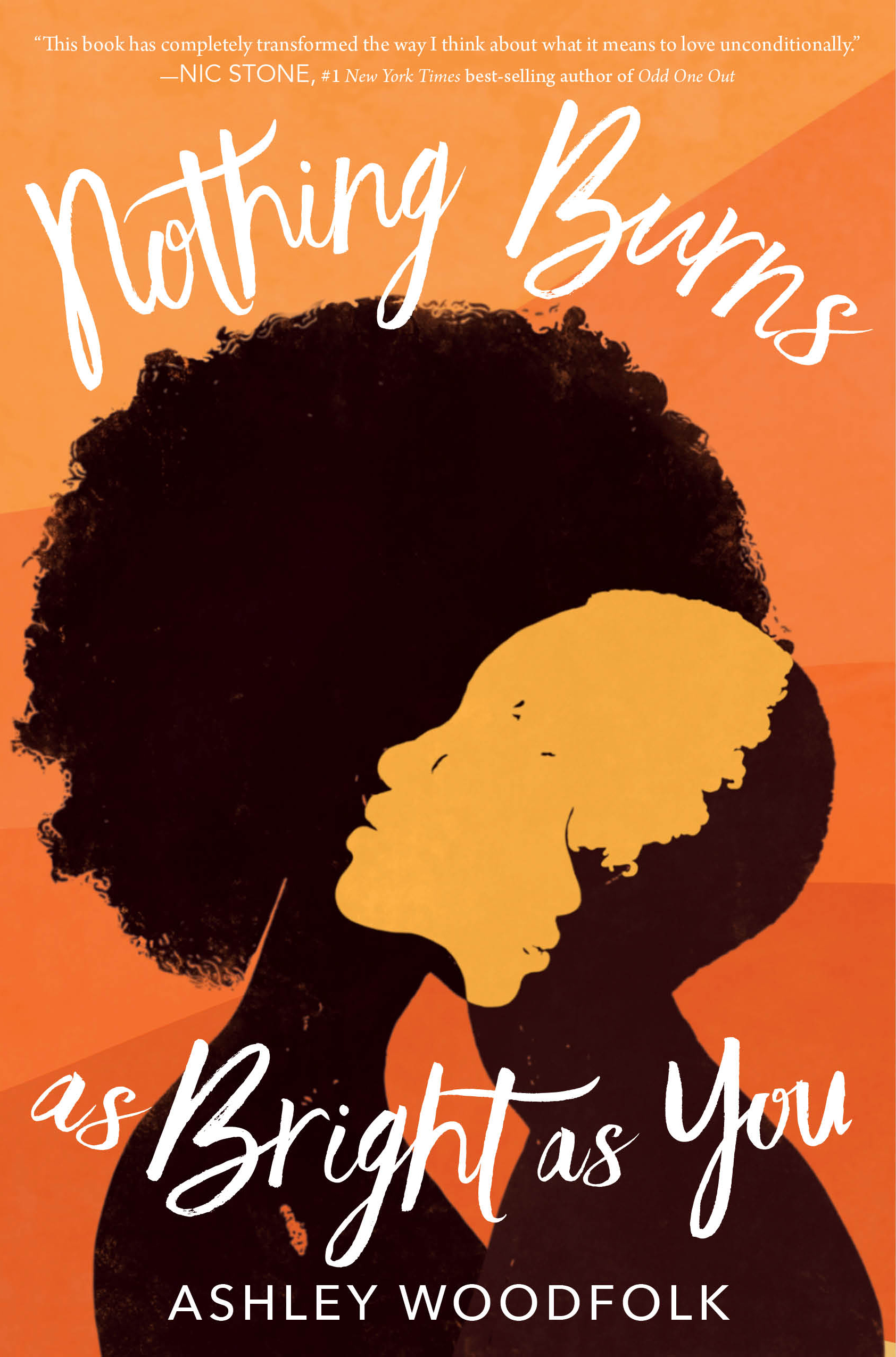
Nothing Burns as Bright as You is a beautiful novel in verse about the complicated relationship shared by two Black queer girls.

ALAN TURING: Mathematician known for cracking the Enigma code but who was persecuted for his homosexuality | A character who deserved better

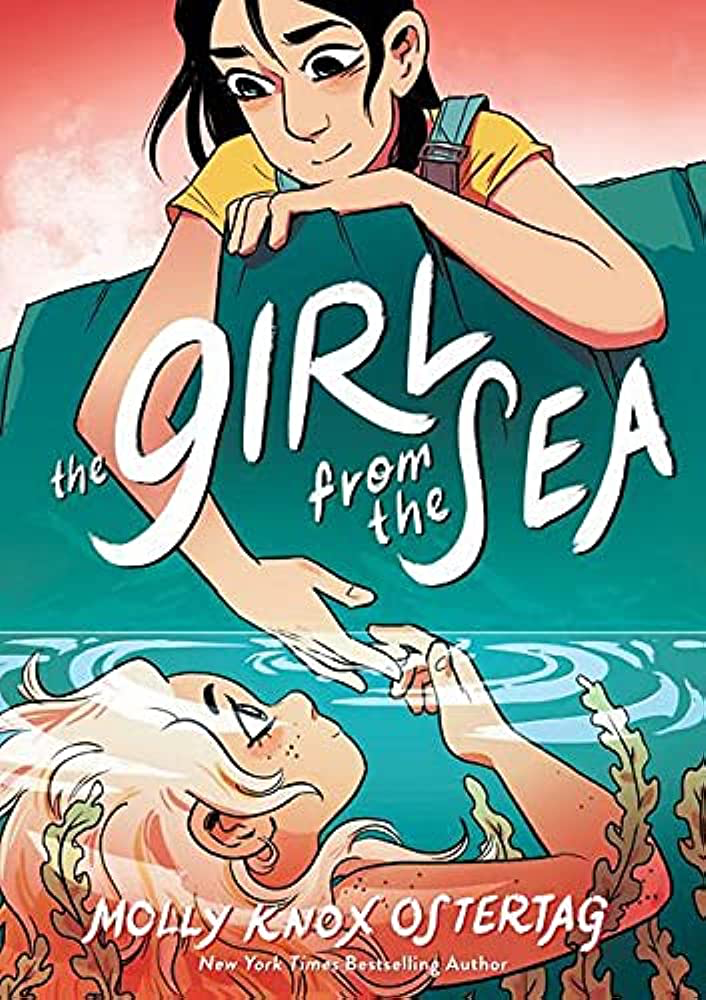
As sweet as The Girl from the Sea was, I found myself getting so stressed out about how Morgan treated Keltie in the beginning. She just kept pushing her around and neglecting her, and while it did resolve itself neatly and they fell in love, I still felt so bad for Keltie. She’s just an adorable creature, dude, she doesn’t need all that human baggage…

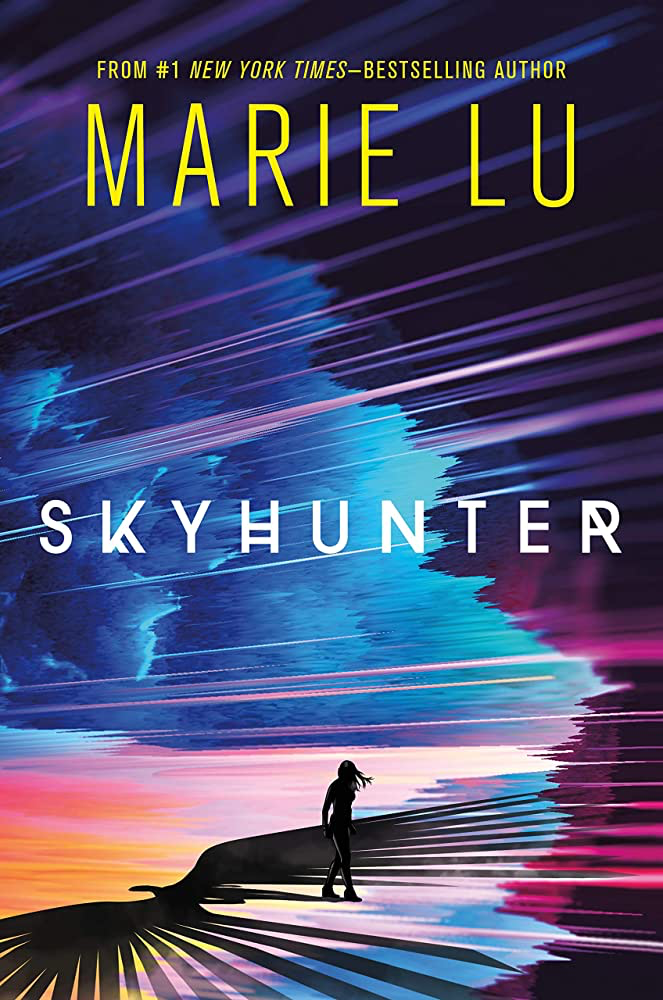
GILBERT BAKER: Creator of the rainbow Pride Flag | The most colorful book you own

Skyhunter has one of my favorite book covers in my collection—it dazzles me every single time I look at it!
ANNE LISTER: Landowner, industrialist and considered to be the first modern lesbian | A book written as a diary (or includes diary entries)

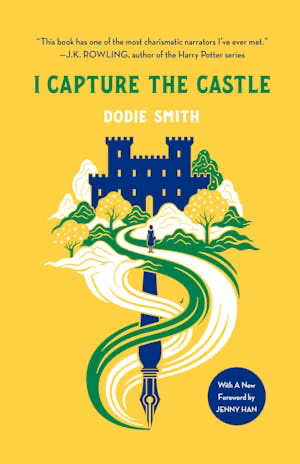
I have fond memories of reading the copy of I Capture the Castle that my mom bought for me while I was out sick years ago, and re-reading it several times since. It’s seriously the sweetest, most charming book—a big thank you to my mom for turning me on to this one.

MARSHA P. JOHNSON: Prominent figure in the Stonewall Uprising and founder of several LGBTQ rights organisations | A character you’d would want fighting at your side

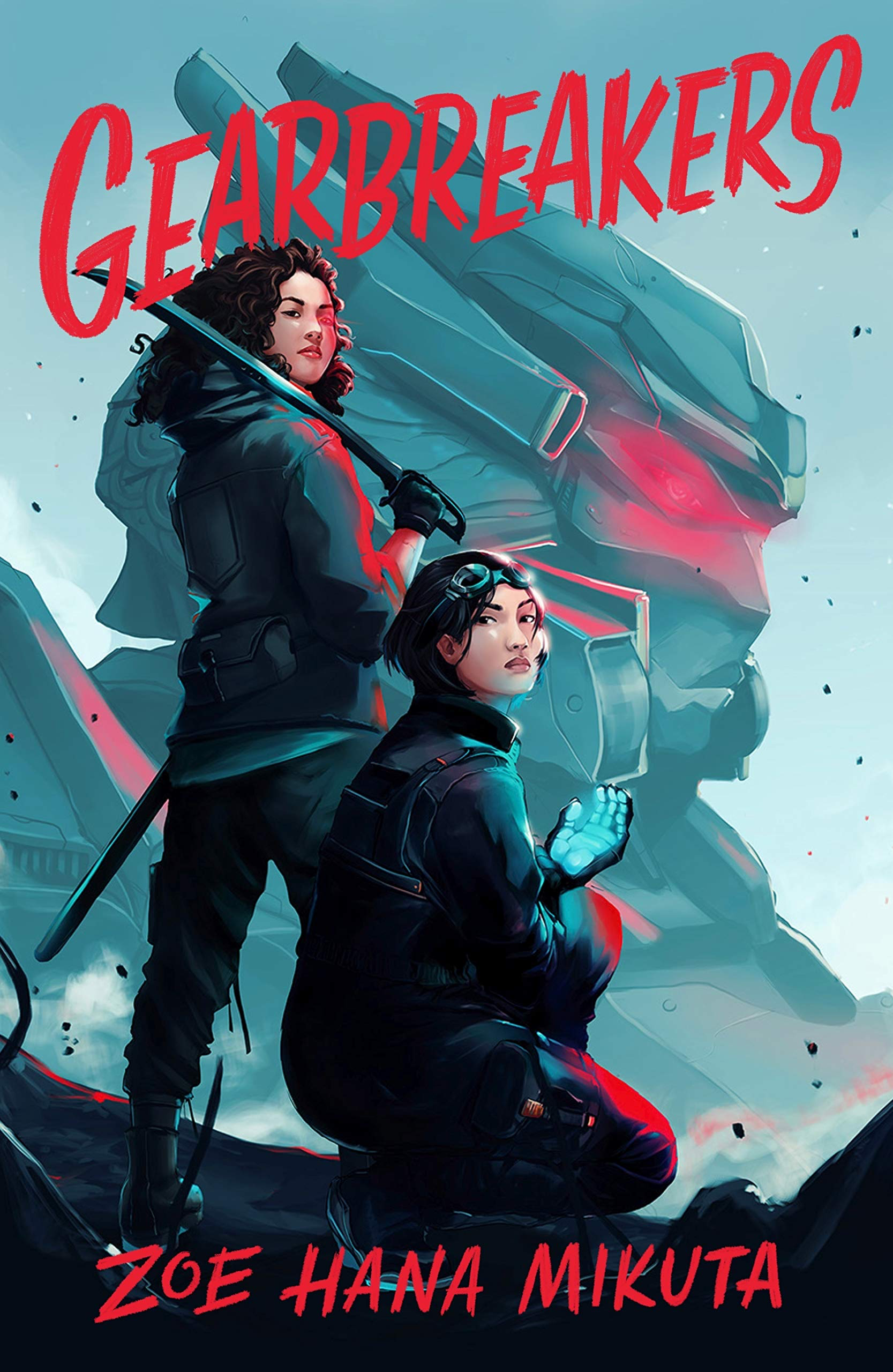
Sona and Eris from Gearbreakers are both formidable in their own ways—either one (or both) would be an easy pick to have fight at my side.

ALFRED KINSEY: Creator of the Kinsey scale | A book set in academia

I haven’t read a whole lot of books sets in academia (and I’ve never gotten the hype for dark academia, so I tend to steer clear of those), but Leigh Bardugo never misses, so obviously this prompt has to go to Ninth House.

LUCY HICKS ANDERSON: First trans woman to defend her identity in court | A book where a major scene takes place in court

It was so hard to think of any books besides To Kill a Mockingbird (Laura’s answer) with a courtroom scene, but I read Meru not long ago, and it has a particularly climactic and poignant courtroom scene—a futuristic one, but a courtroom scene all the same.

OPEN PROMPT: Your choice | A book that inspires you

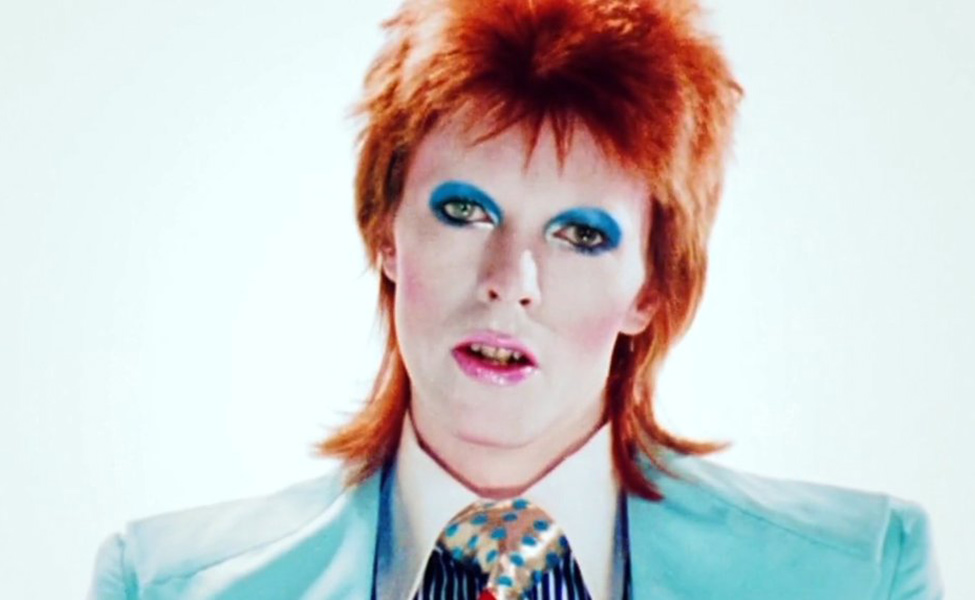
Of course, I’m going with David Bowie as my LGBTQ+ historical icon of choice—who else? He’s been a hero of mine for years, and a hero to so many. Even in the 60’s, before he rose to stardom, he was already breaking down barriers, and continued to do so in all aspects of his career thereafter. Calling somebody “ahead of their time” is thrown around quite often, but I really think that the world wasn’t ready—and wouldn’t be ready for today—for Ziggy Stardust. And personally, I can’t think of a better beacon of hope to me than him; I started getting into his music at a time when I was struggling to find my place and looking for a light at the end of the alternative weirdo tunnel. And here was Bowie, wearing dresses in the 70’s, openly declaring his bisexuality, and creating a cosmic persona that touched the hearts of so many people. I’ve certainly felt like an alien all my life, but he, if anyone, is to credit for teaching me to embrace that feeling—to quote him, “oh no, love! You’re not alone.” From one bisexual alien to another: thank you.

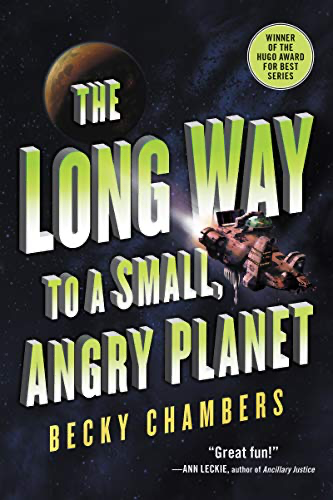
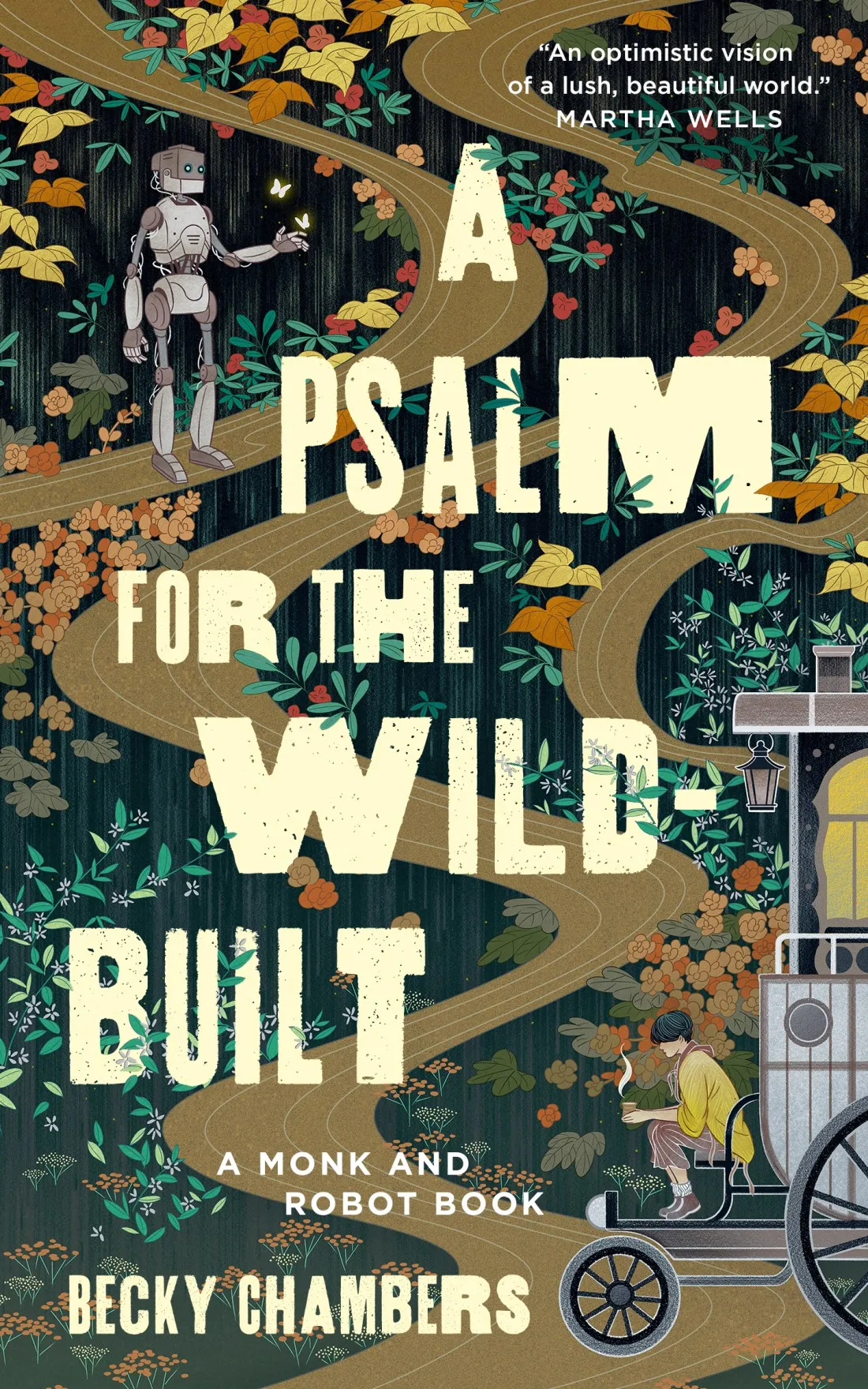
As for a book that inspires me, I’d easily give that title to Becky Chambers’ Wayfarers series. Sci-fi always seems defined by cosmic stakes and harrowing violence, and while that can work in moderation, these books really cemented the idea that a narrative doesn’t have to be centered around struggle or suffering to be worth reading—and writing. Here, Chambers has created a vast, creative space opera universe with complex political background noise and dozens of strange creatures, but they’re not embroiled in some lofty, intergalactic conflict: they’re just going about their lives. It’s something that almost no other piece of sci-fi media has ever done—it’s very common in realistic fiction, but the concept that happiness and healing as genuine plot points can exist alongside aliens and starships just blew my mind. I aspire to write at least one thing as comforting and cozy as Becky Chambers someday.

And remember, kids: grimdark is just as unrealistic as sunshine, lollipops and rainbows, because they represent opposite ends of the same literary spectrum. Making a book excessively dark and gritty doesn’t automatically make it deep, and giving a character an excess of trauma and a tragic backstory doesn’t automatically make them fleshed-out and well-written.

I tag:

Today’s song:

we love a good guitar freakout

That’s it for this book tag! Have a wonderful rest of your day, and take care of yourselves!