

Happy Tuesday, bibliophiles!
I’ve been eyeing this book for a while—I remember it being heavily advertised on Goodreads when it was first released, and normally, I don’t pay much attention to Goodreads ads or sponsored books, but all you had to say was “space opera” and I was hooked. I’m a woman of simple tastes. It was cheap on the Kindle library, so I bought it to read on vacation. To my excitement, it ended up being my favorite book that I read on vacation—so detailed and gripping!
Enjoy this week’s review!
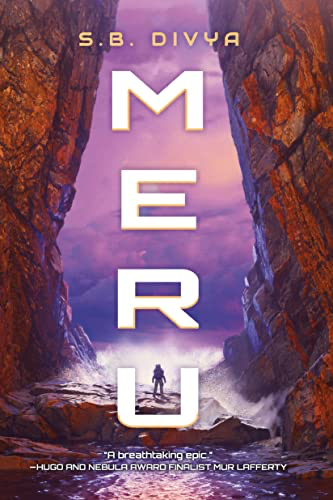
Meru (The Alloy Era, #1) – S.B. Divya
Jayanthi, like all other humans in her day and age, are confined to Earth. Kept there by the Alloys, evolved human descendants with advanced capabilities, she has been raised by Alloy parents on her homeworld, but has always dreamed of seeing the wider galaxy. But when an opportunity arises for Jayanthi to explore the newly discovered planet Meru with the aid of an Alloy pilot, she jumps at the chance—what better way to show the galaxy that humans are more than their violent past?
With the help of Vaya, her Alloy pilot, Jayanthi touches down on Meru. Soon, they find themselves embroiled in a human-alloy conflict, seemingly engineered to separate the two of them. Will Jayanthi and Vaya beat the odds—and restore faith in the human race?
TW/CW: ableism, xenophobia (fictional), sexual content/pregnancy, descriptions of injury, sci-fi violence
I got carsick while reading this book, but I don’t hold it against it at all. That was on me and my hubris of thinking that I wouldn’t get nauseous on a long car trip just this once. Whoops.
Reading some of the lower-rated reviews of Meru is kind of cracking me up…listen. I get that zie/zir pronouns (and neopronouns in general) are somewhat obscure, but of all the absolutely wild, dense, and out-there concepts that this book throws at you, that’s what makes you jump ship? Not the exceedingly complicated…well, everything else?
That being said, Meru lived up to the hype I’ve seen it getting for the past few months! It hit a sweet spot for me that a lot of sci-fi and fantasy books rarely do—creating a complex and multilayered universe, but very delicately balancing when and where to deliver all of this information. Divya came very close to going over the edge, but she navigated the worldbuilding delivery with aplomb.
So, about said worldbuilding. I’d say that Meru isn’t for the faint of heart, even for longtime sci-fi fans—as I mentioned in the beginning of the review, there’s a lot to take in, from the post-human history of the Alloys to all of the machinations surrounding new genetic modification laws in the future. But even though we do get some of this information in larger chunks, Divya excels at navigating which information is actually relevant to the scene it’s informing, and not sledgehammering you with extra information that only becomes relevant elsewhere in the book. It also helps that every inch of said worldbuilding is truly fascinating—it’s clear to see how much care was put into the creation of this universe.
If you’re talking about disability in sci-fi, you’re generally bound to open a particularly dicey can of worms. There’s quite a lot of eugenics narratives that a lot of readers have let slide for years, and the narrative of curing all disabilities is seen as positive, when a lot of the disabilities being described never needed curing in the first place. For the sake of this review, I’ll keep it short, but the bottom line is that it’s gross. But Meru takes a refreshing perspective on disability in sci-fi—not only was Jayanthi, the protagonist, specifically engineered to have sickle-cell anemia (now THAT’S a subversion I like), her disability is depicted in a far more advantageous and positive light. Anyone who’s ever touched a high school biology textbook probably remembers this example: despite its drawbacks, those with sickle-cell also have increased resistance to many tropical diseases. That’s exactly the case for Jayanthi, whose sickle-cell anemia makes her more suited to the environment of the planet Meru than those without it. Positive disability rep is good enough, but having it specifically depicted as something that gives the character the edge is something special. That, along with the wonderful discussions around disability and bodily autonomy (both allegorical and literal), made Meru a wonderful experience for me as a disabled reader.
In addition, Divya has created such a vibrant cast of characters in Meru! Jayanthi was such an endearing and powerful protagonist, and her relationship with the equally endearing Vaha was full of tenderness, despite its ups and downs. Almost all of the cast added to the book’s masterful suspense and tension, making you feel deeply for all of the relevant characters before things got (very) hairy. Plus, the integration of Sanskrit, several Indian-coded (and other POC characters), and loads of casual queerness was a breath of fresh air from all of the white, male, cishet sci-fi that still dominates the market. We need more books like Meru.
All in all, an intricately-crafted sci-fi novel that dazzled with its detailed worldbuilding, diversity, and refreshing discussions around disability. 4 stars!
Meru is the first book in S.B. Divya’s Alloy Era series, continued by the forthcoming Loka, slated for release in July of 2024. Divya is also the author of Machinehood and Run Time, as well as a contributor to several short story collections.
Today’s song:
That’s it for this week’s Book Review Tuesday! Have a wonderful rest of your day, and take care of yourselves!

 The Bookish Mutant