

Happy Sunday, bibliophiles!
This week: I fully see the irony of putting a song called “Get Off the Internet” on a blog post……….decidedly on the internet, but you get it, right? Right?
Enjoy this week’s songs!
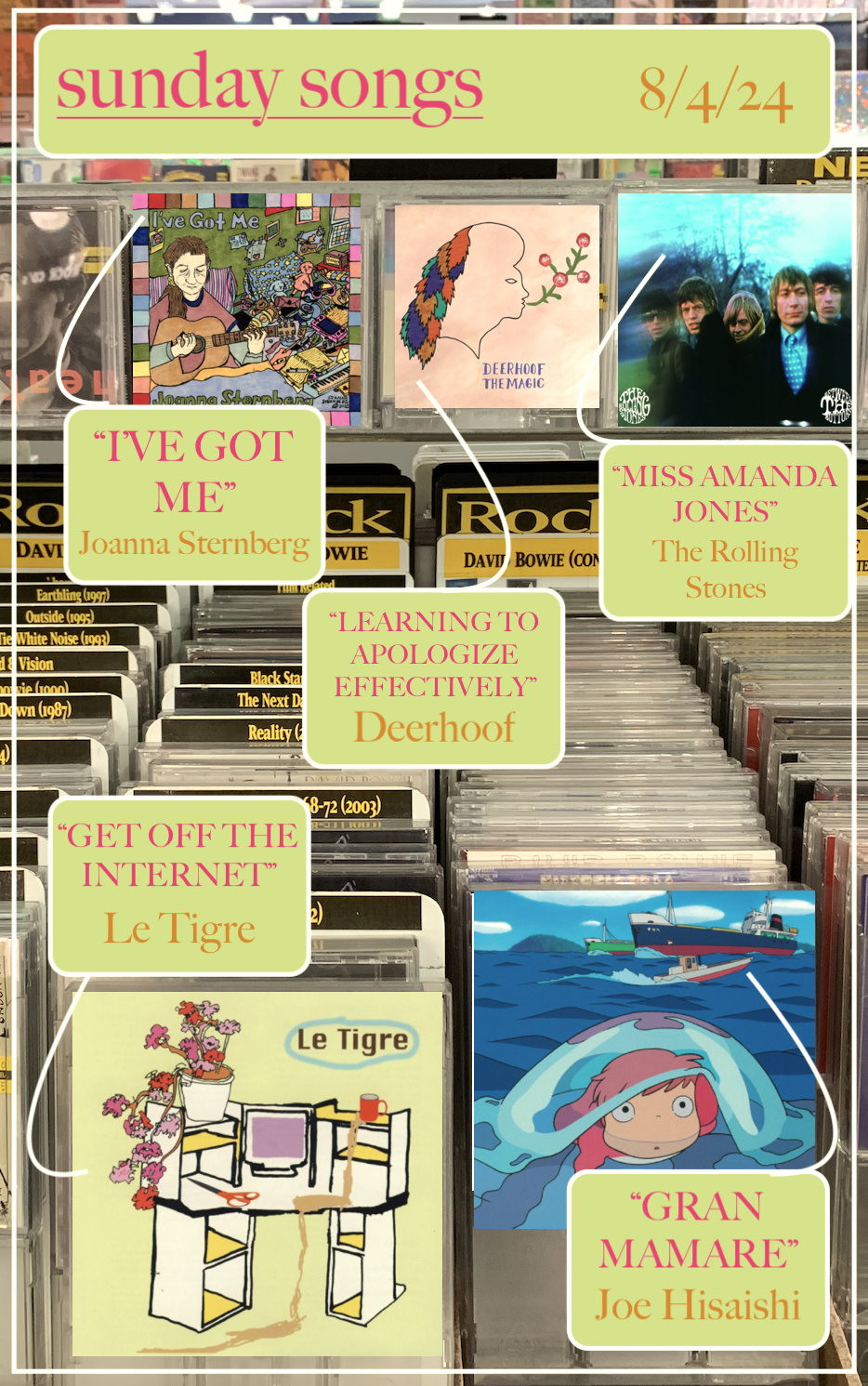
SUNDAY SONGS: 8/4/24
“Get Off the Internet” – Le Tigre
I miss when people could get along despite their politics, but…have you seen Project 2025 lately? Were you not paying attention to Trump’s entire presidency? I wouldn’t be saying this if, y’know, they weren’t trying to take all of our rights away, but…
GET OFF THE INTERNET!! DESTROY THE RIGHT WING!!!!
…AND A BOOK TO GO WITH IT:

Our Stories, Our Voices: 21 YA Authors Get Real About Injustice, Empowerment, and Growing Up Female in America – edited by Amy Reed – modern accounts of femininity and feminism from a collection of incredible authors.
“Gran Mamare” (from Ponyo) – Joe Hisaishi
Watching Ponyo as an adult felt like watching it for the first time. Technically, my recent rewatch was my second time seeing it in over a decade. Every time I’ve thought about it before then, it felt like a fever dream…probably because my first viewing was something along those lines. I was about 5 or 6, and I’m almost positive that I was home sick from school. Either way, I was in my parents’ bed. All I could remember were faint glimpses of Ponyo underwater, the man, the myth, the legend, Fujimoto (close enough, welcome back David Bowie)…and Granmamare.
If there’s any gorgeously-crafted scene (of which there are many) to take away from that movie, it’s any scene with her. No wonder my five-year-old brain retained an image of such beauty, even when it was (probably) sick. Her first appearance isn’t necessarily emotional—all she’s doing is talking to Fujimoto about what to do with Ponyo—but all of the sudden, I found myself overcome with tears. All those years ago, and it took my breath away. (And who better to voice such a goddess of such beauty than Cate Blanchett? It had to be Cate Blanchett.) Maybe I was just in an emotional state, but something in the sheer beauty of that scene stirred up something hidden and beautiful in me. Joe Hisaishi’s sweeping score gives it an appropriately sparkling, John Williams-like grandeur, befitting of a character so powerful that she illuminates the whole ocean with her radiance.
Either way, I’m so glad that I rewatched it. Ponyo want ham.
…AND A BOOK TO GO WITH IT:
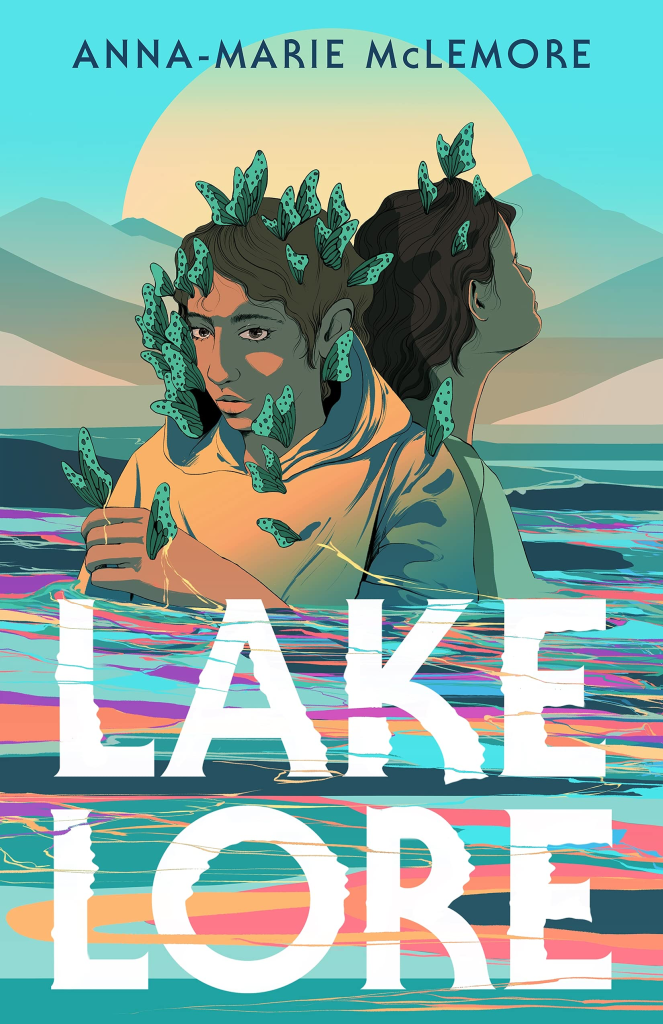
Lakelore – Anna-Marie McLemore – mysterious and magical underwater realms, anyone? (Admittedly, Ponyo delivers much more on that aspect, but you can’t beat Miyazaki.)
“I’ve Got Me” – Joanna Sternberg
The name of the video is a bit of a misnomer, in my opinion—yes, technically it is a lyric video, but the lyrics are accompanied by a full-color comic drawn by Sternberg, which makes it feel like a fully-fledged music video. It’s so worth a watch—they have such a charming art style.
When I say this, I say it with all of the affection in my soul, but it’s remarkable that at only 32, Joanna Sternberg sounds just like a kind, elderly music teacher. Again: nothing but affection. Their voice just emanates that comfort that I associate with the kind of person who teaches preschoolers how to use maracas and such. The album art, as well as the associated art only add to the vibe—the scratchy inking and pastel backgrounds only add to the feeling that I would find this CD in said music teacher’s collection. Heck, I can almost imagine having to sing “I’ve Got Me” in a preschool program, if not for lines like “between self-hatred and self-awareness is a very small, thin line.”
Nonetheless, all of this is to say that “I’ve Got Me” has a purity to it. It’s got the sing-songy sway of a children’s song, but in its touching vulnerability, brushes over a sentiment I’ve battled with for much of my life: “why is it so hard to be kind and gentle to myself?” (Boy, do I relate to the panel at 0:46 with a sullen-faced Sternberg wearing thick-framed glasses captioned “me looking through the file cabinet in my brain that stores all of my bad memories”—even better, it’s alphabetized.) Armed with nothing more than their acoustic guitar and a stand-up bass, they produce a solution that gives this even more of a children’s music feel: “Take the box of self-deprecation/Lock it and put it on the shelf/Then wait five days, take that box/And throw it in the fire.” Through said self-deprecation gathering dust and anxiety on the shelf, Sternberg retains an understated but resilient hope—”I’ve Got Me” as a title feels like an assertion that, no matter if you think you’re alone, you are all you’ve got. You have but one body and one mind, in all of its flaws, and you may not be able to control some of the inevitable bouts of self-deprecation, but it’s still you, in the end.
…AND A BOOK TO GO WITH IT:
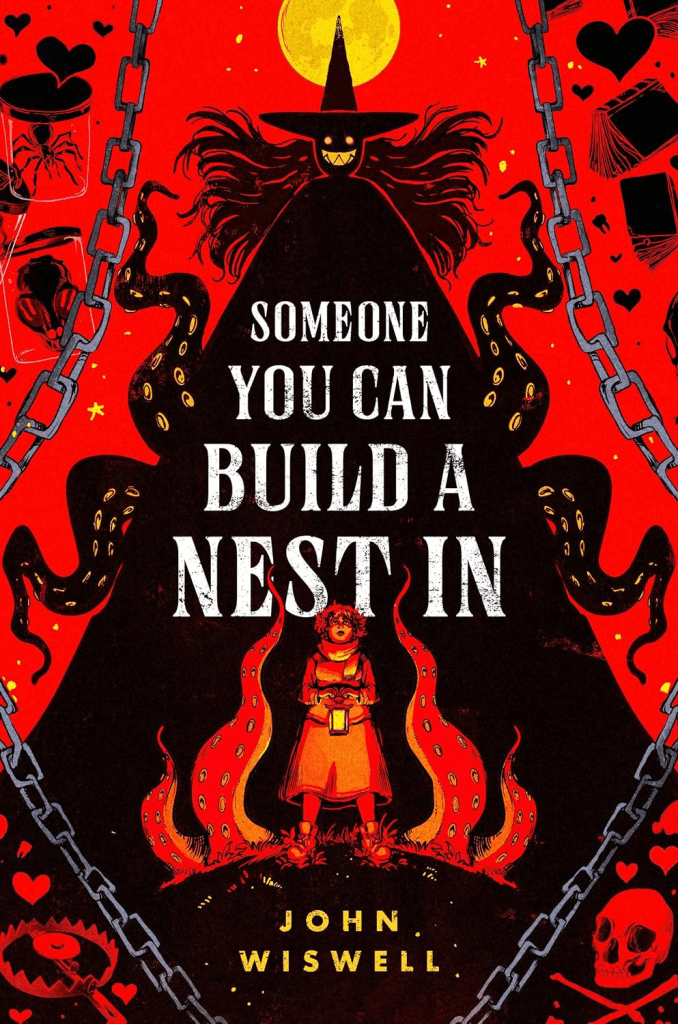
Someone You Can Build a Nest In – John Wiswell – in both a literal and figurative sense, learning self-love after viewing yourself as monstrous.
“Learning to Apologize Effectively” – Deerhoof
Being a newcomer to Deerhoof is a unique experience because I can never seem to find a consensus about what they sound like—or what other people think they sound like, at any rate. One reviewer says this is a return to form, another critic says it’s some kind of new venture, like nothing they’ve ever done before. The only consensus I can seem to draw is that they’re bent on being weird—and I have nothing but admiration for that, especially after seeing the craft to their weirdness. (Learning “Future Teenage Cave Artists” on guitar and having to puzzle through not one but four odd time signatures with my guitar teacher sure was something.)
Either way, I’m almost ashamed to say that the YouTube algorithm spat this one up before me, but I’m not one to complain. I’m done being ashamed with how I found out about songs—so long as I have the song in my hands and I enjoy listening to it, what’s the issue, really? “Learning To Apologize Effectively” is much more rock-oriented (as its album, The Magic, seems to be in its entirety), with crashing. classic rock-recalling guitars. Yet even if their inspirations for this track lie more in mainstream rock, there’s that undeniable weirdness that seems to ooze from their music no matter what. Like with “Future Teenage Cave Artists,” Satomi Matsuzaki’s vocals have an uncanny quality to them, not necessarily in the sound of her voice, but in the ever so off-kilter timing of it—I can’t pin down a time signature, but in her “the song is waiting for another song” intro, each pause makes a deliberate form of obscurity, darting into an unexpected corner when you expect it to go down the well-lit hallway right in front of it. It feels like an imitation of rock from a band used to making the most deliberately strange music for most of their career—an imitation that feels almost authentic.
…AND A BOOK TO GO WITH IT:
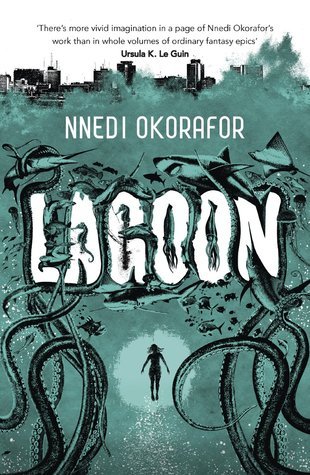
Lagoon – Nnedi Okorafor – “And when we saw what we were doing wrong/We found the cause underwater, long/And then we saw what we were doing wrong…”
“Miss Amanda Jones” – The Rolling Stones
For a fleeting moment, I can pretend that this song exists in a vacuum, and that Mick Jagger hasn’t been acting like it’s 1967 for the past five decades or so. The fact that he (and Keith Richards) have actually survived long enough to act like they’re 20 for so long is almost impressive, but…yikes, dude.
As much as I rag on Jagger and company, I can’t deny that for at least a decade or so, he and the rest of the Stones could concoct some truly legendary songs. Of course they could, they’re the Rolling Stones! Yet somehow, I rarely see this one among the greatest hits—maybe it’s the rose-colored glasses shielding everything once more, but I feel like if it was good enough to name a whole character after it in Some Kind of Wonderful, that has to give it some street cred, right? (So real of them to name a character after a song just so that they could play said song in the movie. I feel like I’m gonna wind up doing that someday.) Aside from being a staple of car rides in my early childhood, it’s just so unbelievably tightly-wound. Not a single cog is winding out of sync, from the twin talents of Brian Jones’ rhythm guitar and Keith Richards’ spiky riffs—in 1966, we already had the precursor to my favorite, early-’70s guitar sound, warm and thick as a fresh pot of soup. It’s a bit too rough around the edges (for the ’60s, anyway) to really be truly jangly, but it’s got the swagger and sway that makes the rock of the ’60s so delightful to listen to.
…AND A BOOK TO GO WITH IT:

Little Thieves – Margaret Owen – “Just watch her as she grow/Don’t want to say it very obviously /But she’s losing her nobility, Miss Amanda Jones …”
Since this post consists entirely of songs, consider all of them to be today’s song.
That’s it for this week’s Sunday Songs! Have a wonderful rest of your day, and take care of yourselves!


 The Bookish Mutant