
Happy Sunday, bibliophiles! I hope this week has been treating you well.
Before I begin, here are the graphics for the past two weeks. I was so excited to write about Hounds of Love, because…well, it’s Hounds of Love, oh my god, self-explanatory, but alas…we all know what happened. Not ideal conditions to write under. Rest assured, it will come back eventually. You can hold me to that. Either way, more music:
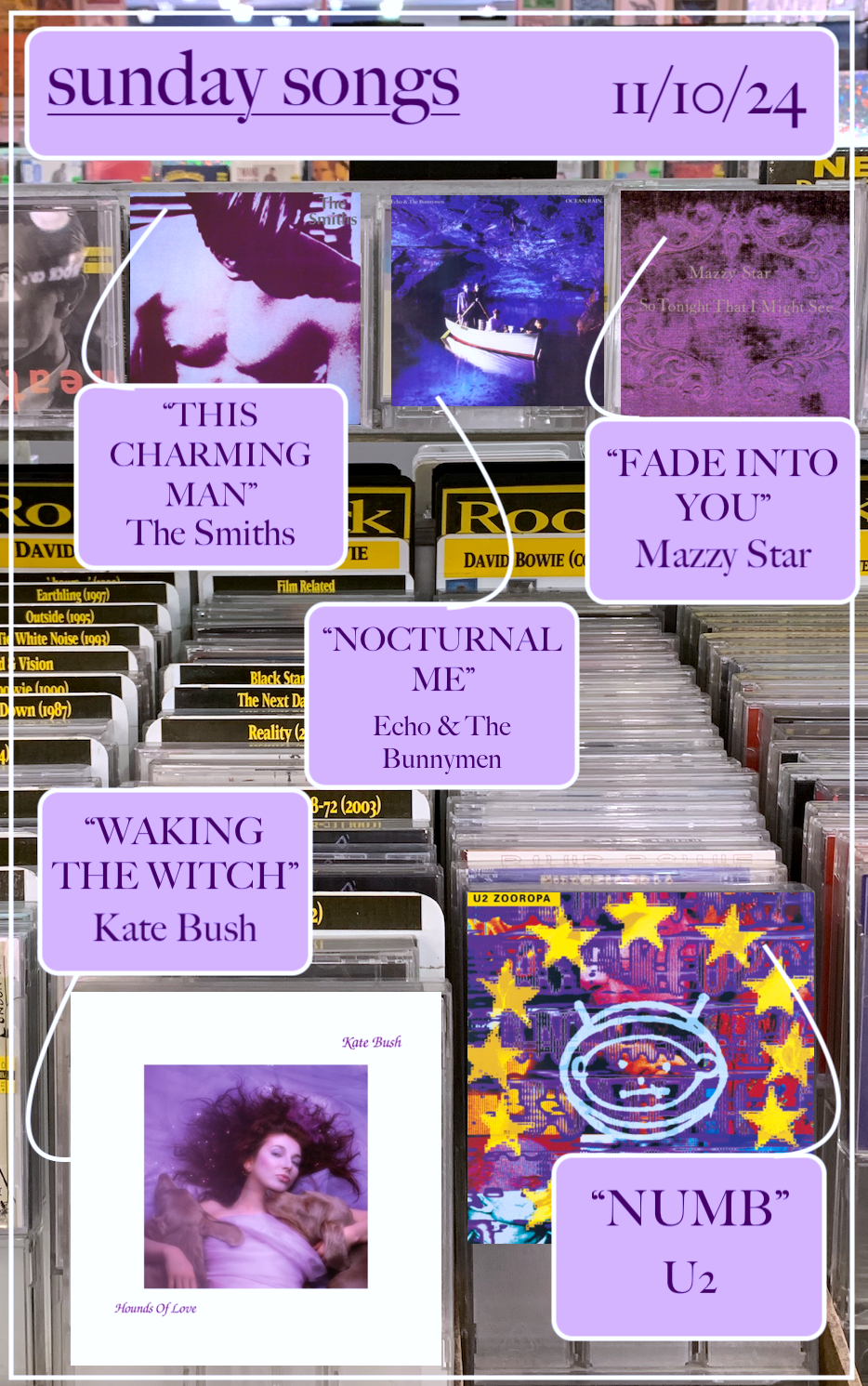
11/10/24:
- “Waking the Witch” – Kate Bush
- “Numb” – U2
- “This Charming Man” – The Smiths
- “Nocturnal Me” – Echo & The Bunnymen
- “Fade Into You” – Mazzy Star
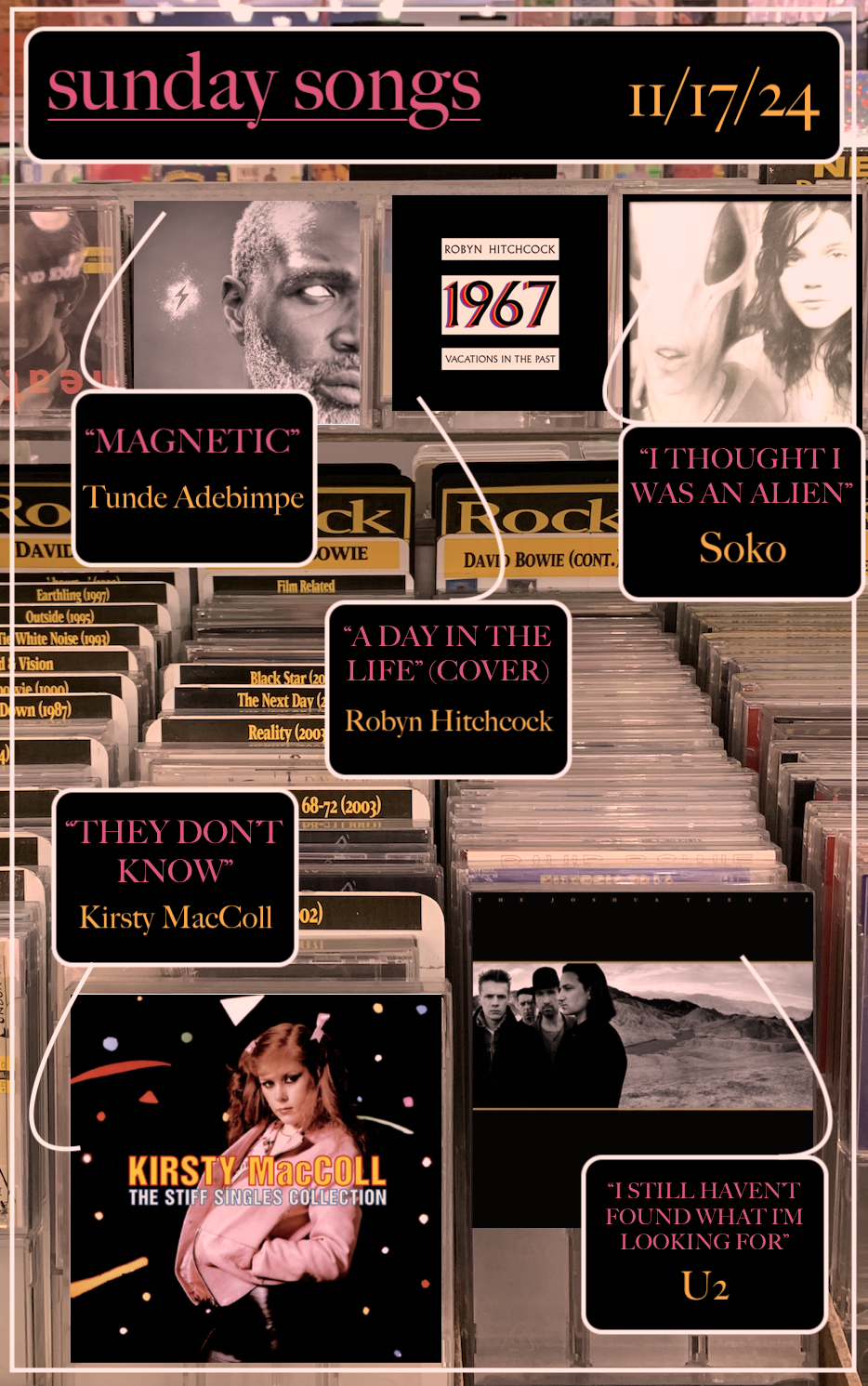
11/17/24:
- “They Don’t Know” – Kirsty MacColl
- “I Still Haven’t Found What I’m Looking For” – U2
- “Magnetic” – Tunde Adebimpe
- “A Day in the Life” – (The Beatles cover) – Robyn Hitchcock
- “I Thought I Was An Alien” – Soko
Now, for this week: ignoring whatever’s going on in that Goldfrapp music video…have fun?
Enjoy this week’s songs!
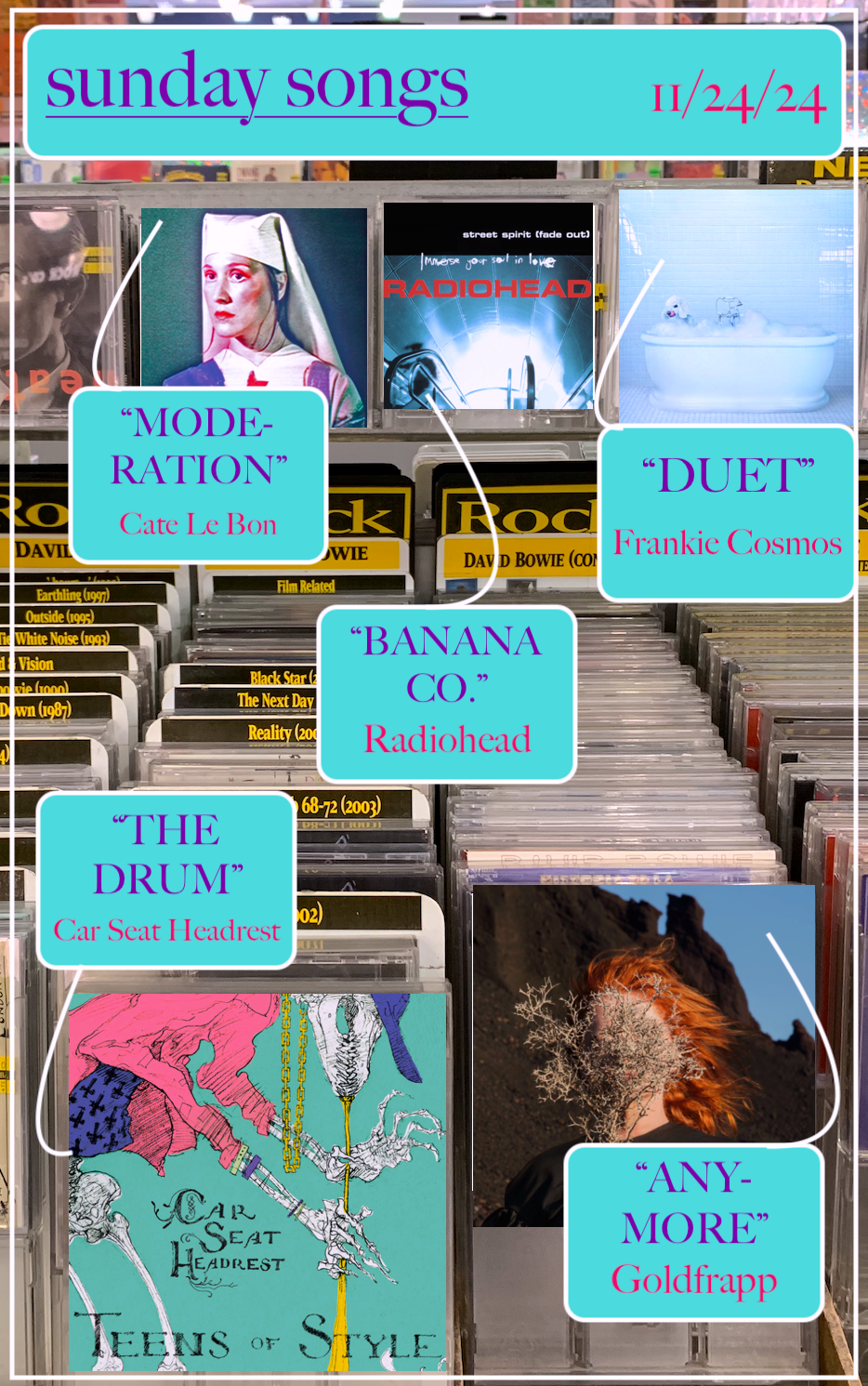
SUNDAY SONGS: 11/24/24
“The Drum” – Car Seat Headrest
“The Drum” is the first video in this setlist, so there’s no need for a timestamp. Watch at your leisure!
That frame at 1:25 sums up my 8th grade experience more than any words can: Will Toledo with the blurry image of St. Vincent’s self-titled album in the background.
Ah, this one’s a throwback. I remember watching this tiny desk concert in my parents’ bedroom with my mom, who always indulged my adolescent squealing about Will Toledo with the bafflement that “he looks like he’s in high school.” I didn’t fully realize it back then, not even being in high school myself, but…no offense, Will, I love you, but the amount of voice cracks throughout (“he don’t have shIiIiIiiiIIIT”) would make me think that he was 14 or 15 here, and not 23, weirdly. This whole Tiny Desk is a work of art in the art it produces in spite of the awkwardness about. Band? Sorta. Ethan Ives and Andrew Katz are there (it’s so far back that Seth Dalby hasn’t even shown up yet!), but Andrew’s the only one with his instruments beside Toledo. And you’d think the other two guys to the left of Toledo are part of the band, right? They’re just emotional support, which, to be fair, I’d love to have during one of those shows, but it gives the effect of a bunch of guys watching their friend play guitar in senior hall. In an endearing way, honestly. It’ll always be endearing to me. It’s Car Seat Headrest, after all. Nothing but love for our nervous young man.
“The Drum” was one of the earlier tracks that was constantly in my orbit during the peak of my Car Seat Headrest heyday in my early teens. Teens of Style was Car Seat Headrest’s full album as a band (still a three-piece by that point) and the first to be signed to a label, but it retains that lo-fi sound that characterized what gave Car Seat Headrest its name in the first place: being recorded by a deeply self-conscious Toledo in his car. It’s composed mostly of songs recycled and refurbished from his early days self-recording (“The Drum” originally appeared on My Back Is Killing Me Baby), and all of them get a kind of self-deprecating grandeur. Though the lyrics have been whittled away and refined, it’s the same old sad boy underneath, rest assured. “The Drum” doesn’t necessarily fall into that category, but it makes me realize…Will Toledo sure loves writing about drunk people, huh? He’s quite good at it, too, and he’d get even better after this song with “Vincent”: “It must be hard to speak in a foreign language/Intoxicado.” This track feels like the song version of that gag in Snatch where they cut back to clips of Frankie Four Fingers gambling and getting drunk out of his mind to the tune of “Viva Las Vegas.” It’s a hundred tiny vignettes of an off-the-walls character as he stumbles through a nonlinear, drunken reality: he’s reading James Joyce, he’s too high to listen to anyone (and even if he wasn’t, he still wouldn’t be listening), and he owes you $20. He’s a real piece of work, and Toledo is the faithful documentarian struggling to catch up with his antics. And somehow, the bridge gives the sense that said sloshed asshole, swimming in alcohol and ego, has elevated himself to think that he has transcended life itself: “This is our lifetime/And I am its creator/A young man slowly pulled apart/By separate poles of gravity.” This bridge came to Toledo in a dream (with the only difference being that “young man” was originally “snowman”), and it begins to close “The Drum” out as one stumbles through an inebriated dream.
…AND A BOOK TO GO WITH IT:
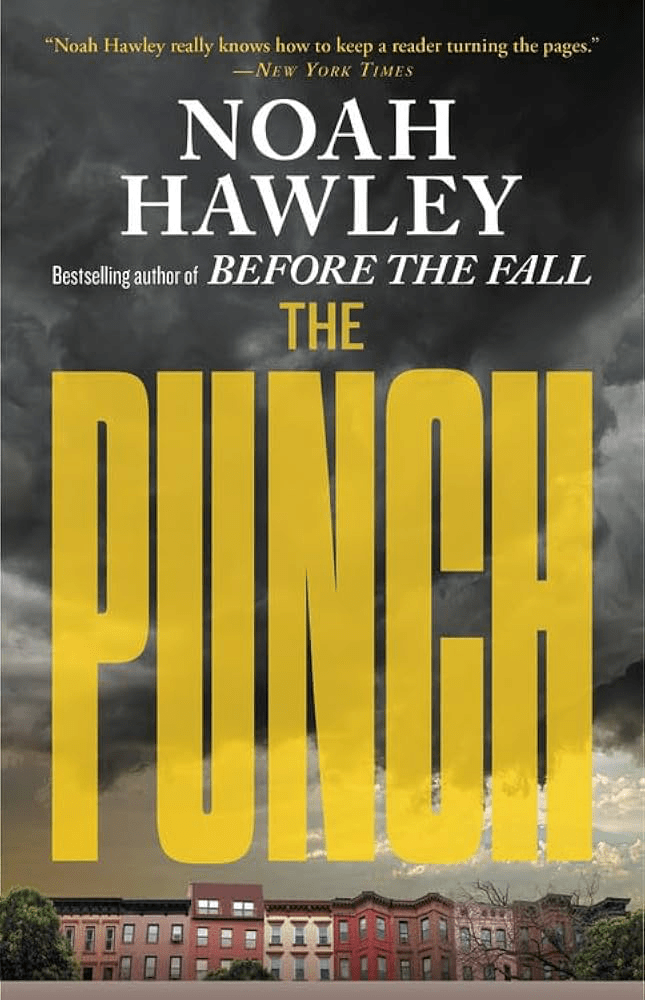
The Punch – Noah Hawley – drunk, dysfunctional people aplenty, all of which need to have their perfect and unparalleled opinions heard. Surely nothing will go wrong…
Another throwback, although this one didn’t factor in changing my 13-year-old brain chemistry nearly as much. That’s not a slight against it—my first memory of Goldfrapp was when I was about 11 or 12, and since then, she’s been a consistent, behind-the-scenes favorite. Between their work with Tricky and Spiritualized, I should’ve been hooked in the first place, but they’re so consistent in her sound, and not in a way that grows tired. Aside from some of the production, “Anymore” could just as easily been from one of their albums from the 2000’s. Their brand of futuristic-sounding synths sounds like something you’d hear from a club in Blade Runner, and not in a way that feels dated. It’s almost like Alison Goldfrapp and Will Gregory are just as precise as the machines that they manipulate to create their music; everything is oiled down until not a single wrinkle remains, and the result feels simultaneously far in the future and timeless…
…if you can ignore the tamer PG (?) version of Feyd Rautha that is the music video. You do you…?
…AND A BOOK TO GO WITH IT:
The Three Stigmata of Palmer Eldritch – Philip K. Dick – I feel like this is the kind of music that would play if you took Can-D and going to Philip K. Dick’s version of Barbie Land…
Several months out from listening to Pompeii for the first time, I find myself returning to it time and time again. I’ll cling to any new weirdness I can find, and Cate Le Bon, at least for this album, delivers. Back in July, I talked about how the first four songs on the album are a cascade of absolute successes; “Moderation” is the second of the four, and although it’s much poppier than the eerie “Dirt on the Bed,” it nonetheless has her oddball twist. The instrumentals, from the so-bright-they-shine guitars to the backing saxophones, are very ’80s, but they’re tweaked enough that they don’t sound like hollow copies; the gated reverb on the drums is gently quieted, while the production, like the music video, feels like everything has been recorded straight from the mouth of a cave.
Something about the lyrics strike me as oddly coy—not in meaning, but more of how they start to reveal themselves as something that makes sense, so vague that they could be applied to anything, and then mischievously peek back behind the curtains and return with something truly bizarre. They’re somewhere in between the matter-of-fact but nonsensical utterances of both Brian Eno and Robyn Hitchcock, and even some of early St. Vincent’s artier ventures. “I get by pushing poets aside/’Cause they can’t beat the mother of pearl.” I love it, and somehow it makes sense, but do I have any clue what that means? Nope. It feels like it’s meant to be poetry more than anything, words strung together for aesthetic effect. The music video gives the distinct feel of a performance piece you’d see projected in a curtained-off corner of an art museum, but the colors of it are the perfect match “Moderation.” Against a backdrop of a brewing storm at sea, Le Bon is cloaked in black, with only her face, arms, or legs visible at any given time. Aside from her “Life On Mars”-blue eyeshadow, the only hints of color she reveals are lacy cuffs on her sleeves or bright colors on her tights. Those pops of color feel like the bursts of oddities throughout “Moderation,” so vibrant that they pop out like cartoon bubblegum.
…AND A BOOK TO GO WITH IT:
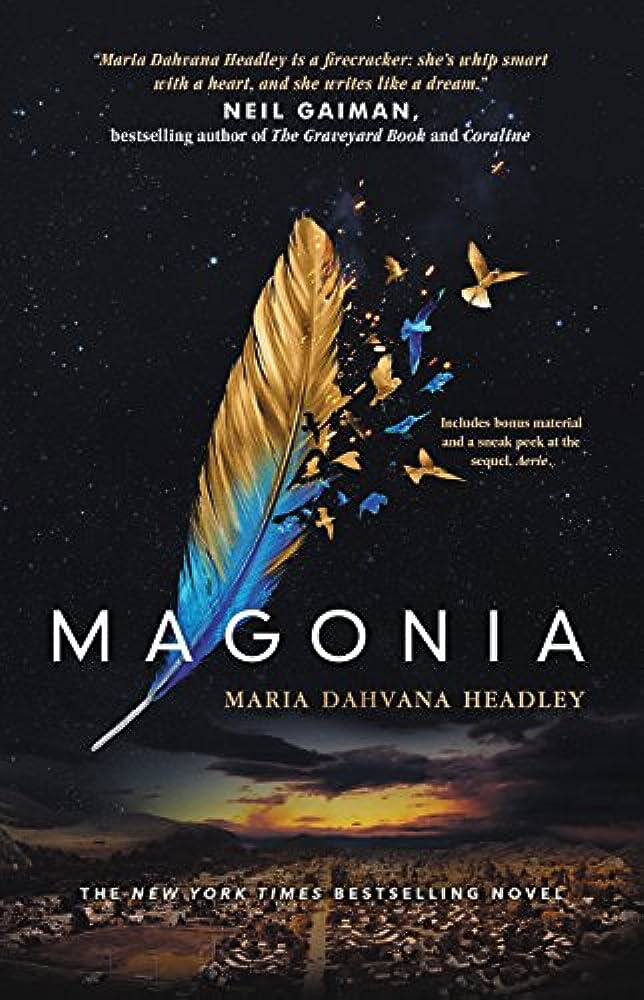
Magonia – Maria Dahvana Headley – you think you’ve got a typical 2010’s YA fantasy book on your hands, and then it gets bonkers…delightfully so.
With every successive Radiohead EP I listen to, I’m baffled at not just the sheer amount of output they had, but how good a solid 90% of it is. The Bends sessions seem like some of the most fruitful of their entire career, what with three EPs and a series of smaller singles released in the periods directly before and after the album’s release. I’ve yet to listen to My Iron Lung – EP or the “Fake Plastic Trees” single, but from what I can tell, they were just constantly cooking. They had to be forcibly removed from the kitchen because the cooking was just TOO GOOD. They just COULD NOT BE STOPPED.
In some ways, “Banana Co” feels like if “Karma Police” was released on The Bends; the term “sardonic wit” is overused these days, but it applies here for sure, as it does to quite a lot of Radiohead. Written about the corporate colonialism of the United Fruit company in various countries in Central and South America, Thom Yorke slathers his honeyed words in sarcasm with the repeated verse: “Oh, Banana Co/We really love you and need you.” Yorke has an almost sleepy register to his words, as though he’s being pulled under by the propaganda himself, before the guitars of Jonny Greenwood and Ed O’Brien coalesce in a controlled blast of everything that makes me miss listening to The Bends. Adding this one to the list of Bends-era songs that make me think “this is a B-SIDE?” (see also: “Maquiladora,” “My Iron Lung”). Luckily—at least for the fans who were alive to see this (cries in Gen Z)—”Banana Co” was a live staple pre-OK Computer, and Yorke has often addressed it towards other colonial problems of the day, including one in 1998 that was addressed to “the people of Indonesia, and the people who have money invested in that country.”
Wow, what a wonderful example of a band committed to calling out imperialism and violence around the world! Surely they would carry these values into this day and age…right? Right?
Uh…
Well. I’ll say that I am quite disappointed after hearing that Thom Yorke confronted a pro-Palestine protestor at one of his solo shows back in October; the protestor demanded that Yorke condemn the ongoing violence in Palestine, and he responded by calling the protestor a coward, then walking offstage. In Yorke’s defense, he has every right to withhold his political views (and also, I don’t think yelling at a celebrity at a concert is necessarily the best way to get people on your side, no matter how good the cause, nor is it going to solve any conflict), but there has to be a much more respectful way of dealing with this kind of thing. Calling this person a coward was not the right move, even if he did want to decline to speak. It’s just so odd and hypocritical to me that he would be a champion for human rights for so long, and then call somebody a coward for protesting the same human rights violations that he once sang about and condemned in the ’90s. Even if he doesn’t publicly condemn the thousands of needless deaths, I just hope that he realizes how hypocritical he sounds. What a shame, really. Again, no way that Thom Yorke’s reading this, but…maybe go listen to your old catalogue over again before you call people protesting the horrors of modern imperialism cowards. Just saying. Free Palestine.
…AND A BOOK TO GO WITH IT:
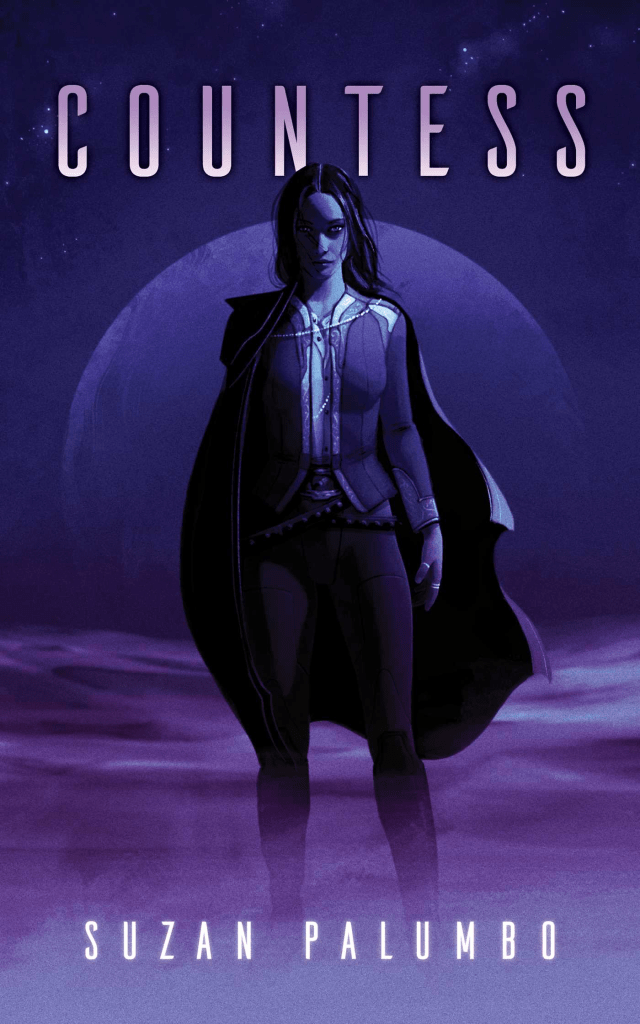
Countess – Suzan Palumbo – being under—and breaking the spell—of imperialism and subservience.
We’re ending on a much lighter note, worry not. Frankie Cosmos is always reliable on that front (whether or not it’s preceded by one of my rants).
I finally caught up with this season of Heartstopper, and I’ve fully moved away from calling it any sort of comfort show, as I feel that would diminish the incredibly important (and tactfully delivered) depictions of eating disorders and mental illness. Nonetheless, it remains a wonderfully queer show, and it’s got plenty of sweet moments, often buttressed by light and bubbly indie pop. I’m only on brand with…a third of the songs that are picked (some of it’s a bit too pop for me), but I can always count on at least a handful of hits popping up—season 3 featured not one but two Arlo Parks songs (“Devotion” and “Pegasus”—Parks is just perfect for the Heartstopper atmosphere), Sufjan Stevens’ “That Was the Worst Christmas Ever!” (it sure was…Charlie cannot catch a break 😭), and, reliably, more Frankie Cosmos. Maybe, just maybe, Alice Oseman might be a fan? We can never really be sure…
Either way, Frankie Cosmos and Heartstopper are matches of media that are made for each other. “Duet” has some of the simplest of lyrics, but they’re delivered with the lovesick joy of doodling hearts in the corner of your notebook as a teenager. Packaged in bite-sized containers (I can’t think of a song of theirs that’s over 4 minutes), they really do feel like bubblegum—sweet, sometimes sickly so, and short-lived, but constructed from simplicity that produces, more often than not, a perfect pop song. Like both the comic’s and the show’s cartoon hearts and leaves that surround the characters, there’s a simple purity to them that’s been distilled to the core.
…AND A BOOK TO GO WITH IT:
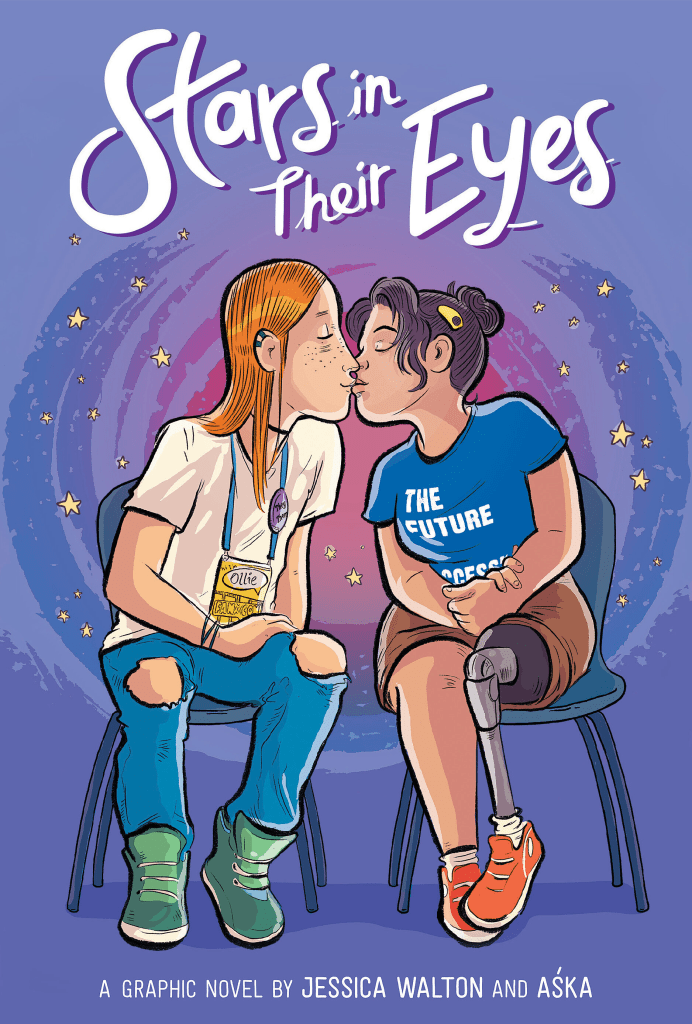
Stars in Their Eyes – Jessica Walton and Aśka – similarly pure and comforting, and full of color and first love.
Since this post consists entirely of songs, consider all of them to be today’s song.
That’s it for this week’s Sunday Songs! Have a wonderful rest of your day, and take care of yourselves!


 The Bookish Mutant