I fully thought I reviewed the first book in this series…whoops. Did I just hallucinate writing a book review? In 10-ish years of writing book reviews, I guess it was bound to happen…
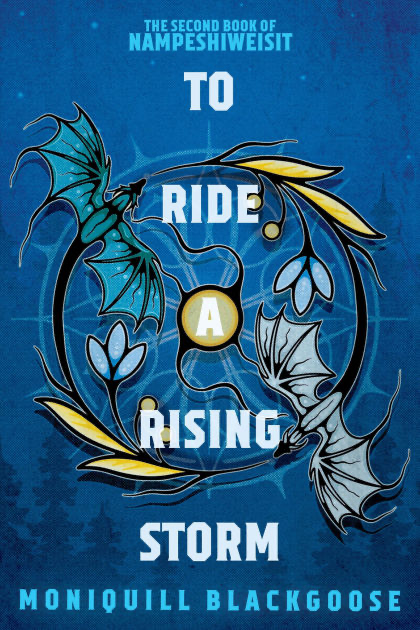
Suffice to say, I really enjoyed To Shape a Dragon’s Breath—it filled the void left by Harry Potter and rekindled my love for good old magic school YA, but without having to remember that J.K Rowling exists. ToShape a Dragon’s Breath is unabashedly Indigenous and queer, with a witty, delightful protagonist, a lovable supporting cast, and potent commentary on racism and colonization. And did I mention the dragons? Naturally, I was excited to see what the sequel had in store. And for the most part, To Ride a Rising Storm was a very rewarding sequel, full of the same heart that endeared me to book one.
Now, tread lightly! This review contains spoilers for book one, To Shape a Dragon’s Breath. If you haven’t read it and plan on doing so, you may want to skip this review.
Anequs has survived her first year at Kuiper Academy. Eager to return home with Theod, her only other indigenous classmate…who she may be developing feelings for. She intends to spend her summer break with her family, but what she returns home to is quite the opposite. The Anglish have begun to encroach on her homeland. Anequs is determined to assert her people’s right to govern themselves, but before she can intervene, she’s swept back to Kuiper Academy for another semester. With new friends and enemies, Anequs is determined to not let the idiosyncratic, nonsensical rules of Anglish society beat her down. But with a looming political threat mounting outside of her school, Anequs’s peace might be short-lived.
I love the Nampeshiweisit series—both books have been a delight to read. But for both books, I’ve been slightly torn about the worldbuilding. What you have to know right off the bat is that it’s not subtle, but also that it’s not trying to be subtle. Anequs and her people are Native American-coded, and the English stand-in is quite literally Anglish. You can see where we’re going here. But I wouldn’t be reading book two of this series if I wasn’t on board with it; and to be fair, the Anglish are basically a hybrid of England and a lot of Scandinavian countries in terms of their culture and folklore, even though they play the role of the English here.
However, I appreciate it more in the sense that it’s a political statement rather than a worldbuilding one—Blackgoose isn’t here to beat around the bush here when it comes to critiquing colonialism. Once you get past the names, there’s a rich fantasy world to be found here. It’s a world of dragons and secret societies and magic, and Blackgoose does an excellent job of explaining how they’re integrated into this world, and how they’ve affected geopolitics; this book gets even more into the politics of the world, which I greatly enjoyed. Plus, if you’re sick of how said magic schools have handled diversity (you all know who I’m talking about here), there’s so much diversity here, be it queer, POC, or disabled characters. And none of it feels like ticking off boxes—it all feels like how marginalized people would have lived and acted historically in a multicultural space.
One of the parts I most enjoyed about To Shape a Dragon’s Breath was Anequs herself. She’s just such a spirited and downright delightful protagonist, but one that easily holds her own against the obstacles that she faces. The Nampeshiweisit series is one that I’d recommend to readers of all ages, honestly, but especially younger readers who have just reached the age range of YA, and one of the main reasons I’d recommend it to younger readers (especially young girls) is Anequs. She’s such a good role model for young women, especially young, queer women of color: she’s determined, smart, and takes both her peers and the authorities to task for their racism and colonialism. Her personality practically bursts off the page. She isn’t without her flaws, either, and all the better—young girls are better off with role models who aren’t perfect. But so much of the draw for this series is how much I love being in her head and going on adventures with her and Kasaqua. Blackgoose really struck gold with Anequs—she’s a memorable protagonist in every way.
To Ride a Rising Storm was more character-driven than its predecessor, and for the most part, it greatly benefitted from it. For most of the novel, there’s not any hardcore, climactic action, but there are so many parts of the world and other cultures that get fleshed out that I can’t complain…mostly. (More on that later.) Either way, I loved the development of Anequs and her friends, old and new. Blackgoose’s characters are just so charming and compelling, and I loved that we got more page time with them. Jadzia was a great new addition, and I loved what she added to the friendship dynamic with Anequs, Theod, Sander, and the others. The glimpses we get of those on the margins of Anglish society outside of Kuiper Academy made the world feel even realer—there were so many pockets that we hadn’t seen before, and Blackgoose’s prose made me so much more immersed into the setting. Though some of the other parts of the book suffered from this focus, To Ride a Rising Storm felt like it was there to make the world more real.
However, there are drawbacks to having a book just for making the world feel more immersive. I’m torn about To Ride a Rising Storm because although I loved reading every second of it, there was a very clear pacing issue. While I enjoyed the more cozy, somewhat low-stakes approach that this book had, it was paced quite unevenly. We get some very serious action and stakes, but they aren’t introduced until halfway through the book. The final battle is crammed into the last 3% of the novel—I checked on my Kindle when this huge battle went down, and it started at the 97% mark! For a moment this climactic, it was introduced far too late. It just didn’t quite feel like Blackgoose quite knew whether she wanted to make this novel fully cozy or low stakes; either commit to the coziness or give the stakes more weight throughout the rest of the novel. Again, I enjoyed the pace until I didn’t—the last quarter of the novel proved that there was a serious issue with imbalance.
All in all, a worthy sequel with timely political commentary, tender friendships, and one of YA fantasy’s most memorable protagonists today. 4 stars!
To Ride a Rising Storm is the second book in the Nampeshiweisit series, preceded by To Shape a Dragon’s Breath.
Today’s song:
prepping myself to see Jeff Tweedy this friday…thanks to my dad for this one!
That’s it for this week’s Book Review Tuesday! Have a wonderful rest of your day, and take care of yourselves!
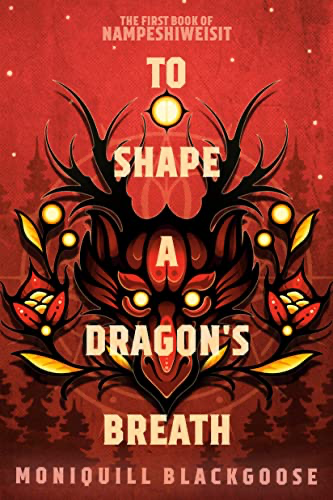
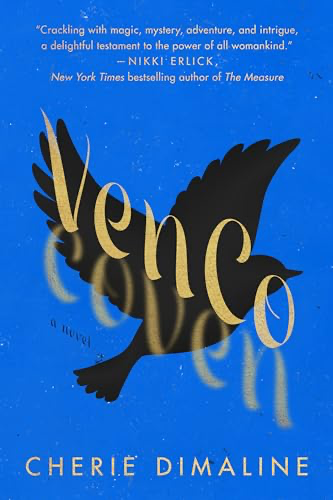
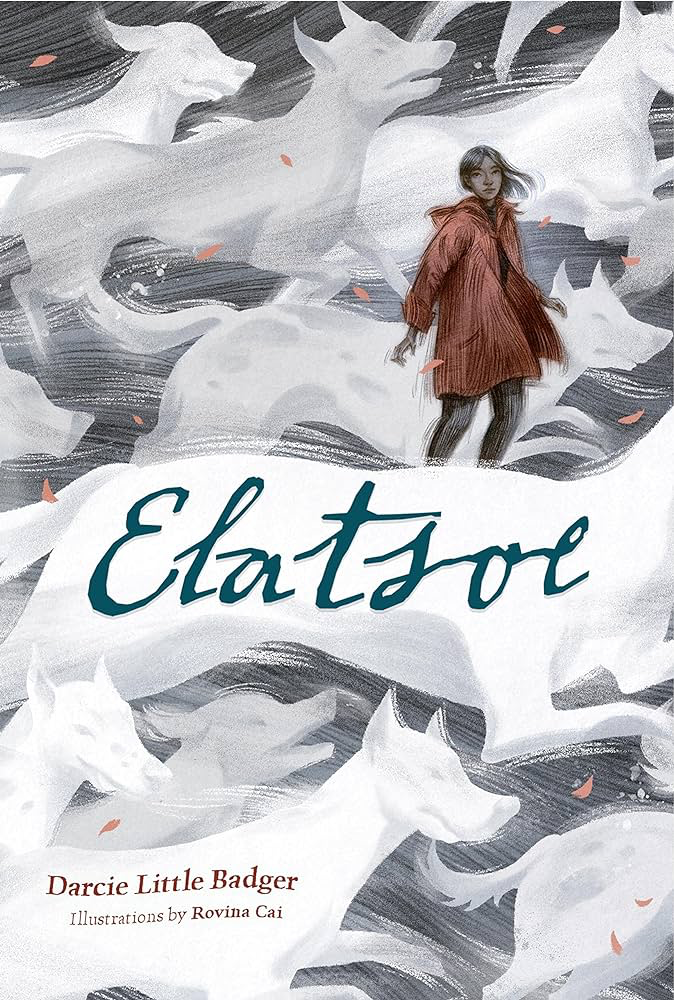
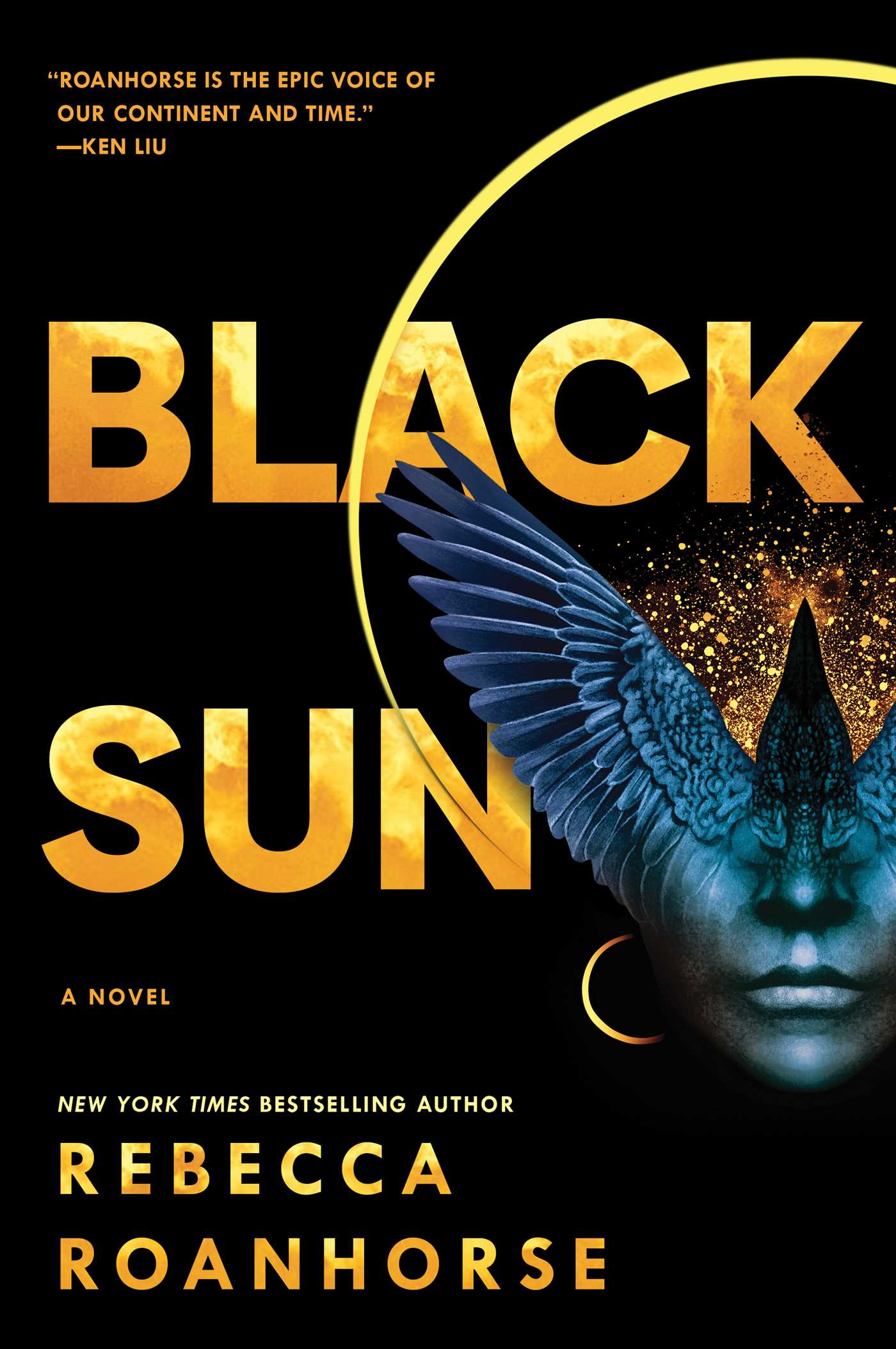
Here in theU.S., November is Native American Heritage Month! I’m surprised that I haven’t compiled a list for the occasion yet, but to be fair, November tends to be a busy month for me. But now that I’m a few days away from break, I figured I would use that time to make this list.
Despite the wonderful boost in diversity in YA and adult literature in the past decade or so, I’ve seen very little of that diversity focused on Indigenous characters and stories. It could be just me, from an outsider perspective, but diversity means boosting all voices—not just the few that you can think of off the top of your head when you think of the word “diversity.” And as an American, I know full well that we are and always have been living on stolen land, so it’s important to read outside of what our history books teach us. So I’ve compiled some of my favorite books by Native American, Indigenous, and First Nations authors for the occasion.
Let’s begin, shall we?
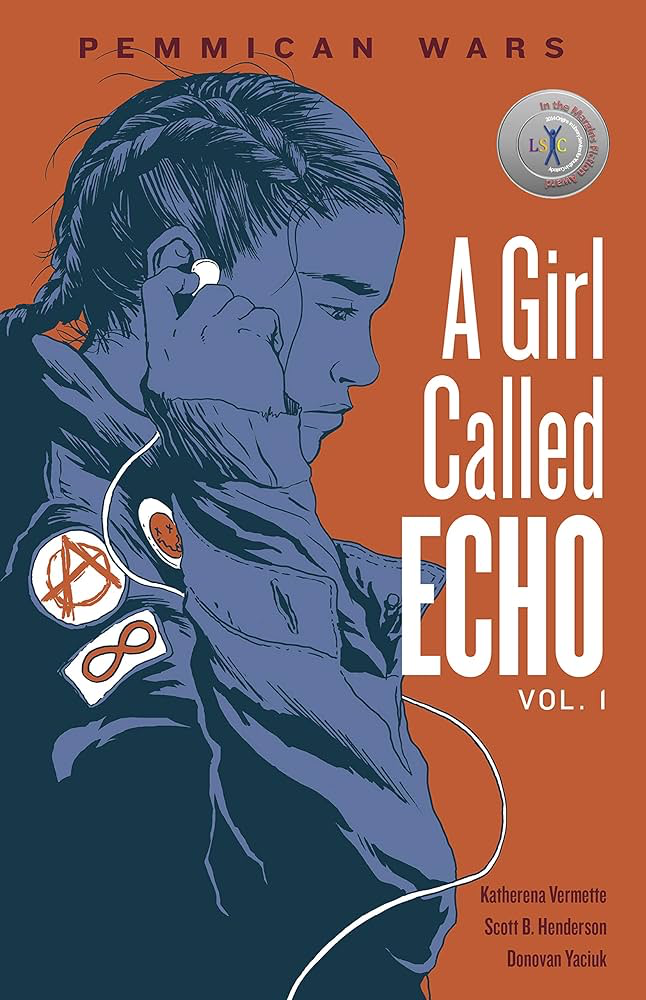
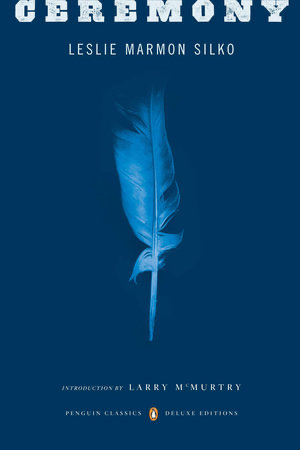
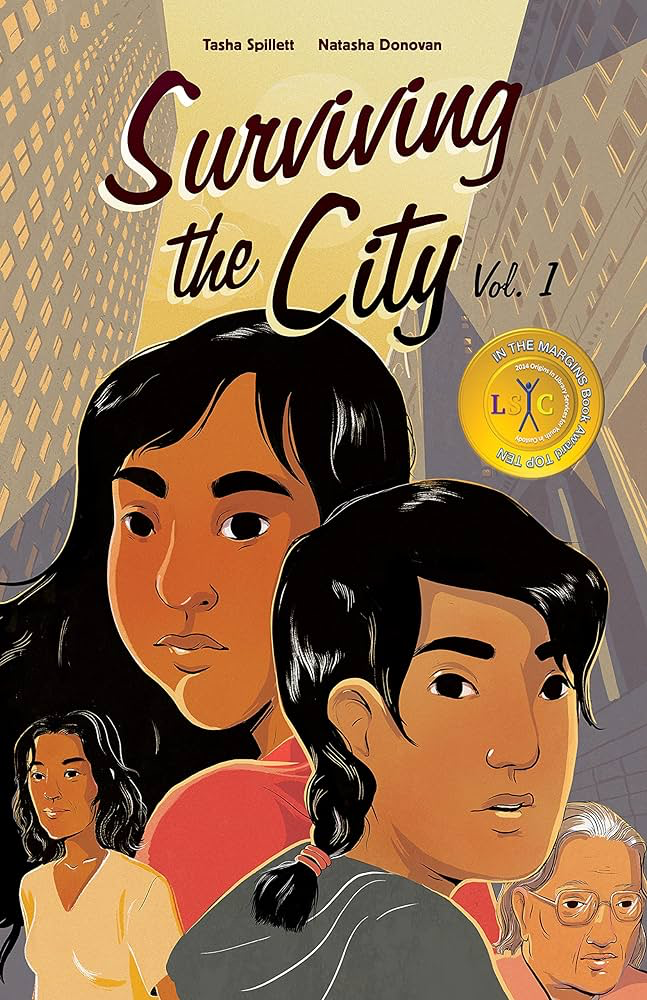
THE BOOKISH MUTANT’S BOOKS FOR NATIVE AMERICAN HERITAGE MONTH
TELL ME WHAT YOU THINK! Have you read any of these books, and if so, what did you think of them? What are your favorite books by Indigenous authors? Let me know in the comments!
Today’s song:
That’s it for this recommendations post! Have a wonderful rest of your day, and take care of yourselves!
It might still be a week or so before I completely return to some semblance of my normal schedule, but I’m starting to get to the point where I know where I’m going and what I’m doing. And as much as I hate the constant home football games we’ve been having, at least it means that my already quiet floor is even quieter, so I can get my homework done in a serene environment—and write these reviews as well!
Since my birthday last month, I’ve taken all of the books I got—ones that I bought on my birthday and gifts from family—back to my dorm, where I slowly (yes, slowly, settling into college is weird) devoured them over the course of several weeks. I’m happy to say that it was a fantastic batch—not every one was the best book I’ve ever read, but it’s chiefly in the 4-star range. I got a 5-star book out of these as well! And now they sit proudly on my little dorm bookshelf, ready to be reviewed.
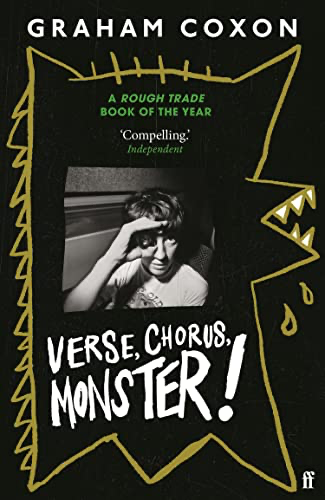
Verse, Chorus, Monster! is the memoir of iconic British musician and Blur co-founder Graham Coxon, charting a life of music, fame, addiction and art. Before the noise and clamour of the Britpop era, Coxon was a shy Army kid tempering his anxiety through painting and a growing love of music. As he honed his artistic skill at school, his band with school friend Damon Albarn, fellow student Alex James, and a drummer called Dave Rowntree began to get noticed. But there are things they don’t tell you before you get famous. There are monsters out there. And some may even be lurking inside yourself.
☆
TW/CW: substance abuse/addiction, themes of mental health issues
I’ve been trying to branch out into more nonfiction over the past few years, but even if I wasn’t, I would have picked this up eventually either way. My Blur awakening back in 2021 made sure of that. So of course I was excited to see that Graham Coxon was coming out with a memoir—he’s always struck me as such a sensitive, creative person, and Verse, Chorus, Monster! fortunately cemented that, for the most part!
I always have a lingering fear that celebrity memoirs will somehow ruin my image of them, but with this one, I still hold that Graham Coxon seems like such a deeply insightful and sensitive soul. This glimpse into his mind was all at once raw and touching; the frequent sections about his struggles with anxiety and alcoholism were difficult to read, but I’m so glad to have verbal confirmation that he’s been getting better as of late, and that he’s starting to work on himself in that respect. Beyond that, there’s just so much about this memoir that was immediately endearing. The insight into one of the main creative forces behind one of my favorite bands (and a fantastic solo artist in his own right) was fascinating to hear from the front lines, and I loved the pieces we got of his creative process—opening the book with the spark of inspiration that lead to the hook of my favorite song (“Tender”) was the quickest possible way to win me over. And it’s easy for memoirs to have a sense of humility that’s manufactured, but Coxon’s personality really did come off as genuinely humble.
All in all, an excellent memoir by a truly admirable creative force—and a refreshingly humble one. 4 stars!
In the ashes of a dying world, Red finds a letter marked “Burn before reading.”
So begins an unlikely correspondence between two rival agents in a war that stretches through the vast reaches of time and space.
Red belongs to the Agency, a post-singularity technotopia. Blue belongs to Garden, a single vast consciousness embedded in all organic matter. Their pasts are bloody and their futures mutually exclusive. They have nothing in common—save that they’re the best, and they’re alone.
Now what began as a battlefield boast grows into a dangerous game, one both Red and Blue are determined to win. Because winning’s that you do in war. Isn’t it?
A tour de force collaboration from two powerhouse writers that spans the whole of time and space.
☆
TW/CW: blood, violence, murder, self-harm, descriptions of bodies/corpses, torture, poisoning, war
Hoowhee, brother. This one was good.
Time War had floated on the edges of my radar for years ever since it came out, but I ultimately decided to pick it up on the recommendations of one of my professors and one of my best friends. And their high praise—and the high praise of so many others—was more than well-deserved.
For such a short novella, Time War packs a truly unforgettable gut punch, vibrant and rich with emotion. Who knew that these two characters identified only by colors would consume so much of my days when I read this? I can’t praise this book enough. The prose is beyond rich, truly enchanting and expansive, fitting for the cosmic scale that this story is set in. It has an almost gothic sensibility to it, even with the firmly sci-fi trappings—what’s more romantic, dramatic, and emotional than two lovers reaching for each other across the vastness of space and time itself? But even with this grand scale, This is How You Lose the Time War is one of the most deeply human stories that I’ve read in ages. It taps into that innate desire to love and be loved, or even to just have someone to talk to as the world around you is collapsing. In spite of the grand, cosmic conflict and multiple universes colliding, nothing can come in the way of our desire for love and connection. It’s one of those stories where plot details—names and how this time-spanning war started—mean nothing in the face of the deep resonance of the characters.
Hold me. I need a minute…
What else is there to say? Go read this, what are you even doing? 5 stars!
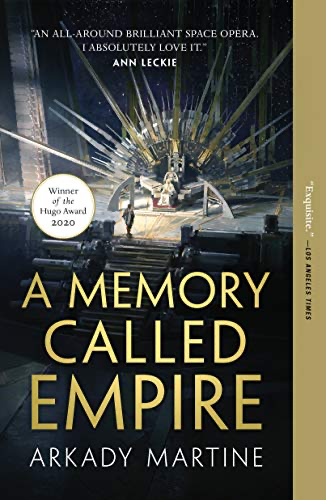
Ambassador Mahit Dzmare arrives in the center of the multi-system Teixcalaanli Empire only to discover that her predecessor, the previous ambassador from their small but fiercely independent mining Station, has died. But no one will admit that his death wasn’t an accident—or that Mahit might be next to die, during a time of political instability in the highest echelons of the imperial court.
Now, Mahit must discover who is behind the murder, rescue herself, and save her Station from Teixcalaan’s unceasing expansion—all while navigating an alien culture that is all too seductive, engaging in intrigues of her own, and hiding a deadly technological secret—one that might spell the end of her Station and her way of life—or rescue it from annihilation.
☆
TW/CW: themes of colonialism/imperialism, murder/attempted murder, violence
College isn’t all sunshine and rainbows, but man, it’s fun sometimes. I got an A on a literary theory assignment where I compared this book to an essay we read in class. I love being an English major.
If the fact that I used A Memory Called Empire for a literary theory assignment doesn’t make you think that there’s a ton of great stuff to chew on in this book, I’m not sure how else to convince you. It’s fantastic space opera, but it errs more on the side of a political thriller—a common enough combination these days, but one that was so well-executed in this case. Reckoning with the history of colonialism in science fiction has been on the rise—and for a very good reason—but A Memory Called Empire had such an interesting take on it. This is the first of these kinds of novels that I’ve seen tackle the seduction of colonialism; along with the actual murder mystery afoot, Mahit Dzmare is also being pulled—both physically and mentally—into the clutches of the reigning Teixcalaanli Empire, and is being groomed into the ruling culture as she tries to stay afloat and protect her space station from imminent colonization. The character work is nothing short of excellent, the worldbuilding is top-notch, and the suspense is palpable from start to finish. It’s all a treat.
This book has gotten quite a lot of hype over the years, but it really is all that—alluring, suspenseful, and nothing short of insightful. 4 stars!
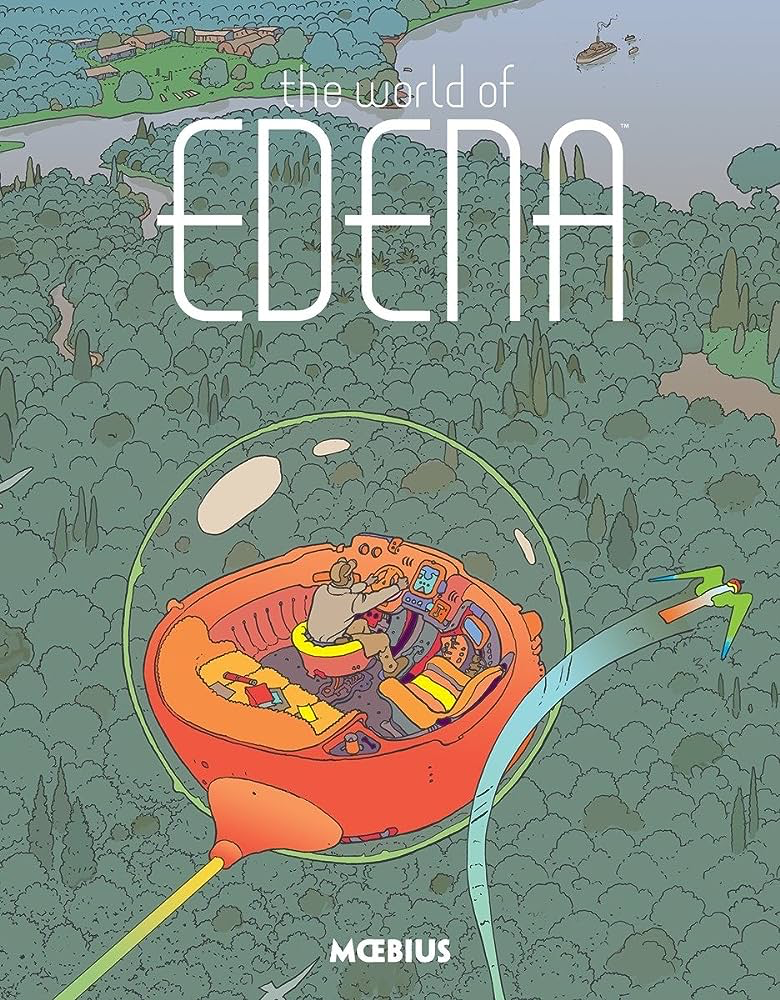
Stel and Atan are interstellar investigators trying to find a lost space station and its crew. When they discover the mythical paradise planet Edena, their lives are changed forever. The long out-of-print Edena Cycle from Moebius gets a deluxe hardcover treatment! Moebius’s World of Edena story arc comprises five chapters–Upon a Star, Gardens of Edena, The Goddess, Stel, and Sra–which are all collected here.
☆
TW/CW: nudity, mild sci-fi action
I’ve been meaning to get into Mœbius for years now; ever since I reactivated my pinterest and went on a deep dive of sci-fi art, I’ve been drawn to the enigmatic, meticulous, and downright wondrous quality of his art. (I feel like it would’ve happened eventually—turns out that he was a major influence on Tony DiTerlizzi, and especially his inking style in the Search for WondLa trilogy, which has shaped me beyond repair.) I started here with Edena, and I put it on my birthday list.
I still hold that he may be one of my favorite artists. His style is so ethereally captivating, and I found many a piece that I’ve used for my desktop wallpaper in the past few years inside Edena. His landscapes are instantly transporting, and there’s not a single character design lacking in whimsical charm. The story itself…slightly less so? It’s like a sci-fi Yellow Submarine, but if the script was due in an hour and he’d forgotten all about it until then. Given the circumstances, it’s understandable; Edena apparently started out as a car ad (???), and then it took on a life of its own, completely unplanned. There’s inconsistencies aplenty with both the story and the art, but for the most part, it was just so wild that I enjoyed the ride. If it gives you some idea of what happens, Mœbius pulls the classic “IT WAS ALL A DREAM” move that ends up resolving (if you can call it that) the whole mess. It’s nuts. But there were so many pockets that I wished we could have explored more. There were some super interesting gender themes going on—I wish we got to know why Stel and Atan were on their gender-neutral hormone supplements, for a lack of a better word, but the resulting transformation into their Adam and Eve roles (hence the name) was so fascinating, especially since this only came out in the late eighties or so. (Of course, Atan/Atana effectively becomes a damsel in distress post-transformation, but that’s a whole other can of worms. Ouch.)
In short, The World of Edena was beautiful, if not a bit of a mess. Luckily, the mess was endearing, for the most part, or at least fun. 3.75 stars, rounded up to 4!
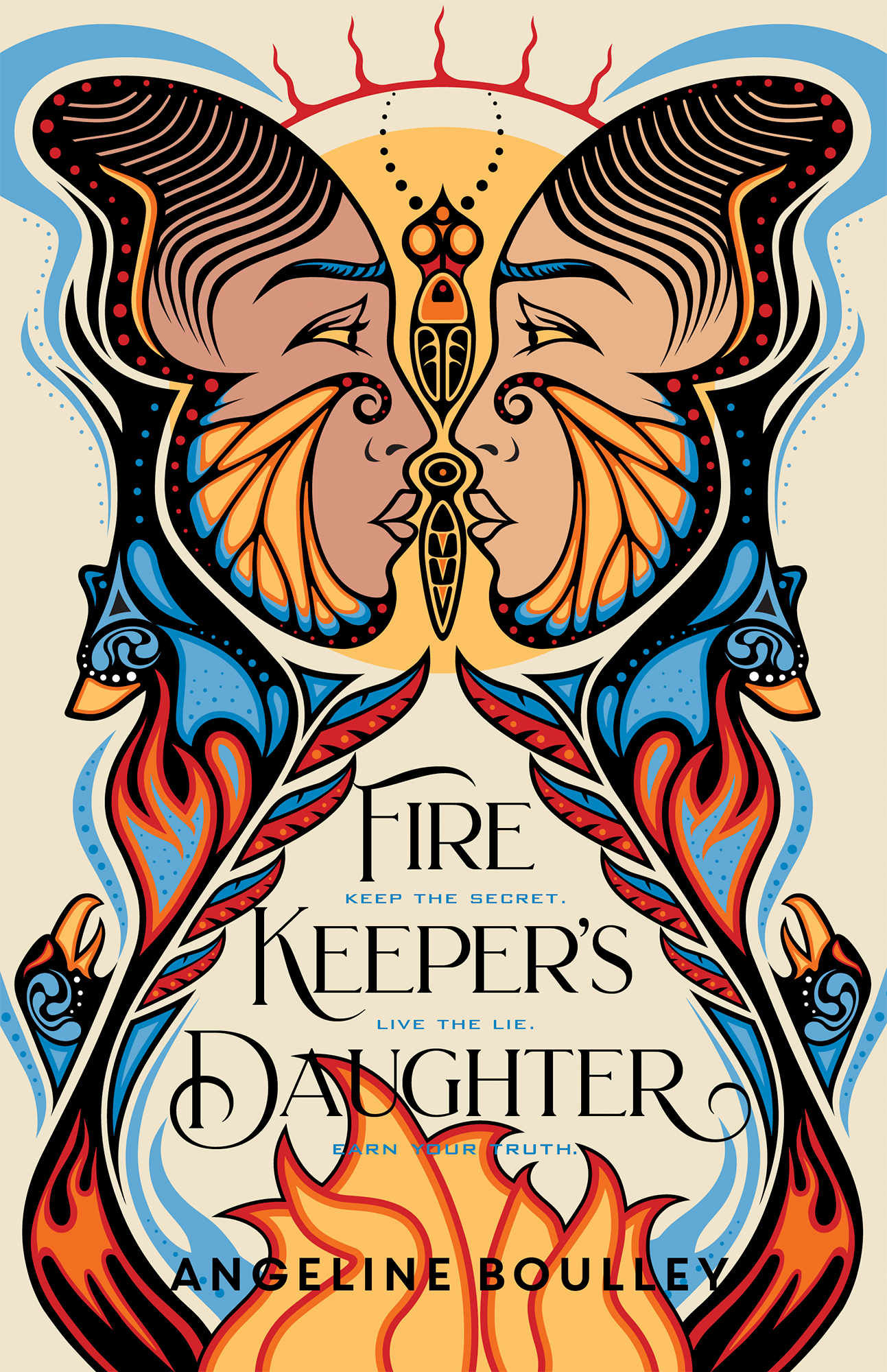
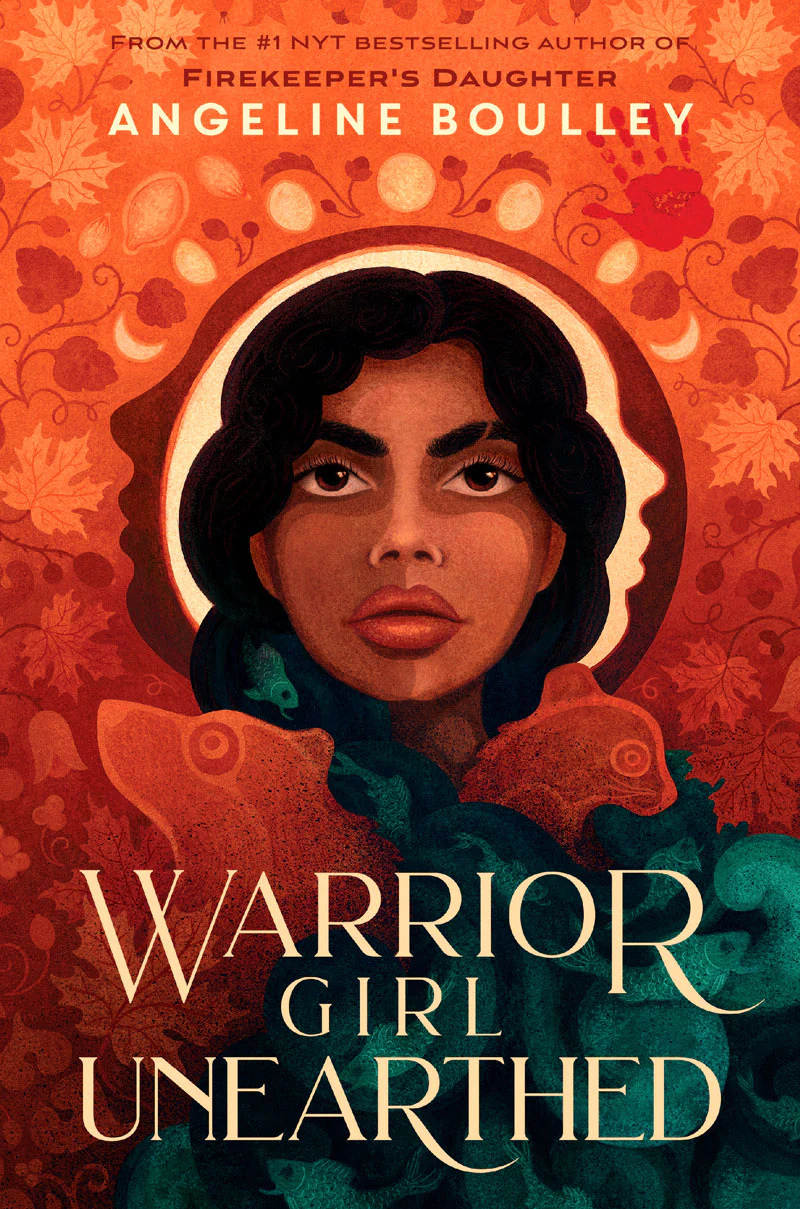
As a biracial, unenrolled tribal member and the product of a scandal, Daunis Fontaine has never quite fit in—both in her hometown and on the nearby Ojibwe reservation. When her family is struck by tragedy, Daunis puts her dreams on hold to care for her fragile mother. The only bright spot is meeting Jamie, the charming new recruit on her brother’s hockey team.
After Daunis witnesses a shocking murder that thrusts her into a criminal investigation, she agrees to go undercover. But the deceptions—and deaths—keep piling up and soon the threat strikes too close to home. How far will she go to protect her community if it means tearing apart the only world she’s ever known?
☆
TW/CW: racism, murder, sexual harassment and assault, misogyny, rape, death, gun violence, descriptions of injury, substance abuse
Originally, I put off reading this book because a) I’m not usually much of a YA mystery/thriller person, and b) the mountain of hype was certainly intimidating. I ended up reading Warrior Girl Unearthed because the plot fascinated me more from the start, and I loved it so much that I ended up buying Firekeeper’s Daughter after all. And, once again, I’ve been struck with the luck of hyped books being all worth the hype.
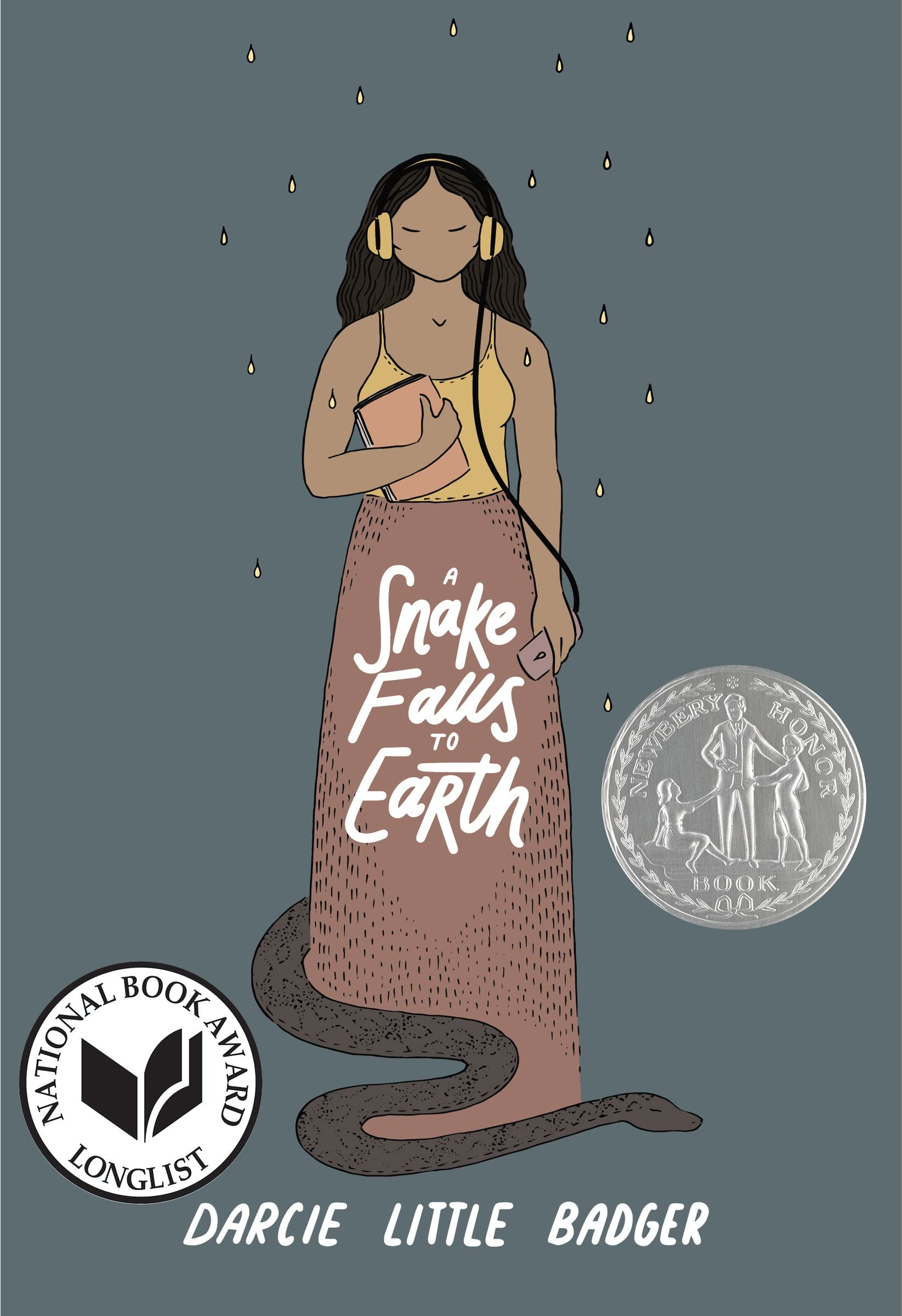
Every part of Firekeeper’s Daughter is excellent, from the effortless way that Angeline Boulley weaves a scene and setting together to the never-ending suspense that kept me guessing for page after page, twist after twist. Making a setting as tangible and populated as hers was is no easy feat—and it suited every other aspect of this book in every conceivable way. You can’t have a corrupt, hidden history of a town without the town itself. The sense of community—and the rifts driven into it—were some of the best I’ve seen in YA fiction in quite a while. Part of that wouldn’t have been possible without Boulley’s equally excellent character work; Just like their community, every character feels nothing short of authentic and multilayered. This all made the twists so much more effective—with such layered characters, I learned to expect the unexpected. And even with the ongoing expansion of diversity in YA as a whole, I feel like I haven’t seen as many novels centering Native American or Indigenous characters and stories, so I’m glad that this book exists in that sense as well. (Shoutout to Darcie Little Badger and Moniquill Blackgoose as well!) And Daunis is mixed-race as well! Yay!!!
If you’re questioning whether or not Firekeeper’s Daughter is worth the never-ending hype: trust me, it’s worth a read. 4 stars!
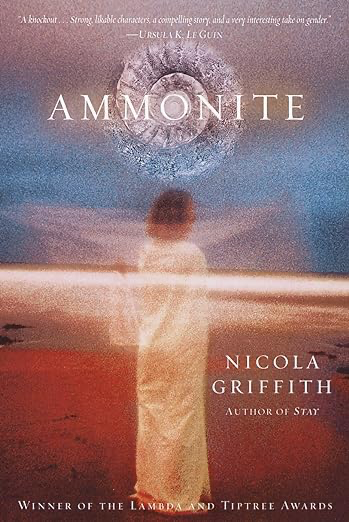
Change or die. These are the only options available on the planet Jeep. Centuries earlier, a deadly virus shattered the original colony, killing the men and forever altering the few surviving women. Now, generations after the colony has lost touch with the rest of humanity, a company arrives to exploit Jeep–and its forces find themselves fighting for their lives. Terrified of spreading the virus, the company abandons its employees, leaving them afraid and isolated from the natives. In the face of this crisis, anthropologist Marghe Taishan arrives to test a new vaccine. As she risks death to uncover the women’s biological secret, she finds that she, too, is changing–and realizes that not only has she found a home on Jeep, but that she alone carries the seeds of its destruction. . .
☆
TW/CW: death, violence, animal death, gore
I picked this one up after how much I loved So Lucky, also by Griffith. Thing is, I had no idea that a) this book was written almost 30 years before So Lucky (although this cover should’ve tipped me off to that), and b) that, even with the genre difference, that this would be a very different kind of book. At this point, nothing tops So Lucky for me, but Ammonite was still a fascinating book in its own right.
If you’re going into this book expecting what most would consider traditional science fiction, you’ll be sorely disappointed. Most of it follows Marghe, who is tasked with delivering a vaccine to an isolated colony of women whose community was decimated by a mysterious illness that wiped out all of the men. At its heart, Ammonite is firmly a survival story; it’s a story of the wilderness, of venturing into the unknown, and adapting to the world around you. There are moments of suspense, moments of tenderness, and moments of absolute fear. Another reviewer described it as “Dune but gay,” and other than the more traditionally sci-fi elements of the former, the comparison was spot-on. Ammonite also has the fact that it’s much slimmer than Dune going for it, but given how long Dune is, that’s not saying much. But I think what has seemed to make this book so groundbreaking is its take on gender dynamics. The cast is entirely women, but when all of the men are taken by the illness, the remaining women don’t automatically form a pacifist, hippie commune; there are flawed women, there are good-hearted women, there are warlike women, and everything in between. This banishing of broad generalizations about gender, I think, is what makes Ammonite feel so ahead of its time.
Sidenote: this was written in the nineties, so Nicola Griffith had to have known about goth people…right? Just saying, calling the barely-described alien megafauna “goths” made me envision a giant, towering version of Robert Smith, not, y’know, whatever she wanted us to picture.
All in all, a very unique take on sci-fi and survival with some groundbreaking gender dynamics that have held up for the past 30 years. 3.5 stars!
A mutated Abe Sapien fights carnivorous monsters crawling out of the desert sand, a fortified militia that’s walled Phoenix off from the rest of the world, and a vicious zombie swarm, while a mad necromancer rises over the monster-infested ruins of Seattle. Collects issues #6-#7 and #9-#11 of the series.
☆
TW/CW: gore, blood, violence, racism, body horror
I haven’t caught up on the actual Abe Sapien series since…[checks notes], eight grade, I think. Jesus. I just remembered flying to New York when I was about 14 and reading the first volume. But even then, I think I subconsciously chose a good place to pick up with it, since there’s a pretty clear gulf between the first three and vol. 4—before and after Abe gets mutated, shot, and quits the B.P.R.D. Just another day at the office for the guy, y’know?
Suffice to say, I was somewhat disappointed by this volume. It was still enjoyable, and even though I was never the biggest fan of Fiumara’s art, the more stylized look suits Abe’s stretched-out, mutated form. Other than that, there wasn’t a whole lot here that I found terribly memorable. Abe goes through the exact same arc as Hellboy upon leaving the B.P.R.D., but it never seems to culminate in much development on his end. Plot-wise, it’s the same ol’, I’m afraid—Abe goes into a random, apocalypse-ravaged town in the middle of nowhere, and, surprise surprise, it’s time to fight some zombies and witness a copious amount of fungus-related body horror. Somehow, the latter works better when it’s the whole B.P.R.D. trying to deal with it—the group dynamic is what makes B.P.R.D. consistently shine, and as much as I love Abe, I’m not sure if he could carry a story like that when it’s the same format they’ve been using on and off for several years. Abe is one of my favorite Mignolaverse characters, and it’s such a shame that he’s never gotten to shine as much in his solo comics. And judging from the reviews on the later volumes, it seems like the quality tanked until we got the band back together for The Devil You Know. Shame.
All in all, an entetraining trade, but one that ultimately did a disservice to one of the Mignolaverse’s most beloved characters. 3.25 stars.
Today’s song:
I swear, this has to be some of Mitski’s best work in YEARS
That’s it for this batch of mini reviews! Have a wonderful rest of your day, and take care of yourselves!
I was in Florida about a week ago for a quick trip, but as I always do, I brought some books along on my Kindle to get me through the plane rides and the heat. I like doing little mini-reviews of these books when I go somewhere else, so I figured I’d do it again here, since I certainly read a couple of very interesting books while I was in Florida. So here we have three mini-reviews of books I read in Florida.
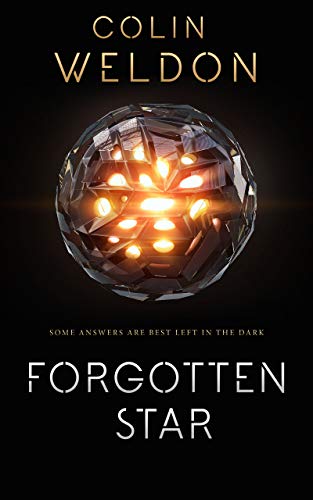
Following a devastating encounter with an unknown alien ship resulting in the disappearance of her parents as a child, Tamara Cartwright now spends her life scouring the galaxy in the hope of finding the dark force that attacked her father’s ship. Now the Captain of a rescue vessel, The Massey Shaw, she makes a choice, resulting in the destruction of a star in order to save a stricken vessel, a prohibited act while using alien technology. Now, an outlaw, she is entrusted with the fate of a very unusual young girl endowed with special abilities. She must also find the survivors of an ill-fated ship at the hands of a malevolent race know only to the humans as the Ghosts. Driven by the hope of finding the truth of her parent’s disappearance and one last chance to make a difference to those in need of rescue, she must go on one final mission into deep space and deal with the monsters from her past.
TW/CW: human experimentation, loss of loved ones, death, graphic violence
Forgotten Star wasn’t without its flaws by a long shot, but it was such a fun and fascinating piece of space opera! With lots of political intrigue, strange aliens, and mysterious powers, there’s something for every sci-fi fan in here.
I need to start off with my main problem, though: the grammar. It was…inconsistent, at best. This novel definitely needed an extra round of editing (or two) in that respect; there were lots of errors in punctuation (mostly placement of commas), and there were a few misspellings and omissions that could have been fixed. (As well as a misspelling of “berth,” as in “a wide berth,” as “birth” …YIKES) On occasion, the faulty grammar was enough to take me out of the story entirely, but for the most part, I could let it slide. Sometimes.
But other than that, Forgotten Star was a great piece of sci-fi! One thing this novel did incredibly well was the handling of multiple POVs – for a lot of multiple POV books, it takes a while for all of the characters/elements to coalesce, but it didn’t take long for all of the elements here to come together, making for a cohesive and intricate story. I also loved all of the alien races, and the intricacies of their relationships with humans. It’s always a breath of fresh air to see aliens that clearly have some creative design put into them.
Some of the dialogue and characters were a little stiff and inauthentic at times, but for the most part, a lot of the characters were interesting to delve into. I liked Ona and Urhan, in particular – they had very interesting arcs and backstories, and I loved seeing them develop.
My only other major problem was that the ending wrapped up a *little* too nicely? From everything that built up over the course of the story, it seemed like there was a setup for a sequel, but the ending tried to wrap everything up too quickly. I’d like to see more from this universe.
All in all, though, a well-thought-out and intricate piece of space opera. 3.75 stars, rounded up to 4!
‘She loved me as I loved her, fierce as a bloodied blade’
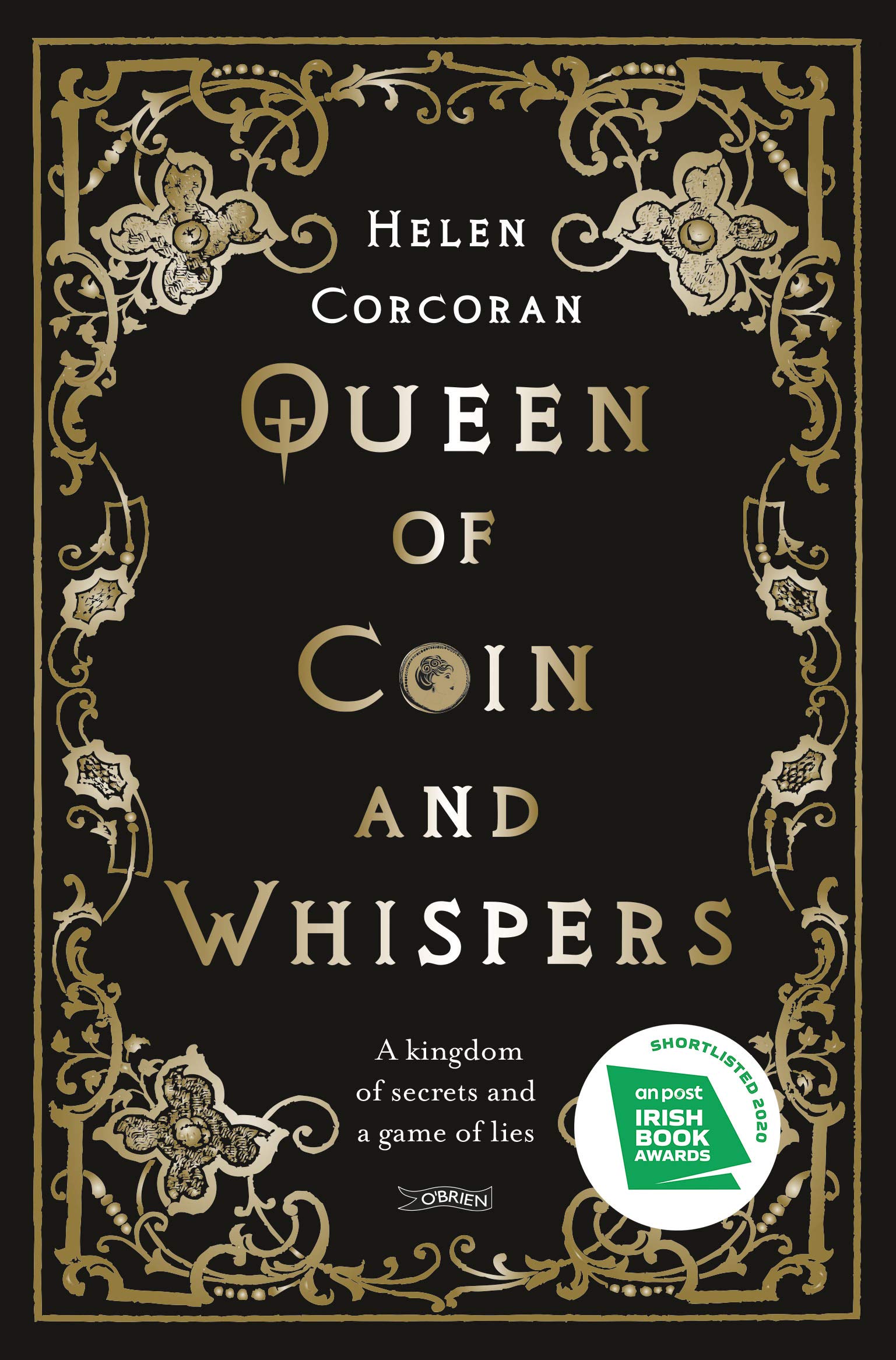
When Lia, an idealistic queen, falls for Xania, her new spymaster–who took the job to avenge her murdered father–they realise all isn’t fair in love and treason.
Lia won’t mourn her uncle: he’s left her a bankrupt kingdom considered easy pickings by its neighbours. She’s sworn to be a better ruler, but if she wants to push through her reforms, she needs to beat the Court at its own games. For years, Xania’s been determined to uncover her father’s murderer. She finally gets a chance when Lia gives her a choice: become her new spymaster, or take a one way trip to the executioner’s axe. It’s an easy decision.
When they fall for each other, their love complicates Lia’s responsibilities and Xania’s plans for vengeance. As they’re drawn together amid royal suitors and new diplomats, they uncover treason that could not only end Lia’s reign, but ruin their weakened country. They must decide not only what to sacrifice for duty, but also for each other.
TW/CW (from Helen Corcoran): off-page suicide, murder, emotional torture
I’m not sure if I would necessarily call Queen of Coin and Whispers a fantasy novel – there wasn’t a whole lot that would distinguish it from a historical setting (no different magic properties/creatures/worldbuilding/etc.). But that’s not to say that it was a bad book – in fact, it was stunning!
There’s plenty of YA fantasy books on the market with protagonists who suddenly ascend to royalty. But Queen of Coin and Whispers addresses what most of those novels don’t – the mental tax of ruling a country at such a young age. Lia goes through endless trials and tribulations and even faces becoming the ruler that her uncle was, all while grappling with love and other relationships. Corcoran wrote her development so well, and it’s so refreshing to see a genuine-feeling story like Lia’s.
Additionally, the romance! Lia and Xania’s relationship was so sweet – sharing books, secret conversations, and all things warm and fuzzy. They go through all the ups and downs of first love, and I love seeing wlw rep like theirs in non-contemporary stories. I love those two. 💗
Other than that, the political intrigue and the depiction of the transition of power was so well-done! Everything was so multi-layered and detailed, making it feel like Lia and Xania’s world was a real and fleshed-out one. Just when you think you know the answers, something new pokes out its head, and you’re left guessing until the very last page.
All in all, a fascinating royal mystery with genuine characters and a sweet sapphic romance. 4 stars!
Parole is still burning. And now the day everyone has been waiting for is finally here: it’s collapsed. A lucky few managed to escape with their lives. But while their city burned, the world outside suffered its own devastating disaster. The Tartarus Zone is a deadly wasteland a thousand miles wide, filled with toxic storms, ghostly horrors, and just as many Eyes in the Sky as ever. Somehow, this new nightmare is connected to Parole. And it’s spreading.
Now Parole’s only hope lies in the hands of three teenagers reunited by their long-lost friend Gabriel – in their dreams. Now they’re on a desperate cross-country race, carrying vital plans that may be Parole’s salvation. First they’ll board the FireRunner, a ship full of familiar faces that now sails through Tartarus’ poison storms. Then, together, they’ll survive Tartarus’ hazards, send a lifeline to lost Parole – and uncover the mystery connecting everyone, inside Parole and out.
The world outside Parole isn’t the one they remember, and it didn’t want them back. But they’ll save it just the same. It’s what heroes do.
(for my mini-review of book 1, Chameleon Moon, click here!)
TW/CW: loss of loved ones, violence, near-death situations
I didn’t like this one *quite* as much as I did Chameleon Moon, but it was still such a fun read!
One of the things I love most about this series is how diverse it is – easily the most diverse series I know! We have an almost entirely different cast of characters in The Lifeline Signal, but among the three main characters, we have a nonbinary (xie/xir pronouns) Native American (Tsalagi) character with Arnold-Chiari malformation, a bisexual Indian-American character, and an aro-ace autistic Vietnamese-American character! Among the side characters, there’s no shortage of queer, POC, and disabled characters, including a Black hijabi woman, a nonbinary character, polyamorous relationships, and more! Books as diverse as this series don’t come along very often, so three cheers for RoAnna Sylver for all this representation!
The worldbuilding outside of Parole was also fascinating – there’s all sorts of weird sci-fi and fantasy aspects, including, but not limited to: superpowers, ghosts, dragons, giant ships, and robotic animals of immense size. As you can imagine, it’s a lot of fun! Between the relationships between all of the characters and the expansion of the worldbuilding, there’s no shortage of interesting elements to chew on. Plus, it was so sweet to see all of the characters from Chameleon Moon come back.
My only major problem was that the plot got a little bit convoluted at times – I found myself thinking “wait, why is all this happening?” several times throughout the novel, but it didn’t take me out of the story itself. Don’t get me wrong – The Lifeline Signal has a great story, but it seemed to get lost in itself at times.
All in all, a sequel that does justice to book one as well as expanding its world, while still providing an original storyline. 3.75 stars, rounded up to 4!
⭐️⭐️⭐️.75
Today’s song:
I saw Sleater-Kinney and Wilco (we came for Wilco, they were AMAZING) on Tuesday night, and even though most of Sleater-Kinney’s stuff didn’t make me feel anything, there were a couple songs that I thought were interesting! This is one of them
That’s it for these three mini-reviews! Have a wonderful rest of your day, and take care of yourselves!








 The Bookish Mutant