Happy Wednesday, bibliophiles, and happy New Year’s Eve!
I know this is probably the millionth wrap-up post you’ve seen today, but this is mostly in service of my love of bullet points and categorizing and such.
Let’s begin, shall we?
GENERAL THOUGHTS:
New Year’s Eve. It’s the time of the year when your social media is flooded with everybody making neat little wrap-up posts about everything that they achieved and how much fun they had in the past year. Now, I fully acknowledge the irony that I’m doing almost the exact same thing in written form. But with Instagram, I often find myself reluctant to post big end-of-the-year lists or posts like I do on here. With my art account, everybody seems to have stuff all ready for the holidays, but I’m just drawing whatever I see fit, rarely ready with anything festive for Christmas or the new year. All this is to say, it’s good to remember that this is, after all, social media. Even as the year ends, it’s okay to not have everything wrapped up in a neat bow. Social media’s all a sham anyway, so post at your own pace.
Compared to this time last year, when I felt like I’d gotten a proverbial pummeling from 2024, I’m at least grateful that I’m in a better place, even if 2025 was…god, it was certainly a year. And honestly, 2025 pummeled me too. But it was marginally better for me than last year, which is saying something. I’ve learned to take better care of myself. Even though keeping my head above water with everything going on in this country has been—and continues to be—an uphill battle, I feel like I’ve come so much further from the person I was last year. I moved into an apartment, I got another two semesters of good grades, I learned how to knit, and above all, I feel more independent. (I’m saying that in my head like they do in Rudolph the Red-Nosed Reindeer. In-dee-pendent!) Yet I’ve also been beaten down by stress, by school, by tragedy—preeminently a school shooting at my old high school back in September. Above all, it’s been a year of upheaval for me—not just the negative upheaval of the government (because they think that our Constitution is a suggestion, apparently), but a year of so much change. But I’m here. And hell, I’m so proud of myself. Half of the things I listed here (and many that I didn’t) are things that I never imagined myself doing even five years ago. But I’m here. I can ride the bus and make easy conversation sometimes, I know the way there and back to my record store, and I am surrounded by people who I love and who love me back. I am grateful.
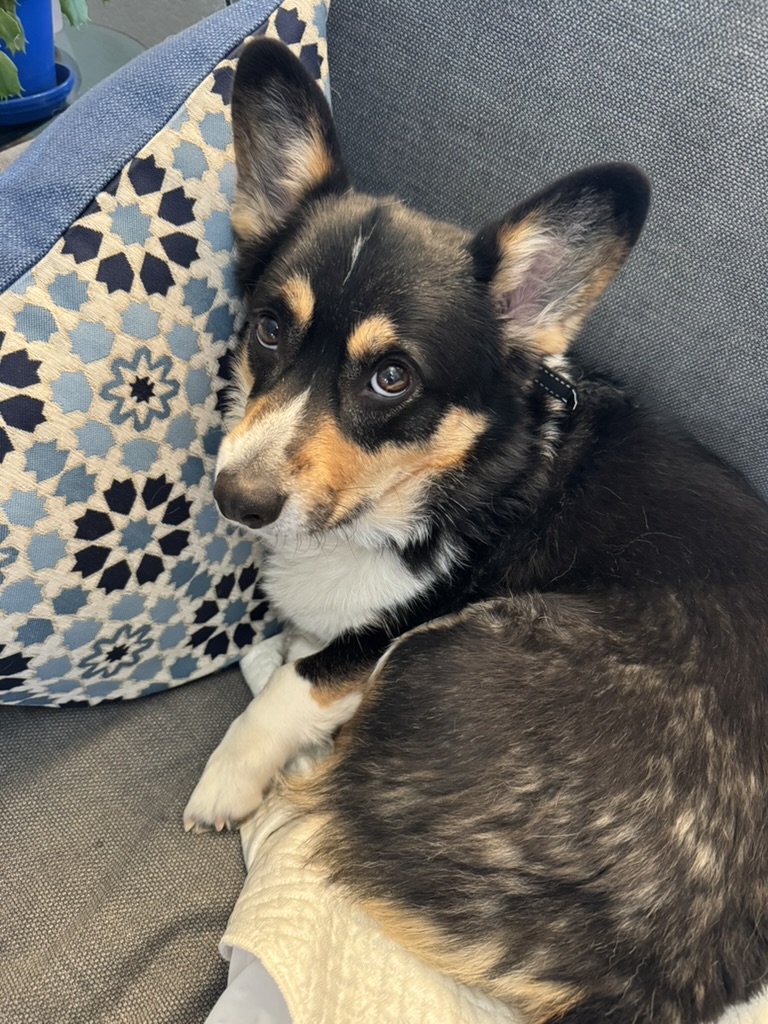
Plus, the more important holiday is Ringo’s 4th birthday. Send your birthday wishes, or the birthday boy will bite your feet…
NOVEMBER READING WRAP-UP
In total, I read 174 booksin 2025!
I read 14 books in November! Though my reading count was buttressed by several re-reads and school books (and one unfortunate DNF), I encountered so many lovely books.
I read 13 books in December! Finals put me way behind my usual reading amount for the month, so I thought this would end up being my worst reading month of the year…and then my power went out for four days. I ended up reading two books in a single day, something I haven’t done since I was, what…9? 10? Either way, the power outage, as unfortunate as it was, gave my reading a bit of a boost.
Above all, thank you for everybody here. WordPress isn’t exactly the most popular site anymore, and I’ve considered moving platforms myself. But for the people who are still here, thank you for the likes, the comments, and the kind words. This year would’ve been ten times harder to endure without my family and friends here to support me—it is the privilege of a lifetime to have you all in my life. And to anyone who’s casually read any of my posts, thanks for stopping by. Keep reading dangerously, keep loving each other. Spread love, not fear, and go to your local record store or library or indie bookshop every once in a while. Smile at people. And celebrate this new year however you see fit.
Happy Sunday, bibliophiles! I hope this week has treated you well.
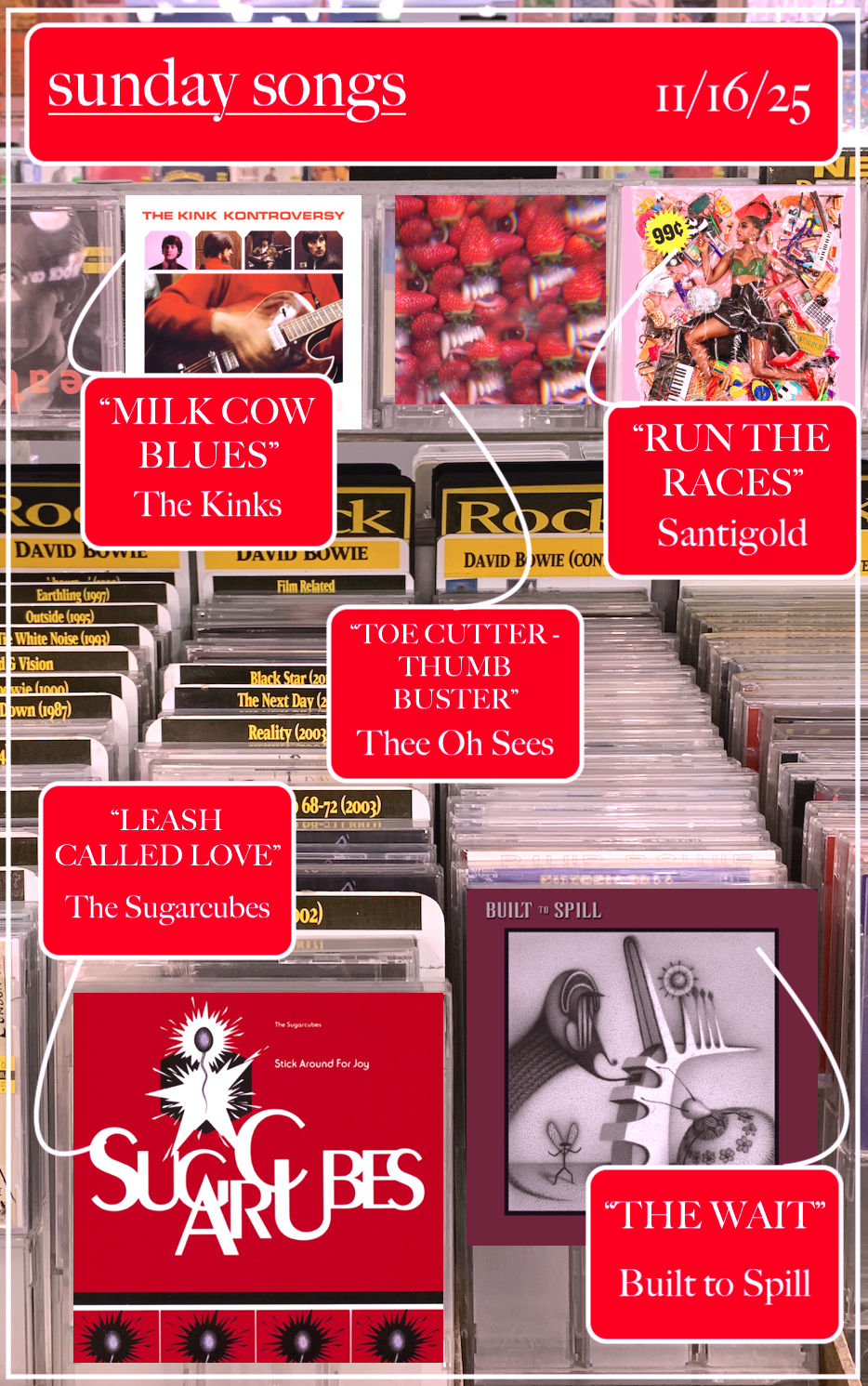
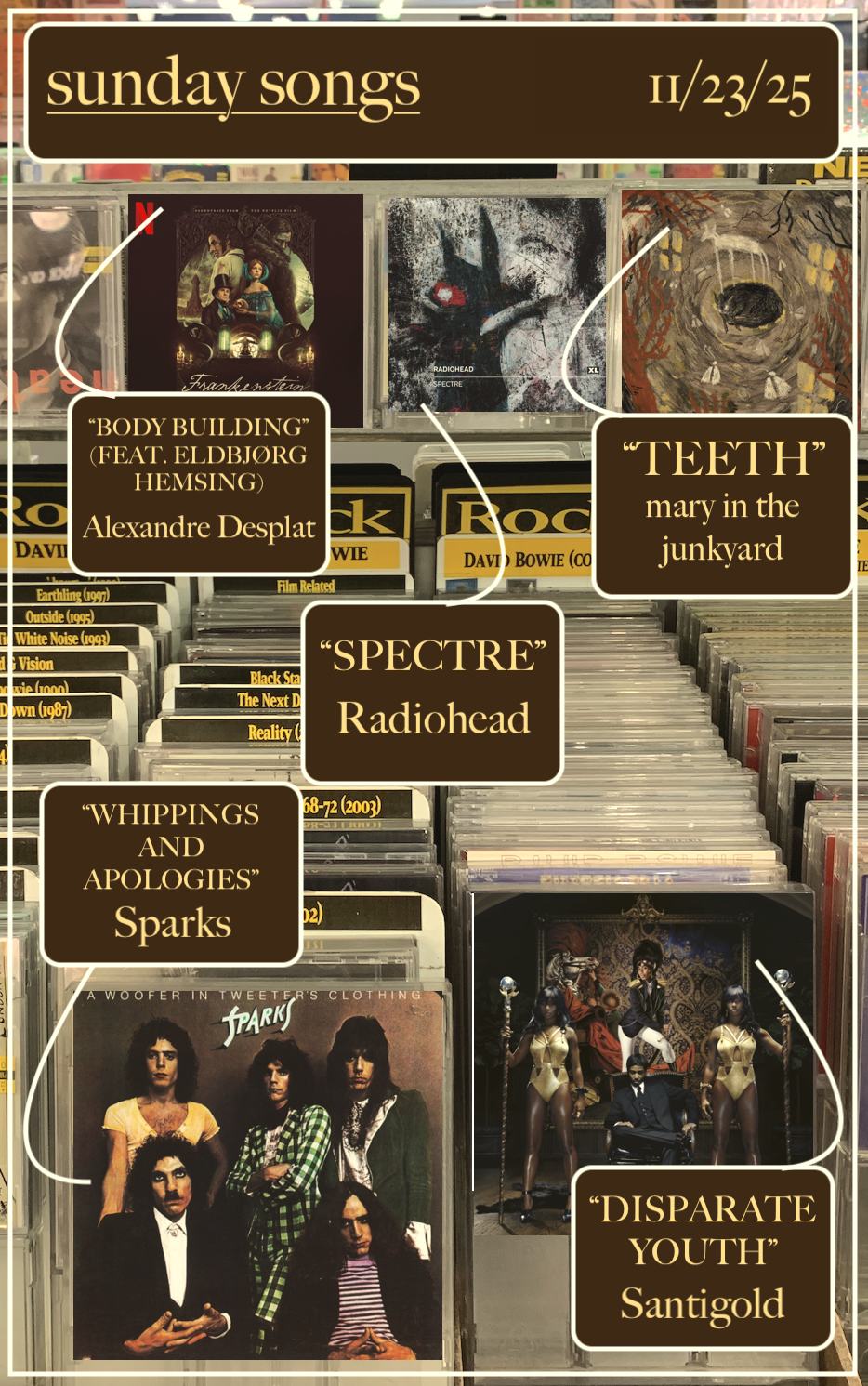
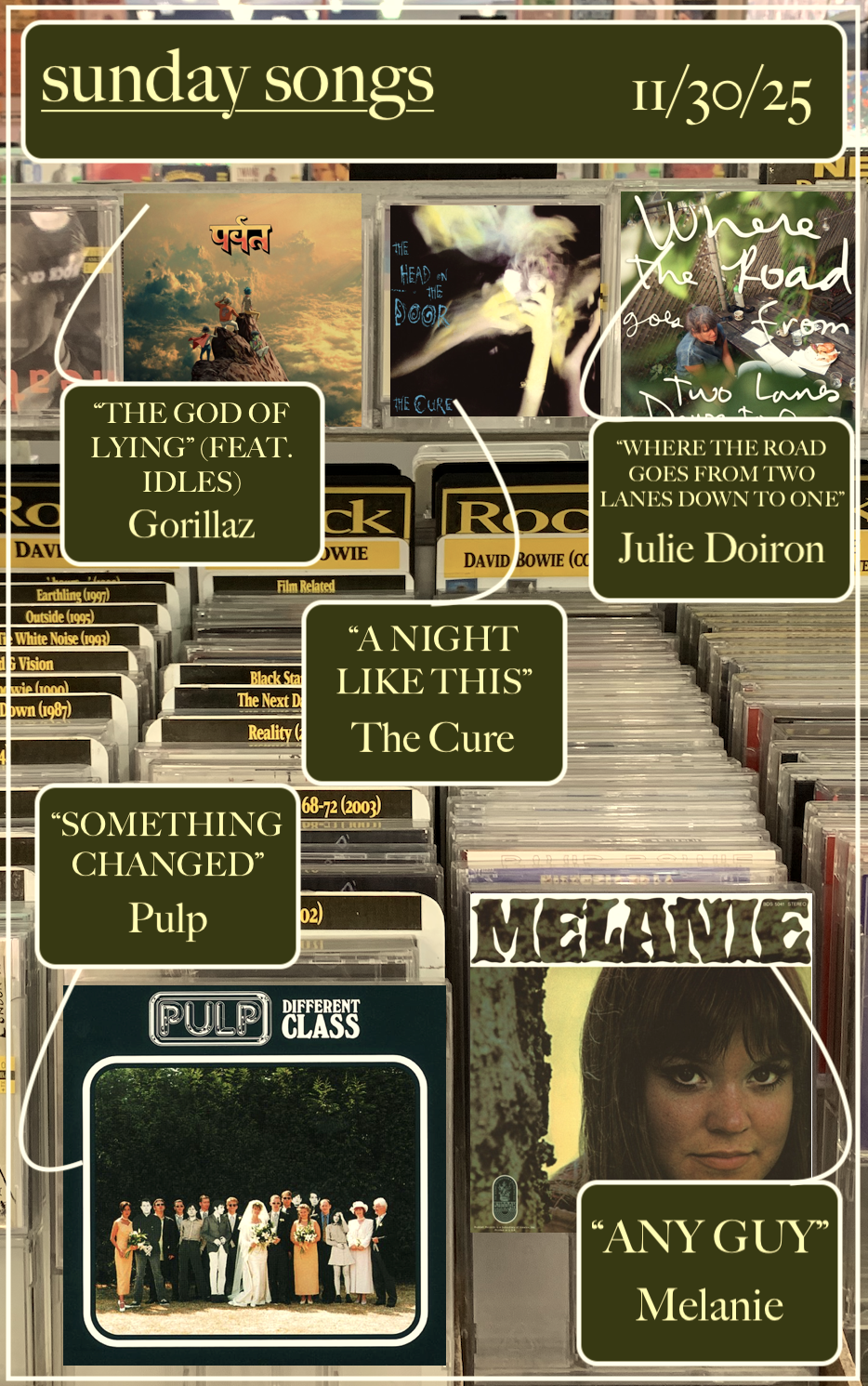
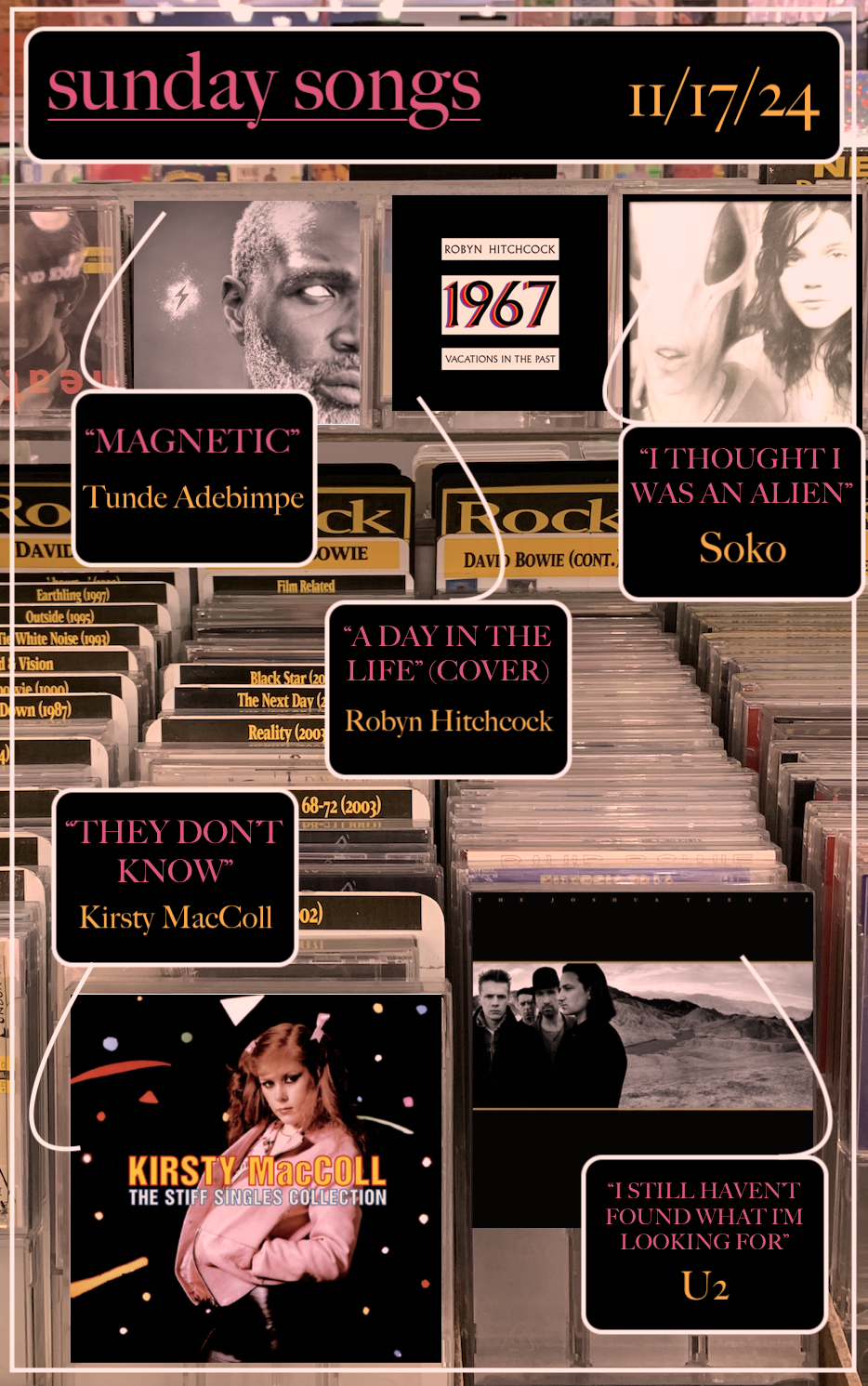
I’ve got at least one more post here before I inevitably have to crawl back into the finals burrow. Since I’ve been out of the office lately, here are my graphics from the past few weeks:
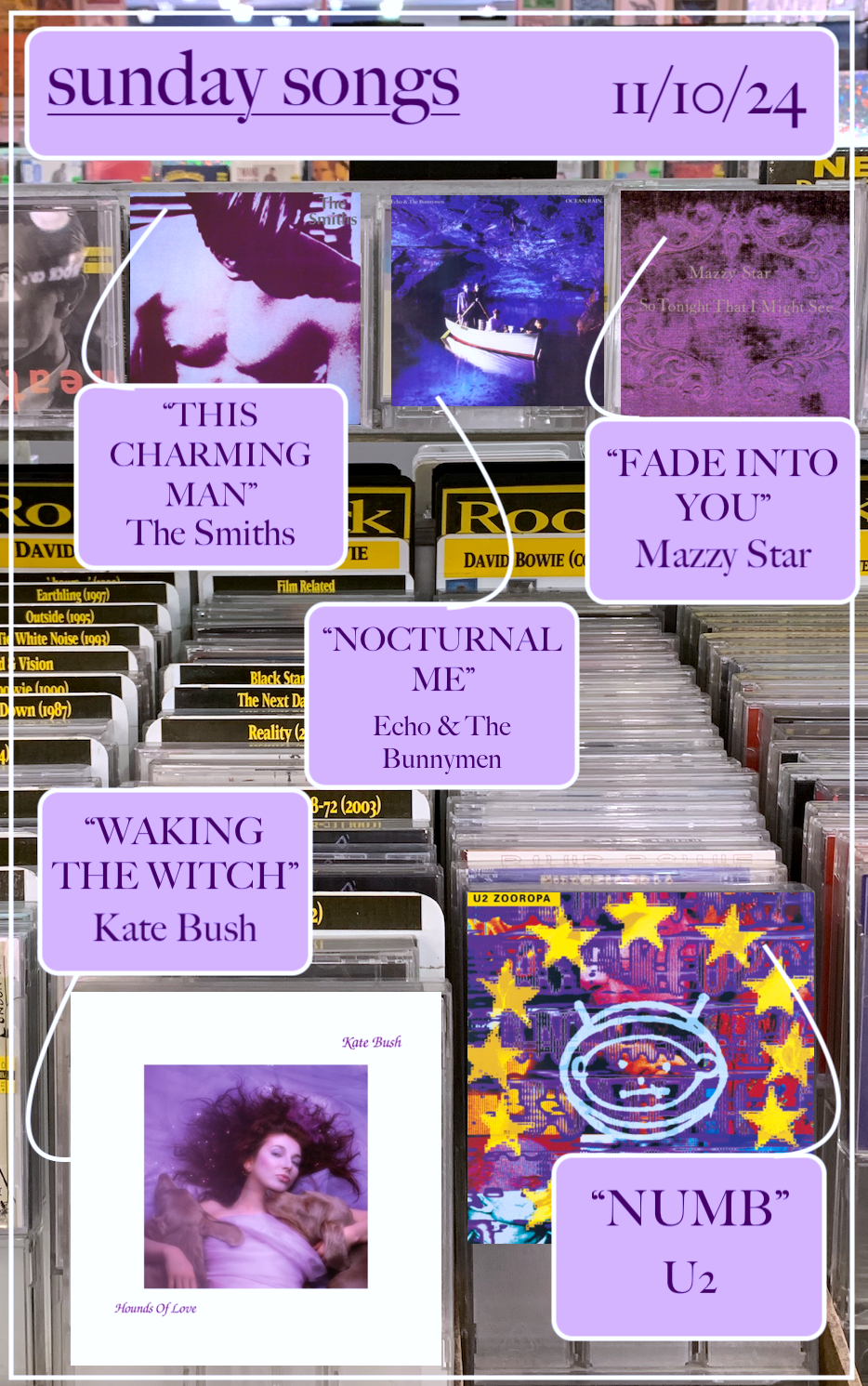
This week: What half of Britpop’s Big Four frontmen are up to these days, peak goth drama, and I finally find out why Joe Talbot was hiding out in that Gorillaz exhibit like Where’s Waldo.
Pulp recently put on an absolutely showstopping performance at NPR’s Tiny Desk Concert. I still have only a handful of Pulp songs that I really know, but even as a budding fan that initially knew only 1/4 songs in their setlist (that one being “This Is Hardcore,” yet another shoutout to my amazing dad for showing me that one!), their performance was an absolute joy. Even in the confines of said Tiny Desk, Jarvis Cocker has the most enigmatic, fluid stage presence that defies being simply Britpop and has transformed into a timeless charm. And now I have three more Pulp songs on my rotation!
“Something Changed” hooked me more than the rest, and it reminded me that I really just need to get over myself and listen to Different Class already. Themes of social and sexual frustration aside (see: “Live Bed Show”), Pulp seemed to have an uncanny ability to create such pure, resonant anthems without making them cloying or insincere. I never got around to talking about “Disco 2000” last year, but that song feels like the platonic ideal of a pure, passionate love song—it’s a small wonder that nobody’s used it in the end credits of a rom-com yet. (Maybe that’s for the best? It’d need a really good rom-com.) “Something Changed” has that same quality in softer shades, with Cocker crooning about the nature of chance against a backdrop of swelling, sunlit strings: “Do you believe there’s someone up above/And does he have a timetable directing acts of love?” For someone with a sense of humor as sardonic and often cynical as Cocker, it’s a display of sincerity that feels anything but inauthentic—you can tell that, to some degree, there’s a genuine feeling of being wonderstruck by the chances that led him to this point in time—and this whirlwind romance.
“Something Changed” starts at 8:05. While you’re here, though, the 7+ minute rendition of “This Is Hardcore” stopped me dead in my tracks. One of the best Tiny Desk Concerts this year, for sure.
…AND A BOOK TO GO WITH IT:
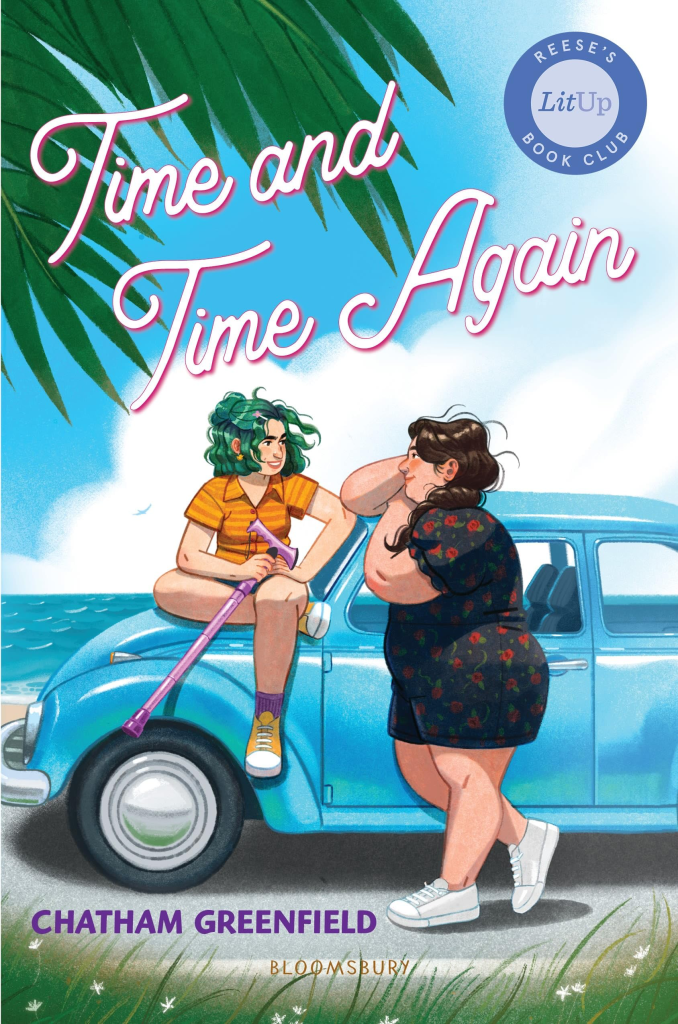
Time and Time Again – Chatham Greenfield – “Oh, I could have stayed at home and gone to bed/I could have gone to see a film instead/You might have changed your mind and seen your friend/Life could have been very different but then/Something changed…”
I never find Melanie songs organically, I just leech them off of TV shows about once a year (see: “Look What They’ve Done to My Song, Ma” thanks to We Are Lady Parts). This one in particular came from the season 1 finale of Bad Sisters, and without spoiling anything, it rang out as a bitterly triumphant anthem for the culmination of a season’s worth of work to try and eliminate a man equivalent to Satan incarnate from the face of the earth. Season 1 has been out for a few years, but I’ll still refrain from spoilers.
But some needle drops get better and better the more that you think about them. Melanie fit along with the musical feel of Bad Sisters, primarily featuring needle drops from great women-fronted bands and musicians (Bikini Kill, Nancy Sinatra, Wet Leg, and of course, the theme song and score composed by the iconic PJ Harvey). Many of them feel more atmospheric other than a handful of very purposeful ones, but “Any Guy” relates so much to the character of Grace to me. A lot of Melanie’s earlier fame centered around how childish she looked—this was pre-“Brand New Key” and people derailing childhood innocence into Freudian nonsense, but there was a clear correlation between what people saw as an unassuming young woman and the talent that resided inside of her. That image remains after her death, but for me, Melanie’s her best when she lets loose—think of the righteous fury at the end of “Look What They’ve Done to My Song, Ma!” That final belt at the end! Reckoning! “Any Guy” has that same explosive moment at the end; beneath the veneer of placid strings, Melanie stews about getting involved with a two-timing guy and feeling disposable, until her waver breaks into an impassioned howl of “Is she as pretty as me, huh?” Nothing’s better than when Melanie snaps and lets the full force of her voice free, and what better song to soundtrack a similarly unassuming, underestimated woman finally breaking free. Even when she’s singing of breaking away, there’s a waver in her voice, and that’s more Grace than anything—and there’s no shame in having a waver in your voice when you’ve finally mustered the courage to speak your mind.
Guess who’s getting tickets to L.A. the minute that they announce when the House of Kong exhibit is coming?? Prepare for me to be INSUFFERABLE and IN CALIFORNIA
Back when they did the story on the London House of Kong exhibit over the summer, they showed the collage on the wall of all of Gorillaz’s collaborators over the years. There were tons of familiar faces: De La Soul, Yasiin Bey, Shaun Ryder, St. Vincent, et cetera…but I swore that I could see Joe Talbot peeking out from between the faces. And it got me thinking…had I missed something? Mind you, this was before The Mountain was announced, so I had no idea what was a head. But now that it’s here, I’m so excited for this pairing! As is the ritual with most modern Gorillaz rollouts, the singles are hit or miss. “The Happy Dictator” was loads of fun, but “The Manifesto” is somehow two different songs, and none of them are particularly good. And here we see the post-Humanz Gorillaz “where’s Damon?” problem—it’s all the collaborators and barely him.
Thankfully, “The God of Lying” fixed this issue swiftly, with Albarn trading off verses with Joe Talbot of IDLES. Gorillaz have been mining the state of dystopian discontent that we’re in for quite some time now, but if there’s anyone more fit for an antidote, it’s Talbot. As he coolly assesses the sorry state of the world (“Are you deafened by the headlines?/Or does your head not hear at all?/Are you pacified by passion/Are you armed to the teeth?”), Albarn’s distorted voice professes that we’ve all reached for some comfort beyond the bad news, but that it’s so overwhelming that we can’t even comprehend that hope is still possible; we’re actively “running to the exit” because we somehow fear the notion of hope existing even while trapped in an endless cycle of doomscrolling and horrific news. Albarn said this to BBC Radio 1: “I suppose I’ve kind of got in my head what happened a few days ago with Mamdani in New York. And one of the things he said that really kind of stuck out for me is that ‘Hope is alive’. And in this track, Joe and I are kind of we’ve been chased by hope. And I thought, Oh, that’s nice.” First off, since I was hunkered down doing homework when it happened…THAT’S MY MAYOR! (I’ve been to NYC a grand total of one time in my life…anyways.) Second, what a poetic assessment—we haven’t just abandoned hope, we’re being pushed away from it, pacifying the weight of carrying every bad thing in the world with fleeting pleasures and addiction. It’s a poignant statement for both Albarn and IDLES, enduring proof that love remains to be the fing.
…AND A BOOK TO GO WITH IT:
No Gods, No Monsters – Caldwell Turnbull – “Are you pacified by passion?/Are you armed to the teeth?/Are you bubbling at the surface of what’s cooking underneath?/Are you dying for an answer for what they call good grief?”
Another album that I need to listen to: The Head on the Door, apparently! As the result of being brought up by gothy parents who went to high school in the ’80s, I’ve practically listened to the whole thing. The same can be said for a fair amount of their albums. (From The Head on the Door in particular, I have a specific memory of my parents showing me the “Close to Me” video and thinking that the puppets were really funny.)
How perfect it was that I remembered “A Night Like This” right after Halloween. Frankly, every season is The Cure season if you can get with the drama 24/7, but you can’t deny that it’s the ideal fall or winter soundtrack. This track in particular represents the peak of what I love about The Cure—oh my god, the drama. I mean that without any irony, because there’s such an art to throwing yourself into it fully without looking insincere. You have to make a bit of a fool of yourself to sell it, but Robert Smith never looked the part to me—it was so intentional, and so clearly from a place of love. Lyrically, that’s what sells the glut of the song for me, but musically, what pulled it back from my memory was that guitar tone—so incredibly rich and full, and yet cavernous in a way that it couldn’t be considered gothwithout. It’s the closest I feel a guitar can sound to a cello without Jonny Greenwooding it with an actual cello—there’s a depth to the sound that feels like it could only come from an instrument with a hollow body. It’s all an undeniable spectacle of romantic (capital R Romantic and the usual sense) passion.
…AND A BOOK TO GO WITH IT:
Red City – Marie Lu – “It goes dark, it goes darker still/Please stay/But I watch you like I’m made of stone/As you walk away…”
I just put Julie Doiron on the graphic since she’s the main artist on this song, but I wanted to credit the rest here. I just don’t think I could fit everybody else in the tiny text in that tiny little rectangle, and I’m not about to give anybody eyestrain.
I found out about this soothing song through Black Belt Eagle Scout, who played several shows with Julie Doiron earlier this month. (Happy to see that they’re well enough to play music again!!) Either way, I was immediately charmed by the nostalgic calmness of this song; it’s a six-minute, lazy stroll down memory lane, buoyed by a series of multilayered harmonies. As Doiron strings together a series of vignettes about crushes on boys and late-night driving, she gives them the feeling of blurry, sun-bleached photos with the edges curled up from wear. Towards the end, as all four of their voices fall artfully out of sync, repeating “Can you say it how I remember/Will you say it how I remember/Can you sing it how I remember/Will you sing it how I remember?”, it brings into sound the feeling of memories tangling together in your mind, timelines hazy and blurred, but just as pleasant as they were in the moment.
…AND A BOOK TO GO WITH IT:
Amelia, If Only – Becky Albertalli – “Get in the van, we’re late for a show/Still got four more hours to go/Road maps, glovebox, no phone/I need to pull over, I wanna call home…”
Since this post consists entirely of songs, consider all of them to be today’s song.
That’s it for this week’s Sunday Songs! Have a wonderful rest of your day, and take care of yourselves!
Guess who’s back…for only a week, probably. We’ll see. My college is on this maddening schedule that only gives us one (1) week after Thanksgiving Break and then it’s straight into finals, so I’ve been grinding for most of November. But now I’m on break, thank goodness!
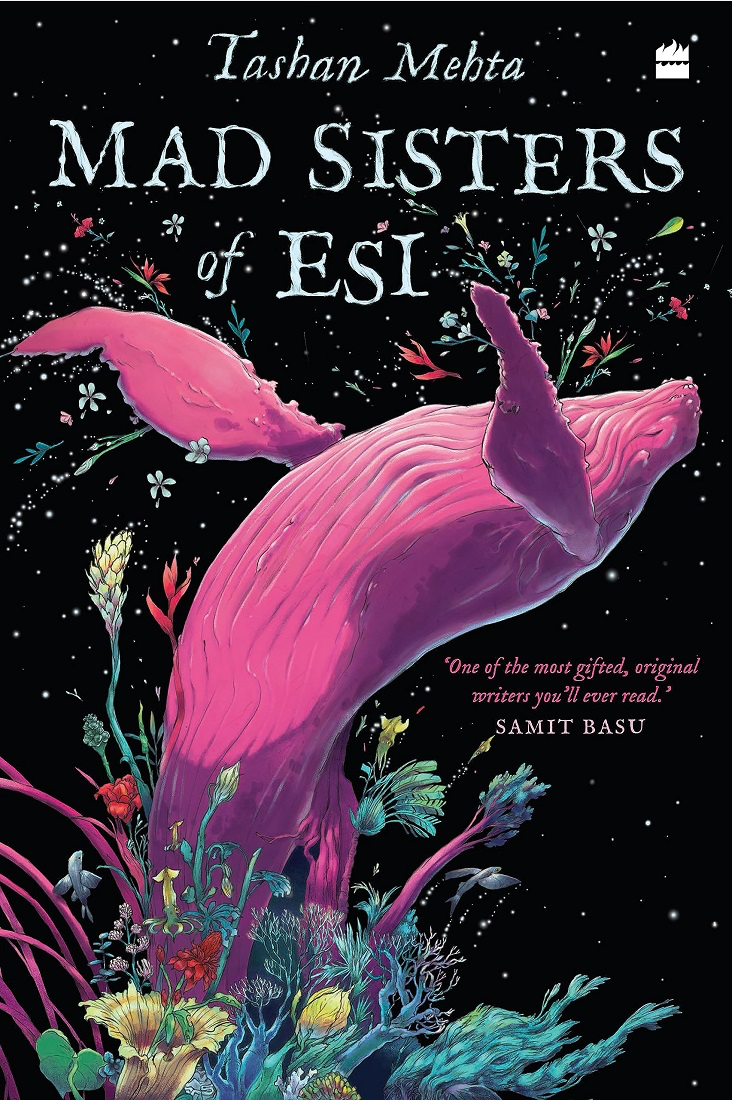
I found out about Mad Sisters of Esi while doing a research paper on the history of science fiction in India. It sounded intriguing—who doesn’t love an incomprehensibly large cosmic whale, after all? I’m not usually one for fantasy (citation needed) novels that are this dense and self-referential, but there was so much passion poured into every word that I couldn’t help but be dragged along for the bizarre ride.
Myung and Laleh are inseparable sisters living inside the Whale of Babel, a whale the size of a galaxy, large enough to contain planets in the folds of its body. They have never known life outside of the Whale, save for the Great Wisa, their distant, unknown creator. Laleh is content to explore the endless lands inside the Whale’s body, but Myung yearns for something more. Her journey takes her to the far edges of the universe, but so far that she cannot find her way back to her only home. As Myung and Laleh attempt to find their way back to each other, they ponder the stories that got them to where they were, and if stories themselves can bring them back together.
TW/CW: loss of loved ones, grief, abandonment
If you’re wondering how I’ve been lately, I’m apparently saturating myself with “[]ad Sisters” media. Mad Sisters of Esi? Bad Sisters? What am I doing here? What’s going on with all these sisters?
I’m glad that this trend doesn’t have a name, but I love the trend of recent genre fiction coming to conclusion that “maybe [x] was the friends we made along the way” can actually be a very powerful message. Maybe storytelling was the friends we made along the way. God. What a book.
I was captivated by the premise of Mad Sisters of Esi, but I could have easily not been. It falls into those fantasy books that verge more on the literary side that are very self-serious about been multilayered, dense, and Deep with a capital D. Not that there’s anything wrong with it, but toeing the line between a story that’s actually meaningful and a book that’s 500+ pages of needlessly convoluted, pretentious nonsense that only serves as a monument for how supposedly complex of a plot the author could dish up. The latter are often all style and no substance, but the real frustrating part is that they’re so convinced of their substance that it deadens any meaning that it could’ve had. (See my review of The Spear Cuts Through Water. At least Simon Jimenez has other good books. Go read The Vanished Birds instead of that one.) It’s just a literary version of “look, Ma, no hands!” that rarely results in anything really substantive.
My main criticism of Mad Sisters of Esi is that it does stray into that territory sometimes. It never fully went over the edge for me, but there were moments were it got too convoluted for both my taste and the service of the narrative. Most of it was complex, but not needlessly so, but at a certain point, parts of it got dizzying. I definitely didn’t get everything about this book, and I feel like it’s almost the point. For me, what separates the two kinds of fantasy novel that I just described is…well, love. I could tell right away that Mehta didn’t write Mad Sisters of Esi to show off how complicated of a narrative that she could write—there’s a story, a tangible message, and a thrum of passion that spills through in every page. With every fictional academic article and magical town, I knew that Mehta’s world was born of love. Which, given the nature of this book’s themes, is exactly what it should have been. It’s a novel that’s all about love, storytelling, and the act of creation, and Mehta’s writing felt more than faithful to that premise.
Mad Sisters of Esi is full of meta commentary on the nature of storytelling. I’ll get more into that aspect later, but part of what sold those thematic elements was Mehta’s prose itself. Mehta is clearly someone who has studied her fair share of fairytales. Mad Sisters of Esi doesn’t just feel like a fairy tale in terms of the plot—Mehta’s prose has the same enchanting quality of a timeless fairy tale. The narrator bobs in and out, always with a cryptic lesson. The lush world is rendered in the most magical, wondrous detail. All of the descriptions surrounding Myung and Laleh make them sound like classic protagonists in an ancient tale. It was all very self-aware, but in a way that made the story feel fuller—and drew me in page by page. With Mehta’s strong hand, every location that Myung visited was bursting with bizarre, fantastical life—I was hooked on nearly every aspect.
If this novel has made me realize anything, it’s that we don’t have nearly enough cosmic whales in literature. We need more of them, frankly. Or maybe not—I’m torn on whether or not we should gatekeep them so they don’t get tired. I doubt they would, though. Either way, you can’t just promise a galaxy-sized whale full of planets and two sisters that live inside it and not deliver on that premise. Thankfully, Mehta did in spades. The world of Mad Sisters of Esi was a sight to behold. Every minute detail was somehow nonsensical and yet made perfect sense. It all felt very trippy and whimsical, and above all, so vibrant. I loved every quirk in every location that Myung visited in the vast universe; I’ve seen reviews compare it to The Phantom Tollbooth, and honestly, I have to agree—it has that same absurd, dreamlike quality more often than not. Beyond that, I love the integration of the academic articles and research papers about all of the bizarre events and people within this novel—it added such a fun layer of worldbuilding that made it all feel more grounded and real—as much as it could be, with all of the out-of-this-world (no pun intended) stuff that was going on.
With all of the emphasis on madness, I was really hoping there wasn’t going to be yet another story about art being all about suffering. From how incredible the first few chapters were, I was hopeful. But with everything about madness, madness, madness…doubt crept into my mind, for sure. I’m not confident that I fully got what Mehta intended, but I feel like this is what I took away from it. There is a little madness in every creation, even if you’re not actively suffering—how do you create a massive cosmic whale and not go a little crazy? Yet she emphasizes that even if you pour your all into your creation, that you run the risk of losing yourself, and that’s when your creation goes wrong. Mehta’s madness isn’t the suffering kind of madness—it’s about the passion. It’s about throwing all of your love into the act of creating, just so that the world is a little brighter and less boring than it was before, and to give your love a physical form. The reason that Myung is so lost out in the universe is that she strays from something that was created with nothing but love. That’s my two cents (is that expression even relevant anymore now that we don’t have pennies?), especially given how the novel concluded. That’s why the passion I felt from every page felt authentic—the passion is what it’s about, to love what you create and not destroy yourself in the process, because you too are made of love.
All in all, a dazzling and surreal space fantasy full of love, sisterhood, and whales. 4.5 stars!
Mad Sisters of Esi is a standalone, but Tashan Mehta is also the author of the novella The Liar’s Weave, and has contributed to several anthologies, including Magical Women, Solarpunk Creatures, and The Gollancz Book of SouthAsian Science Fiction, Vol. 2.
Today’s song:
That’s it for this week’s Book Review Tuesday! Have a wonderful rest of your day, and take care of yourselves!
My Yo La Tengo knowledge is limited, considering how they theoretically line up with quite a bit of my music taste. They definitely seem to fit into my indie music sensibilities, and I even share a name with one of their songs, though they pronounce it differently than my name. (You win some, you lose some.) I do, however, know drummer and vocalist Georgia Hubley from the infectiously catchy and delightful 6ths track “Movies in My Head.” It’s a song about dreaming up fantastical scenarios and real life never measuring up, and Hubley’s airy vocals really do give it the feel like she’s never quite looking at the camera and never quite there, at least not fully. (Surely I don’t relate to that at all. Nah…)
That same dreamy quality of Hubley’s vocals blooms here, but in nearly the opposite environment. It feels like an adaptable houseplant to me: plant it in wildly different-shaped pots, and it still blooms just the same, and just as bright and healthy. I suppose that’s what you’d call versatility, but bear with me, I’m an English major. Let me have a metaphor or two…either way, this is just about the opposite end of the spectrum as Stephin Merritt’s sparkling indie pop. “Decora” is far noisier and grungier in the background, laden with crunching, distorted guitars that sound like the squealing of rusted machinery. It’s all rough edges and pockmarks, much like the collaged album cover of Electr-O-Pura. Yet Hubley’s voice drifts like a pastel balloon above a junkyard, sailing effortlessly through the clouds amidst the grime and squealing of the instrumentals. It’s beyond a perfect pairing—such disparate sounds meld together so seamlessly, and that’s magical to me.
…AND A BOOK TO GO WITH IT:
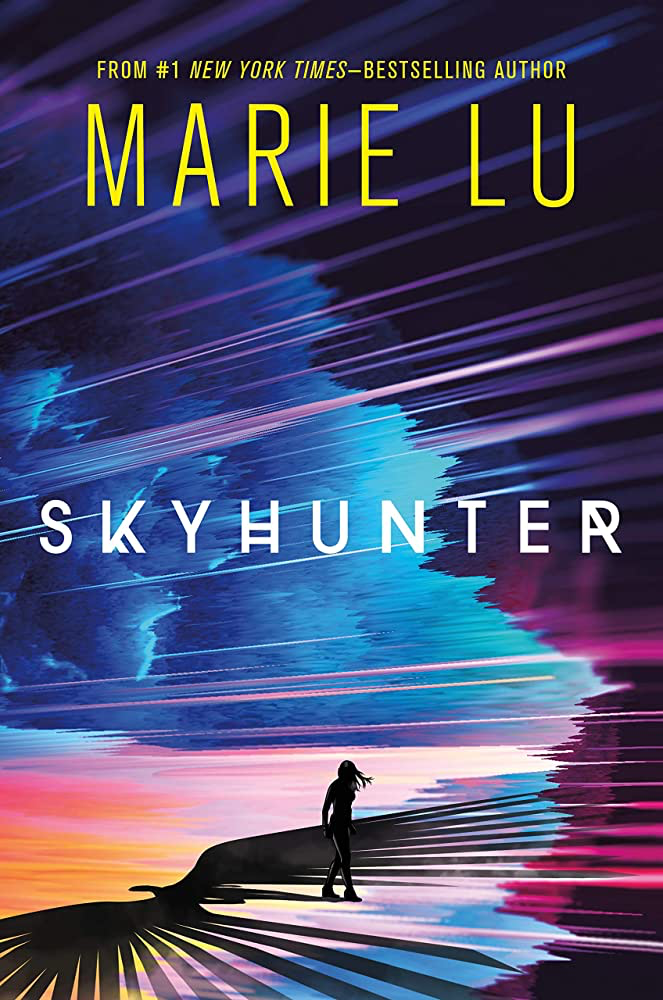
Skyhunter – Marie Lu – “It’s not the first time you’ll take a fall/Act like you’ve never seen double before/We tie deep into the past/Take this chance with me ’cause it’s the last…”
British men in 1987, for whatever reason: “I absolutely need to write a diss track about God RIGHT THIS SECOND” (see also: the more well known “Dear God”)
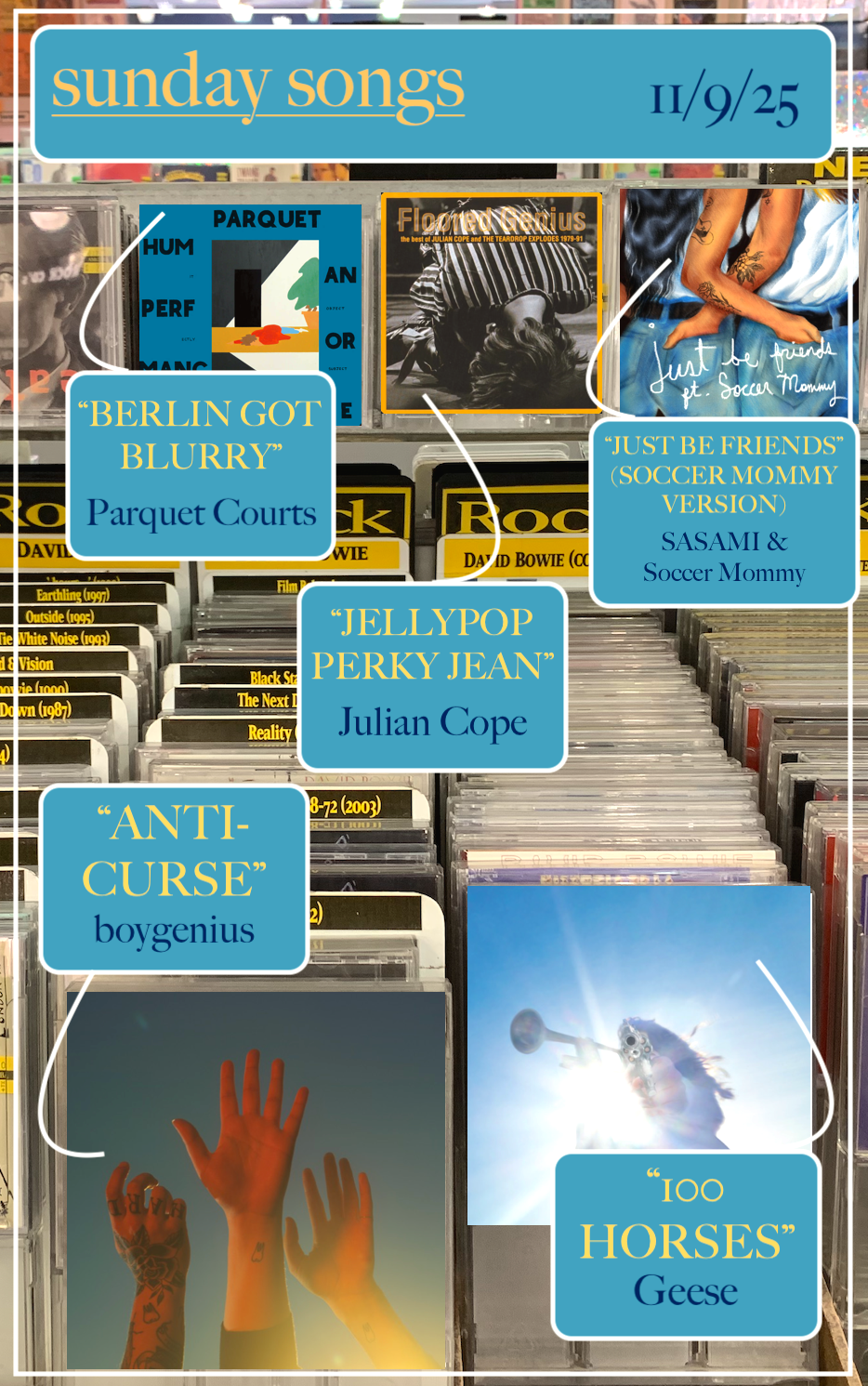
So. Saint Julian! Severely underrated album, right? It just reeks of this jangly, proto-Britpop sound that I can’t get enough of. I’d already listened to about half of the album by virtue of it being on heavy rotation in my dad’s car throughout my childhood, but the familiarity of it didn’t dull the sheen at all. It’s very much a pop album, but it’s a clever, horny, dramatic, literate, and downright catchy one—”Eve’s Volcano” has been on repeat for me since June.
Past the first half, the album takes a turn from literately horny to just literate, but the sound is just as consistent. Where he was just singing about how you need to hold onto his special feature (wink wink), he applies the same instrumentals to his personal beef with God. Which…entirely understandable, and given the rest of Cope’s discography, is actually much more common for him than the former, given his penchant for philosophy and the ideas of Jungian psychoanalysis. Amidst almost medieval-sounding woodwinds and an otherwise ’80s band, he characterizes God as deliberately smug, a God that all but slapped him in the face when he tried to seek him out for solace: “‘I’ve been looking around this world I created/It’s going so well!’/I looked, I stared, I said, ‘I think I’ve lost you!'” Cope’s got a lot of snark to spare, but it’s all leveled in such a sly, clever way—he feels almost like a kind of trickster deity with a smirk aimed at the camera knowing that he’s had God himself. And like a lot of tricksters, the narrative ends in Cope getting imprisoned by God for mouthing off, not knowing that he’s given him even more proof that God’s not all that: “Remind me not to pray to you!”
And talk about covers that sound eons away from the original! I didn’t even know it was a cover until a few days ago, but the original version by Cream from 1967 sounds worlds apart from Bowie’s interpretation in 1992. As Bowie tells it, in the early days of The Spiders from Mars, he and Mick Ronson would frequently cover this song—according to him, it didn’t sound very good, but I swear their ’70s sound would suit this cover perfectly. (It was also the final track that Bowie and Ronson recorded together before Ronson’s tragic, early death from cancer at age 46.) Instead of the peppy, very distinctly ’60s swagger of Cream, Bowie’s version of “I Feel Free” all but sounds like it was fast-tracked into the ’90s at startling speeds. It almost sounds more like the Pet Shop Boys than Bowie. It feels like his slicker, more commercial ’80s sound dialed up to a dizzying degree, complete with chrome-shininess abound, fluttering and frenetic saxophones, and soaring guitars, thanks to Ronson. And can we talk about his vocal range? Those low notes are just intoxicating.
There’s a very distinctly hippie flavor to Cream’s version, so it feels like a small wonder (or perhaps, a little wonder? Thank you, thank you, I’m here all night), and that feeling naturally lends itself to lyrics of carefree and ecstatic nature. Here, Bowie translates that feeling to something akin to cruising through the city in an expensive, silvery car, watching the city lights reflect off of the freshly-waxed doors, glimmering and luxurious. Just as easily as Bowie could shift personas and musical styles, he could also place that almost alchemical property onto any cover he touched, while still retaining the heart of the original—the core of the mouth percussion in the beginning remains fairly similar. But it just goes to show how deeply creative of a musician Bowie was, not just in interpreting his own work, but the work of others.
Everybody seems to have this heartwarming, cinematic experience of listening to this song the first time. Me, on the other hand? Found it in an edit of Kermit and Miss Piggy…how could I not immediately download it after that?
Unironically got misty watching this, which should probably tell you exactly the kind of person I am, but I’m not ashamed of it.
I really don’t know a ton of Neil Young (though “Cinnamon Girl” is an obvious classic), but sometimes…yeah, I can’t resist a good ballad sometimes. There was just this warmth to it the instant I heard it, the kind of warmth you only get when leaning next to the fireplace as you watch the sun fade into the clouds at night. Those sporadic, plucked notes on the dobro feel like they’re drifting skyward; who’s to say if they’re fireflies or embers from a campfire, but either way, they glow to me. And despite the slightly corny music video (the dude sweeping to the beat in front of the restaurant nearly ruined the vibe, I’m sorry), “Harvest Moon” has this autumnal comfort to me, tinged with the last colors of the sunset and the warm of somebody in your arms.
…AND A BOOK TO GO WITH IT:
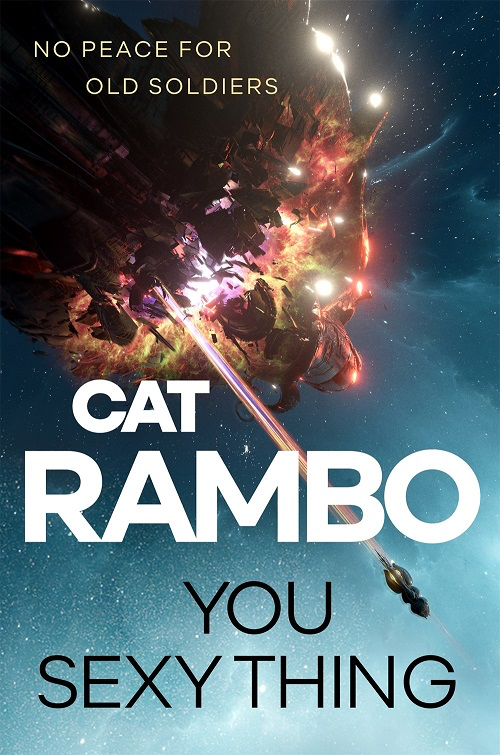
You Sexy Thing – Cat Rambo – look, I know the cover has the polar opposite vibe of this song, but stay with me here…
This was one of those songs that was tucked into the absolute deepest, dustiest archives in my brain. I remember hearing it a lot in my parents’ cars when I was little—really little, there was always a big, bulky car seat in these hazy memories. I don’t know if I fabricated this memory, but I swear I remember hearing it as we passed down a run-down storefront somewhere along a highway in Denver. Maybe that strange, lingering feeling is why I can’t shake the feeling that “You’re My Thrill” has always come off a little bit eerie to me. I suppose it’s just the shifting standard of what’s considered the “right” way for a love song to sound and the more creeping tone of the song. With this instrumentation, Holiday’s crooning of “Where’s my will?” certainly feels a bit more like succumbing to something against her will than it does just being lovesick. And yet, still, still, it’s such a classic love song—it’s no wonder that Holiday’s legacy has become so solidly set in music history. Her voice is, without a doubt, one of the most captivating. It’s difficult for me to describe the exact cocktail of emotions that it evokes—enchantment, seduction, and in some cases, dread—but that’s the mark of an iconic vocalist.
…AND A BOOK TO GO WITH IT:
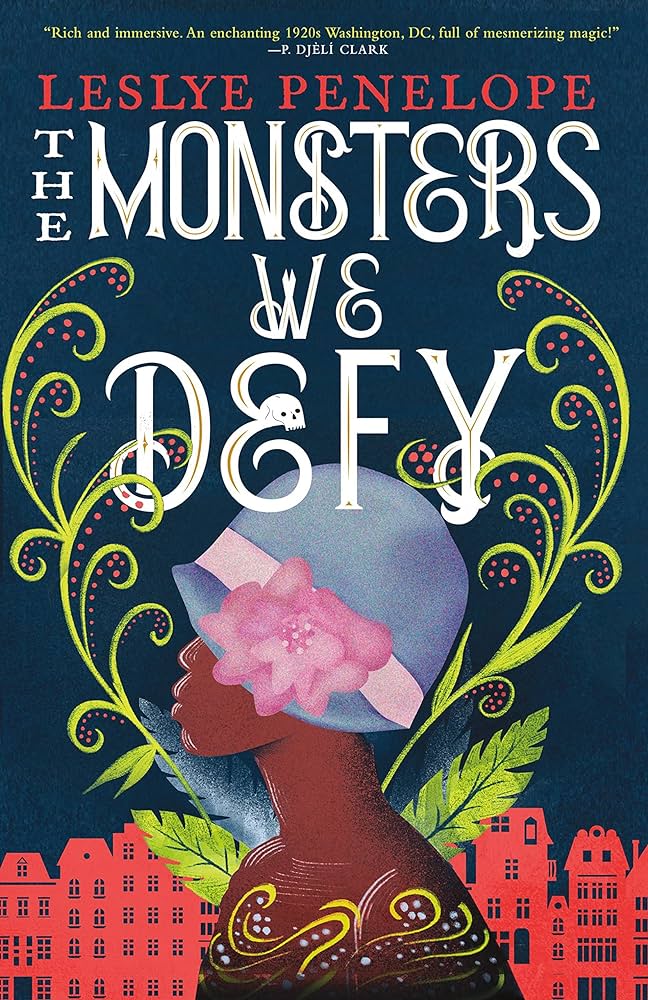
The Monsters We Defy – Leslye Penelope – I…whoops. The Venn diagram of when Billie Holiday had a career and the year this book is set is off by a few years, but I still feel like the jazz in this novel fits.
BONUS: it’s been a great week for indie rockers on late night TV. Here are some standouts:
Since this post consists entirely of songs, consider all of them to be today’s song.
That’s it for this week’s Sunday Songs! Have a wonderful rest of your day, and take care of yourselves!
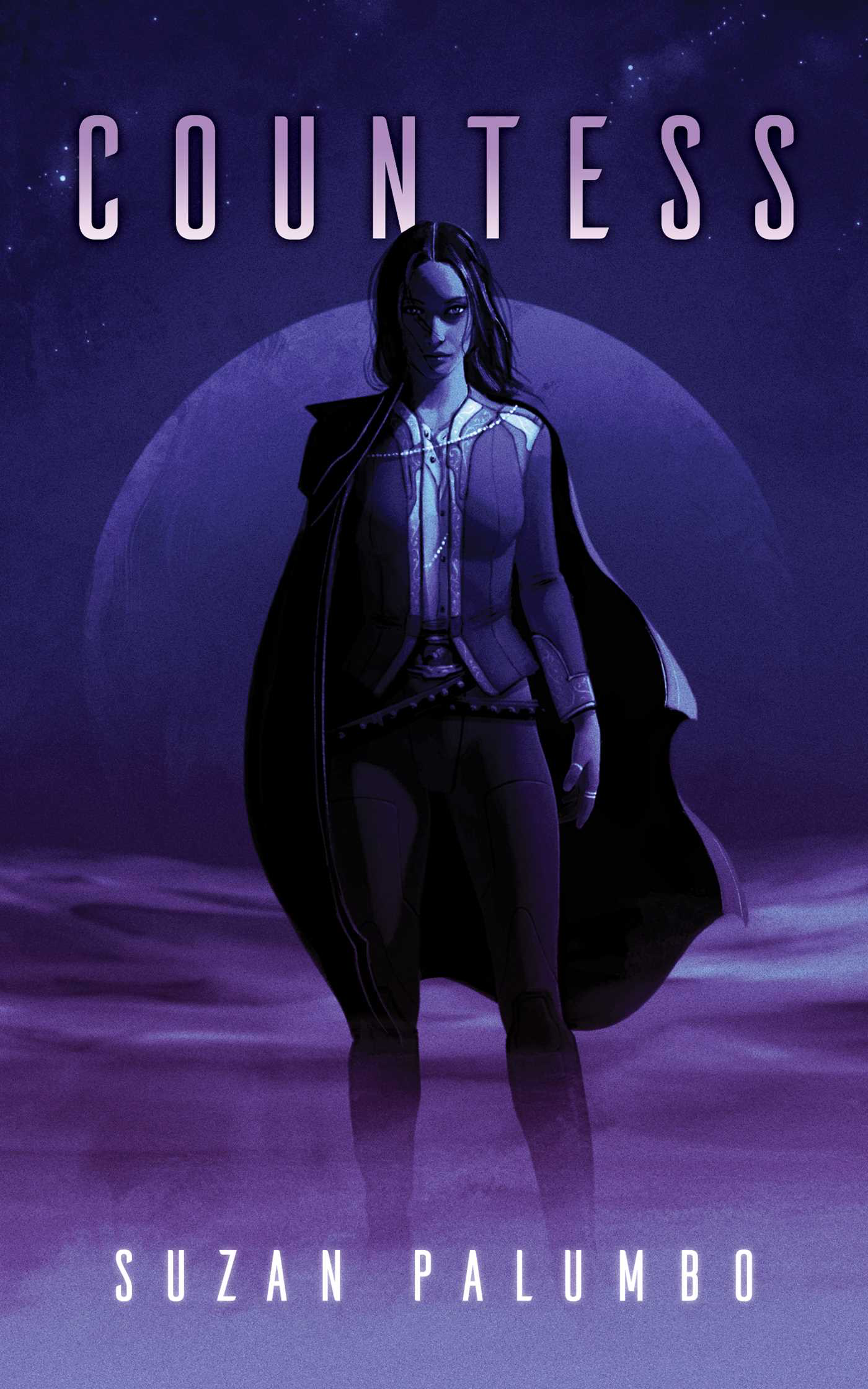
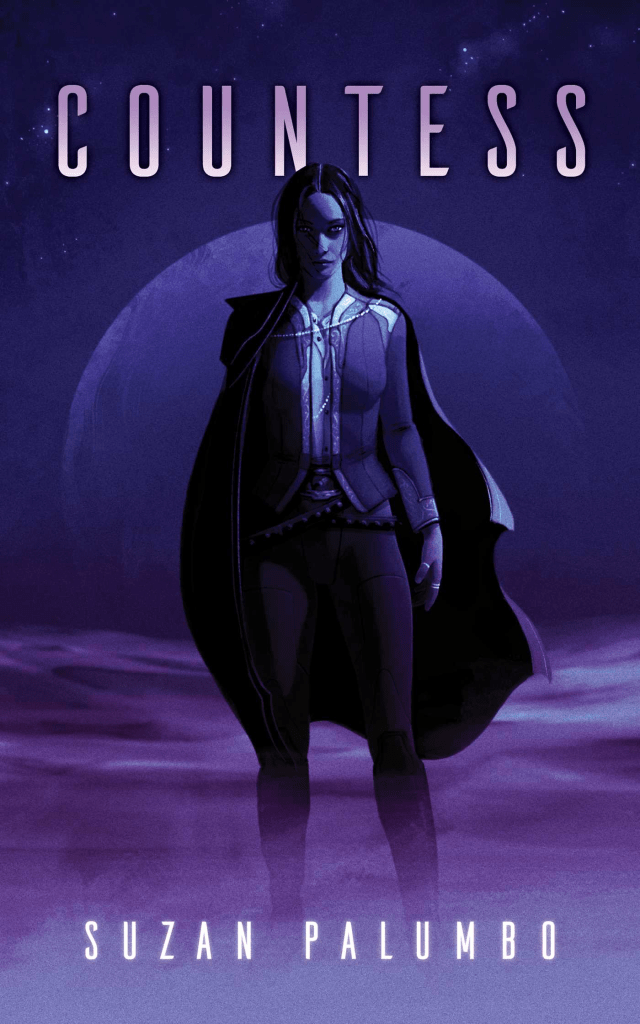
I try not to let my lizard brain take over when it comes to my TBR these days (that’s how it got to almost 1,100 books back to high school…that took some serious pruning). That being said, at this point, I’ve accepted that the phrases “space opera,” “queer,” and “anti-colonial” strung together activate me like some kind of sleeper agent. Thus, Countess found its way onto my TBR and swiftly onto my Kindle. It excited me even more that Countess was Caribbean-inspired and that the author is Trinidadian-Canadian (!!!!), so my expectations were high. Though it wasn’t perfect, Countess was a raw and brutal novella—hardly a page was wasted.
Centuries after the British colonized islands in the Caribbean, an evolution of their iron fist remains in space. Under the harsh rule of the Æcerbot Empire, planets and moons are stripped of their resources and their inhabitants left with the paltry choice to enter an immigration lottery to find work or make a meager on their exploited homeworlds.
Virika Sameroo has sworn her life to the empire, loyal to their army for years. But just as she attempts to ascend to a higher position, her captain mysteriously dies—and the imperial authorities frame him for his death. Imprisoned and alienated from the empire that brainwashed her, Virika becomes an unlikely figure for a galaxy-wide revolution—but will she survive long enough to see the Æcerbot empire fall to its knees?
TW/CW: colonization/imperialism themes, torture, murder, descriptions of corpses, blood, self-harm, attempted suicide, sexual assault
how it feels to enjoy a retelling when a bunch of the reviews say that it doesn’t follow the source material (I’ve never read The Count of Monte Cristo):
Of course, regardless of whether or not I’ve actually read The Count of Monte Cristo, I think it’s worth saying that a retelling doesn’t have to stick to every plot line to a T. I get going into a retelling and being disappointed on that front, but even if the setting is wildly different (as Countess is), I don’t think it’s a crime to tweak many of the plot points. In this case, having a vastly different setting kind of necessitates the plot being different, but from what I can gather, Countess is more inspired by The Count of Monte Cristo than it is a direct retelling. That’s fine, in my book. No pun intended.
As a whole, Countess was a fantastic read, but its one weak point was the writing. In a way, the writing style, even if I disliked some of it, worked for the story—and the character—that Palumbo was telling. It picks up at the halfway point, once the plot rockets into a breakneck pace in terms of both action and stakes, but for the first half, the prose felt very bare-bones. Even in this new, expansive empire in the stars full of political intrigue, there wasn’t much to embellish the prose—it was all very quick and to the point, with language that took the quickest routes to explain how we got from point A to point B. This is my first experience with Palumbo’s writing, so I’m not sure if it’s just her style, but either way, it works in connection to Virika; she’s been groomed to be a perfect, obedient soldier, so I doubt she’d be one to mince words or get into excessively flowery prose. For some of the scenes where Virika is in prison and a decade blurs by in only a handful of pages, it makes complete sense. Yet I needed some more descriptive prose to get me immersed in the setting—and in the other characters outside of Virika.
I’m all for having gentler books about resistance, but that doesn’t mean that narratives centered around brutal realities have no place. In fact, in stories like that of Countess, I’d argue that they’re necessary. This is a novella about the horrors of imperialism, down to the most minute aspects. For me, it didn’t go full grimdark, but it was because there was realism to it; grimdark is, for the most part nothing but suffering and pain with no real basis, but the events of Countess, horrendous as they are, were logical byproducts of the crushing weight of a colonialist empire with the galaxy under its colossal thumb. Palumbo pulled no punches with the depictions of what Virika goes through (especially the sequences in prison…please pay attention to the trigger warnings); some of it bordered on gratuitous, but this is a slim novella, and all of it was in service of the theme that the crimes under imperialism are many, varied, and real.
As I’ve said so many times, I see the phrases “queer,” “space opera,” and “anti-colonial” and I’ll run towards the book like I’m a bull that’s just seen the tiniest sliver of red in my peripheral vision. What grabbed me about Countess in particular was that it was Caribbean-inspired—particularly Trinidadian. My grandparents on my mom’s side are from Trinidad, and I’ve seen hardly any literature—much less speculative fiction—that incorporates these cultures. Admittedly, I’m more than a little distanced from that part of my heritage, but I’ve been learning thanks to the tireless research of my amazing artist mom, who is in the process of making a Caribbean oracle deck of her own! It’s thanks to her that I caught a lot of the Trini and generally Caribbean references (the fact that there’s a rebel ship called the Pomerac was gold), and there are plenty scattered throughout the novella—I’m sure I didn’t catch all of them, but what I recognized, I loved. I’ve loved witnessing the shift towards marginalized voices in speculative fiction, but one of the reasons it feels particularly beautiful to me is because for so long, our communities have been denied a place in the collective imagination, a place in a distant future among the stars. So thank you to Suzan Palumbo for this novella, and thank you to my wonderful mom for being the reason that I got these references.
In these kinds of stories (and in life in general), I always try to look for a glimmer of hope, even if it’s foolish of me. Make no mistake: Countess is a tragedy, one of the many (forthcoming) ones that Palumbo has written, according to her Goodreads bio. This novella is a very realistic depiction of how revolutions often make martyrs of their figureheads, and that was Virika’s fate from the start. Palumbo does make you feel the wasted potential of her life as she falls, but I couldn’t help but see the swell of revolution that she ushered in as the ultimate form of revenge—and an assurance of a better tomorrow, at least for a short time.
All in all, a brutal and bold—if not rote in periods—novel of revolutionary change and one woman’s struggle to break free of imperialism. 4 stars!
Countess is a standalone novella, but Suzan Palumbo is also the author of the anthology Skin Thief: Stories and several short stories in various magazines.
Today’s song:
finally got around to listening to Songs Of A Lost World!! this was my favorite—the whole album tended to be repetitive, but it was great nonetheless.
That’s it for this week’s Book Review Tuesday! Have a wonderful rest of your day, and take care of yourselves!
Happy Sunday, bibliophiles! I hope this week has been treating you well.
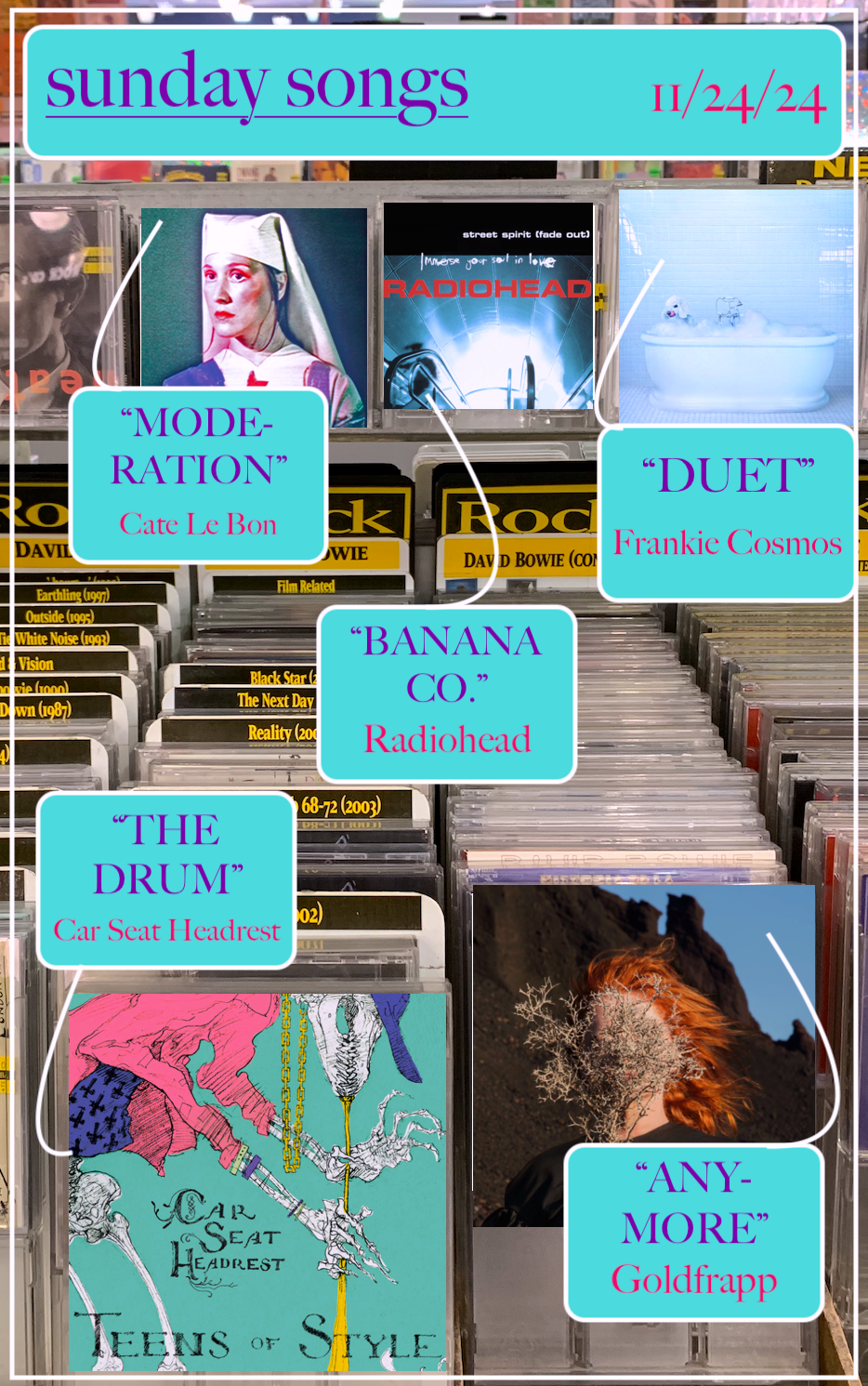
Before I begin, here are the graphics for the past two weeks. I was soexcited to write about Hounds of Love, because…well, it’s Hounds of Love, oh my god, self-explanatory, but alas…we all know what happened. Not ideal conditions to write under. Rest assured, it will come back eventually. You can hold me to that. Either way, more music:
“The Drum” is the first video in this setlist, so there’s no need for a timestamp. Watch at your leisure!
That frame at 1:25 sums up my 8th grade experience more than any words can: Will Toledo with the blurry image of St. Vincent’s self-titled album in the background.
Ah, this one’s a throwback. I remember watching this tiny desk concert in my parents’ bedroom with my mom, who always indulged my adolescent squealing about Will Toledo with the bafflement that “he looks like he’s in high school.” I didn’t fully realize it back then, not even being in high school myself, but…no offense, Will, I love you, but the amount of voice cracks throughout (“he don’t have shIiIiIiiiIIIT”) would make me think that he was 14 or 15 here, and not 23, weirdly. This whole Tiny Desk is a work of art in the art it produces in spite of the awkwardness about. Band? Sorta. Ethan Ives and Andrew Katz are there (it’s so far back that Seth Dalby hasn’t even shown up yet!), but Andrew’s the only one with his instruments beside Toledo. And you’d think the other two guys to the left of Toledo are part of the band, right? They’re just emotional support, which, to be fair, I’d love to have during one of those shows, but it gives the effect of a bunch of guys watching their friend play guitar in senior hall. In an endearing way, honestly. It’ll always be endearing to me. It’s Car Seat Headrest, after all. Nothing but love for our nervous young man.
“The Drum” was one of the earlier tracks that was constantly in my orbit during the peak of my Car Seat Headrest heyday in my early teens. Teens of Style was Car Seat Headrest’s full album as a band (still a three-piece by that point) and the first to be signed to a label, but it retains that lo-fi sound that characterized what gave Car Seat Headrest its name in the first place: being recorded by a deeply self-conscious Toledo in his car. It’s composed mostly of songs recycled and refurbished from his early days self-recording (“The Drum” originally appeared on My Back Is Killing Me Baby), and all of them get a kind of self-deprecating grandeur. Though the lyrics have been whittled away and refined, it’s the same old sad boy underneath, rest assured. “The Drum” doesn’t necessarily fall into that category, but it makes me realize…Will Toledo sure loves writing about drunk people, huh? He’s quite good at it, too, and he’d get even better after this song with “Vincent”: “It must be hard to speak in a foreign language/Intoxicado.” This track feels like the song version of that gag in Snatch where they cut back to clips of Frankie Four Fingers gambling and getting drunk out of his mind to the tune of “Viva Las Vegas.” It’s a hundred tiny vignettes of an off-the-walls character as he stumbles through a nonlinear, drunken reality: he’s reading James Joyce, he’s too high to listen to anyone (and even if he wasn’t, he still wouldn’t be listening), and he owes you $20. He’s a real piece of work, and Toledo is the faithful documentarian struggling to catch up with his antics. And somehow, the bridge gives the sense that said sloshed asshole, swimming in alcohol and ego, has elevated himself to think that he has transcended life itself: “This is our lifetime/And I am its creator/A young man slowly pulled apart/By separate poles of gravity.” This bridge came to Toledo in a dream (with the only difference being that “young man” was originally “snowman”), and it begins to close “The Drum” out as one stumbles through an inebriated dream.
…AND A BOOK TO GO WITH IT:
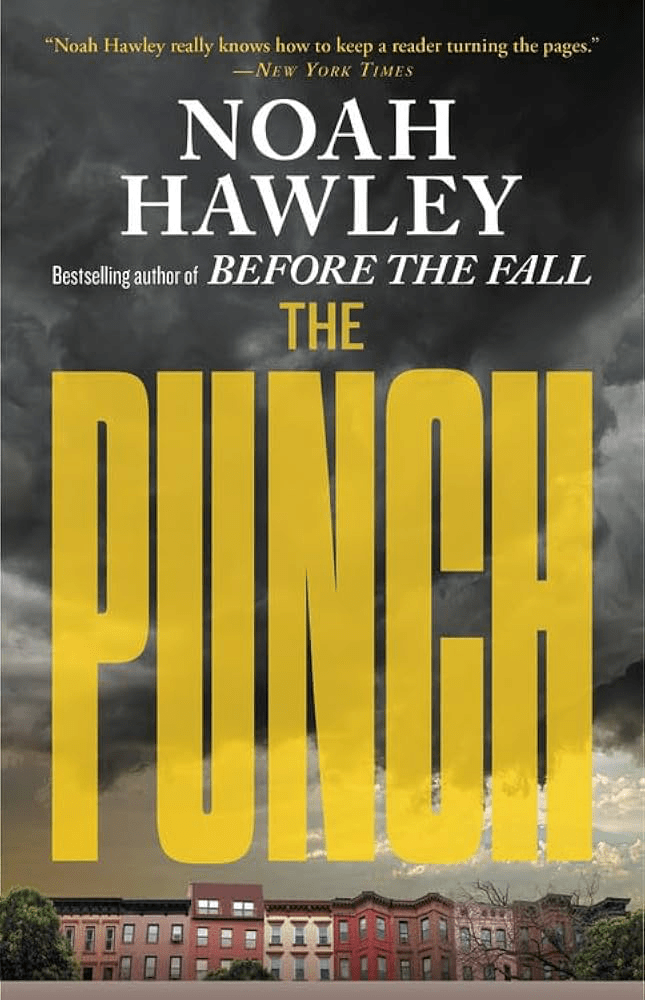
The Punch – Noah Hawley – drunk, dysfunctional people aplenty, all of which need to have their perfect and unparalleled opinions heard. Surely nothing will go wrong…
Another throwback, although this one didn’t factor in changing my 13-year-old brain chemistry nearly as much. That’s not a slight against it—my first memory of Goldfrapp was when I was about 11 or 12, and since then, she’s been a consistent, behind-the-scenes favorite. Between their work with Tricky and Spiritualized, I should’ve been hooked in the first place, but they’re so consistent in her sound, and not in a way that grows tired. Aside from some of the production, “Anymore” could just as easily been from one of their albums from the 2000’s. Their brand of futuristic-sounding synths sounds like something you’d hear from a club in Blade Runner, and not in a way that feels dated. It’s almost like Alison Goldfrapp and Will Gregory are just as precise as the machines that they manipulate to create their music; everything is oiled down until not a single wrinkle remains, and the result feels simultaneously far in the future and timeless…
Several months out from listening to Pompeii for the first time, I find myself returning to it time and time again. I’ll cling to any new weirdness I can find, and Cate Le Bon, at least for this album, delivers. Back in July, I talked about how the first four songs on the album are a cascade of absolute successes; “Moderation” is the second of the four, and although it’s much poppier than the eerie “Dirt on the Bed,” it nonetheless has her oddball twist. The instrumentals, from the so-bright-they-shine guitars to the backing saxophones, are very ’80s, but they’re tweaked enough that they don’t sound like hollow copies; the gated reverb on the drums is gently quieted, while the production, like the music video, feels like everything has been recorded straight from the mouth of a cave.
Something about the lyrics strike me as oddly coy—not in meaning, but more of how they start to reveal themselves as something that makes sense, so vague that they could be applied to anything, and then mischievously peek back behind the curtains and return with something truly bizarre. They’re somewhere in between the matter-of-fact but nonsensical utterances of both Brian Eno and Robyn Hitchcock, and even some of early St. Vincent’s artier ventures. “I get by pushing poets aside/’Cause they can’t beat the mother of pearl.” I love it, and somehow it makes sense, but do I have any clue what that means? Nope. It feels like it’s meant to be poetry more than anything, words strung together for aesthetic effect. The music video gives the distinct feel of a performance piece you’d see projected in a curtained-off corner of an art museum, but the colors of it are the perfect match “Moderation.” Against a backdrop of a brewing storm at sea, Le Bon is cloaked in black, with only her face, arms, or legs visible at any given time. Aside from her “Life On Mars”-blue eyeshadow, the only hints of color she reveals are lacy cuffs on her sleeves or bright colors on her tights. Those pops of color feel like the bursts of oddities throughout “Moderation,” so vibrant that they pop out like cartoon bubblegum.
…AND A BOOK TO GO WITH IT:
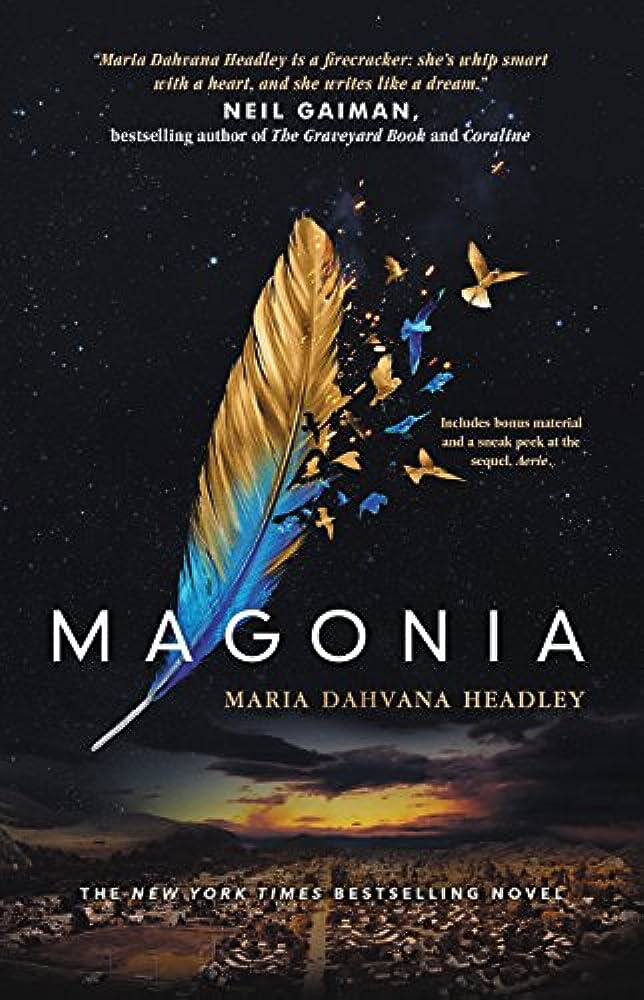
Magonia – Maria Dahvana Headley – you think you’ve got a typical 2010’s YA fantasy book on your hands, and then it gets bonkers…delightfully so.
With every successive Radiohead EP I listen to, I’m baffled at not just the sheer amount of output they had, but how good a solid 90% of it is. The Bends sessions seem like some of the most fruitful of their entire career, what with three EPs and a series of smaller singles released in the periods directly before and after the album’s release. I’ve yet to listen to My Iron Lung – EP or the “Fake Plastic Trees” single, but from what I can tell, they were just constantly cooking. They had to be forcibly removed from the kitchen because the cooking was just TOO GOOD. They just COULD NOT BE STOPPED.
In some ways, “Banana Co” feels like if “Karma Police” was released on The Bends; the term “sardonic wit” is overused these days, but it applies here for sure, as it does to quite a lot of Radiohead. Written about the corporate colonialism of the United Fruit company in various countries in Central and South America, Thom Yorke slathers his honeyed words in sarcasm with the repeated verse: “Oh, Banana Co/We really love you and need you.” Yorke has an almost sleepy register to his words, as though he’s being pulled under by the propaganda himself, before the guitars of Jonny Greenwood and Ed O’Brien coalesce in a controlled blast of everything that makes me miss listening to The Bends. Adding this one to the list of Bends-era songs that make me think “this is a B-SIDE?” (see also: “Maquiladora,”“My Iron Lung”). Luckily—at least for the fans who were alive to see this (cries in Gen Z)—”Banana Co” was a live staple pre-OK Computer, and Yorke has often addressed it towards other colonial problems of the day, including one in 1998 that was addressed to “the people of Indonesia, and the people who have money invested in that country.”
Wow, what a wonderful example of a band committed to calling out imperialism and violence around the world! Surely they would carry these values into this day and age…right? Right?
Uh…
Well. I’ll say that I am quite disappointed after hearing that Thom Yorke confronted a pro-Palestine protestor at one of his solo shows back in October; the protestor demanded that Yorke condemn the ongoing violence in Palestine, and he responded by calling the protestor a coward, then walking offstage. In Yorke’s defense, he has every right to withhold his political views (and also, I don’t think yelling at a celebrity at a concert is necessarily the best way to get people on your side, no matter how good the cause, nor is it going to solve any conflict), but there has to be a much more respectful way of dealing with this kind of thing. Calling this person a coward was not the right move, even if he did want to decline to speak. It’s just so odd and hypocritical to me that he would be a champion for human rights for so long, and then call somebody a coward for protesting the same human rights violations that he once sang about and condemned in the ’90s. Even if he doesn’t publicly condemn the thousands of needless deaths, I just hope that he realizes how hypocritical he sounds. What a shame, really. Again, no way that Thom Yorke’s reading this, but…maybe go listen to your old catalogue over again before you call people protesting the horrors of modern imperialism cowards. Just saying. Free Palestine.
We’re ending on a much lighter note, worry not. Frankie Cosmos is always reliable on that front (whether or not it’s preceded by one of my rants).
I finally caught up with this season of Heartstopper, and I’ve fully moved away from calling it any sort of comfort show, as I feel that would diminish the incredibly important (and tactfully delivered) depictions of eating disorders and mental illness. Nonetheless, it remains a wonderfully queer show, and it’s got plenty of sweet moments, often buttressed by light and bubbly indie pop. I’m only on brand with…a third of the songs that are picked (some of it’s a bit too pop for me), but I can always count on at least a handful of hits popping up—season 3 featured not one but two Arlo Parks songs (“Devotion” and “Pegasus”—Parks is just perfect for the Heartstopper atmosphere), Sufjan Stevens’ “That Was the Worst Christmas Ever!” (it sure was…Charlie cannot catch a break 😭), and, reliably, more Frankie Cosmos. Maybe, just maybe, Alice Oseman might be a fan? We can never really be sure…
Either way, Frankie Cosmos and Heartstopper are matches of media that are made for each other. “Duet” has some of the simplest of lyrics, but they’re delivered with the lovesick joy of doodling hearts in the corner of your notebook as a teenager. Packaged in bite-sized containers (I can’t think of a song of theirs that’s over 4 minutes), they really do feel like bubblegum—sweet, sometimes sickly so, and short-lived, but constructed from simplicity that produces, more often than not, a perfect pop song. Like both the comic’s and the show’s cartoon hearts and leaves that surround the characters, there’s a simple purity to them that’s been distilled to the core.
…so. Elephant in the room here, quite literally. I’ll venture to say that last Tuesday was one of the worst Tuesdays in American history. Hence, no activity. (Also, I had a whole cocktail of midterms to study for and papers and annotated bibliographies to write.) I needed the time to grieve. Let me tell you the truth: I’m so scared. I’m betrayed. Being in my formative years under a president who systematically mocked the identities of everyone who isn’t him—not just the ones that comprise my family—forced me to confront the fact that America had no regard for me. If there was change to be made, I had to do it myself, and with the help of the communities around me. So I started writing. I started educating myself. The process is never over, and will continue until my dying day; even with the sort of beef that I have with Sara Ahmed (yeah, killjoy etc. etc. etc., I’m on board with 50% of it, but can’t feminism be gleeful sometimes?), I look back to her words: “To become a feminist is to stay a student.” I am always learning. I am far from perfect, but I am trying. The key here is motion: we can’t afford to stay static, not in our ideas or in our actions. Resistance comes in many forms (and don’t let anybody tell you that there’s one right way to fight), but the key is that we must always keep moving. Donate. Protest. Pay someone a compliment. Make art. Write with hope in your heart. Trump and his ilk win when we’re too far into the quicksand of hopelessness.
Never lose hope and never lose love, because that is what the Trump administration lacks. Grieve, and grieve on your terms. I certainly did. The last thing I wanted was a repeat of that November morning when, at the age of 13, I woke up to my dad hanging his head over the kitchen counter as he made lunches for my brother and I. I remember clinging to him tighter than I ever had, frightened of every horrid possibility. Some of them came true. Some of them didn’t. I called both of my parents. I cried the same tears to them that I cried when I was young. Cry the same tears, but remember that they are the same tears. I’m frightened. But if we can resist Trump once, we can do it again. We can fight the same good fight. I love you.
…
All this is to say that, even though my output has been lessened lately (college!), this won’t change a thing. I’ll still be reviewing queer books aplenty, and no election will change that. Gather ’round.
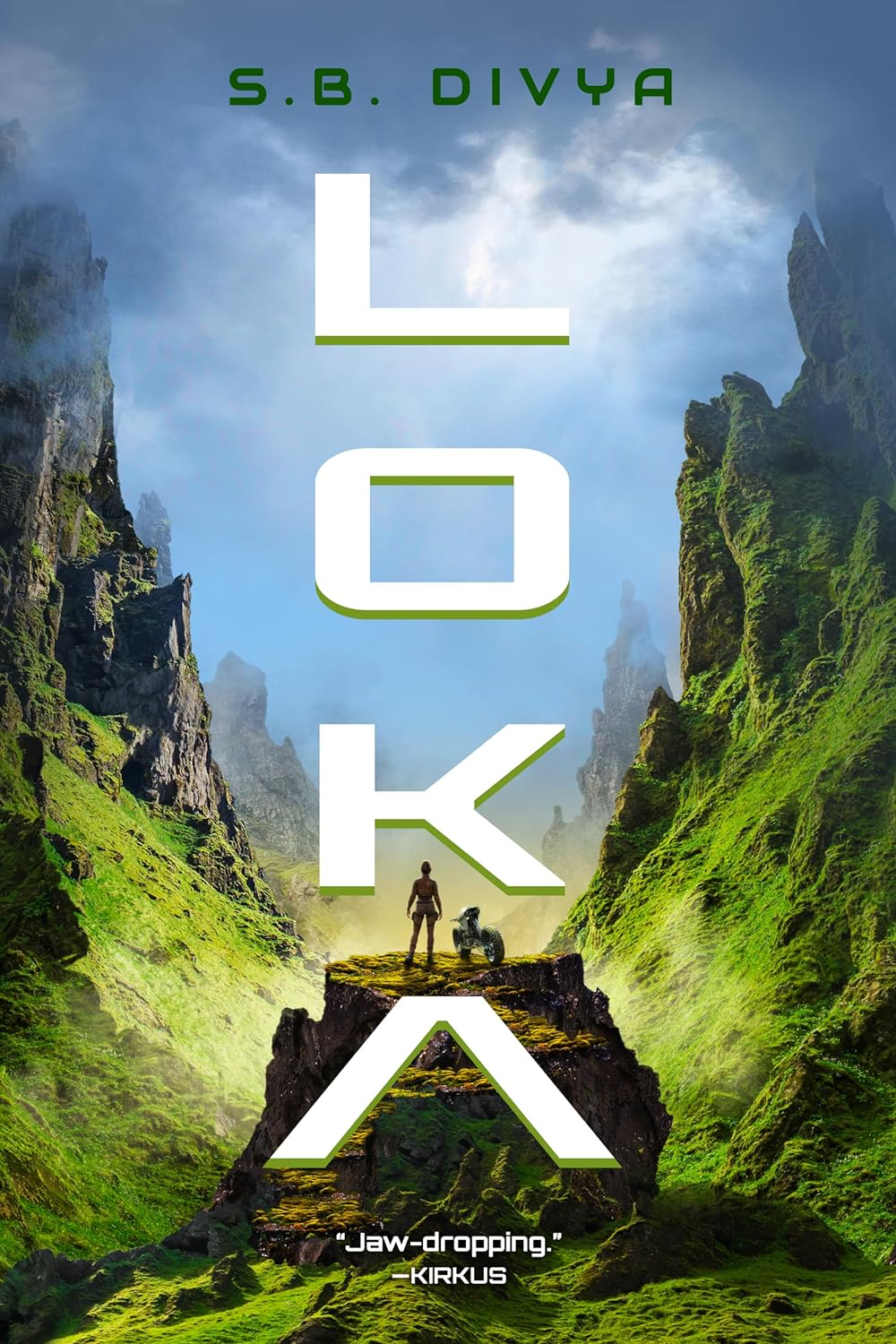
After a solid two weeks of reading nothing but fluff to keep my mind off of everything, I remembered that Meru, one of the more innovative new sci-fi novels I read last year, had a sequel that was finally out! I was eager to re-immerse myself into S.B. Divya’s endlessly creative futuristic landscape, and Loka found itself on my Kindle in no time. Loka turned out to be contrary to my expectations and a very different book to Meru—it was a mixed bag at first, but by the final third, I’m happy to say that it stuck the landing in a deeply moving way.
Now, TREAD LIGHTLY! This review contains spoilers for Meru, book one in The Alloy Era series. If you haven’t read Meru and intend to do so, read at your own risk!
Akshana is a child that defies all existence. Her mother is human, and her maker is an Alloy—a post-human being with godlike powers. The ruling Alloy government condemns her very existence. For years, she has lived a sheltered existence on the planet Meru, raised by her human mother. But once Akshana turns 16, she heeds the call of Earth, the ancient homeworld of humankind. With the help of her friends, she takes up the rigorous Anthro Challenge: a trek to circumnavigate the habitable zone of Earth. As she navigates foreign terrain, Akshana comes to terms with how she was born and created—and where her destiny lies.
TW/CW: near-death situations, medical emergencies (related to sickle-cell anemia), xenophobia/discrimination (fictional), life-threatening storms
I thought that Meru had scared off all of the people who thought that S.B. Divya invented neopronouns, but apparently people are still complaining about it in the reviews for Loka? Did you just…miss book one in its entirety, or what?
I’ll get my main gripe about Loka out of the way first. The more I think about it, the more that I realize that my issue with Loka is that to some extent, it has the exact same stakes as Meru: a young girl/woman has to take a daring trek onto a foreign landscape, all the while facing prejudice from the outside world and alien, terrestrial dangers from the ground beneath her feet. S.B. Divya remains an excellent writer and crafter of worlds, but in terms of plot, in this case, lightning couldn’t strike twice. Aside from Akshana’s differing personality and the novelty of Earth 1,000 years in the future, there wasn’t as much to distinguish the two plots once I broke them down.
I wasn’t crazy about the main plot of the Anthro Challenge. In the future landscape of Loka, this challenge is designed for humans and Alloys to circumnavigate the landscape of Earth as humans did millennia ago. Only a few strips of Earth remain habitable (forming ringed borders around the world), but the brave adventurer must cross swaths of the Southern hemisphere and the Atlantic and Pacific Oceans in order to complete the challenge. In concept, it’s a great bit of worldbuilding, but it didn’t make for a very compelling of a plot. For the first half of the novel, it felt like the same regurgitation of 1) reach new landscape, 2) inter or intra-personal conflict within the friend group, and 3) make a harrowing trek to the next stop on the Challenge. This was rinsed and repeated with less change than I wanted; even with the new landscapes, none of the side characters had much time to develop, and they seemed to encounter almost the exact same problems for a solid 100 pages. It bordered on feeling cheap, given how innovative Meru was.
That being said, even though the plot faltered, Divya’s writing never did. You’ve just got to trust in her abilities at this point, because she can write some fantastic sci-fi, even if the foundation of the plot is flimsy. Her voice for Akshana perfectly captured that teenage urge to explore beyond your parents’ backyard and prove everyone wrong. Divya’s descriptions of future Earth, from the raging seas to the lush greenery to the plains of a futuristic America, immersed me instantly in a vibrantly crafted vision of the future. I’ll get to the specifics of the emotional core of Loka later, but that was perhaps the best part of the novel—S.B. Divya’s brand of space opera borders on hard sci-fi for me, but it keeps the emotional center that so many other hard sci-fi novels forget to consider.
The subject of disability was one of the more compelling aspects of Meru; in a genre rife with eugenic practices that get dismissed as signs of a “progressive” society, Divya changed the game by creating Jayanthi, who, in a future when most disabilities were edited out of the gene pool, was specifically engineered to have sickle-cell anemia. More than that, her sickle-cell anemia was advantageous for surviving the landscape of Meru. Fast-forward 16 years, and Akshana is experiencing, as I said before, the same plot, but her sickle-cell anemia presents unique challenges on Earth, leading to many a close scrape when she exhausts herself to near-fatal levels. She has thoughts of resentment towards her mother, who made a conscious decision to pass this gene down to her. S.B. Divya said that Loka was inspired by their experience being a disabled parent, and that shone through in Loka; eugenicists would have you believe that this would constitute cruelty on the highest level, but Akshana comes to reconcile with—and understand—her mother’s logic. By erasing this gene and others from the gene pool, the Alloys past erased entire cultures, as well as the ways in which they moved about in the world. Being disabled is challenging, to say the least, and in my experience, bothersome and at times taxing to deal with on a daily basis. Yet it has shaped my life in ways that I will never regret. Akshana comes to realize that her mother, even though the road to this decision was rocky, merely wanted her to know that individuality, adversity, and culture cannot be erased by a purging of the gene pool.
Which brings me to the ending. The buildup of Loka concerns the mounting pressure and prejudice surrounding daring Akshana and her friends as they complete the challenge and return to a world that wants to erase their bravery and ban the Anthro Challenge altogether. Not only has she come to terms with her disability, she has come to reckon with her status as a half-human, half-Alloy being in a galaxy where neither party wants her to exist. Yes, there was the physical challenge, but the real Anthro Challenge is the identity crisis you have along the way, amirite? All jokes aside, that was the real hurdle to overcome. I know how corny I sound, but the real journey was Akshana’s journey to self-acceptance in all of the facets of her identity. At the end of the treacherous paved with prejudice and hatred, Akshana learns that the only way to survive is to be yourself, unapologetically so. As she says, in Loka’s stunning final lines:
“Our bodies don’t have a true end. Subatomic particles bounced between skin and air continually. So what did that make me, or any person? If I coexisted with everything and everyone, then part of me was also part of them, and vice versa. To some people, I would never be human enough. To others, I would always be too human. In the end, I had no choice by to be myself.”
And if anything could save Loka from being a letdown, it would be this, and the character arc it coincides with. Excuse me for a moment…no, I’m not crying, it’s just raining on my face.
All in all, a sequel with a plot that nearly dragged the novel down, but just like Akshana completing the Anthro Challenge, beautifully stuck the landing after a rocky journey. 4 stars!
Loka is the second book in The Alloy Era series, preceded by Meru. S.B. Divya is also the author of Machinehood, Runtime, and several other science fiction short stories.
Today’s song:
NEW HORSEGIRL IN FEBRUARY? ON VALENTINE’S DAY? PRODUCED BY CATE LE BON? today is a GOOD day
That’s it for this week’s Book Review Tuesday! Have a wonderful rest of your day, and take care of yourselves!
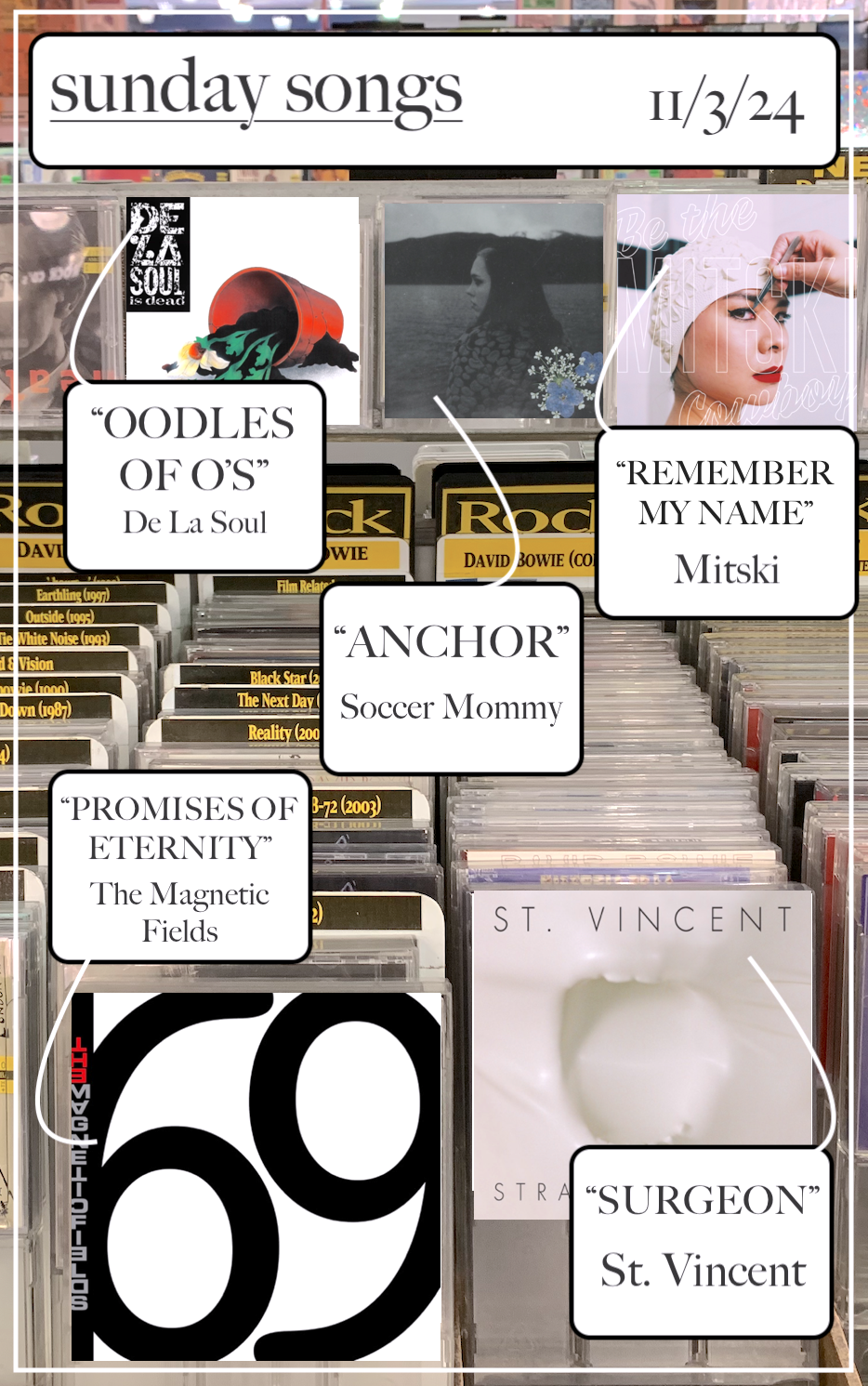
I had the privilege of seeing The Magnetic Fields a second time last weekend; this year marks the 25th anniversary of an album that (from what I’ve heard) is not so much an album but a great balancing act of music itself: 69 Love Songs, a triple album consisting entirely of songs about love. (Make no mistake, they’re not all romantic. See: “How Fucking Romantic,”“Yeah! Oh, Yeah!”“I Think I Need a New Heart.”) I’ve yet to find the time to set aside a whole three hours and listen to the album in its entirety, but even a glimpse at around half of it over the course of my lifetime leaves me in awe of how Stephin Merritt and company pulled this off. Especially Merritt, as he wrote every single song—his songwriting never falters, but to not sputter out after 69 songs is a feat as awe-inspiring as his vocal range.
Somehow, “Promises of Eternity” slipped by my notice, but it hasn’t let me go since last weekend. Sung by Merritt on the album and by Anthony Kaczynski live, it immediately stuns. In both mediums, the synths just bowl you over—they don’t play as much as grandly announce their presence with the flourish of the same velvet curtain that the song speaks of. That chest-clutching drama defines the rest of the song—all of the lyrics detail the hypothetical collapse of the world if the narrator’s lover did not love them back: “What if no show ever happened again?/No seven, no eight and a half, no nine and no ten?” Most of Merritt’s singing has a sarcastic current to it that almost makes you question if the guy really believes in true love (though “The Book of Love” disproves that hypothesis quickly), but the way that he belts out “What if the clowns couldn’t be clowns?”, of all lines, gives you the feeling that he’s just fallen to his knees and is begging straight to your face. Apparently, the absence of clowns will signal the end? Who’s to say, really? Along with the circus imagery, the organ sound created by the synth makes “Promises of Eternity” feel like an elaborate, gilded carousel of lovesickness, with instrumentals that wouldn’t be out of place at a fairground, but lyrics fit for Romantic (in the Keats way, not the general way) poetry.
In the age where you can make a synth—and most any instrument, really—make almost any sound you want it to, I shouldn’t be surprised at the staggering achievements that music has made in the simple terms of what noises we can make. What sounds like “the future” feels entirely subjective when we’re talking about anything past the 2010’s—electronic music had exploded, and plus, what sounds futuristic to me might not sound futuristic to you.
My waxing poetic about St. Vincent has mostly been directed to her self-titled 2014 album, which, ostensibly fits that description for me. But with each successive listen to “Surgeon,” I’m blown away at just how much this sounds like the future. This was 2011, and aside from the percussion, most everything on this track sounds utterly alien. Watching the 4AD sessions recording that I linked above was genuinely eye opening—every few minutes, I just found myself going wait, that’s the instrument that’s making that weird noise? The synths are manipulated to the point where they could just as easily be the vocalizations of a children’s choir from another planet. Even the blink-and-you’ll-miss-it trill of a flute turns into a glitch in some kind of code. I can see the threads of Björk—especially Homogenic—throughout, yet it’s so distinctly Annie Clark. By far the most masterful of these manipulations should be obvious: Clark’s guitar solo beginning at 3:36 feels like she’s almost reached the extreme of what the instrument can sound like. It’s hardly even a solo anymore—it doesn’t just sound like a synth, it sounds like some kind of creature whose consciousness has been trapped in a computer and is howling to be freed. If you were to somehow visualize this music, I’d fully believe it if it came out fleshy and trailing with electrodes.
Oh, to spend a day in her mind…
…AND A BOOK TO GO WITH IT:
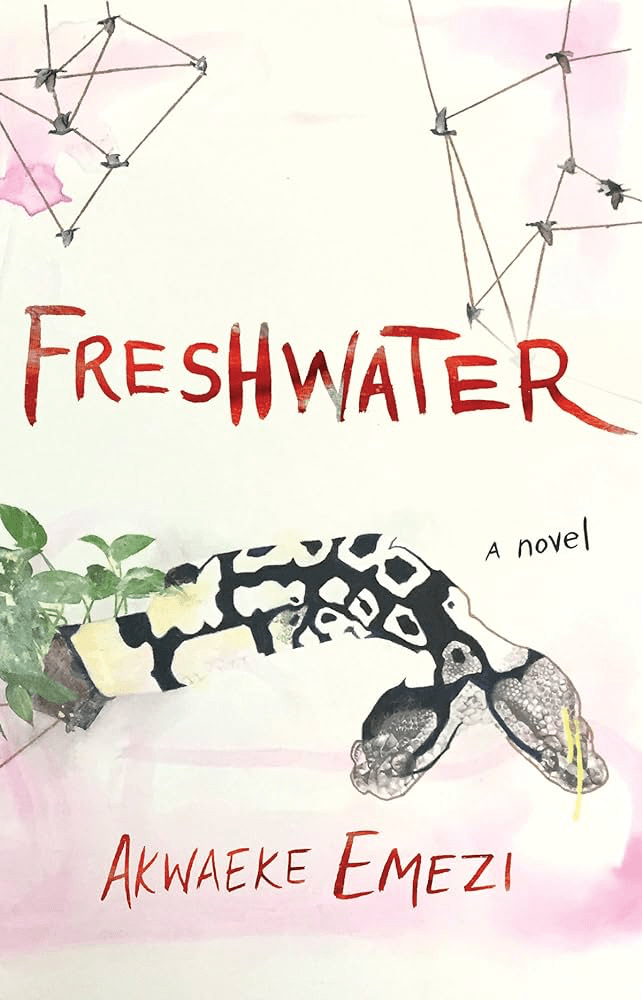
Freshwater – Akwaeke Emezi – stagnation, grappling with identities beyond the human, and the desire to free that identity with help of a surgeon.
Is it possible for De La Soul to have a bad song? Well…okay, I haven’t gotten into their later catalogue, which seems to have a worse reputation (I don’t know, though, “Snoopies” is pretty fantastic), so that’s up for interpretation. But for me, De La Soul are one of those bands where almost every new song of theirs I find feels like digging up buried treasure. At least in the ’90s, their creativity seemed to come to them as easy it is for the average person to breathe. The lyrics? Deadly serious, but still full of whimsical, silly rhymes—nothing but De La Soul. The best part is that every single line ends in an o sound—quite literally oodles of o’s! The samples? That Tom Waits bassline sample is something to behold. This is my kind of hip-hop. Can’t say if their entire catalogue is perfect, but “Oodles of O’s” is. We need to bring back the word oodles. Carry on the spirit.
At the end of the day, it’s beautiful that this got the video that Dave wanted it to have, now around a year and a half after his passing. Maybe it’s not the grittiness he envisioned, but a donut shop more than makes up for it.
With the workload I’ve been swimming through this semester, I’m not sure if I’ll get around to reviewing Evergreen, but rest assured—I LOVED it. After a few listens, Sometimes, Forever remains on top, but Evergreen is special. There’s a matured, bedroom-pop-grown-older familiarity to it, but as with every successive album, Sophie Allison always has something new to offer. Her fourth album is a cartography of grief, detailing the tangled web of loss, healing, and pining after your Stardew Valley wife, as it turns out. As with every one of her albums, it’s her introspection that shines—with every kind of grief that she experiences, it feels like a flag planted in the ground, a recognition of every hill and valley of the harrowing trek she’s been on, but recognition that it’s not the end, no matter how much of it is behind her.
In contrast to the largely acoustic (or at least traditionally guitar-driven) landscape of Evergreen, “Anchor” instantly singles itself out as the black sheep of the bunch. Though it covers some of the same ground as the rest of the album, the production doesn’t jump out at you so much as it pounces on you like some creature going after your ankles in the dead of night. I should’ve expected that Allison would retain some of the sound from Sometimes, Forever, but with how the rest of Evergreen sounded, it was a surprise—and a 100% welcome one. With synths and bells that wouldn’t sound out of place in a Chelsea Wolfe track, it has a jaggedness and fear that the rest of the album lacks. In a song about feeling so unmoored in the face of loss, it’s one of the most creative stylistic choices on Evergreen to me. In the same way that a simple object or scent or song can trigger a domino effect of memories that takes days or weeks to recover from, “Anchor” comes out of nowhere with its instrumentation. It has the static and crunch of watching yourself bolting through the woods through the lens of a trail cam, and that’s how grief can make you feel—cornered and in the dark.
…AND A BOOK TO GO WITH IT:
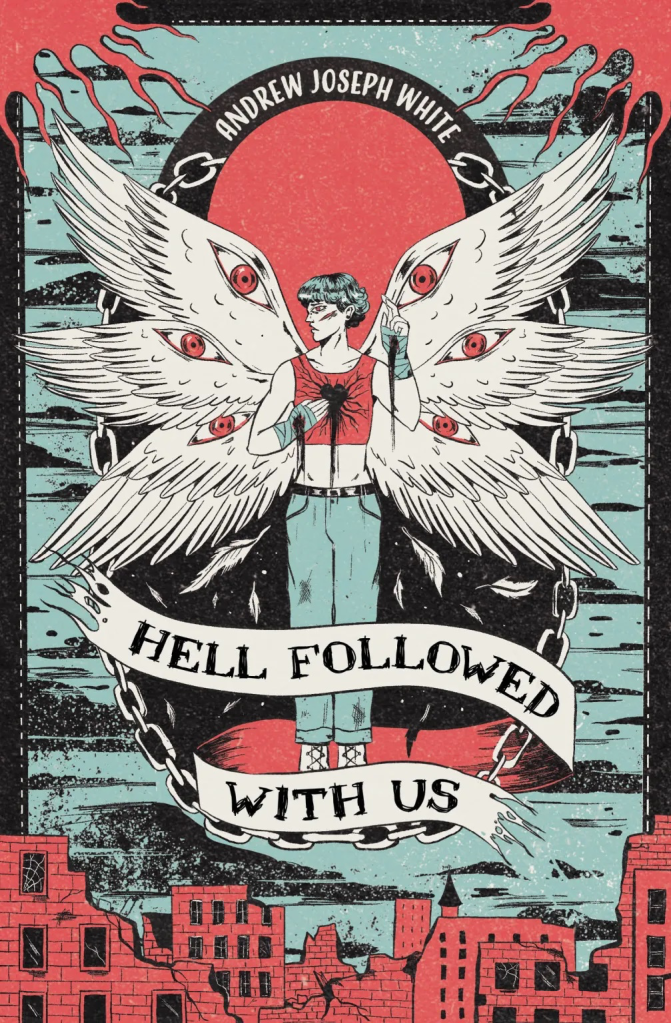
Hell Followed With Us – Andrew Joseph White – “When we left the harbor/I was certain of my path/There’s no turning back/Now I long for something that/Could stop me in my tracks/An anchor to cast…”
Knowing that “Remember My Name” was released so close to the time that she almost quit music (back in 2019) really puts this song in perspective. Mitski’s still battling being in the spotlight, but this song presents the other side that’s been waging that war; deep down, she harbors a desire to be musically immortal, even at the steep cost: “I gave too much of my heart tonight/Can you come to where I’m staying/And make some extra love?/That I can save ’til tomorrow’s show.” With its crunching guitar riff that’s begging to be sampled and the way that the chorus consumes you in the same way that watching an approaching tornado on the horizon does, there’s so much urgency and volatility packed into just over two minutes. The best of Mitski speaks to that part of me that is so easily overcome by emotion and gives itself over to its throes—sometimes, whatever the situation, you do feel like you need something bigger than the sky. What works so well is that Mitski is dead serious—every song is an explosive, cathartic release. Of course, again, that’s probably what attracts so many parasocial weirdos to her shows, but I at least have the tact to not yell “MOMMY” at her, much less anybody else. That’s exactly the price of the fame she speaks of—she places her heart on a platter, people tear it to shreds, and the process repeats itself every day. I’m just glad that after The Land is Inhospitable and So Are We, she’s repaired that volatile relationship with music, or at least started to. Much as I love a good Mitski explosion, her best music comes when she’s healed, or at least processing it.
…AND A BOOK TO GO WITH IT:
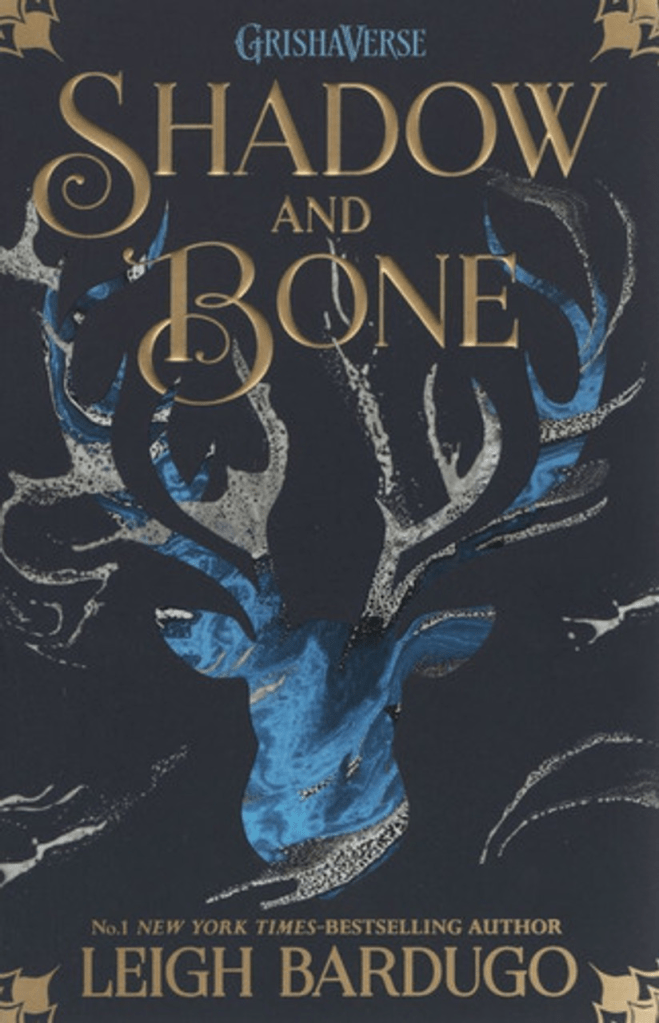
Shadow and Bone – Leigh Bardugo – “I need something bigger than the sky/Hold it in my arms and know it’s mine/Just how many stars will I need to hang around me/To finally call it Heaven?”
Since this week’s post consists entirely of songs, consider all of them to be today’s song.
That’s it for this week’s Sunday Songs! Have a wonderful rest of your day, and take care of yourselves!
Here we are, and once again, the year is nearly over…at least we have season 5 of Fargo to distract us from the inevitable passage of time.
Let’s begin, shall we?
GENERAL THOUGHTS:
Break aside, November has been on the busier side, but it’s been a productive one for me. It’s been chaos as far as my workload has gone, but part of that chaos was the editing that led me to send off two of my short stories for consideration to be published in some school literary journals! I won’t hear back for several months, but I’m so excited!! The initial impostor syndrome has faded (it’ll probably come back in a few months, mark my words…I’ve got my NyQuil ready), but either way, I’m really proud for taking this first step. Now, the workload chaos is in the form of looming final projects, which is not nearly as fun, but at least I don’t have to take a stats final at the crack of dawn like last year.
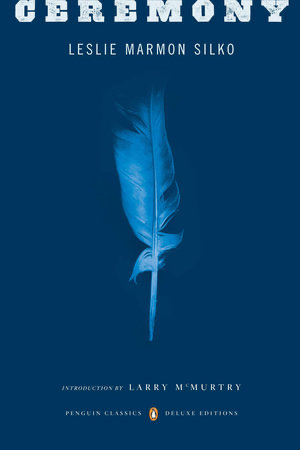
My reading has been a bit slower this month (see above), but as far as enjoyment goes, I’ve had a much more successful month! I had another 5-star read in the form of Ceremony (me when mixed-race experience and themes of storytelling), and I only had one book in the 2-star range for this whole month! I ended up reading a ton of literary and literary-leaning fiction for no particular reason, but the ones I read this month were almost all hits. I’ve had some more time to blog, what with break and whatnot, so it’s been fun to write more frequently before finals hits me like a train.
Other than that, I’ve just been trying to draw and play guitar (when I can), watching Taskmaster and The Great British Bakeoff (hEY NOW NO SPOILERS US AMERICANS HAVE TO WAIT UNTIL FRIDAY FOR THE FINAL), trying to ignore how cold the weather is, and rejoicing the return of Fargo! FARGO! I FEEL ALIVE AGAIN!
…say, are we gonna talk about how utterly insane episode 3 was? Just me?
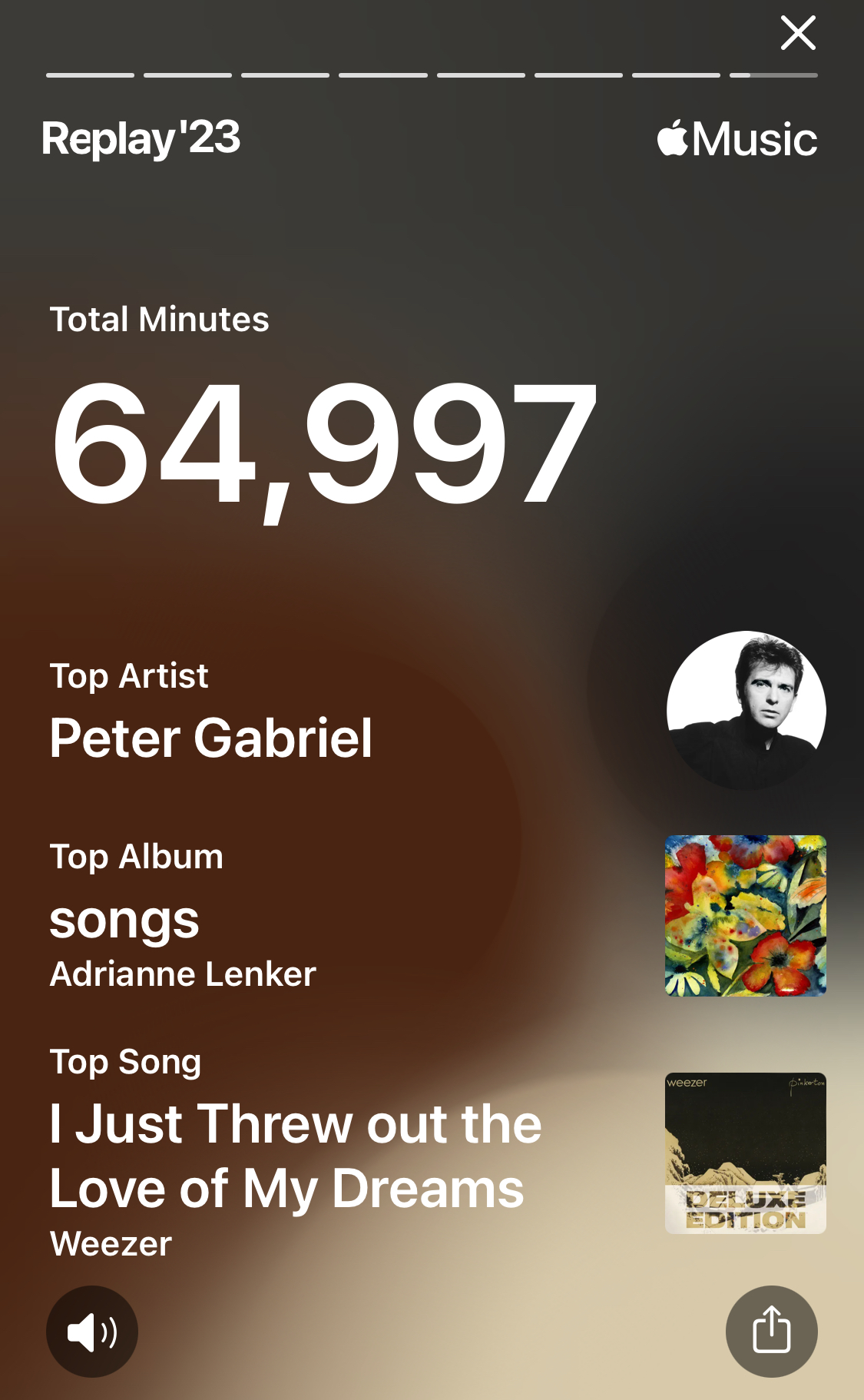
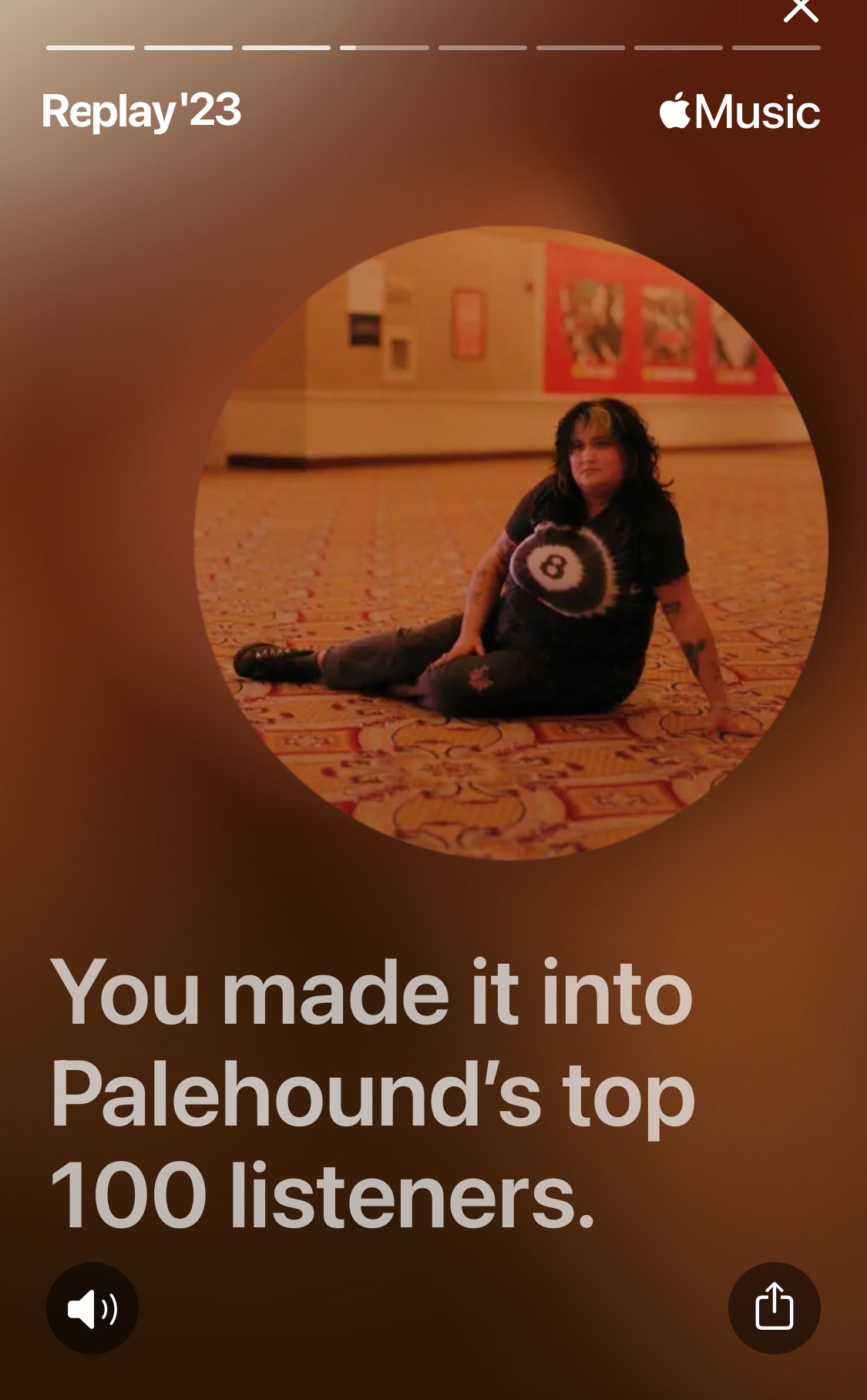
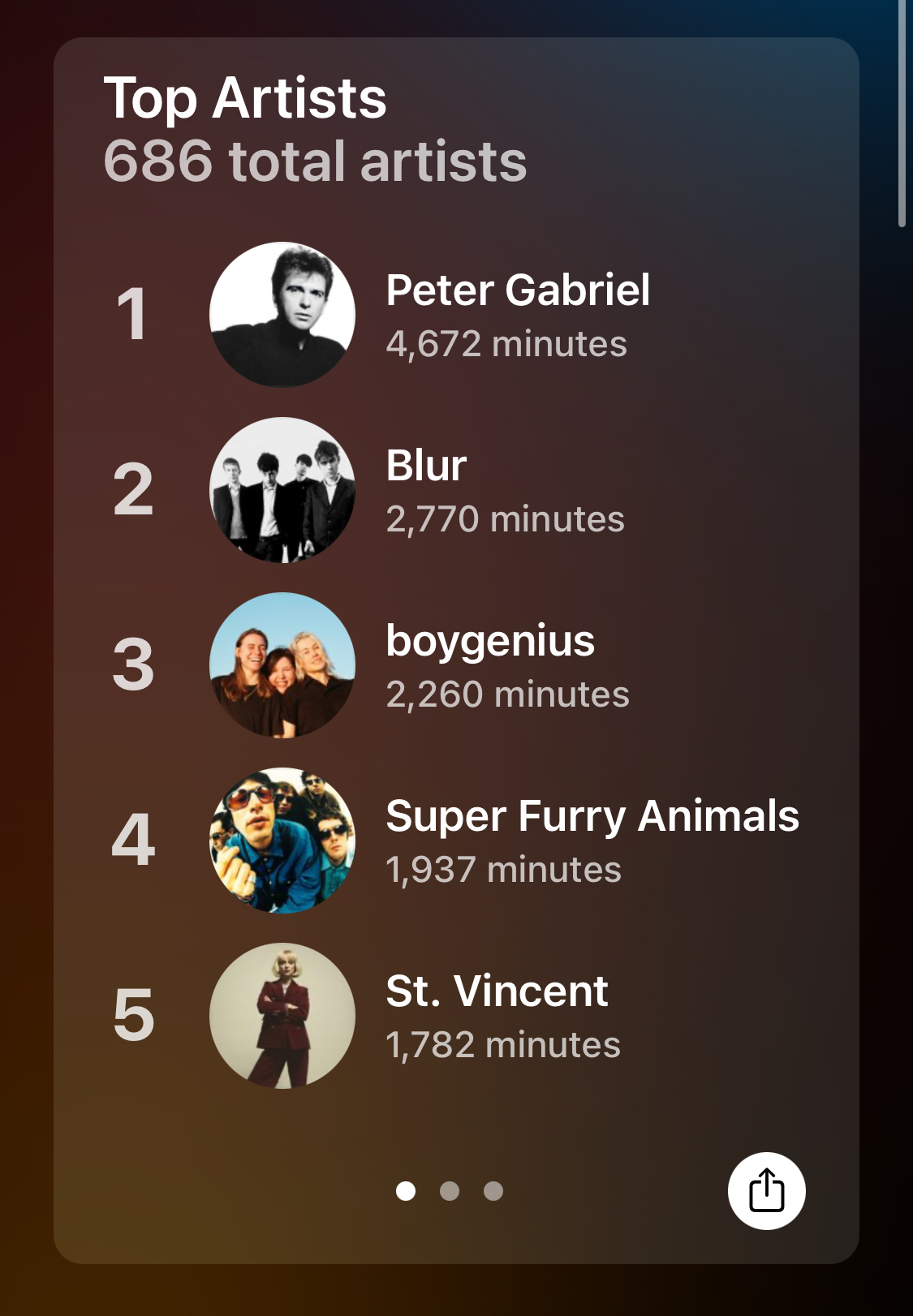
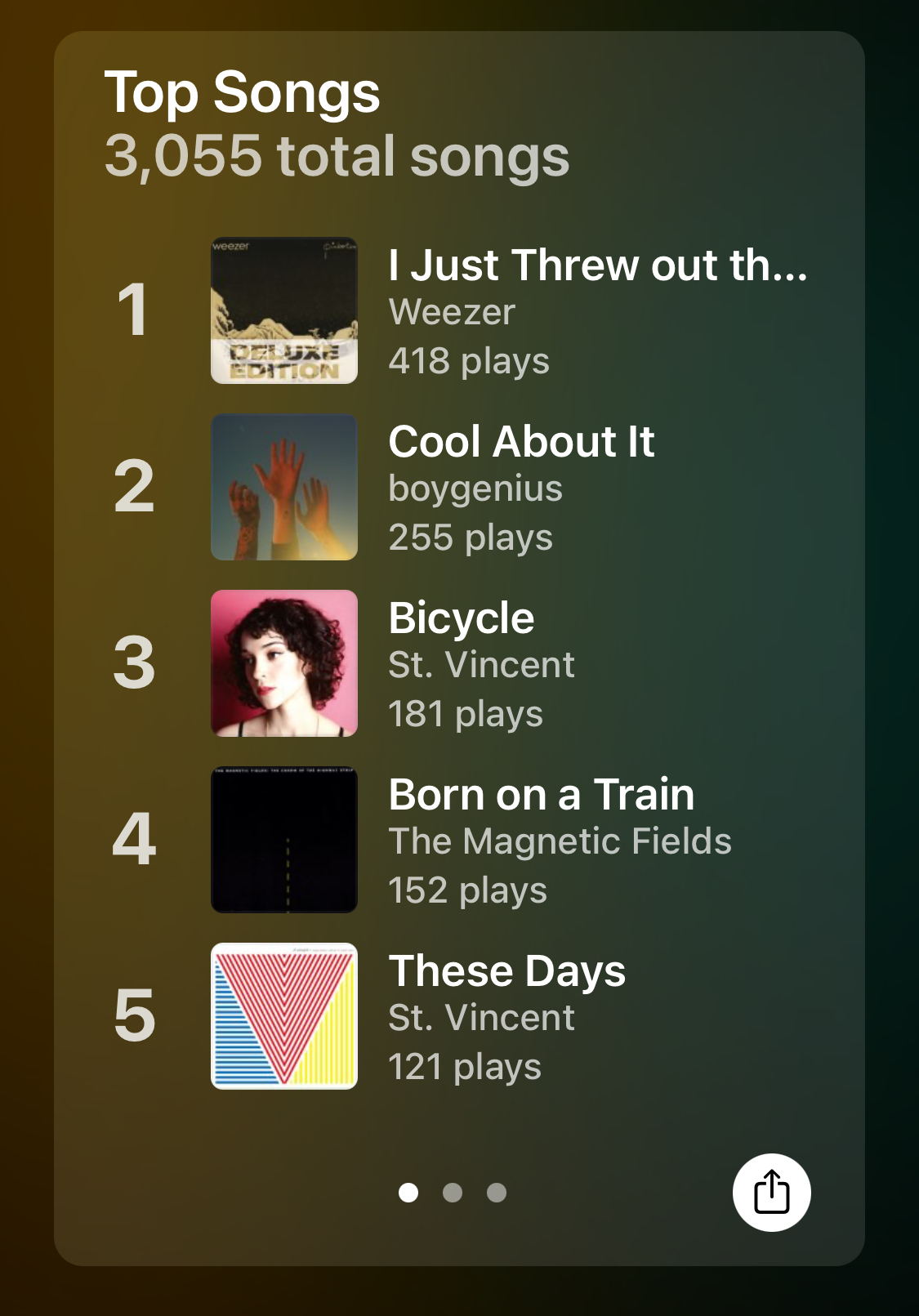
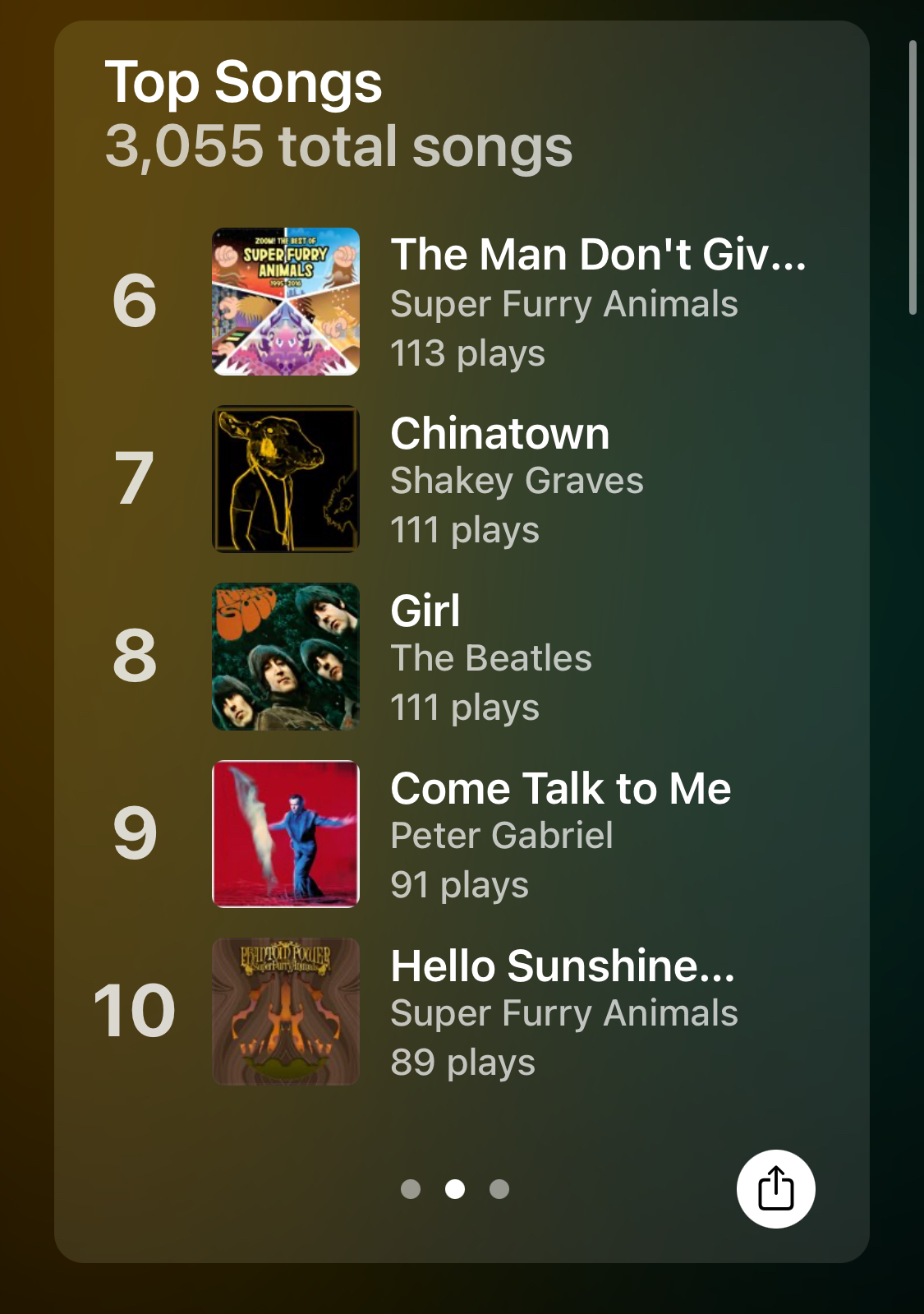
Also, for your casual amusement, here’s the mess that is my Apple Music Replay for this year:
READING AND BLOGGING:
I read 15 books this month! Again, slower than normal, but it’s impressive to me, given how much editing and pre-finals chaos has consumed me this month.
Happy Tuesday, bibliophiles, and more importantly, MERRY FARGO DAY!! SEASON FIVE IS FINALLY HERE!! REJOICE!! I’ve been waiting three years for this…I can’t WAIT to watch it tonight!
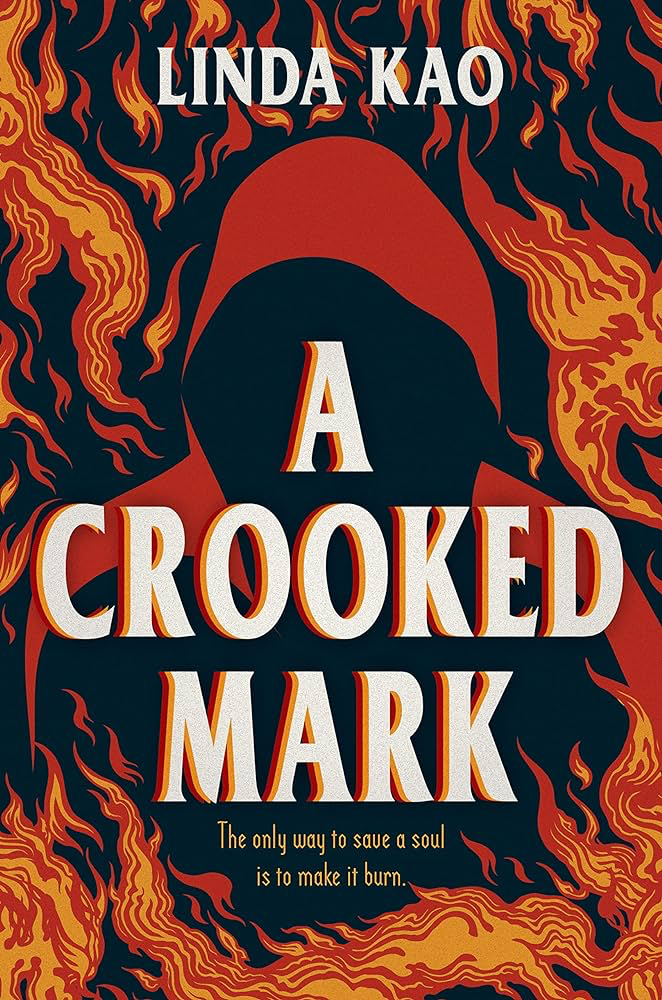
I’ve noticed that I’ve read a lot of adult books this month (much of which have been more literary fiction) and not a lot of YA; although it’s been a much better reading month than October, I wanted some YA to mix it up. A Crooked Mark was the perfect book to scratch that itch—campy and silly in the best possible way.
Matthew Watts knows that evil works in mysterious ways. That’s why his father has raised him to know the signs of those marked by Lucifer himself. Ever since he was young, they’ve been going from town to town, making sure the Marked are killed before their evil is unleashed on the innocent. But Matt’s father has a new mission for him—his first ever solo mission, following a girl named Rae Winters. As Matt tries to blend in at the local high school, he befriends Rae—and begins to fall in love with her. And as his mission steers in the wrong direction, he begins to question if all that he’s working for is a lie…
TW/CW: murder, descriptions of burning alive, car crash, grief, loss of loved ones (on and off page), descriptions of injury
A Crooked Mark caught my eye over the summer because of its premise—not necessarily that it was particularly unique, but because it sounded so similar to Frailty—a movie about a father and his sons killing those that God has told him are demons. As far as I can tell, there’s no real correlation between the two (though I’d be shocked if this wasn’t at least a partial inspiration for the book), but, again, caught my eye—of all the movies to inspire a younger-leaning YA novel, Frailty would not be my first choice. That being said, A Crooked Mark, though not without its flaws, scratched the itch I needed—corny, supernatural fun.
From here on out, if I say “corny” in this review, I mean in the most affectionate way possible. I was on a streak of reading a lot of adult fiction/more literary-leaning fiction, and while I enjoyed all that, A Crooked Mark was just the kind of unserious book I needed to shake things up. It feels like it could’ve been the kind of campy, supernatural drama that I would’ve watched in middle school, down to the fact that there’s actually a character named Moose. It’s great. I’ve seen a lot of reviews comparing it to Supernatural, which I haven’t seen, but even from the vibes I get from the show, the comparison hits the nail right on the head. The writing, while it wasn’t the best, really nailed that feel, even if it wasn’t what Kao was going for. I can probably enjoy it more because there isn’t cheesier acting attached to the already cheesy writing, but either way, A Crooked Mark was made for corny enjoyment.
Going off of that, A Crooked Mark really nailed the beats of that kind of campy, paranormal story. Matt was the perfect protagonist for this story—not overly brooding, but still self-serious (in a very un-serious way) enough that he was fun to follow around. His friend group didn’t necessarily contribute a whole lot to the narrative, but they served the purpose of putting a shield around Rae—and later being sources of conflict once everything went south. Rae was on the too-perfect side, but again: this is the campiest book I’ve read all month. I’m not expecting monumentally good character development. I did also love that Matt was mixed-race—as a mixed-race person, I wouldn’t say it’s groundbreaking rep, or that the book explores his mixed-race identity poignantly (it really doesn’t), but it’s more important in that everybody deserves to be the hero of a cheesy, paranormal teen drama. It’s what we deserve.
That being said, for a book where Matt was up against the clock trying to discover if Rae really was marked by Lucifer himself and put an end to said evil, A Crooked Mark meandered quite a lot. It was more than a sagging middle—more of a sagging 60-75% of the whole book. There was a whole lot of uneventful high school bonding, a lot of Rae’s tutoring sessions that went nowhere, and a lot of hemming and hawing in general. It would have been easy to add bits of drama here and there to amp up the stakes, and Kao partially did this, but not enough to sustain the story. Especially since a lot of the “twists” ended up being dead ends, (save for the Big Twist™️), there really should’ve been more suspense—or at least more drama—before the main twist right before the climax. I was in it for the cheese in the first 30% or so, and it only managed to pick up in the last 20% of the book—not enough to hold my attention.
All in all, A Crooked Mark isn’t anything revolutionary or exceptionally well-written, but if you’re in the mood for something spooky and campy, this is the perfect book for you. 3.5 stars!
A Crooked Mark is a standalone and Linda Kao’s debut novel.
Today’s song:
I love listening to music like this while I’m just calmly doing chores…I’ll just be cleaning the sink and Joe Talbot’s aggressively screaming about kindness and consent in my ears bahahaha I love IDLES
That’s it for this week’s Book Review Tuesday! Have a wonderful rest of your day, and take care of yourselves!









 The Bookish Mutant