Here in the U.S., March is Women’s History Month! Every year, I find myself repeating the same horrors about the attacks on women’s rights in the past five years. This year is no different, save for the fact that with Trump’s presidency, so many men have felt emboldened to let their misogyny run rampant—and our society seems to encourage it, time after time. Every year, we fight to make sure that misogyny, sexism, and rape culture become impermissible again. Though it seems like an uphill climb with no discernible light at the end of the tunnel, there will always be a constant: we will keep fighting for all women. For women of color, for immigrant women, for queer and trans women (especially trans women, because feminism wouldn’t be possible without them), for disabled women, for survivors. They keep pushing against them, so we’ll keep fighting—and keep reading. The good news is that literature is rife with heroines fighting against the system, and as long as these stories are told and spread, someone will be inspired to fight. So as with all the other year, I’ve compiled even more books of women fighting against oppression from a variety of perspectives, age ranges, and genres.
NOTE: once again, I’ve switched these posts to books for several age ranges, too lazy to change the header, etc. etc.
TELL ME WHAT YOU THINK! Have you read any of these books, and if so, what did you think of them? What are your favorite feminist books? Let me know in the comments!
Today’s song:
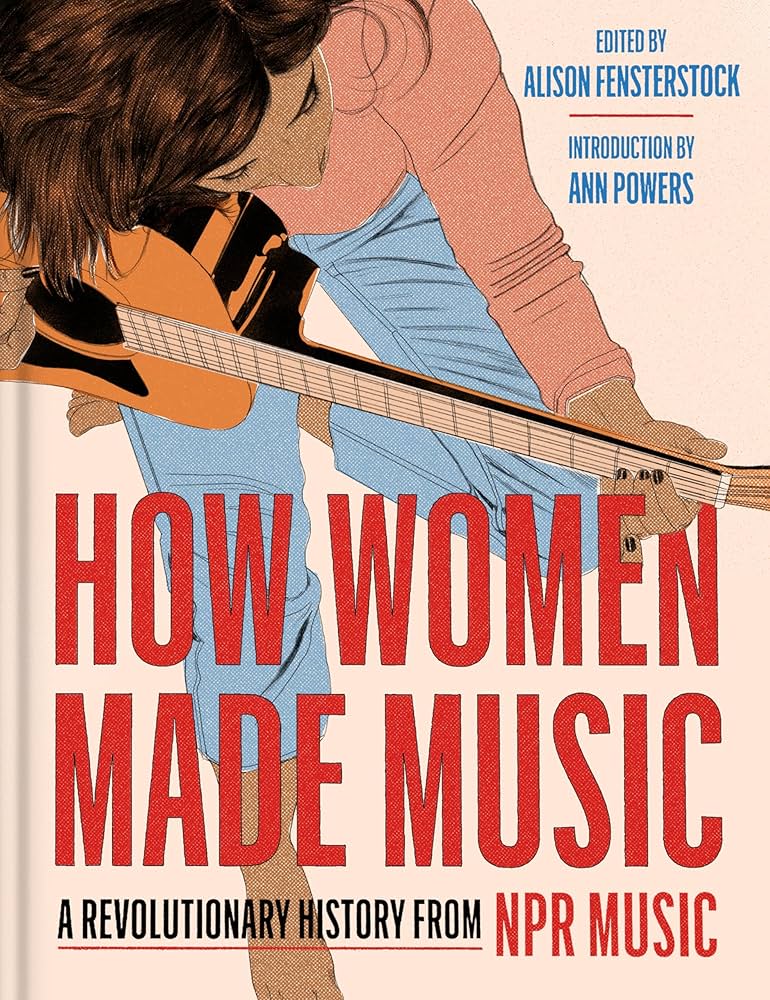
How Women Made Music brought me here…
That’s it for this year’s Women’s History Month list! Have a wonderful rest of your day, and take care of yourselves!
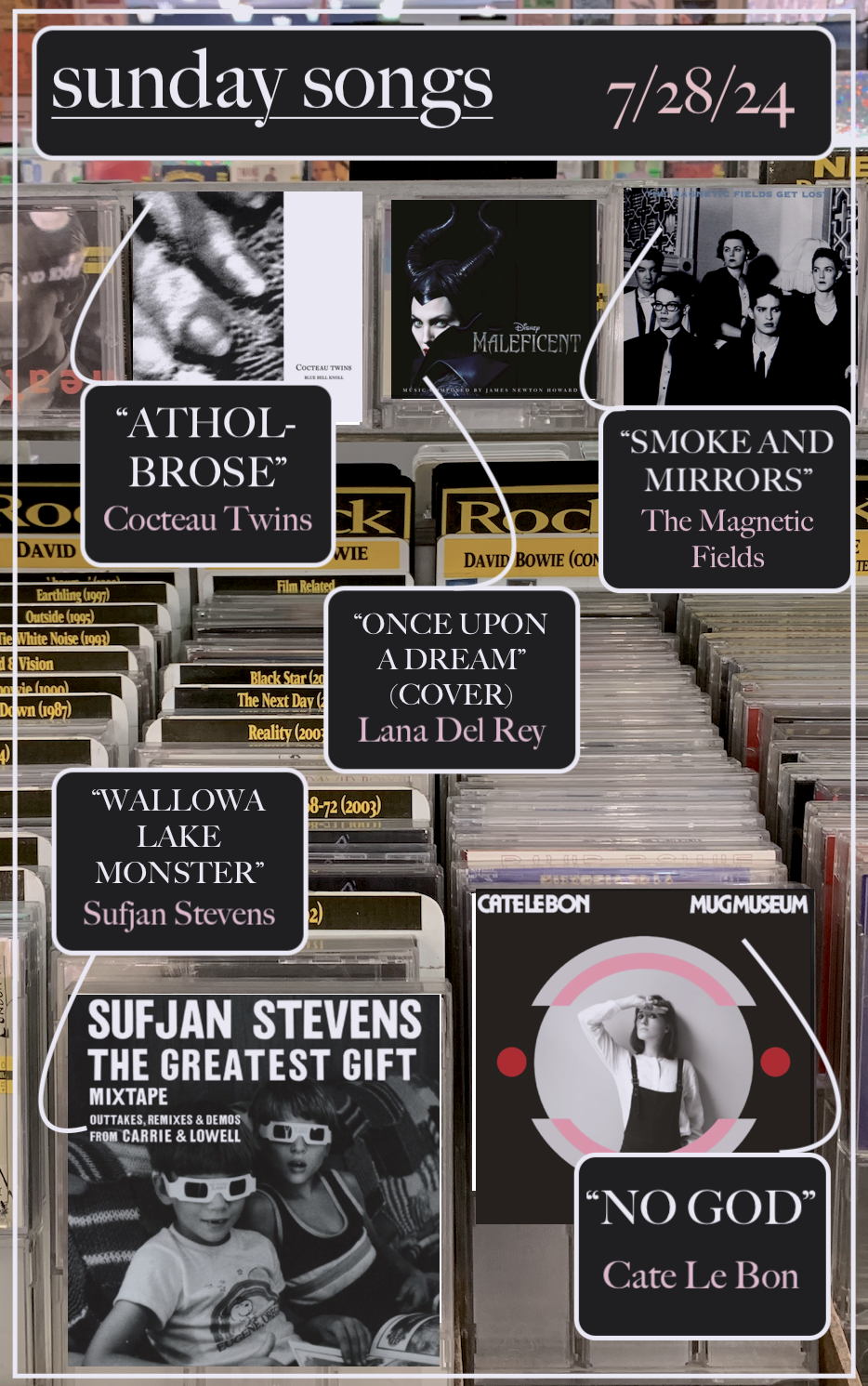
The other night, a friend of mine and I were discussing the merits of album intros—cinematic curtain-openers (David Bowie’s “Future Legend”), gradually creeping easers (IDLES’ “IDEA 01”), and intros so engrossing that the rest of the album almost doesn’t measure up (Cate Le Bon’s “Dirt on the Bed”). I ended up making a Top 5 list that got so overblown that it expanded to top 10, but my friend was remarkably able to whittle it down to 5. “Wallowa Lake Monster” was squarely at the top of their list, and now I understand exactly why.
I’d call “Wallowa Lake Monster” a member of the first category, though in a different sense than “Future Legend.” The album it opens is The Greatest Gift, a mixtape of remixes, demos, and tracks cut from Carrie and Lowell, making “Wallowa Lake Monster” a b-side. I’m now experiencing “Burning Bridge” levels of how the hell was this a b-side, because, in my limited experience of Sufjan Stevens, how does one cut a track this cinematic? Who knows, with what little I know of Carrie and Lowell, save for that it deals with his complicated relationship to his mother. The gliding electronics seem to ripple like lake water itself, as wispy as Stevens’ voice as he opens his tale as one might a storybook: his mother’s twin struggles of alcoholism and schizophrenia become the backdrop for the Wallowa Lake Monster, a creature from Nez Perce legend, as it slowly pulls her under the waves: “And like the cedar wax wing, she was drunk all day/We put her in the sheet, little wreath, candles on the crate/As the monster showed its face.” There’s enough references, from scientific names for flowers to Dungeons & Dragons monsters to the Odyssey, to require three different dictionaries open at once while listening—Stevens has often fallen into the “overly pretentious” side of indie rock in my purview, and although that’s still not without basis, it’s clear that he’s a very literary-minded songwriter. It wasn’t surprising to learn that Stevens originally got his MFA in creative writing! A line as literary as “The undertow refrained with the flame of a feathered snake/Charybdis in its shallow grave” couldn’t have come from anyone but an English major, and that’s pretentious game recognizing game.
Yet in spite of such stunning lyricism, the lyric-less parts are what floored me on the first listen of “Wallowa Lake Monster.” After the flitting, storybook storytelling, clouded in Oregon fog, there was no other way to go but a nearly three-minute, instrumental outro, from synths that cut like searchlights through the dark to a cavernous choir that only rises in its intensity. It grows to such a bellow that you feel its physicality towering over you, much like I would imagine the fraught memory of such a deeply flawed yet deeply important figure in one’s life. It nearly eclipses all else about the song until its final, electronic exhalations.
…AND A BOOK TO GO WITH IT:
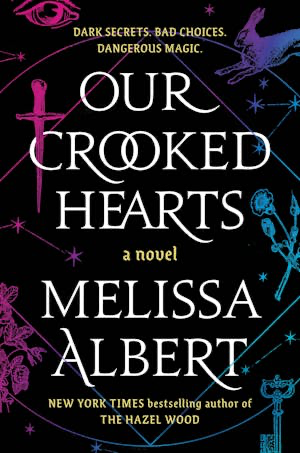
Our Crooked Hearts – Melissa Albert: brimming with magic and secrets, this novel explores a similarly fraught relationship between mother and child.
When I talked about “Dirt on the Bed” last week, I talked about how much Cate Le Bon reminded me of St. Vincent, down to their humbler, more arty beginnings. They’re both arty at present, but the art I’m thinking of is more the quaint, fresh-out-of music college sound that St. Vincent had on Marry Me, an era that she recently jokingly referred to as her “asexual Pollyanna” period. Ouch…I can’t say that it doesn’t make sense, because it…does, in a way, but it feels dismissive of all the rampant creativity swirling about in that album.
Cate Le Bon seems to have wallowed in that artsy, borderline twee period for much longer than St. Vincent did; Mug Museum is her third album, and the tracks I’ve heard all ring with that early-2010’s indie, folksy leaning. Le Bon’s Welsh lilt twists ordinary words into melted candy, and much like St. Vincent, her riffs wind around the melody like tiny flower buds bursting from vines crawling up a fading brick wall. Some songs were made for summer strolls, and “No God”‘s bright melodies brim with sunshine and the security of concrete under your feet as you take a morning walk through the city, stopping to sniff a basket of flowers in the window of a storefront. Her vocals get their well-deserved spotlight in the chorus, rich and bubbling with each drawn-out cry of “No Go-o-o-o-o-d,” swirling into the morning dew.
Yet the cheery exterior hides the grief that clouds her 2013 album Mug Museum; much of the album was written after the death of Le Bon’s beloved grandmother, and the title itself explains the memories contained in ordinary objects—an accumulation of mugs, for instance. But the grief of Mug Museum is more of a recognition of lineage; Le Bon said that “The album was inspired by the loss of my maternal grandmother but rather than it being a grief laden album it is more about what someone at the top of the female chain leaves behind.” The lilting repetition of “No God” is suddenly recontextualized as not necessarily spiritual, but the loss of the ground beneath your feet, the rug pulled out from under you now that there’s no maternal anchor. The God here is more a feeling of connection to your feminine ancestors and the security it brings—and the upending of that security once death overcomes the family.
…AND A BOOK TO GO WITH IT:
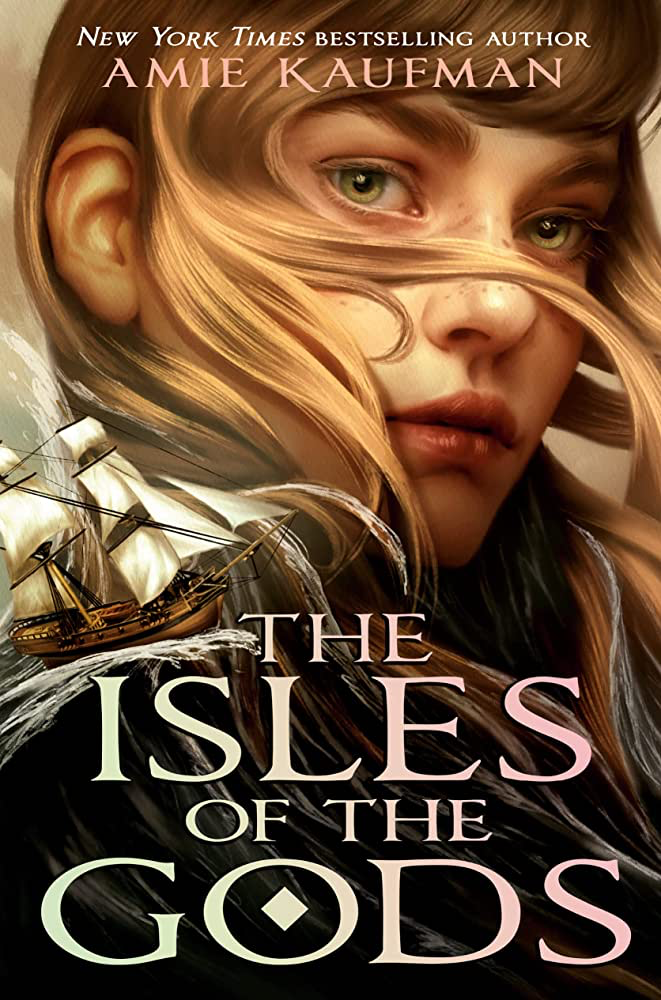
The Isles of the Gods – Amie Kaufman – “When leading lambs lose track/Hands hold me back/I saw a face again/I pulled it from my head/No looking, I know it well…”
Another merit I’ve discovered in my apparent Cocteau Twins summer is that they’re perfect for easing overstimulation. In my ongoing journey to better manage my sensory issues, I’ve compiled a playlist full of songs I use to come down from sensory overload, distinct from the playlist where I just pile on all the slow songs. Sensory overload calming demands a more specific kind of slowness, the kind that oozes relaxation and massages every fold of my overstimulated brain.
There you have it. I’ve just described most of the Cocteau Twins’ discography. The combination of their lazy, dreamlike pace and the swirl of graceful gibberish in Elizabeth Fraser’s vocals make them prime sensory calm material. (That instant muscular relaxation I felt when I first heard “Oomingmak” is a sensation I desperately need to bottle the next time I’m overstimulated.) After a recent bout of overstimulation that had me cycling through all of their music that I had on my phone, I decided to bump Blue Bell Knoll up to a higher priority on my Sisyphean Album Bucket List, but also…y’know, Cocteau Twins. I’m waiting until I’m hibernating in December or January for the wintry Victorialand, but Blue Bell Knoll, with its bedsheet white, silken melodies was a welcome embrace after a month of election anxiety (finally quelled for the most part…anyways, HARRIS 2024). I’m glad that I’d only heard “Carolyn’s Fingers” (a song that goes eerily well with “Creep”…somebody needs to make that mashup), because letting Blue Bell Knoll wash over me in nearly-new wholeness was the best way to breathe it in.
“Athol-brose” starts off with a soft-spoken, percussive beat, but quickly swallows you in a murmuring whirlpool, a whispering chorus of voices bobbing and humming in unison like songbirds on the wind. The more distinct, angular synths pave an easy path to Heaven or Las Vegas, their most famous effort, gliding on nebulous wings through a star-flecked field of melody. In Elizabeth Fraser’s mouth, ordinary words are made into alien percussion; the final repetition of “very very silly ball” rolls against her tongue like the rapid flutter of bee’s wings. Like the red floatboat that the album later sings of, “Athol-brose” feels about the closest thing to riding on a motorboat through a sea of stars, then reaching your fingers out to reach for each glowing filament, watching the light trail around your fingertips.
…AND A BOOK TO GO WITH IT:
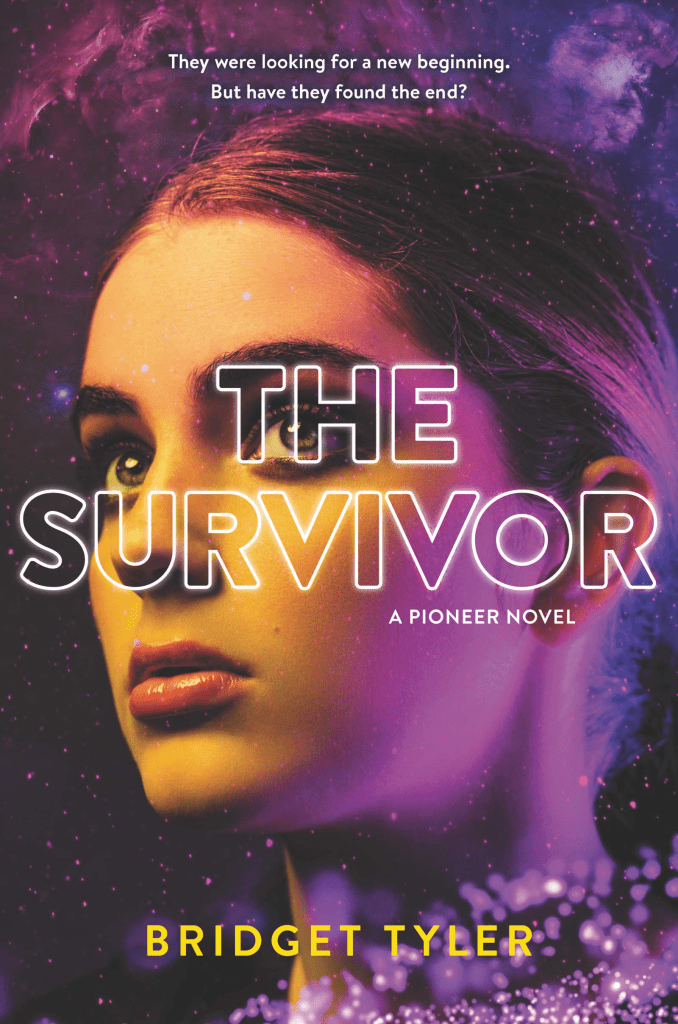
The Survivor (The Pioneer, #2) – Bridget Tyler – there’s a deeply moving scene where an alien character sees his home from space for the first time, and that initial flush of sound fits that explosive wonder.
Lana Del Rey and live-action Disney remakes are two things that have never been my cup of tea, although I’ve engaged with some of her music (“Video Games” remains a nostalgic favorite of mine) and some of the movies when I was younger. I write this fully acknowledging that the rose-colored glasses are so far up the bridge of my nose that they’re digging into my skin, but dare I say that this cover—and the film—are exceptions to the mediocrity? Maleficent was one of my favorite movies growing up, and, yeah, it’s Disney, I’m not about to rush to their defense, but I swear it’s the only one of the remakes where they didn’t outright remake it; they flipped it to Maleficent’s perspective and didn’t just rehash the story with CGI…as all the others have done. Who knows. Admittedly, I haven’t exactly been paying close attention to Disney’s army of remakes.
Either way, this is the one instance of trailerized music that clicks into place for me; James Newton Howard’s haunting, sweeping orchestration clearly set the tone for all of the Epic™️ Trailer Music that came after it, but none of his imitators captured that grandeur he establishes. Lana Del Rey’s husky but rich voice hums through a cover that brushes that silky line between darkness and fairytale innocence. I’ll say it again: nostalgia is at the wheel here, but I’d be lying if I said that remembering this cover and listening to it 10 years after Maleficent’s release didn’t give me goosebumps.
At this point, Stephen Merritt has probably had every weird, toxic ex in the book—either that, or he’s happened to have just a handful with all of those horrible qualities rolled into one. Either way, songs like “Smoke and Mirrors” paint him as exhausted by all of them, and understandably so; this track in particular recounts a lover who tried to woo him with sex and affection to distract from the implosion of their relationship (“Smoke and mirrors, special effects/A little fear, a little sex”). He does admit that it was mutual, but keeping up the façade clearly ground him to the bone. Somehow, Merritt makes sounding so exhausted so enchanting and artful. Melding with the appropriately smoky, hazy atmosphere, his voice drifts in and out of focus, just a passing cloud in the thick fog of synths, backing vocals, and bass. Merritt makes such a disaffected mindset into something purple-gray and glittering at the edges, even if all that color and shine is a sham when you fan all the fumes away.
…AND A BOOK TO GO WITH IT:
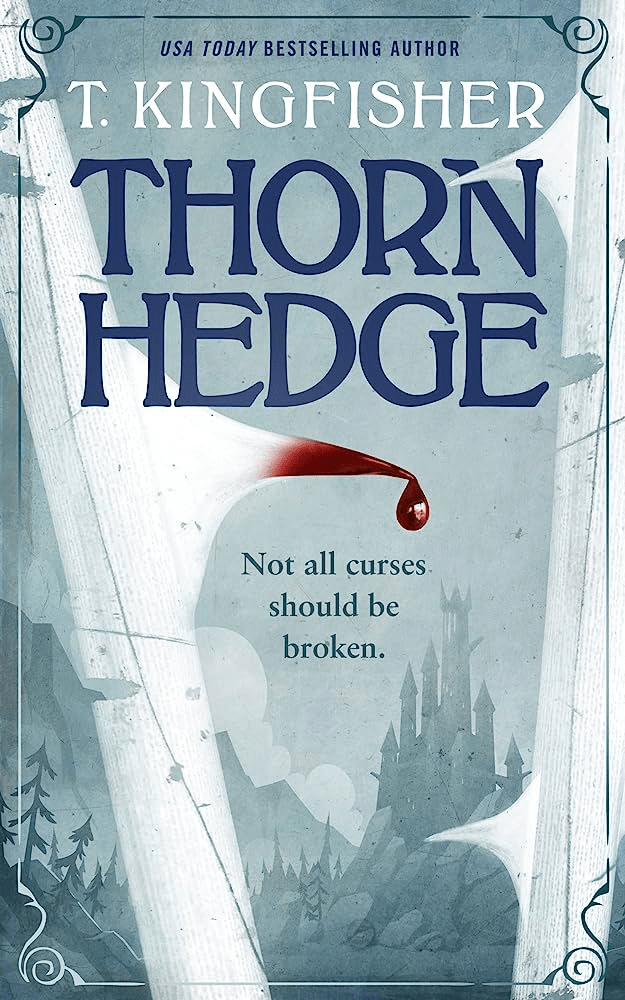
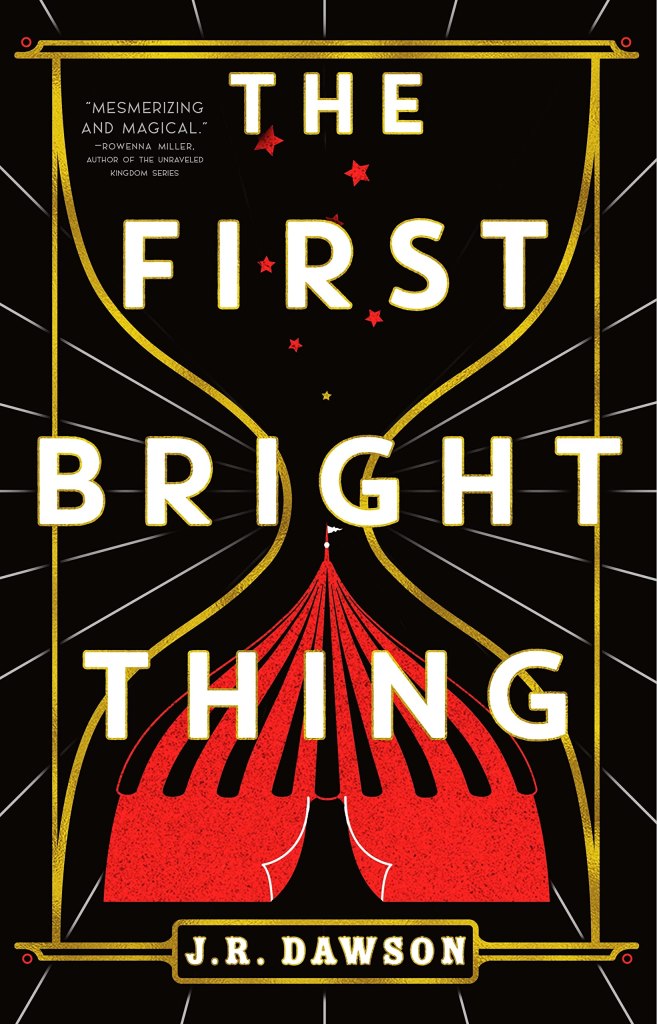
The First Bright Thing – J.R. Dawson – “We were foolish, you and I/But there’s no reason to cry/We put on a lovely show, but that’s all/I had to go…”
Since this post consists entirely of songs, consider all of them to be today’s song.
That’s it for this week’s Book Review Tuesday! Have a wonderful rest of your day, and take care of yourselves!
Happy Sunday, bibliophiles, Happy Trans Day of Visibility, and Happy Easter for those celebrating!
Mentally, I’m still at the beginning of the semester, but somehow midterms are over and I’ve just gotten back from break…ignoring that…
Let’s begin, shall we?
GENERAL THOUGHTS:
I’ve continued to be busy in most of my academic aspects of life, but I’ve managed to stay on top of it—midterms season wasn’t as bad as I thought it was going to be, and it certainly helped that we got an accidental four-day weekend thanks to a snowstorm so drastic that my college called two snow days in a row. I’ve lived in Colorado my whole life, and I’ve never experienced a double snow day…good times, gotta say. I didn’t leave my dorm for all of that Thursday and spent my time playing Minecraft and drinking hot chocolate. A win is a win. But now, the weather’s warming up, and I’m looking forward to soaking it all in.
I honestly thought that this month was going to be my worst reading month, but I read a lot more than I expected; spring break definitely gave me a boost, and March has ended up being my best reading month of 2024 so far! Rating-wise, it’s a different story (certainly more stinkers in this batch), but there were plenty of excellent reads before and after my brief reading slump. Blogging has been about the same—again, school has made it so that I’m mostly sticking to my usual book reviews and Sunday Songs, but I’ve had fun writing them all the same.
Other than that, I’ve just been drawing, playing Minecraft (WE’RE FINALLY GETTING THE DOG UPDATE), studying, watching The Bear, The Completely Made-Up Adventures of Dick Turpin (STAND AND DELIVAH), Abbott Elementary, and Constellation (I haven’t been this stressed out and baffled by a show since Dark, and that’s really saying something), series 17 of Taskmaster, Dune: Part 2 (may thy knife chip and shatter), seeing Chelsea Wolfe live (!!!!! THE QUEEN), and reverting from human to hibernating grizzly bear the minute snow started falling.
READING AND BLOGGING:
I read 19 books this month! I thought it would end up being a lot less than that, but spring break gave me much more time to read. As far as ratings, this has probably been my worst reading month (first DNF and 1-star rating of the year…), but that doesn’t mean that I didn’t read a ton of fantastic books!
I’ve been a huge fan of Melissa Albert ever since I fell in love with The Hazel Wood series way back when (2018? No way…I feel old…). I forget how or why it’s taken me so long to pick up her follow-up, Our Crooked Hearts, but it was worth the wait—this novel made me remember exactly what endeared me to Albert’s writing in the first place!
Ivy has found herself at the center of string of unexplainable events. An eviscerated rabbit in her driveway. Secrets buried in the backyard. And now, a nude woman in the middle of the road that Ivy and her boyfriend almost hit with their car. The more she digs into these strange happenings, the more they lead to her mother, who dabbled in forbidden magic when she was a teenager. Ivy, now the age that her mother was when she started tapping into the supernatural, wonders if this magic has come back with a vengeance—and if there’s a way to control it before it comes back for her mother.
TW/CW: animal death/abuse/torture, blood, gore
I don’t know why it took me this long to pick up Our Crooked Hearts and how I could’ve possibly gone three years without reading something of Melissa Albert’s, because wow. This one toes the line between magical realism and horror, but either way you took it, there’s no doubt that Albert is the master of YA magical realism!
Let’s start with Albert’s obvious strength: the lyrical nature of her prose. Though Our Crooked Hearts wasn’t steeped in fairytales like the Hazel Wood duology was, it was no less enchantingly written. Every line feels like its own fairytale, full to bursting with metaphors so unique I found myself highlighting up and down the page. Albert has the ability to weave magic into the smallest of things, from the small moments in the suburbs to the unexplainable events that litter the plot like strange trinkets found on the side of the road. The Hazel Wood was already luscious, but Our Crooked Hearts feels like a maturation of everything that makes Albert’s writing good: a recognition of the magic in everything, but also of the darkness behind the glitter.
The way that Albert writes magic itself was just as compelling! Though the magic system itself is not gone into depth, it’s understood to be the kind of magic that only awakens in the shadows, summoned by girls left to their own devices without any clue of the consequences. I understood some of the unexplained bits to be a byproduct of how little Dana, Fee, and Marion understood of what they were getting themselves into—they knew about as much as we do. Like the relationships running through this novel (more on that later), it is an undercurrent to every decision that they make, rooted in revenge but later a series of bandages to throw over every little breadcrumb they leave behind by accident. On that note, I loved that this wasn’t simply a revenge story—it started as such, but that revenge grew into something so monstrous that it was spread down through generations. Hmm, sure feels like a metaphor to me…
Our Crooked Hearts is written in a dual POV between timelines, following our protagonist, Ivy, and her mother, Dana; Ivy’s perspective finds her in a quiet suburb, while Dana’s perspective is set in Chicago in the ’90s. I loved how the two of them evolved in tandem—dual POVs aren’t especially difficult to pull off, but having them set in different timelines was such a wonderful move to not only elevate the story, but deepen the mother-daughter relationship at the heart of the novel. In terms of literary fiction, I feel like there’s a trend of multigenerational novels (somehow they’re all set in New York) where they hop between time periods and family members; sometimes they’re successful (see: Elizabeth Acevedo), but often, they miss the nuance of familial connection and just focus on being literary. This is far from literary fiction (complimentary), but what this novel does that a lot of others don’t is make the timelines feel distinct. Ivy and Dana have radically different personalities, and though their journeys of dabbling in forbidden magic are similar, their goals—and endpoints—were so different that I found myself fully invested in both of them.
Mother-daughter relationships are at the heart of Our Crooked Hearts, and the dual POV makes for such a fascinating examination of when such relationships become toxic, and the events building up to the toxicity once Dana began raising Ivy. Dana’s perspective was one of constantly being pulled along—by her friends, by authority figures, and by forbidden magic beyond her comprehension. The guilt that resulted from living a life predicated almost entirely on the decisions of other people tragically informed how Ivy grew up—picking up the pieces, and discovering the pieces of her mother along the way. Without spoiling the ending, I loved how it was resolved—there’s no immediate absolution of guilt once familial ties are brought up (unlike a certain recent Disney film beginning with E), but there’s an understanding to how and why things turned out the way they did. Ivy is still left to sift through the wreckage, but all that she thought was lost was not far beyond reach.
Also, one thing that Melissa Albert can always be counted on is top-tier music references. All she had to do was mention Dana putting Liz Phair on the jukebox, and I was already foaming at the mouth.
All in all, a horrific and lyrical observation on magic and teenage girlhood, mothers and daughters. 4 stars!
Our Crooked Hearts is a standalone, but Melissa Albert is also the author of The Hazel Wood duology (The Hazel Wood, The Night Country, and the companion novel Tales from the Hinterland) and The Bad Ones. She is also the founder of the Barnes & Noble Teen Blog.
Today’s song:
That’s it for this week’s Book Review Tuesday! Have a wonderful rest of your day, and take care of yourselves!







 The Bookish Mutant