Posted in Sunday Songs

Sunday Songs: 2/8/26

Happy Sunday, bibliophiles!

This week: unfortunately, the pink theme couldn’t be scheduled for the week of Valentine’s Day, so enjoy your pink disentangled from the holiday. Also, Madeline being pretentious from the age of 5, a whole lot of beep-boop-beep, and Kathleen Hanna’s answer to these trying times.

Enjoy this week’s songs!

SUNDAY SONGS: 2/8/26

“This Island” – Le Tigre

All rise for the anti-ragebait national anthem! The litany against ragebait, if you will.

I’m sure there’s some activism/politically-involved situation that Kathleen Hanna hasn’t written about, but you have to give it to her—in that sphere, she’s got a song for almost anything. Since 2024, every new Le Tigre song that I discover has hit hard in this political context, whether it’s the perennially relevant reminder to “Get Off The Internet” (destroy the right wing!) or the rallying cry of “Keep On Livin’.” Even in 2008, the internet already had shown the ugly side of not just enabling faceless trolls to spread misinformation, but for anger-inducing content to get the most engagement; it’s been a disaster for everything, really, but especially activism. Pair that with social media’s penchant to push the most shocking angles on news stories that are already shocking (and the sheer volume of said shocking, disheartening news), and you’ve got a recipe for disaster for anybody who wants to doggedly keep hope. It’s ground so many would-be activists into the ground, turning them into despairing doomers convinced that there’s no hope for the future.

“This Island” isn’t exactly the uplifting chant of “Keep On Livin'”, but it doesn’t necessarily need to be. Its target is that kind of person who’s so hopelessly entrenched in internet-peddled doom that they need a bucket of ice water to the face to snap them out of it. It’s tough love (part of the chorus is just a repetition of “You’re a mess!”), but it’s vital if you want to carry on. The brutal 3.3/10-rated (3.3? Did Le Tigre kick your puppy?) Pitchfork review of This Island lamented that the album sacrificed its normal political bite in favor of making it more watered down and commercially accessible. Yet although the instrumentals are smoother and the beats poppier, no major label production could ever defang Hanna and co.; “This Island” rings as an unflinching slap upside the head and a call to remember all of the good things happening in the world; the backdrop of the album was the War on Terror, but now, in…well, a new iteration of just that, this last verse hits harder than ever:

The horizon’s like a ship in flames tonight/You say you just don’t know/If you can take this city, cause the/Rent’s high, and the war’s on/And it’s last call/Even your friends look worried/My friends all think you’re smart/We think you’re super-fine/But it’s high time/I mean it’s high tide…”

I’m not above doomscrolling. Goodness knows that I’ve needed said splash of cold water in my face more often than not. It’s not our fault—social media has been deliberately manufactured to keep you hooked as long as possible; in just the same way, the ruling class wants to keep you hopeless and constantly posting so that you only make money for their corporations and don’t rise up. What matters most is what you are—and what you do—outside of the internet. What matters is that you have the strength of your friends and community beside you. Even when it seems like all hope is lost, we can take this city. Le Tigre took this city in 2004—who’s to say that we can’t do it in 2026?

…AND A BOOK TO GO WITH IT:
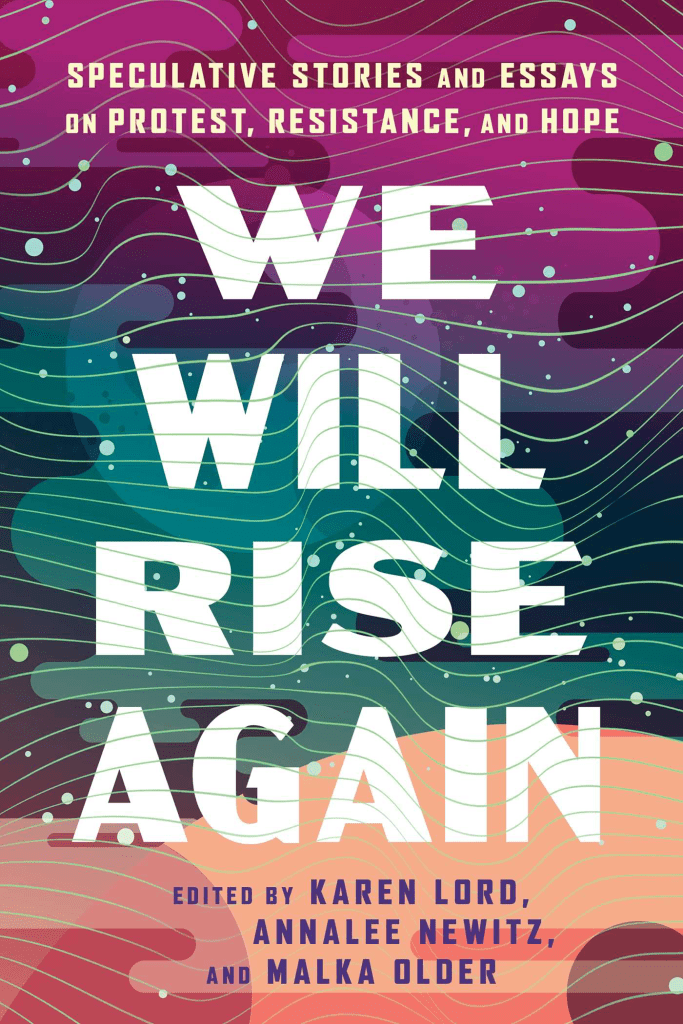
We Will Rise Again: Speculative Stories and Essays on Protest, Resistance, and Hope – edited by Karen Lord, Annalee Newitz, and Malka Olderseveral of the stories in here have a similar aim that Le Tigre did back in the day: to merge political awareness with art.

“Always On My Mind/In My House” (cover) – Pet Shop Boys

Separately, the elements of this song should not work. If you just said, without context, that this was an ’80s synth pop cover of an Elvis song (which was, as with most Elvis songs, a cover in and of itself) that devolves into acid house halfway through and stretches to nearly 10 minutes long, I’d probably be put off, to say the least. It’s like the musical version of “I hate gay halloween, what do you meanyou’re dressed as [insert combination of niche references]?” Things that were only possible in the late ’80s, folks. But against all odds, this is incredible. A few weeks back, I was listening to this on repeat while making a digital drawing, and I got into a flow state so queer that the drawing practically flew from my fingertips. Originally conceived to commemorate the 10th anniversary of Elvis Presley’s death, this, “Always On My Mind” later morphed into the 9-plus-minute remix and combination with “In My House.” Retrospectively, most of the writing on this song talks about how, by all accounts, this shouldn’t have worked. And yet Neil Tennant and Chris Lowe make it look like the combination of Elvis, house, rap, and random firework samples was always meant to be. It’s a case study in lulling a listener into a false sense of security before letting the floor drop out from under them. Every beat drop and twist works seamlessly—the switch from house back into the Elvis cover at 5:26 knocks me off my feet every time. You already need a boatload of talent for a song to sound effortless, but to be able to unite so many disparate elements and make it into a chart-topper—this was the #1 Christmas single in the U.K. in 1987.—takes a special kind of band.

…AND A BOOK TO GO WITH IT:
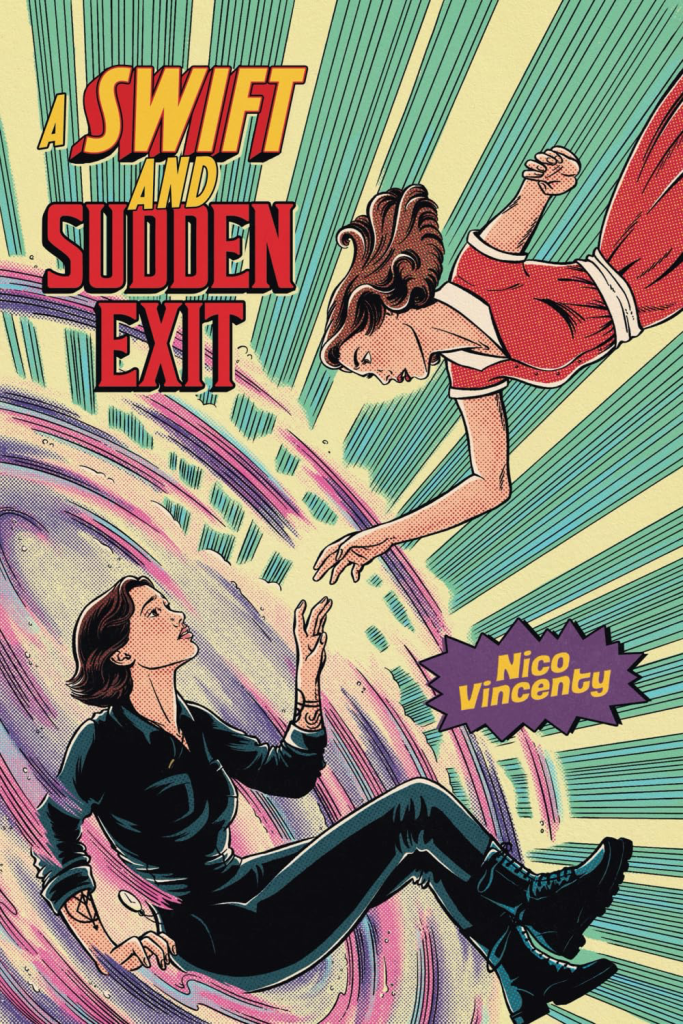
A Swift and Sudden Exit – Nico Vicentythematically, it fits nicely with this book, but this had to have been hidden somewhere in the ’80s scenes (or the ’90s ones, for that matter).

“Cover Me” – Björk

I always come back to Post. To me, it’s one of her most experimental albums, but not in the sense of musical genre—it’s one of her more accessible ones, right after Debut. But it’s much more experimental in its mindset. She sends her feelers out in every possible direction, and the joy of the album comes from the sheer range of emotions and genres she explored, from grimy, electronic tracks to an attempt to channel Chris Isaak’s “Wicked Game” (in the way that only Björk could). The adventurous spirit that she first fostered on Debut, playing the role of ingenue in both her life and music, practically explodes out here. You can hear it more clearly on the louder songs, whether it’s the bevy of strange instrumentals pulsating outwards or Björk herself actually screaming—another staple of her music that’s carried on 30 years post-Post.

“Cover Me,” the penultimate track on the album, is often forgotten in the deluge of other masterpieces stacked on top of each other on Post. But to me, it represents, both lyrically and musically, a key part of where Björk would go later on in her career. It’s a prickly yet twinkly song—the main body of the instrumental consists of hammered dulcimer, which is played in such a way that it feels cautious, like any sudden movement or snap of branches could trigger a trapdoor; the feeling is accentuated by the humid, jungle-like atmosphere, with all sorts of rattling noises that disappear just as quickly as they appear. Without a doubt, it’s one of the less accessible tracks on the album. Every time I listen to “Cover Me,” I feel like I’ve stepped into Henri Rousseau’s painting “Tiger in a Tropical Storm (Surprised!),” pushing aside the woodcut-looking leaves and treading lightly so as not to alert the snarling tiger inches away from me; it’s fearful, but the fear is outweighed by the ecstasy of proving that “the impossible really exists.” Her lyricism feels fairytale-like, as though she’s mapping out an entirely new land, looking over her shoulder to guide you with her commentary; With a sly smirk, she declares, “I’m going hunting for mysteries.” Taking another step forward, she whispers back to you, almost afraid to admit: “This is really dangerous/But worth the effort.”

According to Björk, she wrote “Cover Me” to poke fun at herself for making the process of making the album so pointedly different, and purportedly, difficult. And yet, as the black sheep even in an album swarming with oddball anthems, it’s paved the way for exactly the kind of career that Björk has made for herself. Every part of her life has been about pushing music to its limits, whether it’s bridging together music, science, and technology to make a stunning album and an educational app or creating entirely new instruments for her tours. Björk has never shied away from what’s dangerous, and her willingness to bend, stretch, and outright break boundaries, musically and societally. Though she’s known by more iconic lyrics, this one might just be the best to describe her career so far: “I’m going to prove the impossible really exists.” And if there’s anything to be learned from her endeavors, is that all of that danger was well worth the effort.

…AND A BOOK TO GO WITH IT:
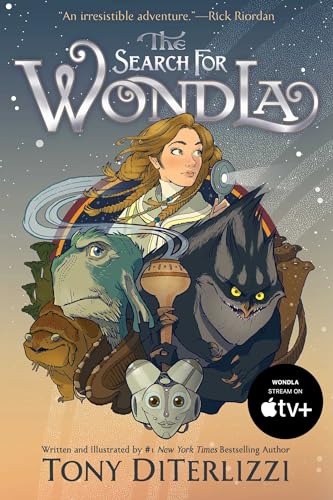
The Search for Wondla (The Search for WondLa, #1) – Tony DiTerlizzi“While I crawl into the unknown/Cover me/I’m going hunting for mysteries/Cover me/I’m going to prove the impossible really exists…”

“Circuit” – Apples in Stereo & Marbles

Tragically, this song (and the album, Expo) aren’t even on YouTube. Criminal, if you ask me! But I think it should tell you how concerningly niche my music taste was, even as a child—”Circuit” was my favorite song when I was about 5. Less of a brag and more of a grim foreshadowing of me becoming an insufferably pretentious adult. Back in the day, I had this great little Hello Kitty CD player; I’ve got a specific memory of having this song on a playlist and having to press down on those thick, 2000’s buttons just so I could hear this song over and over, ad nauseam. I stand by 5-year-old Madeline—it never gets old.

Though it’s labeled under The Apples in Stereo, Marbles is the solo project of Robert Schneider, the Apples’s frontman; if you thought that you can’t possibly get any more beep-boop-beep than The Apples in Stereo…buckle up. Chiefly consisting of synths, Expo is nothing but electro-pop—emphasis on the electro. Every song I’ve heard from the album sounds like the kind of music that could only be made by squeaky robots from some ’50s pulp sci-fi movie. Little me specifically imagined Plex from Yo Gabba Gabba! singing it. It’s a self-contained sci-fi universe, complete with its alluring protagonist, some sort of robot or cyborg woman who “perceives circuitries/Inside everything she sees.” Lo and behold, this is the work of a man, not a machine. But with the precision applied to every single part of this track, “Circuit” truly is a well-oiled machine. Like the intricate, fragile fragments of a circuit board, every flourish of processed orchestral samples and every bubbly synth chord all work as cogs in a machine with so many moving parts, yet with effortless cohesion that so many artists can only dream of reaching. This is how you make a pop song. Embrace the beep-boop.

…AND A BOOK TO GO WITH IT:
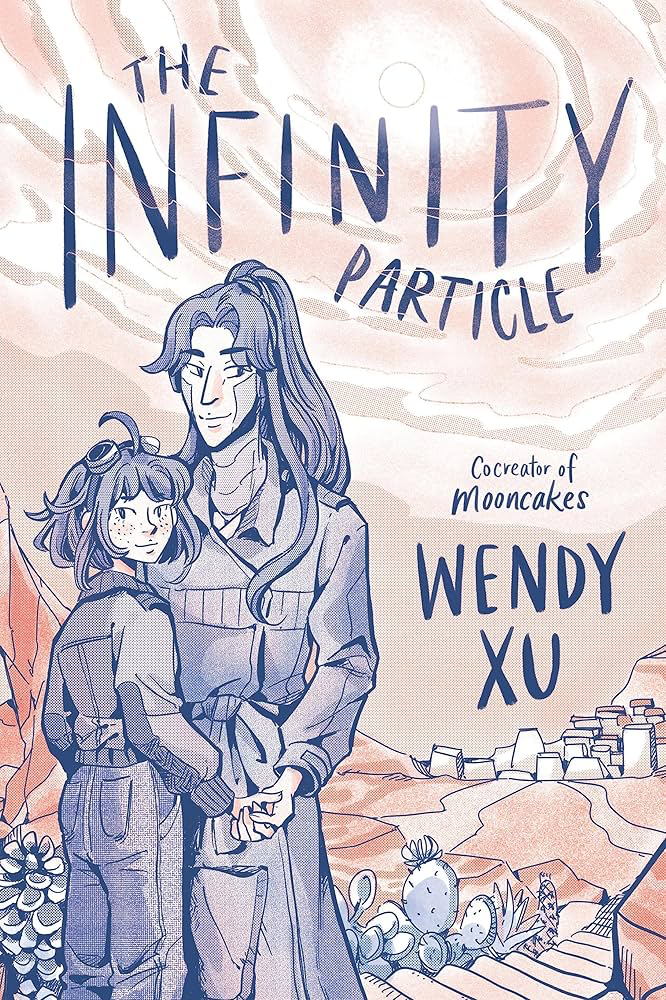
The Infinity Particle – Wendy XuThe robot is gender-swapped here, but he sure does see electricity.

“Typical Love” – Cate Le Bon

“Typical Love” was cut from the Pompeii sessions, but according to Cate Le Bon, was “disassembled and reassembled it many times but it always felt like a second cousin to the other tracks so was put aside for a rainy day.” It’s in limbo between the production of Pompeii but with the kind of lyrics I would’ve expected on Michelangelo Dying, cataloguing the quiet, suffocating mundanity of a relationship gone stale. If it had any closer cousin on Pompeii, it would probably be “French Boys”; it has the same kind of wry comedy of Le Bon putting on airs—she might as well be muttering “Typical love, typical love” before taking a drag from one of those long, old-fashioned cigarette holders. But as with most of her tracks, “Typical Love” is anything but typical, with percussive bursts of her own breath, saxophone blares that bleed out like oversaturated watercolors soaking through thin paper, and an Eno-like taste for taking repetition to its logical limit, stretching melodies and words until they no longer feel like their original forms. It’s all at once angular and circular, like an abstract painting, woven from brightly-colored, dancing shapes.

…AND A BOOK TO GO WITH IT:
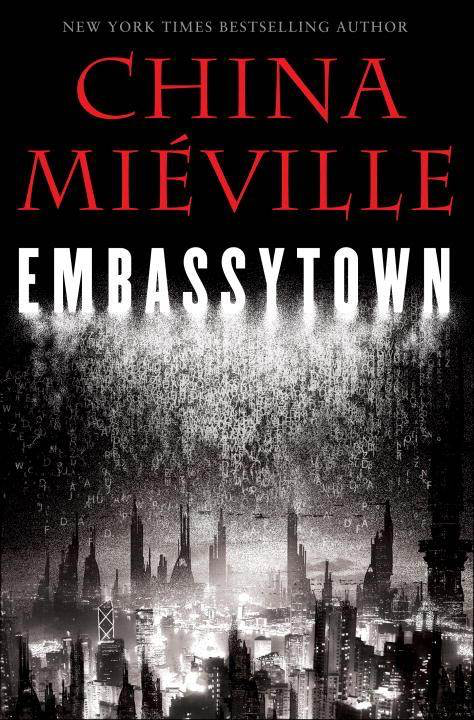
Embassytown – China Miéville“Nothing ever changed in your corridor eyes/Rely on me, baby/Rely on air/Only a shadow again/Typical love…”

Since this post consists entirely of songs, consider all of them to be today’s song.

That’s it for this week’s Sunday Songs! Have a wonderful rest of your day, and take care of yourselves!

Posted in Sunday Songs

Sunday Songs: 6/30/24

Happy Sunday, bibliophiles! I hope this week has treated you well.

This week: this ain’t rock n’ roll…

Enjoy this week’s songs!

SUNDAY SONGS: 6/30/24

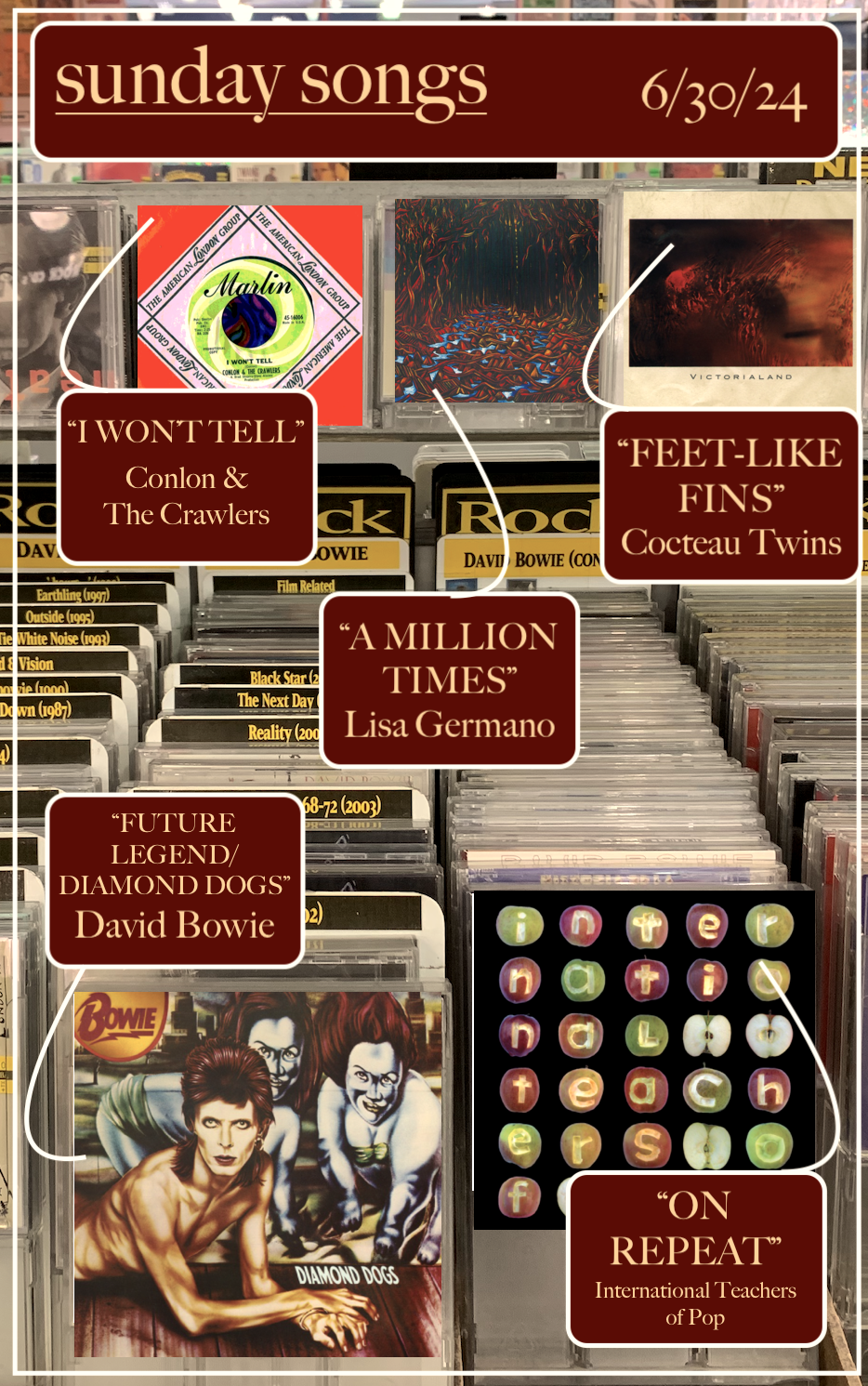
“Future Legend/Diamond Dogs” – David Bowie

Another victim of me trying stubbornly to fit this into a color scheme, and also a victim of me trying to align my albums with what I draw on the whiteboard of my dorm. Listen, if the original sleeve was banned in the U.S., that generally means it’s a cool album cover, but probably not a good idea to be displayed for the world and my RA to see. And I was not about to draw David Bowie’s anatomically accurate canine lower half. Nah.

A time-proven rule: nobody does it like Bowie. You can put on all of the theater and spooky voices that you like, but nobody will ever replicate the sheer goosebumps that the intro to this album induces. The same can be said for many songs on this album (see: “Sweet Thing/Candidate/Sweet Thing [reprise]”), but I put “Future Legend” and “Diamond Dogs” together because the most enriching way to experience them is to experience them as a single song, and that single song is one of my favorite album intros of all time. Diamond Dogs is glam rock covered in flies—the lovelorn hope of Ziggy Stardust remains, but stinking of a world left in tatters, a hunk of rotting meat left for the mutant vultures in the searing desert heat. Cobbled from shreds of William S. Burroughs and Bowie’s failed attempt at a musical adaption of 1984, this album is a dystopia full of lust and peril. As a prologue, “Future Legend” is the height of Bowie’s theatricality. On anybody else, a dog’s howl, distorted as though bellowed through a plastic tube would feel like a feeble attempt to set a scene. Bowie, of course, makes it into the most bone-chilling alarm bell signaling the beginning of the end. It’s not the kind of sound any normal dog makes— it immediately triggers a sense of uncanny valley, a hair’s breadth away from being distinctly, evolutionarily wrong. His staticky narration is accompanied by synthy moans and high-pitched, delirious singsong beasts echoing “love me, love me!” as he tells of an alien landscape where all that remains of the 20th century is the excess it produced, the last monoliths that the mutant survivors of some horrific extinction now cling to. Panting dogs and drooling bloodsuckers lick their lips in the distance as Bowie lifts the curtain to declare this an era beyond the collapsed remnants of our sense of time. No month, no four-digit number to designate this hellscape: it is the year of the Diamond Dogs.

And “Diamond Dogs?” Hearing it for the first time while freshly 13 rearranged my molecular structure. In that moment, nobody had ever done anything as cool as that. It’s still true.

Because there will never be another album intro like this:

And in the death, as the last few corpses lay rotting on the slimy thoroughfare,
The shutters lifted in inches in Temperance Building, high on Poacher’s Hill
And red, mutant eyes gaze down on Hunger City.
No more big wheels.

Fleas the size of rats sucked on rats the size of cats,
And ten thousand peoploids split into small tribes,
Coveting the highest of the sterile skyscrapers like packs of dogs assaulting the glass fronts of Love Me Avenue,
Ripping and rewrapping mink and shiny silver fox, now legwarmers.
Family badge of sapphire and cracked emerald.
Any day now…
The Year of the Diamond Dogs!

…AND A BOOK TO GO WITH IT:

1984 – George Orwellneed I really explain this?

“On Repeat” – International Teachers of Pop

In terms of Co-Pilot, I end up focusing. more on Jim Noir, which…well, he has played a very prominent part in my musical life, but Leonore Wheatley’s musical ventures rarely get the praise they deserve. Wheatley’s talents extend to The Soundcarriers (big thank you to my brother for introducing me to them!), Co-Pilot (who released their incredible album Rotate almost a year ago!! Make some noise!!), and International Teachers of Pop, where she provides vocals alongside Katie Mason.

I’ve heard far too many bands who desperately want to market themselves as a second-coming of a certain era of music (We haven’t recovered from what Stranger Things did to shove the ’80s in everybody’s faces…I want out), but only end up sounding like plastic imitations. The key, which this school board of musicians has figured out, is not to set out to imitate. This sounds like a product that emerged from a desire to have fun and make catchy dance-pop and not try and sound like somebody more famous. Fun should be the prime motivation to make music, especially in a side project like this, but the bar’s low in such a hit-churning industry. You can hear Erasure and the Pet Shop Boys in every synthy buzz and flourish, but not because they set out to sound like them—it’s an homage, never an imitation. Mason and Wheatley’s harmonies center this pulsating track, built for booming bass and bouncing feet. (It really was a shame to see how lukewarm the crowd was in the video above—why are they barely dancing??) With lyrics swimming between existential dread and a desire for oblivious joy, “On Repeat” is the product an extensive pop study. Maybe the name is a touch presumptuous, but they’ve got the talent to back up their assertion, tongue-in-cheek or not.

…AND A BOOK TO GO WITH IT:

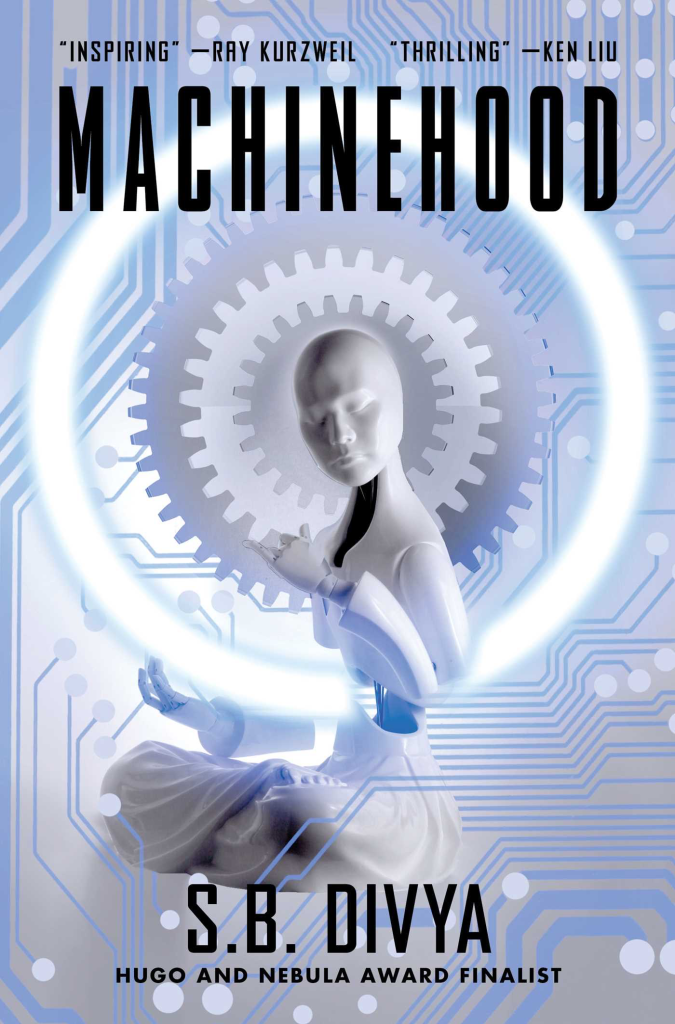
Machinehood – S.B. Divyaooh! aah! capitalism! woo! woo! yeah! this economy cannot sustain human life! get funky!

“I Won’t Tell” – Conlon & The Crawlers

Listen, I am BEGGING the Hacks fandom to do their stuff, because I can’t keep looping this song over and over on YouTube, and I don’t have a record player and therefore have no reason to snag the copies lingering on eBay…PLEASE. WE NEED TO GET THIS ON STREAMING. WHATEVER IT TAKES. DO YOUR STUFF!!!!!

“I Won’t Tell” was one of two one-off singles (the other being “You’re Comin’ On”) by Conlon & The Crawlers, an offshoot of The Nightcrawlers (top 10 band names that I totally want to steal for reasons that are totally not X-Men-related). From the looks of it, neither song went anywhere, and now the only remnants are floating around on eBay, and, thanks to some digging, a few eagle-eyed people on YouTube. All of this begs the question: how were they able to get this on Hacks? Somebody’s got a great record collection…unfortunately, the scene isn’t on YouTube, but it appears in Season 3, Episode 6, and briefly soundtracks a hilarious slo-mo of Ava and Deborah on a golf course, with Ava confidently strutting beside Deborah with her caddy vest on backwards.

The minute I heard it, I knew I had to hunt it down—it encapsulates a very distinct sound of the late-’60s that I just adore. It’s just deliciously jangly, from the opening riff (a reworked and arguably improved version of the opening to The Nightcrawlers’ “Little Black Egg”) to the almost banjo-like strum that builds the track’s backbone. Chuck Conlon’s butter-and-sugar voice spins the strings of “Little Black Egg” into a precocious, peculiar masterpiece—who would forget a song that opens with “A teaspoon holds more than a fork does/A long snail eats more than a short one?” This vibrant, jangly oddball is practically asking to be used for a tightly-shot Wes Anderson montage. Surely it’s obscure enough for him…

…AND A BOOK TO GO WITH IT:

Floating Hotel – Grace Curtislighthearted, jaunty, and equally matched on the Wes Anderson vibes front.

“A Million Times” – Lisa Germano

I’m not sure which direction I should go for next in terms of Lisa Germano’s discography. She has nine studio albums, two of which I’ve already listened to (Excerpts from a Love Circus and Slide). I know I’ll feel like a kicked puppy lying on a dirt road in the middle of nowhere after I listen to any given album, so chances are, it probably doesn’t matter where I start. Either way, on a whim, I dipped my toes into a handful of songs from her 2009 album Magic Neighbor. Many of the reviews have categorized it as having a childlike innocence juxtaposing the veil of darkness that never lifts from her discography, and there’s tangible strings of it stretched throughout. Even if you’ve dictionary-definition Been Through It like Germano has, I feel like you’d still have to have at least the tiniest mote of innocent glee—or humor—left in your soul to name a song “Kitty Train,” even if it’s a short instrumental break.

“A Million Times” has a childish glint to it, but childish here translates to complacency and toxicity; it feels like the emotional progression of “Small Heads,” musically twelve years down the line, but personally, only a handful. (At least…I hope so. I can only hope that the abusive bastard who inspired her to write any of the songs from Love Circus is just one guy, and that he got his comeuppance.) “Small Heads” acknowledges how unhappy she is in said relationship, but wryly admits that it’s not all the other party’s fault: “How convenient to forget/All the lies that you say/When you’re really really drunk…like me.” It’s a mutual kind of tangling, with both people ouroboros-ing themselves into their own minds so deeply that they’ve ceased to think of each other (“Did I ever think of you?/Did you ever think of me?/Probably not, with our heads in the clouds”), or, as Bowie might put it, “making love to [their] egos.” It’s all just fun and games, right? Whee! “What a lonely life!” she sings to the cheer of the crowd and dainty recorders.

Such fun and games echo through “A Million Times.” Said recorder has made a comeback, and all of the egg shakers and brushes in the background sound like remnants of rusty toys being disassembled. Just as childlike, Germano tosses the relationship across the room like a discarded doll, letting its limbs crumple now that she’s had her fun: “We fell in love and we were caught/Inside this game we call together/And it felt good until we found/We had more fun when we were strangers.” Every motion they go through is described in the same way that Ken tells Barbie “we’re girlfriend boyfriend,” smashing doll heads together to simulate kissing. Such kisses and games are a distraction from the inevitable implosion of their excuse for love—they’re so caught up in performing love that both of them have retreated into their own heads, convincing themselves, over and over, that they’re not sick of playing. It’s self-aware in the way that an arsonist is self-aware: they know that they’ve just burned down a building, but they’ll continue to set as many fires as they like. Germano seems to regress as she drags out her cry of “You can’t leave me/No, not really/We are happy with this misery/So we’ll start it all again/A million times, a million times.” Never before have I heard an accordion that sounds so distinctly ominous—the bellow of it as Germano’s lyrics get progressively poisonous might as well be the siren in a bomb shelter, a low, distant warning of disaster to come. “You can’t leave me” is simultaneously the rug of innocence being pulled out and the dread of pulling apart from someone who you know will collapse without you to parasitically cling to. Platonically, I’ve been the host/discarded toy in such situations, so for my sake and hers, I hope Germano’s since quit playing with her dollies. I’m willing to give her some leeway, since if she’s played up the eerie overtones in this song, she recognizes these patterns for the toxic mess they are.

…AND A BOOK TO GO WITH IT:

The Emperor and the Endless Palace – Justinian Huang“We fell in love and we were caught/Inside this game we call together/And it felt good until we found/We had more fun when we were strangers…”

“Feet-like Fins” – Cocteau Twins

Rounding out the month with yet another Cocteau Twins song…sorry, everybody. Get Victorialand‘ed, I guess. The only thing keeping me from swallowing this album in one gulp like some kind of deep-sea abomination of god is knowing that this is the perfect album for winter, what with the Artic and Antarctic inspiration.

Situated near the end of the album, “Feet-like Fins” is a dewy spiderweb of reverb that glitters in waning sunlight through gray clouds. Crested by soft cymbal crescendos, you can never pick out a note from the track that isn’t vibrating like raindrops on a speaker. Even the bongos that gently steady the melody never truly feel percussive, nothing but droplets sending ripples out into the frigid water. Like “Aikea-Guinea,” “Feet-like Fins” is distinctly watery, but where the former feels like being tossed through the waters of time, this track is a gradual descent into the ocean, watching the last threads of silky light disappear into the shallows as you’re pulled downwards. Judging from the “Frozen World,” Living Planet-inspired patchwork of the album, the feet-like fins likely belonged to the various seals that appear throughout the episode: crab-eater seals, fur seals, and elephant seals; Indeed, the sleek movements of this track mirror their bubble-trailing paths through the water as they hunt for prey.

…AND A BOOK TO GO WITH IT:

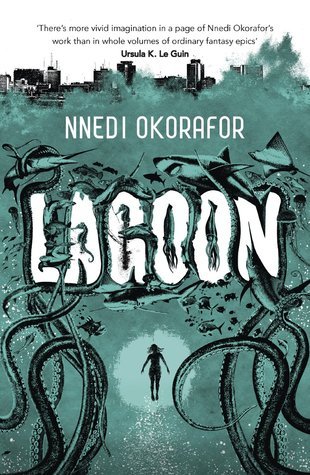
Lagoon – Nnedi Okorafora mysterious, alien lifeform stretches its feelers and emerges from the ocean…

Since this post consists entirely of songs, consider all of them to be today’s song.

That’s it for this week’s Sunday Songs! Have a wonderful rest of your day, and take care of yourselves!