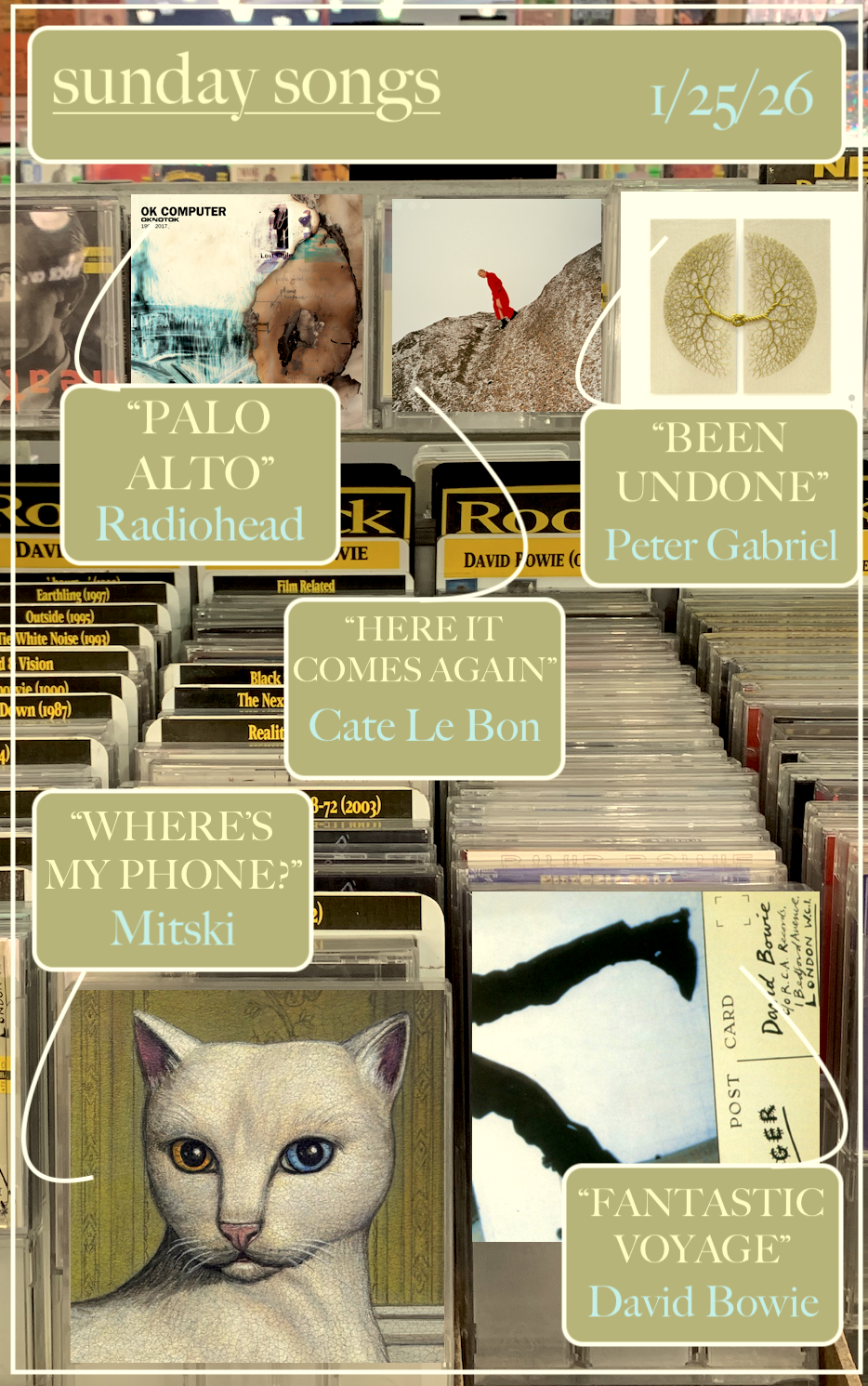
Posted in Sunday Songs

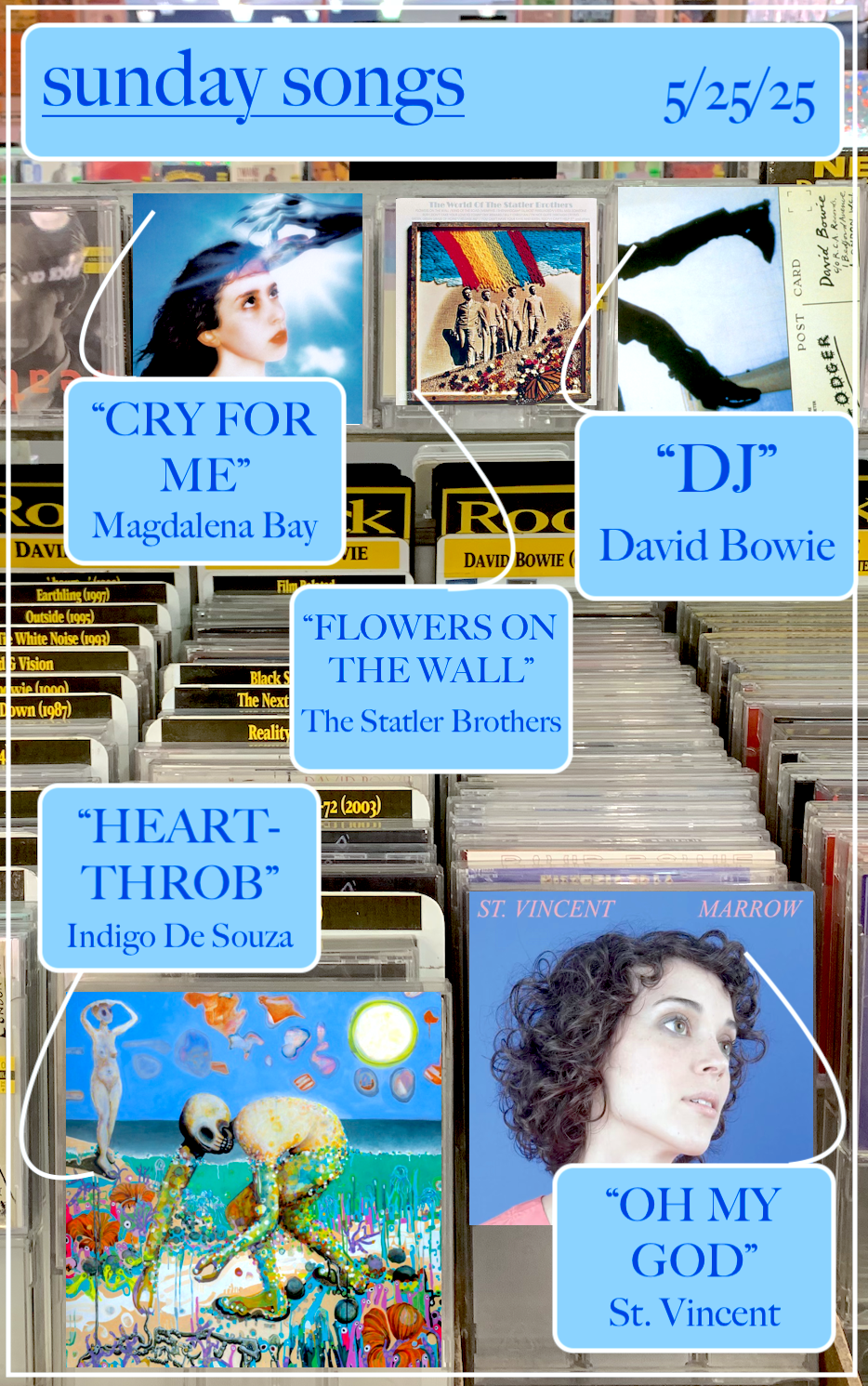
Sunday Songs: 5/25/25

Happy Sunday, bibliophiles! I hope this week has treated you well.

This week: it’s all a trick question. I saw St. Vincent last week, but did she play the song I’m writing about this week? No. Did she play the David Bowie song I’m writing about this week, though?

…yup.

Enjoy this week’s songs!

SUNDAY SONGS: 5/25/25

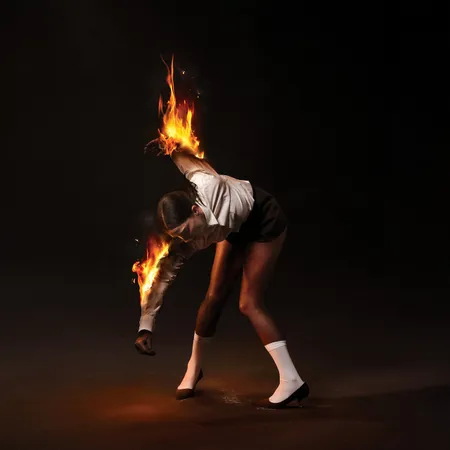
“Heartthrob” – Indigo De Souza

Two years on the heels of All of This Will End (I say that like I’ve listened to it…I’ve listened to about half? Good stuff, though), Indigo De Souza is back with a new album out this summer, Precipice. I don’t know if I’m committed enough to listen immediately (I might go for Any Shape You Take first). To be honest, after briefly hearing whatever the hell that disastrous, autotuned misfire that was WHOLESOME EVIL FANTASY, I was hesitant to see what De Souza had done next. Thankfully, it was far from that. The album cover’s gorgeous, too—the naked skull creature is having its beach episode!

As cheesy as the music video is, “Heartthrob” seems for all the world to be a moment of healing for De Souza, and I’m so happy for her. The chorus of “I really put my back into it” describes the throttle of this track, a more pop-rock offering with trembling vocals but no shortage of determination. The pre-chorus describing De Souza’s experiences of abuse are jarring against the otherwise sunny, bubbly feel of the track, and yet that’s the point; De Souza said that they wrote the song about “process[ing] something that is often hard to talk about—the harmful ways I’ve been taken advantage of in my physical memory. ‘Heartthrob’ is about harnessing anger, and turning it into something powerful and embodied. It’s about taking back my body and my experience. It’s a big fuck you to the abusers of the world.” That passion radiates through every inch of the track through wavering warble and cheerleader-like shout, which De Souza delivers in equal measure. More than anything, “Heartthrob” feels like a release, an outpouring of joy, anger, and passion, a bubbling bottle uncorked. I can’t help but love the rallying cry of “I really put my back into it”—maybe it’s not my favorite song in the world, but for all of the unoriginality plaguing our landscape, it’s refreshing to see people like them pouring it all into their art.

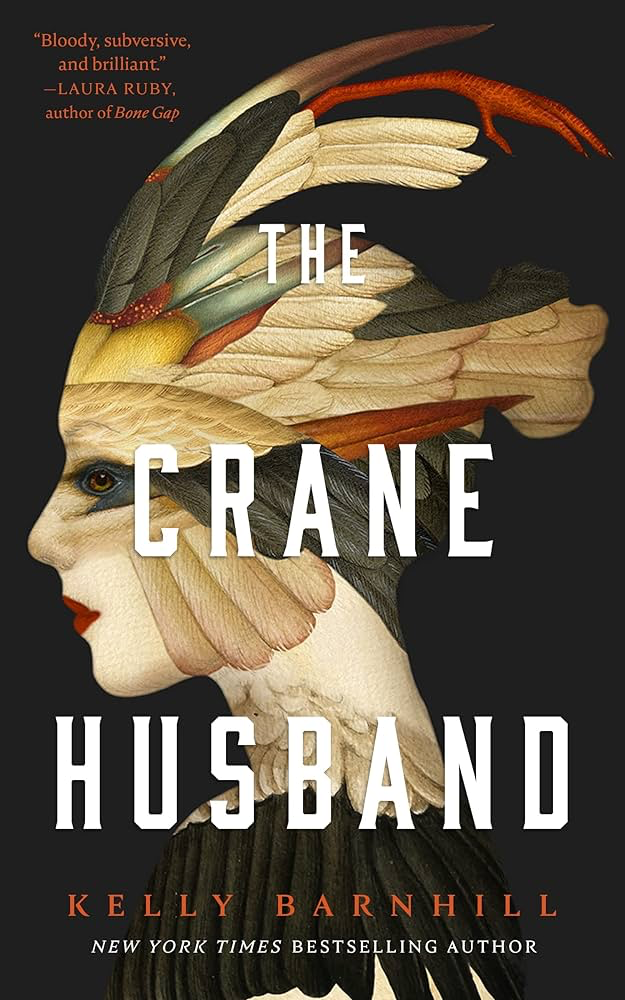
…AND A BOOK TO GO WITH IT:

The Luis Ortega Survival Club – Sonora ReyesA story of feminist resistance and reclaiming your body and identity in the face of abuse.

“Oh My God” – St. Vincent

I had the absolute privilege of seeing St. Vincent for a second time last week. I know I’m obsessed, but it was seriously breathtaking—the setlist was incredible, her stage presence was so captivating, and her guitar playing always knocks me off my feet. I was right near the third row, and I nearly had a heart attack when she started crowdsurfing during “New York”…never thought I’d find myself getting choked up by that song (it’s nowhere near my favorite), but to be so close to her and in the presence of so much love and togetherness began to heal a part of me, if only for a night. Sure, the loungy rendition of “Candy Darling” she did at the end was a bit of a misfire, but if that was the worst part of the night, then it was a concert I’ll never forget.

So without further ado, here’s a song that…she didn’t play, and I suspect that she probably won’t revive unless she willingly goes into her deep cuts. A bonus track from Actor that was also released along with the “Marrow” single (which she did play that night and absolutely annihilated), its deceptively quiet intro hides a suppressed, roiling storm. Like much of Actor, it hides dread and unpleasantness beneath a veneer of delicate woodwinds and finger-picking, but conceals a spreading rot beneath it. The dread veers into focus with Annie Clark’s chorus of “‘Cause when the drink goes in/The devil comes out” after detailing all of the dishes gone without washing and the bathwater gone cold while she’s still in it. A faintly “Via Chicago”-like drum fill patters as the chorus grows in intensity, a chanting of “Oh my god” that never loses its delicacy but turns more from an indifferent remark to a quietly horrified exclamation, as though she sees the landscape of dying houseplants and unmade beds before her. Given that this was a bonus track, it seems that even then, this was a time that Clark wasn’t keen on returning to, but I do find some comfort in the fact that presumably, given that there’s around 16 years behind it, this is something that Clark has deliberately put in the past; MASSEDUCTION saw her dealing with substance abuse and other issues more upfront, but even that’s an era that seems behind her, even if All Born Screaming found her in a darker but seemingly different headspace. I’m glad that she was able to exorcise “Oh My God”—sometimes, you have to extricate those things from your life, but hiding the track in plain sight seems a strategic way to not return to a time you’re not keen on revisiting.

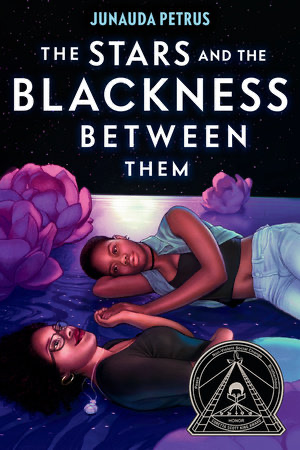
…AND A BOOK TO GO WITH IT:

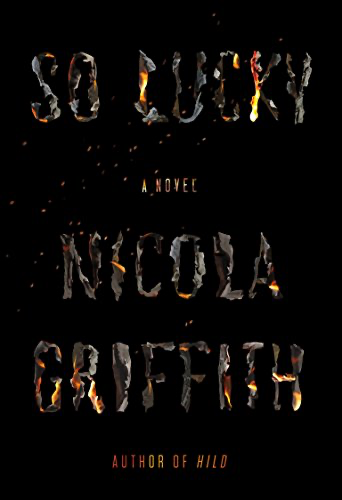
So Lucky – Nicola Griffith“Oh My God” matches the dread of the protagonist, Mara, picking the pieces of her life after losing everything, as well as the lingering feeling that her life is in danger—from herself and from outside forces.

“Cry for Me” – Magdalena Bay

Everything I’ve heard about Imaginal Disk has been nothing short of worship: album of the year (2024), modern classic, cult classic…the list goes on. Imaginal Disk feels inherently tied to hype for me, even though I’ve only heard this song. Again, outsider perspective, Magdalena Bay just seemed to spring up out of nowhere. Before this, I’d only heard a handful of reviews several years ago, a remix they did of Soccer Mommy’s “Shotgun” (not a huge fan, honestly) and this interview they did with Stereogum ahead of Imaginal Disk talking about how much they love the weird CGI in the music video for Peter Gabriel’s “Steam” (which, honestly, so based of them. They really just said “let’s dress Peter up like Jack Nicholson’s Joker and then put his face on as many objects as possible. I don’t care if they’re ungodly cursed.” I love it so much.). There’s also a concept and a narrative I’m missing here—something about a person rejecting some sort of disk put into their head by aliens?—but I’ll do my best.

I was floundering for comparisons for “Cry for Me” at first, but then it hit me. Imagine if the Cardigans had access to 21st century technology in the ’90s, and then imagine them taking that and making some kind of weird disco. They’ve got their uber-’70s violin piano flourishes and bass lines paired with the most modern-sounding, cinematic synths. What’s cooked up is bizarrely good—the at first disparate contrast of Mica Tennenbaum’s air-light voice and the oily chrome of the synths makes for something that works together in surprising harmony. The disco bit sometimes veers into too much for me, but I can’t deny how deliciously catchy “Cry for Me” is—the song’s title is uttered like a seductive plea to cross into a world where everything is glittering and perfect, but once you bite into the fruits, the venom starts pumping through your veins. The crunching, bubbling shift in synths at the 2:00 mark make you feel like you’ve turned a corner on some kind of theme park ride—into what, you’re not sure. For the rowers keep on rowing, and they’re certainly not showing any signs that they are slowing…

BONUS: who the fuck let a keytar in the—oh, okay. Just this once. I’ll allow it. Maaaaaaybe. Magdalena Bay recently covered “Ashes to Ashes” on Triple J, and even though it’s up there with my favorite Bowie tracks, they clearly get how weird of a song it is:

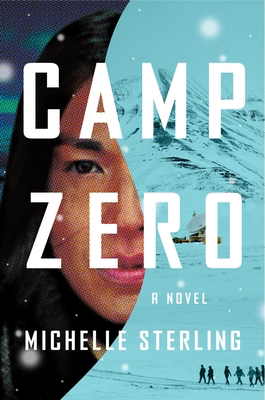
…AND A BOOK TO GO WITH IT:

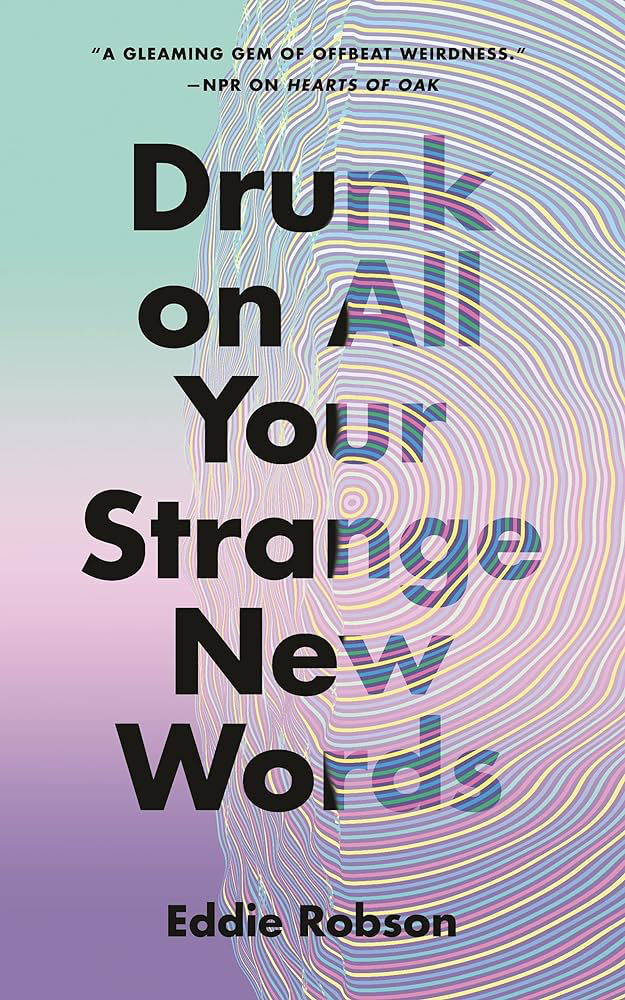
Drunk on All Your Strange New Words – Eddie Robsonagain, I’m not entirely clear on the concept, but if you want alien revelations with unintended side effects, look no further…

“Flowers on the Wall” – The Statler Brothers

Sometimes you remember certain songs at times that are too perfect for words.

“Last night, I dressed in tails pretending I was on the town/As long as I can dream, it’s hard to slow this swinger down/So please don’t give a thought to me, I’m really doing fine/You can always find me here and having quite a time…”

Depression, self-isolation, and making up scenarios transcends time, but getting this song absolutely hooked in my head while I was about a month into lockdown had to be divine intervention. Or something. Minus the more ’60s language, this could’ve been the contents of a long-distance FaceTime call right smack in the middle of 2020. I have a specific memory, give or take five years to the day (I’m just glad I can put some distance from it) of hearing nothing but this song in my head while I was supposed to be recalling something or other about U.S. History for the APUSH exam…a single essay question that I did on my laptop in my bedroom. (Don’t worry, I got a 4. I wasn’t really in dire straits.) Yes, feelings aren’t inherently attached to history, but “Flowers On the Wall” bottled something so succinctly and charmingly. Once it invited itself into my shuffle after years of not thinking about it, that feeling never went away—in a good way. Despite being so pandemic-feeling it never got sullied by it. I’ve never been one for this almost hokier country sound, but it fits the kind of exaggerated state that the narrator’s in—it’s exactly how I’d expect the inner voice of someone who spends their days playing solitaire and dressing up in a tux, never once leaving the house. It’s the catchiest song about extensively denying that you need to touch grass. Truly timeless.

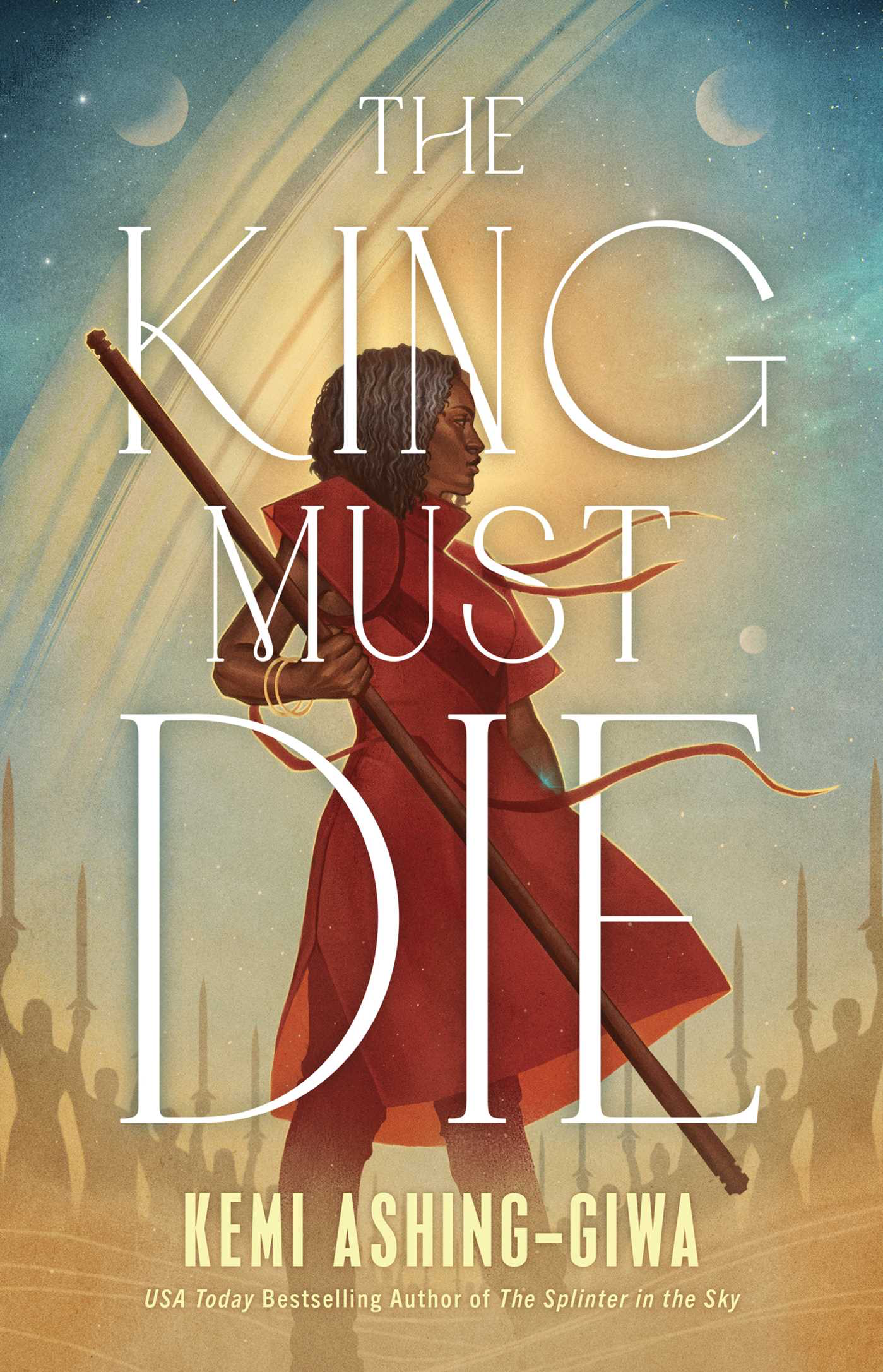
…AND A BOOK TO GO WITH IT:

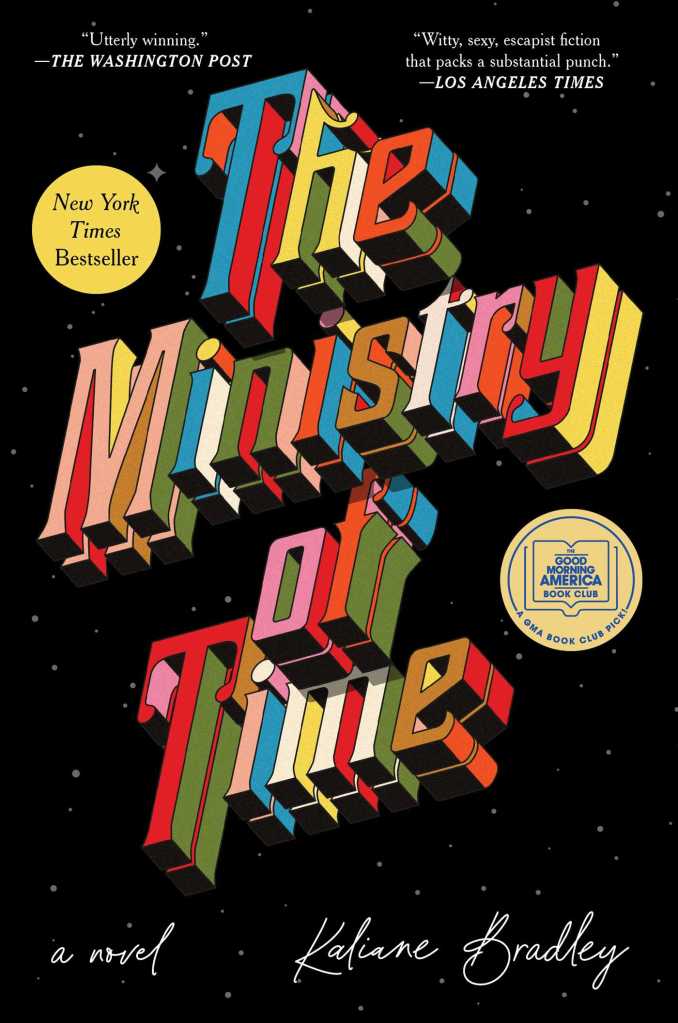
The Ministry of Time – Kailene Bradleywhat else is there to do when you’re [checks notes] a time-displaced polar explorer from the 1840’s who really shouldn’t leave the (21st century) house?

“DJ” – David Bowie

Diversity win! Bowie is breaking his and her heart!

“DJ” has been on the brain because, back to St. Vincent, they played this song not once but twice before she came onstage. Taste, especially from someone who has said that there’s no one she’d put above Bowie.

From Lodger, “DJ” retains some of the theatricality of his glam days, but well past the Ziggy Stardust days. He’s long shed that persona, as well as the abysmal leanings and drugs of the Thin White Duke, closing out the Berlin Trilogy with a slicker flourish that led into the ’80s (see: “Boys Keep Swinging”). It’s got a critical, sardonic eye that he retained from his earlier ’70s songwriting, magnifying the role of a DJ who becomes so swallowed in his career that he becomes it: “I am the DJ/I am what I play/I’ve got believers/Believing me.” According to Bowie, it was his take on the disco culture that had overtaken the ’70s: speaking to Melody Maker, he said, “The DJ is the one who is having ulcers now, not the executives, because if you do the unthinkable thing of putting a record on in a disco not in time, that’s it. If you have thirty seconds silence, your whole career is over.” Yet it’s so easy to see the through line back to himself—persona or not, you don’t have to chip away at much to find the one true Bowie within.

Even if “DJ” didn’t also spell out David Jones’ initials, this fear of becoming inextricable from his music and celebrity was a constant fear of his in the 1970s. 1979 saw Bowie recovering from his devastating cocaine addiction, and that almost-separation from it makes “DJ” feel like a less fatalistic version of “Cracked Actor,” in which he saw his future self as a washed-out, middle-aged actor relying on his past fame to pay the bills.”DJ” sees him inching away from “Forget that I’m 50/’Cause I just got paid” territory, but no less critical—and almost fearful—of being on the precipice of losing his career thanks to one less hit and being seen only as a vessel for the music. In the music video, he’s passed around by fans in the middle of the street; some hug him and seem to make genuine conversation, while others simply try to give him a kiss on the cheek (BRO?? not to get all gen z with it, but did he WANT that??). It’s all at once tenderly human and a little eery watching him weave through the crowd, some seeing a human, others seeing a celebrity. No matter the disaffected sarcasm in his words and lyricism, Bowie’s always there.

As for the music video…I don’t think there’s really any bad Bowie videos I can think of, and even the really bad ones are at least hilarious. But this one seems to fall on the wayside, and I don’t see why! The way that Bowie drapes himself down the blue shutters, the demolishing of the DJ equipment, the proto-Trait pink boiler suit/gas mask combination…he could work anything. Well…okay, definitely not this. Almost anything.

…AND A BOOK TO GO WITH IT:

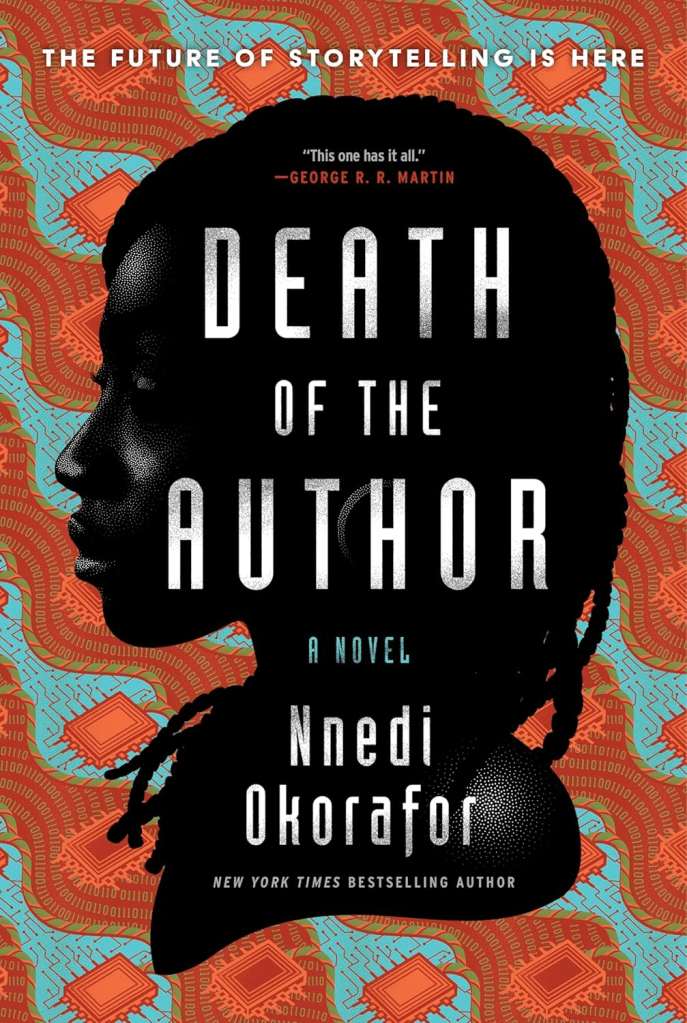
Death of the Author – Nnedi Okoraforanother work about the line between the author, their work, and how the two are interconnected, no matter the perceived separations (and the complications that arise from it).

Since this post consists entirely of songs, consider all of them to be today’s song.

That’s it for this week’s Sunday Songs! Have a wonderful rest of your day, and take care of yourselves!

Posted in Book Review Tuesday

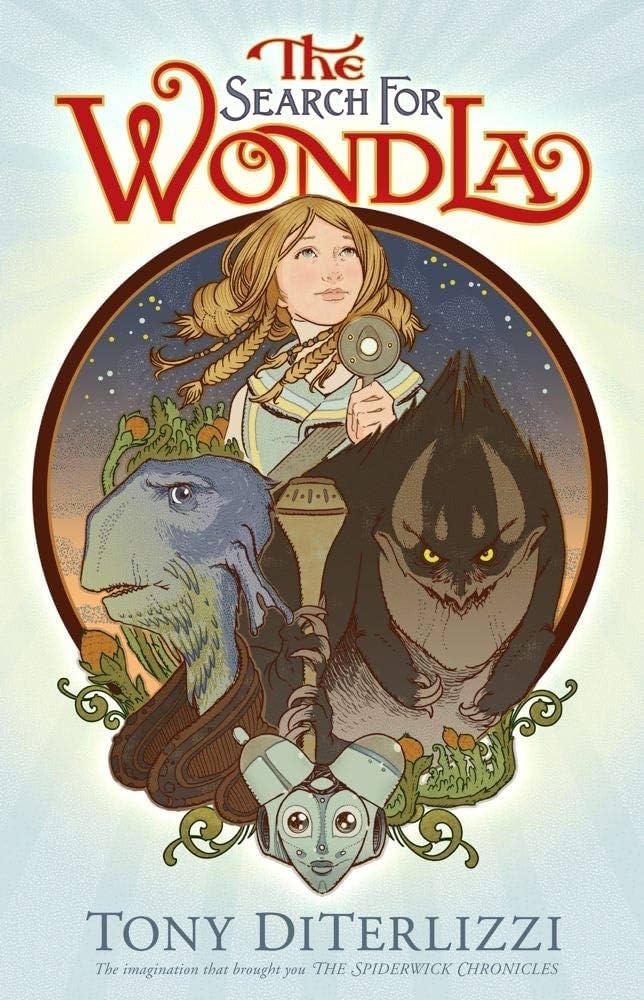
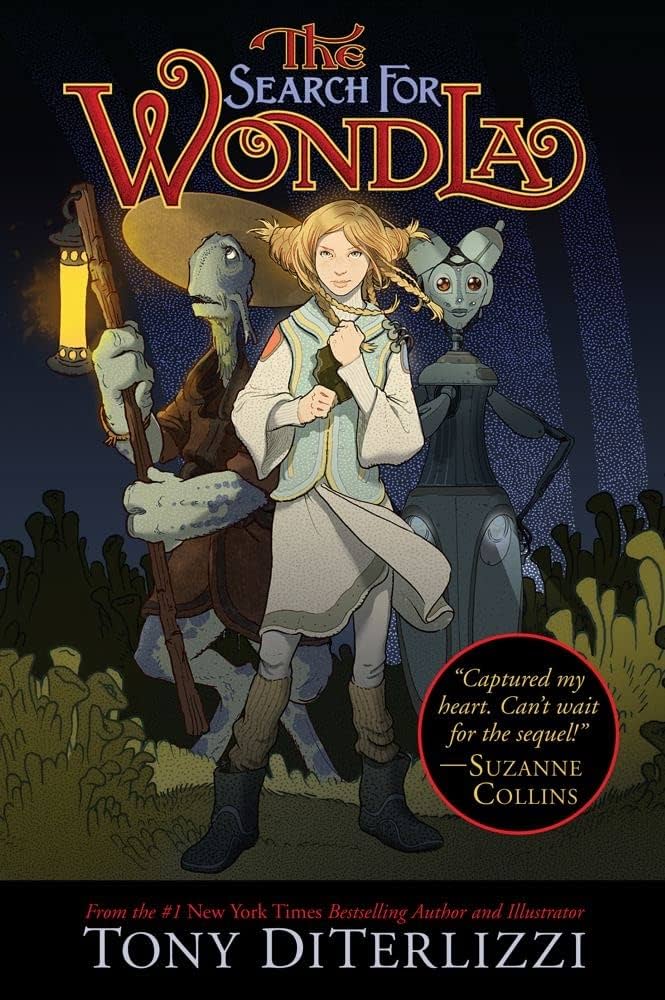
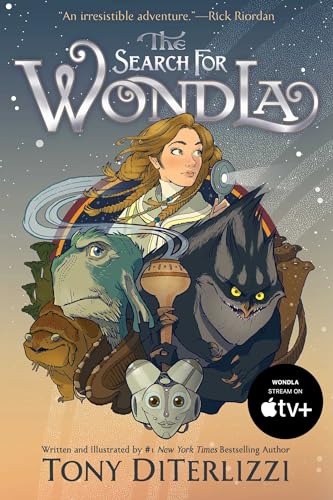
Book Review Tuesday (7/2/24) – The WondLa Trilogy: A Re-Read Retrospective

Happy Tuesday, bibliophiles!

This is going to be different from my normal Book Review Tuesdays, as I’m reviewing an entire trilogy. Normally, that would be a tall order for a single post, but this trilogy is different. It’s a series that I read so often in middle school that even the teachers started to recognize the cover when I brought it in. It’s a series that has woven itself into the fabric of my life, just as Arius’ metaphor of time as a braided rope. It’s a series that inspired me to pursue writing—specifically writing science fiction.

In light of the new (and deeply disappointing) Apple TV+ series, I decided to re-read the series for the first time in six and a half years. Some novels you loved when you were younger don’t age well, but after I devoured all three books in the span of a day each, I can say that Tony DiTerlizzi’s WondLa trilogy has stood the test of time.

Enjoy this week’s reviews!

The Search for WondLa (The Search for WondLa, #1) – Tony DiTerlizzi

Summary from Goodreads:

When a marauder destroys the underground sanctuary that Eva Nine was raised in by the robot Muthr, the twelve-year-old girl is forced to flee aboveground. Eva Nine is searching for anyone else like her: She knows that other humans exist because of an item she treasures—a scrap of cardboard on which is depicted a young girl, an adult, and a robot, with the strange word, “WondLa.”

There definitely wasn’t an ulterior motive to me re-reading this series…totally not just to replace my reviews on Goodreads from 2016 (“OMG BEST BOOK EVER SQUEEEEEEEEEEEE but BIG FEELS”). Yeah.

The Search for WondLa is the reason why I decided that I wanted to write science fiction. It introduced me to a vast world of sci-fi literature that would become my favorite genre. It showed me a rich world full of bizarre, wonderful creatures and told me that I, too, had the power to foster such weirdness in my heart and bring it into the world. When I say that I don’t know where I would be without the WondLa trilogy, I’m not exaggerating in the slightest. Tony DiTerlizzi truly has, like Arius, given gifts to the world in the form of these novels.

The Search for WondLa coexists as a startlingly original piece of worldbuilding while also paying homage to a number of novels and stories—The Wonderful Wizard of Oz, of course, but also the older sci-fi that has inspired DiTerlizzi throughout his career, from Dune to Star Wars and others. There’s Jim Henson lurking in his fanciful creatures, Hiyao Miyazaki in his alien landscapes, and Ray Bradbury in his matter-of-fact, bombastic dialogue. On the subject of both Miyazaki and dialogue, what always cracks me up about this series (affectionately) is the various names DiTerlizzi gives to his characters and places. When I watched Nausicaä of the Valley of the Wind for the first time, my brother and I agreed that the long chunks of expository dialogue were all part of the hokey charm of the movie—it’s distinctly old sci-fi, and it’s so silly that it becomes charming. The same can be said for DiTerlizzi’s naming process…which is so unsubtle that it’s hilarious. Besteel? Surely he’s not a beast-like, predatory character. A fishing village by a lake? Can’t be anything but Lacus, right? Cæruleans? You’re not gonna believe what color these aliens are…but it’s WondLa’s charm. Intentional or not, these names might be one of the most faithful homages to the sci-fi genre.

Even if The Search for WondLa was the only book in the series, some of the character arcs are so expertly resolved within the span of a single book that it would be a satisfying standalone. Muthr’s may be the most clear-cut, but it’s nonetheless deeply impactful; her journey of battling with her own programming and beliefs and embracing the perilous, unknowable beauty of the natural world forms a key piece of the novel’s emotional anchor. She’s clearly the Tin Man, and although she can never fully adapt, by the end of her story, she has most definitely grown a heart. I think Rovender Kitt is the reason why I love the trope of gruff, older characters who reluctantly end up taking children under their wing on a fantastical journey. His development oscillates between heartbreaking and heartwarming in equal measure; Eva helped him remember to have empathy, and he, in turn, became the father figure that she never had. He never stops being gruff and sarcastic, but he rediscovers his caring core. The last few chapters of the novel are brutal for clear reasons, but Rovender’s breakdown, wracked with grief and survivor’s guilt, guts me every time. It’s a drastic shift from the Rovender we see at the beginning of the novel, but almost 500 pages is enough time for him to become the series’ epicenter of guidance and wisdom.

Part of my motivation to re-read the series was because of the Apple TV+ series (spoiler alert: it’s awful. They turned Eva into an adorkable Disney princess. Skip it.), but watching and reading them closely together made me realize what the show fundamentally gets wrong about the series: it’s weird, and it’s unafraid of being weird. All of the aliens have unique, truly otherworldly designs, with no punches held just because the target audience skews younger. Eva Nine is so far from perfect, even by the standards of young girls: her hair’s a mess, she doesn’t have a clue about surviving in the outside world, and yet confidently asserts that she can talk to animals, something that most would have left behind by the time they turn 12. But it’s all true! She’s unafraid of being weird, but that’s where her loneliness arises: she’s not just looking for humans, she’s looking for someone who understands the circumstances that molded her into the confidently strange person that she is…

Somebody hold me. No wonder I read this book to death when I was 12…

For its undeniable role in shaping the course of my life, 5 stars.

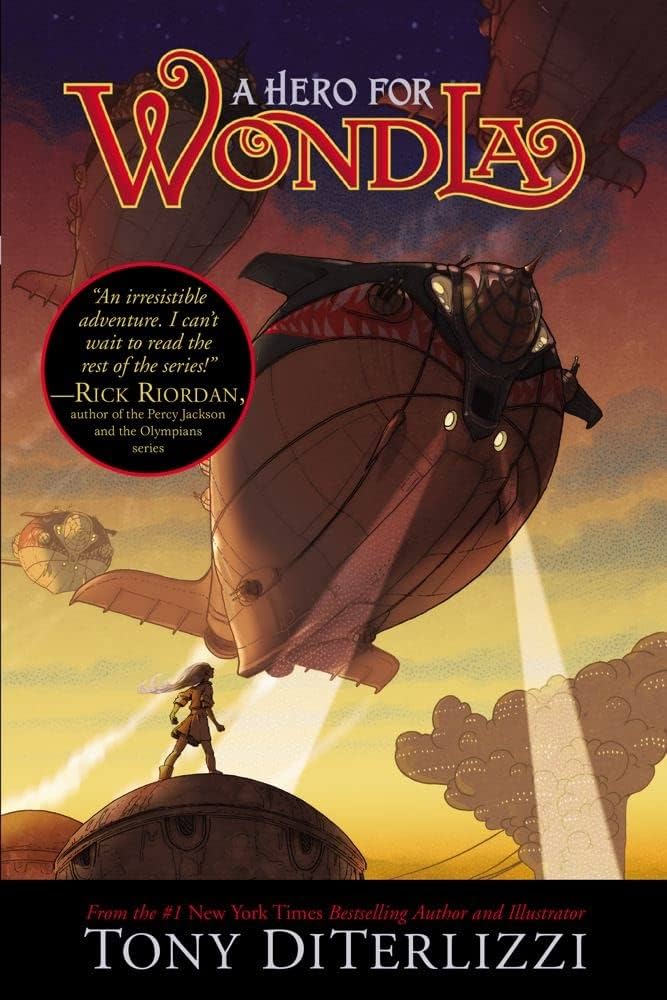
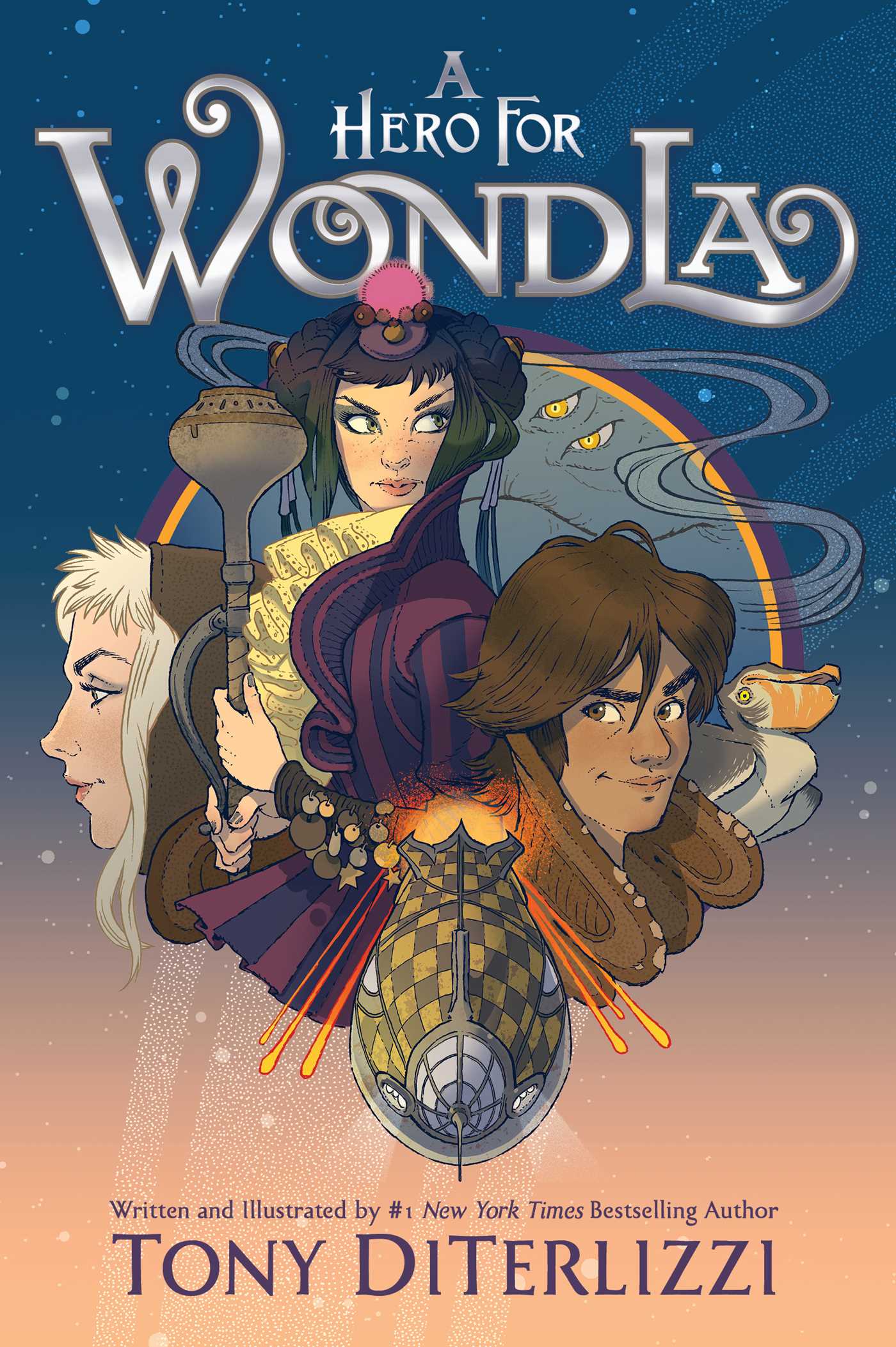
A Hero for WondLa (The Search for WondLa, #2) – Tony DiTerlizzi

Summary from Goodreads:

Before the end of The Search for WondLa , Eva Nine had never seen another human, but after a human boy named Hailey rescues her along with her companions, she couldn’t be happier. Eva thinks she has everything she’s ever dreamed of, especially when Hailey brings her and her friends to the colony of New Attica, where humans of all shapes and sizes live in apparent peace and harmony.

But all is not idyllic in New Attica, and Eva Nine soon realizes that something sinister is going on—and if she doesn’t stop it, it could mean the end of everything and everyone on planet Orbona.

A Hero for WondLa is a truly worthy predecessor to book 1 for so many reasons, but what struck me the most upon re-reading it is how painfully accurate—and beautiful—Tony DiTerlizzi’s depiction of weird middle school girlhood is. I had to stop and remember that yes, this is a middle-aged man writing this, and yes, he has a daughter, but she was still a toddler when he wrote this…and yet he nails it. Right down to the smallest details.

A Hero for WondLa follows Eva Nine’s journey after she’s discovered that she’s not the only human. She visits New Attica, the pristine, final stronghold of the human race, where technology rules all. Eva’s first instinct is to fit in; she’s taken under the wing of Gen Pryde and her Mean Girls 2049 posse of identical, plastic friends, who are intent on making her fit in—they giggle at her sanctuary-born eccentricities, and she’s only praised when they mold her to look just like them. Even after that, they’re laughing behind their hands. She flees their false promise of friendship and into the arms of Eva Eight, her long-lost sister who has waited 100 years for her arrival. Eight hates New Attica and all of its lies, and promises Eva that she’s just like her. And yet, despite this insistence, Eva fails to find solace in her, either. It’s only when she becomes one with the Spirit of the Forest that she becomes her truest self—putting that which gives her power front and center. Like The Wizard of Oz, the (emerald) city she has spent her whole journey looking for is nothing but a sham, and in the end, there’s no place like “home”—the person that she is most comfortable being.

Oh, god. I need a minute. Ow. No other book I can think of captures the limbo of being 13 and not knowing who your real friends were lodged so deeply into my heart. Eva, like me, was so desperate for friendship and human connection that both attempts ended in complications, but through it all, everything came back to the found family she has built—the outcasts, the prisoners, the exiled. The ones who had her back. The ones who were just as confused as she was, but joined her journey after realizing the error in their ways.

The aesthetic language of A Hero for WondLa is drastically different than book one, with its pristine, plastic city of humans living in a bubble. Even the clean walls of Sanctuary 573 had a retro feel to them—likely centuries outdated from New Attica’s tech—but all of this is so blindingly new. None of the robots and automatons have the same old-fashioned friendliness as Muthr, trading approachability for sleekness and monstrous amounts of wires and tentacles. But along with it is a sinister aspect that DiTerlizzi doesn’t shy away from; I’d forgotten that, although the discussion is brief, that it’s implies that among all of the mind-control and executions that Cadmus Pryde is carrying out eugenics is casually a part of his long list of crimes against the last of humanity. The WondLa trilogy isn’t one to shy away from darkness (part of why it’s stood the test of time for me), but that aspect stood out, especially since this is science fiction we’re talking about, a genre that has a long history of portraying the eradication of disabilities as a sign of progress. I’d remembered that there are a handful of disabled characters, but having that as a clear signifier of evil in a middle-grade novel is something I can’t praise enough.

The Search for WondLa is a very self-contained story; although book sequels surpass it, in my opinion, the conclusion that it ended on (minus the epilogue) was hopeful and wrapped-up enough that it could have been a reasonable end to Eva Nine and Rovender’s journey. But this novel does such an excellent job of intensifying the stakes in so many ways. As Eva learns of a conflict that could soon entrench the whole planet in war, we get so many of the real time costs. Foreshadowed details, hinted at from the start of the series, metamorphose into sinister threats. Interpersonal relationships become tangled in this vast, interspecies conflict—nobody knows the truth. Side characters (although all but one do end up surviving in the end) often die mere chapters after they’re introduced. It’s a very tense book in and of itself, but as the setup to the massive conflict in the final book, it’s a masterclass in building up both physical and emotional stakes.

And…good god, all of Rovender’s emotional moments always kill me the most. Without going too in-depth, the scene of his complicated reunion with Antiquus destroyed me when I was younger, and it might have destroyed me even more…

It reminds me of another song that similarly destroys me:

“There will come a day/When the Earth will cease to spin/You’ll hold me close and say: ‘my God, where have you been?'” (Shakey Graves, “Chinatown”)

For the deeply emotional journey, then and now, 5 stars.

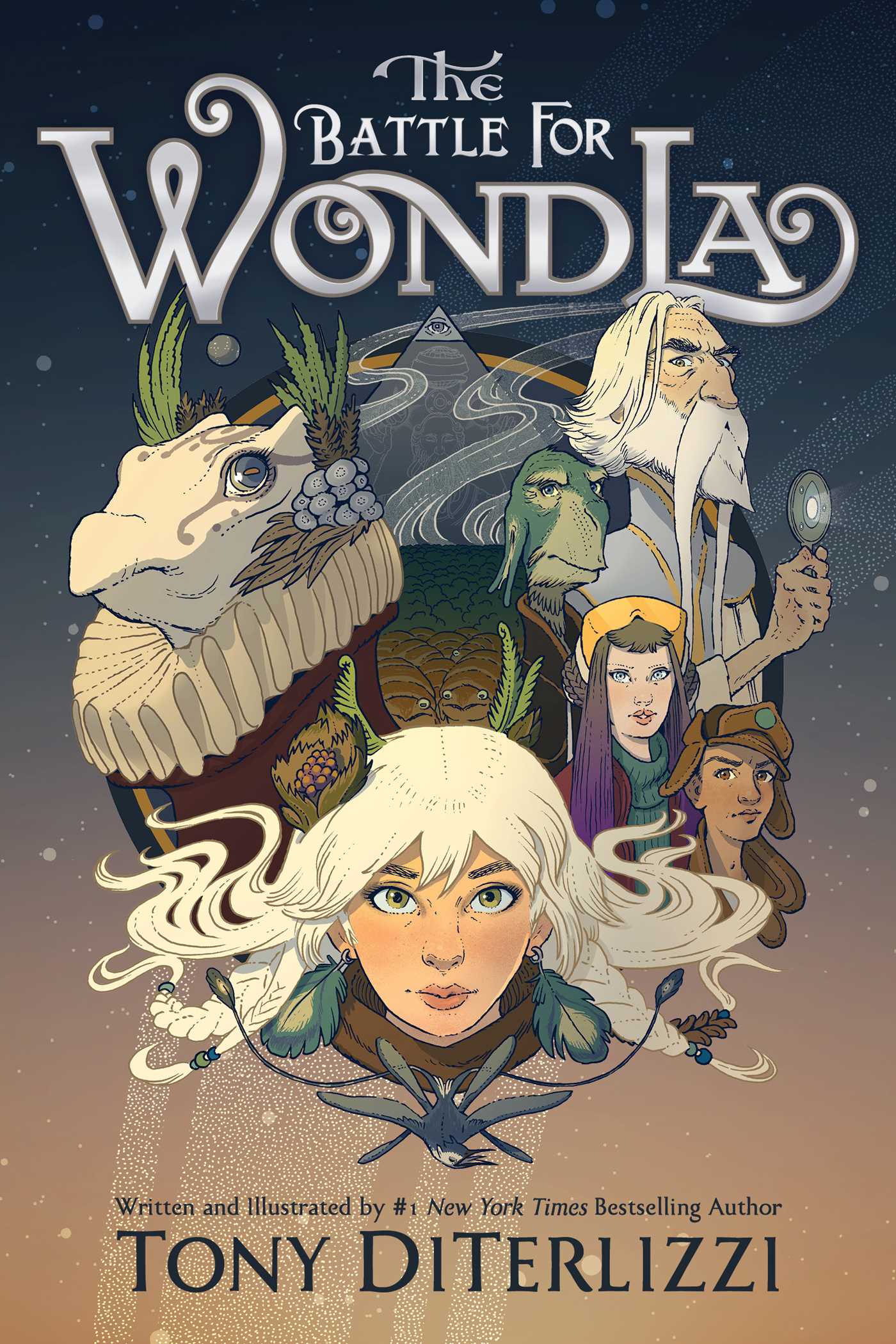
The Battle for WondLa (The Search for WondLa, #3) – Tony DiTerlizzi

Summary from Goodreads:

All hope for a peaceful coexistence between humankind and aliens seems lost in the third installment of the WondLa trilogy. Eva Nine has gone into hiding for fear of luring the wicked Loroc to her companions. However, news of the city Solas being captured by the human leader, Cadmus Pryde, forces Eva into action once again. With help from an unlikely ally, Eva tries to thwart Loroc’s ultimate plan for both mankind and the alien life on Orbona.

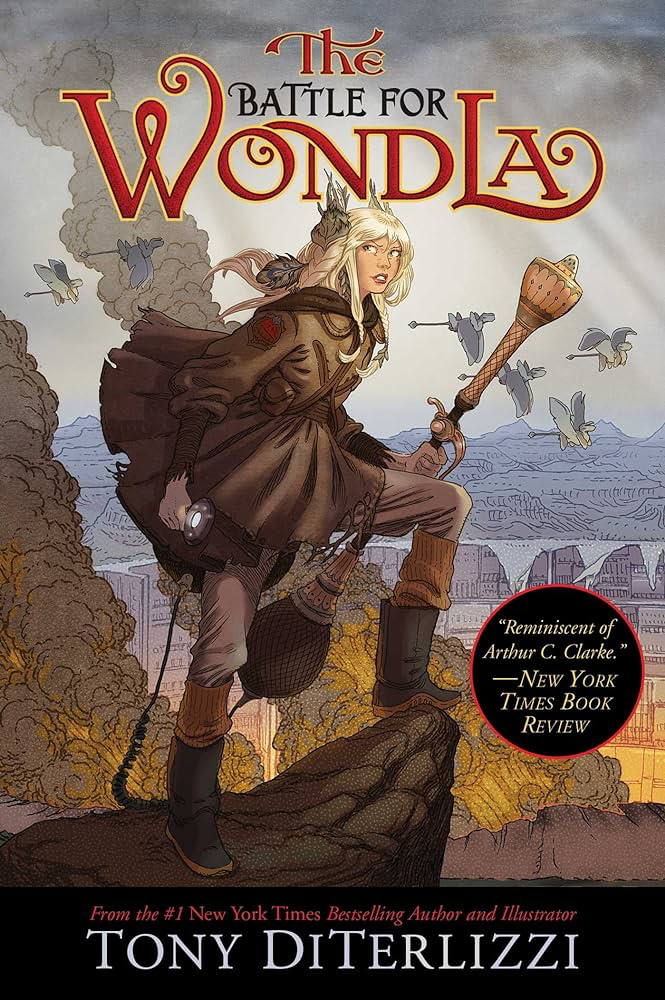
The Battle for WondLa was my favorite book of the trilogy when I first read it, and I find myself agreeing with the sentiment almost a decade later. Was this influenced by the fact that, in retrospect, the original book cover almost certainly contributed to my bisexual awakening at age 12? Maaaaaaybe. In all seriousness, it’s such a brutal, beautiful, and downright exhilarating conclusion to a series like no other.

This incarnation of Eva Nine, as matured as we see her in the trilogy, has always been my favorite. After she embraces her powers and connection to the natural world, she’s such a fascinating hero to follow, partly because she never fully gives up her younger traits. In fact, her powers lie in what made her a target in the first novel—her sensitivity and empathy. Now that she can communicate with all of the creatures of Orbona, she uses her sensitivity to find it within herself to accept the machinations of the natural world and show mercy for even the most frightening of beasts. Sensitivity is her superpower, and that is such an important lesson for younger readers—especially young girls. It’s overwhelming to feel everything all of the time, especially when you’re Eva’s age, but having a heroine who wrestles with that and learns to fine tune her all-seeing empathy and use it to her advantage is so, so crucial. I’m likely among a majority when I say that my sensitivity was often treated as a weakness growing up, so having a heroine whose sensitivity saves the world is just about the best role model you could write for a young girl.

As the title suggests, The Battle for WondLa boasts some of the best battle scenes in the whole trilogy. I’m not talking about the massacre of New Attica, although that remains truly brutal, but the ones that display Tony DiTerlizzi’s talent the most is the scenes where Eva uses the sheer might of the forest to win her battles. Now that I’m older, I’ll inevitably associate WondLa with Björk for a number of reasons, but Eva Nine goes from that precocious, earlier “Human Behaviour” Björk straight into “Nattúra” as her development goes on—unflinching femininity channeling the incomprehensible power of nature. Does it get any better than that, folks? Actually, it does—watching Eva Nine take down a squadron of Warbots with the help of a herd of giant water bears. “My herd…help me.” COME ON. Eva getting injured and then being carried back into battle by the mother sand-sniper that she freed from the menagerie? GIVE IT TO ME!! A highlight of the novel, without a doubt.

What stands out to me about Battle is this novel’s willingness to make complicated characters. Whether they’re the culmination of arcs of characters who have been in the series for multiple books or side characters that only show up in the latter half of the novel, there’s something to be said for how unflinchingly complex everyone is, and how that further complicates Eva’s quest to unite humans and aliens on Orbona. Hailey, with whom Eva is still (justifiably) bitter over her treatment in New Attica, sheds his tough, cocky exterior to reveal a loyal, humble friend by the end of the novel. Zin’s scientific distance becomes a detriment to him in the wake of the death of his family—and the threat exerted by his power-hungry brother, making him realize the error in his lack of emotional intelligence. Redimus, who unintentionally caused nearly all the dominoes for the entire series to play out against Eva, is never written as fully black or white; Eva can never fully bring herself to forgive him, but she learns to accept his attempt to, in his own words, “rectify his past actions,” and to accept that everyone is a web of decisions and consequences that never fully align with each other. And that’s what makes her journey feel so much more earned.

At the heart of The Battle for WondLa is connectivity—it’s all very “I/O” to me. Loroc’s ultimate goal is to unite Orbona, but unity in the form of everyone, human and alien, being either enslaved or consumed by him. He tricks his allies with promises of harmony, only for them to realize that harmony ends up being the harmony of being together…inside of his stomach. Eva wins by championing the fact that it’s the uplifting of everyone’s unique strengths that makes a community strong, whether it’s the unity of the aliens or the interconnectedness of all of the plants and animals of Orbona. We are each an integral part of a community, whether it’s a food web or a village, and it is those unlikely connections that make us stronger. As with today, the greatest mistake that any civilization can make is thinking that we are separate from nature. To once again quote Peter Gabriel, “I’m just a part of everything,” and that is where strength—and love—come from.

All in all, an unforgettable finale for a series that changed the trajectory of my life overwhelmingly for the better. 5 stars.

Tony DiTerlizzi is the author of several books for both early readers (Adventure of Meno, Ted, Jimmy Zangwow’s Out-of-This-World Moonpie Adventure, G is for One Gzonk!) and middle grade (Kenny and the Dragon and The Spiderwick Chronicles, co-authored with Holly Black). All seven episodes of WondLa are now streaming on Apple TV+*.

*I could only make it through 5/7 episodes before I had to quit. Only watch it out of morbid curiosity or if you have intentions to read the books and see how you got robbed.

Today’s song:

thank you to my brother for turning me on to this one!!

That’s it for this week’s Book Review Tuesday! Have a wonderful rest of your day, and take care of yourselves!

Posted in Music

All Born Screaming – album review

Happy Friday, bibliophiles!

2024 has proven to be momentous for my inner middle schooler. A new St. Vincent album, and the Apple TV+ adaptation of The Search for WondLa…exists. I may revert to my middle school self if everything else about the show is as terrible as the “reimagined” character designs. But that’s not what I’m reviewing today.

Those of you who have stuck around on this blog may remember me enthusiastically reviewing Daddy’s Home on the heels of surviving the hell that was junior year during COVID. Those who have stuck around longer still remember my middle-school rant about MASSEDUCTION. (I’d rather you…not remember the specifics of the latter, but I still count that album as her lowest point.) Her self-titled record was as much of a friend as an album can be when I was 12, struggling to reconcile being unapologetically myself and wanting the acceptance of my peers. Marry Me was the first album I ever bought with my own money, and Actor, Strange Mercy, and Love This Giant all saw me through high school. All that is to say that St. Vincent has been there for me in the best of times and the worst of times. So naturally, I did scream when I found out about All Born Screaming—not just a new album, but a supposed return to her harder sensibilities—was coming out this year. And while it wasn’t fully the rock album that was marketed—or as musically cohesive as she tends to be—All Born Screaming is, without a doubt, some of her best work in years.

As I’ve been excited about this album for months—and writing more about music than I have in past years—I’ve already reviewed 3/10 of the tracks from All Born Screaming, so I’ll link to each separate installment of Sunday Songs that I reviewed them in, so as not to sound like a feral, sobbing, broken record.

Let’s begin, shall we?

ALL BORN SCREAMING – ST. VINCENT

Release date: April 26, 2024 (Total Pleasure)

TRACK 1: “Hell Is Near” – 8/10

St. Vincent tying the aesthetic and merch in with images of marigolds is pure evil. Diabolical. Diabolical of them to pair one of my favorite artists of all time with my favorite flower…holding out until she announces a date near me until I buy that one marigold shirt, because it’s an inevitability. It’s only a matter of time.

“Hell Is Near” is an opener that creeps through the shadows on feet that you can barely see coming. With a thumping bass that thrums like a heartbeat witnessing horrors in the dark, it feels like the slithering transition between eras and personas, especially with the allusion to “The Nowhere Inn” (“Snubbed out smoke in a pack from the Nowhere Inn”). I can almost see Clark crawling out of some kind of giant shadow box as the song progresses, the heartbeat bass echoing off of every wall as her hands emerge from the darkness. I can’t help but think of the chord progression of “Prince Johnny”—this album is the most similar to the self-titled record since the record itself, and it’s clear that she’s cobbling this current aesthetic upon shadowier corners of that era, with guitar riffs that seem to interlock like strands of DNA. It’s a slow trickle of an opener, and as it dissolves into a flurry of high piano notes and fluttering synth, it leaves you guessing—where could she possibly be taking us to next?

TRACK 2: “Reckless” – 8.5/10

“Reckless” almost feels more like an opener than “Hell Is Near” does, even though the latter does a fantastic job of being an opener. After “Hell Is Near” dissolves, we return to sparse wasteland that the first track set up, but with a significantly darker tone—both speak of leaving the past behind, but “Reckless” turns “Hell Is Near”‘s willingness to move on to dwelling on it.

If there’s one thing about new music that I always live for, it’s those moments where you hear a lyric for the first time and physically have to stop in your tracks just to process how beautiful it is. Last year, I had that moment with Wilco’s stunning “Sunlight Ends”—”you dance/like the dust in the light” made all time stop around me. Jeff Tweedy just does that. And so does Annie Clark—it’s hard to think of a line on All Born Screaming more hard-hitting than this: “I’ve been mourning you since the day I met you.” Even if it precedes “Flea” and its tale of a love so predatory that it becomes parasitic, this feels like the fallout; it feels like a reconciliation, or just a realization of a feeling of destroying everything you touch, knowing that your actions will eventually drive away everyone that you will ever love. Whatever the narrator did has become so thoughtless and violent that it’s left them with nothing but “the smell of your hair on the curtains, babe,” and all that is left of them is a memory that they cling to with all that they can, knowing that what they did was enough to send them running for good. The sparkling synths that burst like faulty wiring at 2:38, around 2/3 of the way through, feel like the memory of the outburst that left them isolated, longing for something more, as Clark stares out the window like a widow remembering how her lover was slain in the war. This, unlike “Hell Is Near,” felt like a more certain sign of things to come—the wires have been cut, the dishes are shattered on the floor, and your heels are burnt and bleeding from stepping on them both.

TRACK 3: “Broken Man” – 10/10

Reviewed on 3/10—I haven’t stopped foaming at the mouth, thank you very much

TRACK 4: “Flea” – 10/10

Reviewed on 4/7—no, I still haven’t recovered from “I look at you and all I see is meat,” why do you ask?

TRACK 5: “Big Time Nothing” – 8.5/10

This is what MASSEDUCTION should have been.

All Born Screaming was what Clark called “post-plague pop,” and nothing exemplifies the “pop” aspect more than this song. Like the spandex she wore on the MASSEDUCTION tour, the skittering synths clamp the beat down enough so that it hardly even has room to squirm. There’s threads of Björk’s electronic catwalk-strutters and the obvious (to me, at least) nod to Peter Gabriel with the last utterance of “big time nothing” being cut off to a chorus of “big time”; a very fitting nod, since these two Big Times deal with the same Big Time in question: the allure—and detriment—of being under the magnifying glass of fame. Gabriel’s “Big Time” was his view on what fame turned people into—and what he feared that, as his own fame grew, he might become. (Of course he wasn’t going to, though. He’s too humble of a guy.) And even though Daddy’s Home was the first album post-MASSEDUCTION to deal with the litany of events Clark experienced, this one seems to address the scrutiny she felt under the microscope of paparazzi while she dated Cara Delevigne; she was already renowned in indie circles, but she’d never been exposed to that kind of relentless tabloid predation before, and, understandably, it’s done a number on her mental health.

Each lyric is a rapid-fire command, as though being dictated to a model while she’s spinning around for the camera: “Don’t blink, don’t wait/Don’t walk, you’re late/Don’t fall from grace, behave/Don’t trip, sashay.” Every misstep is tabloid fodder, and every move she makes is under heavy surveillance. The dead-eyed delivery of each spit lyric cements the soullessness of it all, other than an occasional vocal dip (“Don’t feel so sick”) where it turns from dead to sinister, a pseudo-coo that seems to come with a promise through red lips and an emotionless pat on the shoulder. It’s pop, but the kind of pop that’s delivered with Clark’s keen (and weary) observations on being in the celebrity spotlight—this is the natural evolution of “Los Ageless,” especially my favorite lyric from it: “girls in cages playing their guitars.” You can entertain, but you can’t move.

TRACK 6: “Violent Times” – 8.5/10

When the starts the All Born Screaming tour, she just has to transition this with “Marrow.” Or any track from Actor, come to think of it. “Violent Times” feels like a version of Actor that leans more into the boldness than the flighty, hiding-under-the-bed sensibilities. With a brass section powerful enough to flatten a forest, the dial is turned from observational pop back to the in-your-face force of “Broken Man,” but instead of the latter’s formal urges, it’s a leather jacket-clad beckoning back to a lover, sunglasses tilted down the nose and not a smear of lipstick out of place. As the brass blasts and the papery drumbeat thrums, Clark sultrily sings of the never-ending glow of kindness in the darkest hour—”I forgot people be so kind in these violent times.” Even though it’s made for Clark’s signature, birdlike dance moves, slick and smoky, it touches at some of the album’s tenderest moments. In the chaos of the modern world, it becomes more difficult day by day to remember that there’s still good left in it. But as Clark reminds us, what’s preserved from history’s great tragedies is always the innate, human quality of love: “When in the ashes of Pompeii/Lovers discovered in an embrace/For all eternity.” The subject matter and the musical atmosphere seem eons away, but in Clark’s hands, they’re all but twins, molded from the same warm clay into one of the most iconic tracks of the year.

TRACK 7: “The Power’s Out” – 9/10

Speaking of nods to other artists…

This one is the most obvious out of the many tributes to her musical inspirations, but for me, it’s the most emotional and poignant. “The Power’s Out” is, in essence, a four and a half minute long tribute to the iconic opener from David Bowie’s The Rise and Fall of Ziggy Stardust and the Spiders from Mars, “Five Years”—in my opinion, one of the greatest album openers of all time, given the artistry, fly-on-the-wall observations, and the overwhelm of emotion. The nods are practically everywhere. My brother pointed out how the drumbeat is almost identical, albeit with one beat more and significantly digitized. The parallels are everywhere:

“Came the message on the station/’The power’s out across the nation/And, Ladies and gentleman, it seems we got a problem’/The man on my screen said, just as somebody shot him.” (Clark)

“News guy wept and told us/Earth was really dying/Cried so much his face was wet/Then I knew he was not lying.” (Bowie)

“It was pouring like a movie/Every stranger looked like they knew me.” (Clark)

“And it was cold and it rained, so I felt like an actor.” (Bowie)

“And ‘Ladies and gentleman, do remember me smiling’/The queer on the train said as she jumped off the platform/And some blind folks held the police, crying/I swear to you I would not lie.” (Clark)

“A cop knelt and kissed the feet of a priest/And a queer threw up at the sight of that.” (Bowie)

I’ve got a whole Charlie Kelly conspiracy cork board laid out in my head. It’s all blatantly intentional, and it’s beautiful to me, coming from someone who has said that “there’s nobody who I would put above Bowie.” But what separates “Five Years” and “The Power’s Out” for me is the grounding. “Five Years” was the grand sweep of the beginning of his famous concept album, where Ziggy Stardust comes to Earth in its final five years to teach humanity the power of love and music before their time is expired. It’s more emotional than “The Power’s Out” for me (because, like Clark, there’s nobody I would put above Bowie…but she’s very close), but even with the barrage of anguish that Bowie pours out at the song’s climactic, chaotic flurry of an ending, you still know it’s part of something fictional. With “The Power’s Out,” there’s no pretense of total annihilation or alien saviors—it’s the horror of reality, the horror of contending with modern life. The world isn’t ending, but the disarray of the city and the fear being grown and harvested in barrels makes every day seem like a catastrophe. We’re assaulted with hate and fear from all corners of the world, now more than ever, and no one is exempt. With all of the horrific events flooding us, all we can do is try to move through it as best we can, yet still be expected to return to it and live through it all over again; all of the chaos, fear, and violence Clark describes is wrapped up in a whispery confession in the final line, as though to a partner: “That’s why I never came home.” It’s a beautiful conversation with Bowie, one that grounds its inspiration in the maelstrom of dystopian chaos that is 21st century living.

TRACK 8: “Sweetest Fruit” – 9/10

Reviewed on 4/28—good LORD, this is phenomenal

TRACK 9: “So Many Planets” – 6/10

Why does the thumbnail for this video look like I’m at a parent-teacher conference and St. Vincent’s about to pull up my math grade and tell me that my test scores have been slipping 😭

There have been various moments on this album that have made me go “huh?”—unexpected musical turns left and right. It’s an album that, if nothing else, has kept me on my toes. But this was the first on the album that was not a good “huh.” Most of the early reviews of the album called it the emotional centerpiece, so I was expecting something in line with “I Prefer Your Love,” “Live In The Dream,” or even “Slow Disco”—St. Vincent knows how to bring things down to Earth from the grandeur that she paints. But “So Many Planets” is just a jumble of confusing decisions. Here’s the thing: the lyrics are vulnerably beautiful, but the tonal dissonance between said lyrics and the music makes the aftertaste one that I don’t like all the way. It’s got this odd, synthy, bounce, and her delivery is oddly stiff and angular. Usually, Clark is one to mesh two oddly contrasting elements and make them work (see: “Violent Times”), but here, it just feels so tonally distant that it falls flat. Separately, these aspects are commendable, but they weren’t meant to be together. This is the low point of the album, without a doubt, but in the grand scheme of things, if this is the worst song, then it’s a fantastic album.

TRACK 10: “All Born Screaming” (fear. Cate Le Bon) – 7/10

All Born Screaming, as wonderful as it is, doesn’t stick the landing so well…until it does. Combined with “So Many Planets,” “All Born Screaming” is another tonally dissonant, pseudo-reggae ball of confusion that sits strangely in my mouth. It seems like the kind of thing to be paired with the kind of perky dance that Clark often did with her backup dancers on the Daddy’s Home tour, and for a song that’s meant to be the album’s closing thesis and its title track, it…doesn’t work. Most of my thoughts on this song parallel my thoughts on “So Many Planets.”

But.

About halfway through, the freakout starts. Distorted voices bubble through the wire, guitars whine and screech, and an accelerated, anxious heartbeat propels “All Born Screaming” into its final form. Joined by the cavernous voice of Cate Le Bon, Clark turns the album’s title into a clarion call, howling out to the masses: an affirmation that despite it all, we are still here. We were all born screaming, and we will continue to scream until our last breath. We are here, and we won’t go away. We went into the woods that Clark spoke of, scarred by brambles and wild animals, but in one piece, stronger for having pushed through the journey. In the background, the electronics accelerate like sleek cars down a racetrack, setting off sparks. This takes up half of “All Born Screaming”‘s nearly 7-minute length, but even if the first part had been cut away, it would still be one of the most poignant moments on the entire album. I almost get choked up at the sudden drop-off of the electronics and the shift to just the chorus of Clark and Le Bon. It gets to you. Gets you right through the ribs…I just wish the whole song got the memo.

It’s an ode to growth in all of its ugliness, knowing that whatever you have survived, you can and will survive it again.

going insane trying to choose just one photo from this photoshoot to use bc THEY’RE ALL SO GOOOOOOOOOOD

I averaged out the ratings for each track, and it came out at an 8.5! All Born Screaming, even if it does lean in a musically scatterbrained direction, is some of St. Vincent’s most vulnerable work to date. Self-produced and deeply personal, it seems to map her heart in ways that haven’t been done in her previous albums. All of that shows—it’s a bold, furious, and boundlessly creative ode to surviving—of crawling free of the darkness and finding your way home to the guiding light of love. The journey may turn you feral, but once you’re free of all of the vile parts, you’re free—to scream. And there is no one’s primal scream I’d rather hear more than that of Annie Clark.

Since this post consists entirely of songs, consider all of them to be today’s song.

That’s it for this album review! Have a wonderful rest of your day, and take care of yourselves!

Posted in Sunday Songs

Sunday Songs: 12/24/23

Happy Sunday, bibliophiles, and a very merry Christmas Eve to all those celebrating!

As far as my book reviews go…yeah, well, I’ve been a bit of a Scrooge, but you can’t blame me. The finals reading slump comes for us all. Some days you just have to air out the dirty laundry. But despite the dreary color palette that ended up happening this week, I hope there’s enough jolliness here to assure you that yes, my festive cheer remains steadfast, and so does my love of ’70s guitars.

Enjoy this week’s songs!

SUNDAY SONGS: 12/24/23

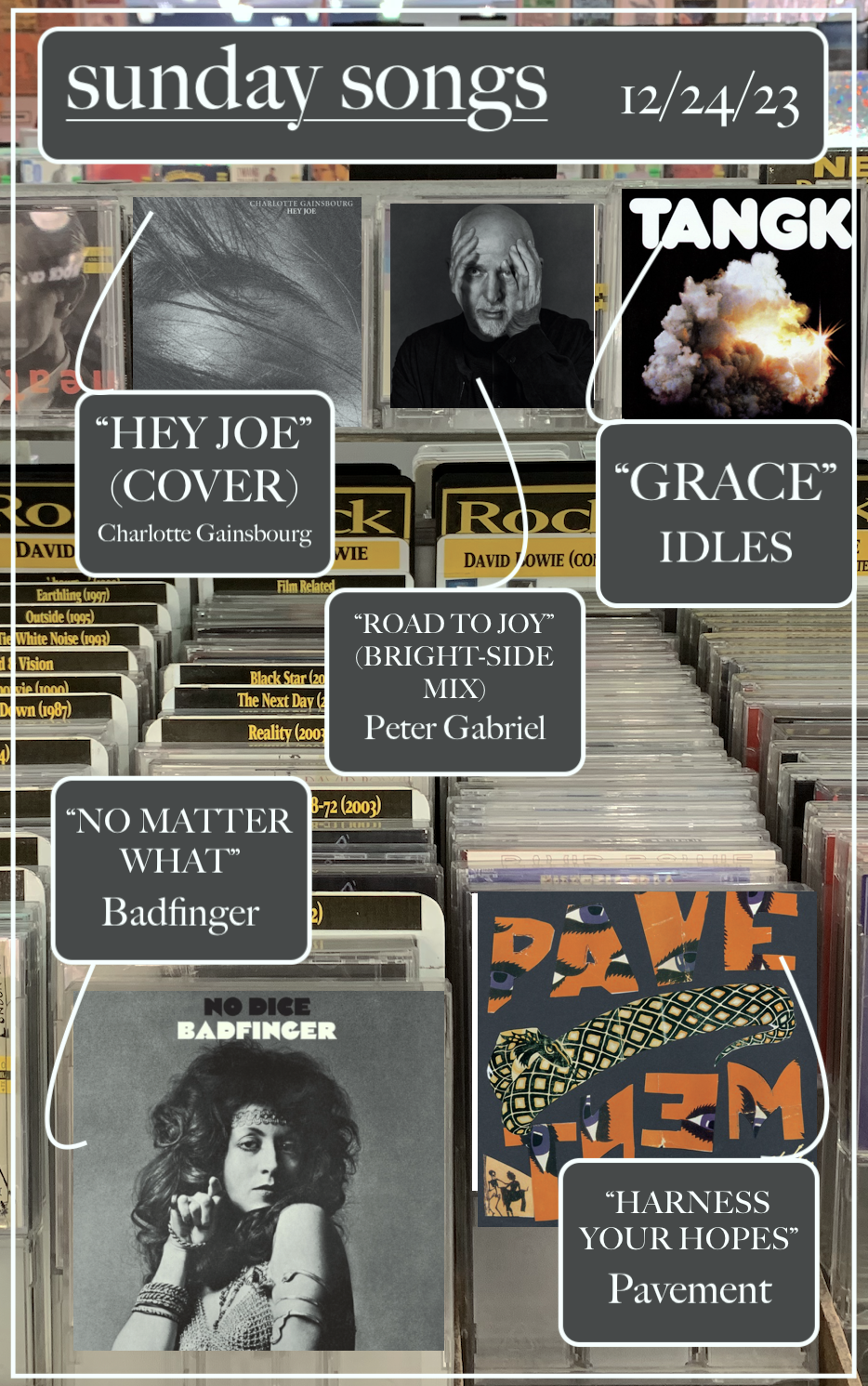
“No Matter What” – Badfinger

1970 was probably the worst year for trying to beat the “copying the Beatles” allegations, and the fact that these guys named themselves after an early title for “With A Little Help from My Friends” (originally titled “Bad Finger Boogie”…yeah, the name change was a good idea, John) doesn’t help their case. But I feel like being signed to Apple Records and having both Paul McCartney and George Harrison separately produce two of their other hits gets them a Get Out of Jail Free card. This once.

That aside, it also doesn’t help their case that Pete Ham sounds like the slightly growly middle ground between Paul McCartney and John Lennon, and the same nearly goes for the backing vocals, which try to hit somewhere between Lennon and Harrison. But it’s not every day that you can hit it that close to such legends, and it’s commendable no matter how (oops) you look at it. I’ve really underhyped all of this, but…there’s seriously something about this song. I swear that “No Matter What” is laced with something…oh, maybe it’s the guitars. My god, it’s barely 1970, and the ’70s guitars already sound so crisp…so full…do not get me started. But even if the guitars weren’t so sharp and full of dance-inducing warmth, there’s something so undeniably pure about this song. It’s no lyrical groundbreaker or generational anthem, but there’s a contagious joy to it—a good pop song does that. ”No Matter What” is the perfect end-credits song—the guitars start chugging in at the final shot of the movie, and everything goes black the minute that Pete Ham begins to sing. Come on, now. You can’t not go along with the clapping at 2:18. Beauty in simplicity. These guys get a pass for having either the best or the worst band name of all time. I genuinely can’t decide.

…AND A BOOK TO GO WITH IT:

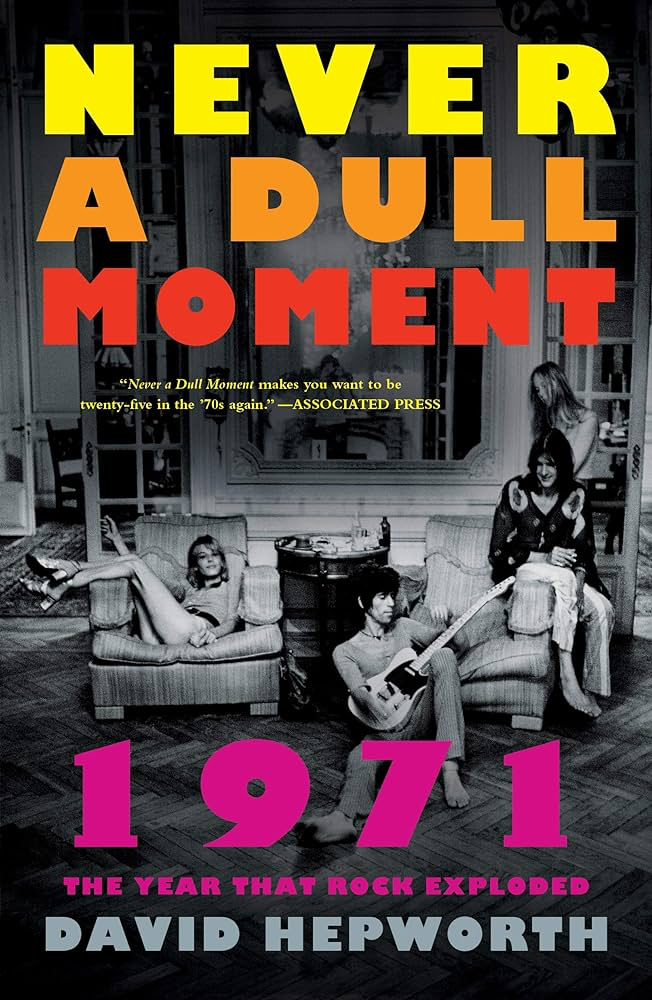
1971 – Never a Dull Moment: The Year Rock ExplodedI…dammit. I totally thought No Dice came out in 1971. I was two months off—November of 1970. Oops. But either way, this book is a little drily written for a book that claims to “never have a dull moment,” but it’s nonetheless a fascinating insight into the absolute goldmine of good music in 1971. (There was never a better high note than ending the year with the release of Hunky Dory.)

“Harness Your Hopes” – Pavement

Apparently I have another “I Just Threw Out the Love of My Dreams” situation on my hands here, since this blew up on TikTok sometime back in 2020 (after Spotify’s autoplay seems to have dug it up out of nowhere), and I didn’t find out until now. Maybe that was the period when the thumbnail for the music video kept popping up on YouTube and I ignored it until it went away? Little did I know what I was in for…

Also like “I Just Threw Out the Love of My Dreams,” I can only describe “Harness Your Hopes” as pure, bottled joy. As soon as the sighing, psychedelic-tinged intro gives way to some truly squeaky-clean guitars, I felt a rush of sheer happiness course through me. Stephen Malkmus seriously pumped this song with nothing but whimsical joy…and yet it was a B-Side? Not only that, but a B-Side that faded into more obscurity than the indie obscurity they were (probably) going for, so much so that Malkmus didn’t even recognize it when he heard it playing in a bakery? Nuts. Seriously. Not that I have any beef with the guy, but when you produce something as curiously delightful as this, you don’t let it slip through your fingers. It has that freeform, Marc Bolan kind of nonsensical lyricism written all over it, with more than a little pretentious affectation (“Leisure, a leisure suit is nothing/It’s nothing to be proud of/In this late century”), but somehow, it feels less pretentious when most of the lyrics don’t make a ton of sense as a whole. (Or maybe there’s some super deep hidden meaning that only Stephen Malkmus and co. can decipher, and it’s nothing to us normies…who knows) And like Bolan, it’s the kind of wordplay that occasionally leads to something unexpectedly romantic—”And I’m asking you to hold me/Just like the morning paper/Pinched between your pointer, your index, and your thumb.”

And paired with Malkmus’ strained, cracking voice on one end and the guitars (so clean that they’re practically still kicking up bubbles) on the other, it’s a capsule of warmth, practically radiant. Bottled joy, truly.

Speaking of Stephen Malkmus’ voice…

skip to 2:11

Please tell me I wasn’t the only one in theaters who laughed way too hard at this (besides my mom). Please.

…AND A BOOK TO GO WITH IT:

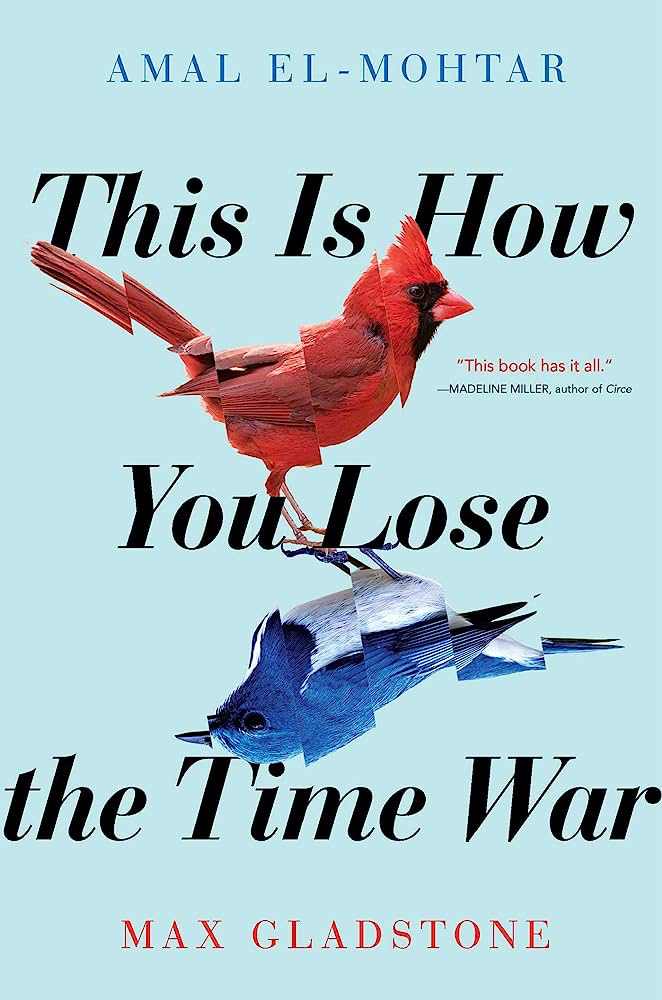
This Is How You Lose the Time War – Amal El-Mohtar and Max Gladstonefor the most part, this novel lends itself more to something more cosmically sweeping and Romantic in both senses of the word (probably Spiritualized?), but lines like “and I’m asking you to hold me/Just like the morning paper/Pinched between your pointer, your index, and your thumb” might as well be straight out of the letters between Red and Blue.

“Hey Joe” (cover) – Charlotte Gainsbourg

hnnnnnnnnnnngh me when Noah Hawley puts a song in Fargo that connects thematically in a deeply creative way hnnnnnnngh

good god I love this season of Fargo. no complaints, this show has made me feel alive again

where were Roy and Gator Tillman on January 6th

…AND A BOOK TO GO WITH IT:

A Conspiracy of Tall Men – Noah Hawleymaybe I’m cheating since I got this song from Noah Hawley. It’s fiiiiiiine. To be fair, this is his debut novel and predates the first season of Fargo by a full 16 years (it’s kind of a mess, but lovably so…mostly), but it’s got all the cross-country conspiracies and paranoia you could ever want.

“Road to Joy” (Bright-Side Mix) – Peter Gabriel

I meant to review this all the way back in June or July, when this single was first released…I forget what about it made it slip out of the roster, but I knew that it had to come back eventually. Now that all of I/O is out…it’s a great album, but I can’t help but be a little disappointed at how it was constructed. I thought that the deal was that the final organization of the songs was going to be a surprise, and that they’d be reshuffled from the order they were released in with each full moon this year, but the order just ended up being the same order they were released in. (I stand by my belief that “Playing for Time” would have been the perfect closing track.) I have similarly mixed feelings about the Bright/Dark-Side Mixes—I haven’t listened to the In-Side mix yet, but I also thought that each mix of the 12 songs would be more radically different, but the differences between the mixes are often very subtle. Some of them fit more clearly than others (ex. “I/O” is clearly more fit for Bright-Side, while “The Court” lends itself more to Dark-Side), but the tweaks between mixes are sometimes barely distinguishable.

That’s not to say that I/O isn’t a great album—it’s a beautiful picture of one of the most innovative artists alive today moving into old age and still being able to produce a relentlessly creative vision of love, mortality, and the nature of connectivity. Now that I’ve seen it live, the experience is all the more enriched, what with the stunning visuals that went along with it, as well as Peter Gabriel toeing the line between a theatrical showman (how’s reenacting the creation of life itself for a show opener?) and the wise, humble figure we’ve known him to be over the years. Songs like this one really showcased both the energy and creativity that clearly haven’t waned with age. “Road to Joy” is a highlight, without a doubt; for me, this one lends itself more to the Bright-Side mix, with the funky, “Fame”-esque guitar riffs and energetic burst of the chorus, like Gonzo firing off cannons without warning. But if the pink-shaded joy doesn’t immediately jump out at you, you know what should? The fact that this song is proof of yet another deeply creative project that Peter Gabriel’s been cooking up since the production of OVO—so, give or take, around 23 years. The man just can’t be stopped. But according to Gabriel, “Road to Joy” is part of a story about the human mind, and this song chronicles a character being woken up after experiencing locked-in syndrome; the triumphant declaration of “You were sure I was gone” has the defiant flair of someone beating the odds, and it’s impossible not to feel the joy from that.

…AND A BOOK TO GO WITH IT:

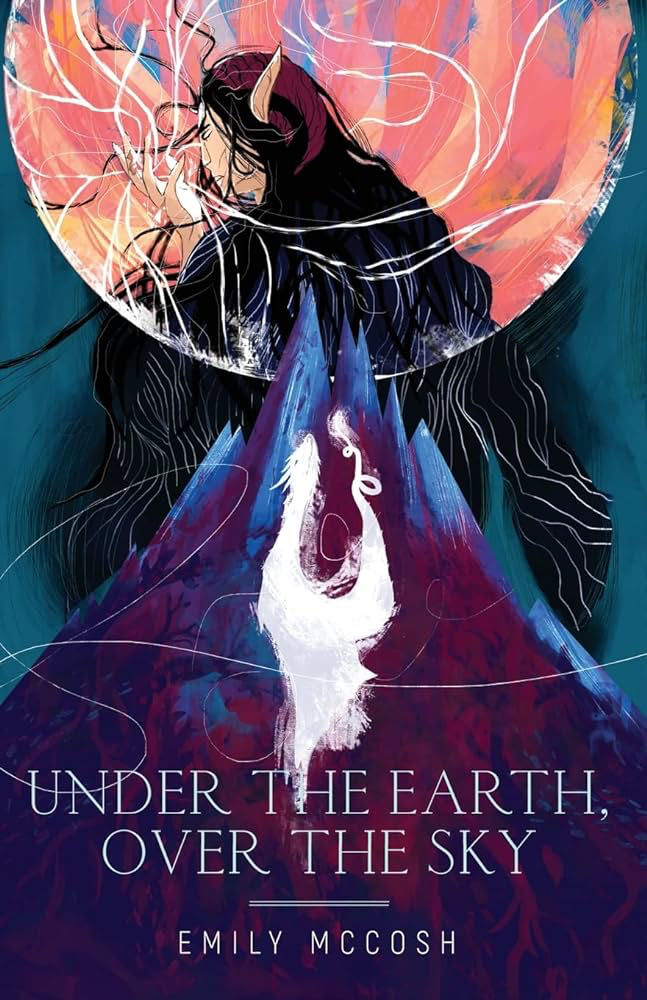
Under the Earth, Over the Sky – Emily McCoshnothing like adopting a human son to awaken your frosty, dormant heart and put you on…the road to joy, maybe? Certainly some “love call[ing] through the walls.”

“Grace” – IDLES

“Grace” has made my expectations for TANGK skyrocket, but whether or not the album turns out to be as adventurous as I feel like it’s going to be, I think I’m almost certainly going to enjoy it. It’s a change in form, even if a fleeting one.

I thought I knew what Joe Talbot sounded like when he wasn’t singing; “A Hymn” certainly gives us a hint, but there’s still the restrained growl to it that roars to life when he’s normally screaming on every other song. But “Grace” showcases his voice at its most vulnerable. Somehow, before the chorus kicked in, I almost mistook it for Mike Hadreas from Perfume Genius. I was scrambling to find the featured list for this, because…there was no way that this is the same guy who screamed at us all to never fight a man with a perm all those years ago. And I love this change in form. IDLES always mean bah-bah-business (in case you cannot tell from their tone) with their message, but this stripped-down feel that “Grace” shifts into suits their ethos just as well as their harder songs—Talbot described the song as “a call to be held,” and the quiet vulnerability really does feel like a gentle embrace. And it’s here that you can see what their change in producer has done to the sound—TANGK was co-produced by none other than Nigel Goodrich (of Radiohead fame!!), and the staccato of the drum machine and the wash of cloudy haze peeking out from under the curtain shines in the quiet places on this track. Talbot’s voice lowers into wavering smoothness, as though he’s singing from a place where no one can hear him, save for when he declares the song’s rallying cry: “No God/No king/I said, love is the fing.”

Man…I’m so excited for this album. IDLES have said repeatedly that their mission was to make an album that was purely about love and warmth—as Talbot said, “I needed love. So I made it. I gave love out to the world and it feels like magic. This is our album of gratitude and power. All love songs. All is love.” And if that isn’t exactly what we need…not to be all hippy-dippy about it, but as much as I indulge in my sad bastard music, I’m gonna go out there and say that IDLES is exactly what we need right now. I hate it that I have to say “not to be all hippy-dippy” when I’m talking about love and warmth and being kind and loving life…you’ve heard me go off about grimdark and frankly, how astoundingly dumb it is that we often think that sadder = deeper and that being happy or consuming happy media equates to stupidity somehow, but I’ll say it again. There’s nothing stupid or naïve about wanting love, giving love, and having love in your heart. IDLES get it. Love is the fing.

…AND A BOOK TO GO WITH IT:

Since this post consists entirely of songs, consider all of them to be today’s song.

That’s it for this week’s Sunday Songs! Have a wonderful rest of your day, and take care of yourselves!
Posted in Monthly Wrap-Ups

November 2023 Wrap-Up 🍲

Happy Thursday, bibliophiles!

Here we are, and once again, the year is nearly over…at least we have season 5 of Fargo to distract us from the inevitable passage of time.

Let’s begin, shall we?

GENERAL THOUGHTS:

Break aside, November has been on the busier side, but it’s been a productive one for me. It’s been chaos as far as my workload has gone, but part of that chaos was the editing that led me to send off two of my short stories for consideration to be published in some school literary journals! I won’t hear back for several months, but I’m so excited!! The initial impostor syndrome has faded (it’ll probably come back in a few months, mark my words…I’ve got my NyQuil ready), but either way, I’m really proud for taking this first step. Now, the workload chaos is in the form of looming final projects, which is not nearly as fun, but at least I don’t have to take a stats final at the crack of dawn like last year.

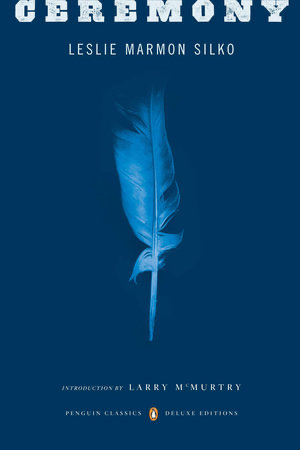
My reading has been a bit slower this month (see above), but as far as enjoyment goes, I’ve had a much more successful month! I had another 5-star read in the form of Ceremony (me when mixed-race experience and themes of storytelling), and I only had one book in the 2-star range for this whole month! I ended up reading a ton of literary and literary-leaning fiction for no particular reason, but the ones I read this month were almost all hits. I’ve had some more time to blog, what with break and whatnot, so it’s been fun to write more frequently before finals hits me like a train.

Other than that, I’ve just been trying to draw and play guitar (when I can), watching Taskmaster and The Great British Bakeoff (hEY NOW NO SPOILERS US AMERICANS HAVE TO WAIT UNTIL FRIDAY FOR THE FINAL), trying to ignore how cold the weather is, and rejoicing the return of Fargo! FARGO! I FEEL ALIVE AGAIN!

…say, are we gonna talk about how utterly insane episode 3 was? Just me?

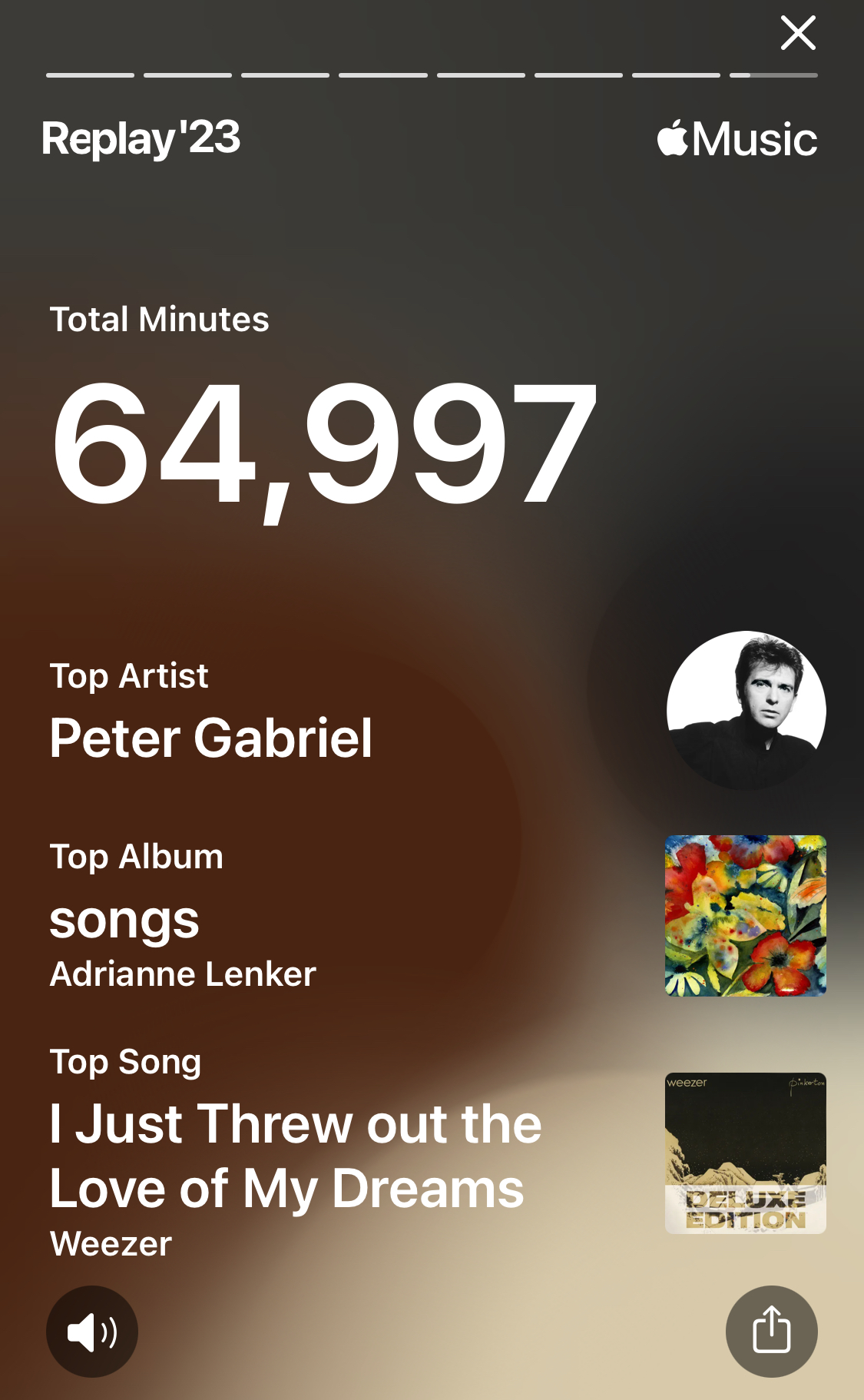
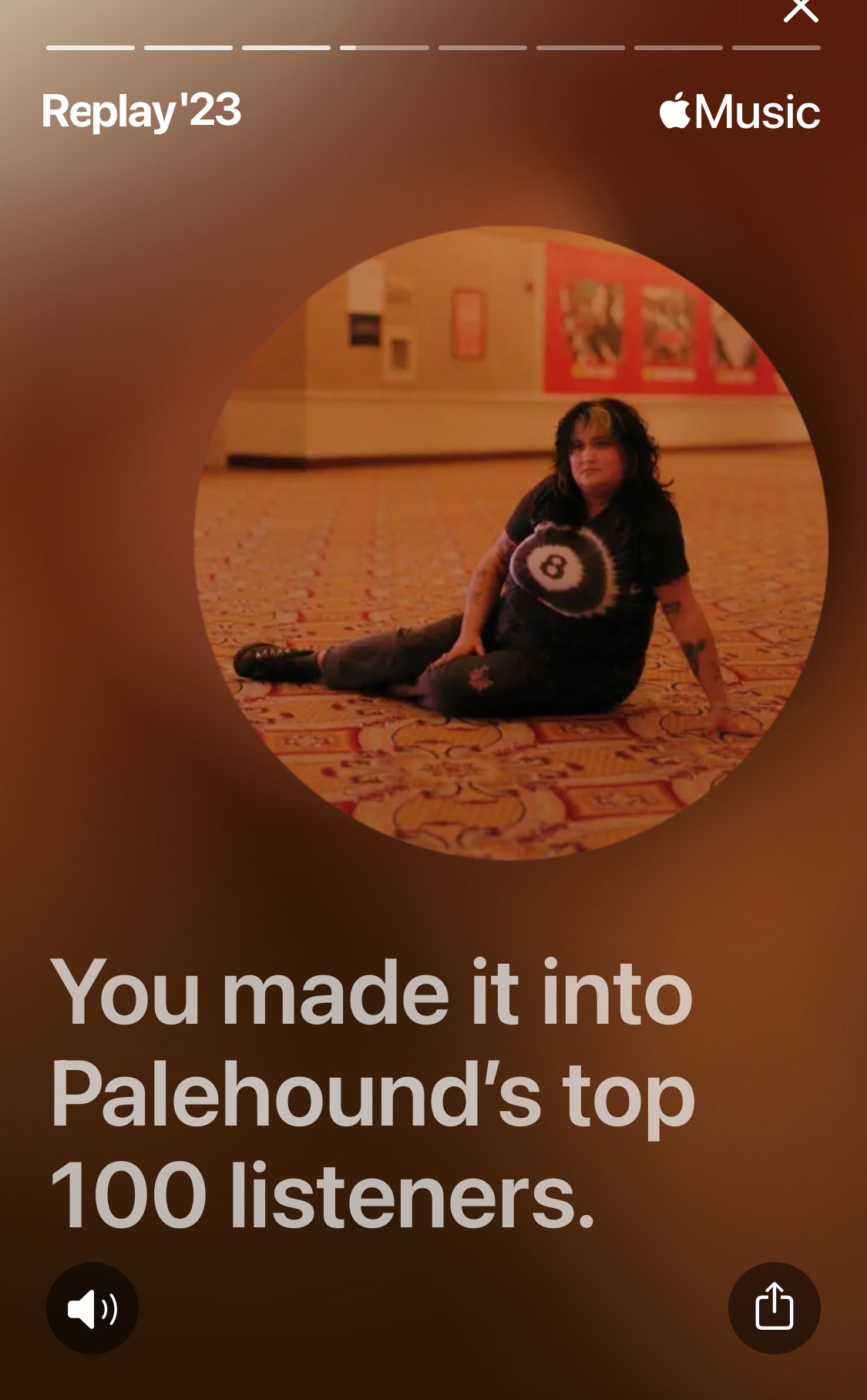
Also, for your casual amusement, here’s the mess that is my Apple Music Replay for this year:

READING AND BLOGGING:

I read 15 books this month! Again, slower than normal, but it’s impressive to me, given how much editing and pre-finals chaos has consumed me this month.

2 – 2.75 stars:

Everyone in My Family Has Killed Someone

3 – 3.75 stars:

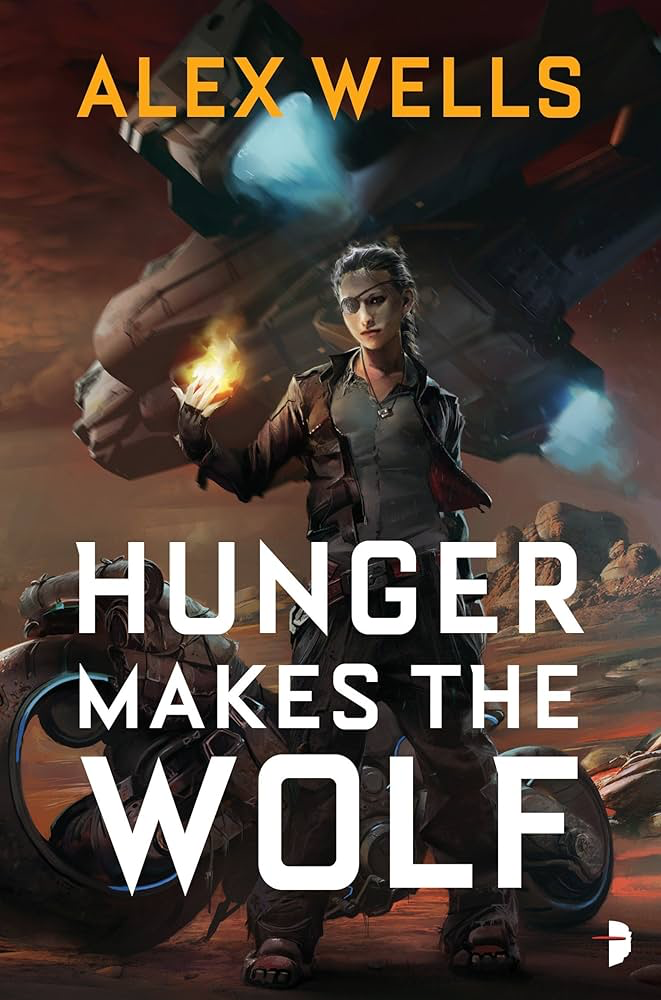
Hunger Makes the Wolf

4 – 4.75 stars:

Our Wives Under the Sea

5 stars:

Ceremony

POSTS I’M PROUD OF:

POSTS FROM OTHER WONDERFUL PEOPLE THAT I’VE ENJOYED:

SONGS/ALBUMS THAT I’VE BEEN ENJOYING:

NEW IDLES IN FEBRUARY LET’S GO
finally got through the rest of Peter Gabriel’s non-soundtrack albums WOO
my first Arlo Parks album!! wonderful, summery stuff
DOI-OI-OI-OI-OING
so whimsically creepy
NEW SMILE IN JANUARY I’M GONNA PASS OUT

Today’s song:

hnnnnnngh 70’s guitars

That’s it for this month in blogging! Have a wonderful rest of your day, and take care of yourselves!

Posted in Sunday Songs

Sunday Songs: 11/19/23

Happy Sunday, bibliophiles! I hope this week has treated you well.

This week: another song I stole from Wilco, and a smattering of calm, autumnal folk. And then there’s IDLES.

Enjoy this week’s songs!

SUNDAY SONGS: 11/19/23

“You Got the Stuff” – Bill Withers

Even though he isn’t here to read this (rest in peace), and I doubt he would even if he was, I owe an apology to Bill Withers. When I asked Siri about the insanely funky song that Wilco was playing before their show back in October, I thought…Bill Withers? Like…the “Lean On Me” Bill Withers? The song we all had to sing in either elementary school or at camp? From here on out, I take back any preconceived notions I’ve had about the man, because this song slaps. I severely underestimated him.

To be fair, from the looks of it, “You Got the Stuff” seems funkier than most of his R&B/Soul-leaning catalogue, but when he did funk, he made it the funkiest funk possible. The minute the drum machine fades and the thick, bass-like synths kick in, it’s like I’ve been possessed to move my body for exactly seven minutes and 16 seconds. I haven’t heard of a contagious groove like this song has in ages, something so instantly captivating that hooks you and immediately tosses you on the dance floor. And it’s seven minutes of this. And the last three and a half minutes of that seven minutes is just bass and an absolutely glorious flexatone. (Many embarrassing google searches went into finding the source of that comically cartoonish “doi-oi-oi-oing” noise. I’m not proud of what I did.) It really is a cartoonish sound that this instrument makes, and yet it fits right in with the thumping bass and Bill Withers’ faint, rhythmic breathing and the occasional “ooh, baby.” Three and a half minutes of just that. It feels like a buildup to something bigger, but it doesn’t need to build up to anything—the unique rush of that stretch of the song keeps the funk alive for longer than I thought it could. And it’s crazy to think that this was chosen as a single for this album (‘Bout Love)—even for someone like Withers, putting the one song that goes over seven minutes long as one of the lead singles is a bold move. It did only get to #85 on the Billboard charts at the time, but it’s a hit in our hearts.

What I’m trying to say is that Bill Withers is forgiven for the setlist of my 3rd grade program. Good god, I love this song.

“Dancer” – IDLES & LCD Soundsystem

As much as I, in theory, dress a fair bit punk (on the days where I have my pin jacket) and generally like the leanings of the political attitude, I’ve never been able to get fully behind it—the combination of the abrasion (both musical and lyrical) and the contrarian, infighting parts of it have made it so I’ve never felt fully aligned with it. I’m only punk up to my jacket, my boots (they’re not very good for extended walking, so I wear them sparingly…there’s only so long I can commit to the bit), and my socialist tendencies. More in spirit than anything else. Same reason that even though I regularly have at least one day a week where I dress in all black and go all out on the eyeliner, I can’t fully commit to being goth, because I’ll then go up to my friends and say “HIIIIIIIIIIIIII :)” in the most decidedly un-goth way. And plus, contradicting everything about yourself sounds kinda tiring, unless you’re Hobie Brown and you make it look cool (and that’s because he was this cool the whole time). And yet, every single IDLES song makes me absolutely foam at the mouth. I love them. I’ve been putting off actually listening to a full album of theirs for who knows why, but their spin on punk—still plenty aggressive, but resoundingly hopeful and positive in their ethos (see “Mr. Motivator”). Joe Talbot himself has repeatedly insisted that they aren’t a punk band, so…okay, I’m not all that punk. But that combination of all the fiery energy of punk with their riotous joy and their wholehearted embrace of vulnerability and love is what endears me to them so much. The absolutely delicious Britishness and bisexuality of it all certainly helps too.

Hearing that “Dancer” was a collaboration with LCD Soundsystem kind of floored me—where could the epitome of tight, high-strung white boy music fit in with this? The mesh, however, is as smooth as it could ever be. There’s a constrained tightness about the opening riff that feels all at once caged in and expansive—the James Murphy touch reveals itself more and more on each listen, aside from the obvious backing vocals on the chorus. Either way, “Dancer” has just about everything I love in an IDLES song. Joe Talbot’s signature aggressively theatrical line deliveries never fail to put a smile on my face—every repetition of “and the sweat” (I can almost hear him raising his eyebrows every time he says sweat) and “so to speak” (imagine that as spitty and Britishly as you will) make listening to the whole song feel like an elaborate performance, a…dance, if you will. There’s an undeniably sensual feel of it all, a visceral pulse to the calculated choreography of each line. It’s a song I’ve never been able to skip since I downloaded, and even though I’ve still yet to listen to any of their full albums (SOON, though), I’ve got hope that Tangk will be more of the same.

New IDLES and The Smile next January…man, I’m gonna implode. It’s been fun, everybody.

“Black Wave” – The Shins

…this is certainly an interesting transition. Whoops.

Certain bands are often seasonal for me—some bands are more spring, summer, fall, or winter than others. (Hence my seasonal playlists). But some bands immediately evoke a more specific point in time. For me, The Shins were always a late fall, early winter band; they feel like fall, but only after the first frost has crept in and stripped the trees bare. There a few leaves left, but they’re all brown and brittle, crumpled underfoot. It’s snowing, but not a January blizzard—maybe just sleet that doesn’t accumulate, if you’re lucky. You’re warm, sitting by the fire. The trees look skeletal now.

So I’m glad I rediscovered “Black Wave” when I did—it’s one of those songs that lingered in my periphery for years (I grew up in a very pro-Shins household), but I’d gotten so complacent in hearing it everywhere that I didn’t even think to ask about its name. But it’s the perfect November song—as most of what I’ve heard from the spectacularly titled Wincing the Night Away is. James Mercer layered effects over his gentle, wordless warble as the song begins, making a rippling, Bon Iver-like echo. Even with a colored named in the title, “Black Wave” is decidedly painted in deep, warm colors; shades of brown and maroon, accented by orange and gray. The opening image of “this goose is cooked” cements the feeling of being huddled around a fire; I imagine the goose being cooked on a spit, the skin crackling as the embers lick it. Mercer’s voice drifts and out of focus, as though on a chilly wind. And like the wind, the song doesn’t so much end as disappear, like the image of a cryptid shifting through blurry footage to fade into the winter woods beyond.

“More Than This” – Peter Gabriel

Since I first listened to Up back in March (oh, the album art is just some water droplets on a gray backgr—oH MY GOD PETER WHY ARE YOU LOOKING AT ME LIKE THAT), it’s been an album that I always fall back on. “Growing Up” was already a faint childhood memory and “Darkness” immediately stole my heart, but the more I listened, the more songs I’ve stuffed in my back pocket—the grossly timely, sleazy groove of “The Barry Williams Show” and the chest-rattling resonance of “Signal to Noise” that makes my soul leave my body every time I hear it. (Real chill stuff for walking to class, amirite?)

There’s something to be said for my hypocrisy of creating dozens of oddly specific playlists and then just listening to my whole library on shuffle, but shuffle always revives songs like this. (Although this one did go on my oddly specific clone playlist next to Roxy Music.) So much of Up has this graying, industrial feel to it, but Peter Gabriel, the genius that he is and continues to be, uses that gravelly darkness (no pun intended) not necessarily to be edgy, but to convey that feeling of hopelessness—the consumption of fear in “Darkness” and the betrayal and desperation of “Signal to Noise.” “More Than This” opens with imagery of “I woke up and the world outside was dark/All so quiet before the dawn/Opened up the door and walked outside/The ground was cold.” I can’t help but think of the quiet bridge of “Darkness,” where the fear wanes and he walks into the woods to find his fear “curled up on the floor/just like a baby boy.” That industrial atmosphere—furthered by distorted, grainy samples of guitars that he and Daniel Lanois messed with in production for the album—immediately sends a hood of coldness over you, the roughness of concrete and frozen ground. And yet, amidst said cold ground and sinking ships, this is where Gabriel finds connection—in the absence made by everything hopeless about this world, there is still a beating heart pulsing beneath our feet, and it’s not the Telltale Heart kind. It’s the connection in knowing that you are surrounded by a community, and surrounded by the love that it breeds. Amidst it all, there’s more than this. It feels like the answer to Roxy Music’s “More Than This”—that song pondered what could exist outside of the all-consuming sorrow, and Peter Gabriel blows aside the curtain of fog to show the many arms reaching out to you, offering their guidance and warmth. It also feels like the prequel to “i/o”—”More Than This” song is the realization of connectivity, and “i/o” fully embraces it, going from a community of people to the connectivity to the Earth and all of its creatures.

“More Than This” was a wonderful surprise to re-stumble upon—the music recaptured me at first, but with every listen, it feels more like an anthem. Not only are you not alone, you have never been alone, and if you can only look beyond yourself, you can find joy in connection. The choir slowly snaking into the backing vocals towards the end of the song…almost gets me choked up, like you’re seeing the fog lifted and the love revealed.

“Fellows” – Daughter of Swords

Another calm one to end this week’s song lineup. It’s getting cold outside, the hearth is ready, and I intend to rock you to sleep with this gentle melody. Grab your blankie, kids.

My halfway deep dive into The A’s (see last week’s songs) only went as far as a few songs on the album, but it also led me to Daughter of Swords, Alexandra Sauser-Monnig’s solo work with a gloriously tarot-sounding stage name. Like The A’s, the tidbits I skimmed through from her album Dawnbreaker (title also goes hard) ventured into territory that was too twangy for my taste, but quiet moments like “Fellows” stood out to me in their calmness. The sea of lo-fi graininess that “Fellows” is drowning in coats the acoustic guitar plucking in a state of drifting, only anchored by the gentle, lilting waver of Sauser-Monnig’s voice. From the moment that faint, ominous noise scratches at the background (it sounds like a train whistle to me, but I could be wrong), you feel like you’re stepping into a sepia-tinted photograph, all hazy edges and soft, grassy ground. Alexandra Sauser-Monnig has the perfect voice for this kind of folk—as she sings about all of said fellows (who get noticeably taller and skinner as the song goes on…I guess she’s figuring out her type? Is Jack Skellington next? No judgment, but he’s taken…), her voice rings out amidst the grainy sea. It can ring when it needs to, but it has the effect of bedtime tea: calm enough to rock you to sleep, but rich enough to savor the herbal flavor as you close your eyes.

Since today’s post consists entirely of songs, consider all of them to be today’s song.

That’s it for this week’s Sunday Songs! Have a wonderful rest of your day, and take care of yourselves!
Posted in Sunday Songs

Sunday Songs – 11/5/23

Happy Sunday, bibliophiles! I hope this week has treated you well.

Did somebody order a monthly blue period double-dipped with Peter Gabriel? Because you guys are not gonna believe what showed up on my doorstep this morning…

Enjoy this week’s songs!

SUNDAY SONGS: 11/5/23

“The Tower That Ate People” – Peter Gabriel

COME AND GET IT! TWO FOR ONE PETER GABRIEL DEAL! TWO FOR THE PRICE OF ONE!

If there’s a vaguely overarching theme for this week’s songs that I can throw together, it’s that Peter Gabriel gets so much weirder than people give him credit for. I suppose that’s the curse of any musician whose earlier hits get the spotlight while the later, more experimental parts of their career go on the wayside in terms of engagement, but are as full of life and creativity as anything else they’ve produced (see also: David Bowie, Kate Bush). To be fair, we’re so used to aging artists that continue to pump out more of the same in hopes of keeping the fire of fame going (say, what’s going on with The Rolling Stones lately?), but equating aging to a decline in musical artistry is shallow either way. Again: I just saw Peter Gabriel a few weeks back, and here he is at 73 delivering some of the most spectacular performances—both visual and musical—that I’ve seen from any musician on stage.

The album, 2000’s OVO, is technically his soundtrack work, and was conceived for a multimedia show that ran in the Millennium Dome for 999 shows in that same year. Gabriel’s work on it interfered with his next album, the criminally underrated Up, which ended up coming out in 2002, a year after it was set to be released. The through lines between the two are clear; “The Tower That Ate People” (good god, what a title) has an industrial, almost Massive Attack-like crawl to it, propelled by a looped guitar riff. Gabriel’s voice comes out as a shrouded growl, making it all the more convincing when he opens the song with “There’s a bump in the basement/there’s a knocking on the wall.” The electronic grinding as he sings of “the pumping of the pistons” makes the music swell. It’s a clanging machine, but it never loses an ounce of that cinematic, Peter Gabriel touch—especially not the prolonged silence after he declares “We’re building up/Until we touch the sky,” letting everything fade to lumbering, echoing footsteps. I can only imagine what the stage show was like. I’m jealous that I wasn’t one of the lucky few who got to see this live on the i/o tour, because can you imagine the feeling of this reverberating straight through your ribs?

“We Looked Like Giants” (Death Cab for Cutie cover) – Car Seat Headrest

THEY’RE BACK!! THEY’RE BACK!!!! So what if it’s a cover—it’s a perfect fit.

Even without as much Death Cab for Cutie knowledge (much less about the album that they’re commemorating—before this, all I knew was the title track. Owie.), it’s easy to see that pairing them with Car Seat Headrest was a fit as perfect as puzzle pieces sliding together. Despite “We Looked Like Giants” being a cover, it feels like the whole song is harkening back to the Teens of Denial glory days, with its crashing guitar breakdowns and angst so dense you could squeeze it out of a dish towel. The lyrics feel even more like it was made for them—”When every Thursday/I’d brave the mountain passes/And you’d skip your early classes/And we learned how our bodies worked.” Certainly makes…every single song from Twin Fantasy make more sense. Even without the slam of an intro that the original version boasts, the tension and momentum that Will Toledo and company bring to this song fills it with the nervous energy that has defined the band for so long—it’s a song teetering on its tiptoes, balancing out both arms as it contemplates the edge. Toledo’s signature, honeyed wail takes the song to dizzying heights, making the collision course back to Earth as the final seconds plunge into silence all the more riveting. I always get all sappy about Teens of Denial and all of the memories of listening to it the summer before I started high school, and this song brings all of the good parts of that back—slip this before “Fill In the Blank,” and I wouldn’t even blink. Leave it to Car Seat Headrest to toe the line between an unchanged cover and one that makes the cover all their own.

“The Family and the Fishing Net” – Peter Gabriel

I’ve done it. I’ve finally surmounted the task of going through all of Peter Gabriel’s albums (minus his soundtrack work). Peter Gabriel summer has come to an end. Peter Gabriel 4: Security was the last one for entirely arbitrary reasons, but it’s fantastic—and a lot creepier than most people give it credit for.

Take this song. Immediately, it sonically calls back to “Intruder,” with its ominously creeping instrumentals, off-kilter chanting and an unsettling chorus of flutes that open the song. Slowly, you start to process the lyrics, and the chill starts creeping down your spine. “Icing on the warm flesh cake?” Yep. Mom, come pick me up, I’m scared. But if you take just a quick look through, you can see the true genius of this song—I was super curious about the meaning, and I was floored by the concept behind it.

“Vows of sacrifice (vows of sacrifice)/Headless chickens (headless chickens)/Dance in circles (dance in circles)”. It sounds like the makings of a cult. But Peter Gabriel specifically created “The Family and the Fishing Net” as a wedding song. Vows of sacrifice? For richer, for poorer, in sickness and in health. Headless chickens? Could just as well be serving a roast dinner at the ceremony. Dance in circles? We’ve all done that at a wedding or two, haven’t we? That’s where the lyrical genius comes in—it’s not just that he’s subverting Western wedding imagery and making it sound like a cult ritual, there’s a level of exoticization that he brings to it that makes it clever in a conscious way that lines up with his worldly sensibilities. It feels like a response to every song that’s ever demonized and exoticized ordinary (and often sacred) rituals of indigenous people around the world. And given that much of this album has that worldly ethos (see also: “San Jacinto,” “Wallflower”), it’s a perfect addition. As much as I tend to rag on old white guys, Peter Gabriel should be one of the paragon examples in writing songs—and any kind of writing—outside our worldviews, just for the simple fact that he cares to listen about people’s lived experiences. It’s not just writing about some strange, foreign goings-on that he witnessed in his travels—Gabriel took the time to make sure that he understood and uplifted the people and cultures that he encountered. That’s what makes this song feel so important—he recognized the detriment in writing songs from an ignorant distance, and used that aspect of the history of Western music to create one of the creepiest—and most clever—songs in his catalogue.

Also, to the anonymous YouTube commenter who said that she wanted to have this play when she walked down the aisle: I salute you. I’d pay to see that.

“She Plays Bass” – beabadoobee

So it turns out that the she who plays bass is beabadoobee’s actual bassist, and…yeah. They’re aren’t romantically involved, but that still has to be bizarre to be playing bass on a song about yourself. At least all parties seem to be okay with it? Knock on wood that beabadoobee’s backing band doesn’t get into any kind of Fleetwood Mac funny business.

That aside, here’s another entry into my thesis that beabadoobee makes the perfect music for teen rom-coms. From her 90’s-inspired Space Cadet EP (hmm, wonder why there’s a song called “I Wish I Was Stephen Malkmus”…), it’s an ode to yearning, longing, and bright, shiny guitars. Bea Kristi described the song as “a Cure rip-off,” a description that she admitted to Robert Smith himself when they met at the BRIT awards back in 2020. Either way you want to describe it, there’s no denying the brightness of it—despite the black and white cover of the single, “She Plays Bass” is rife with neon colors and cartoon stars. I halfway get the Cure bit—definitely more like “Friday I’m in Love” or “Let’s Go to Bed” than their other music—but what I do get is delightfully guitar-driven indie longing, sparkling and starry-eyed. If “Glue Song” plays in the end-credits of said rom-com, maybe this plays as the intimidatingly cool love interest is introduced. Just a thought.

“Black Hole” – boygenius

What? You thought I was gonna shut up about the rest after talking about “Powers”? You fools…

“Black Hole” is an easy song to have on loop—it’s part of the 3/4 of this EP where every song is freakishly hypnotic, but they’re all around two and a half minutes long, so they just suck you down with them forever, like water sucked down the sink drain. Or…maybe, something else? Mayhaps…a black hole? But the black hole in this song is a more recent revelation—”You can see the stars, the ones/The headlines said this morning were being spat out/By what we thought was just/Destroying everything for good.” The black hole in question is a fascinating one: caught by the Hubble telescope in early April of this year, NASA observed that this supermassive black hole was leaving a trail of stars in its destructive wake that stretched over 200,000 light years long. It’s the perfect, beautiful moment to write a song about. Hopefully this bodes well for me because I’m taking an astronomy class next year: I’ve always struggled with astronomy in school previously, but it makes me tear up that we live in a universe that we will never fully know everything about. That there will always be new things to discover about the vastness of space and the world around us and beyond us until the day I die.

Back to the song: it’s poetry. More specifically, it’s two separate poems. Julien Baker takes the reins in the first poem, with her musings about looking at the stars. The gently clattering electronic instrumentals sound appropriately starry, with the hum of synths leading into Baker’s voice, then transitioning into a tinny, ascending scale on a keyboard just before everything shifts. This is the second poem. It feels like the camera has whipped around as the drums and synths intensify, panning around to Lucy Dacus as Phoebe Bridgers lingers just out of the frame, opaque camera shots flickering at high speed over them as the camera zooms in on their faces. Hearing Dacus take the high notes and Bridgers taking the low, the opposite of their normal range, is an odd treat—it makes Bridgers’ voice seem like a ghost, barely there unless you really pay attention, while Dacus acts as the piercing lighthouse beacon cutting through the fog. All of their lines are enchantingly neat, spaced apart like they’re all collected in separate bins. Apart from the initial confusion (and fleeting clunkiness) of the first two lines (“White teeth/black light/White tee/brown eyes”—”teeth” and “tee” sound way too similar, especially when preceded by the same adjective), I’ve been eating up the emotionally-charged precision of it all. As each line is cut off the chopping block, the drum machine thrums on, just as meticulous as the delivery of each lyric. And I am nothing if not a sucker for songs on an album (or an EP, in this case) that transition into the other as though they’re the same song. Especially with this and “Afraid of Heights” being so short, it feels all the more like a single song. Pure artistry.

Since this post consists entirely of songs, consider all of them to be today’s song.

That’s it for this week’s Sunday Songs! Have a wonderful rest of your day, and take care of yourselves!
Posted in Monthly Wrap-Ups

October 2023 Wrap-Up 🧛🏼‍♀️

Happy Tuesday, bibliophiles, and more importantly, happy Halloween!

I really should be used to this by now, but getting this much snow two days before Halloween always feels so wrong. I like snow this time of year generally, but not when I have a costume to wear.

Let’s begin, shall we?

GENERAL THOUGHTS:

Usually a month this busy would dampen my overall feeling of it, but for once, it really hasn’t! That’s the magic of the Halloween season, I suppose. I’ve had a ton more stuff to do on the heels of midterm season, and even though I’m still somewhat busy (hence the scant amount of posts I’ve been able to make this month), I’m still enjoying myself.

However, even though most of the month has been favorable for me, my reading…hasn’t been as much so. Since the beginning of the month, I’ve been in a slump that I’ve only just been able to get out of in the last week or so. After the first few days, I just fell into a bad spell of especially mediocre books—for a solid two weeks, I didn’t run into much that I ended up rating higher than 3.5 stars. But I’ve slowly gotten out of the dry spell, and the end of the month has been filled with some fantastic reads!

I’ve also tried to get back into the rhythm of fiction writing, since I’ve fallen off the wagon for that since school started. Although I haven’t been able to adhere to the schedule to a T, I’ve allotted a good time of night towards writing at least 1,000 words a day, and that got me to the end of my first draft of the second book in my main sci-fi project! This one ended up being almost 82,000 words! Pretty proud of myself. Sadly, as I’m getting older, November has become a worse and worse year to try and crank out 50,000 words, so I’m not doing NaNoWriMo this year. The July Camp is a much more reliable time for me. In the meantime, I’m hoping to polish up some of my short stories to send off for publication…

Aside from that, though, there have been SO many fantastic things going on. First off, Sir Patrick Stewart (!!!!!) stopped by my school for his book tour, and it was incredible! I wish I had more pictures to show for it (we weren’t allowed to take any), but he just had the kindest, warmest presence, and it was such an honor to hear him speak about his life. What an incredible man.

After that, I had the amazing luck of being able to see Peter Gabriel and Wilco in the same week! Both were such phenomenal shows in their own ways—seeing Peter Gabriel when I thought I’d never even see him tour was the most transformative, beautiful experience, and seeing one of my favorite bands perform their best setlist yet (and seeing them from the front row!!) was just as wonderful.

Peter Gabriel at the Ball Arena
Wilco at the Mission Ballroom

Other than that, I’ve just been getting back in the rhythm of drawing, playing some guitar now and then, taking far too many pictures of the pretty leaves on campus, drinking my fill of apple cider, watching Taskmaster (FINALLY GOT THROUGH SEASON 15! THE BINGING HAS CEASED!) and catching up on Only Murders in the Building (please stop pairing Mabel up w randos, she deserves so much better), and soaking up the fall weather. At least I was until we got snow 2 days before Halloween. Oops.

READING AND BLOGGING:

I read 16 books this month! This month was slow going, and I ended up in a somewhat extended reading slump, but there were bright spots here and there.

2 – 2.75 stars:

The Jinn-Bot of Shantiport

3 – 3.75 stars:

Thornhedge

4 – 4.75 stars:

The Thursday Murder Club

FAVORITE BOOK OF THE MONTH: Under the Earth, Over the Sky4 stars

POSTS I’M PROUD OF:

[cough] not a whole lot here, but:

POSTS FROM OTHER WONDERFUL PEOPLE THAT I’VE BEEN ENJOYING:

Again, I haven’t had as much time to blog-hop, but:

SONGS/ALBUMS I’VE BEEN ENJOYING:

LOVING the new Wilco
this song makes my soul leave my body
this album was just as wonderful (and uncomfortable) as I thought it would be
WAAAAAAAAAAAAAAAAAAAA
yeah I love OK Computer with every cell of my being, but there’s something to be said for the good ol’ Bends-era Radiohead
seeing Peter Gabriel live was truly magical :,)

Today’s song:

HAPPY HALLOWEEN EVERYBODY

That’s it for this month in blogging! Have a wonderful rest of your day, and take care of yourselves!
Posted in Books

The Bookish Mutant’s Book for Asexual Awareness Week – 2023 Edition

Happy Sunday, bibliophiles! I hope this week has treated you well.

First off, apologies for the lack of a book review/Sunday Songs this week. I’ve just been busy with school, and I didn’t have as much time to sit down and write something that wasn’t the draft I’m trying to get myself back into the rhythm of writing. (I’ve been cobbling at this post in advance before this week, so that’s why you’re able to see it now.) Plus, I was just generally exhausted on Tuesday, but it was a good exhaustion, all things considered, because I’d seen Peter Gabriel the night before! Words don’t do justice to how incredible of a show it was. You’ll definitely hear about it later.

Here in the U.S., Asexual Awareness week, or Ace Week, is celebrated from October 22-28! Even though I’m not on the asexual/aromantic spectrum, it’s impossible to not see how much this community gets left behind, even within the LGBTQ+ community; just as any other spectrum of identity, it’s just as valid and worthy of respect as anything else. I’ve been meaning to make more asexual book lists, but this time of year is kind of crazy for me. But this year, I figured I would start early so I would have another book list—we need to shed more light on these fantastic books and authors!

For my original list from 2020, click here!

Let’s begin, shall we?

THE BOOKISH MUTANT’S BOOKS FOR ASEXUAL AWARENESS WEEK

FANTASY:

REALISTIC & HISTORICAL FICTION:

SCI-FI:

TELL ME WHAT YOU THINK! Have you read any of these books, and what did you think of them? What are your favorite books with characters on the asexual spectrum? Let me know in the comments!

Today’s song:

That’s it for this year’s recommendations! Have a wonderful rest of your day, and take care of yourselves!
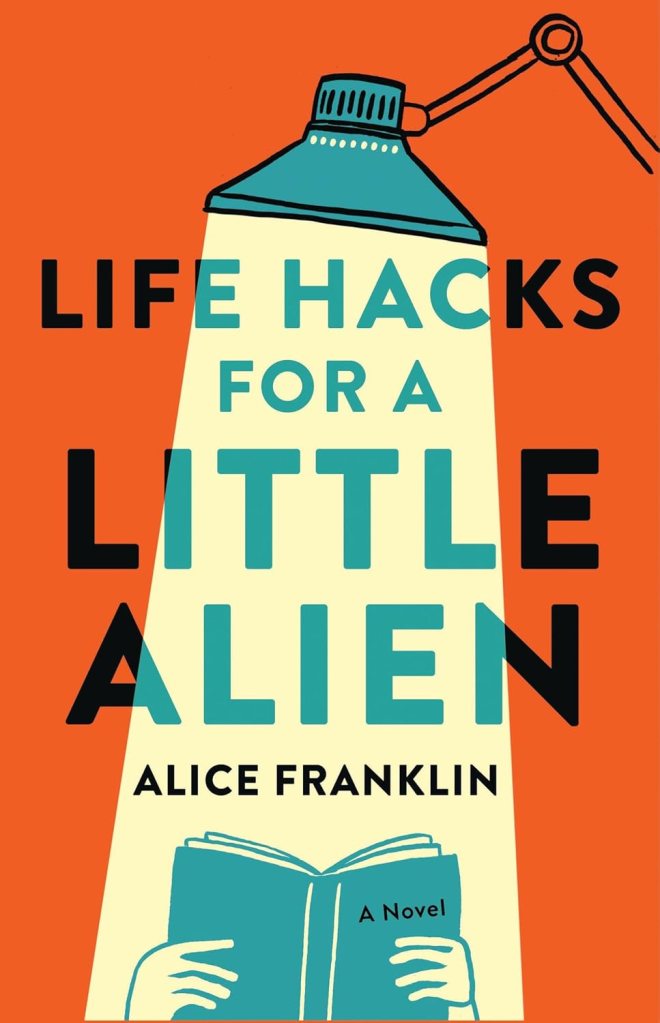
Posted in Sunday Songs

Sunday Songs – 10/15/23

Happy Sunday, bibliophiles! I hope this week has treated you well.
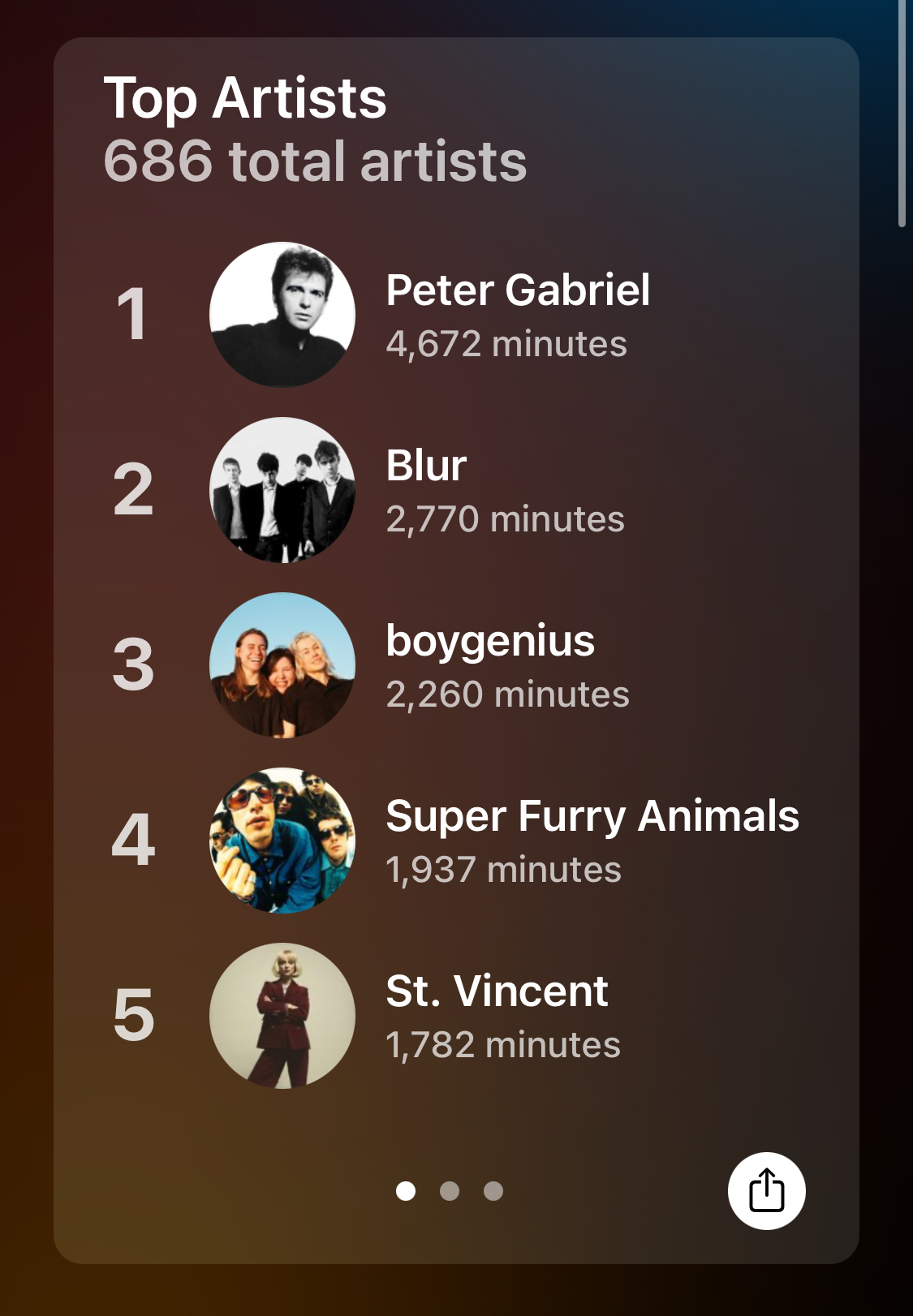
THIS IS A CODE RED, I REPEAT, WE HAVE A CODE RED! IMPENDING BOYGENIUS BREAKDOWN IMMINENT! BRACE, BRACE, BRACE! BOYGENIUS BREAKDOWN HAS REACHED MACH 1, I REPEAT—[RADIO GOES DEAD]

…CAPTAIN? CAPTAIN!

Enjoy this week’s songs!
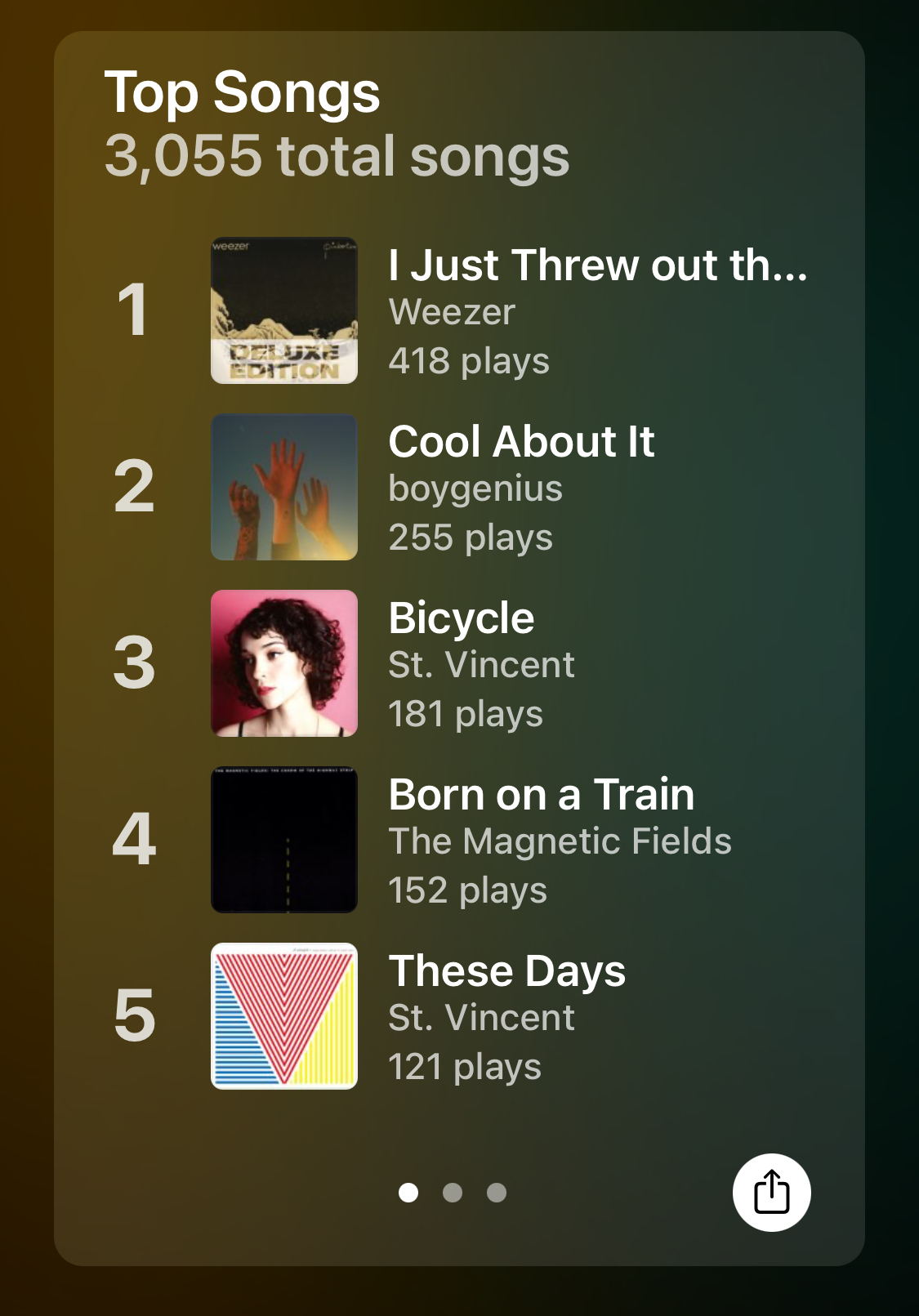
SUNDAY SONGS: 10/15/23

“Powers” – boygenius

I’m writing this on the day that the rest – EP came out, and I can assure you that’s been the only thing pouring through my headphones all day. I’ve lost count of how many times I’ve run through the whole thing. It’s easy to do it endlessly—only four songs, 3/4 of then in the two minute range. That’s this EP’s only crime—those three songs are just too short. Other than that, they’re so criminally flawless that it was exceedingly difficult to pick just one to talk about this week. There was the appropriate all-consuming but gentle harmonies of “Black Hole,” the painful relatability of “Afraid of Heights” (Ms. Lucy Dacus could you not stare into my soul today? Please?), and the gut-punches of “Voyager.” I was trying to have a good morning, but then, boom: Phoebe Bridgers hit me with that beautiful line about the pale blue dot. Ouchie.

But from the start, “Powers” would have always broken through as a standout amongst standouts. Led by Julien Baker, this song is appropriately the EP’s longest, and one of boygenius’ most lyrically exciting songs. It’s something that I wouldn’t have expected out of them—of all things, a superhero origin story. It’s the coolest. Who wouldn’t get that rush of excitement as Baker and company croon “Either way, I have been wondering/Just how it is that I have never heard/The tale of how I got my powers?” Leave it to a line so inviting, so promising of something cosmic, to immediately steal my heart. Over the course of the song, Baker ponders this untold tale, searching for some remnant of the event that made her extraordinary—”Did I fall into a nuclear reactor/Crawl out with acid skin or something worse/A hostile alien ambassador?” It’s the kind of subject matter that lends itself to a more pop-rock sensibility, something punchy and full of action, but the subtle rise from acoustic guitars to atmospheric, electronic background noise feels just as sweeping. As the background reaches something close to a quiet crescendo, the lyrics are all it takes to ramp up the stakes: “No object to be seen in the supercollider/Just a light in the tunnel and whatever gets scattered/Life flashing before the eye of whatever comes after.” And with a whole album about their shared friendship, how could the final lines of “The hum of our contact/The sound of our collision” not be about just that—the strange journey that led three to become one and create such meaningful music together? And to follow it with a somber, resonant chorus of brass as the EP fades out? Glorious. “Powers” really is boygenius at the height of their own powers—purely cinematic, all-consuming, and as emotional as ever. Long live the boys.

“A Wonderful Day In a One-Way World” – Peter Gabriel

It’s long overdue that I talked about Peter Gabriel 2: Scratch. I listened to it all the way through…wow, a month ago? But stubbornly, I refused to put it in because it didn’t at least vaguely fit into one of my color schemes until this week. As everything has been with my eternal Peter Gabriel summer, Scratch was a strange and jaunty little adventure. It seems to be his only album that never really produced any “hits,” as we’d define them, but it still charted to #10 in the U.K. Scratch didn’t chart quite as high in the U.S., and you can sort of see why—it wasn’t made for hitmaking. Neither was Car, but that album was just so nuts and all over the place that a hit was bound to come out when the dust settled. It’s still got that playful weirdness that Car had in spades, now with the cohesion that Car lacked. It’s still experimental and abrasive as all get-out at times (see: “Exposure,” another favorite of mine from the album), but you can see the unifying threads.

“A Wonderful Day In a One-Way World” was a surprise favorite for me, but it really shouldn’t have been. I’m not fully warmed up to prog in general, but Peter Gabriel’s late 70’s take on it has a certain jaunt to it that makes it endearing. Like some of Kate Bush’s weirder music coming out at around the same time, it’s got that hip-swaying, Bowie-inspired groove that propels it for the whole length. Something about the particular arrangement of instruments and the light, airy key that it’s in makes it feel so playful. I’d even go so far to say that it borders on sounding like a show tune. Again: not something I’m normally receptive to, but the combination of Peter Gabriel’s theatrics (no doubt leftovers from his Genesis days) and the winking spirit of the whole song make it much more fun to listen to. The wry lyricism only adds to that theatricality (“There’s an old man on the floor, so I summon my charm/I say, ‘Hey scumbag, has there been an alarm?’”) as the self-absorbed narrator makes his way through his one-way world (“Time is money/And it’s money I serve”). If there’s anything that this journey through the Peter Gabriel catalogue has taught me, is that he’s always been full of surprises, and continues to be to this day—that’s what’s made him so lasting, in my opinion. Whether he’s looking outward or inward for inspiration, he always has something new to offer. That sure is a rarity for an artist of his age.

As for me, I’m excited to see his newest surprises on tour tomorrow! Ready to cry…
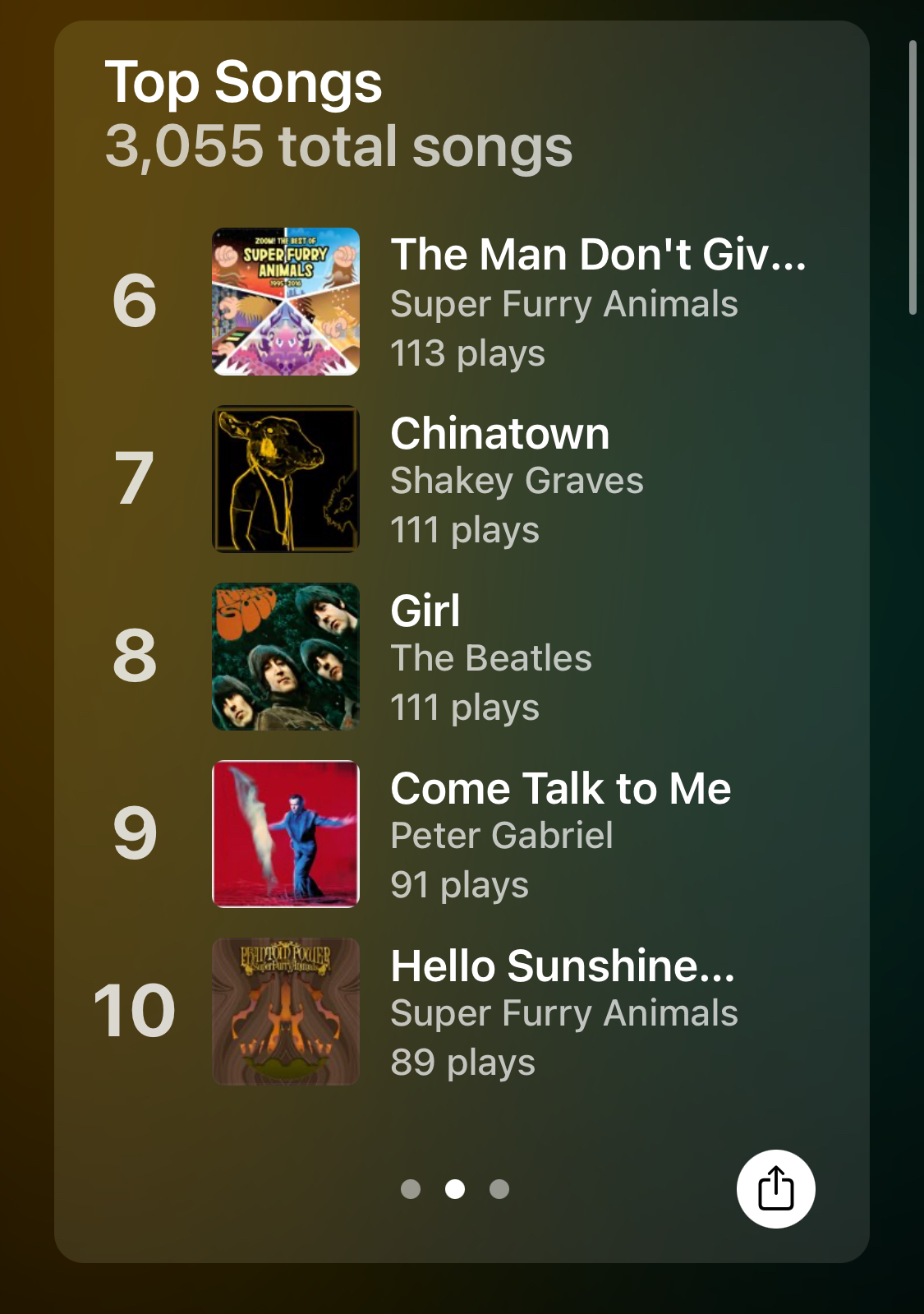
“Me and Your Mama” – Childish Gambino

This is probably one of the more left-field songs that I’ve ever ended up including on these posts. I’m 100% under a rock when it comes to most mainstream music; most of what I know is a) what I remember from middle school dances (not fondly), b) random stuff I pick up from following Pitchfork and Stereogum, and c) my neighbors. It’s always just background noise for me—thankfully, I’ve matured past the “I don’t like mainstream music and therefore I’m better than anyone else” mindset that plagued me in middle school, and even though most pop/mainstream rap still remains not my cup of tea, I’ve gotten to the point where I can admit how cool something sounds. I’d be remiss if I didn’t deny that it happens once in a blue moon.

Like this. I only happened upon it because a friend of mine put it in the background of their story, but the snippet I heard blew me away. We’ll get to that a bit later. But if there’s any song that screams “album intro” louder than anything else, it’s “Me and Your Mama.” It starts off at a crawl, with some gentle, twinkling synths and a beat that doesn’t persist so much as creep up on you. There’s a nearly 2-minute wait for anything to change about this song—it takes a while to really kick in. But the payoff? Jesus, the payoff. The first time I hit the 2:01 mark when listening to this song all the way through, I swear my soul left my body. Everything about it makes it worth the wait—come on, how could that Halloween-store-skeleton laughter not immediately elevate everything? All of it—the sudden collision and time signature shift, the bass—it’s like getting an electric shock straight to the heart. And right on the heels of Donald Glover absolutely howling the rest of the lyrics. Even when some of the earthshaking soundscape fades in favor of letting a bit of acoustic guitar slip through, none of the momentum gets lost. Every line is delivered rawly, like it’s freshly covered in blood, pulsating with captivating energy. And just as it reaches its crescendo, it’s gone. Two minutes more of spacey synths, and this song drops out of existence. Poof. I can’t not see the expert craft that went into every note of this song—it’s elevated from a song to something reaching beyond an experience. It really does swallow you whole for all 6 minutes and 18 seconds. I only have a vague notion of the rest of Childish Gambino’s catalogue, but damn. That’s how you open an album.

All for a song called “Me and Your Mama.” Go figure.

“So Cruel” (U2 Cover) – Depeche Mode

I’m gonna say it: I’ll absolutely defend U2. Up to their more recent stuff, I’ll still hold that they’re an incredible band, the “we’re going to put our new album on every single apple device and there’s nothing you can do about it” incident notwithstanding. I might’ve been too young to understand the full degree of annoyance of every apple user who wasn’t into U2, but I wasn’t too young to have a ton of fun at one of my first concerts—U2, on that same tour. Even if Songs of Innocence wasn’t their best work, I can still remember how the show was just pure fun. And whoever was in charge of the visuals was putting out their absolute best work—even almost 10 years after that show, I still remember how wowed I was by them. Sure, their more recent work has gone more than a little stale, but they’re far from deserving of the “worst band in the world” title that people have foisted on them in the last 20 years or so. How is everybody putting that on them when…I don’t know, Oasis exists?

Oh, they toured together, you say?

…oh.

Anyways. I’m not necessarily here to talk about U2 themselves. Just as U2 has been the soundtrack to many a car ride in my childhood (see: at least a quarter of How To Dismantle an Atomic Bomb), so too were many songs from this album of U2 covers. I’ve always been back and forth about Depeche Mode—I love their atmosphere in general, and I like some of their songs here and there. (“John the Revelator” will ALWAYS be a banger.) It’s that atmosphere that elevates their cover of “So Cruel.” The original was already chock-full of drama, and Bono’s soaring voice, as it usually does, sells it all. But Depeche Mode’s interpretation gives this drama and heartache a new flavor, taking it to goth heights that make both the heartbroken, enchanting moan of both Bono and David Gahan feel all the more palpable. The landscape of synths consumes the whole of this cover, with a murmuring heartbeat of a drum machine blanketed by a static hum of electricity that feels fizzly enough to touch. It grows sparser (and bleep-bloopier) in the chorus, but that’s exactly what it needs. Gahan’s cavernous voice needs all the more room to breathe, and it’s given that and more. It’s hard to think of anybody other than Bono who could deliver lines like “Her skin is pale like God’s only dove/Screams like an angel for your love” without sounding ridiculous. It’s an excellent cover—and a welcome surprise from my shuffle.

“More Than This” – Roxy Music

This one’s been a long time coming on one of these posts. I listened to it a ton this August, but it got lost in my desire to create a somewhat coherent color scheme, despite the chills it gives me on every listen. But now here we are, in our nice little blue period, and here we are. Perfect time for us to join hands, close our eyes, and feel like someone’s blowing a nice, big gust of wind into our long, lustrous heads of hair.

There’s few songs that I can think of that are as instantly transporting as “More Than This.” I’m not usually as receptive to that eighties, saccharine synth extravaganza, but this feels like the fleeting, sweet time capsule of that moment in time. It does call to mind that angle where the subject is blindingly front-lit, glowing from within with the wind blowing in their hair. I feel like we would all be receptive to feeling that glow once in a while, right? I wouldn’t complain. Maybe it’s because “More Than This” came before this was the concrete norm—this was 1982, and we were still a few years removed from the overlords of synthesizers and consumerism, so maybe that’s why it doesn’t feel as contrived. Somewhere in between Roxy Music and the rest of the eighties, the romantic grandeur of this song was lost—and that’s what keeps this song so powerful. It perfectly matches the starkness of the album cover; Bryan Ferry conceived of Avalon, the album where this song hails (its title track and first single), while visiting the west coast of Ireland. I haven’t been, but I can imagine that kind of stormy environment of steep, gray cliffs, the kind that have endured since time immemorial, would tend to stir that up in a person. And even though I haven’t listened to the rest of the album, that sweeping beauty shines through. As the narrator languishes in melancholy, hoping that there is something beyond this deep sorrow but being so entrenched in said sorrow to definitively say so, the instrumentals make a combination of guitars, synths, and saxophone sound as expansive as the sea. Bryan Ferry’s voice isn’t the deepest, but it hits that level of deep that sells the existential plea of it all. “More Than This” really feels romantic—not in the lovey-dovey sense, but in the 19th century poetry sense. Is it too much of a stretch to say that somebody like Shelley or Keats would have rocked with this? I’ll stand by it. Bottom line: yes, we put too much focus on old dead white guys in literature, but sometimes nobody hits it quite like certain subsets of old dead white guys. Keats knew what was up. And if this song is proof, so does Bryan Ferry.

And as a bonus, here’s the legendary Karen O’s acoustic take, from a few months back:

Since this post consists entirely of songs, consider all of them to be today’s song.

That’s it for this week’s Sunday Songs! Have a wonderful rest of your day, and take care of yourselves!