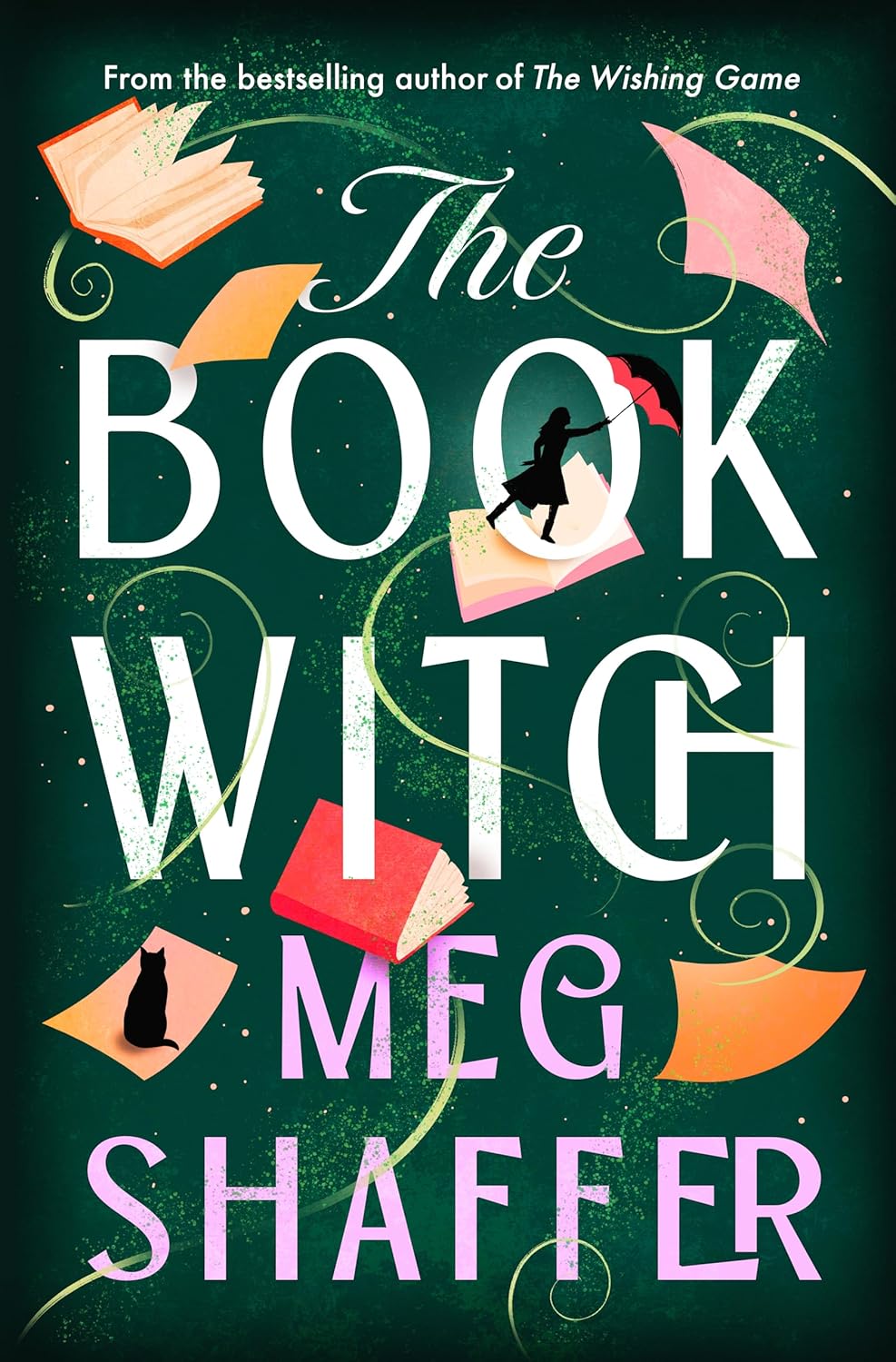
I’ve been a fan of Meg Shaffer since I first read her debut, The Wishing Game, several years ago. I liked The Lost Story as well, and when I found out that she had a new novel out this year, I was eager to see what she’d concocted. Though it was worth it to endure until the end, The Book Witch‘s corny writing nearly smothered the more earnest sentiments at its heart.
Rainy March is a Book Witch, an umbrella-wielding magician with a sworn oath to protect the fictional realm from real-world threats. Two years ago, she made the gravest mistake a Book Witch could possibly make: she fell in love with the Duke of Chicago, the main character in her favorite series. A slap on the wrist and a demotion later, and Rainy has accepted that she’ll never see the Duke again. But when her grandfather disappears, leaving cryptic, bookish clues behind, she may have to turn to him again to solve this seemingly unsolvable mystery.
TW/CW: loss of loved ones, grief themes, mild violence, terminal illness, brief descriptions of injury
WARNING: This review contains spoilers! If you haven’t read The Book Witch, tread lightly.
Let me start off by saying this: I didn’t enjoy most of The Book Witch, but it’s worth sticking it out until the ending. That being said, the payoff is excellent, but Jesus Christ, the road there was awful.
For the first 2/3rds of the novel, Shaffer’s prose in The Book Witch was insufferable. The recurring feeling that I had was that this was some kind of Sherlock x reader fanfic circa 2012 that had breached containment. It just reeked of that overly meta, quirky millennial humor that’s only become more grating with time. Rainy kisses the book boyfriend of her dreams, and mid-kiss, she says something to the effect of “Um, am I actually kissing the Duke of Chicago right now? 🤪” PACK IT UP. Who is this, y/n? Just put me out of my misery right now. And all of it is in that juvenile, cloying adorkable style, from the too-perfect Duke of Chicago (a book boyfriend made manifest) to the comically-evil, mustache-twirling, black-horse-riding stock villain, a book burner named X (I wish I was kidding). Even for a somewhat silly and whimsical concept, it just felt lazy to lean this heavily on tropes; knowing that Shaffer is capable of better writing than this made it even more sour.
On top of all that, the scaffolding of The Book Witch was barely there. There were just countless plot and character elements that didn’t feel believable at all. Rainy was meant to be somewhat exhausted, a bit jaded and beat-up after her dalliance with the Duke and the trouble she got in. We’re supposed to see the peppy Penny as a contrast to her, but they have the same cloyingly happy-go-lucky personality. Like X, all of the characters had one stock trait to go on that stayed static for the whole novel. I feel like there were more plot conveniences than actual plot, and therefore no tension, since I knew that everything would magically work out in Rainy’s favor. If this were a different author, I would’ve DNF’d it on the spot—it was just too convenient and juvenile to hold water.
Then came the last third of the novel. The Book Witch is one of those books that’s difficult for me to talk about without verging into spoilery territory, so here goes nothing. After 150+ pages of corny galumphing through fictional worlds, we get hit with the twist that Rainy March was never in the real world to begin with: she is a fictional character herself, and her author, Maxine Blake, is terminally ill and needs to pass the torch to a new author to finish her bestselling series. This is where the Meg Shaffer I know and love finally came through. This part of the book cemented some genuinely touching moments about the power of reading, the impact that authors and stories have on us, and the sanctuaries that books provide for reader and author alike. For how predictable the rest of The Book Witch was, this part hit me upside the head, and it was a glimmering lighthouse of sincerity in a sea of eye-roll-inducing prose. With that guiding the rest of the novel (and Rainy March’s journey), it actually managed to have some real heart.
With that said: does the end justify the means? Despite the poignant story behind The Book Witch, I don’t think it excuses any of the heinous prose that happened before the big reveal. Just because the story is a book-within-a-book doesn’t mean that fictional authors can’t write well. I just don’t believe that a dying old woman would write like a millennial in 2012 on Wattpad with too much time on her hands. Even though the Rainy March series is a bestselling series in-universe, I just don’t buy that something with such juvenile writing would be aimed at adults and gain the traction that it did. Having these books be a fluffy series of bestsellers doesn’t excuse the mountain of plot conveniences and tired tropes. It’s like Shaffer got so caught up in how a fictional bestseller would be written that she stumbled headfirst into every possible writing pitfall. The sad thing is that The Book Witch could’ve been so much more enjoyable and touching if not for that—the bones were here, but the meat (the book-within-a-book itself) was completely spoiled.
All in all, a novel that was worth the poignant message about the books that change us…but as a book, it didn’t change me. Honestly, it just really annoyed me. 2.5 stars.
The Book Witch is a standalone, but Meg Shaffer is also the author of The Wishing Game and The Lost Story.
Today’s song:
saw phoebe bridgers live for the first time last night (!!!!) and I’m still reeling from it!! I was really hoping she’d play this, and I just about spontaneously combusted when she did…what a magical night :,)
That’s it for this week’s Book Review Tuesday! Have a wonderful rest of your day, and take care of yourselves!
Noisier, more metal-adjacent music isn’t usually my forte. I used to hate most forms of industrial or metal music when I was younger, up until about high school. This was true for all but a few Nine Inch Nails songs (admittedly, I did love a handful of songs from Pretty Hate Machine in middle school…fitting, and also, “Head Like a Hole” will always be a banger). To this day, I still can’t decide how much I regret not seeing them with the rest of my family back in 2018, at a Red Rocks show where they ended up playing one of the only live performances of “The Perfect Drug” up until that point. Cruelly, it took me until a few years ago to like that song, too.
Nowadays, I can appreciate Trent Reznor much more as an artist, having gone from the throes of addiction to sobriety but still keeping true to his mission of making art to exorcise pain and create a safe space for those working through similar issues. Anybody with that mindset automatically has my respect. But of course, everything goes back to Bowie with me—I think I heard “I’m Afraid of Americans” around the same time as I started sort-of-kind-of liking Nine Inch Nails, and I don’t think there’s a way that you can come away from that experience without thinking that Bowie and Reznor are the coolest people on Earth. Hearing “God is an American” for the first time in the Trump era was certainly pivotal. But to hear of their relationship—Bowie taking Reznor under his wing, seeing pieces of his younger self in him and helping Reznor work his way out of his addiction and help his artistry blossom—is such a critical part of the Bowie and Nine Inch Nails story that a lot of Bowie fans who only fixate on the ’70s or ’80s woefully miss. The ’90s marked a turning point for Bowie musically and personally, with his no-holds-barred dive into experimental music and the peace of his private life, which allowed him to become that stable mentor for people like Trent Reznor, and many others afterwards. And then, of course, there’s the legendary tour they did together.
So understandably, Bowie’s death left an indelible mark on Reznor. Even before I got into Nine Inch Nails, I could understand that if anybody could, nay should cover “I Can’t Give Everything Away,” it was him. That’s not even mentioning his concrete song about grieving Bowie, “This Isn’t the Place.” Yet even if “God Break Down the Door” wasn’t directly about Bowie, it kinda still is, in its warped way. It’s a writhing mass of tentacles frenetically squirming ever outwards towards entropy. Reznor’s blares of saxophone are the most obvious Bowie (specifically Blackstar) callback and a connection point between them, as they both played the instrument in their younger years. But amidst all of the seemingly disparate aspects of the track—the writhing beats (almost goes into yoinky sploinky territory), the marimba, the persistent drone of it all—it creates something so singly whole. That fleeting beat of silence amidst Reznor’s droning and the explosive exorcism of sound that comes afterwards bottles a kind of feeling that I can only describe as a black hole being reversed, like all of the matter of the universe being shot back out from the point of oblivion. It’s the door that God’s broken down, from my interpretation. But to me, it’s not just the sound of Bowie that Reznor inherits: it’s the floodgates of creativity being busted open in the ’90s, wiggling free of all corporate and fan expectations to create something nobody expects.
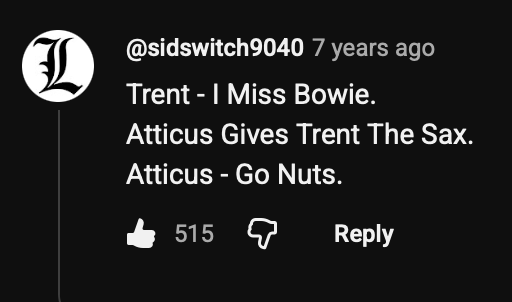
It’s very succinctly summed up in this YouTube comment:
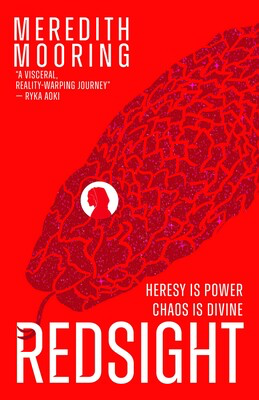
…AND A BOOK TO GO WITH IT:
Redsight – Meredith Mooring – “God break down the door/Everything all at once/There aren’t any answers here/No, no, not anymore…”
mary in the junkyard is a band I expect to come forward with something fresh lyrically, whether it’s feral people in the woods, reincarnated mice, or people turning into trees. Clari Freeman-Taylor has an eye for the left-of-center, the unloved creatures and inherent weirdness that reveals itself once you peer beyond the space between branches; her songwriting cradles spiders, mice, and impish creatures and nurses them back to health, patting them on the head when most people would run away and abandon them. So it’s no surprise that “Jane” is similarly unique. It hung in unreleased but often played live-limbo, where it was introduced by Freeman-Taylor as a love song about her period, who she named Jane and is “too annoying and honest.” Ain’t that the truth.
Writing affectionately about your period is a daring undertaking, given that it’s the bane of pretty much every AFAB person’s existence. But I think that the same tenderness Freeman-Taylor offers to the unloved creatures translated naturally to menstruation, which frequently makes you feel like an unloved creatures, and is a kind of unloved creature in her hands. The understated combination of electric guitar and Saya Barbaglia’s plaintive viola makes it feel like an apology, the sort of intimacy of cupping your hands over somebody’s chin as they weep. (Which, once again, very much a period feeling.) For me, it evokes the fear when I went through puberty as a young girl, developing at a rate that felt entirely too fast for the uncertain body I was in, doddering around like a foal: “It’s hard to be a woman, is it harder to be here?/It’s hard to be someone when everything is new.” To me, it’s both about that womanhood/AFAB experience as well as Jane herself being new in the world, emerging like some nocturnal creature every month. I never considered that my sentient period didn’t want to be brought into this world either. Maybe I’m the bad guy. Nobody’s having a good time here. But that’s where “Jane” finds sympathy, for both herself and Jane being constant, confused, and cramping companions.
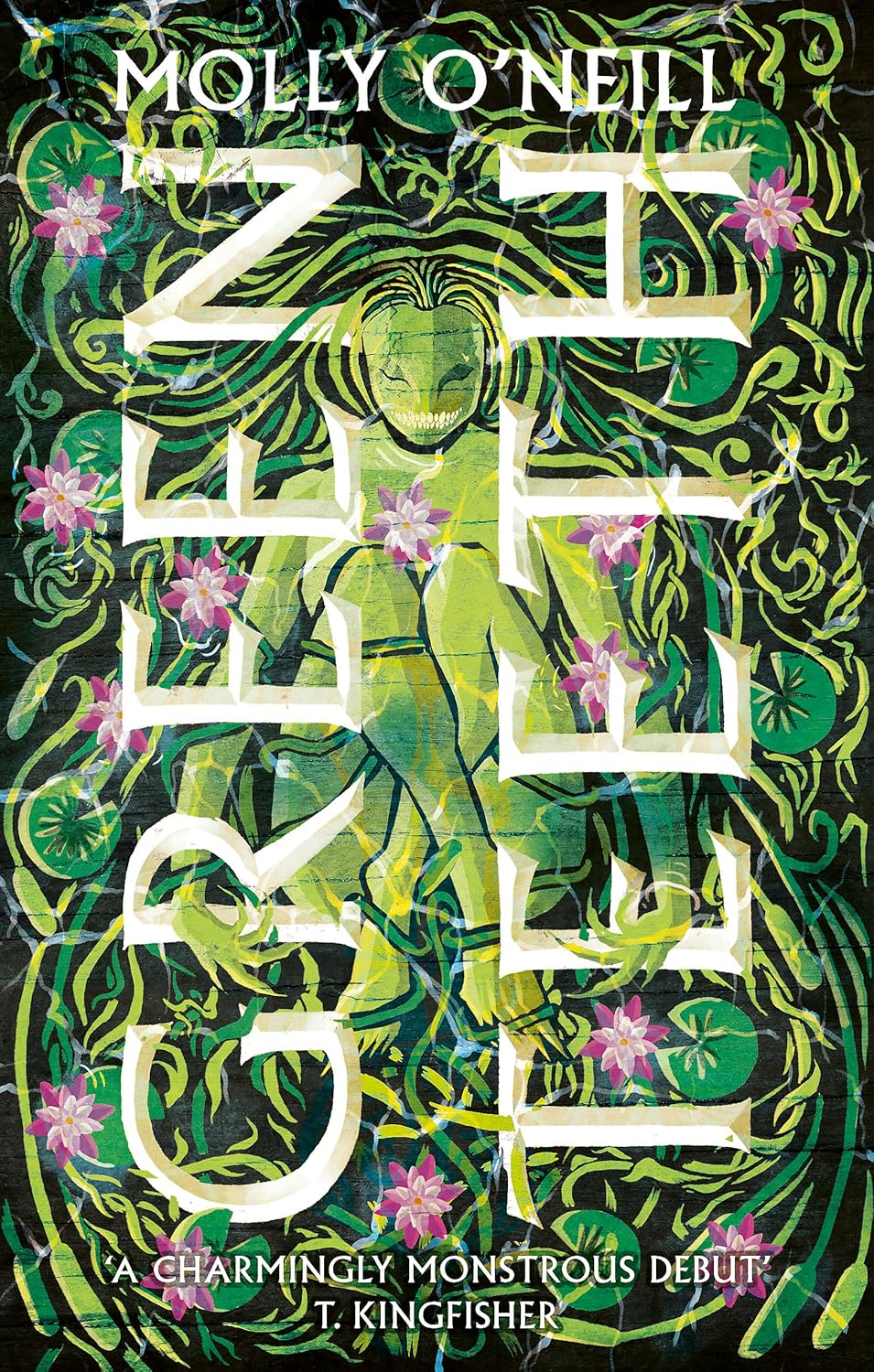
…AND A BOOK TO GO WITH IT:
Greenteeth – Molly O’Neill – to be honest, I haven’t exactly read many books that are a) about menstruation, or b) sentient periods, but Greenteeth gives me the tenderly, whimsically dark yet sympathetic feel of a lot of mary in the junkyard songs.
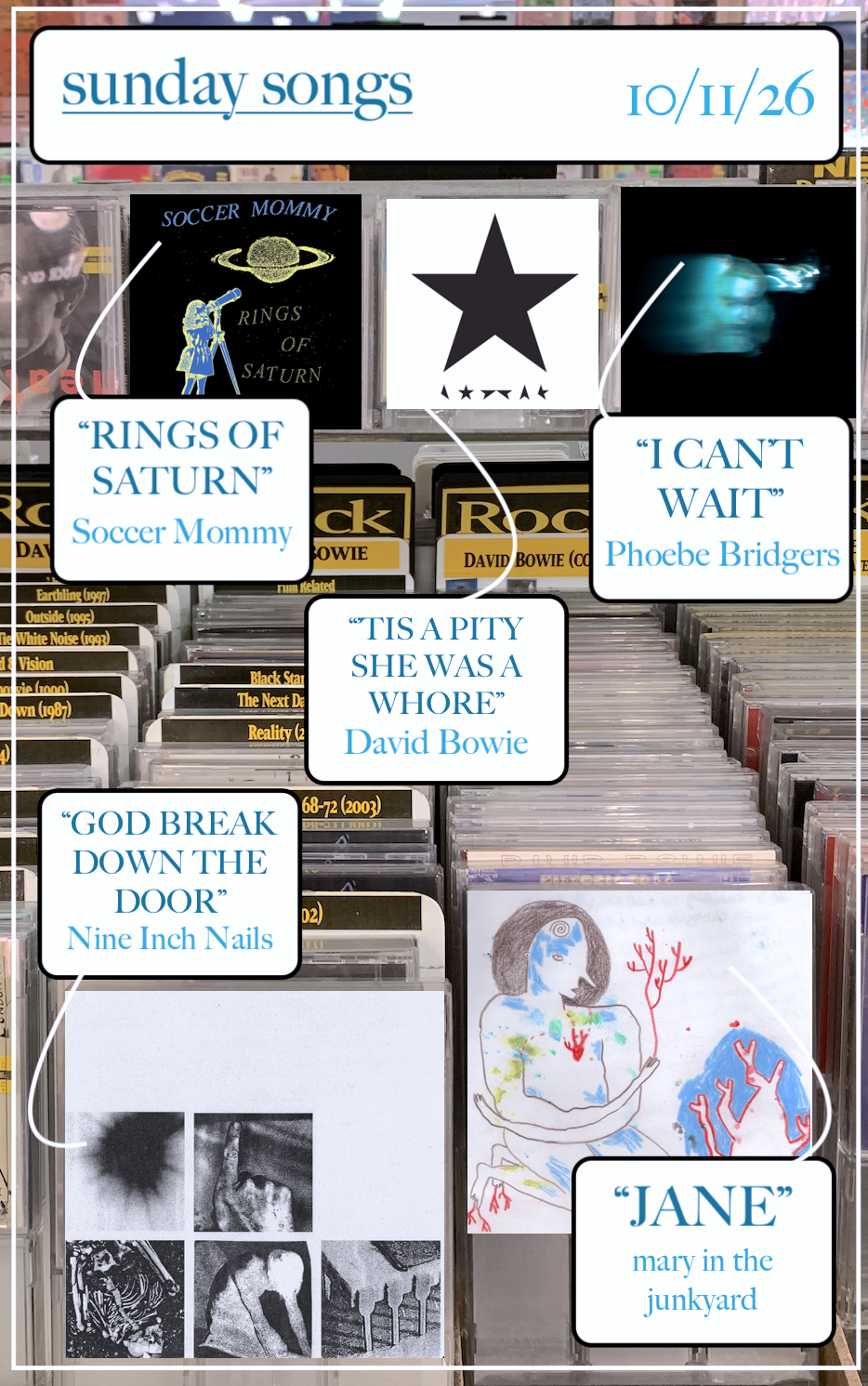
Have I gotten to the point where I’m ambivalent about Soccer Mommy? I don’t think so, but I think I’m dangerously close. “Rings of Saturn” is a nice song. That’s about it. It’s a nice Soccer Mommy song. But I feel like it’s not a huge leap from any of her other work. I feel like this could be an outtake from color theory, which isn’t necessarily a complaint. Yet with somebody like Soccer Mommy, I expect at least something new with each new release—there was the color-coded concept behind color theory, the experimental daring of Sometimes, Forever, and the acoustic grief cataloguing of Evergreen. Other than the production, there’s not much that separates “Rings of Saturn” from the rest; but I do enjoy the production, with its spacey, retro graininess. The lyrics are solid too—certainly relatable, and they would’ve been even more so when I was in high school. “Rings of Saturn” is perfectly fine, but I just wanted more. At worst, Evergreen’s tracks blended together, and I’m just afraid that it’ll happen again. Then again, back when she released “Shotgun,” it felt like she was playing it safe, and then came Sometimes Forever. So who knows? I want more from “Rings of Saturn” because I know she’s capable of something more. Tentatively, I’ll follow Soccer Mommy wherever this constellation leads.
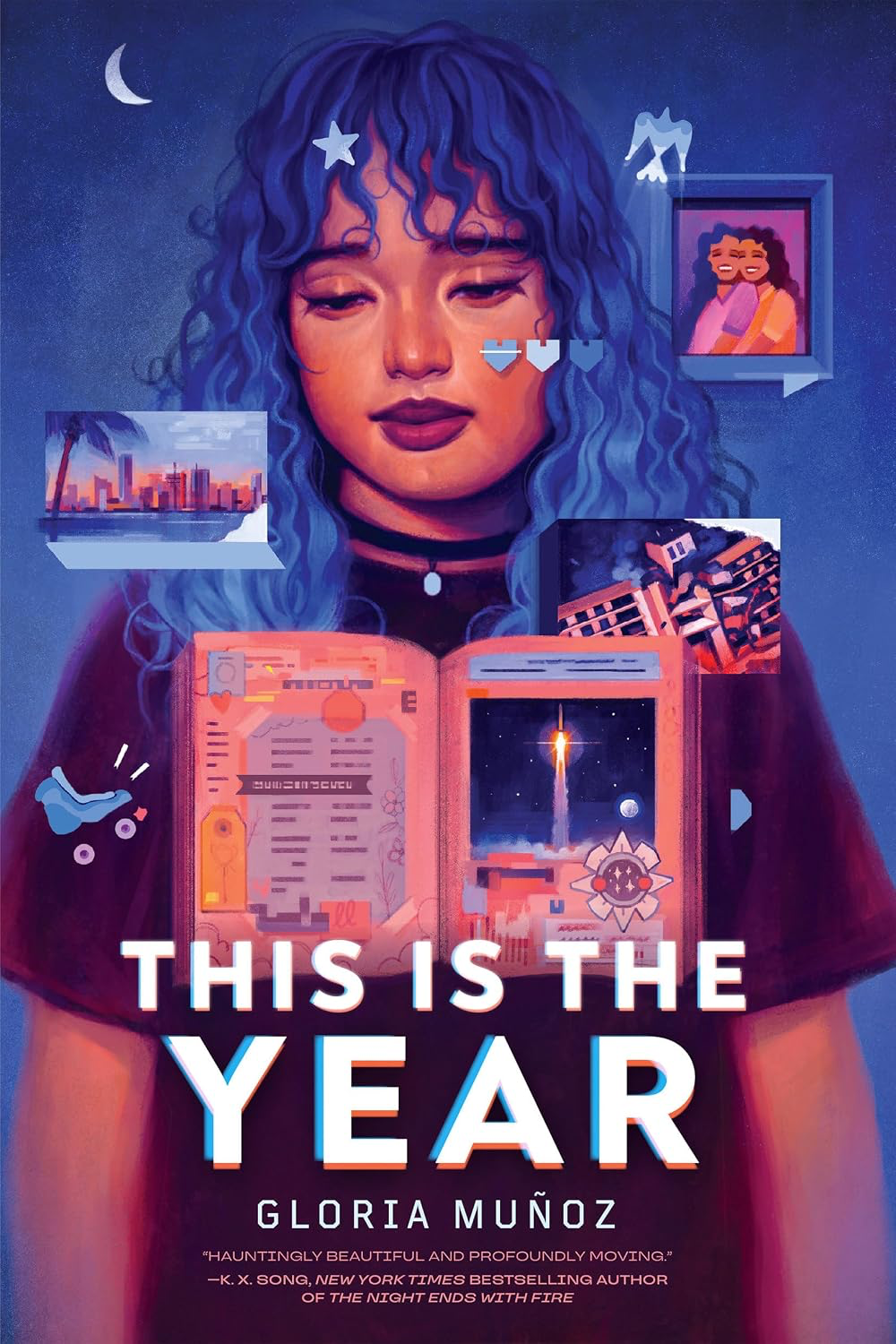
…AND A BOOK TO GO WITH IT:
This Is the Year – Gloria Muñoz – “The stars, they hardly shine/In the city lights, but I/Point my finger to a halo in the sky, I see your light/Rings of Saturn, do you hear me when I cry?”
Blackstar was always going to be an album that I needed to sit with. It took me years to even listen to it all the way through. A second time around, and I could barely handle the crushing weight of grief coupled with the ecstatic art-jazz-rock freakouts. And then I bought the record because it was within my self-imposed budget, a fine addition to my collection, etc., and that final piece clicked for me. Granted, most of the tracks still make me cry like a baby, but once I vomited up that initial onslaught of sadness, I could peek back and not just appreciate but genuinely enjoy the artistry behind it. It’s not that I didn’t get it before—even while I was actively weeping, I recognized all of the snatches of odd time signatures and how flooring pretty much all the lyrics are—but the immediacy of it had worn off.
I hate hearing the sound of breathing. Not even consciously heavy breathing, that’s obvious, but just any audible breathing. It’s very much a sensory issues thing, but hearing breathing (nay, any kind of mouth noises), chewing, sniffing, it all makes me fucking squirm. Something about it sets my perpetually askew nervous system on high alert. And that’s how “‘Tis a Pity She Was a Whore” begins. David Bowie breathes into the mic, then licks his lips. You can almost hear how chapped they are. It’s laborious. The exhaustion, the energy sapped out of him, is immediately apparent in seconds, and even when the saxophones and pounding drums kick in, you can hear him heaving. Bowie never gave a statement as to what the lyrics were about: all he ever said about the track was that “if Vorticists wrote rock music, it might have sounded like this.” Keeping the art movement in mind, characterized by cubism, harsh angles, and secrecy, it’s very apt. But that no-frills, human panting and breathing inclines me to believe one of the more popular interpretations of the song; Bowie describes a woman (in quite disparaging terms) who “punch[es] him like a dude” and “steal[s] his purse with rattling speed”…what could said “whore” be if not cancer?
Even if the language is more sparse than the usual flowery, cosmic Bowie epic, “‘Tis a Pity” is an epic in every sense. There’s no shortage of aspects to pick apart. There’s the gender dynamic of the cancer personification, clearly marked as a woman but whose violence takes on distinctly masculine language (“Man, she punched me like a dude”). There’s the title, taken from a 1633 play by John Ford, which is only tangentially related to the song’s themes, but nonetheless contains that same undercurrent of violence. The literary references continue with an interpolation of Robert Southey’s Sonnet 1, part of a collection of poems condemning the Transatlantic Slave Trade, where Bowie gets “hold your mad hands.” (Thanks are due here for the no doubt exhaustive research from the blog Pushing Ahead of the Dames.) Through it all, it paints an image of Bowie as a frail boxer, battered but impossibly full of energy until his last breath. It’s a harrowing song, especially with that final ragged yelp he lets out at the end. He sounds beaten. And yet, he was ready to throw those creative punches in the ring until the bitter end.
…AND A BOOK TO GO WITH IT:
The DSM-5 – American Psychiatric Association – we all need therapy after this, let’s be real…
Are you imagining me somehow serenely, sitting stationary while writing this post? Wrong. I’m still vibrating at the thought of Lost Weekend, mainly because I’ve got tickets to see Miss Phoebe (!!!!) very soon!! I’ve come back to the album constantly—easily one of my favorites of the year so far, and it only gets better every time I revisit it. This week’s pick was a real tossup—I could’ve easily gone with the enchanting slow dance (and brief Gracie Abrams diss) of “The Governor’s Waltz,” the bittersweet, country-fied healing of “Haunted,” or the visceral existential pleas of “As Above.” Now that I’ve had almost two months to sit with it, I think Lost Weekend represents the height of Phoebe Bridgers’s powers (no pun intended) so far. Dare I say that it’s better than Punisher? I do dare say it. She’s skyrocketed in fame and artistic ability, a rare combination; she’s only strengthened the emotional, raw pull in her lyrics without sacrificing a subtly adventurous spirit. The soundscapes have turned from artfully sparse to cosmically expansive, doffing shoegaze, country, and electronic hats with an ease that most musicians of her standing couldn’t attempt.
Yet I keep coming back to “I Can’t Wait.” There’s about a million puns I could make about this song and the fact that I can’t wait for the concert, but I’ll hold back. Another aspect of Lost Weekend that endears me is the fact that, in spite of the tragedy that led up to the album’s release, Bridgers has started finding peace of mind. Despite being labeled as such by the press and her fans, she’s frequently chafed against both a static sound and being pigeonholed as a sad girl; and, yes, while that’s part of why I love her, seeing her write songs of unabashed hope and love is like watching a depressed friend start healing and doing better for themselves. “Bobby” is the more obvious example, but “I Can’t Wait” hits me in the gut the most. With its juddering, harmonized sprint at the start, it’s brimming with anticipation. This time, it’s not the end-of-the-world prophecies of Punisher, but being excited for the first time about what’s on the horizon: romantically, emotionally. Bridgers paints herself as more than a little bruised and beat up, but she’s ready to run towards the finish line no matter how much dirt she’s got smeared over her bloodied knees: “I’m not good, but I’m better/Missed my cue, but whatever/It’s now or never.”
And of course, as if “I Can’t Wait” wasn’t one of Bridgers’s best already, it also solves one of the problems that she’s had for her whole career: her duet partners. She’s finally picked somebody with a lower vocal register than her to duet, and it actually works. They said it couldn’t be done…but if anybody could do it, it was obviously Cameron Winter uh [cough] excuse me, Son-John Johnson, my bad. The beat where the electronic skittering dissipates into folksy embers around a campfire, where Bridgers and Winter’s voices delicately intertwine, feels exactly like the song’s excellent music video; at that moment, the fly that the video’s POV has been from, gets gently cradled in Bridgers’s palms. It’s so secure, warm, and the moment that their voices coalesce feels like home, somehow. Incidentally, that’s where the real love song part of “I Can’t Wait” comes in, but that brimming, brilliant nucleus of hope and genuine excitement for the future gets me choked up. You can change your mind, but you can’t change mine…
…AND A BOOK TO GO WITH IT:
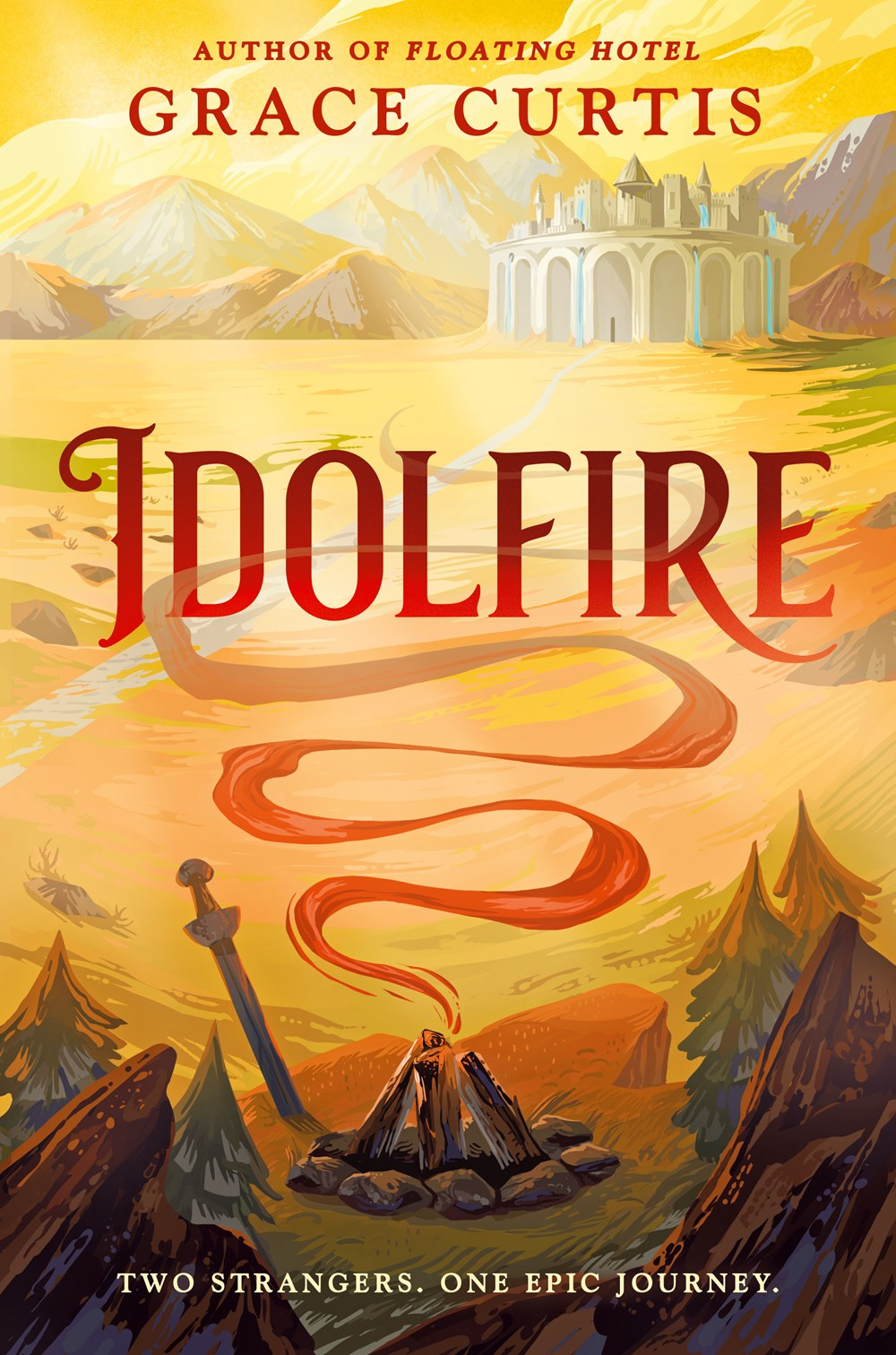
Idolfire – Grace Curtis – “Baby, baby, if you leave me/Can you take me with you?/I can sit in the back seat…”
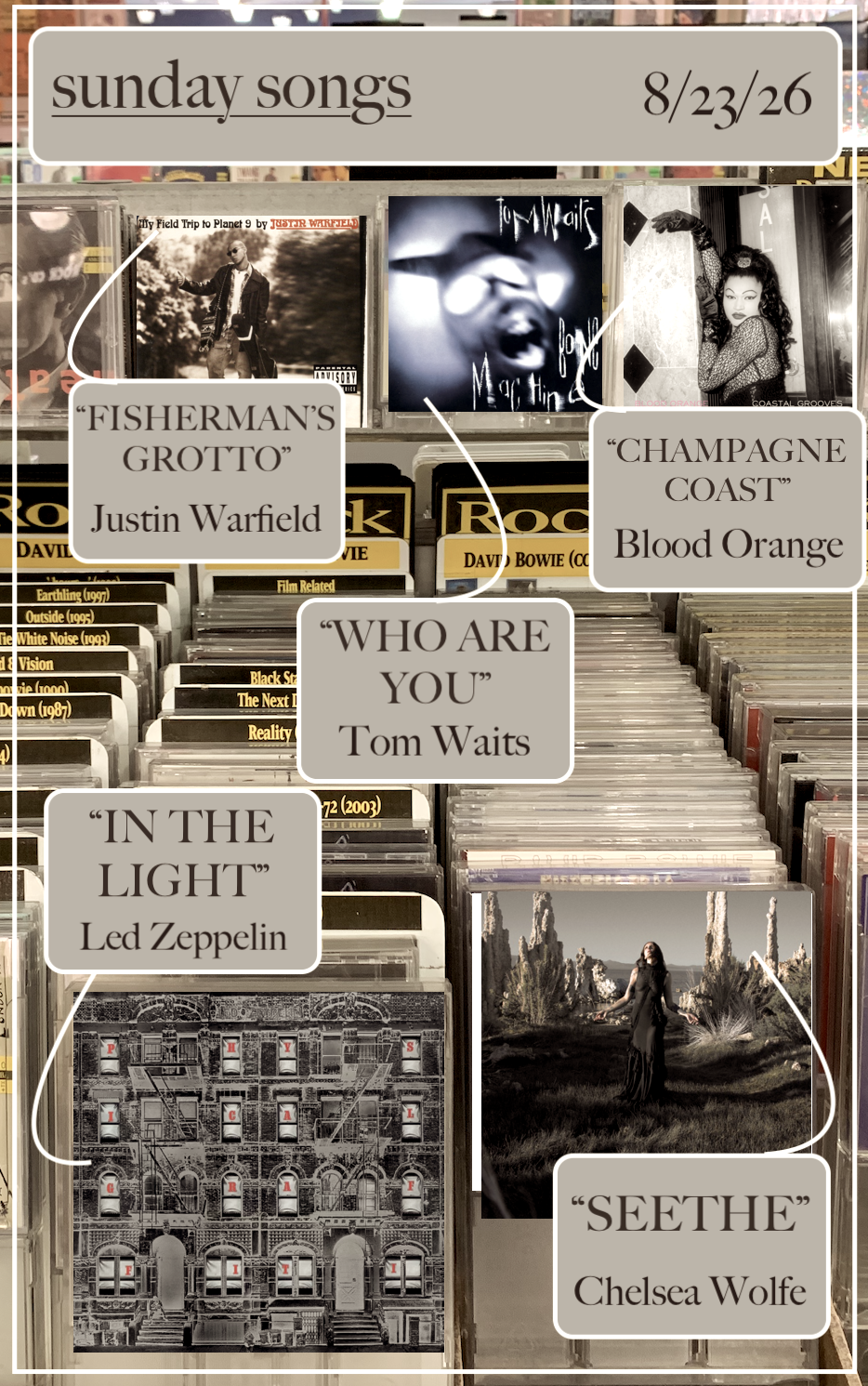
Since this post consists entirely of songs, consider all of them to be today’s song.
That’s it for this week’s Sunday Songs! Have a wonderful rest of your day, and take care of yourselves!
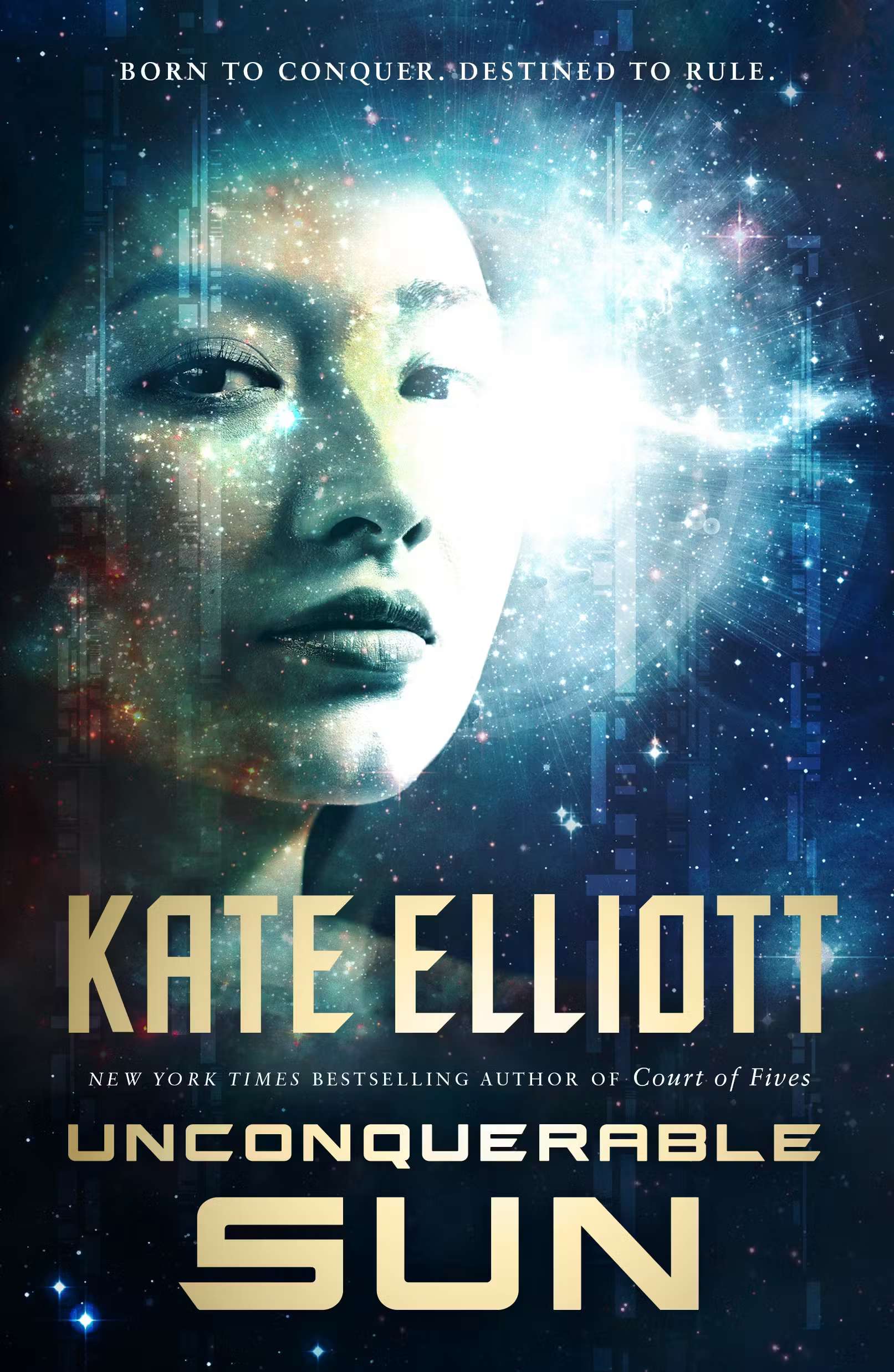
I’ve had my eye on Unconquerable Sun for several years; it’s appeared on several lists of queer sci-fi books that have caught my attention, and a loose retelling of the story of Alexander the Great seemed interesting enough. Unfortunately, Unconquerable Sun was overblown, overwritten, and kind of a waste of 500+ pages.
The Republic of Chaonia is in chaos. Princess Sun has come of age, and the throne that she’s inheriting is one of immense responsibility. Her mother, the Queen-Marshal Eirene, commanded armies and seemed to pull off miracles in order to keep their empire afloat. With a ruthless court and bloodthirsty enemies on all sides, Princess Sun must fight to earn her name—and keep her planet alive.
TW/CW: war themes, human experimentation, xenophobia (fictional), violence, murder
Unconquerable Sun wasn’t bad enough for a full-on DNF. I didn’t hate it, but I certainly didn’t enjoy reading it. Ultimately, the reason I slogged through it was because it felt like the book equivalent of the sunk-cost fallacy: I’d already gotten halfway through and I was at least vaguely curious as to what would happen, so I saw it through to the end. Sadly, things really didn’t pick up from there—this novel is 528 pages of mediocre worldbuilding and even worse characters.
Unconquerable Sun pairs two writing issues that are a fatal combination. The way that Elliott wrote the dialogue was downright obnoxious. It had that pompousness of somebody trying too hard to make the royalty come across appropriately Royal, which circled back around to just being corny. Suffering through that was already a lot, but then comes the second issue: with one notable exception, almost all of the characters had this exact same voice. Most of their voices were indistinguishable from the other, and to make matters worse, they all had the most annoyingly overwritten dialogue possible. Even the non-royal characters had voices like this, when they reasonably shouldn’tbe talking like elitist politicians—it was annoying to read, but more often than not, it didn’t even make sense. It reminded me of Maria Z. Medina’s Mistress of Bones,which, to this novel’s credit, was way worse, but it had a similar issue: it made no sense for most every character to sound the same. It was a headache-inducing combination, one that doomed me to lose interest in this novel early on.
Those issues with the dialogue translated to the characters as well. Most of the characters weren’t terribly distinguishable from one another, and there were countless side characters who didn’t have any business having such a large role in the story. Elliott attempted to do some in-depth development of Princess Sun, but I feel like a lot of the discussions of her living in her mother’s shadow were heavy on the telling and lacking on the showing, making her a somewhat hollow protagonist. (That being said, I liked how Elliott wrote about her being mixed-race, and the depictions of the discrimination she faces and her inner conflict was at least decently done.) Now, remember how I said that all of the characters were/sounded the same, save for one? That’s where we get to the issue with Persephone, who was utterly obnoxious in a secret third way. Elliott was so clearly trying to make her the witty, rebellious one, from the eye roll-inducing chapter names (Rick Riordan and his consequences) to her quippy, Joss Whedon dialogue. Similarly, her seeming issues with family were so glossed over just so she could be the quirky, messy foil to the more stuck-up Princess Sun, a dynamic that couldn’t have been more overdone. It’s a real feat for me to hate most of the cast of a single novel, but somehow, Unconquerable Sun pulled it off.
Unconquerable Sun was a mixed bag in terms of the plotting and pacing. Even though I wasn’t the biggest fan of this novel, I will say that the scenes were nicely plotted and placed. The disastrous royal wedding scene was compelling, and many of the similar scenes were action-packed and kept me hooked enough to see this novel through to the end. I’m not too keen on military sci-fi as a subgenre, but the fight scenes were well-paced and the action solidly written. Other than that, I really don’t think Unconquerable Sun needed to be this long; there was a significant lull in the middle that mostly consisted of the main cast running in circles that definitely needed to be trimmed down by at least 50 pages minimum. (I peeked at the sequel, Furious Heaven, and that one is over 700 pages…UH OH.) This novel was just too overwritten for its own good—it mostly affected the characters, but the plot wasn’t spared either.
To Elliott’s credit, the worldbuilding was solid. The bones of Unconquerable Sun’s world were well-thought out, and she did a good job of building up the history of all of the factions and all of their issues. The court intrigue was decently written, and it was the only place where the insufferably highfalutin dialogue worked. That was one of the only aspects of the novel that I wanted more of, but it was often left in the dust in favor of pew pew pew military sci-fi time. I’d mostly seen Unconquerable Sun advertised for said court intrigue, but it’s solidly military sci-fi (the Guardian review quite literally called it a “shoot ’em up,” so that’s on me for not seeing that. My fault, not the book’s fault). I wish this had been developed more, but it did a good job of humanizing the people caught in the crossfire of war, from the Phene victims of experimentation and the soldiers who had been drafted against their will; of course, I’m that one friend who’s too woke, but I feel like that could’ve been increased more, and there was some good potential for some commentary on the imperialism rife in this novel. Of course, this is military sci-fi, so this might be an ordering a milkshake from Home Depot situation, but I think my point still stands; military sci-fi, at its best, can be an excellent way to dissect of the horrors of war, imperialism, and unfair exploitation of all kinds.
All in all, a space opera that had too much and too many of everything: overwritten dialogue, forgettable characters, and, overall, just pages. 2 stars.
Unconquerable Sun is the first book in the Sun Chronicles, followed by Furious Heaven and Lady Chaos. Kate Elliott is also the author of several other books for teens and adults, including the Black Wolves series (Black Wolves and Dead Empire), the Jaran series (Jaran, An Earthly Crown, His Conquering Sword, and The Law of Becoming), the Court of Fives trilogy (Court of Fives, Poisoned Blade, and Buried Heart), and many more.
Today’s song:
I keep coming back to this track—it’s not my favorite from lost weekend, but it has some of the album’s best lyrics, hands down
That’s it for this week’s Book Review Tuesday! Have a wonderful rest of your day, and take care of yourselves!
It’s a real shame that I haven’t talked much about Led Zeppelin here, but to be fair, they are talked about quite a lot—as is what they deserve. I did go through a brief Led Zeppelin kick last year after watching the great documentary Becoming Led Zeppelin, but somehow, it never made it here. (In lieu of that, I’ll share their goosebump-inducing cover of “I Can’t Quit You Baby.”) But somehow, even though I spent my childhood hearing snatches of Led Zeppelin, “In the Light” slipped through the cracks. All I can ask, at this point, is how? How did I miss one of the best Led Zeppelin songs I’ve ever heard for this long?
“In the Light” feels mammoth in every way, as do a lot of classic Led Zeppelin songs. Partially, that’s the length—this track is nearly nine minutes long, and it’s one of those songs that deserves every minute of its runtime, because Led Zeppelin juices every ounce of gravity from it. Every second is used to its fullest extent—the intro, which lasts nearly two minutes, is a sparse palette consisting of synths and Jimmy Page’s best party trick: using a cello bow on his guitar. (I eat it up anytime somebody does it. I saw Johnny Greenwood do it on his bass with The Smile and I haven’t been the same since.) It’s enough to make you shiver with antici……pation. But once the full band kicks in, the momentum never stops feeling colossal. “In the Light” is just towering—it feels like staring up at a crumbling, ancient monument, a relic brimming with power underneath the surface. I can’t pin down the time signature, but there’s something so enticing about how John Bonham’s drums have such a consistent, fairly ordinary rhythm to them while Jimmy Page and the others just go absolutely nuts over it—that’s half the fun of the average Led Zeppelin song, to be honest. It has this zigzagging, staircase rhythm to it—everything feels like it’s climbing, with chord progressions that call to mind the Beatles in their later career. And of course, it’s held together by Robert Plant’s rich vocals, his signature howl becoming the weathered stone holding “In the Light” together. It doesn’t feel like a long song at all—you just get so hopelessly lost in it.
How did Chelsea Wolfe go from having one of the most hard-hitting albums of 2024 to…this?
So, The Dark. I came away thinking that Wolfe’s newest batch of 10 goth-rock (citation needed, at this point) tracks were…perfectly fine. Pleasant. Solid. But those aren’t words that I want to describe Chelsea Wolfe with. She’s adventurous, she pushes boundaries, she’s not afraid to get in the mud, to get raw and visceral and vulnerable with it! She’s a poet that finds the empathy even in the darkest corners of the psyche! So why does The Dark feel so lightweight? The lyrics are significantly weaker, the song structures are traditional, the instrumentals just fine…it just feels like she’s holding back. Of all the artists I’d expect to play it safe, Chelsea Wolfe wasn’t one of them. Unfortunately, that’s my overarching takeaway from The Dark. Even the album title is just vague. Like, oooh, naming your goth album The Dark? Completely uncharted territory…
That’s not to say that “Seethe” is a bad song. I feel bad ragging on these lyrics, but next to, I dunno, “Be All Things” or “Dusk,” it feels a lot simpler. It’s like Jeff Tweedy having some of the greatest poetry in American rock n’ roll and then using a metaphor about somebody being “cool enough to be ice cream.” (Again: nothing against “Ice Cream,” but it just feels like low-hanging fruit. At least Hot Sun, Cool Shroud – EP was leagues better than The Dark is.) But for “Seethe,” I feel like it isn’t the song for gothic, flowery poetry: it’s just a fun song about getting your righteous revenge. You don’t necessarily need a lot of complex metaphors if you’re on Chelsea Wolfe’s list and she’s out to get you—she’s just coming for you, she’s got her knife in her pocket, and she’s gonna getcha if it’s the last thing she does. Her vocals are as flowing and ethereal as ever, and we get some top-notch, raspy screaming in the background towards the end. With its ragged guitars and mile-a-minute bass and percussion, “Seethe” is a perfectly fun cut from the album—it’s just Wolfe letting loose, and who can fault her for that?
…AND A BOOK TO GO WITH IT:
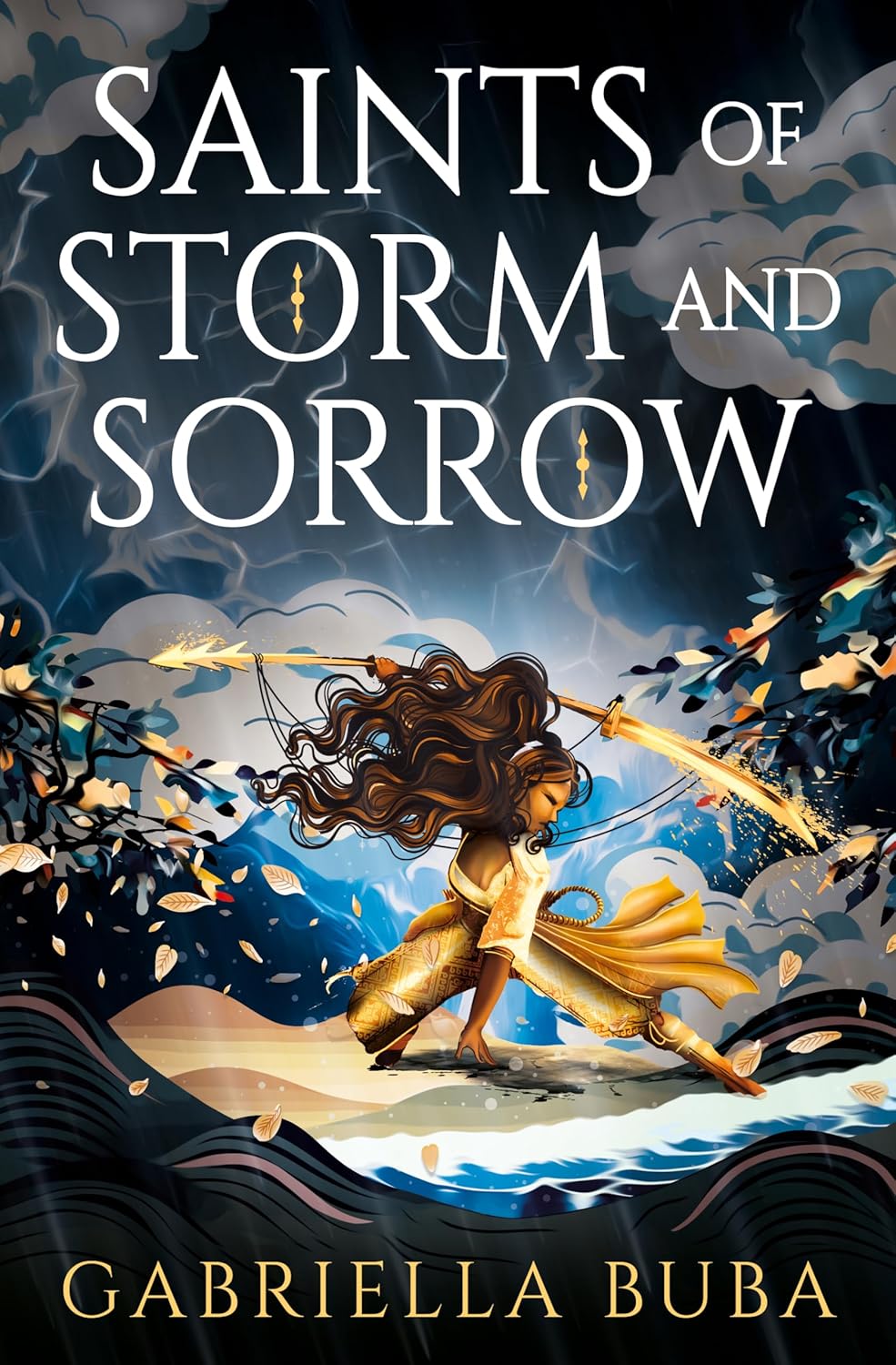
Saints of Storm and Sorrow – Gabriella Buba – “I see the ill in all of you/The violence hidden out of view/What I have done, if you only knew/I’ve got sharp edges all for you…”
As much as I credit my dad for my musical upbringing, I feel like my mom equally deserves the credit—especially when it comes to hip hop. Particularly, she’s basically given me my hip hop education: I know about Queen Latifah, Lauryn Hill, De La Soul, and the Beastie Boys (who she loves) because of her. And she’s the reason that I know about Justin Warfield—this track, as well as the low key instrumental “Guavafishcentepede (Aquatic Meditations).” Speaking of the Beastie Boys, Warfield samples them in “Fisherman’s Grotto” (that’s a sped-up portion from “Hold It Now, Hit It,” which appears at 1:24). It reminds me of how much artistry can go into samples; the centerpiece, to me, is the blaring horns that introduce “Fisherman’s Grotto.” You’re instantly hooked—it’s the audio equivalent of watching Warfield kick down a brick wall. Said horns are sampled from Blood, Sweat & Tears’s “Lucretia MacEvil,” and from there, Warfield expertly rides the groove of this track—it’s so effortlessly smooth from beginning to end.
…AND A BOOK TO GO WITH IT:
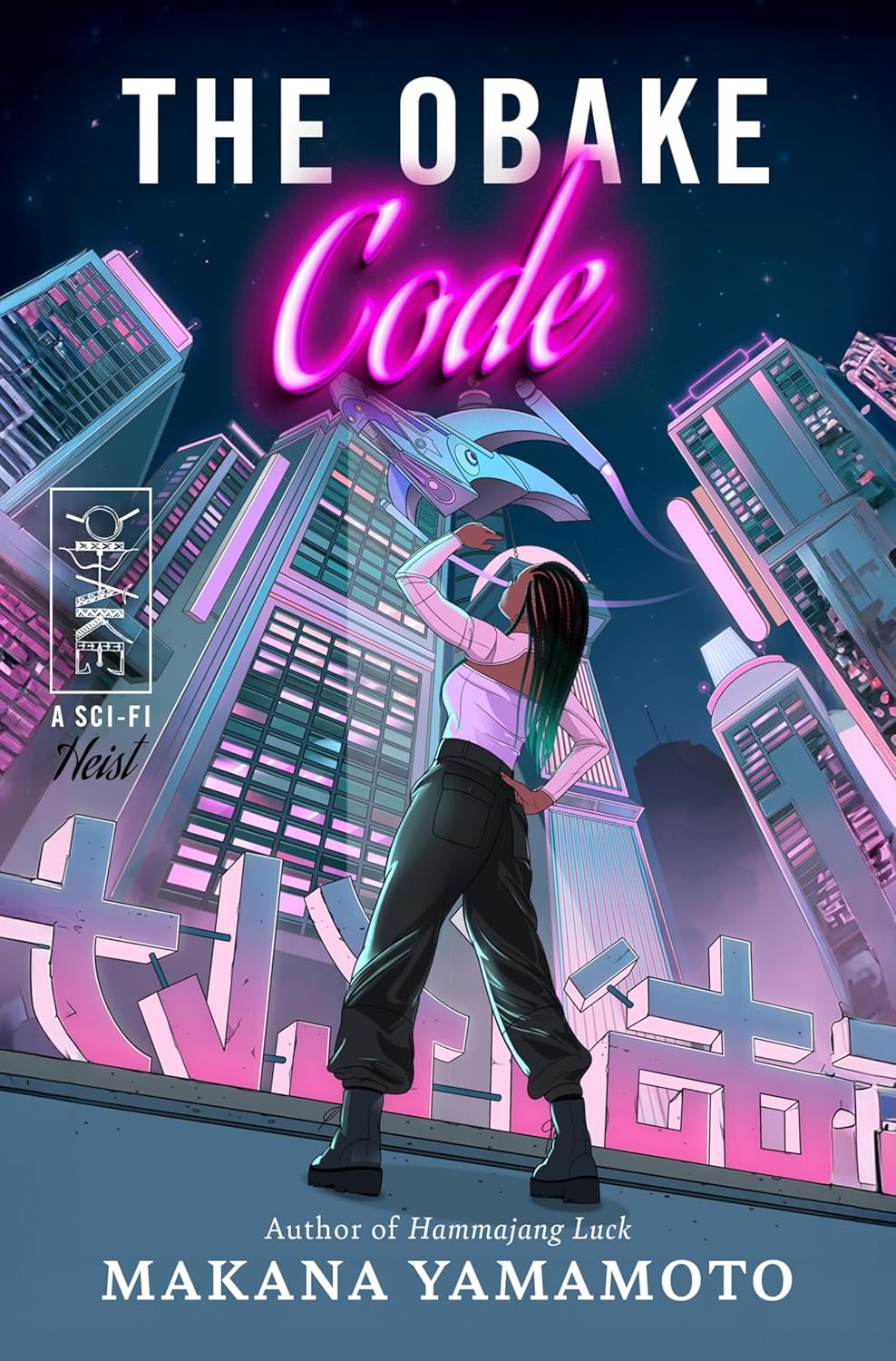
The Obake Code – Makana Yamamoto – this is exactly the kind of soundtrack I’d expect this gritty yet trickstery cyberpunk world to have.
Physically and mentally, I haven’t recovered from my grand decision to listen to Bone Machine and Lost Weekend in the same week. I know I’m cooked. I really haven’t changed since the age of 16. I love a sad bastard. Of course, if this was a sad bastard music competition (Phoebe Bridgers is also a noted fan of Tom Waits), Tom Waits would come crashing into first place—Bone Machine was the emotional equivalent of riding a dilapidated roller coaster with rotten, wooden slats that’s been decommissioned since the ’70s and should not humanly hold any weight beyond two pounds. It wildly oscillates from some of the most plainly, horrifically sad songs that I’ve heard in my life, and then we’re back to hootin’ and hollerin’ like a bunch of rabid swamp goblins around a campfire. Whiiiiplaaaaaash. Moments of unlikely beauty rub shoulders with moments of depravity and rot, but they’re all strung together by Waits’s uncanny knack for storytelling. A lasting impression, carried over from “The Earth Died Screaming,” is that he has more than a way with words.
“Who Are You” falls into the latter melancholy category. The minute the lazily ambling upright bass kicked in, I was transported to some rusting, barely populated pub at an ungodly hour, with Waits dejectedly slumped over the bar. It’s a track that’s positively drenched in venom and scorn, but Waits’s bitter storyteller’s bent gives it such a distinct feel. “I did my time/In the jail of your arms” feels like the exact kind of lyric I’d expect from Waits, but it gets so much better—and evocative—from there. Evoking the imagery of a run-down carnival and drunken, reckless escapades, Waits maps out a rugged terrain of a relationship gone sour: “Do you cry? Do you pray? Do you wish them away?/Are you still leaving nothing but bones in the way?/Did you bury the carnival with the lions and all?/Excuse me while I sharpen my nails.” All delivering in Waits’s wavering, throaty growl, “Who Are You” hits all of the visceral parts: biting, stinging, and raw.
A final note: I swear that Bone Machine gives the distinct vibe of the exact kind of music that Hellboy would listen to. The vibe carries over the whole album for me, but there’s a few moments on “Who Are You” that have pronunciations that sound straight-up Ron Perlman. Tom Waits and Ron Perlman do have a vaguely similar vibe, now that I think about it.
…AND A BOOK TO GO WITH IT:
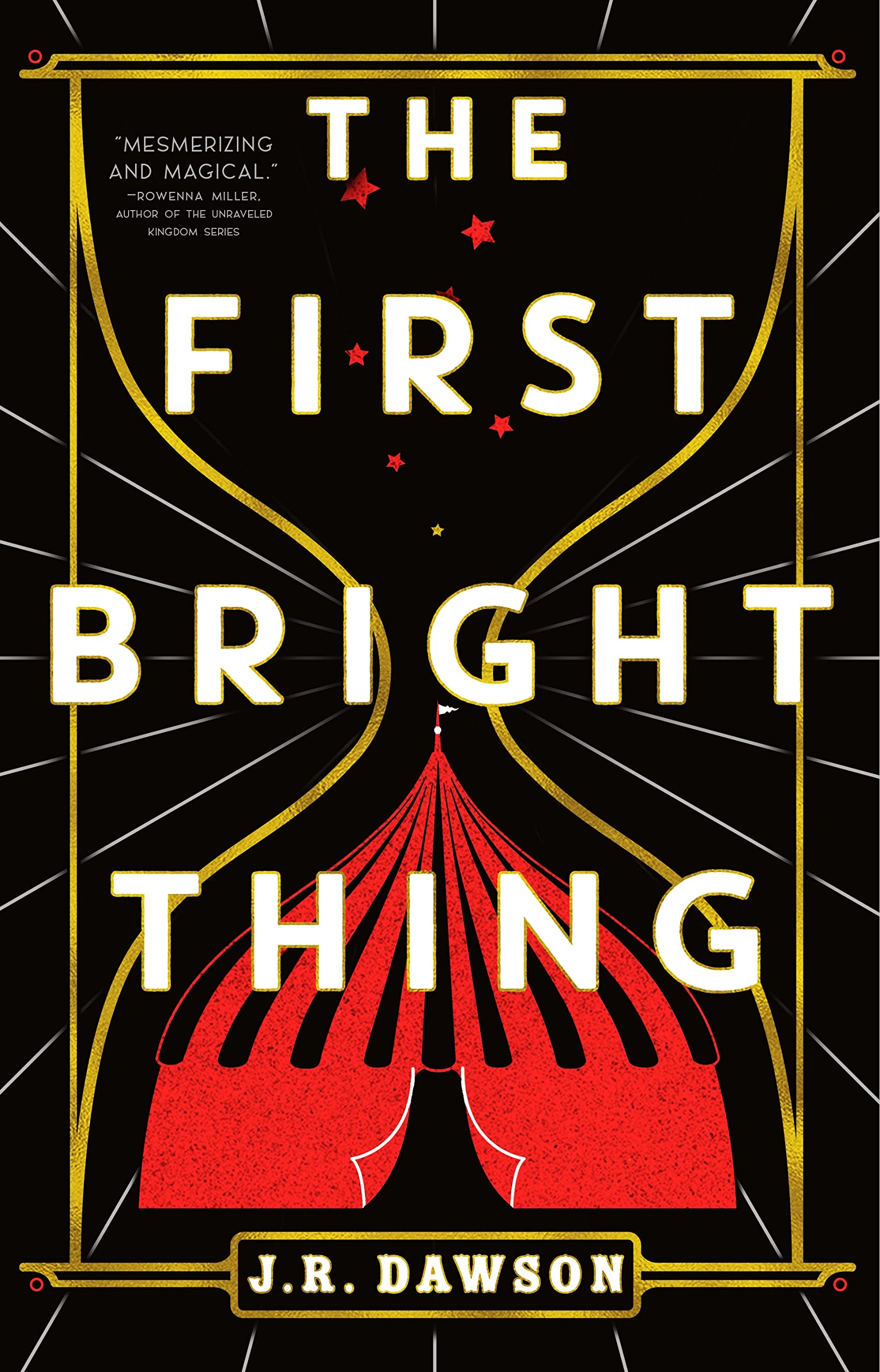
The First Bright Thing – J.R. Dawson – “Tell me, what did you do? What did you do the last time?/Why don’t you do that?/Well, go on ahead and take this the wrong way/Time’s not your friend…”
Alright, steady now. Hold my hand. We’re getting out of this Bone Machine morass together. Go take a shower, let’s dance! Up and at ’em! Life is worth living!
I’ll get it out of the way: yes, I remember “Champagne Coast” primarily from when it had a moment on TikTok about two years ago. The instrumental almost-chorus, with its high-pitched guitar riff that just glittered, was easily understandable as a catchy hook—and unfortunately, a backdrop for the unattainable beach vacations of influencers. (Happens to the best songs, I guess. I miss when TikTok didn’t know who the Yeah Yeah Yeahs were.) But on its own, “Champagne Coast” is a solid piece of indie pop—Perfume Genius is the best comparison that comes to mind, with Devonté Hynes’s warm, breathy vocals and the airy quality that lingers around the track like a silvery garland. Breathless and yearning, Hynes’s near-mumbled lyrics speak to a loving kind of desperation while waiting for a lover to return home. But its centerpiece is that viral, delicately plucked guitar, performed by Hynes himself; the greatest tragedy about “Champagne Coast” is that even though it’s nearly five minutes long, that guitar doesn’t get much room to breathe. Come on, man! “Let it rip” isn’t appropriate for a song this light, but give that guitar some love!
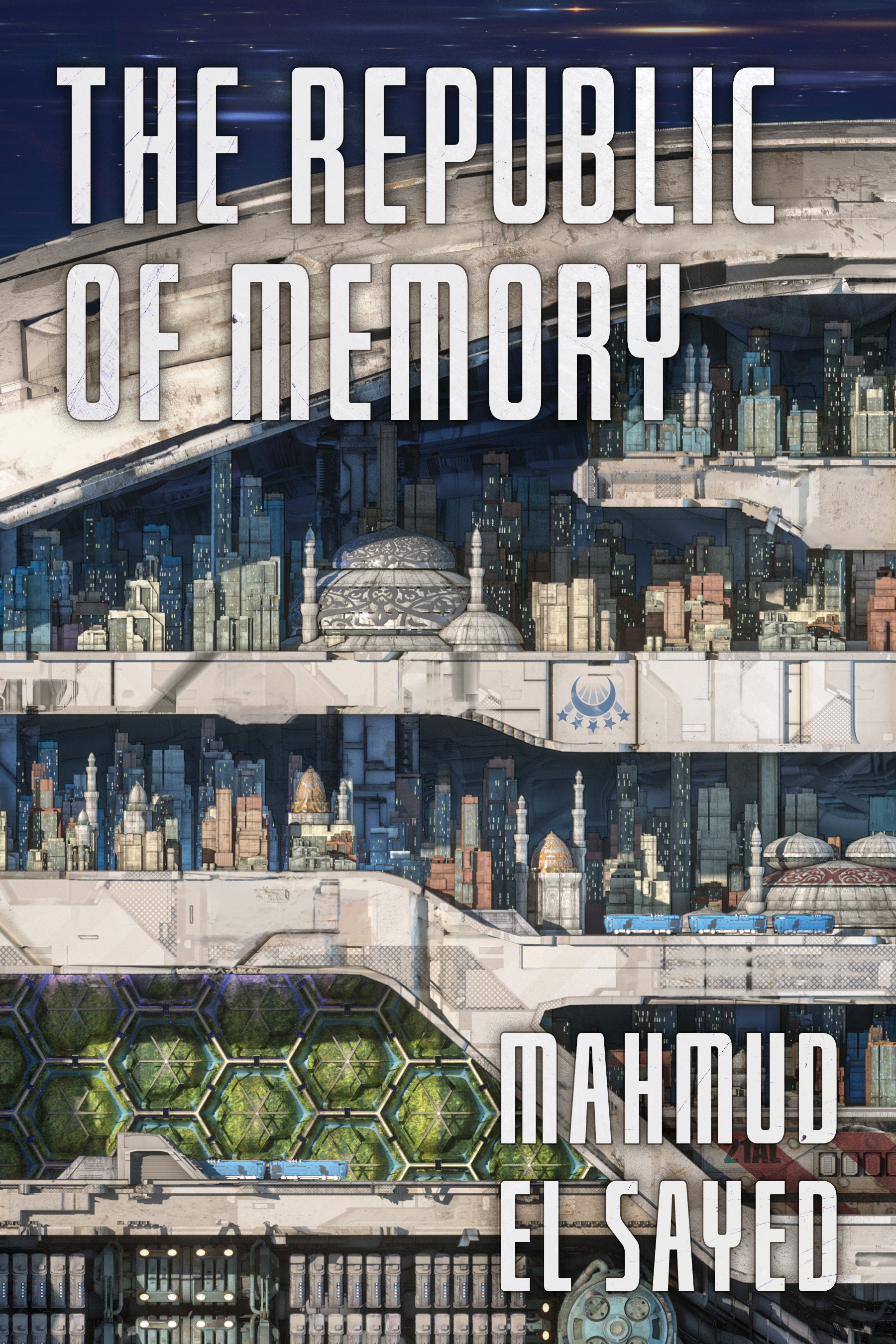
It’s always the best feeling when you find an extra cool-looking book at a bookstore that you’ve never even heard of before. (It’s a rare feeling for me, since I spend too much time reading and engaging with content about reading. Oops. I need to get out more.) That’s what happened with The Republic of Memory, and I recently bought myself a copy (shoutout to the Boulder Bookstore!).The Republic of Memory boasted so many inventive concepts, and it was such an original novel!
Onboard the Safina, a generation ship on a 400 year journey, revolution is brewing. Factioning based on one’s language and the tyrannical rule of the Captain have begun to chafe on the thousands of crew members. But when the Safina is plagued by a series of targeted blackouts, many of the disparate crew must come to terms with the fact that the foundations of their ship—and their journey—are about to change forever.
Without a doubt, The Republic of Memory is one of the more original sci-fi novels that I’ve read recently. It’s in a subcategory that Mahmud El Sayed calls Arabfuturism, and though I’ve read speculative fiction by Arab authors, it was so fascinating to see all of the cultural aspects integrated into this classic sci-fi setting. The worldbuilding is top-notch, and El Sayed did an amazing job of making the vast, interconnected world of the Safina into such a lived-in place brimming with history. I loved how El Sayed explores the idea of linguistics and language; the Safina is stratified based on language, and he gets into every possible outcome of separating people and groups based on language. Not only that, he gets into so much detail on how this has affected the culture aboard the Safina in the past few centuries, from how translators have become bureaucratic annoyances to a con-lang that mixes at least six different languages becomes a form of resistance. To say that El Sayed put so much thought into The Republic of Memory is a major understatement—this is a massive worldbuilding undertaking that was nothing short of phenomenal.
This novel dissects the beginnings of revolutions like very few others I’ve read have done. Until the end, it’s not terribly action-packed, but I loved that about it; it’s very much in the vein of a political thriller, and you get to see the revolution boiling over and eventually erupting through a kind of slow-burn, tense series of incidents all across this centuries-old generation ship. Along with El Sayed’s expert worldbuilding, there was such an incredible attention to detail paid to every aspect of what could trigger a revolution. We get a complicated, messy history of the Safina and all of the circumstances leading up to it, and The Republic of Memory is, in a way, a trail of hundreds of separate dominoes leading to the climax. It felt like a very honest depiction of how a revolution begins: not in a single, concentrated burst of activity, but a slow implosion over the course of years—in this case, centuries.
The Republic of Memory juggles dozens of POV characters. It’s a hard task, but I think it partially worked. It reminded me of Grace Curtis’s Floating Hotel, which is admittedly a very different book, but it has the same structure of including lots of POV characters in service of telling the story of the vast setting. For El Sayed, it wasn’t the setting that was told through the characters, but the story of a revolution from dozens of different perspectives. Although I wish some of the characters had been developed more, I loved how El Sayed examined the rumblings of a budding revolution through characters of all walks of life. Not all of the characters were likable or necessarily compelling, but I liked how they contributed to different views of how the revolution aboard the Safina was brewing. The execution wasn’t perfect, but I liked the approach that El Sayed took with the characters.
Unfortunately, the big ideas that made The Republic Memory so compelling also became its downfall. El Sayed has so much to say about the nature of language, resistance, and ideologies; for the most part, he’s successful in getting his ideas across. But there was a point when those ideas got so tangled up in the already complex plot that they made said plot even more convoluted than it already was. There were moments where El Sayed was so clearly so deep in his head that he thought it would be perfectly fine to frequently have nigh-incomprehensible chapters in the main con-lang of this novel, which were dizzying, to say the least. (To be fair, said con-lang incorporates elements from at least six different languages, so there’s bits and pieces that you eventually understand, but boy, it takes a long way to get there. And I’m not sure if it was worth it.) In addition, I’m not sure there was enough payoff for all of the established ideas; granted, The Republic of Memory is the first in a duology, but I think El Sayed ran into the classic issue of wanting to have lots of Big Statements on said Big Themes, but there wasn’t nearly enough time to get into everything that he established at the beginning of the novel. It’s a very ambitious novel, but not everything in it was executed neatly enough. I have faith in book two though.
All in all, a densely-packed sci-fi novel with lofty ideas to spare, which was both its strength and its weakness. 3.75 stars!
The Republic of Memory is Mahmud El Sayed’s debut novel, and the first book in the Song of Safina duology; the release date of the sequel has not yet been announced.
Today’s song:
phoebe bridgers + cameron winter doing a duet is seriously a match made in heaven!!
That’s it for this week’s Book Review Tuesday! Have a wonderful rest of your day, and take care of yourselves!
Happy Sunday, bibliophiles! I hope this week has treated you well.
This week: Yes, I did, in fact, preorder a song for Sunday Songs because I knew that I’d have Things to say about Lost Weekend, even though it’s only been two days since it came out. No, I’m not trying to kill you by putting Sparklehorse, Mitski, and Phoebe Bridgers in the same post (I swear the Mitski is actually upbeat. No, really!).
“Little Fat Baby” is one of the more somber songs in an already somber album, It’s a Wonderful Life. Yet it’s also one of the more empathetic songs. In the chorus, he ruminates on the song’s nebulous protagonist: “He got dragged/By a donkey/Through the glass/And the myrtle/But he was once/A little fat baby.” We never know what circumstances lead to this man meeting such an agonizing fate, but Linkous peers beyond the pain to see the inherent humanity in this character. The circumstances aren’t the point—the point is that all of us started off as helpless little creatures deserving of love. “Little Fat Baby” is a tender duet between Linkous and Sol Seppy, who provides fairylike accompaniment to Linkous’s already fragile voice. Quivering strings give this track a kind of grand reverence, amidst the quiet sympathy it weaves for the man who was once a little fat baby. There’s a strange comfort in “Little Fat Baby” amid the sadness—the feeling that you can always come home, no matter what you did before you stumbled onto the doorstep.
…AND A BOOK TO GO WITH IT:
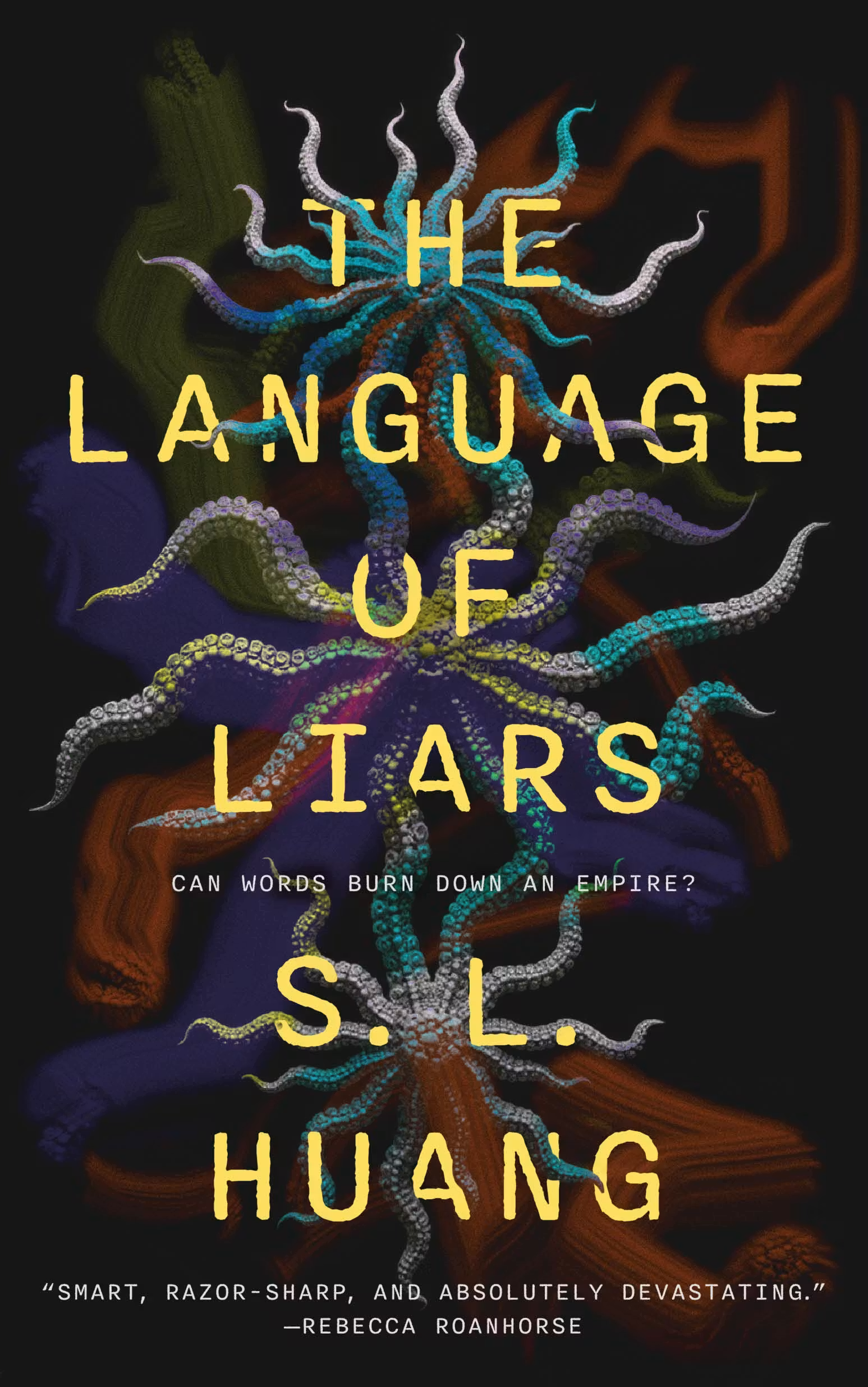
The Language of Liars – S.L. Huang – “Did you make the city slickers laugh?/He got dragged by a donkey/Through the glass and the myrtle/But he was once a little fat baby…”
Everything that Mitski touches turns to gold. Well, maybe not Laurel Hell, but they can’t all be winners. The recent tenth anniversary of Puberty 2 prompted her to release an edition with two new covers with whiplash-inducing source material: Frank Sinatra (which I talked about around a month ago) and One Direction. Of course, Mitski didn’t have to try in order to make “Fireproof” loads more fun than the original, which is pretty much the dictionary definition of milquetoast. (How do you make a song called “Fireproof” and then make it into the most sauceless, pallid excuse for a song possible? Jesus.) Mitski, on the other hand, made the vague promises of the lyrics into something tangible and fiery—her breathless admission of “I’m feeling something deep inside/Hotter than a jet stream burning up” makes it feel real. Aided by the crunchy guitars of her Bury Me at Makeout Creek era, this cover feels like she means every word, even if they aren’t hers.
…AND A BOOK TO GO WITH IT:
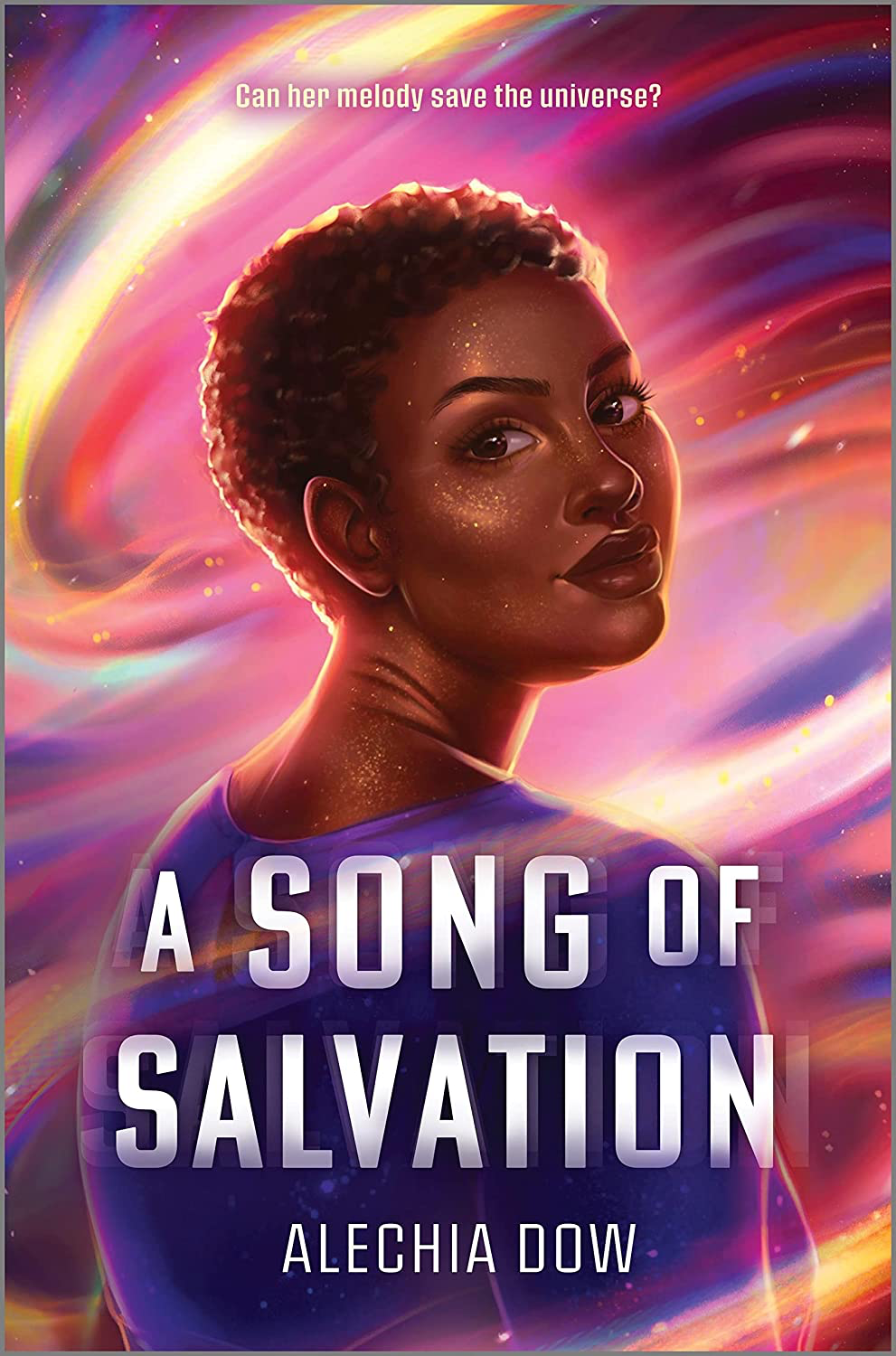
A Song of Salvation – Alechia Dow – “I’m feeling something deep inside/Hotter than a jet stream burning up/I got a feeling deep inside/It’s taking, it’s taking all I’ve got…”
Having only seen him live twice, I can say in confidence that there’s a point in every Robyn Hitchcock show where it goes from a concert to a stand-up routine. The last time I saw him, he veered into a whole bit about how rock n’ roll was invented in the 1700’s aboard ships. There was a joke about “Horse Latitudes” somewhere in there. He quoted “Time and again, I tell myself/I’ll stay clean tonight” from Bowie’s “Ashes to Ashes” before segueing into “The Cheese Alarm.” The guy’s just naturally hilarious. This is the same man who casually used the interjection “yaysville!” multiple times in his memoir, after all. It felt nothing but natural.
What sticks to me about Robyn Hitchcock’s sense of humor to me is that yes, he’s got jokes, but he never half-asses them. He still puts his all into a song with lyrics like “I love that old museum of sex/You never know what’s happening next.” With the grooving, horn-laden accompaniment of the Venus 3, he launches into a track that winds along slinkily like a snake. He added in a lyric about said Museum of Sex closing at 4pm, to the laughter of the crowd, and all the while he’s chipping away at an artfully complex riff. He’s committed to the bit to a degree that most artists aren’t.
…AND A BOOK TO GO WITH IT:
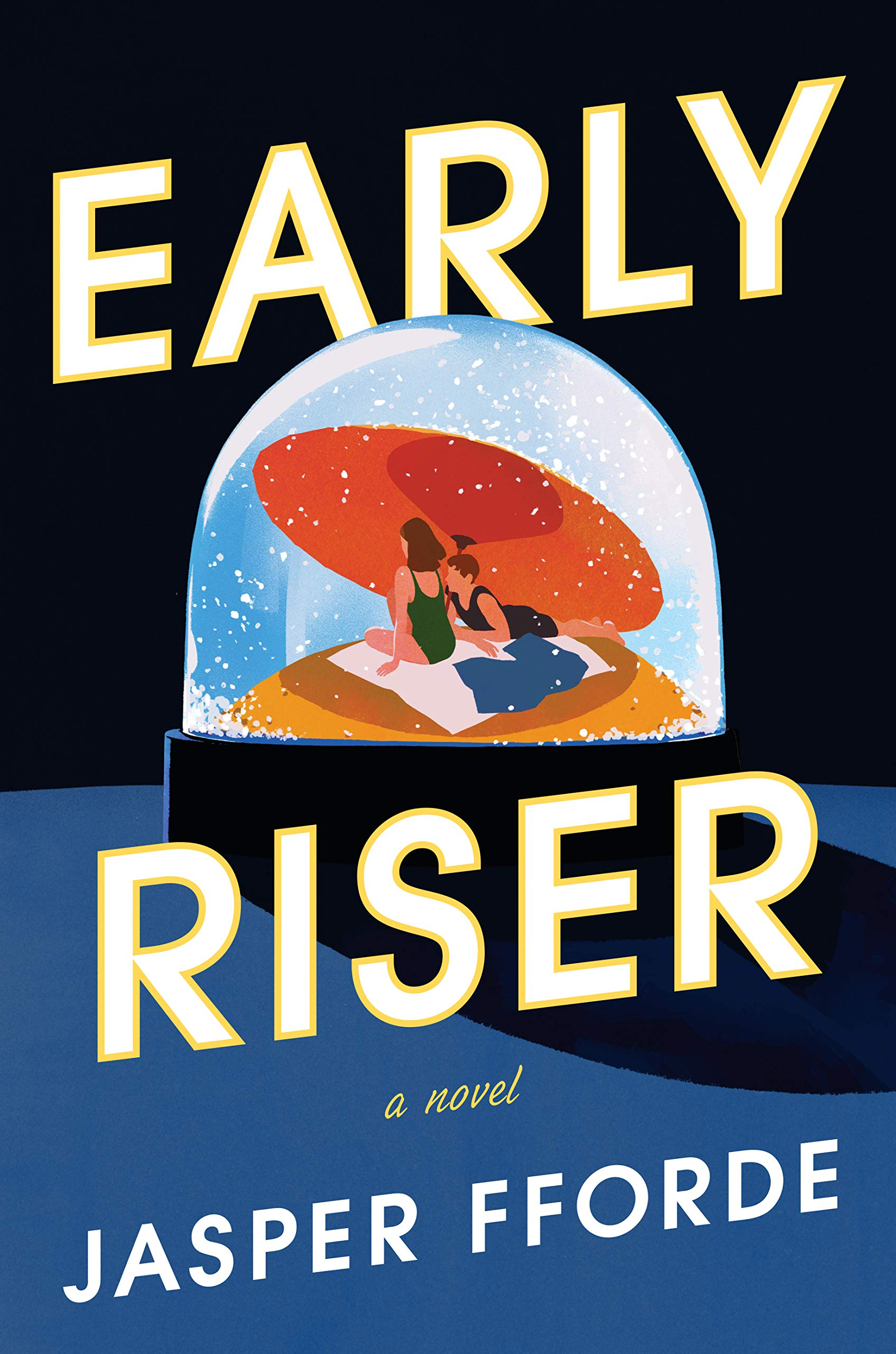
Early Riser – Jasper Fforde – there’s not a lot of books or authors I can think of that are similar to Hitchcock’s sense of humor, but Fforde’s quirky, dry wit and out of left field premises certainly comes close.
“The A Song” is monumental. There’s no doubt about it. When I saw Spiritualized back in 2022, about a month before Everything was Beautiful was released, I remember being caught up in the towering tidal wave of noise. I could sense that “The A Song” was new, and all I could make out from the dizzying bee’s nest of sound was the line “One man’s crime is another man’s thrill”; the rest was just a shockwave.
It’s no wonder that I listened to Everything Was Beautiful to death when it came out. I had to take an extended break from it because it consumed me so much in mid-2022. To this day, I still think it’s one of Spiritualized’s best albums to date, nearly on par with Ladies and Gentlemen We Are Floating in Space, no less drugged-out but with the optimism that comes with age—and the revelation that you’re still alive, and there’s a myriad of things that you can do with your body and your life. Sure, “The A Song (Laid In Your Arms)” is probably as much about being high and watching your life slip away as any given Spiritualized song, but it’s a truly spectacular show of the amount of command that J Spaceman has of sound. Watching him at work is like watching a conductor with a 60-piece orchestra; squealing horns, screeching guitars, and percussion like pounding waves all convalesce into a marvelous, tidal force that knocks me off my feet, even when I’m sitting down. It’s so meticulously controlled and constructed, and yet there’s something so primal about how this song just swallows you whole. “The A Song” is a cosmic force—like the album title, it’s the kind of immaculate construction that, in spite of its lyrics, taps into the wonder of watching life itself unfold in front of your eyes, just like J Spaceman’s arresting compositions unfold in front of you. I think that’s the point of Everything Was Beautiful, in the end; it’s a celebration of the overwhelming shock of being alive.
Predictably, I’ve become insufferable about Lost Weekend. Phoebe Bridgers could’ve easily gotten away with releasing Punisher 2: Electric Boogaloo after six years of radio silence, but she’s easily defied it. It’s a different record, temporally and stylistically. I’m struck by how it sounds next to Punisher; the former was lonely in the way of expansiveness, intensely sparse, like the image of Bridgers staring up at the stars in the middle of nowhere on the album cover. Lost Weekend, on the other hand, is lonely in a way that only happens when you’re caught in the eye of a storm in a roiling sea of chaos. The album is all about upheaval and disorientation, both positive and negative, with the confluence of her father’s unexpected passing and her relationship with Bo Burnham. Add to that the unforgiving eagle-eye of the music industry and the tabloid press, it’s got enough hairpin turns to make somebody want to abruptly get off the ride and throw up.
Chaos is something that Bridgers takes full advantage of on Lost Weekend, with some of the stylistic detours feeling disorienting if not played in the right order. But in order, the cohesion is difficult to miss; it feels strung together in a more adventurous way, especially with the bevy of instrumentation and noise that’s been added to the soundscape. “Kill Me,” one of my standout tracks from the album, feels like the lodestone of the chaos and disorientation: the repetition of Bridgers’s breathy admission of “This is gonna kill me/Wait!” as the instrumentation blinks into momentary silence feels like stumbling off of a dizzying rollercoaster, not knowing which direction is up or down. (Fittingly, I had a similar feeling coming out of the accompanying laser show at the Denver Museum of Nature and Science. In a good way, for sure. Fitting.) Much of the song deals with time out of time, years bending and blending together: “My boys are getting married/Turning 21/I’m not, but I was once certain, always.” That sense of uncertainty feeds into the verse about a shared kiss at a costume party where “the veil is thinning.” (Admittedly, I thought that the “flower with chemical petals” line was corny, but it turned out to be a reference to David Foster Wallace.) All of it culminates in a propulsive turn into cascading shoegaze at 3:34 that sounds like the fabric of reality itself is fragmenting into fragile pieces, buoyed by Cameron Winter’s (!!!) backing vocals. Bridger’s rallying cry of “Let’s go missing” certainly puts “Lost Boys” in a new light—all of this upheaval and heightened visibility would make anybody want to go off the grid.
Lost Weekend, in the end, reads to me like a beautiful statement about facing the inherent unpredictability of life. Some days, it’s enough to make you want to disappear. But some days, it represents a promise of something wonderful that you’ll never see coming on the horizon. Life is full of this chaos, in all of its grief and turmoil—there’s no use running from it, good or bad. Sometimes what’s on the other side is the very thing you’ve always wanted.
BONUS: Speaking of Cameron Winter [ahem] Son-John Johnson, here’s one of my other absolute favorites from the album, the duet “I Can’t Wait” and it’s newly released music video:
Happy Sunday, bibliophiles! I hope this week has treated you well.
This week: in honor of the 250th anniversary of our glorious, flawless United States of America, I’ve concocted a color scheme that pairs well with the sickly algal green of the Reflecting Pool. God bless America, or something. Worry not: there’s enough women, queers, and people of color to give half of the White House a stroke. D.E.I.!
SHE’S BACK!! SHE’S BACK, THIS IS NOT A DRILL! LOST WEEKEND COMES OUT THIS AUGUST!!!
Returning to music—and the public eye—was always going to be a tall order for Phoebe Bridgers. In the absence of new music since 2022, her fame has unexpectedly skyrocketed. It’s so bizarre to think that when I got into her music in 2019, she was on par with artists like Soccer Mommy, Snail Mail, or Jay Som in terms of recognition, and now she’s selling out arena shows…whiplash, for sure. Opening for Taylor Swift on the Eras Tour was likely the turning point. Either way, when she finally came back, there would be an inevitable torrent of naysayers and unwarranted speculation. I almost still can’t believe that she’s back.
Most of my thoughts about “Lost Boys” coalesced while I was listening to it on repeat while making a grilled cheese, which feels strangely fitting—here’s a song with themes of immaturity and not wanting to grow up, and there I stood with the ultimate kid’s menu dinner. (At least it wasn’t American cheese and white bread.) But the doubts kept swirling around in my head. Is the production too polished? Are the horns and tempo too much like “Kyoto?” Was Punisher the only trick up Phoebe Bridgers’s sleeve after all? Sure, I maintain that the production feels on the unnecessarily slick side (damn you, Jack Antonoff). And it does ring similarly to “Kyoto.” But “Lost Boys” feels like being invited into something new. It feels like the lulling into a false sense of security before the sound of Lost Weekend unfolds in earnest.
Yet even if it wasn’t, “Lost Boys” would be a worthy addition to Bridgers’s catalogue. The “Kyoto” comparison is apt because they have that same quality of feeling like a reckless sprint—both to escape something they should’ve confronted long ago. Imagery of fantasy and escapism melds with Bridgers’s usual structure of very modern vignettes—these lost boys are emblematic of the kind of escapism she longs for, but she’s equally damaged by being in the company of that amount of emotional stuntedness and immaturity. It’s a bittersweet concoction, made all the more so by the effortless shifts from whispery reflection to the raw-throated count-off before the final chorus. “Fun” isn’t the word I’d normally describe Phoebe Bridgers with, but I can’t help but feel a rush of excitement every time I listen to this song—there’s something ecstatic about it amidst the uncertainty. Maybe it’s the fact that both Julien Baker and Lucy Dacus quietly contributed backing vocals. Either way, “Lost Boys” is a strong start for Bridgers’s long-awaited return.
…AND A BOOK TO GO WITH IT:
Do You Dream of Terra-Two? – Temi Oh – “To another life/Where they make you cut your hair/Impatient with a rifle and your papers/Weightless, but not scared…”
Jim Noir’s new album, The DLC Tapes, is now available exclusively on Patreon and Ko-Fi! If you’re financially able, I highly recommend this album alongside Programmes for Cools.
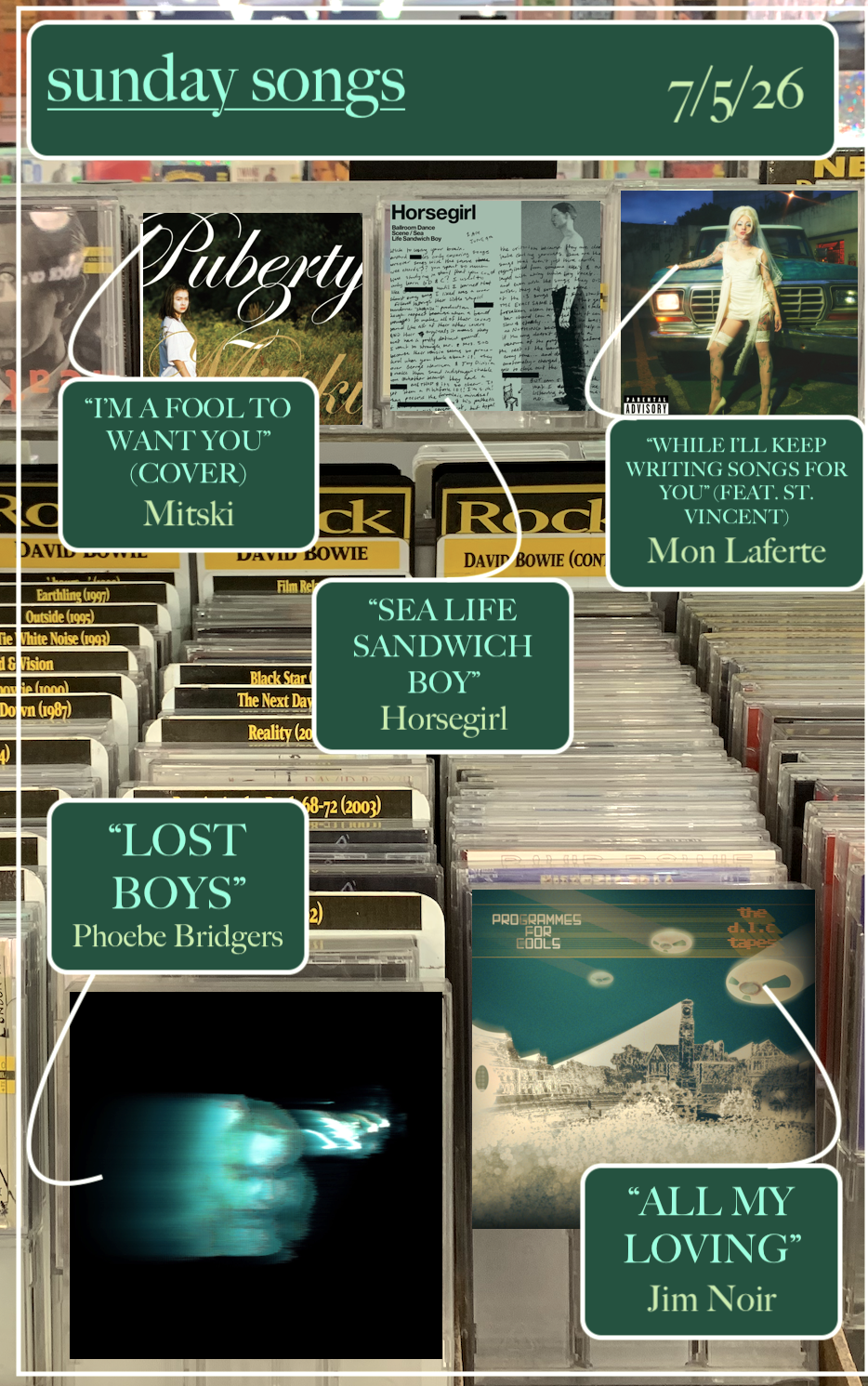
After all this time…not one but TWO Jim Noir albums this year! We truly have a bountiful harvest on our hands. Alongside Programmes for Cools (now available on all streaming platforms), Jim Noir has released The DLC Tapes, an album of 13 more songs previously released as part of the Jim Noir EP Club. (This song is technically a double-dip that I featured all the way back in 2022, but it was well before I even started writing these posts. If any song deserves it, it’s this one.) From the start of the Programmes announcement, I was holding out hope that “All My Loving” (originally from EP 7) would make the cut—it was one of the best tracks from his entire run of EPs, a delightful piece of catchy, ’60s-indebted jangle-pop. Granted, the changes from EP 7 to The DLC Tapes are minimal—mainly just the production—but it was exactly what I was hoping for. “All My Loving” was already a prime example of just how neatly Noir has carved his niche over the years—it’s proof that his craft has only gotten better as the years have gone by. The cleaner production amplifies the cheery, dreamy mood of the track—the harmonies, the starbursts of space-age synth, and the warm organ all get their flowers with this fresh coat of polish.
…AND A BOOK TO GO WITH IT:
The Cybernetic Tea Shop – Meredith Katz – the lyrics are minimal, but the electronic, cozy feel of this track wouldn’t feel out of place in a tea shop run by robots.
If there’s any artist who genuinely baffles me with the unexpectedness of their cover choices, it’s Mitski. Case in point: for the 10th anniversary of Puberty 2, Mitski released an extended edition that included two extra covers: one of One Direction, and one of Frank Sinatra. If I didn’t know any better, I’d say that Mitski was throwing darts at a board with all of the most popular artists of the past 70 years and covering whatever they landed on. But both of these covers—yes, also the One Direction one—show off the many different facets of her artistry that frequently show up in her original music. Her cover of “Fireproof” has notes of her more straightforward rock days, especially from Bury Me at Makeout Creek.
“I’m a Fool to Want You” is almost the exact opposite. Accompanied only by grainy, droning synths, she turned Sinatra’s swell of big band strings into some of her most desolate-sounding music. The comparison that immediately came to mind was This Mortal Coil’s cover of Syd Barrett’s “Late Night”; both are incredibly sparse in their instrumentation, letting both of their vocalists unnervingly tremble to their hearts’ contents, and shining a spotlight on the more abjectly dreary parts of the lyrics. The latter part is more applicable to “Late Night,” but Mitski’s interpretation “I’m a Fool to Want You” turns a lovelorn ballad into something weighed down with deep-seated shame. Without the backing of an orchestra and a chorus of voices, “I’m a Fool to Want You” becomes almost unbearably ominous and lonely…in typical Mitski fashion.
On the subject of songs that take me back to high school…
“Sea Life Sandwich Boy” occupies a brief but distinct place in my memory: sometime in the winter of 2021, during my senior year of high school—the start of my eventual Horsegirl awakening. This song will always be arm-in-arm with The Beatles’ “Oh! Darling”—I was listening to both of them on repeat at the time. It’s very indicative of Horsegirl’s early days—a very ’90s sound, a random, jokey title unrelated to the song, and vocals buried in grainy effects. No band starts out in their prime, but I’d say that Horsegirl started out damn near close—”Sea Life Sandwich Boy” could have easily been a standout on Versions of Modern Performance. Swimming in airy harmonies and precise riffs that make each note flicker like stars cut out of paper, “Sea Life Sandwich Boy” was an ambitious single for the band, but one that pays off to this day.
Sure, this is Mon Laferte’s song, but it seems like a sign that St. Vincent is almost done ripping holes her tights and setting things on fire. Laferte and St. Vincent collaborated on “Tiempos Violentos” (“Violent Times“) off of Todos Nacen Gritando, her Spanish translation of All Born Screaming; There, Laferte delivers a visceral scream that rivals Annie Clark’s, but “While I’ll Keep Writing Songs For You” is worlds away from the battered rage of Todos Nacen Gritando. Instead, Laferte and Clark’s voices form harmonies that are nothing short of soul-warming—they’re seriously such a match made in heaven. “While I’ll Keep Writing Songs For You” is a somber, sleepless ballad about trying to cling to a static, depressed lover who barely seems to respond to her affection. Clark and Laferte’s wordless preludes almost say more than the lyrics, purely plaintive as though they’re trying to get the last word out in the emptiness of space. Laferte’s music video feels laser-attuned to the feel of the song—her she is, all dolled up and surrounded by flowers in her shopping cart, but the world beyond her borders on colorless.
…AND A BOOK TO GO WITH IT:
Our Wives Under the Sea – Julia Armfield – “Will we ever be ok?/You left hair in the shower again/Why don’t we laugh instead/There is no need/To argue over stupid things/You are still depressed/While I’ll keep writing songs for you…”
Since this post consists entirely of songs, consider all of them to be today’s song.
That’s it for this week’s songs! Have a wonderful rest of your day, and take care of yourselves!
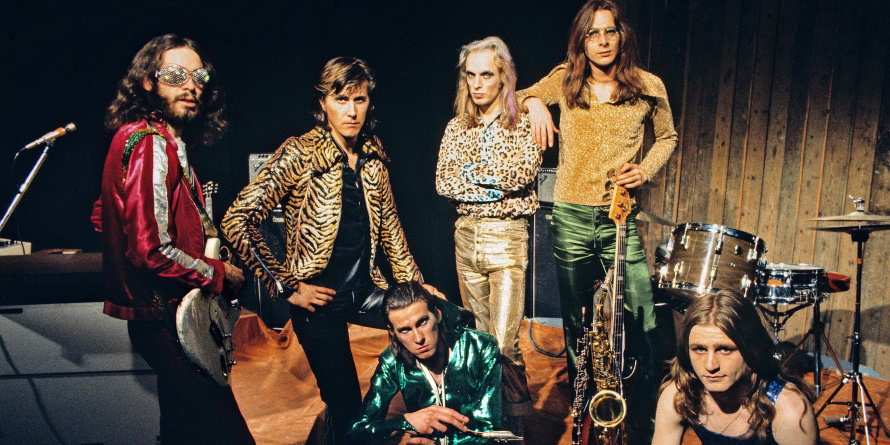
Seeing old photos of Roxy Music always cracks me up…5/6 of them look goofy as hell in all that leather and animal print, and then there’s Brian Eno over here casually serving enough looks to feed a family of four. Good god, I don’t think anybody’s gotten that closet to valiantly fighting male-pattern baldness and winning. The receding hairline fought hard, but damn if Brian Eno wasn’t fighting just as hard.
Okay, maybe I should go easier on the other members of the band, because “Virginia Plain” reminds me of why I love early ’70s glam rock so dearly. This song is just immaculate. It’s at that perfect, Ziggy-era moment in time right before glam fully broke into the mainstream. It’s all swagger, sheen, and pure skill—it’s a blast, but this song feels chiseled and streamlined to a meticulous level. Most of the Roxy Music songs I’ve heard instantly recall The Rocky Horror Picture Show to me, and Bryan Ferry’s seductive vocals feel so proto-Frank-N-Furter—I’d be surprised if Tim Curry didn’t take a few cues from him for his performance; the lyrics are classic glam as well (“You’re so sheer/You’re so chic/Teenage rebel of the week”). Phil Manzanera’s acrobatic guitar work soars, but it effortlessly shape-shifts from classic, guitar-based rock to electronic freakouts in mere seconds, leaving the space between the two eerily natural. I can’t imagine being alive in the ’70s and hearing Brian Eno’s space-age keyboards get unleashed in “Virginia Plain”—it would’ve cracked my mind in two, for sure. Some old British guy in 1972 definitely had a heart attack watching this. But to me, “Virginia Plain” embodies the best of glam rock: a sound that was meant to send a shock to the system, but pushed boundaries creatively as well as socially. It’s all shiny, leather boots and smudged eyeshadow, full to the brim with hard-earned confidence.
…AND A BOOK TO GO WITH IT:
You Sexy Thing – Cat Rambo – I know this series is called Disco Space Opera, but…it’s just the vibes. The overwhelming vibes.
Unfortunately for you all, the pharb sleeper agent that’s been inactive since about 2023 has been reawakened. You’ve been warned.
One of the hallmarks of early Phoebe Bridgers tracks is that they often had male duet partners who were an odd fit, vocally—they’re all good singers, but their vocal ranges and styles run counter to Bridgers’s style (see also: “Garden Song”). I think that was the initial reason that, when I first listened to Stranger in the Alps back in high school, that I was turned off from “Would You Rather”; Conor Oberst duets with Bridgers in the chorus—he’s objectively a talented singer, but his nasally voice just does not mesh with Bridgers. The same can be said for the music video, directed by Phoebe Bridgers’s younger brother, Jackson Bridgers…her penchant for gallows humor aside, what’s Conor Oberst doing with that stupid grin on his face while lip-syncing along to “in a suicide pact with our family and friends” at 1:53? Read the room, my dude…
But as with several songs on Stranger in the Alps that didn’t grab me on the first listen, “Would You Rather” only gets better—and more devastating—with each listen; her best instrumentation sounds like watching embers from a campfire become stars in the sky, and the delicate plucking at 1:05 is one such beautiful moment. According to Bridgers, “Would You Rather” was inspired by a mix of events—her childhood home burning down and her brother being suspected as the culprit, as well as an undercurrent of domestic violence; even for someone so usually candid about her experiences, I’m not surprised that neither she or the song has divulged any details of the latter. Sometimes the only way to be vulnerable is to always have the safety net of metaphor—to protect yourselves and the ones you love. Yet at the heart of it seems to be their bond as siblings: the chorus of “Come to find out/I’m a can on a string, you’re on the end/We found our way out/Of the suicide pact of our family and friends” emphasizes the lifeline that they’ve built with each other in spite of the strife that surrounded them growing up. There’s a bedraggled, burdened hope to it; despite the sense of being trapped by family, their mutual connection is what keeps them afloat in the end.
If you or a loved one is/has been a victim of domestic violence, click here for a link to the National Domestic Violence Hotline.
I owe you an apology, Let’s Dance (1983), I wasn’t familiar with your game.
It’s easy to think of the album as David Bowie’s sellout pop album, the one where he cast aside all the pretense of experimental daring and weirdness that he’d built up with the Berlin Trilogy and Scary Monsters (And Super Creeps), not to mention the infamous “David Bowie Straight” magazine cover for an accompanying issue of Rolling Stone. Here’s the thing: yes, it is a pop album. But it’s not as if Bowie wasn’t making pop music for a significant portion of his career in the ’70s. Sure, The Rise and Fall of Ziggy Stardust was stranger than most things on the airwaves, but it was pop. This was just his ’80s pop record, and like the albums before it, Let’s Dance has so many enduring hits to spare. Sure, it’s more sparse than some of his other albums, and there’s clearly a few afterthought tracks that were just made to make it complete, with its slim eight-track, 40-minute runtime (lookin’ at you, “Shake It”). But let’s be real: it’s hard to measure up when the first track on this album is “Modern Love.” Come on.
“Without You” is often regarded by critics as one of said afterthoughts to beef up Let’s Dance. I get where they’re coming from. For a songwriter like David Bowie, the lyrics are…well, yes, even as a fan, it’s a bit bland. But I feel like a three-year gap between releases after a powerhouse like Scary Monster (And Super Creeps) justifies it. Anybody would have to recharge after that. But “Without You” feels like Bowie’s take on a slow, yearning pop song, and he hits it out of the park. Strung with guitar flourishes that glimmer like string lights, “Without You” is a warm and wistful yearner, aided by the rich, graceful deepening of Bowie’s voice as he aged into his forties. Is it as instantly memorable or well-constructed as “Modern Love” or “Let’s Dance?” Maybe not, but it’s a damn good pop song.
As a bonus: even though they’re two distinct songs, Perfume Genius also has a great song called “Without You,” and for what it’s worth, it’s a good pairing with this song.
5 a.m. really is the perfect hour for this song. “5AM Waltz” is woozy in every sense of the word. Awash in reverb, the first two thirds feel like you’re stumbling around the kitchen in the middle of the night, trying to find the light-switch; it’s almost enough to feel directionless, but the directionlessness feels fully intentional. There’s lots of hyphenated genres that you find hints of—trip-hop, dream-pop, indie-pop—but whatever you’d call it, “5AM Waltz” is downright melodic and atmospheric, an exercise in crafting something memorable from less than two minutes.
Chances are, if you haven’t listened to a ton of Graham Coxon’s solo work (like me), this song won’t give you a good idea of how his sound generally is. “Oochy Woochy” doesn’t sound anything like the frenetic, anxious indie-rock that he usually writes. But I think it’s proof of him being one of the members of Blur who was most willing to take risks with their sound, and it translated instantly when he had more creative freedom. I mean, this is basically a jazzy saxophone loop with a hip-hop-inflected beat. The lyrics amount to only “Oochy woochy/Yeah, baby,” with the later drawled like James Acaster. And it’s so fun. It’s the perfect walk-on song. That prolonged silence at the beginning allows the full force of the saxophones to bowl you over, and from there, it’s just such a fun, carefree groove to get lost in. Even the little quacking sounds punctuating the beat are strangely natural. He’s got range.
…AND A BOOK TO GO WITH IT:
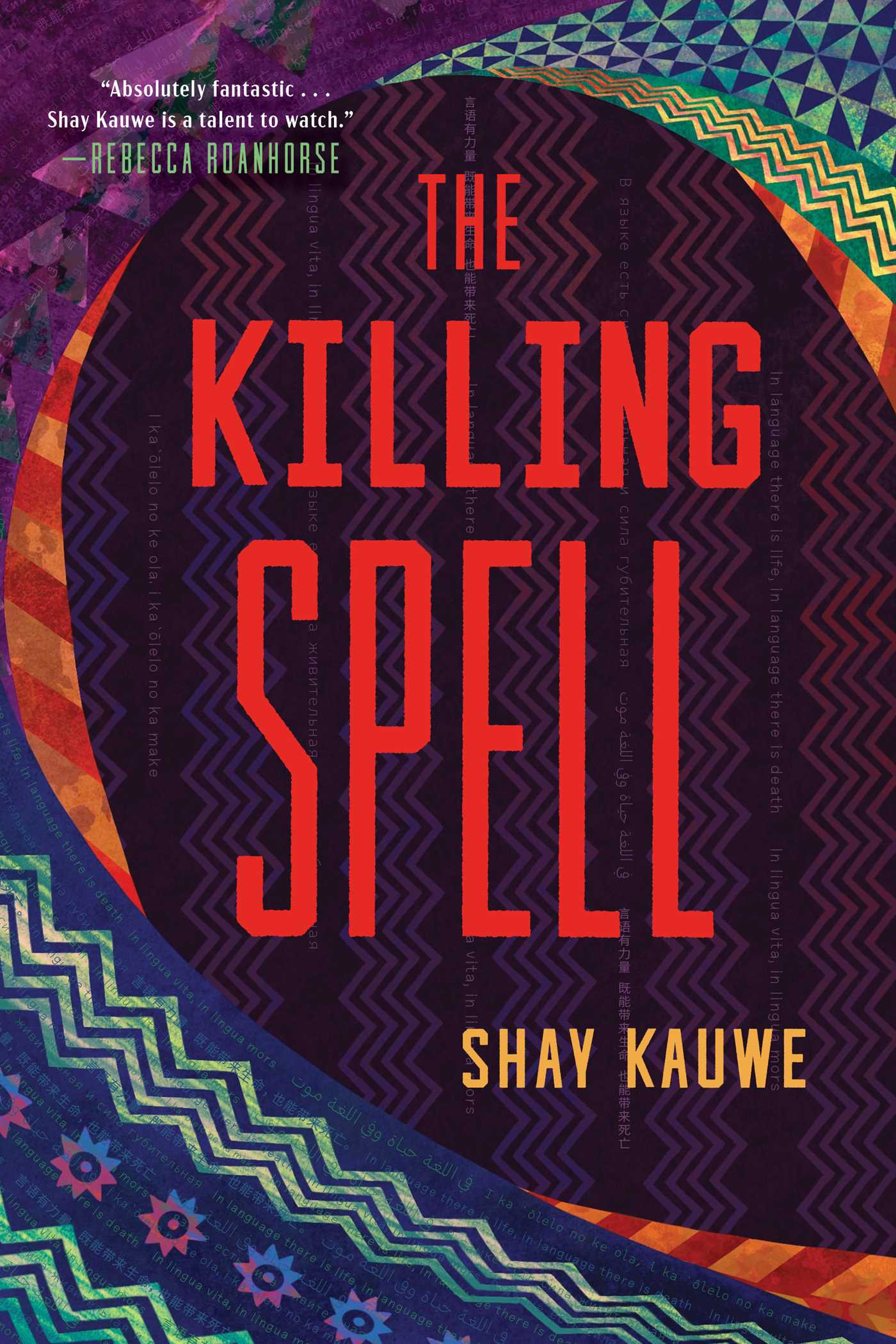
The Killing Spell – Shay Kauwe – the ideal soundtrack for plunging into a crowded ballroom…somewhere in a post-apocalyptic L.A. with magic and murder running amok.
Since this post consists entirely of songs, consider all of them to be today’s song.
That’s it for this week’s Sunday Songs! Have a wonderful rest of your day, and take care of yourselves!
This song’s a way-homer, but it’s a hell of a long way home. It’s difficult to pitch this song, because yeah, how do you convince somebody to willingly listen to a nearly 17-minute long song whose main instrument is the harp with a decidedly squeaky-voiced vocalist? I doubt it’d convince you further if I said that it took meat least two listens to really get it. But when I did, I got it. I don’t think I’ve ever been captivated by a song this long, or this proggy. I say “prog” because there’s an element of this that its detractors would probably dismiss as self-indulgent, artsy-fartsy bullshit, and that its defenders would call epic. Prog of any subgenre is hit or miss for me, but I think what’s valuable about it is that it emphasizes art for art’s sake—it’s not afraid to get sprawling in service of creating music that defies mainstream traditions. I doubt that there was anything else like the harp-dominated, esoteric folk of Joanna Newsom released in 2005. Most of the imagery surrounding it feels medieval, and there’s a certain bardlike quality to how Newsom presents herself (especially on the album cover of Ys). But to me, it strikes me as strangely Appalachian, more rooted in the pioneer times of the U.S. in the 19th century than anything—particularly in this song, it’s the more folky instrumentation, the mentions of somewhat modern war imagery (even if it’s in an in-song dream sequence), and, somewhat irrelevantly, the way that Newsom says “swimmin’ hole.”
But really, “Only Skin” has genuinely made me go a bit bananas. Admittedly, I was exposed to this song through separate TikTok trends, but frankly, it’s wild that a song as weird as this got any traction. But this song is downright captivating. At best, I feel like I’m picking it apart in the same way that I would some esoteric classic in my English classes; other times, I feel like the voice in my head is about to bust a vein, announcing different elements of the track like a WWE announcer: “AND THERE’S ANOTHER TEMPO CHANGE! FELLAS, WE’VE GOT ANOTHER TEMPO CHANGE—AND HERE COMES BILL CALLAHAN WITH THE STEEL CHAIR!” (And yeah, that was wild to find out too—he has a brief but prominent feature about 13 minutes into the song.) Newsom has this distinct voice that squeaks so much in the first few seconds of the song that I genuinely though it was studio feedback, but I love that nontraditional quality of it—she peeps and howls and mewls, defying all notions of how the feminine voice is supposed to sound. She has this kind of sprite-like quality about her that makes her already stunning lyricism even more like a fable or a fairytale—there’s whole handfuls of lyrics that stop me in my tracks: “Back on the patio/watching the bats bring night in,” “The retreat of their hairless and blind cavalry,” “And I watched as the water was kneading so neatly/Gone treacly” are just a handful of the gems that Newsom has scattered through the rich earth of this track. I could probably go on for at least two paragraphs longer just picking apart all of the poetic devices scattered throughout, but this part of the post is already getting unwieldily long. But the real emotional oomph is the juxtaposition with the more devastatingly bare lines, things like the waver in her voice when she repeats the motif of “That’s an awfully real gun.” It all has a very Kate Bush quality about it, both in the vocal and lyrical styles—as well as her stories of women.
She breathes wonder and fear and devotion and snapped rage into every line—it’s so dense that I can only scrabble for certain meanings. As far as I can tell, Newsom is the kind of enigmatic artist who ostensibly does write true stories, but obfuscates them under at least seven layers of fiction so that they’re all but impenetrable. There’s hints of personal relationship turmoil, something that her ardent fans have been desperately trying to puzzle out in the 20 years since this album was released. In my mind, I can see some kind of 19th-century narrative of a desperate woman married to a man wracked by trauma. She breaks her back trying to provide for him, and he only responds with demanding more and more still of her, without any thought to what she’s going through. I don’t blame said TikTok trends for choosing the part that they did: the part beginning at 13:02 (yeah, sorry) is the most striking part of the song, the climax where the woman reaches her breaking point. You’ve heard me ramble about the watering-down of female rage…but if you want real, desperate, breaking-point female rage? Step right up. Holy shit. This part is the musical equivalent of the straw that broke the camel’s back, the final response of the protagonist as she confronts him about how much she sacrificed just to keep him happy: “All my bones, they are gone, gone, gone/Take my bones, I don’t need none.” I get goosebumps every time I listen to it. This is why it’s worth all 16 minutes and 53 seconds—even if you don’t appreciate the highs and lows of the journey itself, the payoff from that buildup is worth every note. Like Oingo Boingo’s “Change,” it goes through movements, but all in service of a staggeringly intricate musical narrative.
I think those reminders of Oingo Boingo and Kate Bush, at least in terms of their mindset if not in their musical style, is what makes “Only Skin” such a spectacular song to me. Art for art’s sake implies a kind of self-indulgent quality, but there’s nothing much more admirable to me than putting out art that’s nothing but the vision in your brain, removed from all sense of trend-chasing or conventionality. If not for the musical freaks of the world, we wouldn’t have art as singularly unique as this. Art needs not appeal to everybody—just you, in the end. And if it finds an anchor in somebody else, then all the better. But it’s got to be for you.
…AND A BOOK TO GO WITH IT:
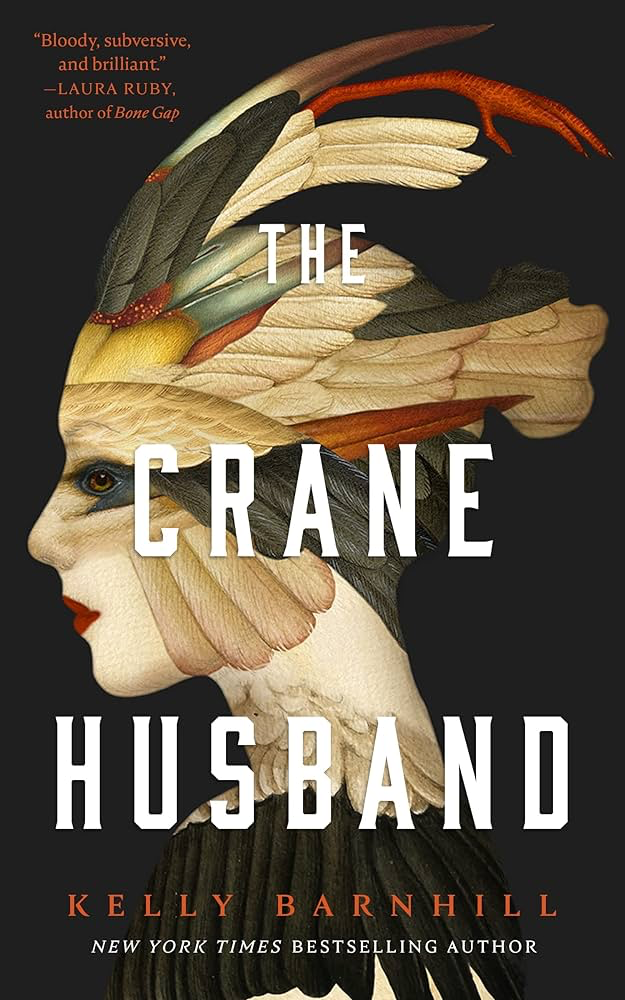
The Crane Husband – Kelly Barnhill – “All my bones, they are gone, gone, gone/Take my bones, I don’t need none/Cold, cold, cupboard, lord, nothing to chew on/Suck all day on a cherry stone…”
What I appreciate about The Marías’s Tiny Desk Concert was that María Zardoya did what I love with a Tiny Desk Concert from an act that’s been around long enough to accumulate a larger discography; she called the setlist a “tasting menu” of their career, with selections spanning from their newest album to their earliest releases. It gave me the perfect jumping-off points for getting into their music. “Only In My Dreams” is off of their very first EP, Superclean, Vol. 1. It’s always so intriguing when you can see the nascent signs of a band’s sound beginning to solidify so early on. Sure, the lyrics aren’t as refined (and the music video veers on being corny), but already, their distinctive flavor of dream pop was right there, waiting to be chiseled away. If this track is proof of anything, it’s that when you have a clear vision of what’s you, it’ll always shine through in the music, and time will only expose it further—it certainly did so for The Marías.
“Savior Complex” was a favorite of mine when Punisher came out…what do you mean, almost 6 years ago? I remember watching that music video in December of 2020 and, as I did with everything in reach, looked at it with a very Fargo Season 4 lens, but to be fair, they have the commonality of a black and white vignette of a bloodied Irish man in a sketchy hotel with a dog that follows him everywhere. (Rabbi Milligan is everywhere for those with eyes to see him.) Listening back to this song is making me marvel at just how immersive Phoebe Bridgers’ atmospheres are. Her best songs feel like being inside of snow globes, but every snowflake feels just as real as one would in the outside world. There’s an ice-skating rink somewhere in that snow globe, somewhere in the middle of a city, where the flickering lights of the skyscrapers illuminate the ice. “Savior Complex” evokes the palate of the dead of night in December, with starry flourishes from the celeste, Rob Moose’s orchestral arrangements, and the understated murmur of Bridgers’s acoustic guitar. Like the album cover, it evokes the feeling of being absolutely alone, out in the middle of nowhere—lonely and liberating in equal measure. Yet Bridgers’s wintry whisper of a voice is what anchors “Savior Complex” in the end, with her stripped-to-the-bone lyrics: “I’m a bad liar/With a savior complex/All the skeletons you hide/Show me yours, and I’ll show you mine.” As poisonous as the relationship sounds, every utterance of “show me yours, and I’ll show you mine,” feels like a secret you’re being let in on.
Us is full of gems. I almost called them hidden gems, but most of them are pretty easy to identify as gems on the first listen. But amongst gems, some songs get overshadowed in the process. Practically every song on this album hits me like a train, so it’s exceedingly difficult to compete when about half of the album makes me feel like this after I listen to it. But I’ve found that in the three and a half years since I’ve listened to the album, there’s always another layer to peel back. “Fourteen Black Paintings” doesn’t necessarily have the gut punch of “Come Talk to Me” or “Secret World” or even the grooves of “Digging in the Dirt,” but to me, it thrives on simplicity. It’s one of the sparser songs on the album, but all of the lyrics speak for themselves, plain and simple:
“From the pain come the dream/From the dream come the vision/From the vision come the people/From the people come the power/From this power come the change.”
That’s it. That’s the entirety of the lyrics in this four and a half minute-long song, other than Gabriel’s hypnotic murmuring. It has the same, dense arrangements and international instrumentation (that haunting instrument you hear at the beginning is a duduk, an Armenian flute), and yet, it’s all so muted and subtle that it tends to relegate itself to the background. Yet it’s proof that even Gabriel’s most seemingly simple songs are anything but throwaways; though it doesn’t have the same striking emotional highs as some of the other tracks on the album, Gabriel’s soaring vocals make up for any need for them. In fact, it’s quite like the fourteen black paintings that Gabriel is referencing in the first place: fourteen black paintings by Rothko, all housed in the Rothko Chapel in Houston, Texas; though they seem like blocks of solid black to the casual observer, the brushstrokes within prove their deliberate and intricate construction. Quietly throbbing and pulsating, “Fourteen Black Paintings” remains an upfront declaration on the nature of power and resistance.
Consider this the millionth post where the gist just ends up being “Jesus, can Robyn Hitchcock leave some of that top-tier songwriting for the rest of us?” Predictably, I’m still stuck on the show I saw him at back in February, and I was delighted to learn that pretty much every other member of my family got as knocked off their feet as I was after hearing the line “I’m a house that burns down every night for you.” There’s a line that’ll stick in your head forever. Here’s the real kicker about “I’m Only You,” though: I’d say at least 95% of the lines are like that. “I’m a policeman working in an empty house?” “I’m a snow-covered mountain in an empty room?” “I’m a liquid you’re dissolving in?”
There’s so much in here about empty structures and becoming a vessel just to hold somebody else, but I found an interesting dichotomy with the lyrics: they’re all either about being said vessel (“I’m a liquid you’re dissolving in”) or being built for a purpose, but being abandoned (“I’m a distant steeple on a long-deserted plain”). It’s such a striking contrast between becoming empty or being surrounded by emptiness—and what a stunning metaphor for being devoted to somebody to the point of total self-sacrifice, only to find that you’re only a shell without them there.
Happy Sunday, bibliophiles! I hope this week has treated you well.
This week: it’ll be two years of making these Sunday Songs graphics in a few days (!!), but I haven’t had many purple color schemes in all that time…enjoy the purple while it lasts. Also, I talk about movies that I haven’t seen and albums that I haven’t quite seen.
Here I am, an absolute poser, posting this without having seen I Saw the TV Glow. I’m a simple woman. I saw Phoebe Bridgers and Jay Som on the soundtrack and immediately downloaded both songs without knowing any of the context apart from Lindsey Jordan being in her first acting role (I’m lovingly suspicious of her acting abilities, but that shot of her with an axe in the trailer is top-tier), and that “Claw Machine” plays in the opening.
The opening? Is Jane Schoenbrun trying to eviscerate us before the movie even begins? For everyone who’s soldiering through the boygenius hiatus: fear not! Phoebe Bridgers, along with Haley Dahl (aka Sloppy Jane, who Bridgers formerly played bass for) have come to emotionally derail your summer. “I think I was born bored/I think I was born blue/I think I was born wanting more/I think I was born already missing you.” Oh! Good to know that I won’t survive 10 minutes of this movie if I eventually watch it! Yippee!
…AND A BOOK TO GO WITH IT:
Freshwater – Akwaeke Emezi – “Your heart is like a claw machine/Its only function is to reach/It can’t hold onto anything…”
It takes a certain kind of person to have the guts to name their album Saint Julian, but thankfully, it’s not entirely Julian Cope’s fault. Before this album’s release, his record label was intent on Cleaning Up His Act™️ and making him into their idea of a rockstar, thus: the leather, the haircut, and constantly looking like there should be a vine boom whenever the camera lands on his face. It was the ’80s. Comfortingly, the song “Saint Julian” is about his frustrations with god, but to be fair, anybody who can cover Roky Erikson’s “I Have Always Been Here Before” so heartwrenchingly deserves the saint title.
The ’80s never gave Cope the praise he deserved, save for some alternative hits. Crazy, given the fact that after Saint Julian came around, he’d basically become the unacknowledged father of Britpop. Everybody mentions The Kinks (obviously) and The Smiths as some of the progenitors of the genre, but where’s the love for Julian, who basically molded Parklife’s guitar-heavy confidence seven years prior with “Shot Down”? The clean, punchy guitars? The tongue-in-cheek lyricism? Even the look, even if it was more on the part of the record label than Cope himself—there’s no denying Damon Albarn and Jarvis Cocker took plentiful notes, chiseled cheekbones and all. Regardless of whether people will remember that, at least they’ll remember that he could pen a perfect pop song. Oiled and sleek as a new car, it oozes confidence more than Cope’s fabricated persona ever could. He didn’t need to get his hair did to have the gravitas to belt “World, shut your mouth/Shut your mouth/Put your head back in the clouds and shut your mouth,” just like the song’s unnamed protagonist who “[flies] in the face of fashion.” Complete with a mic stand that Cope could climb up and spin around on, it’s the side of the ’80s that I wish lingered—the slickness combined with clever turns of phrase thanks to the likes of Cope. Even if Cope resented the attempts to make him into a pop star (understandably so), there’s no denying that, at the height of his powers, he could write a perfect pop song. Good for him, though. Presently, he’s out living his best life and writing about Stonehenge and rock history. Go off, king.
I suppose all this means is that I selfishly get to gatekeep Julian Cope while cursed with the knowledge that he may get the praise that he deserves. I’ll Cope. I’ll Julian Cope—[gets dragged off stage by a comically large cane]
…AND A BOOK TO GO WITH IT:
Cloud Parliament – Olivia A. Cole – Bold confidence abound—the kind strong enough to avenge the dead and bring entire industries to their knees.
The newest single, however? A joyous summer bop, to say the least! For Waterhouse, this has a slight rock edge, but undeniably remains the indie pop that she’s begun to polish. Strung together with “My Fun,” it’s clear that Memoirs of a Sparklemuffin centers rediscovering joy and healing at the forefront; “Supersad” is an anthem to hauling yourself out of bed, letting go of what you can’t control, and embracing fun in all of its forms: “Could be the worst time I ever had/Lose my mind, always get it back/There’s no point in being supersad.” Stagnation and sadness aren’t just detrimental to your health—at the end of the day, it always feels so boring to me, even if, in the moment, I can’t do anything to do it. And there’s a multitude of things that are way out of your control! No matter how long it takes to get yourself out of the funk, it’s temporary—and there’s no point in being supersad. Life is short.
My mom and I are very similar people in a number of ways, but one of the ways that we hadn’t acknowledged until now is that we’ll see a song with Santigold on it and immediately hit download. It’s Santigold!! Who wouldn’t?
Named “Santidalang” in acknowledgment of the aforementioned legend, this track is a slight reworking of Master Peace (ba-dum tssssss)’s “Shangaladang” from his debut album, How to Make a Master Peace (ba-dum tsssssssssss). For someone who frequently cites LCD Soundsystem as one of his primary influences, what I’ve heard of his music is far from the uptight rhythms that I associate with James Murphy. What he’s taken from him, along with several other indie and dance acts from the 2000’s, is a neat rhythm—it’s a box, when you look at it from afar, but one that’s large enough to allow Master Peace a spacious environment to dance. Even amidst the pressing issues of the lyrics, “Santidalang” never stops being carefree; the opening is delivered with a defiant “ha-ha,” and lines like “The police wanna arrest me and my mates/I’m just wanna get myself some good grades/My mom told that she’s gonna send me away” with the goofy ring of a flexatone in the background and a smile that you can hear through the music. Like Santigold, it’s a grinning middle finger to those who would put him in a box and an assertion of joy in spite of it all. That’s why it’s so perfect that Santigold is featured on this finger after championing a similar mentality of joy and self-love in spite of societal expectations. Santigold bursts into an already vibrant track with her signature confidence, immediately claiming the space as hers. Like Master Peace, her smile and persistence cuts through the track like rays of sunshine: “Try to hold me down/I fight the power with my fist up.”
It’s easy to imagine that both Master Peace and Santigold had an absolute blast recording “Santidalang,” but it seems this picture only confirms it:
Once I hit a valley in my Sisyphean Album Bucket List, I’m due for revisiting Fossora. When it was released almost two years ago, I liked it, but I felt like I didn’t fully get it. Björk is about as out there as out there can get, but even for me, it felt impenetrably so, like she’d ascended to a higher plane of being that us mere mortals couldn’t dream of reaching. Is that still true? It’s Björk, of course it is. But the more I listen, the more the ice melts—it’s not that I never liked Fossora, but for me, its merits become more evident the more time you spend with it. A way-homer, if you will.
I’d forgotten all about “Freefall” in the dust, and in retrospect, the fact that I listened to Fossora while I was figuring out how college works didn’t do wonders for remembering this album—or interpreting it. In Björk’s quest to become the all-knowing fungus queen, she remains as attuned to the surreal thrill of love as she was on Vespertine. Even in the wake of the tumultuous divorce with Matthew Barney (cheating is reprehensible on its own, but IMAGINE CHEATING ON BJÖRK, MY GOD), she has still found time to reminisce about the coalescence that the best relationships produce: “I let myself freefall into your arms/Into the shape of the love we created/Our emotional hammock/Safe inside the fabric of our love-woven membrane.” Of course she refers to it as a membrane, but it’s one of my favorite lyrics; saying that she’s attuned to nature and her body is an understatement—even in such a yearning song, she feels more whole than ever. Love as a fleshy, beating membrane, something to curl up inside like a vital organ (or a cocoon, even), evokes what most songs could not touch with multiple verses. Even if Björk drinking the water of life and willingly being consumed by the fungus has made her music more esoteric than it already was, what strikes me about “Freefall” is that she has such a human understanding of love; not necessarily in the sense of the soul, but in the sense of the sensation of warmth and the bodily joy of watching your heart tie itself to another and merge.