Posted in Sunday Songs

Sunday Songs: 10/12/25

Happy Sunday, bibliophiles! I hope this week has treated you well.

This week: shoutout to the Welsh for carrying alternative music at the moment. Also, I continue to eat up 99% of what Horsegirl does, and Michael Stipe appears in (somewhat) unexpected places.

Enjoy this week’s songs!
SUNDAY SONGS: 10/12/25

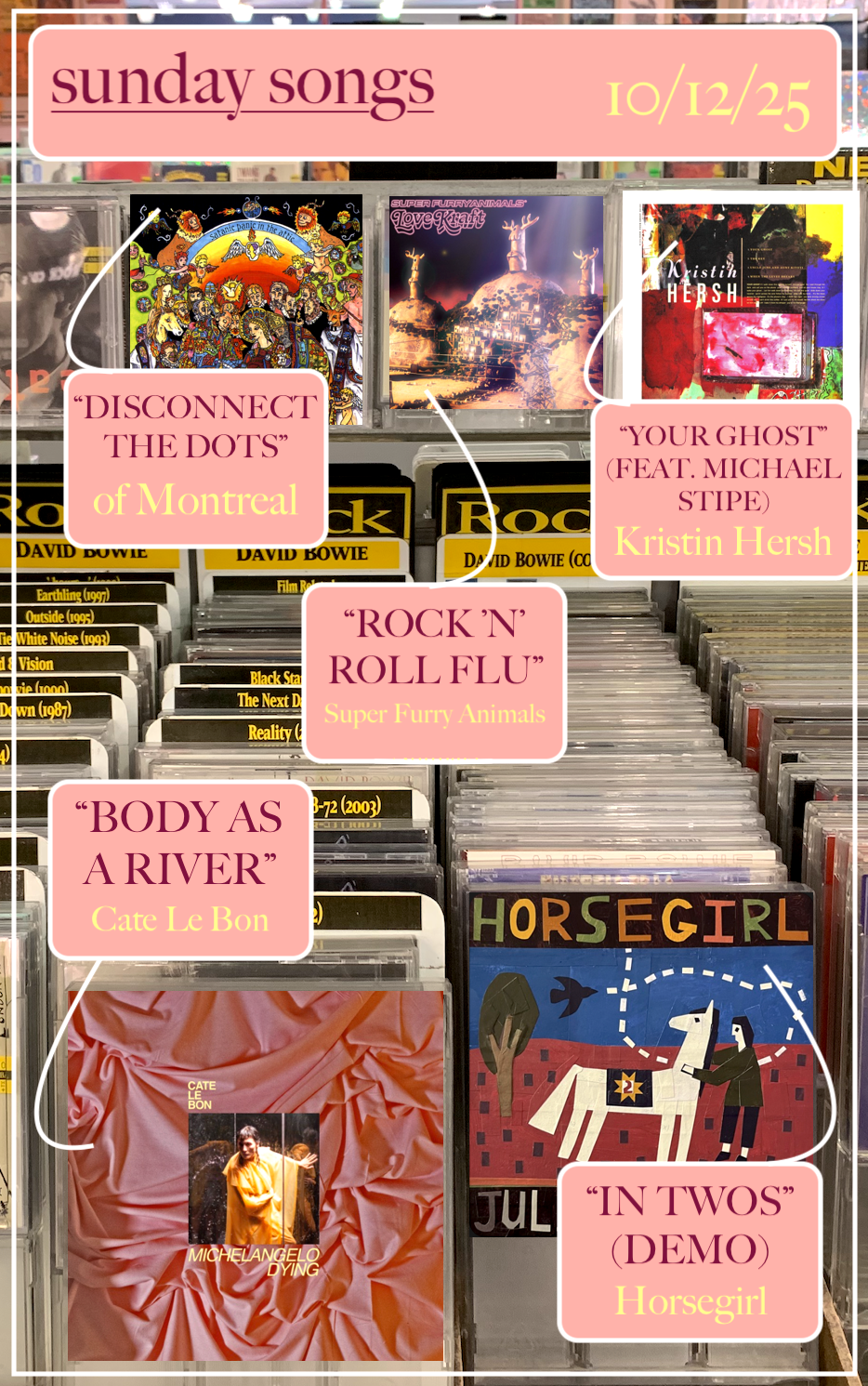
“Body as a River” – Cate Le Bon

Y’all. MICHELANGELO DYING! It’s a strong contender for my favorite album of the year at this point. I’m trying my best not to listen to it to death, but it’s so hard when this album has hidden sonic surprises every time I go back to it.

Since 2019, Cate Le Bon’s music has felt like an ever-expanding, tactile landscape. Listening to her last three albums feels like running your hands over a model village of an alien world, full of all manner of silken, rubbery textures charting out a world that only Le Bon has access to. Thankfully, she’s chosen to share that world with us, and her musical cartography has made me all the better. Michelangelo Dying in particularly made me feel like I was plunging through a sunlit creek, watching the sunlight dapple through the water onto my skin, watching pebbles, plants, and silvery fish dart through the current alongside me. As she maps out the prognosis of a personal heartbreak, she transforms her knotted mess of pain and grief into a vibrant swath of glistening sound; “Mothers of Riches” bobs up and down like birds vying for a mate, and “Ride,” with the help of John Cale (!!!), meanders into a searing climax and shows off Le Bon’s vocal and emotional range.

But it’s “Body as a River” that swept me off my feet and into the frigid creek waters—or the river, I guess I should say. Or maybe not: after all, “My body as a river/A river running dry.” There’s only a riverbed to speak of now, for Le Bon, a once rushing energy force now diminished by pain. It’s one of those songs that you instantly surrender to. Awash in thrumming pianos and guitars and saxophones so warped and bubbly that they cease to become instruments, Le Bon drags you along with the proverbial current. You can’t do much other than release yourself to the thrall of the music—and I’m glad to do it time after time. The entire album feels watery, but this feels like this musical concept pushed to its extreme; it all burbles and rushes like a waterfall, Le Bon’s voice layered, echoed, and pulled apart in all directions to linger in the feeling of exhaustion and transience. Her lyricism dwells in the real and the surreal in equal measure: “Do you see her/Falling on the wishing bone/Dripping like a candle?/In the pages lost/I’m holding on to sorrow and lust.” It’s a song that makes me glad to be alive in a time when, if you look hard enough, artsy people are honing their craft beneath the shadow of the mainstream, free to let their unique sound flow free like water. We don’t deserve Cate Le Bon.

…AND A BOOK TO GO WITH IT:
The Ephemera Collector – Stacy Nathaniel Jackson“See what you like/I read what I write/And it’s never without shame/My body as a river/A river running dry/And I’m sick all the time…”

“In Twos” (Demo) – Horsegirl

Phonetics On & On has had me in a chokehold ever since it came out on Valentine’s Day. Like Cate Le Bon’s new music, it just gives me so much joy that there are so many artists out there making music true to their quirky selves, and music that’s so catchy and creative at that. Somehow, even the demos are almost on the same level as the final products of the album—both versions of “Julie” were worthy, scratchy precursors to one of the album’s most introspective moments.

“In Twos” was a faintly melancholy bridge before the album really got up and started doing the dance from the end of Fantastic Mr. Fox, but it was one of the highlights for me in terms of songwriting. It was already a spectacular track, but somehow, this lo-fi, larval stage of it is almost better than the studio version. Practically, I feel like the lower key would’ve probably been more difficult to sing, but it feels more resonant and more fitting with the lyrics, a gentle, wistful ramble through crowded city streets. The spare instrumentals on the studio version made the melancholy more tangible, but on a personal level, I just love the more garagey sound that this demo has, chock-full of a more restrained version of the sounds of Versions of Modern Performance. Despite the wistfulness, they can never take the jangle away from Horsegirl.

…AND A BOOK TO GO WITH IT:
A Closed and Common Orbit (Wayfarers, #2) – Becky Chambers“Every car that passes by drives to you/Overlooked by any face just passing through/Your footprints on the street, they walk in twos/Every good thing that I find, I find I lose…”

“Disconnect the Dots” – of Montreal

Isn’t it so wonderful to look back on a musician’s sound to see exactly where the good stuff gestated? “Disconnect the Dots” is already the good stuff in question, but I swear it’s like peeling back a layer of age to see the future of where of Montreal would go in the next four years. I can practically hear an embryonic version of the anxious thrum of “Heimdalsgate Like a Promethean Curse” in the bouncing bass of this track and the ever-so-slightly off kilter, catchy dance music of The Sunlandic Twins. “Disconnect the Dots” comes right as Kevin Barnes had stepped off of the precipice of their potential; the lyrics haven’t gotten as English major delightful yet, but this feels like one of their dance songs, so it doesn’t really need those lyrics quite yet. What it does have, however, is Barnes saying “Come disconnect the dots with me, poppet”—I really should’ve seen “poppet” coming a mile away, but it’s such a quirky little additive to the song that exhibits a weirdness in Barnes that could never be suppressed.

…AND A BOOK TO GO WITH IT:
Of Monsters and Mainframes – Barbara Trueloveonly a book as bonkers as this could be befitting of a song like this…

“Rock ‘n’ Roll Flu” – Super Furry Animals

“Rock ‘n’ Roll Flu?” That’s just what happened when I saw Gorillaz and then realized that I’d gotten RSV a few days later…thank you, thank you, I’ll be here all night.

Super Furry Animals have been all but dormant for the better part of a decade, having not released new material since 2016. Separately, most of the band has been active on different projects, but after an agonizing string of teasers that lasted a solid week, Gruff Rhys and co. announced a UK tour and a reissue of their 2005 album Love Kraft. The (extreme) optimist in me is hoping that they’ll do a US tour (and come to Colorado by some miracle), but…listen, I’m glad said super furry animals have emerged from their hibernation, at least for a fleeting moment. Big fan of whatever Super Furry Animal is in this visualizer too.

“Rock ‘n’ Roll Flu,” a joyous, harmony-driven stomper, was a B-Side from the Love Kraft sessions that has just now been released. Though I haven’t listened to any of the album, it’s got some of my favorite qualities of a good Super Furry Animals song. It’s got an absolutely glistening glam sheen to it; it really seems to shimmer like a just-washed car with a handful of water droplets clinging to the surface. With its spacey instrumentals and the seamless harmonies. It’s one of those songs that seems to encapsulate the art that Super Furry Animals surrounds itself with—it’s the exact kind of song to fit in the backdrop of their universe of bold colors and cartoon creatures on rocket ships.

…AND A BOOK TO GO WITH IT:
You Sexy Thing – Cat Rambothe perfect soundtrack to a bonkers yet heartfelt romp through the galaxy with a bunch of chefs.

“Your Ghost” (feat. Michael Stipe) – Kristin Hersh

There’s at least five different sayings about what you can do with three chords in a rock song, but some songs make you instantly understand every one of those sayings. It didn’t even occur to me that “Your Ghost” is comprised of only three main chords until I listened to it more closely. That might be a consequence of the cello in the background making it appear more lush and complicated, but it’d be lush without it. That’s that talent of someone like Kristin Hersh; she weaves a narrative so haunting and compelling that you barely even notice how deceptively simple the composition is.

Conflicting sources about this one have said that it’s either about Hersh’s struggles with schizophrenia as a teenager or grappling with the death of a close friend. Either way, the lonely yearning for something just out of reach resonates in every note. The music video, directed by Katherine Dieckmann, captures that feeling of an early 1900’s house with aging decorations that I associate with a solid handful of Hersh’s songs. This time, it’s cast in a more decaying light as Hersh sings of being mocked by memories and visions: “So I pad through the dark and call you on the phone/Push your old numbers/And let your house ring/Till I wake your ghost.” Her lyricism is nothing short of evocative, and the verbs are really doing the heavy lifting—her “pad[ding] through the dark,” and instead of simply waiting on the other line, she “slide[s] down your receiver/sprint[s] across the wire” as she yearns for someone to answer her. Nothing does, but this ghost, whatever it may represent, drives in circles around her in dreams, almost mockingly, as if taunting her with the reminder of mortality. When I first heard “Your Ghost,” I was floored by the fact that Michael Stipe and Hersh had crossed paths, but in retrospect, I really shouldn’t have been. I guess they did run in similar circles, and if you slicked up the production and added some mandolin, this could’ve been a cut from Green. But he proves a fitting duet partner for Hersh, whose voice echoes through the decaying wooden slats of her decaying house and onto a forlorn wind.

…AND A BOOK TO GO WITH IT:

What Happened to Ruthy Ramirez – Claire Jiménez“You were in my dream/You were driving circles around me…”

Since this post consists entirely of songs, consider all of them to be today’s song.

That’s it for this week’s Sunday Songs! Have a wonderful rest of your day, and take care of yourselves!

Posted in Sunday Songs

Sunday Songs: 2/2/25

Happy Sunday, bibliophiles! Hope you didn’t drive angry today.

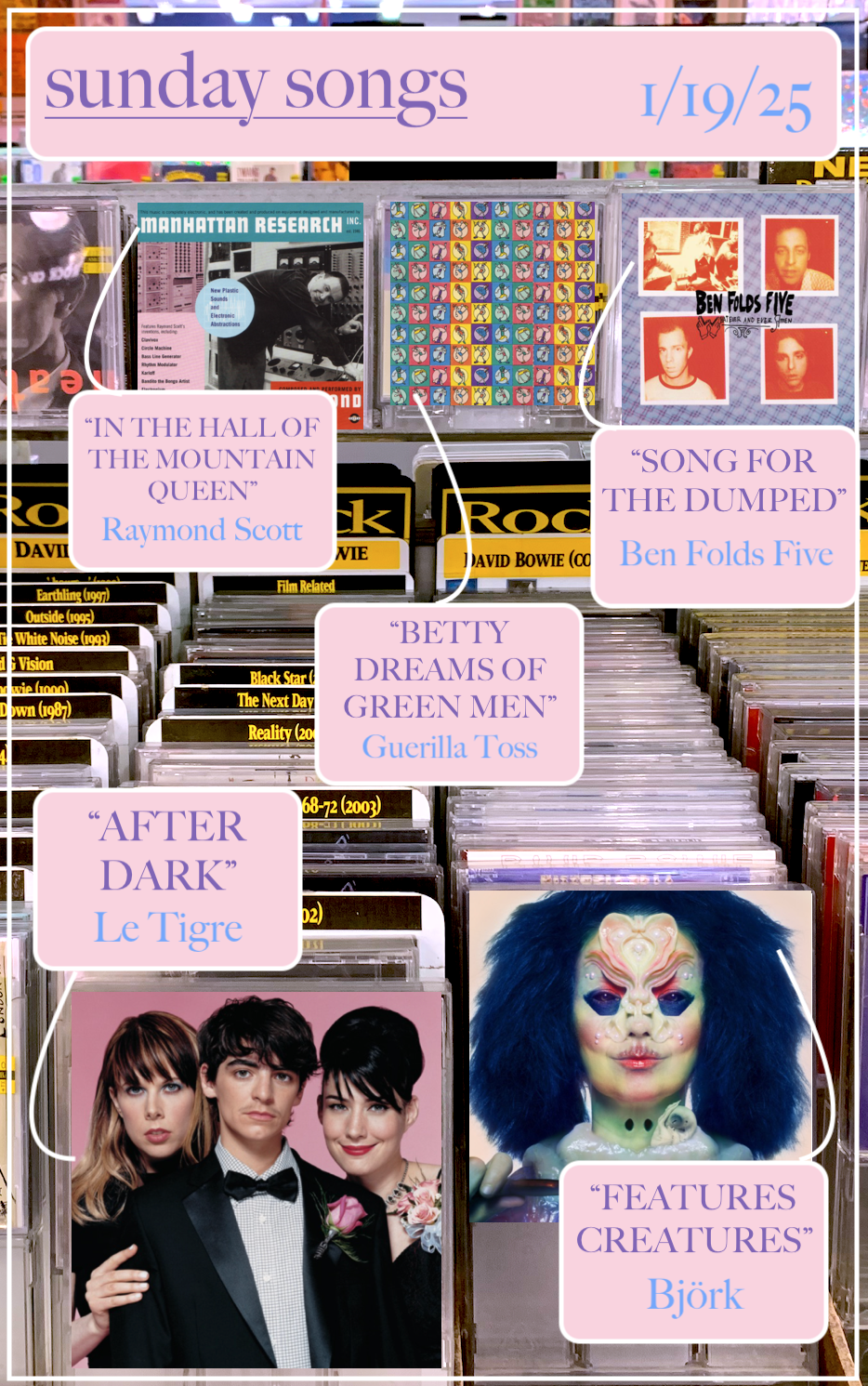
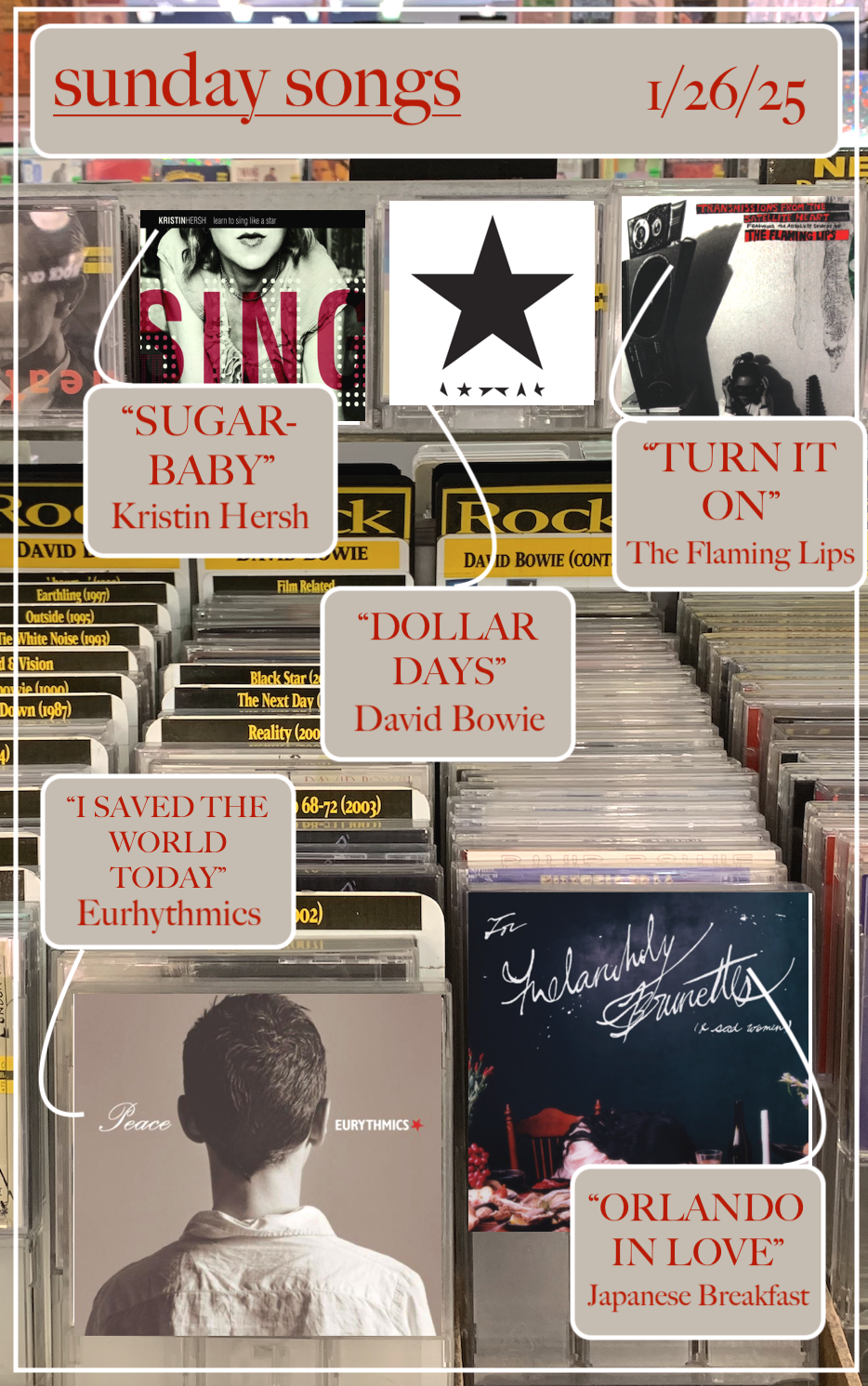
Since I’ve been absent for the past two(ish) weeks, here are my graphics and songs from the middle of January:

1/19/25:

1/26/25:

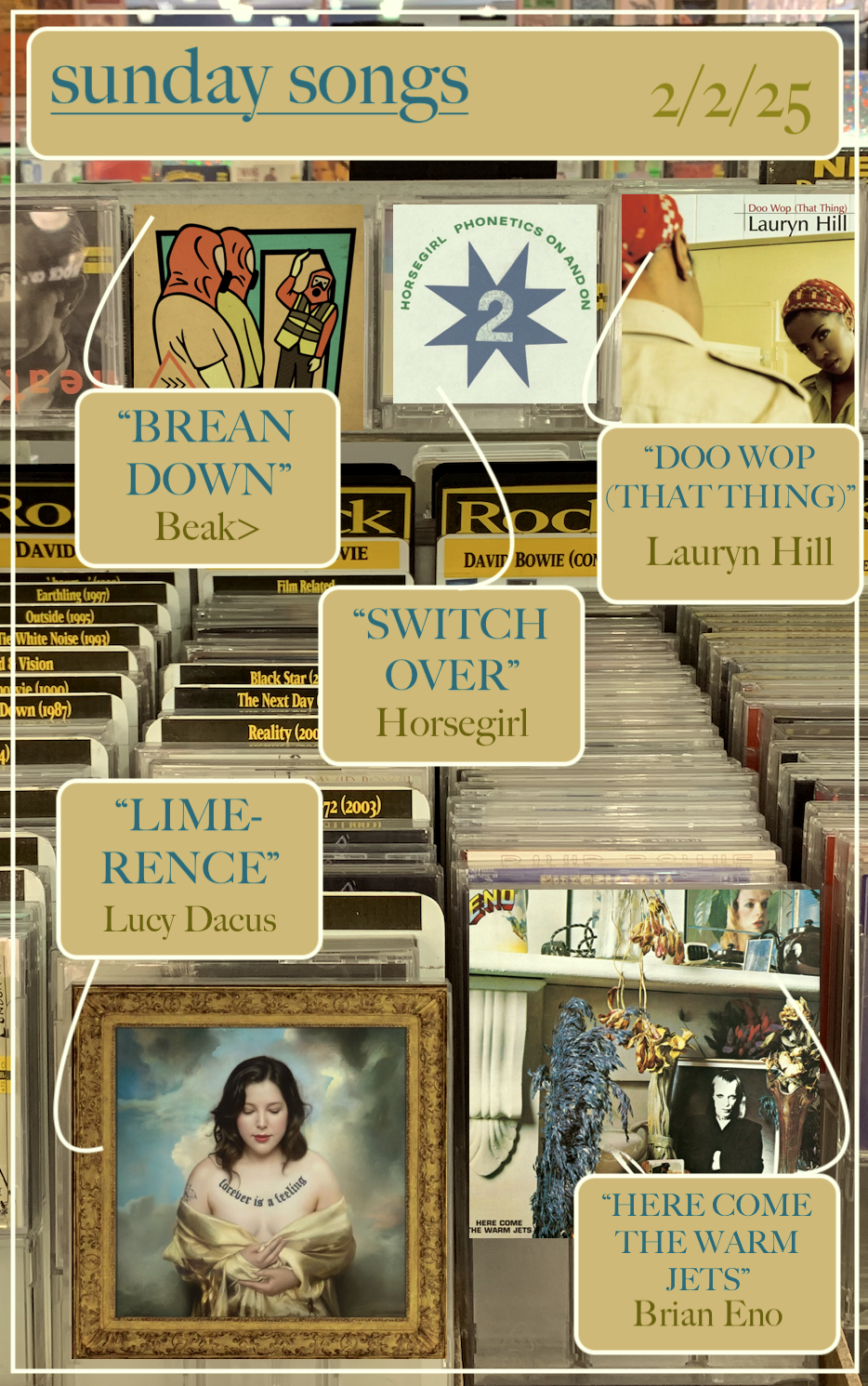
This week: shoutout to Brian Eno songs with vehicles in the names. Plus, Lucy Dacus is thinking about breaking your heart (but when is she not?).

Enjoy this week’s songs!

SUNDAY SONGS: 2/2/25

“Limerence” – Lucy Dacus

January. Love it or hate it, it’s that magical time of year when all of the singles and album announcements for the first half of the year start rolling in. Oh, the sweet sound of new music…especially when it’s from Lucy Dacus! It’s been known that she’s been cooking something up after previewing a handful of new songs post-the record (as is Julien Baker—new album from her and TORRES too!!), but mid-January, she officially announced her new album, Forever Is a Feeling, which will be out this March! Aside from…well, y’know (I know it’s a painting, which makes it more impressive, but what in the PicsArt is that album cover?? That font?? 😭 No hate to Dacus or to Will St. John, but…there could’ve been so many better choices…), I’m so excited for this new record—I’m loving the aesthetic of gilded museums and flowing dresses, as well as the orchestration that Dacus has brought to the record—or at least to “Limerence.”

The other day, I saw some reel or another about how a lot of modern songwriters see writing down explicit, confessional details (or details that sound authentic enough to be confessional) in their songs as an automatic way to get depth, and I halfway agree. I do think that with the steady stream of Phoebe Bridgers wannabes that have been pouring out of some factory in L.A. since 2021 has influenced that, but I don’t think it’s always lazy songwriting. Let’s just say that you can tell when it’s for soul-baring or clout-getting purposes. The key is knowing which details are important: vignettes or extended scenes that elevate the themes or contribute to evoking the intended emotion, something that Bridgers has always excelled at. I hate to say it, but the first lines of “Limerence” nearly feel like the anti-Bridgers method: “Natalie’s explaining limerence/Between taking hits from a blunt, high as a kite/While Roddy’s playing GTA/I swear, why is he so good at this game?/It should be cause for concern.” Against the delicate, piano-dominated orchestration of “Limerence” and the soaring warmth of her voice, such ordinary details feel shoehorned in, without as much connection to the rest of the song. It’s not as though she hasn’t written similarly observational lyrics, but the wording (and maybe the mention of some guy playing GTA with a harp in the background) doesn’t mesh with the rest of the track.

Key word here is nearly. I’ve been a fan of Dacus long enough to trust in the consistency of her songwriting—that bit really is a blip in the vast glory that is her catalogue. The rest of “Limerence” swiftly picks up the slack of those first handful of lyrics. Orchestral Lucy Dacus is, in my opinion, the best Lucy Dacus; guitar carries her humbly captivating gravitas perfectly, yet there’s something about strings, piano, and harp that carry it to new heights (see: “Body to Flame”). With the gentle tempo that recalls the reflection of silk off of marble floors during a ballroom waltz, Dacus drifts into melancholy rumination…as she often does, but it has yet to get old, especially since she’s at least self-aware of the fact (see: “The Shell”). Against the delicate plucking of harps and strings, she sings of drowning herself in distraction just to distance herself from the inevitable collapse of a relationship: “I want what we have/Our beautiful life/But the stillness, the stillness/Might eat me alive.” Carrying the leaden weight of wanting to break free, “Limerence” nervously toes circles around its subject, subtle enough between the folds of a voluminous dress to avoid the truth. The marriage of Dacus’ unbeatable voice and the almost hesitant restraint of the orchestra carve out that feeling of wanting to squirm free, but feeling the weight of severing the other person even more intensely. It’s no wonder that Dacus seemed to have the trouble she did releasing “Limerence” as a single—it was a last-minute call after releasing the much more lighthearted “Ankles” (also excellent), but I can imagine that it has that effect—too personal to keep close but also to release, yet a song that needed to be launched as one launches a satellite out into the vastness of space.

It’s…yeesh, huh? Couldn’t have expected less from Lucy Dacus…anyways, the music video is much more delightful, I promise (and see? 3:19, there’s your album cover):

…AND A BOOK TO GO WITH IT:

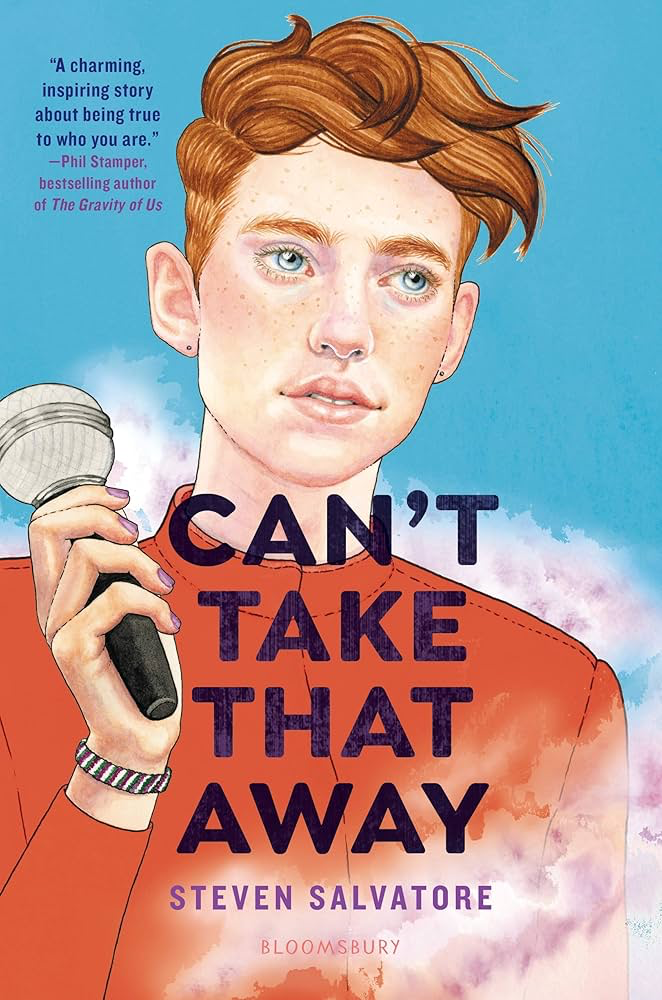
Can’t Take That Away – Steven Salvatore“Is there a difference between lying to you/If it feels just as bad as telling thе truth?/I know that there is/And I know what I’ll pick…”

“Here Come the Warm Jets” – Brian Eno

I’m about 6 months too late to make a “brat summer? Nah, Brian Eno summer” joke, but humor me, alright? We cling to what we can in these trying times. Let me have my shitty Brian Eno jokes. Brian Eno winter doesn’t have the same ring to it. (Now, Cocteau Twin-ter—okay, okay, fine, that one’s run its course, I know…)

Somehow, when compiling my list of my favorite album closers of all time, I forgot “Here Come the Warm Jets” entirely. At that point, it had been a solid year since I listened to Here Come the Warm Jets, and it had fallen off my radar. Only when I listened to Before and After Science: Ten Pictures did this track return to me. Obviously, the emotional impact of instrumental tracks can’t be understated, but it seems they’re often overlooked when they’re not film scores. Eno, to me, has a true gift of imbuing such clarity of emotion into his instrumentals (see: “The Big Ship”). Technically, “Here Come the Warm Jets” isn’t technically instrumental, but the vocals don’t come in at 2:33, and they’re so shrouded that they sound like vaguely nonsense chanting. (Eno has said that the lyrics are also meaningless and free-associative, as are many of the lyrics on the album.) Especially as a closing track, “Here Come the Warm Jets” is one of those songs that’s able to breathe life into its title without words. With the dense, buzzing hive of distortion, so thick you could stick your hand in it and feel the wings of millions of insects, it has the fuel and squeal of both tires screeching against the tarmac and the heat and urgency of a plane taking off.

Like “The Big Ship,” you can trace the slow, hopeful ascent of the song, a steady trajectory upwards as the music rises and fades into a cloud-streaked sky. And…okay, well, I know the dirtier interpretations of the whole “Here Come the Warm Jets” phrase, and the playing card on the album cover doesn’t help, but I’m choosing to believe that they’re jet planes, and I can feel the warmth of the rising, fiery hope propelling their engines skyward. Besides, Eno took the title from how he felt the guitar sounded—“like a tuned (warm) jet,” which he added into the track sheet. As with most anything he observes, it’s truly right on the money.

…AND A BOOK TO GO WITH IT:

Activation Degradation – Marina J. LostetterI can imagine the warm atmosphere of this song amongst the machinery of this novel, humming along with all of the engines and parts.

“Brean Down” – Beak>

Man, I admire committing to the bit, but how do you pronounce >>>>? Or >>>, where “Brean Down” is taken from, come to think of it? The only pronunciation I’ve seen is from BBC Radio, which, after some hesitation, called it “four chevrons.” I thought it was some sort of !!! (chk-chk-chk…don’t come for me, that’s all I know about them), but that doesn’t have the pretentious ring I thought it would have. Fascinating…you do you, Beak>. Can’t knock them, especially since one of their (now former, as of last year) members, Geoff Barrow, was from none other than PORTISHEAD back in the day…damn.

When my dad sent “Brean Down” to my brother and I, he described it as “if Radiohead and Shakey Graves had a baby,” and the more I listen to it, I can’t think of a more astute description. There’s a dread-inducing, dead-eyed drone aplenty, but with vocals from someone who’s practically a British Alejandro Rose-Garcia—it’s almost eerie how similar he and Billy Fuller sound. (The Britishness wasn’t even detectable…) Either way, it’s got a kind of creeping, cagey nausea to it that’s perfectly paired with the dusty brick walls and city streets of the music video, all while Fuller sings of alienation and empty absorption: “Tell me what I want and I feel like I do/Stuck in a cage and the people looking at you/Nobody’s perfect and even if you say so/We don’t like the music ’cause it ain’t up on the radio.” There’s your Radiohead for you…but really, Beak> excelled at making the song have the illusion of looseness, with the occasional pulse of the guitar and the drums, but still ultimate feel caged and immobile, as purposefully restrained as the artfully jerky moves of the music video’s danger, Vladislav Platonov. It’s not just the mechanical drone that haunts “Brean Down,” but the sensation as if something is slowly shadowing your figure—conformity, so it seems. Not a whole lot that induces dread as much as that.

…AND A BOOK TO GO WITH IT:

Junker Seven – Olive J. Kelley“Tell me what I want, and I feel like I do/Stuck in a cage and the people looking at you/Nobody’s perfect and even if you say so/We don’t like the music ’cause it ain’t up on the radio…”

“Switch Over” – Horsegirl

Only took me three singles to use the actual Phonetics On & On cover for one of these graphics…I do it for the color scheme. After months, it finally fit. Sorta.

With every single from Phonetics On & On that comes out, I’m continually blown away by just how much Horsegirl have grown and the incredible talent they’ve managed to accrue with experience and maturity. From the beginning, they’ve known how to throw together a tight groove, but “Switch Over” is one of their most striking ones yet. It shines in the way that only freshly polished wood does, creating a catchy, dynamic tapestry with lyrics that, when put together, only consists of about nine words total, repeated over and over. It’s not unusual for Horsegirl, but god, it’s sure been refined from greatness to something fantastic. In limbo between the ’70s (if that wasn’t evident from the Lou Reed poster at the beginning of the video), the ’90s, and something uniquely current. Even with the rhythm kept on such a tight leash, there’s an undeniably current of ease and whimsy running through it—I think it’s the lack of restraint. They’re throwing everything into making something deceptively simple and cooped up, but the passion that they throw into it makes the edges, rigid upon first glance, wiggle with every strike of Gigi Reece’s cymbals. (Also, gotta love how they just disappear into nothingness the minute they hit the cymbals. Peak comedy.) Maybe it’s too early to say so, but Phonetics On & On is shaping up to be one of the best albums of the year—“2468” and “Julie” were hits from the start, but “Switch Over” is proof that we can’t predict the breadth of talent that Cheng, Lowenstein, and Reece (and Le Bon) have up their sleeves.

Man, I’m glad to live in a world with Horsegirl in it. Their only sin so far is refusing to tour near where I live.

…AND A BOOK TO GO WITH IT:

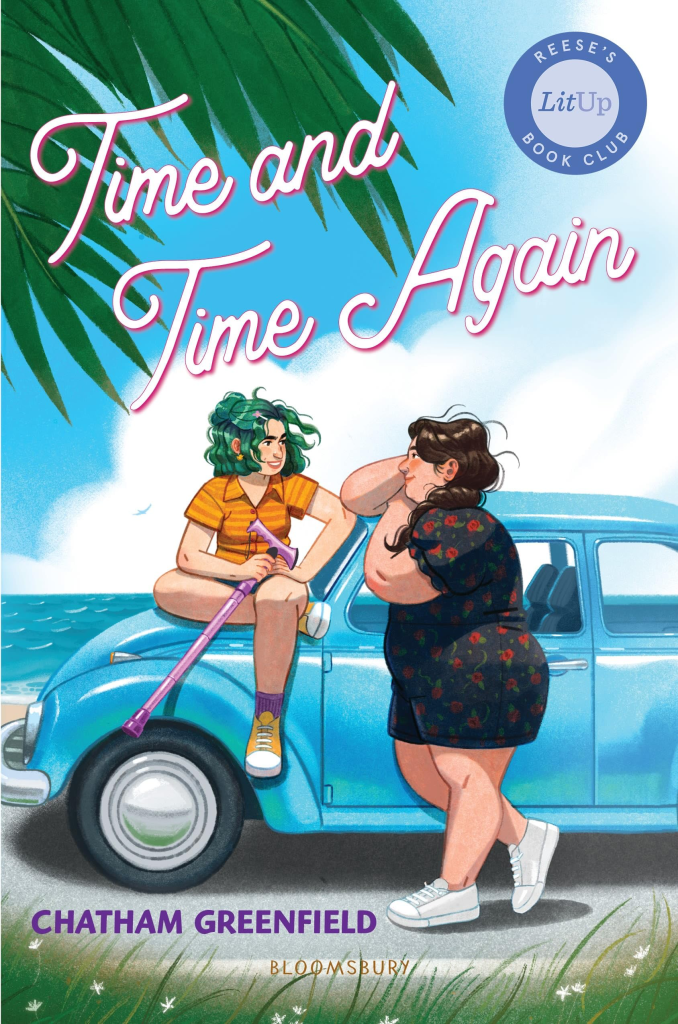
Time and Time Again – Chatham Greenfieldrapid switching and repetition, but this time, it’s repeating the same day over and over (yes, this is basically lesbian Groundhog Day).

“Doo Wop (That Thing)” – Lauryn Hill

Aside from the crushing constraints of the music industry, especially for someone as influential as Lauryn Hill was at her peak…yeah, if I wrote anything as good as this, I’d be perfectly content to get it out there and then disappear from the face of the earth. Well, sure. The tax evasion and the random controversies aren’t exactly ideal. But again—if you release one album and become this influential, I don’t blame her. “Doo Wop (That Thing)” is an extension of that—it’s almost mythic in its construction, written and produced solely by Hill. Sure, I’m late to the party—it took me a minute to warm up to hip-hop as a whole, really—but better late than never.

In fact, I can’t think of a better time to return to this song. If there’s anything that’s essential in these times, it’s “Doo Wop (That Thing).” (The line “Talking out your neck/Saying you’re a Christian” comes to mind for…multiple reasons, related and unrelated to the song’s message.) You need armor against misogyny, materialism, and being seen only for your body and sexuality—it goes both ways, as Hill astutely points out. Patriarchy harms everybody. “Doo Wop (That Thing)” isn’t so much an anthem as it is instructional, and not even instructional in the “and THAT’S why…” way. It’s less of lines on a chalkboard than it is the calloused hand of a mentor, a mother, on your shoulder telling you not just to not make her past mistakes, but to know your damn worth. It’s critical. Men have always thought that they’re immune to the consequences of their actions (and the systems we have in place have reaffirmed that), but I’ve seen Trump’s reelection embolden them even more. Jesus Christ…if I had a son, I’d never kick him out of the house for being queer (a bit redundant, since I’m queer myself, but stay with me), but I WOULD if I found out that he was commenting “your body, my choice” under women’s posts online. CHRIST. Moments like these do seem like nothing has changed since 1998, but maybe that’s why Hill’s rallying cries resonates now more than ever. I want it on banners all across the country, from now until it’s no longer relevant: “Respect is just the minimum.” It’s a call for men to reconsider (and ENTIRELY reconstruct) how they treat women and for those women to realize the potential they have within themselves, restrained by misogynistic structures and societal expectations. The end of the first verse really does send chills down my spine: “Let it sit inside your head like a million women.” Remember those who came before you. You have your power, and their power.

…AND A BOOK TO GO WITH IT:

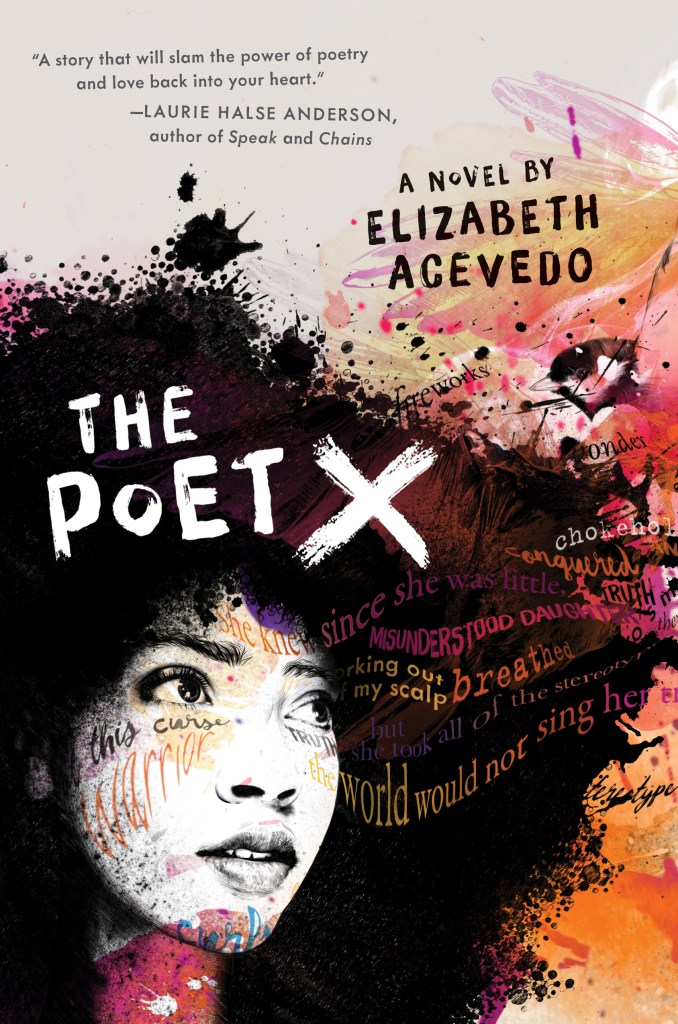
The Poet X – Elizabeth Acevedoa young girl reckons with being seen only for her body—and learning to use her voice.

Since this post consists entirely of songs, consider all of them to be today’s song.

That’s it for this week’s Sunday Songs! Have a wonderful rest of your day, and take care of yourselves!
Posted in Sunday Songs

Sunday Songs: 12/29/24

Happy Sunday, bibliophiles! I hope this week has treated you well.

This week: Patchwork songs, and a few too many lyrics that hit me like a train. It’s the final Sunday Songs of the year…I might as well ramble.

Enjoy the final Sunday Songs of 2024!

SUNDAY SONGS: 12/29/24

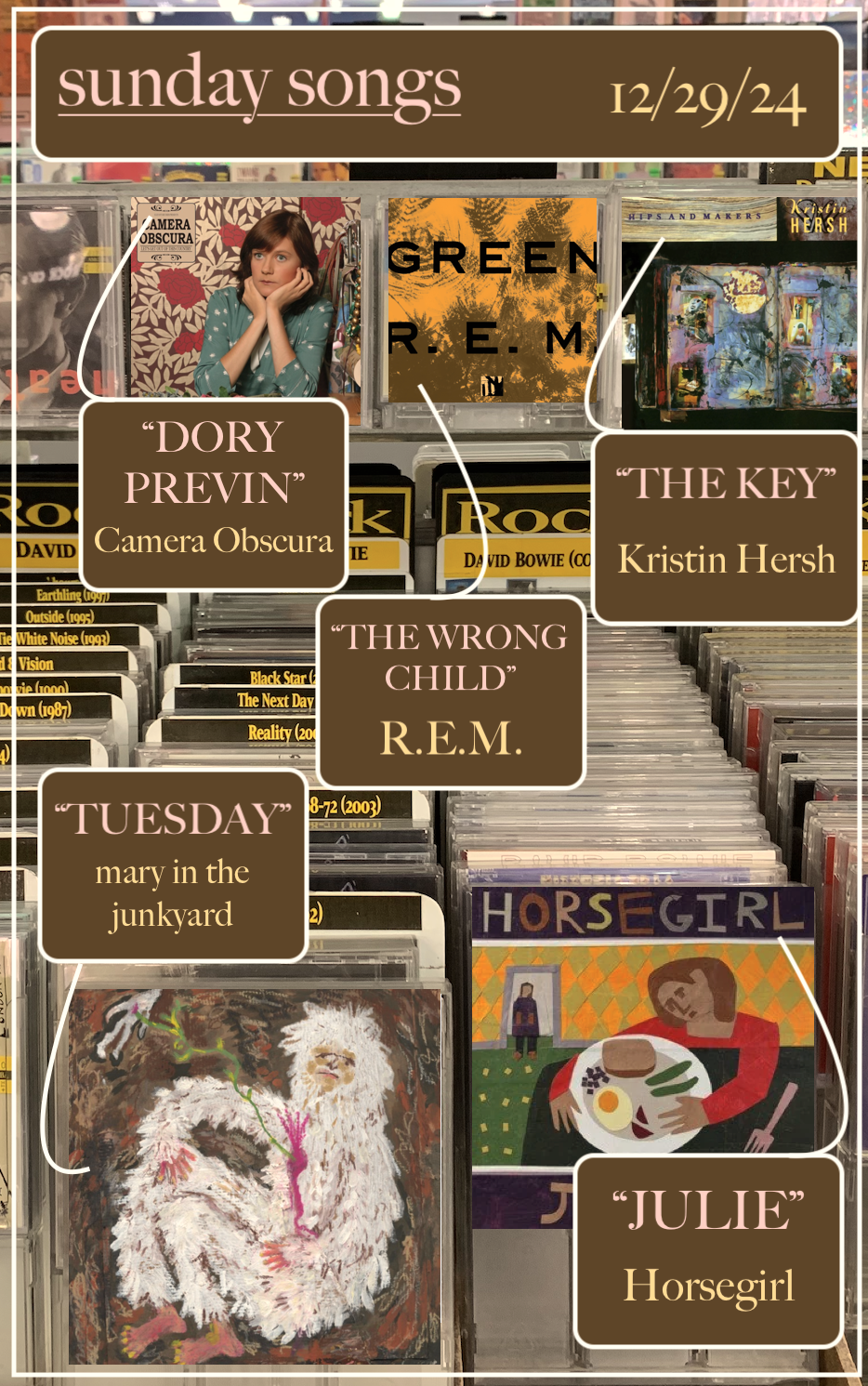
“Tuesday” – mary in the junkyard

“this is my california” was my introduction to mary in the junkyard, but “Tuesday” was what convinced me to like them. [slides glasses up bridge of nose] Having listened to their entire discography now (read: a four-song EP and three singles), I gather that, whenever it comes time for them to release an album, I’ll be happy with the product, but I really, really hope that “Tuesday” is more the direction that they go in.

“Tuesday” might as well be three songs Frankensteined together into a neat five minutes, but in its shambling, stitched-up form, it packs an unexpected punch. Imagine: three figures hunched over a cauldron. One adds something adjacent to your typical sadgirl indie, one adds the juiciest bass-line you’ve ever heard, and another adds a skittering tribute to Radiohead’s “2+2=5.” Pieces of the patchwork monster reveal themselves in the light in the form of Clari Freeman-Taylor’s lyrics—a favorite of mine is “I feel like an alien here/Breathing from a separate hole.” As…gross an image that potentially conjures (no, not that hole, GET YOUR MIND OUT OF THE GUTTER), it’s apt for the jerkily combined spare and found parts of this song. It’s an urgent sprint through a foreign landscape, furtive as it darts into alleys and backroads as it tries to find its way around. The disheveled yeti in the music video seems more whimsical than the lyrics imply, but it’s nonetheless a story of a creature out of its element.

Freeman-Taylor, when interviewed for The Line of Best Fit, explained that “Tuesday” was written about living in the city for the first time: “[I] was feeling very small…I wanted to write about my yearning for chaos and realness—we all have wildness within us that we might be suppressing and we shouldn’t feel like aliens because of it.” Wildness and chaos are what stands out to me—”Tuesday” scampers with the speed of a frantic prey animal, cornered as it finds a new burrow to dart into. Cities and nature have a very different kind of chaos to them—a city’s chaos feels bred by the bustle of machinery and productivity, and it becomes so compressed and rushed that order births chaos; nature’s chaos comes only from the cycle of itself. That clash of opposite breeds of chaos is where “Tuesday” finds its not-so-happy, alien(ated) medium, the space between the shards of flint where the embers crack away.

…AND A BOOK TO GO WITH IT:

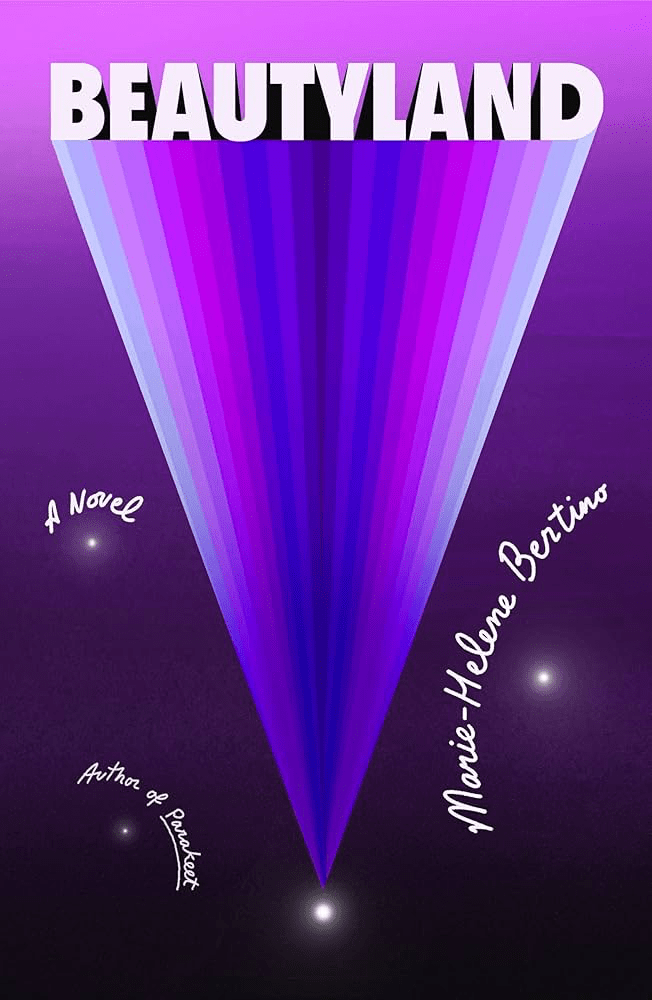
Beautyland – Marie-Helene Bertino – isolation, alienation, and surviving both from suburbs to big cities.

“Julie” – Horsegirl

First off: in concert with an excellent song, I have to praise this incredible music video by Daphna Awadish Golan! Her style melds so well with the collaged aesthetic of Horsegirl’s album covers and sound; the music video consists entirely of black and white footage of cities, animals, and people colored in with pastels that jump away from the grainy shades of gray.

As for “Julie” itself, the song makes me even more excited for Phonetics On & On just because I entirely can’t pinpoint the direction that Horsegirl are going in—and that excites me so much. Sure, albums have their more energetic points and their slower points, but this track is only one song away from “2468” and lands just past the halfway mark of the album. Their first album, Versions of Modern Performance, was fairly cohesive in its tempo and the invitations of different sounds and lyrical styles; aside from the instrumental interludes, there were never any slowdowns unless it was to watch a song crumble (“The Fall of Horsegirl”), but even that was crunched out and artsied-up to the extreme.

That’s not to say that “Julie” isn’t artsy, but it touches a more introspective side that the band have rarely reached thus far. The skeleton, aside from the slower tempo, is as Horsegirl as ever: guitar slides that dart around like frightened koi in a pond, buzzing synths, and a healthy dose of “da-da-da-da”s integrated throughout. (Is it really Horsegirl if there’s no da-da-da-da?) Yet the lyrics deviate from their usual style of sticking nonsense phrases together. Whether or not there’s a real Julie behind it, they extend reflection and comfort towards a figure: “Well, there’s something on your plate/You wish it was morе than you could take/We have so many mistakеs to make/What do you want from them?” It feels like an encouragement to break from monotony and form; the colored-over footage of subways in the music video emphasize that impression, but the mistakes to make feels to me like an encouragement to be human, to break free of a routine or lifestyle that isn’t necessarily crushing, but nonetheless doesn’t serve you either. With the way that the Horsegirl gang has with weird words, it doesn’t surprise me that they have something more emotional in them, but either way, it’s a promising glimpse of Phonetics On & On.

…AND A BOOK TO GO WITH IT:

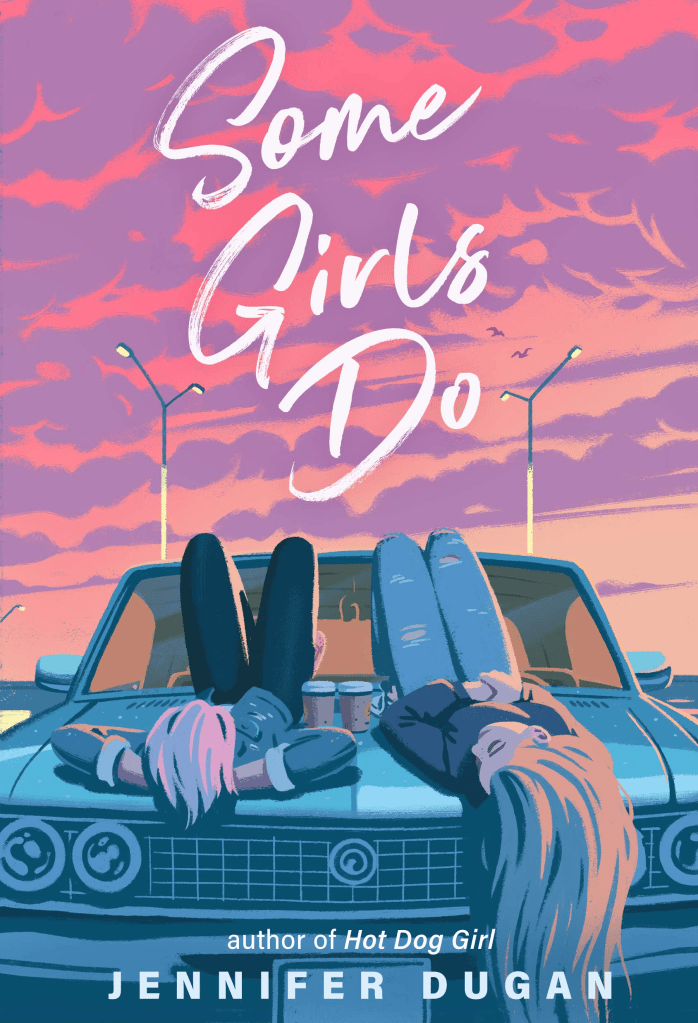
Some Girls Do – Jennifer Dugan“To have the same dream three times a week/Favors too big for you to keep/I have so many mistakes to make/Mistakes to make with you/You know I want them too…”

“Dory Previn” – Camera Obscura

The two-week gap between it doesn’t do it justice, but I’m reaping the benefits from Suki Waterhouse’s episode of “What’s In My Bag?” She’s got taste.

What is it with Scotland and cranking out soft-sounding indie pop bands in the late 90’s and early 2000’s? Does the weather necessitate that kind of tempo? No complaints of course, knowing that they produced this and Belle and Sebastian, who Camera Obscura were heavily influenced by. Even from all the way across the pond, “Dory Previn” has a nearly country twang, but it’s distinctly indie-pop, with its ever-stargazing, wistful delivery of Tracyanne Campbell’s lyrics or the muted instrumentals. The album title, Let’s Get Out of This Country, suggest more urgency, but “Dory Previn” implies that the sentiment is more out of quiet resignation; it’s a song at the crossroads, not ready to give up a lover, but at the same time “Sick of the sight of my old lover/Went under sheets and covers to get away from him.” Simultaneously wrapped up in the waning colors of the sunset and right smack in the emotional middle of 2 a.m., it feels like the exhausted yet determined position right after you’ve cried your eyes out; you’re embarrassed it took this long to decide, but you’re making a change—for Campbell, it’s the mantra-like repetition of “I think it’s time/I put him out of my mind.”

…AND A BOOK TO GO WITH IT:

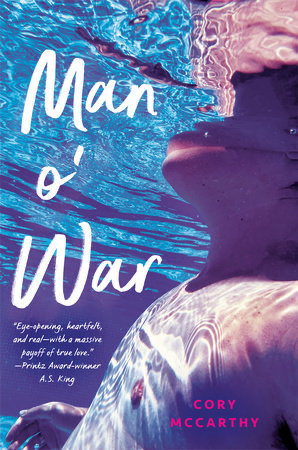
Man o’ War – Cory McCarthy“So I took a glimpse of Montana/Now nothing else matters/I’ll heal eventually…”

“The Wrong Child” – R.E.M.

Can we talk about Green? Genuinely, I think the only thing wrong with the album is that the album cover isn’t green. Probably a joke between the band members and the album artist, but the burnt shade of yellow on the cover does somehow fit how the album feels—sunny, but in a humid, Southern way. Sometimes it’s the eager yellow of energy and intent (“Get Up,” “Stand”), and other times it’s the fading yellow of a sunset over memories curling up and going sepia (“I Remember California”).

I’ve loved this album since late high school, but “The Wrong Child” was one that I was so used to skipping when it came on shuffle that it became lost. To be fair, the beginning is one of the less listener-friendly ones of the album, immediately opening with the out-of-sync clash of the mandolins and the key that Michael Stipe is singing in. (Can we talk about those mandolins? If anything else, Green will make you appreciate what a mandolin can do.) Once you stay with it—and I’m so glad I did on that fateful night in early December—it contains some of Stipe’s most evocative poetry on the whole album. The first verse should be in masterclasses about the ability of music to set a scene:

I’ve watched the children come and go/A late long march into spring/I sit and watch those children/Jump in the tall grass/Leap the sprinkler/Walk in the ground/Bicycle clothespin spokes/The sound the smell of swingset hands…”

The smell of swingset hands! It’s so specific, but I can smell exactly what Stipe is describing, the medley of the sweaty scent of skin with the tang of metal smeared all over it. There’s some gravel mixed in if I dig deep enough. I can feel the tickle of every blade of grass, each ray of sunlight. But more than that, I can feel the deep-seated aching of this song. Over the years, there have been a variety of interpretations of the song, everything from a burn victim reintegrating into society to a young gay boy’s experience of homophobia. In 2008, Stipe admitted that he’s “fine with any and all interpretations that aren’t manifested in real life as harmful, hateful or violent,” but that it was loosely centered around “a kid who is physically handicapped, and left it purposely undefined.” It is distinctly othered song. I can’t relate to the severity of what the subject experiences, but even some of it rings true for me; I did feel isolated from my peers for quite some time, in part due to my SPD, among the varied things that made me different. There was never that outright bullying, but I could see it all in the periphery, the kids that laughed behind their hands whenever I had what they saw as an overreaction to an unexpected sound—some of that “Hey those kids are looking at me/I told my friend myself/Those kids are looking at me” certainly put a bit of a knife in my gut. But this subject has become so removed from society for whatever reason that they yearn for the outside world, even if its occupants do nothing but torment them. They attempt to self-soothe, but in the end, they try to mold themself to the outside world instead of the other way around, repeating the chorus like a mantra: “I’m not supposed to be like this/But it’s okay.” And god, Stipe’s delivery of “it’s okay,” the bleeding rawness of it…oh, god. Yeah. It gets me every time. It delivers that sense that the subject is trying so hard to justify their existence and their right to play with the other kids that they’ve convinced themself that they are inherently wrong. They try and try, but never reach the happiness the other kids have, and the only way they know to try to reach it is to convince themself that they’re the problem, not the prejudice and taunting of the others. That is what any kind of prejudice does to you: it convinces you that, even if you were born in the same way as humans have been reproducing for millions of years, that you’re wrong, and not the fabricated idea of rightness taught from a young age. In the end, I’m glad that Stipe kept the subject undefined, because it does provide a kind of sanctuary, a reassurance that none of us are alone in this experience, whichever lyric rings true.

…AND A BOOK TO GO WITH IT:

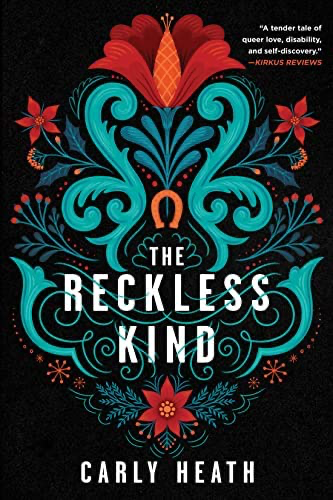
The Reckless Kind – Carly Heath“Hey those kids are looking at me/I told my friend myself/Those kids are looking at me/They’re laughing and they’re running over here/They’re laughing and they’re running over here/What do I do?”

“The Key” – Kristin Hersh

“You don’t inspire a metric ton of trust/’Cause I’m on fire, and so is all my stuff.”

There. I could just leave it at that, and it would explain the whimsical cleverness of this song, kind of like “Little Bird,” which I talked about back in July. Once again, that wouldn’t work, simply because there are just too many good lyrics here. Leave some for the rest of us, Kristin! God. So selfish. Can’t we get some of whatever creativity inspired “If I lived in a pumpkin shell/I’d have the key/And if I had a daughter/She’d look a lot like me?”

I may use the word “whimsy” quite liberally, but there’s a kind of ethereal whimsy to “The Key” that I can only describe in images. This song was a frequent visitor in my dad’s car when I was young; I associate it the most with nights spent on the car ride back from dinner or road trips. As the sky darkened, so did the images in my mind—not in emotion, just in the amount of light that was let in. Kristin Hersh felt candlelit, the kind of music meant to soundtrack a child’s nursery in the early hours of night. The lyrics nearly call to mind Lewis Carroll—save for the absence of made-up words, I wouldn’t bat an eye if you attributed “Copper and snow/Make a dusky blue boy” to one of his poems, if he’d condensed them more. Less British, of course. (Maybe that’s for the best.) We’re not getting too “Walrus and the Carpenter” with it, but we sure are close. “The Key” is inherently soft; in that children’s bedroom, dated maybe 100 years ago, with flowery, peeling wallpaper and lacy curtains, I can see a pink, plush blanket over a bed tucked in the corner, yellowed by a lantern on the dresser. Hersh’s fingerpicking has a comforting repetition to it, chords blending into each other as gently as freshly-washed hair splays out across a pillow. In between all of these images, there’s a ballerina in a music box that squeaks as it spins in a circle. Sometimes it’s the one I had as a kid, sometimes there are subtle tweaks—longer hair, different painted eyes. Like that music box, the repetition is soothing in a way that few songs are—the song’s outro of “and we’d dance all night” is a promise, and one filled with golden-lit joy to come. As Hersh’s guitar fades out, I see that mother and daughter, dancing in circles. I didn’t quite get it when I was younger, but that repetition, that security, swaddled me up like a blanket.

…AND A BOOK TO GO WITH IT:

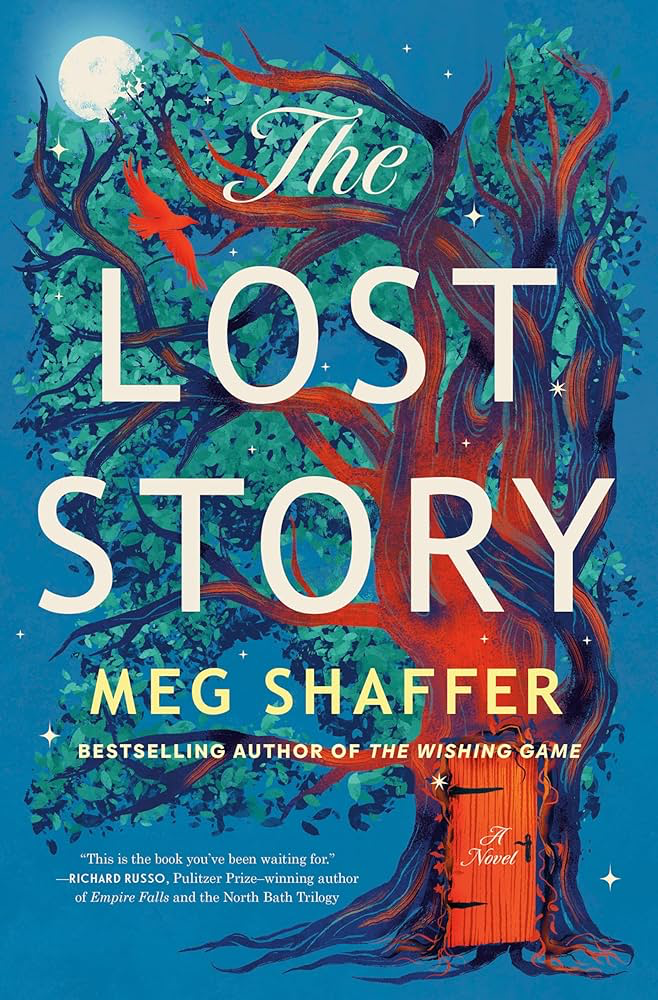
The Lost Story – Meg Shaffer“If I lived in a pumpkin shell/I’d have the key/And if I had a daughter/She’d look a lot like me…”

Since this post consists entirely of songs, consider all of them to be today’s song.

That’s it for the last Sunday Songs of 2024! Have a wonderful rest of your day, and take care of yourselves!
Posted in Sunday Songs

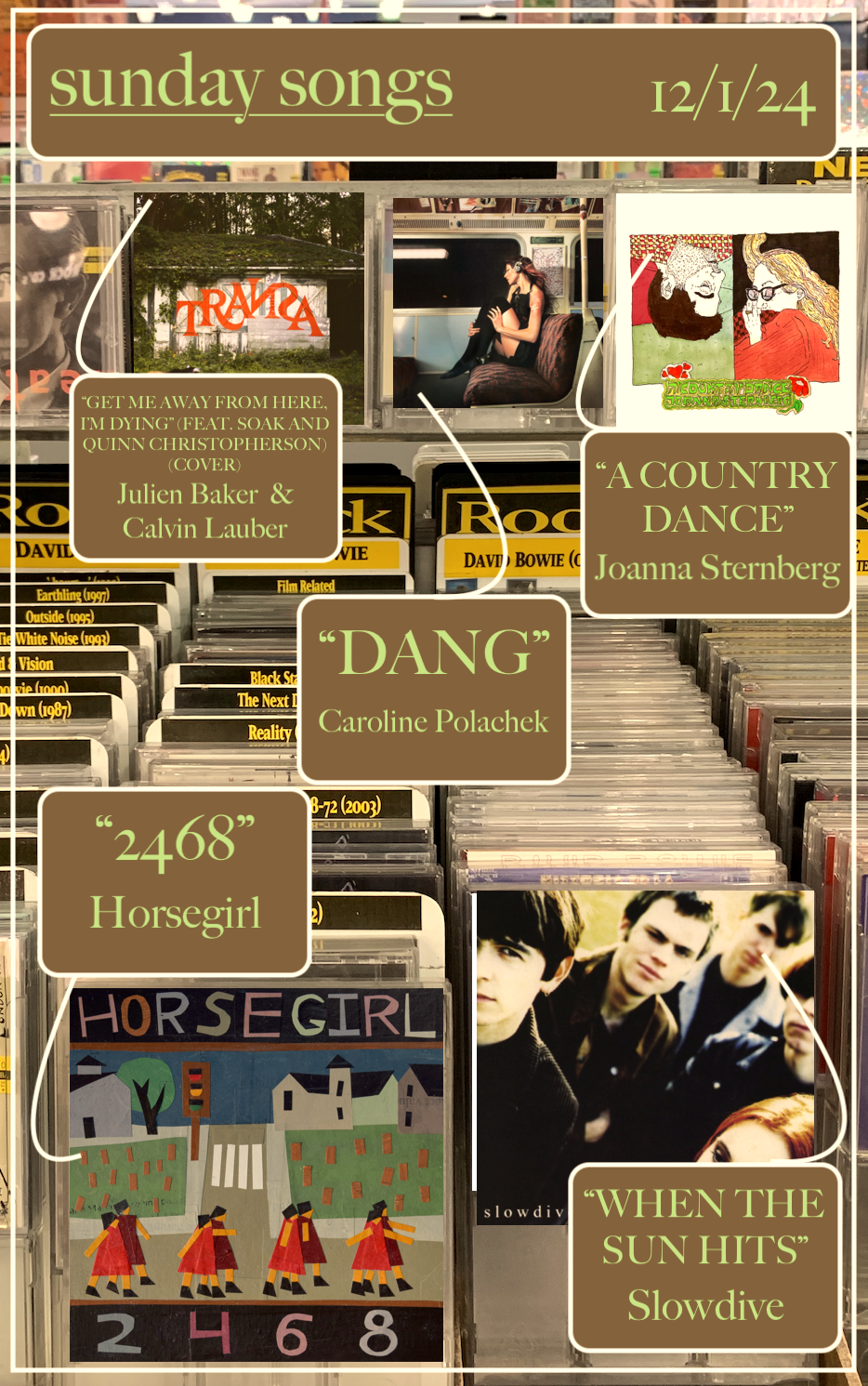
Sunday Songs: 12/1/24

Happy Sunday, bibliophiles! I hope this week has treated you well.

This week: apologies for the whiplash lineup, but if your shuffle hasn’t whooped you with Julien Baker and Caroline Polachek back to back, have you even lived?

Enjoy this week’s songs!

SUNDAY SONGS: 12/1/24

“2468” – Horsegirl

2024 was such a powerhouse year of fantastic albums that I’ve found myself wondering how 2025 could possibly measure up. Of course, the future’s unwritten, to quote Phoebe Bridgers, but if the upcoming solo Tunde Adebimpe album and this are anything to go by, it’s gonna be another fantastic year of music. Or at least a fantastic February, now that we have new Horsegirl on the horizon! Their second album, Phonetics On & On (if there was ever a more Horsegirl album title) comes out on Valentine’s Day next year, so I’m officially spoken for, thank you very much. It’s produced by none other than Cate Le Bon (!!!), and no matter how utterly pretentious I sound for getting excited about Horsegirl being produced by Cate Le Bon, oh my gooooooood (nobody got that), I remain excited after finally listening to some of Le Bon’s weirder solo albums and knowing the magic she worked with Wilco on Cousin back in 2023.

Horsegirl have always been an artsy bunch, taking inspiration from everyone from Brian Eno to Built to Spill, but “2468” reminds me of their picks from their episode of What’s In My Bag?—specifically their last one, The Feelies’ Crazy Rhythms. Penelope Lowenstein described a moment on that episode where she was supposed to be doing homework in Spanish class and was listening to The Feelies instead and felt like “the coolest person in the world.” I’ve always respected The Feelies, but they just make me anxious. Props to them for having their music so sanded down that there’s no wrinkles whatsoever, but it feels like the point after you’ve enjoyed your coffee and the caffeine jitters start to set in, but you have to stay put in your seat. They feel itchy, weirdly. Like something’s trapped in the music and is clawing to get out, but The Feelies just won’t let it. Good for them, man, but the nervous energy transfers very easily. “2468” is proof that Horsegirl’s uptight needle is quivering in the direction of The Feelies, but for all of their toy-solider precision, I don’t think they could ever be that itchily nervous. All of the lyrics are spoken deadpan, in some sort of no-man’s-land between nursery rhymes and marching orders, complete with a little “da-da-da-da-da-da-da-da” in case it gets too strict. With the band decked out in their best Wes Anderson fits, they shuffle and paddy-cake around as their well-oiled machine skips along. They may be taking after their uptight forefathers, but they’ve left themselves plenty of leeway to jump around—and those artsy leaps are what make me the most excited for what the future holds for Horsegirl.

…AND A BOOK TO GO WITH IT:

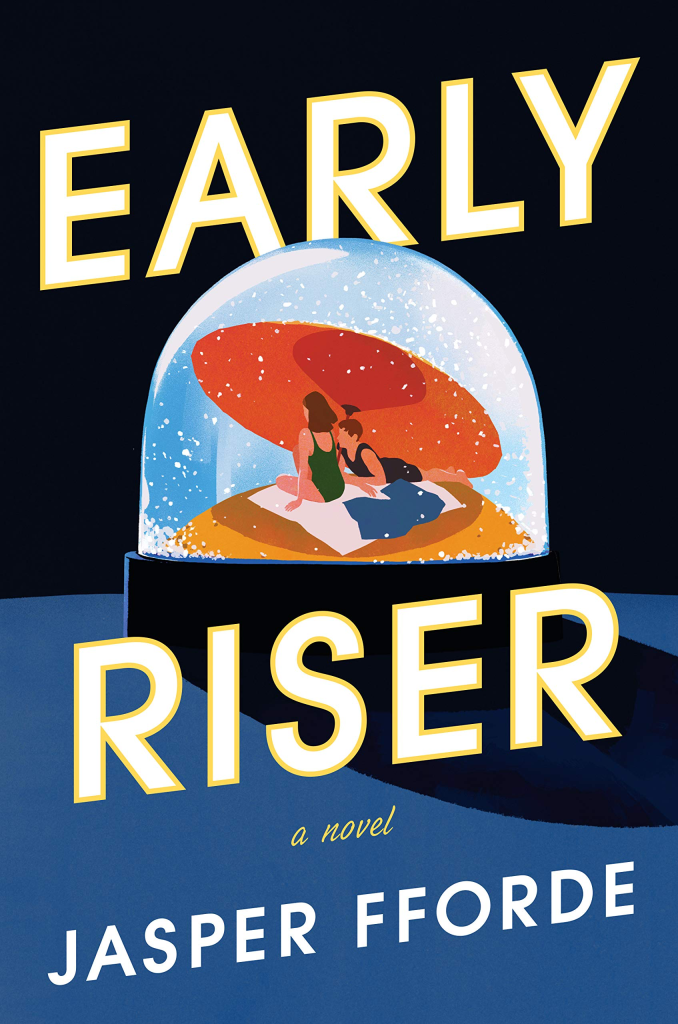
Early Riser – Jasper Ffordedelightfully odd in both concept and writing.

“When the Sun Hits” – Slowdive

Dread it…run from it…shoegaze always arrives on this blog.

I guess I was too mired in Spiritualized (and a sprinkling of Beach House) to get into Slowdive sooner, but it was always at the back of my mind, even when I’d never listened to it yet. I’d seen them floating around in the same musical circles that I listened to, not to mention my awesome honors English teacher from high school wearing a Slowdive shirt out of nowhere for band shirt day during spirit week. (My high school’s English department happened to be very shoegazey. I bumped into that same teacher at a Spiritualized concert in my senior year.) I should’ve hitched a ride on the bandwagon after Soccer Mommy covered “Dagger” last year, but here we are. Look, I know “When The Sun Hits” is their most popular song, and I’m a poser, yada yada yada, but LORD, this is beautiful.

For me, what separates shoegaze is its ability to create an atmosphere. J. Spaceman is the undisputed king (in my mind) in that regard, with his ability to create cosmically lived-in music that sounds all at once intimately personal and wide enough to swallow the world whole. “When The Sun Hits” stirs up that same feeling; the production is nothing short of cavernous, capturing the dappled reflections of water on the walls of a cave and the stringy sunlight shyly peering in. Both the vocals of Neil Halstead and Rachel Goswell take a blinding backseat to the mounting ocean of sound that reduces all else to a wavering echo. Slowdive were one of many alternative bands inspired by David Bowie’s Berlin trilogy, citing Low and Lodger as key influences, but funnily enough, I discovered this song through this inspired mashup of this track and David Bowie’s “Heroes.” I’d be surprised if that missing album didn’t creep in there, given how seamlessly the chorus of “When The Sun Hits” glides into Bowie’s opening chords. Having the first line of the pre-chorus be “It matters where you are” is a choice that defines the song’s experience: when you’re in the midst of experiencing it for the first time, all else seems to fall away. You can’t help but be pulled into the undertow, to be in the present, just to experience this song. That’s shoegaze.

…AND A BOOK TO GO WITH IT:

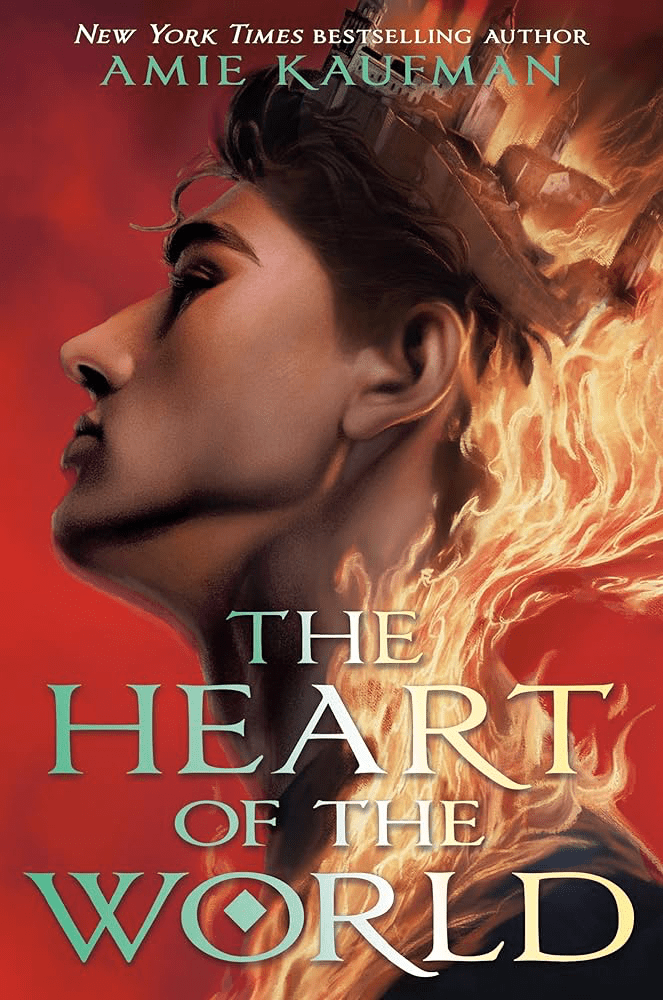
The Heart of the World (The Isles of the Gods, #2) – Amie Kaufman“Sweet thing, I watch you/Burn so fast, it scares me/Mind games, don’t leave me/Come so far, don’t lose me…”

“Get Me Away From Here, I’m Dying” (feat. SOAK and Quinn Christopherson) [Belle and Sebastian cover] – Julien Baker & Calvin Lauber

If you’re able, consider supporting this album, TRANSA, a compilation album featuring over 100 artists organized by the Red Hot Organization to bring awareness to trans rights! The album features Jeff Tweedy, Adrianne Lenker, Bill Callahan, André 3000, Perfume Genius, and so many more amongst its ranks, with both original songs and covers ranging from Kate Bush to SOPHIE.

Predictably, I first heard of TRANSA through Julien Baker, who covered Belle & Sebastian’s “Get Me Away From Here, I’m Dying” with SOAK, Quinn Christopherson, and Calvin Lauber. Lauber, who also produced many of Julien Baker’s newer material as well as boygenius’ “Black Hole,” turns Belle & Sebastian’s melancholy, jangly yearning into an urgent spectacle, a sprint through the woods to a brighter future for all four minutes and 13 seconds. If there’s anything that Baker can always deliver on, it’s urgency—the urgency of trauma, the urgency of love. With the context of both Baker’s queer identity and the album’s overarching theme of the trans experience, “Get Me Away From Here, I’m Dying” takes on a whole new light; “Oh, I’ll settle down with some old story/About a boy who’s just like me/Thought there was love in everything and everyone/You’re so naive” becomes the loss of innocence in the face of homophobia and transphobia and finding solace in fiction, and “Here on my own now after hours/Here on my own now on a bus/Think of it this way/You could either be successful or be us” feels like a vignette of someone on the run after being kicked out of their home. Even the title becomes a rallying cry of wishing to break free of the confines of prejudice that so many queer people know like the back of their hands. SOAK and Quinn Christopherson, both trans artists, trade verses and backing vocals with Baker, creating a harmony of solidarity that gives Belle & Sebastian’s original words an even more emotional meaning.

…AND A BOOK TO GO WITH IT:

I Wish You All the Best – Mason Deaverheartbreak, new love, and a desire for a new life.

“Dang” – Caroline Polachek

Even with specific music categories being an illusion kept afloat by critics, I feel like what I’ve heard of Caroline Polachek aligns with my hazy definition of indie pop. It’s theoretically everything that should be popular, but like alternative or mainstream rock, it’s the label or the sensibilities that separates it. In the case of Caroline Polachek, she’s definitely too out there for the Top 40, but make no mistake: in the words of XTC, this is pop (yeah yeah, this is pop, yeah yeah, etc). The pop part is what prevents me from entirely getting into her music; as impressive as her vocal range is, it’s often too polished for me, and sometimes the isolated instrumentals feel like they could belong in a commercial. Not always my cup of tea.

But. But. I can’t not admire how weird she gets with it. I’m not seeing any other pop star willingly turn themselves into a chimera in their music videos, after all. And Polachek has more than a few excellent belts and screams in her. (Plus, she has my immediate respect for, after being called “this generation’s Kate Bush,” responding by saying that “SHE [Kate Bush] is this generation’s Kate Bush. Damn right.) “Dang” gets recommended to me in droves around every 6 months, and I can’t not be compelled by it. When I call it corporate, I mean it as a compliment—it feels like a strange distillation of disinterest and sanitized, company-wide messages saying something on the lines of “we’re all a family.” The intro of garbled vocals, followed by Polachek’s bored delivery of “Dang” feels like the pleas of low-level workers drowned out by an uncaring boss waving them off. “Aww, you don’t have enough to provide for your family? Dang. Get that spreadsheet on my desk by noon.” No wonder Polachek, in this live performance on The Late Show, is presenting an unconventional powerpoint, including but not limited to diagrams about “how many wolves are inside you” and a notes-app apology consisting of a paraphrased version of William Carlos Williams’ “This Is Just to Say.” (I’m wondering about the significance of replacing plums with grapes…maybe it’s not that deep?) Her music as a whole remains a bit too pop-polished for me, but I have nothing but respect for her unconventional spin on it—and her vocal range. The shriek beginning at 1:51? Autotune or not, either way, it’s enough to convince me that this is unedited:

good for you, Caroline…put those geese in their place

…AND A BOOK TO GO WITH IT:

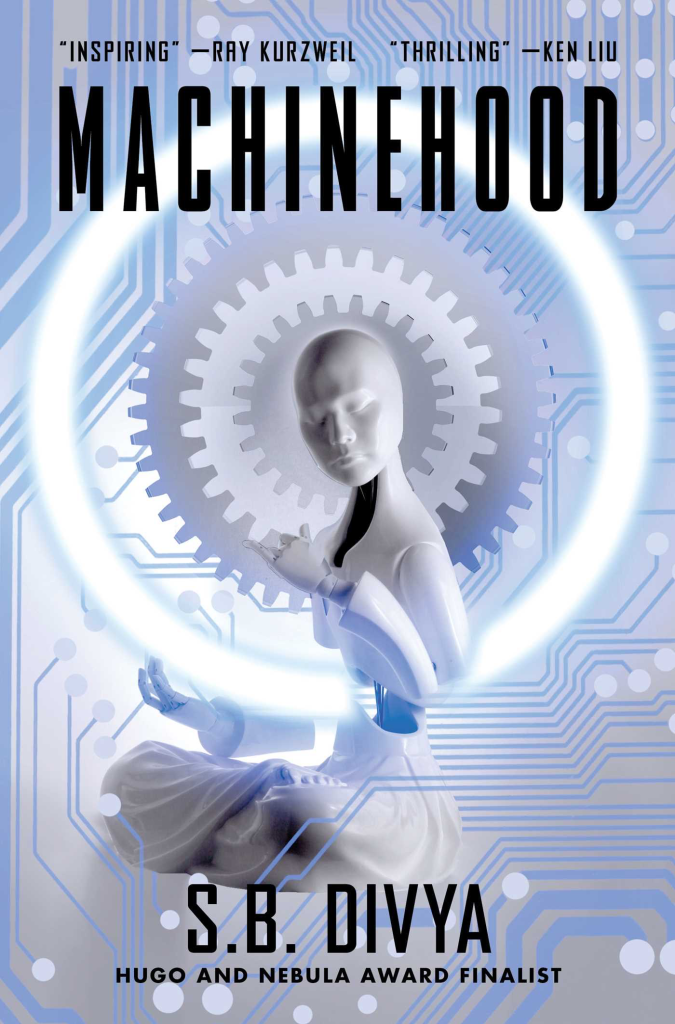
Machinehood – S.B. Divyacorporate disinterest and neglect, with a dose of S.B. Divya’s signature weirdness (and a Christopher Nolan-style thriller).

“A Country Dance” – Joanna Sternberg

I write this as a light snow is falling outside my window, and even though this song was released in August (as was the film it was written for, Between the Temples), it’s so distinctly placed in that period between autumn and winter for me, as far as the sound. “A Country Dance” has a gentle, intimate warmth to it that could only come from the embers of a fireplace in late November or mid-December. It lands on the opposite spectrum of The Shins’ “Black Wave,” which I spoke about around a year ago; seasonally, it’s at the same time, but “Black Wave” feels more like huddling around a fire, exposed to the elements. “A Country Dance” is comfortably cozy, without any notion of the snow biting at your cheeks. For me, good folk music gives you the feeling that you’ve just eaten a stomach-warming, rich holiday dinner—maybe some kind of stew or soup—and that warmth stays in your bones long after you’ve digested it.

I fully thought that “A Country Dance” was a cover—it sounds like it could’ve come out of the ’60s or ’70s, but this is a Sternberg original, and that timelessness is hard to capture—it feels very ’60s and Adrianne Lenker at the same time. (Their music teacher voice certainly contributes to that effect as well.) As the leaves fall off of the trees, this track feels like the perfect antidote to the coming chill—warm, tucked inside of a log cabin, half-asleep and wrapped in woolen blankets. Not every Joanna Sternberg song captures me, but “A Country Dance” honestly makes me feel like the Celestial Seasonings Sleepytime Bear, and that’s not something I’d say about just any song.

…AND A BOOK TO GO WITH IT:

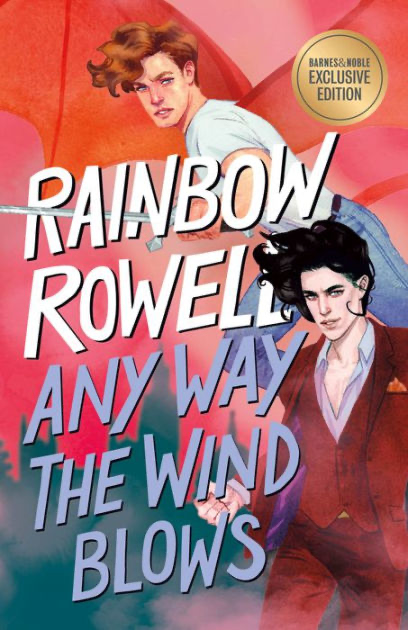
Any Way the Wind Blows (Simon Snow, #3) – Rainbow RowellEven if it is tumultuous in places, the quiet Christmas scenes here invoke this song.

Since this post consists entirely of songs, consider all of them to be today’s song.

That’s it for this week’s Book Review Tuesday! Have a wonderful rest of your day, and take care of yourselves!